




Abstract
Significance:
Wound dressings are frequently used for wound covering and healing. Ideal wound dressings should provide a moist environment for wounds and actively promote wound healing and skin recovery. The materials used as ideal wound dressings should possess specific properties, thus accelerating skin tissue regeneration process.
Recent Advances:
Bacterial cellulose (BC) is a natural polymer synthesized by some bacteria. As a kind of natural biopolymer, BC shows good biological activity, biodegradability, and biological adaptability. It has many unique physical, chemical, and biological properties, such as ultrafine nanofiber network, high crystallinity, high water absorption and retention capacity, and high tensile strength and elastic modulus. These excellent properties of BC have laid the foundation for its application as dressing in wound healing.
Critical Issues:
To optimize the biocompatibility and antimicrobial activity of BC, different methods including microbial fermentation, physical modification, chemical modification, and compound modification have been adopted to modify BC to ensure a better application in wound healing. BC-based wound dressings have been applied in infected wounds, acute traumatic injuries, burns, and diabetic wounds, showing remarkable therapeutic effects on promoting wound healing. Furthermore, there have been some commercial BC-based dressings and they have been utilized in clinical practice.
Future Directions:
Because of its excellent physicochemical characteristics and biological properties, BC shows high clinical value to be used as a wound dressing for skin tissue regeneration.


Scope and Significance
Bacterial cellulose (BC) has developed nano-network pores, which are favorable for the absorption of wound exudates. 1 It has decent biocompatibility and is easy to store and handle. 1 Moreover, it can provide a suitable temperature for the wound surface, which is crucial for rapid wound healing. 1 This article reviews the various methods of functional modification of BC to enhance its applications in wound healing, mainly by improving its biocompatibility and endowing it with antibacterial activity. Moreover, the investigations on the applications of BC-based materials in dealing with different kinds of wounds are summarized.
Translational Relevance
Traditional wound dressings were used to keep wounds dry. Exudate absorption and contamination prevention were considered as essential properties for ideal dressings. 2 The expectations on wound dressings have changed in recent years. A perfect dressing should not only be a passive supplement, but also can actively promote the skin regeneration process. It is designed to inhibit bacterial invasion and provide a proper environment that can accelerate wound healing. 3,4 Translational research involving in vitro and in vivo experiments have proved that BC meets the requirements of wound dressing and has the potential to be applied within clinical settings.
Clinical Relevance
There have been some commercial BC-based dressings, namely Biofill®, Gengiflex®, Xcell®, Bioprocess®, Dermafill®, and Epiprotect®. BC-based dressings have been used in clinical trials, and the outcomes indicated that the BC membrane could significantly reduce pain and promote the healing of different wounds. 1,5
Background
Wound dressings are one of the oldest products used for wound covering and healing. The traditional gauze-based dressings are easy to be manufactured and used, which can stop the bleeding of wound surfaces. However, the hemostatic effect of traditional dressings is not satisfactory, and they do not show a moisturizing effect. 6 Granulation tissue tends to grow into the material, resulting in adhesion to the materials and scabbing. 7 Besides, most of the traditional dressings are not waterproof, and exogenous infections frequently occur when the dressings are soaked with water. 7 Moreover, these dressings only serve as passive supplements, and they could not positively promote wound healing.
With the development of materials science, a variety of synthetic dressings using polymers as raw materials are currently highlighted for treating wounds. They have been applied in different types, including membranes, foams, hydrogels, and hydrocolloids. 3 An ideal wound dressing should meet the following requirements: (i) it should protect the wound from dust particles and microorganisms in the external environment. (ii) It does not attach to the wound surface. Then the wound will not be damaged again at dressing replacement. (iii) It can provide a moist environment and actively promote wound healing. (iv) It should be biocompatible without inducing rejection and inflammation. (v) It should be easily produced, stored, and disinfected. 8
BC is considered as a kind of natural wound repair material that meets the requirements of a modern wound dressing because of its excellent physicochemical characteristics and biological properties (Fig. 1). 1,2,9 The three-dimensional (3D) network structure of BC can effectively prevent microbial invasion, avoid wound infection, and ensure the normal gas and liquid exchange during wound treatment. 1,2 In addition, because of the 3D network structure, BC can be used as a carrier for slow release of drugs, so as to effectively promote wound healing and accelerate skin tissue regeneration. 2,9,10
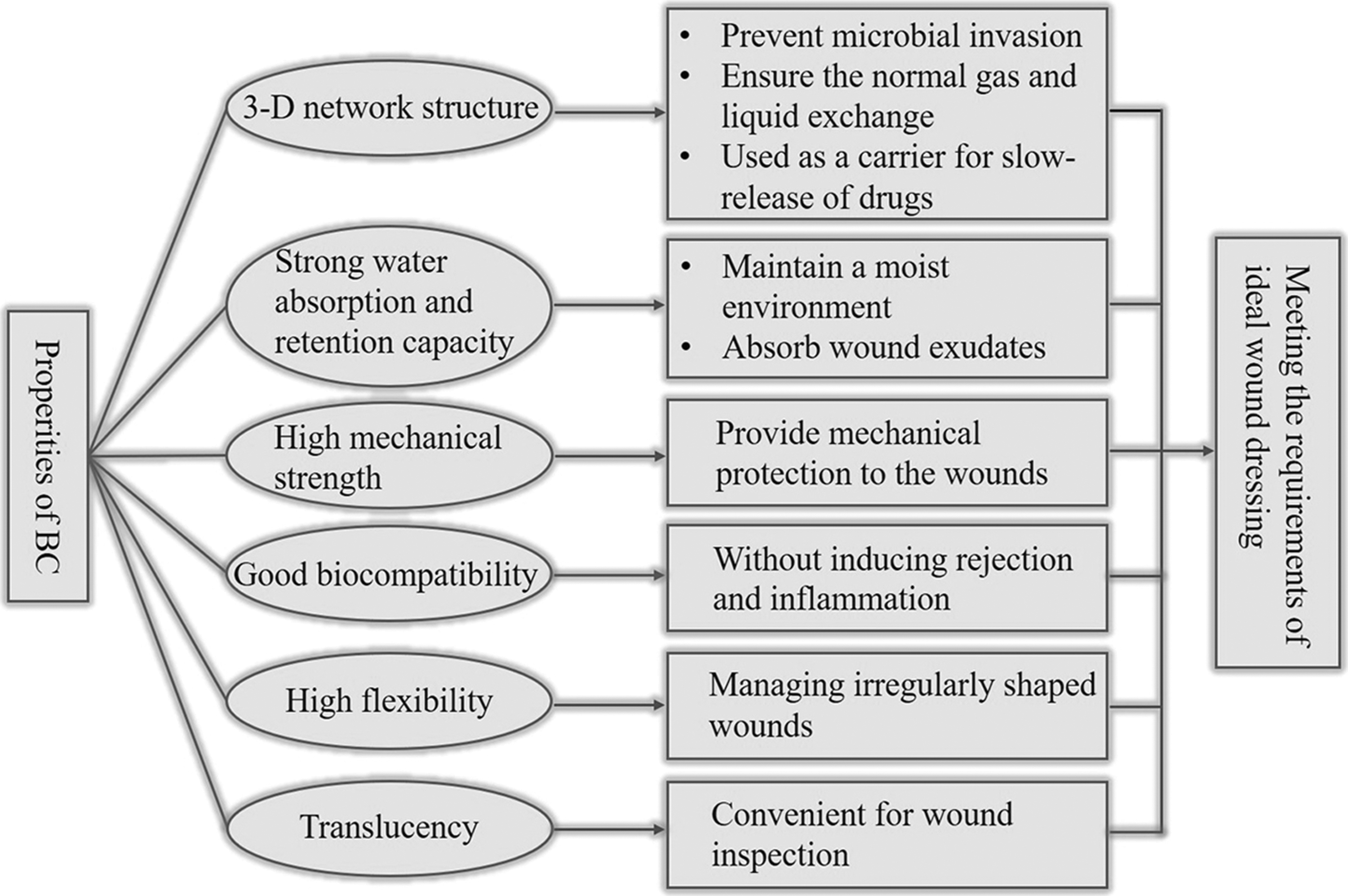
Properties of BC concerning the requirements for ideal wound dressing. BC, bacterial cellulose.
It has a strong water absorption and retention capacity, allowing absorption of wound exudates. 1,2 The material has high mechanical strength in wet state, which can provide mechanical protection to the wounds. The high flexibility of BC ensures that it can be used as a dressing for managing irregularly shaped wounds. 10,11 BC shows excellent biocompatibility to skin. 1,2,9,10 Moreover, BC membrane is translucent, making it convenient for wound inspection. 5
Discussion
Basic properties of BC
The morphology and basic molecular structure of BC are given in Fig. 2. It is a nonbranched macromolecular straight-chain polymer, known as β-1, 4-glucose, which is connected by hydrogen bonds. 12 The BC molecules are rich in hydroxyl and glycoside bonds. Hydroxyl is a hydrophilic group, so BC has strong water absorption and holding capacity. 13 The high porosity and surface area of BC also contribute to the strong water absorption and holding capacity. 14 The weight of water absorbed in BC is 60–700 times its dry weight. The water retention rate of BC is higher than 1:50, and it can be as high as 1:700 after some special treatments. 15
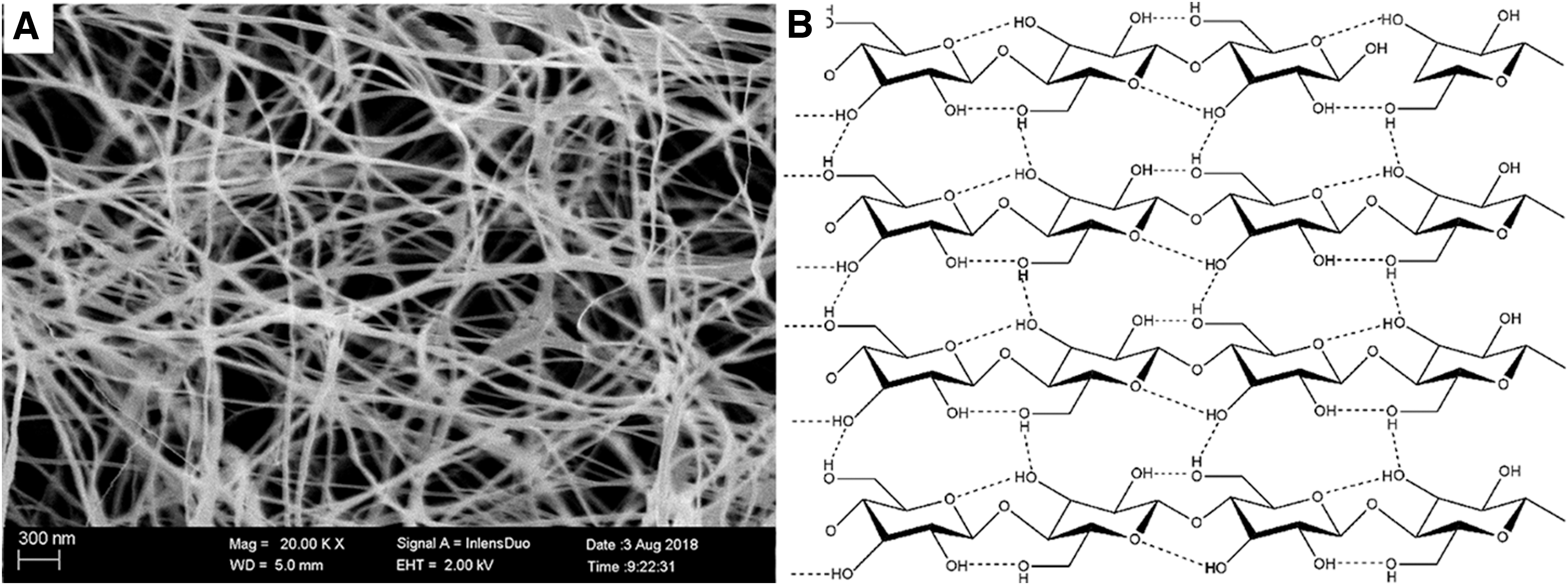
Besides, the large amounts of hydroxyl groups present in BC facilitate the easy formation of strong intramolecular and intermolecular hydrogen bonds, which have a significant impact on elastic modulus and tensile strength of BC. 11
The structure of BC contains two parts, namely the crystalline region and amorphous region. 16 As the percentage of the crystalline region increased, the tensile strength, Young's modulus, hardness, specific gravity, and volume stability of fiber increased. At the same time, elongation, hygroscopicity, swelling, softness, and chemical reactivity decreased. 17 The crystallinity of BC is higher than that of common higher plant fiber, which may be caused by the network structure of BC. 17 The degree of polymerization is a representation of the number of monomers in polymer macromolecules. The degree of polymerization of BC is 2,000–6,000. 10
The Young's modulus of BC in sheet form was reported to be >15 GPa, 18 whereas Young's modulus of ordinary planar-oriented or nonoriented organic polymer is generally <5 GPa. 18 Tajima et al. 19 found that Young's modulus of BC sheet was between 30 and 40 GPa. Guhados et al. 20 directly measured BC fibrils and reported a Young's modulus of 78 ± 17 GPa. It was considered that such high Young's modulus is caused by the high crystallinity of BC superfine filaments and the strong hydrogen bonds between the fibers. 20
Functional modification of BC
BC is produced by certain bacteria strains, including Achromobacter, Aerobacter, Achromobacter, Agrobacterium, Alcaligenes, Azotobacter, Salmonella, Gluconacetobacter, and Rhizobium. 21 Among them, the Gram-negative Gluconacetobacter xylinum has been the primary genus used to produce BC in most studies because the production of BC by this genus is far more significant in both quantity and quality than that by some other strains. BC produced by G. xylinum is with extremely high purity, and its microfiber structure is quite similar to that of algal and plant cellulose. 22
A variety of methods have been adopted to improve the physical, chemical, and biological properties of BC to further extend its application within the field of wound healing. They were divided into four categories as follows: (i) modification through microbial fermentation, (ii) physical modification, (iii) chemical modification, and (iv) compound modification.
Modification through microbial fermentation
In the process of bacterial culture, BC with desired properties could be obtained by controlling the culture conditions or adding additional materials to the culture medium or changing the carbon sources. 23 Different factors, such as culture conditions, carbon sources, and models can regulate the structure, size, and composition of BC fibers, resulting in BC with different properties. 2 Moreover, in the process of bacterial culture, fermentation medium plays a crucial role in the production of BC. 5 By adding additional molecules or units to the medium, they can enter the microbial metabolic pathway in the form of carbon source, thus effectively regulating the physical and chemical properties of produced BC. 24
Many researchers have made beneficial explorations on the biological modification of BC. Winter et al. 25 investigated the effects of polysaccharides contained in the medium on the structure of BC. The adsorption of arabinoxylan in BC reduced the crystallinity of BC and the content of cellulose I. Brown and Laborie 26 found that the diameter of BC fibers increased by adding ethylene oxide into the bacterial culture medium. Ciechanska 27 indicated that the structure and formation of BC could be controlled by adding chitosan to the medium, and the synthesized BC composite showed excellent antibacterial properties. Moreover, it was confirmed that there was a strong interaction between BC and chitosan molecules, which changed mechanical properties, water absorption, retention, and water vapor transmission capacities of the membrane.
Bottan et al. 28 introduced surface-structured polydimethylsiloxane (PDMS) mold at the gas–liquid interface of acetobacter cultures using a guided assembly-based biolithography method. During bacterial fermentation, the resulting BC nanofibers assembled in a 3D network, producing geometric shapes imposed by the mold. Human fibroblasts and keratinocytes kept activity and proliferation on the surface-structured BC (S-BC) substrates. Moreover, the in vivo tests indicated that these S-BC membranes were durable and benefited for tissue regeneration on skin wound healing.
Modification through microbial fermentation can change the morphology and properties of BC, but it was still with some limitations. For example, some additives or reinforcing materials added to the medium showed an adverse effect on the fermentation process of bacteria, thus producing BC with undesired properties.
Physical modification
Physical methods, such as ultrasonic waves, have also been utilized to change the properties of BC. Gabriel et al. 29 treated BC with gamma irradiation for changing its surface properties. The thermal properties of BC were not changed after treatment. However, the porosity of BC was promoted, enhancing the potential application of BC in biomedical fields. Xiong et al. 30 used a CO2 excimer laser beam with a wavelength of 10.6 μm and an energy of 80 W to introduce patterned pores with diameters larger than 100 μm into the original 3D nanofibers bracket of BC. Furthermore, by adjusting the distance between samples and the laser focus and laser irradiation time, 3D macroporous BC scaffolds with different pore size and density were obtained. The materials could promote the adhesion and proliferation of human breast cancer cells, denoting that they are potential to be used as an ideal 3D system to incubate breast cancer cells.
Wang et al. 31 mixed the suspension of BC and the suspension of graphene oxide (GO) in a particular proportion and then used ultrasonic to remove the gas in the mixed solution. After freeze-dried, the BC/GO composite aerogel was obtained. The porosity of BC/GO aerogel was twice that of the original BC. Moreover, it can absorb a large amount of organic liquid because of the hydrophilicity and highly porous structure. BC, with high strength and stiffness, was obtained through a process of wet drawing and wet twisting. 32 The resulting BC macrofibers have promising applications in the fields of aerospace and biomedicine.
Modification of BC through some physical methods is easy to operate and precise to control the material structure. However, the high cost and high requirements for instruments make it difficult to meet the needs of mass production of materials.
Chemical modification
Chemical modification can be achieved through chemical reactions. The molecular chains of BC contain a large amount of −OH, the activity of which is high. Therefore, many chemical reactions can occur, such as oxidation, acetylation, phosphorylation, and carboxylation. 33
Wu et al. 34 prepared C2, 3-oxidized dialdehyde BC (DBC) through oxidation reaction using sodium periodate as oxidant. During the oxidation reaction, the crystal form of BC was not changed, but the crystallinity of BC was slightly reduced. The biomechanical compliance of DBC was increased compared with BC without oxidation reaction, whereas the tensile strength and the nonlinear elasticity were reduced. In vitro experiments showed that epidermal cells could adhere and proliferate both on the surface of the DBC membrane and inside it, and the membrane prevented the differentiation capacity of epidermal cells. Taken together, DBC is attractive for application in repairing injured tissue.
Goncalves et al. 35 showed that acetylation of BC slightly decreased tensile strength, elongation at break, and surface hydrophilicity. On the contrary, it significantly promoted the attachment and proliferation of retinal pigment epithelium cells. Svensson et al. 36 indicated that unmodified BC promoted the growth of bovine chondrocyte, whereas sulfation and phosphorylation of BC showed no enhancement on the growth of chondrocyte, but the porosity of membrane affected the viability of chondrocyte.
In the study by Taokaew et al., 37 BC was modified by grafting methyl-terminated octadecyl trichlorosilane (OTS) and amine-terminated 3-aminopropyl triethoxysilane (APTES), resulting in the generation of methyl and amine groups on surfaces of BC, respectively. APTES-modified BC promoted the adhesion of normal human dermal fibroblast (NHDF) cells, which may be attributed to enhanced electrostatic interaction between the surface of APTES-modified BC and cells. The surface hydrophobicity of BC modified by OTS increased compared with pristine BC, leading to fewer NHDF cells and a slower proliferation rate of cells. Several other studies have shown that introduction of aminoalkyl groups onto the surface of BC through alkoxysilane polycondensation using 3-APTES could also endow BC with great antibacterial properties against Escherichia coli, Staphylococcus aureus, Bacillus subtilis, 38 –40 and strong antifungal properties against Candida albicans. 39 Moreover, the grafted BC membranes demonstrated no obvious toxicity to human adipose-derived mesenchymal stem cells (hASCs), 38 human embryonic kidney 293 cells, 39 and NHDF cells. 40
Qiao et al. 41 prepared microporous oxidized BC (MOBC) and then in situ grafted MOBC with arginine (Arg). NHDF and human umbilical vein endothelial cells (HUVEC) were incubated on MOBC/Ag composite, and proliferation, migration, and collagen-I expression of cells were evaluated. The prepared MOBC/Arg composite enhanced proliferation, migration, and collagen-I expression of NHDF cells and HUVEC in comparison with pristine BC, indicating that it has potential to be applied as an ideal wound dressing.
Compound modification
Compound modification could combine the features of individual materials and overcome their defects, thus developing novel materials. 42 Through the addition of biocompatible substance, the biological properties of BC membranes can be enhanced to extend their potential applications in wound healing. There are varieties of materials that have been utilized for the purpose, including natural and synthetic polymers, metal or metal oxide nanoparticles (NPs), cationic antimicrobials, antibiotics, and so on (Table 1).
Different materials used to modify bacterial cellulose and the resulting properties
Cu, copper; NHDF, normal human dermal fibroblast; NPs, nanoparticles; PEG, polyethylene glycol; PHMB, poly(hexamethylenebiguanide) hydrochloride; TCH, tetracycline hydrochloride; ZnO, zinc oxide.
Modification with polymers
To improve properties of BC as wound dressing, it can be modified through incorporating a number of natural and synthetic polymers, including collagen, 43 –45 gelatin, 46,47 chitosan, 48,49 silk sericin, 50 polyethylene glycol (PEG), 51 and so on. Among them, collagen is a frequently used polymer applied in various biomedical fields, such as bone, cartilage, and skin regeneration. The structure of collagen closely matches that of living tissues, and it can promote adhesion and proliferation of cells. 52 By immersing BC membranes into collagen solution, BC/collagen composite was produced and then freeze-dried. 43 Collagen penetrated BC, and hydrogen bond interactions formed between them, leading to increased Young's modulus and decreased elongation at the breakpoint. 3T3 fibroblast cells cultured on BC/collagen showed better adhesion and proliferation than pristine BC, suggesting that the composite material is a potential candidate for wound dressing or artificial skin.
Wiegand et al. 44 found that by incorporation of collagen type I into BC, a composite biomaterial was produced. It reduced the number of proteases, interleukins, and reactive oxygen species significantly in vitro, showing potential as a suitable dressing for chronic and burn wounds. In the study by Wen et al., 45 BC was first oxidized into dialdehyde BC and then reacted with collagen, forming Schiff's base-type composite. The prepared composite displayed a controlled release of collagen and promoted cell attachment and proliferation of rat fibroblast cells, demonstrating that it is a promising material for skin tissue engineering.
Gelatin is heat-denaturated collagen, and it has also been used to improve the biocompatibility of BC. Recently, Ye et al. 46 prepared a novel BC/gelatin composite sponge using glutaraldehyde as a cross-linker. The synthesized composite showed a honeycomb structure with uniform pore distribution and a large surface area. The composite was loaded with ampicillin to achieve antibacterial activity. Therefore, it has a potential to be used in various antibacterial fields, especially in wound healing. Kirdponpattara et al. 47 prepared gelatin–BC composite sponge using glucose to cross-link the gelatin and BC through the Maillard reaction. The composite showed high porosity (26–92% depending on the content of gelatin), proper swelling properties (2.4–27.6 times its dry weight depending on the content of gelatin and cross-linking conditions), nontoxicity, and supported attachment of Vero cell.
Chitosan displays excellent mechanical stability properties, biodegradability, antimicrobial activity, and biocompatibility, thus being extensively used in biomedical fields. 53 Chitosan and chitooligosaccharide were incorporated into BC, respectively. The two composites showed lower porosity than native BC. 48 Furthermore, BC/chitooligosaccharide showed better mechanical property and higher robust ABTS radical scavenging capacity than BC/chitosan. Both membranes exhibited excellent antibacterial properties with average inhibition rate of 99.99% (S. aureus and E. coli) for BC/chitosan, 99.64% (S. aureus), and 90.56% (E. coli) for BC/chitooligosaccharide.
In another study, BC was modified with chitosan, and chitosan incorporation thickened the BC membrane. 49 BC/chitosan membrane loaded with ciprofloxacin showed a controlled and sustained release of the antibiotic. Both BC/chitosan and BC/chitosan/ciprofloxacin membranes displayed anti-biofilm activity of common pathogen microorganisms that may cause wound infections. Finally, the BC/chitosan membrane showed no apparent toxicity to human fibroblast cells. Therefore, they are potential candidates for wound dressing applications. 49
Silk sericin, extracted from silk, can promote the proliferation of fibroblasts and activate the synthesis of collagen, accelerating wound healing. 54 BC/silk sericin composite was synthesized through solution impregnation and the two materials were bonded by hydrogen bonds. 50 The composite was highly porous and released silk fibroin in a controlled manner. It showed no effect on keratinocyte growth but increased fibroblast proliferation and improved cell viability of both cell types. Because of the attractive structure and properties, the BC/silk sericin material is suitable for wound dressing application.
Modification with metal or metal oxide NPs
The unique properties of BC have drawn much attention for using BC as wound dressings. Unfortunately, pristine BC has no antimicrobial activity, which should be solved to prevent wound infection. Several substances have been incorporated with BC to achieve antimicrobial activity, such as metal or metal oxide NPs, cationic antimicrobials, and antibiotics. Metallic NPs such as silver (Ag), copper (Cu), and zinc oxide (ZnO) have been introduced into BC, and they showed intense antimicrobial activity.
The incorporation of NPs into BC matrix was achieved through several methods. In general, they were divided into two categories. The first one is to add BC with previously prepared NPs directly. Another one is in situ preparation of NPs on BC. On the one hand, the process of direct adsorption is easy to be controlled. On the other hand, it always results in the formation of NPs aggregates on BC. 55 In comparison, the in situ synthesis method is more complicated, but it is more likely to introduce evenly distributed NPs.
Owing to the intense antimicrobial activity of Ag NPs, they are frequently loaded to BC. Xie et al. 56 utilized a unique in situ modification method, including self-polymerization of dopamine, to fix Ag NPs on BC. The composite showed a sustained and stable release of Ag+ because of the chelation between polydopamine and Ag. The material displayed stable and durable antibacterial properties (42 days) and low toxicity to NHDF cells, illustrating that it has excellent potential to be used as antibacterial dressing. Gupta et al. 57 synthesized Ag NPs through the green chemistry approach using curcumin:hydroxypropyl-β-cyclodextrin as a reducing agent, and then Ag NPs were loaded in BC through immersing. The composite hydrogel showed broad-spectrum antimicrobial activity and antioxidant property. In addition, the composite displayed no toxicity in U251MG, MSTO, and Panc 1 cell lines. The hydrogel demonstrated high moisture content and proper transparency, promising for chronic wound applications.
In the study by Wu et al., 58 BC was oxidized by 2,2,6,6-tetramethylpiperidine-1-oxyl (TEMPO) radical in TEMPO/NaClO/NaBr system, forming TEMPO-oxidized BC (TOBC) with anionic C6 carboxylate groups. The TOBC was then immersed in the AgNO3 solution, and Ag NPs were in situ produced on surfaces of TOBC nanofiber through thermal reduction. The composite showed no influence on NIH3T3 cell viability and exhibited significant antibacterial activity against S. aureus and E. coli. Therefore, the composite is a promising candidate for wound dressing.
Other than Ag NPs, Cu or copper oxide NPs have also been introduced into BC. Araújo et al. 59 fabricated BC/Cu nanocomposite through the hydrothermal process using NH4OH as a reducing agent and showed that the composite with different Cu derivative NPs [i.e., Cu(0) and CuxOy species] was obtained with different hydrothermal synthesis time. BC/Cu composite demonstrated excellent antimicrobial activity against S. aureus, E. coli, Salmonella enterica, and C. albicans, indicating the potentiality of the composite as a bactericidal film. In one of our previous studies, 60 BC membrane loaded with Cu NPs was produced by in situ reduction of CuCl2 using NaBH4 as a reducing agent. Cu NPs uniformly distributed on the BC nanofiber surfaces. The composite displayed long-term (90 days) antibacterial activity against S. aureus and E. coli, which may be attributed to sustained release of Cu2+ from the membrane. Moreover, BC/Cu composite with controlled Cu concentration showed no obvious toxicity to NHDF cells, revealing its ability to be used as a wound dressing.
ZnO NPs have also been deposited on BC by a matrix-assisted pulsed laser evaporation method, obtaining a 3D composite. 61 The BC/ZnO composite demonstrated excellent antibacterial activity against E. coli and B. subtilis by changing the cell morphology of bacteria and inhibiting bacteria amount. Moreover, it neither influenced the viability nor the attachment of NHDF cells.
Modification with cationic antimicrobials
Cationic antimicrobials have been applied for a long time because of its potent antimicrobial activity. Quaternary ammonium compounds and biguanides are two kinds of typical cationic antimicrobials that have been frequently used. 2 Poly(hexamethylenebiguanide) hydrochloride (PHMB) is among the most actively used biguanides. PHMB showed substantial antibacterial and antifungal properties. 62 Wang et al. 63 prepared a BC-based composite containing PEG and PHMB through impregnation. The PHMB-PBC composite showed proper transparency and decreased tensile strength (78.45 ± 2.01 MPa). However, it displayed increased elongation at break (37.20% ± 2.00%), water absorption and retention ability, and flexibility. Furthermore, it exhibited excellent biocompatibility to L929 cells and sustained antibacterial activity against S. aureus and E. coli. In vivo experiments proved that the composite promoted and accelerated mice skin wound healing.
In the study of Napavichayanun et al., 64 BC was incorporated with silk sericin, PHMB, and glycerin through physical absorption. The incorporated silk sericin promoted the formation of collagen and tissue in wounds. Glycerin showed a concentration-dependent inhibition in dehydration rate and wound adhesion of BC. Simultaneously, PHMB endowed the membrane with excellent antibacterial activity. The membrane was confirmed to be safe using as a medical material according to ISO 10993-6 standard. Other cationic surfactants have also been incorporated with BC to demonstrate excellent antibacterial activity, including polyhexamethylene guanidine hydrochloride, 65 benzalkonium chloride, 66 octenidine dihydrochloride, 67 and so on.
Modification with antibiotics
Some antibiotics have also been introduced to BC dressings for antibacterial effects, including amoxicillin, 68 ceftriaxone, 69 doxycycline, 70 doxorubicin, 71 tetracycline hydrochloride (TCH), 72 ciprofloxacin, 59 and gentamicin. 73
Shao et al. 72 loaded BC with TCH and then analyzed the release behavior, antibacterial activity, and cell response of the composite membrane. Their results demonstrated a controlled release of TCH from the membrane and the membrane displayed a potent antibacterial activity against S. aureus, E. coli, B. subtilis, and C. albicans (with the best inhibition ratio of 100%, 99.98%, 100%, and 99.99% for the four species, respectively, after 6-h incubation). Moreover, the composite did not influence the proliferation and morphology of HEK293 cells. BC membrane was first incorporated with chitosan of low molecular weight and then loaded with ciprofloxacin. 49 BC directly loaded with ciprofloxacin displayed a burst release profile of ciprofloxacin, and the incorporated chitosan decreased the release of ciprofloxacin by 30%. The membrane revealed a synergic antibacterial effect against Pseudomonas aeruginosa and S. aureus, and it was not cytotoxic to human fibroblasts.
Applications of BC in wound healing
The skin is an organ in the interface between the body and the environment that has a pivotal barrier role in preventing the penetration of pathogenic bacteria. The skin is composed of (i) epidermis (i.e., epithelial layer, facilitating the physical barrier role), and (ii) dermis (i.e., connective layer, providing the immunological skin function role). 74,75 Wound healing cascade is a complex process, including three phases, after hemostasis, as follows: (i) inflammatory phase, clearing pathogens and tissue debris from the wound bed. (ii) The proliferative phase starts after 3 days, forming a tissue scaffold through the produced collagen and fibers from fibroblasts. (iii) remodeling phase starts after 2–3 weeks, creating a full cross-linked, mature wound tissue. 76 –78 Interruption of this wound healing cascade may lead to the development of chronic wounds, constituting a frustrating burden to the patient and health care system within the developing and developed worlds. 76,79
As an ideal dressing, BC has emerged in wound management for its unique characteristics of maintaining a moist environment, absorbing excess exudate, providing mechanical protection, preventing microbial infection, avoiding allergic reactions, reducing wound pain, facilitating an easy replacement, and so on. 1,2,5,9,10 The therapeutic effect of BC-based wound dressing on different stages of wound healing is delineated in Fig. 3. Previous in vitro and in vivo experiments have proved that BC-based wound dressing has been used in different kinds of wounds, such as infected wounds, acute traumatic injuries, burns, and diabetic wounds (Table 2). 5 Moreover, some commercially BC-based coverings are commercially available now.
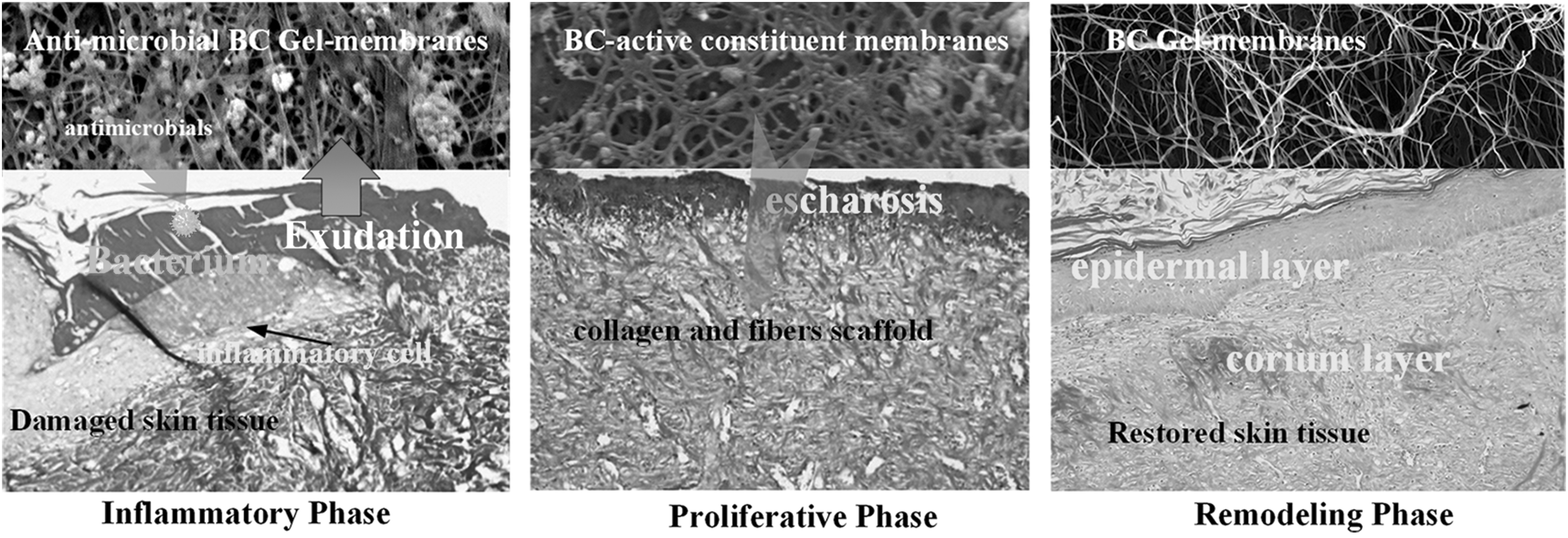
Schematic illustration of the therapeutic effects of BC-based wound dressing on different stages of wound healing. The figure in the lower right corner was reproduced with permission from Wu et al. 108
Bacterial cellulose-based wound dressings used in different types of wounds and the therapeutic effects
3D, three-dimensional; Ag, silver; Arg, arginine; BC, bacterial cellulose; BCM, BC with maleic anhydride; HCP, hyperbranched cationic polysaccharide; hUSCs, human urine-derived stem cells; METAC, 2-methacryloyloxyethyl trimethylammonium chloride; MMT, modified montmorillonite; RBC, regenerated BC; S-BC, surface-structured BC; siMMP-9, small interference matrix metalloproteinase 9.
The biocompatibility of BC and BC-based composite
The prerequisite of using BC or BC-based composite as wound dressings is that it should be biocompatible with skin tissue. Several studies have confirmed that BC or its composites supported the growth of epidermal cells, 80 fibroblasts, 41 and HUVEC 41 on its surface.
Fu et al. 81 prepared BC for skin tissue repair using an improved multilayer fermentation method. BC supported the adhesion and proliferation of hASCs in vitro. Moreover, BC induced less inflammation to the wound tissues in vivo as indicated by fewer lymphocytes and macrophages for the BC-treated groups. The potential toxicity of BC nanofibers was investigated in vitro on HUVEC and in vivo in C57/Bl6 mice. 82 The results showed that BC nanofibers did not influence the viability and cell cycle of HUVEC. Besides, the indexes of albumin, total cholesterol, aspartate aminotransferase, alanine transaminase, creatinine, and triglyceride in the investigated mice were not affected by BC nanofibers. Therefore, BC nanofibers showed no side effects on the body, organ weight, food consumption, and gross performance.
Other than pristine BC, BC-based composites have also been proved to be biocompatible both in vitro and in vivo. The in vitro and in vivo evaluations of BC/acrylic acid (AA) for biocompatibility as wound dressing were investigated. 83 The BC/AA was nontoxic to NHDF and showed a low hemolytic index (0.80–1.30%), suggesting its blood biocompatibility. BC/AA was also nonirritant and nonallergic to the skin, as demonstrated by dermal irritation and sensitization tests. Luo et al. 84 modified BC with maleic anhydride (BCM) and then used it as a template for in situ synthesis of ZnO NPs, producing BCM/ZnO composite. The BCM and 5wt% nZnO/BCM did not influence the growth of mouse fibroblast cells in vitro. In vivo experiments demonstrated that BALB/c mice implanted with BCM and 5wt% nZnO/BCM had little inflammatory cell infiltration.
BC-based wound dressing used in infected wounds
During wound healing, bacterial infections are frequent and cause severe problems. Extensive research has shown that S. aureus is the key pathogen infecting wounds. 85,86 Besides, P. aeruginosa, β-hemolytic Streptococci, Enterococcus faecium, Klebsiella pneumoniae, Acinetobacter baumannii, and Enterobacter species are also critical pathogens incriminated in wound infections and biofilms. 77 S. aureus is a wicked pathogen, constituting a headache to the health care sector because of its acquired resistance. A well-known example of such resistance is the methicillin-resistant S. aureus (MRSA). Unfortunately, MRSA is involved in wounds by its both types, namely hospital-acquired MRSA (the traditional type causing nosocomial infection within hospital settings) and community-acquired MRSA (the emerged type causing infections to healthy people within the community). 87 Belbase et al. 88 isolated 76 S. aureus strains from wounds of patients in a tertiary care hospital. They have identified MRSA, with an inducible clindamycin resistance, in 47.4% of the isolated strains. Furthermore, S. aureus formed biofilms, with multidrug resistance, in 46.1% of the strains. Therefore, there is a scientific cry to formulate novel therapeutic strategies defeating the hell of bacterial resistance and tolerant biofilms in wound infections, which could be achieved by antibacterial agents functionalizing BC (natural and bioinspired) wound dressings.
Li et al. 89 decorated BC with gold NPs modified by 4,6-diamino-2-pyrimidinethiol, and then used the composite to treat wounds infected with bacteria. The composite inhibited bacterial growth and facilitated the recovery of the full thickness of rat skin wounds infected with E. coli or P. aeruginosa. BC was chemically anchored with quaternary ammonium salt [R-N(CH3)+] through a vinyl group in 2-methacryloyloxyethyl trimethylammonium chloride (METAC) 90 and at the same time, the density of [R-N(CH3)+] was enhanced by free radical vinyl polymerization. METAC-grafted BC membrane demonstrated 99% antibacterial activity against S. aureus and E. coli, which may be attributed to the positive surface charge. This surface charge is a significant contributory factor to the development of antibacterial effects because the surface positive charges attract the negatively charged bacterial cells (i.e., negatively charged phospholipids within bacterial cell walls), facilitating a contact-killing activity. 91 Moreover, in vivo studies displayed that the membrane with the highest positive surface charge density showed the best inhibition efficacy against E. coli, thus better healing of E. coli-infected wound.
Luo et al. 84 investigated the effect of BCM/ZnO composite on infected wounds of murine. In S. aureus- and E. coli-infected murine wound models, BCM/ZnO prevented bacterial infections, accelerated epithelial formation and wound closure, thus enhancing wound healing. Moreover, the membrane was not significantly toxic to normal tissue. Ye et al. 68 fabricated a novel sponge through grafting amoxicillin onto regenerated BC (RBC). The grafted RBC demonstrated excellent antibacterial and antifungal activities. In vitro and in vivo studies confirmed that this sponge was nontoxic to HEK293 cells and could accelerate infected wound healing in mouse.
BC-based wound dressing used in acute traumatic injuries
An acute traumatic injury is a specific type of injury that opens the skin. Immediate risks to a person with an acute traumatic injury include blood loss at severe cuts or rupture of a major blood vessel. Some wounds may heal up without suture, forming an open scar. It has been shown that BC-based dressings reduce acute traumatic wound infection rates and scarring. 11
BC introduced with Arg, resveratrol, hyaluronic acid (HA), and chitosan have promoted healing of the acute traumatic injury. In the work of Feizabadi et al., 92 Arg was attached to BC through electrostatic adsorption, forming Arg functionalized BC (BC/Arg) gel. In vivo experiments demonstrated that BC/Arg gel better improved wound contraction through enhancing reepithelialization, angiogenesis, and collagen deposition in a full-thickness rat wound model than BC gel and Arg solution. BC has been incorporated with resveratrol for epithelial defect regeneration. 93 During wound healing, the BC/resveratrol membrane retained the normal collagen-bundling pattern and enhanced epithelial regeneration in defective rat epidermis.
A novel BC/HA composite was prepared using a solution impregnation method. 94 The BC/HA membrane showed better water uptake capability and elongation at breakpoint than pristine BC. Furthermore, the membrane enhanced the proliferation of primary human fibroblasts in vitro and shortened wound healing time of full-thickness skin injuries in Wistar rats. Khan et al. 95 produced 3D microporous RBC/gelatin scaffold for skin repair. When the scaffold was administrated on mice wound, wound healing and skin regeneration completed in 2 weeks. The wound closure efficacy was also significantly improved compared with that of control (blank and pristine BC-treated groups).
BC/chitosan composite was produced by impregnating BC in chitosan, and then the membrane was freeze-dried. 96 In vivo results demonstrated that BC/chitosan accelerated epithelialization and regeneration of rat skin wounds. BC/dextran hydrogel has also been proven to show excellent wound healing ability by improving fibroblast proliferation and skin maturation in acute traumatic injuries of C57BL/6 mice. 97
BC, with different structures, showed different effects on wound healing. Li et al. 24 confirmed that the bottom side of BC, with looser structure and larger pore size, could better promote cell migration. Moreover, it accelerated the recovery rate and induced less inflammation in the full thickness of skin wounds of Wistar rats in comparison with the gauze and top side of BC. Yu et al. 98 developed a microfluidic process to prepare the hollow BC microsphere. The BC microsphere, as a functional unit, can form an injectable scaffold through a self-assembled process. The created porous scaffold supported 3D cell culture and promoted the proliferation of both PC-9 cells and primary epidermal keratinocytes. Furthermore, the injectable scaffold enhanced the repair of skin tissue and the healing of Sprague-Dawley rat wound.
In the research of Hu et al., 99 a crossed groove/column micropatterned BC was produced using low-energy CO2 laser lithography, and then arginine-glycine-aspartic acid-serine tetrapeptides were immobilized onto the column platform of BC. The membrane aggregated human skin fibroblasts orderly on column platform. Moreover, collagen was increasingly established on groove channels overtime. In vivo experiments confirmed that the micropatterned BC composite induced scar-free wound healing in Sprague-Dawley rats. This micropatterning design allowed cell migration and collagen distribution, contributing to the scar-free wound healing.
A new S-BC combined with human urine-derived stem cells (hUSCs) was used for wound healing in full-thickness wounds of SD rats. 100 In vivo studies demonstrated that animals treated with S-BC loaded with hUSCs showed the fastest wound healing rate, followed by BC loaded with hUSCs, hUSCs, S-BC, BC, and blank control in sequence. The S-BC combined stem cells promoted skin wound healing through inducing reepithelialization, collagen production, and neovascularization. The combination of S-BC and stem cells provides a new strategy to deal with clinical wound healing problems.
Hypertrophic scar (HS) often occurs if deep layers of dermis were injured, involving excess fibroblast proliferation and excessive fiber deposition. 101 BC was modified with a stripe pattern by static culture method using patterned PDMS mold, and its effect on inhibition of cicatricial contractions in full-thickness skin wounds of mice was investigated. 102 Mouse treated with patterned BC displayed reduced fibroblasts accumulation, decreased scar contraction, and less inflammatory response. These results indicated that patterned BC showed a proper effect on inhibiting HS. Moreover, patterned BC showed a better antiscar effect if the stripe width matched cell size.
BC-based wound dressing used in burns
Burn care is always complex because of pervasive infection, complicated pathophysiology, and clinical complexities. 103 Burn damage may extend to the dermis, the regeneration of which is quite complicated and slow. 11 Therefore, it is of massive significance to develop suitable wound dressings, particularly for burns. It has been reported that BC can regulate angiogenesis and connective tissue formation, resulting in accelerated wound healing in burn wounds of SD rats. 104 Pandey et al. 105 investigated the effect of BC/polyacrylamide composite hydrogel on partial-thickness burn wounds. The composite promoted wound repair through increasing the proliferation of fibroblasts and enhancing the epithelialization.
The therapeutic effect of pristine BC and BC/lidocaine composite has also been studied on full-thickness rat burns by Brassolatti et al. 106 Wounds treated with BC and BC/lidocaine displayed shortened recovery periods, less inflammatory responses, and better collagen fiber organization than those of the blank control. Both materials are expected to be used for clinical burn wound healing. BC and copolymer of 3-hydroxybutyric and 4-hydroxybutyric acids have been combined to construct hybrid wound dressings. 80 The composite loaded with actovegin and fibroblasts, respectively, were used to treat mature female Wistar rats with third-degree skin burns. The results showed that BC-based wound dressings were more effective in wound healing management than a commercial wound dressing (VoskoPran).
As mentioned previously, burns are often associated with microbial infection. Therefore, BC incorporated with different antimicrobial agents have been applied in the management of burns. Wu et al. 107,108 prepared a BC/Ag NPs membrane through the in situ generation of Ag NPs on BC nanofibers. The BC/Ag NPs membrane displayed excellent antibacterial activity and was used for coverage of a second-degree rat scald wound. The results demonstrated that BC/Ag NPs showed a better effect on decreasing the inflammation and promoting burn wound healing than BC and blank control. BC/silver sulfadiazine NPs composite was also applied to partial-thickness skin burn wounds of Wistar rats. 109 Wounds covered with BC/silver sulfadiazine NPs displayed a higher healing rate and better epithelialization than the control (gauze covered).
Sajjad et al. 110 prepared BC/modified montmorillonites (MMTs) composite for wound healing in burn mice model. BC/modified MMTs promoted wound healing through inducing reepithelialization, vascularization, and skin tissue regeneration. BC/ZnO and BC/titanium dioxide composites have also been used as wound dressings in burn mice model. 103,111 Animals treated with the two composites mentioned previously showed proper healing efficiency with enhanced wound contraction and accelerated reepithelialization compared with the pristine BC. Jiji et al. 112 developed thymol-enriched BC (BCT) hydrogel well to treat third-degree burns. The authors tested the efficiency of BCT hydrogel on burn wound healing of female albino Wistar rats. The results showed that compared with BC and control groups, BCT hydrogel accelerated wound closure and reepithelialization, thus appropriate for burn injuries.
BC-based wound dressing used in diabetic wounds
Chronic wounds are nonhealed wounds from 30 days and up to 3 months. 78,113 Pathophysiological abnormalities, including diabetic foot ulcers, venous stasis ulcers, and pressure sores, are predisposing factors for the development of chronic wounds. 79,85,114 In China, diabetic wounds have been thought of as a prime cause of chronic cutaneous wounds. 79 In Europe, diabetic patients hit 55 million cases, predisposing 8 million vulnerable patients to a consequence of diabetic foot ulcers that could, regrettably, further progress to lower limb amputations (450,000 cases annually), increasing the economic burden and costs to a sum of 2–2.5 billion €. 115 Diabetic skin is vulnerable, and the wounds are difficult to heal. 11 BC-based dressings have been used to treat diabetic wounds and they showed desirable therapeutic effects.
Li et al. 116 used BC/hyperbranched cationic polysaccharide derivatives encapsulated with small interference matrix metalloproteinase 9 (siMMP-9) RNA to treat wounds of male Sprague-Dawley diabetic rats. The controlled release of siMMP-9 RNA effectively inhibited MMP-9 expression (that impedes diabetic wound healing) in human immortalized epithelial cells and diabetic rat wounds. The composite enhanced diabetic wound healing, which may be attributed to the unique nanostructure of BC and the released siMMP-9 RNA for MMP-9 inhibition. Picolotto et al. 117 combined BC with red propolis and then used the composite as a dressing for diabetic mice wounds. Animals treated with the membrane displayed a significant decrease of lesion size, less inflammation, an increase of TGF-β levels, and complete epithelialization, indicating an accelerated wound healing of diabetic mouse.
BC-based wound dressing used in clinical practice
There have been some commercial BC-based dressings, namely Biofill, Gengiflex, Xcell, Biopro-cess, Dermafill, and Epiprotect. The manufacturing technologies applied to produce these products are different, leading to different properties. Different factors, such as initial carbon source concentrations, fermentation time, and surface-to-volume ratio, have been adopted for different products. 5 These products are of massive significance and play important roles in wound treatment.
As early as 1990, the use of a cellulose pellicle product, namely Biofill, produced by Acetobacter as a temporary skin substitute, was reported by Fontana et al. 118 The product displayed the following characterizations: reduced pain, good attachment to the wound bed, convenient for wound inspection, accelerated wound healing, promoted exudates retention, and reduced treating time and costs. Therefore, Biofill is widely used in the management of skin wounds, such as burns, ulcers, skin grafts, and as an adjuvant in dermal abrasions. 118
Gengiflex was used to treat Class II furcations in mandibular molars, compared with expanded polytetrafluoroethylene. 119 Both materials were effective in treating Class II furcations of mandibular molars, and they did not show statistical differences in efficacy.
Alvarez et al. 120 reported the application of the BC membrane (Xcell; produced by Xylos Co.) in treating chronic venous lower leg ulcers. BC showed more efficacy for autolytic debridement than a standard protocol (nonadherent cellulose acetate gauze). BC also accelerated wound healing as indicated by a smaller wound area at weeks 6 and 12 compared with the standard care. Moreover, BC significantly reduced the pain of the patients. Xcell has also been proved to be able to facilitate and absorb moisture, depending on the wound condition. 121 Based on the abovementioned properties, Xcell was effective in treating hard-to-heal chronic wounds.
Kucharzewski et al. 122 compared the effect of BC wound dressing (Bioprocess) on treating nonhealing venous leg ulcers with a frequently used product, namely, Unna's boot hydrocolloid dressing. The results showed that more patients were completely healed after 8 weeks' treatment with BC than those treated with Unna's boot. The remaining patients treated with BC were healed after another 6 weeks, whereas the remaining healing time for patients treated with Unna's boot was 20 weeks. The authors concluded that BC wound dressing was a more effective treatment for chronic venous leg ulcers than Unna's boot. 122
In a randomized trial of II and III skin tears in a population of frail elderly patients, 27 patients treated with a commercial BC membrane Dermafill were compared with those (24 patients) receiving standard wound care with Xeroform™ and a secondary Tegaderm™. 123 The outcomes indicated that BC showed the same healing time, but better pain control, and it was easier to be used. Thus the BC treatment received a higher level of satisfaction from patients and nursing staff compared with control.
Aboelnaga et al. 124 compared the therapeutic effect of BC (Epiprotect; S2Medical AB, Sweden) with that of silver sulfadiazine on patients who suffered partial-thickness burns. The results confirmed that patients treated with BC demonstrated less pain, got fewer dressing changes, and spent fewer days within the hospital than those treated with silver sulfadiazine cream, suggesting that BC dressing is better for treating partial-thickness burns.
Maia et al. 125 evaluated the feasibility of BC dressing in managing ischemic wounds of patients who suffered lower limb revascularization. They conducted a randomized clinical trial by treating 24 patients with BC and gauze containing fundamental fatty acids (as control). After 30 days, the average ischemic wound area treated with BC was smaller than that of the control. Moreover, the complete healing rate on day 90 for BC-treated groups was 31.8% higher than that of control. The efficacy of the BC membrane as a wound dressing in treating varicose ulcers of the lower limbs was evaluated by Cavalcanti et al. 126 A controlled and randomized study was performed on 25 patients who suffered chronic venous ulcer disease. Patients were divided into two groups: (i) those treated with the BC membrane were the experimental group, and (ii) those receiving dressing with triglyceride oil served as the control group. Both dressings reduced wound area, prevented infections, and did not induce reactions. BC reduced the pain of patients, and analgesics were discontinued earlier for the BC-treated group.
All the studies mentioned above point toward the promising potential of using BC as a wound dressing, either as a commercial (Biofill, Gengiflex, Xcell, Bioprocess, Dermafill, and Epiprotect) or noncommercial product.
Summary
BC is a natural polymer with several advantages: mechanical stability, biocompatibility, conformability, elasticity, and transparency. Moreover, it ensures proper thermal and gaseous exchange, provides a moist environment for wounds and absorbs wound exudate, contributing to its efficient usage in wound healing and skin tissue repair. This study has provided an overview of the recent developments of BC-based materials used in wound healing, including their properties, methods of functional modifications, and applications in different wounds and clinical trials. The performances of BC before and after modification have been investigated intensively, and all the results shed light on the stellar role of BC in skin tissue repair.
Take-Home Messages
Traditional wound dressings are not satisfactory because they have some drawbacks; for example, they do not show moisturizing effect, only serve as passive supplements, and could not promote wound healing.
BC is a natural polymer, and it shows excellent biocompatibility, high tensile strength and flexibility, high porosity and water-holding capacity, and excellent gas and liquid permeability.
BC can provide mechanical protection, maintain a moist environment, absorb excess penetrant, avoid allergic reactions, and reduce wound pain, meeting the requirements of a modern wound dressing.
The properties of BC could be improved through microbial fermentation, physical modification, chemical modification, and compound modification to ensure better wound healing applications.
BC-based wound dressings have been used to manage and control infected wounds, acute traumatic injuries, burns, and diabetic wounds, showing a remarkable effect on promoting wound healing.
Some BC-based dressings are commercially available. BC-based wound dressings have been administered in clinical practice.
Footnotes
Acknowledgments and Funding Sources
This study was financially supported by the National Natural Science Foundation of China (Grant No. 31700829, 51973018 and 51773018), Key Research and Development Projects of People's Liberation Army (BWS17J036), Natural Science Foundation of Jiangxi Province of China (20192ACB20033), and Haiyan Project of Lianyungang (KD2019lyghy001).
Author Disclosure and Ghostwriting
The authors have no competing financial interests. The content of this article was entirely written by the authors listed. No ghostwriters were used in the writing of this article.
About the Authors