




Abstract
Abstract
Malachite green (MG) is frequently used to treat fish pathogens in zebrafish, but little is known about how MG may affect the physiological processes that are targets of research investigations. This study evaluated the effects of MG on reproductive success in zebrafish, Danio rerio, and the relative toxicity of MG oxalate and MG chloride salts. After 5-day exposure to a prophylactic concentration (0.065 mg/L) of MG oxalate, the percentage of spawning pairs significantly declined (57.5%±8.5 SE) and then returned to pre-exposure levels (89%±6.6 SE) within one week. Embryo and larval survival were not affected by exposure of parents to MG; however, when exposed directly, MG oxalate was more toxic than MG chloride in both life stages. The LC50 for embryos was 0.067 μM and 0.116 μM for MG oxalate and MG chloride, respectively, and the LC50 for larvae, 0.057 μM and 0.103 μM, respectively. Other than a transient reduction in the number of fish that spawned, MG treatment of broodstock did not impact reproductive success, which indicates that MG can be used prophylactically with minimal effects on reproduction. Based on acute toxicity, MG chloride should be preferred over MG oxalate.
Introduction
Some aspects of MG toxicity have been investigated in fish, and results indicate that effects on reproduction of broodstock are a concern. Srivastava et al. 10 reported degenerative lesions in gonadotropic and gonadal tissue in the catfish, Heteropneustes fossilis; however, it is unknown if these changes were sufficient to alter the reproductive output of brood stock. Lesions following MG exposure have also been reported in rainbow trout, Oncorhynchus mykiss, and include degeneration of hepatocytes and gill pathologies after repeated exposure. 11 There have been no investigations on the effects of MG on physiological processes in zebrafish, Danio rerio, and, for the broad spectrum of zebrafish research occurring around the world, 12 unknown effects of MG treatment may confound results and reduce comparability among studies. Within the zebrafish research community, there is recognition that consistent methods of husbandry must be applied and these include culture conditions and nutrition, 13 and there is further the need to understand the effects of therapeutic chemical treatments on physiological processes.
The toxicity of MG has been investigated but the type of MG studied is often omitted, and results among studies are frequently difficult to compare. Because MG is commonly available in two different forms, MG chloride and MG oxalate, the relative toxicity of each form should be determined.9,14 The properties of oxalates are similar to those of humic substances (HS) in their ability to chelate metal ions, and Meinelt et al. 15 reported that HS can lower the toxicity of MG in hard water by chelating calcium ions, thereby lowering cell membrane permeability. Consequently, MG oxalate may be less toxic than MG chloride because of effects on calcium ion concentration. The objectives of this study were to evaluate changes in reproductive success (spawning through survival of larvae) in adult zebrafish upon exposure to MG and to determine if there are any differences in toxicity between these two MG salts in zebrafish early life stages.
Materials and Methods
Chemicals
Malachite green chloride (analytical standard, ≥96%) and malachite green oxalate (technical grade, >90%) were obtained from Sigma-Aldrich (Poole, Dorset, UK). Stock solutions of both salts were prepared in Milli-Q water (Millipore) to yield stock concentrations of 1 mg/mL. Ten-fold dilutions of the stock were prepared for dosing water containing fish.
Experimental animals
Adult zebrafish (Indian wildtype) were obtained from the University of Plymouth Zebrafish Research Facility. All adult fish in this facility (25±1°C with a 12-h photoperiod) were held in 40-L glass aquaria with aerated recirculating water (20% replacement each day). Water quality was measured throughout the 7-week trial on a weekly basis, and measurements included temperature, dissolved oxygen (DO), and pH (Hach HQ40d multi meter), total ammonium, nitrite, and nitrate (Hach DR 2800 portable spectrophotometer with test kits LCK 304, LCK 341, and LCK 340 for ammonium, nitrite, and nitrate, respectively). The values were 25±1°C; DO 7.7–7.9 mg/L; pH 7.25–7.35; ammonia <0.01 mg/L; nitrite <0.08 mg/L; nitrate <22 mg/L. Stock fish were fed to satiation twice each day with Artemia sp. nauplii and flake fish food (Tetramin). Adult female fish (age ∼210 days) were distinguished from male fish (age ∼210 days) by their more yellowish color, larger abdomen, and presence of a genital papilla. Sexes were confirmed by pair spawning, which was conducted by placing a male and a female fish on either side of a divided 2-L pair-spawning tank with a false bottom (Aquatic Habitats, Apopka, Florida) near the end of the photoperiod. Approximately 1 h prior to the onset of the next photoperiod, the divider separating the fish was removed and fish were allowed to spawn for 4 h after the start of the photoperiod. Fish that spawned successfully (produced viable embryos) were selected, and males [total length (TL), 36.2 mm±0.16 SD; weight 0.35 g±0.046 SD] and females (TL, 35.1 mm±0.23 SD and 0.41 g±0.067 SD) were placed in separate aquaria and held <10 days prior to beginning the experiment.
Effect of MG on reproductive success
The selected adult fish were randomly stocked into eight 24-L glass aquaria that were fitted with tank dividers such that five females were on one side of the divider and five males were on the other side. Four aquaria were used as the control and four aquaria were used for MG exposure (four replicate aquaria, five pairs of fish/aquaria). The aquaria held static aerated water that was replaced (80%) each day and water quality characteristics did not deviate from those described above. Fish were held in static aquaria for 4 weeks prior to exposure, and during this period each fish was given the opportunity to spawn once a week by being placed in a pair-spawning tank as described above. Spawning success was recorded including the number of eggs from each pair and egg quality characteristics (i.e., fertilized, unfertilized, or nondeveloping). Embryos were transferred to labeled plastic dishes containing de-chlorinated tap water, and dead embryos were enumerated and removed every 24 h through hatching and larval development (until 96 h post-fertilization (hpf)). Dead embryos were identified by failure to develop or by white appearance (water mold Saprolegnia sp.), and mortality of larvae was identified by lack of movement and confirmed by lack of heart beat examined with a stereomicroscope. After 4 weeks, the randomly selected exposure tanks received a prophylactic dose of MG (0.065 mg/L) on a daily basis for 5 days. The MG dose was administered to each aquarium immediately after receiving the daily 80% water change. Seven days after the initiation of exposure, pairs of fish from each tank were given the opportunity to spawn as described above.
Comparison of MG oxalate and MG chloride toxicity
Adult fish from the stock colony were spawned to provide embryos and larvae to test acute toxicity of MG. Embryos for use in toxicity tests were collected (within 4 h of spawning) and randomly distributed among 11 beakers with 25 eggs per beaker within 4 h of spawning. Each beaker contained 300 mL of de-chlorinated tap water (Zebrafish system water from the facility). In each beaker, embryos were exposed (96 h, until age 100 hpf) to a single aqueous concentration of either MG chloride or MG oxalate, and each experiment included beakers containing an aqueous MG concentration of 0.01, 0.02, 0.03, 0.04, 0.05, 0.06, 0.07, 0.08, 0.09, and 0.10 mg/L to establish the concentration response relation. The concentration response relation was tested in an independent replicated experiment for each MG salt, and each experiment included three beakers containing embryos not exposed to MG (controls). Temperature was maintained during exposure by placing beakers in a water bath at 28.5°C. Every 24 hours (96-h exposure), dead embryos in each beaker were removed and recorded, and a complete daily water change was conducted for each beaker with replacement of MG. The procedure for investigating the toxicity of each MG salt in larval zebrafish used identical MG concentrations and experimental design and larvae were exposed (96 h) from 96-192 hpf.
Statistical analyses
Results for the effects of MG on reproductive success were divided into 4 categories; percent of pairs that spawned successfully, total production of eggs from each pair, production of fertilized eggs, and survival of larvae. Initially, the first 4 weeks pre-exposure data on reproductive success were evaluated for variance homogeneity (Levene's test), and if variances were homogeneous, differences among treatments were tested by ANOVA. The overall ANOVA model was considered significant when a p value ≤0.05 was obtained, and differences among treatments and the control were tested by post hoc test (Fisher's LSD). Percentage data were arcsine square-root transformed 16 prior to statistical analysis, and all analyses were conducted with StatGraphics 5.1 (Statistical Graphics Corporation, Rockville, Il). Differences in spawning success endpoints were compared between pre-exposure and exposure period by ANOVA according to the same criteria indicated above. The concentration computed to be lethal to 50% of exposed (96 h) organisms (96-h LC50) and the corresponding 95% confidence intervals were computed based on logistic regression models generated in StatGraphics 5.1. Statistical differences among mortality functions defined by logistic models of mortality were tested (ESTIMATE statement in PROC GENMOD) in SAS (Statistical Analysis System, Ver 9.1, SAS Institute, Canary, NC) and considered significant at p≤0.05 for the Wald χ2 statistic.
Results
During the 4-week pre-exposure period, no differences in spawning success were observed among aquaria and most paired fish spawned (91.2±2.2%). The 5-day exposure began at the end of week 4 and the mean percentage of fish per tank that spawned in week 5 was 57.5±8.5% and decreased significantly (p<0.01) relative to the pre-exposure period (Fig. 1). Spawning success in weeks 6 and 7 was not significantly different from the pre-exposure period (i.e., weeks 1–4). No treatment- or time-related differences were detected among the other spawning success endpoints considered (total egg counts, percent fertilized eggs, and percent survival) (Table 1). No significant differences were observed in the mortality of embryos spawned from exposed adults for the 96-h observation period, and mortality did not differ from offspring spawned pre-exposure. Embryo mortality throughout the experiment was 2.3±0.4%.
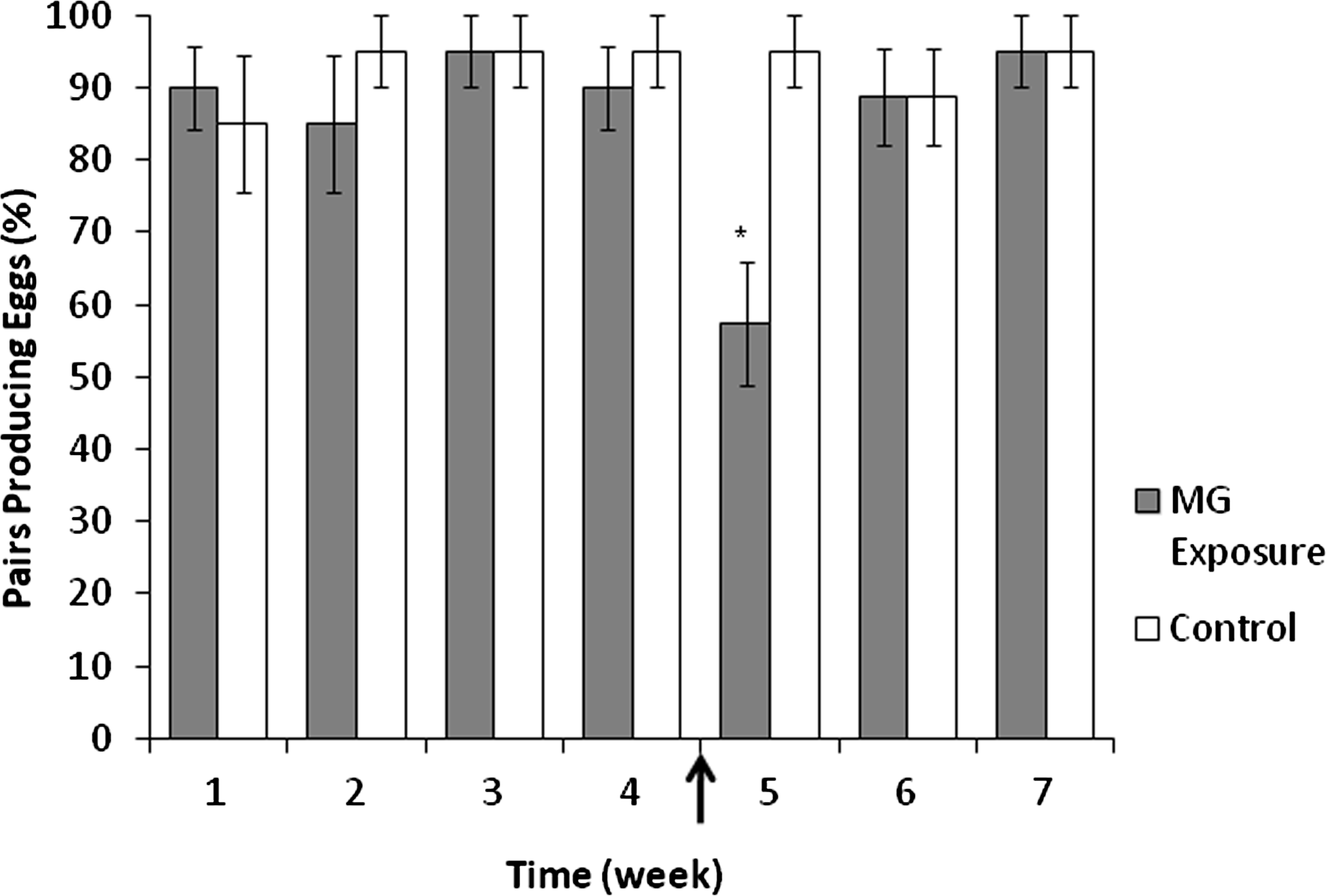
Effects of MG on the percentage of spawning fish. Mean percentages generated from 4 replicates (n=5)±SE. Exposure occurred between weeks 4 and 5 (black arrow). Significant differences (p≤0.05) between pooled pre-exposure data and post-exposure data are denoted with (*).
Numbers presented are mean values±SE (n values are given in parentheses).
In the LC50 tests, mortality of embryos and larvae that were not exposed to MG was low (<8%), and for exposed fish, mortality increased with concentration of the MG salt tested (Fig. 2). The LC50 values for embryos exposed to MG oxalate and MG chloride were 0.067 μmol/L, 0.116 μmol/L; and LC50 values for larvae were 0.057 μmol/L and 0.103 μmol/L, respectively. Logistic regression models of mortality were significant (p<0.0001), MG oxalate was more toxic in both life history stages than MG chloride (embryos, p=0.011; larvae, p<0.001), and larvae were significantly more susceptible to lethal effects of MG than embryos (p<0.001 for both MG salts).
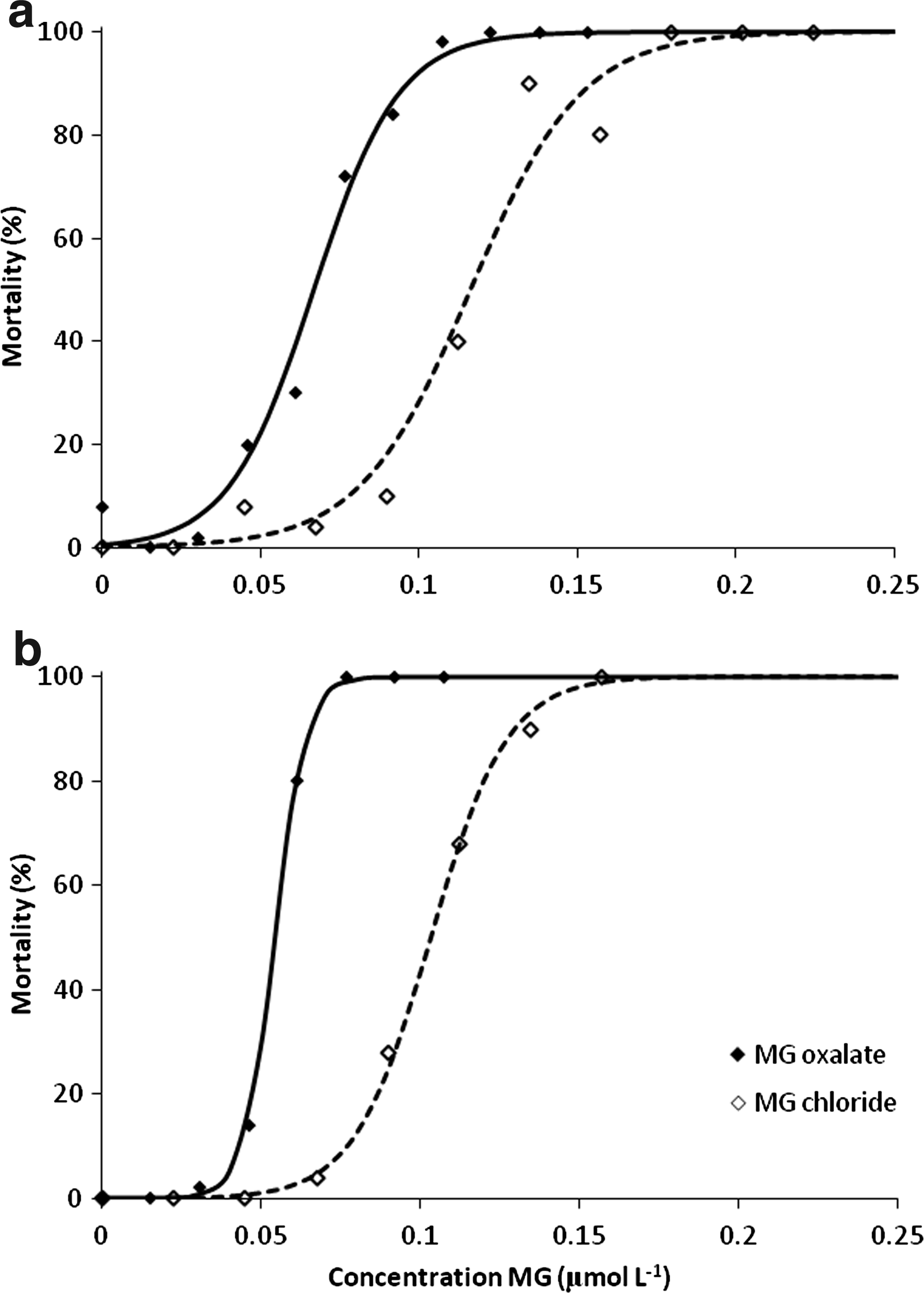
Dose-response (mortality) curves for embryos
Discussion
Results of the present study indicate that a typical 5-day prophylactic dose of MG can have a small but significant effect on the reproductive success of adult zebrafish. The reduction in spawning success was transient and fish recovered within 1 week after exposure to MG; there were no effects on fertilization rate or survival of zebrafish offspring obtained from adults exposed to MG. There are no previous investigations on the effects of MG exposure on spawning success in fish. However, lesions in gonads have been reported upon histological examinations in H. fossilis after exposure to MG, 10 and while these lesions could impact spawning, the exposure concentration (0.2 mg/L) and exposure duration (60 day) of MG exceeded what is considered a typical prophylactic dosage. Although gonad histology was not conducted in the present study, it is not likely that lesions in gonads similar to those reported by Srivastava et al. 10 were induced that were subsequently resolved within 1 week after exposure to MG (i.e., such that spawning success returned to control levels 1 week after exposure). The mechanism for the reduction in the number of paired fish that spawned after MG exposure in this study is unknown, but could be attributable to a general stress response from which fish recovered relatively quickly.
The oxalate form of MG was more toxic than MG chloride in both embryonic and larval zebrafish. Information on the toxicity of oxalate ions in fish is limited, but one investigation with Daphnia magna, based on the endpoint of immobilization, reported that threshold concentrations for sodium oxalate and sodium chloride were 1.6 mmol/L and 72 mmol/L, respectively. 17 Oxalate ions can chelate positively-charged metal ions, and effects of oxalate on Ca2+ concentration have been attributed to differences in MG toxicity by consequent changes in membrane permeability. 15 An alternative hypothesis is the direct toxicity of oxalate on cell physiology. Gilli et al. 18 reported that oxalate ions can inhibit pyruvate kinase extracted from fish muscle and therefore can influence cell metabolism. Zebrafish larvae were more sensitive to MG than embryos, which may imply differences in the uptake and metabolism of MG between these life history stages.
Conclusion
In summary, MG remains an effective and regularly used treatment in zebrafish research facilities, non-food fish culturing facilities, and among home aquarists. The present study indicates that when MG is used in a manner consistent with that used by non-food fish culturists, the effects of exposure on reproduction are minimal in zebrafish. The greater toxicity of MG oxalate suggests that MG chloride should be preferred; however, the relative efficacy of each form of MG should be considered and there presently is no information on whether the MG oxalate or MG chloride is more effective at treating fish pathogens. At normal MG prophylactic concentrations and durations, no acute toxicity is expected for either form of MG. Use of mixtures of MG and formalin appear to enhance efficacy against some fish pathogens (initially reported by Leteux and Meyer 19 for protozoan pathogens), and continue to be recommended and used in some commercial formulations; however, the relative toxicity of these mixtures and types of MG are unknown. While the present results indicate that treatment with MG does not reduce reproductive potential of zebrafish fish beyond a short-term depression of spawning success, reports of MG as a teratogenic or carcinogenic compound must be considered. Further study is required to determine if MG is to be used in zebrafish research facilities and the effects on specific physiological processes that are targets of research investigations. Persistence of MG within tissues could have some unexpected effects within particular research questions. While there is considerable concern regarding use of MG in food fish and potential release into the environment, use of small quantities of MG within zebrafish facilities are unlikely to be of substantial concern for ecosystem and human health provided routine laboratory procedures are applied.
Footnotes
Acknowledgments
The authors thank S. McMahon, H. Reinardy, and C. Ramsden for laboratory assistance.
Disclosure Statement
No competing financial interests exist.