




Abstract
Abstract
The saltwater rotifer, Brachionus plicatilis, is widely used in the aquaculture industry as a prey item for first-feeding fishes due to its ease of culture, small size, rapid reproductive rate, and amenability to enrichment with nutrients. Despite the distinct advantages of this approach, rotifers have only been sporadically utilized for rearing larval zebrafish, primarily because of the common misconception that maintaining cultures of rotifers is difficult and excessively time-consuming. Here we present simple methods for maintaining continuous cultures of rotifers capable of supporting even the very largest zebrafish aquaculture facility, with minimal investments in materials, time, labor, and space. Examples of the methods' application in one large, existing facility is provided, and troubleshooting of common problems is discussed.
Introduction
Of the live prey organisms, rotifers are perhaps the most important for culture of first-feeding stages of many fish larvae, due to their smaller size, slow swimming speed, and ready availability. 5 These qualities are especially critical for fishes that are not yet large or fast enough during the first few days of independent feeding (up to complete yolk-sac absorption) to ingest larger, swifter Artemia nauplii efficiently.
Zebrafish fall within this class of fishes. Although it has been reported that it is possible to rear zebrafish larvae from the onset of exogenous feeding on Artemia nauplii alone with high survival and growth rates,6,7 it is difficult to achieve this efficiently in practice, especially on a large scale, chiefly because the narrow difference between the average gape size of this life stage of the fish and the size of a typical Artemia nauplius makes feeding on this prey item possible, but inefficient.4,8 Furthermore, measures to address this shortcoming by increasing encounter rates tend to be counterproductive due to problems associated with waste build-up in rearing tanks.4,9
Accordingly, most zebrafish rearing strategies involve a preliminary feeding step in which a smaller-sized prey item is presented to the fish, prior to the introduction of Artemia. Historically, Paramecium spp. have been used for this purpose,3,10 and while this approach has been in use in the zebrafish research community for many years, there are few published data in the scientific literature that demonstrate this as an efficient or well-defined practice. The few reports that detail performance of fish fed on Paramecium alone show poor growth, 11 which is consistent with the fact that Paramecium does not possess adequate levels of key nutrients required by fish larvae for growth and development. 12 Although live rotifers have always been a clear alternative to Paramecium, until recently they have seldom been utilized in zebrafish rearing protocols, mostly due to the misconception that rotifers are too difficult or labor-intensive to culture readily.
However, a recent study has now demonstrated that the presentation of rotifers to larval zebrafish during the first several days of exogenous feeding results in excellent growth and survival rates. 9 Naturally, the success of this rearing approach is dependent upon the ability to maintain a predictable, efficient, continuous supply of rotifers that possess nutritional profiles that support good larval growth and survival. An additional and critical criterion for success is that the protocol for rotifer production be straightforward in both design and execution, especially in light of the staffing shortages that are common to many zebrafish research operations. 13 Here we present practical methods for the maintenance of continuous rotifer cultures that will meet the needs of virtually any zebrafish nursery system, regardless of scale, with minimal investments in labor, space, materials, and expense.
Rotifer Biology
Growth and reproduction
Domesticated strains of the rotifer Brachionus plicatilis (Fig. 1) are exclusively parthenogenetic females when cultured under near-optimal conditions. At 25°C, each female produces about 20 eggs during her 7-day lifetime, beginning 1.5 days after hatching. Because egg production declines rapidly by Day 5, it is important to harvest rotifer cultures daily to maintain an average age that is young enough to ensure high fecundity. The population can then more than double each day.5,14
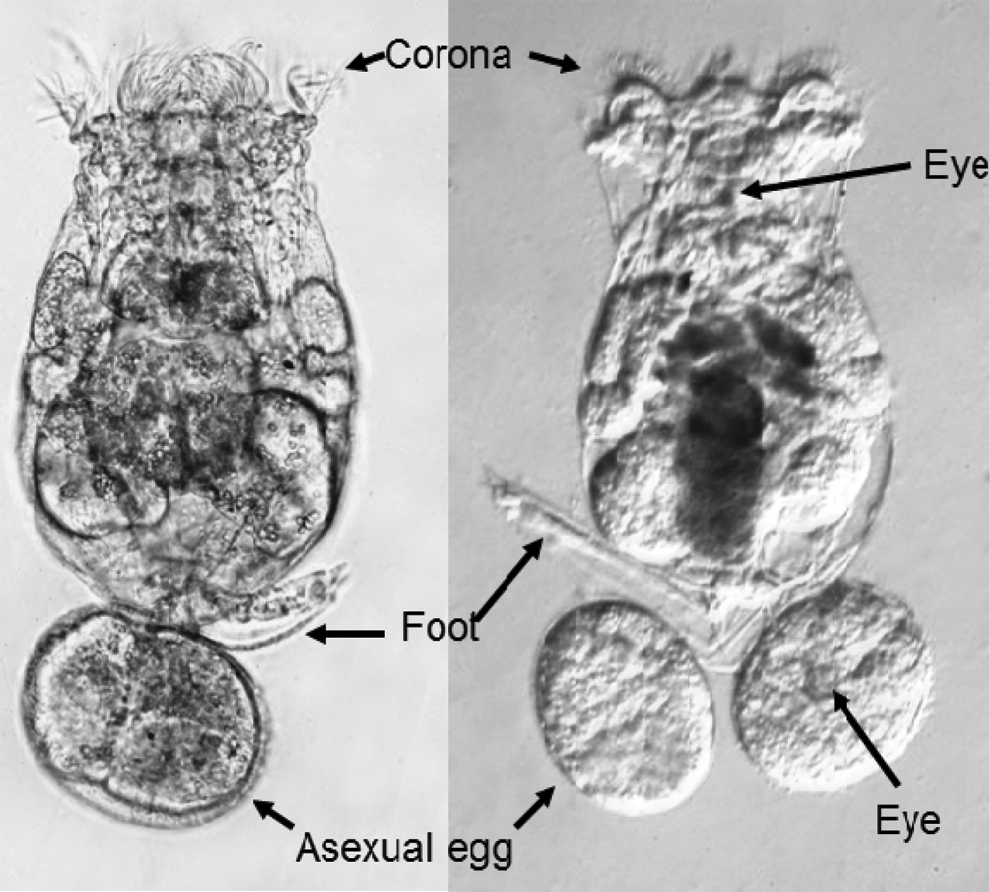
The Rotifer, Brachionus plicatilis. Representative examples of adult rotifers, both carrying asexual eggs. Arrows indicate basic anatomical features.
Rotifer cultures are most productive when maintained as “continuous,” using a chemostat-like approach employing regular feeding and frequent (normally daily) harvests. Use of concentrated feeds allows cultures be maintained at densities as high as several million per liter. 15
Feeding, nutritional enrichment, and “greenwater”
B. plicatilis is naturally a plankton feeder, efficiently capturing and ingesting 2–20 μm particles, and although bacteria are ingested they are not sufficient to support growth.16,17 Rotifers capture plankton via the corona, a ciliated structure on the head that creates a current that sweeps feed into the mouth. Cultures have been fed a wide variety of particulate feeds including their natural food, microalgae, as well as yeast, lipid globules, and even human red blood cells. 18 All rotifers are equipped with a mastax, an internal chewing apparatus that can mechanically disrupt cells, enabling rotifers to digest algae with tough cell walls that cannot be digested by other zooplankton such as Paramecium that have only enzymes to process prey.
The biochemical composition of rotifers, and therefore their nutritional value for fish larvae, is highly dependent on the rotifer feed. Cultures fed only yeast or certain algae such as Chlorella can show excellent productivity but they will lack nutritional factors (e.g., certain fatty acids), that are essential for normal development of larval fish.19–21 Therefore, the nutritional requirements of the fish should determine the nutritional profile of the rotifer feed. Microalgae-based feeds are now available that include “enrichment” levels of essential nutrients, producing rotifers with nutritional profiles that support the growth and survival of larval fish (e.g., http://www.reedmariculture.com/pdf/product_rotigrow_plus.pdf).
Food passes through the gut of B. plicatilis in about 30–45 minutes at usual culture temperatures, depending on particle concentrations, 22 but when presented with very high particle concentrations, ingestion is so rapid that food already in the gut is pushed out before it can be digested and assimilated. 18 This phenomenon makes it possible to quickly “gut load” rotifers with “enrichment” feeds containing preferred nutritional factors before being fed to larvae. 22 However, after rotifers are introduced to the larval culture, some will swim for several hours before they are consumed. In the absence of food, this is long enough for the rotifers to metabolize their gut contents and begin to starve, significantly reducing the rotifer tissues, as well as the gut contents, in their nutritional value as larval food. Fish aquaculturalists have found that the “greenwater” technique overcomes this problem. Microalgae are added to the larval tank sufficient to keep the rotifers well-fed, with the additional benefit that the resulting turbidity can greatly reduce damage to the larvae from bumping against the walls of the tank.23,24 Furthermore, larvae of some fish have been shown to derive direct nutritional support by ingesting the algae.25,26
Critical Water Quality Parameters
Oxygen
B. plicatilis cultures perform best at oxygen concentrations near atmospheric saturation (∼8 mg L−1), but they can survive indefinitely, although with reduced growth rates, at concentrations as low as 1 mg L−1. 27
Temperature
Growth is optimal at 26°–27°C and can be maintained from 10°–35°C, although with greatly reduced production rates at the extremes. 14 Large, abrupt temperature shifts are of course stressful. 28 However, with gradual temperature reduction, rotifers may be refrigerated without harm, greatly reducing oxygen and feed requirements during transport or storage. This procedure may be achieved by simply transferring them in a container at culture temperature into a refrigerator.
pH
B. plicatilis prefers a pH from 6.5–8.5, showing signs of stress beyond this range. 29 There is advantage in maintaining cultures at the lower end of this range, because, in the event of an accumulation of ammonia, the fraction in the toxic NH3 form at pH 7.0 is only about 10% of the toxic fraction at pH 8.0.
Salinity
B. plicatilis can maintain reproduction at salinities from about 3–50 ppt (parts per thousand; seawater is ∼35 ppt). Optima for various strains have been reported from 10–20 ppt.30–33 For use with zebrafish, it is advantageous to culture the rotifers at lower salinity (∼10–15 ppt); this pre-acclimation reduces the osmotic stress when rotifers are transferred to zebrafish cultures, so their swimming and feeding are not impaired.
Materials
Examples of required materials are given in Table I. These materials are readily available from multiple sources, and may be scaled appropriately.
Culture System Overview
Culture vessel
The central component of the culture system is the culture vessel (Fig. 2A). There are numerous options available, but in general, the chosen vessel should be constructed of durable, nontoxic material, and can be sized in accordance with the needs of the facility. It is most convenient to provide a drain port so that the culture/water can be easily removed, although very small vessels can be lifted for pouring, and larger ones emptied by siphon.

Typical Rotifer Culture Setup.
Aeration
The culture vessel should be supplied with constant, vigorous aeration, which serves to maintain adequate levels of dissolved oxygen, keep the rotifers in suspension, ensure uniform distribution of the feed, and transport detritus and protozoa into the solids filter. Supplementing with pure oxygen is not necessary unless maximum productivity is required from high-density cultures in large vessels, which are more difficult to aerate uniformly.
Feed supply
Concentrated microalgae “paste” (e.g., Rotigrow Plus, Reed Mariculture Inc., Campbell, CA) serves as the food source for the rotifers. The feed must be kept in a covered container at ca. 4°C, so a refrigerator should be sited near the culture vessel if a pump is used to deliver the feed.
Feed delivery and dosing rate
It is best to provide the microalgae feed to the rotifers at frequent, regular intervals, because infrequent feeding requires large doses at each feeding, and such high concentrations of food are more prone to aggregate and foul surfaces. Feed can be delivered automatically by means of a peristaltic metering pump that draws from the microalgae concentrate supply container and delivers the algae to the culture vessel (Fig. 2B and 2C). This apparatus can be controlled by a “cycle” timer that is set to dose the feed at regular intervals. It can be difficult to pump very small amounts of the highly concentrated and therefore viscous feed, so it may be easier to first dilute the feed into a larger volume of water (e.g., 3 liters of water to 1 liter of feed).
In a healthy culture the numbers of rotifers produced each day directly corresponds with the amount of algae fed each day. If more rotifers will be needed, increase the feed dosing; it will take 2–3 days for the culture to reach a new equilibrium, and then production will again be stable at the new higher level. If a larger than usual harvest is performed and feed dosing is not changed, fewer rotifers will remain after the harvest and this results in more feed available per rotifer. This increases the reproductive rate and the culture density soon returns to the previous level.
To determine feed dosing rate, it is not enough to know how many rotifers are in the culture, because it is the harvest rate that determines the production required, and so how much feed is needed. When feeding, for example, RotiGrow Nanno® (for maximum rotifer yield), 3.1 mL is required per million rotifers harvested (e.g., http://www.reedmariculture.com/pdf/product_rotigrow_nanno.pdf). When feeding, for example, RotiGrow Plus® (optimized fish nutrition), 3.8 mL is required per million rotifers harvested (e.g., http://www.reedmariculture.com/pdf/product_rotigrow_plus.pdf).
Waste removal
The culture will naturally produce animal waste detritus during routine operation, often accompanied by salt-tolerant protozoa, which are resident in almost all zebrafish facilities. Most protozoa are benign, merely feeding on detritus and bacteria, and do not appear to harm rotifers, but a conspicuous increase in their numbers is a symptom of suboptimal conditions in the culture. 34
The particulate waste must be removed from the culture regularly in order to maintain its health. A filter “floss” (Fig. 2D) made from nonwoven polyester fibers should be suspended within the culture vessel. The detritus collects on the floss, which is also a preferred substrate for protozoa, so both detritus and protozoa are removed from the culture when the floss is cleaned daily.
In dense rotifer cultures ammonia can accumulate to inhibitory levels (above 1 mg L−1). 35 Ammonia production is proportional to the protein metabolized by the culture, so an ammonia neutralizer (eg, ClorAm-X®, AquaScience Technologies LLC) can be dosed according to feed dosing.
Small-scale cultures
Rotifers can be cultured easily at almost any scale, even as small as multi-well test plates. For “small-scale” production for larval fish, a 5-gallon (20 L) bucket can serve as an inexpensive and convenient culture vessel capable of producing several million rotifers/day. Feeding and harvesting can be carried out as in larger systems, with the same use of floss to remove solid wastes, and effective aeration is generally easier in smaller vessels. Accurate small-volume automatic feeding can be challenging; a syringe pump may prove easier to use at this scale than a peristaltic pump. However, if high densities and maximum productivity are not required, it is sufficient to dose feed by hand twice per day.
Setup and Routine Operation, 100 liter culture
Typical setup
The culture vessel should be filled with 50 L of culture water at 15 ppt salinity: 824 g of Instant Ocean® sea salts, or 682 g NaCl (equivalent osmolarity), and 34 g sodium bicarbonate, vigorously stirred. The culture is first inoculated with rotifers, which may be purchased from a commercial supplier (eg, Reed Mariculture Inc., supplied in “breatheable” plastic bags). A population of 5–10 million rotifers is suitable to start a 100 L culture. Upon receipt, each bag of rotifers is temperature-equilibrated (the rotifers are shipped chilled) by floating it in the culture water (or water at culture temperature) for 20–30 minutes. After temperature equilibration, the bags are opened and the contents transferred to the culture vessel. Aeration is started and feeding begins.
The rotifers will require about a day to recover fully from the chilling they are subjected to during shipping, so their feeding rates are initially depressed. At first, feed algae concentrate, for example, 0.5 mL RotiGrow Nanno® per million rotifers every 6–8 hours, or enough to impart a distinct green tint to the water. Rotifer feeding should noticeably reduce the green tint after a few hours. If there is no reduction in the green color, examine the rotifers to confirm that they are swimming actively and that there is green coloration in their guts, and continue feeding only when the green tint of the water is reduced. If feeding has recovered, after 24 hours the volume of water in the culture vessel can be increased to 100 L, and feeding continued. ClorAm-X® should be added at 0.11 g mL−1 of RotiGrow Nanno® used. At 48 hours post-inoculation, routine operation of the culture may commence.
The culture is fed automatically with a timer-controlled peristaltic pump (Table 1, Fig. 2C), which draws from a container of algal concentrate kept at 4°C. The timer should be set to deliver feed at least hourly, and 2–4 times/hour is still better. This setup should be checked daily to ensure that the supply of algal concentrate is not exhausted and that the supply lines are not clogged.
Routine operation
Approximately 25%–50% of the culture should be harvested each day. Aeration should be maintained in the culture vessel during collection to ensure that that the rotifers are uniformly distributed in the water column. In this example, a length of flexible tubing is connected to the culture vessel drain and is run into a 40–60 μm mesh strainer, which can be placed in a sink, above a drain, or inside a bucket. The drain valve is opened to permit a convenient flow rate, and the desired volume of culture is allowed to pass through the tubing and into the strainer (Fig. 3A). The collected rotifers can be immediately transferred into 1–4 L of pre-mixed 3–5 ppt salinity water by gentle rinsing, distributed into squeeze bottles (Fisher 03-409-22D), and allowed 10–20 min for osmotic acclimation (Fig. 3B–3D). This sub-stock of rotifers is then used for feeding larval fish.

Rotifer Culture Daily Maintenance Routine.
After the rotifers are harvested from the vessel, the floss filter should be removed and rinsed vigorously with a jet of fresh water until the rinse water runs clean (Fig. 3E). The entire inside surface of the vessel should then be swept with a designated brush (Fig. 3F). This will liberate detritus/solid wastes that have accumulated on the sides of the vessel and send them back into suspension so they can be captured by the floss filter during routine operation. The culture vessel should then be replenished with new culture water. Finally, the clean floss filter is then re-suspended back inside the vessel and normal operation resumes.
Practical Tips/Troubleshooting
Rotifer density and reproductive rate
Rotifer density should be checked daily. A simple way to do this is to collect a sample of 100 μL directly from the culture vessel and examine it under a dissecting microscope. The rotifers in this sample can be easily counted and assessed for health. A Sedgewick-Rafter plankton counting slide with grid (Aquatic Eco-Systems, Item No. M415) makes counting high densities easier. Under optimal growth conditions rotifer densities can be as high as >1000 mL−1. Discerning whether the rotifers in the sample are carrying eggs is also important. Egg ratios (egg count/rotifer count) typically range from 0.25 to 0.5, but an egg ratio of 0.25 in a heavily harvested culture is sufficient to double the population daily (because a rotifer can lay more than one egg per day). A low egg ratio or more than occasional detached eggs indicate adverse conditions. Rotifers carrying more than one egg result from high feed rates; this will yield maximum population growth, but with some sacrifice of feed utilization efficiency.
Weekends/holidays
The cultures can be left undisturbed for up to 1–3 days, although this is not ideal. Productivity of the culture will always be reduced to some extent when no daily harvest/maintenance is performed. However, unless rotifer densities are extremely high (>2000 mL−1), cultures will usually tolerate a day or two of neglect with no problem. Nevertheless, on weekends/holidays the culture system should be checked daily to ensure that it is operating properly (i.e., ensuring the algae feed supply is adequate, aeration is still on, etc.).
Backup cultures
Backup cultures of rotifers should be kept on hand in case of emergencies. Once every 1–2 weeks, a small portion (e.g., ∼3–5 mL of concentrated, harvested rotifers, or other appropriate quantity) should be collected and placed in a clean 500 mL flask containing 15 ppt water and a few drops of algae concentrate. Refrigerated rotifers will slow their metabolism, and can be kept at 4°C for up to 2 weeks. They can be used as a backup to re-start or bolster the culture should the need arise.
Conclusions
Given the relative simplicity of culture equipment, ease of startup, and low maintenance cost of rotifer cultures, and especially in light of recent publications illustrating their superior performance as a first food item for larval zebrafish, we anticipate that rotifers as first feed will continue to gain favor in the zebrafish research community. Adoption of this live feed will help accelerate the pace of science derived from this model organism by decreasing the generation time of the fish, enhancing the status of the zebrafish as a low-cost alternative model organism to rodents and other vertebrate animals.
Footnotes
Disclosure Statement
Eric Henry is employed by Reed Mariculture, Inc.