




Abstract
Abstract
The Zebrafish, Danio rerio, is a well-known vertebrate model species widely used in research associated with biomedical areas and comparative and evolutionary biology. Interestingly, despite the importance of this species, little is known about the natural history, habitats, and native distribution. In our study of the species, we collected individuals from twenty-one wild populations from within the species' natural distribution, ranging from streams/rivers of the Western Ghats of Peninsular India to those of the Western and North-Eastern Himalayas. Habitat types are identified from various geographic locations. Danio rerio is largely confined to and most frequently associated with habitats of low flow and with a sandy substrate in secondary and tertiary channels connected with the main channel of a stream/river, or habitats adjacent to wetlands and paddy fields. These connections can be natural channels or man-made irrigation canals, beels, or culture ponds. Among the 21 populations, individuals from two populations (one from Orissa and another from Arunachal Pradesh) were much larger in size (total length) when compared to other populations. The general habitats of Danio rerio vary from small to large mountainous and lowland streams/rivers, wetlands, and paddy fields.
Introduction
Taxonomy and Phylogeography
Danio rerio was originally described by Hamilton in 1822 7 from the Kosi River, Bengal. Day (1878) 8 also recorded this species from Bengal to the Coromandal coast. Menon (1963) 9 documented the distribution of the species from the Brahmaputra, Gandak, Rapti, Karnal, Kali, Ramganga, Ganges, Yamuna, and Indus river drainages. Hora10,11 recorded its distribution from Nadhave and Kalauma rivers in Kumaon Himalayas and also from Rajmahal. Chauhan and Ramakrishna (1954) 12 reported the species from the Balangi district, Orissa and Tilak (1968) 13 reported this species from Sikkim. Recently, two distributional records 14 have been observed in the Western Ghats, one from the Thunga River in Karnataka and another from the Kabini River, Wynaad district of Kerala. These populations were used in a study of population genomics. 15 Thus, based on a broad literature review, our current understanding of the distribution of this globally important species, Danio rerio, in the wild, includes rivers, small streams, channels, and paddy fields16–18 from Myanmar, Pakistan, India, Bangladesh, and Nepal.
Danio is reported to be paraphyletic with respect to Esomus, Chela, and Inlecypris. 19 In this study, one clade consisted of Danio rerio, D. dangila, D. nigrofasciatus, D. albolineatus, and D. kerni, while the other clade with the resurrected genus name Devario included D. devario and D. regina. However, a recent study 20 revealed that the genus Danio is a monophyletic group and D. rerio is sister to D. kyathi and that comparisons of Danio species with species of Devario and/or Esomus/Microrasbora have often been simply misleading.
We collected wild populations (Fig. 1) across a range of geographical locations with various elevational ranges from the states of Kerala and Karnataka of Western Ghat mountain ranges and one of the hotspots of biodiversity, and from north and northeastern states of Orissa, Uttar Pradesh, Meghalaya, Assam and Arunachal Pradesh of India (Figs. 2 and 3). Habitats of the wild populations were studied randomly as a part of the detailed inventory in rivers of India and ongoing icthyological surveys of various ecoregions of the country.

Localities in India where Danio rerio species were collected.

Danio rerio in the wild.

Danio rerio in the wild.
Methods
Habitat inventory/observations in streams and rivers are based on channel gradient, stream depth, stream width, riparian cover, and bank stability are the microhabitat features.21,22 Stream habitat features were estimated in a 100 m thalweg length (the longitudinal path following the fastest cross sectional water velocities) and included pools, riffles, cascades, alcoves, and backwaters.21,22 Riparian cover was measured using a spherical densiometer, and riparian vegetation was estimated with a clinometer and was determined by averaging three repeated measurements. Instream fish cover was boulder edge, canopy (overstory, midstory, understory), root, and undercut banks. 23 Water velocity was measured using electronic flow meter (propeller type). We used seines, rectangular hand nets, cast nets, and gill nets based on the habitat conditions. Local fisherman was also engaged for fishing in larger bodies. The habitats of Danio rerio could be well easily identified and quantified throughout the country.
Morphometric measurements were taken with digital calipers to a precision of 0.1 mm. Counts, measurements, and color pattern terminology are according to Fang. 24 The following abbreviations are used herein: SL=standard length and HL=head length. Body measurements are expressed as percentage of standard length (%SL) and head measurements as percentage of head length (%HL). Gut contents were taken from two individuals where the relative biovolumes of algae, detritus, higher plant matter, and animal matter were determined. 25 Gut content analysis was carried out for all the Danio rerio populations throughout its range of present study.
Results
Feeding habits
Gut contents of Danio rerio in all populations showed allochthonous materials, mostly red ants, in the Western Ghat streams and also the habitats where there was much overhanging vegetation such as in Budapalang River, Simla village, Orissa; Mathumathi River, Sonauli, Uttar Pradesh; Rani village, Siang, Arunachal Pradesh; Thore, Siang, Arunachal Pradesh. In the rest of the habitats, the gut contents were of terrestrial arthropods and to a lesser extent aquatic insects.
Habitat types
Thirunelli, Wynaad, Kerala
This area is a second order, low-gradient and forested stream inside the Wynaad Wildlife Sanctuary (Table 1 and Fig. 4a). Danio rerio was found below overhanging vegetation over a substrate type of pebbles and sand. Both banks were stable despite the stream being a low gradient one; the left bank (looking upstream) was covered by understory vegetation with dense riparian cover. Devario aequipinnatus was found in high velocity habitats. Danio rerio was confined to shallow habitat areas (water depth range 10–35 cm) of the stream with low flow, ranging 9–9.7 cm/s. Other species recorded from this location included: Esomus danricus, Chela fasciatus, Devario aequipinnatus, Barilius gatensis, Rasbora daniconius, Salmophasia boopis, Puntius conchonius, P. carnaticus, P. bimaculatus, P. fasciatus, Garra mullya, Aplocheilus lineatus, and Xenentodon cancila.
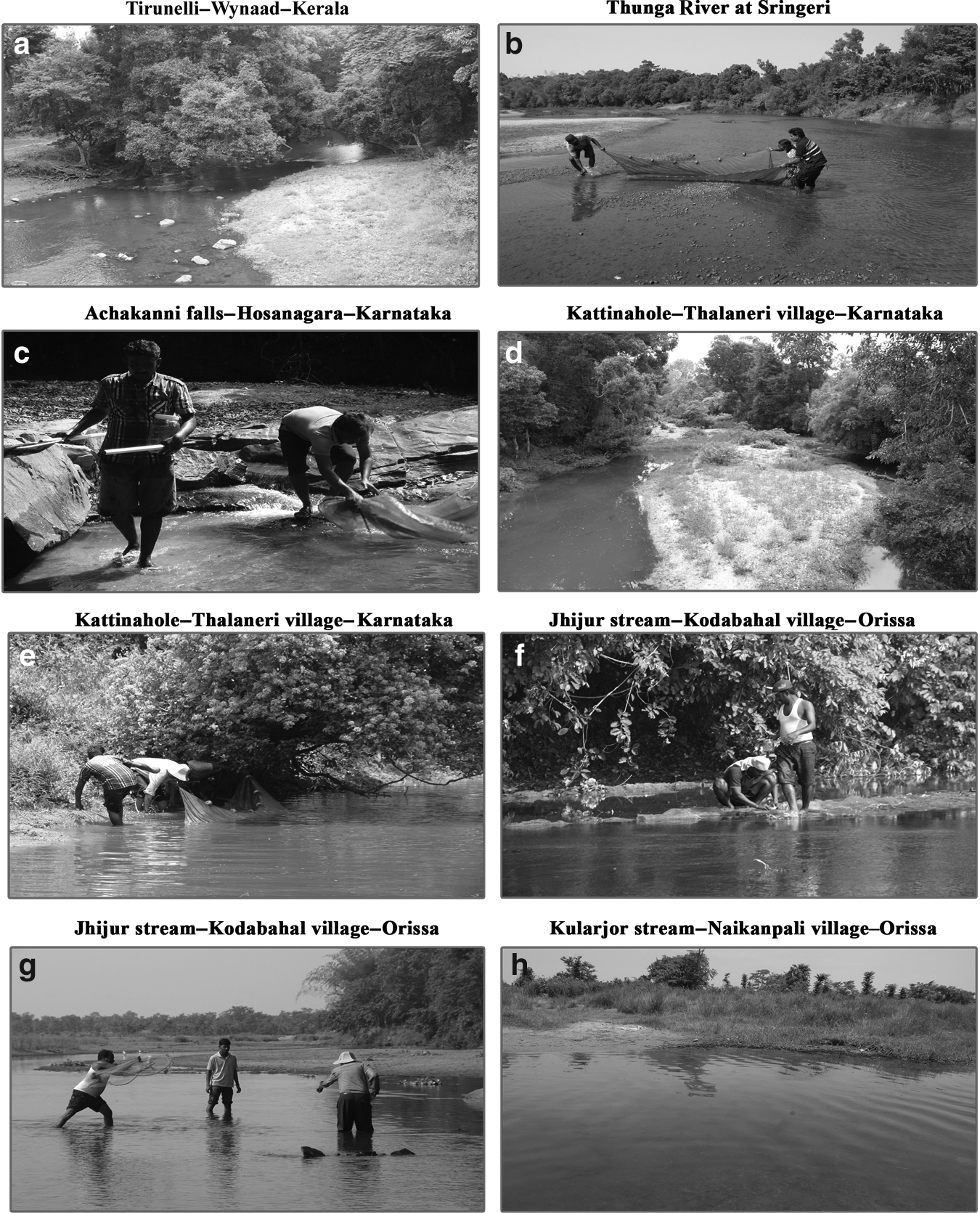
Study sites of streams/rivers where Danio rerio was collected.
A=Algae; D=detritus; HPM=Higher plant materials; AM=Animal matter.
Thunga River at Sringeri, Karnataka
The river stretch in this area where we found Danio rerio was in the Thunga River at Sringeri, Karnataka. The habitat in this area where Danio rerio was collected was mostly a stream run (Table 1 and Fig. 4b). Species was also found in secondary channels where the substrate type was mostly cobble and sand. The river meandered to the left bank (looking upstream) during the sampling period (dry season of the year) with a flow range of 6.3–6.8 cm/s and the water depth range is 10–32 cm. The waterway is a relatively larger river (width 98 m) with stable banks with good riparian vegetation. In some areas, undercut banks and overhanging vegetation were noted. Other species recorded from this area were: Esomus danricus, Chela fasciatus, Devario aequipinnatus, Barilius gatensis, Rasbora daniconius, Salmophasia boopis, Puntius conchonius, P. carnaticus, P. bimaculatus, P. fasciatus, Hypselobarbus jerdoni, Osteochilichthys nashi, Tor khudree, Psilorhynchus tenura, Garra mullya, Aplocheilus lineatus, and Xenentodon cancila.
Achakanni stream and falls, Hosanagara, Karnataka
In this area Danio rerio was located below a small waterfall of the Achakanni falls which is located in a 2 km diversion from Hosanagara village along the Thirthahalli main road. This water way is a tributary of Sharawati River in the mountain ranges of the Western Ghats, South India (Table 1 and Fig. 4c). The stream was clear and had dense forest canopy. The substrate type was bedrock and boulders, and a small proportion of sand. Danio rerio habitats were backwater areas created by bedrock and the alcoves created by large boulders. The species occurred in a large pool largely surrounded by bedrock with a flow range of 5.2–5.8 cm/s and water depth range of 0.1–1.1 m. Water in this stream was clear and suitable for snorkeling. While walking along the edges of a pool, Danio rerio was commonly found along the sandy areas of alcoves and backwater habitats. Other species collected in the study area included Devario aequipinnatus, Rasbora daniconius, Puntius conchonius, P. sarana, Acanthocobitis botia, and Xenentodon cancila.
Kattinahole stream, Thalaneri village, Karnataka
This waterway is a third-order stream with thick canopy cover (Table 1 and Fig. 4d, e). Banks were stable and the substrates were cobbles and sand. Danio rerio was confined to a secondary channel formed by a sand dune and the exact microhabitat was below the overhanging vegetation of the secondary channel. Instream vegetation providing canopy was common in the secondary channel. Leaf litter was 40%–50% in the main channel, and 20%–30% along the side channel in a 100 m reach. Danio rerio was collected from the above habitats with a flow range of 5.5–6.2 cm/s and the water depth range of 30–45 cm. Farming activities were common beyond the riparian zone. Other species in the study area included Devario aequipinnatus, Rasbora daniconius, Puntius conchonius, P. sarana, Salmophasia boopis, Hypselobarbus kolus, Acanthocobitis botia, Xenentodon cancila, Aplocheilus lineatus, Anabas testudineus, and Chanda nama.
Jhijur stream, Kodabahal village, Orissa
Danio rerio was found in the main channel of this fourth-order waterway (Table 1 and Fig. 4f, g). Substrate types were mostly sandy; water flow was low. The population occurred below overhanging vegetation. Both banks were stable with midstory and overstory vegetation. An additional population was found along the secondary channel of the main stream with a flow range of 6.1–6.8 cm/s and water depth of 15–35 cm; the substratum was sandy. The floodplain in this area is vast and the river meanders along the left bank (looking upstream). Other species in the study area included Devario aequipinnatus, D. devario, Salmophasia bacaila, Osteobrama cotio peninsularis, Puntius ticto, P. conchonius, Cirrihinus reba, Tor mosal mahanadicus, Parambasis ranga, Acanthocobitis botia, Lepidocephalichthys guntea, Mystus cavasius, Macrognathus aral, Mastacembelus armatus, Ompok bimaculatus, Glossogobius giuris, Gudusia chapra, Nandus nandus, Channa stewartii, and Xenentodon cancila.
Kularjor stream, Naikanpali village, Orissa
Kularjor is a lowland, third-order stream with cobbles and sand as the dominant types of substrates (Table 1 and Fig. 4h). Major cover for the fish was midstory canopy and Eichhornia crassipes was the major weed along banks. Bathing, and washing of clothes and utensils, and washing of buffaloes and cows from the nearby village were the common activities in the stream. Danio rerio was found in the areas with low gradient and with riffle habitats characterized by a cobble substrate with a flow range of 6.2–6.5 cm/s. Danio rerio population also occurred below a midstory vegetation with little undercut to the bank. However, riparian vegetation was disturbed due to recent rain and the depth was in the range of 0.1–0.8 m. Otherwise banks are relatively stable with replacement of big boulders along the bathing ghat. Other species in the study area included Devario aequipinnatus, D. devario, Puntius ticto, P. conchonius, Salmophasia bacaila, Osteobrama cotio peninsularis, Parambasis ranga, Cirrihinus reba, Acanthocobitis botia, Lepidocephalichthys guntea, Mystus cavasius, Channa stewartii, Glossogobius giuris, and Xenentodon cancila.
Marudi River, Kalapadia, Orissa
The Marudi River is a second-order lowland stream with a gradient less than 1% (Table 1 and Fig. 5i). The stream is highly degraded with little midstory vegetation and the banks were highly unstable, a condition resulting from its secondary confinement. Two habitats were identified in a 100 m length where Danio rerio occurred, a shallow pool and in the inflow and outflow areas of the shallow pool. Substrate type was mostly silt and clay. Leaf litter input through leaves falling into the habitats originating from understory grasses and other riparian vegetation, contributed to 10%–20% leaf litter to the system. There was little flow in the pool other than the areas of inflow and outflow, with a range of 7.2–7.8 cm/s. Water depth was from 0.1–0.5 m in the pool area. In the outflow and inflow areas, water depth ranged from 0.1–0.3 m. As it is a low gradient stream, a small degree of meandering occurred that resulted in secondary channel confinement. Other species in the study area included Puntius conchonius, Acanthocobitis botia, Glossogobius giuris, and Xenentodon cancila.

Study sites of streams/rivers where Danio rerio was collected.
Budapalang River, Simla village, Orissa
The Budapalang River is a lowland, second-order stream surrounded by paddy fields beyond the riparian zone. Stream banks were stable; as a typical lowland stream it had dense understory, midstory and overstory tree canopy (Table 1 and Fig. 5j). Danio rerio was found in the low gradient riffle area followed by a pool. Substrates are mostly silt and fine silt and 10% of the thalweg length included small boulders. Danio rerio was confined to riffle areas where the flow was 9.8–10.2 cm/s. In pool areas, water was turbid. Other species collected in the study area included Devario devario, Devario aequipinnatus, Puntius conchonius, and Channa stewartii.
Mathumathi River, Sonauli, Uttar Pradesh
The Mathumathi River is a lowland third-order stream with unstable banks (Table 1 and Fig. 5k, l). The left bank (looking upstream) is more or less stable with sparse overstory vegetation. Beyond the riparian zone, there are plantations. In a 100 m thalweg length, the predominant habitat type was a run with low flow and alcoves (side pools). The active floodplain was sparsely vegetated and most of the sands had been removed. A secondary channel was formed by a sand dune on the left bank (looking upstream). Danio rerio was identified to occur in three habitats in this stream. One was a side pool on the right bank and the second was a secondary channel (5 m length) with little flow to the main channel. The third was a shallow pool formed by the sand dune. Substrate type was uniformly sand and silt, typical of a slow run habitat. Water flow ranged from 7.0–7.5 cm/s. The pool with 8 m length, 8 m width, and 0.3 m depth was identified in the secondary channel. Other species occurring in all the habitats in the study area included Puntius sophore, Puntius conchonius, Barilius bendelisis, Devario devario, Aspidoparia jaya, Salmophasia bacaila, Acanthocobitis botia, Botia almorae, Lepidocephalichthys guntea, Schistura sp., Colisa fasciatus, and Xenentodon cancila.
Mehdoompur fish farm, Marana, Meerut, Uttar Pradesh
Preference of this population of Danio rerio in this area was the flowing water habitat (Table 1 and Fig. 5m). We collected Danio rerio from a private fish farm receiving water from the adjacent irrigation canal system of Yamuna River. The occurrence of Danio rerio was noted only from inflow and outflow regions of the fish pond that is used to culture carps such as Gibelion catla and Labeo rohita. Inflow and outflow regions were characterized by sand and silt substrates and the flow ranged from of 11–11.8 cm/s. Danio rerio was absent in the nearby canal system where we found only two species, Puntius conchonius and Colisa fasciatus.
Mawlymkhang, Umsingh Highway, Meghalaya
This is a lowland first-order stream surrounded by midstory and understory vegetation (Table 1 and Fig. 5n). Banks were relatively stable and the water velocity was uniform, exhibiting a water sheath representing a typical run habitat. Here, the mean stream width ranged from 0.6–1.2 m. Substrate types were fine sand and clay. Danio rerio occurred along the shadowed area of the stream with little undercut bank habitat. The study site is located in between the plains below the hills where paddy fields were used for cultivation. Water velocity was 4–4.5 cm/s. Other species occurring in all the habitats in the study area included Devario aequipinnatus, Lepidocephalichthys guntea, Macrognathus aral, Channa stewartii, and Xenentodon cancila.
Two km from Umsingh Highway, Meghalaya
This waterway is a lowland stream with little or no tree canopy on the left bank (looking upstream). (Table 1 and Fig. 5o) Right bank (looking upstream) was characterized by understory vegetation. Beyond the riparian zone, agriculture activities were common and the major crop was rice/paddy. Bank erosion was mainly due to the loss of vegetation on both stream banks. On the right side the channel was modified to a secondary confinement. Stream width was only 3.6 m and substrate type was mostly fine sand and gravel. Almost all of the habitats in this stream reach can be designated as slow to fast runs (flow range 3.5–4.8 cm/s). Danio rerio was found below the undercut banks on the left side with vegetation cover. Other species occurring in all the habitats in the study area included Devario aequipinnatus, Lepidocephalichthys guntea, Channa stewartii, Macrognathus aral, and Xenentodon cancila.
Five km from Umsingh Highway, Meghalaya
This waterway is a typical first-order stream with unstable banks (Table 1 and Fig. 5p). Water flow was in the range of 3.8–4.6 cm/s and the depth range was 10–15 cm. Substrate was bedrock, boulders, and fine sand with disturbed riparian vegetation. From the road, the stream is not visible because of the vegetation all along the small pool with the major substrate being bedrock. Other species occurring in all the habitats in the study area included Devario aequipinnatus, Lepidocephalichthys guntea, and Channa stewartii.
Sansori stream, Subanshri River, Assam
This waterway is a larger river system, and a major tributary of Brahmaputra River basin. Width of the river was more than 2 km (Table 1 and Fig. 6q). Danio rerio was located in an oxbow pond with little water exchange with a secondary channel. The secondary channel was formed due to sand dunes by the meandering processes. Substrates were almost exclusively sand and silt and flow ranged from 5.1–5.5 cm/s. The oxbow pond was small and 3 m in length and 2.81 m wide, with a single outlet with a width of 40 cm. In the main channel we collected Rasbora rasbora, Barilius bendelisis, Devario devario, Puntius chola, P. conchonius, Raimas bola, Labeo boga, L. pangusia, Garra nasuta, Botia dario, Gagata cenia, Mastacembelus armatus, and Chanda nama.

Study sites of streams/rivers where Danio rerio was collected.
Dhalpur stream, Bipuria town, Assam
The Dhalpur stream is a clear-water third-order stream with stable banks and mostly midstory canopy cover (Table 1 and Fig. 6r). Substrate types were small boulders and cobbles, along with gravel and sand. Danio rerio was found in a shallow pool with little flow (10–13 cm/s). Habitats are mostly run and glide and the mean depth of the 100 m reach was 0.7 m; the width ranged from 1.8 m to 5.2 m. Washing of clothes and bathing by the local people is common. Other species occurring in all the habitats in the study area included Devario devario, Barilius bendelisis, Puntius chola, P. stoliczkanus, Salmophasia bacaila, Cirrhinus reba, Psilorhynchus balitora, Garra nasuta, Acanthocobitis botia, Lepidocephalichthys irrorata, L. guntea, Mystus vittatus, Mastacembelus alboguttatus, Ompak bimaculatus, Xenentodon cancila, and Channa punctatus.
Beel near Brahmaputra, Jamuguri village, Dhalpur, Assam
At this location, Danio rerio was found in a beel (wetland) in a kitchen pond used for aquaculture (Table 1 and Fig. 6s). Throughout the lowland of the Brahmaputra River basin in Assam, isolated ponds were connected by the floodwaters during the wet seasons and receiving water become stagnant along the floodplain for 5–6 months. These oxbow ponds are used for culture of native fishes drifted during flooding. Danio rerio was confined to the inflow areas where the pond receives water, and juveniles were confined to areas with grasses. Other species occurring in all the habitats in the study area included Chela khujairokensis, Devario devario, Puntius chola, P. stoliczkanus, Chagunius chagunio, Lepidocephalichthys annandalei, Nandus nandus, Xenentodon cancila, and Tetraodon cutcutia.
Ghagor stream, Ghagor, Assam
The Ghagor stream is a low gradient, alluvial river with a high meandering process (Table 1 and Fig. 6t). Water was clear and the habitat was mostly run with smooth substrate type of sand and silt. Floodplains were vast with little vegetation cover. Danio rerio population was found in shallow secondary channels formed with the sand dune in the middle of the river channel, along the secondary channel where there was overhanging vegetation and undercut bank. The undercutting of the bank was common due to erosion and the banks are almost unstable. Algal mats were noted in areas exposed to sunlight. Another population was found in a shallow pool created by the undercut bank where the water velocity was from 7.0 to 7.9 cm/s. Water depth in this area ranged from 0.1 to 0.6 m along the 100 m reach. Other species occurring in all the habitats in the study area included Rasbora rasbora, Devario devario, D. aequipinnatus, Barilius bendelisis, B. vagra, Puntius sophore, P. conchonius Psilorhynchus balitora, Glyptothorax sp., Lepidocephalichthys guntea, and Acanthocobitis botia.
Dikrong River at Khola camp, Arunachal Pradesh
The Dikrong River is a tributary of Brahmaputra River drainage in Arunachal Pradesh. Collection of cobbles and small boulders is a major activity in this stream and is a big threat to the entire stretch of this river (Table 1 and Fig. 6u). Banks were stable and had good riparian vegetation. Water was clear. Danio rerio population was found in a side channel created inside a stream for vehicle movement carrying loads of boulders. Immediately after the bank, or in some places along the floodplain, there were crusher units for breaking of river stones. Boulders were removed also from the secondary channel and hence the dominant substrates were sand and silt. There was little flow in the areas where the secondary channel was connected to the main stream and the water velocity here ranged of 11.8 to 12.9 cm/s. Depth of the habitat was 0.2–0.6 m. In the main channel we collected Rasbora rasbora, Barilius bendelisis, B. vagra, Cirrhinus mrigala, Puntius chola, Poropuntius marginatus, Neolissochilus hexastichus, Labeo gonius, Cyprinus carpio, Garra annandelei, G. lissorhynchus, Psilorhynchus balitora, Acanthocobitis botia, Botia rostrata, Lepidocephalichthys guntea, Schistura arunachalensis, and Mystus vittatus.
Rani village, Siang, Arunachal Pradesh
This waterway is a third-order stream with thick vegetation along the right bank (looking upstream) and the left bank is mostly midstory cover (Table 1 and Fig. 6v). Banks are more or less stable and Danio rerio was found along the right bank area where the substrate was sand. Flow rate was in the range of 13.0–13.9 cm/s. Most of the populations were confined to areas below overhanging vegetation and were absent in the mid-channel area in deeper pools. Danio rerio also occurred in a backwater pool with roots forming habitats, as well as in undercut banks. Washing of clothes and bathing by the local village people were common in this region. In the upstream habitat areas there were slow riffles with pebbles and sand from where we collected a good number of Psilorhynchus sp. In these habitats Psilorhynchus were easily picked up by hand before using fishing nets. Other species occurring in all the habitats in the study area included Amblypharyngodon mola, Devario devario, Barilius vagra, B. bendelisis, Raimas bola, Puntius conchonius, P. chola, Acanthocobitis botia, Mystus vittatus, Gagata cenia, Pseudochensis sulcatus, Eutropichthys vacha, and Xenentodon cancila.
Thore, Siang, Arunachal Pradesh
This waterway is a third-order stream with a mostly cobble substrate. Stream width ranged from 5–8 m. Water was clear with 100% visibility (Table 1 and Fig. 6w) and water flow ranged from 5.3–5.8 cm/s. Snorkeling was done in this stream, and Psilorhynchus was the abundant fish species found by underwater observation. Danio rerio habitats were identified near the confluence of this stream with a first-order stream (with fish cover). Specific habitats of Danio rerio were below overhanging vegetation with 80%–90% cover. Most of the populations prefered these habitats and few were located near the confluence zone. Substrate included cobble and sand. It is a shallow (depth 1–15 cm) and narrow (30–70 m width) stream with relatively stable banks and good vegetation cover. Other species occurring in all the habitats in the study area included Rasbora rasbora, Devario devario, Barilius bendelisis, B. vagra, Puntius conchonius, Psilorhynchus balitora, Garra lissorhynchus, Acanthocobitis botia, Lepidocephalichthys guntea, and Xenentodon cancila.
Sora River, Hapoli village, Arunachal Pradesh
At this location Danio rerio was found in a small ditch with grasses and semi-aquatic vegetation (Table 1 and Fig. 6x). This was the only habitat where Danio rerio was observed; other habitats studied were without direct contact with the adjacent stream, though subterranean seepage was also possible. Danio rerio was absent from the main stream, though other species such as Devario aequipinnatus, Esomus danricus, Puntius conchonius, and Garra lissorhynchus were recorded. Terrace cultivation of rice fields was located around the main stream. Among all the populations throughout its range of distribution from Peninsular India to north and northeast, this population showed with deeper body (Table 2A and B). Other species occurring in all the habitats in the study area included Esomus danricus, Puntius ticto, and P. conchonius.
Discussion
Alcoves and backwaters are habitats of Danio rerio in streams of the Western Ghat mountain ranges (four populations). In Wynaad, while occurring in the lowland streams, the species preferred secondary channels with little flow. In a relatively larger river in Western Ghats (Thunga River), it was found in two separate types of habitats: in shallow flowing secondary channels, where it co-occurred with juveniles of Hypselobarbus jerdoni and Barilius gatensis, or isolated pools in the secondary channels where it co-occurred with Aplocheilus lineatus. Danio rerio was completely absent from the main channel; species in the main channel included Devario aequipinnatus, Barilius gatensis, and Osteochilichthys nashi. Larval habitats of Danio rerio were identified in streams/rivers of peninsular India as backwater areas or alcoves over a sandy substrate in areas with limited flow but in contact with the main habitats (run or riffle). In Orissa, Danio rerio occurred only in highly disturbed habitats resulting from the removal of riparian vegetation and overhanging canopy, important factors altering freshwater ecosystems and fish faunas as this practice can lead to the complete drying of streams in some lowland areas.
As noted previously, 5 in our study we also observed habitat degradation and loss in Meghalaya due to rapid destruction and conversion of paddy fields for human settlements and for small industrial establishments. This disturbance included the removal of the riparian zone and any overhanging vegetation for streams along the highway between Shillong and Guwahati. In these areas, Danio rerio populations were absent and the only species noted in these stagnant waters was Aplochelius panchax. This provides clear evidence that in lowland streams of this area Danio rerio prefers habitats with overhanging vegetation, flowing water (even if minimal), or both habitat conditions.
The patterns of occurrence of Danio rerio in the state of Arunachal Pradesh, India, is notably different in that the species exhibits a wide range of habitat tolerances. The species was observed as occurring in several streams and habitats ranged from stagnant pools (beel in local language) to secondary channels with low flow and shallow areas. In lowland streams and in large alluvial rivers, such as the Dikrong River, the primary habitats of Danio rerio included shallow and flowing secondary channels and, in some places, even tertiary channels with shallow low flow areas.
Danio rerio populations from beels and household fish ponds in the Brahmaputra River drainage face a major threat by villagers that are attempting to eliminate the so-called weedy species such as Rasbora, Esomus, Puntius, and Parambassis and replace these species with introduced culture carps (Gibelion catla, Labeo rohita, Cyprinus carpio). However, in these habitat types Danio rerio populations are confined to the inlet and outlet areas of culture ponds where there is an exchange of water. Earlier reports from Bangladesh 4 and from Indian states 5 stated that Danio rerio, when occurring in lowland streams/rivers or in irrigation canals, tends to confine itself to habitats connecting with paddy fields. This pattern is consistent with our observations based on this survey; however, Danio rerio also occurs in paddy fields that are connected to a lowland stream or irrigation canal where it confines itself to the areas where water overflows into the channel/stream. Also Danio rerio occurs in habitats with wide pH from 6.2 in Arunachal Pradesh in the high terrain with a temperature of 12.3°C and also in the habitats in Orissa with a pH of 9.8 and a peak temperature of 28.4°C in the summer season in the Mathumathi River in Uttar Pradesh.
Based on our field collections and observations in various streams/rivers in India, the zebrafish prefers to occupy areas with overhanging vegetation and/or areas with undercut banks. The species feeds primarily on allochthonous materials, usually ants and other insects falling into streams, secondary channels, and pools. This is consistent with our inspection and observations of gut contents from almost all habitat types where the species occurs. Danio rerio also occupies surface waters in rivers and lowland streams as does Devario aequipinnatus, a species already established as a surface dweller in streams of the Western Ghats. 22 The surface dwelling and surface feeding guild of fishes includes Danio rerio, Devario aequipinnatus, species of Barilius, Rasbora daniconius, and species of Salmophasia, Chela, and Esomus. This surface dwelling guild of fishes in streams of peninsular South India is highly consistent across many areas sampled and is a commonly observed phenomenon where there is habitat partitioning for all these species via their use of various microhabitat parameters.23,26–28
However, across all the habitats in north and northeastern India, Danio rerio exhibited a pattern of large environmental tolerances from stagnant beels to secondary channel habitats with low velocity and shallow depths where it utilized the wide range of resources. Furthermore, in the lowland streams and the larger alluvial rivers such as the Dikrong River in Arunachal Pradesh, the habitats of Danio rerio were secondary channels isolated from the main channels, and in some places tertiary channels, with low flow and shallow water habitats. Low-flow, shallow habitats were the preferred habitats that we observed for Danio rerio. In general, in this region Danio rerio utilized a wide range of habitats across the countryside and hence was widely distributed.
Partitioning of habitat or other resource is the mechanism for the co-existence of different species in the same environment29–33 and the tropical fish assemblages are more structured and are well segregated in their food usage. 25 With the great diversity of fishes in the streams of India, the diversity is likely correlated with or associated with habitat segregation and within this it is based on feeding microhabitats related to their behaviors and anatomical adaptations (mouth morphologies). In this situation and with respect to notably important species Danio rerio, surface feeding species include those of Danio, Devario, Barilius, Aspidoparia, Rasbora, Salmophasia, Esomus, and Chela where in at the macrohabitat level there is consistent overlap for habitats. We hypothesize though that, within this macrohabitat, these species also maintain consistent microhabitats that are necessary for their continued existence and coexistence. Segregation of Danio rerio is observed in microhabitat usage in all the habitats studied and also found no aggressive behavior of all populations with co-existing species when there is a overlap in using the habitats while moving from one microhabitat to other (personal observation).
Footnotes
Disclosure Statement
No competing financial interests exist.