




Abstract
Abstract
As zebrafish became a popular research system in contemporary biomedical research, effective anesthesia, which had low toxicity and high efficacy, was needed. The objective of this article was to evaluate the anesthetic effect of rapid cooling for embryo and larvae zebrafish with ice slush (ice and water admixture). The time to stage 5 anesthesia and maintaining for more than 5 s were detected and compared to MS-222 anesthesia. Besides, the time of recovery from anesthesia, mortality, and the survivability were measured and compared with MS-222 anesthesia. The results showed that anesthesia was generally achieved within 10 s for rapid cooling, which was more rapid than MS-222. The survivability assay demonstrated that rapid cooling was suitable for embryo and larvae zebrafish (1–14 days) and could be used for repeated anesthesia. The most important advantage was that this anesthesia could persist for 10 min and had no mortality. These findings suggested that rapid cooling provided advantages of improved safety, rapid anesthesia, and potentially low mortality rates and could be an effective anesthetic method for scientific research.
Introduction
T
To accomplish the experimental manipulations like the dynamic observations and recording of molecule or organelle movement in cells, it is necessary to immobilize the zebrafish. Anesthesia is the commonly used method. According to Keene et al., anesthesia can be divided into six stages. 5 Stage 1 is characterized by light sedation and a slightly decreased opercular rate, whereas stage 2 is deep sedation with a slight decrease in the opercular rate. Stage 3 is defined as the stage at which a fish looses partial equilibrium with a decreased opercular rate, and when a fish looses total equilibrium with a slow, but regular opercular rate, it is referred to as stage 4. After more prolonged anesthetic exposure (stage 5), all reflex reactivity of the fish is lost and the opercular movement becomes slow and irregular. Finally, the last stage (stage 6) is described as medullary collapse with opercular movement cease. MS-222 (tricaine methanesulfonate) is the only Food and Drug Administration approved anesthetic for market fishes and is widely used for zebrafish anesthesia by the research community. 6 However, the disadvantages, including long time to stage 4 anesthesia, 5 many metabolic or chemical residues long after anesthesia, and high mortality under long-term sedation, restrict the application on anesthetic studies especially the repeated anesthetic studies. Alternative anesthesia, which is effective and takes a short time to induction of anesthesia and a long recovery time from anesthesia, would fill a priority need in fish science.
Rapid cooling can act as a method of euthanasia in zebrafish and has the advantage of faster time to death and fewer signs of distress when compared to MS-222. 7 What is more, it has been an acceptable method for euthanasia in zebrafish according to the newest guidelines of the AVMA. 8 Those suggest that rapid cooling can lead to loss of movement and reflex reactivity in zebrafish within a short time and with few injuries at the same time. Indeed, some studies have shown that cold temperatures can induce anesthesia in vertebrates, such as reptiles and amphibians. 9 And cooling has been successfully used as an anesthetic method in fish 10 but not zebrafish. At present there is limited information about whether rapid cooling is available for effective anesthesia in zebrafish or not.
In this study, we reported the comparison of rapid cooling to MS-222 for anesthesia of 1–60-day zebrafish after fertilization to estimate the effectiveness of the rapid cooling method systematically. The outcome will be important in anesthesia for zebrafish and allow a wide variety of experiments to be performed on zebrafish embryo and larvae zebrafish in future biomedical applications.
Materials and Methods
Zebrafish maintenance
All zebrafish used in this study were obtained from the Shanghai Research Center for Model Organisms, and the facilities housing these animals were AAALAC-accredited. Zebrafish (AB strain) were raised and maintained at 28°C, pH 7.0 reverse osmosis-purified water under a 14-h light/10-h dark photoperiod. 11 Embryos were raised on 15-cm Petri dishes (BD Falcon™), and larvae fish were housed in 2-L tanks with ∼10 fish per tank after fertilization. The larvae fish were fed twice daily with paramecium, then substituted with brine shrimp. After 6 weeks, the zebrafish were fed with tropical fish flakes thoroughly.
Anesthetic preparation
MS-222 (Sigma) was dissolved in distilled water to different concentrations (0.2, 0.15, and 0.1 mg/mL) with pH=7.0. The anesthetic powder was stored at 4°C and added to the distilled water right before use. 12
Onset and recovery from anesthesia
The 7-day-old fish were selected for the evaluation of the rapid cooling method compared with the anesthetic MS-222. Zebrafish (n=10, each group) were placed in a 15-cm dish (BD Falcon), which was surrounded by approximately equal amount of ice and water at a temperature of 0°C or in a MS-222 solution (0.2, 0.15, and 0.1 mg/mL MS-222) with the system water at a temperature of 28°C, respectively. Once an individual fish had reached the onset of stage 5 anesthesia, it was removed from the dish to a 200-mL recovery tank maintained at 28°C and observed until it fully recovered. The next day, the number of dead fish was recorded and the others were repeated to undergoing the process of anesthesia and resuscitation for three times totally. In our studies, the anesthesia was defined as the fish turning their abdominal sides up, losing all reflex reactivity and having no movement of the operculum for more than 5 s (stage 5), 13 and the time of recovery was defined as the time required for the fish to right themselves and swim normally. All experiments were replicated three times.
Survivability assay
To investigate the endurance to the rapid cooling anesthesia, the 1–60-day zebrafish were exposed to ice slush at 0°C for 1 s–60 min (1, 10, 60 s, 5, 10, 20, 30, 40, 50, 60 min), and then removed to a recovery tank maintained at 28°C. The next day, the number of dead fish was recorded and the others underwent the process of anesthesia and resuscitation repeatedly for three times totally.
Statistical analysis
All the experiments were performed three times. The data were analyzed by SPSS 11.5 and expressed as mean with standard error of the mean. Paired data were analyzed by the paired t-test. Statistical significance was determined as p<0.05.
Ethical statement
The state and local laws and the 3R principle were followed and the Institutional Animal Care and Use Committee (IACUC) of Shanghai Research Center for Model Organisms (SRCMO) had approved the study.
Results
Onset of anesthesia
The time to stage 5 anesthesia and maintaining for more than 5 s using methods of ice slush and MS-222 are shown in Figure 1. For all observations, the differences between rapid cooling and MS-222 were significant (p<0.05). All fish exposed to the ice slush displayed rapid anesthesia within 10 s, and the time of the first, second, and third daily replication of the experiment was not significantly different from each other. The time to achieve anesthesia for MS-222 exhibited an obvious dose–effect relationship that the time was decreased with the increase of the concentration. The results indicated that the rapid cooling method was an effective approach to accomplish the process of anesthesia within 10 s, and the time was not affected by anesthesia on three consecutive days.

The time (s, mean±SEM) to stage 5 anesthesia and maintaining for more than 5 s by rapid cooling are less than that by MS-222 (n=30). *p<0.05 compared to 0.1 mg/mL MS-222, △p<0.05 compared to 0.15 mg/mL MS-222, #p<0.05 compared to 0.2 mg/mL MS-222.
Recovery from anesthesia
The time of recovery from anesthesia for rapid cooling and MS-222 are shown in Figure 2. Fish exposed to ice slush took more than 2 min to achieve the recovery, and the time of the first, second, and third daily replication of the experiment was not significantly different from each other. The recovery time for MS-222 displayed positive responses to the concentration. When 0.2 mg/mL MS-222 was used, the time of recovery was identical with that of ice slush. However, the fish exposed to low concentrations of MS-222 required only 100 s for recovery, which showed significant differences (p<0.05).

The time (s, mean±SEM) of recovery for rapid cooling are longer than that for 0.1 mg/mL—MS-222 (n=30). *p<0.05 compared to 0.1 mg/mL MS-222.
Mortality
During the recovery from the ice slush bath, no mortality occurred at all 3 days (Fig. 3). In contrast, two mortalities occurred in 0.1 mg/mL MS-222-treated group at the second day, and the number was increased to six on the third day. Meanwhile, mortality also occurred in 0.15 and 0.2 mg/mL MS-222-treated groups and the mortality increased accompanied with the increase of the concentrations. The results indicated that zebrafish could be successfully anesthetized using the rapid cooling method and the mortality was decreased significantly (p<0.05).
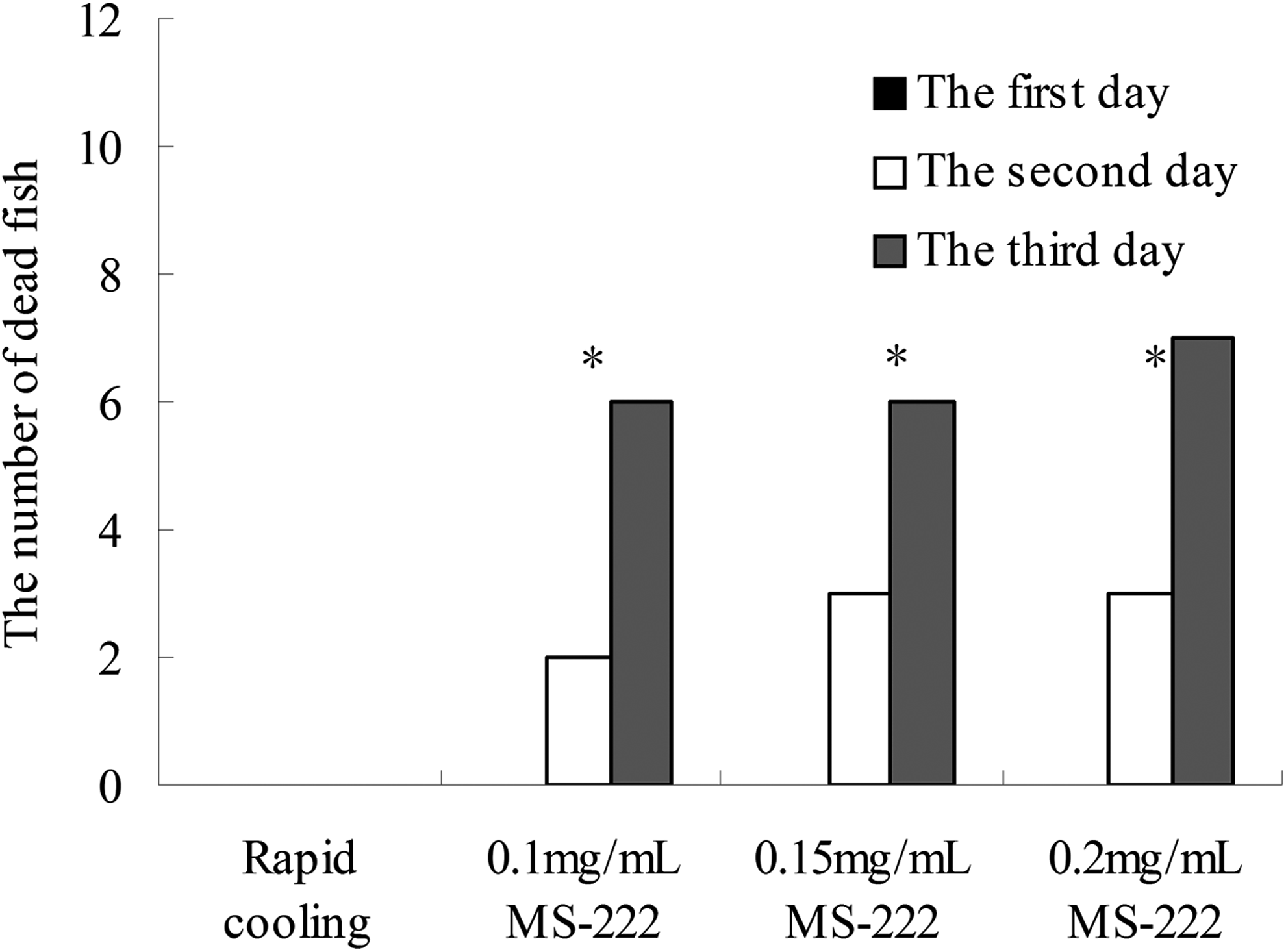
The mortality of zebrafish with rapid cooling is lower than that with Ms-222 (n=30). *p<0.05 compared to rapid cooling.
Survivability during rapid cooling anesthesia
To determine the survivability during rapid cooling anesthesia, the experiments that the 1–60-day-old fishes were exposed to in ice slush bath for 1, 10, 60 s, 5, 10, 15, 20, 30, 40, 50, 60 min were designed and the mortality was recorded (Fig. 4). Fish survival in response to rapid cooling increased with younger age, and the 1–14-day zebrafish showed zero mortality when they were exposed to the ice slush bath within 10 min. When the time for exposure was longer than 10 min or the fishes were older than 14 days, the mortality would be increased. The results indicated that the rapid cooling method was suitable for 1–14-day zebrafish and the anesthesia could persist for 10 min without a major threat to the life of zebrafish.
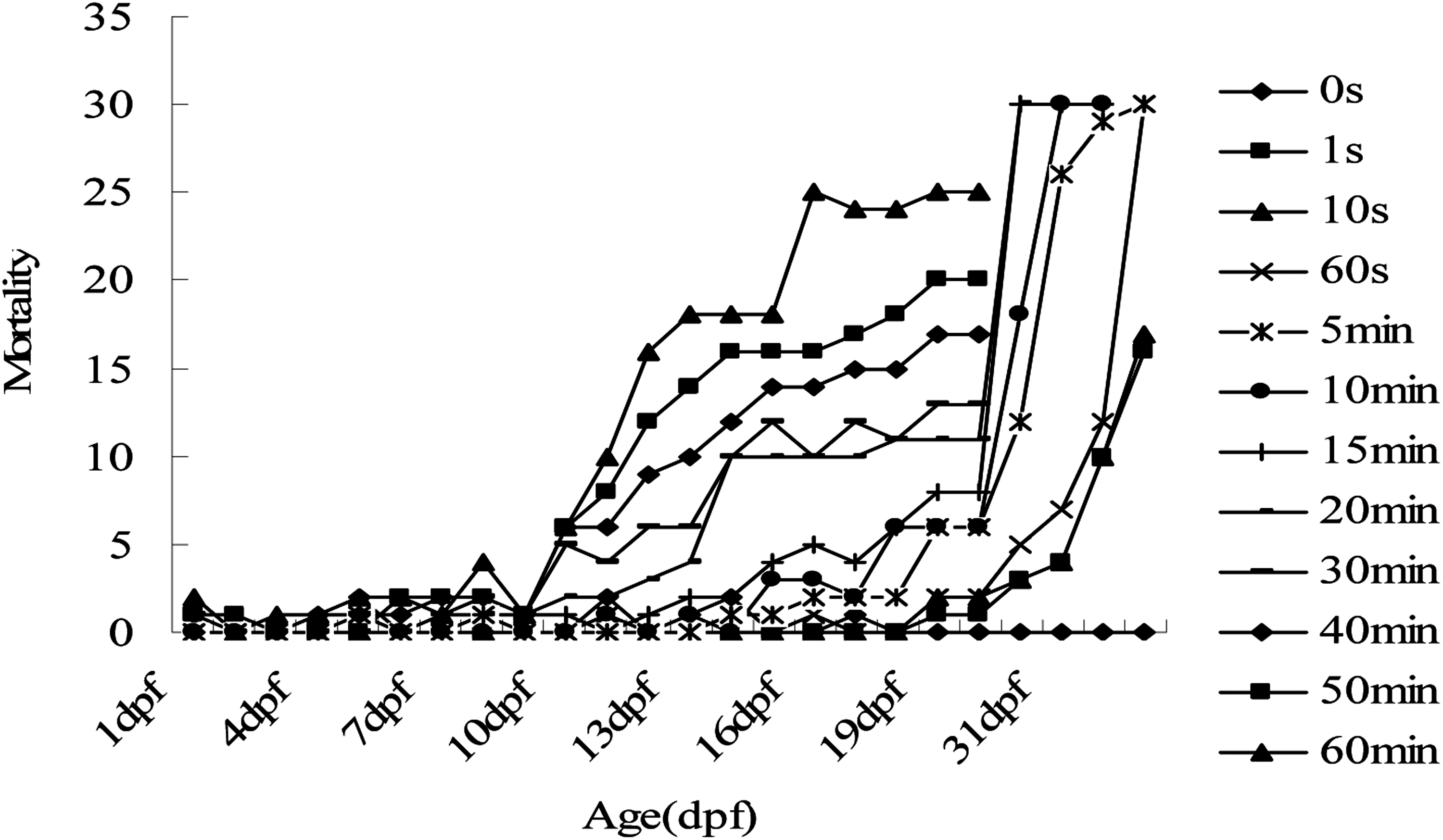
The mortality of zebrafish (1–60 days) for rapid cooling increases with older age (n=30).
The 7-day zebrafish were chosen to investigate the survivability of repeated rapid cooling anesthesia, and the results were consistent with the aforementioned conclusion that the zebrafish showed high survivability within 10 min for anesthesia on three consecutive days (Fig. 5).
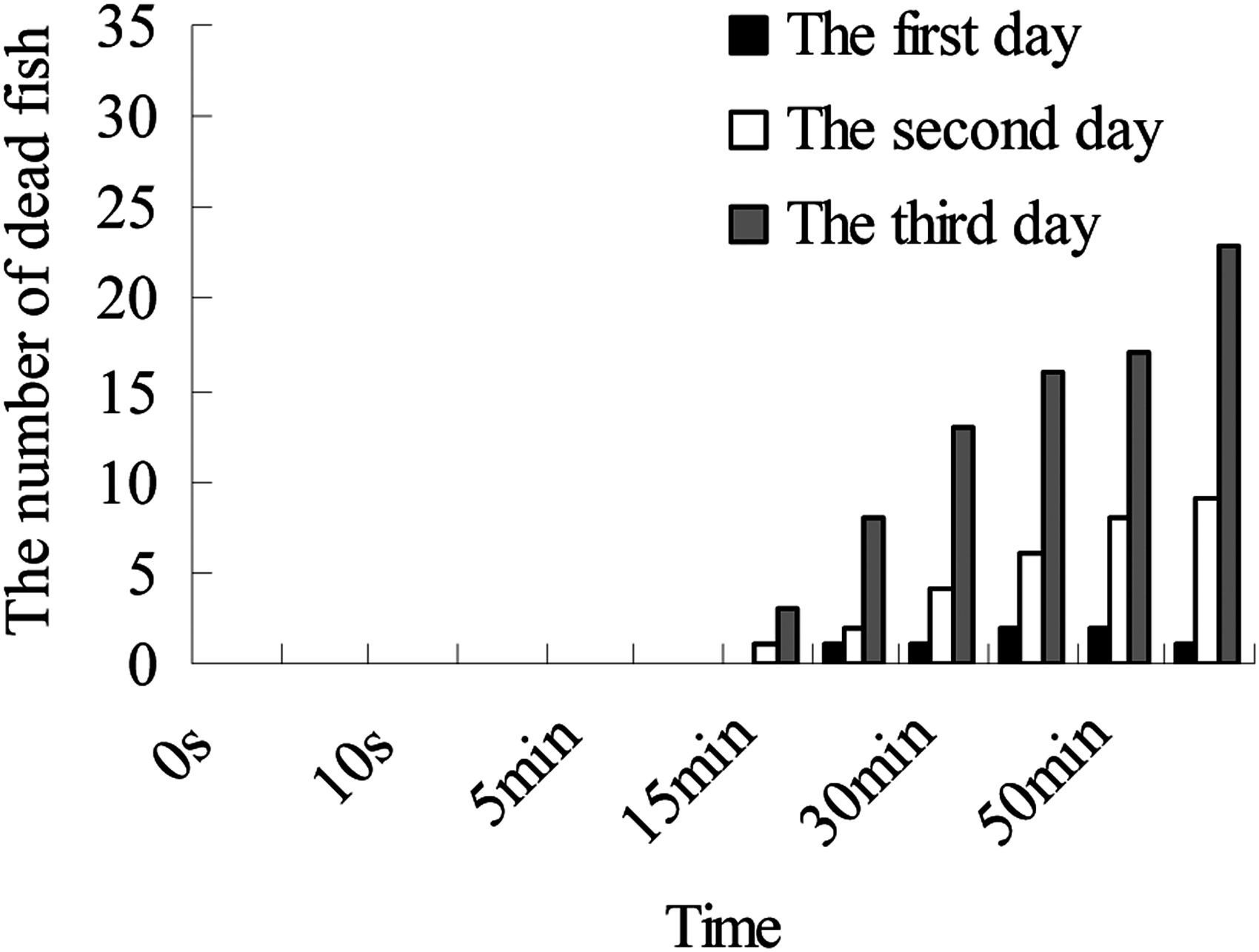
The 7-day fishes show high survivability within 10 min for rapid cooling anesthesia on three consecutive days and the mortality increases with the maintenance at chilled temperatures from 10 to 50 min (n=30).
Recovery from anesthesia for 10 min
As the results showing that the 7-day zebrafish presented high survivability within 10 min after rapid cooling anesthesia, the comparison between the rapid cooling and MS-222 anesthesia for 10 min were designed in this part. The time of recovery increased with the concentration of MS-222, but there was still a significant difference between rapid cooling and 0.2 mg/mL MS-222-treated group (p<0.05) (Fig. 6A). Besides, it was worth noting that the mortality was increased when the 7-day fish were exposed to 0.15 and 0.2 mg/mL MS-222 (Fig. 6B). Although the larvae anesthetized with 0.1 mg/mL MS-222 also showed low mortality, there were six fishes that regained consciousness during the course of anesthesia (data not shown).

The comparison between the rapid cooling and MS-222 anesthesia for 10 min in 7-day fishes.
Discussion
The data obtained from this study indicated significant differences between rapid cooling and MS-222 anesthesia in zebrafish. As expected, compared with MS-222, anesthesia was generally achieved within a shorter time for the rapid cooling method. In addition, the recovery time from anesthesia for rapid cooling was longer than that for MS-222 except the 0.2-mg/mL MS-222, the time of which was similar to rapid cooling. Although there was an obvious dose–effect relationship for MS-222 anesthesia that the time to anesthesia was reduced accompaniment with the increase of concentration, the mortality also increased possibly due to the accumulation in vivo. There were mortalities that occurred in the 0.1 mg/mL MS-222-treated group at the second day. However, no mortality occurred during the recovery from the ice slush bath. The series of experiments presented here suggested that rapid cooling was more effective than MS-222 for zebrafish anesthesia.
Repeated anesthesia is an important problem since the zebrafish may be used to perform experiments twice or even more times. The repeated anesthesia was performed in this research for the first time. The results showed that the rapid cooling anesthesia displayed better effectiveness than MS-222 anesthesia for repeated anesthesia, which could satisfy the requirement of scientific research.
The AVMA guidelines for euthanasia stipulate that adult zebrafish should be exposed for a minimum of 10 min and fry 4–7 dpf for at least 20 min for loss of operculum movement. 8 This suggests that different age zebrafish have different tolerance for rapid cooling and the young have a higher tolerance. In our study, based on the survivability data for fish from 0 to 60 dpf, we found that this is indeed the case. The rapid cooling method is suitable for larval fish, but not for older fish due to high mortality. However, this is the first report focusing on the survivability related to cold in larvae zebrafish and the detailed mechanism is still unknown. One possible mechanism is that the respiration of adult zebrafish is inhibited in ice water, but the embryo and larvae fish can complete the respiration using skin. 14
Our findings demonstrated that the rapid cooling introduced a more rapid anesthesia method with less mortality and a longer persistence time than done by MS-222, an anesthetic agent advocated by Food and Drug Administration. The rapid cooling was suitable for embryo and larvae zebrafish (1–14 days) and could be used for repeated anesthesia. The rapid cooling, which has some advantages, including low cost, improved safety, and potentially low mortality rates, appears to have promise as an effective and safe anesthesia method for scientific research.
Footnotes
Acknowledgments
This work was supported by the National Natural Science Foundation of China (grant no. 30971436, 31201010, and 81270376) and the Science and Technology Commission of Shanghai (no. 09XD1403100, 114119a8700, and 10JC1408900).
Disclosure Statement
The authors report no declarations of interest.