




Abstract
Abstract
The increasing use of adult zebrafish in behavioral studies has created the need for new and improved protocols. Our investigation sought to evaluate the swimming behavior of zebrafish against a water current using the newly developed Spinning Task. Zebrafish were individually placed in a beaker containing a spinning magnetic stirrer and their latency to be swept into the whirlpool was recorded. We characterized that larger fish (>4 cm) and lower rpm decreased the swimming time in the Spinning Task. There was also a dose-related reduction in swimming after acute treatment with haloperidol, valproic acid, clonazepam, and ethanol, which alter coordination. Importantly, at doses that reduced swimming time in the Spinning Task, these drugs influenced absolute turn angle (ethanol increased and the other drugs decreased), but had no effect of distance travelled in a regular water tank. These results suggest that the Spinning Task is a useful protocol to add information to the assessment of zebrafish motor behavior.
Introduction
The swimming behavior can easily be observed and quantified in controlled environments.4,5 The vast majority of studies evaluate the spontaneous locomotion in zebrafish as the main measure of behavioral activity, complemented by parameters such as velocity, freezing time, and turn angle.6,7 However, there is a lack of easy-to-use protocols for the assessment of locomotor abilities in zebrafish under more demanding circumstances, in a similar fashion to rotarod, used for testing motor dysfunction in rodents. 8 Such a protocol could be valuable for the evaluation of strength, resistance, and motor coordination in zebrafish.
Our goal was to develop a practical task to assess the swimming behavior against a water current, instead of still water, called the Spinning Task. To this end, we placed individual zebrafish in a beaker with spinning water and analyzed the total swimming time until they were dragged into the whirlpool generated by the stirrer. Additionally, we evaluated the effects of ethanol, clonazepam, valproic acid, and haloperidol, which are known to affect motor coordination in humans through different mechanisms, in the Spinning Task and in a general locomotor task in a regular tank.
Materials and Methods
Animals and maintenance
Adult (>8 months old) wild-type zebrafish (Danio rerio) with Tuebingen background9,10 of both sexes were used. All animals were from our breeding colony and kept in recirculating tank systems (Zebtec) under controlled conditions. They were kept on a 14–10-h day/night cycle, and two weeks before the experiments they were acclimated in groups of 50–60 fish in 20-L tanks kept at 28°C±2°C with water previously treated with Tetra's AquaSafe®(Tetra) (to neutralize chlorine, chloramines, and heavy metals) and filtered with Tetra Whisper® PF10 (Tetra). Fish were fed three times a day with commercial flakes and live Artemia sp (Alcon Basich).
Spinning Task apparatus and procedures
The Spinning test was conducted in a 1000-mL beaker (12 cm diameter) containing 800 mL of water and a magnetic stir bar of 9 mm in diameter×50 mm. This beaker was placed on top of a magnetic stirrer (Fisatom model 752A) and isolated with black walls, as represented in Figure 1, to avoid external interferences and increased fear.
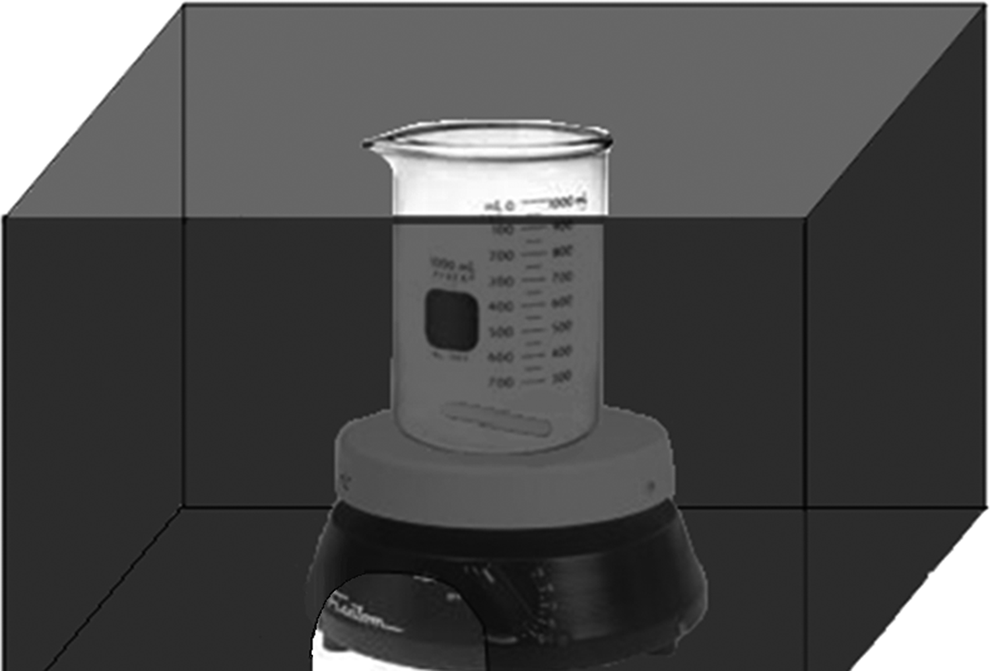
Design of the apparatus for the Spinning Task. A beaker on top of a stirrer is placed inside walls made of black cardboard.
Each fish was placed in the test beaker and allowed to habituate for 2 min to minimize the effect of stress and anxiety, since lack of habituation can increase anxiety. 11 During this time, fish explored the environment, usually moving from the bottom to the middle and upper portions of the beaker. The stirrer speed was then gradually increased for 20 s until the desired speed was reached, typically causing fish to move toward the bottom and toward the wall of the beaker.
Pilot studies were conducted with ascending speeds represented by levels 1, 1.5, 2, 2.5, 3, and 4 of the stirrer. We chose the speeds that are represented by numbers 2.5, 3, and 3.5, which correspond to 399, 492, and 585 rpm, respectively, according to the manufacturer's specifications.
Quantification of swimming time
The water current generated by the stirrer produces a visible whirlpool and fish tend to avoid being swept by the water whirl by swimming closer to the beaker walls. Using a stopwatch, the swimming time was defined as the latency of fish to be swept into the whirlpool. When fish were unable to swim against the current by any period, that is, they were immediately dragged by it, the swimming latency was defined as zero, as in the case of higher doses of ethanol.
Determination of fish size
Preliminary observations suggested that larger fish were able to swim for longer periods in the stirrer. Therefore, we categorized fish in two sizes (2–3 cm and 3.1–4 cm long) by photographing them from the top in a small tank with 1 cm of water (height) and a measuring grid as reference in the bottom and compared both groups in the Spinning Task.
Locomotion in a regular tank
To compare the results of the Spinning Task with a regular locomotion protocol in still water, different fish with the same characteristics were pretreated with the highest dose of each drug (30 min for ethanol) and placed in a rectangular glass tank (30 cm×15 cm×10 cm, length×height×width) with 2.7 L of drug-treated water. Fish behavior was video recorded for 10 min and the total distance travelled (m), time in the upper half (s), and absolute turn angle (o) were automatically analyzed by the Any-maze video tracking system (Wood Dale).
Light/dark task
The evaluation of anxiety was conducted with the light/dark task in a glass tank (18×9×7 cm, length×width×height) divided in equally sized dark and white compartments using black or white self-adhesive film externally covering the walls, floor, and the corresponding sides of the partition. 3 The tank water level was 3 cm and allowed zebrafish to swim freely from one side of the tank to the other. Fish were placed in the light zone of the apparatus and the time spent in both compartments was recorded during a 5-min session.
Chemicals
Clonazepam (Rivotril®; Roche), haloperidol (Haldol®; Janssen-Cilag), and ethanol (CAQ) were purchased from common commercial suppliers and valproic acid was purchased from Sigma-Aldrich.
Treatments
Fish were treated individually for 10 min in 600-mL beakers with 300 mL of water containing drugs, as described in Gebauer et al. 3 The test apparatus also contained the same drug treatment. The drug concentrations used were clonazepam 0.03, 0.1, and 0.3 mg/L, valproic acid 10, 30, and 100 mg/L, and haloperidol 0.3, 1, and 3 mg/L. For ethanol, treatment was conducted for 30 min at 0.025%, 0.08%, and 0.25% concentrations. Doses used were chosen based on previous works.3,12–14
Statistical analysis
Given the asymmetric data distribution, statistical analyses were performed with the Mann–Whitney test for comparison of two groups and the Kruskal–Wallis test with drug treatments as the independent variable, followed by the Dunn's test, for more than two groups. Significant differences between groups were considered for a p<0.05.
Results
Swimming time in the Spinning Task as a function of body size and gender
During preliminary testing, we realized that the fish size could influence the latency to be swept into the whirlpool, so we evaluated the swimming time classifying fish in two categories according to their body sizes (2–3 cm and 3.1–4 cm). As shown in Figure 2A, smaller fish had longer swimming times (U=47.50, p<0.05). Based on these results, we used only fish of 2–3 cm in length in subsequent experiments. In contrast, the comparison between males and females of similar size showed no significant differences (Fig. 2B).
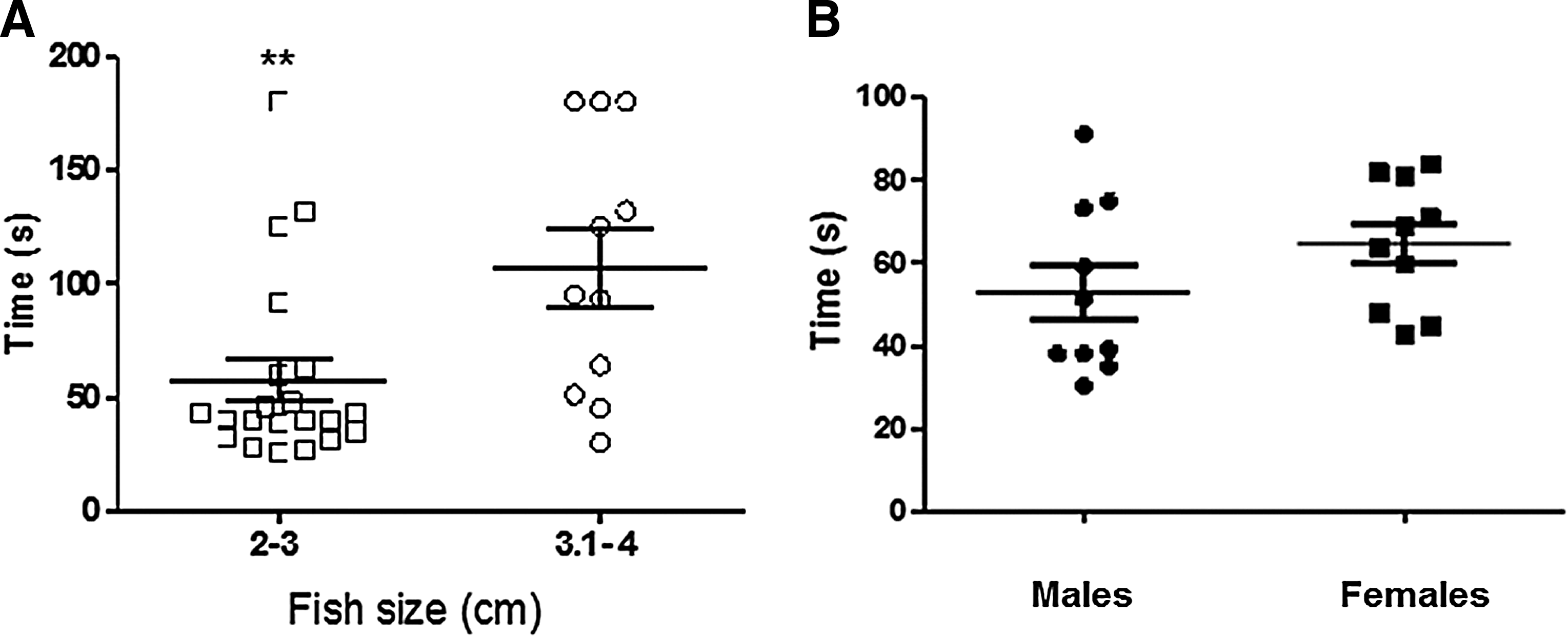
Swimming time in relation to fish size
Determination of rotation speed
We conducted a speed–response curve to characterize the optimum speed in which fish would swim for a sufficient time to be reliably measured but would force them to be eventually swept into the whirlpool. Figure 3 shows that increasing the speed significantly reduced the swimming time comparing 399 to 585 rpm (Kruskal–Wallis=12.90 p<0.05). We selected 492 rpm for further experiments.
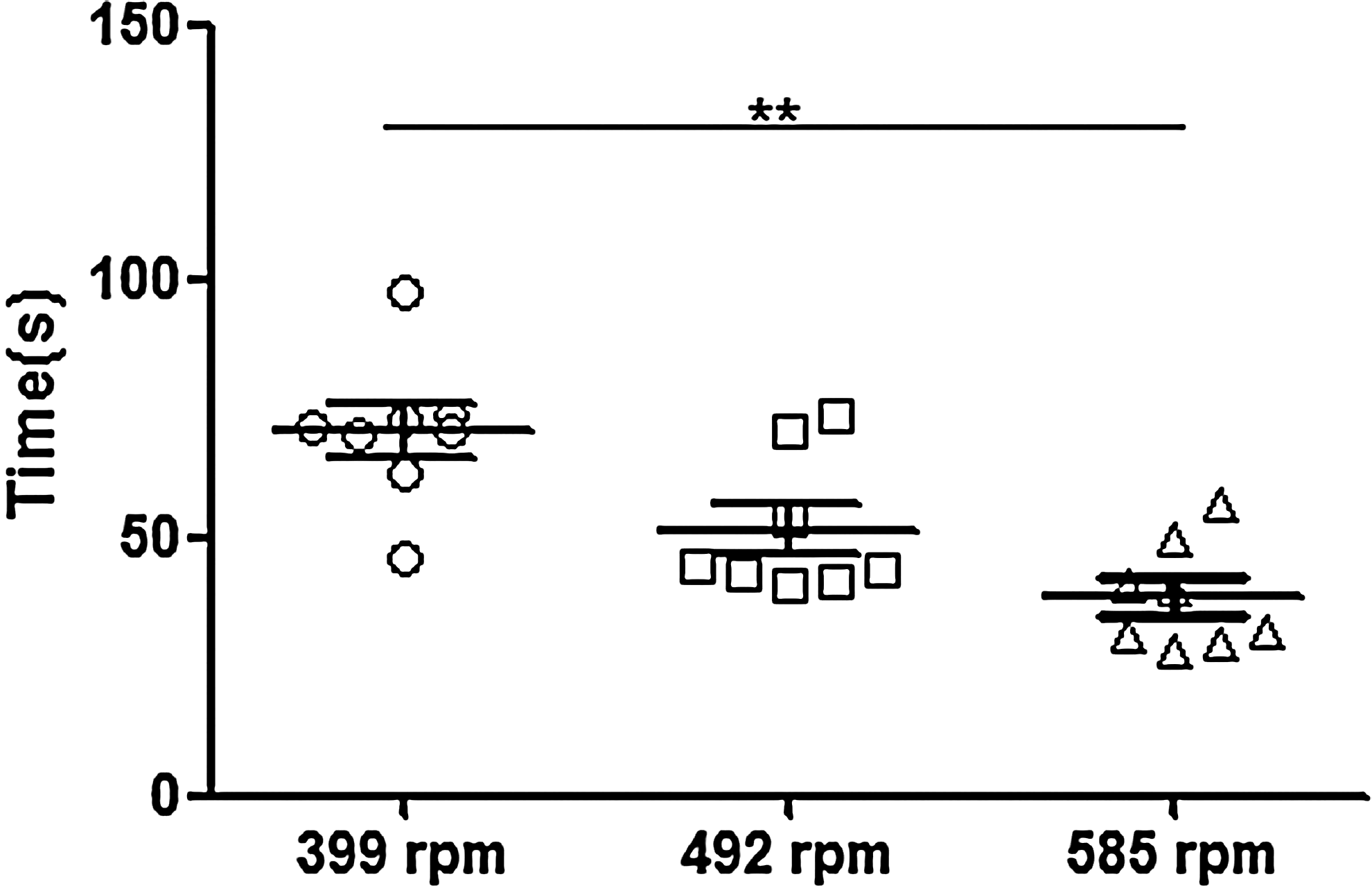
Swimming time according to spinning speed. At 399 rpm, the swimming time was significantly higher than 585 rpm. The selected speed for the other experiments was 492 rpm (**p<0.01).
Swimming time and locomotor parameters after treatment with clonazepam, valproic acid, and haloperidol
Compared to controls, the swimming time in the Spinning Task was significantly reduced in fish treated with clonazepam 0.3 mg/L, valproic acid 100 mg/L, and haloperidol 3 mg/L (p<0.05) (Fig. 4A, Kruskal–Wallis 68.03, p<0.05). The exploration of a regular tank by animals exposed to the higher doses of each tested drug showed no effect on the total distance travelled (Fig. 4B, Kruskal–Wallis=3.476 p>0.05). The absolute turn angle was significantly reduced in all groups (Fig. 4C, Kruskal–Wallis=15.69 p<0.05) and time in the upper half of the tank was lower in the valproic acid group (Fig. 4D, Kruskal–Wallis=8.257, p>0.05) when compared to controls.
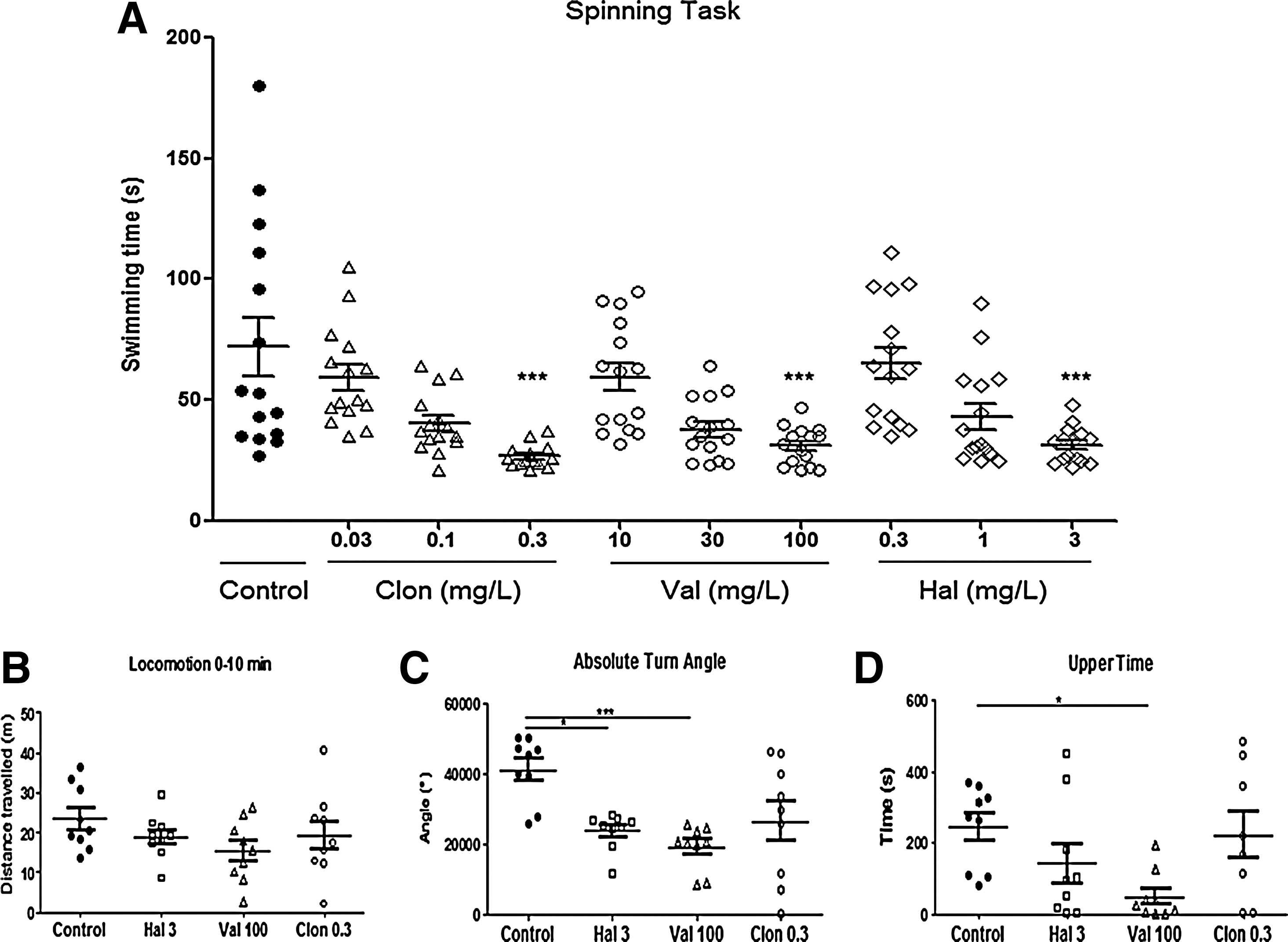
Effect of acute pharmacological treatments on swimming time in the Spinning Task
Swimming time, light/dark preference, and locomotor parameters after treatment with ethanol
Figure 5A shows that ethanol exposure for 30 min reduced the swimming time in the Spinning Task at a dose of 0.25% (Kruskal–Wallis=21.55 p>0.05). In the regular tank, 0.25% ethanol increased the absolute turn angle (Fig. 5D, U=14.00, p<0.05), but did not alter the time spent in the upper portion of the tank (Fig. 5E, U=50.00 p<0.05), and the distance travelled (Fig. 5C, U=41.00, p>0.05). To evaluate if possible, the anxiolytic effects of ethanol could be present at the doses tested, we evaluated its effect in the light/dark task. Figure 5B represents the time spend in the light zone with ethanol treatment, which was not different between groups at all doses tested (Kruskal–Wallis=3.741, p<0.05).
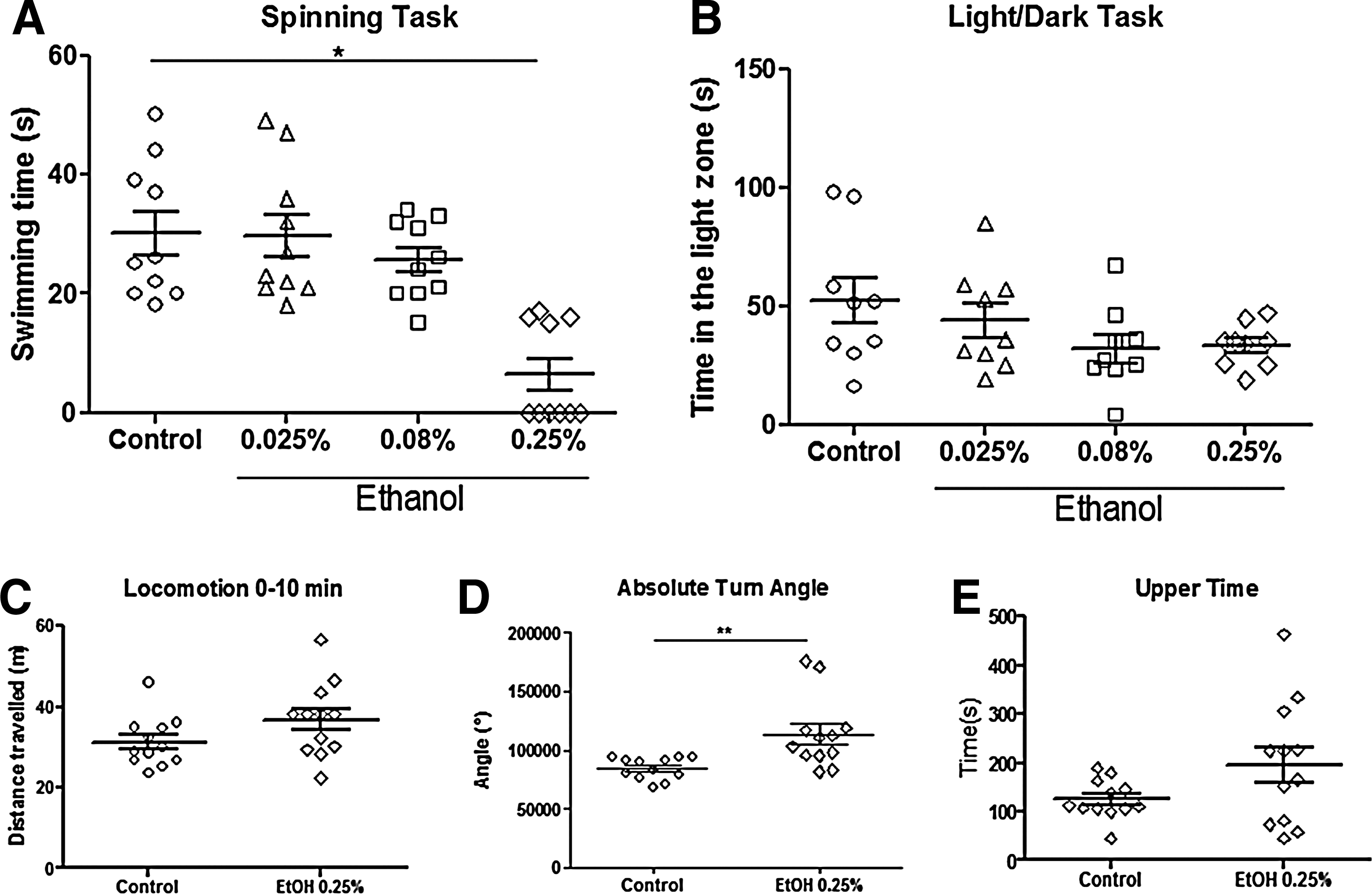
Effect of exposure to 0.25% EtOH in swimming time, light/dark task, and locomotor parameters in zebrafish. The swimming time was reduced in the Spinning Task at the dose of 0.25%
Discussion
Zebrafish has been increasingly used in neurobehavioral research, strengthening the need for protocols that allow easy assessment of their behavior. To our knowledge, motor coordination parameters have been well studied in larval zebrafish by evaluating specific body movements and performing kinematic analysis.15–17 In contrast, the evaluation of motor coordination in zebrafish has been mostly based on the assessment of exploratory locomotion in still water in novel tanks. 7
The Spinning Task here presented allows evaluation of swimming behavior and motor coordination of zebrafish against a water current., Since swimming time in control conditions showed a large variation, a ceiling time of 180 s was adopted. With this protocol, we observed that larger fish and lower rotation speed were associated with longer swimming time, without sex differences. For this reason, we selected 2–3 cm fish and the 492 rpm to promote sufficient swimming time in subsequent experiments.
We also evaluated the effects of different doses of haloperidol, valproic acid, clonazepam, and ethanol on performance in this task. All drugs decreased the swimming time in the Spinning Task in a dose-dependent fashion, with significant differences from control in the highest doses of the drugs tested. However, these same treatments failed to affect the distance traveled by the fish in a regular locomotion test in a rectangular tank, but altered turn angle. These results suggest that the subtle effects of psychotropic drugs on locomotor behavior may only be revealed under more demanding circumstances and for specific parameters.
Valproic acid has been used as an antiepileptic drug and mood stabilizer, but high doses of valproate may produce behavioral impairments, tremor, and less frequently, ataxia. 18 Treatment with up to 400 mg/kg valproate failed to alter spontaneous locomotion in rats, 19 but this dose affects rotarod performance in mice. 20 Accordingly, our results showed that valproic acid 100 mg/L reduces the swimming time against a water current and turn angle without significant changes in time in the upper half and spontaneous locomotion for a period of 10 min.
Haloperidol is a first generation antipsychotic drug used for the treatment of schizophrenia and is known for its high propensity to induce extrapiramidal effects in patients, for example, tremor, muscle stiffness, motor impairment, and slowness of movements due to high blockade of striatal D2 receptors. 21 Our results replicate previous reports that haloperidol does not induce changes in spontaneous locomotion in zebrafish at the dose of 0.003 g. 22 However, haloperidol at a dose of 3 mg/L showed a significant decline in the swimming time in the Spinning Task and absolute turn angle compared with the control group, indicating that haloperidol induces subtle changes in the mobility of zebrafish even when the distance travelled is not affected.
Ethanol induces well-known adverse effects of motor coordination, suppression of locomotor activity, and sedation in humans, 23 and such features can also be seen in other animals, including zebrafish.3,14 Ethanol acts on many difference systems, including GABAergic, dopaminergic, and noradrenergic as well as on voltage-sensitive calcium receptors. Clonazepam is a benzodiazepine, which acts by increasing the frequency of chloride channel opening, 24 at the same doses tested in our study, and produces minimal effects on spontaneous locomotion. Again, our results showed that a change in swimming behavior of zebrafish against running water is more sensitive to increasing doses of ethanol and clonazepam than spontaneous locomotion.
The performance in the Spinning Task does not seem to be associated with a nonspecific effect of drug treatment on anxiety. Time in the light zone in the light/dark task and time in the upper half of the tank reflect lower anxiety in zebrafish.3,25,26 Our results showed that valproic acid reduced and ethanol increased the time in this zone, but both impaired swimming in the Spinning Task. Moreover, ethanol 0.25% was able to reduce the swimming time in the Spinning Task at doses that did not affect time in the light zone in the light/dark task. Finally, haloperidol is devoid of anxiolytic activity and also impaired performance in the Spinning Task, suggesting that a reduction in anxiety is not required to affect locomotion against water current. However, we cannot completely rule out that effects other than on motor coordination do not interfere with performance in the Spinning Task.
The present data suggest that absolute turn angle is a sensitive measure of motor coordination, since it was affected by drug treatments at doses that failed to alter locomotion. However, clonazepam, haloperidol, and valproic acid decreased, whereas ethanol increased turn angle. In contrast, all four treatments diminished the swimming time in the Spinning Task.
Overall, our study suggests that swimming time in the Spinning Task is a sensitive parameter to evaluate motor coordination in zebrafish. The absolute turn angle was also sensitive to drug treatments at doses that did not affect spontaneous locomotion. These parameters add to the repertoire of behavioral assessment of zebrafish and may be used to evaluate subtle motor impairments induced by drug treatments and, possibly, genetic manipulations.
Footnotes
Acknowledgments
D.R.L. and M.R.V. are CNPq research fellows and A.R.B. received a student scholarship by CNPq. This study was supported by a grant from DECIT/SCTIE-MS through CNPq and FAPERGS (Proc. 10/0055-0 PRONEX).
Disclosure Statement
No competing financial interests exist.