




Abstract
Abstract
Tricaine methane sulfonate (TMS), often called MS-222, is the most common anesthetic used with fishes. Because it is very acidic (pKa about 3) it must be neutralized especially when used in soft fresh water. Much of the literature on fish anesthetics recommends neutralizing with bicarbonate. However, much of the zebrafish literature uses the protocol in “The Zebrafish Book” that recommends neutralizing with TRIS. Three considerations when comparing these buffers are: first, TRIS has the advantage that the pH tends to remain constant, whereas the pH of solutions containing bicarbonate tends to increase as CO2 diffuses from the water to air; second, the CO2 produced by bicarbonate may have some sedative effects in and of itself; and third, there is some evidence that the efficacy of TMS changes with pH. In the present study, we compared the efficacy of TMS using these two buffers and show that there is no substantial difference in anesthetic properties in zebrafish.
Introduction
T
The advantage of TMS being water soluble comes with the disadvantage of being very acidic (pKa about 3) and thus it must be neutralized, especially in fresh water. The fact that TMS must be buffered is not appreciated by all workers judging by four of the articles that we have recently reviewed and by inquiries from veterinarians that we regularly receive. Most reviews and references3,4 suggest neutralizing with sodium bicarbonate because it is inexpensive, readily available, and chemically stable. Common recommendations in the literature are ratios of either 1:1 or 1:2 by weight (TMS:sodium bicarbonate). The ratio 1:2 was recommended in one of the early articles using it in fish culture in the USA 6 and subsequently used by many workers in fresh water aquaculture. The ratio 1:1 appears more commonly in the research literature and is recommended in many reviews and in the Canadian Council Animal Care Fish Guidelines. 3 In contrast, much of the zebrafish literature uses the protocol in The Zebrafish Book 7 that recommends using TRIS to neutralize TMS, although some recommend bicarbonate. 8
Sodium bicarbonate and TRIS differ in three important aspects when used to neutralize TMS. First, adding sodium bicarbonate to acidic water results in the production of CO2 and CO2 has sedative effects in and of itself and thus may act synergistically or additively with the TMS. Second, the CO2 produced will diffuse from the water and thus the pH will gradually change with time. And finally, there are some reports that the efficacy of TMS changes with pH and thus efficacy may change as CO2 diffuses to the air and the pH changes.9–11
The aim of the present study was to compare the effects of using sodium bicarbonate with TRIS in buffering TMS on the water chemistry and anesthetic parameters. We reasoned that using sodium bicarbonate may be more efficacious at a common pH because of the increase in CO2 (CO2 has a sedative effect itself), but that the pH of the solution would be less stable.
Materials and Methods
pKa of TMS
The pKa of our TMS was estimated by titrating 50 mL of 0.05 M TMS with 0.05 M NaOH at 28°C. In this study, we used milli-Q H2O (>18 MΩ) for solutions and added NaOH every 30 s with a calibrated 1000 μL eppendorf pipette (we recorded the pH 25 s after addition of NaOH, i.e., when pH was stable). The equivalence point occurred after the addition of 53.36 mL and the pKa (pH after addition of 26.68 mL) was 3.64. Chemicals were weighed to 0.0001 mg and solutions were made up in volumetric flasks. The initial pH of TMS in milli-Q H2O was 2.52. Temperature and pH of the anesthetic solutions were measured with a pH meter (Oakton model 510) and electrode (Beckman Coulter; model 2812 calomel pHfree; standard pH electrodes are easily clogged with TRIS).
Fish
Zebrafish (D. rerio) were obtained from a local pet store and maintained in 40 L tanks at 28.3°C±0.4°C (mean±standard deviation). They were fed flake food three times daily (NutrafinMax; Hagen Ltd.) with automatic feeders (model 3581; Ehiem) and maintained on a 12/12 h photoperiod. Deionized water was supplemented with Nutrafin aqua plus (5 mL/40 L; Hagen Ltd.), EasyBalance (5 mL/40 L; Tetra Holding, Inc.), and sea salt (2 g/40 L; D-D the Aquarium Solutions Ltd.). Fish were acclimated to holding conditions for 2 months before the experimental trials. All experiments were performed in accordance with the CCAC guidelines and were approved by the local Animal Care Committee at the University of Prince Edward Island Atlantic Veterinary College (AUP 13-046).
The test arena for anesthesia was a standard zebrafish holding tank (Aquatic Habitats 1 L) modified with a partition 5 cm from one end that contained a small submersible pump (Resun model SP-800) to create a slow water flow in the arena. Thus the test section of the arena was 17×4×6.5 cm deep. The recovery chamber was an 8×3.5×3.5 cm deep plastic tank (100 mL) with sand on the bottom. Holding tank water was used to make anesthetic and recovery tank water. Fish behavior was recorded continuously during the trial with a camcorder (model GZ-VX700; JVC) at 1920×1080 at 30 fps for later analysis. Dissolved CO2 was measured using an OxyGuard carbon dioxide analyzer and stir chamber calibrated with their solutions (OxyGuard Company). This probe measures only physically dissolved CO2.
Behavior
We examined the videos for some general aspects of behavior to measure if there was a difference associated with the buffer used. In particular we examined the videos during the first 30 s after placing the fish in the chamber containing anesthetic. We counted the number of piping events (apparent gulping of air at the surface); activity level (0=sitting on bottom, 1=occasional movements, 2=slow continuous exploratory behavior, 3=occasional rapid exploratory behavior, 4=occasional frenetic escape behavior, 5=continuous frenetic escape behavior); and rate of opercular movements. We also looked for gill bleeding as a marker of adverse effects of TMS.
Anesthetic efficacy
For each trial, a fish was transferred from the holding tank to the anesthetic tank and left until it failed to respond to the slow water current with any movement of the fins or tail, but all fish still showed some respiratory movements. Then the fish was immediately transferred to the recovery tank and left until it swam spontaneously more than five lengths of the recovery chamber (i.e., swam 45 cm). The initial pH of the tank water varied from day to day from 6.0 to 7.0. Aeration of tank water for 5 min resulted in an increase in pH of about 0.1 and addition of 100 mg/L TMS resulted in a pH decrease to about 3.6.
Videos were analyzed and the times to the nearest second to each of the following metrics was timed for each fish using the time stamp on the video:
- Loss of equilibrium=10 s continuous record with failure to maintain normal horizontal attitude. - No response=paralysis except for respiration; no movement of tail or fins in response to slow water flow. - Regain equilibrium=fish upright and with normal horizontal attitude. - Swimming=time to swim spontaneously five lengths of the recovery chamber, that is 45 cm.
Two stock solutions were prepared: one exactly as described in The Zebrafish Book 7 with 400 mg TMS plus 2.1 mL 1 M TRIS/100 mL milli-Q H2O (i.e., 4000 mg TMS/L and 0.021 M TRIS); the other stock solution was the same, but with no TRIS and was used in the bicarbonate buffer trials.
Experiment 1: 100 mg TMS/L; 100 mg NaHCO3/L
In these trials we used a TMS concentration of 100 mg/L (0.38 mM) presuming that this concentration would provide good resolution power regarding anesthetic induction time. Further, we used a 1 TMS:1 sodium bicarbonate (w:w) ratio because this ratio often is used in the field. 3 Working solutions of 100 mg TMS/L were made by adding 20 mL of stock to 800 mL of tank water and then aerating for 5 min. TRIS buffered working solutions were prepared using the stock containing TRIS. Bicarbonate buffered working solutions were made with the stock solution with no TRIS, but adding the same amount of bicarbonate as TMS (i.e., 80 mg/800 mL; 1.2 mM). The final pH at 28°C was adjusted to 7.0 by titrating with 0.1 N NaOH or 0.1 N HCl as recommended in The Zebrafish Book. 7 We treated 26 fish with TRIS buffer and 19 fish with sodium bicarbonate buffer.
Experiment 2: 168 mg TMS/L; 336 mg NaHCO3/L
In these trials we used a TMS concentration of 168 mg/L (0.64 mM) because it is the dose recommended in The Zebrafish Book 7 and used by many zebrafish researchers. Working solutions of 168 mg TMS/L were made by adding 33.6 mL of stock to 800 mL of tank water and then aerating for 5 min. TRIS buffered working solutions were prepared using the stock containing TRIS. Bicarbonate buffered working solutions were made with the stock solution with no TRIS, but adding twice the amount of bicarbonate as TMS (i.e., 268.8 mg/800 mL; 4.0 mM). The higher concentration of bicarbonate was used in these trials because the 1:1 ratio in Experiment 1 did not completely neutralize the TMS and because a ratio of 1 TMS:2 sodium bicarbonate is recommended in the original article on the topic. 6 The pH after adding TMS and TRIS was 7.5 at 28°C. We treated 13 fish with TRIS and 12 fish with bicarbonate.
Chemicals
Aqua Life TMS was from Syndel Laboratories Ltd.; Ultra-pure TRIS base 1.0 M, pH 10.0 (CAS 77-86-1) was from Amresco LLC.
Statistics
In both experiments the raw data for anesthetic and recovery times were not normally distributed and required transforming. After Box–Cox transforms, all variables met criteria of normality (Ryan-Joiner, p>0.10) and homogeneity of variance (F-test, p>0.10). For parameters during anesthesia, treatments were compared using a one-way analysis of variance (ANOVA). For parameters during recovery after anesthesia, treatments were compared with a one-way analysis of covariance (ANCOVA) with time in TMS during anesthesia as the covariate because time in TMS during anesthesia differed between fish. Medians were used to estimate central tendency because the distributions were not normal. Error bars in the graphs are 95% confidence intervals 12 ; standard errors should not be back-calculated from transformed values. 13 Fisher's exact test was used to test the effect of buffer on the occurrence of piping behavior. General activity levels after being placed in the anesthetic solution were tested using Student's t-test.
Results
The pH of unbuffered 100 mg/L TMS in milli-Q water was 2.96. The anesthetic and recovery times varied considerably between fish. In both experiment 1 and experiment 2 when TRIS was used as the buffer, the CO2 as measured with the CO2 probe was not detectable (i.e., <1.0 mg/L). When NaHCO3 was used as the buffer, the initial CO2 in experiment 1 was 13 mg/L and in experiment 2 was 23 mg/L; CO2 invariably decreased as the experiment progressed (Fig. 1). The initial pH was 7.0 in both buffer trials; the final pH was 7.1 in the TRIS buffer trials and was 7.6 in the NaHCO3 buffer trials.
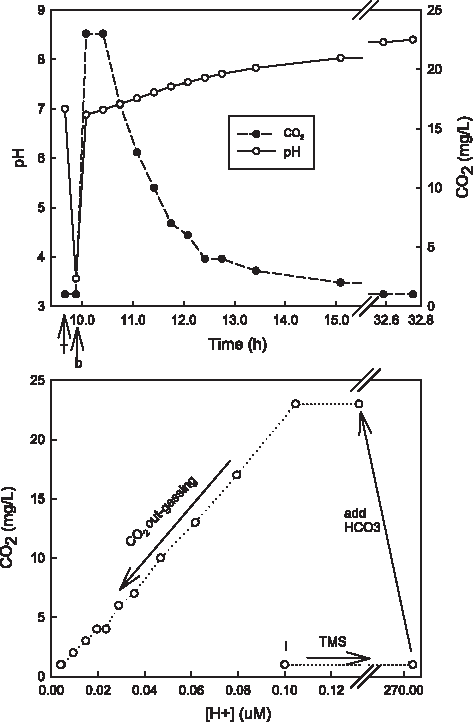
Change in pH, [H+] and CO2 with the addition of tricaine methane sulfonate (TMS) and then NaHCO3 to tank water. Top panel shows the initial decrease in pH with the addition of TMS (168 mg/L, indicated by arrow T at 9:48) and then the increase in pH and CO2 with the addition of the NaHCO3 (indicated by arrow b at 9:55). When the solution was stirred but not aerated, then the slow out-gassing of CO2 resulted in a gradual decrease in CO2 levels in the water and a concomitant increase in pH (decrease in [H+]). The lower panel shows that the decrease in CO2 during out-gassing is related in a linear fashion to a decrease in [H+]; I, initial values; TMS arrow, effect of adding TMS; HCO3 arrow, effect of adding NaHCO3; followed by the linear decrease in [H+] as CO2 diffuses from the water to the air.
In experiment 1 with 100 mg/L TMS, there were no significant differences between the buffer treatments during anesthesia either for time to loss of equilibrium (ANOVA, F1,43=1.59, p=0.21; Fig. 2A) or time to no response (ANOVA, F1,43=0.65, p=0.43; Fig. 2B). There was no significant difference in the total time exposed to TMS between the two experimental groups (ANOVA, F1,43=0.18, p=0.67). Total time exposed to TMS was not significant in the ANCOVA either for time to regain equilibrium (F1,42=0.67, p=0.15) or for time to swim 45 cm (F1,42=0.13, p=0.72). Similarly, there were no significant differences between the buffer treatments during recovery either for time to regain equilibrium (ANOVA, F1,42=2.12, p=0.15; Fig. 2C) or for time to swim 45 cm (ANOVA. F1,42=0.52, p=0.48; Fig. 2D). Even after transformations, there were a few outliers (values with standardized residuals >2); deleting these outliers did not change the outcome of no significant difference between the treatment groups.
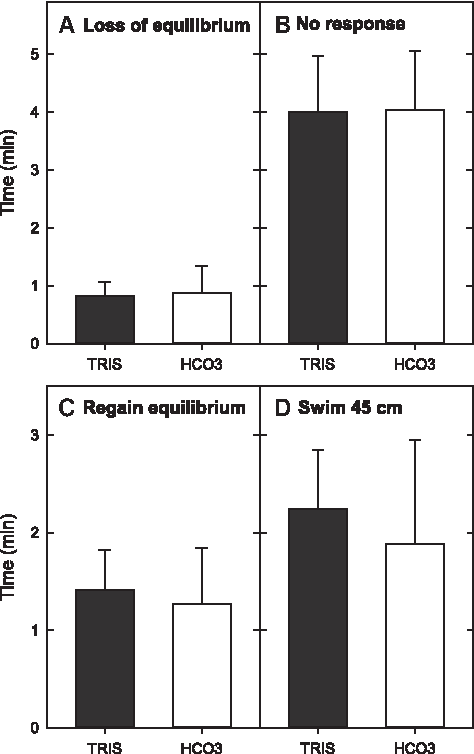
Effect of the type of buffer used with TMS (100 mg/L) in experiment 1 on anesthesia
In experiment 2 using the dose of 168 mg TMS/L recommended in The Zebrafish Book, 7 there were no significant differences between the buffer treatments during anesthesia either for time to loss of equilibrium (ANOVA, F1,23=0.01, p=0.91; Fig. 3A) or time to no response (ANOVA, F1,23=3.13, p=0.09; Fig. 3B). There was a significant difference in the total time exposed to TMS between the two experimental groups (ANOVA, F1,22=4.63, p=0.04); time in TMS during anesthesia was used as a covariate to test for treatment differences during recovery. There was a small, but significant difference between the buffer treatments during recovery for time to regain equilibrium (ANCOVA, F1,22=4.92, p=0.04; Fig. 3C), but not for time until fish swam 45 cm (ANOVA. F1,22=3.22, p=0.09; Fig. 3D). Even after transformations, there were a few outliers (values with standardized residuals >2); deleting these outliers did not change the outcome between the treatment groups. There was an increase in recovery times with an increase in time exposed to TMS during anesthesia in experiment 2 (Fig. 4). The initial and final pH value in the TRIS buffer trials was 7.5; the initial and final pH values in the NaHCO3 buffer trials were 7.0 and 7.4, respectively.
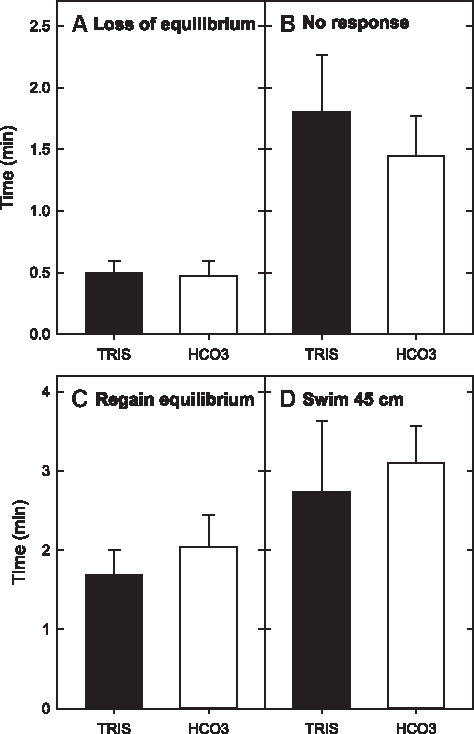
Effect of type of buffer used with TMS (168 mg/L) in experiment 2 on anesthesia
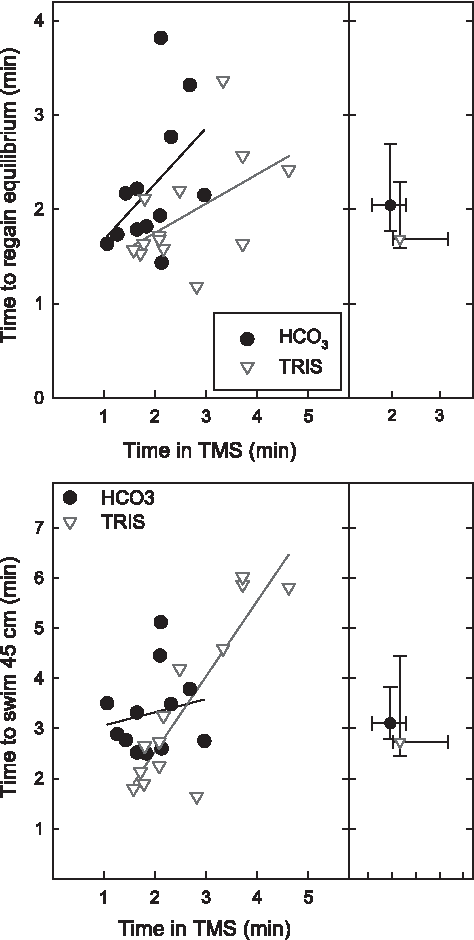
Effect of total time exposed to TMS (168 mg/L) in experiment 2 on recovery times in zebrafish. Values in right panels are medians with 95% confidence intervals.
Behavior
There were no mortalities during the experiments and all fish were still alive months later. We did not see any gill bleeding in any fish for either treatment in either experiment (data not shown). All fish in both treatments showed an increase in rate of opercular movements when placed in the anesthetic solution. There was no significant difference associated with treatment in the number of fish piping in experiment 1 (Fisher's exact test, p-value=0.21; 7 of the 45 fish tested showed some piping behavior; Fig. 5A). In experiment 2 none of the fish in either treatment showed any piping (Fig. 5B). There was no significant difference in the general level of activity associated with buffer treatment after being placed in the anesthetic solution in experiment 1 (T=0.08, p-value=0.93; Fig. 5C) or in experiment 2 (T=1.71, p-value=0.10; Fig. 5D).
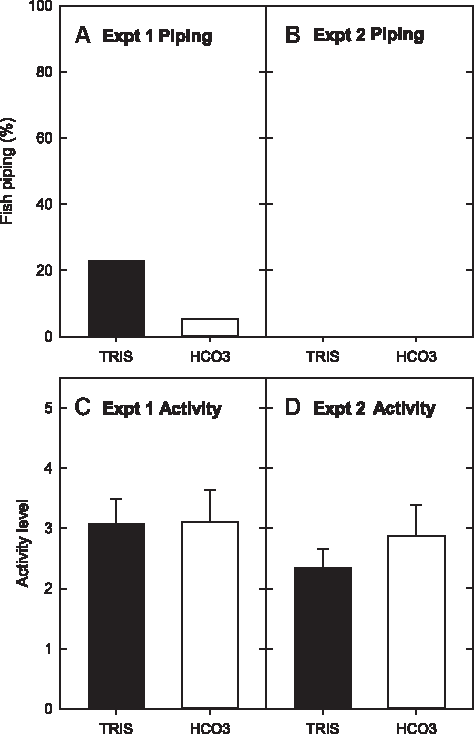
Effect of the type of buffer used and TMS concentration (100 mg/L in experiment 1; 168 mg/L in experiment 2) when exposed to the anesthetic solution on piping behavior
Discussion
The results of the present study showed that the CO2 produced by the addition of bicarbonate was not sufficient to act synergistically or additively with the tricaine to significantly reduce anesthetic induction time. Insofar as we can determine, the possible synergistic effect of CO2 from the bicarbonate with the anesthetic has not been tested previously. The anesthetic effects of CO2 in fish have been known for a long time, first described by Fish 14 and reviewed by Ross and Ross. 4 It has been used by bubbling water with CO2 gas, adding dry ice, or adding bicarbonate (with or without acid) to the water.15–18 The observation that CO2 has efficacy when added as acid (dry ice) or as base (NaHCO3), and has a sedative effect even if the solution is buffered to neutral pH 15 suggests that the sedative/anesthetic effect is due to the direct effect of CO2 and not due to the change in pH of the water. CO2 also is commonly used as an anesthetic for terrestrial and aquatic invertebrates.19–21 In vertebrates, CO2 has been used by muscle physiologists to change intracellular pH (pHi) because it penetrates the sarcolemma with ease. 22 Thus, it seems likely that its use to sedate/anesthetize/euthanize is due to the fact that it penetrates cell membranes with ease and decreases pHi. Most interestingly, in amphibian muscle, a decrease in pHi has an effect similar to that of tricaine; it nearly eliminates inactivation of voltage gated Na-channels. 23 However, cells have a complex machinery to regulate pHi and it is likely that we did not see any effect of the added CO2 in the present experiments because the amount of CO2 added was not enough to overwhelm that machinery.
We have no mechanistic explanation for the small (average=18 s) but statistically significant difference in time to regain equilibrium when using the bicarbonate buffer in experiment 2.
Mixing sodium bicarbonate with acid results in the production of CO2 as most of us remember from our grade 5 volcano science project using baking soda (sodium bicarbonate) and vinegar (acetic acid). Mixing bicarbonate with TMS has the same effect, but because the concentrations are low there is no volcanic froth. TMS is a 1:1 mixture of tricaine (a weak acid, pKa about 3.5) and methanesulfonic acid (a strong acid, pKa about 1.75); TMS completely dissociates in water, likely with the positive charge on tricaine at the amino group. 24 Adding bicarbonate or TRIS titrates this charge rendering the tricaine less charged, more lipid soluble, and thus more diffusible through gill membranes. In an open system, and a fish anesthetic container is invariably an open system (i.e., open to the atmosphere), this production of CO2 will increase the PCO2 in the container such that it is much greater than in air—thus, CO2 will diffuse from the fish container to the air. The rate that CO2 diffuses into the air will depend on the extent to which the water is mixed (either with a mixing device or by the activity of the fish) and the extent to which the water in the container is aerated. Over time, the CO2 concentration in the anesthetic container will decrease and the pH will increase. The Henderson–Hasselbalch equation cannot be used to estimate CO2 because the system is not in equilibrium until the PCO2 in the fish container equilibrates with that in the surrounding air. Assuming that TMS is a strong acid and that each mole added would remove 1 mol of bicarbonate that is outgassed as CO2 and pKa value of 6.35 for bicarbonate, 25 then the predicted pH value at equilibrium would be 8.8 at 28°C. Our observed pH values were less than this because in experiment 1, acid was added to bring the initial pH close to 7. Moreover, in both experiments the solutions were not aerated and the fish chamber CO2 values did not equilibrate with air values during the experiment.
As suggested above, the efficacy of TMS depends on pH (Fig. 6). Figure 6 shows results from a number of experiments on amphibians and fishes. All the results show that there is an increase in induction time as pH decreases with a marked increase at the very low pH that occurs when TMS is used unbuffered in soft water. Even in medium hard water with an initial pH of about 8, neutralizing the acidification that occurred when TMS is added results in a decrease in induction time in three species of fish (carp, tilapia, rainbow trout) at three doses of TMS. 11 Similarly, seawater, which contains a relatively high concentration of bicarbonate, is acidified about 1 pH unit by the addition of normal anesthetizing concentrations of TMS (100 mg/L) and it is likely that induction times would be decreased by neutralizing the acidification.
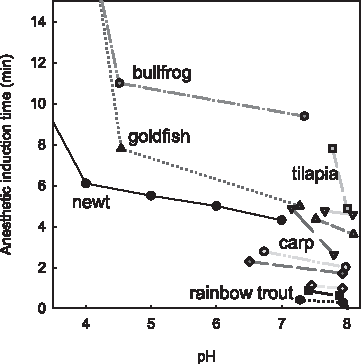
Results from three studies all showing that acidification is associated with an increase in TMS anesthetic induction time in both amphibians and fishes (i.e., neutralizing the TMS decreases induction time). Open circle, newt 10 ; closed triangle up, goldfish; hexagon, bullfrog 9 ; three fish species: carp, tilapia, rainbow trout; each at three concentrations of TMS. 11
Examining the videos immediately after fish were placed in the anesthetic solutions revealed very few untoward effects. The one result that seems relevant is that piping behavior was only observed at the lower concentration of TMS with no significant difference related to buffer type, but was never observed at the higher concentration of TMS. Thus it seems likely that lower concentrations may result in stress behaviors, but that at the typical higher concentration used the fish is anesthetized before these behaviors occur.
In conclusion, TMS is an acid and its addition to water reduces the pH to a value that depends on the buffering capacity of the water. However, even in hard water or seawater there is an acidification sufficient to increase anesthetic induction time. In this study, we show that there is no substantial difference in using either TRIS or sodium bicarbonate to achieve that result, but that the pH of the solution is less stable using bicarbonate. The CO2 produced by the addition of sodium bicarbonate was not enough to significantly alter induction times in solutions containing the anesthetic TMS.
Footnotes
Acknowledgments
Funding support was provided by Sir James Dunn Animal Welfare Centre to J.S. and E.D.S. and from NSERC to E.D.S. The authors thank Dr. Luis Bate for providing laboratory space for the study.
Disclosure Statement
No competing financial interests exist.