




Abstract
Abstract
This research aims to describe the effects of a variable number of Danio rerio fish subjects, ranging from one to eight, in the light/dark box preference test. Four hundred eighty adult male short-finned phenotype zebrafish were tested in the light/dark box. There were four groups in this experiment and a different number of subjects was used in each group: the control group had only one subject, whereas the experimental groups had either two, four, or eight subjects simultaneously inside the apparatus in every session. The average occurrence (AO) of subjects in the white side of the aquarium and the first choice average (FC) were recorded. The AO revealed no difference between the control group and test groups with two and four subjects. The results for the test group with eight subjects showed significant difference when compared to the control group and from the test group with two subjects. The FC also showed no difference between the control group and test groups with two and four subjects. There was significant variation between the control and the test group with eight subjects. The results reflect a conflict between the animal's preference for dark places and the innate drive to explore new environments. Zebrafish are highly social animals, exhibiting preference for swimming in groups and other patterns of social cohesion. The reduced white avoidance behavior in the test group of eight subjects may possibly reflect the role of shoaling, which is a defensive behavior, in reducing anxiety and stress. On the other hand, the absence of difference between the control group and test groups with two and four subjects suggest that it is feasible to run the light/dark test with up to four subjects, becoming an alternative to streamline and simplify data collection and test analysis.
Introduction
Z
Anxiety and the light/dark test
Tests like the light/dark test are based on novelty paradigms and are commonly used in behavioral neuroscience to study fear and anxiety. 11 According to McNaughton and Corr, 12 anxiety is most often generated by concurrent and equivalent activation of fear and risk assessment systems. The particular set of responses depends on the perceived threat.13–16 Thus, risk assessment behaviors, like thigmotaxis (swimming next to walls), stretching posture to observe, and different exploratory distribution in threatening and safe situations are seen in situations where the risk is low. 17 This can be observed in tests like the open field, the elevated plus maze, and the light/dark box.
The light/dark test has gained behavioral validity for some fish species (Cardinal-tetras Paracheirodon axelrodi; lambaris Astyanax altiparanae; Nile tilapias Oreochromis niloticus; guppies Poecilia reticulata; and banded-knife fish Gymnotus carapo), including zebrafish. 6 To establish pharmacological validity, the light/dark test with the Danio rerio 8 species used several drugs, such as lysergic acid diethylamide (LSD), 18 acute or chronic fluoxetine, buspirone, benzodiazepines, moclobemide, caffeine, ethanol, and dizocilpine. 19 Other variables, like the effects of the forced exposition to a white chamber, lightness level (250 and 500 lux), 20 effects of alarm substance, 21 methylmercury, 22 and the effects of circadian cycle, 23 have also been tested. The results have altogether demonstrated that this method can be useful to assess anxiety-like behaviors in Danio rerio, showing consistency in the dark preference behavioral pattern, which is responsive to test manipulations. Such findings render the model a large face, use and predictive validity as an animal model of anxiety for this species.
Shoal
Zebrafish are highly social and prefer swimming in groups. Social cohesion in zebrafish is exhibited through social interactions, shoaling, boldness, aggression, and social preference.24,25 Being part of a group helps to avoid predators, to travel efficiently, to acquire food, 26 and to reproduce more successfully. 27 According to Spence et al., 4 forming schools is a natural zebrafish behavior and shoaling initiates subsequently to the eggs hatching. 1 In addition, fish created in isolation quickly form schools when placed in the company of other fish 28 and show preference for joining others similar to the ones with which they were raised, even if they have different phenotypes, just like in an imprinting phenomenon of social preference acquisition during early development. 29
The shoaling behavior increases in threatening situations and in response to a pheromone released as a result of injury to epidermal cells.1,30–32 This shows that shoaling is relevant in predator avoidance. According to Rehnberg and Smith, 33 in the presence of threat there is greater group cohesion, with agitated swimming or subject's immobilization close to the substrate. These behaviors increase the individual's survival probability since fish schools are more likely to detect predators than an isolated fish. 34
The shoaling behavior seems to have reinforcing properties, 29 reducing anxiety and stress in fish. This is evident in the effects of different drugs in behavioral tests. In shoaling tests, in which the distance between conspecifics are measured, zebrafish exposed to anxiolytic substances, like LSD 18 and alcohol, 35 had the distance between subjects altered. Alcohol is a stimulating substance in lower doses and an inhibitor in higher doses. As expected, alcohol reduced the distance between subjects in lower doses and increased in higher doses. 35 LSD was proven to enhance inter-fish distance in this test. 18 Meanwhile, the alarm substance, a substance known for its anxiogenic and stressor effects, has reduced the distance between subjects. 31 Altogether, these results suggest that shoaling behavior reduces anxiety and stress responses in zebrafish, since social cohesion is an indicator of anxiety. 31
Computational simulations in laboratory have been successful in forecasting migratory movements in groups and schools movements based on temperature, salinity, and other ecological variables.36–38 According to Romey, 39 the study of schools can be done in two ways. One way is to use models of population dynamics that investigate the size and the group's displacement as a whole among the environment. Another way is to use behavioral models, which investigates the movement of individuals within the group. This study helps to elucidate how light variations play a vital role in computer algorithms/simulations that predict movement.
The factors that contribute to the animal's decision to initiate a movement include momentary contingencies and variables, such as hunger, exposure to predators and temperature, as well as durable and morphological variables, which include size, age, lipid levels, parasites, and genetic predisposition.40–46 The position of each individual in schools, seems to be due to the relative position of other group members, in an attraction and repulsion chain, in which an individual is attracted to conspecific members, unless they get too close, and if so, turning away. 39
Behavioral models are used to gather information about behavior. Moreover, they need to better detect and point out the changes in brain and behavior. With the study of the light/dark preference test applied to groups, we expect to verify the influence of conspecifics on the behavior of isolated individual group members. In the absence of significant change in behavior, group tests become an alternative to streamline and simplify data collection and test analysis.
Objective
This research aims to describe and analyze the effects of a variable number of Danio rerio subjects, ranging from one to eight, on the light/dark preference test. To develop a more efficient data collection and to achieve an increased throughput test, we will also verify the feasibility of running the light/dark test with more than one subject.
Materials and Methods
Subjects
Four hundred eighty adult male short-finned phenotype zebrafish were acquired from a local pet shop and only experimentally naive fish were used in the experiments. They were kept in the laboratory for at least 2 weeks before the experiments, housed in two collective 30 L tanks (240 subjects per tank), measuring 32×34×67 cm, with controlled light exposure (12-h light–12-h dark, starting at 6:30 a.m.). The average pH was 6.8 and average temperature was held constant at 24°C±2°C. The fish were fed once a day with chow (Color Tetra Tetra GmbH). The experiment was conducted in the Laboratory of Neuroscience and Behavior at the Center of Theory and Research of Behavior, Federal University of Pará and the housing conditions met the APA Guidelines for Ethical Conduct in the Care and Use of Animals. The experimental procedures were approved by the ethics committee of UFPA (CEPAE: 138-13).
Test apparatus and general procedure
All the experiments are conducted in rectangular acrylic opaque tanks (black/white boxes), half side black and half side white, each side measuring 15×10×45 cm, with water column of 10 cm height. The central compartment where the fish are placed measures 15×10×10 cm and it is delimited by sliding doors that can be pulled up. The sliding doors have the same color and material as the aquarium, one side is black and the other white. Two lamps illuminate the apparatuses, each of them cautiously positioned one meter above the extremities of the aquarium to keep a uniform illumination, avoiding shadow formation. After each session, the tanks are rotated 180° to prevent effects of spatial orientation (Fig. 1).
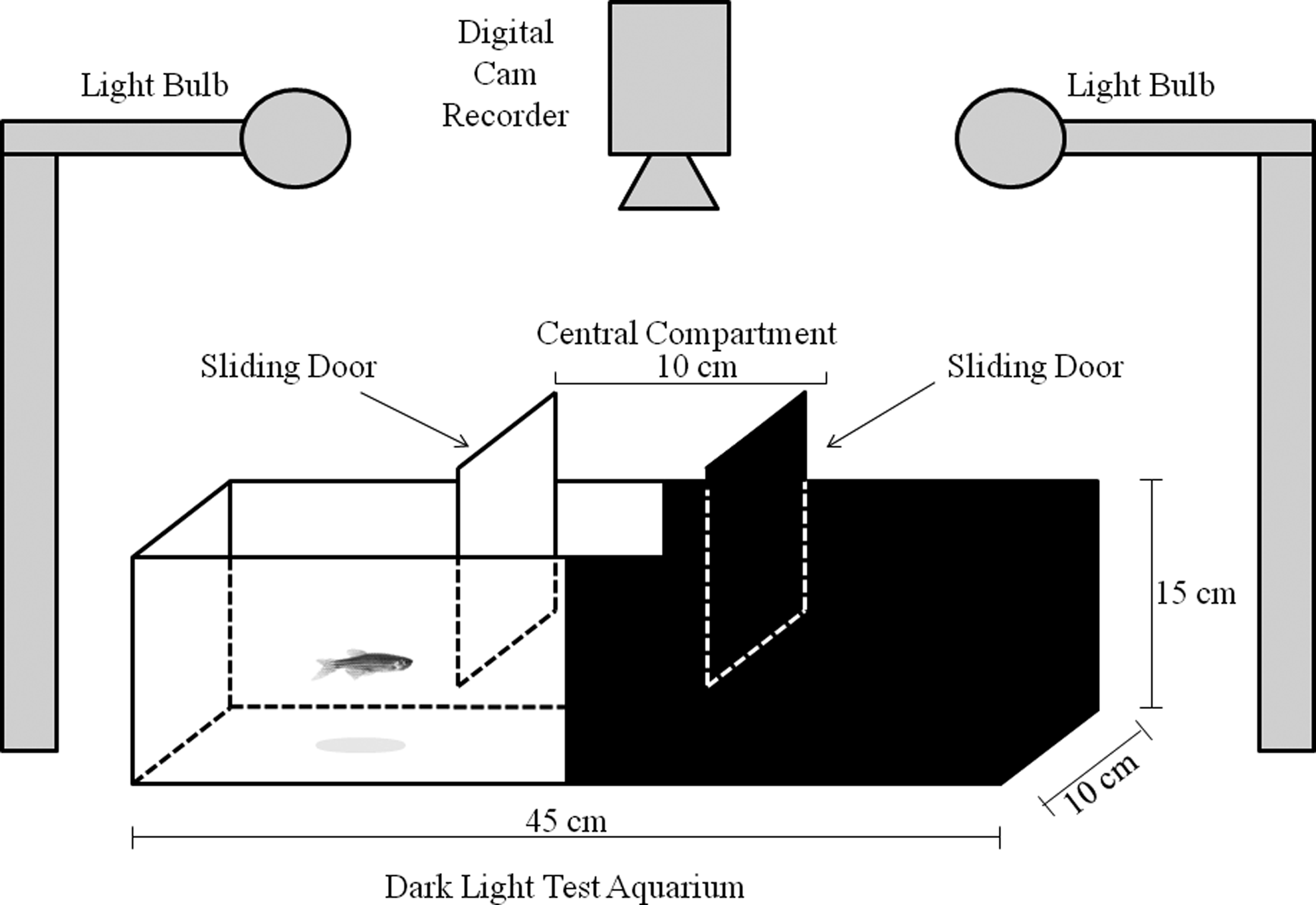
Dark/light box setup.
Procedure
The first subject is placed in the central compartment of the black/white box for a 5-min period (300 s) of habituation, to diminish effects of manipulation of the subjects. After this period the sliding doors are carefully removed at the same time and the subject can freely explore both compartments of the tank. The subject's behavior is recorded with a video camera during 15 min (900 s). Afterward, the video files were analyzed and the occurrence of subjects on each side of the aquarium was registered every 15 s, resulting in 60 occurrences per session. Furthermore, the first side chosen by each subject was also recorded.
There were four groups in this experiment and a different number of subjects was used in each group: the control group had only one subject inside the apparatus during the test, whereas the experimental groups had 2, 4, or 8 subjects placed simultaneously inside the apparatus on every session (As shown on Table 1). Each group was tested 32 times. To control day-to-day variations, each group had three sessions a day, totaling 12 sessions per day. All group types were tested each day. The tests were always performed between 8 and 11 a.m. and the subjects were not used in more than one test. No animals were hurt or sacrificed as a result of this experiment.
Measurement methods
The total time spent by each subject on both sides of the tank is the main standard variable used to analyze dark/light preference. In this study the number of occurrence of subjects on each side of the aquarium was registered every 15 s. To validate this method, 16 sessions of the control group were analyzed using both techniques (total time and number of occurrences) for further comparison.
Statistical analysis
To verify if the dark/light preference pattern changes with the number of subjects in the tank, the average occurrence (AO) of subjects in each side of the aquarium and the first choice average was calculated and compared between groups. Since normality was not assumed for the data, the one-way analysis of variance Kruskal–Wallis test was used followed by Dunn's post test. A Pearson correlation test was performed to determine if measuring the number of occurrences every 15 s is as accurate as measuring the total time of permanence.
Results
Validation of measurement methods
Preliminary descriptive statistics was run to compare the average total time spent by subjects in the white side of the apparatus and the average number of occurrences of subjects in the white side of the apparatus every 15 s, revealing similar results (as shown in Table 2 and Fig. 2).

Descriptive statistics graphic comparing the average percentages of total time spent in the white side and average occurrence of subjects in the white side on every 15 s.
The Pearson correlation test comparing the two analysis methods was statistically significant, with a p-value of 0.000000000858. Furthermore, a very strong positive correlation coefficient r=0.968 was found.
Dark preference
After data collection and transcription it was possible to assess and compare the AO of subjects in the white side of the apparatus in each group. The Kruskal–Wallis test revealed significant variation between groups [H(3)=18.838, p=0.001] and the Dunn's post test showed that the test group with eight subjects differs significantly from the control group and from the test group with two subjects (Fig. 3).
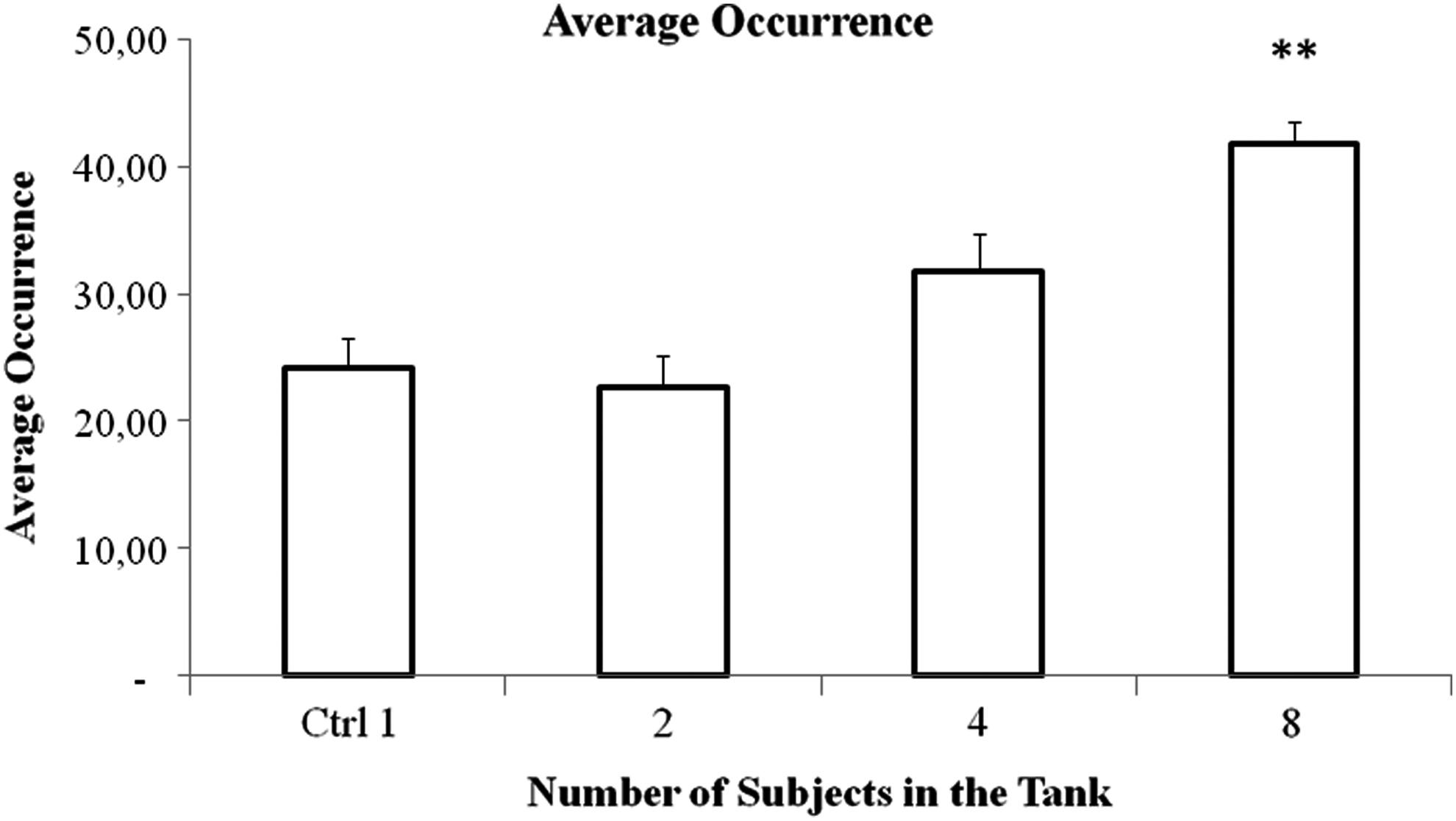
Average occurrence (plus standard error) of subjects in the white side of the apparatus measured on every 15 s. **Differs from control and from group 2, assuming that p<0.05. The average occurrence is calculated for each group adding up the percentage of occurrence of subjects in the white side of all sessions (32 per group) and then dividing the result by the number of sessions (32).
A linear regression test was conducted to verify whether the AO of subjects has a linear relationship between groups. The linear regression test has shown a slightly positive linear relationship. R=0.370; R 2 =0.137; Coefficient=2.753; Standard Error=0.615; t=4.474; P=0.001 (Fig. 4).
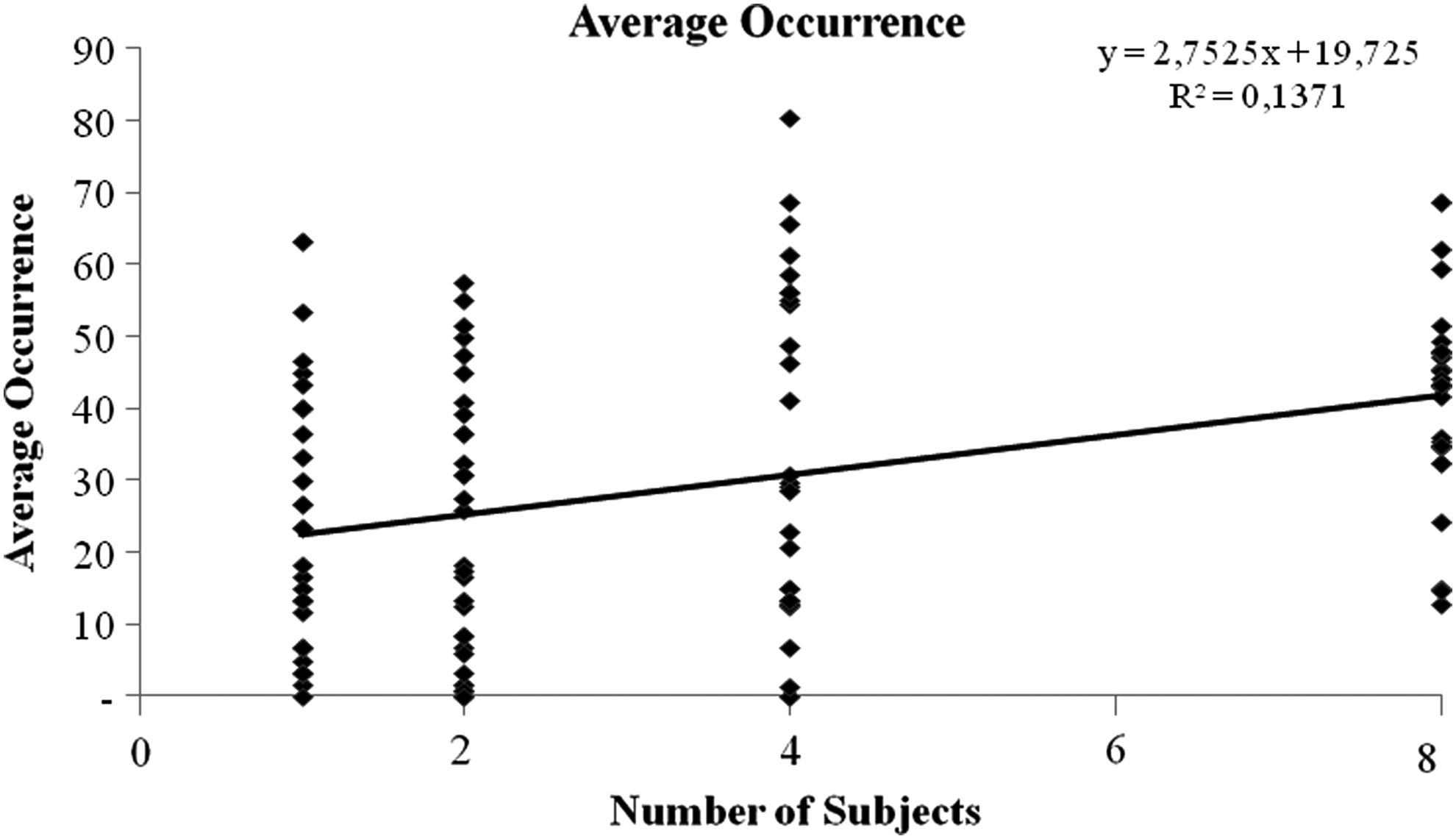
Linear regression line and data points of the average occurrence of subjects in the white side of the apparatus.
First choice
It was also assessed and compared the average of subjects that have first chosen the white side of the apparatus within each group. The Kruskal–Wallis test revealed significant variation between groups [H(3)=10.167, p=0.017] and the Dunn's post test showed difference between control and the group with eight subjects (Fig. 5).
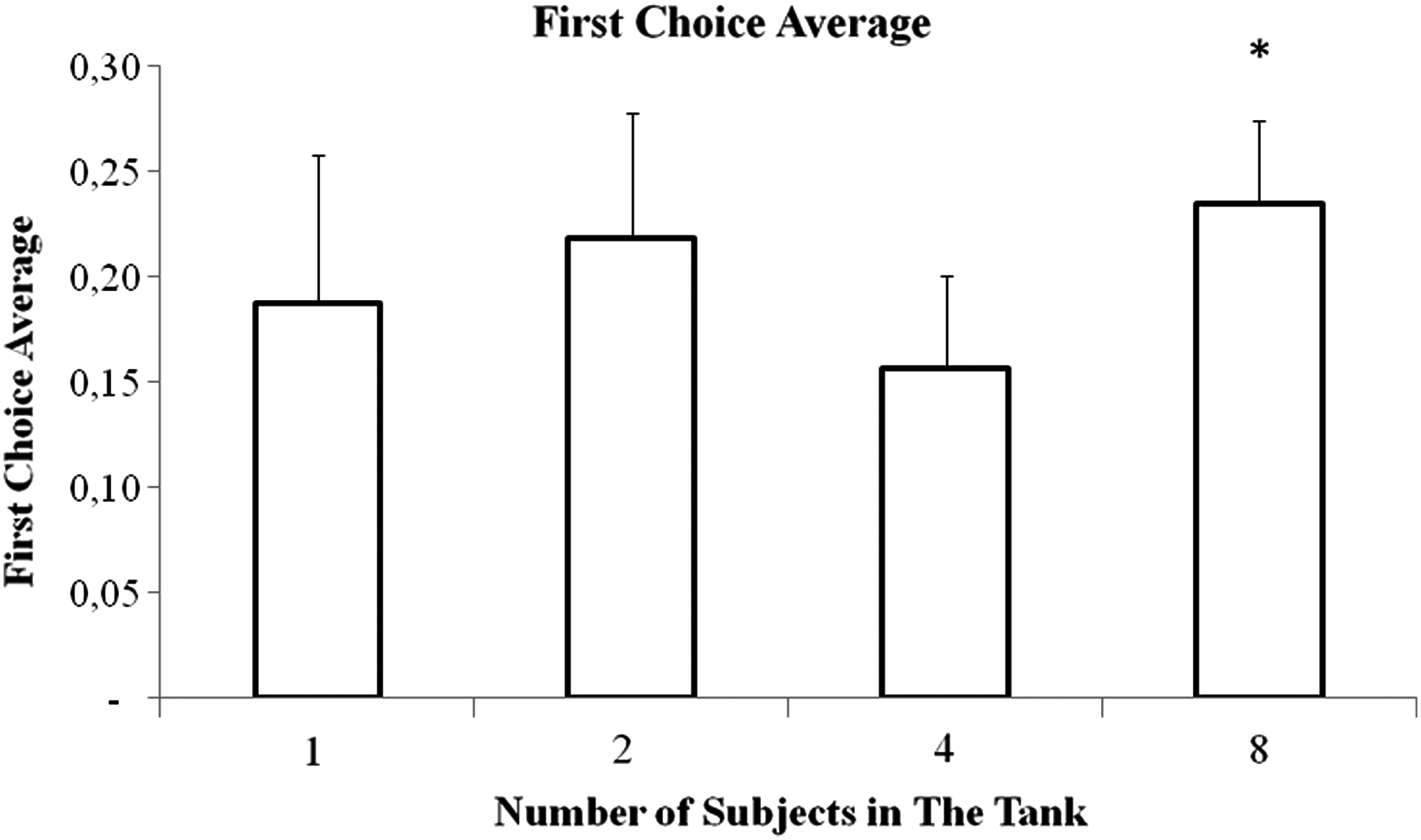
Average of subjects (plus standard error) that have first chosen the white side of the apparatus. *Differs from control, assuming that p<0.05. The average occurrence is calculated for each group adding up the subjects that have first chosen the white side within the 32 sessions and then dividing this number by the number of sessions.
A linear regression test was conducted to verify if the average of subjects that first chose the white side of the apparatus has a linear relationship between groups. The linear regression test did not show any positive or negative relationship between these variables. R=0.0416; R 2 =0.00173; Coefficient=0.364; Standard Error=0.779; t=0.468; P=0.641 (Fig. 6).

Linear regression line and data points of the average of subjects that have first chosen the white side of the apparatus. The numbers beside the dots represent frequency of the events.
Discussion
The data indicates no significant differences in the light/dark preference test when carried out with as many as four subjects, meanwhile, the test group with eight subjects showed statistical differences, when compared with the control group and the test group with two subjects. This indicates that the light/dark test may be done with up to four subjects in the same tank, during the same session, without affecting the light/dark preference behavior of individual subjects.
The white side of the apparatus is an aversive stimulus to the fish. Given the significant results obtained with the eight subjects group, it is possible to deduce that the shoaling behavior reduces stress and anxiety. 31 In the light/dark box experiment with more than one subject, there are some competing stimuli that induce the animal to move to the white side or to the dark side. The animal's natural tendency to seek protection in dark places, avoiding bright environments, and the anxiety caused by new environments contribute to the preference for dark places. On the other hand, the innate drive to explore new places added to a possible anxiolytic effect caused by the presence of other subjects inside the apparatus contributed to the subject's displacement to the white side. Zebrafish are a highly social animal, exhibiting preference for swimming in groups and many other patterns of social cohesion. The reduced white avoidance behavior in the group of eight subjects reflects the role of shoaling, which is a defense mechanism, in reducing anxiety and stress. However, the test results show that four subjects inside the apparatus is not enough to cause the anxiolytic effects of shoaling in the light/dark test.
Figure 4 shows that the regression line has a mild positive tendency for the AO of subjects in the white side of the apparatus; it might reflect a slight decrease in white avoidance even in the group of four subjects. In the novel tank test, for example, four subjects are enough to form a shoal with consistent performance in the test. 47 Perhaps only four subjects in a school is not enough to elicit all the benefits observed in larger schools, such as food location, efficient displacement, food acquisition, reproductive improvement and, particularly, predator detection and avoidance. It reflects the subject's performance on the test, since there is no significant reduction in white avoidance behavior in the groups with two and four subjects. These findings support future test with more than one subject, since shoal cohesion remains stable and practically unaltered and only stimuli of considerable magnitude are able to alter its natural condition. 48 Therefore, the subjects are prone to behave accordingly to the scototaxis behavior.
The variables commonly measured in the light/dark box test are the total time in each side of the box; number of midline crossings; latency for the first choice; first choice of compartment and thigmotaxis. The measurement of the time of permanence is related to dark preference/white avoidance behavior and can be used as a measure of anxiety, whereas thigmotaxis and first choice are measures of locomotor behavior and fear.6,8 From the above mentioned variables, this research tested only for first choice behavior. The total time of permanence of subjects in each side of the apparatus would be a very difficult task to perform, since there were too many subjects being observed at the same moment. Therefore, instead of the total time of permanence of each subject in each side of the apparatus, this research measured the occurrence of subjects in each side of the apparatus every 15 s. This measure has proven to be efficient and just as reliable as the measurement of total time (as shown in Table 2 and Fig. 2). Accordingly to this, the present model with enhanced numbers of subjects has the potential to provide faster outcomes and new possibilities for the light/dark box test. However, researchers are advised to consider the limitations of this method. Although faster and more convenient, in this variation of the test, it would be difficult to measure the total time of permanence and thigmotaxis.
The results of the research may also have been influenced by two outside variables, social behavior and/or shoaling, and the preference for dark places. Social behavior is presented by the Danio rerio species, which has an established hierarchy in the shoal, where the subordinated subjects follow the dominant subjects. In this study, fish of Danio rerio species were placed to swim in a 15×10×45 cm dimensions light/dark box with a 10 cm water column, containing 4.5 L. According to Aoki, 49 there is a regular distance between individuals in a shoal, which rises due to the maintenance of a private space for each individual. Our tests were made successfully with up to four subjects in the same apparatus. The inefficacy in the test with eight subjects was possibly due to the lack of space inside the test aquarium that lead the researchers to investigate whether the scototaxic behavior is altered or supplanted by a tendency to maintain the distance between subjects. According to Westerfield, 50 zebrafish is a shoaling fish and can be maintained at high concentrations such as 20 subjects per 3 L of water at 3 months of age. In our experiment the highest concentration of fish was eight subjects per 6.75 m3 of water. However, studies using light/dark boxes of different sizes and with different water volumes should be further conducted.
The test still needs to undergo pharmacological validation to verify the effectiveness of utilizing more than one subject in the presence of drugs, provided that some drugs can modify both fish and shoal behavior,47,51 resulting in cognitive impairments, lowering or altering social behavior. It is possible that such deficit in the subject's ability to follow conspecifics may harm the group's movement cohesion, causing the absence of shoaling behavior. Nevertheless, even without this kind of behavior, it is likely that the results in the light/dark test remain unmodified in the presence of any drugs, if the fish scototaxis behavior remains intact, because the white avoidance behavior would most likely keep the subjects in the dark side. This study does not attempt to determine if the results are due to social behavior or scototaxis, therefore, further studies with anxiolytic drugs are necessary to investigate this matter.
Conclusion
The reduced white avoidance behavior in the group of eight subjects seems to reflect the role of shoaling, which is a defense mechanism in reducing anxiety and stress. On the other hand, the absence of significant difference between the control group and the test groups with two and four subjects suggest feasibility to run the light/dark test with up to four subjects, becoming an alternative to streamline and to simplify the data collection and test analysis. Pharmacological tests are still required to determine whether the effect of drugs alters the model with enhanced number of subjects.
Footnotes
Acknowledgments
This research was supported by grants from CAPES (Coordination for the Improvement of Higher Level or Education Personnel).
Disclosure Statement
No competing financial interests exist.