




Abstract
Abstract
In the past three decades, the number of zebrafish laboratories has significantly increased in Taiwan. The Taiwan Zebrafish Core Facility (TZCF), a government-funded core facility, was launched to serve this growing community. The Core Facility was built on two sites, one located at the National Health Research Institutes (NHRI, called Taiwan Zebrafish Core Facility at NHRI or TZeNH) and the other is located at the Academia Sinica (Taiwan Zebrafish Core Facility at AS a.k.a. TZCAS). The total surface area of the TZCF is about 180 m2 encompassing 2880 fish tanks. Each site has a separate quarantine room and centralized water recirculating systems, monitoring key water parameters. To prevent diseases, three main strategies have been implemented: (1) imported fish must be quarantined; (2) only bleached embryos are introduced into the main facilities; and (3) working practices were implemented to minimize pathogen transfer between stocks and facilities. Currently, there is no health program in place; however, a fourth measure for the health program, specific regular pathogen tests, is being planned. In March 2015, the TZCF at NHRI has been AAALAC accredited. It is our goal to ensure that we provide “disease-free” fish and embryos to the Taiwanese research community.
Introduction
Z
Zebrafish research in Taiwan covers a wide range of disciplines, due to the increased numbers of researchers and their diverse research interests. Most research groups are from institutes and universities, where zebrafish may not be a major research model; therefore, few resources have been allocated to them. Furthermore, some small laboratories cannot even sustain the cost for housing fish lines due to their tight budget. In view of the growing number of zebrafish laboratories and the advantages of using zebrafish in a variety of research interests, the establishment of a national resource center was essential to further promote and support the growth of zebrafish research. Hence, in 2010, the Taiwan Zebrafish Core Facility (TZCF) was established with grant support from the MOST (Ministry of Science and Technology, Taiwan). In addition to resource integration, the primary goals of the TZCF are:
1. To provide a central repository for zebrafish (Danio rerio) lines. 2. To be a central base for national zebrafish research. 3. To serve as a corresponding entity for the international zebrafish research community.
In the past 6 years, the TZCF has distributed 57,635 embryos and 15,678 adult fish and hosted 24 training courses and 12 national zebrafish symposia. Its support of the Taiwan zebrafish community is significant.
Funding Support and Research Programs
The TZCF was built at two sites, one located at the National Health Research Institutes (TZeNH, Taiwan Zebrafish Core Facility at NHRI; from 2010 to 2014 called TZeTH [Taiwan Zebrafish Core Facility at Tsing Hua University and National Health Research Institutes]; however, Tsing Hua University has withdrawn from this program due to its site reconstruction). The second site is located in Taipei, at the Academia Sinica (TZCAS, Taiwan Zebrafish Core Facility at AS). Both facilities are supported by MOST grants and their respective institutional funding. The TZCAS, where zebrafish research first started in Taiwan, has the largest collection of fish lines that have been created by Taiwanese researchers. Among others, around 60 different lines have been generated from research programs of skin, liver, heart, intestines, neuron, eye, muscle development, and hypoxia research. The TZeNH is located on the NHRI campus and also serves as a zebrafish repository of the NHRI. The supported research programs are mainly biomedical and translational. In the TZeNH, disease-related transgenic, as well as mutant, lines are often used and some cancer and occupational disease relevant transgenic lines are also produced.8,9 Thus, the TZCF is operating under the principle of “One-Core-Two-Sites” and both sites complement each other to serve the Taiwan zebrafish community by providing services such as maintaining a core facility website (https://sites.google.com/site/twzebrafish/), distributing healthy zebrafish lines and materials, hosting zebrafish training courses and symposia, importing/exporting zebrafish lines, and developing/acquiring novel techniques.
Facility Design
Environmental control
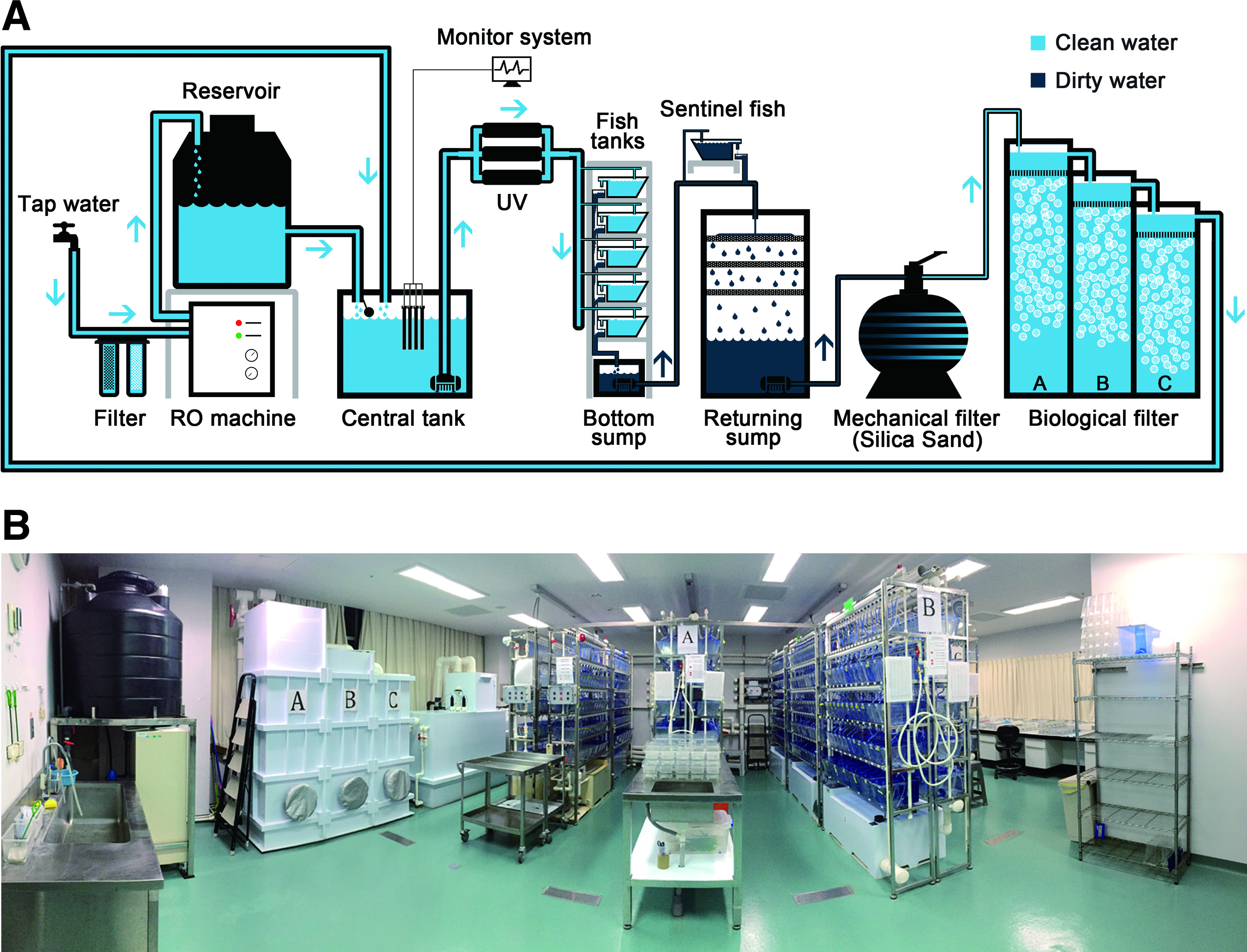
Due to space and budget limitations, the TZCF was designed as a medium size facility with around 2280 tanks (TZCAS covers about 80 m2 with 1080 tanks; TZeNH about 102 m2 with 1200 tanks). Each site includes its own quarantine room, main facility, and experimentation rooms. Both sites are using city, conditioned recirculating water systems in their main facilities (TZCAS is using the Aqua Blue system and TZeNH is using the Aquaday water system). The life support systems contain housing tanks and filtered recirculating water. Environmental factors that are known to be important for housing zebrafish are controlled as described in Refs.10–12 Environmental parameters such as room temperature, lighting cycle (14 h day/10 h night), electricity (connected to emergency power supplier), and ventilation are all automatically controlled and monitored by the institutional infrastructure. Figure 1A represents a schematic drawing of the circulating filtration system and Figure 1B is a panoramic view of the zebrafish facility in TZeNH.
Water quality control
Several key water parameters are monitored constantly for the recirculating water systems. The desirable ranges of water temperature (25°C ± 2°C), pH (6.8–7.8), conductivity (200–500 μS/cm), and dissolved oxygen (5–8 mg/L) are monitored automatically at all times with an alarm system (SUNTEX water detecting system plus YOKOGAWA FX1006 recorder). The UV sterilizer is checked every day by visual inspection. Parameter readings can be tracked and usually, the data of an entire month will be printed out and maintained for the records. The water quality control in the quarantine room is done manually. All above-mentioned parameters are detected by portable devices, and the data will be logged separately. Chlorine, nitrate, nitrite, and ammonia levels are monitored at least once a week in both recirculating water system and quarantine rooms. Figure 2 shows an automatic water parameter recording with the alarm system.
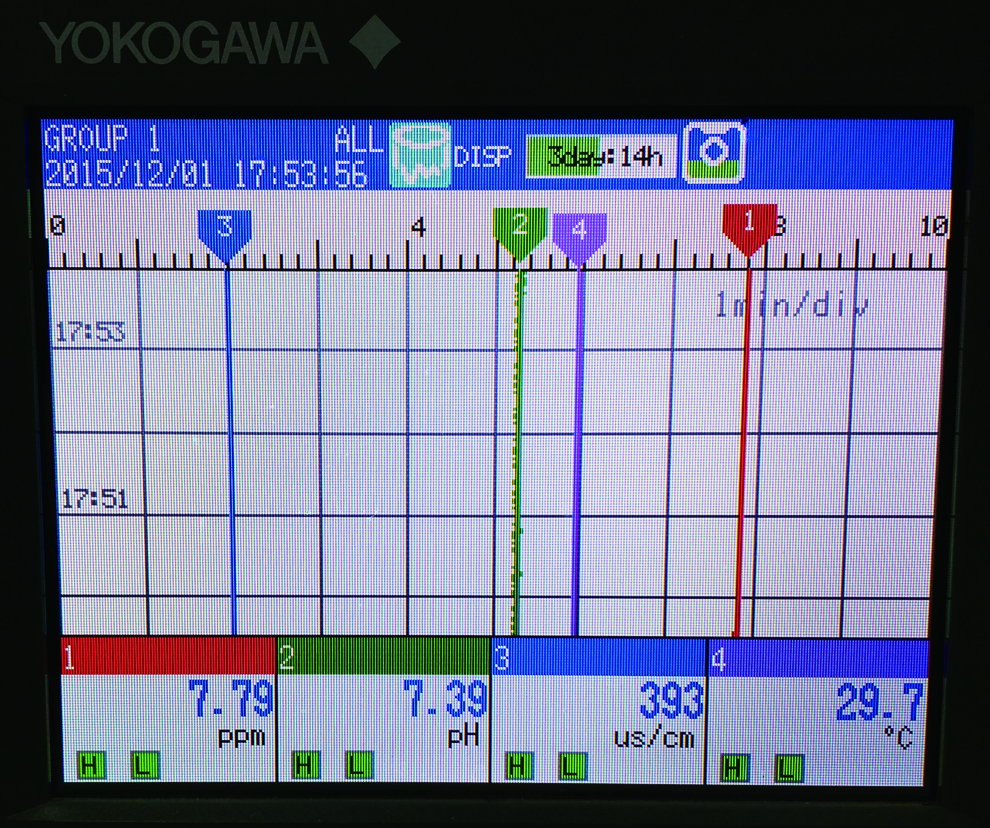
The water quality monitoring screen with alarm system. The recorder (YOKOGAWA FX1006) collects probe data from the SUNTEX water detection system, which consists of pH (green), temperature (purple), conductivity (blue), and dissolved oxygen (red) probes. The reading is presented in blue, but turns red if it is outside of the acceptable ranges. Color images available online at www.liebertpub.com/zeb
Facility maintenance
The life support system involves several components that must be regularly maintained to ensure smooth operations. Therefore, timing and methods of the maintenance work have been written up in the Standard Operating Procedures and is strictly followed by the facility staff. Table 1 shows routine maintenance plan for the TZCF.
Tanks with dead/sick fish or if intended for a different strain.
Fish Husbandry
Housing density and fish tank management
In TZCF, there are three different types of tank in use supporting different needs. The maximal housing densities for adult fish are: 1 L tanks, 4 fish; 3 L tanks, 20 fish; and 9 L tanks, 60 fish. Larvae are raised in static water tanks with around 50–60 larvae per liter for up to 2 weeks, which are then introduced into the recirculating water system and maintained at the same density. Juveniles are normally kept in 9 L tanks with a density of 60 per liter. An animal tracking system is used at the TZeNH, where tank positions are marked with a four-number/letter code and tanks are labeled with color tapes (as shown in Fig. 3). Fish information (including strain name, birthday, parental genotypes, and fish owner) is written on tapes and documented using a FileMaker database.
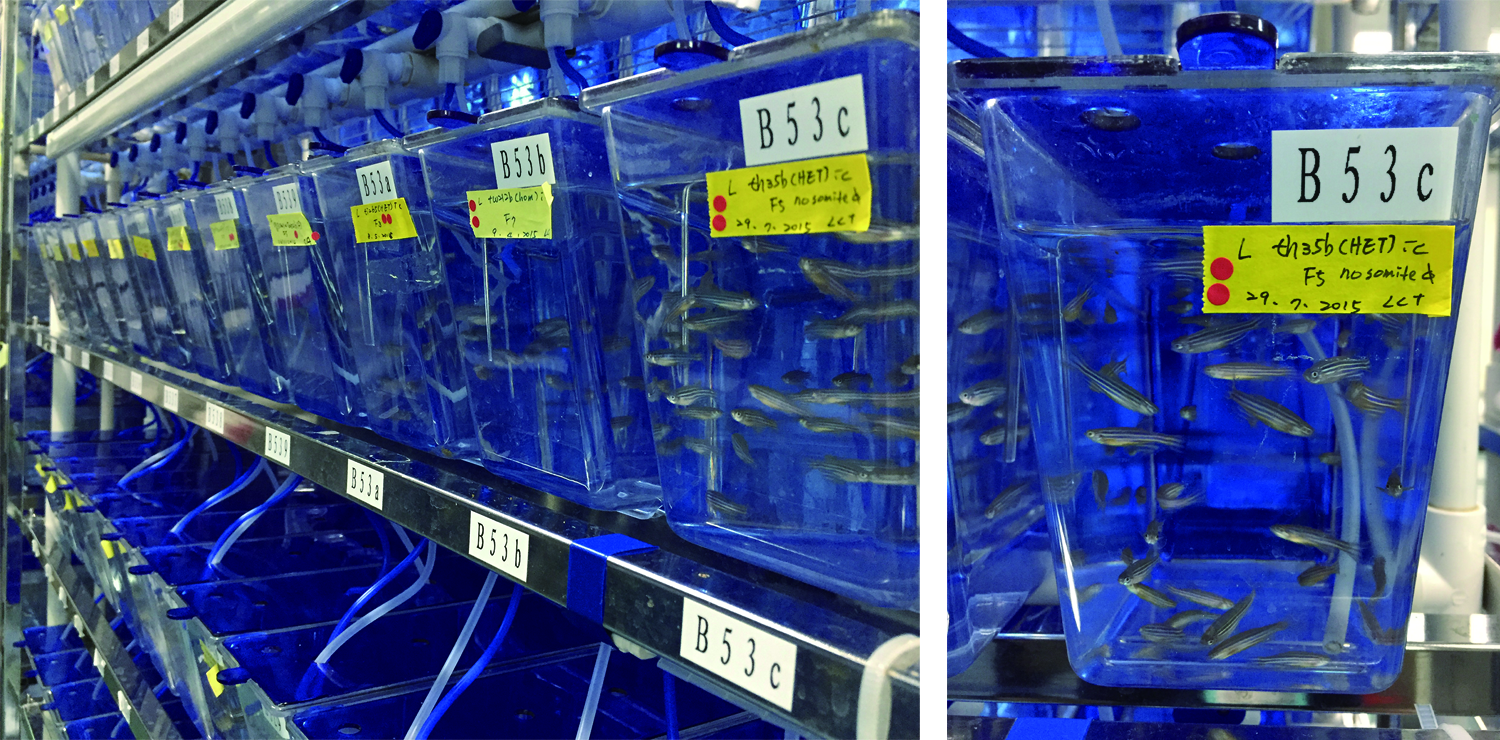
Tank positional coding and labeling system at the TZeNH. Each tank is labeled with a four-number/letter positional code and a colored tape with handwritten fish line information. Color images available online at www.liebertpub.com/zeb
Feeding
At the TZCF, feeding is carried out manually. The frequency, amount, and the size of food particles are provided according to the number, size, and age of fish, normally two meals per day. The morning feeding starts at 8:30, feeding Zeigler or other zebrafish-powdered food; the afternoon feeding of live brine shrimp starts at 14:30. Larvae up to 2 weeks are fed four times (8:30, 11:00, 14:30, 15:30) using paramecia or Zeigler larval food. Juvenile and fish with special conditions, for example, those needed for frequent breeding or in preparation for sperm freezing will be fed thrice per day by feeding live brine shrimp and different sizes of powder food. Table 2 shows the detailed feeding plan of the TZCF.
Animal usage regulation and humane endpoints
Since 2003, all vertebrate animal use has to be regulated by the IACUC (Institutional Animal Care and Usage Committee) in Taiwan. To comply with animal-welfare regulations, all procedures regarding the handling of fish, the administration of anesthesia, minimization of pain or distress, or the euthanasia of fish are well defined. In the Academia Sinica and NHRI, the maximum age of fish is set at 2 years. Only very few fish lines under special conditions are maintained for shorter or longer than the defined period. Most fish lines are cryopreserved before they are euthanized. Euthanasia is only performed by trained facility staff using Tricaine (MS-222) overdose according to the literature. 13
Health monitoring and disease prevention
Existing strategies for disease prevention
Due to space limitations, each site of the TZCF operates only one recirculating water system. Therefore, disease prevention has been the first priority of facility management. Two main measures are taken to prevent disease outbreaks in the facilities. Imported fish from outside facilities are only maintained in the quarantine room, where a flow-through system is in use to prevent water contamination. In addition, all embryos need to be bleached before entering the recirculating water system. Fish health in terms of activity, appetite, and swimming patterns is monitored every day during feeding. Dead fish will be removed immediately from the tanks and the date and number will be recorded. Sick fish or fish showing any abnormal appearance or behavior will be isolated from the recirculating water system and placed in a separate area with an individual tank for further care and observation. If dead or sick fish appear in the same tanks repeatedly over 1–2 weeks, all fish in that tank will be euthanized and the tank will be washed and autoclaved to eliminate potential pathogens. In the TZeNH, there is a monthly veterinary checkup to ensure that fish are healthy and best practices for disease prevention are applied in the facility. In recognition of our efforts devoted to maintaining a healthy well-run colony, the zebrafish core facility at the NHRI has become AAALAC accredited in March 2015.
Specific pathogen control plans
Over 6 years of applying best husbandry practices to minimize the risk of disease outbreaks, the TZCF has never encountered disease outbreaks per se; however, some pathogens have been observed to infect fish in the facility. Based on the description and pictures shown in “The Zebrafish Book” and “The Laboratory Zebrafish,” the most commonly observed diseases in the facility are so-called “skinny disease” and mycobacteriosis (Fig. 4). Around one to two infected fish are removed per month from the recirculating water system. The impact of these existing pathogens is so far not significant; however, it is a potential threat. Fish health is becoming more important as more fish research programs are focused on disease or translational programs. In the TZeNH, over 50% of IACUC approved zebrafish programs are disease related. Research programs such as using zebrafish embryos for toxicity and infectious studies, using adult fish for neurodegenerative behavior test, and creating liver transgenic fish to study liver cancer progression, requiring healthy embryos and fish. In view of the importance of maintaining and distributing “disease-free” zebrafish within the TZeNH and the Taiwanese research community, a collaboration between TZeNH and the Fish Veterinary Department at the National Pingtung University of Science is in planning stages to implement a regular zebrafish health monitoring program. Initially, specific pathogens such as molds, Mycobacterium spp., Pseudocapillaria tomentosa, and Pseudoloma neurophilia will be tested in sentinel fish every 6 months, because these appeared sporadically in the facility.
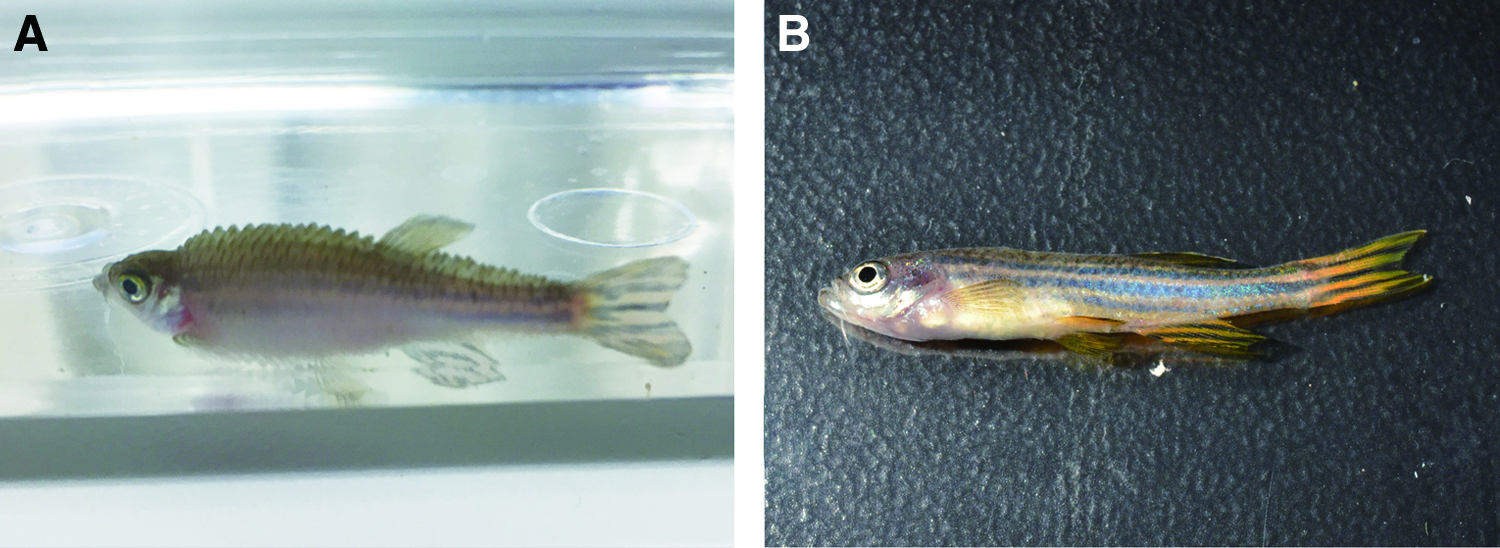
Diseased fish observed at the TZCF.
Summary
TZCF is using recirculating water systems with filtered water source. Environmental and water parameters are monitored constantly with an alarm system. Fish husbandry and rearing are following the methods recommended by ZIRC (Zebrafish International Resource Center). As a result of applying best practices, the TZCF has never encountered disease outbreaks. Few commonly-seen pathogens exist in the facility and are known to infect fish, but have not caused further concern. Sick and dead fish are removed as soon as they are found. To detect and manage the presence of pathogens in TZeNH, a health surveillance and special pathogen control program are currently being planned. Our ultimate goal is to provide disease-free zebrafish to the community in Taiwan.
Footnotes
Acknowledgments
TZCF are mainly supported by government funded grants, including the following: NSC99-2321-B-400-001, NSC100-2321-B-400-003, NSC101-2321-B-400-014, NSC102-2321-B-400-018, NSC103-2321-B-400-010, MOST104-2321-B-001-045, MOST104-2319-B-400-001, and MOST105-2321-B-001-029 to support TZeNH and NSC 99-2321-B-001-027, NSC 100-2321-B-001-030, NSC 101-2321-B-001-026, NSC 102-2321-B-001-038, NSC 103-2321-B-001-050, MOST 104-2321-B-001-045, MOST104-2319-B-400-001, and MOST105-2321-B-001-029 to support TZCAS. In addition, TZCF is also strongly supported by the intramural funding from IMGM (Institute of Molecular and Genomic Medicine) of NHRI and ICOB (Institute of Cellular and Organismic Biology) of Academia Sinica.
Disclosure Statement
No competing financial interests exist.