




Abstract
Abstract
Methylene blue (MB) is an FDA-grandfathered drug with memory-enhancing effects at low doses, but opposite effects at high doses. We investigated the effects of four MB doses (0.1, 0.5, 5.0, or 10.0 μM) on zebrafish memory retention in the T-maze task. After training fish to swim into a certain arm of the T-maze, the fish were placed into a tank containing one of the four MB doses or a control tank containing blue food dye. Subsequently, fish were placed into the T-maze for memory retention testing. Results indicated that MB produced hormetic dose–response effects on memory. Fish that received the 0.5 μM dose performed significantly better at the T-maze than those that received higher doses. Fish who received 5.0 μM did not exhibit a significant difference in performance from control fish, and the fish that received the 10.0 μM dose performed significantly worse than lower doses. These findings support the utility of zebrafish in comparative research and their potential value for testing of MB and other neuropsychopharmacological treatments in animal models of memory disorders.
Introduction
T
Zebrafish are already known to be capable of various forms of learning such as classical and operant conditioning. Through a series of experiments that paired visual cues with electric shocks, it was found that zebrafish learn through both of these forms of conditioning. 6 In addition, zebrafish are capable of visual discrimination learning when tested on the T-maze. In three separate experiments, zebrafish were given the choice of two differently colored arms: green versus purple, red versus blue, or horizontal versus vertical black and white stripes. In each version of the experiment, the zebrafish gained a preference for the predetermined visual stimulus that led to a food reward. 7
Although the T-maze is an excellent tool for measuring visual discrimination as well as left–right discrimination, memory, and learning acquisition, it has been underutilized in the zebrafish.8–10 It appears, however, that the T-maze is gaining favor as a viable test of learning for the species. The T-maze has recently been used to examine the role of nicotinic acetylcholine receptors on learning and memory. 11 The researchers found that nicotine improved learning and memory at low doses and worsened abilities at higher doses. In addition, the apparatus has been used to test for potential learning deficits in zebrafish induced by toxins such as bisphenol A (BPA). 12 BPA was found to induce hyperactivity in larval zebrafish and thus promote learning deficits in adulthood. These latter studies have not only expanded on previous visual discrimination in the T-maze findings but also exhibited its viability to test the effects of various substances on learning and memory in the zebrafish. 7
Methylene blue (MB) was the first synthetic chemical used for pharmaceutical applications in the history of medicine. Aside from being used as a dye in laboratory and surgical settings, MB has been used as a drug to treat malaria and as an antidote for cyanide and carbon monoxide poisoning, among many other pharmaceutical uses. 13 First shown as a memory enhancer in rodents, low doses of MB enhance memory retention in rats and mice. 14 Due to these findings and the substance's neuroprotective properties, MB has recently been researched for its potential to alleviate cognitive deficits associated with various neurodegenerative disorders such as Alzheimer's disease and Parkinson's disease. 15
MB has been implicated as a possible cognitive-enhancing treatment for decreased mitochondrial respiration due to its ability to increase such respiration and regulate cerebral hypoxia.16,17 The increase in mitochondrial respiration produced by MB relies on MB's affinity for a wide variety of tissue oxidases, including those in mitochondria. 18 Low doses of MB can donate electrons to cytochrome c increasing the cytochrome oxidase activity and oxygen consumption. For instance, 1 mg/kg MB caused a 30% increase in the cytochrome oxidase activity in the rat brain. 19 However, MB displays a hormetic dose response with an increasing cytochrome oxidase activity at low MB concentrations (0.1–0.5 μM) and decreasing cytochrome oxidase activity at high concentrations (10.0 μM and above; Fig. 1). 20 Biphasic dose–response curves similar to MB's effects on cytochrome oxidase have been found in numerous instances as they represent the fundamental principle of hormesis. 21 Cytochrome oxidase is an enzyme also found in the zebrafish.22,23

Graph showing hormetic dose–response curve of brain cytochrome oxidase activity in rats that received differing doses of MB. An increased response was seen from 0.1 to 0.5 μM, the response was similar to control by 5.0 μM, and the response decreased by 10.0 μM. The same type of hormetic dose response, with opposite effects of low and high doses, has been found in previous MB studies using different physiological and behavioral responses. Reprinted by permission from F. Gonzalez-Lima. Bruchey AK, Gonzalez-Lima F. Behavioral, Physiological, and Biochemical Hormetic Responses to the Autoxidizable Dye Methylene Blue. American Journal of Pharmacological Toxicology 2008; 3: 72–79. MB, methylene blue
Based on previous findings in rodents, the present experiment aimed to determine not only whether MB acts as a cognitive enhancer in zebrafish, heretofore untested, but also whether the effects would follow the hormetic dose–response curve consistently seen in rats. 20 We employed a T-maze with two visually distinct arms as a tool for measuring learning acquisition. Subsequently, we exposed zebrafish to four doses of MB (0.1, 0.5, 5.0, and 10 μM). Concentrations were chosen based on previous rodent literature, 20 which used a 1–4 mg/kg mammal ratio. We converted this to the zebrafish model by accounting for how much water was in the tank, how many fish were in the tank, and the dose we were testing. We hypothesized that zebrafish would replicate the hormetic dose–response curve seen in rodents, with lower doses yielding enhanced performance on the learning task and higher doses resulting in impaired performance when compared to a control group. With this study, we intend to bolster zebrafish as a model organism with importance in cognition research.
Methods
Animals and housing
Seventy-five experimentally and drug-naive adult (3–6 months) wild-type zebrafish (D. rerio) of a randomly bred, genetically heterogeneous strain were obtained from a local aquarium supply store (Pet Palace). They were of unknown sex. Before testing, all fish were acclimated to the laboratory environment for a minimum of 10 days, housed within a 55 L (190.5 × 203.20 × 330.20 mm) group holding tank.
Following this acclimation period, fish were group housed in one of two 27 L tanks (203.20 × 254.00 × 406.40 mm). One tank was for all randomly assigned control fish. The other tank was for all randomly assigned MB fish. They were placed in these tanks 24 h before testing. All tanks included a filtration system, ceiling-mounted fluorescent light tubes set to a 14-/10-h light/dark cycle, and white gravel bottom. Tank water was reverse osmosis–deionized H2O maintained at ∼28°C. Before testing and during the first 3 days of habituation, fish were fed once in the morning (∼9:00) with live brine shrimp (Premium Grade Brine Shrimp Eggs; Brine Shrimp Direct), and once in the afternoon (∼15:00) with flake food (Tetra). Testing occurred between 9:00 and 16:00 in an isolated and soundproof room. All behaviors were recorded by video camera located above the maze. Fifteen fish per group (MB and control) per dose (0.1, 0.5, 5.0, and 10.0 μM) were used. Fish were randomly assigned to a dosage group and tested in a random order to account for any issues regarding fluctuating water chemical levels, time of day, etc.
T-maze
A Plexiglas T-maze filled with 4 L of tank water (height of 82.30 mm) was used in all stages of the experiment. The water was kept at ∼28°C. The maze consisted of a start box (101.60 × 101.60 × 101.60 mm) separated from the main arm by a removable Plexiglas insert. From the start box extended the main arm of the maze (101.60 × 101.60 × 304.80 mm) with two shorter arms (101.60 × 101.60 × 203.2 mm each) extending from the end of the main arm. At the end of both shorter arms, there was a containment area (101.60 × 101.60 × 101.6 mm) with removable Plexiglas inserts that allowed the researchers to contain the fish for reward administration (Fig. 2). The start box and main arm of the maze were lined with opaque white shelving paper to obscure the view of the fish. The shorter arms were transparent Plexiglas. Two patterned sleeves (one black and white striped, one black dots on a white background) were fitted onto the shorter arms of the maze during the training days. They were alternated randomly after every trial.
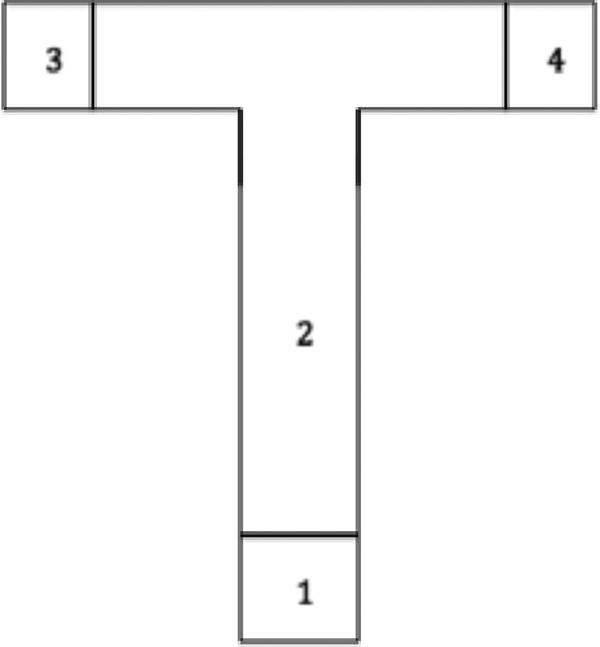
Diagram of the T-maze apparatus. 1, start box; 2, main arm; 3, containment area; 4, containment area.
Habituation
To minimize novelty stress, the fish went through 4 days of habituation. During the first day of habituation, the fish were netted from their respective home tanks in a group of five fish and placed into the T-maze, which was open at all points. They were allowed to explore the maze for 1 h. The size of the group was reduced over the course of the habituation days to reduce isolation stress. On the second and third days, groups of two and three fish were allowed to explore the maze for 1 h. On the fourth and final day of habituation, the fish were placed into the T-maze individually and allowed to explore for 30 min. The fish were food deprived on the last day of habituation.
Training trials
After the habituation period ended, there were five training days and each day followed the same procedure for both the control and experimental groups, respectively. During the training trials, it was intended that the fish would learn to associate a predetermined and randomly assigned pattern (black dots on a white background or black stripes on a white background) with a food reward. Each pattern was placed around one of the two arms of the T-maze during every trial so that one arm had the dotted pattern and the other had the striped background. The placement of the patterned sleeves was alternated randomly after every trial. After filling the maze with 4 L of water, placing the patterned sleeves on the predetermined arm for the trial, randomly assigning one pattern to be the correct choice, and assuring that the Plexiglas dividers were in place to isolate the start box, right arm, and left arm, one fish was netted and placed into the start box of the maze. The fish was allowed to acclimate to the maze in the start box for 10 s. The start box was then opened and the fish was allowed to swim into the main arm of the maze. The fish was given 10 min to make a choice between swimming into the left or right arm. If it swam into the containment area of an arm, the divider for that area was closed, containing the fish in the end of the arm. The fish would have to swim completely into the containment area so that its whole body was past the divider (101.60 × 101.60 × 101.60 mm) in order for the experimenter to close the door. If the fish made the predetermined correct choice (either striped or dotted arm), it was given a food reward of live brine shrimp using a dropper (0.05 mL, ∼25 brine shrimp). The reward was administered to the containment area in which the fish was captured. Other than receiving the food reward, the fish were food deprived for the duration of the training trial days.
If, however, the fish made an incorrect choice, it performed a correction trial in which the fish was placed back into the start box and allowed, once again, to swim through the maze for a maximum of 10 min. The incorrect arm was closed off so the fish could only swim into the correct arm where it was contained by the experimenter-controlled divider and then given the brine shrimp reward. If the fish did not make a choice in the 10 min allotted for either the initial trial or the correction trial, it was be considered to have “timed-out” and the trial was considered void.
This procedure was completed four times per fish per day for a total of 20 training trials per fish over the course of the experiment. After each trial of each fish, the water was siphoned out, the maze was cleaned, and the water was replaced from a reservoir that kept the water at ∼28°C. Whether or not the fish swam into the correct arm of the maze was recorded. All behavior was recorded using an overhead camera (Tessar 2.0/3.7; Logitech) and then coded for correct choices by the experimenter.
Drug exposure
Immediately after the last trial on the fifth and final day of training, the fish were either exposed to methylene blue mixed with tank water (MB; Sigma-Aldrich; dye content ≥82%, purity 90%) or a mixture of blue food colorant (Wilton) and tank water that matched the color of the MB dose based on the group to which they were randomly assigned (approximately Pantone PMS 2945, PMS 294, PMS 287, PMS 280, respectively). The experimental group was put into 4 L of water with the appropriate predetermined dose of MB (0.1, 0.5, 5.0, or 10.0 μM). The control group was put into 4 L of water mixed with an amount of blue food colorant mixed to match the color of the MB water. There was a control group for each MB dose group, for a total of four MB groups and four control groups. The fish were kept in these tanks for 12 h according to MB dosing reports. 24 After this period of time, they were removed from these tanks, rinsed with fresh tank water, and returned to their home tanks, which contained fresh water, devoid of any drug or colorant.
Probe trial
Following a 12-h period in the home tank, the fish were then probed individually for learning by using the same procedure as the training trials only; there was no correction trial for incorrect choices. There was only 1 day of probing, and each fish was probed four times to test for learning acquisition of the desired behavior, either swimming into the arm of the maze with the dotted sleeve or the striped sleeve. The sleeves on the arms of the T-maze were alternated randomly for each probing trial. Whether or not the fish made the correct choice was recorded and the average of correct choices per group was calculated (see Fig. 3 for flow chart of methods).
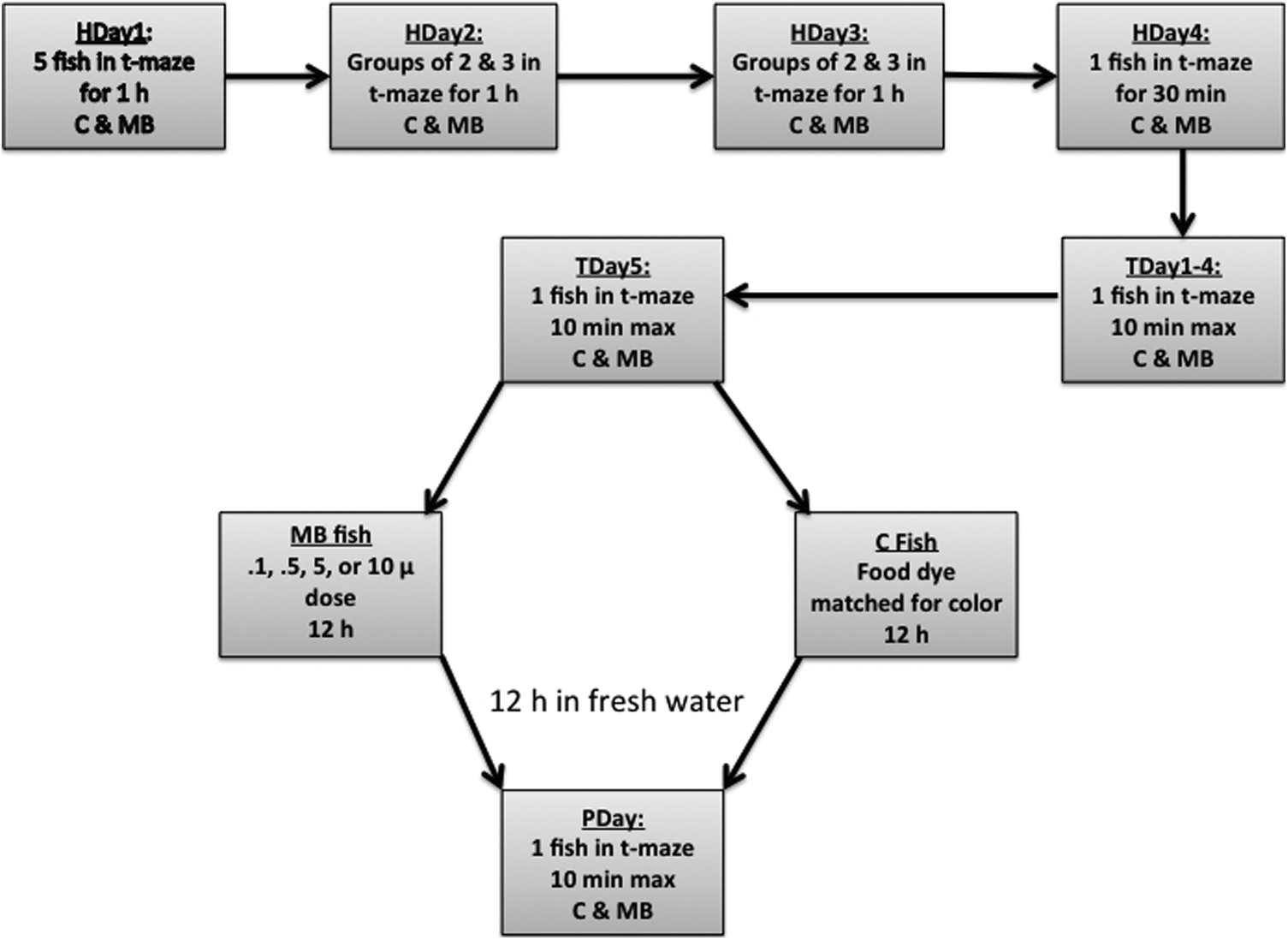
Flowchart detailing the methods. H, habituation; T, training; P, probe; MB, methylene blue; C, control.
Statistics
A one-way ANOVA was run to determine whether MB affected T-maze performance (correct choice vs. incorrect choice) in zebrafish that received MB (0.1, 0.5, 5.0, or 10.0 μM doses) compared to a control condition of zebrafish that received no MB (two-tailed, p < 0.05).
Results
The above study assessed the effects MB had on fish's ability to learn and remember an association task in the T-maze. Results indicated that exposure to MB after T-maze training produced hormetic dose–response effects on memory retention, with improved performance at lower doses and inhibited performance at higher doses. There was a significant difference between groups as determined by a one-way ANOVA (F(4, 70) = 4.47, p = 0.003). A Tukey's post-hoc test revealed that fish which received the highest dose, 10.0 μM (0.380 ± 0.244), performed significantly worse than those fish who received the 0.5 μM dose of MB (0.633 ± 0.16, p = 0.008) and the 5.0 μM dose of MB (0.647 ± 0.232, p = 0.005). There were no significant differences between any of the other groups.
Discussion
MB has been found to enhance various forms of learning and memory when used in low doses in rodents and humans.25,26 This finding was corroborated by administering MB to rats after an object recognition task. 24 Rats that received MB exhibited significant improvement in recognition of a familiar object when compared to a control group that did not receive MB. However, memory recognition varied based on the dose of MB. Administration of MB produces a dose-dependent hormetic curve in relation to memory tasks. Behaviorally, test subjects show improved recognition at lower doses and significantly worse performance than control at higher doses. 20 MB-induced increases in the brain cytochrome oxidase activity and thus oxygen consumption are seen in relation to MB-induced memory enhancement. 24 Brain regions with high metabolic demands during memory consolidation show the largest increases in the cytochrome oxidase activity after posttraining MB administration to rats. 27 While low-dose MB has elicited these memory-enhancing effects in various mammals, we asked the question of whether these effects could be observed in other species such as the zebrafish.
In this study, we wanted to examine if posttraining-administered MB had any influence on the memory retention associated with T-maze performance (tested on the probe day). This study specifically investigated the influence of four posttraining doses of MB (0.1, 0.5, 5.0, or 10.0 μM) on the memory performance of zebrafish in the T-maze task.
Based on the dose-dependent hormetic curve observed in rats, we expected zebrafish who received the 0.5 μM dose of MB to perform significantly better than those who received other doses of MB, fish who received 5.0 μM of MB to perform the same as control, and fish who received the 10.0 μM dose of MB to perform significantly worse than the other doses. In addition to the doses noted in previous literature, we added an additional dose of 0.1 μM MB to observe the effects on performance when compared to the control and the optimal 0.5 μM dose groups. 24 Our results indicated that like the hormetic curve seen in rats, zebrafish follow a similar performance-based dose-dependent curve. Zebrafish that received lower doses of MB performed better (made more correct arm choices) than those who received the higher doses. Such findings allow us to assert that MB does indeed have a cognitive enhancing effect in the zebrafish (Fig. 4).
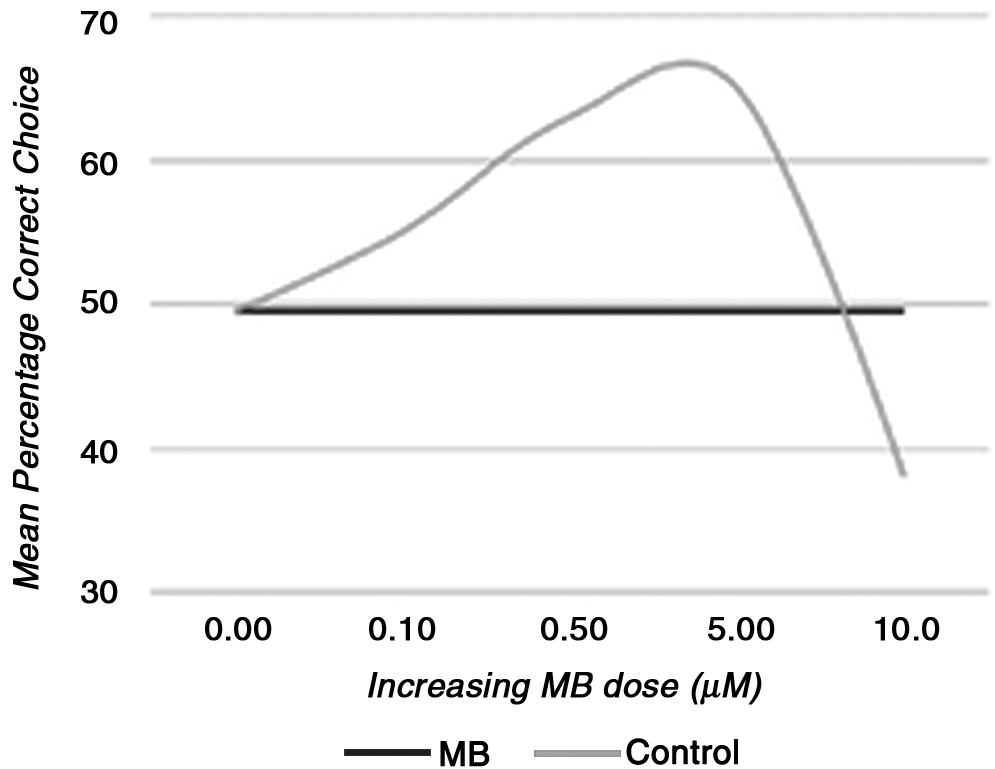
Curve showing the hormetic dose response of MB on mean percentage correct choices on the T-maze memory probe test obtained from the groups that received MB. The straight line represents the averaged response of the control zebrafish. The low and high doses of MB had opposite effects on memory retention in zebrafish as seen in previous studies with rodents.
Although our findings uphold and corroborate previous findings, there are some matters we must address. 24 Our data could have been affected by their housing situation. The fish were group housed, not singly housed, according to treatment dose group. We were not able to record the performance of an individual fish, but only the performance of the group as a whole. In future studies, we will house the fish individually to allow for more precise data collection and to allow us to attribute performance to an individual fish.
In future studies, we will test more doses of MB to see additional effects along the dose–response curve as well as to determine more definitively the effects of MB on cytochrome c oxidase in the zebrafish to better understand the mechanisms of action in the species. In addition to this, we will test MB to see its effects on performance in other zebrafish cognitive tasks (e.g., fear conditioning, conditioned place preference, object recognition). By expanding on our examinations, we intend to better understand zebrafish learning, memory retention, and memory degradation.
By generalizing our findings, we intend this information will not only strengthen the utility of zebrafish in comparative research but also will aid in the dose–response testing and development of MB and other pharmacological treatments in animal models of neurocognitive disorders such as Alzheimer's and Parkinson's diseases
Footnotes
Acknowledgments
The authors would like to acknowledge the help of the many research assistants and laboratory members of the Behavioral Neuroscience Laboratory at The University of Southern Mississippi. We would also like to thank Georgianna Gould (Ezra Scientific) for help in acquiring the T-maze apparatus.
Disclosure Statement
No competing financial interests exist.