




Abstract
Abstract
Research into adult zebrafish often requires fish to be of a specific size. Currently, fish must be individually measured to achieve this goal. Here, we design and utilize fish graders to quickly sort fish by width. We characterize graders individually for the length of fish they discriminate between and we also analyze graders in pairs to define the range of lengths for a retained population of fish. We note that a 1 mm increase of fish width increases fish length by 6.2–7.2 mm. We provide the schematics to print a series of eight retention widths, and note that graders of any desired retention width can easily be printed by slightly modifying our design files.
Introduction
R
For larger fish, such as catfish, trout, or salmon, size graders for fingerling stage fish and up have long been available.15,16 No such graders are commercially available for sorting the much smaller juvenile or adult zebrafish into different size classes. The advent of three-dimensional (3D) printing, offering the ability to produce an object of nearly any shape, is a tool whose use in medicine is expanding. 17 3D printing is also beginning to see some zebrafish-specific applications.18,19
Here, we develop a tool, zebrafish graders, to rapidly and safely obtain fish of defined sizes. We used 3D printer technology to design and produce a series of graders that can sort fish of widths ranging from 1 to 4.3 mm. We used these graders individually and serially to determine the relationship between the width and length of fish.
Materials and Methods
3D printing
Graders were designed using the TinkerCAD webtool (Autodesk, www.tinkercad.com), and printed using Makerbot Desktop with a Makerbot Replicator 2 (http://store.makerbot.com/printers/replicator2x/; Makerbot, Brooklyn, NY). We printed and used graders with spacing of 1.0, 1.5, 1.9, 2.3, 2.7, 3.0, 3.4, and 4.3 mm. Our stl files for printing the graders are available as Supplementary Data S1–S8 (Supplementary Data are available online at www.liebertpub.com/zeb) and at our website (http://genetics.wustl.edu/sjlab/public-data/grader-designs)
Fish husbandry
Fish were reared according to standard laboratory procedures. 20 All fish used were inbred AB (sjA). 21
Sizing fish with graders
Fish graders were suspended over empty tanks and fish were poured through them. Fish were sorted repeatedly by graders until the smallest grader to retain was determined, which is the value reported. Fish were then measured for standard length (SL 13 ) and the number of caudal fin segments was counted.
Results
Printing graders with a 3D printer
We wanted to quickly sort fish by size. To this end, we custom designed graders using the freely available TinkerCAD webtool. Our basic design is a lidless rectangular box, in which the bottom has evenly spaced divider bars. We have two sets of circular openings at either end of the long sides where dowels can be inserted to suspend the grader over a tank (Fig. 1A). We initially used square-shaped divider bars for the grader design, but eventually settled on oval-shaped divider bars (see Discussion section). Graders were printed using the Makerbot Replicator 2.
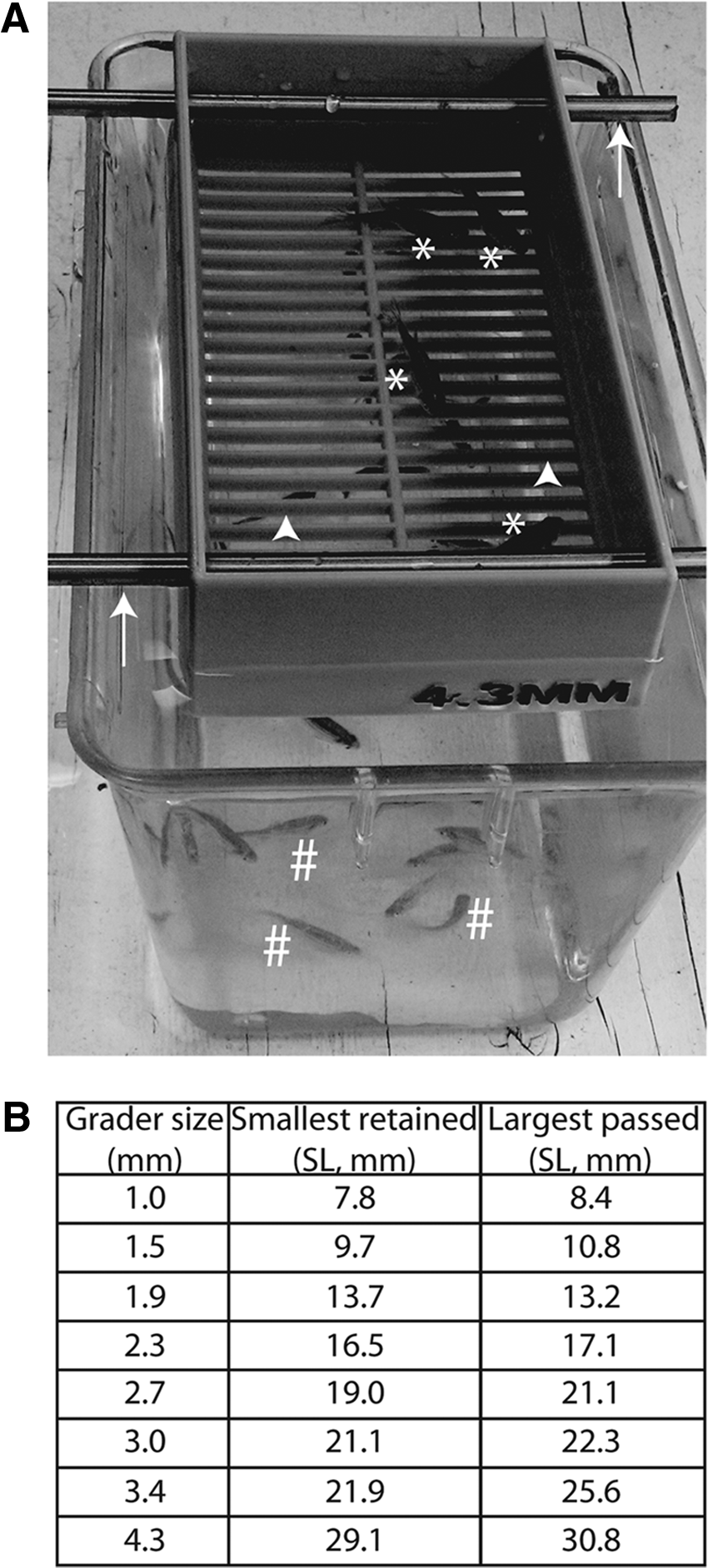
Separating fish by width through graders.
Sizing fish with graders
Once we had settled on a grader design, we next tested how effective the graders were at separating fish. Passing fish through one grader splits the population into fish of width smaller or larger than the distance between divider bars (grader size). We passed fish ranging from 5.3 to 38.7 SL, serially through our set of graders, starting with the largest grader. We then measured the SL and the number of caudal fin segments of each fish, as the number of caudal fin segments has also been shown to correlate with length. 7 We report the largest fish retained and smallest fish passed (by SL) for each grader (Fig. 1B). In addition, we show the proportion of fish with a given number of caudal fin segments to pass through each of our graders (Fig. 2).

Probability that fish with caudal fin segments pass through a grader. Dark gray shading indicates fish with that number of segments are retained by the indicated grader. Lack of background shading indicates fish with that number of segments are passed by the indicated grader. Light gray shading indicates that some fish with that number of segments are passed by the indicated grader. n is the number of fish with that number of segments tested.
Using graders in pairs creates three groups: fish wider than the larger grader, fish of width between the two graders, and fish of width narrower than the smaller grader. Excluding fish retained by the largest grader (>4.3 mm) or passed by the smallest grader (<1.0 mm), the remaining fish are of a defined size between two graders. Using these fish, and the average width of the two graders the fish are between, we find that width is strongly correlated with length, and an increase of 1 mm of fish width results in a 6.8 mm increase in fish length (Fig. 3A). We display the observed range for each group (Fig. 3B).
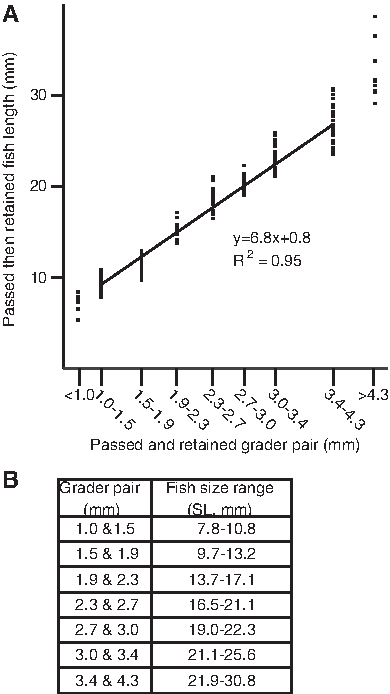
Using graders in pairs to obtain fish of defined sizes.
Discussion
We utilized 3D printer technology to create a quick, easy, and safe method for sorting fish based on size. Pouring fish through our graders quickly divides the fish wider than the grader spacing from those thinner than the grader spacing. We initially printed square-shaped divider bars, but this proved problematic. Printing a square design seemed inaccurate in our printer, which led to inconsistent gaps between the divider bars. In addition, the sharp corners of a square divider bar were occasionally hazardous to the fish. Switching to an oval-shaped design solved both of the problems and we have not lost a single fish with the oval-shaped divider bars since.
Fish length clearly and robustly increases with the width of the fish. To try and capture the full range of each grader, we made sure that at least one of our stocks was only partially retained by each grader. We do, however, note that there is overlap at the boundaries of the graders; some fish retained have a smaller SL than some fish that are passed by any given grader. Performing a linear regression on the entire group of fish between a pair of graders shows a strong relationship between length and width (Fig. 3A, R2 = 0.95). As we do not know the exact width of the fish, we instead used the midpoint in spacing between the two graders. This results in an increase of 1 mm in grader spacing (width) corresponding to a 6.8 mm increase in fish length (6.8:1). We observe similar results if instead of using the midpoint of spacing of the two graders, we used either the size of the larger or smaller grader (6.2:1 or 7.2:1, respectively, not shown). Our designs can be edited, and after a brief familiarization with the TinkerCad program, a grader with any size spacing can be designed. This means that a population of any desired size could be defined by a pair of graders, not just the populations listed in Figure 3B.
Although obtaining a population of defined range is important, excluding or including fish of a certain size can be equally important. Using two graders in combination will result in a population of fish of a defined range, whereas using single graders can quickly exclude fish of unwanted sizes. For example, Goldsmith et al. described an Adult Growth Fasting Response as juvenile fish transited from 12 to 15 segments in the longest caudal fin ray. 7 We believe that this response underlies a metabolic change in the entire animal. Using a 2.3 mm grader, only fish with 15 or more caudal fin segments will be retained, and fish passed by the 1.5 mm grader will have 9 or fewer segments. This will allow us to quickly sort for fish that are clearly on each side of the Adult Growth Fasting Response, and the potential underlying metabolic change.
We imagine a similar procedure could be accomplished for just about any developmental trait, like those found in the normal table of development produced by Parichy et al. 13 Some examples include fish that are passed by the 1.0 mm grader (<8.4 mm SL) may be largely devoid of scales, which begin to form at 8.1 mm13,22 and pelvic fins 13 ; fish retained by a 1.9 mm grader (>13.7 mm SL) may have a complete adult pigment pattern 13 ; fish retained by the 2.3 mm grader (>16.5 mm SL) may have completed ossification of the adult skeleton. 23
With the graders, sorting fish is extremely quick and easy. Rather than having to anesthetize the fish and then measure each individually, the entire population is sorted in the amount of time it takes to pour the water containing the fish through the grader.
We note that we performed this analysis on only one strain of laboratory fish (sjA). It is possible that the ratio between length and width is different across different strains, as there are potential growth differences for SL across different strains. 1 Each laboratory may need to do its own calibration to determine the relationship between length and width and the relationship between width and developmental milestones for their strain of fish. These potential differences are especially important at the smaller widths, as many developmental changes occur over small differences in length. 13
We have also observed that these graders can be useful in sorting on sex. Typically, secondary sexual characteristics (ventral yellowing in males, gravidity in females) are readily apparent to an experienced zebrafish worker when fish are large enough to be retained by the 2.7 mm grader. Fish passed by the 2.7 mm grader could not reliably be sorted by sex. As females become gravid, their bodies can become “plump,” which may result in a different length-to-width ratio than males. Female body shapes are too varied, and our sample sizes are too small to draw any firm conclusions with these data, but this is an issue to be wary of for fish wider than 2.7 mm. Although it may be tempting to use graders to select fish that mature the fastest, this may lead to the selection of undesired traits.
Footnotes
Acknowledgments
We wish to thank Brian Stephens for fish husbandry. This work was supported by NIH grant GM056988 (to S.L.J.).
Disclosure Statement
No competing financial interests exist.
References
Supplementary Material
Please find the following supplemental material available below.
For Open Access articles published under a Creative Commons License, all supplemental material carries the same license as the article it is associated with.
For non-Open Access articles published, all supplemental material carries a non-exclusive license, and permission requests for re-use of supplemental material or any part of supplemental material shall be sent directly to the copyright owner as specified in the copyright notice associated with the article.
