




Abstract
Abstract
Electronic databases provide effective and efficient management of zebrafish colony operations, but commercially available options are expensive. In this study we have developed a free zebrafish management repository alternative using free Google applications. Husbandry information is logged into a Google Sheets-based catalog through Google Form (GF) entries. Form autopopulation can be streamlined by barcodes, which can be generated and deciphered through free smartphone applications. The repository is capable of calculating pertinent husbandry dates from GF input and sending e-mail reminders to users for specified tasks. A Google application-based repository allows for a free simple zebrafish husbandry management solution.
Z
Our repository is designed to maintain a log of important animal husbandry information by automated GS updates from GF. Repository usage assumes moderate literacy in Google applications and spreadsheets, but an intuitive environment and online “Help” pages (see Supplementary Material 3A section) can guide less experienced users. By employing a cloud-based system, the repository can be accessed anywhere, by all laboratory members, through mobile devices most people already own. It is important to note that any data stored in a cloud-based system or with Google should meet the requirements of NIH best practices as well as all institutional policies. All data recorded from GF entries are integrated into a catalog (Supplementary Material S1) GS file named “Zebrafish Inventory.” The catalog is automatically populated by three GF files named “New Line Input,” “Breeding,” and “Mortality” (Supplementary Material S2A–C). To expedite data logging, we implemented three-dimensional barcodes (QR™ codes), which are easily generated and used to embed demographic information and populate the repository. QR keyboard applications are also employed and allow for any activated field in GFs to be populated with the code deciphered from a QR reader (Fig. 1).
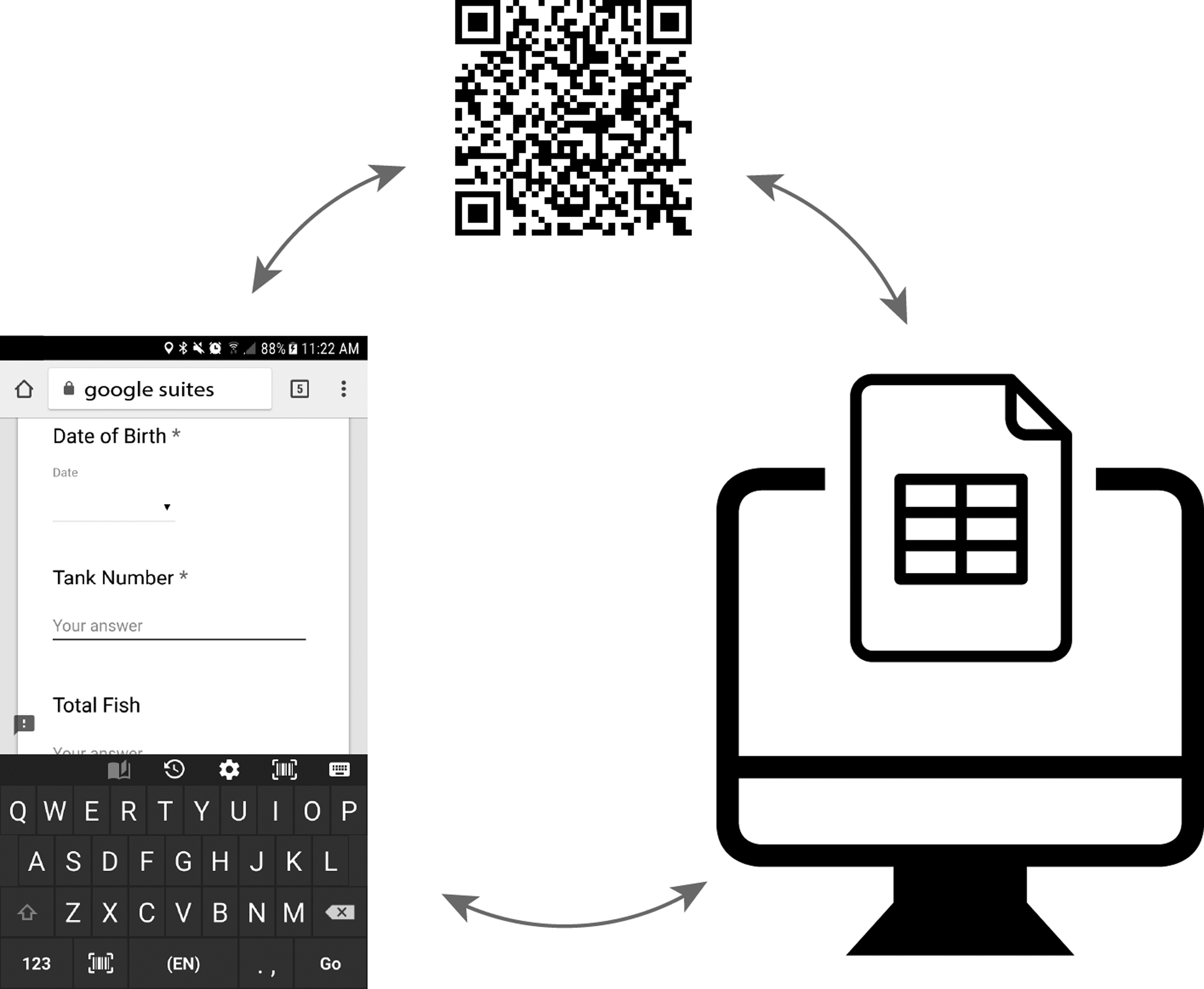
Accurate and efficient management of Zebrafish Inventory is made possible by QR™ updates through Google Forms.
The “New Line Input” GF consists of demographic metadata for differentiating strains, including tank name, tank number, location, and parents, which allows the user to easily name, locate, and access genealogical data for each labeled tank. For instance, within our system, we have designated a 15-digit code for each tank along with a 15-character alphanumeric code signifying tank location. Each code has been embedded within a QR code and labeled on the tank and rack location, respectively.
Fields for tracking important dates are also included in the “Zebrafish Inventory” catalog. Clutch date of fertilization (DOF) is recorded upon all “New Line Input” GF updates. “DOF” input informs the “Year One” field, which automatically calculates a recommended date for tank euthanasia and the “Generation” field automatically calculates a specified outcross date. Furthermore, scanning a tank code from the “Breeding Form” populates the “Breed” field in the “Zebrafish Inventory” catalog to inform a user when a tank requires maintenance breeding. By implementing the GS add on “Add Reminders” and designating a tank “Owner” and entering his or her e-mail address in the “New Line Input” form, the owner will automatically receive notifications of significant dates associated with his or her tank. Moreover, if the designated e-mail address is a Gmail account, specified husbandry dates will also be automatically added to Google Calendar through the “Events for Gmail” calendar feature.
The number of animals per tank is tracked upon all “New Line Input” form entry in the fish number field. Users update fish mortality through the “Mortality Form” and track individual animal deaths within a tank. Reports of animal fatality automatically inform the fish number field and subtract deaths from the total number of animals. In addition, the “Mortality Form” can mark a tank as euthanized for notification of tank removal from the “Zebrafish Inventory” catalog GS file.
Importantly, the Google application-based repository described here is extremely versatile and can be adapted to fit the needs of any laboratory. The provided repository is merely a template and any form field information can be added or omitted. Finally, all animal demographic information can be coded for QR as needed and the template can be adapted for any animal model. The described system provides a free, simple, and highly functional alternative to traditional electronic zebrafish databases.
Footnotes
Acknowledgments
The authors thank the Boston Children's Hospital Aquatic Resources Program for its expertise, in particular, Dr. Christian Lawrence for his critical feedback on this article. The Poduri Lab's zebrafish work is supported, in part, by the Boston Children's Hospital Translational Research Program and the NINDS (R01NS100766-01).
Disclosure Statement
No competing financial interests exist.
References
Supplementary Material
Please find the following supplemental material available below.
For Open Access articles published under a Creative Commons License, all supplemental material carries the same license as the article it is associated with.
For non-Open Access articles published, all supplemental material carries a non-exclusive license, and permission requests for re-use of supplemental material or any part of supplemental material shall be sent directly to the copyright owner as specified in the copyright notice associated with the article.
