




Abstract
The study of swimming behavior is an important part of fish biology research and the swim tunnel is used to study swimming performance as well as metabolism of fish. In this investigation, we have developed a user-friendly, automated, modular, and low-cost swim tunnel that permits to study the performance of one or more fish separately, as well as a small group of individuals. To validate our swim tunnel, we assessed swimming activity of four different species (zebrafish, medaka, guppy, and cavefish) recording reliable data of swimming behavior and performance. Because swimming behavior has been recently used in different fields from physiology to ecotoxicology, our setup could help researchers with a low-cost solution.
In the last 60
In this study, we describe a user-friendly, automated, modular, and low-cost swim tunnel that permits to study swimming performance of one or more fish separately, as well as in a small group of individuals. By means of an interdisciplinary and intersectoral collaboration between biologists, engineers, and computer scientists, we designed a swim tunnel that (1) minimizes rambling flow paths; (2) is automated and can be programmed to control water velocity with a predetermined time schedule; and (3) integrates the setup with a fish tracking software and an automated pump controller to stop the flow when the fish reaches maximum swimming speed (Supplementary Figs. S1–S4). Moreover, the chamber of our swim tunnel can be rapidly and easily modified in width and length to fit species with different body size or to create a wide arena to investigate shoaling behavior. The control architecture of the smart swim tunnel is based on a computer program that acts both as a human–machine interface and a controller. It collects data from a camera, a pH-meter and a water temperature sensor, and it additionally provides a control signal for the pump, by means of an Arduino board, which is able to generate a 0–10 V signal for the pump controller (Supplementary Fig. S4).
To validate our swim tunnel, we assessed swimming performance of four different species: two strains of zebrafish (AB and Ariosto), medaka, guppy, and Somalian cavefish (Fig. 1A, B and Supplementary Movie S1). We applied a protocol of incremental changes in water velocity, from 20 to 80 cm s−1 in 10-min steps. Thanks to the automatic tracking software, we recorded the fatigue as the point at which a fish stopped swimming and contacted the rear section of the tunnel for >5 s (Fig. 1C). Ucrit (body length per second, BL s−1) of the four species (N = 10 per group) is shown in Figure 1D. Mean Ucrit (±SEM) of the two zebrafish strains was comparable (AB: 44.85 ± 6.23 cm s−1; Ariosto: 56.26 ± 8.92; Mann–Whitney U-test, p = 0.47). Interestingly, in the Ariosto strain two subgroups with different Ucrit were discriminated (Mann–Whitney U-test, p = 0.01). This last result could be due to heightened behavioral individual differences in the wild strain, in line with data in other species. 4 The mean Ucrit of medaka (18.61 ± 1.06 cm s−1), guppy (9.25 ± 0.49 cm s−1), and cavefish (9.28 ± 0.5 cm s−1) was significantly lower in comparison to zebrafish (one-way ANOVA, F4, 49 = 22.69, p < 0.0001; Tukey's multiple comparison test, p < 0.01). Our estimation of swimming performance of guppies and zebrafish was broadly overlapped with that of prior studies with a similar setting,5–7 suggesting that the setup described in the present article allows reliable measurements of swimming activity and performance of fish. With other type of swim tunnels, some differences were observed. However, it is unclear whether these variations were due to differences in the chamber8,9 or in some characteristics of the fish that can affect swimming such as genetic background, maintenance conditions, morphology, and physiological traits.6,7,10–12
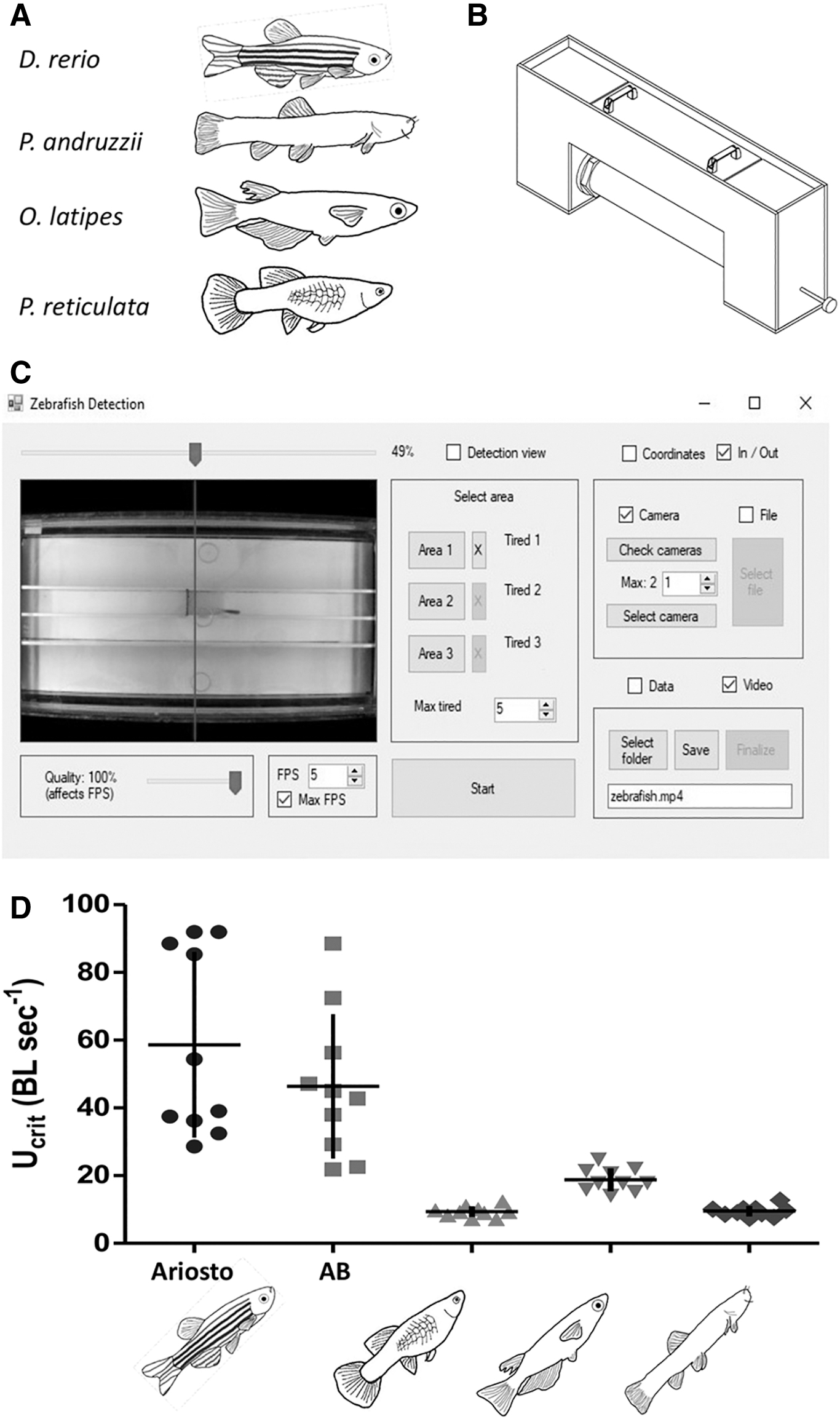
The measurement of swimming behavior, energetics, and kinematics is an important part of fish biology research13,14 and swimming tunnels are now consistently used also in applied studies on pharmacology, 15 ecology, 16 toxicology, 17 and biomedical research. 10 Our system could help researchers in these fields with a cost-efficient solution for characterization of zebrafish and medaka mutants and testing biologically active compounds. Furthermore, differently from other Brett-type swimming tunnels,1,3,14,18 our modular system gives the opportunity to simultaneously test multiple specimens (i.e., mutants vs. wild type) and to investigate shoal's swimming behavior. With the possibility to enrich the system with additional features, such particle image velocimetry for visualizing the flow physics around swimming fish 14 or respirometer to measure oxygen consumption, 19 our study could also provide the base for more complex research on fish swimming metabolism and mechanic.
Footnotes
Authors' Contributions
M.B., C.B. and T.L.-X. conceptualized and designed the study; L.B. performed experiments; E.M. and  . developed control software; M.B. projected the apparatus; C.B and L.B. conducted statistical analysis; C.B., M.B., E.M., T.L.-X., and D.S. wrote the article; and D.S, C.B., and M.B. provided the resources.
Acknowledgment
The authors are thankful to Andrea Margutti for technical support.
Disclosure Statement
No competing financial interests exist.
Funding Information
C.B. and T.L.-X. are supported by the University of Ferrara Research Grants (FAR2020 and FIR2020). D.S. is supported by the Muscular Dystrophy Association research grant [MDA 577888], the Italian Telethon Foundation Research Grant [GSP20004_PAsMCT8005], and the Association Francaise contre les Myopathies Research Grant [23000].
References
Supplementary Material
Please find the following supplemental material available below.
For Open Access articles published under a Creative Commons License, all supplemental material carries the same license as the article it is associated with.
For non-Open Access articles published, all supplemental material carries a non-exclusive license, and permission requests for re-use of supplemental material or any part of supplemental material shall be sent directly to the copyright owner as specified in the copyright notice associated with the article.
