




Abstract
This study investigates a novel method to induce mating in zebrafish (Danio rerio) by direct water addition of membrane progestin receptor (mPR) agonists, Org OD 02-0 (Org), or a maturation-inducing steroid, 17α,20β-dihydroxy-4-pregnen-3-one (DHP). Traditional spawning induction methods using hormone injections can be invasive and stressful for fish, especially small fish such as zebrafish. A previous study showed that progestins applied externally to the water can induce oocyte maturation and ovulation in female zebrafish. Then, a recent study showed that the addition of steroids and Org to the water also induced male sexual behavior in zebrafish. Therefore, it was hypothesized that the addition of these compounds to the water could induce mating in zebrafish. To address this, we investigated the efficacy of adding these compounds to the water in the vessel with a pair of zebrafish. Female and male zebrafish pairs were exposed to varying concentrations of DHP or Org in the water, and the resulting spawning rates and rate of sexual behavior induction were recorded. Our results showed that both simple addition of DHP and Org solution successfully induced mating within 4 h. A single chemical induced both spawning in females and sexual behavior in males. In this study, we have established a simple, novel method to induce mating in zebrafish by adding mPR agonists to the water.
Introduction
Zebrafish (Danio rerio) are widely used as model organisms in various fields of biological research, including genetics, developmental biology, toxicology, and reproductive biology. 1 Recently, genome editing technology has been widely used in zebrafish and has become a common research tool to elucidate the function of many genes. Genome-edited fish generally have low reproductive capacity, making it difficult to obtain the next generation. Therefore, a major issue in zebrafish research is reliable mating induction to maintain the gene-edited strains. Traditional methods, such as hormone injections, are used to induce spawning.2,3 However, hormone injection can be invasive and stressful for fish, especially small fish such as zebrafish. To overcome this problem of injection, noninvasive methods have been developed that allow spawning to be induced simply by adding hormones to the water.4,5 The same was achieved in the aquatic frog, Xenopus laevis.6,7 It is also a meaningful, easy-to-use, and relatively less stressful alternative to manual injection for the animal. It also improves animal welfare and makes the experimental protocol more meaningful and straightforward. A promising alternative is the use of biologically active agents, such as steroids, which play a critical role in oocyte maturation and ovulation. Instead of hormone injections, these agents can be added directly to the water, which is absorbed through the gills and skin, activating natural reproductive pathways. 8 Two critical compounds in this area of research are 17α,20β-dihydroxy-4-pregnen-3-one (DHP) and the selective agonist for the membrane progestin receptor (mPR), Org OD 02–0 (Org). DHP is a well-known natural progestin and maturation-inducing steroid in freshwater fish and is essential for regulating oocyte maturation and ovulation. 4 Org, a synthetic compound, has also shown the potential to influence reproductive processes, specifically by enhancing oocyte maturation and ovulation. 9 The stimulating effect of Org on male fish sexual behavior has also been demonstrated. 8 The combined treatment of Org and testosterone (Tes) at specific concentrations successfully induced sexual behavior in male zebrafish. After treatment, the male zebrafish exhibited female-chasing behavior, followed by hooking behavior, to induce spawning in the females. In the previous study, males and females were incubated separately in glass jars with hormones, which effectively induced reproductive behavior. However, the current study explores a new and even more streamlined approach by using Org or DHP in a mixed-sex environment, allowing both male and female zebrafish to be incubated in the same glass bottle. A single dose of mPR agonist was sufficient to induce both male chasing behavior and female ovulation and spawning simultaneously. The method will provide an efficient, non-invasive alternative to injection techniques in small fish.
Materials and Methods
Materials
Zebrafish were cultured under standard laboratory conditions. The fish used in the experiments were maintained in an outflow culture system set at 28.5°C on a 14-h light and 10-h dark cycle. 10 The steroid hormone DHP was purchased from Toronto Research Chemicals (Toronto, Canada), while Org OD 02–0 (Org) was purchased from AXON Medchem BV (Groningen, The Netherlands). Other chemicals used in the study were purchased from Wako Pure Chemical Industries, Ltd. (Osaka, Japan). All zebrafish experiments were performed under the approval of the Institutional Ethics Committee of Shizuoka University, Japan (Approval No. 2023F-9 and 2024F-9); the guidelines for the use of animals established by this committee were strictly followed.
Protocol for hormone treatment and induction of reproductive behavior
The transparent zebrafish strain roy (mpv17a9/a9) is bred in our laboratory. 11 Between 3 and 4 months of age were used for this study. Any males that showed chasing behavior toward females after the light was on in the morning were excluded from the experiment. Also, females with ovulated eggs in the morning were excluded. For the experimental setup, one male and one female zebrafish were placed in a glass bottle filled with 200 mL of water. Marbles were placed at the bottom of the bottle to prevent the fish from consuming the spawned eggs. Each pair was exposed to different compounds by adding 10 µL of 10,000-fold stock solution in ethanol of each compound to 100 mL of water. Fish were exposed to these solutions for 4 h. The flasks were kept in an incubator and covered to minimize external disturbances and prevent stress. The water temperature was maintained at 28.5°C throughout the exposure period.
Observation of sexual behavior of treated fish
The behavior of the fish in each pair was observed for 4 h to monitor their interactions. If a pair failed to spawn until 4 h, the ovulatory status of the female fish was determined manually by gently squeezing the abdomen to check for the presence of ovulated eggs. After male fish started chasing, the sexual behavior was recorded using a video camera (Panasonic HC-W580M) for 1–5 min. To check hooking behavior (before spawning, males wrap their caudal fins around the female’s body in a final sexual behavior), video footage was observed in super-slow motion after being converted to slow motion using Adobe Premiere Pro video editing software (Adobe et al., 2005).
Determine the number of spawned eggs, fertilization, and survival
Any spawned eggs were collected after the 4-hour incubation period, and the total number of eggs was counted. The fertilization rate of the embryos was evaluated by observing whether cell cleavage occurred. In addition, the survival rate of the zebrafish larvae was assessed at 5 days post-fertilization.
Statistical analysis
Results were expressed as mean ± SD (standard deviation). Statistical analysis was performed using one-way ANOVA to determine significant differences between the control and treatment groups. All analytical data and graphs were generated using GraphPad Prism software version 9.4.0 for Mac OS (GraphPad Software, San Diego, California, USA).
Results
Externally applied hormones induce zebrafish mating in vivo
To elucidate the inducing ability of the mPR agonists DHP and Org on zebrafish mating, we applied the hormones directly to the water in which a pair of zebrafish was placed (Fig. 1). We used the transparent zebrafish strain, roy, to observe changes in ovary. 11 By using the strain, ovulation in the female body could be checked from outside the body during incubation. DHP and Org induced ovulation and spawning in females as reported (Fig. 2A, B).4,9 In addition, a single dose of the compounds induced male sexual behavior, chasing, and hooking, which can induce spawning in females under the condition that females and males were present in the same tank (Fig. 2C, D). In the case of male sexual behavior, males started chasing after 2 to 3 h of incubation, but successful chasing led to hooking for the female ovulation occurred later. During incubation, male and female zebrafish displayed sexual behavior within 3 to 4 h of exposure. Males were observed chasing females, and once females appeared to have ovulated, spawning occurred after males successfully engaged in “hooking” behavior (Fig. 1). Male sexual behavior was scored over a 3 to 4 h incubation period based on three performance criteria: 0 for no chasing, 0.5 for occasional chasing and 1.0 for active chasing with induced spawning (Fig. 2D). 8 The most pronounced sexual behavior was observed in males, including chasing of the female, and successful hooking and spawning occurred several times; these behaviors were scored as 1.0. Pair behavior around spawning was recorded on video for both DHP and Org (Supplementary Movie S1 and Movie S2). When fish were treated with concentrations higher than 10 nM, a maximum number of females ovulated and spawned (Fig. 2A and B). Only one female and one male were reactive at 0.01 nM for both DHP and Org. However, no spawning was observed at this concentration. This concentration is considered the lower limit for reactivity. At 0.1 nM, 30–40% of female spawning or male sexual behavior was induced. Based on these results, the EC50 values for spawning induction by DHP and Org were calculated to be 1.27 and 2.64 nM, respectively. The EC50 value for male sexual behavior was similar (0.98 and 2.58 nM). Spawning in females and sexual behavior in males were induced by a mixture of DHP and Org at concentrations of 0.01 and 0.1 nM. The induction rates at 0.1 nM were additive to the rates observed at each concentration. Therefore, we concluded that DHP and Org have an additive effect.

Induction of spawning in females and sexual behavior in males by addition of a single dose of compounds. Representative photographs of zebrafish pairs treated with a single dose of DHP

Induction of spawning in females and sexual behavior in males by addition of a single dose of compounds. One pair of zebrafish in a single tank was treated with different concentrations of compounds for 4 h by adding them to the water at time zero. Data represent the mean of five to six experiments with three different pairs (n = 18). Percentage of females induced to ovulate
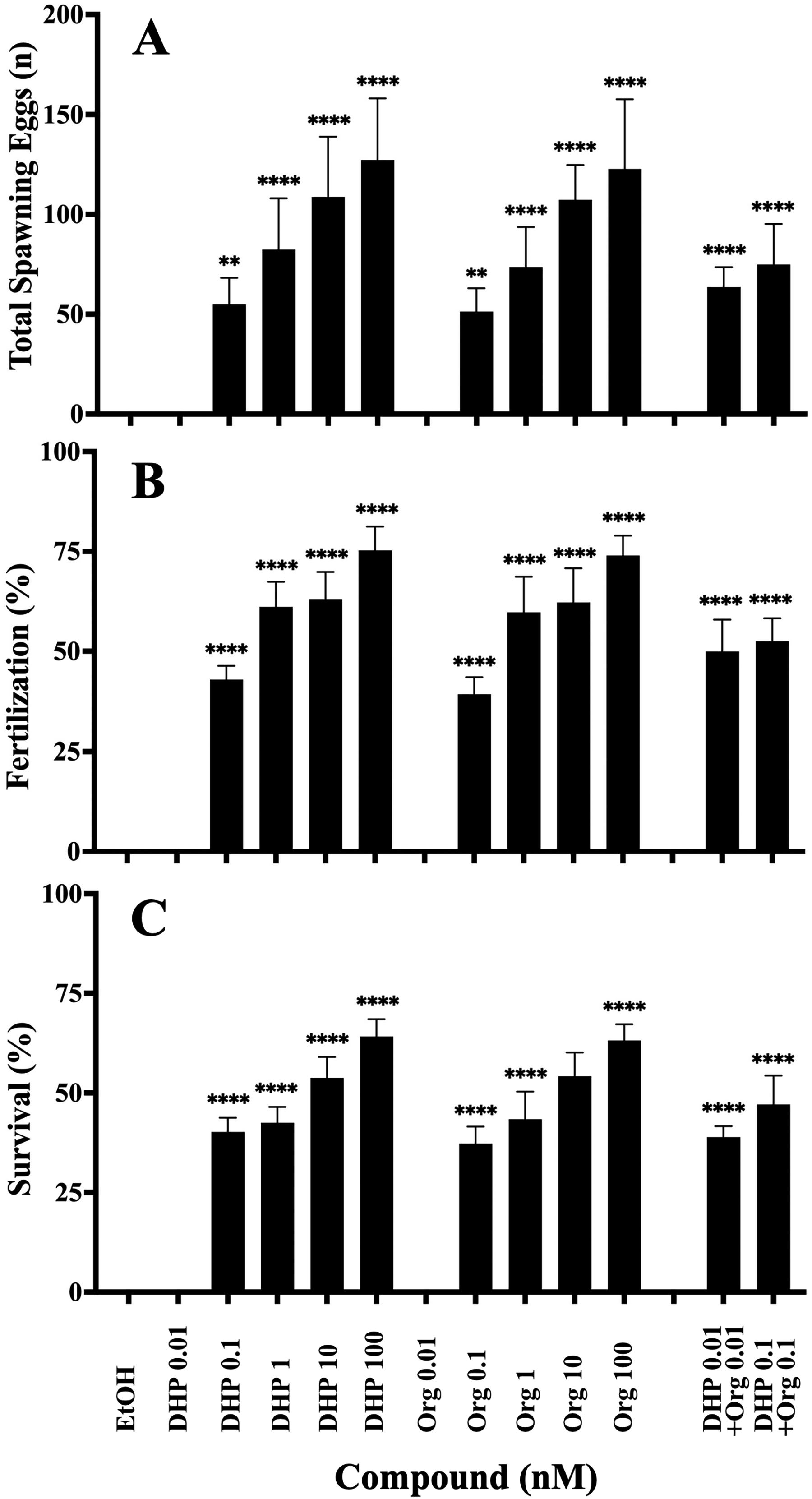
Org and DHP treatment resulted in spawning almost the same number of eggs at both concentrations (Fig. 3A). The result showed that both compounds possess the same magnitude of activity. No ovulation and spawning were found when treated with EtOH as a control group. The fertilization rate and survival rate were also determined. Fertilization rate and survival rate of embryos were also comparable in Org and DHP treatment (Fig. 3B and C). No significant difference was found between Org and DHP at both concentrations. These fertilization and survival rates were similar to those obtained in our laboratory by natural spawning, indicating that artificial mating with Org or DHP can also provide adequate rates. Fertilized eggs spawned by the new method established in this study developed normally. Fry developed normally, mature fish were fertile, and a second generation was obtained. These results showed that the established mating method was functionally identical to physiological mating.
Externally applied compounds induced natural spawning.
Discussion
This study investigated the effects of introducing two compounds, DHP and Org, directly into the water during zebrafish mating. The results showed that these compounds can effectively induce zebrafish mating without direct injection, marking a significant advance in aquaculture techniques for zebrafish mating. Previously, we demonstrated that zebrafish spawning could be induced by adding DHP or Org to the water.4,9 We also established a novel method to induce male sexual behavior in zebrafish using the same technique. 8 The results showed that the in vivo technique induced sexual behavior within 3 to 4 h of incubation by adding Org and Tes in water. In this study, single-dose administration of DHP or Org was effective in inducing male sexual behavior. It is expected that pheromones secreted by the female activated the male and resulted in stimulation by the single dose. Consequently, the effect of hormones was stronger in the case of pair treatment than in the case of single fish treatment. When steroids were applied in water, they were absorbed through the gills and other organs, accumulated in the ovaries and testes, and stimulated for mating. 8 The method was effective in ovulating females in Xenopus levis. 6 When added to water, tracer experiments in African clawed frogs show that the compounds concentrate in the ovaries and testes within a few hours. 7 The receptor for progesterone signals to induce oocyte maturation has been shown to be mPRβ (Paqr8). 12 It is interesting to note that the mPR selective agonist, Org, showed an inductive effect. Org, a selective agonist for mPR, showed a potent inducing effect on male and female sexual behavior in vivo. Thus, it is suggested that the mPR signaling pathway is involved in the induction pathway of male sexual behavior by stimulating the non-genomic actions of steroids. 13
Our results indicated that both DHP and Org could effectively stimulate the reproductive system, although DHP showed a relatively higher spawning rate (Fig. 2B). This observation is consistent with previous research highlighting the role of DHP as a potent maturation-inducing hormone in fish, where it has been shown to play a critical role in triggering final oocyte maturation and ovulation in species such as zebrafish and other teleosts.14,15 Org, a synthetic analog, also proved effective, possibly due to its ability to mimic the natural binding affinities of DHP to mPRs. These results suggest that although Org is synthetic, it may act through the same molecular pathways. The result of fertilization obtained with DHP and Org was similar (Fig. 3B). It is also noted that the embryo develops normally with this method. With this new method, the simultaneous application of a single hormone induced sexual behavior after a certain incubation period, and the offspring from fertilized eggs were normal. The number of spawned eggs was satisfactory and almost similar to natural spawning (Fig. 3A). The observed efficacy of introducing steroids into the water rather than by injection is noteworthy because zebrafish can effectively absorb these steroids through their skin and gills. This supports the understanding that fish, especially small teleosts such as zebrafish, can take up certain steroid hormones from their aquatic environment, allowing for non-invasive induction of reproductive processes. 16 The results highlight the potential of water-based hormone delivery as a less stressful alternative to injection, with the added benefit of reducing handling stress, which is known to inhibit spawning behavior. 17
In this study, we established a new method to induce reproductive spawning behavior in zebrafish without hormone injection by adding a hormone solution to water. We also combined this method with the previously described female ovulation induction method to establish a new artificial egg collection method. In this study, we used a glass vessel to avoid steroid absorption. However, we confirmed that the plastic mating tank commonly used for zebrafish mating is applicable to this method. Thus, this method will be widely applied. In addition, we expected that this method would also be applied to other small fish species. Mating induction plays a critical role in sustainable aquaculture production. This study provides a safe alternative solution for mating induction that helps reduce handling stress and creates opportunities for reproductive success in fish.
Footnotes
Authors’ Contributions
S.A. performed all experiments and drafted the article. M.A.B. contributed to the maintenance of the zebrafish. M. M. H. performed the video editing. T.T. participated in the design of the study, drafting, and final editing and writing.
Disclosure Statement
No competing financial interests exist.
Funding Information
This work was supported by the Grants-in-Aid for Scientific Research on Priority Areas from Japan’s Ministry of Education, Culture, Sports, Science and Technology and JSPS Grant Number 23K05830 (to T.T.). The funders had no role in the study design, data collection and analysis, publication decision, or article preparation. We also acknowledge a scholarship from Science and Technology Fellowship Trust, Ministry of Science and Technology, Government of the People’s Republic of Bangladesh for S.A. (award memo no:08//04-01-2021).
