




Abstract
Among the primary headaches, cluster headache (CH) presents very particular features allowing a relatively easy diagnosis based on criteria listed in Chapter 3 of the International Classification of Headache Disorders (ICHD-II). However, as in all primary headaches, possible underlying causal conditions must be excluded to rule out a secondary cluster-like headache (CLH). The observation of some cases with clinical features mimicking primary CH, but of secondary origin, led us to perform an extended review of CLH reports in the literature. We identified 156 CLH cases published from 1975 to 2008. The more frequent pathologies in association with CLH were the vascular ones (38.5%, n = 57), followed by tumours (25.7%, n = 38) and inflammatory infectious diseases (13.5%, n = 20). Eighty were excluded from further analysis, because of inadequate information. The remaining 76 were divided into two groups: those that satisfied the ICHD-II diagnostic criteria for CH, ‘fulfilling’ group (F), n = 38; and those with a symptomatology in disagreement with one or more ICHD-II criteria, ‘not fulfilling’ group (NF), n = 38. Among the aims of this study was the possible identification of clinical features leading to the suspicion of a symptomatic origin. In the differential diagnosis with CH, red flags resulted both for F and NF, older age at onset; for NF, abnormal neurological/general examination (73.6%), duration (34.2%), frequency (15.8%) and localization (10.5%) of the attacks. We stress the fact that, on first observation, 50% of CLH presented as F cases, perfectly mimicking CH. Therefore, the importance of accurate, clinical evaluation and of neuroimaging cannot be overestimated.
Introduction
Although the first description of cluster headache (CH) is credited to the Dutch doctor Nicolaas Pieterszoon Tulp in 1641, and other authors like Willis (1), Van Swieten (2) and Oppermann (3) later noted isolated occurrences with similar features, CH acquired nosographic status only in the 1930s, when it received the eponym of Horton's headache and later of histaminic cephalalgia (4). The current name was introduced by Kunkle in 1952 (5). Already included in the first edition (1988) of the International Headache Classification (6), at present CH diagnostic criteria are defined in Chapter 3 of the International Classification of Headache Disorders, 2nd edn (ICHD-II) (7), according to which there must be at least five attacks; severe unilateral pain in the orbital, supraorbital and temporal areas associated with at least one of the following symptoms: ipsilateral conjunctival injection and/or lacrimation, nasal congestion and/or rhinorrhoea, eyelid oedema, forehead and facial sweating, miosis and/or ptosis, a sense of restlessness; and duration of the attacks ranging from 15 to 180 min with frequency of attacks from one every other day to eight per day. It is, of course, necessary to exclude secondary causes. A feature frequently mentioned by patients suffering from this disease, but which does not appear among the ICHD-II criteria, is the circadian and circannual rhythm of the attacks. Depending on the duration of the interictal phase, CH can appear either in an episodic form (remission periods > 1 month, ICHD-II code 3.1.1) or in a chronic form (remission periods < 1 month, ICHD-II code 3.1.2). In typical cases, diagnosis is not particularly difficult as it might be when one or more of the main features required by the classification is missing or when other atypical elements are present. On the other hand, it is well known that clinical features, which at the beginning are virtually indistinguishable from a primary headache, may later turn out to be related to a secondary cause: this is true not only for tension-type headache, due to its relatively non-specific features, but also for primary headaches possessing more particular characteristics such as migraine and CH. As in our recent study of rarer trigeminal autonomic cephalalgias (8), we carried out a comprehensive review of the literature on symptomatic cluster-like headache (CLH) cases published from 1975 to August 2008, with the aim of highlighting the main features that could lead to an early suspicion of a secondary condition.
Materials and methods
A literature search was carried out on Medline (Pubmed and Winspirs; keywords: cluster-like headache; symptomatic cluster headache; symptomatic headache; atypical cluster headache; vascular pathology and cluster headache; tumoral pathology and cluster headache; inflammatory pathology and cluster headache; post-traumatic cluster headache; neurological diseases and cluster headache), on Medical Current Contents and on the references of each article. The research was limited to papers written in English, French, German, Italian and Spanish.
We identified 115 papers or abstracts (9–123) reporting a total of 156 cases in which the symptomatology was dominated by a cluster-like pain, which then turned out to be associated with a secondary condition (CLH). Although we did our best to include all cases mentioned in the literature, it is possible that some might have been omitted. All cases, including those published before the ICHD-I (1988) and ICHD-II (2004), were submitted to a rigorous control, reviewing the diagnoses following ICHD-II criteria, where restlessness has been added as a criterion as an alternative to presence of autonomic symptoms. Eight cases were excluded from any further examination since either the CLH diagnosis turned out to be wrong (9): a case of migraine with aura is clearly recognizable; (26,121): the diagnosis is more likely to be that of hemicrania continua), or its association with the reported disease was clearly not causal (11: case 5; 19,43: case 2; 111: cases 1 and 2). Cases were not excluded that did not report if headache was greatly reduced or resolved after successful treatment or spontaneous remission of the causative disorder (7). We are aware that only a positive outcome after removal of the associated condition would prove unequivocally the causal connection. However, since this information is often missing, the number of CLH patients would be drastically reduced to 38 (12,14,16,27: cases 2 and 3; 29: cases 1 and 2; 34,35: cases 1–3; 40,42,44,59,60,77,78: cases 1 and 2; 80,81,86,88,91,92,94,96,97,102,104,107,113,116: cases 1 and 2; 118–120,123).
Results
Among considered CLH patients (n = 148), 74.1% of the sample were male and 25.9% female, the M : F ratio being 2.7:1 (100/38, since data on patient gender were missing in 13 cases). The age of symptom onset was 42.8 ± 15.2 years, while the age of correct diagnosis was 47.0 ± 13.4 years. Cases were then divided in seven categories depending on the condition associated with cluster-like symptomatology (Figure 1): vascular pathologies (n = 57) (10,12,18,27: cases 2 and 3; 30,33,35: case 4; 38: cases 5 and 6; 39,41–43: case 6; 44,48,51,54,56,57,62: two cases; 65: two cases; 66,70,71,73–75,77,78: case 1; 80,83: two cases; 88,90,92,95,97,98,100,102,105: two cases; 107,108,112–114: two cases; 115: case 2; 116: two cases; 118,122,123) were the most common cause of CLH, followed by tumoral pathologies (n = 38) (14–17: two cases; 23,27: case 1; 32,34,35: case 2; 36: six cases; 38: case 4; 40,43: cases 3–5; 46,50,58,59,61,63,78: case 2; 86,94,96,101,103,106,109,115: case 1; 117,119), and by inflammatory/infectious diseases (n = 20) (13,21,22,25,29: two cases; 35: cases 1–3; 38: three cases; 43: case 1; 49,52,55,60,67–69,81). The remaining cases (n = 33) were classified as post-traumatic (n = 13) (11: cases 1–4; 20,24: four cases; 37,47,64,91); other central nervous system diseases (n = 9) (31,72,76,82,84,85,99,110,120); iatrogenic or drug-related conditions (n = 7) 45,53,79: three cases; 93,104); and dental pathologies (n = 4) (28,87): two cases; 89.
Criteria of selection of 156 cluster-like headache cases found in the literature.
Among these 148 cases, we decided to exclude from further analysis of headache features those missing relevant information (n = 72) or those presenting with a clinical history and/or a physical examination immediately indicative of a secondary condition. To be more precise, in 13 cases the clinical case history and/or the physical examination upon first observation clearly pointed to a secondary cause (64,69,79: three cases; 85,93,99,100,105: two cases; 110,115: case 1); in 12 cases (11: cases 1 and 2; 22,24: case 1; 28,47,55,78: case 2; 84,89,90,114: case 2) the neurological examination was not reported; in 47 cases (11: cases 3 and 4; 17: two cases; 18,20,23,25,29: case 2; 31,36: six cases; 38: six cases; 43: cases 1 and 3–5; 45,46,48–50,52,61,62: two cases; 65: two cases; 71,82,83: two cases; 95,98,101,108,112,117) the text did not describe the pain features and/or the associated symptoms during the attack.
The remaining 76 cases where divided into two groups, depending on whether the headache features described by the author fulfilled the requirements of a formal CH diagnosis according to the ICHD-II classification (‘fulfilling’ group, F: n = 38; 24.4% of total cases and 50.0% of cases considered more specifically) (13–16,21,24: cases 2–4; 27: three cases; 29: case 1; 32,34,37,40,41,43: case 6; 44,51,53,54,58,60,72–74,77,81,86,87: case 2; 91,94,96,103,104,113,123); or whether these features were not fulfilled or presented with one or more atypical elements (‘not fulfilling’ group, NF: n = 38; 24.4% of total cases and 50.0% of cases considered more specifically) (10,12,30,33,35: four cases; 39,42,56,57,59,63,66–68,70,75,76,78: case 1; 80,87: case 1; 88,92,97,102,106,107,109,114: case 1; 115: case 2; 116: two cases; 118–120,122).
Criteria for screening the case reports according to the data reported in the articles, and the number of selected patients, are summarized in the flow chart in Figure 1. Figure 2 shows CLH cases found in the literature (n = 148), divided according to their underlying condition. Within each disease category, the number of F and NF cases is provided, as well as that of those not further analysed for the reasons already specified.
Cluster-like headache cases of secondary origin (n = 148) reported in the literature (1975–2008) divided according to their underlying condition. Each disease category has been further subdivided in different groups, as reported in the text.
Vascular pathologies
This category was the first cause of CLH (38.5%; 57/148). Among CLH cases associated with vascular diseases, 21.0% (12/57) showed features fully in accordance with a formal CH diagnosis and were thus inserted in the F group; in one-half of them (n = 6) CLH proved to be secondary to aneurysm (27: cases 1 and 2; 43: case 6; 44,54,77); other reported cases could be ascribed to dural fistula (n = 2) (73,74), ischaemic injuries (n = 2) (41,51) and cerebral venous thrombosis (n = 2) (113,123).
Vascular cases classified as NF were 43.9% (25/57): arteriovenous malformation (n = 6) (10,12,30,33,35: case 4; 39); carotid artery dissection, extracranial (n = 9) (66,80,97,102,107,115,116: two cases; 118), intracranial (n = 1) (92), vertebral (n = 2) (57,122); medullary stroke (n = 2) (70,75); intracranial aneurysm of internal carotid artery (n = 2) (42,114: case 1); carotid endarterectomy (n = 1) (56); superficial temporal artery fistula (n = 1) (78); and subclavian steal syndrome (n = 1) (88). A case of arteriovenous malformation (12) may be considered as ‘Probable CH’, since it missed only one ICHD-II diagnostic criterion, that of attack duration.
Tumoral pathologies
The second most frequent cause of CLH was tumoral pathology (25.7%; 38/148), of which 31.6% (12/38) were included in the F group: pituitary adenomas (n = 5, of which four were prolactinomas) (14,27: case 3; 86,96,103, meningiomas (n = 2) (16,34), carcinomas of the paranasal structures (n = 2) (15,32), posterior fossa epidermoid carcinoma (n = 1) (40), fifth cranial nerve neurinoma (n = 1) (58), inflammatory myofibroblastic pseudotumour (n = 1) (94). No tumours of glial origin were found. Neoplastic cases included in the NF group were 15.8% (6/38): meningiomas (n = 3) (35: case 2; 59,119); multiple cerebral metastasis from lung carcinoma (n = 1) (63), cavernous sinus metastasis due to unidentified primitive tumour (n = 1) (106), and right epidermoid lesion of the clivus (n = 1) (109).
Inflammatory/infectious pathologies
CLH due to inflammatory/infectious diseases amounted to 13.5% of cases (20/148), of which five (25.0%) (13,21,29: case 1; 60,81) were included in the F group and four (20.0%) (35: cases 1–3; 67,68) in the NF group. Among F, two cases were associated with sphenoidal aspergillosis (60,81) and one each with ophthalmic herpes zoster (13), post infection from herpes simplex (21) and maxillary sinusitis (29: case 1). Among NF cases, two were associated with sinusitis (35: cases 1–3), one with sphenoidal aspergillosis (67) and one with infection from parainfluenza virus (68). Of the two cases associated with sinusitis, one (35: case 1) may be regarded as ‘Probable CH’, in that it missed only one ICHD-II diagnostic criterion, that of attack duration.
Post-traumatic pathologies
CLH associated with post-traumatic causes were 8.8% (13/148) and included non-concussive (n = 3) (24): case 3; (37,47) and concussive cranial trauma (n = 3) (24): cases 1, 2 and 4), orbital enucleation (n = 6) (11: cases 1–4; 20,64), and penetration of a foreign body in the maxillary sinus (n = 1) (91). Five cases could be assigned to the F group (24: cases 2–4; 37,91), none to NF.
Other neurological pathologies
These amounted to 6.1% of cases (9/148): multiple sclerosis (n = 3) (72,82,85); syringomyelia (n = 2) (84,99), one of which was associated with Arnold–Chiari malformation (99); idiopathic intracranial hypertension (n = 2) (110,120); retrobulbar neuritis associated with giant aneurysm (n = 1) (31); and orbital meningioma associated with cavernous sinus granulomatosis (n = 1) (76). Only one case, secondary to multiple sclerosis (72), was included in the F group and two, secondary to orbital meningioma plus granulomatosis of the cavernous sinus (76), and idiopathic intracranial hypertension (120), were assigned to NF group.
Iatrogenic or drug-related conditions
This category represented 4.7% (7/148) and included cocaine use (n = 3) (79: three cases), chemotherapy (n = 1) (45), warfarin therapy (n = 1) (93), tonsillectomy due to presence of a carcinoma (n = 1) (53), and intraocular lens implant (n = 1) (104). These last two cases were included in the F group. None was assigned to the NF group.
Dental pathologies
CLH associated with dental pathologies were 2.7% (4/148): inclusion of the upper wisdom tooth in the pterygopalatine fossa (n = 1) (28), tooth extraction (n = 2) (87: two cases), and periostitis of the third upper molar (n = 1) (89). Only one case (87: case 2), associated with tooth extraction, was included in the F group. A second tooth extraction case (87): case 1), included in the NF group, was compatible with the diagnosis of ‘Probable CH’, since it missed only one diagnostic criterion, that of attack duration.
Fulfilling group
‘Fulfilling’ cases (n = 38), i.e. cluster-like headache patients in whom the clinical features, upon first clinical observation, were fully in accordance with International Classification of Headache Disorders, 2nd edn diagnostic criteria for cluster headache

References are listed in chronological order.
SAH, subarachnoid haemorrhage.
Of the 38 cases belonging to this group, 29 featured a side concordance between pain and the underlying condition; in two cases pain occurred on the contralateral side; in seven cases it was not possible to obtain this information. In 12 cases the symptomatology completely ceased after surgery on what was considered to be the main cause (14,16,27: case 2; 34,40,44,60,74,77,94,96,104); in eight cases pain disappeared with medical therapy (27: case 3; 29: case 1; 54,58,86,87: case 2; 113,123). The presence of circadian rhythm of the attacks was observed in 19 cases (13,16,21,24: cases 2 and 3; 40,43,44,53,58,60,72,74,77,81,94,96,104,113); it was absent in four cases (14,27: case 2; 87,103); it was not reported in 15 cases (15,24: case 1; 27: cases 1 and 3; 29,32,34,37,41,51,54,73,86,91,123).
Not fulfilling group
‘Not fulfilling’ cases (n = 38), i.e. the cluster-like headache patients in which the clinical features, upon first clinical observation, were not in accordance with International Classification of Headache Disorders, 2nd edn diagnostic criteria for cluster headache

References are listed in chronological order.
AVM, arteriovenous malformation.
Cluster-like headache (CLH) ‘not fulfilling’ cases (NF, n = 38)
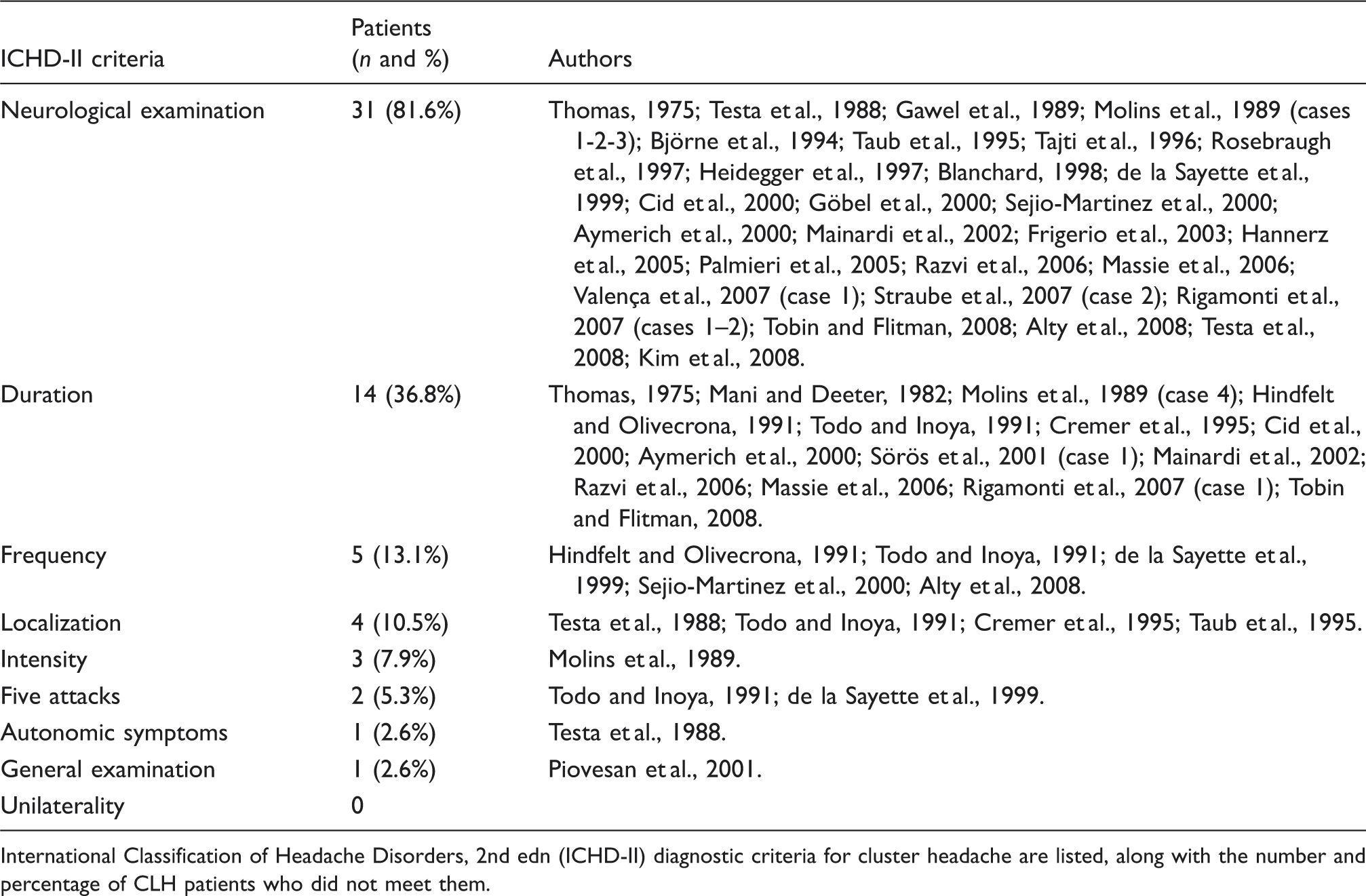
International Classification of Headache Disorders, 2nd edn (ICHD-II) diagnostic criteria for cluster headache are listed, along with the number and percentage of CLH patients who did not meet them.
Cluster-like headache (CLH) ‘not fulfilling’ cases (NF, n = 38)

Number and type of not fulfilled International Classification of Headache Disorders, 2nd edn diagnostic criteria for cluster headache are listed, along with the number and percentage of CLH patients who did not meet them.
Discussion
In general terms, when dealing with a diagnosis of secondary headache, an important causal relationship criterion to establish is the disappearance or clear improvement of headache when the associated condition is removed (7). This also holds true for patients presenting with a cluster-like symptomatology. In 2002 a review was published of 68 CLH cases occurring between 1980 and 2001 (124), fulfilling the strict requirements set forth by the authors, i.e. headache features compatible with CH diagnosis according to International Headache Society 1988 classification criteria (6); negative general and neurological examination both during attacks and in the interictal phase; localization of the second condition consistent with a likely triggering of the trigeminovascular system; and CLH symptom remission without recurrence after adequate treatment of the other conditions.
The assessment of the outcome after specific intervention on the alleged cause of pain is often difficult because of lack of information in the text and of various interpretations by the authors: in our study, only 38 cases report on the remission of symptoms following the lesion treatment. Focusing this evaluation on the two groups F and NF, which are considered most in detail and where all information relevant for a formal CH diagnosis is available, only in 27 cases is reference made to the disappearance of the symptoms after removal of the associated condition. Therefore, the cases that might be regarded as CLH sensu stricto would be too limited by lack of information, preventing any further analysis. Bearing in mind this choice, we selected the patients as specified in Materials and methods.
Age at onset
CH onset usually occurs between the third and the fifth decade (125). In a recent observational study carried out over three decades, the onset peak was placed between 20 and 29 years of age for both sexes (126): therefore, late onset of symptoms compatible with CH diagnosis would represent per se an element that requires attention, although onset in the elderly has been reported (127–129), particularly in female patients (130). The need for special caution for older groups is confirmed by our reappraisal of symptomatic cases, since the average onset in CLH patients turns out to be at the age of 42.7 years.
Interval between clinical onset and diagnosis
As a whole, in CLH the average time elapsed between symptom onset and correct diagnosis turns out to be 3.0 years in the NF group, whereas it stretches to 5.4 years in the F group. Therefore, the correct diagnosis in the F group of CLH, which so closely mimics CH, presents a delay of > 2 years in comparison with the NF group.
Male/female ratio
The concept that CH is chiefly a male disease has been challenged by two reports of a significant increase of cases in female patients, with a reduction of the male : female ratio from 5.9:1 to 3.1:1 (126) and 6.2:1 to 2.1:1 (129). In order to explain this, it has been assumed that this change may be due to social and cultural modifications that took place in recent decades, especially to changes in the behaviour and living habits of women, progressively more similar to those of men both in work and leisure. The behavioural factor, according to this view, should concur to determine the clinical occurrence of CH. On the other hand, CH also seems to be related to increasingly demonstrated genetic factors (131). However, the decrease of male:female ratio was reported in patient sample studies, and with a decreasing trend over years (126): ratio M:F from 5.9:1 for patients with CH onset before 1960 to 3.1:1 for patients with CH onset from 1990 to 1997; (129): ratio M:F from 6.2:1 for patients with CH onset before 1960 to 2.1:1 for patients with CH onset in the 1990s; (132): ratio M:F from 11:1 for patients with CH onset during 1982–1997 to 3.6:1 from 2001 to 2003), whereas in a recent meta-analysis (133) of population-based studies reporting on the epidemiology of CH up to August 2007, the overall sex ratio was 4.3 (range 1.3–14). Therefore, the authors did not confirm the finding that the sex ratio has changed over recent decades with an increasing rate of female cluster patients.
In our study, gender ratio in CLH is close to that reported in the last decade for CH (126,132), reaching 2.7:1. Unfortunately, due to the limited number of cases available in the literature, it has not been possible to evaluate the male:female ratio of CLH patients in the different decades of the period considered in our study (1975–2008), or to check if any trend could be detected. However, male prevalence is unexpected in CLH, where the identified secondary causes as a whole are not gender related, nor genetically determined, nor dependent on behavioural factors. A possible explanation could be the anatomical and possibly physiological differences of the hypothalamus in the two genders, since it is known that the male hypothalamus with its suprachiasmatic nucleus possesses a greater volume in comparison with the female one (134). If we accept this explanation, then these remarks would lead us to view CH as a clinical picture resulting in a multifactorial state where the interaction of genetics and environment acts on the structure of the hypothalamus, more susceptible in men than in women, whereas CLH male preponderance would be consequent on the hypothalamic anatomical differences between the two genders.
CLH-associated conditions
Vascular pathologies are largely represented among CLH patients, accounting for about one-third of cases; they are followed by tumoral pathologies (about one-fifth) and inflammatory (about 13%), as reported in Figure 2. It is difficult to state whether this is due to their higher incidence in the population, or if they favour per se the occurrence of CLH. Since the specific lesions are heterogeneous within different categories, it is likely that CLH occurrence is more related to the anatomical site involved than to a specific pathogenic role of the associated condition. This hypothesis is supported by evidence that the underlying conditions mostly involve the trigeminovascular system. The absence of the glial series from CLH-associated tumours is interesting: possibly the infiltrating nature lowers its potential to act on the structures triggering CLH.
Red flags
One of the main objectives of this review was to identify the possible atypical elements that are part of CLH symptomatology after the first observation, and that therefore can help in raising early suspicion of a secondary cause. Compared with CH, CLH cases, in our review, are present at older age at onset of about 42 years. Therefore, as stated before, late onset represents a condition that requires careful evaluation.
The analysis of the CLH NF group (Table 3) highlighted evidence that an altered neurological examination is the most frequent red flag, present in about three-quarters of these cases. Its importance is further stressed by the fact that this was the only suspect element in 16/38 NF patients (Table 4). An attack duration exceeding the limit of 180 min set forth by the ICHD-II constitutes another element of suspicion, present in more than one-third of NF cases (Table 3), usually along with other missing criteria, but in about 7% of cases as the only missing criterion.
A recent survey of 289 patients with ‘Probable CH’, missing only one diagnostic criterion for a CH diagnosis, showed that the criterion most often not met was attack duration, which in about 65% of these cases was > 180 min. Therefore, it was proposed to reconsider the criteria, suggesting a duration > 180 min (135). Our study has shown that, should the criterion of attack duration be extended to > 180 min, an important element raising the suspicion of a possible secondary origin could be lost, increasing the risk of classifying as CH forms that are actually CLH.
Other, less frequent, red flags are, in descending order of occurrence, localization of pain (10.5%) and frequency of attacks (13.1%); headache intensity, described as moderate in 7.9%. In 5.2% of cases fewer than five attacks occurred and in 2.6% the attacks did not present with accompanying symptoms.
Finally, it has to be stressed that, at first observation, 50% of CLH patients clinically presented as F cases, perfectly mimicking CH. Therefore, the likelihood that a secondary cause is responsible for a clinical picture mimicking a primary CH, albeit low, should always be considered to provide a correct diagnosis and appropriate treatment. In this context, besides accurate clinical evaluation, the importance of neuroimaging cannot be overestimated. This opinion is in accordance with the review by Favier et al. (136), which recommends neuroimaging in all patients with trigeminal autonomic cephalalgias. We suggest that the diagnostic management of a patient featuring CH symptoms should include cerebral magnetic resonance imaging (MRI) with contrast medium and further examinations in accordance with MRI findings or the clinical general or neurological picture. This measure, taking into consideration the low occurrence of the disease, justifies the relatively small economic outlay.