



Abstract
The article proposes a systems-theoretical approach to political clientelism. It places political clientelism in the theoretical framework of a democratic political system characterized by internal differentiation in government and bureaucracy, party politics and a politically relevant public. Against the background of existing research on the link between democracy and political clientelism, it uses Luhmann’s concept of power and more specifically his model of the formal and the informal power cycle to point out parallels and differences between a political system based on expectations with regard to policies and a political system in which clientelistic expectations prevail. Democratic political systems are based on formal, legally codified power and informal power. Clientelistic power is a special form of informal power affecting this interplay, as the example of democratization in Mexico shows. Political systems with clientelistic expectations differ from those with a policy orientation with regard to the complexity of policies, the generalization of political support, the bases for personalization, the pattern of interest articulation and the most prominent external influences on the system.
Keywords
Introduction
For decades, social science has pointed to the political relevance of asymmetric relations between powerful patrons and less powerful clients, the latter of which offer services and loyalty in exchange for various favours (Lemarchand, 1981: 15). In the 1960s and 1970s, political clientelism registered as a feature of developing countries. The granting of favours and particular benefits in exchange for votes seemed to point to deficiencies in political systems not (yet) sufficiently modernized but compromised by traditional structures. Researchers expected the phenomenon to recede once political and economic modernization had gained ground. In the 1980s, it became clear that clientelism tended to be an enduring characteristic of politics in newly emerging democracies, but also that established democracies, to varying degrees, showed clientelistic features as well (Roniger, 2004: 355–356). As a consequence, research on political clientelism became more comparative and placed it in the theoretical context of modern society instead of attributing it to residual traditional structures in modernizing countries.
The structure of the political clientelistic relationship pertains both to the input side of democratic politics in terms of elections and to its output side in terms of state-funded benefits based on political and/or administrative decisions, i.e. characteristics associated with functions of the welfare state. The idea of the welfare state entails universal provisions for subsistence, health, housing, education, etc., provisions that would render patron–client ties, otherwise often essential for receiving support, obsolete (Therborn, 1987: 240). In actual fact, social policy as such does not preclude clientelism (Kurtz, 2002). In some welfare regimes it is used to target particular groups in the electorate and link welfare state benefits with individual voting decisions. Apart from such benefits, employment in the public sector, administrative decisions with regard to concessions, fines, public contracts and many other aspects of state regulation and activity are turned into personal favours within a clientelistic relationship when the public bureaucracy does not decide according to universalistic criteria. In the context of a democratic political system, the main service clients can offer in return for such favours, apart from deferential behaviour and diffuse loyalty, are their votes in political elections.
In spite of the renewed research interest in political clientelism the theoretical understanding of this link between electoral politics and administrative decision-making is still sketchy. Comparative research remains largely divided along the input/output distinction, focusing either on elections, party competition and interest articulation or on welfare state regimes and their relative universalism or particularism. This division corresponds with different theoretical frameworks. With regard to electoral and interest politics, political clientelism is today predominantly conceptualized as political behaviour that can be accounted for in terms of the rational choices of the actors involved in it (Kitschelt and Wilkinson, 2007; Piattoni, 2001). In contrast, research on the welfare state treats clientelism as a cultural feature of certain countries relevant to demarcate a specific type or family of welfare states (Ferrera, 1996; Gal, 2010). Studies that bridge the two sides, which have a long tradition in research on clientelism, mostly do so based on case studies focused on examples of clientelistic interactions with regard to one or a few localities (Auyero, 2001; Chubb, 1981a, b; Gay, 1994; Weingrod, 1968). They provide invaluable insight into the everyday practices and mechanisms associated with political clientelism, but often lose sight of the wider context of democratic politics and the state.
When this wider context is taken into account, it is proposed either in terms of the macro process of modernization (Günes-Ayata, 1994; Hopkin and Mastropaolo, 2001) or with a focus on civil society, the autonomy of which is assumed to be a decisive factor for democracy (Fox, 1994, 2007). This article aims at linking the macro-sociological understanding of the context of political clientelism with a theory of democratic politics and proposes that it is a theory of politics as a differentiated system that provides the appropriate framework for achieving this goal. It thus departs from the established research traditions concerning clientelism although it greatly benefits from the results they have accumulated. Examples of political clientelism from post-Second World War Italy, Greece, Mexico, Argentina and other countries – although diverse in many respects – all concern the way in which clientelism may be incorporated or encouraged in a democratic context that could be expected to oppose and curtail it. To point to historical and cultural specifics in order to account for these cases is always possible, but it leaves unclear to what extent such factors somehow trump a ‘normal' course of democracy or democratic politics itself invites and perpetuates clientelism.
A clarification becomes feasible once political processes and results are regarded as a systemic context of communication in which an orientation towards political power pre-selects all actions and decisions (Luhmann, 2000). Such a conception does not in any way imply an argument for functionalism, an association often mistakenly made with regard to Luhmann (Brans and Rossbach, 1997: 426). On the contrary, it focuses on the contingent character of systems structures and consequently makes it possible to analyse the way in which clientelistic structures may realize the political system’s openness to other possibilities.
A systems-theoretical approach can conceptualize clientelistic structures beyond single patron–client relationships, take up the insight that there is an asymmetry of power at their core and avoid confusing it with phenomena such as vote-buying or corruption (see Hilgers, 2011). Clientelistic structures can be understood as specific structures of expectations about expectations of social actors, which orient the selection of actions (Luhmann, 1995: 292–294). Although doubtlessly based on a power differential, this characteristic in itself does not tell us much about the consequences of political clientelism. In so far as politics entails the capacity to make decisions that affect others not involved in the decision-making process, differences in power are part and parcel of it. As power differentials and the expectations related to them produce selectivity with regard to actions and decisions, the question is how political clientelism and the expectation of an exchange logic it entails specifically affect this selectivity.
Regardless of the many differences between national political systems, those possessing minimal attributes of democracy (Collier and Levitsky, 1997; O’Donnell, 1996) are to some degree internally differentiated. Apart from the public bureaucracy (including government and legislation), where collectively binding decisions are taken and implemented, there is a politically relevant public and a sphere of politics in the narrow sense for which political support is mobilized typically by political parties of some kind (Luhmann, 1990: 46–48). This view on a threefold differentiation breaks with the classic dichotomy between politics and administration or politicians and civil servants, respectively. It understands both the preparation and the implementation of political decisions as inherently political processes within a system that continuously relates them to each other and to a public that is relevant because it elects people for public office (Brans and Rossbach, 1997: 428).
Once the concept of clientelism is placed in this theoretical framework, existing theoretical approaches can be reassessed with special regard to consequences of democratization. Although most of them point out a connection between political clientelism and democracy, its understanding is hampered as long as the threefold internal differentiation of the political system is not taken into account. Against this background the threat to withhold positive sanctions can be identified as an important basis of political power, in addition to the threat of physical coercion that is the last resort of any state. Both programmatic expectations with a view to welfare state universalism and clientelistic expectations create such power, but with differing implications for power relations in the respective overarching political system and for the scope and style of political decision-making, as the following sections argue. Since systems theory has so far overlooked the potential of clientelistic power to structure political communication, the article suggests the way in which systems-theoretical understanding of the internal differentiation of politics needs to be amended.
Democratization in the context of research on clientelism and systems theory
The emergence of a public bureaucracy that can make and implement collectively binding decisions for a territory is at the heart of the formation of modern states. Different trajectories lead from traditional patrimonial administration to the administration of today‘s nation-states (Barkey and Parikh, 1991). This is already true for Europe, where the differences in the timing of increased geo-political competition that triggered state-building efforts led to a persistence of the patrimonial state in some cases and an early adoption of proto-bureaucratic structures in others (Ertman, 1997). Outside Europe, where colonialism with its different administrative strategies intervened massively in the development of states, other historical contingencies were at work and made for a more or less lasting presence of clientelism in state administration (Migdal, 1988). Consequently, although the distinction between public and private is established as a schema for observing state bureaucracies world-wide, the extent to which nominally public administrations are penetrated by clientelistic relationships hugely differs from country to country.
Where the holding of political offices depends on the outcome of regular general elections, the existence of clientelism must be related to a political public of voters. There have been several theoretical approaches to political clientelism that attempt to explain political clientelism in a democratic setting: Socio-economic approaches expect a weakening of clientelism with the prospering of the economy (and vice versa), because poor and less well educated voters in particular seem prone to the concrete material benefits clientelism promises (Kitschelt, 2000: 856–857). Institutional approaches point to the influence of electoral rules, the constitutional relation between the executive and the legislative, or the extent of federalism explaining the conditions under which we can find clientelistic structures even in democracies (e.g. Cox and Thies, 1998; Sadanandan, 2012). A culturalist perspective regards the persistence of traditional conceptions of community and reciprocity in the electorate as the basis for political clientelism (e.g. Buenker, 1988). Whereas these theoretical approaches focus either on certain characteristics of the voters or on institutional specifics of democratic government, it is Shefter (1994) who concentrates on the process of democratization itself as a key factor in the existence of political clientelism. His approach focuses on the relationship between the administration and political parties and regards the mobilization of voters as the major problem of the latter. In this sense, his understanding of democratic politics parallels the threefold internal differentiation proposed by Luhmann (1990).
Shefter (1994) argues that parties can win supporters and voters either by providing them with concrete material benefits or by offering a political programme. The resources necessary for the first option are only available via the public bureaucracy. If the administration has already developed relative autonomy, it is beyond the reach of political elites eager to secure political power. Consequently, they can attract voters only with programmatic policy proposals. If the administration has not yet developed professional structures, it is susceptible to political influence on the allocation of posts and resources and thus to political clientelism.
Shefter’s approach has been criticized for its lacking explanation of bureaucratic autonomy and its assumption of a very strong path dependency (Kitschelt, 2000: 858–859; Manow, 2002: 33–34). Most important for the present argument, however, is Shefter’s attempt to treat the existence of clientelism as a genuinely political phenomenon. He places it in the context of both party competition for electoral votes and the characteristics of public bureaucracy. The role clientelism plays for the latter can readily be regarded as the transformation from a traditional to a modern society. In contrast, the hypothesis that democratization, which is closely associated with conceptions of modernity, may foster clientelistic structures is far more consequential.
Fox (1994, 2007) also explores the link between democratization and clientelism. He emphasizes the difference between electoral democracy and the accountability of state actors and sees a chance for more such accountability primarily as the result of repeated episodes of interaction between a public administration that includes some reform-oriented actors and civil society actors who strive for autonomous interest articulation.
At this point, the systems-theoretical distinction between the legislative-administrative complex of government and public bureaucracy, (party) politics and a politically relevant public proves helpful. It gives an understanding of a democratic political system in relation to its internal differentiation and a cyclical dynamic of political power. The concept of power that underlies this model is one that emphasizes its ordering effects for the political system (Haugaard, 2003). Power renders regularities of communication and action possible by influencing the valuation of alternative courses of action. It shares this effect with other symbolically generalized media of communication, such as money or truth (Luhmann, 1997: 332–358). In the case of power, this selectivity is more specifically an effect of a threat with negative sanctions. Although often remaining implicit, it is such a threat that motivates the acceptance of propositions that would otherwise be rejected (Luhmann, 1990: 157–158). Possible negative sanctions include violence, but also the withdrawal of benefits and the withholding of crucial information.
In regard to the political system, power can thus be understood as relating government and bureaucracy, party politics and the political public to each other (Luhmann, 1990: 48–51). For the politically relevant public this implies a twofold role: On the one hand, it has to accept binding decisions that result from the workings of government and public bureaucracy, but in elections or by other, informal, means, it can, on the other hand, communicate approval or disapproval of such decisions. Accordingly, power does not work in a hierarchical way in democracies, but produces a cyclical dynamic instead: Based on regular elections and interest articulation in between, the public influences party politics. As abilities and resources for organization are not equally distributed in the public, the public is not a unitary or homogeneous actor with regard to politics, and parts of it exert far more influence on it than others (Luhmann, 1983: 164–167). Party politics sets priorities for the decisions of government and public bureaucracy, which in turn bind the political public, who can react by voting for or against political programmes and personnel in the regular elections as well as by forming or joining interest groups.
Although this power cycle relies on the state’s monopoly over the means of physical coercion as a last resort, this basis mostly remains invisible as the power differentials with regard to the relationships between the political public, political parties and the public bureaucracy, respectively, are legally codified. Moreover, a crucial insight of Luhmann (1990: 49–50) is that the application of legally codified power in democracies inevitably induces a counter cycle in which power differentials work in the opposite direction (Figure 1). Since party politics depends on the expertise of the bureaucracy in order to develop feasible political programmes, the administration has power to influence party politics. This power is not legally codified and does not rely on the explicit threat with negative sanctions. But the complexity overload that would follow from a lack of administrative expertise for political use implicitly constitutes such a threat. It thus renders political parties dependent on information available only from the bureaucracy. The same applies to the relationship between the political public and parties. Although it is formally the electorate that judges the credibility and competence of political parties, the latter possess informal power over the former. As not any politically relevant public is able to recognize and evaluate all possible options for political candidates, policies and issues, it depends on political campaigns organized by the parties in order to vote. But since the public bureaucracy needs the cooperation of the public in order to implement many of its decisions, the informal power cycle also provides the political public with a normatively unexpected power differential towards the bureaucracy.
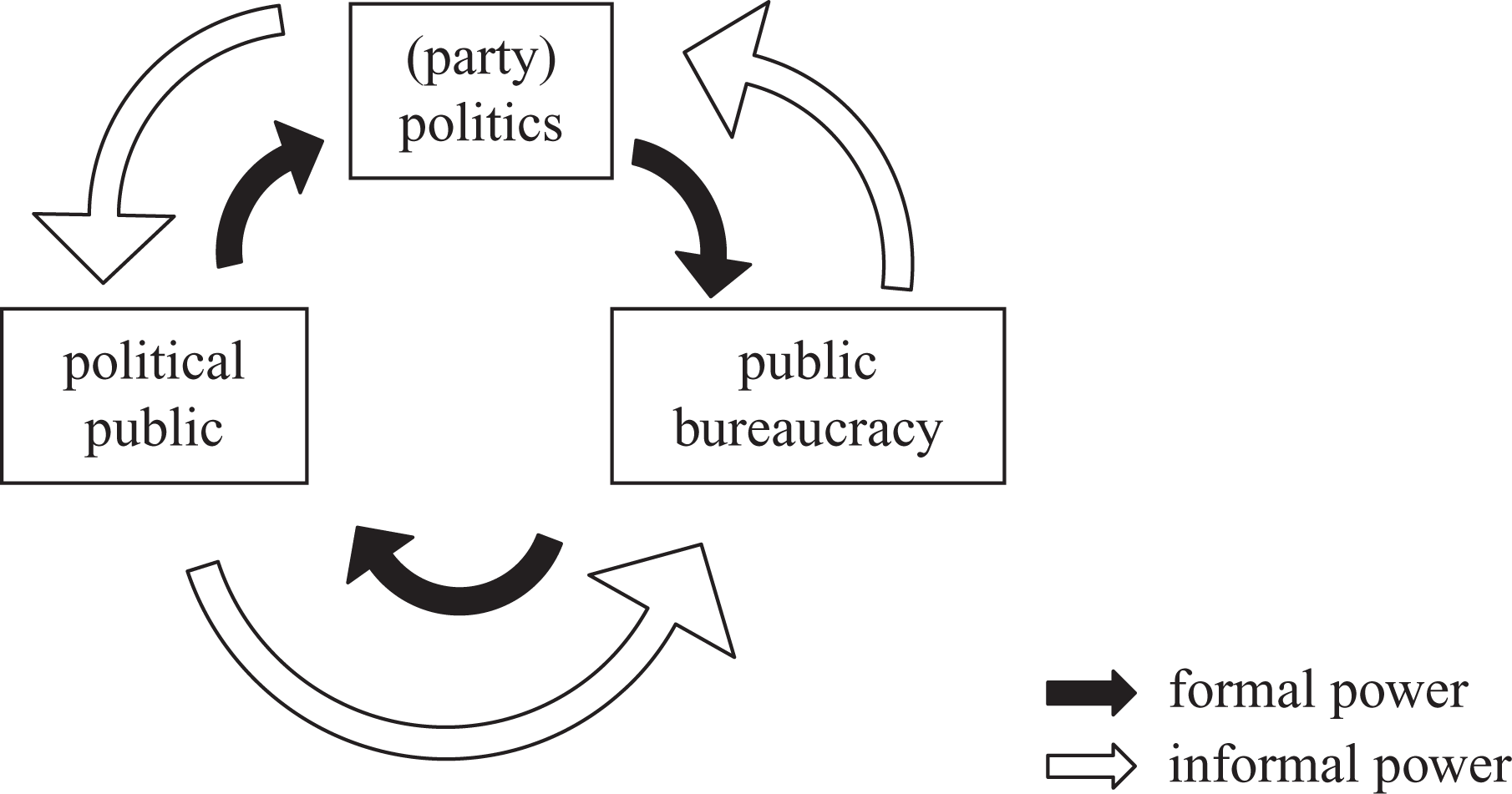
Luhmann’s model of the double power cycle.
As Luhmann’s model assumes a full-fledged democracy with established rights for individual citizens, it does not address the possibility that clientelistic structures may function as a power basis for differentiated political systems. Conveying informal power of another kind, clientelistic structures also counteract formal power relations. As long as formal democratic rights are not yet well established in practice, informal power relations may sometimes block them, but sometimes also open ways for larger parts of the public to participate at least informally (Fox, 1994). In order to clarify this in theoretical terms, the characteristics of clientelistic relations with regard to power are considered in the following section.
Clientelistic power
To the extent that the welfare state introduces services and benefits that meet various demands of the public, it also multiplies sources of power by establishing the expectation of such benefits and thus turning their possible withdrawal into a threat. Clientelistic structures display similar effects. From the perspective of politicians as patrons, clientelism is all about making a specific action, i.e. voting for a particular candidate or party, more likely by offering a positive incentive for it. Such incentives can range from promising a job in the local administration to support in cases of material need or help with getting public contracts. Moreover, routine state activities, which do not depend on the material resources of the state, such as the issuing of licences or permits, can be turned into positive incentives for which only those who display the appropriate political support can hope for (Chubb, 1981a).
Although political clientelism is often defined as an exchange relationship, it is rare that a positive sanction directly causes a desired behaviour at the ballot. Vote-buying certainly happens, but it is extremely expensive for politicians and thus only an option when relatively few votes are sufficient to decisively influence the electoral outcome or when considerable parts of the electorate are so poor that minimal material incentives are sufficient to get their vote (Van de Walle, 2007). Political clientelism, in contrast, relies on expectations that are less specific with regard to time and content. The client expects the patron to assume that the client will support him at the ballot. At the same time the patron expects the client to assume that the patron will (continue to) grant him certain benefits if the client supports him at the ballot and will not provide any (further) benefits to him if the client fails to do so.
In other words, instead of a ‘spot exchange’ there is an ongoing relationship based on the expectation that the political support for a particular politician or party will render personal benefits of some kind. The desire of politicians to get elected and the individual decisions of voters are brokered by pyramids of patron–client ties that dominate political party organizations or unions and other interest organizations. Such organizations follow a clientelistic logic when they mobilize members and voters by providing material incentives (Kitschelt, 2000: 848; Scott, 1969: 1143–1144). This does not necessarily mean that they refrain from party platforms and ideology, as parties often combine the distribution of clientelistic benefits and commitments to policy (e.g. Hilgers, 2008: 129–134; Holzner, 2010: 79–82).
Jobs in the public bureaucracy form typical clientelistic incentives for party activists. They are expected to use their position to attract voters to the party by linking administrative decisions in favour of applicants with their individual voting decision. When certain administrative tasks are delegated to interest organizations, e.g. the implementation of pension schemes for particular occupational groups, a similar mediation between politicians as patrons and voters as clients may take place (Graziano, 1973: 24–26). Consequently, the exact nature and timing of benefits that can be expected often remain open. They are expected to accrue when there is a need to deal with a public authority or when there actually is a job opening that can be used to reward someone (see Auyero, 2001: 89–94; Chubb, 1981a: 79–82). In certain cases, help may not even be possible in the expected way and those seeking help will have to make do with less than they hoped for. It is the promise of potential services on which clientelistic structures of expectations are based. Political support of a patron works as a personal substitute for the right to public services, which either are not provided or actually under the control of a patron. If the expectation is established that it is in principle possible to benefit from such favours, the threat to withdraw them is a source of power for the patron.
Preferences with regard to the alternative between subordination and negative sanctions are not calculated in every concrete situation. Generalized expectations about the asymmetric power distribution between a political patron and his clients replace the observation of situational power differentials. The threat of withholding clientelistic benefits is thus institutionalized, functions implicitly and without regard for the concrete persons involved (Kitschelt, 2000: 851–852). Taking into account the potential for generalization clientelistic power entails, the systems-theoretical understanding of the internal differentiation of the political system needs to be amended. To the extent that clientelistic expectations provide a power basis that reaches beyond the situational circumstances of specific interactions they affect the way power operates in a democracy.
Clientelistic structures of expectation and the democratic power cycle
The clientelistic structures so far described affect expectations with regard to the relationship between the politically relevant public and politics. They presuppose that the public formally has power over candidates for political office owing to regular elections. At the same time, they permit a reversal of power differentials with the result that politics and politicians have power over the public. The effect is one of perverse accountability (Stokes, 2005), as parties hold voters accountable for their individual voting decisions and reward or punish them accordingly. Thus, even though parties may also present a programmatic platform, the use of clientelistic incentives creates a basis for informal power that alters the relation between politics and the politically relevant public decisively.
Luhmann expects such informal counteracting power to develop due to the role party organizations play in the selection of candidates and programmatic slogans, which shields voters from information overload and thereby governs their individual decision-making (Luhmann, 1990: 49). With regard to all three relations, it is the threatening overload with complexity that induces the informal power cycle. Luhmann (1990: 36) assumes that democratization of the political system inevitably brings about this increasing complexity to the extent that party competition provokes the continuous search for new policy proposals suitable for attracting large groups of voters by promising to help them with the various problems of their individual existence (see Albright, 2010). The search is not restricted to welfare in the sense of social policy. It encompasses issues such as environmental protection, food safety and a multitude of other problems individuals may worry about. Facing limits to tax or borrow and spend, established welfare states shift their emphasis from redistribution to regulation (Majone, 1997), further increasing complexities with regard to policy proposals and their implementation.
Clientelistic structures of expectation are also mediated by parties. More or less substantial platforms notwithstanding, they turn party politics into a competition for the control of clientelistic networks (Holzner, 2010: 140–145). This implies that the formal power differential can assert itself in the case of conflict and parties or persons can be voted out of office. It also leaves the possibility that purely programmatic parties and those offering clientelistic benefits compete (e.g. Chubb (1981b) for the case of 1970’s Italy). How relevant the formal power is, however, depends on the way in which clientelistic power modifies the other relations of the power cycle.
The case of Mexico and its democratic transformation can serve as an example illustrating this impact. For decades, the Partido Revolucionario Institucional (PRI) secured its hegemonic rule with the help of organizations supposed to represent major sectors of the population (peasants, workers, self-employed). The functionaries of these organizations were appointed by politicians and thus bound to them. They acted as brokers between the government’s need for political support and the interests and demands of the population, effectively realizing a corporatist version of clientelism (Hellman, 1983).
Patron–client ties have also dominated Mexican bureaucracy (Grindle, 1977). The change of the presidency every six years is accompanied by a massive turnover at all levels of the bureaucracy. Middle and high level positions are not filled with a view to the specialized expertise required for a position, but as a result of personal appointment. Top officials are accorded the right to appoint their subordinates who in turn select their staff, based on personal loyalty and trust. Movement from a position to almost any other position is possible with the incumbency of a new president and it exclusively depends on whether past performance has met the patron’s expectations.
In Luhmann’s original model, the autonomy of the public bureaucracy and the specialized expertise it commands is the source of the informal power it has over politics. This informal power is displayed when politicians learn from the administration that the policy proposals they envision are not fit to be implemented in binding decisions and have to accept the blueprints of the administration instead (Luhmann, 1990: 49). Consequently, the implementation of political objectives can be facilitated when key positions within the bureaucracy are filled according to political criteria. Hence, clientelistic appointments within the public bureaucracy have two aspects (Manow, 2002: 33): On the one hand, they may be a personal reward for past services. On the other, they can be made in order to thwart the informal power of the bureaucracy. With regard to the relation of politics and bureaucracy, clientelism thus reinforces the official and not the informal power cycle and all governments attempt to use this effect in order to ensure the implementation of their policy agenda (see Mayntz and Derlien (1989) for the example of the German federal bureaucracy).
For the informal power cycle Luhmann (1990) describes, such practices are of limited consequence as long as the relations between party politics and the political public are dominated by programme-based competition for votes. If this mode of competition prevails, politics will potentially deal with any issue that could make a difference at the ballot. Since the public bureaucracy is most likely able to provide the necessary expertise in order to deal with such complex requirements, programmatic politics reinforces the informal power cycle (e.g. Mayntz and Scharpf, 1975: 95–105) and political appointments remain feeble attempts to break the informal power of the bureaucracy.
In Mexico, however, the absence of a professional civil service renders patronage ubiquitous and as a consequence the informal power of the public bureaucracy in its relation to politics remains extremely weak. As long as there is no competitive electoral arena it does not even make much sense to differentiate between politicians and bureaucrats in terms of behaviour (Lindau, 1996: 296); such a political system simply lacks the internal differentiation that constitutes the double power cycle Luhmann describes. The advent of competitive elections in Mexico, triggered by the foundation of the Partido de la Revolución Democrática (PRD) under the leadership of the popular PRI dissident Cuauhtémoc Cárdenas (Hilgers, 2008: 123–124) and by cautious moves towards decentralization, thus constitutes a decisive change as politicians now routinely have to take into account voters’ wishes. However, this transformation neither changes the weak autonomy of the bureaucracy nor establishes clientelistic expectations on the part of the voters. Opposition parties have focused on competing for existing clientelistic networks and their electoral successes have often been achieved by luring away local PRI leaders with the promise of more than the PRI leadership was prepared to offer. The situation has thus changed from a power hierarchy to a clientelistic version of the power cycle.
Although the parties have political programmes, clientelism is an important electoral strategy in gaining any advantage at the ballot box (Hilgers, 2008: 130–133; Holzner, 2010: 79–82). As long as general policies – and their actual implementation – play a minor role for party competition, apart from producing tangible and divisible benefits that can be used to conditionally reward voters, there is less need for administrators with highly specialized policy expertise. Thus, exactly those features a highly politicized bureaucracy lacks are less important when party competition is clientelistic. The administrative turnover after each incumbency, reiterated at the state and municipal levels (Grindle, 2010: 4), strengthens the formal power differential between politics and bureaucracy and prevents an accumulation of specialized expertise in the latter.
Apart from easily organized interests of the economic elite, informal power of the political public over the bureaucracy is exerted mainly with the help of various community committees, which petition the municipal administration for specific infrastructural improvements and tend to choose leaders who are locally well connected in order to increase their chances of success (Grindle, 2010: 14–16). In this way, they reproduce clientelistic expectations, insisting on the clientelistic version of informal power over the bureaucracy (Haber, 2006: 228–229; Holzner, 2010: 45), even though, compared to the times of PRI hegemony, the number of possible informal channels has increased. Formal provisions for citizen participation, on the other hand, such as municipal development committees, rarely seem to have actual influence on decision-making (Grindle, 2010: 13).
In sum, the demise of PRI hegemony in Mexico was concomitant with the emergence of a party politics in which all parties have to take into account the possibility of electoral defeat. Although this gives the political public the formal power to reward and punish politicians, the latter counteract this with the informal power derived from clientelistic promises. In the absence of a professional civil service, the formal power of politics over the bureaucracy is strengthened by informal patron–client ties. The persons who occupy administrative positions thanks to such ties are not necessarily incompetent but often highly educated. Owing to the frequent turnover of positions, however, the bureaucracy cannot develop an autonomy that would permit informal power being exerted over politicians based on long-standing specialized expertise. Finally, at those points where citizens come into contact with the bureaucracy, the informal power the former can muster continues to follow a clientelistic logic that tries to acquire concrete benefits and to counter formal bureaucratic decision-making in this way.
Those who try to avoid any involvement with clientelistic ties are worst off, and those who can offer more than just their own vote in terms of political support but blocs of votes instead are in a far better position to informally influence administrative decision-making than a single client on her own (Haber, 2006; Shefner, 2008). As in Luhmann’s original model (1990: 49), the public is thus internally differentiated with regard to capacities for informal power. However, it is notable that a demise of clientelism in favour of a more policy-driven political competition appears to reduce the opportunities, especially for the poor, to influence the administration informally (Holzner, 2010). On the other hand, while programmatic party politics favours the autonomous formation of interest groups, clientelism aims at restricting interest articulation to those forms that reliably deliver votes (Fox, 1994: 157–158).
Above all, there is a crucial difference that the model of the two power cycles reveals: When party politics is based on issues and policy proposals, all informal power differentials act in the direction opposite to formal power. In this case, party competition fosters the search for problems of individual existence that can be turned into political issues (Albright, 2010). Clientelism also generates informal counteracting power. However, this is only true for two of the three relations (Figure 2). Clientelistic structures do not counteract the formal power of politics over the public bureaucracy. Instead, clientelism reinforces this power by filling positions in the administration according to political criteria.

Clientelistic version of the power cycle.
Paradoxically, this excess of political control is not used to implement ambitious policies in a way that is closer to political priorities and ideas. The focus on measures that permit discretionary spending in favour of political supporters does not encourage new policy projects, the development and implementation of which depend on specialized expertise and detailed research in order to assess feasibility and consequences. At the same time, as state resources are limited, discretionary spending does not mean that clients receive some calculable return for their support. Clientelistic expectations instead are based on the hope that the support of a political patron will at some point yield a tangible benefit on observable examples of clients that have benefited, and on the regulatory power of local administration providing occasions in which clientelistic ties may be helpful (Chubb, 1981a).
Theoretical aspects for empirical comparison
Clientelistic expectations and programmatic expectations provide alternative orientations for political decision-making with regard to all three relations in an internally differentiated political system. The systems-theoretical conception presented here permits a look at the specifics of political clientelism within the same framework that describes the functioning of non-clientelistic politics. Although most parties present some kind of programmatic platform, reliance on clientelism affects the internal dynamics of a system in which political power renders certain actions and communications more likely and others less likely in several regards.
Complexity of policies
The scope of problems and topics that may become issues of political decision-making is smaller in the case of clientelistic expectations compared to programmatic ones. Clientelistic expectations provide politicians with superior power and prevent informal counteracting power of the administration. This superiority in terms of power limits political resonance. The scope of potential issues is restricted by the fact that many clientelistic favours and benefits accrue as an effect of administrative decision-making as such, no matter which specific policies are implemented (Wolfinger, 1972: 377). Issues other observers might regard as relevant societal problems do not become politically relevant because there is no drive to politicize new issues.
Generalization of political support
To the extent to which elections only permit the choice between political programmes of different ideological inclination or candidates associated with some broadly conceived view of politics and policies, the political support the electoral outcome expresses is highly generalized (Luhmann, 1983: 162–165; Parsons, 1969: 211). Consequently, it only weakly constrains actual political decision-making. Clientelistic structures of expectation produce generalized political support in the sense that voters are treated as indifferent with regard to issues and policies as long as they can expect tangible benefits for themselves. This does not preclude that voters have policy preferences; however, as long as they depend on clientelistic ties in order to deal with immediate problems of their daily life, their political support does not hinge on policy outlook but on the hope for tangible assistance (e.g. Haber, 2006: 135–157; Shefner, 2008: 119–130). When the latter does not seem to accrue in some minimal way for enough clients at a time in order to preserve the hope of all others, clientelistic political support may quickly waver. Compared to the political commitment to a policy programme, the failure of which may be attributed to reasons for which a party or politician cannot be held responsible, clientelistic promises imply narrower constraints actually to deliver (Kitschelt, 2000: 851–852). On the other hand, virtual indifference beyond such demands may facilitate the implementation of other policies, deemed necessary for contingent reasons, as for example international pressure for economic liberalization (Levitsky, 2003).
Personalization
To the extent that political issues are of minor importance, public opinion and mass media focus on the personalities of leading politicians. While this statement applies to many democratic political systems, it does so for different reasons in the cases of clientelistic and programmatic politics. Political clientelism fosters personalization because it replaces an orientation towards issues and policy proposals with the promise of tangible benefits that imply patrons in whose personal power the distribution of such benefits lies (e.g. Banck, 1998). When political parties do not rely on clientelistic benefits to attract voters, personalization is rather an effect of the complexity of welfare state policies, for which, in addition to party labels, persons serve as cognitive and emotional shortcuts (Scammell, 1999: 727–730).
Interest articulation
Competitive elections induce an orientation towards the political public as voters. Programme-based competition relies on organized interests to gauge support for policy proposals between elections (Luhmann, 1983: 164–167). Clientelistic competition relies on organized interests to ensure the delivery of votes. In both cases, the potential for political influence is unevenly distributed in the political public. Programme-based competition combines a potential for resonance with regard to all kinds of issues with difficulties for many interests to actually get heard. Clientelistic competition channels the articulation of interests towards patrons. It thus restricts their scope and diversity but at the same time suggests to larger parts of the public a chance to get heard with some of their problems (Holzner, 2010).
External influence on the political system
The political system is subject to various influences external to the double power cycle. The need for particularized benefits that can be used to create political support renders clientelistic structures prone to the direct influence of money (Kitschelt, 2000: 853). Not only the opposition, which may lack access to resources of the bureaucracy, but also the government may be tempted to accept financial contributions from businesses or interest groups in exchange for public contracts or favourable regulation. In contrast, universalistic welfare states are especially susceptible to external influence in the form of expert knowledge from scientists and researchers, but also from lobbyists, in order to deal with the demands of ever more complicated legislation (Kusche, 2008).
The listed comparative aspects do not lead to an exhaustive description of political clientelism. For example, they do not point out similarities and differences in terms of the internal organization of both parties and the public bureaucracy although the list implies that such organizations, while seemingly similar, will work in very different ways according to the wider context of the political system. The listed aspects instead highlight features of a political system that result from its internal differentiation. They can thus be related to a functional differentiation of society in the sense that there are social systems that specialize on an identifiable task and condition the selectivity of their operations accordingly. The political system is one such system. It conditions its selectivity with the help of power as a medium that makes certain communications and actions more likely than could be expected if it were absent. The interplay of (party) politics, public bureaucracy and a politically relevant public, informed by power differentials, produces decisions with binding, enforceable effect, no matter whether affected individuals agree with them.
Contrary to any functionalist reading, Luhmann always insisted that the effects of such a systemic context of specialized communication for its societal environment are not per se beneficial but contingent (Luhmann, 1997: 776–788). This is all the more true once one takes into account that it may well be clientelistic power that informs political power differentials. It organizes the selectivity of political communication and thus forms the relations between politics, bureaucracy and public, but it limits the resonance for various societal problems compared to cases in which programmatic political expectations prevail. The political system is adapted to less complexity and, accordingly, the societal environment registers as less complex in terms of politically relevant issues. This does not imply that political actors will find it easier to act under such conditions; quite the contrary, personalized power relations tend to be uncomfortably intransparent for all concerned. However, neither does it imply that the resulting relations between politics, bureaucracy and public are unstable.
With regard to systems theory, the consideration of political clientelism undermines the assumption that processes of differentiation converge to a more or less universal form of democratic politics. At the same time, the merit of an accordingly modified systems-theoretical perspective lies in the way it links the dynamics of party competition and welfare state development. Neither does it relate the drive towards universalistic welfare regimes to non-political factors such as economic development and industrialization or to the predominance of social-democratic parties (for an overview, see Esping-Andersen and van Kersbergen, 1992: 190–195). The latter may actually mobilize their voters with clientelistic means, as the Greek PASOK has demonstrated for a long time (Spanou, 1996). The former factors cannot directly affect political decision-making. To understand social policies in the context of a differentiation of democratic political systems, which can solely be based on programmatic orientations or induce and reproduce clientelistic expectations, suggests an approach that is sufficiently general to be linked with wider theoretical concerns and flexible enough to account for empirical variation.
Footnotes
Acknowledgement
An earlier version of this paper was presented in the working group ‘Societies and Differentiation: Discourse, Field and System’ at the 25th Conference of the Nordic Sociological Association, August 2011, in Oslo. I thank all the participants for their helpful remarks. I also thank two anonymous reviewers for their comments and suggestions.
Funding
This research received no specific grant from any funding agency in the public, commercial or not-for-profit sectors.