




Abstract
Although optimal labour market allocation of school leavers benefits individuals, employers and societies, a substantial part of European school leavers do not find a job that matches their field or level of education. This paper explores the extent to which horizontal and vertical education-to-job matches of European school leavers from secondary education is associated with the level of stratification, standardization, and the level of vocational orientation and institutional linkages of education systems. We combine notions of signalling theory, human capital theory and job matching theory to formulate hypotheses about how education systems affect horizontal and vertical education-to-job matches. We use micro-data on 30,805 school leavers in 20 European countries from the 2009 Ad Hoc Module of the European Labour Force Survey and data on system characteristics. Using multi-level logistic regression, we show that the level of stratification of secondary education is associated with better vertical job matches. We also find that the positive relation between being vocationally trained and education-to-job matches is stronger in systems with stronger institutional linkages. The positive relation between being vocationally trained and vertical job matches is less strong in more vocational oriented systems. Theoretical and practical implications are discussed.
Keywords
Introduction
This paper investigates the relationship between countries’ education systems and the probability that school leavers from secondary education start their careers in a job that requires their acquired level of education (so-called vertical match, or VM) and have jobs in the same domain of their field of study (horizontal match, or HM). In most European countries, both vertical and horizontal education-to-job mismatches are very common. About a quarter of all workers in the OECD are overeducated (OECD, 2011) and a considerable proportion has a job in a different field than the field for which they were educated (Solga and Konietzka, 1999; Wolbers, 2003).
Some authors argue that mismatches do not exist, and that observed mismatches might be statistical artefacts or a temporary phenomenon (Halaby, 1994; Leuven and Oosterbeek, 2011). However, most authors agree that mismatches do exist (Green, 2013; Groot and Maassen van de Brink, 2000; Quintini, 2011) and may have long-term consequences for individual careers (Scherer, 2004). A high incidence of mismatches is usually considered an indication that education systems might be failing to transfer useful skills to school leavers and that labour markets might be failing to effectively allocate the same school leavers to the available jobs (OECD, 2011). This institutional failure is costly for economies, for firms and for workers. As countries’ productivity and welfare could be higher if overeducated workers’ skills were fully utilized and tax revenues might be wasted on providing workers with skills that do not contribute to their productivity, economies suffer from a high mismatch incidence (McGuiness, 2006). Likewise, an undereducated workforce is detrimental for firms’ productivity (Kampelmann and Rycx, 2012). Being mismatched is also costly for workers themselves. Overeducated workers earn less than matched people in the same job (Levels et al., 2014), have lower levels of job satisfaction (Battu et al., 2000) and high turnover rates (Sloane et al., 1999). Horizontal mismatching comes at a cost, too: mismatched employees have more volatile careers and achieve a lower occupational status (Wolbers, 2003).
Many studies have highlighted that characteristics of the educational system frame the transition from education to work. Starting with the seminal work of Allmendinger (1989), authors have shown how cross-country differences in the school-to-work transition are systematically related to the way in which educational systems (Hannan et al., 1999; Kerckhoff, 2000; Müller and Shavit, 1998; Van der Velden and Wolbers, 2003; Wolbers, 2007) or labour markets (Breen, 2005; Gangl, 2003, 2004; Marsden, 1990) are organized in these countries. Most studies focus on labour market indicators like unemployment, occupational status attainment or job-search duration. However, relatively little is known about the relationship between education systems and education-to-job matching. Only a few papers directly focus on the relationship between institutions of education systems and the matching process, but these papers either focus on tertiary education graduates (Verhaest and Van der Velden, 2013) or focus only on the effect of vocational orientation and institutional linkages on horizontal matches (Wolbers, 2003). Given the potential costs of vertical and horizontal mismatches, more detailed knowledge about the extent to which education systems might serve to improve matching is clearly warranted.
Our approach aims to provide a comprehensive overview of the complex macro–micro relationships between education system characteristics and job-matching outcomes. Previous studies have sought to categorize countries into a distinct and usually dichotomous classification of their education systems (cf. Gangl, 2001). For example, authors have distinguished between organizational or occupational spaces (Jobert et al., 1997; Maurice et al., 1986), internal or occupational labour markets (Marsden, 1990; Marsden and Ryan, 1995), or highly or weakly stratified education systems (Allmendinger, 1989). Such ideal-type dichotomies – while informative as heuristics – are arguably too broad to capture the complexities of a education system’s labour market consequences (Gangl, 2001). Scholars of education systems have therefore recently moved away from classifying countries’ education systems and started to study the effects of their specific characteristics (Bol and Van de Werfhorst, 2011, 2013). Following this line, we aim to empirically disentangle the relation between school leavers’ education-to-job matching and education systems’ levels of stratification (i.e. the extent to which education is tracked), of input and output standardization (i.e. the extent to which curricula and outcomes are subject to nationwide standards), of vocational orientation (i.e. the proportion of pupils in upper secondary education who are enrolled in vocational tracks) and of institutional linkages (i.e. the share of vocational education that is provided as a combination of school-based teaching and learning at the workplace). By doing so, we aim to provide a comprehensive test of hypotheses on the relation between education system characteristics and early-career education-to-job matches.
Our paper addresses two research questions. First, stratification and standardization might be related to education-to-job matches of all school leavers, irrespective of field or level of education (Bol and Van de Werfhorst, 2011). These relations have not yet been investigated for graduates from upper secondary education. The first research question in our study is: to what extent do the level of stratification, input standardization and output standardization of education systems affect the extent to which European school leavers from upper secondary and post-secondary education: (a) start working in a job that matches their field of study; and (b) start working in a job that requires as a minimum the level of education from which they have graduated? Our second research question is specifically aimed at school leavers from vocational education. This part of the study aims to improve the understanding of how and when vocational training affects school leavers’ HM and VM. Although the general labour market effects of vocational training are well-studied (Gangl, 2003; Iannelli and Raffe, 2007; Ryan, 2001, 2003; Shavit and Müller, 2000; Van de Werfhorst, 2002) the relation between vocational training and (particularly horizontal) education-to-job matching is still unclear. Wolbers (2003) observes that having a vocational qualification is not substantially related to HM. However, we will demonstrate that cross-level interactions are theoretically plausible: it might very well be that the extent to which vocational training affects education-to-job matches depends on the way in which vocational education is organized (Gangl, 2003; Iannelli and Raffe, 2007). Indeed, Wolbers (2003) also found that in countries in which the share of upper secondary education students in school-based vocational education is large, the probability of horizontal mismatches is higher. However, in his analysis Wolbers did not allow for cross-level interactions, nor did he control for other educational system characteristics such as stratification and standardization. In this contribution, we analyse whether being vocationally trained improves school leavers’ education-to-job matching, and whether the relationship between vocational education and education-to-job matching covaries with the level of vocational orientation and the extent of institutional linkages of upper secondary education. Such cross-level interactions have only been tentatively explored (Iannelli and Raffe, 2007). Our second research question is: to what extent does the effect of vocational training on job matching covary with the level of vocational orientation and the extent of institutional linkages of the education system?
To answer our research questions, we draw hypotheses from signalling theory, human capital theory and job matching theory. To test hypotheses, we use the 2009 Ad Hoc Module of the European Labour Force Survey (EU LFS) (Eurostat, 2010) on over thirty-thousand young people from 20 European countries, who left education and entered the labour market with a diploma at ISCED levels 3 and 4 in the period 1989–2009. 1 We combine these school leaver data with country-level data on education systems and labour market conditions, and use multi-level regression analysis to model horizontal and vertical matches.
Theory
To understand how education affects education-to-job matches during the school-to-work transition, we build on matching theories of labour market allocation. We assume that both job-seekers and employers strive for the most optimal match, given their preferences, opportunities and constraints (see, for example, Kalleberg and Sørensen, 1979; Logan, 1996; Müller, 2005). Job-seekers are assumed to maximize the returns to their educational investments, and seek a job that provides them with the highest monetary rewards given their level of education and experience. By the same token, employers aim to hire employees who are expected to be the most productive and least costly.
The extent to which job-seekers and employers are able to reach their goals is framed by institutional arrangements of labour markets and education systems (DiPrete et al., 2001; Gangl, 2003, 2004). Most theorizing about cross-national variation in school-to-work transitions revolves around some sort of clustering of education and labour market systems (Allmendinger, 1989; Iannelli and Raffe, 2007; Jobert et al., 1997; Marsden 1990; Marsden and Ryan, 1995; Maurice et al., 1986; Shavit and Müller, 2000). Gangl (2001) examined if cross-national variation in patterns of labour market entry can be related to the systems of internal and occupational labour markets proposed by Marsden (1990, 1999), and concluded that while these clusters have some explanatory power, large within-cluster and between-cluster variation in transition patterns remain unexplained. In other words, the often used classifications might be too crude to capture the complex set of institutional arrangements of modern education systems. Recently, scholars have argued that it might be more informative to move beyond the clustering of countries, and towards analyses of the relevance of the countries’ education system characteristics (Bol and Van de Werfhorst, 2011, 2013). Education systems vary with respect to the level of stratification, standardization, vocational orientation and institutional linkages, and while these dimensions might be correlated, they refer to empirically and theoretically distinct institutions (Bol and Van der Werfhorst, 2011).
Stratification
The level of stratification of education systems captures the sorting of pupils with different ability levels into separate educational tracks. The literature offers three reasons for the expectation that stratification is positively related to HM and VM. First, the more highly stratified education systems, the more fine-grained the distinction of abilities of graduates from the various tracks (Van der Velden, 2011). As a result, in more highly stratified systems, employers are better informed about the ability levels of job applicants (Andersen and Van de Werfhorst, 2010; Müller, 2005). Secondly, employers model job tasks to expected workers’ skills (Marsden, 1999), which is easier in more highly stratified systems as the average skills level of workers can be more precisely defined. Thirdly, the description of required skills levels can be much more precise in systems with higher levels of stratification (e.g. Dörfler and Van de Werfhorst, 2009). So, it should be clearer to applicants which ability levels that various jobs require. We therefore expect (hypothesis 1) that there is a positive association between the level of stratification in a country and school leavers’ chance to experience VM.
Standardization
Educational credentials can be used to sort prospective employees during the job matching process, as they signal various unobserved properties of those who have obtained them (see Arrow, 1973; Riley, 1976; Spence, 1973; Van der Velden, 2011; Weiss, 1995). The literature has spawned a wide variety of signalling theories, all presupposing that: (a) employers have imperfect information about the actual skills of prospective employees; and (b) educational credentials hold information about unobserved qualities of prospective employees. Qualifications and other characteristics of the educational career serve as a signal of the type and level of skills that prospective employees have acquired in education (Van der Velden, 2011), or of unobservable personal characteristics that affect their expected productivity or training costs (Arrow, 1973; Spence, 1973). 2
The more informative educational credentials are about the actual skills of applicants, the better informed employers are during the recruitment and selection process, and the less likely it is that job mismatches occur (Andersen and Van de Werfhorst, 2010; Breen, 2005). One way of increasing the signalling power of educational output is by standardization, which reflects the degree to which the quality of education meets the same standards nationwide (Allmendinger, 1989). Standardization can be achieved in two main ways. First, input standardization refers to the extent to which schools can make autonomous decisions about what is being taught, how and by whom. Nationwide regulations on teachers’ training, school budgets, books and curricula can reduce between-school variance in input. Higher homogeneity of students’ skills and knowledge, in turn, will increase the transparency of skills levels and of curricula content to employers. We expect that (hypothesis 2) there is a positive association between the standardization of input in a country and school leavers’ chance to experience HM (2a) and VM (2b).
Secondly, standardization of output refers to the extent to which educational performance of pupils or students is tested against external standards, such as a national inspection institute or centralized exit examinations (Bishop, 1997; Woessmann, 2005). In highly standardized systems, diplomas are more informative about the acquired level of skills and employers can more easily compare job applicants during the recruitment and selection process. Evidence indeed suggests that standardization is associated with a lower incidence of job mismatches (Müller, 2005; Müller and Shavit, 1998). We hypothesize that (hypothesis 3) there is a positive association between the standardization of output in a country and school leavers’ chance to experience VM.
Vocational orientation
Vocational orientation is defined as the proportion of students in upper secondary education who are enrolled in vocational tracks. From a human capital point of view, vocational training is theoretically thought to give vocationally educated graduates a higher probability of HM and VM than generally educated graduates, because vocational training teaches skills that are strongly in demand by employers (Ryan, 2003). Vocationally trained students are thus more directly productive and employers have an incentive to allocate these people to jobs that match their skills. Network theories predict the same: apprentices might capitalize on social capital acquired at the workplace, by continuing to work with the employer who provided the training (Rosenbaum et al., 1990). We can also expect a cross-level interaction effect here as the effectiveness of vocational education plausibly interacts with macro-level contexts (Gangl, 2003; Iannelli and Raffe, 2007). In occupational labour markets (OLMs), selection on the basis of specific educational credentials is even more important (Maurice et al., 1986). If we take the share of vocationally educated school leavers as a good proxy of the existence of OLMs we would expect the positive effect of having a vocational diploma to be even more important.
However, Wolbers (2003) found that horizontal matches were less common in more strongly vocationally oriented systems. This appears to contradict the above. From a signalling theory perspective those with a background in vocational education might be worse off when entering the labour market, compared to generally educated school leavers. Instead of signalling the acquisition of specific skills, a vocational diploma might be a signal of lower motivation or ability compared to academically (read: generally) educated peers, even at the non-tertiary levels (Gesthuizen et al., 2011; Thurow, 1975; Wolf, 2002). Education is a positional good, and one’s relative education might more strongly determine one’s relative position in the job queue than one’s absolute position. If vocational training is a negative signal, vocationally trained applicants might be placed lower in the queue, which would in turn increase the likelihood that they would have to accept a job below their education level or outside their educational field. Here a cross-level interaction can also be expected. If the share of vocationally educated school leavers as a percentage of the entire cohort is higher, the signal sent by a vocational diploma would be less unfavourable.
Based on these theories, we have two alternative sets of hypotheses (hypothesis 4). Based on human capital theory or network theories, we expect to observe a positive relation between being vocationally trained and school leavers’ chance to experience HM and VM (4a) and that this relation is stronger if the education system is more vocationally oriented (4b). Alternatively, based on signalling theory, we expect negative relations between being vocationally trained and school leavers’ chance to experience HM and VM (4c) but these relations are weaker if the education system is more vocationally oriented (4d).
Institutional linkages
Breen (2005) argues that institutional linkages in the education system are crucial for improving the labour market allocation of young people. Institutional linkages indicate the share of vocational education that is provided as a combination of school-based teaching and learning at the workplace (e.g. apprenticeships or dual system). Institutional linkages improve VM and HM in two main ways. First, in countries in which vocational education is more strongly institutionally linked, employers have more influence on the vocational curriculum (cf. Andersen and Van de Werfhorst, 2010) or on the size of the vocational system (Culpepper and Finegold, 1999; Thelen, 2004). Secondly, in countries with more strongly institutionalized linkages between employers and schools, jobs are more readily moulded to meet the average expected skills of vocationally educated workers (cf. Marsden, 1999; Maurice et al., 1986). If vocational education takes place directly in the workplace, it is more likely that the skills taught in the curriculum are actually in demand by employers, which increases HM and VM for vocationally trained students.
The general individual effects of vocational training are the same as has been argued before in hypothesis 4a. But here too, a cross-level interaction is to be expected. In countries with a high level of institutional linkages, vocational training is well-institutionalized and a large share of the curriculum is workplace-based. This ensures a better provision of job-relevant skills and a higher transparency of qualifications. We expect that the relations between being vocationally trained and HM and VM are stronger if the education system has stronger institutional linkages (hypothesis 5).
Data
We used data from the EU LFS 2009 Ad Hoc Module on the entry of young people into the labour market (Eurostat, 2010). This module combines data from the core questionnaire of the LFS with specific data on the labour market entry of youth. The data contain information on school leavers from all 27 EU member states, as well as from Iceland, Norway, Switzerland and Serbia. We could only analyse countries for which sufficient macro-level data were available, i.e. Austria, Belgium, Czech Republic, Germany, 3 Denmark, Spain, Finland, France, Greece, Hungary, Ireland, Italy, Luxembourg, the Netherlands, Norway, Poland, Sweden, Slovenia, Slovak Republic and the UK.
The technical evaluation of these data (Eurostat, 2012) revealed that respondents had recall problems for variables associated with dates (such as the exact month in which respondents left education, or dates on which they started working). 4 The variables associated with a mismatch (i.e. the field and level of both study and first job) are not reported to have a demonstrable bias. Our mismatch measures are based on validated cross-national measures, of which we used broad classifications to further reduce the possibility that people would make a mistake.
We applied some selections to the data. First, we defined school leavers as all people between 15 and 34 years old, who left formal education between 1989 and 2009, and who entered their first job after leaving formal education. We further selected only those who had attained education at the upper secondary and post-secondary, non-tertiary level (i.e. ISCED levels 3 and 4). 5 We looked at the first paid job that lasted longer than three months. Respondents for whom we could not establish a field of education or occupation were excluded. Furthermore, as some countries still have a military draft that can in principle enrol persons who have not yet graduated, we also excluded military personnel. After selection and listwise deletion of respondents with missing values on any of the independent variables, we could analyze a sample of n = 30,805.
Measurements
We discuss the measurements of the variables used in this study below. Descriptive statistics are presented in Table 1.
Descriptive statistics.
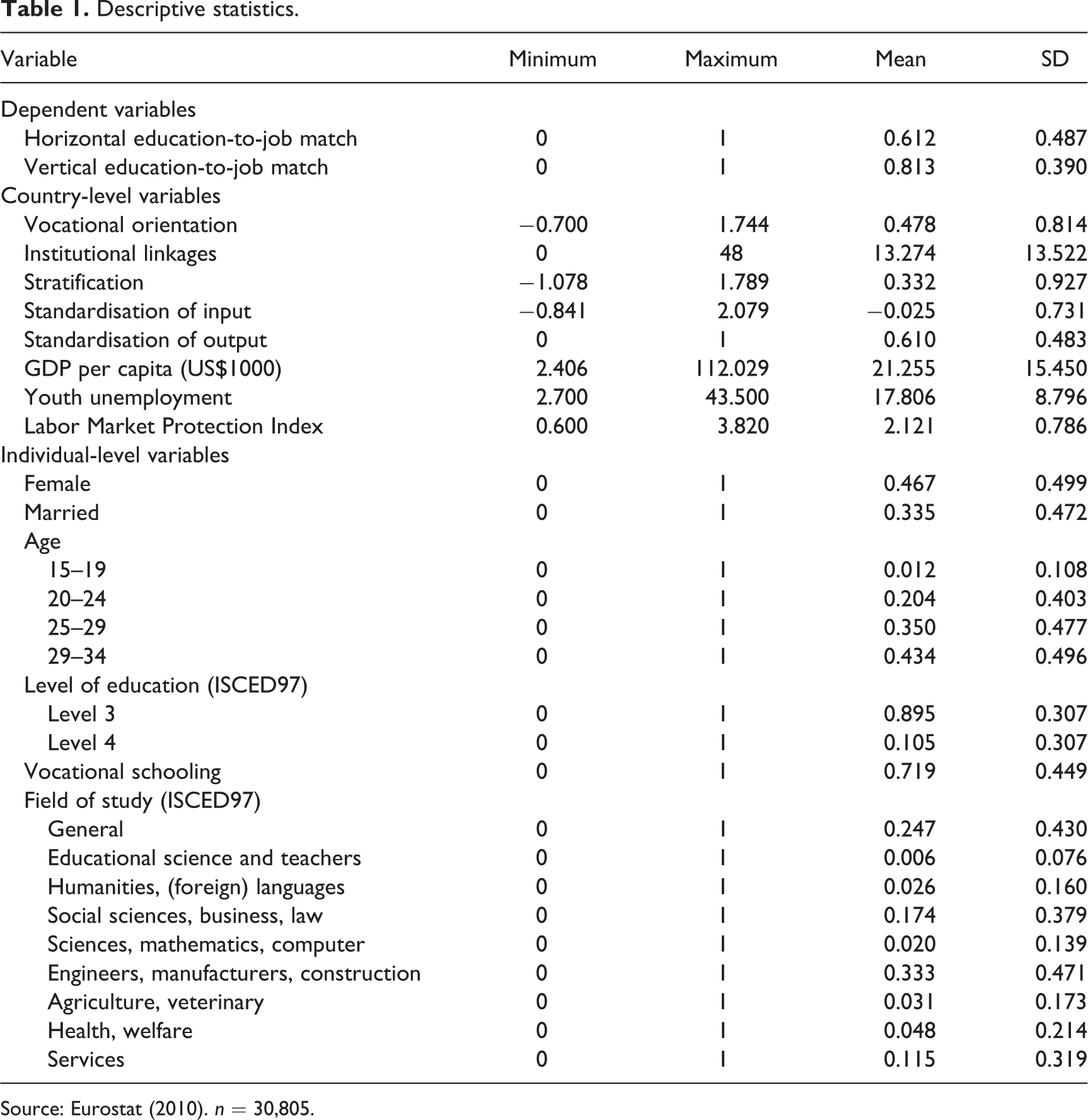
Source: Eurostat (2010). n = 30,805.
Dependent variables
To measure HM we built on Wolbers’ (2003: 254) definition of horizontal mismatch, operationalized as a discrepancy between the field of occupation of a school leaver’s first job and the field of education he or she attended. HM is defined as working in an occupational field that matches the field of one’s study. We made some adjustments to Wolbers’ (2003) scheme to incorporate general (i.e. non-specific) study programs and also to increase the coherence of the classification. 6 Information about how we matched ISCED fields of study to ISCO three-digit occupations is presented in Table 2. To measure VM we considered all selected respondents (i.e. those with an educational attainment at ISCED levels 3 and 4) working at jobs of one-digit ISCO 8 or 9 to be overeducated, and all others to be vertically matched. 7 We did not consider the situation of undereducation separately.
Classification of fields of education and matching jobs.

Country-level independent variables
For most of the characteristics of education systems we build on the work of Bol and Van de Werfhorst, who used principal factor analysis to construct indicators of commonly used system traits (Bol and Van de Werfhorst, 2011, 2013).
8
From their dataset, we used the following country indicators:
9
Level of stratification: factor score based on the age of first selection, the percentage of the total curriculum in primary and secondary education that is differentiated and the number of educational tracks available to 15 year olds. The index ranges from −1.078 (Norway and the UK) to 1.789 (Germany), has a mean of 0.332 and a standard deviation of 0.927. Standardization of input: based on PISA data on school autonomy, i.e. the extent to which schools were responsible for textbook use, course content and course offerings. In our sample, this scale ranges from −0.841 to 2.079, with a mean of −0.025 and a standard deviation of 0.731. A higher score on the index implies a lower level of school autonomy, and thus a higher level of standardization. Standardization of output: based on whether (1) or not (0) countries’ education systems have centralized exit exams in secondary education. Note that the variable is not a full dummy variable: in Germany, centralized exams are not mandatory in all federal states. We use the proportion of German regions where central examinations are mandatory. Vocational orientation: based on two data sources measuring the percentage of students enrolled in upper secondary vocational programs (from the OECD (2006) and UNESCO (2011a; 2011b)). This index has a sample mean of 0.478 and a standard deviation of 0.814. In order to capture institutional linkages, we used the percentage of upper secondary vocational education that takes place in a dual system. Data were provided by the OECD (2007). The scale ranges from 0 (Italy, Sweden and the UK) to 47.70% (Denmark). Next to the education system traits we included a number of control variables The first two were taken up as time-varying measures, at the individual level linked to the year in which respondents entered the labour market: GDP per capita: countries’ economic productivity indicated by the gross domestic product per capita between 1989 and 2008. The index is measured in 2011 US$1000, and obtained from the World Bank (2012a). The scale ranges from 2.406 (Poland) to 112.029 (Luxembourg). Youth unemployment rate: defined as the percentage of the 15–24 year old male labour force in a given country that was unemployed but available for and seeking employment for the period 1989–2008. Information was obtained from the World Bank (2012b). The scale ranges from 2.7% (Luxembourg) to 43.5% (Poland). We also control for the strictness of employment protection legislation, as this has been shown in previous research to affect the school-to-work transition of European school leavers (Gangl, 2003; Wolbers, 2007). We use the Employment Protection Legislation index (EPL) developed by the OECD (2012). This index uses three main components, i.e. the existence of: (a) policies to protect workers against dismissal; (b) requirements for collective dismissals; and (c) regulations regarding temporary employment. A higher score on this index corresponds to a more protective labour market. The scale ranges from 0.6 (UK) to 3.82 (Spain).
Individual-level independent variables
To control for possible confounders at the individual level and to control for the contextual effects for compositional differences of countries’ populations, we control for the following individual level variables: Age, measured in five-year groups: 15–19 (reference group), 20–24, 25–29 and 30–34. Gender, distinguishing females (1) from males (0). Partner state, distinguishing persons who are married (1) from those who are not (0). Educational attainment: two dummies, distinguishing upper secondary education (ISCED level 3; reference group) and post-secondary, non-tertiary education (ISCED level 4). Field of study: two-digit ISCED97 field of education code, distinguishing education sciences or teacher training (code 100), humanities, (foreign) languages and arts (200), social sciences, business or law (300), sciences, mathematics and computing (400), engineering, manufacturing and construction (500), agriculture and veterinary (600), health and welfare (700) and the services (800). People trained in general programmes are the reference category. Vocational orientation of education followed: dummy variable indicating whether (1) or not (0) respondents followed some kind of vocational education.
Analyses
To get a first understanding of the cross-national variation in school leavers’ education-to-job matches, we present some descriptive statistics in Figure 1. The top panel shows the proportion of school leavers with HM. More than 60% of school leavers were able to find a job that matches their field of study. Considerable cross-national variation can be observed. The proportion of HM ranges from 0.45 in Norway to 0.80 in Germany. The lower panel of Figure 1 shows the proportion of VM. The European average is about 0.81. Cross-national variation exists, but the range is rather limited. The proportion of VM ranges from 0.71 in France to 0.92 in Germany, Luxembourg and Austria.

Labour market allocation of school leavers from upper secondary and post-secondary non-tertiary education in 20 European countries. Source: Eurostat (2010). (a) Proportion of school leavers who had a horizontal education-to-job match on their first job; (b) Proportion of school leavers who had a vertical education-to-job match on their first job.
The EU LFS data are structured hierarchically, with respondents nested in countries. To correct the standard errors for this clustering, we employed two-level hierarchical regression analyses to test our hypotheses (Rabe-Hesketh and Skrondal, 2005). We used the xtlogit package in Stata 12. 10
Results
We present the results of the analyses in Table 3. The first two columns represent the analysis on the main effect of vocational training and the education system characteristics for HM (model 1a) and VM (model 1b). 11 These refer to hypotheses 1 to 4. The next four columns present the results for a model that includes the interaction between being vocationally trained and vocational orientation (models 2a and 3a; hypotheses 4b and 4d) and for the interaction with institutional linkages (models 2b and 3b; hypothesis 5). Results are discussed by hypothesis, not by model. All macro–micro relations are controlled for compositional differences related to individual-level control variables. Macro–micro relations are controlled for each other, as well as for differences in GDP per capita, labour market protection and youth unemployment.
Multi-level logistic regression of variables associated with HM and VM on individual characteristics and indicators of countries’ education systems and economies. Standard errors in parentheses.
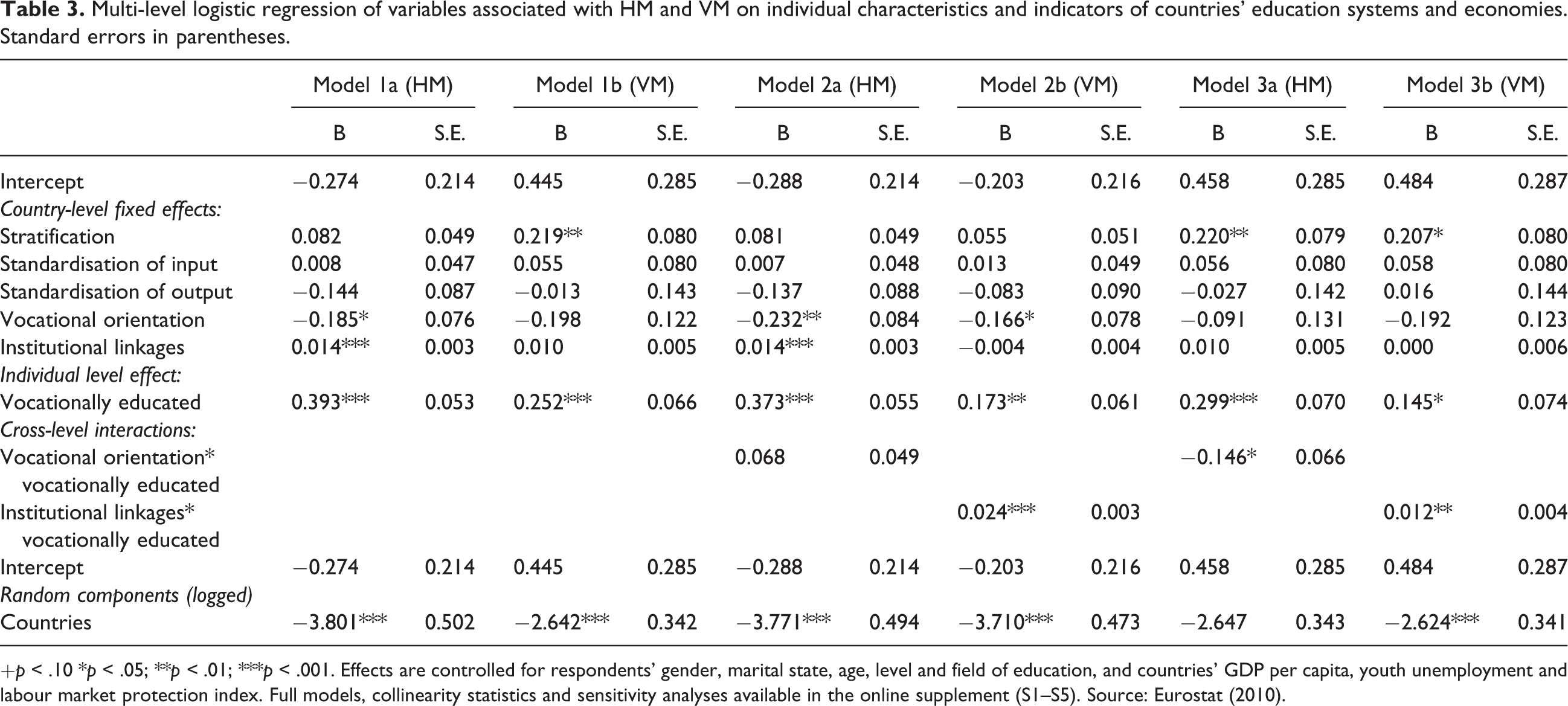
+p < .10 *p < .05; **p < .01; ***p < .001. Effects are controlled for respondents’ gender, marital state, age, level and field of education, and countries’ GDP per capita, youth unemployment and labour market protection index. Full models, collinearity statistics and sensitivity analyses available in the online supplement (S1–S5). Source: Eurostat (2010).
Table 3 confirms hypothesis 1: the level of stratification of education systems is positively associated with VM (Model 1b: b = 0.219). Sensitivity analyses (online supplement S2) reveal that this result is robust for country selection. Our results do not support hypotheses 2a and 2b, as we do not find the hypothesized positive association between standardization of input and HM or VM. We also do not observe the positive relation between output standardization and VM that we expected with hypothesis 3.
In the theory section we presented two alternative hypotheses on the effect of vocational training. Based on both human capital and network theories, we predicted a positive relation between vocational training and matching (hypothesis 4a), and that this relation should be stronger in systems with a stronger vocational orientation (hypothesis 4b) or stronger institutional linkages (hypothesis 5). Signalling theories, on the other hand, predict a negative relation between vocational training and matching (hypothesis 4c) and that this relation would be weaker in systems with a stronger vocational orientation (hypothesis 4d).
Our findings support hypothesis 4a and reject hypothesis 4c. The labour market allocation of vocationally trained school leavers is better than the allocation of their non-vocationally trained counterparts both with respect to HM (model 1a: b = 0.393) and VM (model 1b: b = 0.252). Moreover, we observe significant cross-level interactions in the hypothesized positive direction in the case of institutional linkages, both for HM (model 2b: b = 0.024) and VM (model 3b: b = 0.012). 12
In models 2a and 3a, we test whether there is a cross-level interaction with vocational orientation. Based on human capital theory we predicted a positive effect for the interaction term (hypothesis 4b), but this is clearly not the case. Our findings also refute our signalling hypothesis. Signalling theory predicts a weaker negative effect of being vocationally educated in systems with a strong vocational orientation (hypothesis 4d), but the results show a weaker positive effect.
The interaction effects are clearly illustrated in Figures 2 and 3. Figure 2 shows that in countries with weak institutional linkages, vocationally educated school leavers are only slightly more likely than their non-vocationally educated counterparts to get a job in their field and level of education. Relative to people without a vocational education, their odds of horizontal and vertical matches gradually improve as the institutional linkages get stronger. Figure 3 shows that for all school leavers alike, labour market allocation functions less well if the system is more strongly vocationally oriented. Also, the positive advantage that vocationally trained school leavers have when trying to find a job at the right level of education strongly decreases if the vocational orientation of secondary education is higher.

Multi-level (logistic) regression of variables associated with labour market allocation on individual characteristics and indicators of countries’ education systems and economies, including cross-level interactions between institutional linkages and being vocationally educated. Effects are controlled for gender, marital state, field and level of education, and type of contract, GDP per capita, vocational specificity, vocational orientation, standardisation of input, standardisation of output and the level of differentiation. Tables are available in online supplement (S1). Source: Eurostat (2010).

Multi-level (logistic) regression of variables associated with labour market allocation on individual characteristics and indicators of countries’ education systems and economies, including cross-level interactions between system vocational orientation and being vocationally educated. Effects are controlled for gender, marital state, field and level of education, and type of contract, GDP per capita, vocational specificity, vocational orientation, standardisation of input, standardisation of output and the level of differentiation. Tables are available in online supplement (S1). Source: Eurostat (2010).
Conclusions
Our analyses empirically explored whether four different education system traits are related to school leavers’ education-to-job matches. First, school leavers are more likely to find a job at the right level of education in more highly stratified systems. This might be because stratification increases the signalling power of educational credentials, which reduces employers’ uncertainty about applicants’ skills when making a hiring decision. Also, in more stratified systems, jobs can more easily be designed to suit the expected skills-levels of workers.
Secondly, we found no compelling evidence that input standardization is related to the probability of HM or VM, as signalling theory would predict. We also found no effect of output standardization on VM. The lack of any significant effect might be the result of two opposing forces. On the one hand, standardization leads to clearer signals, thus improving the matching process. But on the other hand, most schools at the upper secondary level prepare pupils for participating in a local or regional labour market. By definition, national governments are less able to determine the needs of employers in these local labour markets than the schools themselves. As a consequence, the more autonomous schools are in determining the contents of what is learned, the better they would prepare their pupils for such labour markets. Centralized exams might hamper schools’ ability to adapt to local labour market needs. Further research should test this hypothesis.
We show that being vocationally trained is positively related to HM and VM in all countries under study. We have found no indications that having followed a vocational track is regarded as a negative signal about underlying cognitive abilities, which would place such school leavers at the back of the job queue. This might indicate that vocationally educated school leavers are more strongly equipped with the human capital that is demanded by employers, or that the vocationally educated can capitalize on the social capital that their occupation-based education has provided. This finding might also be related to signalling. While we hypothesized that being vocationally educated might be a signal of relatively low academic abilities, an opposing interpretation also merits consideration. Although ISCED levels 3 and 4 are starting qualifications in many countries, it might very well be the case that graduates from these levels are expected to pursue tertiary education. On these levels, entering the labor market from non-vocational tracks might be a negative signal: it might be that these school leavers are perceived as not academically skilled enough to pursue tertiary education, and also lack the occupationally specific skills that vocational education would have provided them with. Disentangling these interpretations provides an interesting venue for future research.
The positive relationship between being vocationally educated and the probability to obtain a matching job is stronger in education systems with strong institutional linkages. Earlier research also showed that institutional linkages enhance the probability of entering the labour market in a skilled blue-collar occupation rather than an unskilled one (Müller and Shavit, 1998:39). Also interesting is that the probabilities of VM and HM for the non-vocationally educated do not change with increasing institutional linkages, which suggests that non-vocationally trained school leavers generally make the transition to parts of the labour market where they do not compete based on the institutional linkages of their skills.
We also explored the extent to which the relationship between vocational education and labour market outcomes was affected by the vocational orientation of education systems. Wolbers (2003) found that horizontal mismatches are more common in countries with more strongly vocationally oriented systems. Our results are in line with these findings. Interestingly, this only holds for HM and not for VM. An interpretation might be that if a larger part of the work force is vocationally educated, the competition between vocationally educated school leavers is more fierce. While vocationally educated school leavers are more likely than non-vocationally educated school leavers to find matching jobs with respect to the field of education, this advantage is smaller in countries with a higher share of students enrolled in vocational education. There will always be sectorial or regional imbalances between supply and demand. If a large proportion of a cohort is vocationally educated, it is more likely that they will be affected by such temporal imbalances than would be the case where only a small proportion are vocational educated. This interpretation is supported by the fact that we do find a positive main effect of institutional linkages. When vocational training is strongly institutionalized, as in apprenticeship systems, these structural imbalances are far less likely to occur.
Our analyses have some limitations that are due to data availability. The first limitation pertains to the indicators we used to measure education system characteristics. As argued, we used the best measures currently available. Our indicators are validated measures of unobserved educational systems traits, standardized to allow for cross-national comparisons. However, they do have limitations. Although the measures are well-suited to explain between-country variation, they are not time-varying. So, we have to assume that the levels of stratification, standardization, vocational orientation and institutionalization of the countries in our sample did not change dramatically in the time-period studied. This is quite plausible as educational reforms are rare and only gradually affect the unobserved traits. However, cross-nationally comparable time-varying data on educational reforms would measure the system traits even better. A second limitation is sample restriction: we focused on the first significant job after graduation, because the influence of education is plausibly the largest in this job, as labour market experience is minimal. However, the transition from school to work is much less clear-cut than these analyses suggest. First, the data show that a considerable group of people had already entered the labour market before getting a diploma. Second, although the first job is important for the rest of one’s career (Wolbers, 2003), so are further jobs. To capture the intricacies of this complex process, more elaborate longitudinal data with biographical information about young people’s entire educational and occupational careers is required.
Notwithstanding these caveats, our study allows for the formulation of two important policy implications. First, since vocational training seems to provide a comparative advantage over general education in all systems, the fear that vocational education serves as a negative signal to employers is not supported by cross-national evidence. However, and this is the second main conclusion, it is important that vocational programs are built on strong linkages between employers and educational institutions. This not only ensures that occupationally specific skills are acquired, but also reduces the likelihood that students are trained for jobs that are not available.
Footnotes
Acknowledgements
The authors thank Yossi Shavit, Roxanne Korthals, Christoph Meng and the anonymous reviewers from Acta Sociologica for their invaluable comments and remarks.
Funding
This work was supported by the Programme Council for Fundamental Scientific Education Research of the Netherlands’ Initiative for Education Research (411-10-920)