



Abstract
This article is based on three waves of data collected by the Nord-Trøndelag Health Study (HUNT), Norway. It investigates changes in life satisfaction associated with transition both into and out of marital unions (marriages and cohabitations). It provides longitudinal data on life satisfaction for a larger sample (N=57,446), a longer age span (19–101 years) and over a longer observation period (22 years) than previously published research on this topic. The large sample permits interaction analyses focusing on small gender/age categories. Results indicate that marriage and cohabitation does enhance life satisfaction, but more for some groups than for others. Cohabitation enhances life satisfaction no less than marriage. There is little difference in life satisfaction between the non-partnered statuses when adjusted for selection. Both men and women are more satisfied as married or cohabiting than as non-partnered. However, transition into widowhood is more harmful to men than to women, and divorce is much more harmful to young males (below 35) than to any other age or gender group.
Introduction
Marriage has lost its dominant position in most Western countries. Concepts such as intimate relationships have to some extent replaced marriage and primary relationships (Jamieson, 1998). Further, marital relationships have supposedly shifted from being economic units to something more emotional (Beck and Beck-Gernsheim, 1995). Men and women marry later and divorce more often than they did some decades ago. In Norway, cohabitation is as common as marriage among persons below 35, but less frequent among those above that age (Noack, 2001). Some feminists have claimed that marriage has an adverse effect on women’s mental health (Bernard, 1982). However, survey data provide little evidence for this (Diener and Oishi, 2004; Glenn, 1996; Mastekaasa and Næss, 2011; Patrick et al., 2007). Research typically claims that persons living in partnership (married or cohabiting) are more satisfied with life and happier than persons who are not partnered (Diener and Diener McGavran, 2008; Diener et al., 1999; Diener et al., 2000; Gustavson et al., 2012; Inglehart, 1990; Lucas et al., 2003). It is still an open question, however, whether the benefits of being partnered are equally shared by all social groups or change between cohorts or age groups.
A crucial issue is how far living in a partnership makes for a better life versus how far individuals who find, and stay with, a partner are better adjusted and more satisfied with life than those who remain single. We assume that both selection and causation may explain why persons who live in a partnership on average have greater life satisfaction than not-married persons. Let us elaborate on the rationale behind the two theories. First, selection: it is assumed that happy individuals are more likely to succeed in attracting and keeping mates (Kohler et al., 2005; Lucas et al., 2003). Merry divorcees and widowers will remarry (Waite and Gallagher, 2000). Some personality traits, e.g. extraversion, optimism and emotional stability, may help people find, and keep, a partner (Cacioppo et al., 2008). Extraversion, optimism and emotional stability are to some degree inherited, and the same traits are important contributors to subjective well-being – that is, to happiness and life satisfaction. Further, economically productive individuals are happier as well as more attractive in the marriage market (Jakobsson and Kotsadam, 2013).
Second, causation: it is also assumed that marriage and cohabitation brings happiness – in both our culture and most cultures studied (Diener et al., 2000). To some, the wedding is ‘the doorway to happiness’, as marriage may bring love, sex and companionship (Lucas, 2008), mutual support and caring (Argyle, 1999; Waite and Gallagher, 2000), protection and social control (Durkheim, 1951[1897]; Mastekaasa, 1994), better health (Myers, 1999; Williams and Umberson, 2004; Williams et al., 2010), less problem drinking (Simon, 2002), economic benefits (Andreβ and Bröckel, 2007; Argyle, 1999; Jakobsson and Kotsadam, 2013), and social status (Waite and Gallagher, 2000). For some, however, the single status also has advantages: more freedom and variation, more time for friendship, individual growth and independence, less domestic fighting and jealousy, more peace (Argyle, 1999; Waite and Gallagher, 2000; Williams et al., 2010).
There are many ways in which people could benefit from being married or cohabiting as opposed to living as singles. Partnerships provide belongingness, social support (emotional and financial support and advice), social control (leading to more beneficial behaviour), economies of scale from household work and the division of household tasks (leading to increased productivity), and shared (increased) consumption (Becker, 1991; Waite and Gallagher, 2000). Partnerships may also entail drawbacks, however – for example, having to consider the interests of another person. One question is how far the benefits and drawbacks of marital partnerships are equally shared by all social groups.
The feminist claim that marriage benefits men more than women (Bernard, 1982) implies that men’s life satisfaction should increase more strongly than women’s satisfaction after entering marriage, perhaps also after entering cohabitations. Further, if men gain more from marriage than do women, then they also stand to lose more following divorce or widowhood.
Partnership dissolution may affect the age groups of men and women differently. One reason is that the so-called sex ratio (e.g. the number of men over the number of women) changes by age, which might affect the prospects of finding an alternative partner (Lichter et al., 1991). Because there is a surplus of young men and older women, the life satisfaction of these social groups could be hit harder by partnership dissolution than it might be for other age and gender groups (i.e. young women and older men). These effects might be further complicated by the fact that child custody decisions tend to favour the mother. There is also the possibility that the gains of marriage have changed over time, for example because of less specialized gender roles, which could imply greater loss in older cohorts of men and women (Williams and Umberson, 2004).
The present article will address the issue of selection versus causation by studying, first, the life satisfaction of individuals of different marital/partnership status and, second, by studying how their life satisfaction changes when they move from one marital/partnership status to another. It provides longitudinal data on life satisfaction for a larger sample (N=57,446), covering the total adult population of a Norwegian county, over a longer observation period (22 years) and longer age span (19–101 years) than previously published research on this topic, which has either been cross-sectional or, when longitudinal, typically limited to a few marital transitions (e.g. marital formation or marital dissolution). Compared to other research, this study shows the large picture, including all social groups in the same analysis (statistical models), indicating how life satisfaction changes when following individuals typically a few years before and after each transition. The large sample also permits interaction analyses focusing on gender/age categories.
Previous research and hypotheses
Marriage has been a field of inquiry in well-being research for decades. In the following we shall review relevant studies on marriage and life satisfaction/happiness. There is a limited body of published research on life satisfaction change related to marital transitions. For this reason, our literature review will also include some research on mental health. Four marital statuses are frequently compared: 1) married people, 2) never-married, 3) divorced and 4) widowed people. Some studies also include cohabitation as a fifth category.
Inglehart (1990), who compared life satisfaction in 16 advanced industrial societies, found that in all societies included in the study, married persons had higher levels of satisfaction than persons who were not married, followed by the never-married (or not yet married), widowed and divorced. Diener et al. (2000) studied the associations between four marital statuses and subjective well-being in 42 nations and found the relationships to be very similar across the world. Married individuals consistently report greater subjective well-being than the never-married, who in turn report greater subjective well-being than previously married individuals.
The studies of Inglehart and Diener are cross-sectional and hence not suitable for cause/effect analysis. To sort out the causality problems, follow-up studies and twin studies provide additional information on the selection/causation theme. Mastekaasa (1992) analysed panel data on life satisfaction from two Norwegian health surveys (HUNT1 and HUNT2), starting in 1984–86 with a follow-up survey of a sample of 20–39-year-olds two to four years later. He concluded that selection might play an important part in producing the oft-observed association between marital status and well-being.
Amato (2000) reviewed longitudinal studies on divorce during the 1990s in the US and concluded that, in general, studies support the notion of divorce causation, but a degree of selection also might be operating. Lucas et al. (2003), leaning on adaptation theory, studied the effects of marital transitions on life satisfaction in a German sample. They followed individuals for 15 years and recorded their well-being before and after marital transitions. They found that, on average, people reacted to events and then adapted back towards baseline levels. However, there were substantial individual differences in this tendency. Thus, marital transitions can be associated with long-lasting changes in satisfaction. The above studies all showed both selection and causation effects. Kamp Dush and Amato (2005) analysed data from a follow-up study of young Americans and concluded that the married had greater well-being than those who were not married and that little support was found for the assumption that people with a high level of well-being select themselves into relationships. Diener and Diener McGavran (2008) summarized empirical findings in longitudinal studies in Western societies between 1985 and 2005. They concluded that marriage is related to greater subjective well-being, that effects of marriage on well-being are bidirectional and that more research is needed on the moderating influence of other factors, such as culture, temperament, age and gender.
Soons et al. (2009) analysed six waves of panel data on dating and marriage related to life satisfaction in the Netherlands and found that marriage had enhancing well-being effects and that a large well-being decrease was found after partnership dissolution. Gustavson et al. (2012) found support for causation as well as selection theories in a longitudinal Norwegian study. Their analyses showed that divorced persons had significantly lower levels of life satisfaction than men and women who had stayed together, but not than persons with new partners. They conclude that selection effects into divorce partially explain the negative association between divorce and life satisfaction.
Kohler et al. (2005) studied the life satisfaction of identical and non-identical Danish twins collected in 2002. They concluded that happiness is associated with a higher probability of being currently in partnerships and that happiness appears to depend crucially on endowments such as stable personality characteristics. However, they also found that current partnerships provide sizable improvements in well-being. Schnittker (2008) compared responses from identical and non-identical twins collected in 1995 and 1996 by the American National Survey of Midlife Development. They found that the causal effect of marriage was strongly reduced when adjusted for genetic influence.
More recent research has also compared cohabiting and married individuals. Soons et al. (2009) found that married individuals reported higher life satisfaction and happiness in all 30 countries participating in the three first rounds of the European Social Survey (ESS) (N=31,465). This so-called cohabitation gap was only partly explained by observed characteristics, of which being employed and being religious were the most important. Stutzer and Frey (2006) investigated causation effects in the German Socio-Economic Panel Study (GSOEP) using a single (0 to 10) life-satisfaction item (N=15,268). Longitudinal (fixed effects) estimates indicated that people were generally more satisfied when married or cohabiting (labelled ‘single with a partner’) than when living as singles (never-married). The estimates indicate that cohabiters enjoy 75 per cent of the added value of being married (0.24 versus 0.31). In a Norwegian study, Mastekaasa (1995) found no difference between married and cohabiting people in well-being, energy and score on a happy–depressed scale. Likewise, Lau et al. (2002) found no difference in mental health and psychological distress. However, Hansen et al. (2007) compared married and cohabiting people. They found that the first relationship was happier when the couple was married, but among the previously married, there were no differences in life satisfaction between the married and the cohabiters.
Closely related to the research on marriage and well-being is the literature on marriage and mental health. Generally, married people report few mental health problems, people being separated or divorced report more problems, and those who never married are in-between (Gove et al., 1983; Pearlin and Johnson, 1977). A number of studies support transitional effects, indicated by a strong peak in mental distress around the time of marital dissolution. Blekesaune (2008) uses 15 waves of the British Household Panel Survey to investigate changes in mental distress surrounding transitions into and out of marital partnerships. Entering marital partnerships is associated with reduced distress in separated or divorced individuals, but not in those not previously married. Partnership dissolution is associated with very high levels of distress, but most people experience levels of distress a few years after leaving a partnership similar to that of a few years before leaving.
Gender is a possible moderating factor. Gender differences have been topical since Bernard’s attack on marriage in 1982. Empirical results are inconsistent, however. Wood et al. (1989) reviewed American studies on gender differences in marriage and concluded that the advantage associated with marriage was slightly stronger for women than for men. However, other studies provide different findings. Inglehart (1990) and Kamp Dush and Amato (2005), with American data, and Gustavson et al. (2012), with Norwegian data, report no gender differences. In the Danish twin study, Kohler et al. (2005) found that the positive effect of marriage was stronger for males than for females. Soons et al. (2009) found that the adaptation process after union dissolution took longer for women than for men. In the GSOEP Andreβ and Bröckel (2007), on the other hand, found that women’s overall satisfaction with life was less negatively affected than men’s by separation. Somewhat similarly, Chipperfield and Havens (2001) found that men’s life satisfaction was more strongly affected by widowhood than women’s.
Empirical research indicates that gender interacts with age. Using the first Norwegian health survey (HUNT1), Mastekaasa (1995) analysed data on life satisfaction. Comparing married and single men and women, he found that both sexes enjoyed greater well-being when married, except for older women (women over 65), who were more satisfied when single. Kohler et al. (2005), in the Danish twin study, analysed two age groups, 25–45-year-olds and 50–70-year-olds. They found age/gender interaction: males, particularly those aged 25–45, tend to benefit slightly more than females from current partnerships. Nevertheless, current partnerships provide sizable improvements in well-being for both sexes and in both age categories.
To summarize, longitudinal studies and twin studies indicate that selection, as well as causation, explains why married people report greater life satisfaction than people who are not married. The results of studies on cohabitation, as well as on gender differences, are less consistent. Age differences and age/gender interactions related to the different marriage statuses may be moderating factors, and analyses of such interactions may give a more detailed picture of the state of affairs in this field.
In the present article, we want to add to current knowledge about marital status and life satisfaction by testing four hypotheses related to longitudinal variation or causation arguments: Entering partnerships is associated with enhanced life satisfaction. Cohabiting provides similar benefits as marital partnerships. Widowhood is more stressful to men than to women. Divorce is more stressful to young men, perhaps also to older women, than to other age and gender groups.
The first hypothesis is supported by a large body of previous research, both cross-sectional and longitudinal. The second hypothesis is supported by a cross-sectional study from Norway (Hansen et al., 2007), whereas longitudinal research from Germany (Stutzer and Frey, 2006) indicates a small cohabitation gap. The third hypothesis, concerning widowhood, is supported by longitudinal research on life satisfaction (Chipperfield and Havens, 2001) and health (Williams and Umberson, 2004). Williams and Umberson (2004) argue that the negative effect among older men is at least partially associated with the stress of learning and undertaking housework for a cohort of men who have traditionally rarely performed such tasks. The fourth hypothesis, concerning age and gender groups, is supported by demographic theory on marital markets (Lichter et al., 1991), regarding young men and older women, and cross-sectional research on life satisfaction (Mastekaasa, 1995; Kohler et al., 2005), regarding young men. Research on partnership dissolution (Blekesaune, 2008) indicates a greater increase in mental distress in both young men and older women than in other age and gender groups.
Method
Sample
Between 1984 and 1986, all persons aged 20 and over in the county of Nord-Trøndelag, Norway, were invited to a screening for hypertension, diabetes and life satisfaction (HUNT1). The study was repeated between 1995 and 1997 (HUNT2) and again between 2006 and 2008 (HUNT3) (Krokstad et al., 2012; Langhammer et al., 2012). Altogether, 57,446 individuals provided valid information about their marital or partnership status and life satisfaction at two (30,404) or three (27,042) time points, giving a total of 141,802 valid observations.
HUNT covers the entire adult population of Nord-Trøndelag, irrespective of previous participation in HUNT. Response rates fell between the three waves from 88 per cent in HUNT1 (1984–86), to 71 per cent in HUNT2 (1995–97), and down to 54 per cent in HUNT3 (2006–08) (Langhammer et al., 2012). Out of those responding to the life-satisfaction item in HUNT1, 60 and 39 per cent provided similar information in HUNT2 and HUNT3, respectively. Of those responding in HUNT2, 57 per cent responded in HUNT3. These attrition rates include mortality, outmigration (from the county) and non-response to the health survey and the life-satisfaction item.
Drop-out analyses of HUNT1 data (Holmen et al., 1990), HUNT2 and HUNT3 data (Krokstad et al., 2012; Langhammer et al., 2012), excluding mortality and migration, show more drop-out among the very young and the very old. Interviews with a sample of the drop-outs indicated that young people failed to participate because they were too busy (more men than women), and the old failed to participate because they were sick or disabled (no significant gender difference).
Measures
The persons taking part in the screening were invited to respond to several questions relevant to the present study.
Marital status
Marital status and age (birth date) was collected from the central person register of Norway. Respondents were asked whether they lived alone or with others. The analysis distinguished between Never-married, Cohabiting, Married, Divorced/Separated and Widowed individuals. Persons previously cohabiting but now living alone are classified as Never-married.
Life satisfaction
The following question was put to all respondents: ‘Considering how you feel these days, are you generally satisfied with your life, or are you generally dissatisfied?’ (Seven-step bipolar scale varying from very satisfied to very dissatisfied.) Calculating the reliability of single items requires longitudinal data and some choice of modelling strategy. Lucas and Donnellan (2012) estimate the reliability of single-item life-satisfaction measures to around 0.7 in four large-scale panel studies using multivariate latent state-trait models.
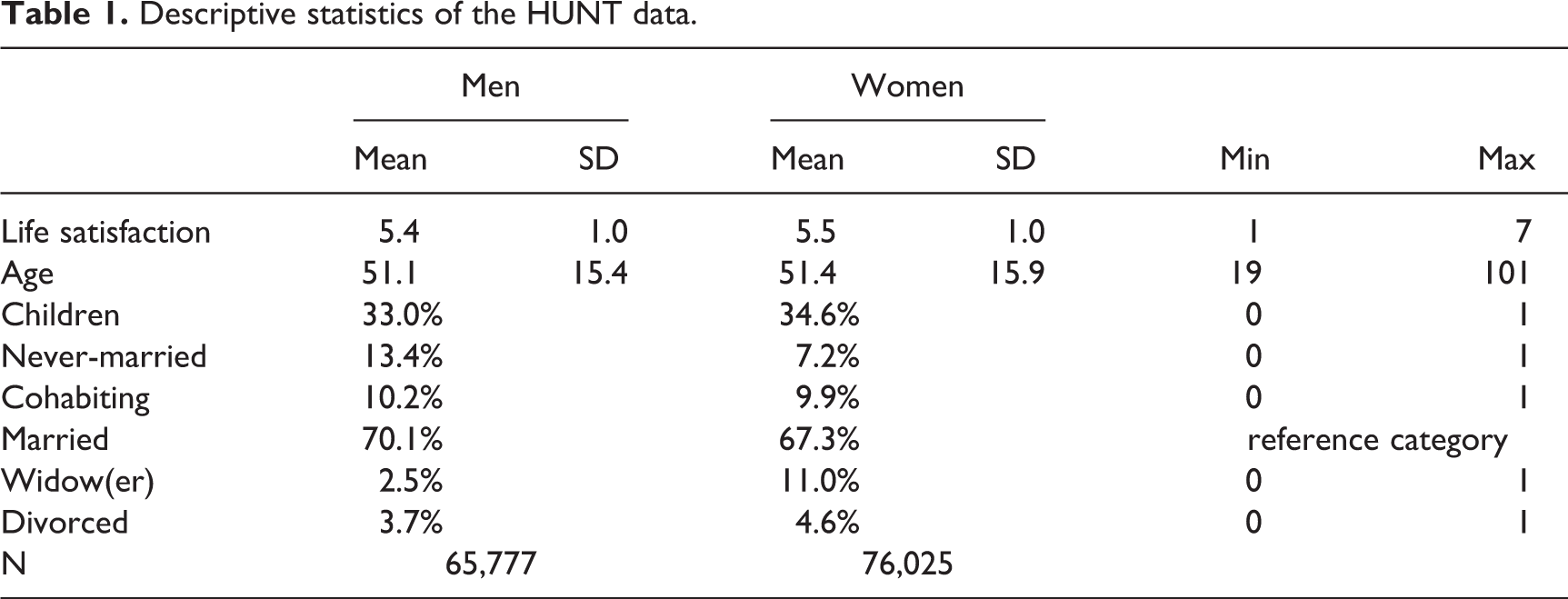
Table 1 presents descriptive statistics of the data. The data are presented by observation, ignoring the fact that the same individuals participated in at least two waves. Men and women report similar levels of life satisfaction, about 5.5 on a scale from 1 to 7. More men than women are never-married (or not yet married), 13.4 per cent compared to 7.2 per cent. As expected, there are more widows than widowers (11 per cent compared to 2.5 per cent). ‘Children’ refers to having children in the household under 15 (HUNT1) or 18 (HUNT2 and HUNT3).
Descriptive statistics of the HUNT data.
Statistical methods
The data are investigated using linear regression models. A cross-sectional analysis shows how life satisfaction compares between marital statuses groups (never-married, cohabiting, married, divorced and widowed) when controlling for age and gender. A longitudinal analysis shows how life satisfaction changes in the same (‘within’) individuals when they move (in either direction) from one marital status group (never-married, cohabiting or married) to another (cohabiting, married, divorced or widowed) when controlling for age and gender. Regarding theory, longitudinal estimates are associated with social causation processes; cross-sectional estimates are associated with both social selection and social causation processes, whereas deviances between cross-sectional and longitudinal estimates are associated with social selection processes.
The longitudinal analysis controls for each individual’s fixed/normal life satisfaction using fixed effects. It controls for all time-invariant characteristics but only two time-variant characteristics: ageing and children. Both analyses control for age/ageing using non-linear forms: age (minus 50 and divided by 10 in order to make the coefficients larger) plus the square and cubic transformations of this (up-scaled and centred) age variable because the method fits the data well, as indicated by test statistics. The issue of interaction between partnership transitions with age is investigated using interaction terms between age dummies and partnership status (three dummy variables). Test statistics correct for the fact that repeated observations for each individual are not statistically independent using the cluster option in Stata.
Results
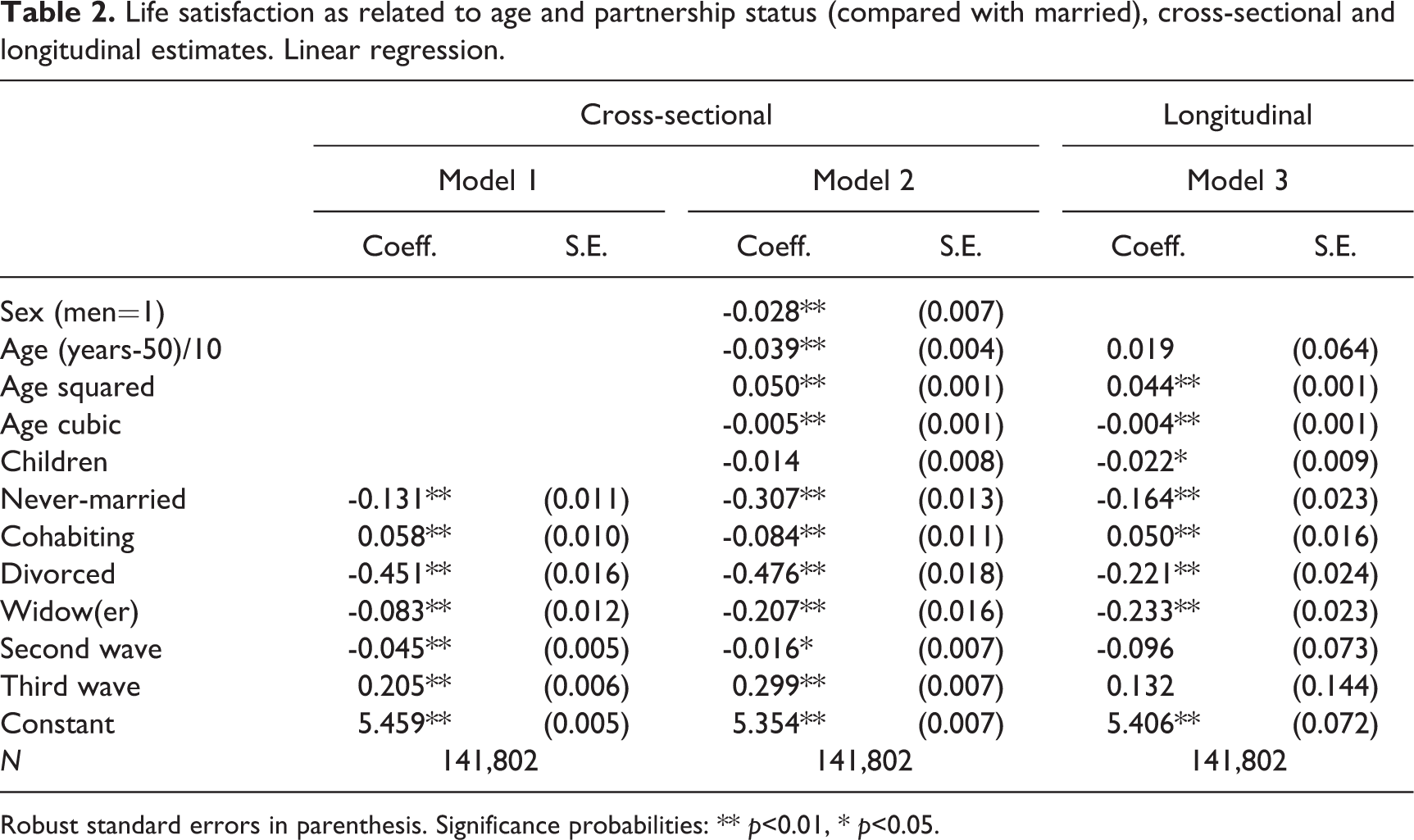
Cross-sectional and longitudinal analyses provide results as presented in Table 2. The four marital statuses listed in the table’s first column – that is, the Never-married, the Cohabiting, the Divorced and the Widow(er)s are compared with (those/being) married. For example, the never-married coefficient compares the never-married with married individuals (model 1) or individuals moving from never-married to married (model 2). Model 1 shows that married and cohabiting individuals are generally more satisfied with life than those who are non-partnered (that is, the never-married, the divorced and the widowed) and that the divorced are the least satisfied, followed by the never-married, and that widow(er)s deviate least from the married. This also holds true when we adjust for gender and age (Model 2). However, the longitudinal analysis (Model 3) indicates that the differences between the three non-partnered states are surprisingly small when adjusted for selection; only the comparison between widowers and never-married individuals is significant. This finding indicates that selection processes are more important in explaining marital status differences in life satisfaction than changes following partnership formation and dissolution. A small cohabitation gap in the cross-sectional analysis (Model 2) is fully explained by the selection processes between the two partnership statuses; longitudinally, cohabitation is associated with the highest level of satisfaction. For the divorced and the never-married, a large part of the deviation from the married state is due to selection (54 and 46 per cent, respectively), whereas there is no selection of dissatisfied individuals into widowhood.
Life satisfaction as related to age and partnership status (compared with married), cross-sectional and longitudinal estimates. Linear regression.
Robust standard errors in parenthesis. Significance probabilities: ** p<0.01, * p<0.05.
In Figure 1 we present the results from models 2 and 3 in graphic form. The height of the bars above the 0 mark corresponds to the coefficients from Model 2; the light grey part corresponds to the causation effects, while the dark part corresponds to the selection effects, as estimated by Model 3.
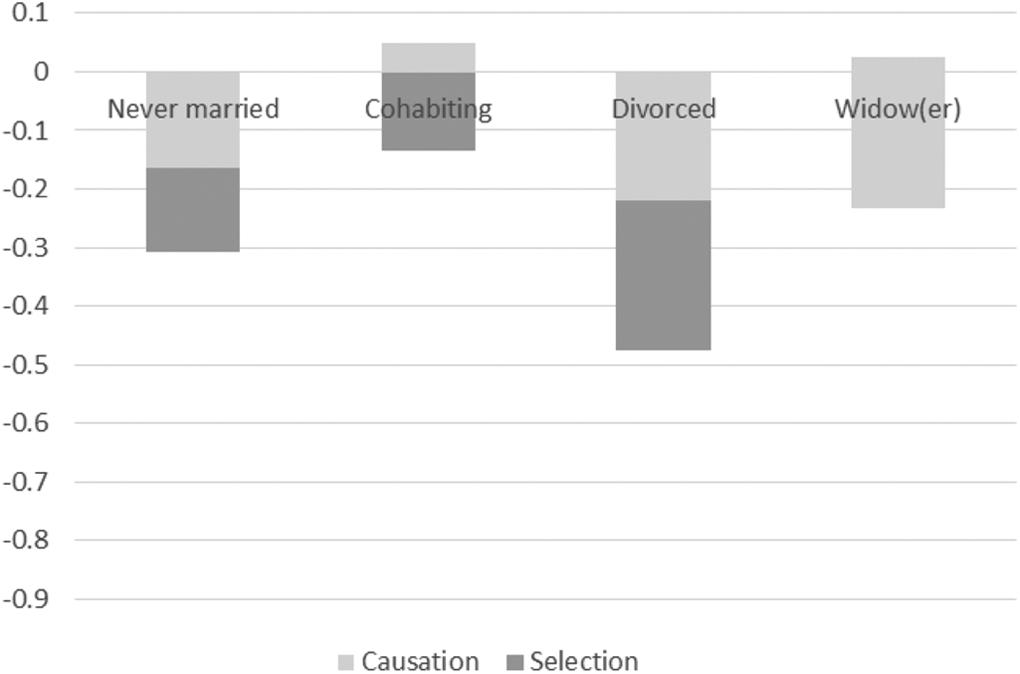
Life satisfaction, persons who are not married compared to married persons.
Both young and old individuals are more satisfied than the middle-aged. This is the reason the differences between the marital statuses tend to increase when controlling for age, most clearly for the never-married (young) and widows/widowers (old).
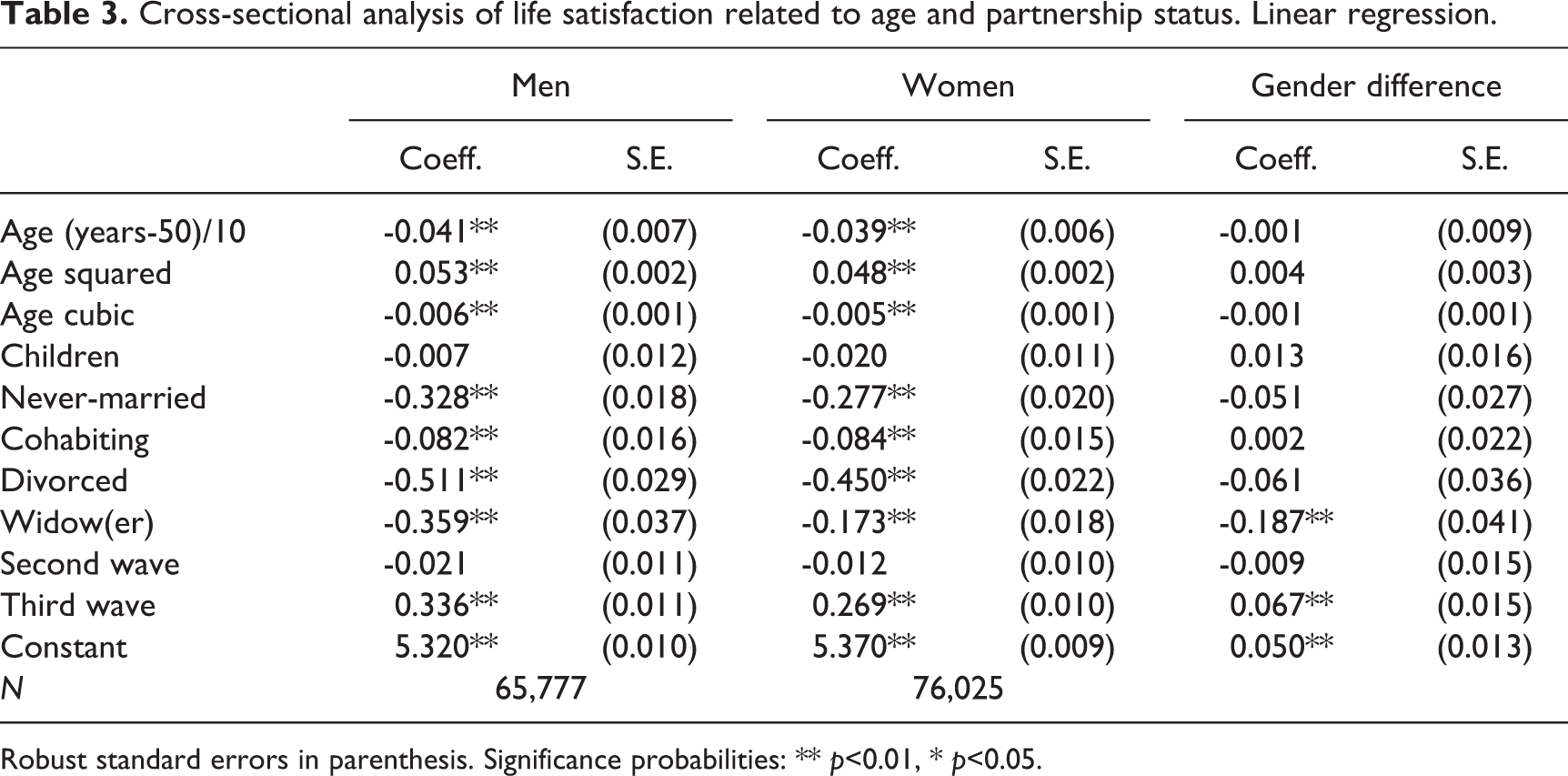
Gender differences are presented in Tables 3 and 4. Table 3 presents results from the cross-sectional analysis, showing significantly lower life satisfaction for men than for women when they are widowed. Similar results are reproduced in the longitudinal analysis presented in Table 4. This analysis also indicates a stronger selection of dissatisfied individuals into divorce among women than among men.
Cross-sectional analysis of life satisfaction related to age and partnership status. Linear regression.
Robust standard errors in parenthesis. Significance probabilities: ** p<0.01, * p<0.05.
Longitudinal analysis of life satisfaction related to ageing and partnership transitions. Linear regression.
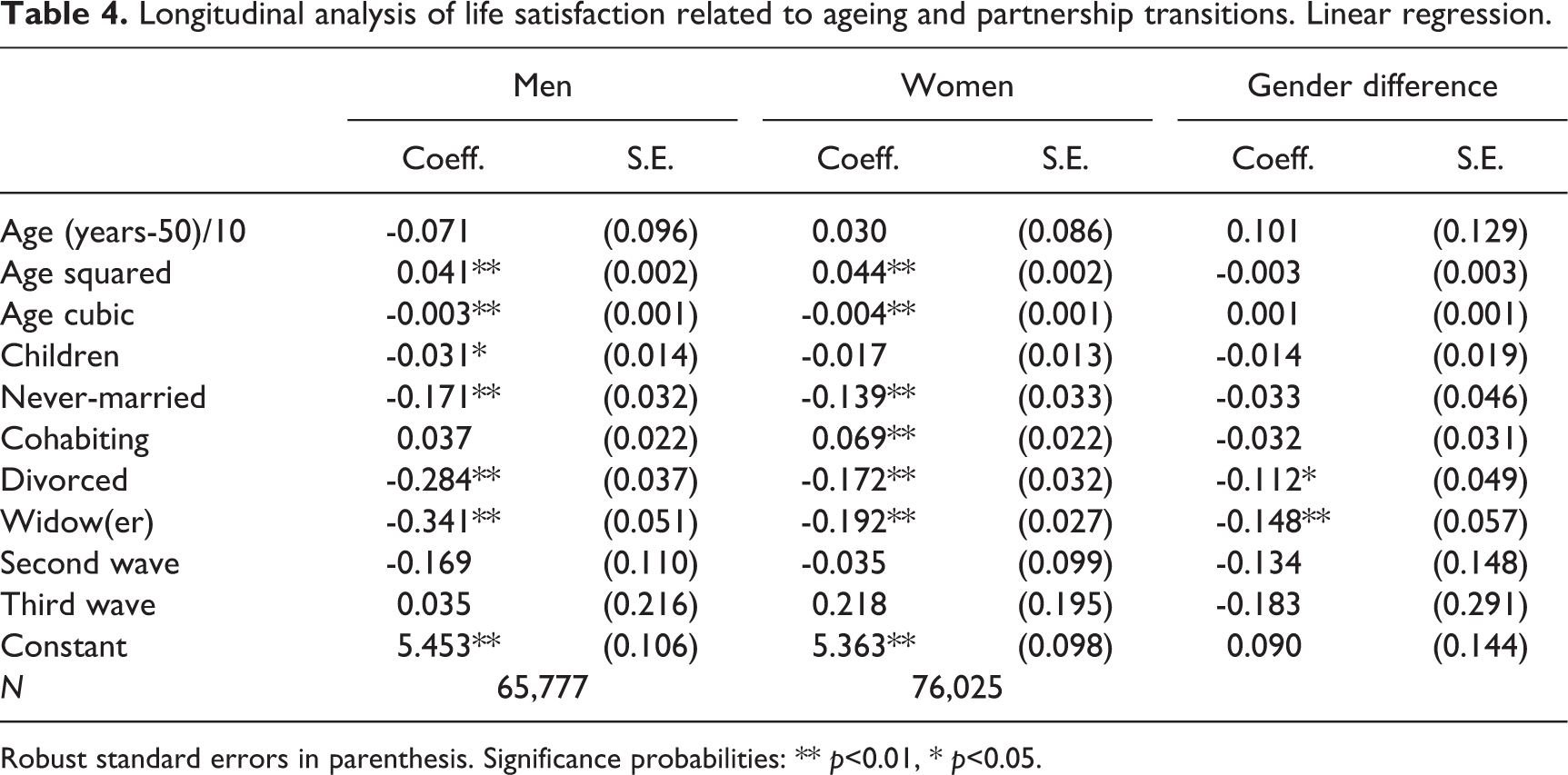
Robust standard errors in parenthesis. Significance probabilities: ** p<0.01, * p<0.05.
The estimates indicate that for men 52 per cent (0.171/0.328) and for women 50 per cent (0.139/0.277) of the difference between the non-partnered and partnered state is explained by the transition into a partnership (a causal effect), whereas the remaining 48 per cent for men and 50 per cent for women is explained by selection. Corresponding figures related to divorce show 56 per cent causation and 44 per cent selection for men (284/511) and 38 per cent causation and 62 per cent selection for women (0.172/0.450). Thus, we conclude that selection explains more of the lowered life satisfaction following divorce for women than for men and the effect of divorce is more harmful to men than to women. These results are also presented graphically in Figures 2 and 3. Entering cohabitation is seemingly slightly more satisfying than entering marriage. However, only among women is the difference statistically significant.
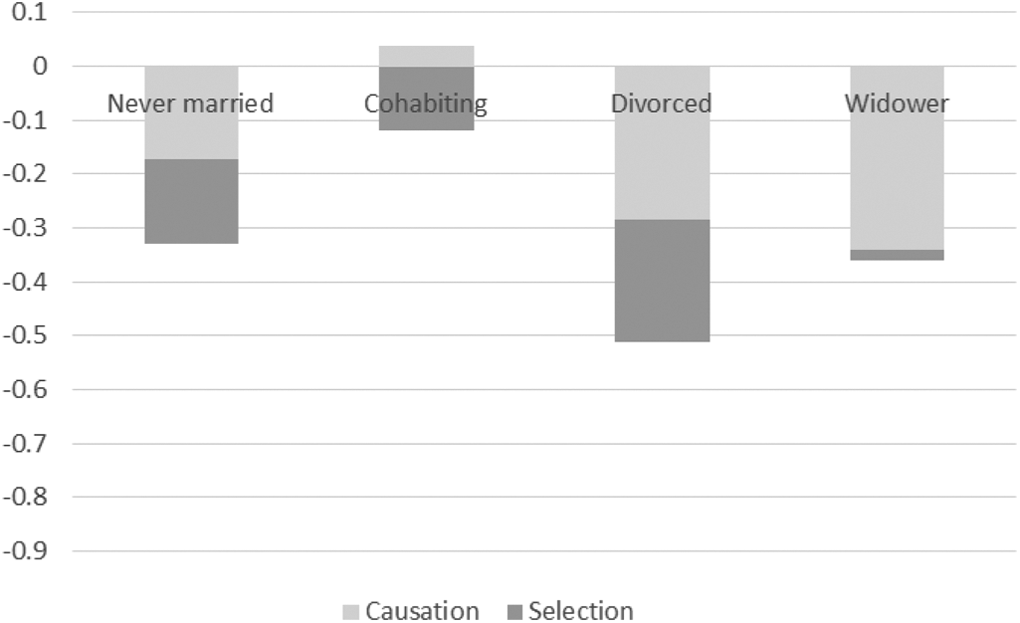
Life satisfaction, persons who are not married compared to married persons, men.
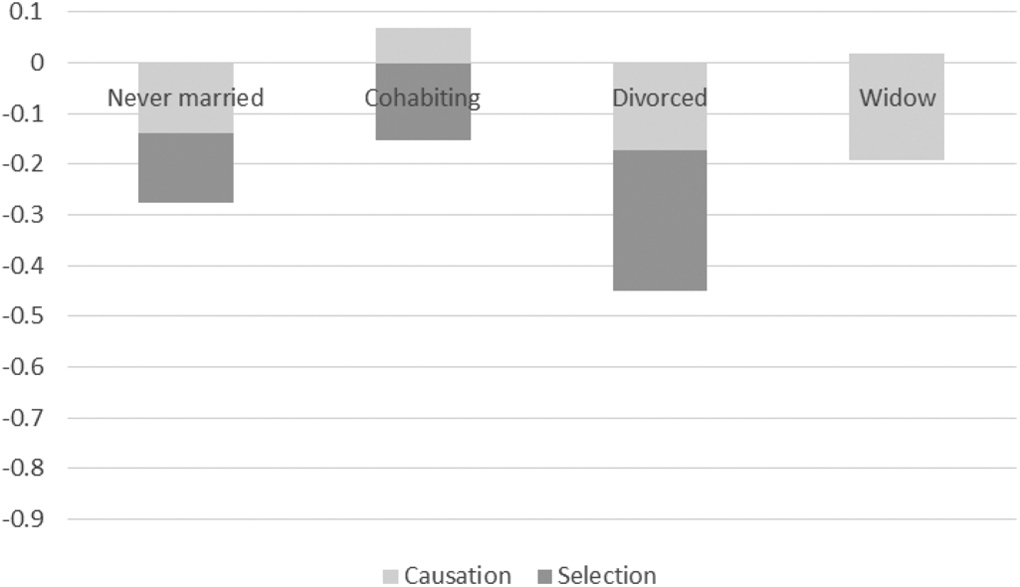
Life satisfaction, persons who are not married compared to married persons, women.
Table 5 and Figure 4 investigate whether the benefits of being partnered vary by gender and age, using interaction terms between partnerships status and gender/age. Transitions between never-married, married and divorced are split at age 35, whereas transitions between married and widowhood are split at age 65. Transitions into marriage are equally beneficial for all gender/age groups. Transitions into divorce are much more harmful for young males (below 35) than for any other age or gender group. Transitions into widowhood are worse for relatively young individuals than for those over 65. The difference is only significant among women, but this is explained by there being more widows than widowers below 65; the estimated difference between young and old people entering widowhood is as large for men (0.091) as for women (0.086).

Life satisfaction, persons who are not married compared to married persons, by age and gender.
Longitudinal analysis of life satisfaction as related to ageing and partnership transitions with interaction terms between age and partnership status. Linear regression.
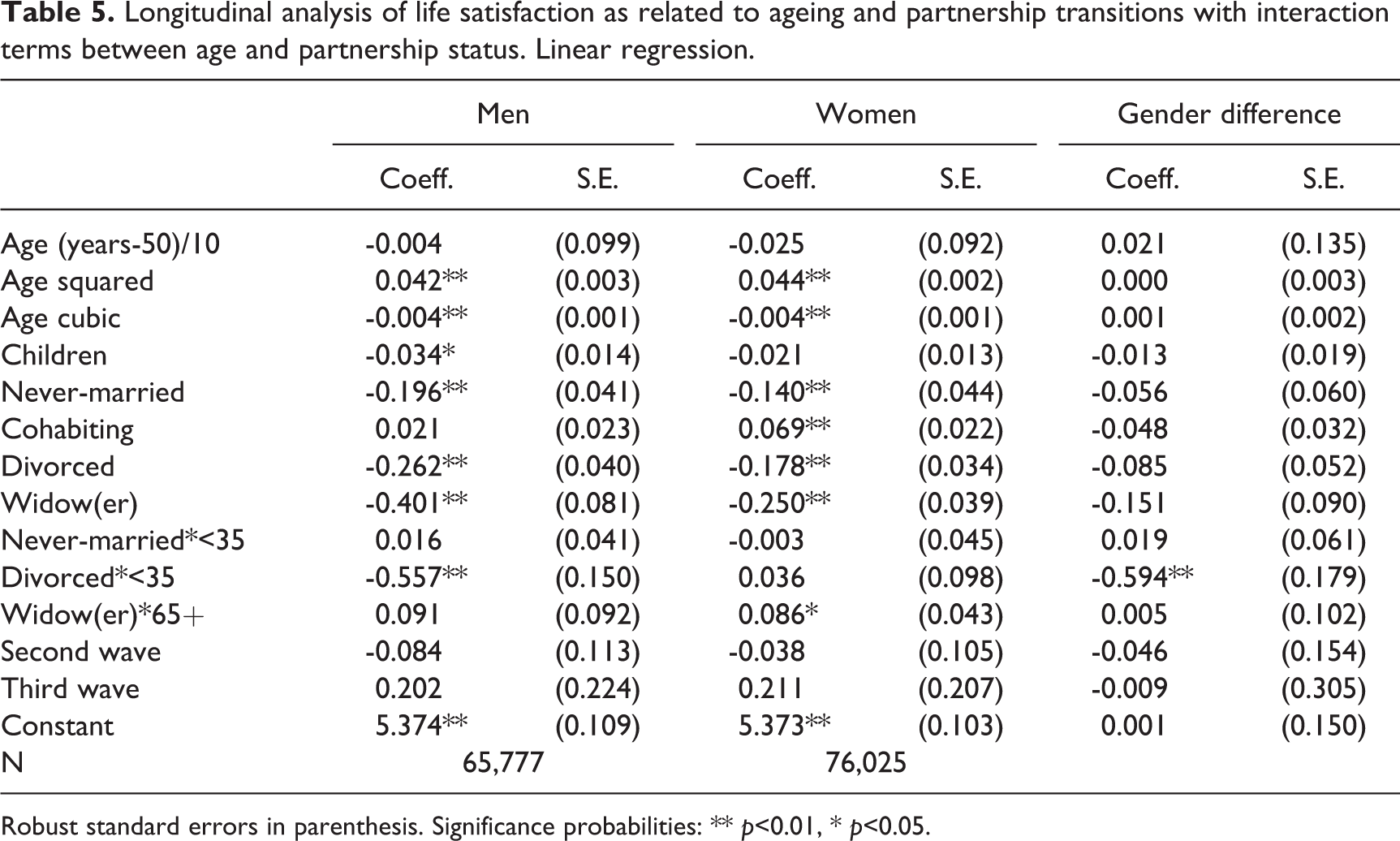
Robust standard errors in parenthesis. Significance probabilities: ** p<0.01, * p<0.05.
Discussion
When comparing individuals before and after marrying or cohabiting, we find that people are generally more satisfied with their lives when partnered than before (hypothesis 1). The analyses show that cohabitation is as good (for men) or better (for women) than marriage (hypothesis 2). Our analyses confirm too that the difference between partnered and non-partnered people is typically smaller when adjusted for life satisfaction before marriage, which means that a substantial part of the advantage of being partnered is due to selection – that is, to satisfied people’s greater tendency to enter a partnership and, especially, stay partnered. The life satisfaction of divorcees is especially low, and our results show that a substantial part of this disadvantage is due to a greater tendency of less satisfied people to divorce. Selection does not explain the reduced life satisfaction of the widowed.
The results show that there are clear effects of changing marital state on life satisfaction. However, for most groups the effects are rather small compared to the variability in life satisfaction across individuals. The effects reported in the present paper are for most groups not greater than 20 per cent of the standard deviation in life satisfaction. The exceptions are divorced young men and widowed men (hypotheses 3 and 4).
Gender and age
Previous studies present varied results in relation to gender differences. Our longitudinal analyses indicate that, corrected for selection, Norwegian women are as satisfied as men when they are married or cohabiting and also when they are never-married, but less dissatisfied when divorced or widowed.
Selection explains a large part of the lower life satisfaction of divorced people, more so for women than for men. Widowers and widows are also less satisfied with their lives compared to those who are still married, men more than women (hypothesis 3). For women it is as undesirable to be divorced as to be never-married. For men it is as undesirable to be divorced as to be widowed. The longitudinal analysis identifies two gender-age interactions. Divorce is much more harmful to young men than to other age/gender groups (hypothesis 4), and widowhood is more harmful to men than to women. These findings support the feminist claim that marriage is more advantageous for men than for women. Long-lasting marital relationships are seemingly more rewarding for men than women, mostly because women suffer less from widowhood than men, but also, to a smaller degree, because they suffer less from divorce.
Limitations
The analyses presented in this article are based on panel survey data collected in the years 1984–86, 1996–98 and 2006–08 in a middle-sized county in mid-Norway. The number of respondents is large; attrition is also large. Drop-out analyses show more drop-out among young men than among young women. This might affect the longitudinal estimates comparing young men to young women.
The theme of the study is whether marriage enhances life satisfaction. Our modelling strategy assumes that longitudinal variation in life satisfaction associated with partnership transitions can be classified as causal effects in contrast to cross-sectional variation, which also includes selection effects. There is the possibility that unobserved time-variant characteristics such as unemployment or health problems may affect both marital status and life satisfaction. For such reasons, our causal effect might be overestimated.
The results differ in some respects from those of similar marriage studies. Compared to pure cross-sectional or pure longitudinal research, this study indicates how much of the differences in life satisfaction between the marital statuses are due to the selection of satisfied people into and out of marriage. By including all social groups we can establish better statistical controls for ageing and period effects, which may bias longitudinal estimates when the statistical models are limited to a few marital transitions – typically marital formation or marital dissolution.
The large intervals between the three waves constitute an important limitation. Other longitudinal research indicates that most people are satisfied after partnership formation and dissatisfied around partnership dissolution, but have a tendency to return to previous levels of satisfaction over subsequent years (Lucas et al., 2003; Soons et al., 2009; Stutzer and Frey, 2006). If so, our results indicate an average effect over the typical 11-year observation span in our data. Furthermore, some marital statuses tend to last longer than others. For example, being married tends to last longer than being divorced. If so, our estimate for divorce is somewhat overestimated if compared with the married state because relatively more divorcees still experience the stressful event of a recent separation as compared to the relatively smaller group of recently married individuals.
Our 11-year observation spans may also include several transitions. For example, many persons start their partnerships as cohabitation and marry later. Our finding that cohabitation is slightly more satisfying than marriage could reflect the possibility that those entering marriage have been partnered for more years (within the 11-year observation interval) than those entering cohabitation. If so, those entering marriage would have more years to return to previous levels of satisfaction. For this reason, we can only conclude that both marriage and cohabitation provide benefits over non-partnered states. It is most likely that, for Norwegian men and women, cohabitation and marriage provide similar benefits with regard to life satisfaction.
Research on re-partnering shows that divorced men are more likely to enter a new partnership than divorced women (Ivanova et al., 2013). If so, young and divorced men could include a comparatively high proportion of individuals still experiencing the stress of a recent divorce. Research on mental distress, on the other hand, shows more mental distress among young divorced men than in other age and gender groups of divorcees at similar time points after partnership dissolution (Blekesaune, 2008). Taken together, we believe our finding regarding the low satisfaction of young divorced men is true, but most likely overestimated in the data.
The possibility of multiple transitions within long observation spans might also include some time-varying selection effects we have not controlled for; we control for all time-invariant (fixed) effects. For example, people who cope badly after divorce (say, if dumped for a more attractive partner) might also have problems finding a new partner. This is merely speculation, however.
The conclusions drawn above relate to people’s life satisfaction. Other indicators of well-being – such as self-reports on happiness or mental health – were not investigated in this research because the questions related to these indicators were not given the same wording in all three surveys. We have not investigated the impact of marriage quality because our data do not provide such information. It is possible that the life satisfaction of divorcees is higher than the life satisfaction of people in unhappy marriages and that the quality of marriage means more to women than to men, but we cannot throw light on these questions.
Conclusion
In this contribution we have investigated whether life satisfaction is associated with transitions both into and out of marital unions (marriages and cohabitations). Results indicate that marriage as well as cohabitation does enhance life satisfaction, but more for some groups than for others. Both men and women are more satisfied as married or cohabiting than as non-partnered. However, transition into widowhood is more harmful to men than to women, and divorce is much more harmful to young males (below 35) than to any other age or gender group.
Footnotes
Acknowledgement
We thank Jostein Holmen at the HUNT Research Centre and John Eriksen at NOVA for helpful support. We also thank the editors and two anonymous reviewers for useful comments on previous versions of this article.
Author note
The Nord-Trøndelag Health Study (The HUNT Study) is a collaboration between the HUNT Research Centre (Faculty of Medicine, Norwegian University of Science and Technology NTNU), Nord-Trøndelag County Council, Central Norway Health Authority, and the Norwegian Institute of Public Health.
Funding
This research received no specific grant from any funding agency in the public, commercial, or not-for-profit sectors.