




Abstract
In this article, we study attitudes towards the gendered division of paid and unpaid work from a comparative perspective. Based on the notion that political institutions are important in structuring individuals’ orientations, five countries with different family policy arrangements are included in the analysis: Denmark, Finland, Germany, Poland and Sweden. Previous comparative attitude research has a strong bias towards public opinion about women’s employment, while research on attitudes towards men’s participation in care work is rare. Drawing on data from the International Social Survey Programme (ISSP) 2012, we use latent class analysis to explore public opinion about: (a) how parents should divide the responsibilities of economic provision and unpaid work; and (b) whether and how parents should divide paid parental leave between them. The strongest support for a traditional organization of work and care is found in Poland, while the strongest support for an equal sharing of work and care responsibilities is found in Sweden. Among the Nordic countries, results differ. While those holding non-traditional ideals in Denmark and Finland emphasize the importance of full-time work for both parents, non-traditional Swedes instead emphasize that both parents should cut back their work hours and thereby share the responsibility for earning and caring in the family.
Keywords
Introduction
One of the most significant characteristics of contemporary western society is the transformation of gender ideals, where the dual-earner family is replacing the breadwinner-homemaker family, although to a varying degree across countries (Daly, 2005; Lewis, 2009). The development towards a dual-earner society with greater gender-role symmetry suggests that families face a larger variety of both opportunities and sources of conflict when deciding how to organize their everyday lives, particularly if there are small children in the family. In this article, we examine public preferences regarding a key issue – how men and women should divide the responsibilities regarding work and care for children – where the choices made by parents may significantly influence their future behaviour in both the domestic sphere and the labour market, and have important long-term consequences, both economically and socially.
The aim of this article is to examine attitudes towards the gendered division of paid and unpaid work from a cross-country perspective. How should mothers and fathers divide the responsibilities of economic provision and unpaid housework and childcare between them? Should there be a clear division of labour between the mother and father, or should the different responsibilities be shared equally? The analysis will reveal if people today favour a gender-equal society, which would imply a rather drastic change in men’s behaviour in the domestic sphere, or if they prefer a society where women continue to shoulder the main share of care work.
Five European countries are examined: Denmark; Finland; Germany-east; Germany-west; Poland; and Sweden. These five countries share some basic similarities: all are industrialized countries, geographically located close to the Baltic Sea, and members of the European Union. However, when it comes to politico-institutional frameworks – family policy in particular – they differ significantly from each other, although some more than others. 1
Through their systems of rules and regulations, political institutions embody national traditions as well as previous power struggles between social actors (Korpi and Palme, 1998; Svallfors, 2007). The institutional framework surrounding citizens in a given context is of substantial importance for structuring individuals’ behaviours, preferences and perceptions (Mettler and Soss, 2004; Soss and Schram, 2007; Svallfors, 2007).
In the context of this article, the countries’ family policy arrangements are assumed to make up a framework that defines and influences the expectations, ideals, roles and relations of women and men, which in turn are of importance for individuals’ perception of society and everyday life (Daly and Rake, 2003; Öun, 2012). As transmitters of resources and carriers of norms, policy arrangements can be understood as a filter that delineates both opportunities and constraints, and through which individuals perceive the world. Thus, the actual design of family policies may influence people’s ideas about proper and desirable behaviour of men and women in the realms of paid work and childcare.
Family issues have long been considered a female domain, and this has also characterized studies in the area of cross-country comparative attitudinal research. The focus on gender within the field has been limited to an almost exclusive analysis of attitudes related to women’s participation in the labour force and possible consequences thereof, such as women’s relationship to their children and the general well-being of the family. Thus, men’s behaviour has implicitly been depicted as static and unchangeable.
The strong emphasis previous research has placed on women’s employment is understandable; the female entry into a traditionally male domain and the consolidation of their position there marked a significant change in the societal structure of western societies. However, it is also clear that the roles and responsibilities of men in housework and childcare – that is, the male entry into a traditionally female domain – have received less attention. Although we can witness an increased interest 2 in the topic, most of this research is about actual behaviour and less about attitudes towards men’s participation in housework and childcare (see, e.g., Hook, 2006). 3 This lacuna in research is unfortunate, not the least when considering that contemporary debates in many societies are not primarily about whether or not women should be in paid work, but about the role of men when it comes to domestic unpaid work and, furthermore, gender equality in both spheres of work.
Few previous studies have explicitly addressed the restricted picture that emerges when women’s roles are the only ones taken into consideration. This women-centred vision on research concerning family and gender has resulted in a lack of survey items in high-quality international comparative datasets that focus on gender relations, in the proper sense of the word, that is, that focus on both men and women in the division of paid and unpaid work. Thanks to a recent module of the International Social Survey Programme (ISSP, 2012), such data are now available. In this article, we deliberately aim to de-emphasize the narrow study of women by focusing on attitudes towards women’s and men’s responsibilities regarding paid work, as well as unpaid household work and childcare.
Previous cross-country attitudinal research on gender relations
There exists a rather extensive cross-country comparative literature examining individuals’ attitudes towards issues that concern gender relations. However, previous research in the area has a strong bias towards public opinion about women’s employment and how such attitudes differ across social contexts (Baxter and Kane, 1995; Knudsen and Wærness, 2001; Kunovich and Kunovich, 2008). In the main, results show that citizens living in countries with more gender-equal policy contexts and higher employment rates among women are comparatively more positive towards women’s employment (e.g. Crompton et al., 2005; Sjöberg, 2004; Sundström, 1999). In addition, a country’s level of affluence and individualism is positively related to the prevalence of gender-egalitarian attitudes (Apparala et al., 2003; Wilensky, 2002). Moreover, these studies show that women, young people and the highly educated are more positive towards women’s employment compared to men, older people and those with low education.
Politico-institutional frameworks: family policy models
Through their institutional frameworks, countries facilitate or even promote different family models. In some countries, family policies encourage men and women to have double responsibilities, both as providers and as carers, while policies in other countries support differentiated responsibilities for women (caregiver) and men (provider). These two ideal-typical dimensions form the base for various classifications of countries into different family policy models (Korpi, 2000; Sainsbury, 1999; Thévenon, 2011).
The Nordic countries are typically understood as examples of the dual-earner family model – as both men and women contribute to the household income – or as the dual-earner/dual-carer family model – as fathers are encouraged to take part in child upbringing more actively (cf. Gornick and Meyers, 2008). The family policies distinguishing this model are the rights to tax-financed public childcare and a lengthy paid parental leave open to both mothers and fathers. By incorporating issues of gender equality within the family policy framework, two major political goals have been to increase labour market participation among mothers and to increase the possibilities to combine family obligations with paid work.
While the Nordic countries share many similarities that set them apart from most other countries, it is important to recognize some differences within the Nordic cluster of countries when it comes to the relative weight given to women’s labour force participation and gender equality manifested in the actual design of family policies. The most obvious differences are: the comparatively stronger focus in Sweden on involving fathers in the care of children, mainly through the available two months “daddy’s quota”; the comparatively lower employment rate and part-time work among mothers and a widely used cash-for-care programme in Finland; and the comparatively stronger focus on gainful employment among mothers in Denmark (Ellingsæter, 2003; Ellingsæter and Leira, 2006). The enrolment in formal care for children under three years of age also differs between the countries. In Denmark, as many as 66% of children below the age of three are enrolled in formal care, while the corresponding figures for Sweden and Finland are 47% and 28% respectively (OECD, 2014).
The male breadwinner family model characterizes the family policies of continental Europe. Influenced by Catholicism and ideals of subsidiarity, these policies are designed to fit a more traditional gendered division of work in production and reproduction. Encouraged by the tax system and generous general monetary child support, mothers with young children often exit the labour market for an extensive period of time (Korpi et al., 2013; OECD, 2007).
Germany was for a long time seen as a classic example of the male breadwinner model, but recent policy changes indicate a move towards greater gender equality regarding the responsibility for the care of children (ILO, 2014a). Still, only 23% of the children below three years of age are enrolled in formal childcare (OECD, 2014). In Poland, family policies clearly fit the ideals envisioned in the male breadwinner model. Mothers are principally seen as caregivers, not as members of the labour force. Parental leave is lengthy but low-paid, and public care for small children is not common (Robila, 2012; Saxonberg and Sirovatka, 2006). At present, around 7% of the children below three years of age are enrolled in formal childcare (OECD, 2014).
Considering that Germany has been reunited since 1990 – a reunification which meant that the former DDR laws and rights were replaced by BRD laws – it is interesting that differences between the western and eastern parts in terms of women’s labour force participation as well as access to public childcare facilities are still quite pronounced. Full-time employment is more common among women living in the former DDR parts of the country compared to their western sisters. This difference is even more pronounced when it comes to employment among mothers with young children, partly because of the greater access to childcare in Germany-east (Konietzka and Kreyenfeld, 2002).
The countries’ family policy structures are clearly mirrored in their present relative distribution of working hours and labour force participation. In the Nordic countries, Denmark in particular, a large share of fathers and mothers works full-time or long part-time (∼30 hours/week). A more traditional distribution appears in Germany-west, where mothers are comparatively less active in the labour market. Between the Nordic countries on the one hand and Germany-west on the other hand, we find the two ex-socialist countries: Germany-east and Poland (ISSP, 2012). The patterns observed for these two are also likely to carry historical traces of state socialism. However, the legacy of state socialism stressing that both men and women, including mothers, should work full-time may play a comparatively greater role in the East-German collective mind. When examining women’s employment rates over time, it seems that the ideals of a universal worker were less strongly emphasized in Poland than in the DDR (Matysiak and Steinmetz, 2008). In the beginning of the 1970s, the gender difference in core workforce employment rates was about 20 percentage units in both countries. Thereafter, the gender gap rapidly decreased in the DDR, and it was as good as closed at the time of the German reunification. In Poland on the other hand, the gender gap levelled at around 20 percentage units throughout the 1970s and 1980s (ILO, 2014b).
As to the actual division of housework, we find that women do a majority of the unpaid work in all of the countries. However, some countries have a less unequal division than others. Among the countries examined in this paper, data show that Polish men participate the least in housework, followed by German men. Cross-national variation across the Nordic countries is quite small, but couples in Denmark and Sweden share the housework more equally than in Finland (ISSP, 2012).
The selection of countries facilitates a number of theoretically interesting comparisons. First, although the main impression from previous cross-national research on family policy is “Nordic exceptionalism”, several studies point towards the internal heterogeneity within the Nordic cluster of countries (Bergqvist, 1999; Bernhardt et al., 2008; Ellingsæter, 1998). Second, both Poland and Germany-west are examples of the male breadwinner model. However, there are reasons to believe that the citizens of Poland may be more in favour of traditional gendered solutions compared to the citizens of Germany-west. Third, to what extent do citizens in Germany-east and Germany-west express different opinions regarding the roles of women and men when it comes to issues of paid work and care? The results may have something to tell us about the lasting effects of living in completely different societal regimes. Fourth, are there any systematic differences between male breadwinner model countries and dual-earner model countries, that is, is the observed country variation smaller within model types than between model types?
Building on the above descriptions of family policies as well as on previous cross-country research, we believe that attitudes suggesting a traditional division of economic provision and unpaid care work between men and women will be most common in Poland and Germany-west. Correspondingly, we expect that preferences for more gender-equal family responsibilities will be most widespread in Sweden, followed by the other Nordic countries. We also expect attitudinal differences based on gender, age and education, where conservative views should be more common among men, older people and individuals with low education. Correspondingly, we expect women, the young and the highly educated to have more gender-equal preferences.
Data, measures and methodological strategy
The analyses draw on data from the 2012 ISSP module. Compared to earlier rounds of the module – which focused almost exclusively on women and employment – the 2012 module brings in the role of men in the domestic sphere and offers a widened focus on gender relations, power and distribution within the household with respect to paid work, unpaid household work and care responsibilities. All six of the sub-samples are nationally representative of the population aged 18–80 years (ISSP, 2012).
In the analyses, we focus on two aspects: attitudes about how parental leave should be divided between the mother and the father (captured by Q1 shown below), and attitudes concerning the extent to which mothers and fathers should work and/or stay at home when their children are young (captured by Q2 shown below). Q1. Consider a couple who both work full-time and now have a newborn child. One of them stops working for some time to care for their child. If both are in a similar work situation and are eligible for paid leave, how should this paid leave period be divided between the mother and the father?
The mother should take the entire paid leave period and the father should not take any paid leave.
The mother should take most of the paid leave period and the father should take some of it.
The mother and the father should each take half of the paid leave period.
The father should take most of the paid leave period and the mother should take some of it.
The father should take the entire paid leave period and the mother should not take any paid leave.
When it comes to how parents should divide the responsibilities of economic provision and unpaid housework and childcare between them, we use two questions: the respondents’ preferences regarding the best option (Q2a); and the least desirable option (Q2b) for a model family. Q2a. Consider a family with a child under school age. What, in your opinion, is the best way for them to organize their family and work life?
The mother stays at home and the father works full-time.
The mother works part-time and the father works full-time.
Both the mother and the father work full-time.
Both the mother and the father work part-time.
The father works part-time and the mother works full-time.
The father stays at home and the mother works full-time.
Q2b. And, in your opinion, which of these options would be the least desirable?
The mother stays at home and the father works full-time.
The mother works part-time and the father works full-time.
Both the mother and the father work full-time.
Both the mother and the father work part-time.
The father works part-time and the mother works full-time.
The father stays at home and the mother works full-time.
Two dimensions are present in the questions; the first is about the strength of the orientation towards paid work, and the other relates to whether this orientation is viewed differently if it concerns the mother or the father. For the analysis of responses to these two items, we will use latent class analysis (LCA). LCA is a suitable method for identifying qualitatively different configurations of categorical variable responses (Magidson and Vermunt, 2001; McCutcheon, 1987). LCA examines whether relationships within a set of observed indicators are explained by a latent variable. The aim is to identify clusters of individuals who share similar preferences. If two dominant combinations of preferences exist, a two-cluster model will fit the data. If the sample can be divided into three configurations of preferences, a three-cluster model will be selected, and so on. By applying different model fit statistics, the number of dominant preference patterns can be determined. By including country as a covariate, we ensure that the empirical assessment of the theoretical construct is the same in each country.
In addition, LCA calculates the probability of each individual belonging to each cluster. These probabilities will be used as dependent variables in forthcoming OLS regressions analysing attitudinal differences between social categories in the selected countries: gender (two categories); age (four categories); education (completed number of years in education recoded into quartiles). Finally, we suggest cautious interpretations of data in the sense that we should not take gross percentage distributions on single items too literally, but pay more attention to examining broad attitudinal patterns and the extent to which such patterns vary across countries and social groups.
Results: attitudes towards the gendered division of paid and unpaid work
The division of parental leave between parents
The question about whether and how parents should share the parental leave period between them is an indicator capturing individuals’ attitudes towards the gendered division of paid and unpaid work. Table 1 shows the distribution of the five response categories by country. When examining the responses, it is clear that only a very small minority of the respondents in each country selected one of the last two categories, which specify that the father should use more of the leave than the mother should.
Attitudes towards the division of paid parental leave between the mother and the father (%).
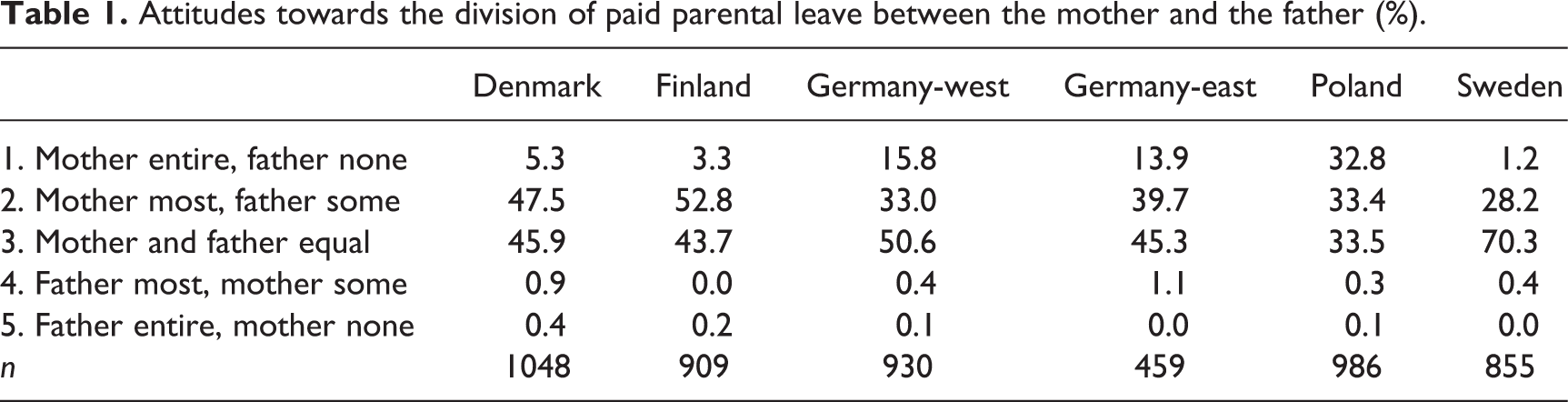
As shown in Table 1, Swedes have the most positive attitudes towards an equal sharing of parental leave between parents (70%). In the other Nordic countries, there is also rather strong support for equal sharing of the parental leave; 46% of the Danish and 44% of the Finnish respondents chose this option. In Denmark and Finland, a larger share of the population thinks that the mother should use most of the parental leave and the father some; 48% and 53% respectively have chosen this option.
Also in West and Germany-east, the most popular alternative is for parents to share the parental leave equally between them (45–50%). About 33–39% think that the mother should take most of the parental leave and the father some of it. Approximately 15% think that the mother should take the entire leave. Considering that Germany is regarded as a typical example of a traditional family policy model, this pattern is rather unexpected. However, if seen in the light of the recent changes of the German parental leave policy, introducing a real possibility for parents to share the parental leave, this result may indicate that ideals about the gendered division of paid and unpaid work are about to change in Germany.
In Poland, alternatives 1–3 are equally popular. Thus, among the examined countries, Poland exhibits the lowest support for an equal division of parental leave.
The next step in the analysis is to examine whether the attitudinal patterns regarding how parents should divide the parental leave between them differ across social categories. As the main topic of interest is to examine support for an equal sharing of the parental leave, the responses on the dependent variable have been dichotomized as follows: (3 = 1), (1, 2, 4, 5 = 0). Category 1 corresponds to the opinion that parents should divide the parental leave period equally. Category 0 comprises all other responses. Given the response distributions, category 0 corresponds in practice to the opinion that mothers should take most or all of the parental leave.
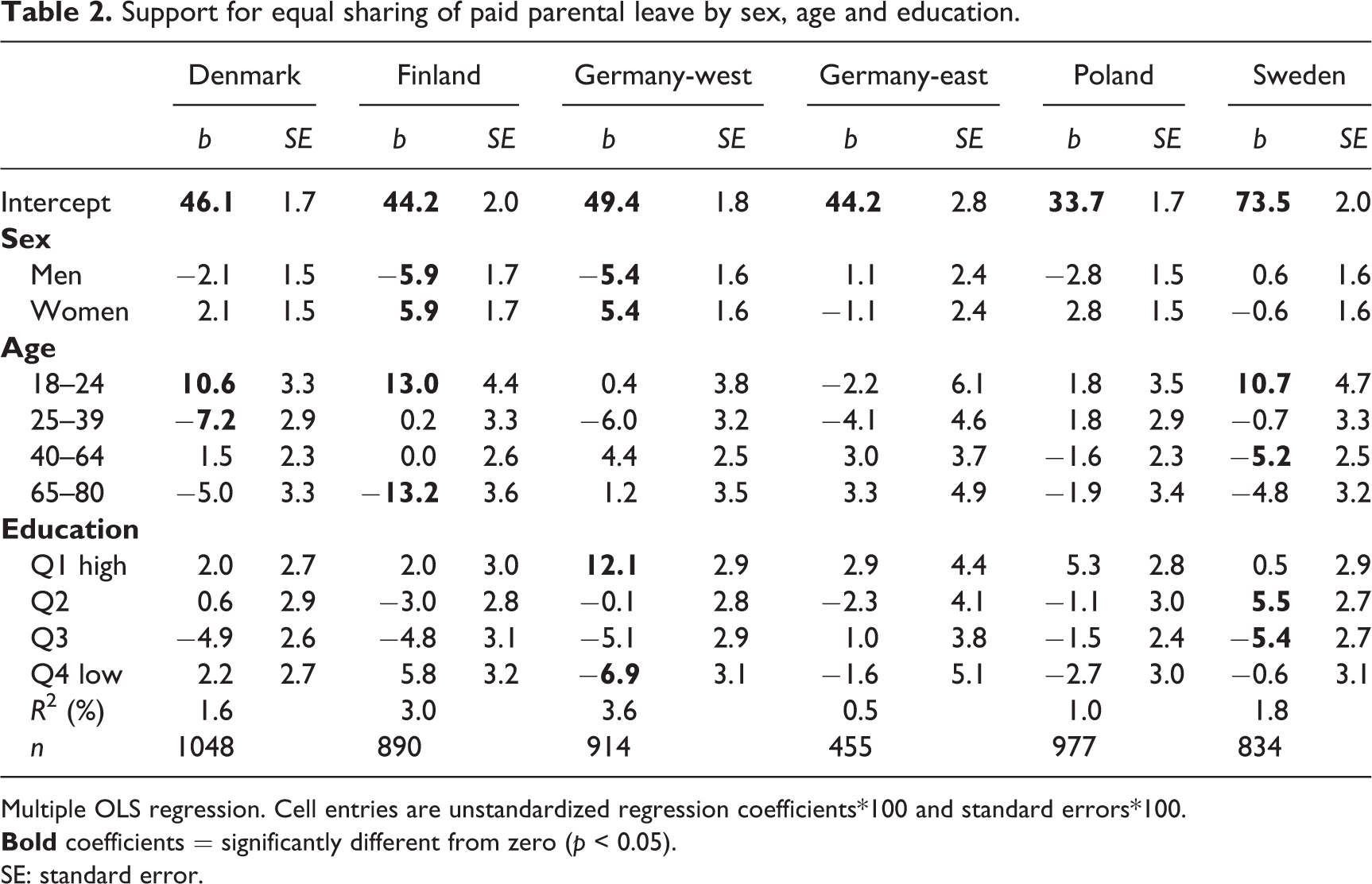
Table 2 shows the support for an equal sharing by gender, age and education in each country. For ease of interpretation of the coefficients, we applied effect coding (the sum of variable values for each variable is zero). Therefore, the intercept can be understood as the average support for a gender-equal division of the parental leave period across groups. As shown in Table 2, the countries’ intercepts correspond closely to the patterns observed in Table 1. 4
Support for equal sharing of paid parental leave by sex, age and education.
Multiple OLS regression. Cell entries are unstandardized regression coefficients*100 and standard errors*100.
SE: standard error.
Regarding group differences, we expected that support for equal sharing would be more common among women, the young and the highly educated. However, as shown in Table 2, most of the observed differences between social categories are quite small and non-significant. As to gender, we can observe significant differences in Finland and Germany-west only. Significant age differences occur in Denmark, Finland and Sweden. Here, we find that support for an equal sharing of the parental leave between parents is much stronger among the young compared to the elderly. This pattern is most clearly distinguished in Finland, where the difference between the youngest and the oldest group is around 26 percentage units. The corresponding figure for Sweden is about 16 percentage units. In Denmark too, data show that support for equal sharing is most widespread among the young. However, the age group showing the least support for equal sharing is the 25- to 39-year-olds – those who are most likely to have small children in their own household. Finally, in relation to education, significant differences occur in Germany-west and Sweden. However, it is only in Germany-west where the form of the relationship meets theoretical expectations.
Who should work and who should care?
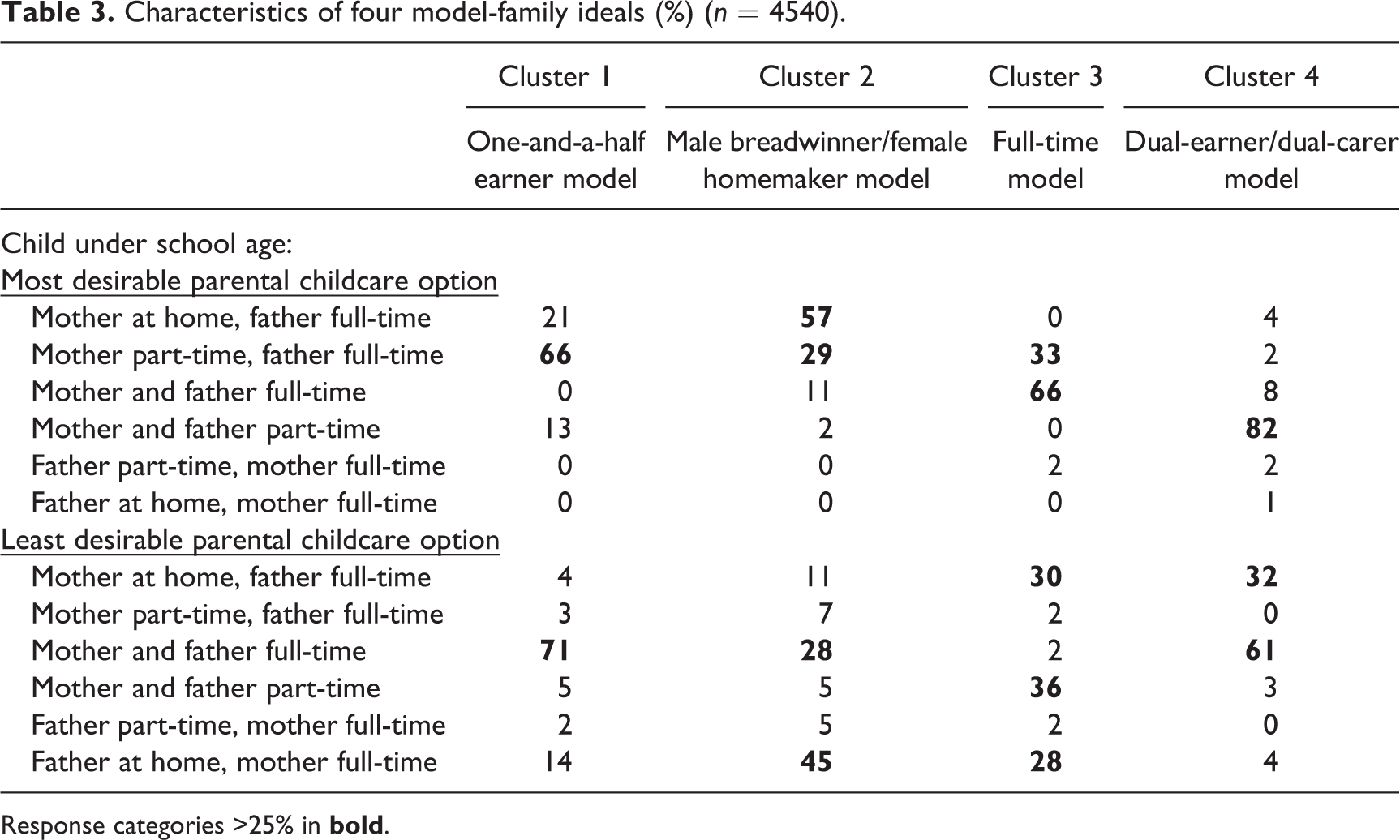
Turning to the second part of the analysis, where the issue is about how parents should organize their everyday life, the LCA shows that four dominant preference patterns seem to exist in the observed countries. Table 3 shows the characteristics of each cluster. The cell entries indicate the probability to support each of the options by cluster membership (model fit statistics in Appendix 1).
Characteristics of four model-family ideals (%) (n = 4540).
Response categories >25% in
Respondents classified into Cluster 1 prefer the one-and-a-half earner family model. For this group, the least desirable option is that both parents work full-time. Instead, the best way for a couple with a child to organize their family and work life is for the mother to take more responsibility for the household and family by working part-time. Cluster 2 respondents support the male breadwinner/female homemaker family model. Here, the best option is that the mother stays at home to take care of the house and family, while the father has the responsibility for economic provision. The worst option for this group is a reversed role division: mothers as providers and fathers as caregivers.
In Cluster 3, we find individuals with a strong work orientation. They prefer the full-time family model, where both the mother and the father work full-time. The worst scenario for these respondents is if one parent stays at home or if both work part-time. Cluster 4 represents those preferring a solution with a shared responsibility for both paid work and care: the dual-earner/dual-carer family model. The best option for this group is that both parents work part-time, and the least desirable option on the other hand is that both parents work full-time, or that the mother stays at home.
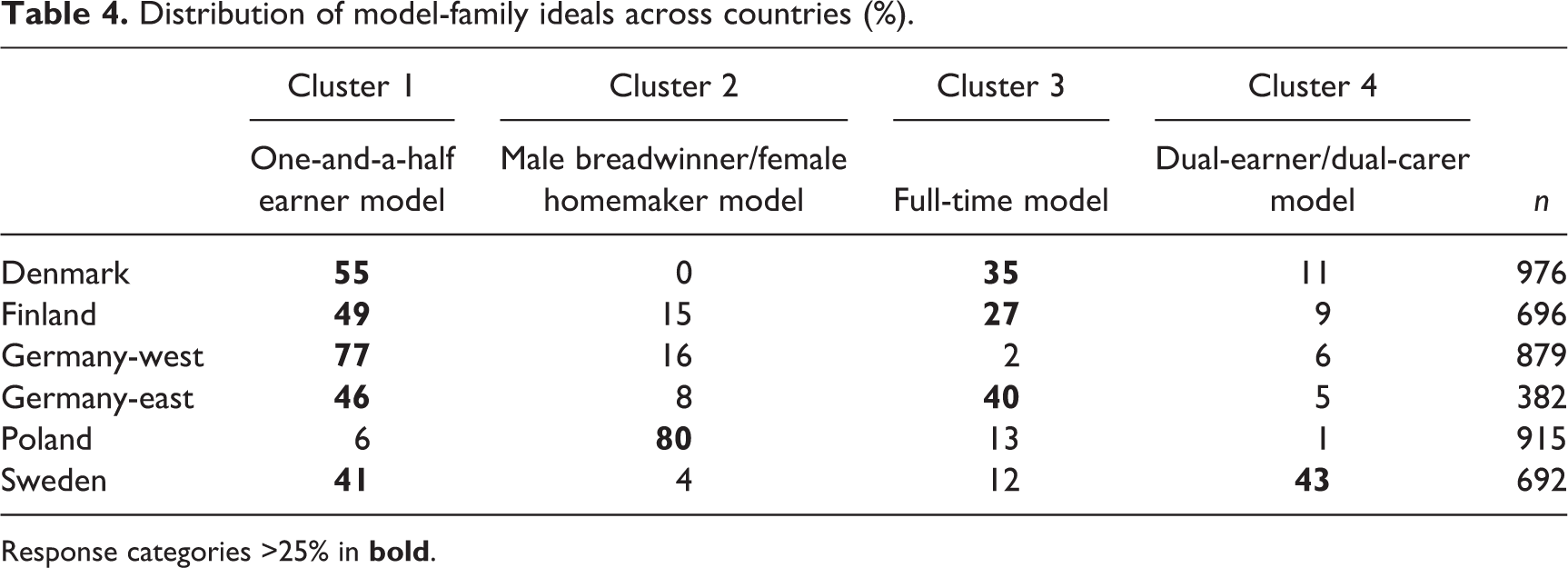
Table 4 shows the level of support for each of the four model families by country. In Poland, the male breadwinner/female homemaker model receives solid support; 80% of the respondents favour this solution. Other models receive low support. The most popular solution in Germany-west is the one-and-a-half earner model, which is supported by 77% of the respondents. The second most popular alternative is the male breadwinner/female homemaker model. Still, only 16% support this model. In Denmark, Finland and Germany-east, the two most popular alternatives are the one-and-a-half earner model and the full-time model. In Sweden – similar to most of the other countries – support for the one-and-a-half earner model is quite widespread. What is striking about Sweden is, however, the observed level of support (43%) for the dual-earner/dual-carer model. Corresponding figures for the other Nordic countries, Denmark and Finland, are 11% and 9%, respectively. In the remaining countries, the support is even lower.
Distribution of model-family ideals across countries (%).
Response categories >25% in
In general, we find quite a close correspondence between empirical results and theoretical expectations. An empirically based rank-order of the countries according to their degree of traditionalism versus support for a more gender-equal family model suggests the following: Poland is clearly the most traditional country, receiving the strongest support for the male breadwinner/female homemaker model. Germany-west is the second most traditional, with strong support for a one-and-a half earner model and some support for the male breadwinner/female homemaker model. Finland, Denmark and Germany-east follow. In these three countries, about half of the respondents choose to support the one-and-a half earner model. A difference between them is the stronger support for the full-time model in Germany-east and Denmark compared to Finland. In combination with the comparatively stronger support for the male breadwinner/female homemaker model in Finland, we would place Germany-east and Denmark as less traditional than Finland. In spite of the high support for the one-and-a half earner model, Sweden ends up as the least traditional country due to its unique support for the dual-earner/dual-carer model. Considering the observed heterogeneity within the Nordic group of countries, it is worth underlining that explicit family policies directed towards increased involvement of fathers in caring for children are clearly most pronounced in Sweden.
The social bases of support for different family models
When it comes to group differences in support for each of the four model-family ideals represented by Clusters 1–4, we expect that women, the young and the highly educated will be in favour of the more gender-equal family models. In a similar vein, we expect that men, the elderly and those with low education will choose models involving a more traditional division of economic provision and unpaid care work between men and women.
When studying group differences, it is important to analyse the support for a model in relation to other models in each country, as the family models representing the most traditional and progressive alternatives, respectively, can vary across countries. Two examples may clarify the argument. In Germany-west, only two models receive more than negligible support. The most traditional alternative is the male breadwinner/female homemaker model (16% support), which makes the one-and-a-half earner model (77% support) the more gender-egalitarian alternative. In Denmark, by contrast, support for the male breadwinner/female homemaker model is practically nil, making the one-and-a-half earner model appear to be the least gender-equal option (55% support). The progressive alternative seems mainly to be the full-time model (35% support). It is thus fruitful to study group differences in support for different models in each country separately.
Analysing potential differences among social categories is interesting for several reasons. Of particular interest when studying ideals about how everyday life should be organized is that group differences can tell us something about which alternatives people consider to be actually viable.
However, the validity of such interpretations depends on the extent to which certain criteria are met. First, the observed group differences should be in line with theoretical assumptions. Second, the most pronounced group differences should concern a small number of the available models, ideally only two of them. Third, the group differences pertaining to the most controversial alternatives should mirror each other. Fourth, the mean level of support for the controversial models should not be negligible. If these criteria are met in the forthcoming analyses we should, with some certainty, be able to identify the family models that according to public opinion in a specific country represent the conservative versus progressive alternatives for a couple with a child to organize their family and work life.
Beginning with Sweden (Table 5), the conflict runs mainly between the dual-earner/dual-carer model – which appears as the progressive or gender-equal alternative, finding support among women, the highly educated and younger persons – and the one-and-a-half earner model as the conservative alternative, finding support among men, individuals with low education and older people. The male breadwinner/female homemaker model seems no longer to play a role in the Swedish context, as public support for this model is weak. The perceived extreme alternatives in Sweden seem to run between: (1) an ideal of gender equality with a shared parental responsibility for both caring and paid work; and (2) a more traditional ideal where the mother takes greater responsibility for the home and care work but still remains in paid work, while the father takes the main responsibility for economic provision.
Sweden: support for four model-family ideals by sex, age and education (n = 672).

Multiple OLS regression. Cell entries are unstandardized regression coefficients*100 and standard errors*100.
In Denmark, the conflict patterns are a bit different (Table 6). The most salient group differences appear between the two most popular models: the full-time model and the one-and-a-half earner model. If we concentrate on observed differences between age groups and educational groups, the conservative option is the one-and-a-half earner model and the more gender-equal alternative is the full-time model. If we instead focus on the observed gender differences, the diametrically opposite conclusion could perhaps be drawn. However, we choose to put more weight on the differences between age groups and educational groups as gender differences are comparatively weaker. Similar to Sweden, the Danish public seems to have left the male breadwinner/female homemaker model behind. In both countries, the one-and-a-half earner model is the conservative alternative. When it comes to the progressive alternative, the countries differ. In Sweden, the alternative is the dual-earner/dual-carer model, in Denmark it is the full-time model.
Denmark: support for four model-family ideals by sex, age and education (n = 976).
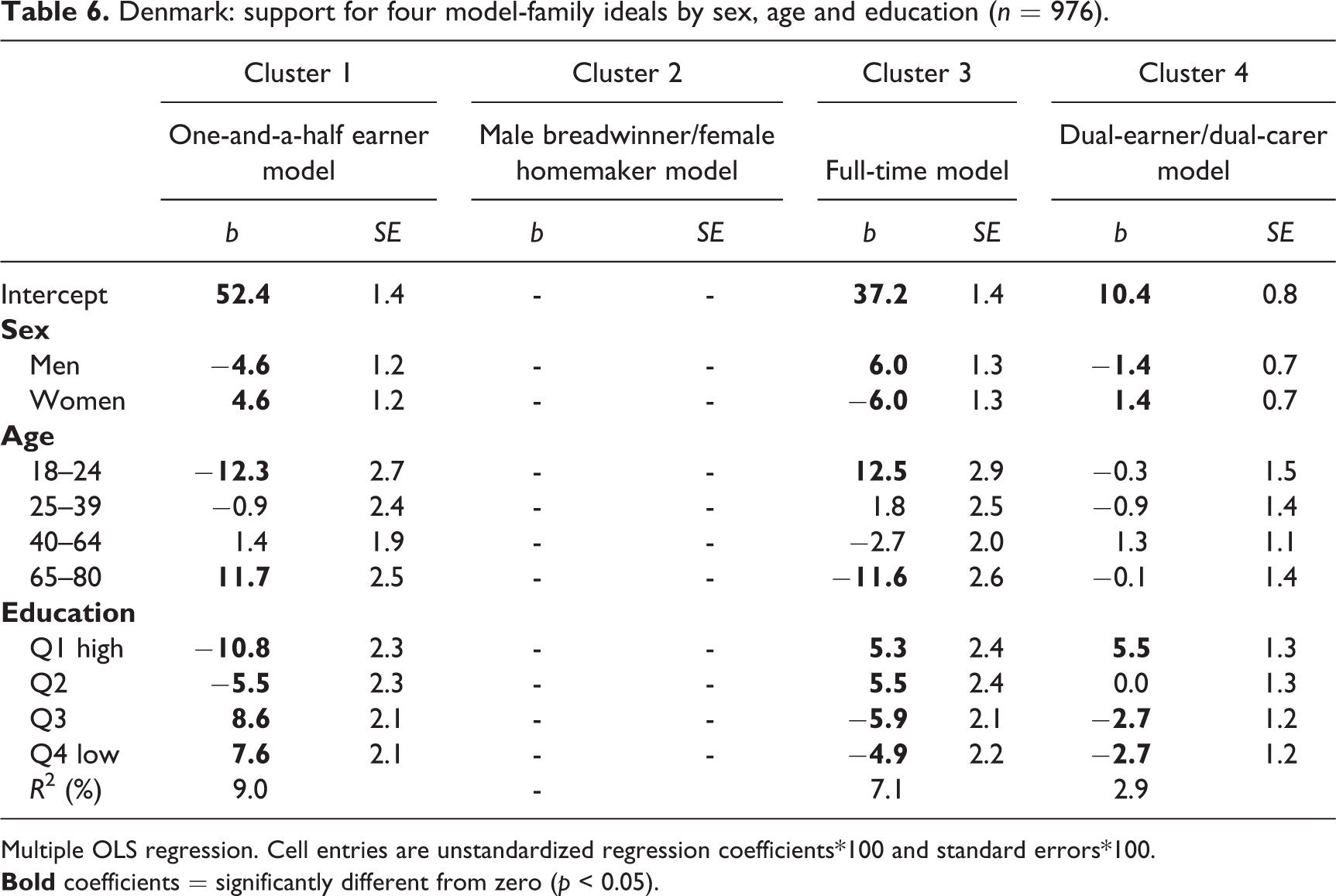
Multiple OLS regression. Cell entries are unstandardized regression coefficients*100 and standard errors*100.
In Finland and, in particular, Germany-west (Tables 7 and 8), the one-and-a-half earner model is by far the most popular alternative. The popularity of the model does not seem to depend on belonging to specific social categories; most of the observed differences depending on gender, educational level and age are non-significant. However, group differences are more pronounced when it comes to support for the male breadwinner/female homemaker model and the dual-earner/dual-carer model; models that do not receive strong support among their respective populations. In both Finland and Germany-west, support for the male breadwinner/female homemaker model is more prevalent among men, individuals with low education and older persons. As to support for the dual-earner/dual-carer model, patterns tend to be reversed, although some of the observed differences are not statistically significant.
Finland: support for four model-family ideals by sex, age and education (n = 680).

Multiple OLS regression. Cell entries are unstandardized regression coefficients*100 and standard errors*100.
Germany-west: support for four model-family ideals by sex, age and education (n = 861).

Multiple OLS regression. Cell entries are unstandardized regression coefficients*100 and standard errors*100.
The observed patterns in Germany-west suggest that a large part of the population supports the one-and-a-half earner model, but there are forces that want to change society away from this model. Some strive towards the more conservative male breadwinner/female homemaker model while some want to move towards the more progressive dual-earner/dual-carer model. The same patterns largely apply to Finland as well, except that support for the one-and-a-half earner model is not as strong as in Germany-west.
Group differences in Poland (Table 9) are most striking in relation to the most popular alternative, namely, the male breadwinner/female homemaker model. Support for this conservative alternative is stronger among men, older people and those with low education. Which model is the progressive alternative in Poland? In our view, the results are a bit inconclusive. Some Poles view the one-and-a-half earner model as the most progressive alternative, while others suggest the full-time model. A common characteristic for both of these models is that the opposition against them mostly comes from the elderly and individuals with low education. In any event, the extreme options in Poland are clearly more conservative than in the other examined countries. For Poles, the dual-earner/dual-carer model appears to be an inconceivable solution.
Poland: support for four model-family ideals by sex, age and education (n = 906).

Multiple OLS regression. Cell entries are unstandardized regression coefficients*100 and standard errors*100.
In Germany-east (Table 10), no significant group differences can be observed. Perhaps the reasons behind this are the special conditions that existed during the former DDR period, with a very strong norm advocating full-time work for all citizens and a pronounced economic need in households, mutually contributing to a high employment rate among women. Societal norms about typical male and female behaviour seem to have only been loosely connected to labour force participation (Javornik, 2010). 5
Germany-east: support for four model-family ideals by sex, age and education (n = 378).

Multiple OLS regression. Cell entries are unstandardized regression coefficients*100 and standard errors*100.
Conclusions
The main theoretical idea guiding this article was that a country’s politico-institutional framework, in particular family policy, influences and structures people’s preferences about desirable behaviour of fathers and mothers. We focused on two research questions, concerning whether and how mothers and fathers should divide paid parental leave between them, and how parents should organize their everyday life in terms of paid work and unpaid work and care.
The results indicate substantial cross-country variation in peoples’ preferences regarding these issues. In line with theoretical expectations, the greatest observed differences occur between Poland and Sweden – the two of the five examined countries that perhaps best signify the ideal-typical male breadwinner and dual-earner/dual-carer family models, respectively. While Swedes seem to have a strong orientation towards gender equality in relation to both parental leave and the distribution of work and childcare responsibilities, Poles are far more conservative, where most people prefer a much larger role for women when it comes to domestic responsibilities.
Regarding the issue of how parents should divide paid parental leave between them, about 70% of the Swedes believe that mothers and fathers should share the parental leave period equally. The corresponding figure for Poland is around one-third. In the other countries, about half of the respondents are positive towards equal sharing of the parental leave.
As to the question of how parents should organize their everyday life in terms of paid work and household responsibilities and care, the variation across countries is even greater. Once again, Poland stands out as the most traditional country with its strong support for the male breadwinner/female homemaker family model. Germany-west, too, is found to favour rather traditional solutions, with strong support for the one-and-a-half earner family model and the male breadwinner/female homemaker model as the second most popular alternative. Sweden turns out to be the least traditional country. Not only is the male breadwinner/female homemaker family model rejected by the public, but the dual-earner/dual-carer family model is a popular option. Moreover, it is only in Sweden that this model receives considerable public support.
Interestingly, we find a rather large variation among the three Nordic countries. In Denmark and Finland, we observe that those not supporting traditional gendered solutions are of the opinion that both parents should work full-time. In contrast, Swedes rather prefer that both parents cut down on their time in paid work and hence, take a greater shared responsibility for both paid and unpaid work. Hence, it is only in Sweden where a large proportion of the population is in favour of gender equality in domains that have traditionally been female strongholds. Whether or not this finding indicates Swedish exceptionalism or if similar preferences exist outside the borders of Sweden may be answered by future research. However, given that Swedish family policy has been and still is at the forefront in terms of pushing for greater involvement of fathers in the domestic sphere, we are inclined to argue in favour of Swedish exceptionalism.
There are also clear differences between Germany-east and Germany-west. The observed patterns for Germany-east are in line with the strong norm prescribing full-time work irrespective of gender that was salient during the DDR period. In former BRD, many women instead tended to fully or partially leave the labour market when they had children, which may be reflected in the current preference for the one-and-a-half earner model and the male breadwinner/female homemaker model.
Finally, we believe that the results can tell us something about the current collective consciousness in the examined countries, and, in addition, about the directions in which they may be heading in the future. The Swedes have clearly left the male breadwinner/female homemaker model behind and presently stand between the more traditional one-and-a-half earner model and the more gender-equal dual-earner/dual-carer model. Given that support for the former is strong among younger individuals and the more highly educated, we believe that the popularity of the dual-earner/dual-carer model may increase in the future. The Danish situation is in many respects similar to the Swedish one, except that the more progressive alternative is the full-time family model.
Finland and, in particular, Germany-west hold steady in their support for the one-and-a-half earner model. One group within their populations tries to take the step back to the male breadwinner/female homemaker model while others are pulling towards a more gender-equal family model. Since the traditional alternative finds its support among the elderly and individuals with lower education, we expect that the dividing line in Finland and Germany-west in the future will run between the one-and-a-half earner model and more gender-equal family models, similar to the present Swedish (the expected route for Germany-west) or Danish (the expected route for Finland) positions.
In both Poland and Germany-east, men’s primary responsibility as provider is not contested. In Poland, a large majority supports the conservative male breadwinner/female homemaker model. Those who advocate for change are torn in two different directions: on the one hand towards the one-and-a-half earner model and on the other hand towards the full-time model. The dual-earner/dual-carer model does not seem to have entered into the collective consciousness of the Polish public; the ideological conflict between conservatism and progressivity is rather about women’s being or not being in the labour force. In Germany-east, however, the question is not whether women should work for pay or not, but whether they should work full-time or part-time.
We admit that the above sections are a bit speculative. However, insofar as attitudes reflect the potentials for behavioural change as well as future political demands for policy change – and there are reasons to believe so 6 – the above suggestions on future developments in the five countries should not be seen as mere unfounded speculations but rather as testable hypotheses for future research.
Footnotes
Acknowledgement
A previous version of the paper was presented at the Swedish ESPAnet Conference, November 2014. Thanks to participants at this conference, in particular Ingrid Esser. The authors are also grateful to Jani Erola, and three anonymous reviewers for valuable comments.
Funding
This research received no specific grant from any funding agency in the public, commercial, or not-for-profit sectors.
Notes
Appendix 1
Model-fit statistics for five latent class models.

| L2 | BIC(L2) | df | L2 reduction (%) | |
|---|---|---|---|---|
| 1-Cluster | 2676.2 | 992.0 | 200 | 0.0 |
| 2-Cluster | 1423.4 | −126.1 | 184 | 46.8 |
| 3-Cluster | 642.5 | −772.2 | 168 | 76.0 |
| 4-Cluster | 329.0 | −951.0 | 152 | 87.7 |
| 5-Cluster | 211.7 | −933.5 | 136 | 92.1 |
Note: Each model includes the two manifest nominal-level indicators as well as the manifest covariate country nominal-level variable. The L 2 value in the baseline model (1) indicates the maximum association between the manifest variables that can be explained by any latent class model. Judging on the Bayesian Information Criterion (BIC) statistic (the lower the value, the better the model), this model should be rejected in favour of a more complex model. By relying on the BIC statistic, it is suggested that the 4-cluster model should be chosen. The L2 value is reduced by 87.7% and the three bivariate residuals between the manifest variables are non-significant (not shown in table).