



Abstract
While many studies document the ambitious educational choices of immigrants across Europe, researchers have only recently begun to investigate the consequences of these ambitious choices. Our article extends this emerging literature by focusing on immigrants’ success throughout tertiary education in Germany. We argue that after the transition into tertiary education, immigrants lose their advantages over native students regarding higher aspirations while retaining or even increasing their disadvantages regarding academic achievements, which ultimately results in a higher risk of dropping out. Analyses based on data from the German National Educational Panel Study (NEPS) confirm our hypotheses. Net of socioeconomic background and prior academic achievements, immigrants enter tertiary education with similar aspirations as their native peers. At the same time, immigrants, especially those of Turkish origins, have lower grades and competency levels. Furthermore, immigrants continue to receive lower grades during tertiary education and have a considerably higher risk of dropping out. We conclude that immigrants’ high aspirations enable them to enroll in tertiary education at comparably low levels of academic achievement but ultimately increase the risk of academic failure. We discuss possible policy measures to improve the situation of immigrants.
Introduction
In Germany and other Western societies, immigrant students achieve lower grades and lower levels of competencies than their native peers throughout their educational careers (Becker et al., 2013; Dronkers et al., 2012; Heath and Rothon, 2014; Jonsson and Rudolphi, 2011; Kao and Thompson, 2003). However, conditional on academic achievement and socioeconomic background, most immigrant groups hold higher aspirations (Becker and Gresch, 2016; Heath and Brinbaum, 2007) and make more ambitious choices at transitions in the educational system (Dollmann, 2017; Heath et al., 2008; Kilpi-Jakonen, 2011; Kristen and Dollmann, 2009; Tjaden and Scharenberg, 2017; Van de Werfhorst and Van Tubergen, 2007).
Over the past decade, ample studies have investigated this so-called aspiration–achievement paradox (Engzell, 2019; Feliciano and Lanuza, 2016; Hadjar and Scharf, 2019; Relikowski et al., 2012; Salikutluk, 2016). Most of these studies either seek to explain the high aspirations among immigrants or explore immigrants’ higher transition rates at branching points of the educational system. The general narrative of this literature is that high aspirations reduce ethnic inequalities by compensating for immigrants’ lower academic achievements and steering them toward the academically oriented tracks (Jackson et al., 2012; for a less optimistic view, see Tjaden and Hunkler, 2017). However, the transition into the academically oriented tracks is only the first step that does not guarantee higher educational attainment. If immigrants cannot adjust to increasing academic demands after the transition, they might not realize their high aspirations and fail to complete a subsequent degree (Kristen et al., 2008: 146).
Against this background, it is surprising that researchers have only recently begun to investigate immigrants’ achievements and completion rates after educational transitions. Across Europe, we know only of two studies that investigate potentially adverse consequences of immigrants’ high aspirations (Birkelund, 2020; Dollmann and Weißmann, 2020). Focusing on secondary education in Denmark and Germany, their findings suggest that ambitious choices can be a blessing and a curse. While reducing the ethnic educational attainment gap at the upper secondary level, immigrants’ high aspirations also result in overambitious choices among some underachieving students who ultimately fail to graduate. Unfortunately, neither of the two studies directly measures aspirations. Thus, whether immigrants’ high aspirations continue to counteract their lower academic achievements in upper secondary education remains ambiguous. Moreover, completing upper secondary education is often viewed as a means to enroll in and ultimately complete tertiary education (Birkelund, 2020: 409; Dollmann and Weißmann, 2020: 43). Given that graduating from tertiary education fosters labor market prospects, civic engagement, and life expectancy (Hout, 2012; Neugebauer and Weiss, 2018; Oreopoulos and Petronijevic, 2013), it is surprising that we still know little about immigrants’ success at this late educational stage.
Our article extends the emerging literature on the consequences of immigrants’ high aspirations. In contrast to previous literature, we shift the focus from secondary to tertiary education, (Kristen, 2014; cf. Kirui and Kao, 2018; Lutz, 2014). We argue that after the transition into tertiary education, immigrants’ advantages regarding higher aspirations mostly vanish because native students enter tertiary education only if they have equally high aspirations. This alignment of aspirations in tertiary education should be particularly pronounced in countries where native students with low aspirations opt more often for vocational training than immigrants (Tjaden and Hunkler, 2017; Tjaden and Scharenberg, 2017). Conversely, compared to native students, immigrants are more likely to enter tertiary education at lower levels of prior academic achievements (Kristen et al., 2008). Thus, their respective disadvantages regarding academic achievements should increase after the transition. Therefore, once they enter tertiary education, immigrants and native students become more homogeneous regarding their aspirations while simultaneously becoming more heterogeneous regarding academic achievements. Because immigrants no longer hold higher aspirations that compensate for their lower achievements, they have a higher risk of dropping out of tertiary education. Overall, we argue that immigrants’ high aspirations reduce ethnic inequalities in educational decisions in the short run but also lead to low academic achievements and, ultimately, a higher risk of dropping out of tertiary education.
We test and confirm our hypotheses utilizing large-scale panel data that follows first-year tertiary education students in Germany for 7 years. We choose Germany as a test case because the particularly well-suited dataset includes measures of aspirations, grade point averages (GPAs), and standardized test scores and allows us to investigate dropout prospectively. Furthermore, Germany has the highest number of tertiary education students across Europe (Eurostat, 2022), making it a particularly relevant case. Germany is also a typical European country where many immigrant students are descendants of “guest-workers” who were recruited to work in the unskilled sector of the labor market (Crul and Vermeulen, 2003). Moreover, Germany's educational system is similar to other European countries, where vocational education and training (VET) systems provide a viable alternative to tertiary education for students with lower academic achievements (e.g. Austria, Denmark, Hungary, and Switzerland). In these regards, results for Germany are likely to generalize to similar institutional settings. In the concluding section, we elaborate on how findings may differ in other contexts.
Theoretical background and previous research
The aspiration–achievement paradox
Following Boudon's (1974) distinction between achievement-based and choice-based social inequalities in educational opportunities, researchers have adopted the concept of primary and secondary effects to describe inequalities according to an immigration background (Heath and Brinbaum, 2007; Kristen and Dollmann, 2009). Here, primary effects refer to differences in academic achievements and ability between native and immigrant students with similar socioeconomic backgrounds. Secondary effects are differences in educational choices conditional on prior academic achievements and socioeconomic background. In sharp contrast to findings on social origin (Jackson, 2013), the secondary effects of an immigration background favor ethnic minorities. Conditional to academic achievements, immigrants choose more ambitious educational pathways (Jonsson and Rudolphi, 2011; Kristen et al., 2008; Van de Werfhorst and Van Tubergen, 2007). A similar pattern emerges among black students in the United States (Eller and DiPrete, 2018). These ambitious educational choices despite low levels of academic achievement have been termed the aspiration–achievement paradox (Salikutluk, 2016).
Most studies investigating immigrants’ ambitious choices have focused on explaining their high aspirations (Engzell, 2019; Hadjar and Scharf, 2019; Relikowski et al., 2012; Salikutluk, 2016). These studies usually draw on four main explanations, which are not mutually exclusive. 1 The “immigrant optimism” hypothesis (Kao and Tienda, 1995) states that immigrants are positively selected, striving for (intergenerational) upward social mobility through education. The second approach is “contextual attainment” or “educational selectivity” (Feliciano and Lanuza, 2017; Ichou, 2014). Here, immigrants’ relative educational level and socioeconomic status in the home country were higher than in the host country. It then appears as if immigrants’ children strive for upward social mobility when they merely try to reproduce their parents’ relative educational level and socioeconomic status before migration. The third explanation is the “information deficit” (Kao and Tienda, 1998), which suggests that immigrants’ lack of knowledge about the educational system in the host country leads them to underestimate the returns to non-tertiary education and overestimate their chances of completing tertiary education. Finally, the “blocked opportunities” hypothesis (Heath and Brinbaum, 2007) states that immigrants perceive high education as a means of avoiding anticipated discrimination in the lower segments of the labor market, especially in stratified countries, such as Germany.
Consequences of immigrants’ high aspirations
Focusing on explanations of immigrants’ high aspirations, researchers have long held an optimistic view that highlights the advantages of immigrants’ ambitious choices at educational transitions (Jackson et al., 2012). However, two recent studies challenge this optimistic view. These studies find that in Denmark (Birkelund, 2020) and Germany (Dollmann and Weißmann, 2020), immigrants’ ambitious choices entail adverse consequences, leading to lower academic achievements and higher dropout rates in upper secondary education. While providing valuable insights into the previously neglected consequences of immigrants’ ambitious choices, neither study contains direct measures for aspirations, nor discusses potentially lasting positive effects of immigrants’ high aspirations. For instance, one might assume that immigrants with comparable academic achievements and socioeconomic backgrounds are more likely to complete upper secondary education due to their higher aspirations. Indeed, Birkelund (2020) finds that compared to native students with similar academic achievements, immigrants have a lower risk of dropping out of upper secondary education. However, Dollmann and Weißmann (2020) report persistently higher dropout rates among immigrants when compared to natives with similar socioeconomic backgrounds and academic achievements. Without measuring the aspirations, it remains somewhat ambiguous whether immigrants continue to hold and benefit from higher aspirations.
The situation in tertiary education
Compared to earlier educational stages, research on immigrants’ aspirations and academic achievements are sparse for tertiary education (Kristen, 2014; cf. Kirui and Kao, 2018; Lutz, 2014). Still, available studies across Europe document that despite completing upper secondary education with, on average, lower academic achievements, immigrants are more likely to enter tertiary education due to their high aspirations (Griga, 2014; Jackson et al., 2012). This pattern also holds for Germany. While transition rates into tertiary education are similar among native students and immigrants at the upper end of the academic achievement distribution (93% and 94% in the top quintile), they diverge markedly in the bottom quintile, where 62% of the native German students but 78% of the immigrants enter tertiary education (Autorengruppe Bildungsberichterstattung, 2020: 187). These ambitious educational choices are most pronounced for Turkish immigrants (Kristen et al., 2008).
One reason for ethnic differences in the transition to tertiary education might be that immigrants are less attracted to vocational training than their native peers. Tjaden and Hunkler (2017) suggest that their families’ optimism diverts immigrants from viable vocational alternatives to tertiary education. Consequentially, immigrants enter tertiary education even at low levels of academic achievement. In contrast, native German students from similarly disadvantaged socioeconomic backgrounds and with low levels of academic achievement tend to aspire to vocational training instead of tertiary education (Becker and Hecken, 2009; Shavit and Müller, 2000). Conversely, only native German students with high aspirations and high academic achievements enter tertiary education.
Given that native German students who enter tertiary education are positively selected regarding aspirations, we generally expect that ethnic inequality regarding aspirations sharply decreases after the transition. More specifically, assuming that all students who enroll in tertiary education aspire to a tertiary education degree, we expect mostly equalized educational aspirations. Likewise, assuming that all students who enter tertiary education aspire to occupations that typically require a tertiary education degree, we would not expect systematic differences between native and immigrant students regarding occupational aspirations either. Note that these arguments hold regardless of whether immigrants’ high aspirations at the end of secondary education result from optimism, educational selectivity, information deficits, or anticipated discrimination. Conversely, because immigrants enter tertiary education despite low academic achievements while native German students are positively selected regarding both socioeconomic backgrounds and academic achievements, we expect an increase in the respective ethnic disadvantages after the transition. Combining our arguments, we derive the following two hypotheses:
Hypothesis 1: Immigrant students enter tertiary education with similar aspirations as native students. Hypothesis 2: Immigrant students enter tertiary education with lower academic achievement and competency levels than native students.
Until now, we have focused on aspirations and academic achievements at enrollment. Next, we ask about their implications for success during tertiary education. Previous research from the United States focuses mainly on students’ race rather than their immigration background and investigates the disadvantages of African American or Latino students (Attewell et al., 2011; Crisp et al., 2015; Eller and DiPrete, 2018; Seidman, 2007). The few studies from the United States that investigate students’ immigration backgrounds find that immigrants continue to hold higher aspirations than natives and that high aspirations are associated with higher completion rates in tertiary education (Kirui and Kao, 2018).
In Europe, even fewer studies investigate immigrants’ academic achievements and completion rates in tertiary education (Kristen, 2014). A systematic review of 44 European studies on tertiary education dropout (Kehm et al., 2019) does not even consider students’ immigration backgrounds. Nevertheless, the few available studies suggest that immigrants in tertiary education have lower academic achievements and a higher risk of dropping out (Lens and Levrau, 2020; Zorlu, 2013). We know only three studies that investigate immigrants’ dropout risk in tertiary education in Germany (Ebert and Heublein, 2017; Lörz, 2019; Müller, 2018). While these studies suggest a higher risk of dropping out among immigrants and, thereby, provide valuable first insights, they also have severe limitations. The studies use convenience samples (Müller, 2018), retrospective data (Ebert and Heublein, 2017; Müller, 2018) and ill-defined comparison groups (Ebert and Heublein, 2017), or measure immigration background with a crude binary indicator (Lörz, 2019; Müller, 2018). None of these studies include adequate measures of students’ grade performance in tertiary education or standardized test scores. Also, none of these studies investigate aspirations. Nevertheless, their tentative findings are in line with our theoretical arguments. We expect that the equalized aspirations between native and immigrant students combined with immigrants’ lower levels of academic resources entail that:
Hypothesis 3: During tertiary education, immigrant students continue to receive lower grades than native students. Hypothesis 4: Immigrants’ lower levels of academic achievement before and during tertiary education lead to a higher risk of non-completion.
Data and methods
Data
For our empirical analyses, we draw on representative data for Germany from the National Educational Panel Study (NEPS): Starting Cohort First-Year Students (Blossfeld et al., 2011). The high-quality data provides a detailed picture of the higher education trajectories of native students and the most relevant immigrant groups in Germany. The initial sample comprises 17,910 first-year students who enrolled in the winter term of 2010/2011 at a German university or university of applied sciences. A stratified cluster sample was drawn, with clusters defined by subjects within higher education institutions. Within a subject-institution cluster, all students were interviewed (Zinn et al., 2017). Follow-up interviews were conducted twice a year alternately by telephone and online. The participation rates varied between just below 60% and just above 70% over the 14 available panel waves (Zinn et al., 2020). We exclude 581 students who enrolled in tertiary education or completed a degree before the winter term of 2010/2011. We further restrict the age at enrollment between 17 and 35 years, excluding 284 students. Last, we exclude 76 students with missing information on the type of higher education institution or the field of studies, leaving us with an analysis sample of 16,969 students.
Variables
We measure students’ aspirations via the International Socio-Economic Index of Occupational Status (ISEI; Ganzeboom and Treiman, 1996) of the occupation they wish to attain (for similar measures, see Engzell, 2019; Tjaden and Scharenberg, 2017). The corresponding item is measured in the first panel wave immediately after enrollment. While studies in earlier educational stages have typically measured educational aspirations, we believe that in the highly selective group of tertiary education students, who obviously aspire to a tertiary education degree, occupational aspirations are the better measure. 2
We measure academic achievements by students’ self-reported GPA. We draw on the GPA from students’ university entrance certificates to assess initial achievements. Because GPA might, to a certain degree, reflect the discriminatory behavior of teachers (Sprietsma, 2013), we additionally measure students’ competency levels by test scores in reading competency (Gehrer et al., 2013), reading speed (Auer et al., 2005), and mathematical competencies (Weinert et al., 2011). Test scores are available for roughly 6000 students (33.4%) who completed the testing instruments during their second semester. 3 We use students’ first GPA after enrollment to measure academic achievements in tertiary education. For our analyses, we recode GPA and test scores such that higher values indicate better performance and standardize both measures to zero mean and unit variance.
Finally, we turn to the single most important outcome in college: obtaining a degree or not (Bowen et al., 2009: 32). We combine information from all panel waves to identify graduates and non-completers. We neither consider changing the subject nor changing the higher education institution’s non-completion. Moreover, students who complete a degree but fail to complete a subsequent degree (e.g. Master's degree) are considered graduates. Although our dataset covers 14 semesters, a small group of students (3%) is still enrolled without having obtained a degree. Given that the median time to degree completion is only between 7 and 8 semesters (Autorengruppe Bildungsberichterstattung, 2020: 195), we consider these students effective dropouts. Thus, we differentiate between graduates and students’ who have not obtained a degree after 14 semesters. We refer to the latter group as non-completers.
Our focal predictor is an immigration background. Immigrants, who we compare to native Germans, comprise first-generation students, who have migrated to Germany themselves, and second-generation students born in Germany to migrant parents (Olczyk et al., 2014). 4 We consider students whose parents were born in Germany natives, regardless of the birth country of their grandparents. The data allow us to differentiate between the largest immigrant groups in Germany. We distinguish between Turkish (n = 344) and the group of Italian, former Yugoslavian, and other South European immigrants (n = 303). These two groups of “labor migrants” are primarily descendants of low-qualified guest workers who migrated to Germany between 1955 and 1973. We further differentiate between immigrants from Russia and the Former Soviet Union (FSU) (n = 537) and immigrants from Poland (n = 356). While Polish students are primarily second-generation immigrants, students from the FSU have migrated to Germany since about 1990. Both groups often have German ancestors and typically come from higher educated socioeconomic backgrounds than the “labor migrant” descendants. Last, we identify North and West European immigrants (n = 300) and, due to small cell sizes, group all immigrants from other countries (n = 876) into a single category (also, see Tjaden and Hunkler, 2017). 5
To differentiate between ethnic and social inequalities, we account for students’ socioeconomic backgrounds measured as the highest parental ISEI score and the highest educational level obtained by the parents (tertiary education or lower). We further include controls for students’ gender, age, entrance certificate, type of higher education institution, pursued degree, and field of studies. Descriptive statistics are presented in Table 1.
Descriptive statistics.

Notes: Descriptive statistics are based on M = 100 imputed datasets.
Source: NEPS, SC5; own calculations.
GPA: grade point average; ISEI: International Socio-Economic Index of Occupational Status.
Statistical methods
We address missing values from item nonresponse and panel attrition with multiple imputations via chained equations (Van Buuren, 2012). The imputation models include all analysis variables and, if available, repeated measures. To further improve the imputations, we add intentions of dropping out, indicators for the panel wave of the last interview, the number of completed interviews, and sampling weights for strata and participation probability as auxiliary variables (Rubin, 1996). We use Stata 14 (StataCorp., 2015) to create 100 complete datasets.
We use linear regression to assess ethnic inequalities in occupational aspirations, GPA, and test scores. We analyze students’ risk of non-completion using nested binary logistic regression models and adjust the estimated coefficients following Karlson et al. (2012).
Results
Paralleling our hypotheses, we first analyze aspirations, GPA, and competency levels at enrollment before focusing on academic success regarding GPA and non-completion during tertiary education. For all outcomes, we report results from two model specifications: one specification combines all immigrant groups into a binary indicator and another specification includes a separate indicator variable for each immigrant group. We present results graphically; 6 corresponding regression tables are presented in the online Appendix.
Aspirations and achievements at enrollment
Figure 1 shows occupational aspirations of immigrant and native German students as predicted values with 95% confidence intervals from linear regression models. In the first model (shown as squares), we include controls for gender, age at enrollment, entrance certificate, type of higher education institution, pursued degree, and field of studies. To isolate ethnic inequalities, we then add controls for students’ socioeconomic background in the second model (shown as diamonds) and include GPA in the last model (shown as triangles).

Occupational aspirations at enrollment in tertiary education.
Overall, we find that immigrants hold, on average, slightly higher occupational aspirations than native German students with similar socioeconomic backgrounds and academic achievement (68.23 vs. 67.50; Δ = 0.73; p <.001). The differences are most pronounced for Turkish immigrants (Δ = 1.89; p <.001). While these ethnic inequalities are statistically significant, they are substantively negligible. All differences remain below 2 ISEI points, and the predicted occupational aspirations of all student groups, including native Germans, fall within the narrow range between 67 and 69 ISEI points. To put these results into context, consider the difference between mechanical engineers, with an ISEI score of 67, and civil engineers or town and traffic planners, with an ISEI score of 69. Because in Germany any occupation within the range of these predicted ISEI scores requires a tertiary education degree, we argue that the respective ethnic differences in aspirations are unlikely to affect inequalities in the probability of completing a degree. Thus, once they enter tertiary education, immigrant students mostly lose their advantage regarding higher aspirations over native Germans.
Turning to students’ academic achievements at enrollment, Figure 2 shows ethnic differences in GPA of the entrance certificate as linear regression coefficients along with 95% confidence intervals. In the first model with basic controls (shown as squares), we find that, except for immigrants from North and West Europe, all immigrant groups enter tertiary education with a lower GPA than native students. While differences are below 0.3 SDs for most groups, Turkish students enter tertiary education with a GPA that is, on average, almost 0.7 SDs below native Germans (b = −0.67; p <.001).
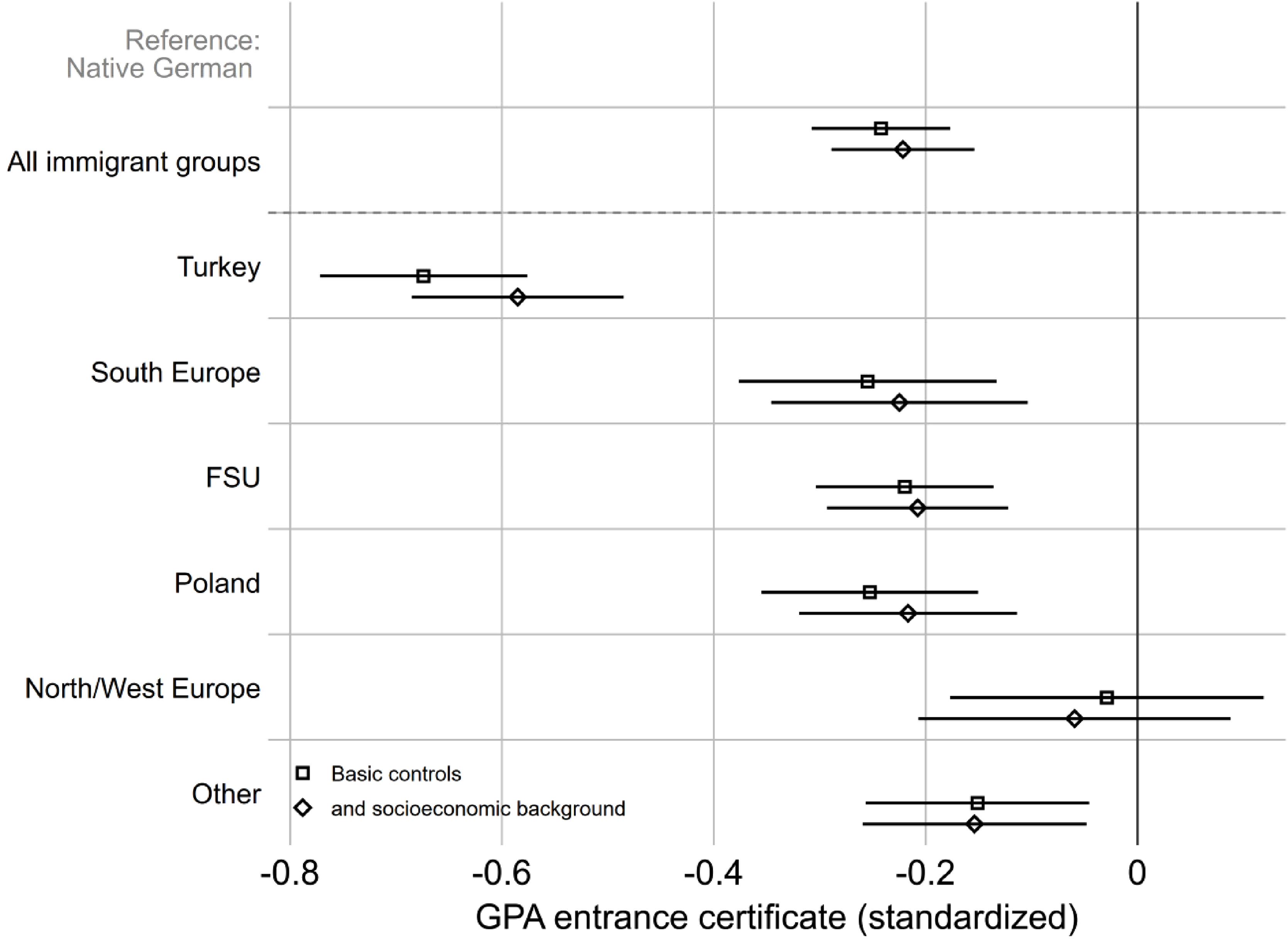
Ethnic inequalities in GPA of entrance certificate.
In the second model (shown as diamonds), the overall picture suggests that differences in socioeconomic background do not account for immigrants’ lower GPA before entering tertiary education despite slightly decreasing ethnic inequalities. While the decrease is most pronounced for Turkish immigrants, their GPA remains more than half a SD below native German students (b = −0.59; p <.001).
When comparing GPAs between immigrants and native German students, we cannot rule out that the differences might, to a certain degree, reflect the discriminatory behavior of teachers. Standardized test scores provide an alternative measure of academic ability that is less likely to be subject to discrimination. Figure 3 shows the differences between immigrant and native German students in reading competencies, reading speed, and mathematical competencies. Differences are shown as coefficients from linear regression models including basic controls (shown as squares) and socioeconomic background (shown as diamonds).

Ethnic inequalities in reading competencies, reading speed, and mathematical competencies.
On average, immigrant students obtain lower test scores than native Germans across all three domains with the most pronounced disadvantages in reading speed. Note that we find ethnic inequalities even in mathematical competencies, which are unlikely to result from language deficits. Moreover, ethnic inequalities cannot be explained by differences in students’ socioeconomic background. Consistent with our results for GPA, the most pronounced disadvantages are for Turkish immigrants, whose test scores are about half a SD below those of native German students. Comparing the remaining immigrant groups to their native peers, most differences in test scores are below 0.2 SDs. One noticeable exception is the reading speed of FSU immigrants who lag almost half a SD behind native Germans (b = −0.45; p <.001).
Academic outcomes during tertiary education
Until now, we have focused on aspirations and achievements before and shortly after enrollment. In Figure 4, we turn to ethnic disparities in students’ academic outcomes during tertiary education, starting with GPA. In the models with basic controls (shown as squares) and controlling for socioeconomic background (shown as diamonds), we see that, on average, immigrant students’ GPA in tertiary education is about 0.2 SDs below that of native Germans. As before, the largest ethnic disadvantages are for Turkish immigrants (b = −0.36; p <.001). While South European immigrants (b = −0.20; p <.01) and those of the FSU (b = −0.23; p <.001) also obtain a lower GPA than native Germans, the respective disadvantages for Polish immigrants and those of North and West Europe are much smaller and not statistically significant. Overall, compared to the situation immediately after enrollment, ethnic inequalities in academic achievements become less pronounced during tertiary education.

Ethnic inequalities in GPA during studies.
In the third model (shown as triangles), we control for students’ entrance certificate GPA to test whether the lower GPA of Turkish, FSU, and South European immigrants during their studies results from lower initial academic achievements. For all three groups, ethnic disadvantages decrease substantially and range between 0.1 and 0.15 SDs. The decrease is most notable for Turkish immigrants, whose disadvantages are now comparable to those of other ethnic minority groups. Except for FSU immigrants, the differences to native Germans turn statistically insignificant (p >.05). Thus, ethnic disadvantages in academic achievements appear to result from lower academic achievements at enrollment.
In the final step, we turn to ethnic inequalities in non-completion, arguably the most important indicator of academic (non-)success. Figure 5 presents results from binary logistic regression models as average marginal effects. The depicted differences are interpreted in terms of probabilities.

Ethnic inequalities in non-completion.
In the first model (shown as squares), we find that, on average, immigrants have an 8 percentage points higher risk of non-completion than native German students. The respective disadvantages vary substantially between immigrant groups. While we do not find disadvantages for immigrants from North and West Europe and only marginal disadvantages for Polish immigrants (b = 0.03; p >.05), Turkish immigrants have a 13 percentage points higher risk of non-completion than native German students.
Controlling for students’ socioeconomic background in the second model (shown as diamonds) reduces ethnic inequalities, especially for Turkish immigrants. However, overall differences in students’ socioeconomic background account only for a small proportion of the ethnic inequalities in non-completion. The respective disadvantages remain substantial and statistically significant for Turkish (b = 0.11; p <.01), South European (b = 0.07; p <.05), and FSU immigrants (b = 0.05; p <.05).
In the final model, we control for students’ academic achievements before and during tertiary education. We find substantially reduced ethnic disadvantages for all immigrant groups, except the composite group of ‘Other immigrants’. The remaining ethnic inequalities of all other groups are below 5 percentage points and are no longer statistically significant (at the 5% level). These results suggest that immigrant students’ higher risk of non-completion is mainly due to their insufficient academic achievements. Moreover, controlling for academic achievements does not reveal any evidence for advantages that immigrant students might gain from their high aspirations. This result should not be surprising, given that ethnic differences in aspirations become negligible after enrollment (Figure 1). 7 Given the socioeconomic background and academic achievements, immigrant students have about the same risk of non-completion as native Germans. Thus, contrary to earlier educational stages and especially the transition into tertiary education, immigrants no longer make ambitious choices regarding persistence and degree completion after the transition into and during tertiary education.
Discussion
While previous studies have long focused on explaining immigrants’ high aspirations and ambitious educational choices, researchers have only recently begun to investigate the consequences of these ambitious educational choices for academic achievements and attainment throughout upper secondary education. Our article contributes to this emerging literature by focusing on immigrants’ academic achievements and attainment in tertiary education in Germany.
Our results indicate that, at enrollment into tertiary education, immigrants’ aspirations are virtually matched by their more positively selected native peers, who aspire to similar occupations. At the same time, immigrants enter tertiary education with lower academic achievements regarding GPA and competence scores. Paralleling results for earlier educational stages (Becker et al., 2013; Dollmann and Weißmann, 2020; Kristen et al., 2008), these ethnic inequalities are most pronounced for Turkish immigrants. Regarding academic achievements during tertiary education, we find, with few exceptions, persistent ethnic disadvantages regarding GPA. These disadvantages appear as a continuation of immigrants’ lower previous academic achievements. Finally, our results show that immigrants’ lower academic achievements lead to a higher risk of non-completion. In contrast to findings for earlier educational transitions (Dollmann and Weißmann, 2020; Kristen and Dollmann, 2009; Kristen et al., 2008), where immigrants’ benefit from their higher aspirations, we do not find similar advantages in completing tertiary education. Summarizing our results, we find that immigrants’ high aspirations enable them to enter tertiary education at comparably low levels of academic achievements, but ultimately increase their risk of failing to complete a degree.
It is striking that the most disadvantaged groups are the descendants of former “labor migrants”, particularly those of Turkey, whose parents were specifically recruited as unskilled workers. Equipped with an optimistic strive for upward social mobility but often lacking socioeconomic and educational resources that promote learning, the aspiration–achievement paradox is most pronounced among this group (Kristen et al., 2008; Salikutluk, 2016). Another reason for Turkish immigrants’ disadvantages in tertiary education might be that they face more discrimination than other immigrant groups in the vocational labor market (Koopmans et al., 2019). Thus, Turkish immigrants might lean more strongly toward tertiary education despite low academic achievements. Yet another reason may be that Turkey (as opposed to, e.g. Poland) does not have a VET system. Hence, Turkish immigrants might not be as well informed about the returns to VET, leading them to instead aspire to tertiary education (Tjaden and Hunkler, 2017).
While our study extends previous research on the consequences of immigrants’ high aspirations, we acknowledge certain limitations. Although our dataset includes direct measures of aspirations, academic achievements before and during tertiary education, and standardized test scores, we only observe students who entered tertiary education. Therefore, we cannot assess aspirations and achievements of the students who do not enroll in tertiary education. While our theoretical argument of decreasing ethnic differences in aspirations and simultaneously increasing ethnic disadvantages in academic achievements follows directly from the established ambitious choices of immigrant students (Kristen and Dollmann, 2009; Kristen et al., 2008), it would be interesting to quantify the extent of these opposing mechanisms. Another limitation that follows from the restricted observation window is that we do not observe immigrants’ trajectories after dropping out. It might well be that immigrants who fail to complete a degree later decide to return to tertiary education and graduate. Further research should investigate immigrants’ pathways following dropout and possible ethnic differences in education trajectories late in the life course.
Some peculiarities of the German context should be kept in mind when interpreting our findings. While the situation of “labor migrants” should be similar across European countries that followed comparable recruitment strategies after the Second World War (Crul and Vermeulen, 2003), it might differ for immigrants in countries with different migration policies. Likewise, our findings might not generalize well to countries without a well-established VET system that serves as a viable alternative to tertiary education. Ethnic disadvantages may also be less pronounced in countries with multilingual higher education systems that better cater to immigrants’ native languages or in countries where large immigrant groups are native speakers, such as the Algerians in France. The consequences of tertiary education non-completion are also likely to differ across countries (Schnepf, 2017). The strong linkage between educational certificates and occupational attainment in Germany (Bol et al., 2019) implies marked negative consequences for labor market success. Indeed, evidence for Germany suggests that non-completers do not benefit from tertiary education regarding hourly wages (Heigle and Pfeiffer, 2019). Thus, immigrants’ time in higher education does not seem to pay off without completing a degree. Moreover, non-completers appear to face long-term disadvantages regarding job satisfaction and life satisfaction (Klein et al., 2021).
Our findings underscore the importance of supporting immigrants to avoid the negative consequences of nonsuccess in tertiary education. From a policy perspective, we can imagine several approaches to help achieve this. One strategy would be to inform immigrants about viable alternatives to tertiary education to guide high school leavers with unrealistically high aspirations in finding more personally suitable career paths. Intensified career counseling may help achieve this goal (Nota et al., 2014). Naturally, for this strategy to be successful, hiring discrimination in the VET system and nonacademic labor market must simultaneously be combated. However, interventions for steering low-performing immigrants toward more suitable vocational options are a rather one-sided view. Instead of suppressing immigrants’ high aspirations, academic support programs should utilize their high levels of motivation to improve immigrants’ competencies. Because competence gaps emerge early (Becker et al., 2013), such programs should support immigrants with learning disadvantages from early educational stages (Schweinhart et al., 1985). Moreover, once enrolled in tertiary education, programs should focus on improving immigrants’ retention. For instance, remedial coursework can increase persistence for academically underprepared students (Bettinger and Long, 2009). Also, many ethnic minority students struggle with adjusting to the tertiary education environment, doubting their social belonging and success potential, which leads to lower performance and withdrawal. Here, psychological interventions can promote persistence (overview: Harackiewicz and Priniski, 2018). Further research is needed to identify effective tailored-to-needs interventions to promote success in tertiary education among immigrant students.
Supplemental Material
sj-docx-1-asj-10.1177_00016993221148897 - Supplemental material for A downside to high aspirations: Immigrants’ (non-)success in tertiary education
Supplemental material, sj-docx-1-asj-10.1177_00016993221148897 for A downside to high aspirations: Immigrants’ (non-)success in tertiary education by Daniel Klein and Martin Neugebauer in Acta Sociologica
Footnotes
Acknowledgements
The authors would like to thank three anonymous reviewers for constructive feedback. We also thank participants of the RC 28 Spring Meeting 2019 in Frankfurt, Germany for their feedback and Thomas Zimmermann for valuable comments on an earlier manuscript draft.
Data availability statement
This paper uses data from the National Educational Panel Study (NEPS): Starting Cohort First-Year Students, doi:10.5157/NEPS:SC5:14.0.0. From 2008 to 2013, NEPS data was collected as part of the Framework Program for the Promotion of Empirical Educational Research funded by the German Federal Ministry of Education and Research (BMBF). As of 2014, NEPS is carried out by the Leibniz Institute for Educational Trajectories (LIfBi) at the University of Bamberg in cooperation with a nationwide network.
Funding
The author(s) disclosed receipt of the following financial support for the research, authorship, and/or publication of this article: This work was supported by the Federal Ministry of Education and Research Germany [grant number 01PX16007 to D.K.].

Supplemental material
Supplemental material for this article is available online.
Notes
Author biographies
References
Supplementary Material
Please find the following supplemental material available below.
For Open Access articles published under a Creative Commons License, all supplemental material carries the same license as the article it is associated with.
For non-Open Access articles published, all supplemental material carries a non-exclusive license, and permission requests for re-use of supplemental material or any part of supplemental material shall be sent directly to the copyright owner as specified in the copyright notice associated with the article.
