




Abstract
Using a round-robin data set assembled from over 60 teams of more than 500 scientists and engineers across a variety of science and engineering disciplines, as well as longitudinal research productivity data, this study examines differences in how men and women in science and engineering teams evaluate their colleagues’ expertise and how that affects team performance. Because these teams are assembled to enhance innovations, they are most productive if they fully utilize the expertise of all team members. Applying a social relations modeling approach, two studies conducted in multidisciplinary research centers in a large public U.S. university test whether a team’s gender composition predicts how well women’s expertise is used within the team, based on peer evaluations of male and female team members with varying education levels. A third study returns to the same two research centers to examine whether the larger context in which the team operates affects the use of expertise and the team’s productivity. An important finding is that the gender and educational attributes of the person being evaluated are less critical to the recognition of expertise than the attributes of the person conducting the evaluation and the relationship between these two team members. In addition, context matters: gender-integrated teams with a higher proportion of highly educated women are more productive in disciplines with a greater female faculty representation.
Keywords
Science and engineering teams are assembled to address pressing scientific and technological challenges such as developing tools for the detection and cure of cancer, identifying new innovations in nanotechnology, or advancing brain-imaging techniques. In fact, scientific and technical innovations are increasingly products of multidisciplinary teamwork rather than lone genius (Wuchty, Jones, and Uzzi, 2007). The very basis for the existence of teams in this context is to harness the expertise of team members, to analyze complex problems, and to advance knowledge and innovations (e.g., Bantel and Jackson, 1989; Keller, 2001; Harrison and Klein, 2007). A team of scientists or engineers can realize its full potential only if team members can recognize and utilize all members’ diverse expertise and skills, but effectively identifying one another’s expertise poses a significant challenge for team members. Actual expertise is often not apparent in these teams. As a result, team members may rely on irrelevant cues such as gender to identify who has the necessary skills to achieve specific goals or tasks (e.g., Cohen and Zhou, 1991; Hollingshead and Fraidin, 1993; Bunderson, 2003).
In historically male-dominated environments such as science and engineering, gender often functions as a cue for identifying team members’ skills and expertise because gender differences among team members are highly salient and visible (Cohen and Zhou, 1991; Ridgeway, 1991). In this context, regardless of actual expertise, team members are likely to value men’s expertise while discounting women’s expertise. Even though women have made significant recent gains in science and engineering education (Etzkowitz, Kemelgor, and Uzzi, 2000; Fox, 2006; Sonnert, Fox, and Adkins, 2007), it is unclear whether team members will recognize and utilize the expertise of even highly educated women in teams. Several well-established traditions in gender research have acknowledged intractable barriers to women’s success in male-dominated settings despite women’s gains in educational qualifications (e.g., Blau and Kahn, 2007). But in male-dominated settings in which teams also work on complex interdependent tasks, if, how, and when women’s expertise will be fully recognized remains less understood, nor do we have a clear idea of under what circumstances the expertise of men and women contributes to the team’s scientific productivity.
Recognizing and Utilizing Expertise in Teams
Expertise recognition in teams is essentially a dyadic phenomenon. Individuals subjectively evaluate each other’s expertise to determine whose skills are necessary to complete their own tasks and accomplish the team’s goals. These subjective, interpersonal evaluations of expertise have important consequences for teams, as well as for individuals working in teams. Research suggests that individuals who are perceived as experts by other team members, regardless of their actual expertise, have greater influence in decision making, receive more opportunities to perform, and are more likely to be assigned informal leadership roles in teams (Berger et al., 1992; Ridgeway and Smith-Lovin, 1999; Bunderson, 2003). Given that a growing number of performance management and compensation practices rely on peer-to-peer evaluations, interpersonal expertise evaluations also have important consequences for the rewards individuals receive and their career success in organizations (Tomaskovic-Devey, 1993; DiTomaso et al., 2007). Interpersonal expertise evaluations can predict a team’s success as well. Teams that are able to allocate tasks and responsibilities based on an accurate identification of expertise perform at significantly higher levels than teams that are unable to do so (e.g., Bunderson, 2003; Thomas-Hunt, Ogden, and Neale, 2003). In historically male-dominated settings such as science and engineering, interpersonal expertise evaluations are likely to have important consequences for the men and women working in gender-diverse teams and for the team’s scientific productivity.
Surprisingly little field research in this area has fully engaged with the complexity of expertise recognition at the level of dyads (Van der Vegt, Bunderson, and Oosterhof, 2006; Krasikova and LeBreton, 2012). At the dyad level, expertise recognition in teams can be understood from two perspectives: the perspective of a target, i.e., a focal team member whose expertise is evaluated, and the perspective of an actor, the team member evaluating a target’s expertise. Two traditions in gender research, based on social role theory and social identity theory, are particularly relevant for unpacking the effects of gender on dyad-level expertise recognition from the perspectives of targets and actors within teams.
Social role theory has been influential in explaining the effects of broader sociocultural factors on the relationship between gender and expertise recognition in team settings. According to this theory, culturally shared beliefs among individuals about the appropriate roles and abilities of men and women in society have widespread effects in the workplace (Eagly and Karau, 1991; Eagly, Makhijani, and Klonsky, 1992; Reskin, McBrier, and Kmec, 1999; Ridgeway and Smith-Lovin, 1999). The contributions of women who occupy roles or display abilities that are atypical relative to established cultural norms tend to be undervalued and discounted by their peers at work (Eagly and Karau, 1991; Eagly, Makhijani, and Klonsky, 1992). Moreover, culturally shared beliefs about typical differences in the abilities of men and women regularly permeate task-based interactions. In male-dominated or masculine settings, women are considered less competent by their team members and have less influence in team decision making than men, regardless of their actual expertise, because women are atypical and underrepresented in these contexts (e.g., Ridgeway and Smith-Lovin, 1999; Carli, 2010). Based on social role theory, in a historically male-dominated setting such as science and engineering, the atypicality of female targets as scientists and engineers will determine how team members evaluate their expertise. Female targets are likely to receive more negative expertise evaluations from team members than are male targets. In a gender-diverse work team, however, while broader sociocultural norms and expectations shape differences in the expertise evaluations of male and female targets, the psychological responses of an actor to a target may also differ as a function of the actor’s gender and not merely the target’s gender. To fully understand expertise recognition at the level of dyads, identifying the psychological mechanisms that shape male and female actors’ responses to male and female targets is also critical.
Social identity theory sheds light on key socio-cognitive mechanisms based on which male and female actors are likely to evaluate the expertise of male and female targets in teams. This theory predicts that differences based on cognitively accessible demographic attributes such as gender provide an enduring basis for in-group/out-group distinctions among team members in demographically diverse teams (Tajfel, 1981; Ashforth and Mael, 1989; Hogg and Terry, 2000). To enhance their self-esteem, people value the expertise, opinions, and skills of in-group, demographically similar team members more than those of out-group, demographically dissimilar team members (Kalkhoff and Barnum, 2000; Oldmeadow et al., 2003). Based on gender similarity, male actors should view male targets in the team as members of the in-group and evaluate them more positively than female targets, who would be viewed as the out-group (Tajfel, 1981; Ashforth and Mael, 1989). But the responses of female actors to their in-group members are more complex and depend on the social context of the team. Some researchers have noted that in male-dominated contexts, female actors are likely to distance themselves from other women and align themselves with other men to enhance their own self-esteem. This research implies that female actors are less likely to value the skills and expertise of in-group members and more likely to value the expertise of out-group members (Bettencourt et al., 2001; Chattopadhyay, Tluchowska, and George, 2004; Derks et al., 2011; Duguid, Loyd, and Tolbert, 2012). Overall, a social identity perspective suggests that in male-dominated settings such as science and engineering, a male actor may evaluate a male target’s expertise more favorably than a female target’s expertise, and female actors may also tend to favor male targets rather than female targets in the team.
Although social role and social identity perspectives are united in predicting that women in science and engineering teams are likely to receive lower expertise evaluations than men, the two theories differ on the underlying theoretical rationale. According to social role theory, female targets receive lower expertise evaluations than male targets because of their atypicality in a social context. Social identity theory highlights in-group/out-group categorization processes among male and female actors and targets as the primary mechanisms governing interpersonal expertise evaluations in teams. These two theoretical perspectives offer complementary views on the conditions shaping the recognition of women’s expertise in male-dominated team settings that have not been fully acknowledged in extant research. In enduring work teams, in which team members work together on interdependent tasks, both perspectives have value for understanding how male and female team members evaluate each other’s expertise.
The growing educational attainment of women in science and engineering (National Science Foundation, 2007, 2009) raises additional important questions for research on interpersonal expertise recognition in teams and for related individual and team outcomes that are as yet unanswered. It is clear from the theoretical perspectives outlined above that in male-dominated teams the recognition and use of women’s expertise pose significant challenges. Are women able to overcome these challenges by achieving higher educational status in science and engineering, or does high educational status serve as a double-edged sword for female scientists and engineers? In the context of science and engineering, educational level is associated with greater technical skills, specialization, research experience, managerial responsibility, and compensation (Blickenstaff, 2005; Fox, 2006). In science and engineering teams, educational level is likely to function as a task-related status cue because it provides information about an individual’s skills and expertise, and individuals with higher educational levels tend to have higher task-related status in teams (Cohen and Zhou, 1991; Bunderson, 2003). By acquiring educational qualifications and technical specialization, women should be able to close the longstanding gender gap in pay and career advancement in science and engineering (Etzkowitz, Kemelgor, and Uzzi, 2000; Blickenstaff, 2005). But even when women achieve a high educational status, it is not clear that their team members will recognize their expertise.
Because highly educated female targets are more atypical than less-educated female targets in science and engineering, team members may evaluate highly educated female targets even more negatively than less-educated male and female targets (e.g., Eagly and Karau, 2002; Heilman and Okimoto, 2007; Rudman et al., 2012). From a social identity perspective, research suggests that male actors are likely to evaluate male targets more positively than highly educated female targets based on in-group affinity with men and the desire to maintain men’s dominant status in science and engineering (Vanneman and Pettigrew, 1972; Brown and Abrams, 1986). But it is less obvious whether female actors will evaluate even highly educated women more positively than men based on gender similarity and related in-group affinity (e.g., Chattopadhyay, Tluchowska, and George, 2004; Duguid, Loyd, and Tolbert, 2012). Moreover, identification with one’s gender group is also likely to predict how actors respond to highly educated men and women in the team and could influence the extent to which actors favor their in-group or their out-group based on gender (Schmitt and Branscombe, 2001; Derks, van Laar, and Ellemers, 2009).
Expertise recognition among male and female scientists and engineers is also influenced by the proximal context in which teams are embedded. Several streams of organizational research have highlighted the benefits that women gain by working in more gender-integrated settings even within male-dominated occupations and industries (Ibarra, 1992; Ely, 1994; Cohen, Broschak, and Haveman, 1998; Huffman, Cohen, and Pearlman, 2010). Although, by and large, the science and engineering fields remain male-dominated, there are variations in gender representation across fields. For example, some fields, such as civil or biomedical engineering, are relatively more gender-integrated than others, such as computer science or mechanical engineering (Knight, Mappen, and Knight, 2011). Variations in the gender composition of the proximal context of work teams can have a powerful influence on the extent to which women’s expertise will be used to enhance the team’s scientific innovation and productivity. In a gender-integrated discipline such as civil engineering, highly educated and technically skilled female civil engineers are visible to team members and represent women’s success and abilities in this domain. Team members are unlikely to perceive female team members as less qualified than men and more likely to accept their inputs in achieving the team’s tasks and goals. In this context, gender may not be a significant predictor of expertise recognition. Conversely, if the discipline in which the team is embedded is male-dominated, team members may not have had exposure to visible symbols of female success. Team members may assume that female team members are generally less qualified than men, and gender may therefore significantly predict expertise recognition and utilization (e.g., Ibarra, 1992; Ely, 1994). These perspectives underscore the fact that to develop a comprehensive framework for understanding the utilization of women’s expertise in teams, the role of the demographic context of the discipline needs to be acknowledged.
This article uses three studies, at multiple levels of analysis, to test the conditions under which the expertise of men and women will be recognized in teams. At the level of dyads in teams, Study 1 uses a social relations modeling (SRM) approach to examine whether actors evaluate the expertise of highly educated female targets more negatively than highly educated male targets and whether male and female actors differ in their expertise evaluations of highly educated male and female targets. Also at the dyad level, Study 2 focuses on the actor’s perspective and investigates whether the gender identification of male and female actors influences their evaluations of highly educated men and women in the team. Study 3 identifies additional outcomes at the individual and team levels of analysis. Using objective data gathered eight to sixteen months later from teams included in Studies 1 and 2, Study 3 investigates whether the team’s gender composition affects how much women are involved in research projects within the team and whether the team’s proximal demographic context influences the effects that its gender composition has on its scientific productivity.
Study 1: The Interactive Effects of Gender and Education on Expertise Recognition at the Dyad Level
Social role theory predicts that while men’s expertise is likely to be highly valued, women’s expertise is likely to be discounted in male-dominated settings. Educational status may therefore have very different implications for men and women in male-dominated teams. For example, a significant stream of research in this area focuses on gender differences in leader effectiveness and shows that female leaders experience two forms of prejudice in the workplace (Eagly and Karau, 1991; Eagly, Makhijani, and Klonsky, 1992). First, women are viewed as having less leadership ability than men. Second, women who do display male-typed agentic leader behavior are viewed as less effective than men who display the same behavior (Eagly and Karau, 1991). More recent extensions of this theory in experimental settings have also identified a backlash against female leaders who are perceived as threatening to the male-dominant status quo; for example, while performing an anagram task, participants sabotaged confederate female leaders more than confederate male leaders (Rudman et al., 2012). Furthermore, highly agentic female leaders, who were perceived as more threatening to the status quo, were sabotaged more than low-agency male or female leaders (Rudman et al., 2012). Just as agentic leader behavior is considered typical for men and atypical for women, in science and engineering, given the historic underrepresentation of women, individuals may view a high educational status as typical among men and atypical among women. We can surmise that female scientists and engineers who are highly educated are likely to experience prejudice based on their atypicality in this context.
Several scholars have noted that gender-based performance and role expectations in teams have such a pervasive influence that, as an expertise cue, gender is often far more salient than other attributes such as educational status or technical expertise (Cohen and Zhou, 1991; Ridgeway, 1991; Carli, 2010). In fact, recent research has shown that women who displayed high levels of expertise are less influential in group interactions than female non-experts, although male experts are more influential than male non-experts in teams (Thomas-Hunt and Phillips, 2004). Reinforcing findings based on research on gender differences in leader effectiveness, research on teams also suggests that women who have atypical abilities, represented by a high educational status, may be penalized by team members. Insights from past research testing social role theory suggest it is possible that female scientists and engineers will experience two forms of prejudice: team members may evaluate their expertise more negatively than men’s expertise, and even when women attain a high educational status, they may be evaluated more negatively than less-educated men or women in the team (e.g., Eagly and Karau, 1991; Thomas-Hunt and Phillips, 2004; Heilman and Okimoto, 2007).
Past research on the effects of gender on expertise perceptions and influence in teams has been largely conducted in the context of artificial teams in experimental settings. In field settings, findings on the combined effects of gender and other task-related attributes, such as organizational rank or technical specialization, on influence and expertise perceptions in teams have been mixed. Some scholars have found that women have less influence in the team than men even after accounting for organizational seniority and rank (Cohen and Zhou, 1991). Other scholars have found that the effects of demographic attributes such as race and gender on perceptions of expertise may be contingent on other task-related attributes such as technical expertise. For example, female minorities with higher technical skills received higher evaluations of their expertise than less-skilled female minorities in teams (Bunderson, 2003). The interactive effects of gender and task-related attributes may be difficult to detect in field settings because gender is strongly correlated with these attributes. But in contexts in which women have made recent gains in education, it may be possible to identify the joint effects of gender and educational status on expertise recognition in teams. Specifically, in science and engineering, although women have made significant gains in education, greater technical expertise may still be viewed as atypical for women and typical for men (Etzkowitz, Kemelgor, and Uzzi, 2000; Blickenstaff, 2005). Based on the research reviewed above, educational status should have a negative effect on the expertise evaluations of female targets and a positive effect on the expertise evaluations of male targets in teams. Therefore, I hypothesize the following:
Social identity theory shifts the focus of this inquiry away from the targets to the actors in the team, highlighting the socio-cognitive mechanisms that might lead male and female actors to differ in their expertise evaluations of highly educated male and female targets. According to social identity theory, expertise evaluations of highly educated male and female targets are likely to be contingent on the actors’ gender and on the gender similarity or dissimilarity between the actors and the targets in teams.
More specifically, self-categorization theory, a corollary of social identity theory, highlights the cognitive and motivational mechanisms associated with identification with a social group (Tajfel, 1981). This theory suggests that individuals are constantly motivated to maintain a positive social identity in order to enhance their self-esteem and will strive to do so by assigning positive attributes, such as greater expertise, to their in-group relative to the out-group (Tajfel, 1981, 1982; Tajfel and Turner, 1986). In work teams, demographic differences based on cognitively accessible and easily discernible attributes such as gender are often the basis for in-group/out-group distinctions. Gender similarity has been widely studied as the basis for in-group/out-group categorization in work teams (e.g., Tsui and O’Reilly, 1989; Chatman and O’Reilly, 2004). Extending this line of reasoning, the gender similarity between the actor and the target should significantly predict the expertise evaluations of targets in teams.
Research has found that these self-categorization processes operate differently for high-status versus low-status demographic groups. Belonging to a high-status demographic category provides a basis for enhancing one’s self-esteem, while belonging to a low-status demographic category does not (Ellemers, Van Knippenberg, and Wilke, 1990, 1993; Bettencourt et al., 2001; Chattopadhyay, Tluchowska, and George, 2004). This research suggests that individuals belonging to high-status demographic groups are more likely to favor their in-group, and individuals belonging to low-status demographic groups are more likely to favor their out-group. In the context of science and engineering, because men have higher status, both male and female actors are likely to evaluate men more favorably than women. But the attainment of high educational status among women adds another layer of complexity to this inquiry that has not been acknowledged in past research conducted primarily in experimental settings. Given that educational level is associated with expertise and skills in science and engineering, a high educational level represents higher status in teams (Cohen and Zhou, 1991; Bunderson, 2003). Although women in general may have a lower status in this context, highly educated female team members can signal a challenge to gender-based status disparities from the perspective of male and female actors in the team.
Female actors might respond to highly educated women by questioning the prevailing beliefs about women’s abilities in science and engineering and by identifying with these highly educated women in order to enhance their self-esteem (Ellemers, Van Knippenberg, and Wilke, 1993; Wright and Taylor, 1999). Considerable research suggests that when some members of low-status groups achieve high levels of success, other individuals belonging to these groups are likely to display in-group favoring behaviors challenging the dominance of high-status groups (Ellemers, Van Knippenberg, and Wilke, 1993; Ely, 1994, 1995). For male actors, the presence of highly educated women also has interesting implications because they represent a threat to the dominant status of men in science and engineering. To mitigate this perceived threat, male actors are likely to display heightened out-group bias and in-group favoritism (Vanneman and Pettigrew, 1972; Kanter, 1977; Brown and Abrams, 1986). Together this research suggests that based on in-group affinity, female actors may evaluate highly educated female targets more favorably than highly educated male targets, and male actors may evaluate highly educated male targets more favorably than highly educated female targets. Combining these insights with the social role perspective outlined earlier, gender similarity between the actor and the target should neutralize negative effects of educational status on expertise evaluations among female targets and strengthen positive effects of educational status among male targets in the team. Therefore, I propose:
Sample and Methods
I tested Study 1’s hypotheses across engineering laboratories in a multidisciplinary research center in a large public university. The center brings together teams across science and engineering disciplines, including neuroscience, computer science, electrical engineering, bioengineering, material sciences, and chemical engineering, that may be working on common topics such as brain imaging, neural network mapping, or cancer detection. Teams typically include individuals working toward a master’s or doctorate degree, as well as post-doctoral employees (N = 550). Each team is jointly affiliated with a department representing a specific disciplinary domain, such as electrical engineering, physics, or computer science, as well as the research center. Although teams represent a variety of disciplines, their affiliation with the research center provides commonalities in terms of research norms, resources, and overall mission.
I made initial contact with the center’s director, who advertised the study to all of the teams in the center (N = 55). Based on responses to this initial call, I made further contact with each principal investigator, i.e., team leader, who indicated an interest in participating in the project. This contact was necessary to obtain access to the team members because there is no publicly available list of research teams and affiliated team members. I interviewed each principal investigator for 30 minutes to obtain information about the teams. Team members meet at least once a week to review the progress of ongoing research projects, as well as to obtain and provide feedback on papers and research projects. All team members are engaged in research projects as either project leads or active participants. The nature of the research conducted in these teams requires a high level of interdependence, and team members share office and/or lab space. Principal investigators play a supervisory role in all ongoing research projects, but peer-to-peer interactions are critical to the workflow of all research conducted in the team. All research teams are funded through a combination of departmental startup funds and external peer-reviewed grants that are obtained by the principal investigator to fund the team members’ compensation and equipment-related costs.
I conducted two online surveys. In the first survey, I gathered data about the team members’ demographic characteristics (e.g., gender, nationality, ethnicity, age) and educational and work-related background (e.g., educational level, disciplinary background, tenure in the team). To maintain viable response rates within the teams, in a second round of surveys, distributed four weeks after the first survey closed, I used a round-robin format and asked participants to evaluate every other team member in terms of his or her research expertise on a 5-point scale (“This individual has the expertise to make high quality research contributions to the team”). In field settings, roster-based approaches to collecting round-robin data are prevalent and often rely on single items measuring variables such as friendship, advice, and interpersonal affect because roster-based surveys make enormous demands on participants in terms of time and effort (e.g., Cohen and Zhou, 1991; Labianca, Brass, and Gray, 1998; Bunderson, 2003; Klein et al., 2004).
All surveys were confidential, and each participant received access to a password-protected website to complete the survey. After completing both surveys, participants received a $30 Amazon.com gift certificate electronically, which minimized attrition between the two rounds. After these two rounds of data collection, I had complete responses from 215 scientists across 32 labs with at least four individuals responding per team. Teams with fewer than four members responding were dropped from the analyses. Among the remaining teams (N = 32), the average within-group response rate was 75 percent, ranging from 50 percent to 100 percent. The average team size in the sample was 6.7 individuals. Seventy-six percent of the respondents were male, 52 percent were Asian, and 40 percent were white/Caucasian. The average number of years spent in a team was 2.25 years, ranging from two months to nine years. The proportion of women in the teams ranged from 0 percent to 66 percent with an average of 23 percent. Teams with a 100-percent response rate differed from other teams in size but not with respect to any of the other variables. These teams (N = 7) had four to five members each.
I derived the educational status measure based on responses to an item in survey 1 that asked respondents to indicate the highest degree they had obtained since high school. Based on these data, I coded a continuous measure of education level using the number of years of post-high-school education, i.e., undergraduate degree = 4 years, master’s degree = 6 years, doctoral degree =10 years, post-doctorate = 12 years (mean = 8.4, S.D. = 2.1). Among men (N = 165), 21 percent had a post-doctorate, 28 percent had a doctoral degree, 25 percent had a master’s degree, and 26 percent had an undergraduate degree. Among women (N = 50), 22 percent had a post-doctorate, 28 percent had a doctoral degree, 20 percent had a master’s degree, and 30 percent had an undergraduate degree. Based on data obtained from the university’s archives across the seven disciplines represented in this sample, the proportion of women in graduate programs ranged from 12 percent to 38 percent, with an average of 21 percent. The number of women with post-doctorates ranged from 0 percent to 50 percent with an average of 20 percent. Thus the final sample included in the study was representative of the larger population in the university in terms of education and gender. I controlled for tenure in the team and national origin (U.S.-born = 1) because both variables might explain the variance in an individual’s experiences in the team and attitudes toward the team and team members.
Analyses
I analyzed the data using a multiple-group version of social relations modeling (SRM) (Snjiders and Kenny, 1999). This approach accounts for multiple sources of variance associated with the multi-group, round-robin, peer-rated design used in this study. As an illustration, consider a hypothetical three-person team X. In team X, person A is rated by B and C, and A also rates persons B and C. Thus the variance in a dyad-level outcome such as expertise attribution may be attributed to A as an actor as well as A as a target. A, B, and C are also cross-nested within A-B, B-A, A-C, C-A, B-C, and C-B dyads within the team. Moreover, variance in the dyad-level variable must be considered within a specific team. The SRM models assess expertise as the sum of the overall mean µ, an actor effect Ai, a target effect Bj, and a dyadic or relationship effect R(ij)k and account for the following: the variance in expertise perceptions attributable to the focal individual or the target (Bj), variance attributable to the perceiver or the actor (Ai), variance attributable to the dyad or the relationship between the actor and the target (R(ij) k), error variance (Eijk), and variance attributable to the team (Fk). The model tested can be represented as:

where Yij is perceived expertise at the actor level. The team is indicated by k, the actor by i, and the target by j. Actors and targets are assumed to be nested within the team. Teams may be of unequal sizes, and the size of a team is denoted by nk. Indices i and j refer to individuals within a team (k). The term Fk is the random main effect of the team k. Further dummy variables are created for each individual actor and partner within the team, denoted as a1 to an for actors and p1 to pn for the targets. Thus the level-one variables are aik (actor ai in group k), pjk (target pj in group k), and Eijk (subject to the assumption that Eijk and Ejik are uncorrelated). The level-two variable is R(ij)k (subject to the restriction that R(ij)k = R(ji)k), and the level-three variable is Fk. The model described above was tested using a SAS PROC MIXED program that is detailed by Kenny (2007). The program uses a constrained least-squares approach to dyadic data analysis. The model recognizes that with dyadic data the slopes are constrained to be equal across all dyads because dyads do not have enough lower-level units (that is, dyad members) to allow the slopes to vary from dyad to dyad. The intercepts, however, are allowed to vary. Therefore the variations in intercepts account for dyadic non-independence (see Kenny, Kashy, and Cook, 2006: 311). Model fit can be determined based on χ2 tests of significance. The χ2 value is −2 times the log likelihood from the null model and −2 times the log likelihood from the fitted model, where the null model is the one with only the fixed effects listed. This statistic has an asymptotic χ2 distribution with q−1 degrees of freedom, where q is the effective number of covariance parameters (those not estimated to be on a boundary constraint). The p-value can be used to assess the significance of the model fit.
Results
Table 1a presents the means, standard deviations, and correlations for the dyad-level variables included in the model. Table 1b summarizes the partitioning of variance in expertise evaluations into actor, target, dyad, and team components (see the procedures described by Kenny, 2007). Fourteen percent of the variance in expertise evaluations was attributable to team-level effects. Thirty-five percent of the variance was attributable to actor effects, suggesting that individual team members differed in how they perceived each other. Seventeen percent of the variance was attributable to targets, and 34 percent of the variance was attributable to dyads. Thus actor and dyad attributes contributed to the largest amount of variance in expertise evaluations.
Means, Standard Deviations, and Intercorrelations of Study 1’s Variables (Listwise N = 1,857)
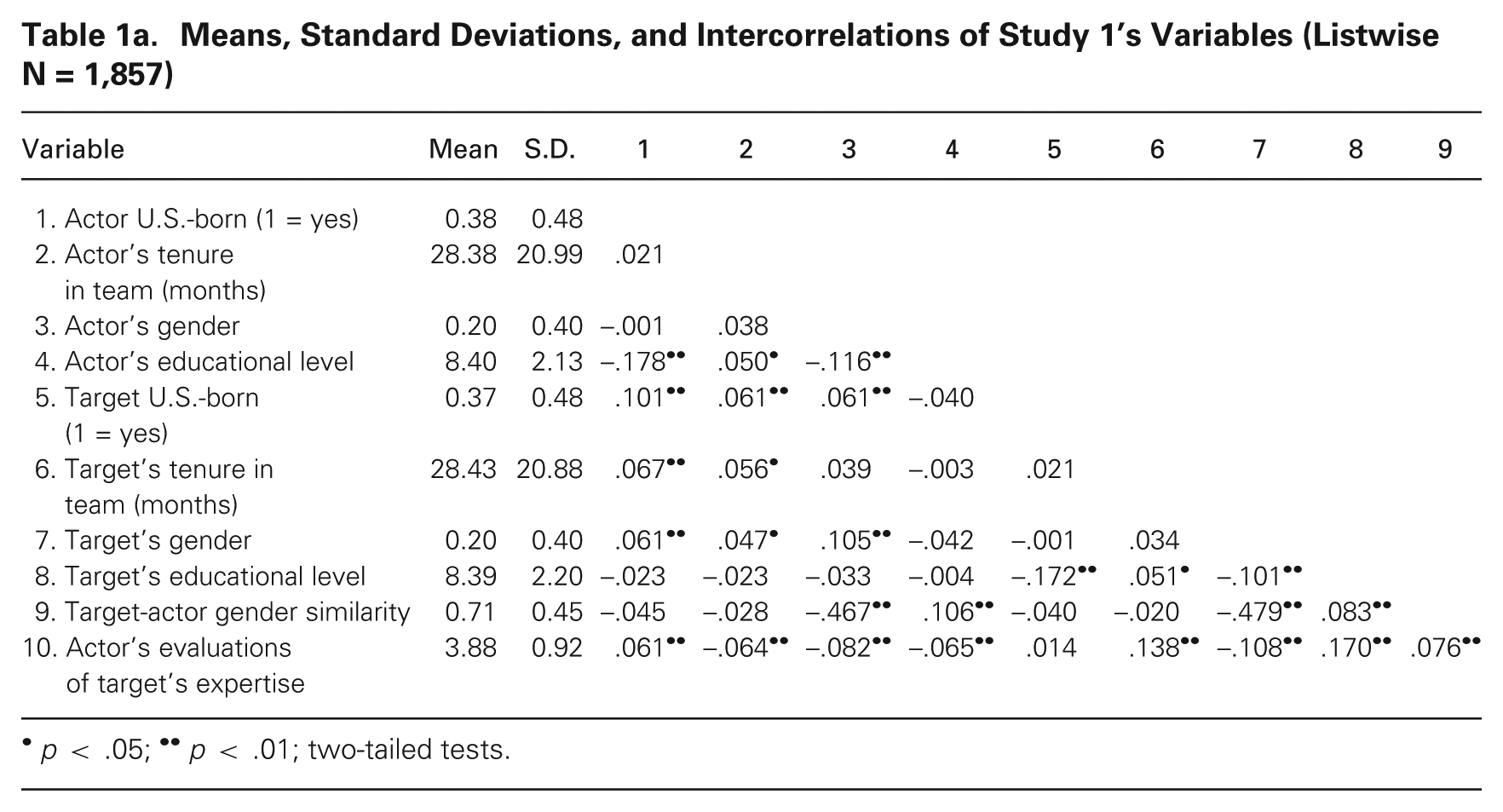
p < .05; •• p < .01; two-tailed tests.
Results of SRM for Variance Partitioning Expertise Perceptions in Study 1*

Overall F = 5642.67, p < .0001.
Table 1c represents the results of the social relations model testing hypotheses 1a and 1b. Hypothesis 1a proposed that the target’s gender would moderate the relationship between the target’s educational status and the actor’s evaluation of the target’s expertise (model 1, table 1c). The interaction between the target’s educational status and gender in model 1 did not significantly predict the actor’s expertise evaluations of the target. By acquiring a higher educational status, women received neither higher nor lower expertise evaluations, providing no support for hypothesis 1a. The target’s gender, however, negatively predicted the actor’s expertise evaluations of the target.
Results of SRM Analyses Predicting Actors’ Evaluations of Targets’ Expertise, Study 1*
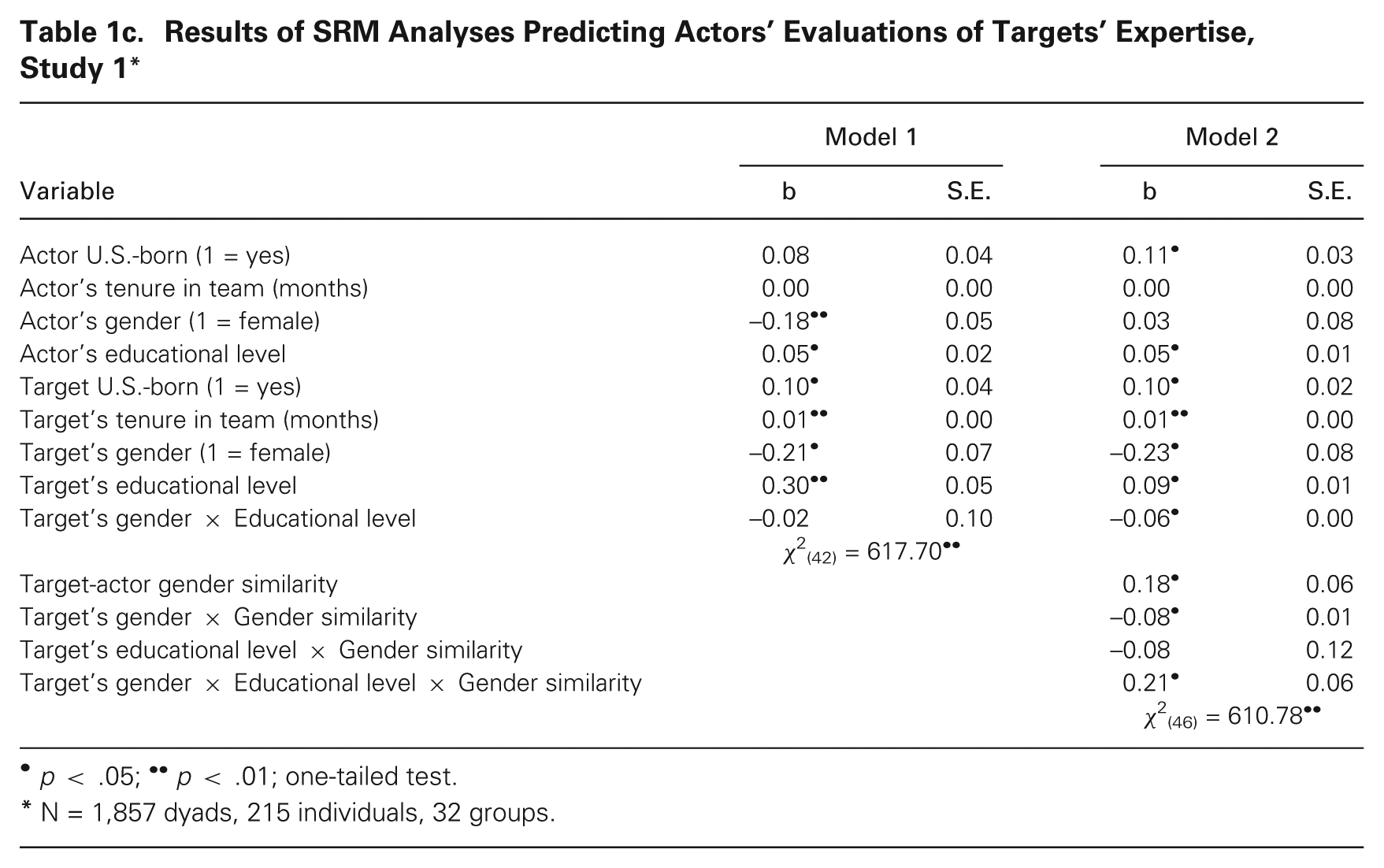
p < .05; •• p < .01; one-tailed test.
N = 1,857 dyads, 215 individuals, 32 groups.
In support of hypothesis 1b, gender similarity in model 2 moderated the effects of the target’s gender on actors’ expertise evaluations of the target. The form of this significant interaction, depicted as simple slope tests in figure 1, reveals an interesting pattern (see Aiken and West, 1993, for procedures). Hypothesis 1b proposed that gender similarity to the actor was likely to strengthen the positive effects of educational status on expertise evaluations among male targets and weaken the negative effects of educational status on expertise evaluations among female targets. Supporting this hypothesis, among female targets, educational status had a significant positive effect on expertise evaluations when rated by a female actor (slope 1: t-value of slope gradient = 1.63, p < .05). But educational status had a non-significant effect on the female target’s expertise evaluations when rated by a male actor (slope 2: t-value = .82, p = .06). Among male targets, educational status did not have a significant effect on expertise evaluations when rated by a male actor either (slope 3: t-value = .13, p = .89). In contrast, among male targets, educational status had a significant positive effect on expertise evaluations when rated by a female actor (slope 4: t-value = 2.3, p < .05).
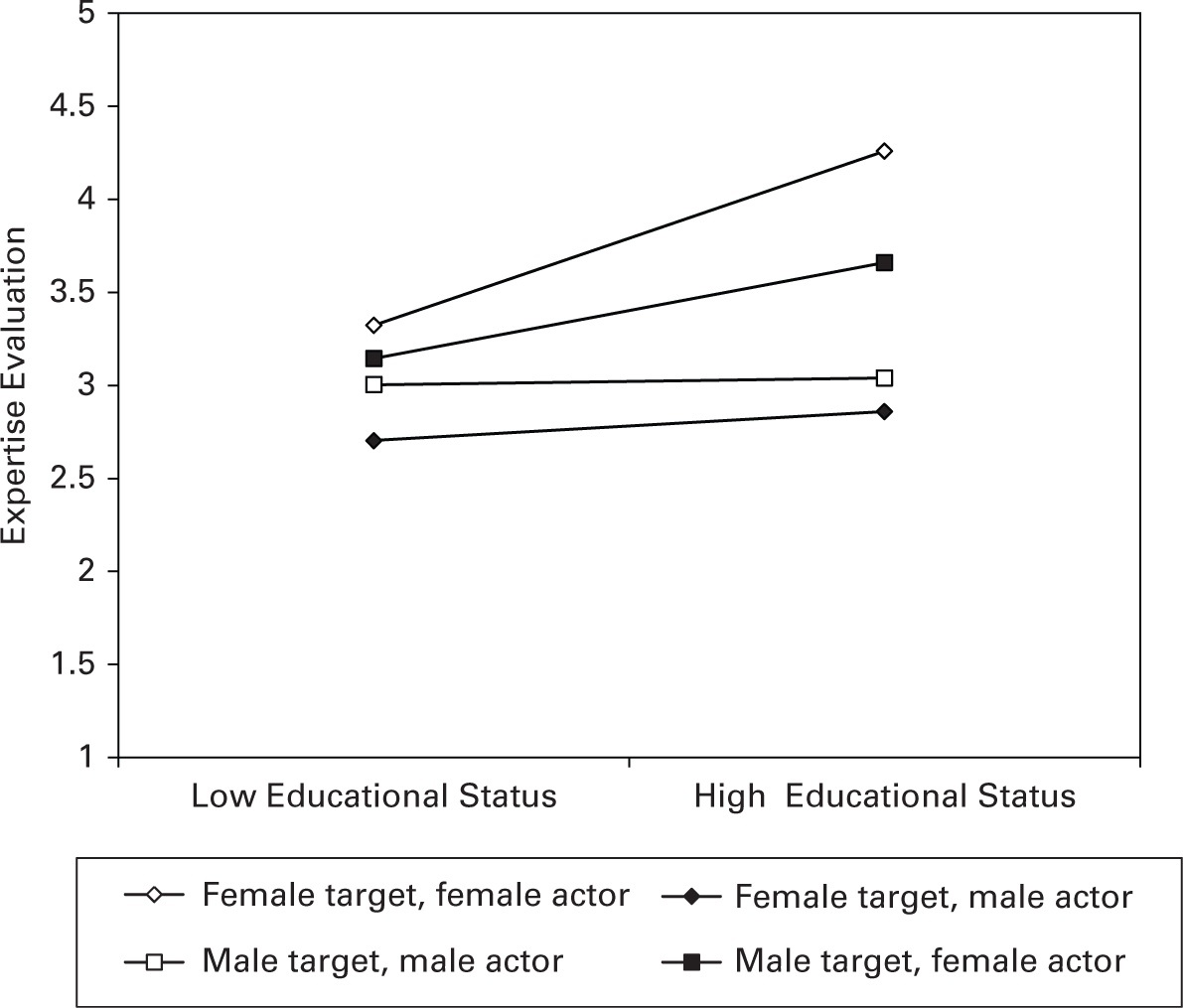
Interactive effects of target’s gender × Target’s educational level × Gender similarity to actor, Study 1.
When assessing expertise, it appears that female actors were more likely to differentiate among targets based on educational status, and male actors were more likely to differentiate among targets based on gender (see figure 1). Slope 1 (female target/female actor) and slope 3 (male target/male actor) were significantly different from each other (t-value = 1.65, p < .05), suggesting that when female actors rate other female targets, the relationship between educational level and expertise evaluations is significantly stronger than when male actors rate male targets. It also appears that highly educated female targets receive the highest ratings from female actors and the lowest ratings from male actors in the team. Highly educated male targets also receive the highest evaluations from female actors in the team. Male actors did not distinguish between less-educated and more-educated male targets; they simply rated all male targets higher than all female targets.
Supporting the social role perspective, after accounting for educational status, women received significantly lower expertise evaluations than men from team members, and among women, educational status did not significantly predict expertise evaluations. From the perspective of self-categorization theory, these findings suggest that the bar for accruing benefits from in-group affinity is rather high for women in male-dominated settings. First, the probability of being evaluated by other women is lower than the probability of being evaluated by men simply because there are fewer women in this context. Second, even when women are evaluated by other women, to obtain a higher evaluation, women must also achieve a high educational status. Reinforcing predictions based on social role theory, self-categorization theory offers an interesting vantage point highlighting the complex effects of actors’ gender and gender similarity between actor and target on the recognition of atypical women’s expertise in teams. Study 2 identifies additional actor-level contingencies as explanations for these findings. It aims to replicate the findings from Study 1 and examine whether the gender effects described in Study 1 can be better understood by accounting for the gender identification of the actors in the team.
Study 2: Actors’ Gender Identification and Expertise Recognition in Teams
Performance settings in which high-status groups are expected to excel pose a threat to the social identity of low-status groups because these settings highlight negative stereotypes about low-status groups (Tajfel, 1982; Tajfel and Turner, 1986). Science and engineering teams represent a setting in which men are expected to excel while women experience negative stereotypes (Cheryan et al., 2009). In such settings, gender identification is a key antecedent of actions and attitudes that are positively directed toward one’s in-group (Derks, van Laar, and Ellemers, 2009). Identification with one’s gender is defined as the emotional valence or significance of gender to an individual’s self-concept (Tajfel, 1982). Gender identification is likely to have different implications for self-categorization-based processes among male than female actors.
Among high-status social groups such as men, identification has been found to enhance intergroup bias (Branscombe and Wann, 1994; Schmitt and Branscombe, 2001). Based on this view, in science and engineering teams, male actors who identify more with their gender may be threatened by women who attain high educational status and will tend to assign negative stereotypes to highly educated female targets as a way to maintain gender-based status distinctions. Among low-status groups such as women, gender identification increases the propensity to engage in in-group favoring as opposed to self-interested actions (Derks, van Laar, and Ellemers, 2009). Therefore, in a team of scientists and engineers, female actors who identify with their gender will feel a sense of solidarity with other women, will be less likely to align themselves with men, and will evaluate the expertise of highly educated women favorably (Ellemers, Van Knippenberg, and Wilke, 1993; Derks, van Laar, and Ellemers, 2009). Based on this research, I examine whether findings from Study 1 can be better understood by accounting for gender identification among male and female actors. Hence I propose:
Sample and Methods
In Study 2, the research site was a second multidisciplinary research center similar to the site in Study 1 in terms of its structure and organization. The procedures for making contact with the team, meeting the principal investigators, and gaining contextual knowledge of these teams were similar to the process followed in Study 1. The disciplines included in this center were aerospace engineering, bioengineering, cell and molecular biology, neuroscience, chemistry, kinesiology, cognitive psychology, electrical engineering, and computer science. Unlike Study 1, this sample allowed for a greater range of gender representation across the participating research teams. Teams (N = 53) included students completing their master’s and doctoral degrees, as well as post-doctoral employees (N = 424). Team members met at least once a week to review the progress of ongoing research projects and to obtain and provide feedback on papers and projects. The structure and organization of work in these teams were similar to those in Study 1.
I received completed survey responses for both time 1 and time 2 surveys from 192 individuals across 31 research teams. Among the teams that were included in the final sample, the within-group response rate was 80 percent. Only teams with four or more respondents were included in the study. The individuals’ tenure in the team ranged from one month to fifteen months, with an average of six months. The average proportion of women in a team was 48 percent and ranged from 0 percent to 100 percent across teams. On average there were 6.1 individuals in each team, ranging from 4 to 24 individuals per team.
Similar to Study 1, a continuous educational level measure was derived based on responses to the item in survey 1 that asked respondents to indicate the highest degree they had obtained and their years of education since high school. Responses to this item were coded into a continuous measure of educational level (mean = 7.4, S.D. = 3.01). Among men (N = 102), 20 percent had a post-doctorate, 24 percent had a doctoral degree, 30 percent had a master’s degree, and 26 percent had an undergraduate degree. Among women (N = 90), 17 percent had a post-doctorate, 25 percent had a doctoral degree, 20 percent had a master’s degree, and 38 percent had an undergraduate degree. Based on data obtained from the university’s archives across the disciplines, the proportion of females in graduate programs ranged from 12 percent to 73 percent, with an average of 42 percent. The number of female post-docs ranged from 0 percent to 100 percent with an average of 21 percent. Thus the sample demographics in terms of gender and education matched the population in the university.
Study 2’s methods were identical to those of Study 1 except that in addition to the variables measured in Study 1, I also measured the actors’ gender identification in the time 1 survey. Gender identification was measured using Derks, van Laar, and Ellemers’ (2009) eight-item gender-identity scale, which measures the importance of an individual’s social group membership to his or her identity (Cronbach’s alpha = .81; Cronbach’s alpha for men =.90; Cronbach’s alpha for women = .89). On a 5-point scale, individuals indicated their agreement with items such as “My gender is central to my identity,”“I often think of myself as a member of my gender group,” and “I am proud to be a member of my gender group.”
Results
Table 2a presents the means, standard deviations, and correlations for all of the dyad-level variables. Table 2b summarizes the partitioning of variance in expertise evaluations at the actor, target, dyad, and team levels. As in Study 1, in Study 2 a larger proportion of variance in interpersonal expertise evaluations could be explained by the actors and dyads rather than by the attributes of the targets. Fifteen percent of the variance in expertise evaluations was attributable to team-level effects. Twenty-seven percent of the variance was attributable to actor effects, suggesting that individual team members differed in how they perceived each other. Twenty percent of the variance was attributable to the targets, with the largest percentage of variance, 38 percent, attributable to dyads.
Means, Standard Deviations, and Intercorrelations of Study 2’s Variables (Listwise N = 1,564 dyads)
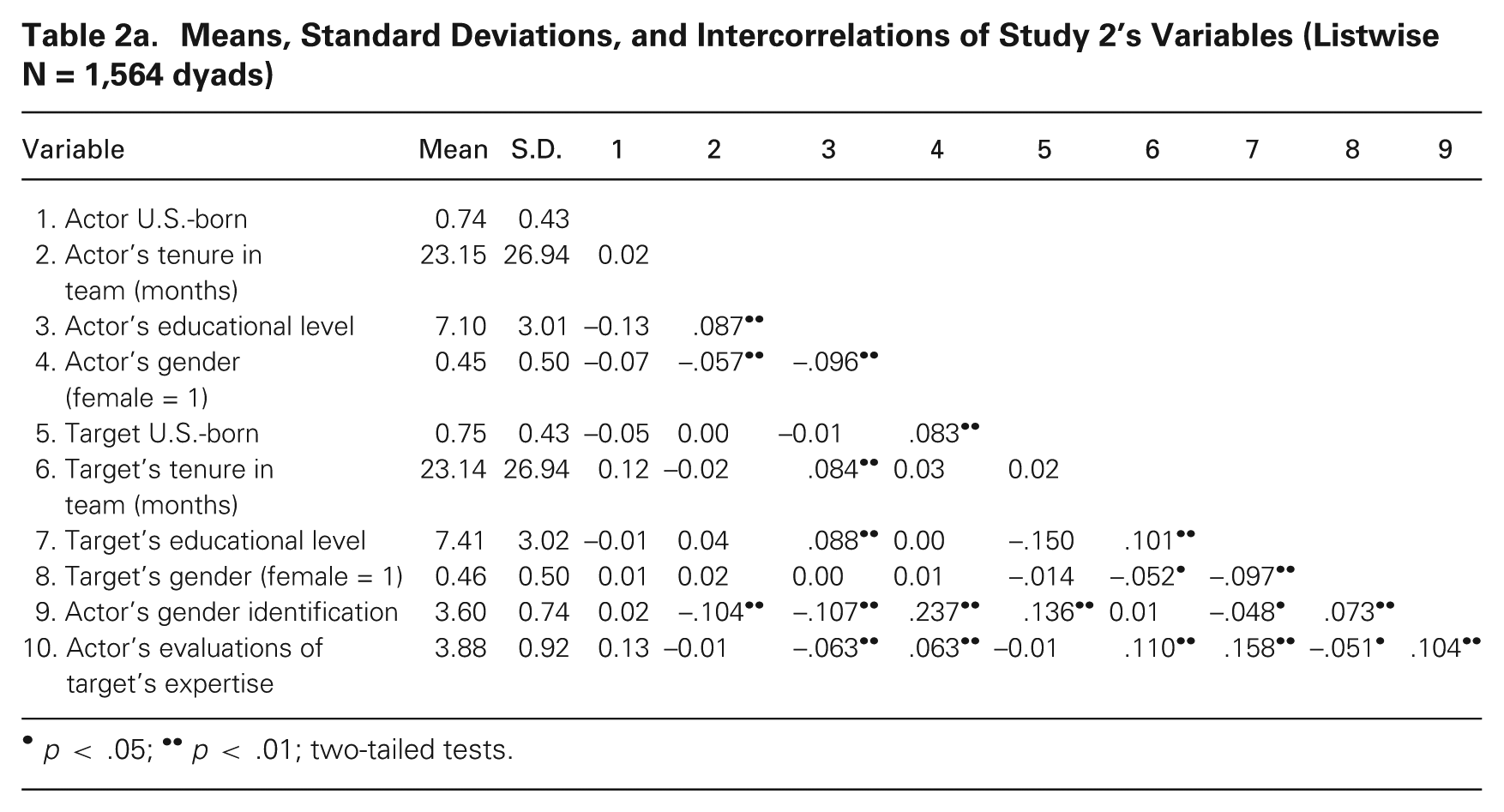
p < .05; •• p < .01; two-tailed tests.
Results of SRM for Variance Partitioning Expertise Perceptions in Study 2

Overall F = 3894.47, p < .0001
Table 2c presents the results of the social relations model testing hypotheses 2a and 2b. To fully test the hypotheses, I ran two separate SRMs: one for female actors and one for male actors. Hypothesis 2a proposed that among female actors who identified more with their gender, highly educated women would receive higher expertise evaluations than highly educated men, but the three-way interactions in model 2 between the target’s gender and the target’s education and the actor’s gender identification did not emerge as significant among female actors. Thus hypothesis 2a was not supported. Although female actors in general identified more with their gender than male actors, male actors who identified with their gender were more likely to differentiate between male and female targets in evaluating their expertise.
Results of SRM Analyses Predicting Actors’ Evaluations of Targets’ Expertise, Study 2

p < .05; •• p < .01; ••• p < .001.
N = 1,564 dyads, 192 individuals, 31 groups.
Hypothesis 2b predicted that among male actors who identified with their gender, highly educated women were likely to receive lower expertise evaluations than highly educated men. As model 3 in table 2c shows, the three-way interaction between the target’s gender and the target’s educational status and the actor’s gender identification was significant among male actors, lending support to hypothesis 2b. Figure 2 plots the form of this interaction and suggests some interesting patterns. A simple slopes test suggests there is a significant negative relationship between the educational status and expertise evaluations of female targets being evaluated by male actors who identified highly with their gender (slope 1: t-value of slope gradient = −2.33, p < .05). Male actors who identified less with their gender also rate highly educated female targets lower than less-educated female targets in the team (slope 2: t-value = −2.16, p < .05), but they rate women in general higher than male actors who identify with their gender to a greater extent. The relationship between educational status and expertise evaluations is non-significant for male targets being rated by male actors who identified highly with their gender (slope 3: t-value = .72, p = .46), although the direction of the relationship is positive. Finally, the relationship between educational status and expertise evaluations is also non-significant when male targets are rated by male actors who identified less with their gender (slope 4: t-value = .93, p = .35).

Interactive effects of target’s gender × Target’s educational level × Actor’s gender identification among male actors, Study 2.
Similar to Study 1, when evaluating the expertise of male targets, male actors did not differentiate among targets based on educational level. When male actors evaluated female targets, however, they did differentiate between targets based on educational status, rating highly educated women lower than less-educated women. Slope 1 (female target, high actor gender identification) and slope 2 (female target, low actor gender identification) were significantly different from one another, suggesting that the relationship between educational status and expertise evaluations is significantly more negative when female targets are rated by male actors who identify highly with their gender (t-value = −2.61, p < .01).
Discussion
In Study 2, as in Study 1, actor- and dyad-level attributes contributed to a larger percentage of the variance in expertise evaluations than targets’ attributes. This finding suggests that instead of target attributes, the attributes of actors and the actor-target relationship are critical drivers of expertise recognition in enduring work teams. This finding has important implications for identifying sources of persistent gender inequity in employment practices that rely on subjective, interpersonal evaluations from team members. In Study 2, as in Study 1, male actors also displayed in-group favoring behavior discounting education level as a basis for expertise evaluations altogether. Once again, this finding suggests that in male-dominated settings, obtaining a high educational status is unlikely to positively influence the expertise evaluations of women. Moreover, Study 2 uncovered yet another contingency shaping the recognition of women’s expertise: gender identification among male actors. Male actors who strongly identify with their gender are more likely to favor men irrespective of their educational status, penalizing women who have attained higher educational status by rating them lower than less-educated women in the team. The responses of highly gender-identified men to highly educated female targets in the team has important implications for social role theory; contrary to this theory, psychological responses to atypical women are not uniform but rather differ based on actors’ gender and their gender identification. Study 3 extends the findings discussed so far to individual-level and team-level outcomes and also identifies additional boundary conditions at the team level of analysis.
Study 3: Expertise Utilization and Team Productivity as Outcomes
Study 3 raises two important additional questions that extend the framework developed so far to the individual and team levels of analysis. First, does the proportion of women in the team lead to greater use of the expertise of highly educated women in ongoing research projects? Second, under what conditions are teams able to fully utilize the expertise of highly educated female scientists and engineers to enhance team productivity? Answers to these questions are critical for obtaining a comprehensive understanding of the conditions under which women’s expertise is used in teams.
So far, at the interpersonal level we know that although there are several challenges to recognizing the expertise of highly educated women, they do receive higher evaluations from female actors in the team. If highly educated women are valued more by other women, the proportion of women in the team should positively influence the extent to which a woman’s expertise is incorporated into the team’s research projects. In science and engineering teams, at the individual level of analysis, the use of expertise, conceptualized as participation in research projects, can be viewed as an objective indicator of the extent to which team members view each other as experts. Individuals whose expertise is evaluated more positively by their team members are likely to be more involved in ongoing research projects in the team. In this context, the utilization of expertise is also important for individuals because the research experience gained through participation in research projects enhances the individual’s prominence in the discipline and contributes to future career success in corporate or academic settings. Thus, for a variety of reasons, participation in ongoing research projects is an important outcome to examine at the individual level of analysis. Based on the arguments and findings outlined so far, I propose:
Challenges to the recognition and utilization of women’s expertise at the interpersonal and individual levels of analysis should also have implications for the team. Because science and engineering teams are assembled to harness diverse expertise, their inability to recognize the expertise of highly educated women should have negative consequences for teams’ productivity. A significant body of research on team information processing shows that if a team is able to draw fully on the expertise of its team members and allow its expert members to influence the team’s decision making, it will perform at a higher level than a team that is not able to identify expertise accurately (Stasser and Titus, 1985; Littlepage et al., 1995; Littlepage, Robison, and Reddington, 1997). Research has also found that not all teams are able to capitalize on the expertise of their demographically dissimilar team members (e.g., Bunderson, 2003; Thomas-Hunt and Phillips, 2004). Corroborating this view at the interpersonal level, findings from Study 1 and Study 2 have shown that among women, educational status does not significantly predict expertise evaluations. Given that educational level provides an individual with the skills and abilities needed to accomplish the team’s tasks and goals, the fact that team members discount women’s educational level implies that teams are likely to struggle to use women’s expertise effectively and that it is unlikely that the expertise of educated women will translate into positive outcomes for the team.
Under some conditions, however, women’s expertise may have more beneficial effects on team productivity than under others. One possibility, highlighted by a significant body of organizational research, is that the demography of the embedding context can shape the extent to which a team benefits from the expertise of female scientists and engineers (Ibarra, 1992; Ely, 1994; Cohen, Broschak, and Haveman, 1998; Huffman, Cohen, and Pearlman, 2010). This stream of research shows that even in historically male-dominated settings, the representation of women with high status in the proximal context of the team can reduce negative performance pressures on women in teams and increase the likelihood that team members will seek and incorporate women’s expertise in meeting the team’s goals (Ibarra, 1992). For example, research shows that the presence of women in high-status positions in an organization symbolizes women’s achievements and legitimizes women’s abilities and skills in that context, neutralizing the effects of broader gender-based role expectations and status differences on perceptions of women’s effectiveness in the organization (Ibarra, 1992; Ely, 1994). Extending this logic to the context of science and engineering teams, the presence of female faculty in the discipline in which a team is embedded might lead team members to recognize the expertise of female team members in meeting team goals because team members have been exposed to highly skilled and qualified women outside the team. In this context, team members may not assume that male scientists and engineers have greater skills and abilities than female scientists and engineers.
The context is also a powerful influence on female team members’ confidence in their own ability to contribute to the team’s success. Cheryan et al. (2009) recently demonstrated that female engineering students’ beliefs in their potential for success varied based on masculine versus gender-neutral manipulations of the proximal physical context in which they worked (i.e., shared lab space). They noted that the context signals “ambient belonging” to underrepresented individuals and influences their beliefs in their own success in engineering. Extending these arguments to the current research context, gender representation among the faculty as a visible aspect of gender inclusion in the discipline (e.g., through departmental websites and seminars) can also signal ambient belonging to highly educated women within teams in that discipline. When these women experience a sense of belonging, they are likely to perform at higher levels and contribute to a greater extent to the teams’ goals.
Considerable research on the phenomenon of stereotype threat—an individual’s fear that he or she will be evaluated based on a negative stereotype about his or her demographic group—also suggests that the context shapes how underrepresented groups perceive their own performance and possibility for success in a setting (Roberson and Kulik, 2007). If the context signals that performance is not correlated with demographic attributes, underrepresented minorities perform at significantly higher levels. In experimental settings when women who were administered math ability tests were subjected to manipulations showing successful female role models, they performed at significantly higher levels than test takers who were not exposed to successful women (Marx and Roman, 2002; McIntyre, Paulson, and Lord, 2003). To the extent that female faculty can be considered symbols of women’s success in a discipline, a gender-integrated faculty could represent a context that reduces negative performance pressures on women working in teams.
In the current research context, these findings cumulatively suggest that the presence of female faculty in a science and engineering discipline can legitimize women’s accomplishments in that field, allow for greater mentoring and career support from female faculty, encourage greater acceptance of women’s expertise in teams, and enhance beliefs among female team members in their own success, paving the way for their increased contributions to the teams’ goals (Ibarra, 1992; Ely, 1994, 1995). Therefore in disciplines that are more gender integrated, not only will highly educated women contribute more, but their contributions will be more readily accepted in a team, driving the team toward higher productivity levels. In highly male-dominated disciplines, however, it is unlikely that teams will benefit from the expertise of female scientists and engineers. Hence I propose:
Sample and Methods
In Study 3, I returned to the research teams that participated in Studies 1 and 2 eight to sixteen months after each study was completed. Based on interviews conducted with the principal investigators who were the team leaders, this was an adequate time frame in which a team or a team member might produce working papers, conference papers, and journal articles. I obtained additional data from the principal investigators of each research team about the participation of the individuals in the research projects ongoing in the groups, as well as the overall research publications by the groups. Based on these data, I developed measures of the use of expertise in research at the individual level and research productivity at the team level. I obtained additional data on research collaborations from 311 of the 410 individuals who took part in Studies 1 and 2, yielding a 75-percent response rate for this measure. Respondents included in the final sample in Study 3 (N = 311) were on average 40 percent female and 59 percent U.S.-born, and they had on average 7.56 years of post–high-school education (using a continuous measure of education level for testing individual-level hypotheses) and 22.75 months tenure in the group.
At the team level (N = 52), the proportion of women ranged from 0 percent to 100 percent, with an average of 41 percent women in a team. The proportion of highly educated women (those with a doctorate or post-doctorate degree) ranged from 0 percent to 66 percent, with an average of 14 percent highly educated women in a team. The average team tenure was 22 months, and each team had an average of eight members. Of this final set of respondents, among women (N = 120), 28 percent had an undergraduate degree, 20 percent had a master’s degree, 20 percent had a doctoral degree, and 32 percent had a post-doctorate. Among men (N = 191), 26 percent had a post-doctorate, 20 percent had a doctoral degree, 34 percent had a master’s, and 20 percent had an undergraduate degree. These demographics matched the demographic data from the university archives for all 15 disciplines included in Study 3, indicating no response bias in this study. Based on data obtained from the university’s archives across the disciplines, the proportion of females in graduate programs ranged from 10 percent to 75 percent, with an average of 40 percent. The number of female post-docs ranged from 0 percent to 100 percent, with an average of 21 percent. Thus the sample demographics in terms of gender and education matched the population in the university.
Expertise utilization in research was a measure of the total number of published and working papers in the group in which a target individual was included as a coauthor. I normalized this score by team size (N − 1), assuming that the number of individuals in a group would increase the probability of being involved in a research project. In the context of this study, research collaborations are the final product of an individual’s work in a group and are vital for the individual’s career success.
The team’s research productivity is the ultimate criterion of the team’s success and is therefore an appropriate measure of the team’s productivity in the academic context in which the study was conducted. To identify the number of top-tier publications, I obtained from the journals’ websites the impact factor scores for the journals in which the articles appeared. If the impact score for a journal was less than 1.5, the journal was not considered a top-tier publication. I also measured the number of conference proceedings, presentations, and book chapters published. In addition, I incorporated a measure of the quality and prestige of the publications produced by a group based on citations of a given paper in the year immediately preceding the data collection (see Brew and Boud, 1995; Judge et al., 2007). Based on searches in Google Scholar, I also computed the sum of the citations for each of the publications listed for a lab over the preceding year. Citations ranged from 0 to 20. These five measures—top-tier publications, book chapters, conference presentations, conference proceedings, and citations—were subjected to a principal components analysis (Ford, MacCallum, and Tait, 1986). They loaded on a single factor with factor loadings over .70 and an initial eigenvalue of 2. In the interests of parsimony, I standardized each measure and developed a combined index of research productivity for each group.
I obtained additional archival data from university records to develop a measure of the gender composition of the faculty of the team’s affiliated discipline. The research centers involved in this project bring together research labs from different disciplines that are engaged in solving similar scientific problems, such as cancer detection, brain imaging, and bioeconomic development. While the centers provide office and lab facilities, administratively and intellectually the teams are also affiliated with a specific discipline such as electrical engineering, biomedical engineering, and cell and molecular biology. In all cases the principal investigators had previous training and affiliation in the home discipline. All 15 science and engineering disciplines included in Studies 1 and 2 were represented in the final sample. I used the proportion of female faculty in each of these disciplines to develop a measure of the gender composition of the faculty in the affiliated discipline. In addition to average team tenure and team size, I controlled for the research grants available to a team in the year preceding Studies 1 and 2, as this might influence the overall resources available to a team. While examining the utilization of expertise at the individual level, I also controlled for the team’s research productivity at the team level to account for the effects of overall performance and productivity-related norms in the team.
Results
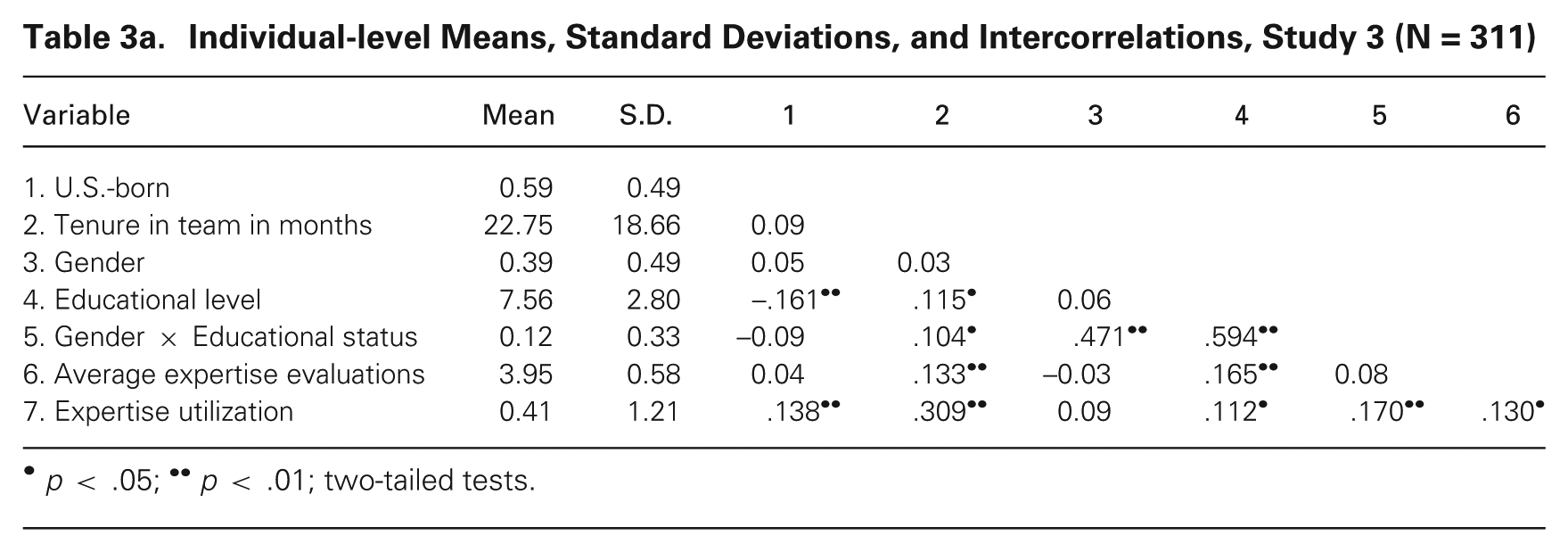
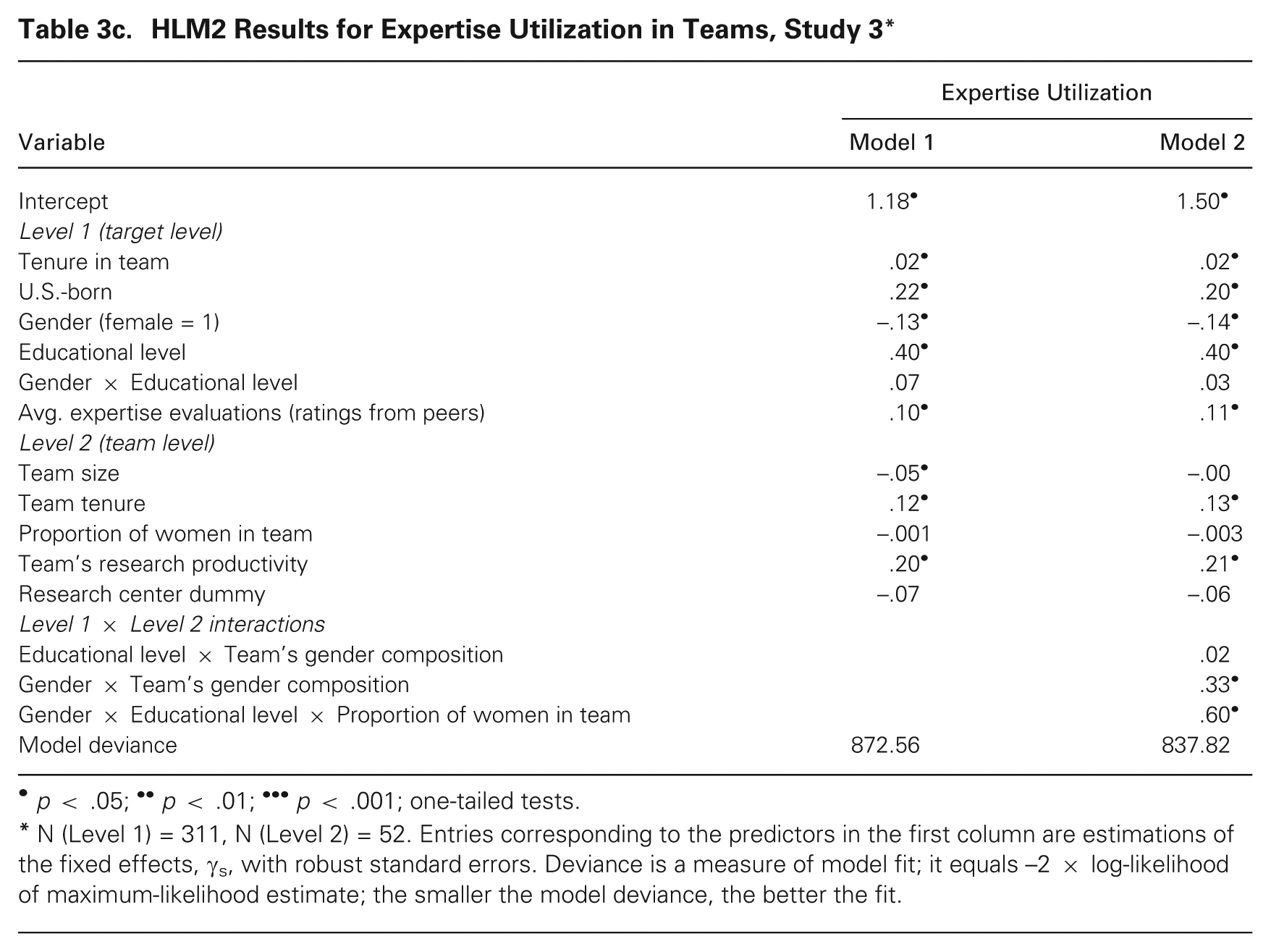
Tables 3a and 3b include the descriptive statistics and intercorrelations at the individual and team levels, respectively, for all of the study variables. Findings at the individual level, obtained using a hierarchical linear modeling (HLM) approach, are presented in table 3c. As noted in model 1, the average perceived ratings of expertise that an individual received significantly predicted the use of that person’s expertise in the team. The interaction between gender and educational level did not significantly predict the use of expertise. In support of hypothesis 3a, the interaction between gender and educational level and proportion of women in the team significantly predicted the use of expertise in the team.
Individual-level Means, Standard Deviations, and Intercorrelations, Study 3 (N = 311)
p < .05; •• p < .01; two-tailed tests.
Team-level Means, Standard Deviations, and Intercorrelations, Study 3 (N = 47)

p < .05; •• p < .01; two-tailed tests.
HLM2 Results for Expertise Utilization in Teams, Study 3*
p < .05; •• p < .01; ••• p < .001; one-tailed tests.
N (Level 1) = 311, N (Level 2) = 52. Entries corresponding to the predictors in the first column are estimations of the fixed effects, γs, with robust standard errors. Deviance is a measure of model fit; it equals −2 × log-likelihood of maximum-likelihood estimate; the smaller the model deviance, the better the fit.
Figure 3a plots the form of this interaction. At higher levels, female representation in a team exceeds 60 percent, and at lower levels, female representation falls below 10 percent. A simple slopes test indicates that educational status significantly predicted use of women’s expertise in teams with a high proportion of women (t-value of slope gradient = 2.65, p < .05). The effect of educational status on the use of expertise was also positive for men in male-dominated teams (t-value = 2.61, p < .05). For women in teams with a low proportion of women and for men in teams with a high proportion of women, the effects of educational level on the use of expertise were not significant. It appears that men participated in more research projects in teams with a high proportion of women than women did in male-dominated teams. Overall, these findings on the effects of gender similarity to the team on expertise utilization among individuals mirror the findings on effects of actor-target gender similarity on expertise recognition at the interpersonal level reported in Studies 1 and 2. Greater gender similarity to team members benefits both highly educated women and men by leading to their greater involvement in the team’s research projects.

Interactive effects of target’s gender × Target’s educational level × Team’s gender composition, Study 3.
To determine the effects of women’s educational attainment on team-level outcomes, I examined whether the gender composition of the faculty served as a boundary condition under which the proportion of highly educated women in the team could contribute to its productivity. In support of hypothesis 3b, I found that the interaction of the faculty’s gender composition and the proportion of highly educated women in the team significantly predicted the team’s research productivity, as shown in table 4. As indicated in figure 3b, the presence of high-status women had a non-significant effect on team productivity in male-dominated departments. In the presence of a gender-balanced faculty, however, the proportion of highly educated women in the team had a positive effect on its research productivity (t-value of slope gradient = 2.58, p < .05). The non-significant effects of the proportion of highly educated women in the team on its productivity in male-dominated disciplines are in line with the findings at the dyad and individual levels that educational status did not predict the evaluation or use of expertise among women. But the gender composition of the discipline’s faculty shapes the effects of the representation of highly educated women in the team on its productivity. Teams with a greater proportion of highly educated women were significantly more productive in gender-balanced disciplines than in male-dominated disciplines. These findings support the argument that the level of gender integration in any given discipline can shape the salience of gender as a basis for status differences or role expectations among men and women in science and engineering. Within gender-integrated disciplines, highly educated women are likely to contribute to a greater extent toward team goals, and team members are more likely to accept these contributions, thereby increasing the team’s research output.
OLS Regression Results for Team-level Research Productivity, Study 3*

p < .05; •• p < .01; ••• p < .001; one-tailed tests.
Standardized coefficients are presented. Listwise N = 49.
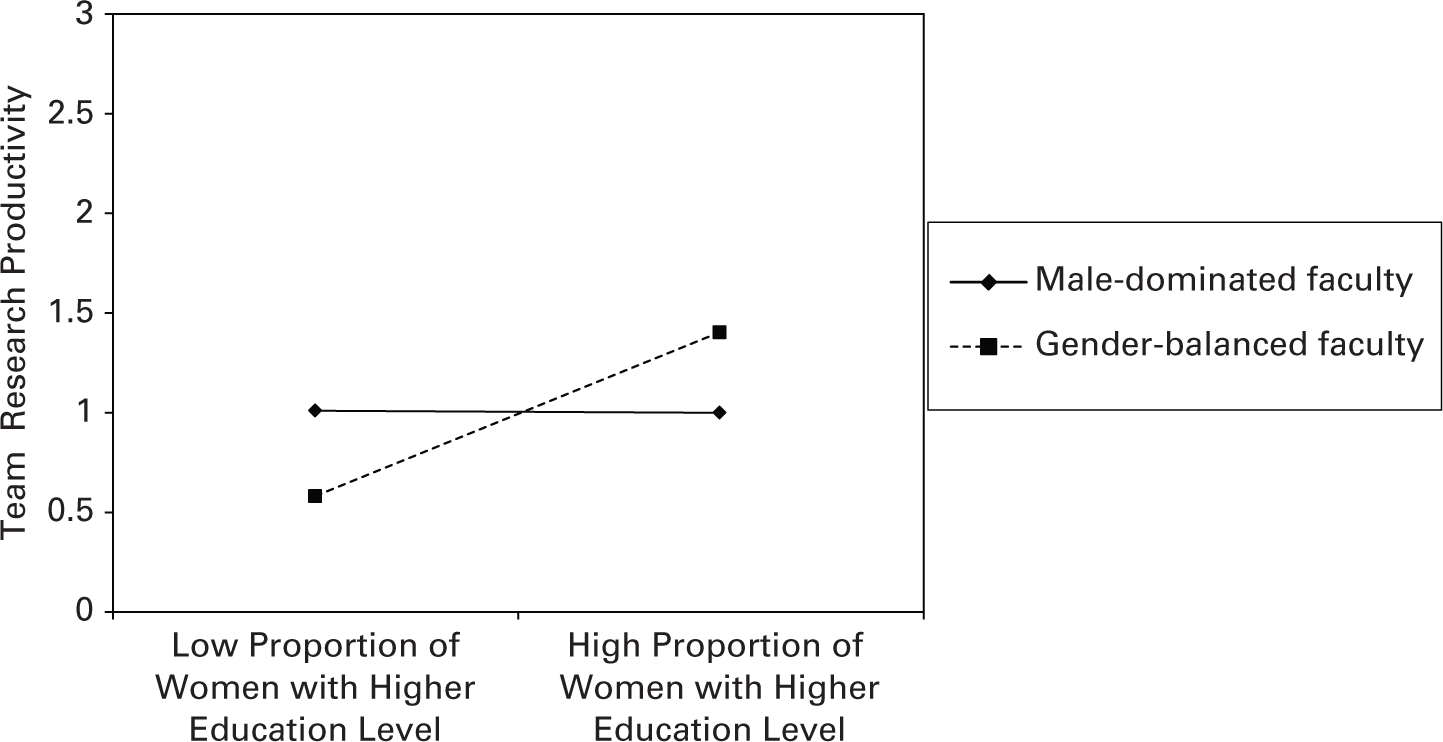
Interactive effects of proportion of women with higher educational level × Faculty’s gender composition, Study 3.
General Discussion
Results across three studies and at multiple levels of analysis showed that the recognition and utilization of the expertise of male and female scientists and engineers was contingent on the gender and gender identification of the actors assessing that expertise, the team’s gender composition, and female faculty representation in the discipline in which the teams were embedded. Highly educated female and male targets were evaluated more positively by female actors than by male actors in the team. Male actors in the team who identified strongly with their gender evaluated highly educated female targets more negatively than less-educated female targets. Furthermore, the expertise of highly educated women was used to a greater extent in teams with a higher proportion of women than in teams dominated by men. The expertise of highly educated men was used to a greater extent in teams that were male-dominated than in teams dominated by women. Finally, teams with a greater proportion of highly educated women were significantly more productive in disciplines with greater female faculty representation. The findings have many important implications for theory and research on gender dynamics in teams.
Theoretical Contributions
Expertise recognition in teams involves a mutual evaluation of expertise among team members in a dyadic process. Team members serve as the targets of others’ expertise evaluations and are also engaged in evaluating others’ expertise to decide whose skills and inputs are necessary for completing their own tasks and assignments for the team. Yet a dyadic perspective of expertise recognition has been lacking in field research (see Van der Vegt, Bunderson, and Oosterhof, 2006, for an exception). The present study offered a unique perspective on expertise recognition and use at the dyad level from the perspective of actors and targets in teams. Drawing on social role theory and self-categorization theory, I examined whether interpersonal expertise recognition was more likely to be explained by the attributes of targets, actors, or the actor-target relationship. While the effects of gender-based role expectations on interpersonal expertise recognition in teams have received considerable attention (e.g., Ridgeway and Smith-Lovin, 1999; Thomas-Hunt and Phillips, 2004; Carli, 2010), the gender-based self-categorization processes underlying expertise recognition have seldom been investigated.
Supporting social role theory, I found that the target’s gender served as an important expertise signal in science and engineering settings. Even after accounting for tenure and education, female targets were evaluated significantly lower than male targets, and higher educational attainment did not predict the expertise evaluations of female targets. An actor’s gender and gender similarity to the target played a significant role in shaping the expertise evaluations of highly educated women in teams. Highly educated women received more favorable expertise evaluations from female actors than from male actors in the team. Male actors evaluated male targets more favorably than female targets regardless of targets’ education level. These results suggest that the extent to which the expertise of female scientists and engineers is recognized in teams is not only a function of their atypicality but is also contingent on the self-categorization processes that govern male and female actors’ responses to these women.
The cumulative implication of these findings is that in male-dominated settings, the expertise of highly educated women will be evaluated lower than the expertise of men simply because there are fewer female actors evaluating their expertise. But a very different picture emerges at the interpersonal level. At the interpersonal level, these findings suggest that attaining status in domains such as education might neutralize the in-group bias that some researchers have highlighted among women in male-dominated settings, which Derks et al. (2011) have termed the queen-bee syndrome. They noted that women engage in in-group bias because they have lower status in male-dominated settings. In such settings, women are likely to distance themselves from and display greater bias toward other women while favoring men in order to enhance their self-esteem (Chattopadhyay, Tluchowska, and George, 2004; Derks et al., 2011). This perspective is valuable because it acknowledges the effects of male-female status differences on self-categorization among men and women. But in many traditionally male-dominated settings, as women close the skills and knowledge gap, status differences between men and women are also in flux.
In the science and engineering teams I studied, women did favor their in-group while evaluating the expertise of highly educated women in the team, and men tended to evaluate other men more favorably than they did women. In these settings, the responses of female actors toward female targets may reflect greater in-group solidarity, and the responses of male actors may reflect a perceived threat from women. By unpacking data at the dyad level, this study provided a far more nuanced picture of how gender interacts with other task-related attributes such as education to shape self-categorization processes than has been available in field research to date. The results reveal the sensitivity of gender-based self-categorization among female actors to variations in targets’ task-related status in teams. Results showed in-group affinity among women at the individual level of analysis and that working in teams with more women had a significant positive effect on the use of highly educated women’s expertise. Extending these findings to the individual level also suggests that gender diversity is a prerequisite for the expertise of highly educated women to be fully recognized and used in teams.
Another striking pattern in the findings is that the greatest variance in expertise evaluations could be explained by the attributes of the dyad (i.e., the gender similarity between actor and target) and the actors’ attributes (i.e., actors’ gender and gender identification) rather than by the target’s attributes. These findings suggest that understanding why actors might differ in their evaluations of men’s and women’s expertise and what aspects of the actor-target relationship contribute to these evaluations is important. Such an understanding can help researchers identify the sources of gender differences in many other outcomes that also rely on expertise evaluations by peers. These findings also have far-reaching implications for future research on gender inequity in the workplace.
Although traditional approaches to identifying the causes of gender differences in performance evaluations and rewards have examined human capital (e.g., educational level, labor market experience) or motivational differences between men and women (see Blau and Kahn, 2007, for a review), many scholars have acknowledged that these explanations do not fully explain persistent gender inequity in the workplace (Reskin, McBrier, and Kmec, 1999). While scholars have also accounted for the role of peers in shaping employment outcomes (Tomaskovic-Devey, 1993; Ostroff and Atwater, 2003; Joshi, Liao, and Jackson, 2006), the findings from this study highlighting the role of actors and the actor-target relationship offer additional insights into this issue. Given the growing prominence of team-based work and reliance on peer evaluations in organizations (e.g., 360-degree feedback systems), outcomes such as promotion decisions, bonus awards, and performance ratings are often grounded in coworkers’ subjective, interpersonal evaluations of expertise. If attributes such as educational level contribute relatively little to the evaluations of women’s expertise, it is unlikely that any gains women make in their human capital can mitigate gender differences in employment outcomes. Particularly in team-based settings, gender differences in these outcomes will most likely be explained by the attitudes of team members toward women and by the attributes of the interpersonal relationships among women and their team members rather than by the educational qualifications of women. These findings are particularly relevant for identifying the sources of continued gender inequity in organizations. Future research should continue to use dyad-focused theoretical and methodological approaches to determine how interactional processes in teams contribute to gender inequity in employment outcomes such as pay and promotions.
This study also points to an important actor variable: gender identification. Not only did male actors evaluate highly educated women more negatively than did female actors, but gender identification among male actors led them to value the expertise of highly educated women even less than that of less-educated women in the team (Study 2). This finding extends past research on the responses of dominant groups to perceived threats to their dominance from individuals who have traditionally occupied a lower social status (Vanneman and Pettigrew, 1972; Brown and Abrams, 1986). This perception of threat is clearly heightened among men for whom gender is a salient basis for identification, with important consequences for women in teams. Recently, some researchers have also found that even brief exposure to sexist men has negative psychological and performance implications for women in engineering and mathematics (Logel et al., 2009). In enduring work teams, future research should examine whether interacting with men who identify strongly with their gender influences other outcomes among women, such as individual performance and turnover. In diverse work teams, the implications of a perceived threat to dominant groups from hitherto underrepresented minority groups for outcomes such as knowledge combination and information sharing should also be examined more closely.
Future research on knowledge combination and use of expertise in teams should also pay closer attention to the embedding context of the team in predicting team performance and innovation. Clearly, the salience of gender as an expertise cue within a team is very susceptible to the proximal context in which the team is embedded. In gender-integrated settings, because individuals are exposed to symbols of women’s success and achievements outside the team, they are less likely to rely on negative stereotypes while evaluating the expertise of female team members (Ibarra, 1992; Ely, 1994, 1995). Although many professions and occupations may be male-typed or male-dominated, within a specific work context, the level of gender integration may vary and can influence the effects of gender on expertise recognition in teams. For example, the presence of female faculty in a discipline is a powerful symbol of women’s success in that discipline and may be instrumental in reducing the significance of gender as an expertise cue and increasing the salience of more task-relevant expertise cues such as education. This finding highlights the fact that the value of diversity at higher levels in academic and corporate settings lies in its potential for fostering the effective use of expertise in teams. Future research should examine whether specific knowledge-combination and innovation-related processes in a diverse team vary as a function of the diversity or inclusion represented in the team’s proximal context.
Finally, the framework developed and tested above also adds value to the extant theory and research on gender by introducing a multilevel paradigm that accounts for both bottom-up and top-down perspectives on gender in teams (Kozlowski and Klein, 2000). Beginning at the dyad level, taking a bottom-up perspective, I examined the relationship between gender and expertise recognition from the perspective of actors and targets in teams. Taking a top-down approach, I also investigated whether the gender composition of the team influenced the relationship between gender and expertise use at the individual level and whether female representation among faculty ranks influenced the relationship between gender composition and scientific productivity at the team level. This multilevel approach highlights the robustness of gender effects at multiple levels of analysis across both subjective and objective outcomes.
Limitations, Caveats, and Future Directions
By focusing on a single context—science and engineering—and a set of academic research teams, I was able to obtain comparable and objective measures of research productivity and participation in research projects across teams. By collecting performance data longitudinally and controlling for factors such as prior research funding available to teams, I was also able to attenuate reverse causality concerns typically associated with field data. Despite these strengths, this research study has a number of limitations that need to be acknowledged.
Compared with a corporate setting, in an academic context it is possible that the effects of educational status may have been overestimated. In corporate R&D teams, for instance, while educational level may be an important status cue, it is likely that organizational rank or functional specialization may also be important cues to consider. In addition, I focused only on gender as a demographic attribute in this context. While gender and educational expertise did emerge as significant predictors of perceptions about expertise, future research should consider other demographic attributes relevant to this setting, such as the nationality of scientists and engineers. Although I included nationality as a control, it is likely that it may interact with gender and educational expertise to predict individual-level outcomes. In fact, in the current dataset non-U.S.-born women were overrepresented among women with a high educational status. Therefore the interaction between gender and nationality might have implications for the relationship between gender and expertise recognition in teams. Because the non-U.S.-born category included a number of different nationalities, however, delving into this complexity was beyond the scope of the current project.
The measure of the gender composition of the faculty may also be confounded with the status of the discipline itself, with greater female faculty representation being associated with a discipline that enjoys less status. As female representation increases, the perceived prestige or status of the discipline may decline. But even if disciplinary status is correlated with female faculty representation, it is not clear why more gender-diverse teams would be more productive in gender-integrated disciplines. Future research could certainly examine disciplinary status or prestige as an additional predictor of the effects of gender in teams.
Furthermore, despite my attempt to obtain objective productivity measures, the measure of expertise utilization in this study may have an element of subjectivity, as the process of research collaborations in any team may be dictated by political rather than task-relevant factors. Future research could rely on more objective, observable measures of the use of expertise, such as actual influence in team decision making. I also used a global single-item measure of expertise evaluations at the interpersonal level. Although such measures are widely used in studies applying a round-robin design, more nuanced measures of expertise in specific task domains may lead to additional insights into expertise recognition in teams. This approach is certainly feasible in smaller teams (e.g., Van der Vegt, Bunderson, and Oosterhof, 2006) but poses challenges in larger teams in field settings. Future research should examine whether the recognition of men’s and women’s expertise is also contingent on the specific domains of expertise under consideration.
The generalizability of the findings reported in this article needs to be established in other settings as well. For instance, the science and engineering context is highly male-dominated, restricting the range of gender diversity available in teams. The framework developed here needs to be tested among teams in which a broader range of gender representation is likely and gender-based categorization and expertise attribution processes may differ. It must be noted, however, that a majority of the fastest-growing and better-paid occupations in the U.S. are male-dominated (Information Technology Association of America, 2003), and the framework developed in this article could be relevant to those settings as well. To identify the sources of gender inequity in the workforce, the barriers to gender integration must first be identified in these prestigious, higher-paying, male-dominated settings in which women have made increasing educational gains in recent times and yet receive lower pay and fewer promotions than their male peers. The limitations discussed above also represent fruitful lines of inquiry for future research in this area.
Conclusions
Consider the following facts about the science and engineering context: since 2000, women have steadily earned more science and engineering bachelor’s degrees than men, and almost half the master’s degrees earned across fields are being awarded to women (National Science Foundation, 2007). Nevertheless, among science and engineering faculty in Research 1 schools, men outnumbered women by a ratio of 2.5 to 1. In corporate settings, female scientists and engineers in managerial roles had significantly fewer subordinates than their male colleagues (National Science Foundation, 2007). At managerial levels, women constituted 8 percent of all engineering managers and 11 percent of all natural science managers relative to 19 percent of managers and 15 percent of top-level managers in other settings. Across all racial groups, median annual salaries for female scientists and engineers were on average 75 percent of those of their male peers (National Science Foundation, 2009).
These facts suggest that, in general, gains made by women in science and engineering education have not translated into women’s advancement in science and engineering workplaces; women remain overrepresented at lower levels and underrepresented at higher academic and corporate levels in science and engineering, even relative to other work contexts. Thus it appears that interventions encouraging STEM (science, technology, engineering, mathematics) education among girls at the high school and undergraduate levels have borne fruit. But the integration of female scientists and engineers in academic and corporate settings needs continued attention. The framework developed in this article identifies several factors that are vital for facilitating the effective utilization of women’s expertise in science and engineering. The findings reported above also suggest that in this context, the rationale for fostering greater gender equity and integration goes beyond ensuring equal employment opportunity for men and women to accelerating scientific productivity and innovation within teams. Cumulatively, the findings carry a simple yet important message: to take full advantage of the diverse expertise and to maximize productivity and innovation in teams, it is vital to increase gender diversity in teams and across the disciplines in which these teams are embedded. The theoretical insights offered in this article can be extended to other team-based, male-dominated work settings and inform future research on the interpersonal, individual, and team-level factors shaping the effective recognition and use of diverse expertise.
Footnotes
Acknowledgements
Funding for this research was provided by a National Science Foundation Grant (#1307353). I am grateful for feedback from ASQ Associate Editor Katherine Klein and three anonymous reviewers. Special thanks for advice and support to Jeanne Brett, Stephen Boppart, Susan Jackson, Andrew Knight, Dan Newman, colleagues at the University of Illinois (LER), and seminar participants at Cornell University (ILR), Carnegie Mellon University, University of Pennsylvania (Wharton), University of North Carolina, Northwestern University (Kellogg DRRC), University of Sydney, University of Queensland, and the Pennsylvania State University. Tiffany Johnson, Jooyeon Son, and Hyuntak Roh provided excellent research assistance for this project.