



Abstract
Nonmarket organizations play a supportive role in knowledge transfer and innovation domestically, but national differences between them can create barriers to cross-border knowledge transfer. Internationally oriented nonmarket organizations—ones that develop international ties and partnerships—may generate commonalities among participants and promote a set of similar rules, expectations, and norms across different countries and thus may be effective in supporting cross-border knowledge transfer and innovation. We focus on one such kind of organization, the intergovernmental organization (IGO), as a country’s connectedness to learning-oriented IGOs may have a positive influence on national innovation. Using an illustrative caselet on one IGO, the Carbon Sequestration Leadership Forum, and an empirical analysis spanning 83 countries from 1996 to 2006, we find that the extent of connectedness to the learning-oriented IGO network enables national innovation. But countries differ in the extent to which they can leverage external knowledge for innovation because of the variation in relationships among local constituencies.
Keywords
Organizational scholars have long argued that nonmarket organizations, such as regulatory agencies, business associations, schools, cooperatives, and government-supported institutions, can play an important, supportive role in knowledge contexts. These organizations can facilitate regulatory support for knowledge transfer and generate reliable channels for collective learning (Lynn, Mohan Reddy, and Aram, 1996; Jaffe, 2000; Mowery and Ziedonis, 2001; Cohen, Nelson, and Walsh, 2002), as well as enable the dissemination of knowledge and facilitate innovation in domestic contexts (e.g., Zuckerman and Sgourev, 2006; McDermott, Corredoira, and Kruse, 2009; Perez-Aleman, 2011). For instance, associations and government-supported institutions allow firms to upgrade their processes (Corredoira and McDermott, 2014), and special-interest communities enable individuals to develop product innovations (Franke and Shah, 2003).
But the same nonmarket organizations have been identified as a source of barriers to cross-border knowledge transfer. By developing and endorsing different rules, regimes, expectations, and norms across countries, they create national systems that may not be compatible with each other. In conjunction with other institutional factors, these organizations contribute to a lack of trust and absence of common norms, resulting in national borders being less permeable (Kogut, 1991; Scott, 1995; Kostova, 1999). They have such a significant influence that innovation arising from knowledge recombination has been proposed to be a country-specific phenomenon grounded in the skills, capabilities, and institutions that accumulate over time in the national system (Lundvall, 1992; Nelson, 1993; Bartholomew, 1997; Furman, Porter, and Stern, 2002).
When nonmarket organizations transcend national borders to develop international ties, forge international partnerships, and draw international participants, however, they may be more effective in supporting cross-border knowledge transfer and innovation. Prior literature has debated whether international organizations, ties, or partnerships would, in fact, facilitate cross-border knowledge transfer (e.g., Saggi, 2002; Görg and Greenaway, 2004; Smeets, 2008), but certain nonmarket organizations, especially intergovernmental organizations (IGOs)—organizations in which national governments participate by signing treaties—may be well situated to promote knowledge transfer and facilitate innovation. As organizations that generate commonalities among participants and promote a set of similar rules, expectations, and norms across different countries while encouraging interactions between participants with diverse knowledge bases, IGOs can play a positive role in cross-border knowledge transfer. Learning-oriented IGOs—those with a mandate for knowledge sharing and transfer—in particular are distinctly situated to overcome regulatory, cognitive, and normative barriers to cross-border knowledge transfer. Government participation facilitates the establishment of common rules across countries, and IGOs’ activities provide reliable channels for collective learning and knowledge diffusion.
But the effectiveness of nonmarket organizations in enabling innovation also depends on the characteristics of the knowledge recipients, in this case IGO member countries. As prior research has noted, the extent to which external knowledge can be leveraged by the recipient depends on the presence of an institutional infrastructure that supports the absorption of new knowledge, information, or practices (Cole, 1999) and facilitates interaction and cooperation among various actors (Perez-Aleman, 2011). Thus IGO member countries with domestic characteristics reflecting complementary knowledge opportunities and coordination mechanisms are expected to have stronger innovation outcomes. Complementary opportunities—as-yet-unoccupied sectors that are closely related to ones in which the country currently has knowledge advantages—reflect a greater capacity for cross-border knowledge absorption and leverage. Thus the presence of complementary opportunities should strengthen the influence of IGO connectedness on innovation. Domestic coordination mechanisms that rely on the market represent the dominance of competitive over collaborative relationships in a country. Therefore the reliance on market mechanisms of coordination (with more competitive attitudes) may make the diffusion of cross-border knowledge obtained through IGOs less widespread. As a result, the effect of IGO connectedness on innovation is weakened. We present an illustrative caselet on one IGO, the Carbon Sequestration Leadership Forum (CSLF), to supplement the theoretical discussion. We complement this with an empirical analysis using a panel dataset of 83 countries across the developed and developing world from 1996 to 2006.
The Role of Intergovernmental Organizations
Barriers to Cross-border Knowledge Transfers
Innovation occurs through a process of knowledge recombination whereby existing knowledge is reapplied to address a new problem (Schumpeter, 1934). The potential for innovation is enhanced by knowledge transfer that occurs through observing the varied experiences of other entities (Argote and Ingram, 2000; Argote and Miron-Spektor, 2011) and supplementing one’s own path-dependent experience (Ingram and Baum, 1997). But knowledge transfer is a challenging process. Knowledge is broader, richer, and deeper than information and data; it is a fluid mix of experience, important values, contextual information, and expert insight (Bhagat et al., 2002). It reflects the social, cultural, and institutional environment in which it is developed and therefore reflects specific national characteristics, including culture (Hofstede, 1980), technological development (Kogut and Singh, 1988), resource endowments, organization of industry, demand and supply conditions (Porter, 1990), and scientific, technological, and regulatory environments (Phene, Fladmoe-Lindquist, and Marsh, 2006). The national innovation system framework emerging from this perspective indicates that innovation is a country-specific phenomenon with a variety of embedded institutions and organizations responsible for differences across countries (Freeman, 1987; Lundvall, 1992; Nelson, 1993; Bartholomew, 1997; Furman, Porter, and Stern, 2002). In a comparative study of innovation systems, Nelson (1993) documented the consequences for national innovation of differences across countries in the character and effectiveness of education systems, the functioning of public laboratories, government policies toward R&D, and financial institutions. Given the strong effect of national borders, the cross-border transfer of knowledge is particularly challenging.
Building on the work of institutional scholars (Scott, 1995; Kostova, 1997; Busenitz, Gomez, and Spencer, 2000), we propose that differences among countries’ institutional profiles along three dimensions—regulatory, cognitive, and normative—pose specific challenges to international knowledge transfer. The regulatory component of a country’s institutional profile reflects its laws, rules, and standards as generated or adopted by regulatory agencies and other rule-making bodies. Rules that constrain the transfer of certain technologies clearly pose a barrier for international knowledge transfer. Advanced nuclear technology transfer is constrained by law precisely to prevent wide access. Even when formal rules do not restrict knowledge transfer, de facto practices may be a barrier. Many countries have laws governing property rights, but the actual level of protection and enforcement is often poor, making investment and knowledge transfer less likely (Mansfield, 1995; Jandhyala, 2013). Further, differences in regulatory standards may make foreign knowledge less relevant and hence less likely to be transferred. Gruber and Verboven (2001) noted that the lack of a single technological standard lowers the likelihood of technology diffusion in the telecommunications industry.
The cognitive component reflects categories, frames, schemas, and representations that influence what is noticed, how external stimuli are interpreted and categorized, and how meaning is shared with others (Scott, 1995). Although residing in individuals, the cognitive dimension has been viewed as an element of the institutional profile of a country (Kostova, 1997; Busenitz, Gomez, and Spencer, 2000) and can influence thinking, practice, and values. In the context of knowledge, these differences can pose significant barriers. Lam (1997) noted how contrasts in knowledge organization and technical work in the electronic industry influenced knowledge transfer between Japan and Great Britain. Differences in skill formation, education systems, labor market structures, and technological heritage led the two countries to develop distinctive cognitive knowledge. Engineers trained in the British system tend to emphasize theoretical knowledge and specialize in conceptual design and development activities. In contrast, Japanese engineers are more focused on practical knowledge with a broader industry emphasis. Such incompatibility between countries’ knowledge structures leads to poor communication, misinterpretation of specifications, and clashes between approaches to product development. Correspondingly, the ability to learn from constituents in other countries and engage in knowledge transfer is impeded.
The normative component focuses on values and norms that exist within a group or category of people that influence the perception of appropriateness. Normative differences among countries can limit receptivity to new knowledge and pose significant challenges to knowledge transfer. In the electronics example described above, the Japanese may be unwilling to capitalize on the theoretical and specialized knowledge in Britain not only because of cognitive issues but also because the Japanese perceive this knowledge as less appropriate. The need to seek legitimacy within the national innovation system may further increase the reluctance to engage in cross-border transfer. Norms may also deemphasize cross-border knowledge exchanges due to the perceived limited benefits of reciprocity and reputation improvement (Levin and Barnard, 2013).
Organizational scholars have suggested that nonmarket organizations like business associations, cooperatives, or government-supported institutions can help to overcome some of the challenges of domestic knowledge transfer among participating entities and generate reliable channels for collective learning (Lynn, Mohan Reddy, and Aram, 1996; Cohen, Nelson, and Walsh, 2002). But it is not entirely evident that international organizations can overcome deeply entrenched national differences. Promoting international ties or partnerships may be insufficient to overcome the barriers to cross-border knowledge transfer, as is evident from the mixed results of studies of knowledge spillovers from foreign direct investment (Saggi, 2002; Görg and Greenaway, 2004; Smeets, 2008). Even when an organizational form supports international ties or partnerships, cross-border transfer can be challenging. Using the context of a multinational firm as an international organization, prior researchers have identified substantial difficulties in knowledge flows between the various R&D locations as each overseas subsidiary develops distinct roles reflecting the national institutional context (Nobel and Birkinshaw, 1998; Gupta and Govindarajan, 2000; Mors, 2010; Capozzi, Biljon, and Williams, 2013). Researchers have also argued that other international organizational forms are ineffective as they may be epiphenomenal (Mearsheimer, 1994) or lack legitimacy (Zweifel, 2006). Consequently long-term convergence among countries’ structures, skills, and nonmarket organizations, even in the age of globalization, is far from complete, and country-level differences continue to persist (Berry, Guillén, and Hendi, 2014). Thus our baseline expectation is that a country’s connectedness to international nonmarket organizations will have no effect on its innovation.
IGO Connectedness and Innovation
Nonmarket organizations that are themselves international—that develop international ties, forge international partnerships, and draw international participants—may help to overcome the challenges to cross-border knowledge transfer. Some international nonmarket organizations may be well situated to promote cross-border knowledge transfer and enhance innovation, in particular organizations that can simultaneously break down cross-country differences in institutional factors and generate commonalities among participants’ expectations and norms. One of these is the intergovernmental organization (IGO), which, like other international organizations, resolves cross-border issues that cannot otherwise be addressed domestically (Abbott and Snidal, 1998). IGO members are countries, and national governments sign treaties to initiate their participation (Pevehouse, Nordstrom, and Warnke, 2004). Since World War II, the number of active IGOs has increased steadily. Prominent examples include global organizations such as the United Nations, the World Bank, and the World Trade Organization, but more than 300 IGOs operate today with varied membership and mandates (Ingram and Torfason, 2010). Our focus in this paper is on learning-oriented IGOs, those that have a specific mandate for knowledge sharing and transfer by facilitating economic transactions or enhancing information access among members. These IGOs may facilitate cross-border knowledge transfer and innovation by establishing common rules across countries and building international channels for collective learning and knowledge diffusion, so a country’s greater connectedness to these IGOs may promote greater innovation.
Establishing Common Rules
Government participation in IGOs plays a crucial role in lowering the regulatory barriers to cross-border knowledge transfer by establishing common rules, policies, laws, and standards across countries. This would be more difficult to achieve with purely private participation, such as from firms and industry associations. Membership in UNESCO, for example, has influenced domestic science establishments. In an in-depth study, Finnemore (1993) described how member countries established similar national-level science bureaucracies in response to the operating guidelines, budgets, and organizational charts established by UNESCO officials. These bureaucracies shared other common features: entities making science policy decisions were not involved in research, and science policy bodies had access to the highest levels of government, were independent, and coordinated actions across the country.
In addition, IGO membership facilitates the development of similar standards that can enable knowledge sharing and transfer. Countries participating in the North American Plant Protection Organization (NAPPO)—an IGO facilitating the shared development of science-based standards to protect plants against pests—implement approved NAPPO standards through formal domestic regulatory channels. Some IGOs also normalize intellectual property protection across countries (e.g., the World Intellectual Property Organization). The presence of common regulatory institutions that allow the transferring and recipient entities to use similar mechanisms for knowledge protection enhances cross-border knowledge transfer (Bhagat et al., 2002). Because they link various constituencies in the pursuit of technological standards, IGOs can be considered as one type of cooperative technical organization (CTO) identified by Rosenkopf and Tushman (1998). Like CTOs, IGOs help to develop industry-wide procedures and standards. But IGOs also differ in significant ways. Many IGOs have a broader agenda than technical coordination, membership is limited to countries (rather than firms, academia, etc.), and their members (governments) have the sovereign authority to implement coordinated rules or standards through legal, institutional, or bureaucratic means. As Ronit and Schneider (1999) noted, private associations face particular challenges in enabling rule enforcement and the provision of public goods, while IGOs may be better equipped to do so. IGOs also have resources for fact finding and dispute resolution, which aids the enforcement of adopted rules and standards (Rangan and Sengul, 2009).
Building Channels for Learning and Knowledge Diffusion
IGOs also have a bureaucratic form and conduct regular meetings and plenary sessions (Pevehouse, Nordstrom, and Warnke, 2004). This allows them to function as “places where information is exchanged and where people come to appreciate others’ points of view” (Dorussen and Ward, 2008: 192) and enables them to create social knowledge (Barnett and Finnemore, 1999). IGOs develop a bureaucratic form through a permanent secretariat and a staff of international civil servants (Bauer, 2006), who embody not only institutional, scientific, and technical knowledge but also distinctive cultures and norms. These actors also control the flow of information and values among participants through various administrative, scientific, and diplomatic activities. IGOs define technical objectives and acceptable behavior regarding their goals, and their civil servants consider it a part of their mission to spread, inculcate, and enforce these norms globally (Barnett and Finnemore, 1999).
IGOs frequently organize conferences, forums, and meetings that draw participants from member countries (Crane, 1971), enabling interactions among members for social and task-oriented activities. The Department of Social Sciences at UNESCO brings together social science scholars from around the world to increase international understanding (Angell, 1950). Repeated interactions through such events develop embedded ties that lead to trust, fine-grained information exchange, and joint problem-solving efforts (Rosenkopf, Metiu, and George, 2001), which are useful for innovation as they facilitate adapting knowledge to novel problems (Miller, Pentland, and Choi, 2012) and new tasks (Lewis, Lange, and Gillis, 2005). The conferences, forums, and meetings also increase the visibility and availability of information across national boundaries. Technical information and research developments are shared among participating firms, national laboratories, and government representatives from several global locations. The intergovernmental Group on Earth Observations (GEO) is developing a system that integrates environmental data from the many thousands of individual land, sea, air, and space-based observations around the globe, giving participants a wealth of new information that may enhance innovation. When cross-border knowledge is made visible and accessible, innovation through recombination is more likely.
Learning also involves acquiring the ability to act in the IGO’s socially recognized ways (Brown and Duguid, 2001). Through repeated interactions among IGO civil servants and participating members, common knowledge and language are developed. Because IGO-sponsored training programs inculcate values and norms among participants, participating in IGO events shapes the outlook of participants and creates a distinctive common thread among them. A common cognitive and normative frame of reference improves the salience of cross-border knowledge and facilitates greater innovation through cross-border knowledge transfers.
Taken together, these factors suggest that membership in learning-oriented IGOs enables the transfer and use of diverse and unique knowledge across national borders. As innovation is enhanced by this type of knowledge transfer, we expect participation to increase innovation, and the greater the extent of connectedness to learning-oriented IGOs, the greater the opportunities will be to benefit from IGOs. Thus we propose:
Boundary Conditions of IGO Effects: Domestic Context
Though we expect IGO connectedness to increase national innovation, the countries participating in IGOs have varying economic and institutional structures. These structures have a significant impact on the domestic dissemination and diffusion of cross-border knowledge, as Cole (1989) demonstrated in the differing adoption of practices such as quality circles and autonomous work groups in the U.S., Japan, and Sweden. Thus we expect the effects on national innovation of cross-border knowledge obtained through IGO connectedness to be contingent on domestic structures. Prior literature has identified two key characteristics of domestic structures in enabling wider diffusion of cross-border knowledge and the creation of local knowledge: the availability of necessary knowledge to support the understanding and absorption of cross-border knowledge, and interactions and cooperation among local constituents to ensure productive dialogue and use of cross-border knowledge for new local knowledge creation (Xu, 2000; Perez-Aleman, 2011).
Complementary opportunities
Domestic complementary opportunities are product sectors in which the country does not have an advantage (hence represent opportunities for expansion), and that are complementary to product sectors in which a country currently has advantages. Thus externally acquired knowledge, assets, and capabilities can be leveraged in new but closely related product sectors, such that combining inputs of one product sector with those of another increases its marginal returns (Milgrom and Roberts, 1990). Domestic complementary opportunities should moderate the influence of IGOs on innovation, such that in countries with large domestic complementary opportunities, connectedness to the learning-oriented IGOs will have a stronger effect in promoting innovation. A large set of complementary opportunities indicates the presence of knowledge and expertise in closely related sectors. 1 Cohen and Levinthal (1990) argued, at the level of the firm, that the internal knowledge base and technology capabilities enhance the ability to recognize the value of new information, assimilate it with existing knowledge stocks, and exploit it for successful innovation. Extending this to the level of the country, Mowery and Oxley (1995) suggested that countries that benefit most from inward technology transfer are ones with strong national absorptive capacities. Therefore experience in sectors in which the country has advantages increases absorptive capacity for knowledge in complementary domains, as individuals and firms are better able to recognize useful complementary knowledge. In addition, the ability to apply and exploit external knowledge is, in part, determined by the availability of technological opportunity (Zahra and George, 2002). In countries with large complementary opportunities, knowledge transferred through IGOs can be effectively leveraged and applied in the complementary sectors, increasing returns to innovation. In contrast, countries with fewer complementary opportunities have limited uses for and lower capacity to use the knowledge transferred. Thus countries with higher complementary opportunities and underlying absorptive capacity in related areas should be able to recognize, exploit, and apply knowledge available through IGOs for innovation purposes. As a result, we propose:
Domestic coordinating mechanisms
Scholars have proposed that coordination mechanisms among firms and other entities are an important parameter of the national institutional context that can account for differences in innovative efforts and economic outcomes across countries (Lazonick and O’Sullivan, 1996; Ziegler, 1997; Höpner, 2007; Hall and Gingerich, 2009). Actors must engage with others in multiple spheres, including with other firms, financial markets, technical arenas, product markets, and labor relations. The nature of this coordination varies significantly across countries. In some economies, firms primarily rely on competitive markets characterized by competition among players, arm’s-length relations, and formal contracting to coordinate activities with others. Here, well-developed markets support arm’s-length transactions, and a concomitant legal system emphasizes formal contracting. In contrast, other economies rely less on formal market systems and more on nonmarket relationships driven by social networks, associations, and state intervention. Actors depend more on relational and incomplete contracting, exchanges of private information within enduring networks, and a high degree of collaboration, as opposed to competition. In both cases, institutions—formal or informal—develop to sustain and support the system across different fields, including labor relations, finance, technical arenas, and product markets.
Differences across countries in domestic coordination mechanisms are highlighted in several research streams. For instance, the varieties of capitalism literature distinguishes among capitalist economies based on the means by which firms and other actors coordinate their endeavors (e.g., Streeck, 1995; Hall and Soskice, 2001; Taylor, 2004; Höpner, 2007). In liberal market economies, firms rely on competitive markets and supporting market institutions to coordinate activities. In coordinated market economies, powerful business associations, strong trade unions, extensive networks of cross-shareholding, and legal and regulatory systems facilitate information sharing and collaboration. Similarly, the literature in international business draws attention to the different forms of governance across countries, from Western market-based systems that depend on a strong legal system to guanxi-type systems that conduct transactions within a flexible network built on relationships, reputation, and trust (Xin and Pearce, 1996; Lovett, Simmons, and Kali, 1999). Differences in coordination mechanisms make knowledge available to firms in patterned ways, making it more rational for firms in different countries to pursue some innovation strategies rather than others (Ziegler, 1997). These differences may influence the extent to which knowledge transferred through IGO membership can be leveraged domestically for innovation.
In countries coordinated by competitive market forces, actors with unique knowledge resources and innovative products or processes are rewarded to a greater extent. Consequently, knowledge acquired through IGO membership resides within particular actors who demonstrate competitive attitudes. They are less likely to cooperate or transfer knowledge to others as doing so may erode their market position. Knowledge awaits selective diffusion by entrepreneurial impulses in response to market signals (Cooke, 2007). Further, legal systems facilitate drawing up narrow, specific contracts even when interaction with other actors may be necessary. For example, Huang and Murray (2009) noted that in the case of knowledge-based firms seeking competitive advantage, expanding property rights decreases public knowledge. In contrast, in countries in which market mechanisms for coordination are weaker, knowledge diffusion is likely to be more widespread. Asheim and Gertler (2006) pointed to cooperative, long-term relationships between private and public actors in such countries. The relationships in these countries, in turn, encourage interactive learning and cultivation of knowledge. Cooke (2007) noted that knowledge diffuses more easily through the innovation chain in these economies, enabling gains in innovation. Prevailing collaborative attitudes and an institutional infrastructure supportive of widespread diffusion suggest that external knowledge acquired via IGOs can be leveraged across a greater segment of the economy and thereby increase innovation outcomes. We therefore propose that domestic coordinating mechanisms moderate the effect of IGO connectedness on innovation:
Methods
We used two approaches to examine our hypotheses. First, we supplemented our theoretical discussion of the main effect of IGOs on innovation using an illustrative caselet of one IGO, the Carbon Sequestration Leadership Forum (CSLF). We complemented this with an empirical analysis of national innovation in a panel dataset comprising 83 developed and developing countries from 1996 to 2006.
Illustrative Caselet
We focused on the CSLF to provide greater depth and nuance to our theoretical arguments. We sketched out how participation in this IGO facilitates innovation among a variety of actors, and we examined the role played by government participation and the organizational form in making the CSLF effective in promoting cross-border knowledge transfer and hence innovation.
The challenge of limiting temperature rise through the reduction of greenhouse gas emissions is a global one. Several technological solutions are in development, but there is disagreement on the suite of technologies that should be pursued or receive government support and attention. For instance, some advocate scaling up renewable energy production, while others propose capturing and storing industrial carbon emissions. Even within carbon capture, countries back different methods: injecting captured emissions into the ground is increasingly accepted in the United States, but India prefers gasification—turning carbon-rich materials into synthetic gas—rather than storage (New York Times, 2009). Different levels of development, technological sophistication, regulations, and expectations around the world shape national technological development and make coordinated action difficult. In this sense, national boundaries pose barriers to the cross-border transfer of knowledge.
In 2003, the CSLF was launched to enable coordinated action on carbon capture and storage (CCS). The CSLF is an intergovernmental organization designed to facilitate the development of cost-effective technologies related to carbon capture, transportation, and long-term storage; promote the implementation of these technologies internationally via collaborative efforts; and determine an appropriate political and regulatory framework needed to promote CCS on a global scale. It is a ministerial-level organization with 23 members. The commitment of participants to cross-border knowledge sharing is reflected in the comments of the Norwegian minister of petroleum and energy (2013), who stated, “We all agree that we need to share knowledge, ideas and experiences in order to find commercially viable solutions. . . . We must learn as much as possible from each other. This requires cooperation and joint efforts from the industry, research community and Governments.”
CSLF initiatives facilitate cross-border knowledge transfer in the area of CCS in several ways. Participating governments have noted that the international forum allows them to share information on important policy initiatives, as well as legal and regulatory developments in member countries (CSLF Ministerial Communique, 2013). For instance, member governments discuss legal, regulatory, and contractual issues regarding liability for the release of stored carbon dioxide (CO2), ownership of injected CO2, intellectual property protection for the transfer of technology, and the establishment of a sound regulatory framework (IEA/CSLF Workshop, 2006). Greater coordination of these aspects across countries facilitates the cross-border transfer and application of CCS technologies. The recent policy focus on CCS has been accompanied by a compounded annual growth rate of 46 percent in global CCS patent applications between 2006 and 2011 (IEA, 2013).
The CSLF also provides technological direction and develops norms about appropriate approaches to CCS. For example, the technical group of the CSLF identifies and recognizes projects from member countries that show significant advancement toward commercialization and large-scale deployment. Innovative, leading-edge CCS projects undertaken by Saudi Aramco in Saudi Arabia, E.ON and GDF Suez in the Netherlands, and Chevron in Australia have all been recognized by the CSLF. 2 CSLF recognition gives these projects greater global visibility, and information on their technical performance and financial viability is widely shared among members. Best practices and standards are also disseminated. By making this information available, the CSLF shapes beliefs among the scientific and policy communities about possible appropriate technologies for future investment. Further, by creating a common understanding of successful approaches across countries, cross-border knowledge flows and subsequent innovation are enhanced.
The CSLF has also been instrumental in generating technical reports on the state of CCS technologies that provide useful data for firms and other actors to leverage in their own R&D. For instance, U.S. patents filed by Calix Ltd., an Australian minerals-processing and carbon-capture firm, and Corning, Inc., a U.S. glass and ceramics company, in the fields of carbon-cycle processing and CO2 capture, respectively, cite CSLF technology reports. Further opportunities for knowledge transfer are created by organizing a variety of meetings, conferences, and workshops that involve all sectors of the research community and are hosted in cities worldwide (www.cslfforum.org). At a 2013 technical meeting in Rome, representatives from firms such as ENEL and Shell interacted not only with each other but also with participants from national laboratories and university researchers from around the world to share the latest technology and research developments.
In addition, the CSLF facilitates cross-border partnerships in research, and the number of international collaborations has grown significantly since its founding (CSLF Ministerial Communique, 2011). An international team of researchers from the U.S. and China collaborated to demonstrate carbon storage capacity in China (PNNL, 2009). This cross-border research was funded by the CSLF, and the organization also recognized the study and disseminated the findings broadly. Following the project, the U.S. organization, a government-backed R&D laboratory, continued to file for several patents relating to carbon storage.
Empirical Analysis
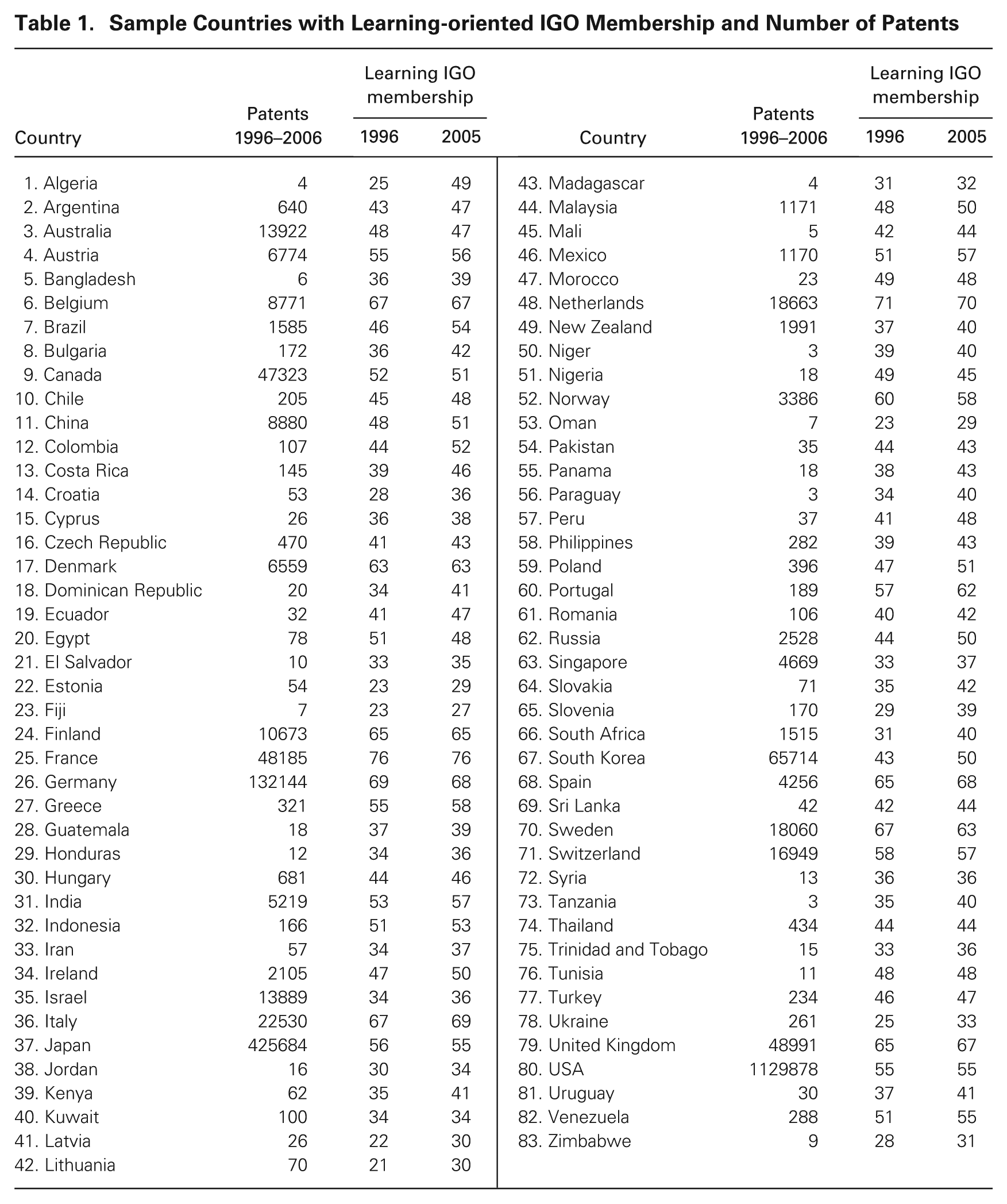
For our empirical analysis, we first created a set of all countries identified in the Correlates of War Database and collected data on their innovation by considering their successful patent applications between 1996 and 2006 under the U.S. Patent and Trademark Office (USPTO) using the Patent Network Dataverse (Lai et al., 2011). Patent documents provide information on the inventor, location, and timing of the innovation. Following extant literature (e.g., Thompson and Fox-Kean, 2005), we used the first inventor’s location (country) and the application year to assign patents to different country–year combinations. We collected additional data for our independent variables and controls from the following sources: Correlates of War Database, the Yearbook of International Organizations, the United Nations Commodity Trade Statistics database, the Fraser Institute, and the World Development Indicators. After dropping observations with missing data, our final sample consisted of 83 countries and 688 observations during the time period 1996–2006. Our level of analysis is the country-year, in which the cross-sectional unit is the country and the temporal unit one year. Table 1 lists the countries included in our sample, their patents over the sample period, and the number of learning-oriented IGO memberships by country at the start and end of our sample time period.
Sample Countries with Learning-oriented IGO Membership and Number of Patents
Dependent variable
Our analysis requires a country-specific indicator of innovation in a given year. We followed prior researchers and used the number of patent applications with first-inventor location in that country under the USPTO system (Trajtenberg, 1990; Cantwell and Hodson, 1991; Furman, Porter, and Stern, 2002), which includes innovations by domestic firms as well as local subsidiaries of multinational corporations. The shortcomings of associating patenting with the level of innovative activity are documented (e.g., Schmookler, 1966; Trajtenberg, 1990); not all inventions are patentable, not all of them are patented, and the inventions that are patented differ greatly in the quality and magnitude of inventive output associated with them. But our approach was based on the assessment that patenting activity provides “the only observable manifestation of inventive activity with a well-grounded claim for universality” (Trajtenberg, 1990: 183). We restricted our analysis to patents filed under the U.S. patent system because, as Singh (2007: 769) noted, “patents from different patent offices are not comparable with each other,” leading to difficulties in creating a standardized measure of innovation across countries. As a result, it is common practice to use data from a single patent-granting country, such as the United States (Jaffe and Trajtenberg, 2002) or the United Kingdom (Lerner, 2002). By focusing on the USPTO, we were able to identify a standardized measure of novel innovations that are at or near the global technology frontier and have potential economic value (Porter and Stern, 2001). Thus our dependent variable is a count of the number of patents with the first-inventor location in the country in a given year, t.
Independent variables
We built a time lag for the effects of our independent variables to avoid contemporaneous correlations and to account for the delayed innovation resulting from the use of linkages to access, assimilate, and utilize knowledge. Thus we measured our independent (and control) variables in year t−1.
IGO connectedness
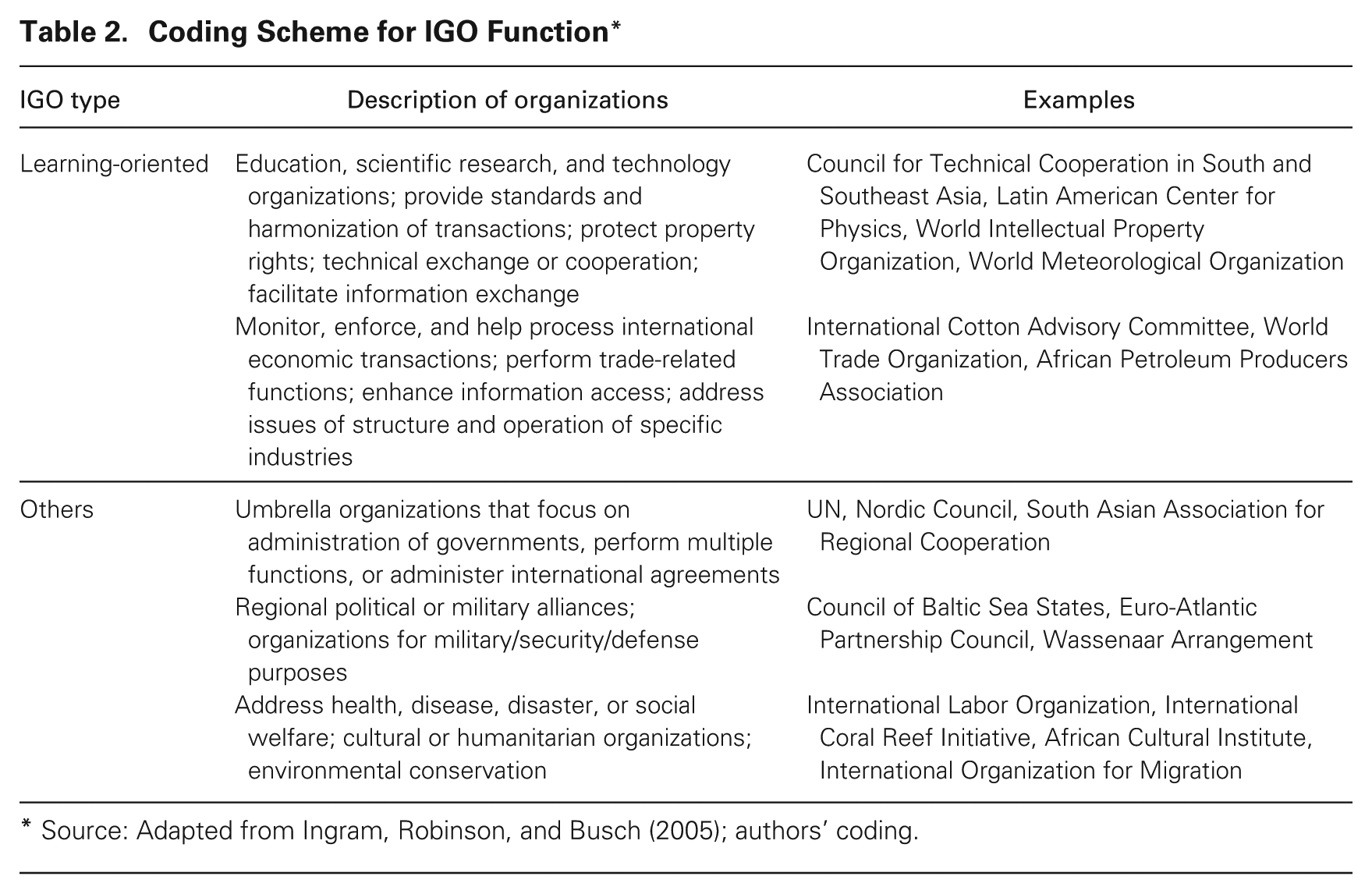
Our main independent variable is the extent of a country’s connectedness with learning-oriented IGOs. We first obtained data on all types of IGOs that a country is a member of by drawing on Pevehouse, Nordstrom, and Warnke (2004), the most extensive source on IGO memberships. By construction, these IGOs (1) include three or more members of the Correlates of War–defined state system, (2) hold regular plenary sessions (at least once in ten years), and (3) have a permanent secretariat and corresponding headquarters. Because our focus was on the subset of learning-oriented IGOs, we collected additional data on each IGO’s principal objectives/aims from the Yearbook of International Organizations. 3 We then reviewed these objectives/aims and classified IGOs as learning-oriented if they had a specific mandate for knowledge sharing and transfer, facilitating economic transactions, or enhancing information access among members. Two independent coders read the primary aims of IGOs to classify each IGO under one of the categories, with an interrater reliability of ~0.75. The coders then discussed differences to come to a consensus. Our coding scheme is shown in table 2.
Coding Scheme for IGO Function*
Source: Adapted from Ingram, Robinson, and Busch (2005); authors’ coding.
As an example, a key objective of the Council for Technical Cooperation in South and Southeast Asia is to promote technical cooperation and assist in the sharing and transfer of technology among member countries (www.colombo-plan.org). As a result, we classified this IGO as learning-oriented. Similarly, the Yearbook identified the aims of the International Institute of Refrigeration as to “Further research and promote studies on refrigeration science and technology, in refrigeration and cryogenic systems and heat pumps; [and] develop applications of refrigeration . . .” We classified it as a learning-oriented IGO because of its explicit mandate on research and development. The International Cotton Advisory Committee, which aims to foster a healthy world cotton economy, is also classified as a learning-oriented IGO as it serves as a clearinghouse for technical information about cotton and textiles while providing an objective forum for furthering international collaboration and discussion on cotton. About 58 percent of the active IGOs during the sample time period were classified as learning-oriented IGOs. Following research on IGO membership (Ingram, Robinson, and Busch, 2005; Alcacer and Ingram, 2013), we measured IGO connectedness as the natural log of the total number of active learning-oriented IGOs worldwide that a country is a member of in a given year. Our measure of IGO connectedness varied from 3.13 (= ln(23) for Latvia in 1997) to 4.39 (= ln(81) for France in 1998). On average, the number of learning-oriented IGO memberships of a country increased by 9.8 percent between 1996 and 2005.
Complementary opportunities
We follow Hausmann and Klinger (2006) in suggesting that a country’s revealed comparative advantage (RCA) in exports allows us to determine its current advantages as well as the complementary spaces. Using exports-based RCA as an indicator allows us to consider the complementarity between sectors by extending beyond broad factor endowments, a priori notions of technological sophistication, or assumptions of relatedness in knowledge domains (Makri, Hitt, and Lane, 2010). We constructed the complementary opportunities variable as a combination of a country’s (1) export advantages and (2) product spaces complementary to those in which a country has an export advantage. We built a time-varying country-level measure that incorporates these two facets based on the methodology and intuition developed by Hausmann and Klinger (2006).
We first used product-level exports data to determine the sectors in which a country has an export advantage. Based on the Standard International Trade Classification (SITC Rev.2), we obtained bilateral exports data for each of the 786 four-digit categories for all countries in the world for the time period 1996–2006 from the United Nations Commodity Trade Database. 4 For each product-country-year, we calculated whether the country had a revealed comparative advantage (Balassa, 1965) by examining the share of exports of the country for product i in relation to the share of product i in global trade.

where x(c,i,t−1) = exports of country c in the ith product in year t−1. If the RCA in the above calculation for a particular product is ≥ 1, then the share of the product in country c’s exports is equal to or larger than the average share of the product across world exports, revealing a comparative advantage for the country in that product category. In our data, the number of product categories in which a country had a revealed comparative advantage ranges from 12 (Gabon in 1997 and 2002; Algeria in 2006) to 369 (Germany in 2006).
Next, we used the product-level data of exports to determine complementarity between product pairs. 5 We followed Hausmann and Klinger (2006) to determine the complementarity between product-sector pairs by examining the likelihood that countries have revealed comparative advantages in both products of the pair. 6 For each pair generated from the 786 product categories, we calculated the complementarity between products i and j in time t−1 using the conditional probability as follows:

where for any country c,

and the conditional probability is calculated using all countries in year t−1. This conditional probability is used to determine complementarity between product pairs. For example, the category “Tube and pipe fittings, of iron and steel” has low complementarity with “Cocoa butter and paste” (proximity = .1) but higher complementarity with “Cocks, valves, for pipes, boiler shells, etc.” (proximity = .5). We built on the specification of Hausmann and Klinger (2006) to measure domestic complementary opportunities as:

This measure thus captures the complementary weighted value of all new product spaces a country could potentially expand into
Domestic coordinating mechanisms
We measured the extent to which the relations between firms and other actors rely on competitive markets by using the Economic Freedom of the World data developed by the Fraser Institute (www.freetheworld.com). In these data, economic freedom is considered to be present in a country when individuals have the freedom to enter and compete in markets, market forces coordinate voluntary transactions, and strong market-supporting institutions like property rights protection and legal enforcement exist. Of this aggregate measure, we used the Regulations subindex, which explicitly measures labor-market regulations, credit-market regulations, and business regulations on their effectiveness in promoting economic freedom. These components mirror the financial and labor-market regulations used by Hall and Soskice (2001) in their classification of countries into liberal market economies (LMEs) and coordinated market economies (CMEs) (see, e.g., their Figure 1.1) and parallel the social institutions identified by Lazonick and O’Sullivan (1996). A higher value on this measure indicates greater reliance on market mechanisms for coordination.
Comparing this measure with Hall and Soskice’s (2001) characterization demonstrates that, as expected, countries classified as CMEs (e.g., Western Europe) rank lower in the regulations index. Further, a simple t-test for the year 2000 shows that for the subsample of Organization for Economic Cooperation and Development (OECD) countries classified as LME and CME by Hall and Soskice (2001), the score on the Regulations index is significantly lower for the CME group than for the LME group (7.3 vs. 7.96)—this pattern is also replicated for the full Economic Freedom index (7.86 vs. 8.38)—indicating that our measure is an appropriate, alternate characterization of coordination mechanisms. 7 The data used to construct our measure have the added advantage of being available over a long time period and for more than 100 developed and developing countries. 8
Control variables
We used additional data from the World Development Indicators, the USPTO, and the U.N. Conference on Trade and Development (UNCTAD) to include several control variables in our estimation. Prior research has established the influence of domestic innovation infrastructure (Bartholomew, 1997), and we captured this influence using three related measures. We first included a country’s GDP per capita at year t−1 as a broad proxy for its innovation infrastructure (Furman, Porter, and Stern, 2002). We expected this variable to capture several dimensions, including the level of human and capital resources devoted to innovative activity, and other resource commitments supporting innovation such as R&D expenditure. 9 The data also allowed us to capture minor innovations and adaptations, which may not be patentable but nonetheless account for the bulk of innovative activity, especially in developing countries (Fagerberg and Srholec, 2008). Second, we also followed Furman, Porter, and Stern (2002) and included an additional control of prior innovative activity in the country, stock of national patents, measured as the number of patents applied for by inventors located in the country in the five years prior to the year of observation. Third, we controlled for a country’s population—ln(population) in year t−1—because this indicates the scale of workers potentially available for innovative activity (Furman, Porter, and Stern, 2002). 10
Next, we controlled for a country’s property rights protection, as it has been shown to have an impact on innovative activity (e.g., Chen and Puttitanun, 2005). Because democratic countries provide better guarantees for property rights (Olson, 1993; Li and Resnick, 2003; Alcacer and Ingram, 2013), we included a country’s regime type in year t−1 based on the Polity IV data set (Jaggers and Gurr, 1995), a 21-point index that ranges from 10 for the most democratic states to −10 for the most autocratic states.
We controlled for a country’s economic structure and activity in several ways. First, we controlled for the growth rate of the economy, as fast-growing countries may be more likely to produce new innovations (Fagerberg, 1994). Thus we included the country’s GDP annual growth rate at year t−1. We controlled for a country’s relative openness to international trade by including a measure of trade as a percentage of national GDP in year t−1. Several studies have indicated the potential for knowledge transfer to occur through spillover effects of foreign investment (for a review, see Hoekman and Javorcik, 2006). Thus we included a control that measures a country’s inward FDI as percentage of national GDP at year t−1. We controlled for a country’s propensity to file patents under the U.S. patent system by including a measure of export dependence, calculated as the log of a country’s share of exports to the U.S. in year t−1. 11 We also controlled for the extent to which a country’s economy is concentrated among a few corporate actors by including the patent concentration index, which represents the percentage of patents filed by the top three firms in a country. In addition to the above controls, we included a country’s connectedness to other international institutions, measured as the number of bilateral investment treaties that the country has signed and ratified.
Estimation Methods
Our dependent variable is a non-negative integer of the number of ultimately granted patents to inventors of a country that were applied for in a given year. This variable also exhibits overdispersion, with the variance exceeding the mean, as observations range from zero to thousands. The appropriate model for count data characterized by overdispersion is the negative binomial (Hausman, Hall, and Griliches, 1984; Cameron and Trivedi, 1998). We therefore present our results using negative binomial regression. We have panel data involving repeated observations of our set of countries over time, so there may be time-invariant, unobservable country-level factors as well as time trends that influence the innovation process. Thus we present our results with a fixed-effects specification that includes country- and year-fixed effects. 12 To fit our data to the conditional fixed-effects negative binomial model, we used the xtnbreg command in Stata with the fe option. As Allison and Waterman (2002) indicated, however, this may not control for all stable predictors. Thus we also report our results using alternate fixed-effects specifications in our robustness tests.
Results
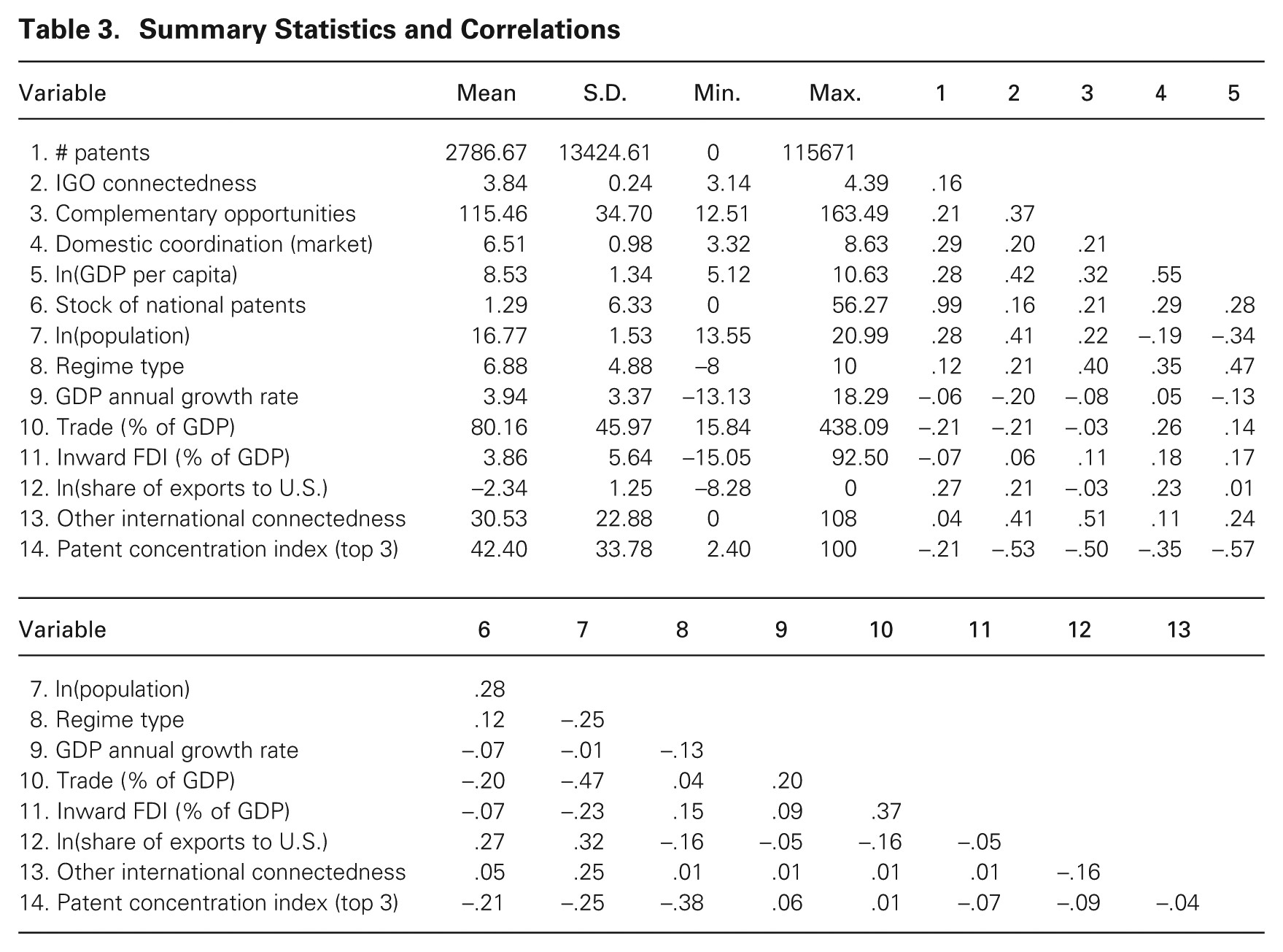
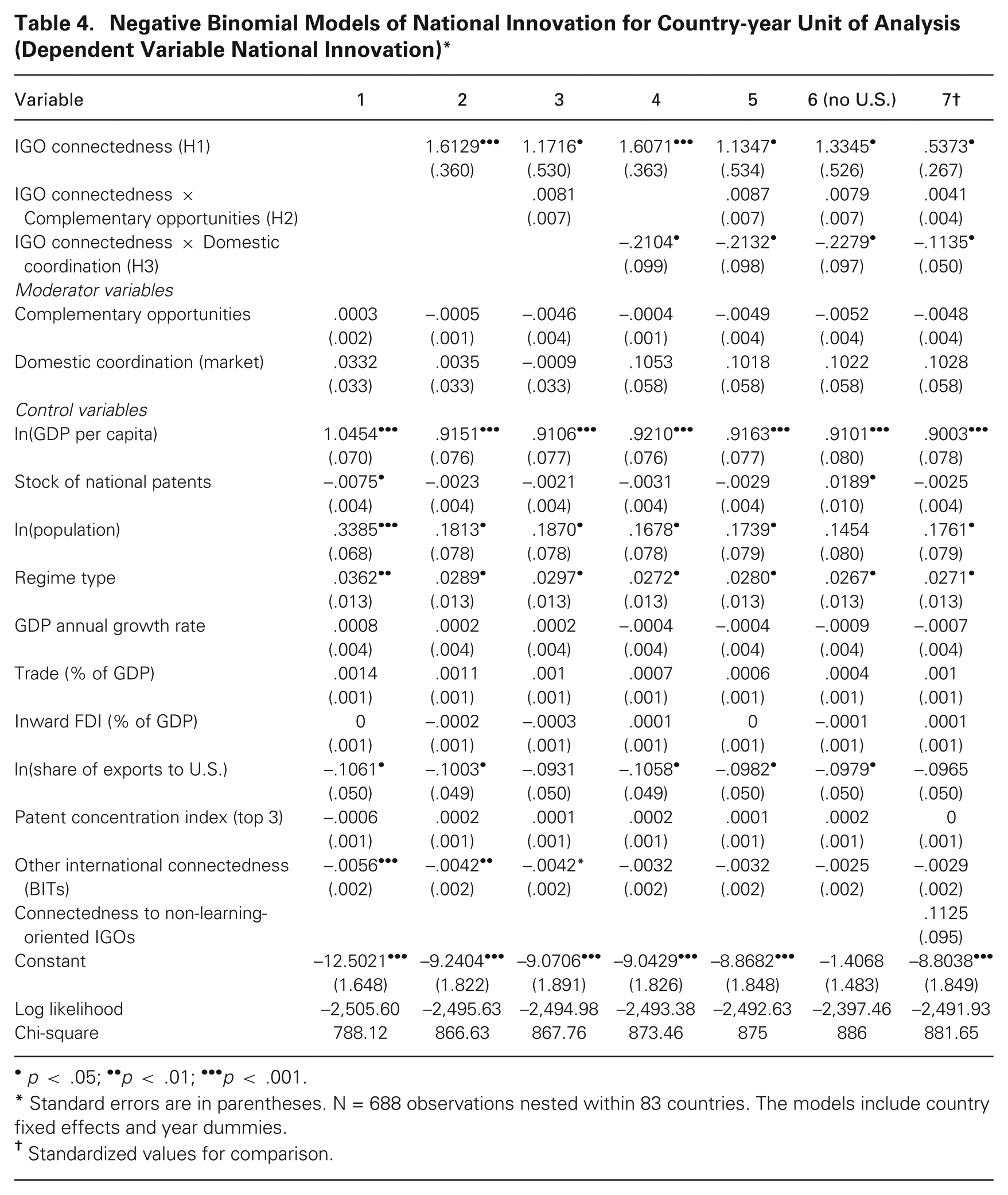
Table 3 presents the summary and correlation statistics for the variables used in the estimation, and the main results are reported in table 4.
Summary Statistics and Correlations
Negative Binomial Models of National Innovation for Country-year Unit of Analysis (Dependent Variable National Innovation)*
p < .05;
Standard errors are in parentheses. N = 688 observations nested within 83 countries. The models include country fixed effects and year dummies.
Standardized values for comparison.
Model 1 includes all the control variables, and our main hypotheses are tested in models 2–5. Given that the number of patents awarded to inventors in the U.S. is more than double those of the next highest country (Japan) and orders of magnitude greater than the countries with the smallest number of patents in our sample (e.g., Ivory Coast), in model 6 we dropped the U.S. from the sample. Model 7 includes both a country’s learning-oriented IGO connectedness and other IGO connectedness, although they are highly correlated. The results support our predictions on the role of IGOs in innovation.
We first examined the coefficient for our IGO connectedness measure. We found the coefficient of this variable to be positive and significant in model 2, suggesting that the number of patents filed in a country increased significantly with the extent of its connectedness to learning-oriented IGOs. An analysis of the coefficient reveals that a one-standard-deviation increase in the IGO membership measure (corresponding to approximately 12 additional IGOs, or going from Pakistan’s level of connectedness to India’s) and holding all other variables at their mean values results in a 15-percent increase in the number of patents. 13 For example, a one-standard-deviation increase in level of connectedness corresponds to approximately 60 additional patents per year for Spain or 17 additional patents a year for Mexico. Thus we find support for hypothesis 1.
We next turn to the moderating effect of complementary opportunities on the relationship between IGO connectedness and innovation. The interaction of IGO connectedness and complementary opportunities is positive but not significant in any of our models, so we do not find support for hypothesis 2. The lack of significance may be due to the presence of an opposing mechanism related to knowledge redundancy. If the potential for knowledge absorption and innovation is in areas related to current strengths, then it is possible that external knowledge from IGOs may be redundant and thus less valuable. 14
We next examined the moderating effect of domestic coordination mechanisms on the relationship between IGO connectedness and innovation. The coefficient on the interaction term between IGO connectedness and market-based domestic coordination mechanisms is negative and significant in models 4–7. Following Brambor, Clark, and Golder (2006), we calculated the marginal effect of IGO connectedness and the corresponding standard errors for different levels of domestic coordination mechanisms to infer the magnitude and significance of the interaction effect. We found the average marginal effect of IGO connectedness to be smaller as market-based domestic coordination mechanisms increase, and the effect is significant across the entire range of the sample. We graph this effect, along with the 95-percent confidence intervals, in figure 1. We also compared the magnitude of the interaction effect at different levels of domestic coordination mechanisms. A one-standard-deviation increase in the IGO connectedness measure (model 4, holding all other variables, including domestic coordination, at their mean values) results in an increase in innovation of approximately 14 percent. But a similar one-standard-deviation increase in the IGO connectedness measure when the market-based domestic coordination measure is high (1 standard deviation above the mean for domestic coordination, other variables at mean values) results in an increase in innovation of approximately 12 percent. These results provide support for hypothesis 3, indicating that the effect of IGO connectedness on innovation is weaker at higher levels of market-based domestic coordination.
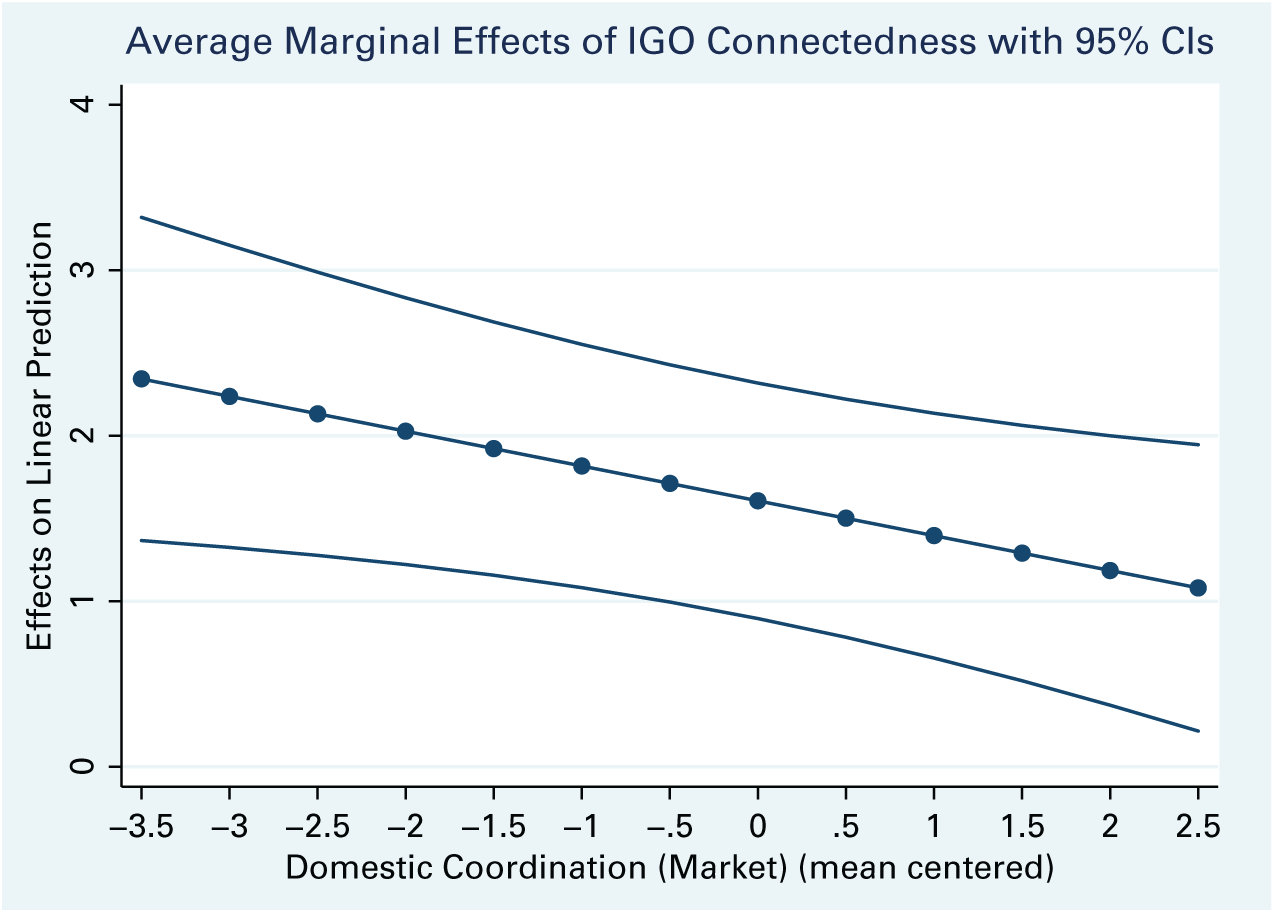
Interaction effect of IGO connectedness and domestic coordination (market) based on model 4 of table 4.
Our results are robust to dropping the U.S.—the country with the largest number of patents—from our sample countries (model 6). In model 7, we included learning-oriented and other IGOs. 15 We found that the coefficient of connectedness to non-learning-oriented IGOs is not significant, while that of learning-oriented IGOs remains positive and significant.
Examining the control variables, we found that they operate as expected, with GDP per capita, population, and regime type consistently and positively influencing innovation. Trade dependence with the U.S. has a negative effect. Also notable is that the coefficient of other international connectedness through bilateral investment treaties is not positive, suggesting that it is not merely international engagement that is driving our main results.
Robustness Tests
We conducted a series of tests to check the validity of our results, including endogeneity checks, different modeling specifications, and other robustness tests, none of which change our reported results. Online Appendix B describes the tests we conducted and the results we obtained.
Discussion and Conclusions
In spite of the recent wave of globalization, challenges to cross-border knowledge transfer persist, with long-term divergence across countries (Berry, Guillén, and Hendi, 2014). As cross-border knowledge transfers are important for innovation, research has emphasized enablers of such transfers, with a focus on the multinational firm (Hamel, 1991; Kogut and Zander, 1992). There is little consensus in the literature, however, about the role played by nonmarket organizations. They appear to be viewed as creating institutional barriers to cross-border knowledge transfer (Nelson, 1993; Kostova, 1999), yet there is substantial evidence of their role in facilitating knowledge transfer for innovation in the domestic context (Lynn, Mohan Reddy, and Aram, 1996; Mowery and Ziedonis, 2001; Perez-Aleman, 2011). We integrated these ideas and theorized that nonmarket organizations that span international boundaries play an important role in enabling cross-border knowledge transfer by overcoming regulatory, normative, and cognitive challenges associated with cross-border knowledge exchanges, and thus have a powerful influence on national innovation.
Our analysis identified the positive effect of participation in IGOs on a country’s innovation, demonstrating a greater geographic reach of nonmarket organizations than previously documented. This insight helps us explain why other alternatives for international engagement may be less effective in promoting cross-border knowledge transfer and innovation. Each of these alternatives offers some of the benefits conferred by IGOs; for example, trade and investment encourage interactions among economic participants, and international treaties demonstrate government actors’ participation in the world polity. But unlike learning-oriented IGOs, in general they do not deliberately and purposefully engage in knowledge sharing and development across multiple constituencies of the member countries. The international engagement by multiple actors from a country supported by the cross-country convergence of rules and an overarching organizational form promoting common norms among participants can facilitate innovation through cross-border knowledge transfer.
Our research also demonstrates boundary conditions associated with the effects of nonmarket organizations. Domestic economic and institutional characteristics that influence the extent to which knowledge acquired through these organizations is leveraged for innovation moderate the relationship. Our findings that market-based domestic coordination mechanisms weaken this relationship suggest that domestic characteristics condition the benefits that countries can get from IGO participation.
We also contribute to the debate in the IGO literature about their effectiveness. On the one hand, IGOs are characterized as epiphenomenal (Mearsheimer, 1994) and lacking legitimacy (Zweifel, 2006), while on the other hand they are deemed to have an influence on important outcomes related to international economic transactions (Ingram, Robinson, and Busch, 2005; Alcacer and Ingram, 2013) and interstate conflict (Mansfield and Pevehouse, 2000). Our study provides support for the second line of thought, demonstrating that IGOs have a significant influence on another outcome, cross-border knowledge transfers and innovation, and help overcome the institutional barriers to cross-border knowledge transfers.
Though our analysis sheds light on national innovation, some limitations in the current study offer opportunities for further examination. Our study examines one type of nonmarket organization, the IGO. Because these organizations take on a variety of forms, future research could explore the effects of other types of nonmarket organizations. We do not account for the structure of the IGO, the nature and extent of interaction it enables, or the capabilities of the other members in those IGOs. IGOs with organizational structures that enable control, compliance, and membership may be more effective. Similarly, those that enable more frequent interactions through meetings and conferences or involve more technologically capable members are likely to increase innovation to a greater extent. Given that IGO records are not always public and are poorly maintained, in-depth analysis combining qualitative and quantitative methods for a small sample of IGOs may lead to interesting insights.
A more focused sample could also allow us to explore in greater detail the mechanism by which complementary opportunities may play a role. Though our empirical results do not provide support for the role of complementary opportunities in knowledge transfer, this finding may result from the aggregation of complementary opportunities to the national level. By disaggregating a country’s patents into those that are related to the complementary sectors and those that are not, we could conduct a more detailed test. But this disaggregation poses several data challenges. Mapping the correspondence among patent classes, industries, and complementary sectors requires not just expertise in the different industries (for instance, to map patent classes to industries) but also a large data collection effort across millions of patents. By restricting our sample to one country, we could construct a disaggregated dependent variable that allows for more specific testing.
Our study assumes that all entities in the country benefit from IGO participation, but the extent to which participants gain from the IGOs may differ. For example, there may be differential effects for public and private actors. To address this issue, we used the USPTO characterization of assignee codes to distinguish between innovation by public and private entities in a country. Unfortunately our data revealed very few instances of public innovation for countries other than the U.S. A future study with different measures of innovation could delve into this issue. Another case of variable gains could be among the different participants of IGO-sponsored activities. For instance, a government agency may participate in a plenary or budget meeting, while firms and research institutions from member countries may participate in a technical or research meeting. Though collecting data for participants in each meeting conducted by the IGOs is challenging, such an extension would help to decipher the exact mechanisms of learning.
Although our study posited that IGOs influence national innovation by overcoming difficulties of cross-border knowledge transfer, we did not empirically test the intermediate step. Our focus on innovation represents the outcome of knowledge transfers, as patents represent the transfer and application of both tacit and articulated knowledge (Almeida, Song, and Grant, 2002) that is vulnerable to issues of cross-border transfers. A future empirical study could focus on this mechanism in more detail and tease out potential mediating effects. IGO participation can lead to increased trade and investment, which may, in turn, facilitate greater innovation.
We also used patent data from the USPTO to examine innovations generated by other countries. But not all foreign innovations are patented in the U.S., and foreign patents filed under the USPTO system reflect only substantial innovations or those that have more than local significance (Qian, 2007). An interesting extension of our study would be an evaluation of national innovation by considering patents filed under domestic systems.
Finally, extending our findings on IGO connectedness to incorporate the network structure of world polity would also lead to greater insights. Just as the ability to draw on high-quality ideas and practices from far-flung sources offers an innovative boost to participants in a global interorganizational network (Whittington, Owen-Smith, and Powell, 2009), IGO networks offer an impetus for national innovation. Understanding the structure of the IGO network and its evolution would improve our understanding of how knowledge and information flow across countries.
Footnotes
Acknowledgements
We are grateful to the International Business Department, Business School, and Sigur Center for Asian Studies at George Washington University for research support and to Witold Henisz, Danny Leipziger, Jennifer Spencer, ASQ Associate Editor Mauro Guillén and the anonymous reviewers, and seminar/conference participants at George Washington University, INSEAD, ESSEC Business School, and the Academy of International Business for comments on earlier drafts of this paper. We also thank Kumar Vemuri and Ganesh Redkar for assistance with computer programming and data construction.
1
Developed countries typically have a larger set of complementary opportunities, while less economically developed countries have a much smaller set. But there are large differences even within developed or developing countries. For instance, in our sample, the complementary opportunities score based on the revealed competitive advantage for Norway and the U.S.—two developed countries—was 65 and 163, respectively, in 2005. In contrast, the score for Brazil and Venezuela—two developing countries—was 142 and 28, respectively, in the same year.
2
Saudi Aramco (http://www.spe.org/jpt/article/6455-saudi-aramcos-carbon-management-program/), Chevron (http://www.lngworldnews.com/chevron-recognised-on-world-stage-for-gorgon-project’s-carbon-dioxide-injection-plans-australia/), and E.ON and GDF Suez ( ), accessed August 14, 2014.
3
In cases in which this information was not available in the Yearbook, we supplemented it with information from the IGO website.
4
5
We used data across all countries in the world and did not restrict this to our sample countries.
6
The idea of complementarity also resonates with the measurement of relatedness among a firm’s businesses (corporate coherence) developed by . In particular, they noted that activities that are more related will be more frequently combined within the same firm. If a firm engaging in activity A almost always engages in activity B, they expect the activities to be highly related.
7
The commonly used characterization of domestic coordinating mechanisms by distinguishing between LMEs and CMEs developed by Hall and Soskice (2001) poses two challenges for our study. First, this classification has been developed both theoretically and empirically for a small subset of developed countries, about 20 members of the OECD. Although there are some extensions of this work for Latin America (e.g., Schneider, 2009), Eastern Europe (Nölke and Vliegenthart, 2009), and Central Asia (Drahokoupil and Myant, 2010), these studies typically use a case method and/or focus on only a few countries at a time. Thus for our study, with 83 OECD and non-OECD countries, developing such a measure is challenging. Second, the measures of LMEs and CMEs are generally static and do not reflect periodic policy changes within countries.
8
The data are available from 1970 to 2012. They are reported yearly from 2001 onward but only in five-year intervals during 1970–2000. In our analysis, we used the interpolated values for the time period 1996–2000.
9
The quality of data on measures of human, capital, and R&D resources tends to be poor outside of the OECD countries in addition to being highly correlated with the GDP-per-capita measure. We collected data on national R&D expenditure and found that it is correlated at 0.77 with GDP per capita. Thus we do not include this measure in our main specifications.
10
Our results are robust to including an additional labor market variable: percentage of the total labor force with tertiary education. But missing data decrease our sample size by about 45 percent.
11
For the U.S., this variable is assigned a value of 1.
12
A Hausman test confirms a fixed-effect model is the appropriate specification.
13
In comparison, Furman, Porter, and Stern (2002) found that a 10-percent increase in GDP is associated with about a 10-percent rise in patents.
14
We thank an anonymous reviewer for this suggestion.
15
While our results are robust to including non-learning IGOs in the model, a country’s connectedness with learning and non-learning IGOs is highly correlated. In addition, some of the IGOs classified as non-learning-oriented based on their primary objectives may still have some divisions devoted to learning-oriented activities. For example, we classified the World Health Organization (WHO) as non-learning-oriented as its primary aims include a leadership role in public health and well-being, developing a health administration network, and strengthening health services. But the WHO also devotes some resources to R&D and organizes scientific workshops and meetings.
Authors’ Biographies
References
Supplementary Material
Please find the following supplemental material available below.
For Open Access articles published under a Creative Commons License, all supplemental material carries the same license as the article it is associated with.
For non-Open Access articles published, all supplemental material carries a non-exclusive license, and permission requests for re-use of supplemental material or any part of supplemental material shall be sent directly to the copyright owner as specified in the copyright notice associated with the article.
