




Abstract
This study investigates the origins of variation in the structures of interorganizational networks across industries. We combine empirical analyses of existing interorganizational networks in six industries with an agent-based simulation model of network emergence. Using data on technology partnerships from 1983 to 1999 between firms in the automotive, biotechnology and pharmaceuticals, chemicals, microelectronics, new materials, and telecommunications industries, we find that differences in technological dynamism across industries and the concomitant demands for value creation engender variations in firms’ collaborative behaviors. On average, firms in technologically dynamic industries pursue more-open ego networks, which fosters access to new and diverse resources that help sustain continuous innovation. In contrast, firms in technologically stable industries on average pursue more-closed ego networks, which fosters reliable collaboration and helps preserve existing resources. We show that because of the observed cross-industry differences in firms’ collaborative behaviors, the emergent industry-wide networks take on distinct structural forms. Technologically stable industries feature clan networks, characterized by low network connectedness and rather strong community structures. Technologically dynamic industries feature community networks, characterized by high network connectedness and medium-to-strong community structures. Convention networks, which feature high network connectedness and weak community structures, were not evident among the empirical networks we examined. Taken together, our findings advance an environmental contingency theory of network formation, which proposes a close association between the characteristics of actors’ environment and the processes of network formation among actors.
Studies investigating how social structure shapes the behaviors and outcomes of actors constitute a vibrant area of organizational research. Prior work on the social structures of corporate actors has indicated that the structure of an interorganizational network helps explain a range of collective outcomes of organizations, such as the diffusion of norms, knowledge, or other resources (Rogers, 2003; Uzzi and Spiro, 2005). Furthermore, recent studies have suggested that networks in different interorganizational settings often show distinct structural properties. For example, studies of partnership networks among firms have demonstrated that the industry-wide structures of these networks differ across industries on a number of important dimensions (Rosenkopf and Schilling, 2007). Yet despite mounting evidence that the variations in industry-wide networks help explain firms’ collective outcomes, there are limited insights regarding why interorganizational networks vary across different industrial contexts. Without a systematic understanding of the antecedents of variation in industry-wide network structures, it may be difficult to link the properties of these networks to the collective outcomes they engender for firms in different industries.
In this paper, we examine the industry-wide networks of technology partnerships among firms and explore why their structural properties differ across industries. Industry-wide networks represent the interlinked structures of firms’ ego networks (i.e., the focal firm and its contacts, as well as the connections among the contacts) and thus capture the overall system of firms and their partnership ties in a given industry. Networks of technology partnerships are critical for the transfer of knowledge and resources among organizations, and they have been shown to affect a range of private and collective outcomes (e.g., Owen-Smith and Powell, 2004). Furthermore, partnership networks constitute a highly dynamic setting in which firms constantly reshape their ties due to the economic imperatives of value creation. These dynamics have been demonstrated as highly consequential for the emergent industry-wide network structures (Powell et al., 2005).
We seek to advance existing theory by exploring whether and to what extent variations in firms’ collaborative behaviors across industries help explain the variation in industry-wide networks. We thus aim to understand why and how firms’ collaborative behaviors differ across industries and whether these differences sufficiently explain the emergence of distinct industry-wide networks. We accomplish these interrelated goals by conducting two studies. In the first study, we examine whether the differences in demands for value creation lead to a significant variation in the collaborative behaviors of firms across six industries. Although a range of behaviors can characterize the formation of interorganizational systems, we focus on those behaviors that have received particular attention in the past, specifically, how firms pursue either closed or open ego networks. Pursuing a closed ego network entails forming ties to partners that are connected to one another, while pursuing an open ego network involves forming ties to partners that are not connected (Burt, 1992).
Building on prior findings on the contribution of open and closed ego networks to firm advantages across different industrial contexts (Rowley, Behrens, and Krackhardt, 2000), our first study postulates that firms’ collaborative behaviors are associated with the requirements of value creation imposed by the technological regime of an industry, in particular, its technological dynamism, which reflects the extent to which resident firms emphasize investments in research and development (R&D) (Chan, Lakonishok, and Sougiannis, 2001). In technologically dynamic industries firms are apt to be driven to pursue more diverse resources and knowledge as critical inputs to innovation, and doing so should be best enabled by open ego network structures. In contrast, in technologically stable industries firms should be driven to preserve their existing resources and ensure reliable cooperation, which are best enabled by closed ego network structures. We anticipate that, on average, firms in technologically dynamic industries will display stronger tendencies toward open ego networks than those in technologically stable industries. We test these arguments using a longitudinal dataset on the formation of interfirm R&D partnerships in six industries from 1983 to 1999, which covers a wide range of industrial environments characterized by a varying emphasis on R&D, including the automotive industry, biotechnology and pharmaceuticals, chemicals, microelectronics, new materials, and telecommunications.
In the second study, we construct an agent-based model of network emergence to examine whether the variation in firm-level behaviors is sufficient to explain the structural differences in industry-wide networks. The model operates under the conditions of varying technological dynamism across different industrial contexts. This feature helps us determine whether, in the presence of other forces driving interfirm ties, the variation in firms’ collaborative behaviors along the continuum of closed to open ego networks explains the emergence of distinct industry-wide network properties. The agent-based model positions us to better address the aggregate complexity of firms’ interactions, which may be complicated by varying collaborative preferences of firms as well as by possible exogenous perturbations. This approach is particularly fruitful because industry-wide networks represent highly dynamic systems that are shaped by the interactions among multiple firms. Such systems exhibit aggregate properties that cannot be predicted from the behaviors of individual firms. Moreover, the processes by which these networks form may be nonlinear, thus obscuring the link between micro-level behaviors and macro-level structures (Skvoretz, 2002; Davis, Eisenhardt, and Bingham, 2009). In addition, this approach allows us to capture the overall variation in network forms by offering a general typology of interorganizational systems in relation to their environment.
Study 1: Technological Dynamism and the Formation of Interorganizational Ties
A key insight from prior studies of complex social systems is that interactions among individual actors as they form new network ties are critical in shaping the properties of the emergent social system (Coleman, 1990). This general insight implies that depending on how individual firms form their collaborative ties with partners, different industry-wide networks may emerge. Admittedly, in forming new partnership ties firms may exhibit a range of behaviors. Yet recent research indicates that one of the central differentiators is the extent to which firms pursue either more-closed or more-open ego networks (Li and Rowley, 2002; Rosenkopf and Padula, 2008; Ahuja, Polidoro, and Mitchell, 2009; Sytch, Tatarynowicz, and Gulati, 2012). A closed ego network results when a firm forms ties to the partners of its current partners, while an open ego network results when a firm forms ties to alters that are unconnected to its current partners.
A particularly intriguing insight into the formation of closed and open ego networks is that they may be driven by fundamentally different strategic motivations on the part of firms. Pursuing closed ego networks has been linked to ensuring reliable collaboration and preserving existing resources. Because information on other firms is distributed imperfectly and the costs of partner search and selection are high, firms often prefer to connect to alters about whom they can obtain private information through shared third-party ties (Gulati, 1995). Furthermore, having a third party in common begets a situation in which the two partners do not necessarily bear the full costs of the partnership. A common third party may offer effective recourse in conflict situations and protection against opportunistic pursuits (Larson, 1992). Finally, by enabling quick diffusion of reputational insights, closed ego networks can make it costly for partners to engage in self-seeking behaviors to the detriment of the focal firm (Greif, 1989; Ahuja, 2000). These features of closed ego networks can make them particularly effective in ensuring reliable collaboration and minimizing the transaction costs of partnering.
In contrast, the central motivation for pursuing open ego networks is that such structures enable more-entrepreneurial firms to acquire diverse information, knowledge, and resources (Burt, 1992). Alters that are not connected to one another are believed to represent distinct network regions with diverse technical knowledge and information endowments (Sytch and Tatarynowicz, 2014a). Firms’ innovation activities often entail recombining existing knowledge elements (Schumpeter, 1934), and open networks can enable firms to leverage such diversity to pursue superior innovation outcomes. This access to diverse information is largely unavailable to firms in closed ego networks because ties between similar firms (Powell et al., 2005; Ahuja, Polidoro, and Mitchell, 2009) and the increased knowledge and information sharing among densely interconnected firms (Lazer and Friedman, 2007; Gulati, Sytch, and Tatarynowicz, 2012) typically result in greater homogeneity of the available knowledge and information pools.
Given the fundamental tradeoff between the benefits and costs of closed and open ego networks, we expect that firms’ collaborative behaviors may vary depending on the environmental requirements for value creation. It is possible that slow-paced and technologically stable industrial settings in which firms focus on the preservation and incremental growth of the existing resource base will tend to engender more-closed ego networks. In such industries, closed ego networks may help ensure collaborative continuity via high levels of trust and reputational lock-ins, both of which can help firms preserve their existing resources. In contrast, firms in technologically dynamic industries may lean toward more-open ego networks in which opportunities to leverage heterogeneous knowledge from diverse partners may outweigh the benefits of resource preservation. This argument builds in part on the work of Rowley, Behrens, and Krackhardt (2000), who showed that closed ego networks provide greater performance benefits in the rather slow-paced steel industry than in the more dynamic semiconductor industry, which is characterized by significantly greater innovation demands.
Three points are worth noting with respect to this argument. First, to distinguish between closed and open ego networks, firms need not necessarily act as astute networkers. Instead of tracing their own network position or that of a potential partner, organizational agents may select partners based on the demands for value creation imposed by their industry. For example, in highly dynamic industries with innovation at the core of competitive advantage, firms may be driven to select partners who can provide unique and diverse skills, knowledge, and resources. Organizational agents may identify such partners by monitoring other firms’ innovation activities, including new product announcements and patent grants. As firms reach out to partners with distinct technological profiles, particularly those that reside in more distant parts of the network relative to their existing contacts, they may eventually form more-open ego networks.
Less technologically dynamic industries, in contrast, may drive firms to emphasize lower transaction costs and the preservation of existing resources while downplaying the potential rewards of continuous innovation. Under these conditions, a key criterion for partner selection may be the moral hazard that comes along with a new partnership. A potential partner’s reliability, in turn, may be easily gauged based on information provided by a firm’s existing or past contacts. Sharing a third-party connection with a potential collaborator can thus provide assurance of reliable collaboration through both thorough selection and a reputational lock-in; furthermore, parties can reasonably expect the common contact to act as a mediator in emerging disputes (Black, 1976), precluding the escalation of conflict and further reducing transaction costs. These motivations may drive firms in industries characterized by stable technological regimes into closed ego networks.
Second, our argument concentrates on firms’ average tendencies to form open or closed ego networks across industries, and we naturally examine the entire spectrum of firms’ collaborative behaviors and the resulting ego-network positions. We thus do not rule out the possibility of encountering firms with hybrid network positions combining both closed and open ego-network behaviors (Sytch, Tatarynowicz, and Gulati, 2012). Third, it is important to note that our argument about how firms’ collaborative behaviors vary across different industrial contexts focuses on (a) capturing firms’ average tendencies toward open or closed ego networks in a given industry and (b) comparing those average tendencies across industries. Accordingly, we expect that the collaborative behaviors of individual firms may vary both within a given industry and over time, and we incorporate such firm-level heterogeneities in our analysis. That said, we anticipate that the differences in firms’ average behaviors across industries should be associated with the cross-industry variations in technological regimes. The arguments advanced above lead us to formulate the following hypothesis:
Data
To test hypothesis 1, we used data on the technology partnerships between firms in the automotive, biotechnology and pharmaceuticals, chemicals, microelectronics, new materials, and telecommunications industries. The breadth of our sample allowed us to capture significant variation in technological dynamism across industries and thus positioned us to examine whether and to what extent this variation could explain differences in the collaborative behaviors of firms. To examine firms’ collaborative behaviors, we traced interfirm partnerships formed between 1983 and 1999 in each industry in our sample. Because collaborative partnerships were rare before 1980 (Hagedoorn, 1996), focusing on this period enabled us to provide a detailed account of the collaborative history of each industry. We obtained partnership data from the MERIT–CATI database, which is among the most well-established and frequently used sources of empirical data on technology partnerships (e.g., Hagedoorn, 1993; Gulati, 1995; Gomes-Casseres, Hagedoorn, and Jaffe, 2006). This database tracks a broad range of partnerships that entail knowledge exchange and development of new products or technologies, including joint ventures, contractual agreements, R&D consortia, and licensing deals (Rosenkopf and Schilling, 2007). Our data included 8,810 distinct technology partnerships formed by 4,400 firms.
From these data, we reconstructed the industry-wide structures of partnership networks using standard empirical procedures. More than 95 percent of partnerships in our data were bilateral, and we treated them accordingly as dyadic relationships. We decomposed the remaining multilateral partnerships into sets of dyadic ties (Stuart, 1998). Because information on partnership terminations was limited, we built on prior work that suggested that interorganizational partnerships last an average of five years (e.g., Kogut, 1988a; Gulati and Gargiulo, 1999; Stuart, 2000; Lavie and Rosenkopf, 2006). To reproduce the evolution of each interorganizational system in our data from 1987 to 1999, we thus reconstructed 13 annual network structures for each of the six industries. 1
Measures
Dependent variable: Closed vs. open ego networks
To differentiate between closed and open ego networks, we relied on Burt’s (1992) measure of ego-network constraint, defined as
Using this measure, we constructed two complementary sets of dependent variables. First, we estimated how likely an average firm is to pursue a more-open (versus a more-closed) ego network. In measuring these behaviors, we focused only on those firms that formed at least one new partnership in any given year. Doing so enabled us to get closer to capturing the agency of the focal firm, in contrast to the changes in ego networks that could be the result of new partnerships not involving ego (Sytch, Tatarynowicz, and Gulati, 2012). For each of these firms, we first estimated the probability of forming a more-open ego network in any year (pi). Figure 1 demonstrates this procedure. Suppose that from t = 0 to t = 3, firm A increased its constraint twice (from t = 0 to t = 1, and from t = 1 to t = 2) and lowered it once (from t = 2 to t = 3). This means that A’s propensity to form a more-open ego network was pA = (0 + 0 + 1)/3 = 0.33. Using the same approach, we estimated B’s and C’s propensities as pB = 0.66 and pC = 0, respectively. We then checked the distribution of pi values for firms in each industry against a number of commonly known distribution functions. The results indicated that the best fit is provided by using two discrete parameters: (a) the fraction of firms with zero probability of forming open ego networks at any time (fracp=0) and (b) the average probability that the remaining firms will form open ego networks (p).
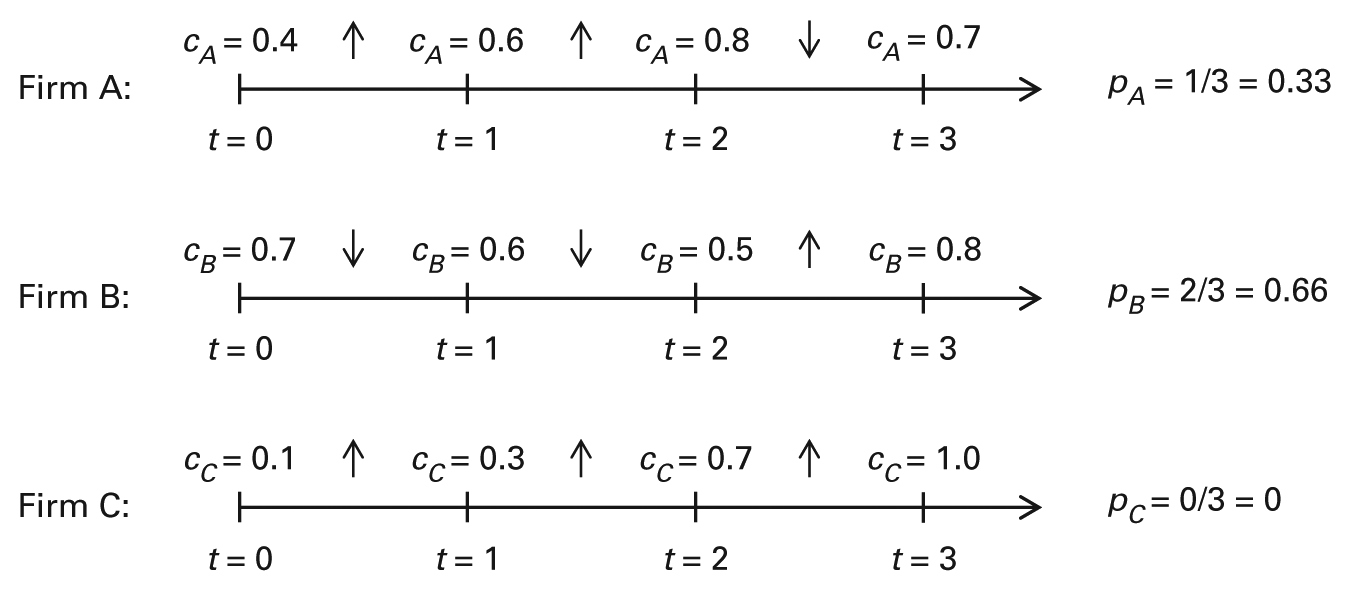
Firm’s propensity to pursue a more-open ego network.
Second, we specified a time-variant firm-level dependent variable constraint change, defined as ci,t–ci,t+1, in which ci,t and ci,t+1 denote the focal firm’s ego-network constraint in years t and t+1, respectively. A positive value indicated the pursuit of a more-open ego network, whereas a negative value indicated the pursuit of a more-closed ego network.
Independent variable
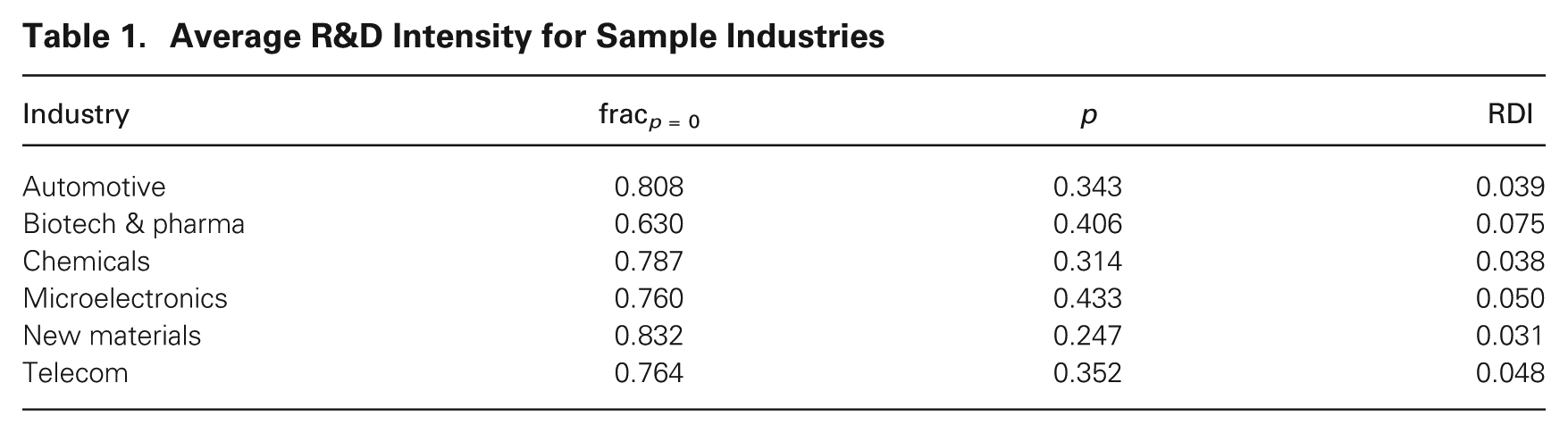
The central independent variable of interest was industry-level RDI, defined as the R&D intensity of a focal firm’s industry in year t. In line with prior research, we used this index to estimate the technological dynamism of each industry in our sample (Chan, Lakonishok, and Sougiannis, 2001). The index was specified as firms’ aggregate R&D spending per year divided by firms’ total assets. Extant research indicates that technologically dynamic industries should exhibit higher levels of RDI because their competitive dynamics are largely driven by innovation and technological change (Chan, Lakonishok, and Sougiannis, 2001; Rosenkopf and Schilling, 2007). We obtained data on firms’ R&D spending from COMPUSTAT and Orbis. Table 1 shows the average RDI measured for each of the six industries along with the fraction of firms with zero propensity for open ego networks (fracp=0) and the average propensity of the remaining firms to create open networks (p). The values indicate noticeable differences in technological dynamism across the six industries. 2
Average R&D Intensity for Sample Industries
Control variables
We controlled for a range of other possible determinants of a firm’s collaborative behavior, all lagged by one year with respect to the dependent variable. We first included a control for industry maturity, defined as the five-year average yearly growth rate in the number of firms in an industry. We specified this variable as

where y = t is the focal year and ny is the total number of firms operating in the industry in year y (cf. Klepper and Graddy, 1990; McGahan and Silverman, 2001). Lower growth rates generally characterize mature industries facing diminishing market opportunities and growing consolidation. In contrast, higher rates are typically associated with younger industries. We obtained the yearly counts of firms by industry from the CRSP database. Second, we controlled for the competitive intensity of an industry using the Herfindahl–Hirschman index of industry concentration (Hirschman, 1964). For each industry and year, we defined this index as the sum of squares of the annual sales of the largest 50 firms. Third, we controlled for network size, which captured the total number of firms present in the network in year t, and for network average degree, which captured the average number of network ties per firm in year t. These control variables accounted for the possibility that both larger and sparser interorganizational networks could make it structurally easier for firms to pursue more-open ego networks.
In addition, we controlled for a number of behavioral determinants at the level of the focal firm. First, to capture the firm’s market performance and financial condition, we included a control for its sales and return on assets (ROA) in year t. Second, we controlled for firm-level R&D intensity, defined as the ratio of a firm’s R&D spending in year t to its total assets. This control helped us account for the possibility that the formation of an open ego network could reflect the firm’s own technological dynamism, rather than the dynamism of its environment. Third, to account for the characteristics of a firm’s current ego network, we controlled for the firm-level network constraint in year t using the previously introduced measure of ego-network constraint. The sales and firm-level R&D intensity controls were entered into the model as logged terms due to their skewed distributions over firms. Finally, to account for any unobserved time effects, we entered a set of 11 year fixed effects, with 1987 specified as the default year.
Analysis
Hypothesis 1 predicted that firms in technologically dynamic industries are likely to form more-open ego networks, while firms in technologically stable industries are likely to form more-closed ego networks. To test this hypothesis, we used two types of analyses. First, we conducted a correlation analysis to test the relationship between industry-level RDI and firms’ average, time-invariant propensity to form more-open ego networks as estimated by fracp=0 and p. Second, we conducted a regression analysis to estimate the time-varying collaborative behavior of any active firm in the industry (as measured by the firm’s constraint change from t to t+1) as a function of industry-level RDI. In addition, the regression analysis allowed us to control for a range of other determinants of firms’ collaborative behaviors, including the potential effect of industry maturity.
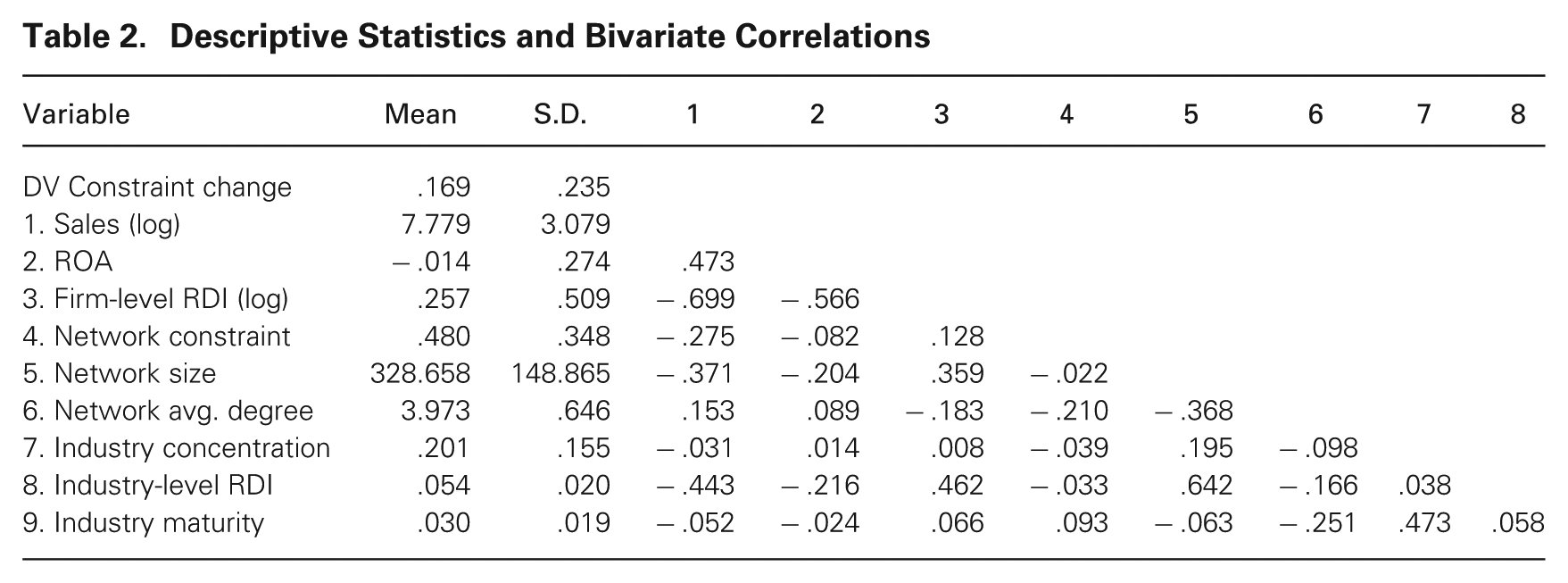
Given the nested structure of the data, we estimated a multilevel mixed-effects regression model that mitigates the risk of biased parameter estimates and incorrect standard errors (Snijders and Bosker, 1999). Specifically, we applied a three-level model with the firm’s constraint change in a given year specified at Level 1 and random intercepts specified at the firm level (Level 2) and the industry level (Level 3). Additional analyses indicated that adding random coefficients at any level does not improve model fit. Table 2 reports the descriptive statistics and correlations for the independent and control variables. The mean variance inflation factor (VIF) of 1.83 suggested that multicollinearity did not pose a serious concern (Belsey, Kuh, and Welsch, 1980).
Descriptive Statistics and Bivariate Correlations
Results
The correlation between fracp=0 and RDI is –.99 (p < .001), and the correlation between p and RDI is .75 (p < .10). These results support our expectation that firms should generally pursue more-open ego networks in those industries that are characterized by higher levels of technological dynamism, as measured by industry-level RDI. The results of the regression analysis in table 3, in turn, demonstrate that the effect of industry-level RDI on a firm’s propensity to form more-open ego networks is positive and statistically significant (b = 1.769, p < .01). This evidence further supports our hypothesis and the findings of the correlation analysis. Notably, this effect holds even after accounting for the effects of industry maturity (i.e., the corresponding coefficient is statistically insignificant), the focal firm’s R&D intensity, firm size, financial condition, and the firm’s current ego-network position. 3
Three-level Mixed-effects Regression with Random Intercepts (N = 1,253)*
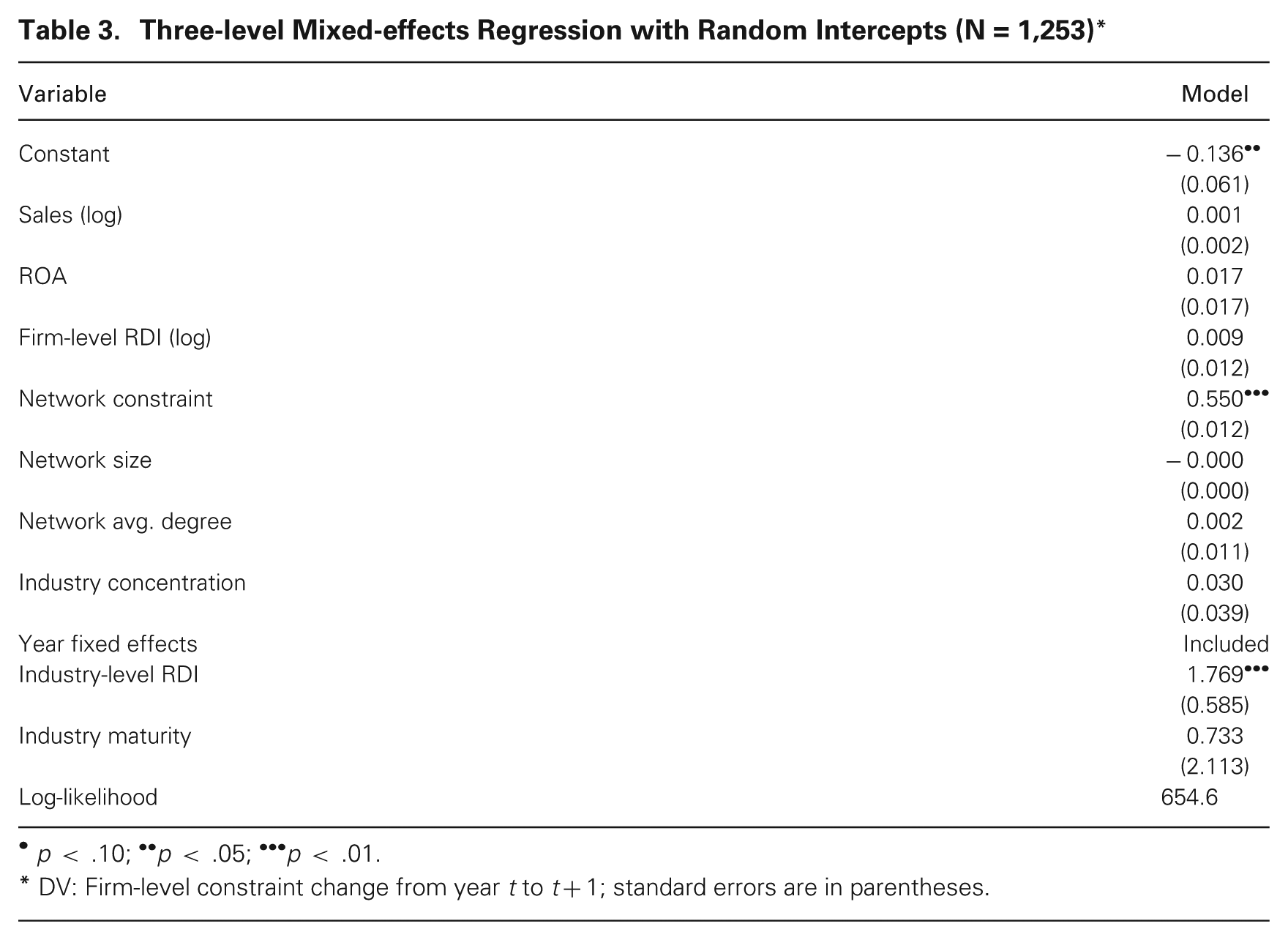
p < .10; ••p < .05; •••p < .01.
DV: Firm-level constraint change from year t to t+1; standard errors are in parentheses.
Discussion
The results of Study 1 show that firms’ collaborative behaviors differ significantly across industries, in line with the observed variations in the industries’ technological regimes. As predicted by our theory, we found that higher levels of technological dynamism provide a greater drive for firms to pursue more-open ego networks as compared with more-stable industrial environments, in which firms were found to generally pursue more-closed ego networks. Study 1, however, stops short of exploring whether the demonstrated firm-level variations lead to the emergence of distinct network properties at the industry level. Building on the results of Study 1, we address this question in Study 2, exploring to what extent the properties of the emergent industry-wide networks differ as firms respond to the variable innovation demands of their industries by pursuing either more-open or more-closed ego networks.
Study 2: Origins of Distinct Interorganizational Network Forms
Network analysts have devised a comprehensive set of concepts to describe the structural properties of social systems (Wasserman and Faust, 1994). Within this vast array of concepts, the network’s connectedness (through ties between actors) and its community structure (the distribution of those ties in the network) stand out as fundamental for understanding how social systems shape actors’ outcomes. Scholars have observed that high network connectedness and strong community structure (see figure 2) help explain a range of dynamic network processes, such as the diffusion of innovations (Wejnert, 2002), exchange of information (Dodds, Muhamad, and Watts, 2003), social influence (Moody, 2001), or the spread of infectious diseases (Anderson and May, 1991). In interorganizational networks, both concepts have been linked to the adoption of innovations, diffusion of governance practices, and dissemination of knowledge among firms (e.g., Davis and Greve, 1997; Reagans and McEvily, 2003; Rogers, 2003).
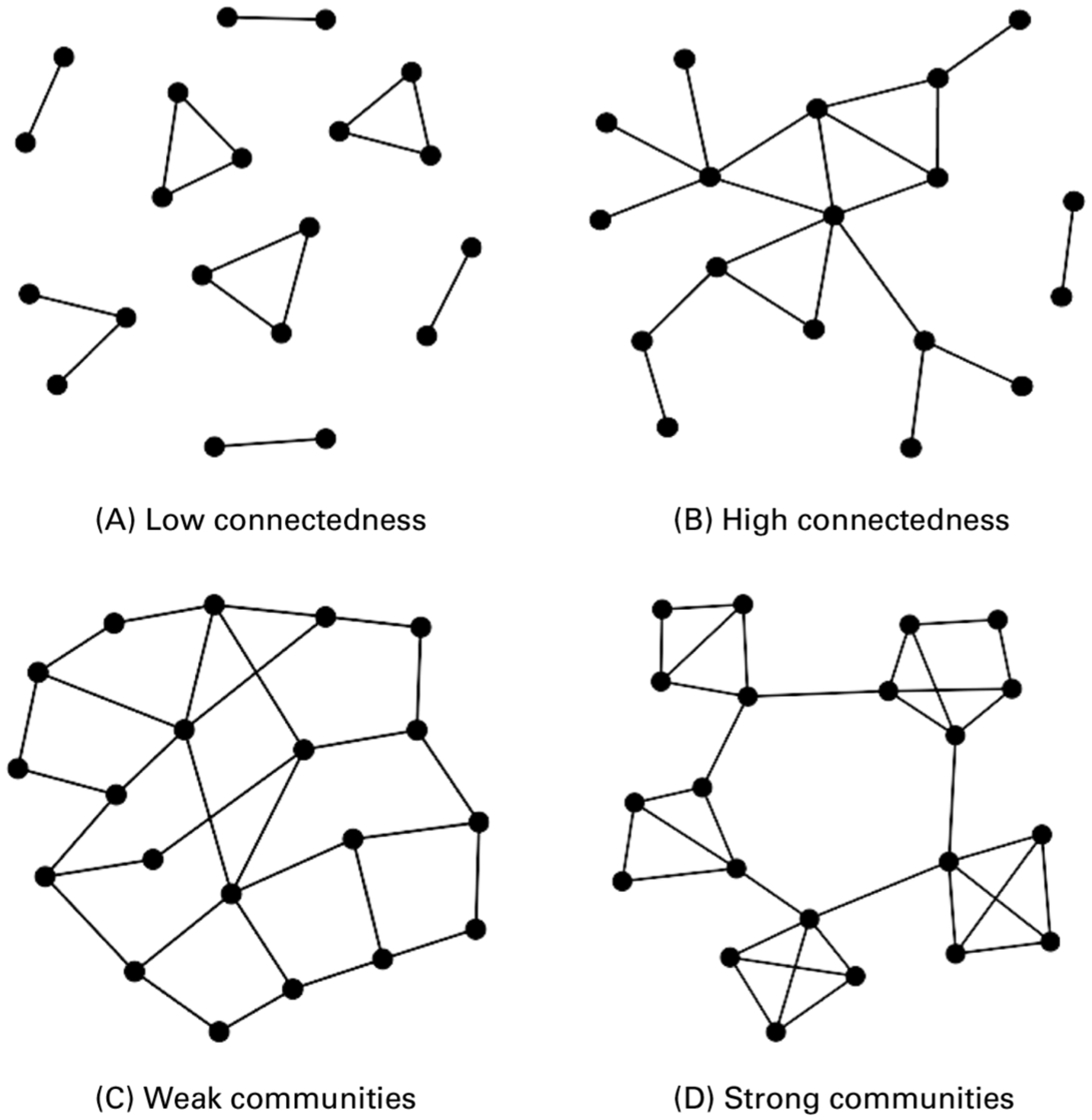
Network connectedness and community structure.
Network connectedness reflects the extent to which network actors can reach one another via network ties (see graphs A and B in figure 2). High network connectedness indicates that most firms can access one another via a network path of some length. This feature supports the flows of knowledge, information, and influence among firms. In contrast, low connectedness indicates that most firms are structurally isolated from one another and are thus inhibited from accessing other firms’ knowledge and resources.
Unlike connectedness, community structure captures the distribution (rather than existence) of network ties throughout the network (Granovetter, 1973; Girvan and Newman, 2002; Sytch and Tatarynowicz, 2014a). Strong community structure (see graph D in figure 2) signals that the distribution of ties is uneven and that the network is characterized by the presence of many relatively small groups (or communities) of densely interconnected firms. In contrast, weak community structure (see graph C of figure 2) suggests a more homogenous distribution of ties, such that no particularly dense groups can be distinguished. Network community structure has been linked to a variety of collective outcomes of actors. For example, strong network communities have been shown to enable the development of unique pools of knowledge shared among firms (Sytch and Tatarynowicz, 2014a) and to act as vehicles of cohesion, social norms, and social influence (Moody and White, 2003; Rogers, 2003; Greve, 2009). Some studies have also suggested that strong network communities are among the key conditions necessary to withstand the homogeneity pressures and sustain sufficient levels of knowledge diversity to thrive in creative environments (Uzzi and Spiro, 2005; Lazer and Friedman, 2007; Gulati, Sytch, and Tatarynowicz, 2012).
Holding all other network properties constant, we can expect that in sparsely connected partnership systems (Rosenkopf and Schilling, 2007) the formation of more-open ego networks should lead to higher levels of network connectedness but weaker community structures. As firms extend their partnerships more broadly, the number of globally dispersed ties should go up while the number of locally placed ties should go down, increasing the system’s connectedness. Yet in sparsely connected systems, network communities generally tend to be weaker by virtue of containing fewer local ties. As such, the process of redistributing ties across the broader industry-wide network may come at the expense of locally dense communities. By the same token, sparse interorganizational systems may be subject to opposite pressures in those industries in which firms generally pursue more-closed ego networks. In those industries firms tend to place their ties in more-proximate parts of the overall network, so the emergent industry-wide system should be characterized by a stronger community structure but lower network connectedness. Similar tradeoffs were anticipated in some formal representations of network dynamics in interpersonal settings (Rapoport, 1957; Skvoretz, Fararo, and Agneessens, 2004) and in empirical work on the dynamics of interfirm networks (Gulati, Sytch, and Tatarynowicz, 2012).
When applied to stylized low-density networks, the argument regarding the tradeoff between community structure and network connectedness could perhaps be derived analytically. But our specific question, which is posed in the context of real-world partnership systems, is significantly more complex than that. First, although we know that the formation of open and closed ego networks varies across industries, it remains an empirical question to what extent this variation can lead to observable differences in the emergent industry-wide networks. Should the variation in firms’ collaborative behaviors across industries not be strong enough, the relationship between firms’ behaviors and the emergent industry-wide networks could ultimately be weak.
Second, even if we were to assume that the relationship between firms’ varying behaviors and the emergent industry-wide networks is strong, we still need to examine the precise nature of that relationship to understand exactly when distinct networks can emerge and what their properties are. Specifically, we need to identify at which levels of firms’ preferences for open versus closed ego networks the expected transitions from low to high network connectedness and from strong to weak community structures can occur. It is entirely possible that both properties may not follow a linear pattern of change but rather feature more complex, nonlinear transitions. For example, some formal studies of network dynamics in statistical physics have indicated that network connectedness is a rather malleable structural property while changes in community structure are more difficult to trigger (Newman and Watts, 1999). Such nonlinear transitions could effectively engender the emergence of intermediate network forms, which could combine high levels of connectedness and strong community structures.
Considering the complexities of our argument, we therefore abstain from hypothesizing the emergence of specific network forms linked to particular levels of firms’ propensity for more-open or more-closed ego networks. Instead, we formulate a general prediction that the observed cross-industry variations in firms’ collaborative behaviors should give rise to distinct industry-wide networks characterized by different levels of network connectedness and community structure:
Methods and Analyses
To test hypothesis 2, we applied a mixed-methods approach that combined empirical analyses of existing interorganizational networks with agent-based modeling. The agent-based model allowed us to perform a series of controlled experiments in which actual firm behaviors were compared with numerous counterfactuals, many of which were unobserved in real data. By experimenting along the entire continuum of firms’ collaborative behaviors from closed to open ego networks, we were able to observe the often complex and nonlinear effects that relate actors’ micro-behaviors to the emergence of macro-level social and economic systems (Schelling, 1978). A particular advantage of the agent-based model in that respect was that it did not impose any strict assumptions regarding the nature of the hypothesized micro–macro relationships, whether linear or nonlinear.
More fundamentally, the agent-based model enabled us to achieve an abstract and yet detailed representation of real-world network dynamics, in which the network’s properties are assumed to co-evolve with actors’ behaviors. This resulted in an interdependent social system in which the evolving network is not just shaped by firms’ direct interactions with one another but also by their indirect interactions through the emergent industry-wide network itself. This modeling approach reflected a growing emphasis on agent-based simulations in organizational research that occurs alongside a growing interest in the processes of network emergence and dynamics (Ahuja, Soda, and Zaheer, 2012). The empirical element in our approach allowed us to use real-world data both to calibrate the simulation model analytically and to validate it against empirical evidence. While helping us to trace the complex dynamics of network emergence directly, the mixed-methods approach thus also positioned us well to explore how strongly the networks observed empirically differ from one another, as well as how strongly they differ from other possible networks that are predicted by the model but are not directly observed in our data (Bonabeau, 2002).
Analysis of industry-wide network properties
We assessed the variation in industry-wide network properties using the concepts of network connectedness and community structure illustrated in figure 2. We defined network connectedness formally as

in which nk is the size of the kth network component, and N is the size of the entire network. This index captures how many components are in the network and how they vary in terms of sizes. The possible values range from close to 0 for a highly disconnected network that contains many small components to 1 for a fully connected network that contains one large component.
To measure community structure, we used the well-known method of Girvan and Newman (2002). 4 This method detects communities by computing the network’s modularity index, defined as

Here, e is the total number of ties in the network,
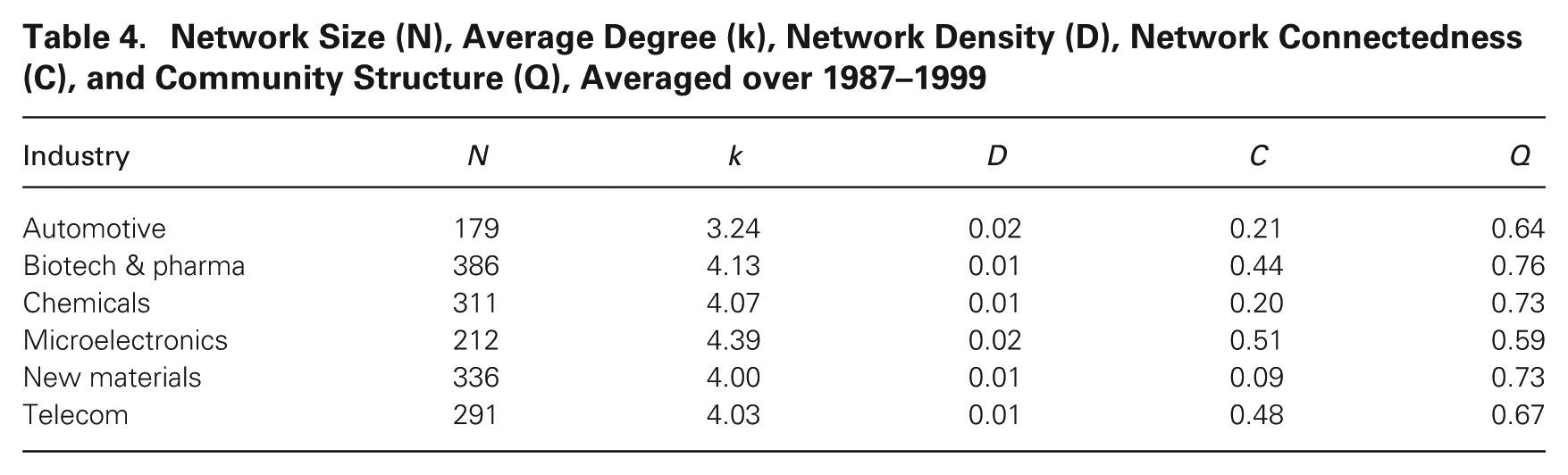
Table 4 reports the values of network connectedness and community structure along with the size, average degree, and density of each network, averaged over the study period. As expected, we found the six networks in our sample to exhibit rather different structural forms, ranging from highly connected systems (biotechnology and pharmaceuticals, microelectronics, and telecommunications) to rather disconnected systems (automotive, chemicals, and new materials), and from strong community structures (biotechnology and pharmaceuticals, chemicals, and new materials) to medium community structures (automotive, microelectronics, and telecommunications). Somewhat unexpectedly, we also found that the anticipated tradeoffs between network connectedness and community structure do not apply equally to all industries; for example, the system in biotechnology and pharmaceuticals indicated both a high level of network connectedness and a strong community structure. 5
Network Size (N), Average Degree (k), Network Density (D), Network Connectedness (C), and Community Structure (Q), Averaged over 1987–1999
Agent-based model of interorganizational network emergence
We simulated the process of network emergence starting from a random Erdös–Rényi network with a fixed number of firms (denoted N) and a fixed average number of ties per firm (denoted k). In such a network, any two firms are connected with an equal probability k/(N−1) (Erdös and Rényi, 1959). This approach offered us several advantages; for alternative starting conditions see Online Appendix A (http://asq.sagepub.com/supplemental). First, starting from a purely random network that is unlikely to be the result of any systematic processes of tie formation provided an uncontaminated testing ground to explore how the simulated firm behaviors could transform and shape the emergent industry-wide networks. Second, an Erdös–Rényi network also helped us approximate the empirically observed variation in partnership counts among firms in any given industry (Cowan and Jonard, 2004; Rosenkopf and Schilling, 2007). 6 Finally, we used constant network size and network density to maintain consistent analytic conditions across different simulation runs (cf. Reagans and Zuckerman, 2001; Buskens and van de Rijt, 2008).
The industry-wide network emerges as firms form new ties to one another, thereby realizing their preferences for more-open versus more-closed ego networks. 7 The model distinguishes between open and closed ego networks using Burt’s (1992) concept of network constraint. Figure 3 illustrates how the process works. Suppose that A is the ego; B, D, and E are A’s current alters; and C, F, G, and H are A’s potential alters. Firm A first ranks its potential alters according to the expected changes in network constraint. For illustrative purposes, figure 3 provides A’s constraint at time t (0.59) and its expected constraint at t+1 following the formation of a new tie ({0.46, 0.48, 0.66}). In our example, the greatest negative change in A’s network constraint is associated with alter G (0.46), and the greatest positive change is associated with alter C (0.66). Depending on A’s preference for a more-open or more-closed ego network, A should thus partner with either G or C.
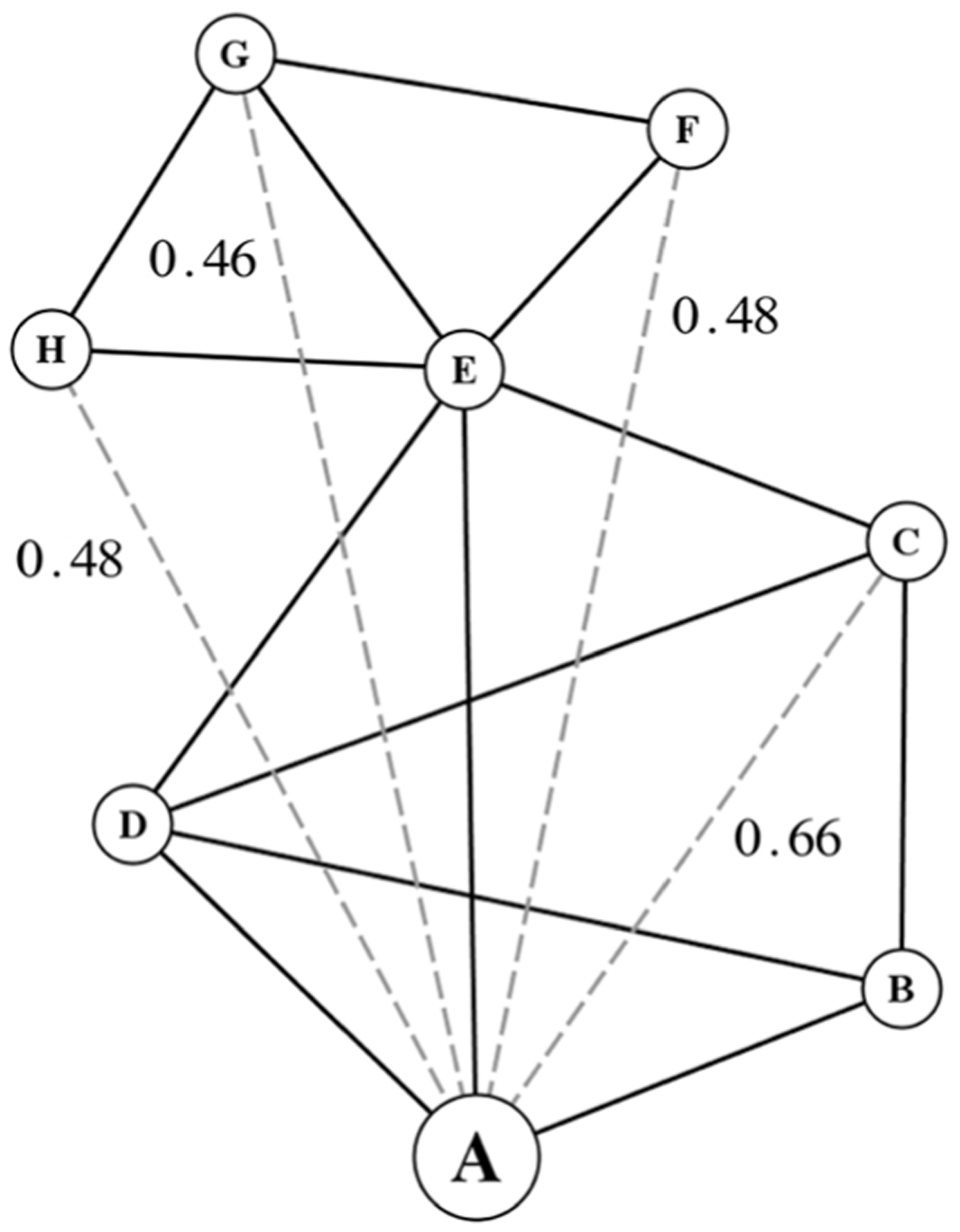
Stylized model of network formation among firms.
We defined an ego’s decision to pursue a more-open versus more-closed ego network using a probabilistic parameter p. In technical terms, this parameter reflected ego’s probability of pursuing an alter associated with the greatest decrease in ego’s network constraint. Ego’s probability of pursuing an alter associated with the greatest increase in constraint was thus 1 – p. To ensure some degree of matching between the preferences of ego and alter, the model considered both actors’ constraint preferences and allowed only for those ties that reflected alter’s expectations as well. Otherwise ego would pursue the next best option. 8
Furthermore, we set the same level of p for all firms in the industry and used this modeling approach to distinguish between firms’ varying collaborative behaviors across industries. Although this modeling approach implied that all firms in an industry would be subject to the same average propensity to pursue more-open ego networks, in practice our model featured substantial behavioral heterogeneity across firms. This was primarily guaranteed by the stochastic nature of the network formation process, which allowed individual firms to act entirely differently than an average firm. In addition, each firm would also be exposed to different local network structures determining the access to and the availability of potential partners (cf. Ibarra, Kilduff, and Tsai, 2005). Taken together, our specifications ensured close representation of a real-world interorganizational setting.
Building on prior work, we also included a range of other behavioral mechanisms to ensure realistic modeling. First, because organizational agents are unlikely to observe the entire social space around them, we assumed that an ego’s probability of observing any potential alter declines as a function of network distance (Friedkin, 1983). Formally, we specified the probability that i can observe j as 1/(dij–1), in which dij is the number of links along the shortest network path between i and j. Should j be entirely unobservable to i by virtue of the two actors residing in disconnected network components, we assumed that a tie between i and j is still possible, albeit with a very low probability equal to 1/(N−1). This rule allowed us to consider the dynamics of real interorganizational networks, in which both isolates and disconnected network components could occasionally become connected. 9
Second, we assumed that any two partners can terminate their existing relationship and that the likelihood of relationship termination increases with tie age. In modeling this process, we built on prior research indicating that partnership terminations are often time-consuming and costly and that alliance partners typically avoid premature contract terminations (Malhotra and Lumineau, 2011). Consistent with the observation that interorganizational partnerships have a clear average lifespan (Kogut, 1988b; Gulati, 1995; Stuart, 2000), we specified a normally distributed duration of ties with a mean of ten time steps and a standard deviation of two time steps. With the total simulation length of 100 time steps, our analyses thus extended over ten full partnership formation rounds by firms. 10
Third, to compare the results among different simulation runs and across different time steps, the agent-based model required us to control for changes in network density. To ensure constant density, we controlled for the number of ties terminated in each time step, making it exactly the same as the number of newly created ties. We modeled this process by first selecting two random subsets of firms that were chosen independently of each other but could overlap. Both subsets were given the same sizes equal to 15 percent of the entire network, which closely reflected the dynamics of real interorganizational systems in our data. Subsequently each firm in the first subset was allowed to create one new tie per time step, while each firm in the second subset was allowed to delete one of its existing ties. Finally, firms could connect both to entirely new partners and to partners who were either their current or past contacts. This condition helped us introduce further realism into the model.
Model validation against empirical data
To validate the model empirically, we explored how closely it represents real collaborative behaviors of firms observed across different industrial settings. A useful validation test entails examining whether the model—when supplied with actual collaborative behaviors of firms—reproduces roughly the same levels of network connectedness and community structure as those found in the real setting (Davis, Eisenhardt, and Bingham, 2007). We specified firms’ collaborative behaviors using the empirical values of the fraction of firms with zero probability of forming an open ego network (fracp=0) and the propensity of the remaining firms to form a more-open ego network (p). To guarantee some baseline concordance with the conditions of each industry, we also matched the size and density of each network with the corresponding empirical values shown in table 4. For each industry, we conducted 100 simulations to mitigate stochastic variance in the results and recorded average levels of connectedness and community structure along with their standard deviations.
We then compared these results statistically with the corresponding properties obtained from real interorganizational networks using z-scores. Specifically, for network connectedness we specified
Simulated Network Connectedness [E(C)], Simulated Community Structure [E(Q)], Z-score for Network Connectedness (zC), and Z-score for Community Structure (zQ)*
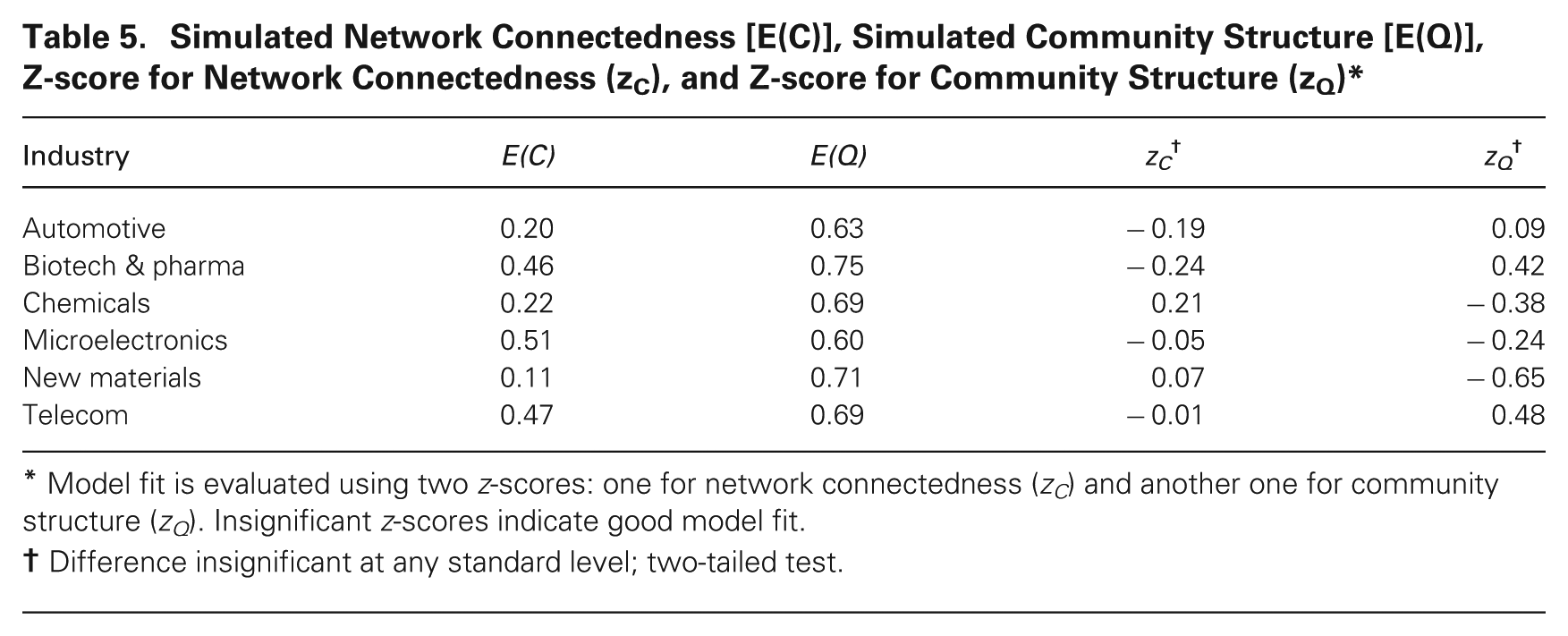
Model fit is evaluated using two z-scores: one for network connectedness (zC) and another one for community structure (zQ). Insignificant z-scores indicate good model fit.
Difference insignificant at any standard level; two-tailed test.
Analytic procedure
To understand the precise link between firms’ local behaviors and the emergent industry-wide networks, we conducted the simulation over the entire range of conceivable values of fracp=0 and p. We obtained these values by varying both parameters over the maximum range from 0 to 1 in .01 increments. This procedure resulted in a comprehensive set of 101×101 = 10,201 analytic cases. To achieve a realistic interorganizational setting, we again followed our descriptive results and those of prior research in specifying the key model parameters (Rosenkopf and Schilling, 2007). This involved modeling a medium-sized network with 200 firms with an average of four ties per firm (see Online Appendix A for alternative specifications). For each set of fracp=0 and p values, we simulated the network for 100 time steps to ensure sufficient stability in the emergent network properties (see Online Appendix B for a formal analysis of model stability). To mitigate stochastic variance, we repeated the simulation 100 times for each analytic case and recorded average levels of network connectedness and community structure. Our complete analysis involved conducting 1,020,100 simulation runs.
Results
We summarize our results in figure 4. The results are consistent with the basic intuition of hypothesis 2, which suggested that as firms’ propensity for open ego networks increases, the emergent industry-wide networks should be more connected and should exhibit weaker community structures. Two results are particularly striking, though. First, Panel A indicates that a sharp initial increase in network connectedness occurs over a relatively narrow range of p values. 12 Second, Panel B documents that community structure follows a more stable pattern over p. Particularly noteworthy, however, is the fact that the initial increase in p is accompanied by a growing rather than a declining community structure. This appears to be somewhat at odds with hypothesis 2, which predicted that in sufficiently sparse systems the formation of open ego networks should weaken rather than strengthen the system’s community structure. 13
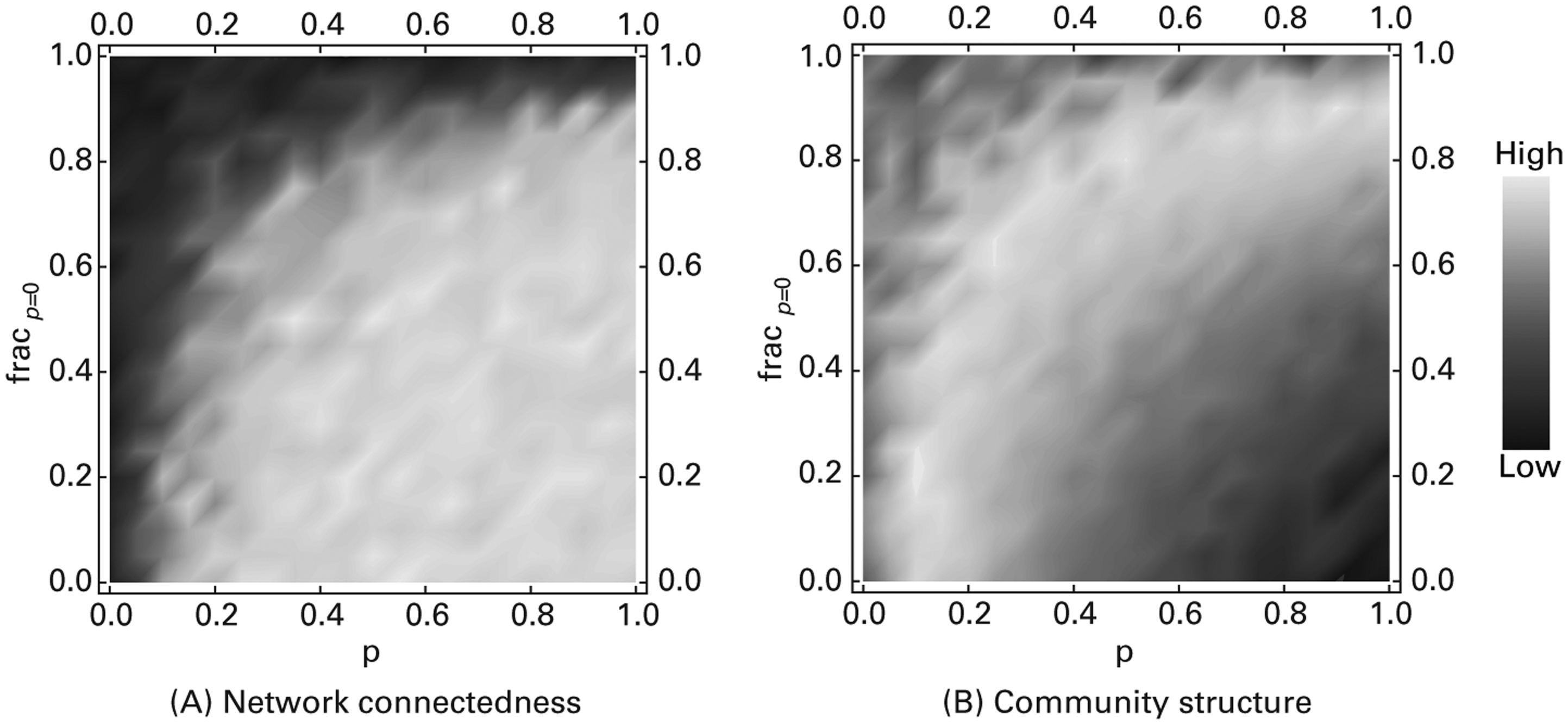
Network connectedness and community structure produced by the simulation at t = 100 steps.
Figure 5 provides a more precise illustration of the above transition effects. In this figure, we plotted a representative set of scenarios with low fracp=0, medium fracp=0, and high fracp=0, tracing the changes in network connectedness and community structure over the entire range of p values. The individual plots were produced by fitting a series of Bézier curves that help smooth out the results of different simulations (Farin, 1997). Using their first-order derivatives, we also estimated when each of the fitted Bézier curves transitions from a positive to a negative slope. 14 Our analysis suggested a rather complex, nonlinear pattern of covariance that occurs along the same set of inflection points for both network connectedness and community structure (p = .15, fracp=0 = 0; p = .22, fracp=0 = .35; and p = .34, fracp=0 = .70). Within this pattern of covariance, certain intervals seemed to be characterized by rather intuitive effects, such as the quick rise of connectedness over low p and the subsequent decline of community structure over medium to high p. But the results also indicated that a simple linear trade-off between both properties does not exist at all levels of p. Instead, we noted a concurrent rise in both network properties over low p values and subsequently a more stable trend in connectedness than in community structure. 15

Smooth Bézier curves capturing the critical transitions in network connectedness and community structure.*
These results allow us to develop a general typology of the emergent network archetypes that are engendered by firms’ varying preferences toward either more-open or more-closed ego networks. These network archetypes are characterized by significant differences in the emergent industry-wide properties of network connectedness and community structure, as shown in figure 6. The first network archetype is characterized by low network connectedness and a rather strong community structure. Because this configuration is reminiscent of a set of clans with strong in-group ties and almost no ties to other groups, we call it a clan network (Panel A). In our results, clans appeared to be associated with firms’ lowest propensities to form more-open ego networks. For example, in the set of scenarios with fracp=0 = 0, clans were found for p < .15.
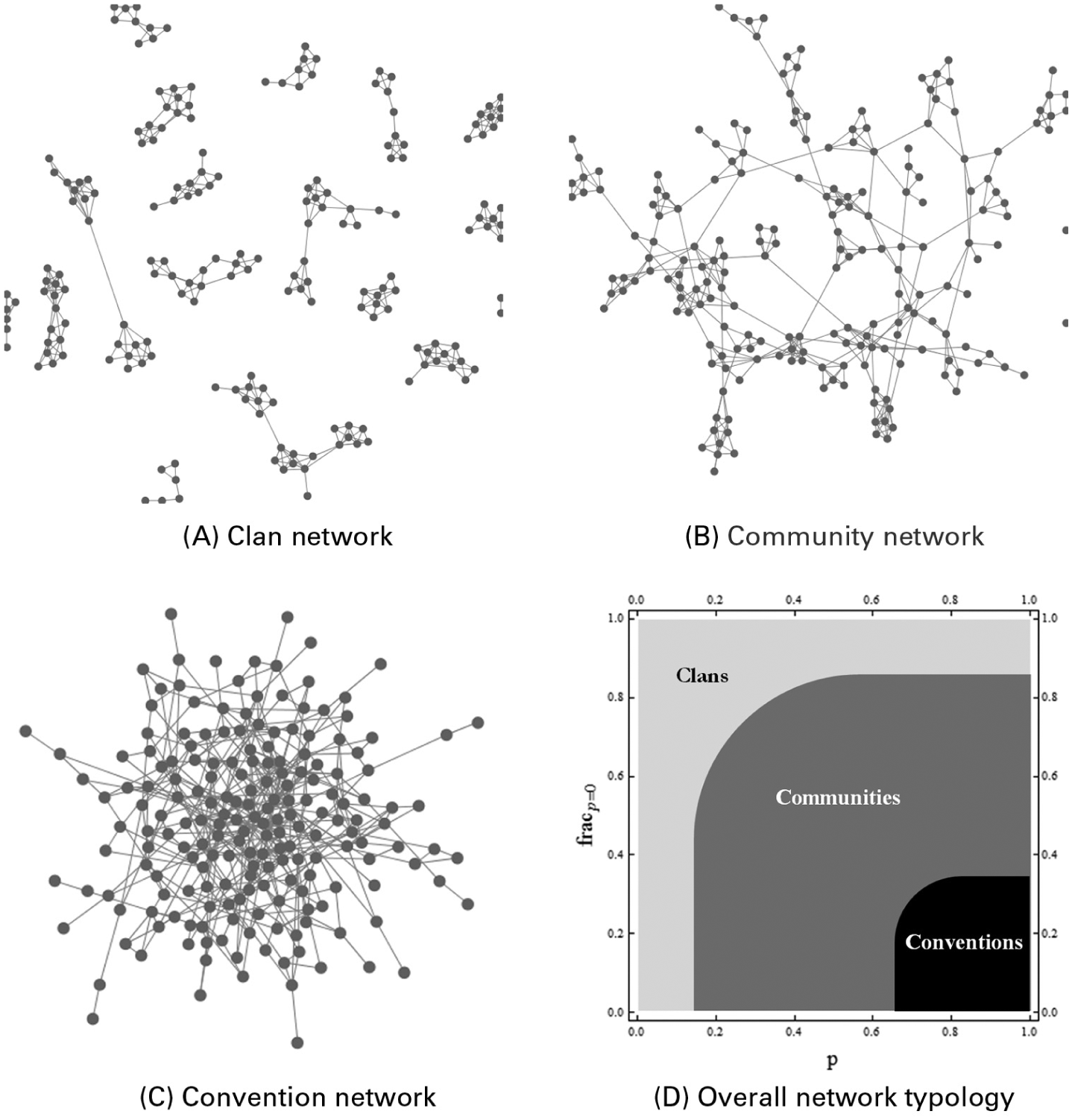
Network archetypes.
The second network archetype is characterized by high network connectedness and a medium-to-strong community structure. It is noteworthy that this structure corresponds to an intermediate network form that is linked to the complex nonlinearities that were uncovered by our agent-based model. In view of the sparsely interconnected and dense network communities that populate this system, we call it a community network (Panel B). Our analysis indicated that community networks are associated with firms’ moderate propensities for more-open ego networks. For example, in the set of scenarios with fracp=0 = 0, community networks were found from p = .15, where community structure peaks at Q = .7, to p = .65, where community structure drops below Q = .5.
Finally, the third network archetype we identified in our results is a convention network, described by high network connectedness and a rather weak community structure. 16 This structural pattern features more disorder than the previous two, bearing some resemblance to a large public gathering (Panel C). In our results, convention networks seemed to be associated with firms’ strong propensities toward open ego networks. For example, in the set of scenarios with fracp=0 = 0, convention networks were found for p > .65. Using a series of one-way ANOVA tests (see table 6), we found that this typology indeed represents a set of statistically significant differences in the industry-wide network properties (network connectedness: F = 278,270.49, p < .001; community structure: F = 10,960.46, p < .001). The complete typology is plotted in figure 6, Panel D. 17
Tukey-Kramer Tests of Pairwise Deviance between Network Connectedness and Community Structure
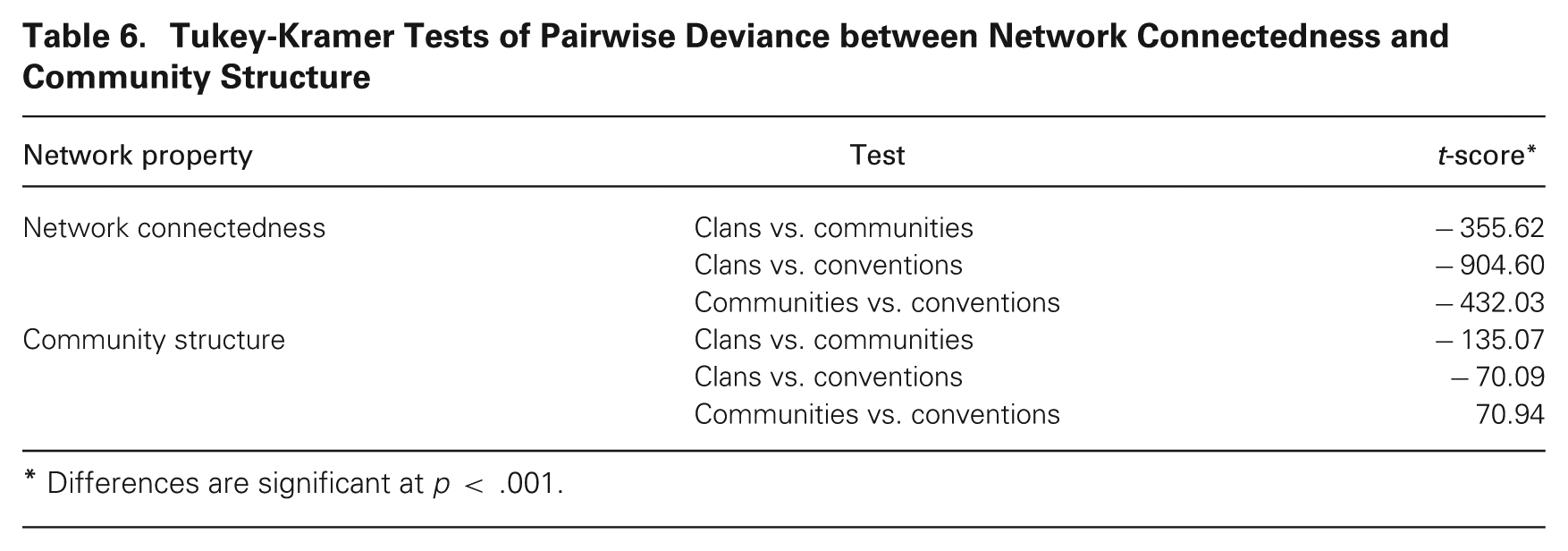
Differences are significant at p < .001.
In a representative application of our typology, we explored which network archetype best characterizes our sample of six industries. Given that the networks in automotive, chemicals, and new materials were found to combine rather low network connectedness with strong community structures, and that this configuration seemed to be the result of relatively weak firm propensities toward open-ego networks, we classified these systems as clan networks. In turn, the networks in biotechnology and pharmaceuticals, microelectronics, and telecommunications were all found to combine high network connectedness with medium-to-strong community structures driven by moderate firm propensities toward open ego networks. Hence we classified them as community networks. To illustrate our classification, figure 7 provides two representative real-world images of a clan network in the new materials industry in 1994 and a community network in the telecommunications industry in 1994. Broadly speaking, these results suggest that clan networks may be associated with technologically more-stable environments, while community networks may arise in environments that are characterized by greater technological dynamism. Notably, our data showed no evidence of an existing convention network.
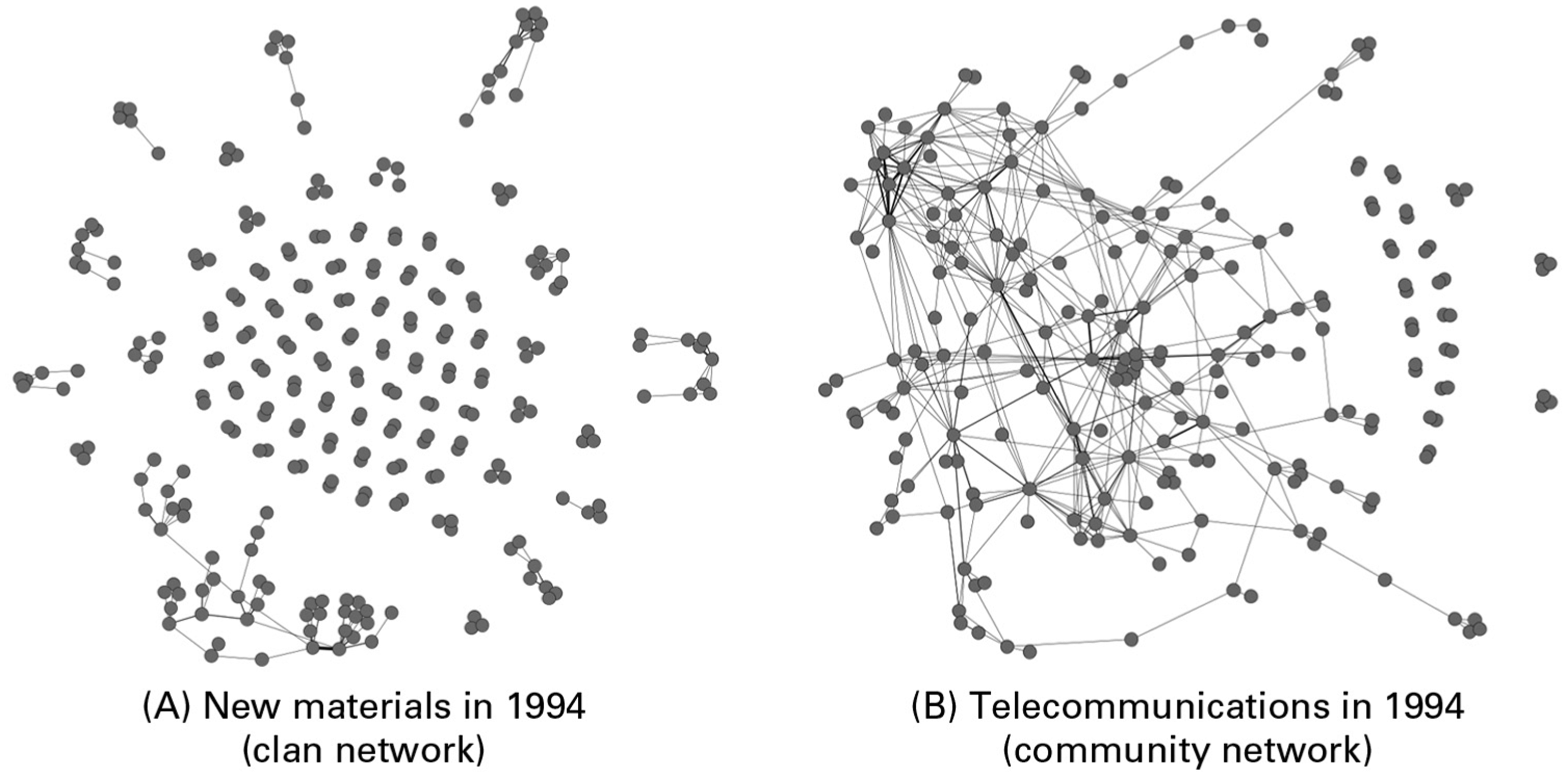
Representative images of a clan network and a community network in the dataset.
Discussion
The findings of Study 2 demonstrate that the variation in firms’ collaborative behaviors leads to the emergence of three distinct network archetypes. Clan networks, which combine rather low network connectedness with strong community structures, are associated with the lowest firm propensities to form more-open ego networks. As a result, we find that such networks tend to describe industries with rather low levels of technological dynamism, such as chemicals, automotive, and new materials. Community networks, in contrast, combine high network connectedness with medium-to-strong community structures, and we find that such networks are engendered by moderate firm propensities toward open ego networks. As a result, these networks are associated with technologically dynamic industries, such as biotechnology and pharmaceuticals, microelectronics, and telecommunications. Finally, convention networks are distinguished by high network connectedness and rather weak community structures that result from firms’ strongest tendencies toward open ego networks. Such networks were not found in our empirical data, and we address this finding in the General Discussion.
Extensions to the Analysis of Collective Outcomes
So far, we have deliberately limited our focus to the study of variations in industry-wide network structures. Underlying this focus, however, is an assumption that the macro-level structures of industry-wide networks can be highly consequential for various collective outcomes of firms. We briefly explored this assumption in supplementary analyses, in which we modeled a simple process of knowledge diffusion across the industry network. In line with prior research, we considered a basic process of knowledge diffusion in which the probability of knowledge transfer between two firms is a function of (a) the existence of a network tie between them and (b) the firms’ familiarity with and trust in each other (Rogers, 2003). We modeled firms’ familiarity and trust using the sum of their current and past ties and the fraction of ties held to the same third parties, respectively (Gulati, 1995). We considered a dynamic model of network diffusion in which new knowledge diffuses in parallel with the processes of network emergence (Cowan, 2005). 18 We subsequently evaluated how quickly and broadly new knowledge can diffuse through the emergent industry-wide network.
Results suggest that among the three network archetypes we analyzed, community networks have the greatest capacity to sustain the diffusion process. These networks facilitate the spread of new knowledge for two reasons. First, they help create higher levels of network connectedness, which allows knowledge to spread more widely across the emergent industry system. Second, they also help firms attain higher levels of familiarity and trust in one another, which are enabled by the emergent structure of dense and cohesive network communities. Clan networks provide a rather strong community structure as well, but they fail to offer enough connectedness to facilitate industry-wide knowledge flows. Thus, compared with community networks, clan networks tend to inhibit diffusion.
Interestingly, we found that clan networks are better at spreading new knowledge among firms than convention networks. Given that firms are significantly more isolated from one another in clans than in convention networks, we expected to see the opposite effect (cf. Davis and Greve, 1997; Westphal, Gulati, and Shortell, 1997). In additional analyses, we found that clan networks tend to provide a rather dynamic network setting that enables sufficient knowledge access via transient ties that span different network components (see Online Appendices C and D). Over time, such transient bridges may effectively substitute for permanent connections through the wider network, thus mitigating the negative effects of low overall connectedness.
One example of a transient bridging tie in our data was the 1989 joint venture between the Japanese automaker Daihatsu and Balkancar, a state-owned Bulgarian manufacturer of large utility vehicles. The two companies got together to exchange knowledge and pool resources to eventually come up with the first Japanese–Bulgarian truck. Although the partnership got off to a good start and in the beginning managed to facilitate substantial knowledge transfer between both firms, it dissolved as political turmoil swept across Eastern Europe in the early 1990s. The two companies have not collaborated since, and ties between their respective network communities have been rare as well. Another example of a transient bridge was the 1992 alliance between BP and the Japanese new materials specialist Ube Industries. The objective of that partnership was to transfer knowledge and technology, with the shared goal of developing a new line of low-density plastics. The partnership terminated in 1997, and both companies, as well as their respective network communities, have remained disconnected ever since. This transient bridge thus also stands out for its key role in supporting knowledge flows across wider areas of the industry-wide network. Both transient bridges are illustrated in Online Appendix E.
Existing studies treat network connectedness as one of the key determinants of diffusion (Coleman, Katz, and Menzel, 1957; Watts and Strogatz, 1998; Cowan, 2005). Our study and the examples we shared, however, suggest that successful diffusion does not necessarily require high overall levels of connectedness. Even if the overall network appears to be rather disconnected, this static image could mask the system’s dynamic capacity to compensate through transient bridging ties that offer sufficient range for a system-wide diffusion, albeit over relatively short periods of time. An important implication of this finding is that understanding actors’ collective outcomes may require reframing network connectedness as a dynamic network property. As our additional analyses suggest, for example, repositioning network connectedness as a dynamic property could significantly enhance our conclusions with respect to the link between social structure and knowledge diffusion.
General Discussion
This work was motivated by the recognition that the networks we observe in different social and economic settings vary significantly in terms of their structural properties and that this variation can be consequential for a range of collective outcomes of actors. With this insight in mind, we set out to explore the differences in the industry-wide structures of networks among firms. We presented two complementary studies that combined empirical analyses of several interorganizational networks with agent-based modeling of network emergence. Our first study showed that firms’ collaborative behaviors vary significantly with the technological dynamism of the industry. Complementing these results, the second study showed that this behavioral variation can lead to the emergence of distinct structural forms of the industry-wide network.
Our combined results represent an important step toward an environmental contingency theory of network formation that proposes a close association between the characteristics of the environment in which actors reside and the processes of network formation among actors. We demonstrated that organizations may respond to environmental demands not only in terms of their internal organizational design (Lawrence and Lorsch, 1967; Davis, Eisenhardt, and Bingham, 2009) but also in terms of the patterns of collaboration with other organizations. In our first study, we found that in technologically dynamic industries, firms on average pursue more-open ego networks. In contrast, in technologically stable industries, firms on average pursue more-closed ego networks. This effect likely indicates that firms in technologically dynamic industries may favor access to novel and non-redundant knowledge and resources, which is best enabled by open ego networks. In technologically stable industries, firms may favor the benefits of resource preservation and safe collaboration, which are best enabled by closed ego networks.
In our second study, we explored whether the variations in firms’ collaborative behaviors across industries are sufficiently strong to explain distinct network structures at the industry level. In our extensive analyses, we found that although the differences in firm behaviors seem rather subtle, they result in entirely different network archetypes characterized by significant differences in network connectedness and community structure. These effects seem to result from the complex interactions between firms’ local behaviors and the emergent industry-wide networks. Our results indicated that technologically stable industries are associated with the emergence of clan networks, which exhibit low network connectedness and a rather strong community structure. More dynamic industries, in contrast, are associated with the emergence of community networks, which exhibit high network connectedness and medium-to-strong community structures.
The results of Study 2 also revealed another network archetype, a convention network, which showed high connectedness and a weak community structure. In our model, the convention network was produced by firms’ strong tendencies to pursue open ego networks. Interestingly, the convention network was not found among the six empirical networks analyzed in this paper. One explanation is that firms could be driven by several potent forces to form more-closed ego networks. For example, the formation of closed ego networks could correlate with geographic proximity, which could enable co-located firms to draw on the economic efficiencies and the institutional support mechanisms of an industry cluster (Krugman, 1991; Marquis, 2003). As another possibility, firms could be driven into dense communities by structural similarities or homophily (Powell et al., 2005). Finally, closed ego networks could also result from inertia and the comfort of familiarity, which could overshadow the economic imperatives of interorganizational collaboration (Li and Rowley, 2002).
Intriguingly, the very same forces might also serve to align firms’ private goals with the shared goal of creating an overall network that best serves the entire collective. This conjecture is consistent with research in complexity science showing that many complex systems self-organize in distinct ways and that this self-organization can reduce the high costs of tie formation or make the system more robust to failure (Simon, 1962; Boisot and McKelvey, 2010). It is also relevant that self-organization may be adaptive and may occur in response to pressures stemming from the environment. Based on this logic, firms might be increasingly adapting their collaborative behaviors to respond to the requirements of value creation that are present in their industry. For example, we see community networks in technologically dynamic industries in which these networks are particularly valuable and are needed to facilitate knowledge transfer among firms. Although our theory and analyses focused on the particular requirement of knowledge transfer, future research could extend this logic to a wider range of systems and other possible outcomes. In some systems, for example, environmental adaptation could reflect the need to minimize the costs of tie formation or to avoid network failure (Jackson and Wolinski, 1996; Schrank and Whitford, 2011).
Our paper offers several contributions to studies of social systems. First, we advance prior studies in the social embeddedness domain (Baker, 1984; Granovetter, 1985; Uzzi, 1996) by exploring the relationship between the micro-processes of tie formation by individual actors and the emergent macro-structures of social systems. Our primary insight is that the variation in actors’ collaborative behaviors across different social and economic contexts helps explain the emergent differences in macro-level networks, and we find that these differences are stable over time. Our work thus extends prior research on network variation that focused on a single social context (Rosenkopf and Padula, 2008; Zaheer and Soda, 2009; Gulati, Sytch, and Tatarynowicz, 2012). We find that networks may show different industry-wide features not just over time but also across different socioeconomic contexts. Importantly, we relate these differences to the varying behavioral tendencies of actors, such as the pursuit of open or closed ego networks, and demonstrate their link to different industrial settings, their varying levels of technological dynamism, and the associated demands of value creation.
Second, the typology of network structures developed in this paper offers fruitful opportunities for a comprehensive analysis of a wider range of systems. Our typology provides conceptual and analytical guidance with respect to the link between the differences in actors’ collaborative behaviors and the salient transitions between different industry-wide networks. These transitions characterize the emergence of distinct archetypes of clan, community, and convention networks, which feature pronounced differences in network connectedness and community structure and seem to have profound effects on actors’ collective outcomes. It is important to note that the scope of our argument is conditioned by generally low levels of network density that characterize many interorganizational settings. Yet because sparse networks occur in other settings as well (Podolny and Baron, 1997), we believe that our typology has the potential to be applicable to a wider range of empirical contexts.
In particular, the typology of clan, community, and convention networks allows for a more precise classification of overall network forms when compared with alternative typologies using other network-analytic concepts, such as betweenness centralization, closeness centralization, degree centralization, or the small-world quotient (e.g., Uzzi and Spiro, 2005). First, our typology is applicable to a broader range of network structures, including highly fragmented structures, for which many of these alternative typologies are undefined. Because the emergent clan, community, and convention networks are differentiated in part by their degree of network connectedness, using our typology allows scholars to assess precisely how network systems differ structurally, as well as how they shape actors’ outcomes. The additional analyses we conducted showed that none of the alternative typologies could capture the emergent differences in interorganizational networks as precisely as the combination of network connectedness and community structure. As applied to our present analyses, the centralization-based metrics produced only two crude network forms, while the small-world quotient turned out to be higher for conventions than for clans. Unsurprisingly, we also found that the typology of clan, community, and convention networks significantly outperforms the alternative typologies in terms of explaining industry-wide diffusion outcomes (by a factor of 1.8 to 8.8 depending on which alternative typology was used).
Third, the results of this paper also contribute to the ongoing debate about the varying implications of social structures in different environments (Rowley, Behrens, and Krackhardt, 2000; Xiao and Tsui, 2007). Our results establish a connection between the collaborative behaviors of firms and the technological dynamism of their industry, which is essential for understanding the antecedents of network variation. This connection helps reconcile some of the conflicting findings regarding how social networks emerge and how they affect actors’ outcomes (Kilduff and Brass, 2010). For example, the present study sheds more light on why closed ego networks prevail in technologically stable contexts, such as the automotive industry or new materials (Gulati, 1995), but not in dynamic contexts, such as biotechnology and pharmaceuticals (Sytch and Tatarynowicz, 2014b). The present paper also helps clarify why chemical companies have been found to benefit more from closed ego networks (Ahuja, 2000) and why companies in the media sector (Zaheer and Soda, 2009) and the semiconductor industry (Rowley, Behrens, and Krackhardt, 2000) have been found to gain greater advantages from open ego networks. Although our goal has not been to examine how a firm’s network position affects its performance, the present findings suggest that one way for research to explore this link would be to account for the baseline differences in value creation regimes across different industrial settings.
Footnotes
Acknowledgements
The authors thank Wayne Baker, Ron Burt, Mason Carpenter, Linus Dahlander, Thomas Keil, Michael Mäs, Jason Owen-Smith, Francisco Palomino, Lori Rosenkopf, Lance Sandelands, Denis Sosyura, Károly Takács, Jim Westphal, and seminar participants at the University of Michigan, ESMT, SMU, HKUST, Academy of Management Annual Meeting, Midwest Strategy Meeting, and the Hungarian Academy of Sciences for helpful comments and discussions of this paper. Martin Kilduff, Martin Ruef, and four anonymous ASQ reviewers provided helpful feedback and editorial guidance. All errors and omissions remain ours.
Notes
Authors’ Biographies
References
Supplementary Material
Please find the following supplemental material available below.
For Open Access articles published under a Creative Commons License, all supplemental material carries the same license as the article it is associated with.
For non-Open Access articles published, all supplemental material carries a non-exclusive license, and permission requests for re-use of supplemental material or any part of supplemental material shall be sent directly to the copyright owner as specified in the copyright notice associated with the article.
