




Abstract
To examine whether and how social movements that target private firms are influenced by larger protest cycles, we theorize about osmotic mobilization—social movement spillover that crosses the boundary of the firm—and how it should vary with the ideological overlap of the relevant actors and the opportunity structure that potential activists face inside the firm. We test our hypotheses by examining the relationship between levels of protest in U.S. cities around issues like Civil Rights, the Vietnam War, and the women’s movement and subsequent support for labor-union organizing in those cities. Combining nationally representative data on more than 20,000 protest events from 1960 to 1995 with data on more than 150,000 union organizing drives held from 1965 to 1999, we find that greater levels of protest activity are associated with greater union support, that spillover accrued disproportionately to unions with more progressive track records on issues like Civil Rights, and that these effects were disproportionately large in the wake of mobilization around employment-related causes and shrank in the wake of conservative political reaction that limited room for maneuver among the external protesters, the labor movement, or both. Our research helps to specify the channels through which external pressures affect firm outcomes.
Research on how social movements affect firms has grown over the last 15 years. We know that social movement activism affects firms’ financial performance (Epstein and Schnietz, 2002; King and Soule, 2007; Bartley and Child, 2011; Soule, 2012, 2013), their images, and their reputations (Bartley and Child, 2011; Vasi and King, 2012; Soule and King, 2015). We also know that firms often respond to activists’ demands with varying mixtures of concrete (Briscoe and Safford, 2008; King, 2008; Soule, Swaminathan, and Tihanyi, 2014) and symbolic concessions (McDonnell and King, 2013). It is not surprising that organizational scholars have focused so much attention on how movements affect firms, given that this stream of research emerged roughly when social movement scholars had shifted attention from studying the antecedents of mobilization toward studying how movements influence their targets (Snow and Soule, 2010). And, of course, it is important to understand how movements affect firms. Only recently have organizational scholars begun to study the factors influencing the emergence of mobilization against firms (e.g., McDonnell, King, and Soule, 2015).
The broader literature on the emergence of activism emphasizes factors such as societal changes that give people more time and resources, shifts in the opportunity structures that make mobilization seem worthwhile, the absolute and relative sense of deprivation felt by individuals, the emergence of framings that resonate with individuals’ world views, and crises or suddenly imposed grievances that may galvanize people into action (Snow, Soule, and Kriesi, 2004; Snow and Soule, 2010). Within this broad tradition, a smaller stream has specifically looked at mobilization in organizations and asked when we are likely to find incumbents mobilizing for change in their organizations (Hirschman, 1970; Zald and Berger, 1978; Soule, 2009; Briscoe and Gupta, 2016). Some of this work has examined how the claims of movements change (Ansari, Fiss, and Zajac, 2010), and particularly how activists moderate their claims, when contention shifts inside the firm (Van Wijk et al., 2013). All such work acknowledges that external political and social changes may be paramount for understanding when intraorganizational mobilization occurs, but few studies have examined the “indirect effects of activism on further mobilization in organizational settings” (Briscoe and Gupta, 2016: 700).
A clearer understanding of the link between extraorganizational and intraorganizational social movement activism is important for both social movement and organizational research. Though they did not present an empirical test of the claim, Zald and Berger (1978: 831) discussed how organizations embedded in society are sites for working out broader political and social issues, and they proposed that “the constraints imposed by the larger society may provide a powerful stimulus for social movement formation.” If extraorganizational mobilization is an important precursor to intraorganizational mobilization, then an obvious starting point for studying the emergence of mobilization in firms is to situate such mobilizations in the context of larger protest cycles (Snow and Benford, 1992). The “early risers” in a social movement make claims on elites that “easy riders” can follow up on (Tarrow, 1989). They can expose weaknesses, such as unforeseen divisions among potential targets, that followers can exploit, and they can alter the “master frames” of contention and advocacy that later movements utilize (Tarrow, 2011). Mass movements should alter the opportunity structures that future potential mobilizations face. And if broader social and political issues are often worked out in organizations, then we should expect greater intraorganizational mobilization in the wake of large social protest cycles.
We take these ideas as a starting point and elaborate several tests of the claim by examining the impact of public protests around issues such as Civil Rights, the Vietnam War, and the women’s movement on workers’ support for organizing new labor unions between 1965 and 2000. This is a substantively important setting in which to explore this question. The protest cycle that began with the Civil Rights movement was arguably the largest in U.S. history. The Civil Rights movement fed into related and sometimes competing mobilizations against the Vietnam War and in favor of women’s rights; the mobilizations of the 1960s in turn were echoed in the environmental movement, the anti-nuclear movement, and beyond. Even today, it is common for a new spate of protest to be compared with the “long protest wave” of the 1960s. Meanwhile, for more than half a century, from the Great Depression through the 1980s, labor unions were the archetypical vehicle for working-class mobilization. They had real power to influence policies in many companies (Slichter, Healy, and Livernash, 1960; Kochan, Katz, and McKersie, 1986; Edelman, 1990). Unions were themselves the organizational product of an earlier wave of social movement activism (Lewis, 2013). And although long-established unions have been criticized as too bureaucratic or captured by the logic of the organizations they are meant to challenge (Fantasia and Voss, 2004; Taylor, 2007), both labor-movement researchers and social-movement scholars agree that “Winning union recognition and the legitimation of strikes is part of a social movement process in society and in specific organizations’’ (Zald and Berger, 1978: 842). It would be useful to understand patterns of influence between the long protest wave and organized labor, not least because that relationship has historically been fraught, and it influences much thinking in social movement, labor movement, and organizational research (Levy, 1994; Voss and Sherman, 2000; Clawson, 2003).
This setting is also theoretically fruitful. It may not be controversial to say that social movements produce successors (McAdam, 1995), but there is almost no research on why we would expect some types of successors and not others. When is there more likely to be spillover from outsiders’ activity to insiders’ mobilization (Briscoe and Gupta, 2016)? It seems likely that such spillover is more likely when there is substantive overlap between claims made by activists earlier in the protest cycle and claims made later by intraorganizational activists. The magnitude of such spillover should vary with the constraints on organizations imposed by the larger society (Zald and Berger, 1978). An advantage in considering the American labor movement is that its constituent unions have varied considerably in their stances toward issues like equal opportunity, immigration, and U.S. foreign policy—issues that motivated many people during the long protest wave. The organizing climate for unions also changed in these years, as the national political climate moved sharply against organized labor. This means we can examine whether spillover varied both by substantive overlap and with changes in the opportunity structure.
From Mass Movements to Private Contention: Osmotic Mobilization
Social movement research has long been interested in the dynamics of interaction among different movements (McCarthy and Zald, 1977; Zald and McCarthy, 1980). Social movement organizations share personnel and office space (Cress and Snow, 2000), form coalitions (Van Dyke and McCammon, 2010), and learn tactics from one another (Wang and Soule, 2012). They also compete with one another in scarce resource environments (Olzak and Uhrig, 2001; Olzak and Ryo, 2007; Soule and King, 2008; Larson and Soule, 2009). These different channels of influence, both cooperative and competitive, constitute “spillover” between different movements and movement organizations (Soule, 2004; Whittier, 2004). 1
Research on spillover between movements has not yet been embraced by organization scholars interested in how social movements affect firms. This is important because we often presume that activism targeting firms has its roots in broader social movements, but we know little about the interaction between movements outside and inside of firms (Soule, 2009; Vasi and King, 2012; Briscoe and Gupta, 2016; Model, Soule, and King, 2016). We focus here on a specific form of movement spillover, which we refer to as “osmotic mobilization”: the spillover of activism across an organizational boundary, from activism in the streets to activism in a firm. We invoke osmosis because we are interested in how outsider-to-insider spillover varies. The chemical process of osmosis varies by osmotic pressure, which is determined by the properties of the solutions on either side of a boundary. We consider which properties of extra- and intraorganizational actors will affect the rate of osmotic mobilization.
The idea that mobilization in a firm has roots in mass mobilization outside the firm draws on work on protest cycles (Snow and Benford, 1992; Tilly, 1998; Tarrow, 2011). Successful protest usually involves disruption of the social order, as well as less contentious actions like influence and negotiation. Though the origins of individual grievances may be specific to organizations, those individuals’ dependence on those organizations means they have less latitude to protest (Hirschman, 1970). Furthermore, people are prone to interpret their personal experiences as idiosyncratic rather than as reflecting broader structural inequalities (Mills, 1967). It is through the comparison of grievances across individuals, organizations, and walks of life that such grievances are usually reframed as a problem of the “system” that needs reforming (Snow and Benford, 1992). Thus protest cycles frequently begin with mass mobilizations, which in turn open up new space for successor movements (Tarrow, 1989). The “early riser” mobilizations can normalize diagnoses of and claims against the status quo that would previously have sounded extremist (e.g., Haines, 1984). Such effects have been demonstrated in the case of single social movements (Dobbin, 2009; Rojas, 2010); we extend the basic logic to spillover mobilization around different claims and argue that greater levels of extraorganizational social mobilization will encourage and inspire group mobilization in organizations via osmotic mobilization.
Osmotic pressure should be greater when there are actors in an organization who have access to resources, including knowledge. Though initial mobilization can alter norms and make once-radical claims seem more feasible, that same mobilization often lacks the detailed knowledge of existing organizations that can help translate general claims into specific reforms (Briscoe and Gupta, 2016). New movements with insider knowledge of potential targets would be among the best placed to capitalize on openings created by earlier mobilization. Thus osmotic mobilization should be greater for groups that have the ability to advance the earlier claims.
Although resources and abilities are important, we do not assume that spillover is simply the content-neutral transfer of tactics or routines between organizations (Wang and Soule, 2012). Overlap and sympathy in claims also matter; many of the channels of spillover that prior research has identified implicitly require some ideological sympathy between movements. For example, spillover can happen through the exchange of personnel or the sharing of resources like office space (Cress and Snow, 2000). A person is unlikely to work with multiple organizations that have competing goals; such organizations are also less likely to cooperate on day-to-day tasks. Nor are movements likely to form alliances (Van Dyke and McCammon, 2010) or target common firms (Evans and Kay, 2008; Jung, King, and Soule, 2014) unless they agree on some dimensions. Other, less relational channels of spillover, such as demonstration effects (Van Zomeren et al., 2004), require less agreement between two groups. 2 On balance, though, the prerequisite of contact and association for most channels of spillover should mean that inspiration from social mobilizations should flow to new mobilizations along roughly similar ideological contours. Osmotic mobilization will be greater between groups with ideological affinity; that is, mobilization within a firm will likely draw inspiration from mobilization outside of the firm with which there is a shared ideology.
The opportunity structure could also encourage or constrain osmotic mobilization. Theories of mobilization around and within organizations presume that social movements alter the acceptable limits on group formation (Zald and Berger, 1978). Thus, for example, the spread of legal protection against ascriptive discrimination in the workplace increased the opportunities for organizing around affinity groups (Lichtenstein, 2002; Piore and Safford, 2006). It follows that the likelihood of groups’ emerging in the wake of social mobilization should be greater in environments in which the new groups face less potential opposition. The relative strength of opposition is typically formulated as the political opportunity structure, though we omit “political” when discussing movements that target private organizations. The idea that “exogenous factors enhance or inhibit prospects for mobilization” (Meyer and Minkoff, 2004: 1457) has been demonstrated repeatedly (Cooper, 1996; Rucht, 1996; Clemens, 1997), but such demonstrations have involved temporal variations in political opportunities over the history of single movements. Osmotic mobilization should similarly be constrained by such changes in the opportunity structure.
Exploring these theoretical propositions presumes observable variation on all of these constituent dimensions: the level of extraorganizational social mobilization, the ability of successor groups in a firm to advance claims, the ideological overlap between early and later social mobilizations, and the opportunity structure faced in organizations. The empirical challenge, as Zald and Berger (1978: 857) discussed with regard to their own theorizing, is that data on the determinants and form of a movement are hard to find, as is information on movements that “were aborted or suppressed.” Briscoe and Gupta (2016: 691) similarly pointed out that much of the extant research on social movements that cross the organizational boundary is qualitative, making it difficult to form a base of generalizable evidence. Labor organizing is a setting in which we can clear many of these empirical hurdles while making progress on generalizability. The long protest wave itself, with its multiple social movements, gives us variation in claims. Unions as an organizational form vary in their ability to advance such claims, as they vary on ideological overlap with many social movements’ claims. Unions have seen shifts in the opportunity structure for organizing. Finally, union organizing leaves records of the failed attempts, so we actually can learn about movements that were aborted or suppressed. There are limits to how much we can generalize from labor unions to other social movements that target firms, but we think that these unique empirical features more than justify the effort.
Labor Unions and Social Movements
The labor movement historically involved waves of mobilization around economic or class-based claims. Labor unions are also among the earliest examples of social movements that target private firms. Organized labor has long posed an ontological problem for social movement and organizational research: is it a social movement, a collection of formal organizations, both, or neither? For our purposes, a useful way to compare labor unions with other social movements is with Briscoe and Gupta’s (2016) typology of outsider and insider activists, which considers activists’ knowledge of and dependence on the targeted organization. The archetypical outsider activist has little detailed knowledge of a targeted organization and little dependence on it. Such activists have greater tactical freedom of action but limited ability to tailor such actions for maximum influence or impact. By contrast, the archetypical insider activist has detailed knowledge but considerable constraint, due to dependence on the targeted organization. Unions are off the diagonal in this typology, because they combine high knowledge with low dependence. This type “appears interesting to study, because—from the vantage of the activists—it combines insight into the target organization with freedom from the influence of that target organization” (Briscoe and Gupta, 2016: 702). Social movements that want to affect firms should be particularly interested in the potential for such organizations’ emergence.
It is important to distinguish between established labor unions and labor organizing. In the U.S., automatic recognition of a labor union—as happens in countries in which collective bargaining occurs at the industry level—is virtually nonexistent. Thus mobilization is required whenever a union tries to enroll members at new workplaces. The distinction is important because, as a population of established organizations, most U.S. labor unions predate the long protest wave that began in the 1960s. But the turnover of establishments requires unions continually to organize new workers if they are to retain their strength, and organizing the unorganized has bedeviled American unions for decades (Goldfield, 1987). During and after the long protest wave, the U.S. labor movement suffered steady, grinding losses of power in the private sector. One in three workers was in a union in 1953, one in four was in 1979, and fewer than one in ten are today. Spillover from social mobilization that encouraged the emergence of more union locals would be as potentially useful for the labor movement as it would be for broader social movements that want to influence workplaces.
The unions’ loss of power raises a potential problem for this study: if labor’s strength was steadily declining, why test for spillover here? Research on spillover from broader social movements to organized labor has indeed been slow to develop, and social- and labor-movement research long developed in separation. Scholars in both fields implicitly assumed minimal spillover between the New Left movements of the 1960s and labor because of the widely held view that the relationship between the two “was one of consistent separation or hostility” (Isaac, McDonald, and Lukasik, 2006: 147). That view came from critiques leveled by some activists against “Big Labor” in the 1960s and 1970s for becoming too bureaucratic and professionalized, if not captured by the same firms the unions were meant to target (Galbraith, 1968; Taylor, 2007). It also arose because some southern trade unionists took a jaundiced view of the Civil Rights movement, and northern unions had their own practices that had historically limited opportunities for non-white workers (Botsch, 1980; Griffith, 1988; Nelson, 2001).
Even as the fact of separation and hostility settled into conventional wisdom and scholarly assumption, though, newer historical work began to undermine it (Jezer, 1982; Levy, 1994; Boyle, 1995; Ganz, 2000). More-recent quantitative studies have shown that the long protest wave led to greater rates of union density in the public sector, though again it concluded that spillover in the private sector was negligible (Isaac and Christiansen, 2002; Isaac, McDonald, and Lukasik, 2006). 3 Such research correlated aggregate protest activity and union density, but union density is a very noisy measure of spillover. It is a demographic variable driven as much by the loss of unionized jobs and workplaces, which social mobilization is not theorized to affect, as by the birth of new ones. Job losses in heavily unionized industries and job growth in non-union industries will lower union density even if workers’ attitudes or public policy toward unions does not change. If unionized establishments close at higher rates than non-union ones, density will fall (Farber and Western, 2001). Increased political or managerial opposition to labor unions can stymie workers’ chances to express their preferences, even if workers’ preferences change (Ferguson, 2008). It is thus possible to see flat or declining private-sector union density even if a protest cycle were to produce osmotic mobilization among labor unions. We think we can better measure osmotic mobilization by looking at a more theoretically proximate measure like workers’ expressions of support for unions. We focus on union-representation elections because they are the culmination of unions’ mobilization efforts at a particular workplace, and the election results directly record workers’ support for or opposition to being represented by a union.
Workers who have participated in or observed previous instances of collective action, such as marches, demonstrations, and occupations, are likely more sympathetic to collective action in the workplace, more optimistic that it can produce change, and more knowledgeable about how to do it. Union personnel who cut their teeth in mass protest movements may have a better sense of which workplaces to target for organizing drives, and workers may find such personnel more sympathetic. Organizers and workers with experience in other social movements can bring new tactics into organizing campaigns and can suggest collective bargaining as a means to press different claims, such as protection from discrimination, against employers. This thinking leads to our first hypothesis:
We have theorized about osmosis because that type of diffusion across a boundary varies by the characteristics of the solutions on each side: different characteristics inside and outside organizations should be associated with different levels of osmotic pressure, and greater or lesser mobilization should result. For example, the presence of different types of protest activities outside firms should affect the rate of mobilization in firms. The bulk of protest activity since the early 1960s has been around progressive political causes. If support for unions increases because potential union voters have either observed or been involved in mobilization around progressive political causes, then it is reasonable to predict that osmosis will have a political dimension. Progressive protest activity—e.g., in support of Civil Rights or against the Vietnam War—should have a larger effect on union support in firms than conservative protest activity, such as pro-War and pro-Life demonstrations.
We also theorize that mobilization around issues with more implications for the workplace should exert greater osmotic pressure than more-distant issues would. Obvious candidates in this regard are the Civil Rights movement and the women’s movement, both of which pressed for the elimination of employment discrimination. This overlap in interests should make osmotic mobilization from Civil Rights and women’s mobilization to union organizing more likely, contingent on the specific union involved.
Hypotheses 2 through 4 focus on the claims made by different extraorganizational social movements, per the argument that similar interests or ideological overlap should imply a more-robust channel through which osmosis can occur. In discussing such affinities, it is important to consider the potential new organizations themselves. Unions vary in how progressive their track records have been historically. Some were early and vocal supporters of black civil rights, and others were racially exclusionary; some opposed the Vietnam War, and others rallied behind the White House; some welcomed female members, and others tried to exclude them (Milkman, 1987). We predict that osmotic mobilization should be most likely for unions that took credible, substantive actions in support of progressive issues like black civil rights or in opposition to the Vietnam War. More-conservative unions would see few benefits, if not actual penalties.
Finally, osmotic mobilization should vary with the opportunity structure that movement activists face in organizations. For the labor movement, the shift from the 1970s to the 1980s marked a major constriction of opportunity, as the failure of labor-law reform and the election of conservative Ronald Reagan signaled to firms that the traditional norms of industrial relations no longer applied (Farber and Western, 2002; Tope and Jacobs, 2009; Western and Rosenfeld, 2011). The late 1970s and early 1980s marked a low point in the effectiveness of union organizing, which corresponded with changes in the Civil Rights movement. In the 1960s and 1970s, many campaigns to integrate the workplace involved integrating labor unions themselves and modifying the elements of collective-bargaining agreements, like seniority protections, that disproportionately benefited white workers (Nelson, 2001; Lichtenstein, 2002). As the 1970s yielded to the 1980s, the elaboration of equal-opportunity legislation and diversity policies in workplaces meant that Civil Rights–related claims could be more effectively pursued through the courts than through collective action (Edelman, 1990; Piore and Safford, 2006). We therefore hypothesize that Civil Rights activism would have more influence on union success earlier in the time period under consideration. We treat the years before 1982 as earlier in these data for historical reasons.
Though the 1980s were a period of union retrenchment in many of the industries in which black workers had made employment gains (Rosenfeld and Kleykamp, 2012), the opportunity structure was different for women. As the women’s movement emerged as an autonomous force from activism earlier in the 1960s, many activist organizations also targeted discriminatory employment practices. Protests for equal pay and the removal of “protective” legislation began in the mid-1960s (Davis, 1991), but as the 1970s wore on, contentious politics around women’s workplace treatment were increasingly focused on attempts to pass the Equal Rights Amendment (Mansbridge, 1986; Soule and Olzak, 2004). In addition to being the period of greatest gains in promotion and pay equity for women (Cohen, Huffman, and Knauer, 2009), the 1980s and early 1990s were also a period when the labor movement became increasingly feminized in both the public and the private sectors (Lichtenstein, 2002; Milkman, 2006). Women formed a disproportionate share of the occupations in which private-sector unions made some gains in the 1980s, including nursing, clerical, and service work, even as union density collapsed in traditional manufacturing. This suggests a telling contrast with our hypotheses about Civil Rights–related osmosis. Although we think that osmosis around women’s employment issues will be larger than for outsider activism generally, we also think that such osmotic mobilization will be largest later in the period rather than earlier.
Hypotheses 2 through 7, which all theorize heterogeneity in the relation of protest activity to union support, also give us an additional way to verify that support for H1 is not spurious. Variation in our main effect along a dimension like the protesters’ claims or the unions’ political orientation implies that unobserved sources of spurious variation must themselves vary along that dimension.
Method
To test our hypotheses, we examined the relationship between the lagged level of protest in various cities and the vote share that unions receive in representation elections in those cities. Our primary data come from two sources. For information on protest activity, we drew on the Dynamics of Collective Action (DoCA) project led by McAdam, McCarthy, Olzak, and Soule (www.dynamicsofcollectiveaction.com). To construct this data series on social movement protest, project personnel read every page of each daily issue of the New York Times printed between 1960 and 1995, searching for any mention of a protest event: “any type of activity that involves more than one person and is carried out with the explicit purpose of articulating a claim against (or expressing support for) a target” (Wang and Soule, 2012: 1682). Project personnel coded the content of each event, listing the claims made, the event’s size and location, the targets of the protest, any organizations that were present, the tactics deployed, and any police response. The project yielded descriptions of 23,624 protest events that occurred in the U.S. between 1960 and 1995. Strikes and other protests specific to labor unions were not recorded in the DoCA data series, so we can assume that any spillover between the protests we studied and union support does not simply reflect campaigning by the unions in question. We controlled separately for strike activity.
Relying on newspaper reporting for information on protests is subject to selection bias and description bias due to the newspaper’s decision to report on an event and the success or failure of its attempts to accurately describe what transpired. For the era in question, it is important that the New York Times strove to be the paper of record, covering as wide a range of events and locales as possible. Prior studies have found the Times’ coverage of social movement organizations to be considerably more extensive than that in secondary sources like the Encyclopedia of Organizations (Larson and Soule, 2009). Furthermore, the DoCA series’ focus on protest events rather than counts of protest organizations allowed us to measure variability in the level of protest across time and space. While recognizing its potential limitations, we believe that several of the DoCA project’s protocols, such as relying on daily reporting rather than weekly summaries or indexes so as to reduce bias in what news was archived, make this the most comprehensive archive of protest activity currently available.
For union representation elections, we used records maintained in the FAST Database by the AFL-CIO. As we explain in the next section, the National Labor Relations Board (NLRB) monitors all union elections in the U.S. private sector. In the early 1960s, the NLRB negotiated an agreement with the AFL-CIO wherein every month the NLRB would transfer to the AFL-CIO copies of every union-representation election case that had been closed during the month. In return, the AFL-CIO would answer any requests for information about representation elections that third parties made to the NLRB. The records were stored on one of the first mainframe computers installed by a labor union, the federation’s Food & Allied Service Trades division (hence “FAST”). Though the AFL-CIO still maintains this archive, the NLRB substantially revised its internal data-management system in 1999; thus both for comparability and because the DoCA series ends in 1995, we used election records running through 1999 in our analyses. A crucial feature for our study is that the FAST data contain records of failed representation elections as well as successful ones, allowing us to study changes in expressed support for unions, separately from density. Because the NLRB has jurisdiction only over private-sector workplaces, we concentrated on union organizing in the private sector.
Though our union election data include information on unions’ wins and losses, they are subject to a different form of sample selection bias, namely which establishments unions chose to target for unionization. This is important because it suggests a different channel through which protest by outsiders could become positively correlated with mobilization by insiders. If protest activity caused unions to change the types of establishments that they target for unionization—through encouraging new groups of people to become union organizers, for example, or by altering the composition of workplaces in ways that make them more attractive to unions—then we could see a positive correlation between protest activity and union vote shares even if outsiders’ activism had no direct effect on insiders’ willingness to take collective action. Data on whether unions go through with elections (rather than withdraw) are not currently available before 1999 (Ferguson, 2008), and even the most ambitious attempts to model the risk set of establishments that unions could target face similar data limitations (Dinlersoz, Greenwood, and Hyatt, 2014). Thus directly testing whether and how outsiders’ activism altered unions’ targeting behaviors is beyond the scope of our data. But two points should reassure us that this is not a critical problem. First, there is almost no indication that unions drastically changed their organizing strategies before the late 1980s at the earliest. Quite the opposite—during the years of union decline, the common lament was that unions were not responding to changes in workplaces and workers (Craft, 1991; Delaney, Jarley, and Fiorito, 1996). To the extent that some unions did begin to reform their targeting and organizing practices in recent decades, this would be grounds for skepticism about evidence supporting hypotheses 6 and 7, but not the others. Second, changes in the composition of workplaces that might make them more attractive to unions would include increased minority employment. Data on workforce composition for this period that can be matched to union-election data are not available, but research on this question for more-recent years has found that increased workforce diversity increases the difficulty of union organizing (Ferguson, 2016). To the extent that we find a positive relationship between outsiders’ protests and insiders’ votes in the establishments in which elections were held, such selection would imply that our results are a conservative test.
Data for our control variables come from several sources. The size of the proposed bargaining unit and information about whether an incumbent union was on the ballot come from the FAST database. We describe other data sources as we introduce the relevant control variables.
Dependent Variable: Union Vote Share
To operationalize workers’ support for unions, we used the votes that unions receive in representation elections. The National Labor Relations Act governs trade-union formation in the private sector. Its primary mechanism is the secret-ballot election regime overseen by the National Labor Relations Board (NLRB). Any union, individual, or employer can petition the NLRB to hold an election at an establishment in which the employees can vote whether they want a given union to be their representative for purposes of collective bargaining with the employer. Along with the petition itself, the petitioner must submit cards signed by at least 30 percent of the members of the proposed unit saying they wish such an election to be held. In these elections, a simple majority of the votes cast determines the outcome. The NLRB records the number of eligible voters, the number of votes cast, and the number of votes in favor of unionizing. We calculated the vote share as the votes for the union over the votes cast.
Figure 1 shows the distribution of vote share across the establishments in our data. A striking feature of union-election data is the large number of elections in which the vote share can be zero, reflecting complete opposition to the union, or one, reflecting complete support for it. This is driven by the many small bargaining units (ten or fewer employees) in the election data; it is much more likely to see unanimous agreement in a small workplace than in a large one. There are more ones than zeroes in the data, because unions can withdraw petitions and cancel elections if they think they are likely to lose. These clusters of complete support for or opposition to the union do not complicate our model estimation, but they do complicate interpreting the results. If there is any correlation between outside activism and the probability of a zero or one vote share, then the preponderance of ones over zeroes can bias upward the estimated effects of the independent variable. As it happens, union campaigns targeting small workplaces are more common in larger cities, which have more protest activity and are more pro-union on average. This correlation could bias upward the estimated effect of protest on union vote shares for reasons that have nothing to do with the process theorized here. We therefore excluded those elections in which the union received none or all of the votes. Figure 1 shows the distribution of this trimmed variable. We conducted robustness checks to show that our results are not substantively altered if we include the extreme vote shares.
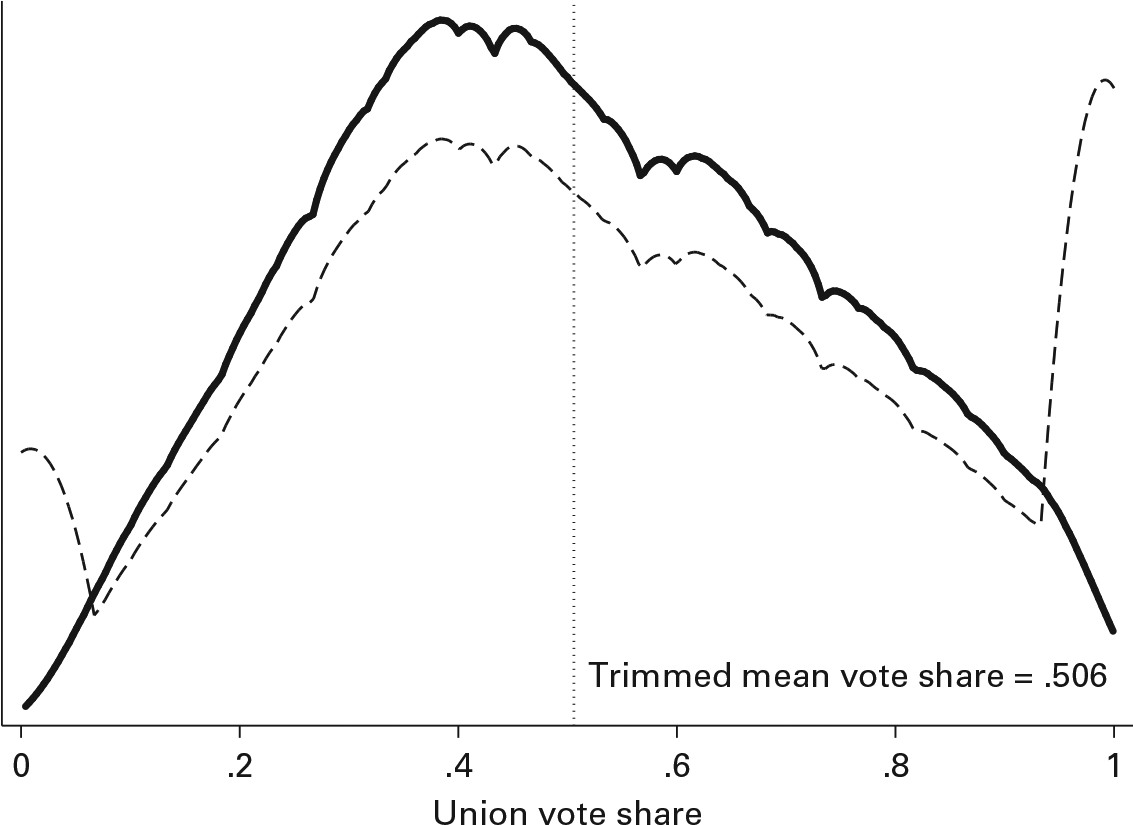
Kernel-density plots of the distribution of union vote shares in union-certification elections.*
The average union vote share was not increasing during the long protest wave. Rather, as figure 2 shows, average vote share declined steadily until 1982, after which it rebounded somewhat. Because unions’ decisions to hold elections rather than withdraw their petitions is a choice variable (Ferguson, 2008), it is unclear how much of this decline represents falling support for unions among work groups that traditionally supported them and how much represents a failure of unions to adapt their targeting of establishments to changing attitudes or conditions. In either case, these trends in vote share are useful for us, because we know that any positive correlation between protest activity and vote share does not just reflect common increases in the two variables.

Average vote share received by the union in representation elections, by year.
Independent Variables: Protest Activity
Our main independent variable is the level of protest activity in a metropolitan area in the period before a union election. We generated a count of protest events in the relevant area in the five years preceding the year of the union election. The effect of the level of protest activity is probably multiplicative—for example, increasing the number of protests from one to 20 is more important than increasing from 101 to 120. Thus we took the natural log of the count, which also helps resolve the skewness of the count variable. When we built similar variables to track progressive protest activity, such as on Civil Rights and women’s-movement issues, we relied on the claims made by each protest, as recorded in the DoCA dataset. Detail on which claims we used is in Online Appendix A (https://journals-sagepub-com.web.bisu.edu.cn/doi/suppl/10.1177/0001839217715618).
Calculating these variables involves making choices about how to define a metropolitan area and which period to choose. Both the DoCA and the FAST data record the cities in which their respective events take place. Yet this seems too restrictive a unit of analysis. To take the city as our focus, we would have to presume that protests in Evanston have no effect on union activity in Chicago; that Newark is equally isolated from Jersey City; Arlington from Washington, DC; Oakland from San Francisco; and so on. At a minimum, we would like a spatial unit broad enough to encompass both where people live and where they work. This matters because much protest activity, particularly that related to the Civil Rights movement, often takes place in the protesters’ own communities, while union elections happen at their workplaces. For our analyses, we mapped cities to the core-based statistical areas, or CBSAs, defined by the Office of Management and Budget. CBSAs are based around an urban center of at least 10,000 people and adjacent areas that are tied to it through commuting. The CBSA definitions that were promulgated by the OMB in 2000 comprise both Metropolitan and Micropolitan Statistical Areas, as well as the New England County Metropolitan Areas. The OMB defines 929 CBSAs in the United States. 4
For time period, we used the previous five years, a choice partly driven by practical concerns: we did not want to throw away too many early-period elections by requiring too long a lag on protest activity. But our choice was also driven by theory: if one of the channels of social movement spillover is the migration into the workforce of young people (in particular) who participated in protest, then it is appropriate to factor in the effects of more temporally distant as well as recent protest activity. We tried replicating our results with lags varying between three and eight years and found substantively similar results.
In addition to the level, we also calculated the median size of protest activity in the CBSA over the five-year period. For this we drew on records of the number of protest participants in the DoCA data. We used the median rather than the mean because the latter is severely affected by a handful of very large protest events, such as the March on Washington in 1963 and the MayDay activities against the Vietnam War in 1971 (DeBenedetti, 1990).
Figure 3 shows the count of both protest events and union-representation elections by year. There is no strong year-to-year correlation between the frequency of the two types of events, but both protest and union-organizing activity decline precipitously after 1980 (Tope and Jacobs, 2009). The correlation in the levels of the two activities across decades raises the concern that both may be driven by a common, unobserved trend that varies by time. This motivates our controlling for year fixed effects in our analyses. The break in the protest and union-organizing time series, as well as the change in the union vote-share series shown in figure 2, together motivate our decision to break the data at 1981 when testing hypotheses 6 and 7. 5
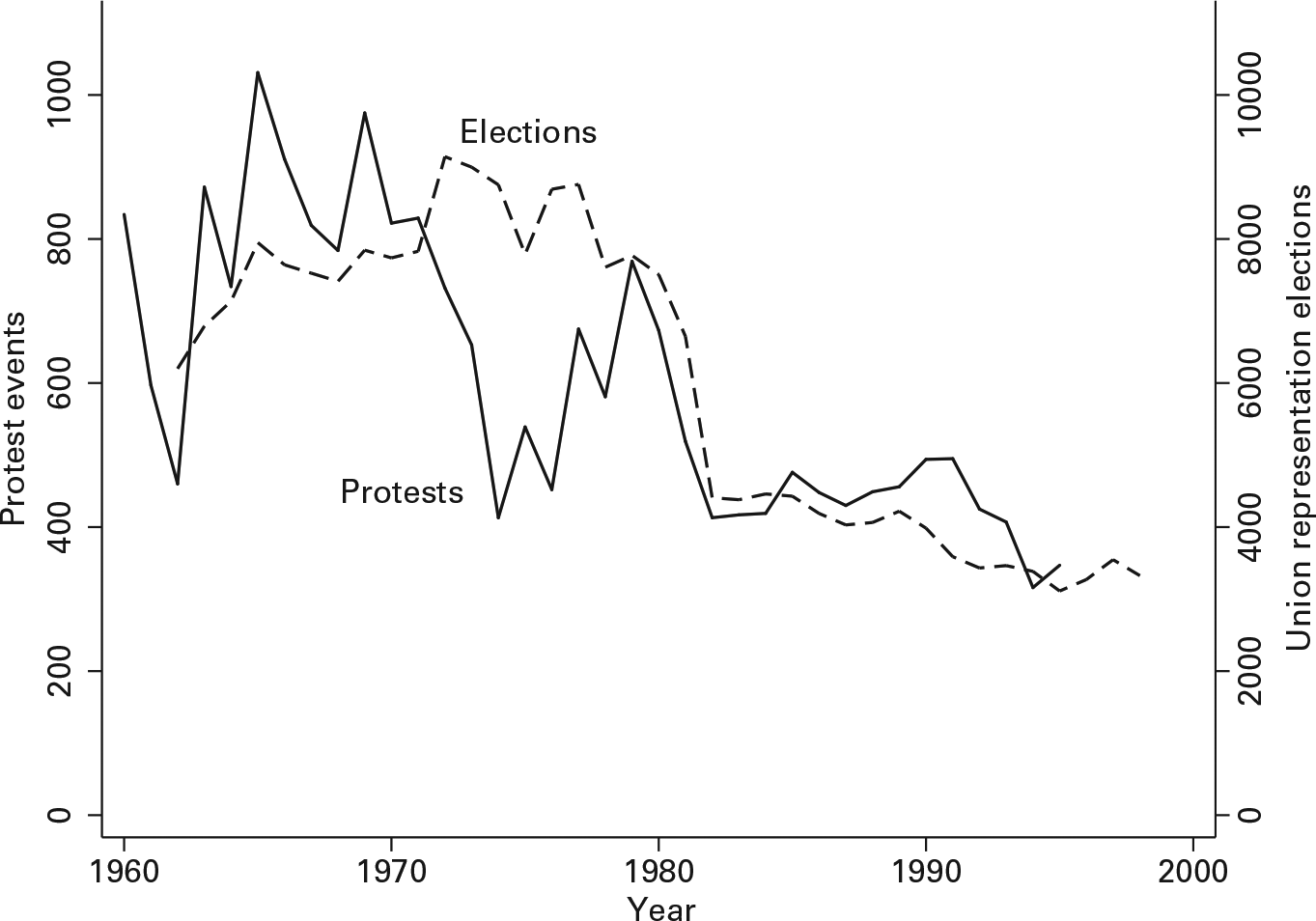
Protest activity and union-representation elections, per year.
In addition to varying over time, both protest and union activity vary across space. Both types of events are clustered in metropolitan areas, though not necessarily the same areas. Tables 1 and 2 show the top 25 CBSAs ranked by their levels of protest activity and organizing activity, respectively. Thirteen city areas appear on both lists. Because the clustering of both activities in a comparative handful of cities might indicate that, as with the variation over time, the levels of both protest activity and union support might be driven by unobserved differences in the environment of different city areas, we controlled for CBSA-level fixed effects in our analyses.
Distribution of Protest Events across Core-based Statistical Areas (CBSAs), 1960–1995: Top 25 Cities*
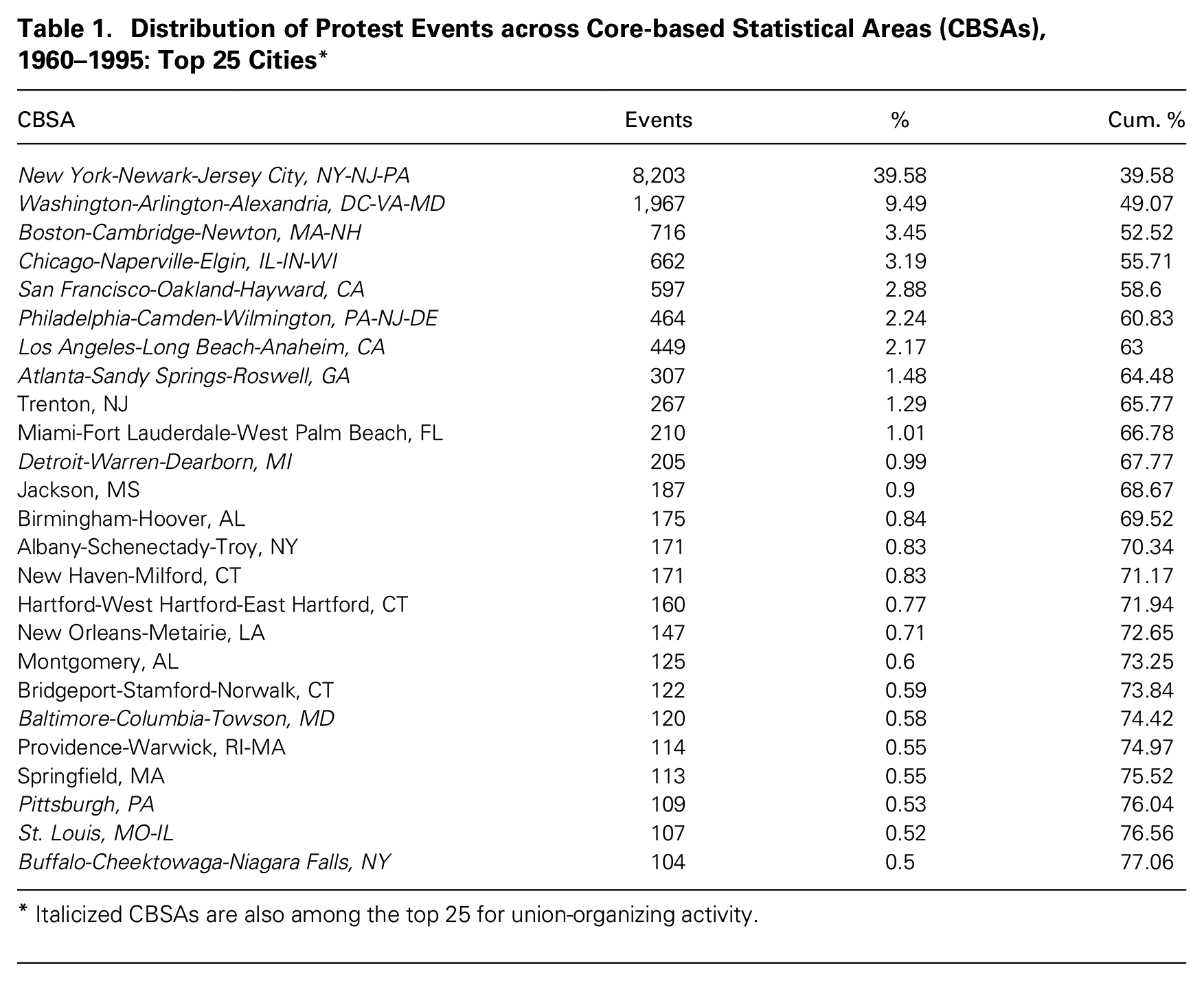
Italicized CBSAs are also among the top 25 for union-organizing activity.
Distribution of Union Representation Elections across Core-based Statistical Areas (CBSAs), 1962–1998: Top 25 Cities*

Italicized CBSAs are also among the top 25 for protest activity.
Finally, “organized labor” is by no means a homogeneous actor. The various labor unions have their own histories and track records with regard to issues like race relations, support or criticism of U.S. foreign policy, and openness to female members. We have hypothesized that protest around progressive causes would spill over into support for unions with more-progressive track records. As table 3 shows, the organizing drives in our data are clustered, such that the 25 most-active unions account for more than four-fifths of all activity. Thus we controlled for union-level fixed effects in our analyses.
Distribution of Union Representation Elections by Union, 1962–1998: Top 25 Most-active Unions*
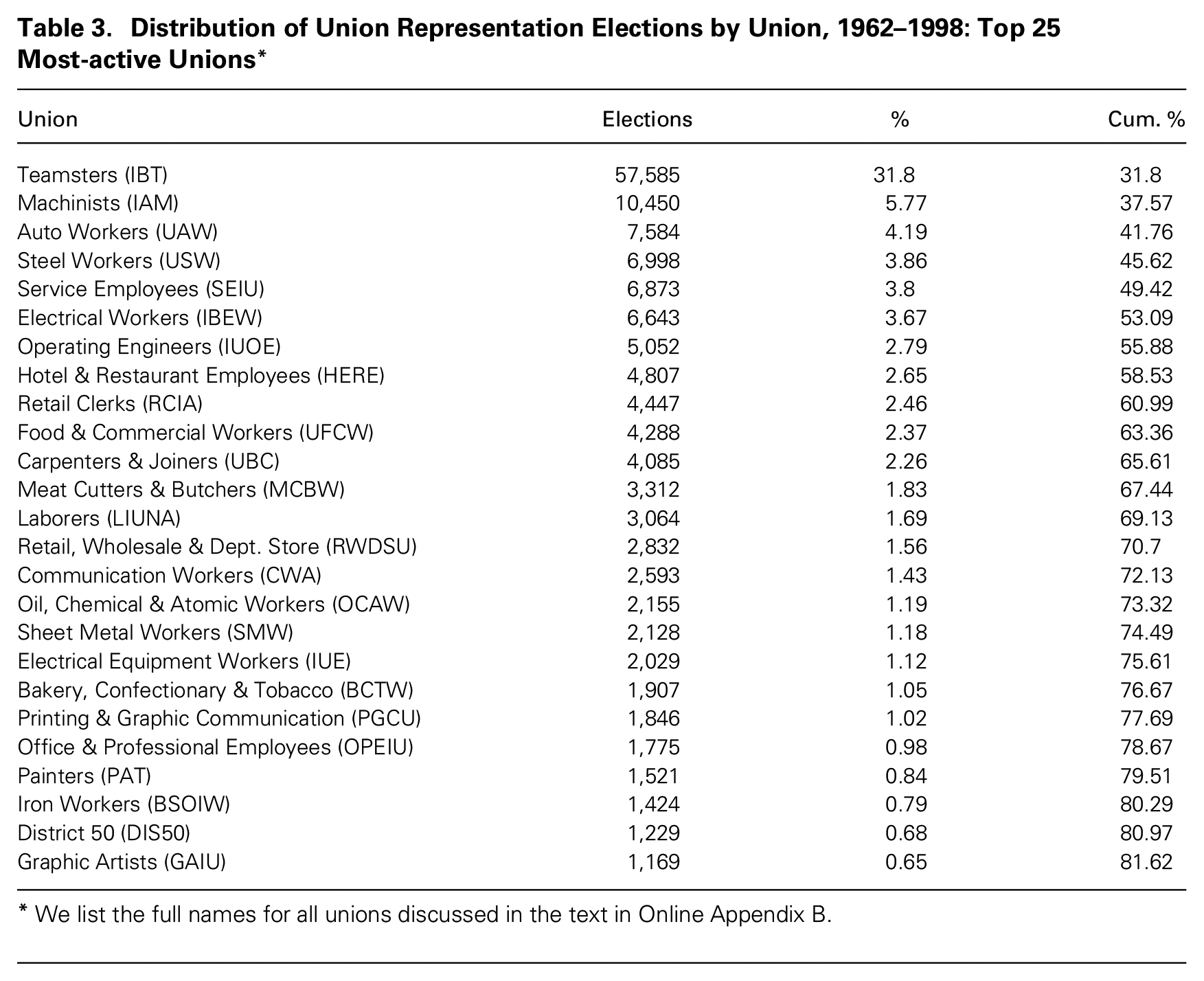
We list the full names for all unions discussed in the text in Online Appendix B.
Control Variables
We included controls at the establishment and CBSA levels. In each case we focused on factors that vary across cities and over time and thus would not be absorbed by fixed effects for CBSA, year, or union. Even though our units of observations are specific union-representation elections, many of these variables are measured annually for each CBSA; thus all of our models cluster their standard errors by CBSA and year.
At the establishment level, unit size has a well-documented negative relationship with election success (Farber, 2001), and including it allowed us to control for any heterogeneity in the size of establishments targeted by union organizers in different times and places. We therefore controlled for the logged number of eligible voters included in the FAST election record. We also controlled for whether there is an incumbent union on the ballot. The vast majority of union elections are held as attempts to establish a union where there was not one before, but some are focused on decertifying one union in favor of another. If there are differences in the frequency of such attempts, controlling for incumbency will partial that effect out. The presence of an incumbent on the ballot is also indicated in FAST records.
The DoCA data do not include strikes by labor unions, but it is obviously important to control for such labor-related protest events. We included strike data for the years before 1978 using the Work Stoppages Historical File compiled by the Department of Labor. After 1981 the Labor Department stopped compiling regular data on strikes that idled fewer than 1,000 workers. For years after 1982 we relied on the archive of work stoppages compiled by the Federal Mediation and Conciliation Service. Detailed data on strikes in the private sector are unavailable between 1978 and 1982, so we interpolated strike levels for CBSAs between 1978 and 1982. 6 The historical strike data record only the state in which the strike happened, so we aggregated our annual counts of strikes at the state level. 7 We used the same five-year temporal structure as we did with other protests.
Differences in the political orientation and control of government can affect both the toleration and perceived efficacy of protest and the success of union activity. We controlled for the conservative politics of the CBSA in which the representation election takes place, drawing on the county-level votes from each presidential election between 1960 and 2000. In each county, we took the vote share received by the more-conservative candidate (or candidates, as when Richard Nixon and George Wallace both contested the 1968 election). For each CBSA we generated a conservative vote share as the weighted sum of each county’s conservative vote, where the weights are each county’s votes cast. We linearly interpolated between election years to compute a conservative-politics score for each CBSA in each year.
Because union elections are more likely to succeed where unions have historically been strong, and because places with strong histories of collective action may be more likely to sponsor new types of collective action (Greve and Rao, 2012), we controlled for the state union density in a given year, using the data that Hirsch and Macpherson (2004) compiled from the Current Population Survey (CPS). Unemployment both weakens the strength of unions and can increase the incidence of protest, so we controlled for the unemployment rate in each state-year using either the Bureau of Labor Statistics’Local Area Unemployment Statistics series or (before 1976) figures calculated from the CPS.
Unions have been more successful organizing in larger cities, and larger CBSAs have more protest activity. We used data taken from the decennial census, supplemented by the annual CPS, to control for CBSA population size. Since at least the late 1960s, black workers have been more inclined to vote for unions than those of other races (Rosenfeld and Kleykamp, 2012). Our data include many protests, particularly around Civil Rights, that disproportionately involved black citizens. Thus we controlled for the annual black share of each CBSA’s population, using the same sources. Finally, we controlled for the annual CBSA employment share in manufacturing, because employment shifts associated with growth or decline in this traditional union stronghold could both affect labor support and trigger public unrest (Sugrue, 1996). Before 1968, manufacturing share can be calculated only at the state level; afterward, we used the share at the CBSA level. Table 4 presents summary statistics and bivariate correlations of the variables used in the analyses.
Summary Statistics and Bivariate Correlations*
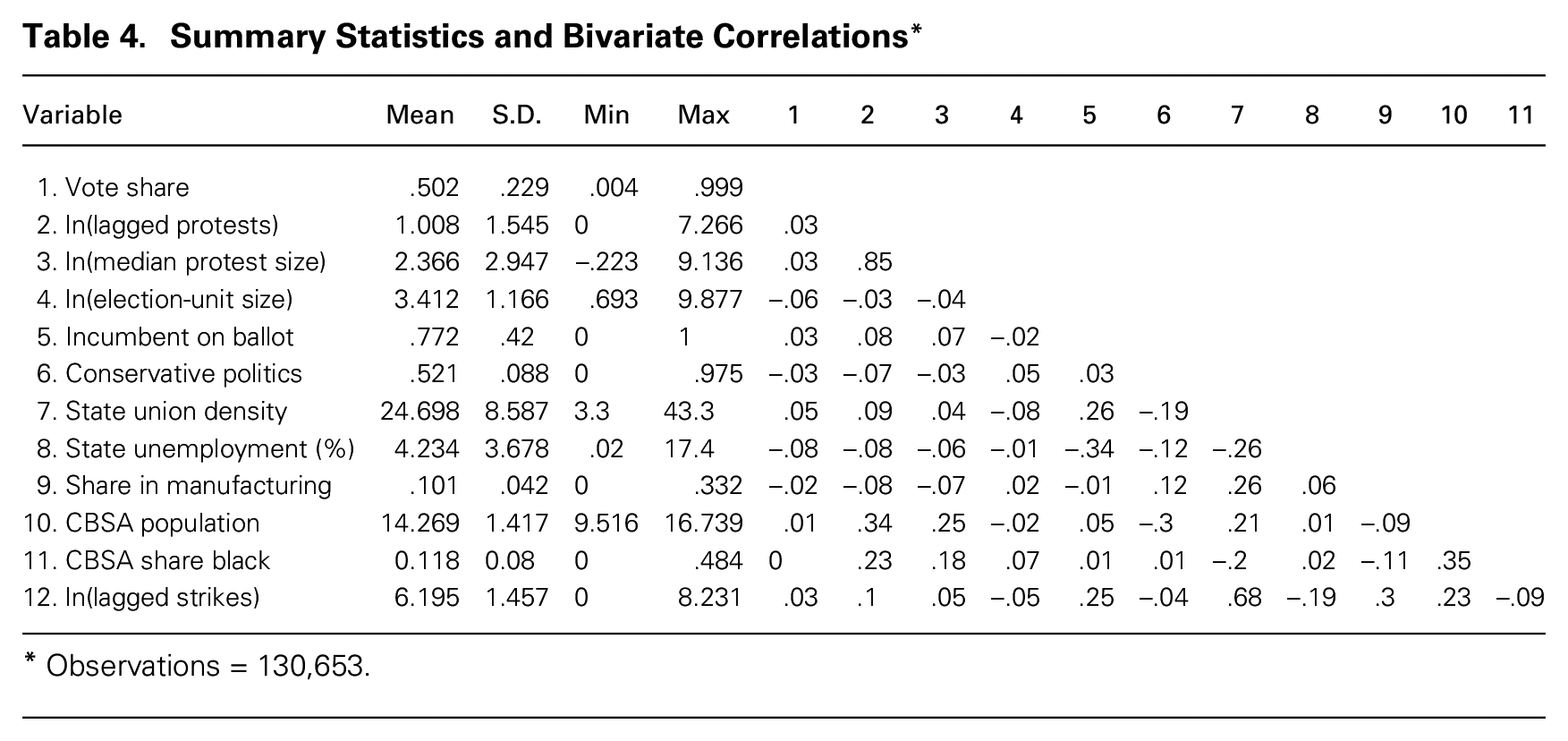
Observations = 130,653.
Models to Be Estimated
Our empirical strategy is to estimate the correlation between lagged protest activity and votes for unions in representation elections, and our unit of observation is the representation election. Our analysis has two main parts. First, we built out a series of fixed-effect models to explore whether any association we found between the two variables persisted when we controlled for various sources of unobserved heterogeneity between the cases. These models allowed us to test H1. Second, we reproduced those models using more-restrictive versions of the independent variable, focusing on progressive, Civil Rights, and women’s-movement protests, to test H2 through H7. Third, we created subsets of these linear models by union and year to explore whether the strength of osmotic mobilization varies by union. Exploring effect heterogeneity for unions is necessary to test H5. In robustness checks, we also estimated the parameters of a two-level hierarchical model in which we allowed the effects of protest to vary randomly by city, year, and union.
Our dependent variable, union vote share, is a proportion bounded between zero and one. We preferred to estimate vote share and then calculate union wins and losses, rather than estimate victory directly, because the former approach is more statistically efficient, uses all available information, and is more useful for computing counterfactual predictions (Gelman and Hill, 2007). In robustness checks we replicated our analyses using a binary win/loss variable and found no substantive difference in the size or significance of our estimated coefficients.
We estimated the proportion of votes for the union using a general linear model. Elections are observed at the level of specific establishments. Let
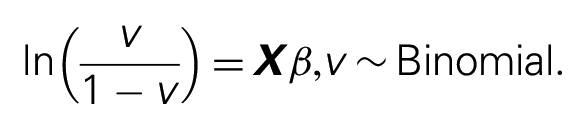
In this case vote share is assumed to follow a binomial distribution, as is typical with an outcome that is the aggregation of i.i.d. Bernoulli random variables, and
We theorized that vote share would be driven in part by levels of protest activity. Of course, many other factors can affect the level of support a union receives. In our full model, we specified

where
Because we measured protest activity at the level of the city-year, we could not include city-year fixed effects. Nor could we include all three sets of fixed effects in the model, as doing so would swamp any variation in protest activity. Instead we introduced these effects singly and in pairwise combination. Though we could not include city-year fixed effects, we included city fixed effects and year fixed effects; we controlled for unobserved heterogeneity between cities that is constant over time, as well as unobserved heterogeneity over time that is stable across cities. We also controlled for persistent unobserved differences among unions. These fixed effects underlie our identification strategy: in addition to our explicit controls, the fixed effects allowed us to control for any unobserved differences in both protest levels and union support across cities, across years, and across the unions involved in the elections. This sharply constrains the possibilities for omitted-variable bias. Any such confounding variable would have to be one that covaries with protest activity and union support, across space and time, with the same lag structure.
To explore heterogeneity of osmosis by union, we fit separate submodels for each union. To test H5, we classified unions into progressive, neutral, and conservative subclasses, as we describe in Online Appendix B. We then estimated a weighted average effect of protest for each subclass. In robustness checks, we also compared these results with those obtained from a hierarchical model that allows for crossed random effects by city, year, and union.
Results
Table 5 presents our general linear model (GLM) results for union vote share as a partial function of the level of protest activity. Model 1 shows the correlation of lagged protest activity with vote share. The estimated coefficient is positive and significant, which supports H1. Model 2 separately controls for the size of the median protest event, alongside the overall protest level. We included model 2 to demonstrate that our main effect is robust to measurement of protest size, but we did not include size in all of the later models for two reasons. First, including protest size changes the interpretation of the protest-level variable. Because the size variable is not defined in city-years wherein no protest occurred, model 2 estimates the variation in vote share by protest activity among only the city-years that had some protest events; hence the drop in observations. Second, separately controlling for level and size means that the size coefficient shows the effect of increasing the median protest-event size while holding the level of protests constant. Our data have only enough repeated measures of protest level to gain statistical power on the variable at a few levels of protest activity, so this coefficient is estimated on a subset of the data. One alternative would be to compute a count of protest events weighted by protest size, essentially trying to count how many people turned out for protests in a CBSA over a given time period, but this has problems of its own, including likely repeat counting due to people attending multiple events. Thus we have chosen to focus on protest level for our subsequent analyses. Model 2 is nonetheless important, as the significance of the protest-level variable shows that the effect in model 1 is not reducible to the difference between having some versus no protest activity.
General Linear Models of Vote Share in Union-representation Elections*

p < .05; •• p < .01; ••• p < .001.
Standard errors, in parentheses, are clustered by CBSA and year.
Model 3 introduces our establishment-level controls. Both of these effects move in the directions predicted by prior work. Union elections are less likely to succeed in larger bargaining units, as prior work has found, and unions are more likely to win elections when they are trying to unseat an incumbent union. Model 4 introduces our city-year-level controls. Unions are less likely to win in more politically conservative places and at times of greater unemployment, and they are more likely to win in states with greater union density. One surprise in the control variables is that unions are less likely to win elections in cities with larger shares of their workforces employed in manufacturing. We suspect this reflects that unions had some of their largest and earliest successes in cities heavily dominated by manufacturing. By the era under study here, many such cities were entering periods of sustained economic decline (Cumbler, 1989; Sugrue, 1996), which has been associated with lower support for unions in some sectors (Goldfield, 1987).
In table 5 the coefficient on protest level is significant and stable, ranging from .013 to .026. It is important to put this effect size in context. In model 4, for example, it implies that holding all other variables at their means and increasing the logged protest level by one standard deviation would increase the expected union vote share by .78 percentage points. 8 Given that the average margin of victory in representation elections is 2.8 percentage points, this effect size is substantial. We can apply this increase to the elections observed here and calculate that a .78-percentage-point increase in the union vote would have flipped an additional 6 percent of the elections to union victories and would have resulted in an additional 294,833 union members. This of course is just the most direct effect. It is reasonable to assume that increases in union density would also imply increases in union organizing, in which case the total increase in membership resulting from increased protest might be larger.
The models in table 6 expand on model 4 from table 5 by adding vectors of fixed effects. As discussed above, we fit these models to investigate whether the effect on vote share that we attribute to protest might in fact be due to some unobserved differences across years, cities, or the unions involved. Models 5 through 10 show that this is not the case. Though some of the effect may be attributable in particular to differences in the unions involved, the main effect of protest level remains positive and significant in all of these models. 9
General Linear Models of Vote Share in Union-representation Elections with Fixed Effects*

p < .05; ••p < .01.
N = 130,651 observations. Standard errors, in parentheses, are clustered by CBSA and year.
Taken together, the results in tables 5 and 6 provide strong support for H1, that there are positive spillovers between outsiders’ protest activity and insiders’ mobilization through union representation elections. The models in table 6 rule out the possibility that this relationship merely reflects unobserved differences across time periods, cities, or unions.
H2 through H4 test how such spillover varies by the type of claims made by outsider activists. Table 7 replicates model 4 with different types of protest counts. Model 11 shows spillover from lagged protests coded as making politically progressive claims. The estimated coefficient, .015, is larger than the .013 from model 4, and a Wald test indicates that the difference is significant at p < .02. This lends support to H2, but the substantive difference in effect size is not very large. The story is very different when we concentrate on Civil Rights–related protests. As model 12 shows, if we focus on Civil Rights protests during the long protest wave itself—modeling only those elections held through 1981 and thus influenced by protest activities through 1976—the estimated spillover is nearly three times larger than for the sample as a whole, supporting H3. The results for employment-related protests by the women’s movement are starker still: the pooled coefficient for such protests is .048 (p < .01). Models 14 and 15 show estimates by time period. Even before 1981, women’s employment-related protests are associated with nearly twice as large a spillover effect on insiders’ mobilization than for the sample as a whole, which supports H4.
General Linear Models of Vote Share in Union-representation Elections, Focusing on Progressive, Civil-Rights, and Women’s Employment-related Protests*
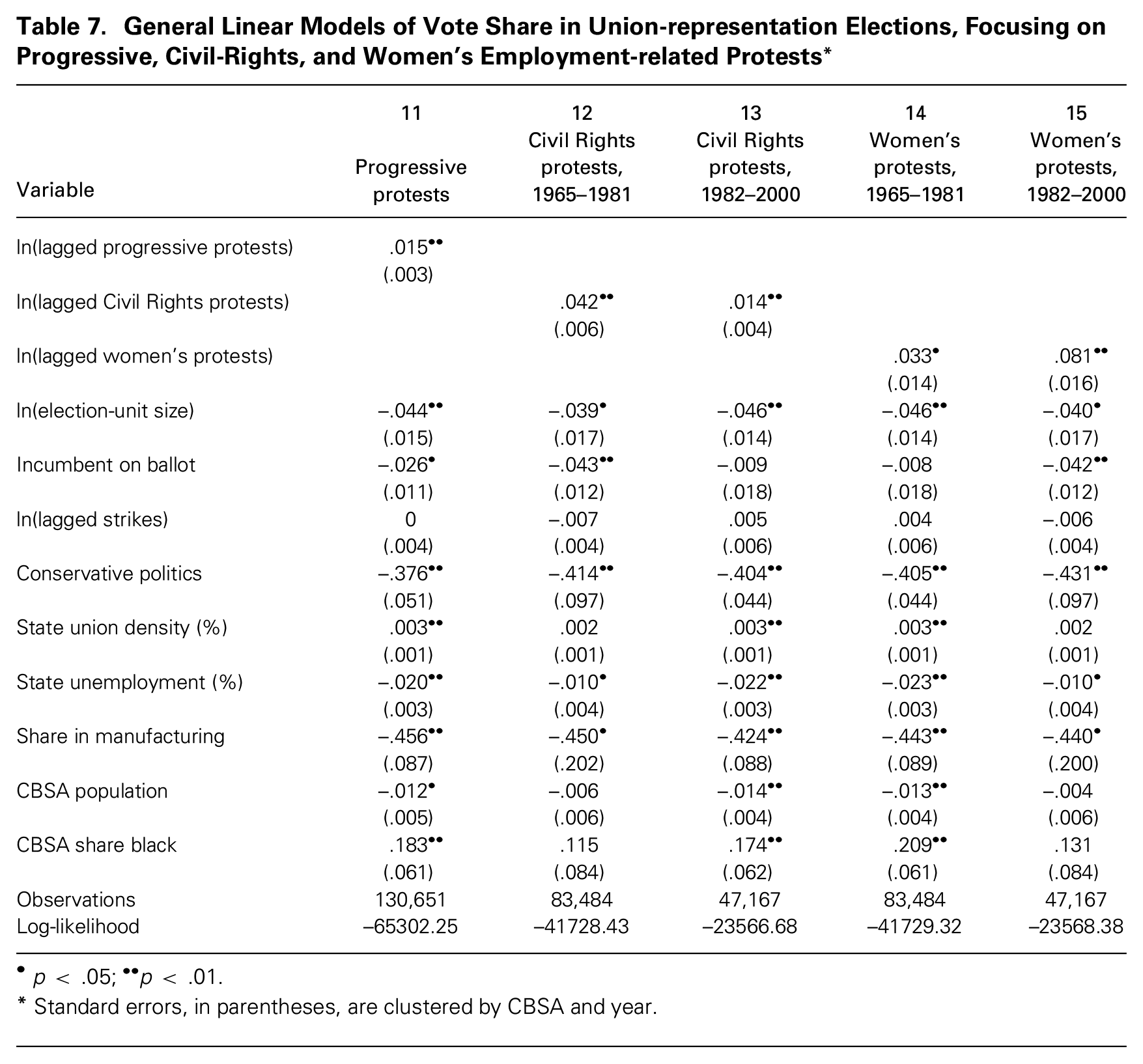
p < .05; ••p < .01.
Standard errors, in parentheses, are clustered by CBSA and year.
H5 is that there will be more osmotic mobilization to unions with more-progressive reputations. Creating data subsets by union produces nearly 100 separate coefficients. We therefore also considered the weighted average effect on progressive, neutral, and conservative unions, and figure 4 summarizes these results. For the majority of unions, protest activity has no significant spillover, as indicated by the faint lines in the figure. For many unions, this owes as much to sample size as to effect size. Despite progressive records on racial integration and/or early opposition to the Vietnam War, for example, unions like the UE or the NUHHCE simply had too few organizing drives to estimate statistically significant effects. 10 Nonetheless, the bulk of unions that did experience positive spillovers from protest were progressive ones—unions such as the SEIU, the HERE, the UAW, the RWDSU, and others that prior studies have either singled out for their liberalism during the period (e.g., Boyle, 1995) or discussed as promising candidates for revitalization later on (e.g., Voss and Sherman, 2000). By contrast, it would seem that, in the wake of external protest activity, the presence of conservative unions makes the organizational boundary even less permeable.

Heterogeneity of effect size of protest on union vote share, shown for different unions.*
It is clear that osmotic mobilization was experienced primarily by progressive unions. The weighted average spillover for progressive unions is .014 (p < .01), for neutral unions is .004, and for conservative unions is –.013 (p < .01). Progressive unions represent 52.6 percent of the organizing efforts we studied, neutral unions 33.1 percent, and conservative unions 14.3 percent. Their average effect is almost exactly opposed to the negative spillovers experienced by more-conservative unions. Because campaigns by more-progressive unions represent the majority of all organizing attempts in the data, the main effect of protest–union spillover is positive. Nonetheless, these differences by political orientation lend strong support to H5.
Finally, models 13 and 15 in table 7 test H6 and H7 by examining whether the effects of protest vary with changes in the opportunity structure faced by the social movements and organized labor. Model 13 shows that Civil Rights–related protests after 1981 are not associated with particularly large levels of osmotic mobilization, even though the coefficient remains positive and significant (a Wald test of the protest coefficients in models 12 and 13 suggests differences significant at p < .01). Meanwhile, in the period after 1981, which includes the lagged effect of mobilization around the Equal Rights Amendment, the estimated effect for women’s-movement protests is more than 2.5 times as large as before 1981 (the difference between these coefficients is significant at p < .01). We take care not to generalize from this coefficient to the whole sample. There were fewer organizing events after 1981, and unions had clearly started to alter their targeting and organizing activities, as the change in the vote-share trend in figure 2 indicates. Nonetheless, this pattern of results is completely in line with the mobilization of collective action among women and the feminization of union organizing in the private sector, parallel with what Isaac, McDonald, and Lukasik (2006), Rosenfeld (2014), and others have found in the public sector. Together, these two models constitute support for both hypotheses.
Robustness Checks
We had two primary concerns related to the choice of our models: whether our pattern of results was being generated by particular clusters of observations, and how sensitive our results were to our choice of the general linear model with a logit link to model vote shares. Accordingly, we conducted two sets of robustness checks, as described in Online Appendix C.
In the first set, we excluded specific groups of observations that might have had an effect on spillovers, including those from the CBSA centered on New York City, all organizing drives by the International Brotherhood of Teamsters, and observations after 1981. Results in table C1 in the Online Appendix show that our main results are not driven by any of these groups of observations.
Next, we tested a non-trimmed measure of vote share and a win/loss outcome variable and tested other specifications of our model. As table C2 in the Online Appendix shows, a non-trimmed measure increases the estimated size of protest–union spillover by about 30 percent, but the general pattern is unchanged. Similarly, the effect of vote share remains significant in an OLS regression. A logit model using the win/loss specification also shows that the effect of protest activity is quite stable.
Finally, we tested the robustness of our results of using data subsets by union by fitting a hierarchical linear model that includes random effects for city and year as well as for union (Raudenbush and Bryk, 2002). Online Appendix C describes modeling procedures. Table C3 reports the analysis of variance resulting from models in which we constrained the effects of protest to be uniform for all unions and in which we allowed the effect to vary. In both cases in which we allowed for separate union-specific slopes, model fit is significantly improved. The union-specific coefficients produced in these models are also substantively similar to what we report from the subset models above (full results are available on request). This additional analysis increases our confidence that the variance in protest’s effect is indeed due to different union behaviors.
Discussion
Little research has focused on when extraorganizational social movements encourage mobilizations inside organizations that target those organizations, so we do not understand the contingencies that determine when this process, osmotic mobilization, will be stronger or weaker. We theorized about movement or organizational characteristics that may increase such spillover: resources that further an external movement’s claims, ideological overlap on those claims between external and internal actors, and variation in the opportunity structure in organizations. We explored these ideas using data on the relationship between public protests and union-representation elections during the long protest wave and found that higher levels of public protests were associated with greater support for labor mobilization in private-sector firms and that such spillover is heterogeneous. Ideological and interest overlap between outsider and insider activists predicts greater spillover, and osmotic mobilization happened disproportionately to unions with politically progressive track records. This was particularly so when outsiders mobilized around employment-related issues that labor unions are well placed to help advance. What is particularly nice about this pattern of results is that many case studies have characterized some unions as more activist or transformative than others (e.g., Voss and Sherman, 2000; Clawson, 2003; Martin, 2008a), and our findings indicate that these unions effectively raise the osmotic pressure for progressive protests in the organizations in which they try to represent workers. Thus we see a pattern hypothesized in small-n work supported in more-representative data.
For organization theorists, the real payoff from understanding this process lies in specifying the channels through which external pressures ultimately affect firm outcomes. Some channels, like legislative change, are clear (Dobbin et al., 1993; Dobbin and Sutton, 1998). Others, like shareholder activism, can also be effective but will vary more by characteristics of the firm targeted (King and Pearce, 2010). Mobilization of the firm’s workers, as opposed to its owners or powerful external stakeholders, has received less attention in recent research. Yet organizations like unions are potentially critical candidates for spillover, because they tend to combine high knowledge of and influence on the firm with low dependence on it, and thus they have comparative freedom of action (Zald and Berger, 1978; Briscoe and Gupta, 2016). Despite its weakness today, for decades the labor movement helped channel extraorganizational demands into formal organizational routines and practices (Slichter, Healy, and Livernash, 1960; Kochan, Katz, and McKersie, 1986; Edelman, 1990). The mobilization of workers and their formal organizations is part of any general understanding of how contentious politics might play out in private organizations (Davis et al., 2008).
Our research design lets us argue strongly for a causal effect of osmotic mobilization and the determinants of its variation here. The rich set of fixed effects that we include rule out most sources of spurious correlation between protest activity and union support. The pairwise combinations of fixed effects further restrict the possible confounds: any confound would have to vary both by city and by year, with the same pattern of temporal variation present in our protest measure. We also controlled for the most likely correlates of union support that vary by city and year, such as the unemployment rate, political control, and demography. Therefore, though it is notoriously hard to make causal statements from observational data, we think that these results clear a very high bar.
Causality and generalizability are separate concerns. As we discussed above, union elections happen only where organizing drives have had some measure of success. If the union thinks its chances are hopeless, it will withdraw and leave no record in these data. The most conservative way to interpret our findings is to say that they apply to organizations in which there was already some threshold level of sympathy for organized labor. This does not reduce the generalizability a priori, but if there are theoretical reasons why we would expect different behavior from, say, manufacturing workers than from professionals, that would apply here. Some portion of the observed effect may also reflect how unions changed their organizing behavior in the wake of protests, rather than how protests changed workers’ views of unions. We think that this sample-selection issue would tend to understate the results we find here, but we do not think it would significantly alter the theoretical propositions we advance. 11
Yet there are boundary conditions on the theoretical conclusions we draw from these findings. Historically, the labor union is not a rare form for mobilization to take. Half a century ago, nearly one in three private-sector workers in the U.S. was a union member; the rate was and is higher in many other industrialized nations. Yet it is an atypical form. Most insider activists (Briscoe and Gupta, 2016) are more dependent on their host organizations and have less freedom of action than the typical union. They may have limited ability to take public positions on issues that matter to outsider activists but that are orthogonal to their organizational purpose. In practice we might observe less variation in the strength of osmotic mobilization among less autonomous insider activists, not because ideological overlap is unimportant but because such activists have less latitude to express their preferences. Similarly, the specific opportunity structure for other types of firm-targeting mobilizations may be harder to define and measure. Here we could exploit changes in political control and enforcement that affected the common legal infrastructure underpinning unionization. Thus we could operationalize broad shifts in the opportunity structure using period effects. Such identification would be harder among more heterogeneous mobilizations.
We should also underline how osmotic mobilization differs from most extant work on the relationship between outsider and insider activists. That research considers activists on both sides of the firm boundary while holding the firm, and usually the activists’ claims, constant. Thus studies might look at the relationship between public protest and shareholder resolutions around disinvestment by specific corporations (Soule, Swaminathan, and Tihanyi, 2014) or the orientation of firms toward outsider agitation around a single issue like domestic-partner benefits (Briscoe and Safford, 2008). We seek to understand something broader: how social movements, even when they are not targeting specific organizations and policies, can provoke or support the emergence of mobilization that does target organizations. At the level of the specific firm or claim, there may be little scope for ideological variation. Outsider and insider activists may almost by definition face the same opportunity structures. We would expect variance on these dimensions to be smaller and less important for our theories. At a greater remove, though, they matter.
We have taken no position on the specific mechanism that produces the correlations we find here—not because we think it unimportant but because the types of relational, nonrelational, and mediated mechanisms that social movement research has identified (Givan, Roberts, and Soule, 2010) all yield similar predictions. Osmotic mobilization can happen, for example, because one-time Civil Rights marchers later support unions in their workplaces at higher rates but also because union organizers who once marched go on to target different firms than their peers. Alternatively, workers might observe the efficacy of collective action without participating themselves and later support such mobilization in their firms. We cannot distinguish such mechanisms here—with these historical data, we are probably at the limits of what detail can be resolved. 12 But this is precisely where the prospects for future work become exciting. The challenge for untangling the mechanisms of osmotic mobilization lies in knowing which individuals overlap between mobilizations and organizations, and in knowing individuals’, groups’, and organizations’ opinions on the claims made by different social movements. Gathering data on this will never be easy, but today it is at least feasible. Social media offers more detail on protest events and individual attendance than ever before; press releases and other statements by organized actors are archived better than in the past. One could imagine tracing a person’s Instagram photos from Zucotti Park during Occupy Wall Street, their employment via a résumé on LinkedIn, and their membership in an anti-sexual-harassment group on Facebook. Could we predict where the next wave of employment-related activism will appear or spread, based on such data? These links are more distant than what most outsider/insider research has explored to date, but they relate to the process of osmotic mobilization theorized here.
This study also has implications for the indirect effects of osmotic mobilization. For example, a hallmark success of the Civil Rights movement was the Civil Rights Act, which in turn created the Equal Employment Opportunity Commission (EEOC). Since the early 1970s, the EEOC has both set out criteria for and monitored compliance with the act. When designing organizational structures and routines that would demonstrate such compliance, many firms drew on models that had originally been worked out as part of their industrial-relations policies, such as grievance procedures and routines for termination with cause. Yet organization theory has largely ignored how the preexisting normative framework of industrial jurisprudence both enabled the rights-based legal employment relationship and simultaneously constrained the forms that that relationship would take. Though early diversity professionals’ reliance on older labor-relations policies is well understood (Edelman, 1990; Edelman, Uggen, and Erlanger, 1999), the spillover from those larger social movements to unions that targeted the private firm that we observe here helps us to understand why so many workers would be satisfied with managers using those routines as a model for fair treatment in the workplace.
Similarly, the labor movement influenced firms that sought to avoid unionization. During the 1970s and 1980s, many successful U.S. firms began experimenting with innovative policies for employee participation. The goal was to give employees a real sense of representation and voice while retaining the managerial prerogative to determine firm strategy (Kochan, Katz, and McKersie, 1986). Company-dominated labor unions are illegal under the National Labor Relations Act, but affinity associations of employees around race, gender, or sexual orientation are not. Such identity-based categories, given salience by mass protest movements outside the firm, offered more-progressive firms different nuclei for worker organizing and representation, separate from union control (Piore and Safford, 2006). We have examined the empirical evidence for osmotic mobilization of unions by the long protest wave, but given the right data, it would be equally possible to model how the same protests influenced firms to support employee organizations that helped forestall unionization but that nonetheless often demanded changes to other firm policies (e.g., Briscoe and Safford, 2008).
We should also note the empirical contribution of this study to labor-movement research and the theoretical connection it draws between that research and organizational theory. Evidence of osmotic mobilization of labor unions by movements in the long protest wave suggests that we should reconsider how effective alliances between social movements and labor unions can be for both parties. Organization theory approaches the issue by asking how worker mobilization can further movements’ goals; labor-movement research approaches it by asking how social movements can revitalize the labor movement itself (Voss and Sherman, 2000; Clawson, 2003; Martin, 2008b). Much of the work on labor-union revitalization presumes that if unions were able to successfully harness the energy, initiative, and popular support of social movements, they could reverse their historic decline. We show that there was nontrivial protest–union spillover during a period of unprecedented social upheaval and mobilization, yet this spillover was not nearly enough to change labor’s fortunes. We agree that more alliances would doubtlessly help labor and may indeed be a necessary condition of labor-union renewal, but based on these results we doubt that such efforts are a sufficient condition. Simply put, unions’ partnering with social movements is not enough.
Today it is increasingly accepted that the decline of organized labor helped prime the explosion of wage inequality and increasing corporate power over the last generation (Levy and Temin, 2010; Western and Rosenfeld, 2011). This is the great paradox of social mobilization and organizational change in our lifetimes: the gains of rights-based, identity politics in formal organizations seemed to come at the expense of an older logic of economic- and class-based mobilization (Piore and Safford, 2006). Such is the belief that these two are substitutes for one another, rather than complements, that in the extreme, the growth of a rights-based workplace consciousness is argued to have helped cause organized labor’s decline (Lichtenstein, 2002). We argue, and demonstrate, that this opposition is overstated. There was positive spillover from these outsider movements to the insiders. The patterns of mutual benefit observed among different movements, around ideological and interest overlap, can help explain when such mobilization will happen. Osmotic mobilization by itself is not enough to produce the broader types of social change for which both of these activist populations have striven for many years. Yet by beginning to theorize and explore when broad social mobilizations are more likely to produce mobilization in formal organizations, we can perhaps start to predict when opportunities might arise in the future.
Footnotes
Acknowledgements
The authors would like to thank Adam Cobb, Amir Goldberg, Sharique Hasan, Brayden King, Thomas Kochan, Rembrand Koning, Andrew Martin, and John McCarthy for their comments and suggestions on the article.
1
See also Levy’s (1994) and  accounts of mentorship of the New Left by the old in the early 1960s.
2
Non-relational channels of spillover probably dominate in the formation of counter-movements. At the time of writing, left-wing social movements are explicitly trying to copy the techniques pioneered by the Tea Party in U.S. elections (Indivisible, 2017). Such movements rarely share personnel and actively compete for resources.
3
Union density is defined either as the share of all employees who belong to a labor union or as the share who are covered by a collective-bargaining agreement that a union has negotiated. The two track one another very closely.
5
A break-point around 1981 also corresponds with similar analyses by Tope and Jacobs (2009) and .
6
We tried excluding observations that rely on these years’ strike levels and got similar results.
7
The post-1982 records include the strike city. We replicated models on the post-1982 data using lagged strikes aggregated by city and by state and got similar results.
8
We calculated the marginal effects discussed here with the margins command in Stata 14.
9
Models with industry fixed effects produce similar results and are available on request. We do not present industry results here for reasons of space and because specific union organizing is correlated with industry, owing to many unions’ industrial jurisdictions.
11
Negative osmotic mobilization might exist if protest participants distrusted unions and could make unions alter the set of establishments they target. In such a case, our results could overstate effects. But this would require any such negative-spillover effects on unions’ targeting behavior to swamp the positive-spillover effects on workers’ voting behavior. We have trouble imagining how this could work. In any case, the empirical answer depends on better data about the earlier stages of union organizing drives.
12
Future work could try to gather demographic information on these establishments, for example by using EEO-1 surveys of the larger workplaces targeted by organizing campaigns (Ferguson, 2015, ). If, for example, more Civil Rights protests were associated with greater union support at establishments with more black workers, this would be evidence for more-direct mechanisms of influence.
Authors’ Biographies
References
Supplementary Material
Please find the following supplemental material available below.
For Open Access articles published under a Creative Commons License, all supplemental material carries the same license as the article it is associated with.
For non-Open Access articles published, all supplemental material carries a non-exclusive license, and permission requests for re-use of supplemental material or any part of supplemental material shall be sent directly to the copyright owner as specified in the copyright notice associated with the article.
