



Abstract
Intra-organizational comparisons—managers and units benchmarking their performance against each other—can turn colleagues into competitors. To better understand when organizations should allow or even encourage internal social comparisons, we study their implications for organizational adaptation and performance. We conceptualize internal social comparisons as an upstream competitive process that shapes performance aspirations and creates interdependencies in search behavior. We distinguish this from downstream, product market competition or complementarities where performance is interdependent across units. Integrating both aspects into a computational model, we show how internal social comparisons affect adaptation and performance through two mechanisms: a balancing effect whereby the organization is guaranteed to contain both exploring and exploiting units, and a stabilizing effect whereby internal social comparisons protect against abandoning existing technologies too early. The benefits of upstream comparisons are accentuated when units are downstream complements, helping synchronize search. When units are downstream competitors, these benefits disappear, suggesting substitutive effects. We highlight empirical implications and discuss theoretical links to work on intra-organizational competition, social comparisons and aspiration-driven search, diversification and performance, and the adaptation of multi-business firms.
Keywords
Intra-organizational comparisons and benchmarking are frequently part of organizations’ political landscapes. Such comparisons often exist at the individual, product, and divisional levels as managers compare their performance. Many of these processes emerge organically, as data about relative performance are available to actors across the organization, fueling comparisons and affecting behavior (Nickerson and Zenger, 2008; Kacperczyk, Beckman, and Moliterno, 2015; Gartenberg and Wulf, 2017). More often than not, these social comparisons (Festinger, 1954) turn colleagues into competitors, evolving into full-blown intra-organizational competition between managers (for status, promotions, and wages) or units (for resources and managerial attention) as the holders of key resources use comparisons to make allocation decisions. This is especially true when comparisons are actively encouraged or formalized by senior management, typically as a way to motivate increased effort through tools like sales leaderboards or stack ranking at Google and Microsoft.
Academic research is divided on whether the net organizational effects of intra-organizational social comparisons will be positive or negative. Many studies have related internal social comparisons to increases in effort—including unit-level effort—to improve organizational performance (Blanes i Vidal and Nossol, 2011; Stark and Hyll, 2011). This aligns with micro-level research suggesting that effort is higher when individuals feel rivalrous toward similar others (Kilduff, Elfenbein, and Staw, 2010; Kilduff, 2014). At the same time, both macro and micro researchers looking at social comparisons have identified potentially damaging side effects of comparisons and the culture they foster, including envy (Nickerson and Zenger, 2008), dishonest behavior (Charness, Masclet, and Villeval, 2013; Chan, Li, and Pierce, 2014), and potentially excessive risk taking (Kacperczyk, Beckman, and Moliterno, 2015). As a result, it is unclear whether—and under which moderating conditions—leaders should allow or even encourage internal social comparisons.
This becomes a question about when, why, and how internal social comparisons may be beneficial for organizational performance. Two important but sparse streams of literature offer initial insights. Taking a unit-level perspective, the organizations research on charter competition (Galunic and Eisenhardt, 1996; Birkinshaw and Lingblad, 2005) has offered a close analogy to intra-organizational comparisons and has suggested that competition between business units can be either beneficial or problematic depending on key contingencies, such as environmental change and capability fungibility. But this research has focused explicitly on downstream, product market competition and not on upstream social comparison processes, thereby ignoring important ways in which social comparisons may affect not just competitive outcomes but also business units’ behavior. Meanwhile, behavioral research has focused primarily on external social comparisons (between competitors) but has recently begun to explore intra-firm comparisons and how they affect behavior (Kacperczyk, Beckman, and Moliterno, 2015). This research has generally emphasized behavior and not performance, and it has not explored the key contingency that units in the same firm may be either competitors or complements in their downstream activities.
In this study, we build on the notion that upstream, intra-organizational comparison processes can affect organizational behavior, thus bridging the literatures on intra-organizational competition and social comparisons. To do so, we consider multi-business organizations and focus on how internal social comparisons affect a specific and fundamental unit-level process: the search for new innovations, both exploratory and exploitative. 1 Behavioral research has generally suggested that lower-performing units engage in more distant search, while higher-performing ones search more incrementally (Greve, 2003; Eggers and Kaul, 2018). Thus internal social comparisons may shape search behavior and thereby affect the entire organization’s ability to adapt to a changing environment (Levinthal and March, 1981). It is this dynamic—the ways in which social comparisons among units of the same firm shape search and adaptation in multi-business organizations, and especially how those effects differ based on the product market interactions of the units—that we seek to explore and understand.
Internal Social Comparisons, Aspirations, and Organizational Adaptation
Most of the work on intra-organizational comparisons has focused explicitly on competition but has not distinguished the important but less-studied upstream social comparisons from the more typical downstream, product market competition. Multiple literatures that may provide insight into the implications of upstream intra-organizational comparisons either do not offer consistent predictions or do not offer any clear prediction at all, thus providing an opportunity to build new theory about the broad effects of intra-organizational comparisons. We seek to fill this gap by leveraging work on aspiration-driven search processes.
In their theory-building research about the emergence of intra-organizational competition, Birkinshaw and Lingblad (2005) identified two levels of competition. The first is competition at the product market level, with divisions selling “competing offerings that the customer chooses between,” which leads to “cannibalization” (Birkinshaw and Lingblad, 2005: 675). Such competition has some negative implications for firms’ performance, as product market competition intuitively leads to duplication costs if divisions build the same resources, and it diminishes a firm’s ability to capture monopoly (or oligopoly) rents through competition with itself over price (Kalnins, 2004). Direct competition between units can also lead to conflict that destroys incentives to share information, a key challenge when units share complementary resources (Joseph and Wilson, 2018). At the same time, substantial research in marketing, economics, and strategy has recognized potential benefits from intra-organizational competition in the product market. Broader product variety within the same firm can help firms capture value depending on heterogeneity among consumers (Kekre and Srinivasan, 1990; Hill, Hitt, and Hoskisson, 1992). Competing products within the same firm can provide insulation against technological change in a dynamic environment (Nault and Vandenbosch, 1996; Sorenson, 2000). Thus the optimal level of product market overlap for any given organization will depend on a number of external environmental factors, such as those Birkinshaw and Lingblad (2005) identified: environmental dynamics, industry maturity, and consumer heterogeneity.
The second type of intra-organizational competition Birkinshaw and Lingblad (2005: 675) noted is “in terms of the social and political processes, such as lobbying, negotiating, and initiative taking.” 2 Recent behavioral research has outlined how political comparisons between units can lead managers to shift attention to regain lost political status (Hu et al., 2017). General Electric (GE) provides a famous, high-profile example: Grant (2013: 763) noted that “internal competition—between divisions and business units for resources and between individuals for performance bonuses and promotions—was a fundamental feature of [GE’s] management systems and organizational culture.” Over 25 percent of U.S. Fortune 500 firms use competitive intra-organizational benchmarking to evaluate business units and managers (Stewart, Gruys, and Storm, 2010). Such competition does not necessarily rely on product market overlap; Nickerson and Zenger (2008: 1432) related the famous backlash among Harvard faculty and administrators over the $25 million in bonuses paid to the school’s own money managers who helped grow the university’s endowment. The faculty and money managers do not compete downstream, but their presence in the same organization led them to benchmark their compensation against one another through social comparison processes. This example highlights the predominantly individual level of analysis for most research on upstream intra-organizational comparisons. In terms of downsides, research has identified social comparison costs that diminish the organization’s ability to coordinate (Nickerson and Zenger, 2008; Blader et al., 2015), as well as the risk of unethical behavior to improve an individual’s standing (Charness, Masclet, and Villeval, 2013; Chan, Li, and Pierce, 2014). The individual-level benefits from intra-organizational comparisons largely involve increased motivation—Stark and Hyll (2011) used a mathematical model to suggest that low-performing, low-wage workers will increase their effort in response to realizing their lower level of relative performance. This increased effort provides benefits to the firm with no costs. Similarly, Blanes i Vidal and Nossol (2011) used single-firm data on piece-rate workers to show that revealing relative position to workers increases the firm’s productivity. Thus the organizationally optimal level of upstream comparisons in the firm may also depend on important yet underexplored factors.
This broad literature on both upstream comparisons and downstream competition has established important contingencies that may determine the performance effects of intra-organizational comparisons, but it leaves important questions underexplored. First, it is important to note that the research on downstream (product market) competition has largely focused on unit-level actions and implications, while most of the research on upstream comparisons has focused on individual-level actions and implications. This presents an opportunity to consider the unit-level implications of intra-organizational upstream comparisons, even if the units are not in the same product market space. 3 If distinct business units in a broad, diversified firm actively compete for resources, as they did at GE, then this behavior may have important unit-level consequences that we have not fully explored. In addition, this gap in our existing knowledge prevents us from fully considering cross-level fit and interactions: does the performative effect of upstream comparisons depend on the level of downstream, product market competition between units of the firm? What if the units are not competitors but actually complements, so the success of one unit benefits the other unit, an important condition identified by Bárcena-Ruiz and Paz Espinosa (1999)? Birkinshaw and Lingblad (2005: 683) suggested that “the greater the level of fit between an organization’s actual profile of environmental and organizational factors and its level of intrafirm competition, the higher its performance,” but the potential for cross-level contingencies between upstream comparisons and downstream competition has not been explored.
We believe that the behavioral research on social comparisons and aspiration levels (Cyert and March, 1963) offers a potential window into how intra-organizational comparisons may affect the behavior of independent business units. In empirical and modeling research, aspirations are important because performance below aspirations typically leads to search (e.g., Baum et al., 2005), risk taking (e.g., Bromiley, 1991), and exploration efforts (e.g., Greve, 2007) to find new solutions that will improve performance, while performance above aspirations maintains the status quo and encourages exploitation (March, 1991). Most behavioral research on social comparisons has focused on external social comparisons (Greve, 2003), which is a form of competitive benchmarking, but the same processes are likely to exist within firms as business units compete for scarce organizational resources and benchmark their performance against one another. 4 This suggests that one gap in the organization-level research on intra-organizational comparison is that it has not considered how the relative standing of the competing units within the firm affects their behavior, actions, and performance. If social comparisons serve as goals and aspirations, then relative performance will affect willingness to invest in risk taking and search in an effort to close performance gaps. Such behavior may be more or less beneficial to the organization depending on the external environment, in line with Birkinshaw and Lingblad’s (2005) core suggestions.
Although to our knowledge no existing research has explored how internal, upstream comparisons between units affect unit-level search efforts for innovations, two closely related streams of research merit note. First, Kacperczyk, Beckman, and Moliterno (2015) explored social comparisons among mutual fund managers and argued that performance below internal social aspirations is especially salient and leads to increased risk taking. Although that study did not consider the relationship between upstream and downstream comparisons within the firm, it represents an important move from a purely individual level of analysis to a unit or organizational perspective, and it informs our research by relating aspirational performance to risk taking. We aim to complement this research by exploring the behavioral implications of intra-organizational comparisons.
Second, the literature on organizational adaptation has conceived of aspirations as a means of regulating organizational search: poor performance leads to exploration, while strong performance leads to exploitation (Denrell and March, 2001; Greve, 2007; Bendor, Kumar, and Siegel, 2009). Most research on organizational adaptation, however, has focused on single-business firms or on specific units within broader organizations (Levinthal and March, 1981). Questions of multi-unit structure, and particularly how structure affects adaptation efforts, have been understudied (Gavetti, Levinthal, and Ocasio, 2007). 5 The two primary empirical papers looking at aspiration-driven search in multi-business firms (Gaba and Joseph, 2013; Eggers and Kaul, 2018) both suggested that firms are more willing to search and explore for novel solutions in underperforming units than in high-performing units but said little about overall adaptive performance. Thus our study seeks to contribute to this literature by expanding a classic question—how do aspirations affect organizations’ adaptation?—to the multi-business setting.
Given the relatively little available empirical work, the discrepancies among available theoretical perspectives, and the difficulty of obtaining broad enough data on the phenomenon to test a cross-context theory, we develop a computational model. Our model extends existing behavioral models of adaptive organizational search (Levinthal and March, 1981; Miller and Arikan, 2004; Blettner et al., 2014) in two major ways: by explicitly representing multiple business units and by considering that relevant performance targets (aspirations) may be driven by comparisons with the performance of other units in the same organization. Because such internal social aspirations determine the balance between exploratory and exploitative search efforts within each individual unit, they affect overall organizational adaptation and performance. Moreover, by representing an explicit notion of task interdependence between the units, we can explore the joint effects of upstream social comparisons and downstream product market competition or complementarity.
Model
Objective and Intuition
To help build our understanding of how upstream, social comparisons between units in the same multi-business firm affect firm-level outcomes and how this effect is moderated by downstream competition and complementarities, we developed a stylized model. The foundation of the model recognizes that internal social comparisons affect organizational outcomes through a process of aspiration-driven search. We argue that internal social comparisons differ fundamentally from intra-unit historical comparisons—the most basic alternative in the aspirations literature—because they create behavioral interdependencies between business units. These interdependencies arise from the fact that internal comparisons establish social aspirations, or social reference points, which business-unit managers consider when evaluating their units’ performance in terms of success or failure and when deciding about future targets and behavior. The interdependencies take effect both at the unit level and at the organizational level. First, whether each individual unit is successful, i.e., whether its performance is below or above the social reference point, does not depend only on the actions of the unit’s manager but also on the actions of his or her peers whose performances get aggregated into the social reference point. Second, at the organizational level, social reference points always categorize one portion of the firm’s business units as “winners” (those above the reference point) and another portion as “losers” (those below the reference point). Intra-unit benchmarks that compare a unit’s current performance with a reference point based on the unit’s historical performance, in contrast, do not create such behavioral interdependencies. When units benchmark their performance only against their own history, whether one particular unit attains its targets is independent from the other units’ performance, and all units may simultaneously operate above (or below) their benchmarks.
The benchmarks that unit-level managers consider are relevant for organizational adaptation and performance because they affect search behavior. Unit managers who fail to meet their aspirations are more likely to engage in exploration, whereas units with performance above aspirations are more likely to focus on exploitation (Levinthal and March, 1993; Denrell and March, 2001; Greve, 2007). 6 Hence our key objective becomes to understand how internal social comparisons affect search decisions at the business-unit level and how these decentralized processes aggregate to affect adaptation and performance at the organizational level (Joseph and Ocasio, 2012; Gaba and Joseph, 2013). 7
The behavioral interdependencies among individual business units and their aggregation into collective outcomes at the organizational level make it difficult to deduce from our conceptual arguments how internal social comparisons determine adaptation and performance (Epstein, 2006). To gain a deeper understanding of these interactions, we thus used a computational model. This approach allowed us to represent and trace the emergent dynamics of an organization’s behavior in a richer manner than would be tractable in a closed-form mathematical model but still in a way that is systematic and simple enough to produce general insights. Moreover, by formalizing various environmental and organizational contingency factors, computational models allow for creating more comprehensive theory (Davis, Eisenhardt, and Bingham, 2007; Harrison et al., 2007). Our model builds on prior modeling efforts in the behavioral theory of the firm tradition that have studied the links among aspirations, performance, and adaptive search (Levinthal and March, 1981; Denrell and March, 2001; Miller and Arikan, 2004; Rhee and Kim, 2014). Existing models have represented firms as unitary decision makers, however, abstracting away from the fact that firms often consist of multiple business units that can each engage in exploratory and exploitative search. By definition, single-agent models do not facilitate the study of internal social comparisons. Our model addresses these shortcomings by explicitly representing firms as multi-agent systems.
To provide a high-level overview of our modeling approach, as shown in figure 1, we represent the typical division of labor in multi-unit firms that consist of corporate headquarters and a number of business units, each of which holds a technology. 8 In each period of the simulation, headquarters allocates resources to the business units, which then decide independently how to allocate those resources to search. Because resources used for one type of search are not available for the other, each unit faces an exploration–exploitation challenge: whether to search for refinements to its current technology (exploitation) or for a new technology that can replace the existing one (exploration). The need for search, and for switching between exploitation and exploration, is driven by environmental dynamics that (slowly or quickly) decrease the value of existing technologies. In deciding how to search, unit managers compare their unit’s performance with their aspirations, which are formed either through internal social comparisons or through historical, unit-level comparisons. Finally, after the units have engaged in search, their performance is realized in their respective task environments, corporate headquarters provides feedback, and the units update their aspirations, thus setting the stage for adaptive search in the subsequent time step. Below we describe in detail how we implemented the different parts of the model.
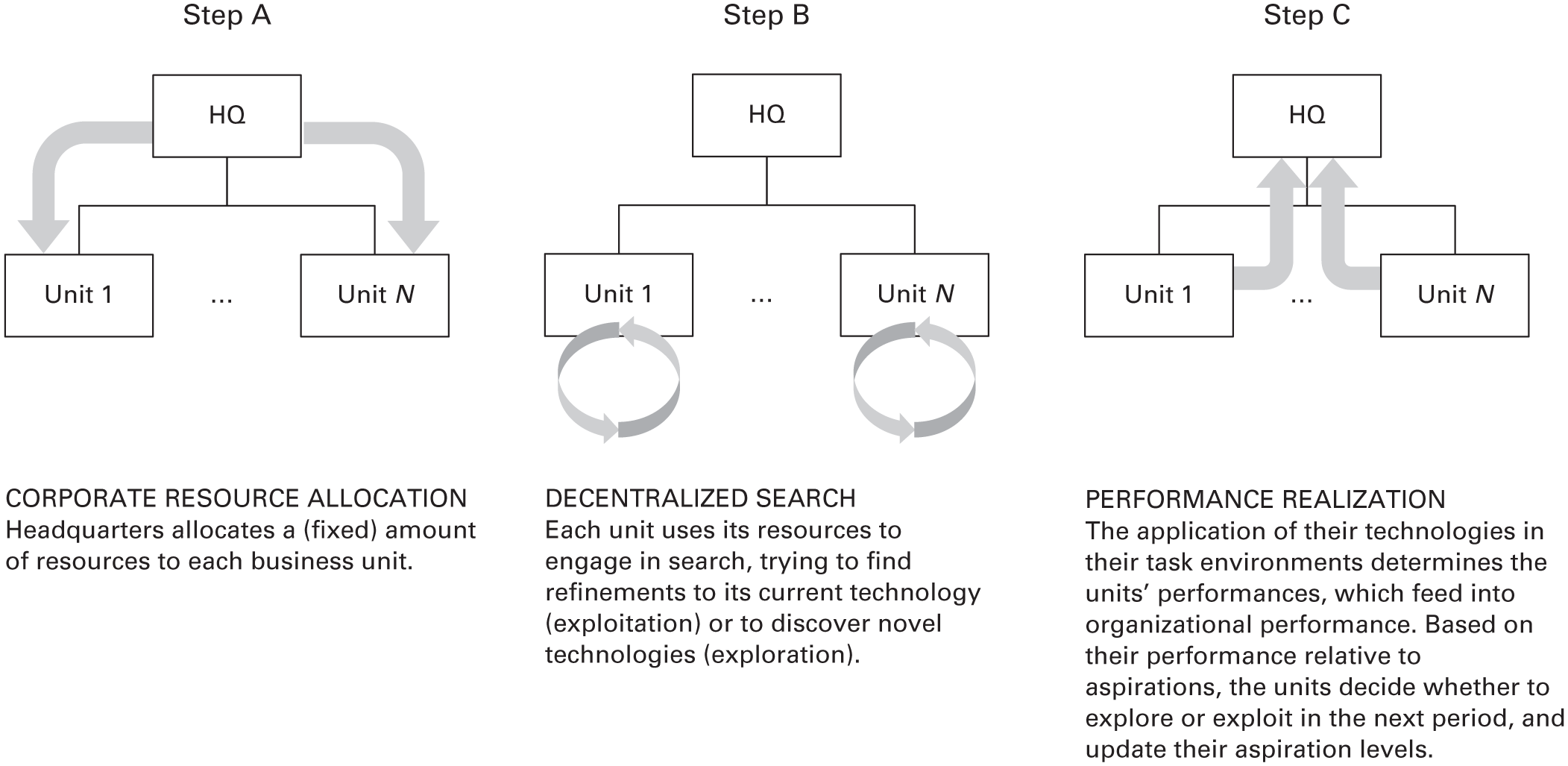
Resource allocation and search in multi-business firms.*
Implementation
Corporate resource allocation
The multi-business firm in our model consists of corporate headquarters and
Exploration and exploitation
Each unit i holds one technology Ti and in each period t uses the Ri,t resources it receives to engage in Ri,t search attempts to further refine the value of its current technology (exploitation) or to discover a potential substitute technology (exploration). If any of the search attempts yield a technological option—either a new technology or a refined one—that has higher value than the unit’s current technology, the unit adopts the best of these options; otherwise, it retains its existing technology. We modeled search as a stochastic sampling process, i.e., its outcomes are uncertain, and agents do not know the probability distributions that they are sampling from (Levinthal and March, 1981; Levinthal, 1997, Denrell and March, 2001). To capture the notion that the returns to exploration are “systematically less certain, more remote in time, and organizationally more distant” (March, 1991: 73) than those of exploitation, we made different assumptions about the underlying probability distributions. 10
In modeling exploitation, our goal was to capture two key aspects. First, exploitation reflects an attempt to improve the performance of an existing technology. For each resource unit that is allocated to exploitation, we thus let the unit draw one refinement value from a normal distribution with mean μ = Ti,t (the current value of the unit’s technology). Hence exploitation produces technological options that are “in the neighborhood” of the unit’s existing technology. Second, the expected gains from refining a technology decline over time, as the technology’s refinement potential becomes exhausted gradually (Fleming, 2001). To capture this aspect, we set the standard deviation of the refinement distribution to
Our approach to modeling exploration likewise built on stylized facts about innovation. Specifically, we assumed that the bulk of innovation efforts fail. Among those that are successful at producing a potentially usable technology, many are of similar (average) quality, whereas tapping into the long tail of high-quality innovations is difficult. For each resource unit that is allocated to exploration, we thus let the units draw one sample from a fixed lognormal distribution with mean μexplore = 0 and standard deviation σexplore = .8. To capture that most innovation efforts fail, we also assumed that discovery search turns up innovations that have no value (and therefore are never adopted) with probability .5. 12
Aspiration formation and adaptive behavior
In each period t, the adaptive behavior of the manager of each unit i is driven by how his or her unit performed relative to its aspirations in the prior period t–1. If the unit’s performance πi,t–1 has met or exceeded the aspiration level Ai,t–1 that the manager had set for the prior period, the manager in the current period allocates all his or her resources Ri,t to exploitation; if the aspiration level has not been met, he or she shifts all available resources to exploration. 13
Conversely, after performance has been realized in the focal period (see below), the manager checks whether aspirations have been met and updates the unit’s aspiration level. To model internal social aspirations, we followed prior work that models external social comparisons (e.g., Greve, 2003, Joseph and Gaba, 2015) and used the mean performance of all units in the organization as the reference point, i.e., unit i’s aspiration level in period t+1 is given by Ai,t+1 =
Business environments and performance realization
Each unit i applies its technology in its business environment, which results in a unit performance of πi,t and an overall firm performance of
Downstream competition and complementarity among business units
Downstream, intra-firm competition and complementarity create task interdependencies among units. Knowledge spillovers or product complementarities (Hill, Hitt, and Hoskisson, 1992) entail positive effects on the performance potential of other business units, such as when successful exploration in one business unit (e.g., the development of a new platform in the videogame industry) raises the potential of the technologies held by other units (e.g., existing content and distribution channels). Negative effects can arise when successful exploration in one unit (e.g., a mobile-based business model in the financial industry) reduces the potential of other units’ technologies (e.g., traditional business models) due to product market cannibalization and charter overlaps (Birkinshaw and Lingblad, 2005).
To capture the performance effects of downstream, product market competition or complementarities among units, we manipulated the value potential of the units’ technologies using parameter τ. To do so, we extended our baseline model by allowing the level of decay τi that unit i faces to be endogenously determined. Specifically, we expressed the level of task interdependence by a factor c and assumed that each time a unit j adopts a new technology, the current level of decay τi in each other unit i (i≠j) is changed to (1 –c) τi+ c τbase. That is, successful exploration in one unit “moves” the other units’ decay level τi by c percent toward a baseline level τbase. The underlying logic is that, depending on whether units have a complementary or competitive relationship, significant innovations by one unit are likely to raise or lower the appeal and viability of related offerings by other units. To the extent that the decay of a unit’s technology can represent both efforts to exploit synergies across units and competitive efforts to weaken the unit’s advantage, our modeling approach recognizes that this effect will accelerate with significant improvements by other units. Accordingly, in the case of complementarities, τbase is smaller than the initial level, reducing the other units’τ and thus raising the performance potential of their technologies; in the case of competition, however, τbase is larger than the initial level, increasing the other units’τ and thus reducing the potential of their technologies. 14
Results
We first report the core results from analyzing a baseline version of our model, including an explanation of the underlying mechanisms and a systematic exploration of the core results’ boundary conditions. We then link upstream, social comparison processes with downstream complementarities and competition among business units and finally report further robustness checks.
In the baseline condition, we assumed that firms consist of N = 10 business units, each of which receives R = 5 resources that it can allocate to exploration or exploitation in each period, and all units face relatively stable task environments (τ = .01). These settings form a useful baseline, because they allow us to demonstrate our core findings in the simplest way possible and because the results are similar for a broad range of parameter values. All parameter settings of this baseline model are shown in table 1. All results are based on running our model for 1,000 time steps (by which time the system has reached a steady-state) and 10,000 replications (to average across individual stochastic outcomes and focus on the underlying model behavior). 15 The dependent variable we are interested in is performance. Because we are interested in how unit-level aspirations affect multi-business firms as a whole, we report primarily organizational performance, i.e., the aggregate performance of all business units.
Parameter Values for the Baseline Model*
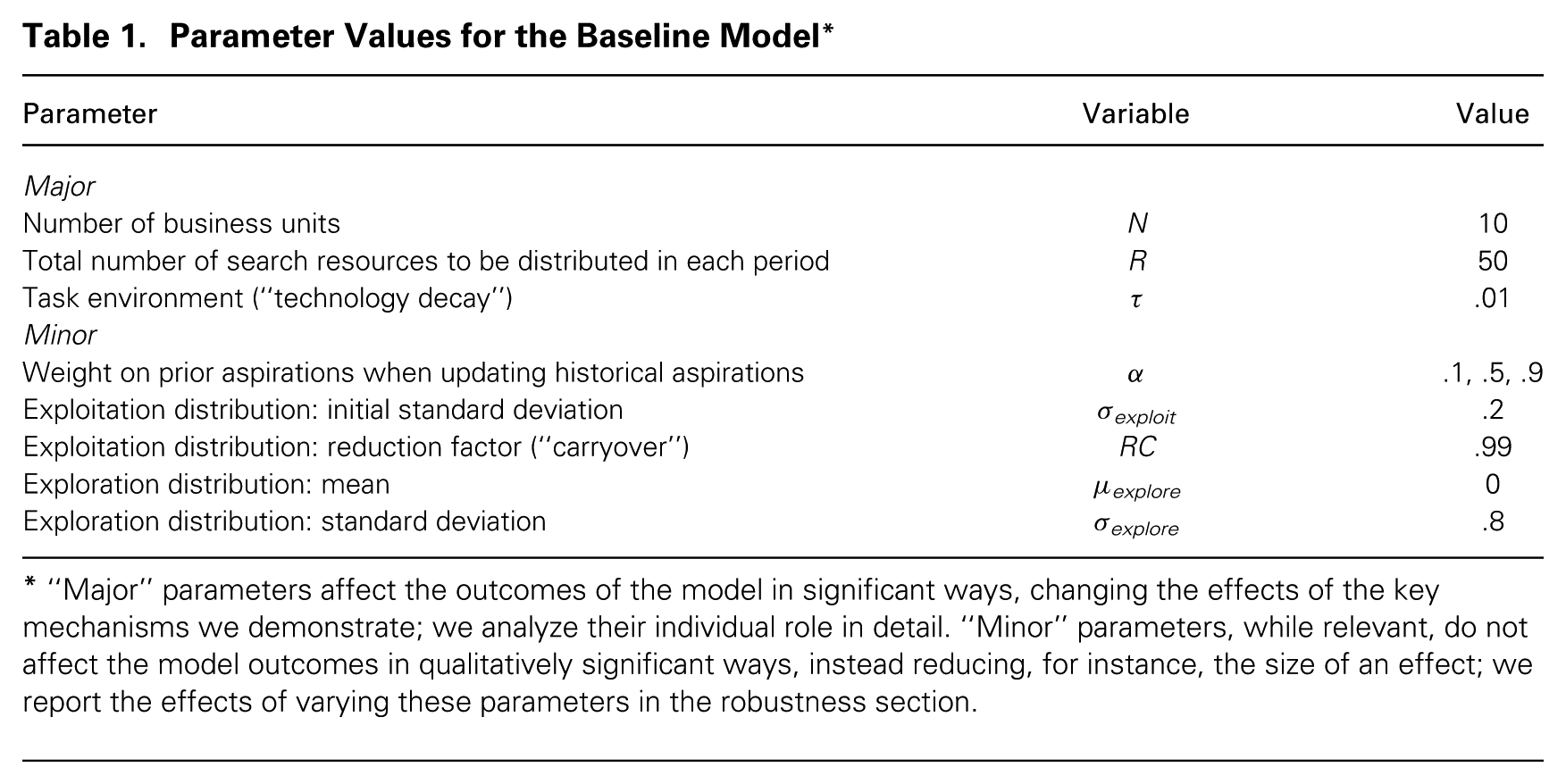
“Major” parameters affect the outcomes of the model in significant ways, changing the effects of the key mechanisms we demonstrate; we analyze their individual role in detail. “Minor” parameters, while relevant, do not affect the model outcomes in qualitatively significant ways, instead reducing, for instance, the size of an effect; we report the effects of varying these parameters in the robustness section.
Baseline Case
The benefits of internal social aspirations
Figure 2 reports how cumulative organizational performance evolves over time when the business units are following internal social aspirations and historical aspirations, respectively. As figure 2 shows, internal social aspirations lead to higher performance across the entire time span, unless historical aspirations are characterized by very slow updating (i.e., when α is very high). These performance differences arise because the firms in our baseline model are structurally identical and are facing the same task environment. Thus performance differences must result from the search patterns that the aspiration systems induce at the business-unit level. We explored these patterns in table 2, which reports a number of performance and adaptation metrics (measured in period 1,000). 16 We considered different speeds of updating of historical aspirations, recognizing that very slow updating (α = .9) is a rather extreme assumption to make; most empirical research that has sought to determine values of α (e.g., Moliterno et al., 2014; Joseph and Gaba, 2015) has found intermediate to fast levels of updating. In our subsequent results, we thus considered historical aspirations only for α = .5, i.e., aspirations are the average of last period’s incoming aspirations and last period’s performance.
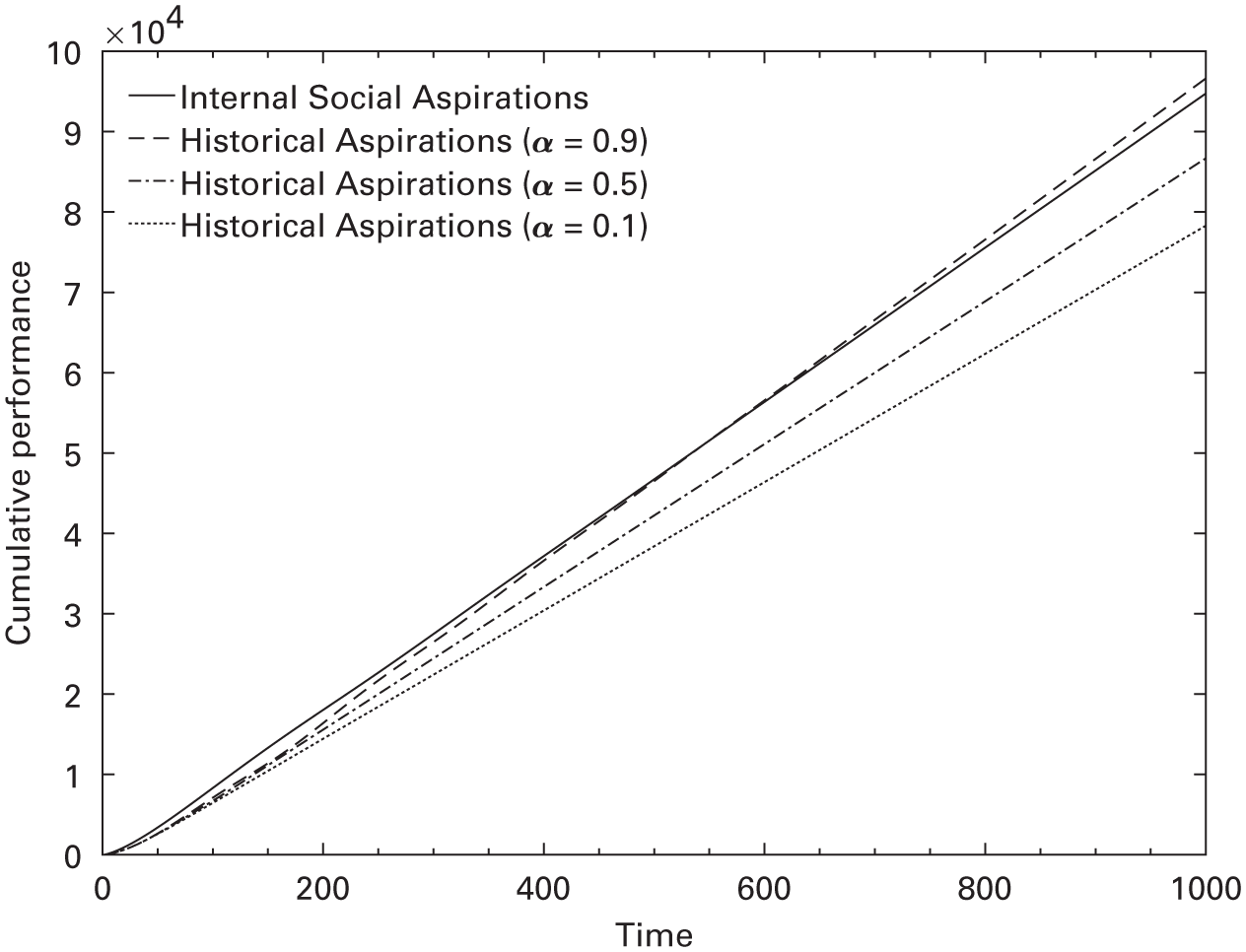
Performance advantage of internal social aspirations.*
Performance and Adaptation Metrics for the Baseline Model*

This table reports performance and adaptation metrics for the benchmarks reported in figure 2.
In line with figure 2, the first row of table 2 indicates that firms using social aspirations perform better than those using historical aspirations, unless historical aspirations are updated exceptionally slowly. At the same time, using social aspirations results in sharper performance differences among a firm’s units: while the best units achieve higher performance (row 2), the worst units have lower performance than under historical aspirations (row 3). Most notably, the technologies held by the units under internal social aspirations are refined to a much higher degree than those under historical benchmarks (row 4). Under historical aspirations, unless they are updated very slowly, units allocate substantially more resources to exploration than to exploitation (rows 5, 6). Nonetheless, the likelihood that a unit discards its current technology and adopts a novel technology is somewhat larger under internal social aspirations than under historical aspirations (row 7). Table 2 thus shows how the search patterns induced by internal social aspirations are systematically different from those induced by historical aspirations, independent of the speed of updating of the latter. The mechanisms underlying these differences are not the same.
Underlying mechanisms
The performance benefits of internal social aspirations stem from how they affect the temporal dynamics of a firm’s collective search activities. As technologies are discovered, are refined, and decay in our model, the value of exploration relative to exploitation changes over time. Ideally, each unit should thus switch from exploration to exploitation once search uncovers an attractive technology, and revert back to exploration when a technology has exhausted its refinement potential—an easy task if decision makers were to know the precise decay rate and the probability distributions of their search activities. In reality as in our model, however, decision makers must make inferences from the performance feedback they receive. This creates the problem of making the wrong inferences and the dual risks of underexploration (i.e., holding on to an unattractive technology for too long) and of overexploration (i.e., abandoning an attractive technology too soon) (Levinthal and March, 1993).
When and how exactly a unit switches from exploitation to exploration and back again is what distinguishes internal social aspirations from historical aspirations. Given the behavioral interdependencies created by internal social comparisons, we identified two effects that explain why the performance feedback provided by internal social aspirations results in more effective temporal dynamics of exploration and exploitation: (1) a balancing effect that ensures a baseline level of exploitation on the collective level, independent of specific individual performance levels; and (2) a stabilizing effect on the unit level because of a larger amount of information. Taken together, the two effects help explain why internal social aspirations offer organizations adaptive benefits in slowly changing environments: they result in a higher baseline rate of exploitation (due to the balancing effect), and they are less prone to overreacting to misleading feedback and giving up exploitation prematurely (due to the stabilizing effect).
Balancing effect
The balancing effect is due to the fact that internal social aspirations, unlike historical aspirations, classify business units into a balance of “winners” and “losers,” which shapes the units’ search behavior. Winners—the units that are performing better than the average of their peers—engage in exploitation, whereas losers explore. Because internal social comparisons always create winners, they ensure a lower boundary for exploitation activities on the organizational level (and consequently an upper bound for exploration efforts). To illustrate this effect, consider a firm with N = 2 units. Because one unit will always perform above the social reference point, 50 percent of all organizational resources will be allocated to exploitation, irrespective of the specific conditions of the units’ task environments at any point in time. That is, one unit would exploit and one would explore, yet the identity of who is the winner and who is the loser at any point in time would be adaptive. Returning to our baseline setting, the balancing effect explains the almost 50–50 split in exploration and exploitation activities shown in table 2. 17 The sharper performance differences between stronger and weaker units are also a testimony to the balancing effect that enforces more exploration by the losers, with some then falling behind relatively more due to the higher risks of exploration.
Historical aspirations, in contrast, do not have this collective feature; instead, success and failure are evaluated based on individual performance feedback. This makes historical aspirations in principle more adaptive, allowing an organization to draw from the entire set of search patterns that range from exploitation-only (all units could improve their performance over their historical targets) to exploration-only (all units failed to reach their historical targets) without systematic constraints. In the baseline case reported in table 2, the fraction of units that engage in exploration depends substantially on the speed of aspiration updating, ranging from a substantially higher level under fast updating to almost similar levels as internal social aspirations when aspirations are updated very slowly.
Stabilizing effect
The stabilizing effect emerges from how internal social aspirations condition a unit’s switching between exploitation and exploration based on feedback about others’ performance, rather than solely on the unit’s own experience. Put differently, a decline (or rise) of unit performance is neither necessary nor sufficient for changing search behavior. Because of the behavioral interdependencies embedded in social comparisons, a business unit switches to exploration (or exploitation) only when its own performance suffers (or improves) more than average performance. Social aspirations thus incorporate a higher number of performance samples (from the unknown probability distributions that generate feedback) in the decision-making process. Because of that, they stabilize the units’ responses and lower the risk of wrong inferences from feedback. This interpretation is consistent with the finding reported in table 2 that internal social aspirations are much more persistent and successful in exploitation than historical aspirations, leading to an average of 62.66 successful refinements for each technology.
Historical aspirations work differently. Even if a technology’s refinement potential is still quite substantial (and well above the decay rate), a unit may be unlucky in its refinement draws and receive negative performance feedback because external events (as captured by the decay rate) lower performance below current aspirations. For historical aspirations, this will be sufficient to reignite exploration. In consequence, historical aspirations can suffer from overexploration due to the risk of abandoning an attractive technology too soon. As illustrated by the results reported in table 2, this risk is higher when historical aspirations are updated quickly, leading to substantially higher exploration rates and a substantially lower level of refinement of each technology.
Given the mechanics of the stabilizing effect, one might thus expect that technologies are switched more frequently under historical aspirations. To the contrary, internal social aspirations exhibit a higher switching rate despite their lower exploration intensity. But social aspirations also create sharper performance differences across units than historical aspirations. This implies that some of the underperforming units operate far below the average performance of their peers. These units are locked into sustained exploration and thus tend to change their technology quite often. Under historical aspirations, all business units continuously move through cycles of exploration and exploitation, but they break off exploitation too soon in favor of exploration unless aspirations are updated extremely slowly.
Key Organizational Contingencies
The mechanisms identified above also help us understand how key organizational contingencies such as environmental dynamism, the availability of corporate resources, the heterogeneity of the units’ task environments, and the number of business units establish boundaries to the performance benefits of internal social aspirations. 18 Figure 3 shows that the relative performance advantage of internal social aspirations over historical aspirations declines as the rate of environmental change increases (panel A), as the amount of organizational resources endowed to each unit increases (panel B), and as the task environments of units become more diverse (panel C). Conversely, a higher number of business units improves the relative performance of social aspirations (panel D). We discuss these results below.

Determinants of the performance advantage.*
The more dynamic the environment (the higher the technology decay rate τ), the more exploration is needed, because existing technologies become obsolete more rapidly and need to be replaced by new ones. The constraints on exploration imposed by the balancing effect now hurt the relative performance of internal social aspirations (figure 3, panel A). For example, in the extremely turbulent case of τ = .5, firms under social aspirations allocate an average of 62 percent of all resources to exploration, while historical aspirations lead to an exploration rate of 67 percent. But historical aspirations are faster and more effective at replacing old technologies than internal social aspirations in dynamic environments, as their disadvantage with regard to the stabilizing effect becomes much less of a liability.
Likewise, endowing each unit with a larger number of corporate resources allows for a higher search intensity, which mitigates the shortcomings of historical aspirations and thus reduces the performance advantage of internal social aspirations (figure 3, panel B). Because more resources correspond to a higher sample size, they improve the reliability of the feedback that a unit receives from its search activities and thus reduce the likelihood of the unit experiencing a “bad” outlier period and of switching to exploration prematurely. Thus for increasing numbers of resources, the performance of historical and internal social aspirations converges.
Internal social aspirations also become less beneficial as the task environments of the business units become more diverse, because the stabilizing effect becomes less informative and even misleading. The reason is that heterogeneous task environments (figure 3, panel C) provide an additional source for making wrong inferences, which matters only for social aspirations. When a unit in a semi-stable environment compares itself with a unit that operates in a dynamic environment, for instance, the consistently higher performance (relative to the mean) that the former can achieve will lead that unit to underexplore and the unit in the dynamic environment to overexplore. Historical aspirations, in contrast, are unaffected by the environments of other units and instead tune their aspirations and rates of exploration to their respective task environments.
Finally, a higher number of business units increases the performance advantage of internal social aspirations (figure 3, panel D). Because more units correspond to more samples in the search process, the efficacy of the stabilizing effect for internal social aspirations is strengthened. The performance of historical aspirations is unaffected, however, because every unit receives performance feedback and updates its aspirations in isolation. As panel D illustrates, this also means that the performance advantage of internal social aspirations is reduced quite markedly if too few units are available to establish the social reference point. Past a point at which aspirations stabilize, however, increases in the number of units produce minimal benefits for the firm. 19
Downstream Complementarities among Business Units
The above analyses assumed that business units were independent in the sense that their performance was unaffected by the performance and behavior of other units; instead, only aspirations were affected, and only in the case of internal social aspirations. Relaxing this assumption, figure 4 reports the effects of positive task interdependencies, in which successful exploration in one business unit has a complementary relationship with the value of technologies in other business units. Panel A shows absolute firm performance, subject to different aspiration systems; panel B reports the relative performance difference (in %) between firms that follow internal social aspirations and firms that follow historical aspirations. As panel A demonstrates, and in line with expectations, complementarities increase absolute performance under both internal social and historical aspirations. By slowing down technological decay, positive interdependencies increase the value of current technologies, which explains the modest increase in the absolute performance of historical aspirations. More noteworthy, however, is how positive interdependencies magnify the absolute and relative performance advantages of internal social aspirations (panels A and B).
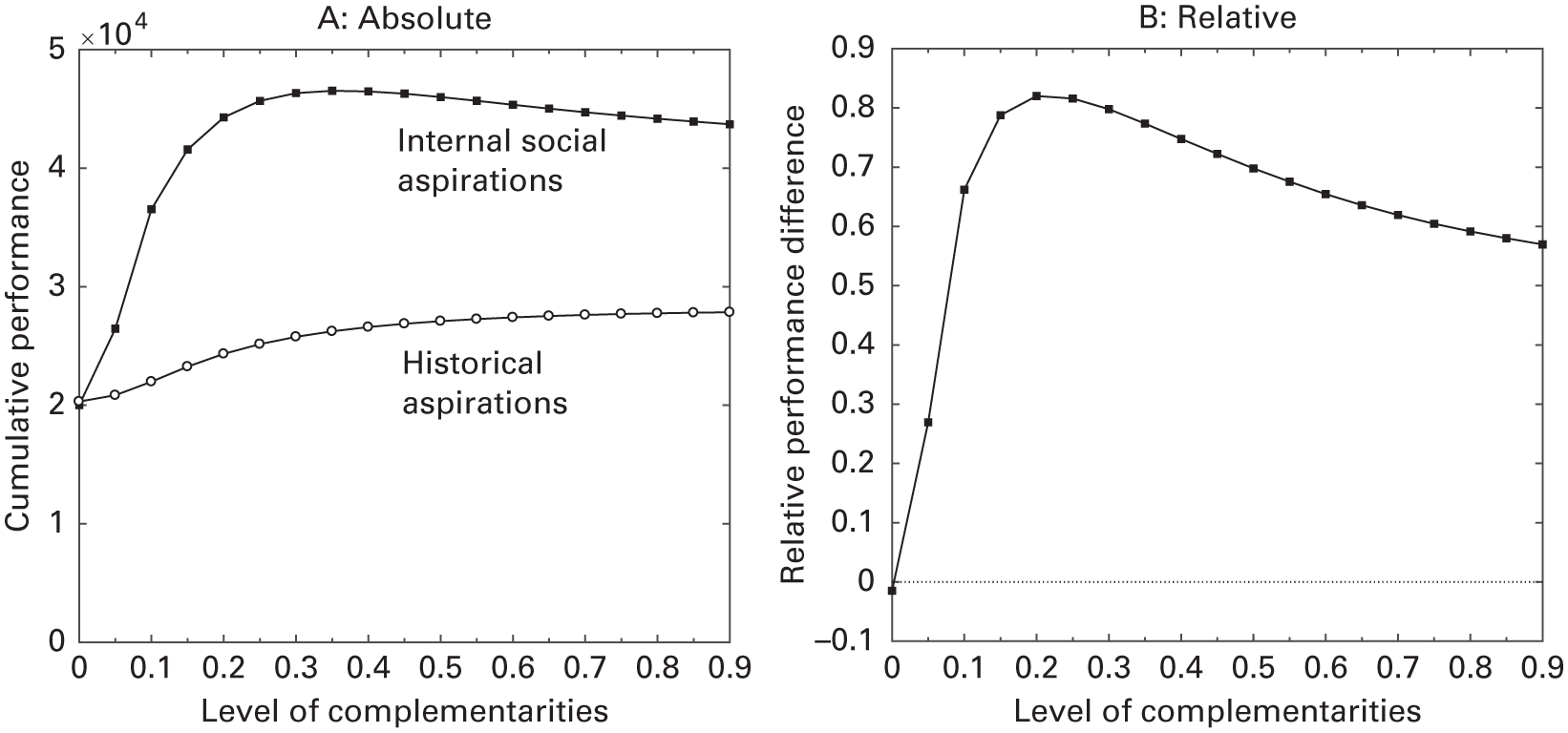
Performance implications of complementarities across units.*
The reason for this substantial advantage of internal social aspirations is that, in the presence of positive task interdependencies, the balancing effect serves to establish a more pronounced division of labor among business units, consisting of three types of units that differ in their search patterns. The first type are units that operate persistently below the social reference point, engaging in exploration with frequent changes in technologies and only a very low probability of performing above the social reference point and switching to exploitation. By frequently innovating new technologies, however, these exploratory units have important beneficial effects on other business units in the organization—in effect they become loss leaders that exist largely to amplify the profits of more successful units. The second type are exploiting business units with very high performance. These units spend a long time on refining technologies while frequently benefitting from the successful exploration by other business units. The third type are units near the social reference point that regularly switch to exploitation and back again. Because the top performers in the second segment create a larger discrepancy between the mean and median performance, the stabilizing effect implies that a majority of all business units operates below social aspirations, thus ensuring a sufficient level of (beneficial) exploration.
High levels of complementarities affect the performance advantage of internal social aspirations negatively, because they render both mechanisms less effective. Even with extreme complementarities, however, internal social aspirations still perform better than historical aspirations. Under strong complementarities and internal social aspirations, the behavior of each unit becomes less important for that unit’s performance (relative to the positive spillovers induced by other units), which decreases the variance of unit-level performance in the organization and makes the units more similar. As the discrepancy between mean and median performance becomes smaller, however, the fraction of business units that engage in exploration also becomes smaller, because fewer units now perform below the social reference point, which results in underexploration on the organizational level.
Downstream Competition among Business Units
Figure 5 reports the performance implications of negative interdependencies (downstream competition) among units. Panel A shows absolute firm performance, subject to different aspiration systems; panel B reports the relative performance difference (in %) between firms that follow internal social aspirations and firms that follow historical aspirations. As one would expect, competition has an overall negative effect on the absolute performance of both internal social and historical aspirations (panel A). Comparing relative performance levels (panel B) reveals that historical aspirations perform better than internal social comparison for low levels of downstream competition among business units, but this difference gets smaller for higher levels of competition, as the absolute performance of historical aspirations suffers relatively more (cf. panel A).

Performance implications of downstream competition between units.*
In general, the negative spillovers induced by downstream competition raise the average level of τ faced by the units, and the overall effect is thus very similar to that of higher environmental dynamism, which we discussed previously (cf. figure 3, panel A). But in the case of negative interdependencies, internal social comparison holds up relatively better than historical aspiration for higher levels of competition. The reason is that, for high levels of competition, units under historical aspirations underinvest slightly in exploration, as they learn individually to become satisfied with lower performance. For internal social aspirations, however, the balancing and stabilizing effects induce more stable behavior by allowing for sufficient exploration to mitigate the rapid obsolescence of technologies. For example, for c = .7, only 56 percent of all units with historical aspiration explore, in contrast to 60 percent of all units under internal social aspirations. The overall effect of downstream competition shown in panel B of figure 5 is far smaller, however, than the effect of complementarities shown in panel B in figure 4—downstream competition generally affects internal social and historical aspirations similarly, whereas downstream complementarities create pronounced differences.
Robustness Checks
We conducted a broad set of further experiments to probe the robustness of our model. We do not include the results here but discuss them below; all conformed to expectations. First, we modeled hybrid benchmarks that are formed by a linear combination of internal social and historical aspirations, much the way prior empirical research has combined historical and social benchmarks (e.g., Greve, 2003). As one might expect, the hybrid benchmarks entail a behavior between that of “pure” internal social and historical aspirations. Performance-wise, they approach that of internal social aspirations in the baseline case and that of historical aspirations in very dynamic task environments. To the extent that corporate managers can shape aspirations in their organizations, such as through reward and control systems, this finding suggests that hybrid benchmarks may be a robust option when the firm finds it hard to assess the environment it is operating in.
Second, we also changed the way we model internal social aspirations. Instead of basing them on average unit performance (Π/N), we represented them as each unit’s relative performance (πi/Π). Under this variant, a unit would explore for a new technology once its share in (or contribution to) overall organizational performance declined, and exploit otherwise. Though most results are identical to the ones we obtained with our main model, we found the alternative measure to be more effective when the number of business units is small, but less advisable in large firms.
Third, we built on Moliterno et al. (2014) and considered also a variant of internal social aspirations that do not update instantaneously to performance feedback. We assumed that units are concerned with their distance from average performance (πi–Π/N), comparing this performance measure with an exponentially weighted average of prior and current distance:
Fourth, we varied the resource allocation rule of the corporate headquarters, testing a myopic competitive allocation policy that simply distributes resources according to the past relative performance of each unit. When resources are allocated in this manner, internal social aspirations suffer a stronger performance penalty than historical aspirations—in the baseline case, for instance, performance drops by 7 percent for internal social aspirations but by only 1 percent for historical aspirations when α = .5. This is to be expected, as a competitive allocation policy distributes fewer resources to underperforming business units, which in turn reduces exploration. This situation is particularly harmful for internal social aspirations because it hampers the endogenous specialization process between units that we highlighted above.
Finally, we also checked whether the initial conditions of the model, such as the aspiration levels or the value of the technologies that units are “born” with, matter and found no relevant effects.
Discussion
We set out to explore how upstream social comparisons among different business units in a firm affected firm-level outcomes and how those effects were related to downstream, product market competition and complementarities among those units. The political and organizational reality of firms is that unit managers and employees often benchmark their performance against other units and that this process of intra-organizational social comparison likely has implications for the firm’s adaptation and performance. We offered a computational model that built from existing research on search and adaptation, which showed that intra-organizational comparisons were often but not always beneficial for the firm. Our analysis of the underlying mechanisms revealed two effects. First, a balancing effect suggests that some business units in the firm will always be satisfied with their performance under internal social comparisons, which leads to a baseline level of investment in exploitation that can be beneficial for the firm. Second, the fact that a business unit compares itself with multiple other units as opposed to only its own past performance leads to greater stability in investment, which prevents the unit from changing technology needlessly; we labeled this the stabilizing effect. The mechanisms underlying these effects, however, have important boundary conditions that can lead internal social aspirations to create dysfunctional behavior in the firm. Importantly, the adaptive benefits from intra-organizational comparisons diminished when the units were in downstream competition but increased significantly when the units were downstream complements. Additionally, when the environment is very dynamic or when resources are highly abundant, the benefits of exploitation decrease and the balancing effect becomes less valuable. Similarly, when the firm is very small or when the business units are highly dissimilar, the comparison benefits of the stabilizing effect disappear and internal social comparisons perform relatively poorly. Our findings contribute to the literature on intra-organizational competition and social comparisons in behavioral theory, while the model and the theory it generates offer important contributions to broader management literatures, including the literatures on diversification and firm performance, and the adaptation of multi-business firms.
Intra-organizational Competition, Upstream and Downstream
Our study distinguishes between social comparison processes and intra-organizational competition but emphasizes the intertwined nature of the two concepts. Thus we highlight a very different but analogous process from most existing research on intra-organizational competition, which has focused on downstream competition (Birkinshaw and Lingblad, 2005), with firms offering similar products to similar or overlapping customer groups.
Our study builds from the idea that managers may also compete upstream within the firm—benchmarking against each other for resources, status, promotions, and executive attention (Nickerson and Zenger, 2008). Not only do these social comparison processes have implications for the manager in question, but they also affect firm-level outcomes by changing how managers allocate the resources they control. Our study suggests that such internal, upstream comparisons may actually help organizations under the right circumstances, primarily by helping units synchronize their search efforts to more effectively allocate them within the organization. But when internal social comparisons occur in an organization in which the units compete in the same downstream markets, the benefits of internal social comparisons disappear. This suggests that the two forms of competition—upstream for resources and downstream for customers—may be important substitutes for one another in how they affect organizational performance. Future empirical research might establish whether upstream, social comparisons can offer both coordination benefits (documented in our study) and motivation benefits (the traditional view on internal competition), or whether firms cannot effectively reap both types of benefits through social comparisons. Future research in the domain of intra-organizational competition could be greatly expanded by considering how explicit downstream competition may contribute to upstream comparison processes that affect ex ante strategic behavior. Our study offers initial insights into how upstream comparisons and downstream intra-organizational competition may interact, but future research could explore these dynamics in more detail.
Behavioral Theory and Social Comparisons
This study also complements and extends the limited existing efforts in the behavioral theory tradition to explore the effects of internal social comparisons. As Kacperczyk, Beckman, and Moliterno (2015) explicitly compared internal and external social comparisons, and a large volume of existing behavioral theory has looked at external social comparisons (between competing firms in the same industry), it is important to note the facets of our model that are explicitly intra-organizational. Though the basic mathematical structure of our model could easily apply to external social comparisons, two factors are explicitly intra-organizational and help to identify the specific contributions of our approach.
First, our model explores the relevance of units’ comparability in terms of their external environment. Given that managers tend to identify firms as relevant comparisons to the extent that they occupy the same industry, are of similar size, and offer similar products (Porac and Thomas, 1990), external social comparisons are likely to be made among highly comparable firms. By contrast, internal social comparisons may emerge among units that operate in very different environments, and our model shows that such comparisons can lead to significant dysfunctional behavior. The fact that the effect of social comparisons changes significantly when the comparisons are among dissimilar units provides an important suggestion for the broader behavioral research on social comparisons and aspirations. Social aspirations are typically calculated versus all firms in the same industry (often a three- or four-digit SIC designation), which may or may not be fine-grained enough to ensure that the comparison set faces the same industry context. This may be especially true when the industry dynamics of higher-end differentiators are very different from those of lower-end cost leaders. For example, the dynamics in department store retail (SIC 5311) are very different for WalMart and Target than for Nordstrom and Saks Fifth Avenue, all members of the same SIC designation. Our results suggest that only very specifically comparable firms should be included in calculating social aspirations, as more dissimilar comparisons produce very different results. This suggests that industry-wide competitive comparisons are too broad, but while other research approaches this from the perspective of behavior (i.e., this is how firms actually behave), our approach focuses on performance benefits from having similar comparisons, when firms face similar task environments.
Second, our model allows for the downstream performance of the compared units to be both positively and negatively correlated. In external social comparisons, logic suggests a negative correlation—these firms are in competition, and the success of one is likely to lead to the failure of others. In our model, when there is competition among units in terms of downstream performance (mimicking external social comparisons), internal social comparisons perform relatively poorly—about as well as historical aspirations. This is in line with existing research suggesting that (external) social aspirations and historical aspirations produce relatively similar organizational outcomes (Miller and Chen, 2004). By contrast, most firms that may encourage internal social comparisons are likely to have business units whose performance is uncorrelated or units that are complementary. Such complementarities dramatically enhance the performance of social comparisons. These findings and the comparison with typical external social comparisons suggest an important aspect of internal social comparisons that hasn’t been fully identified in the limited previous literature on such comparisons: the fact that managers may be competing for upstream resources but actively engaged in downstream coordination and complementarity suggests that internal social comparisons may play an important synchronizing role to facilitate the realization of synergies among related units. Further behavioral research could explore the extent to which such internal comparisons shift between functional and dysfunctional based on units’ need to coordinate.
Diversification, Structure, and Performance
This study and its findings about the link between the structure of multi-business firms and performance also contribute to the broader literature on the relationship between diversification and performance. Most of the research in this domain has built from strategy (Palich, Cardinal, and Miller, 2000) and economics (Rajan, Servaes, and Zingales, 2000) to argue that diversification can improve performance when divisions in the firm are closely related and can destroy performance otherwise. Some of the early work in this domain focused on processes related to governance, structure, and risk-taking behavior (Hoskisson and Hitt, 1988; Hoskisson, Hitt, and Hill, 1991). Most similarly, Hill, Hitt, and Hoskisson (1992) argued that related diversifiers need governance systems that encourage cooperation among divisions. This point is closely related to our suggestion that internal social comparisons can facilitate synchronization among divisions that is especially helpful when the divisions offer complementary products and services. Much of the subsequent literature, however, has focused on empirical discussions of the existence of the link between diversification and performance (e.g., Villalonga, 2004), producing many contradictory empirical results and moving away from uncovering the organizational mechanisms behind any link.
We believe that this study offers an organizational theory about micro-mechanisms that link diversification and performance (Ahuja and Novelli, 2016): that expansion beyond a single division presents the potential that unit managers will benchmark their performance against one another, and that the performance implications of this benchmarking will flow in part through the direction of search efforts and will depend on the relationship among the divisions. The idea of relatedness has been explored in terms of technological knowledge (Silverman, 1999) and other strategic assets (Markides and Williamson, 1994), but little work has considered factors such as the similarity among the external environments of different divisions or the implications of complementarities (or competition) among divisions in the downstream product market. By suggesting a potential micro-mechanism linking diversification and performance that does not rely on strategic assets but instead builds off the cognitive and political comparisons among division managers, we suggest potential avenues for future research in this domain that shift the discussion from being only about strategy and economics to being a broader organizational question.
Aspirations and Adaptation in Multi-business Firms
We also contribute to the literature on balancing exploration and exploitation in organizational learning and adaptation. Prior work has considered primarily how learning speed (March, 1991; Denrell and March, 2001; Greve, 2002; Miller, Zhao, and Calantone, 2006), communication structures (Lazer and Friedman, 2007; Fang, Lee, and Schilling, 2010; Knudsen and Srikanth, 2014; Schilling and Fang, 2014), and organizational designs (Siggelkow and Levinthal, 2003; Siggelkow and Rivkin, 2009) help organizations maintain an effective balance between exploration and exploitation. Few studies have examined how (historical) aspirations affect exploratory search and organizational learning (Denrell and March, 2001; Greve, 2002, 2007; Bendor, Kumar, and Siegel, 2009), and these studies focused on the impact of the speed of updating aspirations based on performance feedback on the efficacy of organizational adaptation. Faster updating magnifies the exploitation bias of organizations, especially in stable environments, whereas very slow updating is in principle beneficial but appears to be an empirically rare phenomenon (e.g., Moliterno et al., 2014; Joseph and Gaba, 2015). We show that social and historical aspirations differ systematically in how they affect organizational search processes and achieve a balance between exploration and exploitation. The balancing effect creates upper bounds on the organizational exploration rate, while the stabilizing effect shapes the switching point between exploration and exploitation, and back.
Our findings also call into question the implicit assumption in much of the behavioral literature that social and historical aspirations closely correspond in terms of how they affect organizational search and learning. Kim, Finkelstein, and Haleblian (2015) showed that external social and historical aspirations differ in their effect on acquisition behavior. According to their study, social aspirations denote a more ambiguous performance benchmark, because heterogeneity in the reference group is often unobserved or inaccurately assessed; accordingly, the higher ambiguity in external social benchmarks makes managers more (or less) cautious when they are below (or above) aspirations. While their arguments largely highlighted the problem of making inferences from ambiguous feedback, our model emphasizes how structural differences between internal social and historical reference points play out in adaptive processes. The problem of ambiguous performance benchmarks should also be less pronounced within companies, because the organizational context strengthens the observability, salience, and assessment of social reference points.
Our model also extends existing work on organizational adaptation (Levinthal and March, 1981) by integrating the realities of complex multi-business organizations. Despite the overall and longstanding interest in organizational structure, especially in the Carnegie School tradition (Simon, 1947; March and Simon, 1958), questions of structure and particularly how structure affects adaptation in multi-business firms have been understudied (Gaba and Joseph, 2013). Our model suggests that encouraging managers to benchmark performance against other business units may facilitate a firm’s adaptation efforts, especially to the extent that units are producing complementary products or services. The underlying process involves providing more-reliable signals on how units should cycle through exploitation and exploration to improve organizational outcomes. If we assume that executives face a choice when designing feedback systems between encouraging historical aspirations and internal social aspirations, the latter appear to be rather easy to implement. Historical aspirations, in contrast, would require tuning the updating parameter to the environment (often involving very slow updating) by encouraging managers to ignore most of the recent feedback they receive. Internal social comparisons seem to be a comparatively simple solution with robust adaptive properties.
Moreover, the idea that organizational structures may not just enable decentralized decision making but also coordinate adaptation efforts across the firm is especially provocative. Our study thereby contributes to research on organizational ambidexterity that has asked how organizations can simultaneously engage in exploratory and exploitative activities (Tushman and O’Reilly, 1996; Raisch et al., 2009), for instance by dynamically vacillating between higher and lower levels of exploration (Nickerson and Zenger, 2002; Boumgarden, Nickerson, and Zenger, 2012). Our study adds to recent work on how emergent bottom-up processes contribute to achieving such a dynamic balance (Zimmermann, Raisch, and Birkinshaw, 2015). Internal comparisons can be an effective instrument to motivate and support such bottom-up processes, and we suggest a novel mechanism through which horizontal (and vertical) interactions in multi-business firms may provide endogenously for an effective balance between exploration and exploitation on the organizational level. In many organizational contexts, social benchmarking may be an effective managerial tool to delegate and decentralize decision making about whether and when to explore. The efficacy of this mechanism, however, depends critically on the willingness of corporate headquarters to fund underperforming units as well as new ventures, and to tolerate distinct performance differences among units. A myopic capital allocation policy that allocates resources according to past success undermines exploration by units below the social reference point. This boundary condition connects to prior work that has stressed top management’s role in maintaining an effective balance between exploration and exploitation in ambidextrous structures (e.g., Smith and Tushman, 2005). We hope that future research will explore these possibilities both empirically and through modeling efforts.
Prescriptive and Empirical Implications
Given that managers sometimes encourage intra-organizational comparisons through incentives (Marino and Zábojník, 2004), typically to engender higher levels of effort, and often have the ability to discourage such comparisons when they emerge organically from the political nature of organizations, it is important to understand when managers should do one or the other. Though this paper focused on theory building using a computational model, our model also offers a set of empirical predictions around intra-organizational comparisons that should be explored in future empirical work to offer sound prescriptive advice to managers. One layer of potential empirical predictions is relatively straightforward: in our discussion of the model, we outline a series of independent factors that dictate when internal social comparisons would improve performance, involving environmental dynamics, resource munificence, and other factors. But on another level there are interesting interactions among these factors that suggest important limits to internal social comparisons’ benefits to firms’ adaptation and performance.
One of the strongest findings of our model is that internal social comparisons are especially valuable when the units offer downstream complementary goods. This brings to mind platform businesses like video game consoles, as firms such as Nintendo offer both consoles and video games. But our model would suggest that the vastly different task environments and lifecycles of video games versus game consoles would result in poor performance if a firm were to rely on internal social comparisons. And benchmarking between different video game units in the same firm (e.g., one unit that develops sports games and another that develops puzzle games) may not be ideal, as those products may be downstream competitors more than complements. Instead, it may be that a traditionally vertically integrated firm represents the ideal context for the mechanisms in our model to be effective—clear downstream complementarities with likely similar task environments. This also provides a cleaner context in which to consider an empirical test of the model—comparing a vertically integrated firm in which internal social comparisons are prevalent with a similar firm in the same industry that is not vertically integrated addresses many other potential empirical concerns.
But how, empirically, is one to understand the presence or absence of internal social comparisons? Existing research that has discussed mechanisms around internal social comparisons (Kacperczyk, Beckman, and Moliterno, 2015; Gartenberg and Wulf, 2017) has assumed that such comparisons occur without necessarily offering direct evidence of their existence. Testing our model would require more substantive evidence that such comparisons exist. Some firms publicize their active benchmarking of employees (Stewart, Gruys, and Storm, 2010), and all firms publicize segment performance, which facilitates unit-level comparisons. More generally, however, we can think about the contextual factors that would facilitate comparisons such as the ones modeled in this paper. Two key factors emerge: transparency into the performance of individual teams or units in order to be aware of social performance, and substantial competition for specific upstream resources, such as R&D resources, managerial attention, and career opportunities. Though still not easy to observe empirically, these two factors should jointly lead to increased levels of social comparisons and benchmarking within the firm.
Limitations and Conclusions
Our study has important limitations to consider as well. Our model abstracts away from typical issues considered in prior research on intra-organizational social comparisons—namely the distinction between risk taking and behavioral change (Kacperczyk, Beckman, and Moliterno, 2015), sabotage (Milgrom and Roberts, 1988; Charness, Masclet, and Villeval, 2013), the undermining of cooperative behavior across units (Tsai, 2002) or individuals (Chan, Li, and Pierce, 2014), and envy (Nickerson and Zenger, 2008). One strength of our model is that it allows us to explore the performance and behavioral implications of internal social comparisons even once those effects are removed, but the real-world implications of social comparisons will have to take these other factors into account. In addition, our modeling approach builds from existing behavioral research to make behaviorally plausible assumptions that produce interesting insights, as opposed to calibrating to observed real-world data and offering a potential mechanism to explain them. Each modeling approach has its strengths and weaknesses, and we believe that the core research question explored here matches the modeling approach that we have chosen, but other modeling approaches to this question may produce different insights.
We began this study with the observation that many firms tolerate or even encourage some sort of internal social comparison processes for managers. Clearly these executives believe that such comparisons provide an advantage for their organizations, but existing theory doesn’t provide clear insight into why, beyond the assumption that such rivalry would increase managerial effort. The model introduced in this study offers a range of additional insights about internal social comparison processes and their implications. Using two underlying mechanisms—the balancing effect and the stabilizing effect—we explored the conditions under which internal social comparisons may increase organizations’ adaptability and responsiveness by affecting the direction of organizational search efforts. If executives are willing to tolerate the larger performance differences that will ensue among units of their organizations, our results indicate that firms may be right to encourage social comparisons, especially to the extent that these firms have many managers or units to compare, the units are relatively similar in terms of environmental dynamics, and there are strong complementarities among them—for example in vertically integrated firms or firms leveraging shared resources to offer closely related products. Given that these conditions are likely to exist in many organizations, our model provides important insights into why internal social comparisons may help firms adapt and succeed.
Footnotes
Acknowledgements
We thank Jerker Denrell and the members of the Strategic Organization Design unit for helpful comments on prior versions of this paper, as well as seminar participants at NYU Stern, Warwick Business School, Copenhagen Business School, Aalto University, SKEMA Business School, the Max Planck Institute for Competition and Innovation, and the Theoretical Organizational Models Society. We are also indebted to Christine Beckman and three anonymous reviewers for their valuable comments and suggestions. All remaining errors are our own. Oliver Baumann benefitted from a grant from the Danish Research Council for Independent Research (FSE).
