




Abstract
To gain attention and build support for new categories, market entrepreneurs often define a new category through its contrast with related, established offerings. Existing research has largely focused on the benefits of this oppositional categorical positioning. In this study, we explore how this strategy might be a double-edged sword. Through a longitudinal inductive study of the e-cigarette category in the U.S. (2007–2017), we develop theory on the risks of associating with an already established category. In our empirical case, we document how value-based distinctions between cigarettes and e-cigarettes became eroded and the e-cigarette category grew increasingly stigmatized. We then propose several mechanisms through which the symbolic and social boundaries between a new and an established category can weaken and the stigma associated with an existing category can become diffused, intensified, and generalized—both across organizational features and across organizations in the new category. This case allows us to investigate the processes by which strategies to legitimize categories may backfire and to consider the role that a diverse set of core and peripheral stakeholders—who enter the market with pre-existing knowledge and motivations—play in category stigmatization processes.
New categories often emerge in opposition to pre-existing ones, as market entrepreneurs seek to define a new market category through its contrast with related, established offerings (e.g., Rao, Monin, and Durand, 2005; Weber, Heinze, and DeSoucey, 2008; Sine and Lee, 2009). Using large breweries’ mass production methods as a counterpoint, for example, specialty beer entrepreneurs constructed the microbrew category around its small scale and distinctive use of traditional, handcrafted production methods (Carroll and Swaminathan, 2000). Entrepreneurs positioned the microbrewery category as similar to mass-market breweries in that both produced beer, while simultaneously highlighting the higher quality and authenticity that made microbreweries distinctive. In a similar way, categories such as wind energy, grass-fed beef, and single-origin coffee have emerged as entrepreneurs champion their new category as addressing problematic elements of an existing one. Existing research has largely focused on the benefits of highlighting the relationship between a new and an established category. In this study, we explore how this strategy might be a double-edged sword.
Researchers have found that creating associations to existing categories is an important mechanism in gaining attention and building support for a new category (Etzion and Ferraro, 2010; Bingham and Kahl, 2013). New category entrepreneurs strategically employ symbols, labels, and metaphors that highlight similarities to existing categories in order to make their novel market types comprehensible (e.g., Kennedy, 2008; Navis and Glynn, 2010; Grodal, Gotsopoulos, and Suarez, 2015; Grodal and Kahl, 2017). At the same time, they aim to create a symbolic boundary between the new and existing category—that is, they highlight differentiated elements that infuse the new category with a distinct meaning system that encompasses separate moral and social values (Lamont and Molnár, 2002; Rao, Monin, and Durand, 2003; Weber, Heinze, and DeSoucey, 2008; Wry, Lounsbury, and Glynn, 2011). The ensuing process of category emergence and growth is often portrayed as a gradual, iterative progression. As entrepreneurs build categorical recognition and legitimacy, they begin to shift attention from defining their new category to highlighting their organization’s positive, distinctive identity vis-à-vis similar others (Kennedy, 2008; Navis and Glynn, 2010).
Yet, while this orderly progression occurs in some contexts, it can fail to play out in others. New categories may fail to cohere into a collectively recognizable form (McKendrick et al., 2003; Jones et al., 2012; Ozcan and Santos, 2015). Or, as in the case we study, a new oppositionally positioned category may achieve the status of a recognizable form but fail to gain widespread acceptance of its distinct meaning system and positive moral/social value. Understanding the conditions that cause category strategies to backfire can provide insight into the risks of associating with an established category—particularly one viewed as having problematic elements or that is stigmatized.
Work on organizational stigma has documented important consequences faced by organizations linked to stigmatized categories—those that are disapproved of or negatively evaluated by influential stakeholder groups (Vergne, 2012; Piazza and Perretti, 2015). Researchers define organizational stigma as a collective label connecting an organization to a stigmatized category (Devers et al., 2009; Tracey and Phillips, 2016). Stigma has been found to transfer across organizations through perceived associations (Hudson, 2008; Hudson and Okhuysen, 2009; Tracey and Phillips, 2016). For example, Jonsson, Greve, and Fujiwara-Greve (2009) explored the interorganizational transfer of event stigma—when some idiosyncratic negative event (e.g., scandal, product defect) results in negative evaluation and loss of social support. They found that a deviant act by a single firm may influence stakeholders’ evaluations of similar others during periods of high media attention. Presumably, stakeholders do not construe the deviant act as unique to the individual organization but as something common to a broader set of organizations (Yu, Sengul, and Lester, 2008). Yet the social processes through which such attributions become generalized to the category level and broadly accepted are not yet well understood—particularly in the case of core stigma, when stakeholders discredit an organization not merely because of an idiosyncratic negative event but because of its core outputs and routines (Devers et al., 2009; Hudson and Okhuysen, 2009; Mishina and Devers, 2012).
A key factor in building understanding of how new stigmatized categories arise is expanding consideration of the stakeholders who influence category construction beyond the set typically followed in studies of category emergence. Accounts tend to treat actors within the new category’s value chain—producers, intermediaries, and consumers—as central to the process of shared category construction (Weber, Heinze, and DeSoucey, 2008; Khaire, 2017). But to understand how new categories may fail to establish their social or moral value, one must consider not only stakeholders who identify strongly with the category or who stand to benefit from its emergence, but also stakeholders peripheral to its core activities. Peripheral community groups derive only a small part of their identity from a category and may choose to participate in the conversation around an emerging category due to personal or economic interests in other categories (Cattani, Ferriani, and Allison, 2014; Grodal, 2018). Their weaker identification may lead them to espouse values and views that diverge substantially from those of core community members.
To develop theory on the emergence of new stigmatized categories, we conduct an inductive study of changing stakeholder perceptions of the e-cigarette category in the U.S. Early e-cigarette entrepreneurs framed their product as a virtuous alternative to the existing category of cigarettes, in a manner akin to oppositional market categories such as microbreweries and grass-fed meat (Carroll and Swaminathan, 2000; Weber, Heinze, and DeSoucey, 2008). We document several mechanisms through which e-cigarettes’ relationship with the pre-existing category was a focal point of discourse for early category participants, who emphasized the new category’s similarities to cigarettes while also highlighting its distinctive virtues. Their positioning strategies were designed to explain the new category in ways that were familiar to targeted stakeholders while highlighting its distinctive appeal.
Yet as regulators reified the framing of e-cigarettes as a “cigarette-like” product and major tobacco companies, attracted by this positioning, entered the e-cigarette category, the strengthening association between cigarettes and e-cigarettes changed how stakeholders perceived the new category. This association also invited the scrutiny of peripheral stakeholders with a long history of challenging combustible (traditional) cigarettes. We document key mechanisms through which stakeholders’ negative attributions about a single cigarette producer’s actions within the e-cigarette category became diffused, intensified, and generalized—both across different organizational features and across organizations. As the U.S. e-cigarette market has grown and producers have increasingly tried to differentiate from cigarettes, value-based distinctions between the two categories have eroded, and social valuations of e-cigarettes as a whole have become increasingly negative.
This case allows us to extend existing theory by investigating processes by which strategies to legitimize categories may backfire and examining the role that a diverse set of core and peripheral stakeholders—who enter the market with pre-existing knowledge and motivations—play in category construction processes. Empirically, developing understanding of how e-cigarettes have evolved appears particularly pressing given recent public alarm surrounding youth adoption of the e-cigarette brand Juul, as well as a 2019 outbreak of lung disease cases related to vaping THC (e.g., Belluz, 2018; Harris, 2019).
The Social Construction of Categories
Processes Driving Category Creation
Scholars have considered a wide range of strategic processes driving new category formation, including the creation of a new organizational type through formal regulations (Ruef, 2000), social movements (Carroll and Swaminathan, 2000; Rao, Monin, and Durand, 2003; Weber, Heinze, and DeSoucey, 2008), and producers’ entrepreneurial activities (Kennedy, 2008; Navis and Glynn, 2010; Anthony, Nelson, and Tripsas, 2016). Efforts at category creation often position a new organizational type strategically vis-à-vis existing categories—relating the new category to already established concepts to facilitate broader recognition and understanding, while establishing what is distinctive and valuable about it in order to garner support (Lounsbury and Glynn, 2001; Navis and Glynn, 2010; King, Clemens, and Fry, 2011).
In many cases, new category entrepreneurs attempt to invoke alternative, culturally resonant values in order to reconfigure the market’s social and material structure in a way that supports new market positions (Haveman, Rao, and Paruchuri, 2007; Schneiberg, King, and Smith, 2008; Sine and Lee, 2009; Fligstein and McAdam, 2011). In such cases, the emergence of new categories not only establishes a new categorical identity that coheres and distinguishes a set of organizations from the rest of their field, but may also disrupt the value system undergirding an existing market. For example, the grass-fed beef category emerged as a coalition of activists challenged the environmental and economic sustainability of the prevailing system of industrial agriculture (Weber, Heinze, and DeSoucey, 2008). As this framing gained social support, producers and other proponents of grass-fed practices were able to construct a distinct market category positioned as superior to the dominant, pre-existing one along dimensions such as sustainability and naturalness. Strategic positioning of new categories relative to established ones along valenced dimensions such as quality, authenticity, and status is a key way that entrepreneurs build support for a new category (Kim and Jensen, 2011; Negro, Hannan, and Rao, 2011; Sharkey, 2014). By articulating value-based distinctions from established categories in a culturally resonant fashion, market agents hope to establish the value of the new category’s purpose and practices and construct a clear symbolic boundary separating the new from the old (Hsu and Hannan, 2005; Wry, Lounsbury, and Glynn, 2011).
Contestation over Category Meanings
A key challenge facing category entrepreneurs is developing a shared understanding of a new category’s meaning, label, and boundaries among diverse stakeholders. While entrepreneurs such as producers and activists may propose a new categorical identity, a new category’s construction is a collective endeavor. Different stakeholder groups, including investors, critics, and consumers, attempt to influence shared category meanings (Khaire and Wadhwani, 2010; Grodal, Gotsopoulos, and Suarez, 2015; Anthony, Nelson, and Tripsas, 2016). The convergence of understandings among stakeholder groups promotes communication, fosters internal cohesion among market participants, and facilitates interactions and exchange (Kennedy, 2008; Weber, Heinze, and DeSoucey, 2008; Kahl and Grodal, 2016).
Yet agreement can be difficult to achieve. During a category’s early emergence, stakeholders often hold competing conceptions of what defines membership and who should be regarded as members (Granqvist, Grodal, and Woolley, 2013; Hsu and Grodal, 2015). Stakeholders attempt to define categories in ways that favor their specific interests and goals (Jones et al., 2012; Anthony, Nelson, and Tripsas, 2016; Slavich et al., 2020). For example, producers often favor category conceptions that advantage their particular capabilities, clientele, and resource endowments (Delmestri and Greenwood, 2016). And producers are not the only agents with material or social interests in a category. Pontikes and Kim (2017) found that gatekeepers such as industry analysts may derive status from covering influential or economically important categories. Stakeholders’ diverging interests in a new category can lead to contestation over shared meanings (Kennedy, Lo, and Lounsbury, 2010; Jones and Massa, 2013). In some cases, disagreements among early category participants can hinder a new category’s formation (Ozcan and Santos, 2015). More generally, differences in categorical conceptions confuse market audiences and inhibit category growth (Grodal, Gotsopoulos, and Suarez, 2015; Slavich et al., 2020).
Category growth itself can also challenge a category’s legitimation by attracting a new, more diverse set of stakeholders. For example, the entry of producers already associated with other market categories can dilute a category’s identity, weakening the strength of its symbolic boundaries and sowing confusion among the stakeholders that category members rely on for resources and support (McKendrick et al., 2003; Negro, Hannan, and Rao, 2010). Category growth may also invite greater diversity of strategic interests and claims about what the category represents (Wry, Lounsbury, and Glynn, 2011; Grodal, 2018).
A common presumption throughout this literature is that market actors become actively involved in early category construction because they have some social or material interest in its development. In most cases, this interest leads early participants to seek ways to promote the category’s acceptance and legitimacy (Khaire, 2017; Grodal, 2018). For oppositional categories, the presumption is that new category entrepreneurs seek to distinguish themselves from an existing category, although they may disagree on the specific rationale as to why. Yet if these were the only stakeholders who participate in category construction, it would be difficult to explain how category stigmatization emerges. Literature on organizational stigma provides potential insight on this issue and how important stakeholders come to label a given organization as socially or morally deviant.
Organizational Stigma
Researchers theorize that stigma arises when stakeholders perceive an organization’s features, such as routines, outputs, or customers, as deviating from collective standards of appropriate values and behavior (Goffman, 1963; Elsbach and Sutton, 1992; Devers et al., 2009). This perception then leads to stronger attributions of dishonesty, untrustworthiness, and/or immorality. Stakeholders begin to view the organization not as an individual entity but as part of a socially or morally deviant category (Link and Phelan, 2001). They stereotype the organization—generalizing from its negative features such that the organization comes to represent “the embodiment of values that explicitly conflict with those of the stakeholder group” (Devers et al., 2009: 157). It is through the lens of this negative categorical identity that stakeholders perceive and evaluate the organization’s actions and intentions as well as reinterpret past actions (Mishina and Devers, 2012).
Research has suggested that stigma can spread from one organizational actor to another through perceived association (Goffman, 1963; Pontikes, Negro, and Rao, 2010). Typically, this is discussed in the organizational literature as stigma transferring from a focal stigmatized organization to network partners (Hudson, 2008; Hudson and Okhuysen, 2009) or to other organizations perceived as having similar characteristics (Jonsson, Greve, and Fujiwara-Greve, 2009). Pontikes and Barnett (2017) also found that potential entrepreneurs may be deterred from entering market categories after salient organizational failures, suggesting that negative events for specific organizations can alter how their broader category is perceived.
Yet such accounts do not consider the mechanisms by which core stigma emerges and takes hold or how event stigma and core stigma might be related. By its definition, core stigma involves processes fundamental to the formation of categorical identities. For this reason, Hudson and Okhuysen (2009) theorized that core-stigmatized organizations cannot repair stigmatized attributes in the same way that event-stigmatized organizations can without abandoning fundamental features defining who they are as organizations. It is thus unclear how stakeholders come to view and label a category of organizations as deviant not just as a result of high-profile negative events but for their core attributes, outputs, and routines.
Developing understanding of this process requires attention to the strategic interests of stakeholders involved in new category construction. In theories of stigmatization, stakeholders are the locus of action. That is, stigma arises not when organizations engage in certain behaviors or adopt particular features but when stakeholders interpret those behaviors and/or features as morally or normatively inappropriate and construct generalized, strongly negative attributions (Crocker, Major, and Steele, 1998). The labeling of organizational stigma is conceptualized as a means by which influential stakeholders exercise social control (Link and Phelan, 2001; Devers et al., 2009). By labeling organizations as incongruent with societal values, stakeholders invite others to share in disidentification with and disapproval of stigmatized organizations, leading to significant social and economic sanctions (Mishina and Devers, 2012).
Of course, a category’s stakeholders are not a uniform set (Wiesenfeld, Wurthmann, and Hambrick, 2008; Dorobantu, Henisz, and Nartey, 2017). Different stakeholder groups can vary widely in values and standards of appropriate organizational behavior. For example, Hsu, Koçak, and Kovács (2018) found sharp tension between customers’ and local voters’ views on the acceptability of cannabis dispensaries in many communities. Link and Phelan (2001) theorized that social power plays an important role in the extent and consequences of stigma. Factors such as stakeholders’ influence, control over key resources, and ability to shape the regulatory and legal institutions that govern organizational activities likely shape whether their disapproval becomes shared more broadly and results in negative outcomes.
We investigate how these types of factors relate to the processes through which a new, oppositionally positioned market category becomes stigmatized by key stakeholder groups. Examining this case inductively allows us to capture the processes through which stigma is transferred from an existing to a new, oppositionally positioned category, and thus to develop theory on the ways in which oppositional positioning can be both a benefit and a detriment to new categories.
Methods
E-cigarettes appeared to be an attractive context for our study for several reasons. First, e-cigarettes were introduced as a healthier alternative to combustible cigarettes. Second, questions around the category’s benefits versus risks for public health and society were intensively discussed. Third, stigma did not appear to be endogenous to the product being offered; rather, interpretations varied about the product’s moral value. For example, while stakeholder discourse toward e-cigarettes in the U.S. became increasingly negative over the time period studied, prominent health organizations and government agencies in the UK continued to adopt a largely positive stance (Glenza, 2017; Dockrell, 2018). While outside the scope of the current study, such cross-national differences in categorical understandings suggest that stigma was not an endogenous characteristic of the category; the valence of the category was open for interpretation and shaped by how stakeholders framed the category’s meanings.
Data Collection
We began data collection by identifying press releases from e-cigarette producers that promoted and discussed products, as well as newspaper articles in which journalists reflected on claims made. To minimize sampling bias, we searched for newspaper articles using both older and newer terms to refer to e-cigarettes (e.g. “electronic cigarettes,”“vaping devices,”“electronic nicotine delivery devices”). To generate a representative sample of manageable size for qualitative analysis, we aimed to sample two articles every month (around the 1st and 15th of the month) from 2007 to 2017. If fewer than 24 articles were available in a year, we collected all the available documents from that year.
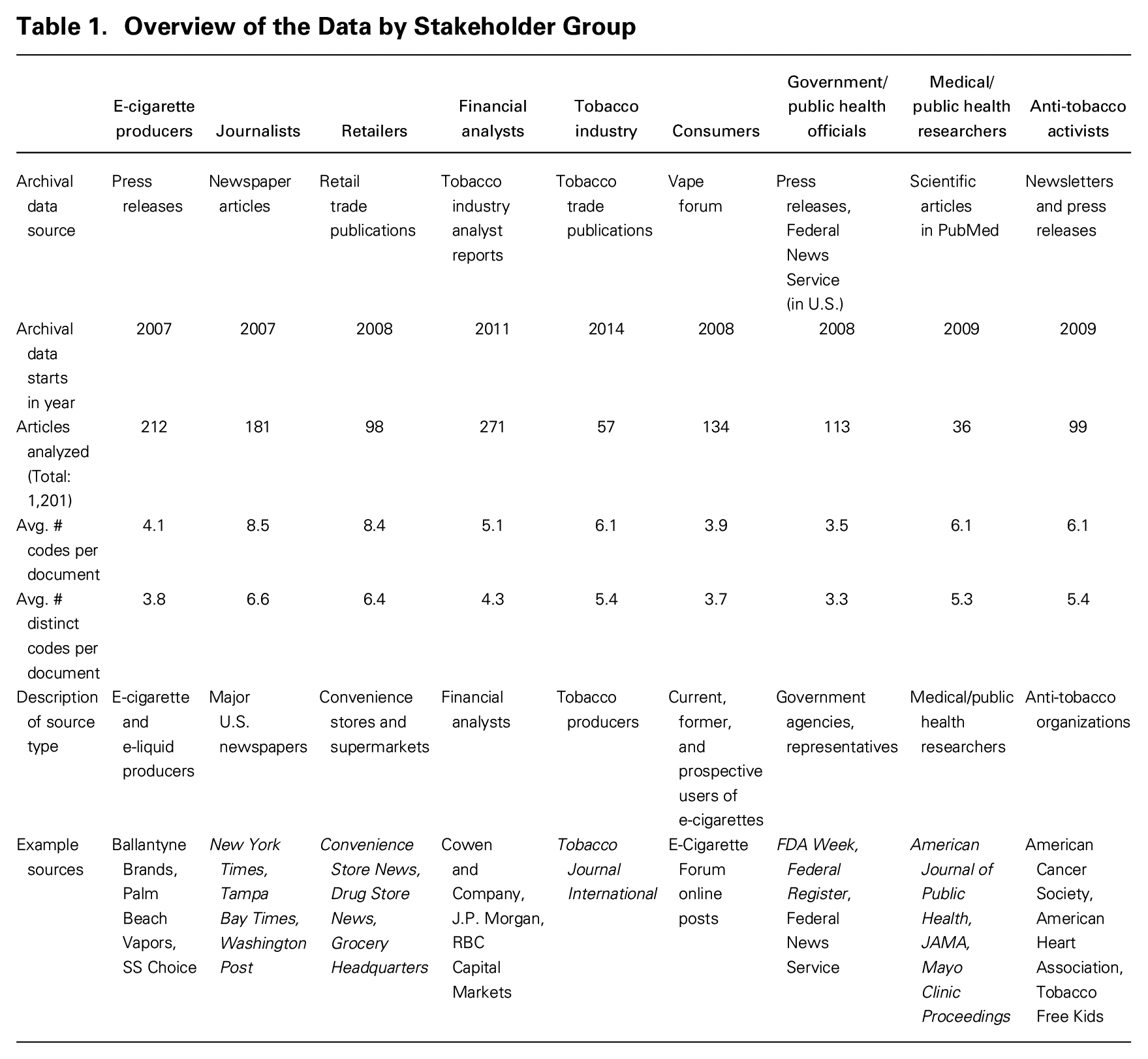
Following Spradley (1979), our data collection and initial document analysis were closely intertwined. In our initial reading of the documents, we realized that the conversation around e-cigarettes involved more than just e-cigarette producers and journalists—it included a number of other stakeholder groups. Accordingly, as data collection progressed, we iteratively expanded our dataset to include seven additional stakeholder groups: retailers, financial analysts, tobacco producers, consumers, government/public health officials, medical/public health researchers, and anti-tobacco organizations. Our goal was to gather viewpoints from all stakeholder groups—core and peripheral—that appeared to have an interest in e-cigarettes. For each group, we identified a major communication channel used to communicate the group’s views to themselves and other stakeholder groups. We used these sources to construct an article dataset for each stakeholder group from the time the group joined the conversation around e-cigarettes until the end of our study period; see Table 1 for details. For each group, we again aimed to collect two articles per month but collected all articles in years when a stakeholder group published fewer than 24 documents. In total, we collected 1,201 articles across the nine groups.
Overview of the Data by Stakeholder Group
We supplemented this archival dataset with two kinds of data. First, because we collected only 36 medical documents through Factiva, we identified journal article abstracts through PubMed that referenced e-cigarettes or a related term. We collected 2,110 such abstracts published between 2007 and July 2018. Second, we conducted 15 interviews with public health researchers and educators, public health regulators, e-cigarette/e-liquid manufacturer representatives, and e-cigarette advocates.
Data Analysis
We began data analysis with the open question of how an organizational category becomes stigmatized. As our analysis progressed, we asked increasingly specific questions of the data (Langley, 1999). This led us to go back and reexamine events that we had not realized were important during our initial data coding. Our analysis thus progressed through an iterative process, moving continuously between theory, data, and puzzles (see Corbin and Strauss, 2014). Although we describe below how our data analysis progressed in several stages, these stages were in reality overlapping and intertwined.
Stage 1: Historical reconstruction
The first step in our data analysis was historical reconstruction (Kahl and Grodal, 2016). We began by creating a temporal overview of important events that took place during the emergence of the e-cigarette category, grouped by broad stakeholder types; see Table A1 in the Online Appendix, https://journals-sagepub-com.web.bisu.edu.cn/doi/suppl/10.1177/0001839220914855. This table functioned as an anchor for our analysis; we frequently referred to and updated it.
Stage 2: Initial puzzling observations
Drawing on Golden-Biddle and Locke’s (2006) advice that central theoretical insights are driven by empirical puzzles, we focused data analysis on a set of initial empirical observations. First, we observed that some stakeholders stated that e-cigarettes were healthier than regular cigarettes, while others declared e-cigarettes to be more dangerous than cigarettes. Second, some stakeholders claimed e-cigarettes were a method for smoking cessation, while others claimed e-cigarettes were a gateway to combustible cigarettes. Lastly, some stakeholders talked mainly about independent e-cigarette producers, while others focused on tobacco companies involved in e-cigarettes.
Stage 3: Open coding
To address these puzzles, we engaged in inductive theory building. Given the large size (1,201 articles) and heterogeneous nature of our sample (nine stakeholder groups spanning 11 years, 2007–2017), we began by coding a subset of documents that were representative across stakeholder type and time. We created this subset by choosing two articles from each stakeholder group per year. After uploading our subsample in Atlas.TI, each author took a turn coding this initial sample, adding and applying codes from the Atlas.TI file. We then compared codes—merging, splitting, relating, and dropping codes along the way. We simultaneously grouped codes into initial categories: “category,”“stigma,”“identity,”“physical design,”“cognitive legitimacy,”“interests,” and “regulatory legitimacy.” After a number of iterations, we arrived at a set of 75 agreed-upon codes, grouped into the seven categories listed above.
Stage 4: Generating propositions
We used this open coding as a springboard to generate initial propositions about patterns observed in the data (Lofland et al., 1995), including that early e-cigarette producers emphasized similarities between e-cigarettes and cigarettes while also highlighting the new category’s distinctiveness and that major tobacco companies’ entry into e-cigarettes drew in new stakeholder groups. See Online Appendix Figure A1 for a summary of initial propositions.
Stage 5: Systematic coding
After generating guiding propositions, we applied our 75 codes to all 1,201 documents. Throughout the coding process, we continually worked on updating our coding scheme and refining our propositions. After each change to our coding scheme, we went back and applied the adjusted scheme to the entire sample. At the end of our coding process, we had 78 codes and had applied these codes to the data 6,702 times for an average of about 5.6 codes per document.
Stage 6: Data triangulation
The next step was to update and refine our propositions by triangulating between the qualitative archival analysis, a quantitative analysis of the data, and the supplementary interviews. In our quantitative analysis, we first tracked the degree to which the e-cigarette category became established over time by measuring the proportion of media articles in our sample that included an explicit definition of what an e-cigarette is (e.g., “The e-cigarette is a battery-powered device that provides inhaled doses of nicotine”). Lack of explicit definition indicates the extent to which e-cigarettes had become readily familiar to and understood by market audiences (Colyvas and Powell, 2006; Hsu and Grodal, 2015). To capture e-cigarette category stigmatization, we tracked codes relating to whether e-cigarettes had a positive evaluation (e.g., “e-cigs as distinct b/c healthier or safer,”“proof of beneficial effects of e-cigarettes”) and codes relating to whether e-cigarettes had a negative evaluation (e.g., “concern about health effects of e-cigarettes,”“e-cigs as gateway or normalizing cigs”).
As another quantitative measure, we tracked patterns in the backgrounds of researchers publishing studies on e-cigarettes over time. Our primary aim was to assess when—and the degree to which—researchers with expertise in combustible cigarette research turned their focus to e-cigarettes. We first collected all articles from PubMed whose abstracts/titles referenced e-cigarettes or one of the related terms. We then examined the extent to which researchers who published studies on e-cigarettes had crossed over from previously researching combustible cigarettes. We determined whether authors had previously published research specific to cigarettes by comparing authors/publication dates with PubMed articles whose abstracts/titles referenced cigarettes or tobacco (without reference to e-cigarettes).
The last part of our efforts to triangulate between our initial findings and additional data sources was to code interviews using the same coding scheme used to analyze the archival data. The interview data provided a slightly different perspective on the stigmatization of e-cigarettes than the archival data because informants would often verbally express thoughts more freely than in written text. Our interview coding confirmed and added nuance to our archival-based assessments.
Stage 7: Identifying phases
During this analysis stage, we identified three key phases in our data. We chose the starting and ending points of these phases when we perceived “continuity in the activities within each period and . . . certain discontinuities at [their] frontiers” (Langley, 1999: 703). Statements in our data consistently pointed to the 2012 entry of major tobacco companies into the e-cigarette category as a watershed moment for the category’s evolution. The transition between the second and third phases was marked by a substantial increase in attention from stakeholders who challenged the e-cigarette category and heightened language about the social threat and danger posed by e-cigarettes.
Stage 8: Reaching saturation on mechanisms
During the process of iterating through the qualitative and the quantitative data, we worked on identifying the mechanisms that drove the stigmatization of the e-cigarette category. As we iterated, we considered the importance of different stakeholder groups in driving each mechanism we had identified. We also considered intertextual references between documents from different stakeholder groups when associating mechanisms with particular groups (Kahl and Grodal, 2016). We eventually reached saturation on the mechanisms and their associated stakeholders; see Online Appendix Figure A1 and Table A2 for details on key mechanisms.
The Creation of Categorical Stigma
Cigarettes were a wolf in sheep’s clothing. Now, with vaping, we have a sheep in wolf’s clothing, and we cannot get the wolf out of our minds.
1
Overview of Change in Perceptions of E-cigarettes
We first examined general trends in public discourse surrounding the e-cigarette category over the first ten years of its history in the U.S. In Figure 1, we track the proportion of media outlet articles that provided an explicit definition of an e-cigarette and the proportions that included characterizations of e-cigarettes as negative (i.e., dangerous or unhealthy) or positive (i.e., healthier or safer than cigarettes). Figure 1 shows that the majority of media documents included an explicit definition of an e-cigarette from 2007–2010. We observe a general decline in explanatory discourse over time, reflecting media contributors’ increasing assumption that their average reader was familiar with the e-cigarette category.

Key document themes in top newspaper articles over time.
Figure 1 also shows that the proportion of articles that reference e-cigarettes as healthy or safe relative to combustible cigarettes generally decreased over time, while the proportion of articles that reference e-cigarettes as dangerous or unhealthy increased. References to e-cigarettes as dangerous/unhealthy increased markedly from 2013–2014, peaking in 2014. This corresponds to the period shortly after which tobacco company Lorillard purchased the e-cigarette brand blu and during which Altria (the parent company of Philip Morris) and R. J. Reynolds tested e-cigarette brands in limited markets and then launched nationally. During the pre-2012 period, the proportion of articles referencing e-cigarettes positively was greater than the proportion referencing them negatively. This pattern flipped after 2012.
Table 2 provides a qualitative overview of change from Phase 1 to 3 in the valence of different stakeholder groups’ discourse regarding e-cigarettes. This table shows variation in stances toward e-cigarettes both across time and across stakeholder types. Within time phases, different stakeholder groups’ discourse on the e-cigarette category varied considerably in valence, with some (such as financial analysts and retailers) more positive and others (such as anti-tobacco activists) more negative. Over the three phases, however, the discourse of almost all stakeholder groups became more negative. E-cigarette producers were the notable exception—their discourse on the category remained generally positive.
Examples of Discourse Related to E-cigarette Category Valence, by Stakeholder Type and Phase

In the following sections, we examine the mechanisms underlying these general changes in understandings of e-cigarettes. We first detail actions by category entrepreneurs that drove category emergence and then show diverse stakeholders’ reactions to and reinterpretations of entrepreneurs’ framings.
Phase 1: Constructing and Establishing the New Category (2007 to 2011)
In the early years of its emergence, the U.S. e-cigarette industry consisted of small, independent firms that primarily sold products online or in shopping mall kiosks (U.S. Department of Health and Human Services [HHS], 2016). A key initial challenge for producers was gaining consumers’ acceptance of this novel technology. Early documents reflected considerable confusion over what the new product was and how it should be used. Retail and industry representatives noted that e-cigarettes were “difficult to categorize” (blu Cigs, 2011) and “need[ed] a classification” (Kress, 2011), and that retailers needed to invest in “a huge amount of education to get people to try electronic cigarettes” (Kress, 2012).
Entrepreneurs initially familiarized the e-cigarette category by promoting similarities with the existing category of combustible cigarettes and highlighting distinctive appeal and goals vis-à-vis that category. Other early stakeholders evaluated and reified producers’ proposed categorization through retail placement decisions and regulations/court rulings, further establishing the category. We detail these mechanisms below.
Promoting similarities with the existing category
From a technological design perspective, the e-cigarette bore little resemblance to the combustible cigarette. The e-cigarette is an electronic device, typically consisting of a mouthpiece, battery, heating element, and liquid-solution reservoir (HHS, 2016). The battery powers the heating element, which converts the liquid solution into an aerosol that is inhaled through the mouthpiece. While this technology could be delivered through a wide diversity of product formats, early e-cigarettes—now referred to as “cigalikes”—were designed to mirror cigarettes as closely as possible. As a 2010 e-cigarette press release described: At first glance the electronic cigarette appears to be a regular cigarette. As the user inhales, a sensor atomizes the contents of the e-cigarette refill cartridge into a smoke-like vapor which causes an LED light on the tip to glow like a burning cigarette. (SS Choice LLC, 2010)
Even the color scheme was chosen to resemble a cigarette: the mouthpiece of e-cigarettes was often colored orange, whereas the rest of the device was white to resemble cigarette paper. By imitating a cigarette’s physical features, entrepreneurs aimed to ensure that users could easily recognize what e-cigarettes were for and how to use them (see Hargadon and Douglas, 2001). This physical resemblance also underscored the e-cigarette’s intention to simulate the experience of smoking a cigarette.
E-cigarette producers also used labeling/discursive strategies that framed the e-cigarette as similar to cigarettes in function, experience, and intended audience. Their strategies included incorporating the term “cigarette” in their labeling, portraying the e-cigarette as replicating the experience provided through cigarettes, and emphasizing that the audience for this new product was existing cigarette smokers.
In early press releases, a variety of terms were used to label what came to be known as e-cigarettes, including “electronic smoking device,”“smoking substitute,” and “smokeless cigarette substitute.” These various terms gave way to a more consistent reference to the label “electronic cigarette” and then “e-cigarette.” The use of the term “cigarette” in the new product’s labels succinctly connoted their intended function and was important in facilitating communication and interest among potential market participants. As an e-cigarette blogger explained, smokers “only want to try something if it looks, feels, and tastes like a cigarette . . . unless the term ‘electronic cigarette’ or ‘e-cigarette’ is used, no one will (a) have a clue what you are talking about, (b) be able to find the products with a web search, or (c) want to switch from smoking” (E-cigarette Politics, 2014).
Accompanying the use of the label “e-cigarette” were descriptive phrases that emphasized e-cigarettes’ similarities in look and experience to cigarettes, such as “fully re-creates the smoking experience complete with smoke and nicotine” (E Cigarettes Choice, 2011) and “mimics traditional tobacco cigarettes in look, feel, and sensation that a smoker gets from a tobacco cigarette” (World of E Cigarettes, 2010). E-cigarette manufacturers frequently emphasized that existing adult smokers constituted their core market, presenting their products as cigarette alternatives for “committed adult smokers looking to avoid the toxins found in combustible cigarettes” (Electronic Cigarette Association, 2009) or who craved cigarettes but were constrained by regulations (i.e., in bars, restaurants, and workplaces). In keeping with this emphasis on existing smokers, producers provided smoking-related metrics to explain how the new product compared with cigarettes. For example, e-cigarette producers translated the amount of vapor a user experiences through an e-cigarette to its equivalent in terms of cigarette cartons through statements such as “approximately 1800 mouthfuls of vapor, nearly the equivalent vapor to the mouthfuls of smoke produced in a carton of conventional cigarettes” (Ruyan America, Inc., 2008).
Highlighting distinctive appeal and goals vis-à-vis the existing category
As e-cigarette producers primarily emphasized the e-cigarette’s similarities to cigarettes, they secondarily described its superior normative status along culturally valenced dimensions such as health and safety. Take, for example, the text directly following the excerpts noted above emphasizing similarities in look and experience between the two types of products (distinctive text italicized for emphasis): The E-cigarette resembles a traditional tobacco cigarette and fully re-creates the smoking experience complete with smoke and nicotine. The smoke, which is actually water vapor, vanishes quickly and does not create offensive odors. (E Cigarettes Choice, 2011) The electronic cigarette is a simple product that mimics traditional tobacco cigarettes in look, feel, and sensation that a smoker gets from a tobacco cigarette, but it lacks well over 95% of the chemicals that traditional cigarettes emit. (World of E Cigarettes, 2010)
Early press releases generally first mentioned physical and experiential similarities between e-cigarettes and cigarettes, followed quickly by statements about the absence of harmful chemicals and/or secondhand smoke in e-cigarette vapor. Producers also portrayed e-cigarettes as a product that would “not offend non-smokers” (PremiumEcigarette, 2009) and avoided “the social and health concerns that smoking entails” (NE-WHERE, Inc., 2013). These benefits highlighted a key oppositional goal that some e-cigarette producers promoted with respect to the cigarette category: to aid in reducing or quitting smoking. In an interview, one e-cigarette producer recalled that many entrepreneurs in the newly emerging category expressed an “anti Big Tobacco sentiment” and believed “they had finally found the new holy grail to quit.” Several other interview respondents recalled that their initial interest in the category stemmed from personal experiences with family members or friends using e-cigarettes successfully to quit smoking. Similar to early press releases, interviewees described the e-cigarette as an effective alternative for smokers struggling with addiction because it closely simulated the smoking experience.
Thus, while e-cigarette producers emphasized the normatively superior appeal and goals of e-cigarettes relative to cigarettes, they took care to position these virtuous distinctions within the dominant framing of e-cigarettes as similar to cigarettes in performance, function, and intended audience. The intention of this strategy was to familiarize consumers with e-cigarettes and their use while simultaneously shielding e-cigarettes from the stigma associated with combustible cigarettes.
Reifying producers’ proposed categorization
Whether stakeholders would accept producers’ framing of e-cigarettes as similar to cigarettes was unclear, as early regulator and retailer documents reflect considerable uncertainty about e-cigarettes’ classification. Initially, the U.S. Food and Drug Administration (FDA) construed e-cigarettes to be drug-delivery devices like nicotine patches and gum based on manufacturers’ claims that they satisfied smokers’ cravings (i.e., withdrawal symptoms) by delivering nicotine. Both the FDA and anti-tobacco organizations expressed concern about the safety and marketing of e-cigarettes as drug-delivery devices designed for smoking cessation (Zezima, 2009). For example, Tobacco Free Kids (2010a) stated that “like other drugs and delivery devices, electronic cigarettes should be regulated to protect public health.” A key concern was that e-cigarette producers were making unsubstantiated claims about this “unproven and unapproved alternative to smoking cessation therapies that have been approved by the FDA as safe and effective” (Tobacco Free Kids, 2010b).
Public health officials and researchers also interpreted e-cigarettes as drug-delivery devices early on and warned about a lack of scientific evidence for claims made about their effectiveness in quitting smoking. In 2008, the World Health Organization (WHO) noted that e-cigarettes were often promoted as alternatives to nicotine replacement therapy and recommended banning the dissemination of information about their health benefits without conclusive evidence. Lack of association with tobacco companies may have played a role in these early interpretations of the e-cigarette as an unproven, yet potentially beneficial, tool for smoking cessation. One tobacco expert we interviewed reflected on the importance of organizational identity to shaping his early positive perception of e-cigarettes: They were independent e-cigarette companies that were just producing e-cigarettes and nothing else that just sprung up. They were all new companies. They had nothing to do with tobacco. . . . [H]ad it been the tobacco companies marketing it I would have been very suspicious, like, okay this is just repeating history. . . . [But] this can’t be a Big Tobacco ploy because there is no Big Tobacco involved. (Public health researcher, interview)
In 2008, the FDA took its first major action involving e-cigarettes by instructing U.S. Customs and Border Protection to confiscate e-cigarette imports based on their status as “unapproved drug/device combination products” (Federal Register, 2014). The e-cigarette manufacturer Smoking Everywhere filed a suit against the FDA in 2009, challenging this categorization and the FDA’s authority to confiscate the products. In evaluating the arguments, the District Court was persuaded by Smoking Everywhere’s position that e-cigarettes were for smoking enjoyment and designed to encourage rather than reduce or prevent nicotine use. 2 That is, the court accepted the framing of e-cigarettes as similar to combustible cigarettes. This suggested a less stringent set of regulations relative to the alternative of regulating them as drug-delivery devices. E-cigarette manufacturers viewed this ruling as a victory for the industry, predicting that it would lead to industry growth (Kress, 2011). After this court decision was upheld on appeal, the FDA announced in 2011 that it would issue regulations for e-cigarettes under the 2009 Family Smoking Prevention and Tobacco Control Act’s “Deeming Rule,” which gave the FDA authority over all tobacco products. The legal codification of e-cigarettes as tobacco products reduced uncertainty about whether e-cigarettes would be regulated under the same framework as cigarettes.
These regulatory actions made e-cigarettes “more appealing to retailers,” encouraging retailer adoption of the new product (Stagnito Media, 2011). With e-cigarettes increasingly on display in convenience stores and gas stations, customers could see and better understand this novel technology up close (Bishop, 2014). Retailers increasingly allocated shelf space to e-cigarettes next to cigarettes (Caley, 2016), both raising customers’ familiarity with the new product and further institutionalizing its categorization as a cigarette-like product.
Yet as the next section details, the accepted positioning of e-cigarettes as highly similar to cigarettes and regulatory equivalence of these two categories opened a path for stigma to transfer by establishing a weak symbolic boundary between the two categories. This positioning encouraged retailers’ attention and growth, which influenced consumers’ acceptance. At the same time, it made tobacco company diversification into e-cigarettes seem like a natural competitive move into a related category, despite differences in the fundamental technology and goals of the two categories. Tobacco companies’ participation influenced how collective understandings of e-cigarettes developed in the next phase.
Phase 2. Diversification from an Existing Stigmatized Category into the New Category (2012 to early 2014)
Tobacco companies’ diversification into the new category was a pivotal event in the e-cigarette category’s stigmatization. It facilitated the process of categorical expectation transfer, meaning that stakeholders scrutinized the e-cigarette category through a categorical lens forged through their prior experiences with cigarettes. Challenger stakeholders’ negative lens for cigarettes led to strong concern that e-cigarette producers might engage in tactics similar to what had been used by tobacco companies in decades past. Spotlighting and diffusing blame was a second mechanism driving stigmatization, in which stakeholders first highlighted the questionable activities of a single tobacco-owned e-cigarette brand and then spread negative attributions about cigarette producers to the broader category of e-cigarette producers.
Diversification from the existing category
Major tobacco companies began to show active interest in the e-cigarette category in 2012, the year following the FDA’s announcement that it would regulate e-cigarettes as tobacco products (Adams and Branca, 2012). Tobacco companies faced strong pressure to diversify from their core product, sales of which had been steadily declining in the U.S. since the 1980s with “[p]rice increases, restrictions on advertising and promotions, increase in regulation and excise taxes, health concerns, decline in the social acceptability of smoking, and other factors” (MarketLine, 2013). Tobacco companies had thus far experimented unsuccessfully with other products that might be viewed as safer or lower in risk than cigarettes, such as nicotine inhalers and heat-not-burn products (Hsu and Grodal, 2015). E-cigarettes were another potential product in this vein.
In April 2012, the first major tobacco company, Lorillard, entered the e-cigarette category with its acquisition of the e-cigarette brand “blu.” This ignited interest among tobacco industry analysts and retailers; for example, the count of retailers selling blu products increased from 13,000 to 127,000 in the year following the Lorillard acquisition (HHS, 2016). By 2013, Altria and R. J. Reynolds launched e-cigarette brands in limited markets; in mid-2014, both expanded to national distribution (Adler et al., 2016).
Our findings show that, as major tobacco companies entered the emerging e-cigarette category, attention to e-cigarettes increased substantially among key stakeholders of the combustible cigarette category. Some attention (such as from intermediaries like financial analysts) was positive, focusing on tobacco companies’ vast resources and capabilities and what these meant for the fledgling category’s growth. Other cigarette-category stakeholders (such as anti-tobacco organizations) were alarmed at the move, focusing on tobacco companies’ past deceptive activities and what these meant for how tobacco companies would grow the category. Thus e-cigarettes’ regulatory institutionalization as cigarette-like and the subsequent entry of tobacco firms into e-cigarettes brought a transfer of categorical expectations from the cigarette to e-cigarette category, but in markedly different ways for different stakeholder groups.
Increasing attention and transfer of category expectations from existing category proponents
Before tobacco company diversification, e-cigarettes attracted moderate attention from tobacco industry financial analysts, who covered e-cigarettes along with products such as roll-your-own cigarettes and snus (a smokeless tobacco product) under the “Other Tobacco Product Segment” in their reports (Herzog, Metrano, and Gerberi, 2012). Early estimates of e-cigarette market growth were unclear because a large proportion of sales were conducted online and not easily tracked by traditional metrics like Nielsen (HHS, 2016).
Lorillard’s entry into the new category in mid-2012 appeared to ignite tobacco analysts’ interest; some quickly began to promote the idea that the category was on the precipice of incredible growth. In August 2012, the same month Lorillard formally acquired blu, Wells Fargo declared that “consumption of e-cigarettes could outpace traditional cigarettes over the next decade” and that “big tobacco needs to wake up and recognize the potential opportunity of the e-cigarette category and not make the mistakes of the large beverage companies that overlooked the potential of the energy drink category when it was in its nascent stage” (Herzog, Gerberi, and Metrano, 2012).
Compared with small, independent e-cigarette producers, major tobacco companies were viewed by analysts as having multiple competitive advantages, including substantial cash resources; entrenchment with retailers, ensuring broad, scalable distribution and premium shelf-space; expertise in building and marketing successful brands; and extensive experience interacting with the FDA. Indeed, Lorillard and R. J. Reynolds reported meeting with the FDA to help develop e-cigarette regulations (Bannon, Kessler, and Taylor, 2013a, 2016). Analysts’ growing enthusiasm for the e-cigarette category was thus influenced by tobacco companies’ entry, as it was viewed as something that “could catapult the growth of the ecigarette category, driving the total conventional cigarette and cigarette profit pool up” (Herzog, 2013).
Positive tobacco analyst reports on the nascent e-cigarette category set the stage for a positive spiral among producers, industry analysts, and retailers. Analysts exerted a strong influence on retailers by providing tangible, legitimized projections that retailers trusted. As John Wiesehan, the CEO of Mistic E-cig, noted in a call with Wells Fargo analyst Bonnie Herzog, “Quite frankly, I think your bullishness on the category has helped retailers realize this is here to stay” (Herzog, Gerberi, and Scott, 2014a). As retailers increasingly adopted e-cigarettes, producers and analysts in turn interpreted their support as an affirming signal of the category’s positive future (Bannon, Kessler, and Taylor, 2013b). NJOY’s CEO observed in 2013 that positive feedback from retailers provided “another air of legitimacy to the category, and sparked a significant amount of consumer awareness” (Herzog and Gerberi, 2013).
In this phase, proponents of the e-cigarette category, such as financial analysts, retailers, and manufacturers, increasingly interpreted e-cigarettes through the positive lens they held for the cigarette category and came to view e-cigarettes as a major growth category for the tobacco industry. Tobacco company diversification into e-cigarettes, however, generated a markedly different reaction from challengers of the existing category of combustible cigarettes—anti-tobacco organizations, public health researchers, and public health officials/regulators.
Increasing attention and transfer of category expectations from existing category challengers
The amount of discussion among anti-tobacco organizations and the public health community around e-cigarettes increased after large tobacco companies entered the new category—particularly by 2014, the year R. J. Reynolds and Altria began national distribution of their new e-cigarette brands. Among the stakeholder groups we followed, these were later than others to focus attention on the e-cigarette category; see Figure B1 in Online Appendix B. The documents collected from these stakeholder groups reflected a substantial focus on tobacco company involvement in the e-cigarette category. Among 95 post-2012 press releases issued by the American Cancer Society, American Heart Association, and Tobacco Free Kids mentioning e-cigarettes, 60 percent specifically mentioned tobacco companies and their presence in the emerging category, emphasizing their organizational similarities.
Public health and medical researcher attention to e-cigarettes also increased, as many researchers with expertise in combustible cigarette research began turning their focus to e-cigarettes. In Figure 2, we show the count of PubMed articles with abstracts/titles referencing e-cigarettes that were published by authors who had previously conducted research on cigarettes versus the count of e-cigarette articles published by authors with no prior cigarette research. As Figure 2 shows, the count of publications on e-cigarettes increased substantially after 2013, and the vast majority of articles published during that period were authored by scholars who previously conducted research on cigarettes.
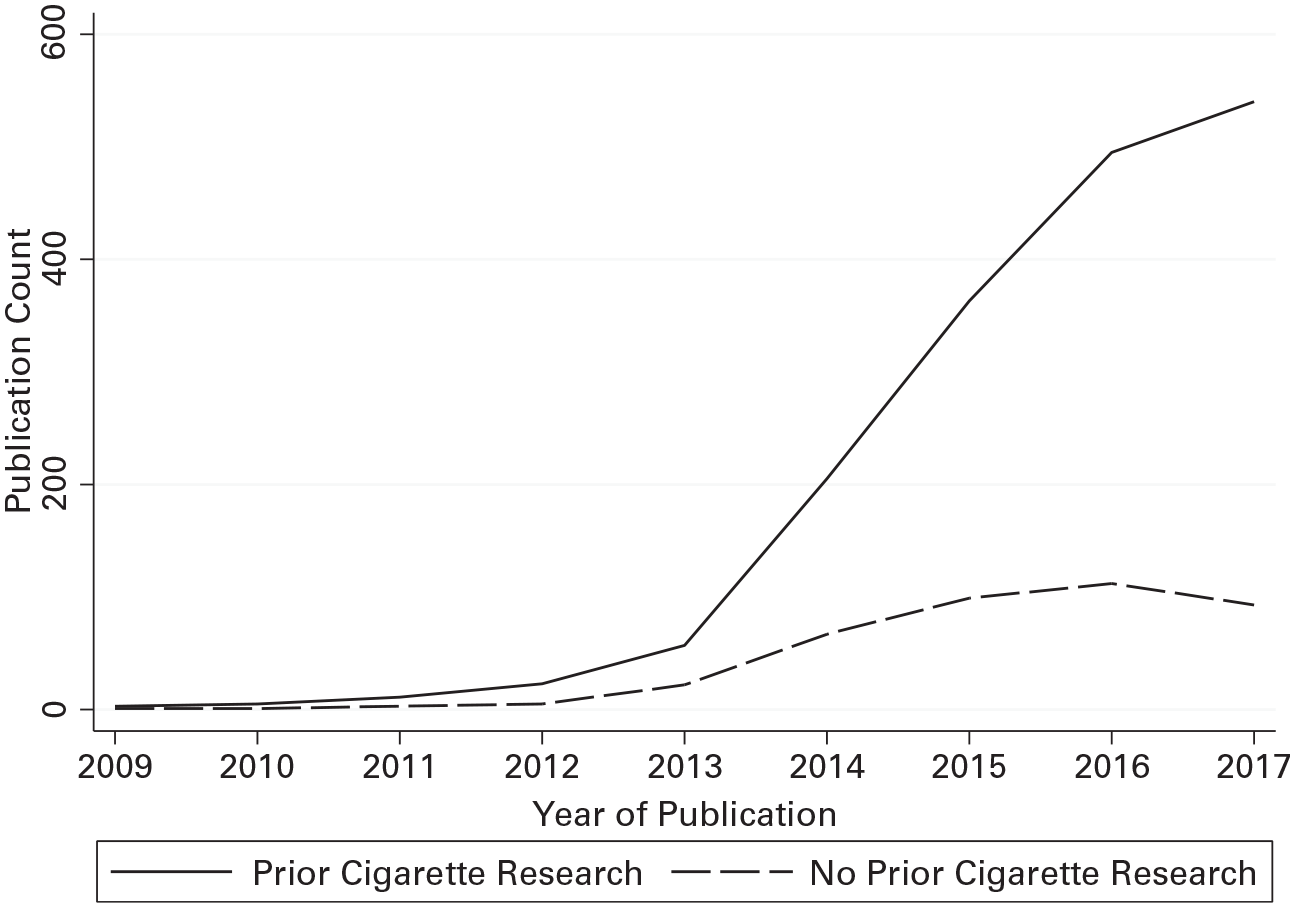
Yearly counts of PubMed e-cigarette articles by researcher background.
As anti-tobacco activists and public health researchers with expertise in cigarettes devoted increasing attention to e-cigarettes, they increasingly challenged the earlier framing of e-cigarettes as a virtuous alternative to cigarettes. We examine how this expanded set of stakeholders stretched existing framings of similarities to question the morality and intentions of the entire category.
Spotlighting actions and diffusing stigma
Our findings suggest that a key step in the process of category stigmatization was the spotlighting of a negatively viewed behavior—youth-targeted marketing—by a single tobacco-owned e-cigarette brand. Discussion about youth-targeted marketing was not new to e-cigarettes—dating back to 2009, public health regulators had expressed some concern that e-cigarette advertisements could appeal to youths (e.g., Hensley, 2009). With the entry of tobacco companies into e-cigarettes, however, this concern intensified and broadened markedly. Anti-tobacco organizations and public health community members raised increasing alarm that tobacco companies could extend marketing tactics used decades earlier to the new e-cigarette category.
A key process in the transfer of stigma from the cigarette to e-cigarette category was generalization from initial media and stakeholder claims about the questionable activities of individual tobacco-owned e-cigarette brands to the broader category. For example, in December 2012, only several months after Lorillard acquired blu, an article in the New York Times noted: Some e-cigarette ads feature celebrity endorsers, in the way that ads for conventional cigarettes once featured actors, athletes, doctors and even cartoon characters. The actor Stephen Dorff began appearing in October in a campaign for Blu eCigs, which was acquired this year by Lorillard, the maker of mainstay cigarette brands like Kent, Old Gold and Newport. (Elliott, 2012)
This spotlighting of Lorillard’s blu campaign was echoed in other media documents that described Dorff as “oozing machismo” and “[i]nhaling with swagger” much as the “Marlboro Man strutted his stuff” decades earlier (Koch, 2013). Blu’s advertising campaign was characterized as “reach[ing] into the bag of advertising tricks” (Nasaw, 2012) and “borrow[ing] a page from glitzy tobacco company commercials that filled the airwaves before a federal ban on TV and radio cigarette ads four decades ago” (Lazar, 2013).
Slight expansions of this claim can be seen in a Tobacco Free Kids’ 2013 press release, which not only singled out blu/Lorillard but noted similar tactics by the independent e-cigarette brand NJOY: Television and online ads for e-cigarettes have featured catchy slogans and celebrity endorsers, such as actor Stephen Dorff and TV personality Jenny McCarthy for blu eCigs and rocker Courtney Love for NJOY. Magazine ads for e-cigarettes feature today’s equivalents of the Marlboro Man and the Virginia Slims woman, depicting e-cigarette use as masculine, glamorous and rebellious. (Tobacco Free Kids, 2013a)
This expansion was again echoed in media documents, which noted that “[c]ompanies such as NJOY and Blu Ecigs are advertising on TV, forbidden for cigarettes for more than 40 years” (Felberbaum, 2013). Soon, these perceived tactical similarities were generalized to the broader set of e-cigarette companies. Links between the category’s marketing tactics and the “Big Tobacco playbook” became common: Manufacturers of electronic cigarettes say they want to be part of the solution to the tobacco problem, but increasingly they’re behaving just like tobacco companies always have. They’re following Big Tobacco’s playbook by marketing their products in ways that appeal to kids. (Tobacco Free Kids, 2013b)
Anti-tobacco organization press releases also frequently stated that the broader e-cigarette industry was targeting youths through “sweet, kid-friendly flavors including ‘vivid vanilla,’‘cherry crush’ and chocolate” (Tobacco Free Kids, 2013a). These claims typically accompanied links made to the cigarette industry’s early history of youth-focused advertising, such as “themes and images long used to market regular cigarettes to kids” (Tobacco Free Kids, 2013a). Public officials similarly began expressing concern about tobacco industry involvement and the organizational and marketing tactics that might be used for tobacco-owned brands. Dr. Ed Ehlinger, Minnesota’s state health commissioner, declared “I have a real sense of déjà vu about e-cigarettes” with regard to the youth-focused marketing tactics cigarette companies had employed years ago (Olson, 2014).
Some e-cigarette firms attempted to assert virtuous identities. For example, Green Nicotine’s CEO proclaimed that “I intend to eliminate any opportunity for a minor to get their hands on Green Nicotine and in turn, I look toward a future where all E-Cigarettes are ethically marketed across the industry” (Green Nicotine, 2011). Another e-cigarette executive interviewed reflected on his efforts to conduct business in an “ethically and morally correct” way. He noted, “I was very careful not to co-mingle with tobacco . . . and only interested in selling to vaper specific retailers. My goal from day one was to provide a safer alternative to offset the leading cause of death, and that was combustible cigarettes.”
Still, as the cigarette category became increasingly intertwined with the categorical identity for e-cigarettes, the broader e-cigarette producer category appeared to have become tainted with the idea of targeting youths and hooking a new generation on its product. A 2014 Cowen & Co. Equity Research report noted that public health organizations’ reports on e-cigarettes were beginning to shift general public opinion about their potential benefits: Earlier this week, e-cigs captured news headlines as: 1) the CDC released their report on underage e-cig use, and 2) the WHO’s report calling for broader e-cig regulation was also well reported. As a result, we believe, Google search trends globally for e-cigs jumped 22% this week. This is not necessarily good news, as risk perception around e-cigs had already been deteriorating. (Azer, 2014)
Claims regarding e-cigarette producers’ deceptive tactics undermined producers’ earlier framing that the intended market for e-cigarettes was existing adult smokers seeking harm reduction. By spotlighting and diffusing perceptions of tactical similarities between cigarette and e-cigarette producers, stakeholder groups recast e-cigarette producers in a way that questioned the honesty and behavior of the category as a whole as well as producers’ claims about the superior normative distinctions between the existing and new category. This process marked a major step in the transfer of stigma from the existing to the new category.
Phase 3: Growing Category Stigma (mid-2014 to 2017)
During the third phase, we identified growing e-cigarette category stigma. This stigma was stimulated by two mechanisms, intensifying social threat and generalizing denigration, which led producers to try to counter the stigma of the category by emphasizing between-category dissimilarity.
Intensifying social threat
In this phase, stakeholders intensified the perceived social threat of e-cigarettes by framing them as a gateway to cigarette use among youths and thus a danger to the health, well-being, and longevity of a new generation of Americans. Early e-cigarette manufacturers relied on physical similarities of their new products to cigarettes to gain existing smokers’ acceptance. Yet later stakeholder groups reinterpreted these similarities as a fundamental problem for public health. For years, anti-tobacco groups had worked to control the use of cigarettes in the U.S. through public service announcements and marketing campaigns that depicted smoking as a “smelly, disgusting, or irresponsible” practice (Voigt, 2015: 1968). Smoking bans and increasing regulatory constraints on marketing also contributed to general social disapproval or “denormalization” of smoking (Voigt, 2015). Given how closely e-cigarettes resembled combustible cigarettes, the new product’s increased use—particularly in locations such as schools, public buildings, and restaurants where smoking had long been banned—was viewed as having the potential to destabilize tobacco control by renormalizing cigarette smoking.
In a panel discussion hosted by Wells Fargo, a health psychology professor noted that some in the public health community argued that “if you just see people walking around, doing something that looks like smoking, we’re going to undo the de-normalization, the stigmatization, of smoking, that’s been accomplished over a lot of years” (Herzog, Gerberi, and Scott, 2014b). In a 2014 speech, Senator Dick Durbin expressed concern with how e-cigarettes were decreasing social stigma around smoking: “We just had the Golden Globe Awards, and some of these red hot actors and actresses who we all love to watch in movies were puffing away on their e-cigarettes, and I thought, you’re killing the next generation of fans in your movies” (Durbin, 2014).
The renormalization argument co-opted an earlier claim by e-cigarette producers about a key benefit of e-cigarettes—that they could be used in many places without offending bystanders and incurring social stigma. Anti-tobacco activists and public health researchers argued that the lack of social stigma for an act that closely resembled cigarette smoking threatened public health and safety. Their concerns frequently accompanied the observation that activists had worked for decades to achieve the current level of stigmatization of cigarette smoking in the U.S. Reported cigarette usage among U.S. adolescents had steadily declined from around 28 percent in 1996/7 to around 7 percent in 2015 (Johnston et al., 2019), but youth adoption of e-cigarettes has been increasing since 2011. By 2014, e-cigarettes had become the most commonly used tobacco product among youths (Cullen et al., 2018).
Researchers frequently raised concerns about whether e-cigarettes provided “a gateway to combustion cigarettes for adolescents” (Al-Delaimy, Myers, and Strong, 2015) yet admitted that scientific evidence supporting this concern remained weak (Green and Hilton, 2018). Still, youth usage of e-cigarettes represented a clear, salient metric of the potential for e-cigarettes to renormalize cigarettes among the nation’s youth. Thirty-one public health and medical organizations wrote a 2015 letter to President Obama stating that “use of e-cigarettes by youth has skyrocketed. . . . We cannot afford more [regulatory] delays that allow tobacco companies to target our kids with a new generation of tobacco products” (Tobacco Free Kids, 2015a). The increasingly strong growth in the e-cigarette category, promoted by financial analysts, retailers, and producers as a positive phenomenon, thus alarmed anti-tobacco activists and public health researchers.
Public health researchers increasingly associated e-cigarettes with the tobacco industry and warned that research into e-cigarettes is “particularly critical as the tobacco industry invests further resources into the development and marketing of noncombustible tobacco products and acquires a greater share of the [e-cigarette] business” (Richardson et al., 2014). Public health research articles continued to draw similarities between cigarettes and e-cigarettes not just in advertising but also in political tactics such as “lobbying state legislators behind the scenes and using front groups to disseminate their policy positions” (Cox, Barry, and Glantz, 2016: 542) and in organizational tactics such as vapor store community events, which researchers characterized as “similar to past and current tobacco industry marketing strategies” in that owners “intentionally created an atmosphere where people could spend time with others and be entertained” (Cheney, Gowin, and Wann, 2015). Overall, we observed this second process of reframing e-cigarettes as a threat to public health as playing a key role in the intensification of challenger stakeholders’ negatively valenced perceptions of the e-cigarette category.
Generalizing denigration
Another process driving stigmatization was a generalization from specific problematic behaviors to other, more fundamental features relating to e-cigarette companies’ values, strategic interests, core customers, and end goals. Stakeholders explicitly linked earlier critiques of e-cigarettes’ dangerous marketing tactics and potential to renormalize cigarette smoking to broader claims involving tobacco industry interests. In press releases, anti-tobacco activists began warning that tobacco companies were seeking to “define the activity of smoking an e-cigarette as ‘sexy, youthful, and vigorous’” in order to “drive people back to cigarettes, their main market” (Richtel, 2014). These warnings included accusations of tobacco companies’ lack of morality, such as “the tobacco industry continues to lure kids into nicotine addiction with a wide assortment of sweet-flavored products” (Tobacco Free Kids, 2015b). Anti-tobacco organizations argued that e-cigarettes as a category represented a strategic “gateway to nicotine addiction and use of regular cigarettes by kids and other non-users” (Tobacco Free Kids, 2013b). Proclamations such as the following by the CEO of the American Heart Association became common: We are fiercely committed to preventing the tobacco industry from addicting another generation of smokers. Recent studies raise concerns that e-cigarettes may be a gateway to traditional tobacco products for the nation’s youth, and could renormalize smoking in our society. (American Heart Association, 2014)
In research articles studying e-cigarettes and other vaping products, researchers also mentioned the tobacco industry’s strategic interests. Such mentions were muted in tone relative to activists’ discourse, in keeping with the more neutral norms of scientific discourse. Yet Voigt (2015: 1967–1968) observed that “the increasing involvement of the tobacco industry in the [e-cigarette] market is a major source of unease for many public health experts, who are concerned that the industry could try to use [e-cigarettes] to maintain or even increase tobacco consumption.”
Anti-tobacco organizations and public health members not only portrayed the tobacco industry as having strategic interests in the new category but also began to portray organizational interests and core customers (i.e., young people) as overlapping between the two categories. Calls for researchers to “think of real world solutions to prevent e-cigarettes from becoming a back door for the return of smoking and the spread of for-profit nicotine addiction in society” (Dawson and Maziak, 2016) became more common, grouping e-cigarette and tobacco companies under the rubric of companies interested in promoting nicotine addiction.
A well-established tobacco industry researcher noted that early e-cigarette researchers in the public health community tended to view e-cigarettes with optimism. Many were focused on smoking cessation and were frustrated with the ineffectiveness of drug-delivery devices such as nicotine replacement therapies; they hoped e-cigarettes might be a more effective alternative. Yet he argued that tobacco company involvement contradicted early e-cigarette advocates’“ideological view that e-cigarettes are this disruptive technology that’s going to disrupt the big major tobacco companies. But that’s not true because now all the cigarette companies are in the e-cigarette business.”
Another tobacco industry expert reflected on the importance organizational identity played in his perceptions of e-cigarette companies’ end goals and strategic interests prior to tobacco companies’ entry: The tobacco companies obviously have an economic incentive not to reduce smoking. Even if they are trying to build a new niche in e-cigarettes, it doesn’t help them necessarily to lose their business. But it’s very different with independent companies because their value proposition essentially is to make smoking history. . . . It’s no different than nicotine replacement therapy. They only make money if people try to quit.
He concluded that this fundamental difference in economic incentives “is why it made such a huge difference to me that this was not a tobacco industry product” early in the category’s history.
There remains considerable debate in the public health community about the role e-cigarettes play in tobacco control (Blanding and Madeline, 2015), with some researchers advancing a more positive harm-minimization perspective and others advancing a strongly cautionary perspective (Green, Fielding, and Brownson, 2018). In general, researchers studying youth adoption and use of e-cigarettes tend to take more negative stances than researchers focused on smoking cessation. The type of individual who is the primary subject of study appears to shape researchers’ general orientation toward e-cigarettes. For those studying youth adoption, e-cigarettes pose a potential threat to children and decades of work educating the public—particularly younger generations—about the harmful effects of cigarette smoking. One researcher we interviewed noted that this cautionary camp has occupied a particularly vocal role in media accounts of e-cigarettes. In contrast, researchers studying smoking cessation generally expressed cautious openness to the idea of e-cigarettes as a harm reduction tool. Their orienting perspective is of the adult smoker interested in quitting but unable to. Another researcher we interviewed reflected on the divide: There is evidence that [the e-cigarette] helps smokers quit better than the patch or the gum. . . . The reason that public health scientists are not embracing e-cigarettes is because they are worried that e-cigarettes might be a gateway for young people to start smoking. . . . The people care about the kids and do not care about the adult smokers. They are scaring people away from e-cigarettes, but they could have a strategy for communicating differently with kids and with adults.
Overall, our findings suggest that the stigmatization of the category intensified as stakeholders generalized from specific actions deemed morally unacceptable to the broader values, strategic intentions, and end goals of the entire category. The symbolic boundary between cigarettes and e-cigarettes has faded, as e-cigarettes have become increasingly viewed as a potential replication of the tobacco industry’s past deception and the public’s addiction to their core product.
Emphasizing between-category dissimilarity
The stigmatization of e-cigarettes is an issue the e-cigarette producers we interviewed were acutely aware of, and archival documents suggest several ways the industry has tried to address it in recent years. For example, producers decreasingly referenced cigarettes, smoking, and even the label “e-cigarettes.” This is illustrated in Online Appendix Figure B2, which shows a general decrease in the proportion of press releases referencing the existing category of cigarettes over time. This pattern is consistent with studies that suggest category producers de-emphasize discursive strategies that link a new category to existing categories as the new category becomes established (Rosa et al., 1999; Kennedy, 2008; Navis and Glynn, 2010). Figure B2 also shows that producers increasingly used the labels “vaping” or “vapor” to reference their product. The choice of this distinct term appears deliberate in its intent to distance the category from cigarettes. As e-cigarette company representative Jesse Gaddis states, “The facts are that this isn’t smoking. This is vapor” (Sutherland and Greene, 2013). Indeed, e-cigarette producers have acknowledged the early choice to use the term “cigarette” as a mistake for the new category’s legitimacy. Jacob Fuller, a top executive for blu, observed, “Our biggest mistake was to call it an e-cigarette in the first place. This means that people are automatically associating it with a traditional cigarette, which it isn’t, other than the fact it looks a bit like one and produces a vapour” (Davis, 2014).
Strategic differentiation from the existing category also involved differentiation of the physical product. While tobacco companies continued to create cigalike devices, other producers have shifted away from cigalikes and increasingly adopted open-systems designs that resemble technological devices (for example, box-shaped and using materials such as glass and aluminum) and allow customizable e-liquid solution, nicotine yield, and puff volume (Hsu, Sun, and Zhu, 2018). In documents starting around 2014, industry insiders began noting a decrease in demand for closed-system (prefilled) cigalikes and increasing preference among e-cigarette users for open-system (customizable) designs (Modi et al., 2014; Kress, 2015).
While consumers’ desire for customizable products was a factor in shifting demand, their desire to avoid the social stigma associated with cigarettes appears to have also played a role. The president of CB Distributors noted in 2014 that “the cigarette-like appearance was once a selling point, but now users do not want to be chastised when they use the product in a restaurant or other non-smoking area” (Caley, 2014). Another e-cigarette company spokesperson observed: “We think it is important to counteract the negativity of the cigarette factor. By their very nature, most e-cigarettes look like cigarettes. We think this is an issue because some smokers don’t want a product that makes them look like they’re smoking” (Grocery Headquarters, 2017).
Yet recent e-cigarette designs that do not resemble cigarettes have brought a new set of concerns from anti-tobacco and public health officials. In 2018, a slew of media articles highlighted the allure to youths of products such as Juul, which physically resemble USB flash drives and deliver highly addictive levels of nicotine (Belluz, 2018; Kaplan and Hoffman, 2018). In Nielsen-tracked retail channels, sales of Juul products increased sharply in 2017, while tobacco industry e-cigarette brands’ retail sales have stagnated since 2015 (Huang et al., 2019).
3
The FDA has characterized Juul’s products as “troubling” and “wildly popular with kids,” and it announced investigations into whether the company was intentionally targeting the youth market (Zernike, 2018). The FDA also announced in September 2018 that it had issued over 1,300 warning letters and fines to retailers “who illegally sold JUUL and other e-cigarette products to minors during a nationwide, undercover blitz of brick-and-mortar and online stores” (U.S. Food & Drug Administration, 2018a). A September 2018 statement from FDA Commissioner Scott Gottlieb noted that the popularity of Juul among teenagers should be regarded as “an epidemic of addiction” and acknowledged tradeoffs that would have to occur in tobacco control: [T]he youth risk is paramount. It’s now clear to me, that in closing the on-ramp to kids, we’re going to have to narrow the off-ramp for adults who want to migrate off combustible tobacco and onto e-cigs. (U.S. Food & Drug Administration, 2018b)
The potential dangers posed by youth adoption of Juul products are something noted with concern even among the e-cigarette producers we interviewed, who regarded the product’s potent nicotine deliveries as potentially harming the reputation of the broader category. Juul’s marketing tactics, crafted to make the product appealing to youths, were also seen as a potential problem for the entire industry. And it is important to note that many e-cigarette producers engage in actions that may promote e-cigarette use among youths. For example, many producers sell e-liquid flavors that appeal to youths, such as dessert and fruit flavors, and some do not take action to restrict youth access to their products (Hsu, Sun, and Zhu, 2018). Still, the idea of e-cigarettes as a gateway to nicotine and tobacco product addiction remains even as the industry has made efforts to distance itself from cigarettes in labels, discourse, and physical design. As Figure 1 illustrates, during the most recent period, media documents have increasingly labeled e-cigarettes as dangerous or unhealthy.
We conclude our findings section by noting that the UK provides a contrast to this account of how e-cigarettes were stigmatized in the U.S.—one that highlights the socially constructed nature of shared categorical understandings. In the U.S., the expert opinions of prominent public health researchers, as well as health-related organizations such as the Mayo Clinic and American Heart Association, were often used to justify and bolster claims about the potential harm of e-cigarettes. In contrast, a number of prominent UK health organizations, including the Royal College of Physicians, Cancer Research UK, and the British Medical Association, have endorsed a more positive view of e-cigarettes as substantially less harmful than combustible cigarettes (Dockrell, 2018). UK government agencies’ stances reflect this position. In an e-cigarette evidence update, the government agency Public Health England (2019) stated that “vaping remains an accessible and appealing alternative to smoking” in the UK. In response to a 2019 U.S. outbreak of lung diseases associated with vaping THC products, Public Health England posted updated guidance that stated “PHE has not changed its advice on nicotine containing e-cigarettes: Smokers should consider switching completely and vapers should stop smoking. We are certain as ever that e-cigarettes are far less harmful than smoking, which kills almost 220 people in England every day” (Newton, 2019). While a detailed comparison of the factors giving rise to these differences is beyond the scope of the current study, we highlight this divergence in stigmatization of e-cigarettes to help make clear the socially constructed nature of category stigma in our focal case.
Theoretical Model of the Category Stigmatization Process
Figure 3 summarizes key processes by which stigma is transferred from an existing to a new category. During the first phase, early category entrepreneurs attempt to construct a new category that is positioned closely in symbolic space to an existing one. Producers focus on promoting similarities between the existing and the new category to make the new category comprehensible and focus on establishing the initial market for the new products. Secondarily, they highlight the distinctive appeal and goals of the new category. Early stakeholders then reify producers’ proposed categorization by highlighting the similarity between the old and the new category. The result is the successful emergence of a new category—but with a weak symbolic boundary vis-à-vis the existing one.
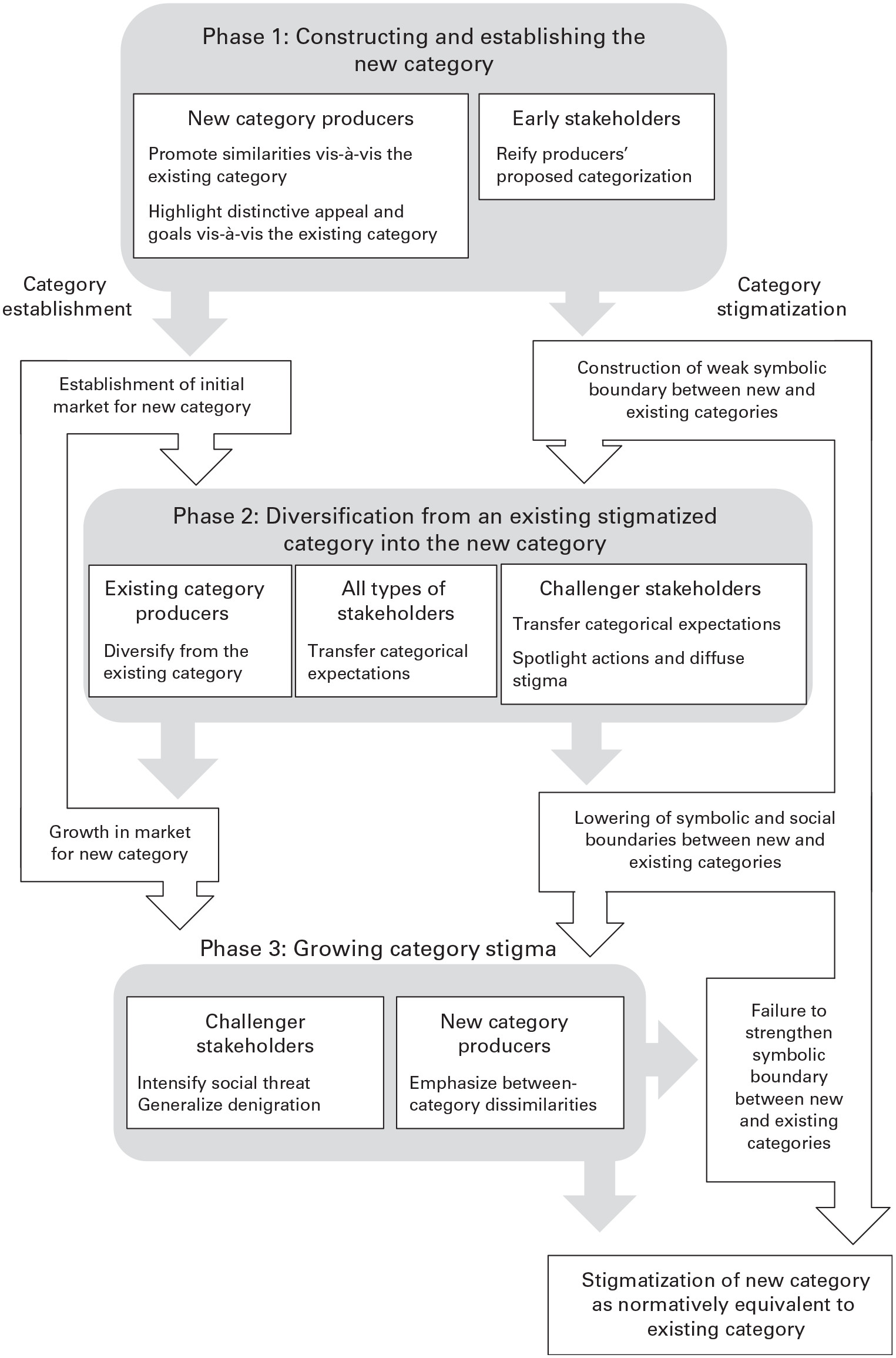
Overview of the process of new category stigmatization.
During the second phase, the weak symbolic boundary between the new and the old category encourages incumbents to diversify from the existing category into the new one. This diversification encourages attention from a broader set of peripheral stakeholders, who transfer category expectations from the existing to the new category. Challenger stakeholders then spotlight actions and diffuse the stigma associated with the existing category to the new category. These negative attributions diffuse subtly—both across different organizational features and across organizations—as challenger stakeholders create a generalized impression of widespread category adoption of negative actions associated with the existing category. Diversification thus presents a double-edged sword. On the one hand, attention to the new category increases. On the other hand, the symbolic boundary between the new and existing category becomes increasingly blurred because the organizational identities of the two categories become less distinct.
During the third phase, challenger stakeholders intensify perceptions of the social threat and generalize denigration from the existing to the new category. While new category entrepreneurs attempt to emphasize between-category dissimilarities, their efforts prove futile. Challenger stakeholders’ actions have broken down the symbolic boundary separating the old and the new category, resulting in the new category becoming stigmatized.
Discussion
Our findings contribute to and extend literature on oppositional category positioning, new category emergence, and organizational stigma. We next discuss implications for our understanding of key issues in each of these literatures.
Oppositional Category Positioning
Existing studies show that category entrepreneurs often attempt to build a new category around claims of superior normative value by invoking culturally resonant frames that reconfigure the market’s social structure (Rao, Monin, and Durand, 2003; Weber, Heinze, and DeSoucey, 2008; Fligstein and McAdam, 2011; Hsu, Koçak, and Kovács, 2018). Carroll and Swaminathan (2000) posited that the growth of new specialist organizational categories depends on the perceived normative legitimacy of their claims. In their study of the U.S. beer brewing industry, they found that the contract brewing category—which did not live up to claims regarding authenticity and tradition—did not follow standard density-dependent legitimation processes. Carroll and Swaminathan speculated that an organizational category that does not satisfy its normative claims will encounter identity-based problems as it proliferates. Our study extends this idea by showing that category growth can invite stronger, more diverse stakeholder scrutiny, increasing the threat of normative devaluation when the organization’s identity is perceived as deviating from its claims.
Our case also highlights that, for new categories that share core features (such as core products or customers) with an existing stigmatized category, the need for a strong symbolic boundary in the early stages of the category’s emergence is paramount. Studies of oppositional categories such as French nouvelle cuisine, biodynamic wine, wind energy, and grass-fed beef have found that new category proponents expend considerable effort elaborating how a new category is different from and normatively superior to an existing category (Rao, Monin, and Durand, 2003; Weber, Heinze, and DeSoucey, 2008; Sine and Lee, 2009). The literature has treated the processes establishing a new category’s normative value as intuitive and natural for entrepreneurs who view their category as oppositional to an existing category. We demonstrate that this may not be the case and, in doing so, highlight the importance of identity-focused work to processes of category emergence from a different angle. We find evidence that the lack of a clear symbolic boundary between cigarette and e-cigarette producers early on enabled tobacco companies to enter and gain market share as the category entered its growth stage. This diversification of existing category members into the new category further blurred what was already a weak symbolic boundary separating the two.
Our empirical case suggests the strategic positioning of a new category vis-à-vis existing ones plays a fundamental role in the transfer of core stigma across categories. Early category entrepreneurs employed product design, labeling, and discursive strategies that highlighted e-cigarettes’ similarity to cigarettes in function, experience, and intended audience. They appear to have assumed that their novel technological device was so different from combustible cigarettes that audiences would have no trouble distinguishing the two. Yet in their pursuit of category recognition and growth, early producers positioned themselves so close to the existing stigmatized category that the symbolic boundary between the two categories was easily blurred. After diversification between the categories increased the similarity of the categories’ organizational identity, stakeholders readily transferred expectations from the existing category to the new one, paving the way for stigma transfer.
Yet strategies related to the strategic positioning of a category could alternatively be used to reduce core stigma. Lashley and Pollock (2019) found that although medical and black-market cannabis are essentially the same product, medical cannabis entrepreneurs in the U.S. used labeling/discourse (e.g. “wellness services”), symbols (a green cross), and design strategies (clear jars, retail spaces that resembled doctors’ offices) to emphasize culturally valenced dimensions such as healing and community service to distance the medical cannabis category from black-market cannabis. By publicly disidentifying with and even vilifying the stigmatized black-market category, entrepreneurs were able to push some of its stigma away from the medical category. Through their positioning efforts, they even succeeded in gaining support from many U.S. legislators and medical community members for medical cannabis as a potential option for patients (Lashley and Pollock, 2019). It appears that through such processes of forging categorical distinctions (versus categorical similarities), stigma can be either constrained within or spread between categories.
The medical cannabis case in the U.S. illustrates the power of early categorical positioning choices. It suggests that an alternative approach to framing the e-cigarette category early on—one that distanced e-cigarettes from cigarettes by emphasizing smoking cessation and harm reduction while vilifying the existing category of combustible cigarettes—could conceivably have allowed entrepreneurs to position their new category in a way that minimized the transfer of stigma from combustible cigarettes. Future comparative research on processes of core-stigma increase and reduction that focuses on similar positioning mechanisms may shed light on how generalizable these mechanisms are to other types of categories. We also need to better understand the contextual factors that may shape how successful positioning strategies are in terms of gaining widespread acceptance. For example, future research might compare and contrast the effect of creating category distinctions through labeling/discourse versus aesthetic/material means. Recent research has shown that these two mechanisms might work quite distinctively in how they shape social processes (Meyer et al., 2018), and it is thus plausible that they vary in how they shape the stigmatization process.
New Category Emergence
Scholars have proposed that the successful construction of a new market category requires that category entrepreneurs establish both cognitive and normative legitimacy (Lounsbury and Glynn, 2001; Navis and Glynn, 2010). Our findings suggest that, in certain contexts, a tension arises between category positioning actions that promote each legitimacy type. The similarity-focused framings that category entrepreneurs adopt to enhance cognitive legitimacy for their new category may constrain their ability to establish a clear and distinctive moral and social position vis-à-vis the existing category. In the case we studied, the same factors that contributed to cognitive legitimacy—positioning e-cigarettes as similar to cigarettes, the entry of larger organizations with considerable resources, and strong category growth—were leveraged by challenger stakeholders to stigmatize the entire category when these factors were reinterpreted in light of the existing stigmatized category. While our case shines light on how the cognitive and normative elements of category emergence are intertwined, future research might examine this interrelationship in other contexts such as categories created outside of existing categorical systems.
Research is also needed to understand the degree to which these processes hold not just for emerging categories for which beliefs and expectations are still being formed, but for more mature categories. For example, Delmestri and Greenwood (2016) documented how an established low-status product—grappa—was successfully repositioned as higher status through practices such as strategic distancing from its prior categorical identity and emulation of the practices of high-status categories. Future research into processes driving change in stigma among well-established categories is needed to understand how general the strategic positioning processes captured in this study are to categories in other stages of evolution. As part of this, it would be important to investigate whether categories in which organizational identities are more firmly established will be as vulnerable to organizational diversification as emerging categories.
Our case also shows that, to understand the evolution of categories’ symbolic boundaries, it is not enough to consider internal contestation among a category’s core stakeholders (Grodal, 2018). Entrepreneurs must anticipate which related category stakeholders might become attentive to their category and how these stakeholders’ perspectives might diverge depending on their strategic interests. In highlighting the importance of changes in different stakeholder groups’ participation in this emerging category over time, our study complements existing work focusing on how the participation of producers across categories shapes category evolution. The existing categorical identities of producers who enter a new category have been shown to influence the trajectory of the new category’s emergence. For example, McKendrick et al. (2003) found that the development of a collective identity for the category of disk-drive array producer was impeded because many early entrants were generalist firms whose primary identities were linked to other market categories. Our study extends this idea by showing that stakeholders’ linkages to existing market categories may also influence a new category’s trajectory. Stakeholders’ existing categorical orientations shape how they perceive and contribute to the collective construction of a new category, as their beliefs and expectations about existing categories are tied to how they perceive the new category. These findings extend recent research by Dorobantu, Henisz, and Nartey (2017), which found that stakeholders’ prior beliefs about a firm shape their reactions to new firm-level events. Our study finds a related category-level dynamic: the strategic orientation and interests of stakeholders vis-à-vis existing market categories will influence how they perceive a new category and can generate starkly different perceptions and contestation over a new category’s meanings.
Future research mapping producer and stakeholder movements across categories could shed light on important issues such as how generalism versus specialism among early stakeholders affects new category evolution. For example, categories for which there is a very specialized set of stakeholders may find it easier to carve a stable peripheral position and distinct identity as opposed to categories that share stakeholders with many other related categories in the domain. More generally, we need more research into the role that diverse stakeholder groups play—in terms of when they get involved in category creation, what their interests/perspectives are, and how they interact with one another as they attempt to influence collective understanding and evaluation of the category.
Implications for the Literature on Organizational Stigma
Scholars studying stigma have called for greater attention to the question of who stigmatizes a given category of organizations in addition to how stigmatization occurs (Devers et al., 2009; Hudson and Okhuysen, 2009). Our study sharpens understanding of how category stakeholders’ prior experiences and strategic interests matter in the creation of category stigma. In our empirical case, the same mechanism—category expectation transfer from cigarettes to e-cigarettes—led different groups to construe the categorical identity for e-cigarettes in markedly different ways depending on their pre-existing perspectives vis-à-vis cigarettes. For stakeholders such as retailers with a history of collaborative transactions with the tobacco industry, tobacco companies’ entry into e-cigarettes led to the positive perception of e-cigarettes as a category with potential for strong growth and high profits. For stakeholders with a long history of challenging the tobacco industry’s activities, category expectation transfer led to the perception of e-cigarettes as a deceptive and dangerous category. Within stakeholder groups, interests and goals also played a role in shaping perceptions. For example, public health researchers interested in understanding how e-cigarettes impact youths were generally more negative about e-cigarettes than researchers interested in understanding their role in smoking cessation.
In the case we studied, the transfer of stigma from the existing category to the new category’s core was not immediate; rather it involved a set of processes that generalized and intensified negative attributions to the broader category level. Our study thus brings attention to the relationship between event and core stigma. With event stigma, there is an assumption that organizations have some capacity to isolate and remove the leadership or processes that led to the negative idiosyncratic event (Elsbach and Sutton, 1992; Devers et al., 2009). In contrast, core stigma cannot be repaired without an organization abandoning its fundamental identity (Hudson, 2008; Hudson and Okhuysen, 2009). Studies tend to focus on either event or core stigma. The empirical case we observed, however, suggests one type (event) played a key role in the creation of the other (core). Stakeholders’ perception of discrete negative events (the blu and NJOY marketing campaigns) diffused into a broader censure of all e-cigarette manufacturers as adopting Big Tobacco’s infamous marketing playbook and targeting youths. This appears a strong form of the transfer of event stigma across similar organizations observed in prior studies (Jonsson, Greve, and Fujiwara-Greve, 2009; Pontikes and Barnett, 2017). A diffusion from discrete negative events also led to a more global critique of e-cigarette producers’ intentions and the danger they represented to youths and society at large. This corresponds to a second diffusion theorized in the stigma literature, in which critique of a single negative action or feature invites further scrutiny and censure of a target’s additional features (Wiesenfeld, Wurthmann, and Hambrick, 2008). The overall effect of both types of attributional diffusion was the spread of stigma associated with a discrete event to core aspects of the new category—its values, core customers, and fundamental processes used to target them.
This type of progression from event to core stigma likely will not occur in every case. We expect that both types of diffusion (across category and across features) are instrumental for a negative event-based attribution to progress to the core values and features of a category. What conditions encourage versus restrict these kinds of attribution processes? Our investigation suggests that factors such as the weak symbolic boundary between e-cigarette and cigarette categories and weakened social boundary (as existing category members diversified into the new category) paved the way for event-based stigma to quickly diffuse to core stigma. To generalize and test these ideas, one fruitful path may be through controlled experiments. Given a hypothetical organization experiencing a negative event such as a product defect or corporate scandal, researchers could manipulate contextual conditions to determine which influence the spread of negative attributions both across different organizational features and across category members. Factors such as subjects’ familiarity with individual members of the category, structural characteristics of the organization undergoing the negative event (e.g., status, prominence, or size), and perceived similarity of category members may all shape the likelihood that event stigma will spread to the category’s core values and features. Testing insights from our historical qualitative analysis through methods such as experiments would establish the validity and general applicability of propositions generated through our theory-building exploration.
Supplemental Material
Supplementary_File – Supplemental material for The Double-edged Sword of Oppositional Category Positioning: A Study of the U.S. E-cigarette Category, 2007–2017
Supplemental material, Supplementary_File for The Double-edged Sword of Oppositional Category Positioning: A Study of the U.S. E-cigarette Category, 2007–2017 by Greta Hsu and Stine Grodal in Administrative Science Quarterly
Footnotes
Acknowledgements
We are grateful to Beth Bechky, Kevin Corley, Gina Dokko, Ozgecan Kocak, Rodney Lacey, and Gerardo Okhuysen for their helpful comments on earlier versions of this paper. We also thank Associate Editor Chris Rider and the three anonymous reviewers for their constructive feedback on our manuscript.

Supplemental Material
Notes
Authors’ Biographies
References
Supplementary Material
Please find the following supplemental material available below.
For Open Access articles published under a Creative Commons License, all supplemental material carries the same license as the article it is associated with.
For non-Open Access articles published, all supplemental material carries a non-exclusive license, and permission requests for re-use of supplemental material or any part of supplemental material shall be sent directly to the copyright owner as specified in the copyright notice associated with the article.
