



Abstract
Experiencing work as a calling has been described as the ideal of a truly positive experience of work. But what we know about how called professionals construct identities as people who are called to their work is incomplete. Discussions about callings are often framed as narratives—stories of people’s callings—yet little is known about how professionals incorporate a wide variety of life events into coherent stories that support their identity claims. To understand this process, we analyzed the narratives of 236 individuals from four professions. We found two ways our participants identified their callings: discernment and exploration. Discerners journeyed toward their destiny, which was their one true calling. Explorers actively searched for work they loved, but destiny played no role. Through a series of lived experiences, called professionals’ identities took shape as they were enacted, with their callings strengthening over time. After identifying their calling, each of these professionals engaged in two crucial processes for integrating self and work as they lived their calling. Like other professionals, called professionals sought legitimacy in their fields by demonstrating mastery and receiving affirmation. Yet their sense of calling simultaneously propelled them to craft personal authenticity through tailoring their own unique enactment of the role.
The concept of work as a calling has recently captured scholars’ imaginations as an ideal of a truly positive experience of work (Bunderson and Thompson, 2009; Cardador, Dane, and Pratt, 2011; Berkelaar and Buzzanell, 2015). Studies indicate that people who experience their work as a calling have greater career success (Praskova, Hood, and Creed, 2014), experience more meaningfulness at work (Hirschi, 2011), and have higher levels of well-being at work (Duffy and Dik, 2013; Schabram and Maitlis, 2017). Research also suggests that callings are associated with stronger occupational identification and engagement with work (Bunderson and Thompson, 2009; Dobrow, 2013), greater organizational commitment (Cardador, Dane, and Pratt, 2011; Rawat and Nadavulakere, 2015), and stronger career commitment (Duffy and Sedlacek, 2007; Duffy and Dik, 2013). Callings “capture the most positive and generative manifestation of the connection between people and their work that scholars have studied” (Wrzesniewski, 2012: 45). Thus understanding callings may be key to grasping essential principles underlying professionals’ motivation and well-being.
Many scholars regard an intimate connection between self and work to be the essence of the experience of work as a calling (Cardador, Dane, and Pratt, 2011; Dobrow and Tosti-Kharas, 2011; Hirschi, 2011). They have posited a variety of ways this connection may arise, including a blending of core life beliefs (moral duties, prosocial values) and work (Bellah et al., 2007; Wrzesniewski, 2012); a fulfillment of one’s life purpose in and through one’s work (Duffy and Dik, 2013); an experience of being uniquely created, destined, or specially “hardwired” for a particular kind of work (Baumeister, 1991; Bunderson and Thompson, 2009); and an experience of one’s work as a consuming, meaningful passion (Dobrow and Tosti-Kharas, 2011; Dobrow, 2013). If callings are the most intimate connections people can have with their work, it is important to understand how called professionals construct identities that achieve this integration of self and work and what forms of self–work connection underlie this integration.
Research has shown that the ways professionals construct their identities are fundamentally important because identities shape how they understand themselves and how they respond to other people and the work worlds around them (Baumeister, 1991; Swann and Bosson, 2010; Oyserman and James, 2012). A professional identity is the constellation of meanings ascribed to individuals, by themselves and others, as they enact a professional role (Ibarra, 1999; Kreiner, Hollensbe, and Sheep, 2006; Pratt, Rockmann, and Kaufmann, 2006; Ibarra and Barbulescu, 2010). A relatively coherent, stable, and secure identity helps a professional function effectively in their role (Kahn, 1990; Ashforth, Kreiner, and Fugate, 2000; Johnson and Yang, 2010), deal with challenges and uncertainty (Swann, Johnson, and Bosson, 2009; Ibarra and Petriglieri, 2010; Conroy and O’Leary-Kelly, 2014), adapt to changes in work (Ibarra, 1999; Pratt, Rockmann, and Kaufmann., 2006; Obodaru, 2012), create and sustain social resources (Dutton, Roberts, and Bednar, 2010), and find meaning in work (Pratt and Ashforth, 2003; Rosso, Dekas, and Wrzesniewski, 2010). Studies of identity work—the processes an individual uses to construct or revise a professional identity in a specific context—indicate that identity construction and revision abound across all types of work (Ibarra, 1999; Thornborrow and Brown, 2009; Petriglieri, Ashford, and Wrzesniewski, 2019). However, understanding how one constructs an identity as a called professional has been complicated by three unresolved issues in the current literature, and studying these issues is important for understanding the kinds of identity work that lie at the heart of a calling.
The first unresolved issue in the existing literature centers around how professionals find or discover a calling. The literature offers two distinct perspectives (Bunderson and Thompson, 2009; Wrzesniewski, 2012). Under the neoclassical view, the call is experienced as arising outside of the individual’s choice, through a divine summons or one’s basic nature (Rosso, Dekas, and Wrzesniewski, 2010; Duffy and Dik, 2013). Bunderson and Thompson (2009: 52) found that entering a calling for zookeepers involved “inherit[ing] an occupational identity,” and that identity was experienced as synonymous with their innate, “hardwired” self. Callings are also “assumed to be unique to the person” (Wrzesniewski, 2012: 49), and so each person is thought to have only one calling, which does not change (Bunderson and Thompson, 2009; Dobrow, 2013). Under this view, a calling is experienced as a moral duty, so personal responsibility to enact that moral duty is prominent, and personal fulfillment is a lesser concern. Indeed, one must be willing to sacrifice oneself to fully live out the call. The power of a calling arises from this moral duty: “If the bond between me and my work is mine to forge based on personal passion or perceived fulfillment, it is also mine to break. But if the bond between me and my work is forged by destiny and duty, it becomes truly binding and, if I respond with diligence and sacrifice, truly ennobling” (Bunderson and Thompson, 2009: 51).
In contrast to the neoclassical calling, the modern view suggests that callings arise from inside oneself and are highly self-directed. Here, personal agency plays a major role in entering a calling—individuals must look deeply within themselves to identify their most prized values (Hall, Yip, and Doiron, 2018) and then “search high and low for feedback . . . that will point [them] in the correct direction” (Wrzesniewski, 2012: 49). This direction may lie in choosing a meaningful profession (Dobrow Riza and Heller, 2015), crafting a work role, or changing to a more meaningful work role from time to time. Callings are not unitary and static (Dobrow, 2013), and therefore professionals may find or create callings in several different kinds of roles over the course of their work life (Berg, Grant, and Johnson, 2010). Here, the power of a calling arises from the personal fulfillment one experiences. Through the neoclassical lens, if a calling is not mine to forge but rather something I must discover, the consequences of missing my calling are dire (Wrzesniewski, 2015). But if callings result from self-direction and personal agency, as the modern view suggests, it opens up possibilities for me to find a calling in several kinds of work, and I can at least find something close to a calling even as I continue to seek ways to identify new possibilities for meaning or new ways to create it in the work I have (Wrzesniewski, 2015; Hall, Yip, and Doiron, 2018). Given differences between these two perspectives, questions remain regarding how a called professional enters their calling and how that entrance shapes their work identity.
A second unresolved issue is how someone goes from identifying a calling to claiming an identity as one who is called to one’s work. Most research on callings has studied individuals who have already found and enacted their callings (e.g., Cardador, Dane, and Pratt, 2011; Duffy et al., 2011; Duffy et al., 2013), and those studies that have examined callings over time have focused on predictors of whether or not a person enters a calling (Dobrow, 2013; Dobrow Riza and Heller, 2015). Both the neoclassical and modern views assume that a calling must be lived out in order for a called identity to be fully formed, but they offer very different views on how that process unfolds. Under the neoclassical view, one’s destiny or divine summons must be followed, and presumably one’s called identity is formed by or around this destiny, but the process through which this occurs remains unarticulated. Does a person discover their destiny and immediately experience an identity transformation? Bunderson and Thompson’s (2009) zookeepers seemed to indicate that they came to animal work with their called identity largely in place, as did the animal shelter workers who followed the identity-oriented path in Schabram and Maitlis’s (2017) study. By comparison, the modern view more explicitly provides indications of what living a calling entails because it posits that an individual must select the right job and then craft it in ways that will actualize their calling. In Dobrow’s research (2013; Dobrow Riza and Heller, 2015), musicians seemed to live out their callings in this way. The strength of their passion for music predicted whether they chose music as a major in college and eventually as a work role, as well as the extent to which they saw themselves as being talented enough to support this choice.
Existing research suggests that the way individuals live out their callings and construct called identities matters because the work identities they construct will shape their longer-term work experiences. Bunderson and Thompson (2009) found that zookeepers who had a greater sense that their calling was their destiny were more likely to believe that engaging their calling was a moral duty, an obligation they were ethically bound to enact. This in turn increased zookeepers’ willingness to sacrifice their own well-being for their work, creating a double-edged sword wherein callings are immensely meaningful but potentially damaging. Schabram and Maitlis’s (2017) study found that people who burned out and exited the animal shelter profession tended to describe their initial work experiences differently than those who kept doing the work. They suggested that workers who formed more intimate connections between self and work may have been more likely to respond negatively to work challenges. Those who had exited were more likely to describe their entrance into the profession in terms of being uniquely gifted for that work, similar to zookeepers ‘sense of destiny, but shelter workers who remained in the profession were more likely to describe their sense of calling as emerging over time. Thus resolving the second issue requires understanding how callings are lived out or made real—how one goes from having a calling to claiming an identity as one who is called to one’s work.
Finally, a third unresolved issue centers on how called professionals achieve an intimate connection between self and work (something uniquely personal) while also becoming legitimate professionals (something conferred by others). Existing studies have established that a fundamental aspect of identity work for a professional is constructing an identity that aligns with the role identity of their profession (Ashforth and Schinoff, 2016). Pratt, Rockmann, and Kaufmann (2006), for example, studied residents as they sought to construct professional identities while entering the medical profession. In response to initial inconsistencies between the ways they saw themselves and the types of work they did, residents engaged in identity “customization,” changing their understanding of who they were so that their identities were consistent with their situated experiences. In her study of junior consultants transitioning to more-senior roles, Ibarra (1999) found that professionals engaged in “adaptation tasks” such as observing role models and experimenting with provisional selves, which helped them construct stable and positive identities that were appropriate for their new jobs. Chreim, Williams, and Hinings (2007) found that when professional role identities change, institutional and organizational pressures compel individual role occupants to adapt their work identity to fit the new role identity. These studies show that to be a legitimate professional requires tailoring one’s work-related identity so that it fits the professional role.
However, a professional who feels called to their work faces the challenge of constructing an identity not only in response to the demanding norms, values, and expectations of their profession (Ashforth, 2000) but also that allows for a uniquely intimate connection between self and work. Called professionals must craft identities that connect their individual and unique selves to their work, a connection that embodies their broader sense of themselves as individuals and their purpose in life (Bunderson and Thompson, 2009; Wrzesniewski, 2012; Duffy and Dik, 2013). A called professional therefore faces a tension in that they must construct an identity that is both similar to the identities of other professionals (conforming to the professional role identity) and yet somehow unique because it is integrated with their self. The current identity literature asserts that achieving both similarity and uniqueness is inherently problematic, especially for professionals (Dukerich, Kramer, and Parks, 1998; Brewer, 2003). Ibarra (1999: 778) found that professionals who aspired to construct professional identities that conveyed their “true competence and character” were unable to achieve professional legitimacy. Other studies (Kreiner, Hollensbe, and Sheep, 2006) imply that, at best, a professional may create an optimal balance that minimizes the tensions between constructing an identity that is too unique and therefore isolates one from the professional role identity (underidentification) and constructing an identity that is too similar to the professional role identity and therefore results in one’s uniqueness disappearing (overidentification). But achieving an optimal balance is a “quasi-stationary equilibrium,” meaning that the tension can never be fully resolved (Kreiner, Hollensbe, and Sheep, 2006: 1048). This view of an enduring friction between similarity and uniqueness is hard to reconcile with the notion of a calling being the most generative and positive connection between people and their work (Wrzesniewski, 2012). Resolving this issue requires understanding how called professionals construct a work identity that navigates this tension between similarity and uniqueness. Do called professionals strive for optimal balance, or do they find other ways to deal with this tension?
Methods
To build theory about how an individual constructs an identity as a called professional and to provide theoretical insights about the three unresolved issues we identified in the callings literature, we engaged in an inductive study grounded in narrative inquiry (Riessman, 2002, 2008; Josselson, 2011). We framed our study with narrative identity theory, which posits that a person’s identity is the internalized and evolving story they craft by weaving together their reconstructed past, their experienced present, and their imagined future. This story forms a coherent sense of self that endures over time but also allows for and incorporates changes in important elements of the self (Pasupathi, Pals, and McLean, 2007; McAdams, 2008; Prebble, Addis, and Tippett, 2013). Coherent narrative identities integrate disparate life experiences, social interactions, role engagements, past selves, and other life elements together into an integrated and positive life story (Gergen and Gergen, 1988; Bauer and McAdams, 2004; Singer, 2004; Thorne, McLean, and Lawrence, 2004; McAdams, 2008; McLean and Pasupathi, 2011). To author a coherent narrative identity, the person must envision their entire life and then create a meaningful sequence to the life events that explains how they developed into the person they are now (Bruner, 2003; Fivush, 2011; McAdams and McLean, 2013). Thus studying the life stories people tell and the way they link those stories can reveal key elements of their current identities, as well as the specific ways those identities were formed, especially when the stories that are examined cover large spans of their lives (Gergen and Gergen, 1988; Bauer and McAdams, 2004; Singer, 2004; McAdams and McLean, 2013).
Narrative identities can be “powerful instruments for constructing a ‘transition bridge’ across gaps that arise . . . across identities claimed and granted in transition-related social interactions” (Ibarra and Barbalescu, 2010: 138). Therefore, we explored how called professionals integrate disparate and unexpected events that unfold over long periods of time into coherent identities that support their claims that they have heard, answered, and lived into callings to their work. We sought to understand how someone narrates and integrates the sometimes long transition from life without an experience of calling into an identity as one who experiences their work as a calling. We focused on identifying key elements of called professionals’ narratives of finding and living into a calling to learn how these shaped the identity construction processes professionals engaged in. Studying their life stories, we hoped, would also reveal the types of identity work they undertook as they entered their callings, the processes through which they moved from identifying their callings to authoring identities as called professionals, and how they navigated or resolved the uniqueness–similarity tension.
Sample
We studied caregiving professions because they are often used as examples of the kinds of work in which people are likely to experience a calling. We selected four so we could explore whether there were differences across professions in the narrative identities individuals constructed.
Pastors
We interviewed 103 pastors from ten Protestant denominations and Roman Catholicism. Most served churches in the U.S. Midwest. Tenures ranged from 7 years to more than 50. Forty-one were women, and 62 were men. All were fully ordained, and most were the only pastor assigned to their church.
Physicians
The 53 physicians in our sample were involved in a variety of specialties including family practice, internal medicine, sports medicine, obstetrics and gynecology, pediatrics, radiology, and orthopedic surgery. Tenures ranged from 7 to over 30 years; 15 were women, and 38 were men. All of the physicians were employed by the same large healthcare system, but they worked at ten different office locations in the U.S. Midwest.
International aid workers
The 51 international aid workers in our sample were involved in relief and development work at the same international organization and worked in Africa, Asia, or the Middle East. Service tenures ranged from 7 years to more than 30; 26 were women, and 25 were men; 63 percent were U.S. citizens.
Teachers
We interviewed 34 elementary school teachers, the majority of whom were part of a rural school corporation (one teacher was part of an urban school system). All but five were women. Years of experience ranged from 7 to more than 30.
Approach to Narrative Inquiry
Although “narrative research eschews methodological orthodoxy” (Josselson, 2011: 225), Riessman (2002, 2008) provided a general guide to the phases of narrative inquiry—attending, telling, transcribing, analyzing, and reading—that we followed in our study. As we explain below, narrative research also borrows some elements of grounded theory, especially in its iterative nature and in the use of first- and second-order coding (Josselson, 2011).
Attending
Narrative research is a highly empathic (cf. Josselson, 2011) approach, and so it begins with researchers sensitizing themselves to the persons and contexts that will be studied. We read several autobiographies of physicians and pastors, first-hand accounts of relief and development work written by aid workers, lengthy descriptions of aid work provided by large international aid organizations, and several essays written by teachers about their experiences in the classroom. We conducted informational interviews with leaders in each of the professions (e.g., seminary presidents, medical directors, senior aid leaders, school principals). We also studied a variety of archival information from each of these professions to acquire important background information and insights about cultural norms (e.g., whether clergy were referred to as “pastor,”“minister,” or “reverend”), required education and credentialing processes, work trends in each profession, and other information about each profession. Our goal was to foster a more empathic approach by learning about the kinds of work and work experiences that might be customary or typical for our participants, especially those that might be related to experiencing work as a calling.
Telling
Narrative research then moves into a phase of gathering detailed stories from participants about their lives. Narratives are understood contextually; that is, they are presumed to be influenced by the circumstances under which they were obtained, so we conducted all of our interviews in the work contexts of our participants. These included physicians’ examination rooms and offices, churches and pastors’ offices, classrooms and teachers’ lounges, and remote field sites and emergency relief camps in which our aid workers lived and worked. We conducted our interviews during a time that each participant considered to be “normal” work time. In this way, we tried to place our interviews in the work contexts that were customary for each professional.
As we will describe more fully below, we used an iterative approach similar to what is done in grounded theory by moving back and forth between telling and transcribing/analyzing. We began the telling phase by conducting and reading a preliminary set of narrative interviews with 15 physicians and 15 clergy to test and refine our research methods. We used a convenience sample of participants known by one of the researchers. We found that most of these professionals were able to remember, quite vividly, the key events, interactions, and identity work activities they believe led them into their callings. Many of these stories were rich in detail, and when we asked probing questions, the participants were able to recount additional memories of specific events. Based on these early interviews, we modified our interview protocol and our sampling procedures in three ways.
First, because we wanted to understand the identity construction process for called professionals, we used a combination of snowball and purposive sampling to find individuals who experienced their work as a calling. To identify new interview candidates, we relied on the recommendations of previous interview participants to guide us to people who view their work as a calling. A disadvantage of snowball sampling is that because participants recommend people they know, the new participants may share traits and characteristics with their recommender. To overcome this limitation, we explained Bellah et al.’s (2007) job–career–callings framework and asked participants to recommend people who they thought were likely to view their work as a calling rather than a job or career. We maintained this sampling strategy throughout the study. Second, as we analyzed initial interviews from clergy and physicians, we were sensitive that these professions had strong professional role identities that may have influenced the calling stories that we were hearing. Thus we altered our sampling strategy to include two additional helping professions (teachers and aid workers) so that we could examine the similarities and differences in narrative identities across professions. Third, we decided to focus on experienced individuals so that we could study people who had formed identities as called professionals. We used five years of experience as our minimum for inclusion because of the customary length of the education and credentialing processes of these professions.
We conducted semi-structured narrative interviews. Narrative interviews place primary emphasis on gathering life stories, so in our questions and approach to interviewing we sought to elicit rich, descriptive, and detailed stories. Our interview protocol covered three general themes; see Online Appendix A, http://journals.sagepub.com/doi/suppl/10.1177/0001839220949502. One set of questions asked participants about their path into their profession. We asked each to recall the time in their life before they experienced any sense of what their future work might be and then to recount the major memories, events, and episodes from that time until they first fully enacted their professional role. A second set of questions explored the kinds of relationships, both positive and negative, that might have shaped participants’ identity formation. When a participant mentioned a relationship, we asked about the characteristics of that relationship, typical interaction patterns, and how they felt that relationship influenced them. The final set of questions focused on initial role enactment—both the participant’s own experiences and their perceptions of how other people responded to them.
The interview protocol was a guide, and we did not follow it lock-step but rather adapted questions as each interview proceeded. Throughout each interview, we asked probing questions to gather details of particular episodes, focusing on information about how an episode influenced the participant’s identity formation. All interviews were conducted by an author or a graduate-trained research associate, and all but one was recorded. (One participant declined having the interview recorded.) We had each of our 90- to 150-minute narrative interviews transcribed. We then used our purposeful, snowball sampling to identify new interview candidates, recruited and interviewed another set of professionals, and then moved to the next phase.
Transcribing and analyzing
Narrative analysis entails first re-presenting the participant’s narrative and then taking “interpretive authority for going beyond, in carefully documented ways, its literal and conscious meanings” (Josselson, 2011: 227). Unlike grounded theory, which often begins with line-by-line coding, narrative analysis moves from the whole to the specific (Josselson, 2011). We began by reading each transcript in its entirety while also listening to the audio recording, noting speech patterns and non-verbal expressions (e.g., sighs, a laugh, crying) where appropriate. We created memos that sketched out the kinds of stories contained in the transcript using primarily in vivo codes. We then returned to the beginning of the transcript and conducted open coding of the transcript. We read and coded stories, or what Riessman (2002) refers to as narrative segments, rather than conducting line-by-line coding. We focused in particular on personal episodic memories that comprise what happened in a particular “event” (e.g., what occurred, where it happened, who was there) and personal semantic memories that comprise how the individual interpreted what happened (e.g., how that “happening” impacted them, its meaning and significance; Addis and Tippett, 2008; Prebble, Addis, and Tippett, 2013). Again, we used in vivo coding whenever possible to remain close to the participants’ language.
Another important part of narrative analysis is use of the “hermeneutic circle” (Riessman, 2008; Josselson, 2011) in which specific stories are drawn from the whole narrative and then considered in terms of how they form the whole narrative. After coding an entire transcript, we created a narrative map—a chronological ordering of the stories—that helped to illustrate the narrative structure of that transcript. Narrative maps capture the way participants weave their stories together to “impose order on the flow of experience to make sense of events and actions in their lives” (Riessman, 2002: 218) and were our primary tool for applying the hermeneutic circle.
Each analyst coded the same set of four transcripts, one from each profession, using this approach. The team then met to go through each transcript story by story. We compared the specific interview segment that each analyst included as a story, debating and discussing places where we disagreed about what should be included in each story. We then discussed our open coding of the content and meaning of each story. We probed instances of agreement and disagreement seeking, whenever possible, to integrate our views into a common interpretation. These common interpretations emerged over time, often through a repeated process of debate and discussion. For example, we had a variety of open codes such as “learned I was good at . . .” or “I really excelled at . . .” that we combined into the code “stories of learning about talents, aptitudes, and abilities.” We compared narrative maps, noting points of agreement and discussing differences. We re-read earlier transcripts to connect our current analysis with earlier analysis. We highlighted gaps in our understanding and lingering points of disagreement among analysts’ interpretations and then updated our interview protocol as necessary.
We then moved into second-order coding by interpreting our participants’ stories. We grouped stories that we thought were similar, and we identified and interpreted the themes we saw in these emerging groups, seeking to elucidate recurring themes. For example, “stories of learning about talents, aptitudes, and abilities” was abstracted into “gain true self-knowledge.” Our goal here was to interpret what participants’ stories meant to them and what those stories revealed about how they came to experience their work as a calling. For example, we developed our theorizing about milestone experiences (i.e., key events in the narratives) and the role of significant others (i.e., supporting characters in the narratives) from interpreting themes.
We also worked to develop a conceptual understanding of what the chronological ordering of participants’ stories and the underlying themes revealed about the processes by which they created their narratives. We looked for similarities across narrative maps, and over time we identified common plot lines using the narrative maps we created. These plot lines revealed, for example, the two paths our participants followed into their callings. By exploring plot lines we also came to a new understanding of an early code for participants who had 2+ jobs. The “+” became particularly meaningful because we began to see that these participants tried different jobs until they found one they loved. It was here that the explorer’s quest (and the discerner’s journey) became clear.
We drew a variety of graphical representations to visualize these patterns and bring clarity to the major story themes and plot lines. The graphics helped us to theorize the two different paths our participants followed to enter their callings and to theorize how the way they lived out their callings was instrumental in resolving the uniqueness–similarity tension. Our final model proposes how the different identity work tasks were part of an underlying identity construction process that led both discerners and explorers to author identities as called professionals. When our interviews were no longer yielding new kinds of stories or new chronologies, and our existing coding scheme was sufficient for coding these interviews, we stopped recruiting new participants. We did, however, complete the interviews with participants we had already recruited, who were mostly clergy. This contributed to the larger clergy sample.
Reading
The final stage of narrative analysis will be accomplished when researchers and others read and respond to this work. The reader is an “agent of the text” (Riessman, 2002: 227), and their interpretations of what we present may be regarded as part of the analysis of our participants’ narratives. In this way, narrative research is rarely regarded as finished; instead it is understood as inviting further inquiry to provide deeper understanding.
Findings
Our participants’ narratives suggest that their identities as called professionals emerged over time through two distinct stages: finding or discovering their calling, and then living into that calling. Their narratives were authored around a series of milestone experiences linked by an identifiable narrative plot line. We use the term milestone experiences to refer to the kinds of “happenings” (i.e., events, experiences, self-oriented activities) in the stories that were pivotal in our participants’ narratives; see Table 1 for a sample of representative quotes and Online Appendix B for many more. We focused on plot lines to understand how our participants connected all the stories they told to explain how they came to experience their work as a calling. We then theorized from milestone experiences and plot lines about the underlying identity construction processes participants followed to author identities as called professionals.
Representative Quotes for Milestone Experiences
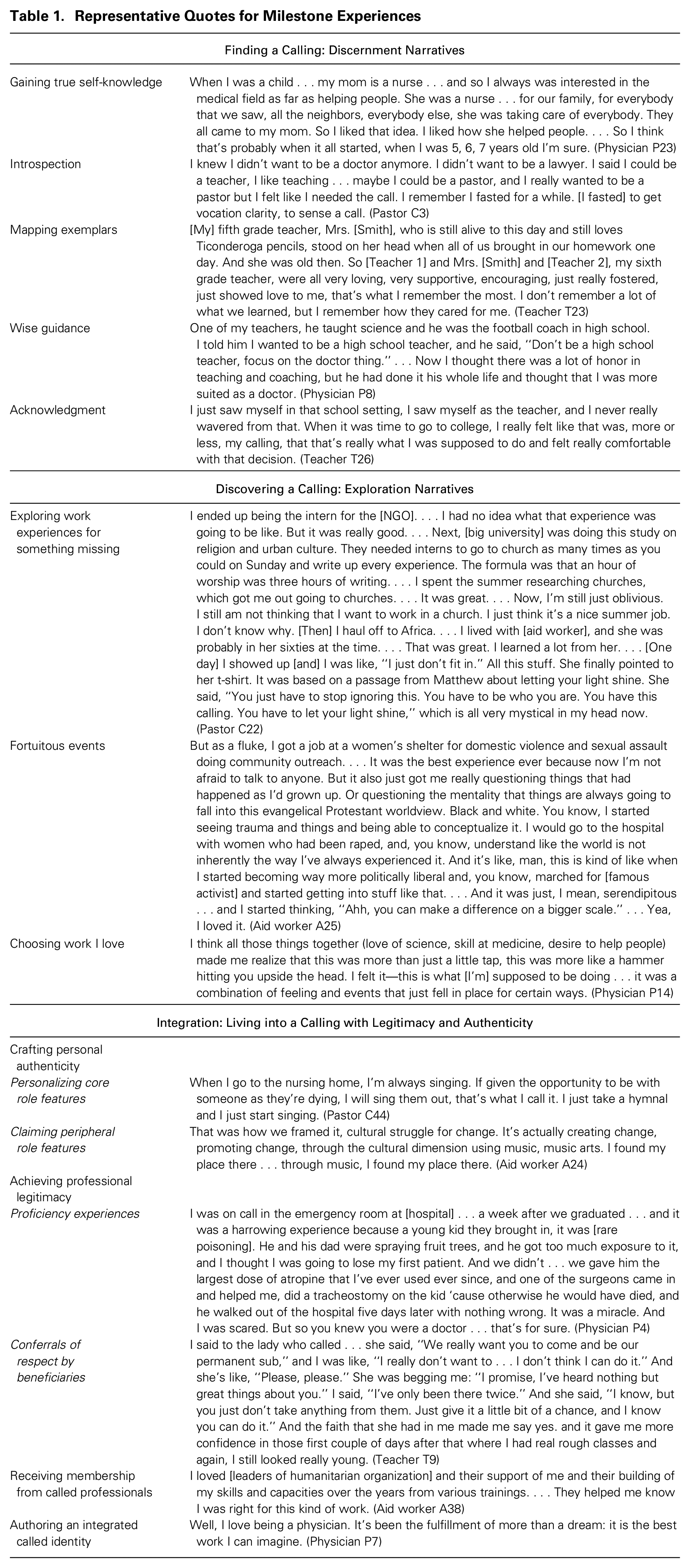
We found that two different plot lines underlie how participants came to experience their work as a calling: discernment and exploration. Similar to previous studies (e.g., Bunderson and Thompson, 2009), the discernment narrative was a journey to find their destiny. The milestone experiences of this journey included gaining true self-knowledge, introspection, comparing oneself to exemplars, and receiving wise guidance. Eventually, based on this process, discerners acknowledged they had found their callings. The second plot line, exploration, was a quest propelled by a sense that something important was missing in their work. Explorers discovered their callings by trial and error, moving through various work experiences and some fortuitous events. Their awareness that they had discovered their callings emerged more gradually until they eventually chose work they loved. The narratives of both groups suggested that after finding or discovering their callings, participants had to live into those callings by seeking ways to integrate their personal sense of call with the professional roles they were entering. Two identity construction motives simultaneously shaped our participants’ identity work as they lived into their callings: professional legitimacy and personal authenticity. Professionally legitimate identities were built around milestone experiences that ensured participants had the competencies required to be regarded as full, competent members of their professions. Proficiency experiences and role models were key in building competencies, and professional legitimacy was further strengthened through conferrals of respect by the beneficiaries they served and affirmations of other called professionals. Personally authentic identities were built around milestone experiences that ensured they had “just the right gifts and graces” (pastor C29) for their callings and could enact “personally significant beliefs through work” (Wrzesniewski, 2012: 46). Our participants personalized core role features and claimed peripheral role features as they worked to achieve authenticity in their professions. Important others served the crucial purpose of validating these personalized role performances. Through the process of living into their callings, our participants eventually moved to a place where they were able to experience both authenticity and legitimacy. Through receiving membership, they were welcomed into a larger community in which their authentic, legitimate enactments of their professions were affirmed. This allowed them to author integrated identities as called professionals.
Finding a Calling: Discernment Narratives
The first narrative plot line, discernment, portrayed finding a calling as an organic, evolving process wherein knowledge and insights about oneself and one’s future work emerged over time. Discernment narratives were structured around journey plot lines. Just as a journey is defined as the process of traveling from a starting place to an intended terminus, discernment was framed as having a fixed destination, the calling. Our participants believed that the destination was always there beckoning them, even during times when they did not see it. The journey discerners described included four significant milestone experiences: gaining true self-knowledge, introspection, mapping exemplars, and receiving wise guidance. These experiences were repeated until discerners had enough understanding to acknowledge their callings. Discernment unfolded in the midst of ordinary life, but episodically—one engages, for example, in introspection from time to time, not continuously—and it accumulated over time in bits and pieces. Discerners often described going through milestone experiences several times, and although there were sometimes long gaps between milestones, they saw important links among those experiences—a series of “connected dots all pointing toward my calling,” as several participants put it. Like Bunderson and Thompson’s (2009) zookeepers, discerners saw evidence of their destiny in the specific ways their lives unfolded.
A physician’s narrative is prototypical of the discernment path (physician P2). Her parents shaped her sense of self from early in her life: “My mother said when she was coming up her only options were teaching, nursing, or secretary . . . she wanted more for me and always told me I could be anything I wanted to be.” Her father taught honors biology at a high school, and she spent a lot of time with him, went on field trips with his classes, and gained a love for biology. She loved science from an early age: “I loved playing with tadpoles. I loved dissecting things. I loved all kinds of things like that.” She was also a good student, and both of her parents encouraged her to follow her dreams. Before college, she “hated doctors, felt they were paternalistic, condescending, patronizing, and greedy.” But all of that changed during college, although she admitted that her early interest in medicine was “for all the wrong reasons”—it was to prove she was smart. She was accepted to an elite college and majored in biology, thinking she would eventually get her Ph.D. In her sophomore year she took a genetics class and became fascinated with human biology. Between semesters that year she shadowed a pediatrician, and “he definitely changed my view of doctors . . . he had an amazing heart.” She saw that he had “real relationships with his patients . . . he had a real big heart and was a real good guy. He challenged my stereotype.” So, she decided to pursue medical school.
Her medical school experiences were very mixed. She loved the classes, loved learning, and “loved the mystery, figuring things out, the diagnostic skills we needed . . . but what I loved most was connecting with the people. . . . I poured myself into those aspects of medicine.” She gained confidence in her capacity to be a physician. As a second-year resident, she was in charge of patients on her own, and “that definitely makes you know that you’re really a doctor.” But the competition among students created a “malicious and vicious” culture of competition, and she could see that kind of culture would continue in many health care contexts. She wanted something different. She tried pathology, but all doctors did there “was look at slides through a microscope and sign forms.” She decided to focus on primary care, especially preventative medicine, because that was where she could “connect with patients and walk with them.” Her religious faith became very important during that time. She felt led by God and felt God was also confirming her decisions—”I felt His blessing,” and that was when she knew primary care was her calling. She ended her interview by reflecting that primary care allowed her to do “what I always really loved to do, teaching and impacting. I didn’t know I loved to impact people’s lives until I actually started doing it. Once you start connecting with people . . . that’s what I get to do every day.”
Gaining true self-knowledge
As illustrated in this physician’s story, discernment narratives began with stories of self-discovery that were usually first located in the discerner’s childhood. Another physician described self-discovery this way:
For me it began probably when I was very young. Just sort of being innately aware of the kinds of things I enjoyed in school. I naturally drifted towards things that were more science and math and kind of left-brain thinking, solving problems . . . I remember in fourth grade when I finished my math homework quickly my teacher would give me additional things that I could work on, challenging things. And I really enjoyed that. So I think early on I realized that I enjoyed the challenge of solving problems. (Physician P37)
Discerners’ stories of self-discovery clustered around three kinds of self-elements. Capabilities comprised talents, aptitudes, and abilities: “I have always been really good at math and science” (physician P26); “I realized I was a very good writer” (teacher T23). Personal characteristics were dispositions, personality traits, and other self-relevant attributes: “I can see now that I have always been an introvert” (pastor C2); “I realized that during tough times I could always persevere” (aid worker A21). Core convictions were core life values, closely held beliefs, and ultimate concerns (cf. Emmons, 1999): “I wanted work where I could really help people, help them when they really needed it” (pastor C67); “Even as a child I had a strong sense . . . of really wanting justice in situations, of really feeling like truth should be known, justice should be done” (aid worker A23). Essential to discerners’ stories of self-discovery was gaining what we refer to as true self-knowledge, learning things they believed were essential to their most genuine or “true selves” (Rosso, Dekas, and Wrzesniewski, 2010; Schlegel et al., 2011). The stories discerners offered suggested that they saw some of their self-elements as not part of their true selves: “I mean, I love baseball, but that’s not a basic thing for me,” as one pastor explained (C98). True self-knowledge refers to those self-elements that are perceived as essential and fundamental to “who one really is”—who one is hardwired, destined, or created to be. Consider this quote from a physician (P40): “I was one of those kids who was always asking why, why, why. . . . So at an early age I was fascinated with the world around me. . . . It was a natural curiosity about science. I’ve always loved science.” Here, curiosity and a love of science are described as essential aspects of who he truly is.
As this quote also illustrates, true selves had to be actual selves, not fictions or unattainable ideals. Significant others, including parents, close family members, pastors, and teachers, were crucial sources to confirm that true self-knowledge reflected actual self-elements. When participants described, for example, a parent’s early observation about a core self-element, such stories were interpreted as “this self-element was apparent in me before I was even conscious of it” and therefore evidence of their actual self. Some insights from significant others were an impetus for a participant’s own self-discovery. Stories like “my mother or father told me I was good at . . .” were often followed by comments like “and so I really started to pay attention to . . .,” which eventually led to gaining additional true self-knowledge. Significant others could also confirm that certain self-elements were true self-elements: “If others see this as true about me, as I do, then it must be true of me.” Non-family members seemed to have special credibility because they were seen as more “objective” sources, people who were less inclined to say things “just to be nice” as parents might, and so their objectivity created a double-confirmation of a true self-element.
Introspection
After stories about gaining true self-knowledge, discerners began telling stories that indicated they were thinking about what that knowledge meant for “find[ing] my place in the world” (pastor C56) or “try[ing] to figure out what I should do with my life” (teacher T14). Phrases like this were very common in discerners’ narratives. This stage of the process involved two closely linked milestone experiences, introspection and mapping exemplars. Introspection involved stepping back from the flow of life to reflect on oneself and one’s life. Stories like this one from a pastor (C77) were common: “At that stage in my life I journaled much better than I do now. I remember reflecting . . . ‘well I’m pretty sure I want to be a minister or something, but I don’t know exactly what. It could be a missionary . . . I could be a youth pastor’ . . . It was pretty wide open.” This process of “looking around” involved intentional acts of self-reflection or “soul searching” as several of our participants described it. It was an opportunity for discerners both to think about what they were learning about themselves—”to just acknowledge what I knew about myself” (pastor C77)—and to deepen their understanding of the true self-knowledge they had gained—”figure out what being good at science really said about me” (physician P9). Introspection provided our participants with a range of possible selves—ideas of what they might become (Markus and Nurius, 1986)—that aligned with their developing self-knowledge.
Mapping exemplars
Stories about mapping exemplars accompanied stories about introspection, indicating that these paired milestone experiences built on each other. Exemplars were people who were both “comfortable in their own skin” (several participants used this phrase) and models of excellence in a profession. Exemplars were important in at least two ways. First, they were archetypes of what living a calling might look like. Exemplars were seen as living proof that callings were real, showing our participants that pursuing a calling was valid. Second, discerners used exemplars as targets onto which they could map themselves. Consider this story from a pastor:
I’m this little girl growing up in the ‘60s . . . church, it was always part of our life, but pursuing (the pastorate) wasn’t really encouraged . . . pastors are men. I never thought someone like me could be a pastor. . . . When I saw [female pastor], it was like a bolt: suddenly everything was clear to me. All those inklings? All along, they were my call. (C53)
As this quote illustrates, when discerners were able to map some of their self-elements onto characteristics they saw in exemplars, they could form clearer connections between their self-knowledge and possible selves. Consider this quote from another pastor (C37): “I just began to see that I could be a pastor, like Pastor [Exemplar], I had this deep love for helping people, for preaching God’s truth, for being present to people. That helped me connect to my call to ministry, and it was something I could turn back to as a reminder.” Here, the pastor connects his deep love for helping, preaching, and being present to what he sees as the same self-elements in his exemplar, and then he uses that mapping to “connect to [his] call to ministry.”
Wise guidance
Discerners also often recounted turning to wise guides, people who both knew them very well and could provide expert advice, sage counsel, and positive support as discerners imagined their callings. Wise guides helped point participants toward specific professions that were possible matches for their capabilities, characteristics, and core convictions. For example, the physician (P37) quoted earlier had a talent for science and math, yet these capabilities are not exclusively applicable to medicine—he thought he would become a high school science teacher. As he notes, a wise guide directed him toward medicine. This quote from a female pastor (C48) illustrates the way a wise guide influenced her journey: “My pastor said, ‘What are you going to do after college . . . have you thought about going to seminary?’ and I said, ‘Yes, but guys do that.’ He said, ‘No, that’s changing, women are serving as pastors. I could see you doing that.’ That was when I really began to believe ministry could be in my future.”
Acknowledgment
Over time, introspection, mapping exemplars, and wise guidance led to discerners developing a growing image of themselves in particular professions. They told stories about how they began to “put it all together” (physician P4); “I realized I was trying to decide whether the glass slipper would fit” (pastor C5). This was when discerners’ narratives suggested that a particular desired possible self had emerged, a self that they now felt destined to become. Consider this story from an aid worker:
I just felt it. I mean, I just felt in my soul, in the deepest part of me, that this was right. This was right for me. I wasn’t afraid of it. I wasn’t thinking, “Oh, well, what if this doesn’t work?” I just knew it would work. I don’t know why. I can’t explain that, but it was clearly the turning point in my life because this is what I’ve been doing ever since. (Aid worker A36)
We labeled this milestone experience acknowledgment because it was the moment when discerners admitted to themselves that they had found the one possible self they felt was their destiny. Out of a repertoire of possible selves they considered during introspection and mapping, a clear image had emerged of the self they were called to become. The significance of that clarity was manifest in the powerful emotional experience that was part of acknowledgment. Many discerners used the term “burst” to describe how acknowledgment occurred in a particular moment—while driving in the car, while praying, while talking with an important other. This “bursting” into consciousness and the powerful emotions that accompanied it helped convey the sense that this possible self was their destiny, their calling. Discerners were often adamant that their calling could not be reduced to adding up the facts about what kind of work they could do; it was a “revelation” (several discerners used this term). “In that moment, it all added up. I could see this was my calling” (pastor C29), or as this aid worker (A5) said, “It was such a powerful feeling, I knew it was what I was supposed to do.”
Discerners’ narratives made clear that they did not yet regard themselves as having become that called self. But acknowledgment gave them the level of clarity necessary to cross an important threshold in their journey: because they had a clear image of the self they were called to become, they formed a strong commitment to become that self. Because of this clarity and commitment, we refer to this as a nascent called identity (cf. Gioia et al., 2010; Conroy and O’Leary-Kelly, 2014). It was not one among a range of provisional selves they would try out (cf. Ibarra, 1999). Rather, this nascent called identity was a possible self that participants were committed to become. It would be built upon, strengthened, adapted, and refined as they worked to craft an identity as a called professional. It was nascent because the process of actually and fully becoming that called self would be the next phase of their journey.
Discovering a Calling: Exploration Narratives
The second narrative structure, which we refer to as exploration, comprises discovering, sometimes stumbling into, a calling. Explorers’ narratives were structured around a quest plot line—a search for “something bigger” and “more important” in work (explorers often used these phrases) by trying out different jobs until they finally discovered work they “loved.” An archetypal quest plot line would be: “I tried job #1. I was good at it, and I liked it well enough, but something was missing. I didn’t know what was missing, but I knew I had to try another job. So I tried job #2. I was good at that job too and liked it, but something was missing. Then I tried (current profession). I knew this was right because I finally found work I could do well and care about deeply. That’s why I love this job. That’s why it’s my calling.” Explorers’ narratives left open the possibility of multiple callings. Many explorers said that, as much as they love their current work, they recognize there could be other kinds of work they might also love. Milestone experiences for explorers included exploring work experiences for something important that was missing in their previous work experiences, finding meaning in fortuitous events, and finally choosing work they love.
An aid worker’s narrative is prototypical of the exploration path (A37). He began his narrative with stories of his work experiences. He was an engineering major in college and spent 20 years in the private sector. He started as a research and development engineer: “I was good at it, liked the people I worked with, but the work was just okay. It wasn’t what I really wanted.” So he switched to a job in production engineering and then after a few years switched again to maintenance engineering. He liked the emphasis on continuous improvement: “you’ve got to be thinking about different ways to do things.” But none of the jobs was right: “I did feel a calling to figure out how to make my work life, family life, and spiritual life come together because they ended up in three different camps. You know, how do you draw those circles so that they overlap more? I didn’t have an answer.” He moved jobs again, this time to a firm where he did overseas consulting and really liked the international travel. “But the work was still not right. . . . It’s not as though I didn’t enjoy work. I got a lot of satisfaction doing things and working in teams and helping people succeed. I mean, there’s a sense . . . there could be more.” At that same time he and his family were also involved in overseas outreach efforts at the church they were attending, and he found great meaning in that volunteer work: “And that was kind of the beginning of like, you know, we can do these things. We have unique gifts and desires to do it.” So he began to spend vacations in overseas mission work and “just fell in love with those experiences.” Through that mission work he was also exposed to an international aid organization. “And it wasn’t like I understood the NGO world. I mean that, I didn’t even know that existed.” He finally decided to seek employment at the aid organization. He was hired and has worked there for more than a decade. He uses his engineering skills and expertise, but now he applies them to ensuring that more people are fed and educated and have safe housing. He describes feeling joy in his work now. He summarized his quest this way: “It evolved . . . I think it’s all part of kind of a path of discovery . . . you know you’re not stuck to a certain career; you change and you adapt and you take your learnings from one thing to the next. I needed to find meaning in what I’m doing. I needed to know that it is making a difference. That’s the most important thing.” Like many explorers, the engineer-turned-aid worker had to discover aid work was a profession. Explorers were less likely to be aware of their professions at an early age because the professions were less culturally visible. Thus, rather than discerning their callings and then journeying toward them, explorers had to discover their callings through a quest.
Exploring work experiences for something missing
Explorers told relatively few stories about gaining true self-knowledge. Learning about themselves was mostly a byproduct of moving from job to job. The stories above illustrate that explorers were willing to leave “good jobs” they could perform well, that were stable and provided a steady paycheck, when they experienced that something was missing in their work. They were not always able to articulate what was missing, but they knew they were “finding something bigger and more important” as several explorers described it. As the engineer’s story illustrates, while his early jobs leveraged his capabilities, it was not until he found a job that also aligned with his core convictions—his deep desire to help vulnerable and victimized persons—that he experienced a job he loved and really felt called to his work.
Fortuitous events
Many explorers told stories of fortuitous events—”coincidences,”“good fortune”—and other silver-lining experiences that were turning points in their quests. Their narratives implied that without these fortuitous events they might not have discovered their callings. Consider the silver-lining experiences in a radiologist’s narrative (physician P3). He did not get his first choice of residency appointment and had to take a residency in mammography—the one part of radiology he wanted to avoid. As he explained, the “residency that I didn’t want turned out to be amazingly lucky . . . it changed everything. . . . Doing mammography, I finally saw that it was the caring part of medicine that I was really drawn to.” During that time, another unexpected experience occurred. His mother developed breast cancer. “She declined traditional medical treatment . . . which I found exasperating, and it just really threw me.” His mother’s physician was “just a technician, none of the caring side.” Notice how this physician describes the impact of those experiences: “I originally got into medicine because of the intellectual side thinking it would be a good career for me. I think that my mom’s experiences and that residency made me realize what was important . . . after that I felt that the helping others side of medicine was almost everything to me. It still is.” Here, unexpected negative events—the wrong residency and a devastating family illness—were pivotal. The silver lining of these events made them turning points because through them he clarified his core convictions and created opportunities to learn how he could embrace medicine as a calling as well as a career.
Social support
Exemplars and wise guides were rare in the narratives of explorers, and when they appeared, explorers had already found work they loved. But caring and supportive significant others appeared often and prominently. Stories like this one were common: “I’ve been very fortunate in my birth parents. I think that’s probably the most important thing that anybody gets. I had very gentle, loving, thoughtful parents and a wonderful brother and that set me up for success ever since” (aid worker A8). As this quote illustrates, while rarely sources of confirmation of explorers’ callings—indeed they often expressed concerns about where the quest was leading explorers—significant others were sources of confidence in the explorer him- or herself. A common phrase was “they’ve always believed in me,” and explorers relied on the confidence of others to keep questing “during the times I almost gave up” (aid worker A24) or “when I didn’t know if I would ever be a pastor” (pastor C27).
Choosing “work I love.”
Exploration narratives differed from discernment narratives in another way. Rather than experiences of acknowledgment, explorers described their discovery of callings as emerging more slowly, only after they had entered their profession, and culminating in a sense that they loved the work they were doing. This quote from another aid worker illustrates this pattern (A34): “I felt like it evolved. . . . When I went in development work, I thought it would be cool, and I thought I might like it, but then I really loved it. And that’s when I decided that’s what I wanted my life to be.” The key for explorers was finding work they “loved”—variations on “work I loved” and “I became passionate about my work” were almost ubiquitous among explorers. For explorers, “loving” their work hinged on discovering that they could express their core convictions in a professional role. Their work was seldom described as blissful—physicians, clergy, and aid workers are exposed to intense human suffering. There were many stories of hard, often intense work and the need for personal sacrifice as essential to their work. Rather, this experience of “loving” their work was the signal that prompted explorers to realize that they had found work aligned with their deepest personal beliefs and values, work that allowed them to express those beliefs and values in and through the way they lived out that work and the kind of person they could be in that work.
Being able to express core convictions in and through work was the “something missing” that explorers were questing for. It allowed them to connect their work to “something bigger and more important” beyond themselves. To complete the quest, explorers needed to first clarify what they valued, believed in, or were passionate about. When their previous work experiences did not resonate with anything they cared about, they moved on to new work roles. Once they started to experience work that felt meaningful, they began to “see”—or, more precisely, to feel—what was missing. What was missing was experiencing, “knowing” in a deep way, that their work had real value in the world. That is why it was work they loved.
At this point, explorers’ narratives portrayed that, similar to discerners, a specific, desired possible self had emerged, one they associated with this work that they loved. Explorers thus experienced the level of clarity necessary to form a strong commitment to this desired possible self. And so like discerners, explorers formed a nascent called identity. For the time being, there would not be another move to a different job because they had found what they were searching for—work they loved—and that search had led them to a clear, compelling image of the work self they wanted to become. They would more fully invest in this specific work role because they could now strongly commit to pursuing that nascent called identity. Even so, there was more “becoming” that had to be undertaken to realize the promise of this nascent identity.
Integration: Living into a Calling with Legitimacy and Authenticity
After discerners and explorers found or discovered the desired selves they wanted to become, their narratives converged around a common plot line as they began to undertake their professional roles. Although they had very clear ideas of what their nascent called identities might be, both groups offered narratives that conveyed they did not immediately find alignment between their true selves and the work roles they felt called to. Someone could not fully enact a called identity from their first day at work. Identifying and committing to the nascent called identity was a necessary foundation, but now they had to engage in identity authoring that would build on, strengthen, refine, and adapt this nascent identity. The structure of discerners’ narratives made clear that their strong commitment to their professional roles was the catalyst for this construction. That is, to go beyond finding or discovering their callings and to actually author identities as called professionals, our participants had to fully engage in the roles they were called to. Even the narratives of explorers, who had already been working in their called professions, depicted this process as beginning only after they formed salient commitments to those professions by explicitly choosing work they loved. There was a difference between doing the jobs and now embracing the roles they loved.
Our participants’ narratives revealed this identity construction phase as a process of integrating their personal sense of call—their unique capabilities, characteristics, and core convictions—with the professional roles they were enacting. Significantly, their narratives also portrayed integration as an immersive experience. They “couldn’t just dip a toe into the water,” as one pastor described it; “I mean, if this was it (my calling), I had to be all in” (C15). The narratives of both groups portrayed an underlying sense that fully living into their callings required authoring called identities that integrated their true selves and roles. It was not simply a matter of sufficiently adapting to a professional role, nor was it a matter of crafting the role in one’s own image to fully fit their true self. Becoming a called professional required changing their sense of self from one who has a calling into one who is a living manifestation of the calling. More specifically, becoming a called professional—fully authoring that identity—required identity work that would integrate their true self and the work role identity they were assuming.
The process of authoring an identity as a called professional was driven by two major identity motives (Ashforth and Schinoff, 2016). Each professional sought to author an identity that was professionally legitimate, something made evident in other studies of professional identity construction (e.g., Pratt, Rockmann, and Kaufmann, 2006). But this was insufficient by itself. They also had to author an identity that was personally authentic, one that established a deep connection between their unique, true self and calling. By seeking to realize both motives, our participants were trying to pay attention to both inward or personal motives (Do I believe this is me? Can I really live out my calling?) and outward or social motives (Do others believe this to be my calling? Do others see me as a bona fide called professional?) (Ashforth and Schinoff, 2016). It was through achieving both professional legitimacy and personal authenticity that each fully authored an identity as a called professional.
Crafting Personal Authenticity
Personalizing core role features
As we will discuss, our participants emphasized the importance of conforming to a commonly held professional standard. But they also described a parallel process that homed in on the capabilities, characteristics, and core convictions that were unique to them. While role models provided an initial set of role prototypes that informed each nascent called identity, our participants described moving beyond these prototypes to develop their own unique style of role enactment.
To achieve a sense of uniqueness and authenticity in their professions, participants described two key milestone experiences: personalizing the way they enacted core role features (Ashforth, 2000; Ashforth, Kreiner, and Fugate, 2000) and claiming peripheral role features in ways consistent with their true selves. Personalizing core role features involved adapting the ways they enacted those features to fit their unique capabilities and characteristics. For example, preaching is a core role feature for pastors, an aspect of the role that is typical and necessary. When enacting this core role feature, each pastor described adopting a style that matched their true self-elements. Consider these three illustrative examples of personalizing preaching: “I’m not an inspirational guy, so I am more teacher in the pulpit than charismatic preacher” (C17); “I really love stories and storytelling, so that is always a part of my sermons” (C13); and “Whenever [I am] preaching . . . [I] open [my]self to the Holy Spirit . . . I read text, and God gives me a title, and I get a good idea of what’s going on” (C29). Physicians also described personalizing their way of practicing medicine, as this quote illustrates: “I always really loved teaching . . . [it] is an important part of my practice, the way I interact with every patient I see” (P39).
Claiming peripheral role features
Participants more fully achieved personal authenticity by claiming peripheral role features that aligned with their true selves. Peripheral role features are not central to a role identity, opening a wider selection of features that participants could enact authentically. For example, an elementary school teacher (T24) described himself as “good at computers when I was growing up. . . . I still love technology, and I’ve always used it as much as I can with the kids.” He also described being the “go-to technology guy” for his colleagues, helping them be more adept at using educational technology, and he added that “I love that part too.” Technology was one of his passions, and by claiming peripheral role features, he was able to bring that unique aspect of his true self into his called identity. Similarly, an aid worker (A28) built a strong reputation for the work she did helping colleagues deal with stress, and so “expert on staff care” became an important part of her identity. She described “loving the development work I do, but I also love that I have a special role helping my colleagues.” A pastor (C77) with an undergraduate degree in marine biology described herself as a “committed environmentalist.” She created a yearly sermon series on “caring for God’s creation” (personalizing a core role feature), and she led her congregants in creating a community garden (a peripheral role feature). She has added more environment-oriented ministries to help her church “be more connected to our local community.” She describes herself as “a pastor for people and the earth,” giving voice to how claiming this peripheral feature helped her experience personal authenticity. Our participants moved between personalizing core role features and claiming peripheral role features, and the combination of these processes allowed them to experience an extraordinary personal connection with the work. As the quotes above illustrate, they modified their identities to include these authentic elements.
The fullness of experiencing personal authenticity in a calling was being able to express core convictions in one’s work by “making a difference that matters” (physician P3) and “tak(ing) a stand for something truly important” (teacher T3). The expression of these core convictions shaped their called identity, “the way I show up as a pastor” (pastor C74) and “how I am as a physician, you know, really being a compassionate doc” (physician P5). Consider how core convictions are prominent in the quotes of the environmentalist/pastor, the physician/teacher, and the aid worker/staff care expert who described being able to bring herself into the work because she believes in what she is doing. In an especially poignant story, a pastor (C12) told us how taking a stand in favor of ordaining gay and lesbian pastors was a way for him to express a core conviction that stood at odds with some members of his church:
There were some people who wanted to take a vote on where we [the local church] stand on this, and that was hard, real hard, but [my family and I] stayed. I love that. It’s one of the reasons why I think [being a pastor] is a call on my life. If I wasn’t there, [oppositional members] wouldn’t have been challenged by this new thing. So I think it’s a really holy thing that God landed me there and that we stayed.
He described how, before this experience, he felt constrained as a pastor. After it, he felt a much deeper “affirmation” of his call and a “new freedom to be the pastor God created me to be.” These quotes illustrate that authoring an identity that embodied one’s core convictions was essential to the experience of living a calling.
Achieving Professional Legitimacy
Proficiency experiences
Our participants’ narratives also conveyed the importance of constructing an identity that achieved professional legitimacy, in part through demonstrating mastery in enacting the profession. Consider this quote in which a teacher describes a realization of mastery:
To middle schoolers I looked really young, so they thought they can get away with stuff, so I just had to learn how to show that I wasn’t going to take anything from them. . . . I was glad that the kids felt comfortable talking to me, but they also knew, I got a little smile on my face when they would walk in and they’re like, “oh we have Miss [Name] again, we’ll actually have to do work today.” . . . They were fine with that. They may roll their eyes or whatever, but they still liked being in my classroom. (T9)
As this quote illustrates, participants pursued mastery over time through a series of proficiency experiences in which they enacted their roles and observed the results of these performances with the goal of confirming where they were proficient and identifying where they needed to develop competency. Participants described responding to successful proficiency experiences by making those role features a more prominent part of their identity as a called professional. Stories of “I performed this (role feature) well” became stories of “I am the kind of professional who does (role feature).” Unsuccessful proficiency experiences were seen by professionals as an impetus to develop those elements they lacked: “I bombed my first sermon, so I worked hard, day and night, to get better. Over time, I became good, at least good enough, at preaching” (pastor C20). As this quote illustrates, however, those features were often not made central to their identity.
Mastery mattered because, as an expression of both one’s true self and an embodiment of one’s core convictions, living a calling meant aspiring to be one’s personal best. As one seminary dean put it, “[N]o one is called to mediocracy; we are all called to be excellent.” Many of our participants spoke with disapproval, even condemnation, about colleagues who did not appear to “really care about our work” (aid worker A41) or “who just don’t take the Gospel seriously” (pastor C6). Mastery was more than being good at one’s work; it was seen as the right way to live out one’s calling.
Conferrals of respect by beneficiaries
The endorsements of credible others were necessary for achieving professional legitimacy. Among the most important were conferrals of respect from the beneficiaries participants were serving. The quote above from the teacher (T9) about how her students responded to the way she established her authority is an example. A pastor shared this story of how a conferral of respect from a member of her congregation shaped her identity: “I visited with them, and I celebrated communion with them, and I got ready to leave and he grabbed my hands and he looked me in the eye and he said, ‘You are my pastor, you are our church.’ And it was so humbling and profound to me. . . . At that moment, I knew I really was a pastor” (C4). Conferrals of respect by beneficiaries were especially important during the early stages of role enactment when participants were especially sensitive to whether they were fulfilling their roles adequately and appropriately. When beneficiaries conveyed that they regarded a participant as a genuine professional, it affirmed that the participant’s role behaviors and role enactment met the expectations of the people they were called to serve. They appeared to be a “real” pastor, teacher, physician, or aid worker to these people. Participants’ narratives portray that conferrals of respect strengthened their sense that they were truly becoming called professionals.
Receiving Membership from Called Professionals
Our analysis revealed that responses from other members of a participant’s professional community were important, and these responses went beyond validating participants’ proficiency or validating the adequacy with which they adapted to professional role identities, as previous research has found (e.g., Ibarra, 1999; Pratt, Rockmann, and Kaufmann, 2006). In addition to receiving conferrals of respect from beneficiaries of their work, which would convey professional legitimacy, our participants needed to be viewed as called by other similarly called members of their professional communities—an experience we refer to as receiving membership. While this step conveyed professional legitimacy as well, it represented a more significant level of verification. Two aspects of receiving membership were key.
First, receiving membership from called professionals affirmed that a participant’s personally authentic embodiment of their calling was in harmony with the values and ideals that all truly called members embody. This affirmation could come only from other called professionals. Note how the responses of a more senior called professional (also a participant in our study) shaped this aid worker’s experience of receiving membership (A40): “When [called professional] praised my work, it was like . . . I had finally made it. I mean, he is the very best. I was totally blown away when he did that. Since then, I’ve never looked back. That is when I was sure this is what I was meant to do.” This participant’s stories about the senior colleague’s responses conveyed that this support indicated he was faithfully adhering to the profession’s values and ideals even while expressing them in his own way. “I had finally made it” and “I’ve never looked back” indicate that this experience allowed him to fully embrace his calling.
Second, when a participant sensed they had received membership they felt welcomed into the community of other called members of the profession. They now belonged to a group that shared an understanding of what a calling is and what it means to live one out—a community bound together by shared values and ideals. Such values and ideals cannot be fully articulated in written standards or formal credentialing processes; they are part of the culture and ethos shared among those in the community of called professionals. Notions of “the brotherhood and sisterhood of pastors” (C18), the “fraternity [sic] of physicians” (P6), and similar phrases we heard from other participants convey the importance of this communal experience of living out a calling that aspires to common values and ideals. Consider this quote from a physician about his experience with receiving membership: “When my colleagues treated me like an equal, when I was just like all of the rest of them, I knew I was no longer training to be a physician” (P8). Statements such as “I was just like all of the rest of them” illustrate the sense of being united by a common understanding of the ideals of the profession, ideals that comprise being both professionally legitimate and personally authentic. “We are all brothers and sisters in ministry” (C6), “Whatever our differences, all good docs really care about their patients” (P15), and “In aid work, we come from all over, but we always come together around what matters most” (A33) were other ways participants described the experience of belonging to the community of called professionals. Receiving membership from called professionals was a communal experience such that the affirmations of specific called others were interpreted as representing acceptance by and belonging to the larger community of called professionals.
Our findings with respect to both conferrals of respect by beneficiaries and receiving membership from called professionals highlight the importance of who is providing identity affirmation. Beneficiaries validate a called professional’s competency and reinforce that the way the professional is enacting their role is legitimate. This is meaningful because beneficiaries are the people our participants were called to serve. Yet only other called professionals could validate that our participants’ authentic enactments were consistent with their professions’ values and ideals. They were also uniquely suited to welcome our participants into the community of called professionals. Thus only other called professionals could help our participants fuse self and work in ways that were validated by members of the community. Our results are consistent with existing research, which has shown the importance of validation in professional identity construction, especially from groups that participants view as being authoritative voices about role enactment (e.g., Ibarra, 1999; Pratt, Rockmann, and Kaufmann, 2006). But our findings highlight that other called professionals provided a deeper and more important kind of affirmation, as only they could confirm a participant’s calling.
Integrated Called Identity
Stories of receiving membership from called professionals gave way to an important but subtle change in participants’ narratives. This experience of solidarity and fellowship conveyed to our participants that their called identities were no longer nascent—they were real. By receiving membership, a participant crossed another threshold in their identity construction: they moved from being someone who has found a calling to one who is a called professional. Our participants switched from stories about finding and living into their calling to stories in which they confidently used “I am” statements to describe themselves as being called professionals. Whereas a nascent called identity was a possible self that participants were committed to become, an integrated called identity is a relatively explicit and permanent assertion that they are faithfully embodying their calling. This assertion extends beyond recognizing the existence of an unrealized call, as with a nascent called identity; it is a claim that one is now realizing that calling. Through living into a calling, the nascent called identity was refined in ways that allowed for the fusion of self and role, and participants’ authentic role enactments were seen as legitimate—they had been welcomed into a community of called professionals. They had authored a called identity. Participants spoke of themselves using phrases like “As a pastor, being in people’s lives in very important times, being of service to the people, people wanting me to be there and bringing comfort in difficult times . . .” (C54), “The way I practice medicine as a physician . . .” (P6), and “One of the most important things that I strive for in my teaching . . .” (T25). Even as they told stories about what work was like now, both the challenges (“There are still days I don’t want to go back out into the field and deal with no water or electricity”; aid worker A50) and the uplifts (“Even after all these years [of teaching], I never get tired of hugs from the kids”; teacher T27), they consistently used language that conveyed a coherent and stable sense of “I am a called professional.” When they authored a coherent narrative identity that integrated personal authenticity and professional legitimacy, their journey or quest culminated in becoming one who self-defines as being a called professional.
Discussion
Callings have long been thought to create the most intimate connection between people and their work (Bunderson and Thompson, 2009; Cardador, Dane, and Pratt, 2011; Hirschi, 2011; Wrzesniewski, 2012; Berkelaar and Buzzanell, 2015) and to “contain the seeds of what makes us fully human in our work” (Wrzesniewski, 2015: 10). Understanding how people construct identities as called professionals is essential for understanding how they achieve this intimate connection between self and work and engage in life-enriching work experiences. The narratives of called professionals we studied conveyed that they indeed experienced their callings as positive, life-enriching connections between their deepest selves and the work to which they were called. Our findings suggest that experiencing this connection arises out of a long process of authoring an identity as a called professional. Our theorizing suggests that the heart of this process involves integrating personal and social identities in ways previous research has not anticipated. Specifically, our model suggests that by authoring identities that integrate personal authenticity and professional legitimacy, our participants achieved a fusion between self and work.
In Figure 1 we present a narrative model of authoring an identity as a called professional. This model suggests that there are two pathways by which professionals may find a calling, and we theorize that the nature of the pathway itself shapes the way a person experiences and understands their calling. For some, their calling is a destiny to be discerned through a process of self-discovery and introspection, while others explore multiple careers until they find the important thing that was missing in their previous work. No matter which pathway one takes to enter the calling, fully claiming an integrated identity as a called professional does not occur when beginning to enact a professional role. Finding a calling is just the first phase of this identity authoring process—that calling has to be lived out. As each participant lived out their calling they ultimately lived into it: their identity transitioned from someone who has a calling into someone who is a called professional. This identity change resulted from integrating their personal identity and their social identity to achieve both personal authenticity and professional legitimacy. Our analysis of calling narratives provides insights into how people can integrate these two identity motives and thereby fulfill both motives simultaneously. Our model thus explains an identity authoring process that operates across at least two levels of identity: individual and communal (Ashforth and Schinoff, 2016). We more fully describe our theoretical model and its implications for unresolved issues in the callings literature below.
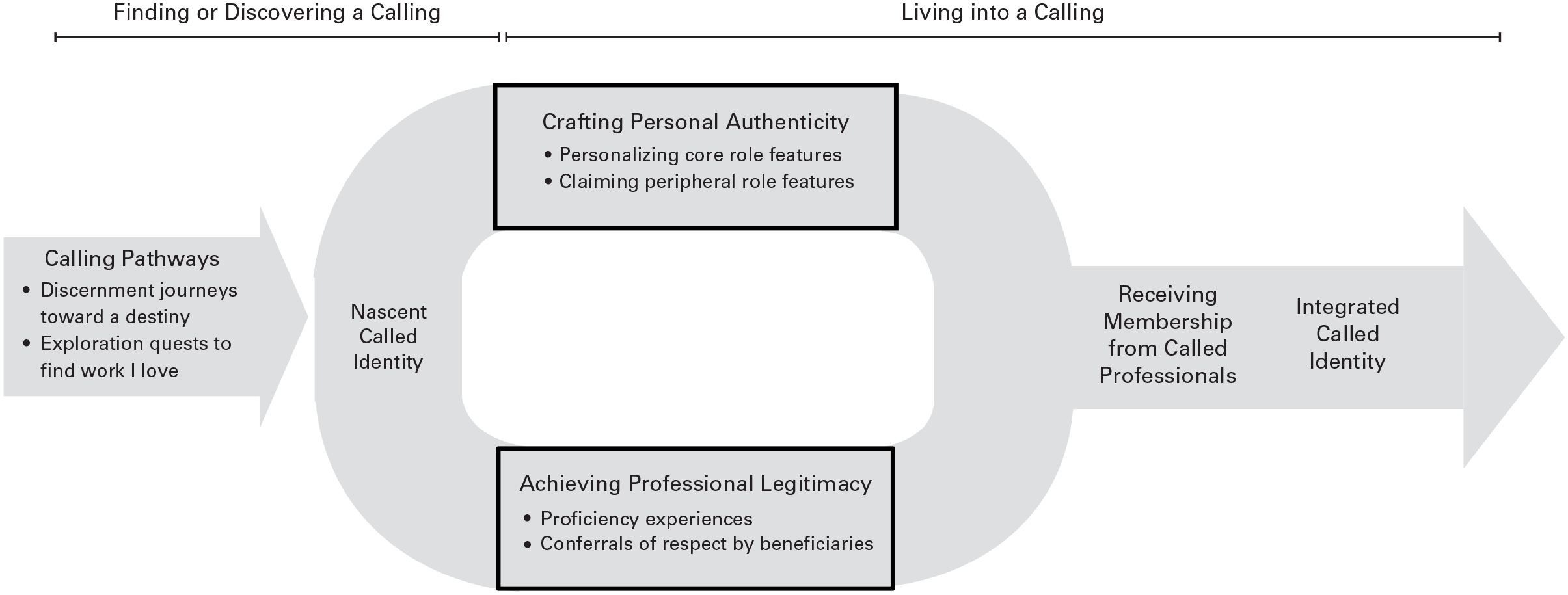
A Narrative Model of Authoring an Identity as a Called Professional
Theoretical Contributions
In our introduction we argued that a fuller understanding of the kinds of identity work that lie at the heart of a calling has been complicated by three unresolved issues in the literature. Our study contributes new theory that helps address each issue.
How does someone find a calling, and how does that finding shape their identity as a called professional?
By being among the first researchers to study how a calling emerges, we contribute in several ways to the small but growing literature on antecedents of a calling. First, our model theorizes more than one calling experience. In the callings literature there has been a debate about the core, defining elements of a calling, and as a result, multiple conceptualizations of callings and pathways into callings have been proposed (Wrzesniewski, 2012; Duffy and Dik, 2013; Thompson and Bunderson, 2019). The neoclassical view of callings suggests that a calling emerges from an external source that creates a sense of destiny and duty, what Thompson and Bunderson (2019) refer to as “outer requiredness,” while the modern view suggests callings arise from internal sources or “inner requiredness,” leveraging passions and providing a sense of personal fulfillment. Rather than supporting one clear winner, our model suggests that there are different kinds of calling experiences, and it leaves open the possibility that there may be more than the two we theorize. The process that discerners followed seemed to propel and guide them toward what they narrated as their destined callings, while explorers’ more experiential pathway seemed to lead them to callings when they found work they loved. By theorizing different kinds of calling experiences we, like Schabram and Maitlis (2017), suggest that callings research should move away from attempts to develop a single overarching conceptualization of callings. Our findings attest that a more fruitful approach is to study variation across calling experiences, what causes that variation, and what outcomes are associated with different calling experiences.
For example, discerners feel they have one true calling while explorers are open to the possibility that more than one could exist. Focusing on this distinction points to several avenues for future research, such as whether there are differences between discerners and explorers in their propensity to fall from their call, miss a calling, or change their call. Our model suggests that if you believe your calling is your destiny, falling from it would be devastating and changing it would be impossible. It may thus be more likely for individuals who follow the discernment path to have problematic experiences such as premature identity foreclosure, which occurs when someone commits to a self without sufficient identity development (cf. Erikson, 1978; Petriglieri and Obodaru, 2019). Our model suggests the exploration path may lead to more flexible called identities, and so missing one calling would be less of a concern because, as an explorer, one would be open to finding a new one. Moreover, changing a calling might be just one more identity transition in a long history of job and identity changes. But there may be costs to this flexibility: perhaps some explorers’ identities are less robust in the face of challenges—one may need the assurance of destiny as a bulwark against strong identity threats. In contrast, when a person follows the discernment path to an integrated called identity, our model suggests that it can lead to a feeling of assurance that one has found work that is meaningful beyond one’s own assessment of its meaningfulness—work that one can claim, as Bunderson and Thompson (2009) posited, to be truly noble. This may be particularly important when a calling requires significant identity and lifestyle changes, such as becoming a religious ascetic or a physician whose medical practice requires spending long periods of time without family in remote and harsh conditions. Rather than suggesting there is one “best” path, we propose there is value in determining when different pathways into a calling lead to more positive or negative outcomes for individuals.
Second, our model proposes that understanding the experiences people have as they enter callings is of central importance. Existing theories often start with a particular definition of what a calling is and then seek to explain how a person would find and enter such a calling (e.g., Hall and Chandler, 2005; Duffy et al., 2011; Dobrow, 2013; Duffy et al., 2013). Our model instead theorizes that the pathway by which a person enters their calling shapes how they experience it—the particular milestones that discerners and explorers experience give rise to their experience of callings as destiny or good fortune, respectively. For our participants, early (often childhood) experiences of true self-knowledge seemed to create a sense among discerners that their unique capabilities and characteristics somehow pointed to their future; we suggest such experiences are the early roots of destiny for discerners. In contrast, the changing, adapting, and experimenting that characterized explorers’ search for work they love seemed to help them learn the value of being open to new callings. Following the plot line of these milestones yielded insights into why people experience their callings the ways that they do. Other pathways have been proposed in research, including a personal passion pathway (Dobrow, 2013) and identity-oriented, contribution-oriented, and practice-oriented pathways (Schabram and Maitlis, 2017); our model suggests those pathways might lead to additional kinds of calling experiences. Studying the specific milestones and plot lines of those pathways into callings would be important for understanding how and why they lead to their resultant calling experiences.
Third, current callings research often suggests that callings are either neoclassical or modern, but our model offers a contrast to this idea. While the callings found by discerners do have strong overlap with the neoclassical emphasis and its “outer requiredness” (cf. Thompson and Bunderson, 2019) orientation, and the callings found by explorers are more characteristic of the modern view, which emphasizes “inner requiredness,” the callings portrayed in our participants’ narratives were not pure examples of either view. For example, through introspection and mapping exemplars, discerners seemed to identify external needs that they were uniquely suited to fulfill and that were also fulfilling to them, leading to callings that also reflected “inner requiredness.” Similarly, explorers described their callings as work that mattered because they had the opportunity to contribute to society in ways that reflect “outer requiredness.” Thus our model asserts that rather than searching for pure types, future research should seek to understand the different ways inner and outer requiredness are manifest in calling experiences, how different paths into a calling lead to different ways of blending inner and outer, and how this blending shapes the way a calling is experienced and lived out. Our model resonates with Thompson and Bunderson’s (2019: 431) assertion that authoring “a compelling personal narrative that sensibly marries the two” is of central importance for a calling, and we provide greater theoretical clarity as to how that marriage takes place.
Finally, while our findings about the role of possible selves are somewhat consistent with prior research on identity construction (e.g., Markus and Nurius, 1986; Ibarra, 1999), it is notable that our model includes a threshold at which a person commits to a single possible self. In this way our model suggests that, even early on, someone can merge self and work clearly enough that they are willing to declare they have found a calling. This idea contrasts with the consultants and investment bankers studied by Ibarra (1999) who experimented with different provisional selves during role transition within a specific profession. Importantly, those professionals did not describe themselves as called. Our model asserts that people who feel called do commit to a single possible self—what we refer to as a nascent called identity—and feel compelled to become that self by crafting an integrated called identity. To author their integrated called identities, our participants did not appear to experiment with different provisional selves; rather they built on, strengthened, refined, and adapted their nascent called identities. It is possible, however, that explorers do adopt a provisional identity during the early period of their role engagement, as did Ibarra’s (1999) professionals. Our model suggests that coming to love that work would cause this provisional identity to shift into a nascent called identity, at which point they would no longer experiment with other provisional selves. The key changes instantiated by a nascent called identity are commitment to a single possible self and a willingness to engage in the identity work required to achieve professional legitimacy and personal authenticity.
Commitment to a single possible self may be necessary because callings require such a strong fusion between self and work. It would likely be difficult to achieve an intimate connection between self and work if one was regularly adopting a new possible self. Especially for discerners, this possible self is seen as their destiny, which may preclude experimentation with a range of provisional selves. And even explorers, who leave open the possibility that they can find an alternative calling, commit to a nascent called identity. Unlike identity foreclosure, which precludes identity change, our model theorizes that nascent called identities do change. But our model also leaves open the possibility that some discerners may be resistant to too much change in their nascent called identity, a form of premature identity foreclosure, which could preclude the work required to author an integrated called identity. In contrast, some explorers may not commit fully enough to their nascent called identity, which could also preclude the work required to author an integrated called identity. Future research might explore what over- and under-commitment to a nascent called identity look like and how differences in commitment are related to both more-immediate outcomes, such as missed or postponed callings (i.e., callings people sense earlier in life but pursue later in life), and long-term outcomes, such as the problems Schabram and Maitlis (2017) studied. Furthermore, research might explore the potential downsides of committing to a single nascent identity, such as misguided callings (i.e., when one is unable to establish proficiency, legitimacy, or authenticity) or thwarted callings (i.e., when external factors or life circumstances prevent one from pursuing a calling).
How does someone live into a calling, and how does this process shape their identity as a called professional?
Much of the calling literature has been built on the idea that becoming a called professional is simply a matter of finding “that place in the occupational division of labor and society that one feels destined to fill by virtue of particular gifts, talents, and/or idiosyncratic life opportunities” (Bunderson and Thompson, 2009: 38). Our model contests this idea. First, our study highlights that as Duffy, Douglass, and Autin (2015) proposed, there seems to be an important difference between sensing a calling and living a calling. Our model explains how this difference might be experienced by people and why it matters. The idea that identities are constructed over time has been well established by extant professional identity research (Ibarra, 1999; Kreiner, Hollensbe, and Sheep, 2006; Pratt, Rockmann, and Kaufmann, 2006). But it has been largely neglected by callings researchers to this point, which has obscured theory about how callings are experienced. Our study leverages the narrative identity lens to articulate the specific process by which a sense of calling (nascent called identity) can be crafted into a fully lived calling (integrated called identity). By studying the stories participants told about how they lived into their callings, we contribute to theory about how someone authors an identity as a called professional. Our model asserts that enacting the role is pivotal to a person’s ability to author a called identity. Our participants’ stories indicate they expected that living into their calling would be an immersive experience, which reveals the deep level of commitment they brought to this identity work: Becoming a called professional appears to be neither a fast nor easy process.
In these ways our model highlights the need to study callings over time to better understand when and how they form, change, and end. Discernment, exploration, and integration stories took place over long periods of time, and taking that time into account was important in our model. For example, the unfolding of discerners’ narratives over time was essential for the sense of destiny they experienced. Future research could explore how stories that compose a called identity change over time and whether these changes matter for called identity work. We wonder, for example, how the narratives of individuals who fall from their call change over time. And past experiences might have mattered for participants’ identities at the time of their occurrence, which begs the question of what stories mattered for a time, say during discernment or exploration, but were later forgotten. How might forgotten stories matter for a called identity?
Second, in building theory about how people live into a calling, our research provides a rich illustration and extension of the understudied narrative identity perspective. Our findings provide evidence of Ibarra and Barbulescu’s (2010: 141) proposal that identity authoring arises by forming a “coherent self-narrative [that] depicts a career as a series of unfolding events that make sense sequentially.” Fundamentally, our model suggests that calling stories have to make sense both to others, through achieving professional legitimacy, and to the called professional, through personal authenticity. This underscores the importance of examining the types of stories people tell, and it serves as a foundation for future research that follows people over time to reveal how stories change and how those changes might relate to whether people find a calling and the kind of calling they experience if they do find one. In addition, our model resonates with the assertion that self-narratives can be powerful “transition bridges” (Ashforth, 2000; Ibarra and Barbulescu, 2010). Our participants seemed to need a nascent called identity to be a bridge between finding and living into a calling. Committing to this one possible self, we argue, formed the basis for the integrated called identity they eventually authored. Future research might look for the existence or absence of such transition bridges, and the structure of bridges when they are used, to explore important questions in callings research like falling from, missing, and ending a calling. Presumably, “good” transition bridges are temporary, or perhaps more in keeping with the metaphor, they are left behind as one journeys forward in one’s identity work. Over-commitment to a nascent called identity may create a bridge that leads to a dead end, where one is no longer motivated or able to continue one’s identity work. In contrast, an underdeveloped nascent called identity may create a bridge that is too weak to facilitate ongoing identity authoring, and when the bridge collapses, the person moves on to yet another job.
Third, our theory raises an important implication about the role that institutional context plays in living into a calling. We have theorized that professional roles had to offer both certain constraints that ensured participants could properly enact the roles (i.e., the core role features, essential aspects of being a called professional) and also enough flexibility for personalizing role enactment in order to achieve authenticity. Thus our model implies that the nature of the role itself may influence the identity construction process for a called professional. This points to the need for callings research to address how institutional identity templates (i.e., the various institutionalized values, goals, and expectations that are associated with a profession; Ashforth, 2000; Chreim, Williams, and Hinings, 2007) might shape calling-related identity work. Some professions have dominant institutional templates that create strong constraints on the identity work professionals can and must do (Chreim, Williams, and Hinings, 2007). A conjecture that arises from our model is that authoring a called identity may be more difficult in such contexts because professionals are not able to engage in sufficient personalizing and are thereby precluded from developing a sense of personal authenticity. An interesting contrast to our study is Pratt, Rockmann, and Kaufmann’s (2006: 239) study of professional identity construction among resident physicians; they refer to the medical school they studied as “Boot Camp” and report that insiders “characterized it as demanding, high quality, and somewhat militant.” Our theorizing brings into focus why such environments may be less amenable to fusing self and work and instead require that professionals tailor their identities to fit the work they are doing. The dominant identity template of such contexts may constrain identity work too much for personal authenticity to be crafted. One wonders if a reason the physicians in our study were able to author a called identity is because they were trained in medical systems with more munificent and flexible institutional templates, which allowed sufficient space for these physicians to craft personal authenticity.
Though it is speculative, we also suggest how our model can guide future research into potential “dark side” experiences of living into a calling (Thompson and Bunderson, 2019). Professionals may struggle to create an adequate fusion between self and work if they hold rigid preconceptions about their work that prevent them from sufficiently revising their actual and possible selves. As an illustration, Schabram and Maitlis (2017) found that “identity-oriented” professionals, in particular, entered their callings having strong, idealistic expectations of what living out their callings would be like. Based on our model, we hypothesize that these workers entered their professions with foreclosed identities that were “frozen” around their idealized possible selves. They may have clung to idealized possible selves rather than being willing to revise them, preventing them from engaging in sufficient personalization and thus precluding them from achieving personal authenticity. In addition, the idealized possible selves may have made it difficult for them to find proficiency experiences that were sufficient to close the gap between their actual and possible selves, undermining legitimacy.
How does a called professional achieve an intimate connection between self and work and author an integrated called identity?
Our model emphasizes that authoring an intimate connection is uniquely complicated for called professionals, and this complication highlights a notable exception to a prominent idea in the professional identity literature. Forming a deep fusion of self and work did seem to require being professionally legitimate, but our participants’ narratives also expressed the importance of being personally authentic. We argue that authoring an integration of both authentic and legitimate identities was of central importance for authoring a called identity. These findings challenge conventional wisdom in the professional identity literature, which suggests that the only way to negotiate the interplay between personal and social identities is through the “quasi-stationary equilibrium” of an optimal balance (Brewer, 2003; Kreiner, Hollensbe, and Sheep, 2006: 1048). Rather than trying to balance differentiation and inclusion, the narratives of the called professionals in our study indicate they were able to author identities that were both true-to-self and true-to-the-profession, and their narratives did not portray competition between the two motives. And rather than maintaining the tension between authenticity and legitimacy, our participants seemed to resolve the tension through receiving membership. Our findings provide evidence of how individuals can “simultaneously instantiate both social and personal identities” and “mesh them smoothly,” thereby creating the basis for more complex thought and action (Ashforth and Schinoff, 2016: 115, 116). Our study thus points to the need for more research into other ways people integrate different levels of identity, as well as the value of using narrative inquiry to understand how they achieve that integration.
In addition, our model theorizes that this fusion was socially embedded, foregrounding the importance of studying how social processes shape identity work among called professionals, something that has not been a part of most callings research. To craft a called identity, our participants needed exemplars, role models, wise guides, and beneficiaries. And importantly, receiving membership is a novel aspect of social embeddedness. This experience involves more than the kinds of feedback from other professionals that previous research has highlighted (e.g., Ibarra, 1999; Pratt, Rockmann, and Kaufmann, 2006) and more than the confirmation of individuals’ global self-views that is expected by self-affirmation (Cohen and Sherman, 2014) and self-verification (Swann and Bosson, 2010) theories. Receiving membership from called professionals comprises both a deeper affirmation of one’s personally authentic called identity (the unique way they embody their calling) by other called professionals and full inclusion in fellowship and solidarity with other called professionals. The concept of receiving membership, along with stories of the other supporting characters in our participants’ narratives, attests to the importance of moving beyond treating callings as an individual-level phenomenon. Some of the pressing issues such as falling from, missing, changing, and ending callings would likely benefit from studying the social factors that are present or absent. For example, explorers in our study lacked exemplars and wise guides. The fact that we studied only explorers who found work they loved begs the question of how the absence of these social relationships might have affected explorers who did not find callings.
Our theorizing around the integration of personal authenticity and professional legitimacy is consonant with Swann et al.’s (2012: 442) concept of identity fusion in which “the boundaries that ordinarily demarcate the personal and social self become highly permeable . . . [and] aspects of both the personal and social self can readily flow into the other.” Importantly, they propose that identity fusion does “not undermine—and may actually increase—the strength and viability of both constructs” (Swann et al., 2012: 442). Our model extends this work by theorizing one way individuals might achieve identity fusion is through the process of living into a called identity—and more particularly achieving this fusion of personal and social identities through receiving membership. Further research into the outcomes of identity permeability may advance callings research by, for example, determining additional identity processes that lead to permeable versus optimally balanced identities. In addition, studying the integration process and the identity fusion it creates might shed light on called professionals’ capacity to adapt to changes in their professions and still retain a fusion of self and work. Given recent changes in medicine and education, and the dramatic shifts in religious landscape in Western countries, more research into how physicians, teachers, pastors, and other called professionals navigate professional changes while maintaining intimate connections between self and work is needed.
Finally, our theoretical insights about integration also contribute to theories of how individuals experience meaning in their work. Rosso, Dekas, and Wrzesniewski (2010: 114) proposed that one important aspect of how individuals experience meaning is whether meaning is achieved through expressing personal agency (“drive to differentiate, separate, assert, expand, master, and create”) or communion (“drive to contact, attach, connect, and unite”). Our model suggests that rather than meaning arising from either agency or communion, it was through experiencing both “fundamental modalities of human existence” (cf. Bakan, 1966: 14–15) that our participants experienced meaning. Through the kinds of identity work our analysis revealed, our theorizing proposes that professionals can achieve a powerful sense of uniqueness and similarity, of agency and communion, and that both experiences can give rise to a sense of meaning in work. Each participant’s calling was meaningful because they could express their true self through it and because that unique expression was also deemed faithful to the ideals and values shared by called professionals. Here again, our model foregrounds the social embeddedness of callings and thereby highlights the need to better understand the social processes that underlie finding and experiencing meaning in work.
Limitations
We intentionally focused on caregiving professions, so we do not know whether the identities of individuals who experience other occupations as a life calling have a similar structure. The theoretical model we developed thus could be unique for these four professions. We see these four as being very different from one another, linked only by being part of a broad category of caregiving professions, but there may be deeper similarities that influenced the nature of the model. Yet when we compare it with evidence from Bunderson and Thompson (2009) and other research on callings (Wrzesniewski et al., 1997; Bellah et al., 2007), we see significant parallels that encourage us to think this model may be useful for understanding the identities of other called professionals.
Additionally, our data are retrospective, and so it is possible that these remembered experiences differ in significant ways from those through which individuals actually moved. For example, the lack of tension between claiming legitimacy and crafting authenticity in our participants’ narratives may have been due to their motive to tell a coherent story. However, an essential feature of these narrative structures was the way our participants’ life stories unfolded over time, bit by bit, chapter by chapter, informing and forming their identities as called professionals. This unfolding structure, and the consistent patterns in plot lines that we found across our participants, suggests retrospective bias may not have been a significant problem. But we do recognize that broader cultural meta-narratives may also have played a role, including shaping the consistency of plot lines across participants. Given that our participants came from several different countries, were from different generations, and had different socio-religious backgrounds, identifying at what level these cultural meta-narratives may be similar enough across our participants was beyond the scope of our study.
We do not know how our participants’ narratives may have changed over time to arrive at where they were when we interviewed them. It is possible that people who told discernment narratives in our interviews would have told exploration narratives in the past. A longitudinal design in future research would be better equipped to examine whether and how participants’ narratives change shape depending on time spent in the profession or other variables. If narratives fluctuate between the two plot lines we found, perhaps rather than being two types of callings, there are simply two main narratives that people adopt depending on their temporal context.
Conclusion
Perhaps the most important finding from our study is that called professionals are driven by the dual motives of achieving personal authenticity and professional legitimacy as they construct their identities. While prior studies on identity work among professionals have focused on the ways they construct identities that fit with their professions, for those who are called to their work, authoring identities that are personally authentic is key to achieving the connection between self and work that is at the heart of a calling. Throughout these narratives, a supporting cast of characters served as guides and supports, essentially helping to co-author the narratives. While there is much more to learn, we believe that studying the narratives of called professionals has provided important insights into the experiences of these individuals and their relationships with their work.
Supplemental Material
Bloom_Colbert_Nielsen_online_supp – Supplemental material for Stories of Calling: How Called Professionals Construct Narrative Identities
Supplemental material, Bloom_Colbert_Nielsen_online_supp for Stories of Calling: How Called Professionals Construct Narrative Identities by Matt Bloom, Amy E. Colbert and Jordan D. Nielsen in Administrative Science Quarterly
Footnotes
Acknowledgements
We thank the 236 participants who shared their life stories with such candor and offer special thanks for the hospitality and care of those participants who gave us safe places to stay when we traveled overseas. We are very grateful to our three reviewers for their guidance and encouragement, and we are especially appreciative of Associate Editor Mike Pratt for his patience, persistence, and insights. Special thanks to Kim Bloom and Sarah Klinedinst for conducting interviews, for traveling overseas to often difficult locations, and for many hours of coding and recoding. We gratefully acknowledge the generosity of the Lilly Endowment, Inc. and Templeton Religion Trust for funding this research.
Authors’ Biographies
 ) where he researches wellbeing at work among helping and care-giving professionals. His Ph.D. is from Cornell University.
References
Supplementary Material
Please find the following supplemental material available below.
For Open Access articles published under a Creative Commons License, all supplemental material carries the same license as the article it is associated with.
For non-Open Access articles published, all supplemental material carries a non-exclusive license, and permission requests for re-use of supplemental material or any part of supplemental material shall be sent directly to the copyright owner as specified in the copyright notice associated with the article.
