




Abstract
Racial inequality is remarkably resilient in organizational and labor market contexts despite efforts to resolve it, which raises significant questions about the mechanisms underlying its persistence. We argue that organizational efforts that increase the inclusion of underrepresented racial groups in the short term may conceal an emergent mechanism that paradoxically results in exclusion over time. The emergent mechanism stems from an acute misalignment between the scope of allocation in the matching process and the scope of valuation in the evaluation process, which ultimately increases voluntary and involuntary turnover among underrepresented racial groups. We examine this paradox through a revelatory case in higher education. Drawing on comprehensive administrative and research performance data from a large (R1) U.S. public university, we find that Black assistant professors are significantly more likely than their White colleagues to be allocated to non-standard positions, i.e., formally appointed in two academic departments with shared compensation. Our results demonstrate that such non-standard appointments are associated with a significant decline in research productivity, which remains central during the evaluation process. The end result is that jointly appointed assistant professors—among whom Blacks are disproportionately represented—experience lower likelihoods of retention.
Racial inequality is remarkably resilient in organizational and labor market contexts despite growing organizational efforts to resolve it (Kalev, Dobbin, and Kelly, 2006; Ray, 2019). Because durable achievements in diversity require addressing both differential recruitment and differential retention of underrepresented demographic groups (Sørensen, 2004; Fernandez-Mateo and Fernandez, 2016), the persistence of racial inequality raises two important questions for organizational research and practice. The first is how to make headway toward addressing turnover dynamics that differ by race (Sørensen, 2004). Attempted remedies for racial disparities at the organizational level have primarily emphasized addressing differential recruitment and lifting the barriers of entry for underrepresented groups (Ahmed, 2012; Dobbin, Schrage, and Kalev, 2015; Rider et al., 2023). But there is growing evidence on differential retention of underrepresented racial groups in various labor market contexts. For example, recent research has documented that Black lawyers exhibit higher attrition rates at every stage of their professional careers (Rider, Sterling, and Tan, 2016). Differential turnover also constitutes a considerable source of underrepresentation of Black scholars in academia (Shaw et al., 2021), in which career sustainability plays a significant role in accounting for long-term inequality (Huang et al., 2020). Findings like these bring to the forefront the pressing need for organizations to address the turnover dynamics of underrepresented racial groups.
The second important question is how to unveil various subtle and unintended mechanisms that can undermine organizational goals of achieving diversity (e.g., Kalev, Dobbin, and Kelly, 2006; Castilla, 2008; Dobbin, 2009; Castilla and Benard, 2010; Dobbin, Schrage, and Kalev, 2015; Ray, 2019). As Ray (2019) explicated, impartial organizational structures and practices often reproduce existing racial disparities in organizations. Castilla and Benard (2010) offered a prominent example: merit-based pay programs can unintentionally exacerbate pay differences between employees in majority and minority groups. At face value, merit-based pay systems ought to serve a positive role in creating fairer, more-inclusive workplaces. Yet, this finding indicates that presumably neutral organizational structures and practices may inadvertently increase existing disparities in labor market contexts, which raises significant questions about the mechanisms that sustain inequality in purportedly neutral organizational contexts.
Here, we theorize and examine an emergent mechanism by which organizations’ efforts to achieve diversity paradoxically undermine their goals of retaining a diverse workforce. The paradox stems from a novel combination of allocative and valuative mechanisms that underlie inequality in organizational contexts (Petersen and Saporta, 2004). Existing research on organizational inequality has emphasized two primary intermediating pathways that pertain to allocation and valuation (Petersen and Saporta, 2004; Castilla, 2008; Rider et al., 2023). Allocative inequality emerges when employers display biases in favor of employees from a demographic group in the hiring and task-matching processes, while valuative inequality arises when classes of jobs and tasks become devalued in evaluation when they are disproportionately performed by a certain demographic group (England, 1992; Nelson and Bridges, 1999; Petersen and Saporta, 2004; Rider et al., 2023). We argue that a combination of these mechanisms may constitute a novel racialized constraint on organizational efforts to achieve diversity (Ray, 2019), with far-reaching implications.
A mismatch between employers’ preference and incumbents’ availability may give rise to allocative inequality, whereby different demographic groups are allocated to initial employment conditions that may differ in terms of occupation, job, task, or pay (e.g., Reskin and Roos, 1990; Reskin, 1991, 1993; Petersen and Saporta, 2004; Fernandez and Sosa, 2005; Chan and Anteby, 2016). Policymakers and organizations alike have made significant efforts to battle differential allocation and to mitigate employer preferences against Black employees. Examples include diversity training (Kalev, 2009), as well as the adoption and diffusion of affirmative action policies (Kalev, Dobbin, and Kelly, 2006) and Equal Employment Opportunity Commission guidelines. The success of these efforts notwithstanding, the pre-existing underrepresentation of Black employees in many sectors limits the availability of incumbents who can meet the increasing organizational goals of diversity. Due to this racialized constraint (Ray, 2019), we argue that Black employees may experience differential allocation to non-standard positions. While non-standard positions are generally more malleable and can be viewed as opportunities for organizations to overcome operational strains (Miner, 1987), they may inadvertently entail a different scope of expectations than standard positions do. The process of differential allocation may not only manifest in the hiring process but can also persist over the course of employment due to ongoing task-matching preferences.
Research has also revealed that the relative uniqueness of one’s contributions to an organization is one important dimension on which valuation can be established within organizations (Burt, 1997; Wilmers, 2020). We argue that inasmuch as employers’ preference for candidates who can embody diversity grows faster than the availability of incumbents, Black candidates are predisposed to provide unique values that ought to have significant implications for valuation. As Wilmers (2020) illuminated in a study on task structure within organizations, pay depends not only on the content of jobs and tasks but also on the uniqueness of the tasks one performs relative to one’s coworkers. In other words, providing unique values to organizations should, in principle, result in a premium in valuation and pay. However, as efforts to achieve diversity are often implemented with decentralization and obscured accountability, contributions to diversity are typically not considered to be a primary job responsibility when it comes to performance evaluation (e.g., Kalev, Dobbin, and Kelly, 2006; Ahmed, 2012; Thomas, 2018). Consequently, a novel instantiation of valuative inequality emerges when neutral evaluation systems fail to account for the unique values expected of a demographic group.
Therefore, we argue that neutral and merit-based evaluation systems (Ray, 2019) may conceal a novel mechanism that sustains inequality due to a stark misalignment between allocation in the matching process and valuation in the evaluation process. When Black candidates are more likely to be allocated to non-standard positions that possibly involve distinctive scopes of expectations, the purported neutrality of merit-based evaluation reflects an acute failure to adapt to the different scope of expected contributions entailed in allocation. Despite the apparent achievements in diversity in both allocative and evaluative processes of employment when they are considered in isolation, the misalignment between these processes may result in a significant challenge for organizational retention of Black employees, presenting a poignant paradox in organizational efforts to achieve diversity.
We examine this paradox in markets for professional labor. Our research setting is higher education, which provides a revelatory case for examining this previously understudied mechanism. Using comprehensive administrative and research performance data from a large (R1) U.S. public university from 1990 to 2016, we find that Black assistant professors are approximately 3.5 times more likely than their White colleagues to have non-standard appointments, i.e., to be formally appointed in two different academic departments as demonstrated by shared compensation. We argue that, all else being equal, jointly appointed assistant professors face hurdles not experienced by their peers with standard appointments. Our results demonstrate that independent of race, being jointly appointed at the assistant professor level is associated with lower research productivity. The end result is that jointly appointed assistant professors—among whom Blacks are disproportionately represented—experience higher likelihoods of voluntary and involuntary turnover.
Theory and Hypotheses
The literature on workplace segregation has established that when a mismatch exists between employers’ preference for a group of employees and the demographic composition of the workforce, individuals of different demographic groups may be allocated to different jobs and tasks, which inadvertently works to the advantage of one group over another (e.g., Reskin and Roos, 1990; Reskin, 1991, 1993; Fernandez and Sosa, 2005; Chan and Anteby, 2016). A pertinent example at the task level is Chan and Anteby’s (2016) ethnographic account of the Transportation Security Administration (TSA). It describes how the gender-sensitive procedure for manually screening passengers (i.e., “pat downs”), which must be performed by same-gender TSA agents, leads to gender-based inequality among the agents. Due to a mismatch between the percentages of female travelers and female TSA agents, the female agents are disproportionately called on to perform advanced screening, raising both the physical and psychological demands of their work relative to their male counterparts.
By analogy, we argue that Black employees can face a mechanism of differential allocation due to demographic mismatch that is compounded by the ways in which many organizations implement diversity efforts. Organizations increasingly face legal and normative pressures to recruit and retain a diverse workforce. Since the 1960s, policymakers and organizations alike have made significant efforts to reduce racial inequality in labor markets. Yet, a significant body of organizational and sociological literature indicates that organizational practices may be decoupled from formal diversity goals when organizations seek to respond to regulatory and normative pressures (Meyer and Rowan, 1977; Dobbin et al., 1988; Edelman, 1990; Edelman and Petterson, 1999; Edelman et al., 2011; Ray, 2019; Westphal and Park, 2020). This is particularly relevant in the context of diversity efforts, which are often implemented with decentralization and obscurity (Kalev, Dobbin, and Kelly, 2006). Taking a closer look at how diversity is articulated and organized within organizations, recent ethnographic and empirical research has revealed that symbolic commitments are prevalent in efforts to promote diversity (Ahmed, 2012; Berrey, 2015; Thomas, 2018; Westphal and Park, 2020). When it comes to diversity-related practices, organizations often prioritize those practices that most directly promote the appearance of diversity (Kelly and Dobbin, 1998; Alexander, 2006; Ahmed, 2012; Berrey, 2015; Thomas, 2018). Consequently, while some initiatives have been introduced to target Black employees starting from the early stages of their careers (e.g., Dobbin, Schrage, and Kalev, 2015), most organizational practices focus on the imminent diversity goal of increasing the representation of Black employees in the workforce (Rider et al., 2023).
However, this emphasis generates demands that cannot be “filled by interchangeable incumbents” (Graen, 1976: 1224). Only demographic minorities can visibly embody diversity for organizations, resulting in an acute mismatch between the growing demand for Black employees to meet immediate expectations of diversity and, paradoxically, the insufficient supply of Black candidates that gives rise to these demands in the first place. When it comes to achieving diversity goals in the short run, this inherent paradox constitutes a significant challenge that constrains emergent organizational responses in racialized ways (Ray, 2019). In the absence of known means to overcome emergent constraints in the pursuit of their goals, organizations experience mission ambiguity (March and Olsen, 1976), which typically requires taking advantage of unexpected opportunities to reach existing goals (Miner, 1987). We argue that this situation may inadvertently lead to differential allocation in the matching process whereby Black employees are disproportionately allocated to non-standard positions. Because non-standard positions tend to be more malleable than standard ones are, the use of non-standard positions can be viewed as opportunities (Miner, 1987) that allow organizations more flexibility to achieve diversity goals. Therefore, we propose a first hypothesis that speaks to the allocative mechanism in the matching process:
Our next hypothesis focuses on the implications of this allocative mechanism for attrition when we account for the valuative mechanism in the evaluation process (Petersen and Saporta, 2004; Sørensen, 2004; Rider et al., 2023). We expect that misalignment between allocation in the matching process and valuation in the evaluation process can overexpose individuals to a set of unique costs that negatively affect their career advancement, consequently increasing their likelihood of voluntary and involuntary attrition. Specifically, we argue that employees who experience differential allocation are subject to greater demands on their time—they may be stretched thin due to the broadened scope of expected behaviors—which can negatively impact their productivity on primary task performance. The additional demands associated with non-standard positions come in at least two distinct forms in terms of both the scope of tasks and the extent of formal and informal reporting relationships.
First, the differential allocation to non-standard positions may involve taking on scopes of expectations that encompass different tasks and roles than standard positions do. It is well established that not all tasks and roles are highly desirable (e.g., Cohen, 2013; Chan and Anteby, 2016; Babcock, Recalde, and Vesterlund, 2017). One critical dimension that differentiates tasks and roles is their implicit potential for employees’ promotion in the future. In general, roles and tasks that are highly valued in performance evaluations can be perceived as more promotable (Babcock, Recalde, and Vesterlund, 2017). Diversity efforts are often dispersed within organizations, which place limited emphasis on accountability for those efforts and role specialization to achieve them; as a result, diversity-related value is seldom viewed as central to an employee’s primary job responsibilities (e.g., Kalev, Dobbin, and Kelly, 2006; Ahmed, 2012; Thomas, 2018). Rather, tasks and roles providing diversity-related value are often treated as comparable to positive extra-role behaviors that employees voluntarily undertake beyond their primary job expectations (Katz, 1964; Van Dyne and LePine, 1998). As organizations tend to base performance evaluation on primary task performance rather than on extra-role behaviors (Bergeron, 2007), tasks and roles related to diversity tend to be disregarded in performance evaluations and therefore amount to activities with low promotability. To the extent that individuals work the same number of hours, performing low-promotability tasks may adversely affect employees’ performance on high-promotability tasks. As previous research on workload inequity has demonstrated, a seemingly negligible increase in time spent on low-promotability tasks accrues over time to significantly undermine one’s productivity on tasks with high promotability (Valian, 2005; Misra, Lundquist, and Templer, 2012; O’Meara et al., 2021).
Second, the negative impacts of being stretched thin can be compounded by a proliferation of formal and informal reporting relationships. This distinct form of additional cost stems from the implicit demand for diversity representation that is prevalent in numerous aspects of organizational life (Ahmed, 2012; Berrey, 2015; Thomas, 2018). There is immense legal and normative pressure on organizations to accelerate progress in diversity achievements, so organizations look to Black employees to increase the diversity of demographics and perspectives represented on tasks that may or may not directly regard diversity. For example, interviews on diversity issues in higher education note not only that Black faculty are more likely to participate in service of all types but also that committee participation feels more like an obligation than a choice (Baez, 2000; Ahmed, 2012; June, 2015). This perceived obligation stems from the fact that minority employees are often asked to share underrepresented perspectives in various facets of organizational life. Representing minority perspectives is important, but the pre-existing underrepresentation of Black employees may generate a unique situation in which they are not only sought out more than their non-minority counterparts but also called on to go beyond conventional boundaries within and across organizations by a wider range of entities. Therefore, the differential allocation also manifests in a broader extent of formal and informal reporting relationships. This may aggravate the negative implications for productivity, as individuals can be overburdened by additional challenges in order to satisfy expectations from multiple and often differing contingencies (Knight, 1976). Irrespective of the underlying tasks involved, a widened scope of formal or informal reporting relationships also implies greater fragmentation in the structure of an individual’s job, which further exacerbates the hurdles for unique contributions to be seen and considered in performance evaluations.
Additionally, individuals who experience a disproportionate allocation to low-promotability activities may experience burnout and perceived inequity, which may further erode productivity and increase the propensity for both voluntary and involuntary turnover (Eagan and Garvey, 2015; Chan and Anteby, 2016; Babcock, Recalde, and Vesterlund, 2017; O’Meara et al., 2019). Considering these observations, we propose our second hypothesis:
Empirical Strategy
The Higher Education Context
We argue that the higher education context provides a promising test case for empirical inquiry into the proposed diversity achievement paradox that arises from the misalignment between allocation and valuation. Higher education organizations have great demand for diversity. As Dobbin and colleagues (2011) pointed out, both organizational culture and pro-diversity norms at the industry level play a critical role in organizations’ decisions to promote diversity practices. Due in part to the liberal ideological leanings of academia (e.g., Gross, 2013), it is unsurprising that higher education is a context in which diversity has long been an important topic of concern (e.g., Berrey, 2011; Ahmed, 2012; Smith, 2015; Smith and Rand, 2018; Babcock, Recalde, and Vesterlund, 2017; O’Meara, Kuvaeva, and Nyunt, 2017; O’Meara, Culpepper, and Templeton, 2020). And yet, despite this long-held concern, the descriptive data in Table 1 reveal a stark mismatch between the racial demographics of professorships and the country at large. Notably, while Black and Hispanic people make up 32 percent of the U.S. population, they account for 18 percent of the doctoral degrees awarded to U.S. citizens and a mere 10 percent of tenured and tenure-track faculty at degree-granting postsecondary institutions (National Center for Education Statistics, 2019). Although numerous factors may ultimately be responsible for the underrepresentation of racial minorities in higher education, existing research has argued that one proximate cause of the racial mismatch may stem from the relative scarcity of underrepresented minorities receiving doctoral degrees (Griffin, 2016; Yared, 2016). 1 This article does not aim to diagnose the underlying cause of this supply problem but, instead, seeks to highlight the constraint this issue can pose for academic institutions striving to create a more diverse faculty in the short term.
Percentage Distribution of Instructional Faculty in Degree-Granting Postsecondary Institutions*

Percentage distribution of full-time tenured or tenure-track instructional faculty by academic rank, selected race/ethnicity, and sex: Fall 2018. Detail may not sum to 100 percent because data on some racial/ethnic groups are not shown. Source: U.S. Department of Education, National Center for Education Statistics, Integrated Postsecondary Education Data System (IPEDS), see Digest of Education Statistics 2019, Table 315.20. We divided the total number of faculty in each academic rank by the number of male/female faculty in the respective academic rank and racial groups. The calculation considers academic ranks at the assistant professor, associate professor, and full professor levels and excludes instructors, lecturers, and other faculty.
Absent an immediate, effective solution to this demographic mismatch problem, how might universities cope with their inability to achieve their imminent diversity goals? We have previously theorized that one approach to this problem involves the use of non-standard positions that can provide more flexibility and opportunities for organizations to increase diversity (Miner, 1987). In the context of higher education organizations, one instantiation of this approach is the disproportionate use of joint appointments, whereby individual faculty members are appointed in more than one academic department simultaneously. The practice of joint appointment is prevalent among U.S. universities. Among a random sample of 50 R1 U.S. universities, including both public and private institutions, we find that 9 in 10 note the possible use of joint appointments on their websites, and 7 in 10 have recent announcements of cluster hires, which often involve the use of joint appointments.
Our research context is one large (R1) U.S. public university. We treat this context as a revelatory case that is particularly useful for examining unknown or understudied mechanisms and phenomena (Glaser and Strauss, 1967; Colyvas, 2007; Small, 2009; Yin, 2009; Rivera, 2017). To better understand the context of joint appointment in this higher education organization, we conducted a handful of interviews in 2022 with senior faculty who have held multiple roles, including department chairs and the associate dean for diversity, equity, and inclusion (DEI). First, the interviews pointed to two distinct types of joint appointments that involve multiple departments, as demonstrated by an individual faculty’s compensation structure. A joint appointment is considered a formal one when each participating department contributes a portion of an individual’s compensation. Due to potential differences in compensation structures across departments, interviewees noted that the allocation of time spent in different departments does not necessarily correspond to the percentages of compensation that the departments contribute. By contrast, when an individual is fully compensated by one department, the joint appointment is referred to as a courtesy, or dry, appointment with the other departments involved. In both cases, there are expected roles for the faculty member to perform for all participating departments, while the expectations for formal joint appointments are generally higher than those for courtesy appointments. For example, the respondents indicated that courtesy appointments may involve informal expectations for occasional presence and/or a particular role, whereas the expectations for joint appointments tend to be more substantial and balanced across the participating departments. While the specific content of the expectation varies on a case-by-case basis, the roles and time expected from each department involved in joint appointments tend to be more formal. In our study, we focus on formal joint appointments identified based on shared compensation from the university administrative records that include annual salary data.
Next, the interviews highlighted several different pathways that can lead a faculty member to be jointly appointed, as well as idiosyncratic personal or professional reasons that an individual might seek such an appointment. At the school or university level, joint appointments often result from university-wide initiatives systematically designed to increase the amount of interdisciplinary research and to develop interdisciplinary programs on campus. At the department level, joint appointments can stretch a department’s resources when a second department expresses an interest in a candidate and a willingness to share the costs in hiring that person. Joint appointments may also result from university- and department-level efforts to retain high-profile faculty, especially at more senior ranks. 2 With regard to evaluation, the interviews revealed a remarkable emphasis on the use of universal evaluation standards irrespective of the specific appointment form in this context. The associate dean for DEI concurred that the rigidity of the evaluation systems in academia presents a challenging operational strain in organizational efforts to retain underrepresented groups.
We argue that the disproportionate use of joint appointment among underrepresented groups instantiates the previously theorized paradox of diversity achievement. In terms of diversity goals, universities and administrators face mission ambiguity (March and Olsen, 1976) that may spark opportunistic uses of unexpected events to reach existing goals (Miner, 1987). Joint appointments can be viewed as an opportunity to increase diversity at the department and university levels. For example, one interviewee noted that jointly appointing underrepresented group members may allow the university to take advantage of cluster or joint hire slots to meet the goals of increasing workforce diversity in addition to research interdisciplinarity (cf. Berrey, 2015). At the department level, a jointly appointed minority faculty member appears on two departmental registers (and websites), thereby increasing the visible diversity of both.
Furthermore, we expect jointly appointed faculty to be more likely to experience misalignment between the scope of allocation and the scope of evaluation. First, jointly appointed faculty may be stretched thin. Research on task assignment in the higher education context documents broad consensus on how tasks rank by promotability (Babcock, Recalde, and Vesterlund, 2017). In research-oriented universities, service tasks are widely regarded as having low promotability, whereas conducting research is presumed to be highly promotable (Blackburn and Lawrence, 1995; Babcock, Recalde, and Vesterlund, 2017; O’Meara, Kuvaeva, and Nyunt, 2017). Examples of service tasks include department service, student mentoring, and institutional housekeeping (O’Meara, 2018). Because a great degree of committee and service work is organized at the department level, jointly appointed faculty members are likely to be subject to greater demands on their time, which can negatively impact their productivity as research scholars (e.g., Chan and Anteby, 2016; Babcock, Recalde, and Vesterlund, 2017; O’Meara, Kuvaeva, and Nyunt, 2017; Social Sciences Feminist Network Research Interest Group, 2017; O’Meara et al., 2018). In addition, jointly appointed faculty can be overburdened by multiple formal reporting relationships, as they must juggle demands that often involve differing and misaligned contingencies (Knight, 1976). As knowledge work can be exceedingly demanding (Michel, 2011), the sum burdens of joint appointment may constitute substantial hurdles that handicap individuals’ research productivity. Therefore, lack of adjustment for these unique costs in performance evaluation constitutes a significant discrepancy between allocation and valuation, which underlies our proposed paradox of diversity achievement.
Data and Sample
We combined comprehensive administrative employment records from a large (R1) U.S. public university with extensive primary data on the university faculty employees’ demographic information, publication records, and career mobility. While our data do not directly quantify the implications of joint appointments beyond the immediate context, we suggest that our findings may have broader implications that are generalizable to other higher education organizations. As mentioned, our search for anecdotal evidence confirms the prevalence of joint appointment at other U.S. universities. Previous research has also found that higher education organizations in the U.S. tend to resemble one another in their organizational structures and practices (Dey, Milem, and Berger, 1997).
The university personnel data extend from 1990 to 2016 and include the following variables: individual name, academic department, position or rank, year, and annual salary. As we are interested in the career development of academic researchers in particular, we restricted the sample of university employees to include only tenured and tenure-track faculty, as well as individuals who have worked as an assistant professor, associate professor, or full professor. We further restricted the sample to the university’s main campus and followed convention to exclude records from the university’s medical and dental schools, as both types of schools follow notably different personnel policies relative to other university schools and departments (National Center for Education Statistics, 2020). The final university personnel dataset on which we drew for our further data collection and analyses was an unbalanced panel containing 51,633 person–year observations, with 4,475 individuals who were appointed to 83 distinct academic departments.
In addition, we manually coded individuals’ demographics and collected rich data on their research performance, using a combination of sources that included the Microsoft Academic Graph (MAG) database, the Dimensions database, the Scimago Journal Rank database, Google Scholar, and departmental and personal web pages. We measured each individual’s main field and subfields of study, research productivity, research impact, and research interdisciplinarity (Leahey, Beckman, and Stanko, 2017), using publications data from the widely used MAG database, which extensively covers the bibliographic information of research outputs. 3 Due to various difficulties with disambiguating authors’ names, we engaged in a cautious matching process. We began with an automatic matching process using individuals’ last names, the initials of their first names, and institutional affiliation with the focal university. When we did not identify a unique match in the MAG database for an individual, we manually searched for information from the author’s departmental and personal web pages, Google Scholar, and CV. Additionally, we obtained data from the Dimensions database on individuals’ access to research grants. We further derived several distinct measures of journal prestige based on data from the Scimago Journal Rank database. To conduct relevant robustness tests, we also coded individuals’ Ph.D.-granting institution and professional mobility both before and after employment at the focal university, for a subsample of individuals. Because of the extensive use of departmental and personal websites in the academic context, we were able to code the key demographic variables for about 95 percent of the individuals in our university personnel dataset.
Variables and Measures
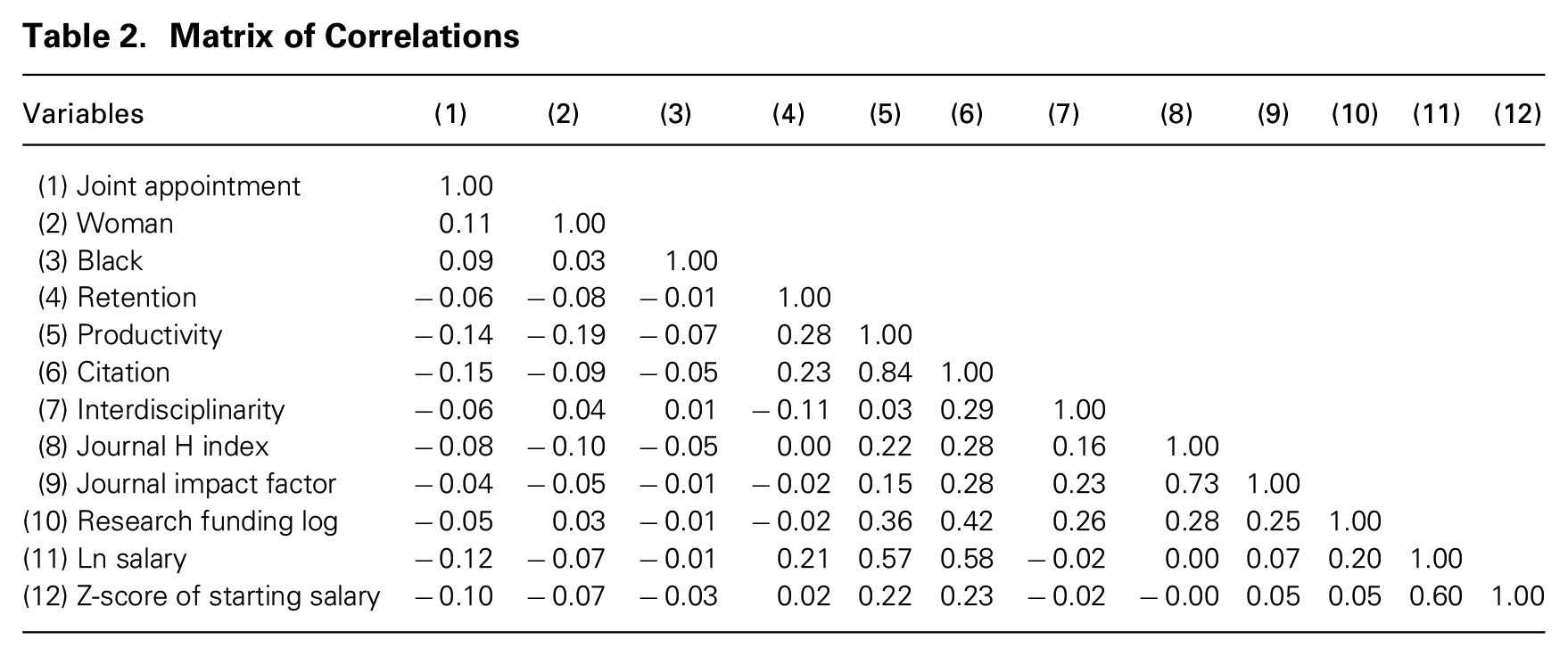
As our analyses depend on substantial data collection and coding efforts, in this section we discuss in detail how we collected the data and measured the key variables. Table 2 presents a matrix of correlations of the key variables.
Matrix of Correlations
Joint appointment
We used administrative records at the individual level to determine whether a person was formally jointly appointed to two or more academic departments. Specifically, we coded joint appointment as a binary variable equal to one if an individual has salary shared by two or more academic departments in the same year, and as zero otherwise. We took additional steps to verify that only formal joint appointments are identified in the university’s administrative record. During interviews with senior faculty members of the focal university, we confirmed that courtesy, or dry, appointments do not involve shared salary. For all the cases that we identified as formal joint appointments in the administrative record, we also manually coded how individuals report their appointment status in their CVs and web pages. In all cases available, we found that none of the self-reported appointment status information involves courtesy appointments, which provides strong validation that our measure is based on formal joint appointments indicated by shared salary across multiple departments in the administrative record.
Demographic variables
We manually coded demographic variables of gender and race, using public data made available on personal and department websites. There is growing consensus that race is a socially constructed characteristic (American Sociological Association, 2003) that encompasses different dimensions and malleability on both macro and individual levels (e.g., Espiritu, 1994; Nobles, 2000; Davis, 2001; Frederickson, 2002; DaCosta, 2007; Saperstein and Penner, 2012; Nix and Qian, 2015; Liebler et al., 2017). The extant literature highlights two distinct dimensions of race that both carry important implications for individuals’ life experiences pertaining to self-identification and perception by others (Espiritu, 1994; Frederickson, 2002; Saperstein and Penner, 2012). Reflecting this multi-dimensional nature, empirical measures of race fall in two broad categories, which are based on either self- or observer-selection (e.g., Telles and Lim, 1998; National Research Council, 2004; Saperstein, 2006; Nix and Qian, 2015). Specifically, growing research in social cognition suggests that observer-selected racial classification may have as much influence as self-identified racial classification on people’s life experiences, and it documents an automatic process whereby observers engage in racial classification when encountering faces (Telles, 2002; Saperstein, 2006; Brown, Hitlin, and Elder, 2007; Campbell and Troyer, 2007; Saperstein and Penner, 2012).
Because organizations may seek recognition for their diversity-related achievements, we adopted an observer-selection approach, which involves racial classification by perceivers. Recent research using the observer-selected measures has relied on either visual information (e.g., Rider et al., 2023) or names (e.g., AlShebli, Rahwan, and Woon, 2018). We followed the former convention and coded demographic variables on gender and race visually based on evidence of automatic racial classification based on facial perception (Telles, 2002; Saperstein, 2006; Brown, Hitlin, and Elder, 2007; Campbell and Troyer, 2007; Fu, He, and Hou, 2014). Importantly, empirical attempts at racial classification usually involve intricacies for both observer-selected and self-selected measures, in part due to the socially constructed nature of race (Saperstein, 2006; Nix and Qian, 2015; Liebler et al., 2017). For example, shifts in subjects’ social and economic status (Saperstein, 2006; Saperstein and Penner, 2012) and observers’ motives for dominance (e.g., Krosch et al., 2013; Krosch and Amodio, 2014; Kteily et al., 2014) are two factors that may affect observer-selected racial classification.
While our empirical context holds constant the subjects’ employer and their related social and economic status, we took a careful approach to derive the observer-selected measure of race. We used an ethnically diverse group of human observers to derive our main measure and used a machine-learning method to develop an alternative measure to test the robustness of our main results (see Online Appendix tables A1–A6). For every individual in the sample, two independent raters manually coded race and gender, using information made public on individuals’ personal and department websites. The raters relied predominantly on photos while also referring to names and relevant diversity experiences. 4 For the first two rounds, the raters agreed in their classification 94.5 percent of the time, yielding substantial interrater reliability (Cohen’s κ = 0.84). 5 A third independent rater conducted a third round of coding when the first two raters disagreed. We then derived our main observer-selected measure of race based on majority agreement when at least two rounds reflected agreement in the classification. Our final analysis sample based on human coding consists of 258 Black faculty and 3,544 White faculty, including 155 Black faculty and 1,780 White faculty at the assistant professor level. 6 Due to the low representation of some underrepresented groups, as well as several unique features associated with Asian or Asian American faculty in particular, we restricted our primary analyses to examining differences between Black and White faculty. 7
To further mitigate concerns about nuances specific to human observers, we used a machine-learning approach to develop an alternative measure. We proceed with the human observer–selected sample in the following analyses, and we report consistent results using the machine-selected sample for every main result (see Online Appendix tables A1–A6). 8
Retention
For all individuals who first appeared in the data as assistant professors, we used administrative personnel records to code whether they were retained with promotion to the level of associate professor. With our use of administrative data, we do not have a direct measure indicating whether an exit was voluntary or involuntary, nor does our theory emphasize this distinction. Therefore, in the main analyses we measured all exits recorded in the administrative record as indicating lack of retention.
Research productivity and impact
We measured three sets of research performance indicators pertaining to productivity and citation impact. First, we followed the convention in the literature and measured research productivity by using article counts (e.g., Sinatra et al., 2016; Leahey, Beckman, and Stanko, 2017). We derived our productivity measure by counting the total number of all research outputs in the MAG database that individuals had accumulated per year, which included journal articles, books, book chapters, and conference proceedings. We further differentiated the types of research outputs by specifying the number of journal articles and the number of books produced per year.
Second, we measured the total citations at the author–year level as a proxy for the impact of individual research outputs. Albeit an imperfect measure, the number of citations is prevalently used as a proxy for impact and performance, as it gauges peer reception and provides a standardized measure across disparate disciplines (e.g., Uzzi et al., 2013; Sinatra et al., 2016).
Research interdisciplinarity
We also measured the level of interdisciplinarity of individuals’ publications. Leahey, Beckman, and Stanko (2017) found that despite the high impact of interdisciplinary research, conducting such research can inadvertently stifle an individual’s research productivity and have negative impacts on that individual’s career advancement. According to the authors, the productivity and career penalties associated with interdisciplinary research originate from both the production side and the evaluation side of academic research. Producing research across disciplinary boundaries involves remarkable challenges, and interdisciplinary researchers face distinct evaluative hurdles that result in significant productivity penalties. Leahey and coauthors (2017) established a novel measure of research interdisciplinarity that has contributed significantly to the literature on the sociology and science of science (e.g., Yang et al., 2022). In our analyses, we followed this convention and systematically replicated the interdisciplinarity metric beginning at the article level, which was further aggregated to an author–year measure of research interdisciplinarity (Leahey, Beckman, and Stanko, 2017).
Our theoretical conceptualization of the diversity achievement paradox implicitly holds constant an individual’s primary tasks, which pertain to academic research in our empirical context. As discussed, one pathway that may lead to joint appointments is the university’s efforts to promote interdisciplinary research. To the extent that joint appointment is associated with a higher likelihood of conducting interdisciplinary research, joint appointment may reflect systematic differences in the content of individuals’ primary tasks that must be accounted for in the analysis. While we note that the correlation matrix in Table 2 shows a negative correlation between joint appointment and research interdisciplinarity, the strength of the correlation is very weak (Akoglu, 2018). To alleviate concerns about underlying differences in research interdisciplinarity, we cautiously controlled for the level of interdisciplinarity of individuals’ research outputs in the following analyses.
Research fields
To account for publication norms that may vary across different fields, we measured an individual’s main field and subfields of research by using data from MAG: a scientific publication database that records research outputs’ bibliographic information, such as authorship, affiliation, journal, associated field, publication year, affiliations, and forward and backward citation links to other research outputs (Wang et al. 2019). With machine learning, the MAG database assigns topics associated with every research output at multiple levels of specificity. Following convention (Yang et al., 2022), we used the highest level of topics to measure an individual’s main research fields, which in MAG include 19 academic fields such as “engineering,”“psychology,” and “history.” We also used the topics at the next level of specificity to measure an individual’s subfields; examples include “gender inequality” and “social movement.”
Research grants
In addition to publications, research grants are frequently considered in faculty evaluations and may have significant implications for involuntary turnover. Moreover, the availability of research funding affects scholars’ career choices in terms of voluntary turnover. It is therefore important to measure and control for the amount of research grant funding awarded to the individuals in our sample. We used data from Dimensions, a bibliographic database that covers publications and their contextual information, such as citations, digital object identifiers (DOIs), authors’ names and affiliations, and relevant patents and policy documents (Hook, Porter, and Herzog, 2018, Herzog, Hook, and Konkiel, 2020). 9 The Dimensions database provides fairly extensive coverage that includes over 105 million publications, and it contains information on awarded grants for about five million funded projects.
The Dimensions database provides a rich set of information on research grants, including the start and end years of funding projects, principal investigator (PI) and co-PI names and institutional affiliations, and the total amount of funding in U.S. dollars (Hook, Porter, and Herzog, 2018; Herzog, Hook, and Konkiel, 2020). In addition, it links publications and awarded grants through papers’ acknowledgment of grants, which allowed us to match the grants data recorded in the Dimensions database with articles associated with the authors in our sample as documented in the MAG database. We measured the annual total amount of new grants awarded to the authors in our sample at the author–year level and then took the logarithm transformation in the analyses.
Journal prestige
We further derived multiple measures of journal prestige by using data from the Scimago Journal Rank (SJR) database, which ranks 34,337 journals from 1999 to 2021. 10 We matched journals listed in the SJR database and journals that pertain to the authors in our analysis sample as recorded in MAG, using each journal’s ISSN and the ISSN-L link table (Pesch, 2009). We derived three metrics from the SJR data. First, we measured a categorical variable SJR journal quartile, which categorizes journals into four tiers based on SJR scores. Second, the SJR database records journal impact factor, which is an index that reflects the yearly average number of citations of all the articles published by a given journal in the last two years. Third, the SJR database also uses the H-index (Hirsch, 2005) to evaluate a journal’s impact. We aggregated each of these metrics of journal prestige to the author level and calculated the average per year in our analyses.
Ln (salary)
For one analysis on additional mechanism tests, we extracted individual annual salaries from the university administrative records. Following convention, we used the natural logarithm transformation of annual salaries in the analysis.
Z-score of starting salary
It is important to control for initial assignment conditions that may help account for unobserved, pre-existing differences among candidates at the time of allocation (Rider et al., 2023). Therefore, to control for any initial differences that affected the university’s salary decisions at the time of hiring, we included a measure of starting salary in the analyses that involved salary. We measured an individual’s starting salary, using the annual salary amount in the first year, and standardized it by that individual’s starting year for comparability over time.
Analyses
Estimation Strategy and Results
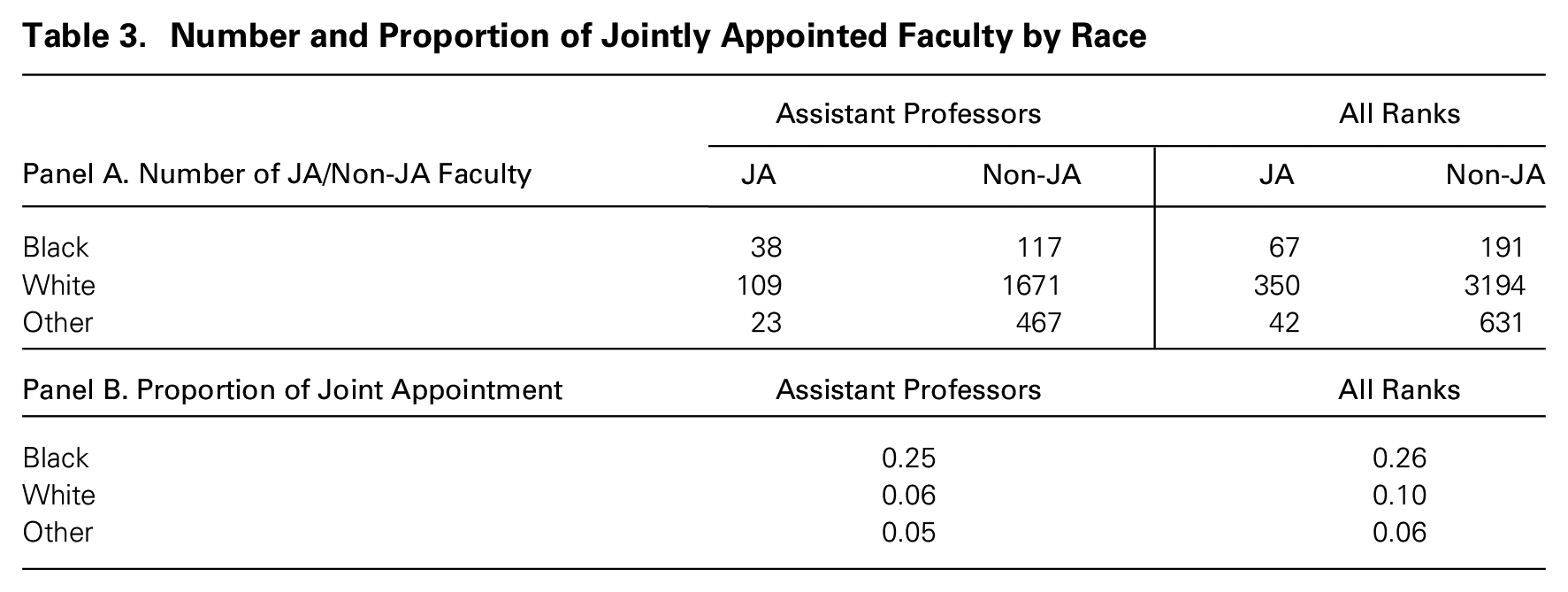
We began our analyses by examining whether Black academics were more likely than their White colleagues to be jointly appointed (H1) in this empirical setting. Table 3’s basic tabulations of the number and proportion of jointly appointed faculty by race reveals stark differences. Among all faculty ranks, 26 percent of Black faculty were jointly appointed, compared to 10 percent of White faculty. This difference is even more striking among untenured assistant professors; while 25 percent of Black assistant professors were jointly appointed in our sample period, fewer than 6 percent of White assistant professors were similarly appointed.
Number and Proportion of Jointly Appointed Faculty by Race
To account for other factors that may affect the likelihood of joint appointment, we used a standard logistic regression framework. We estimated a series of logistic regressions of the following form,

where
Likelihood of Joint Appointment for Individual Faculty*
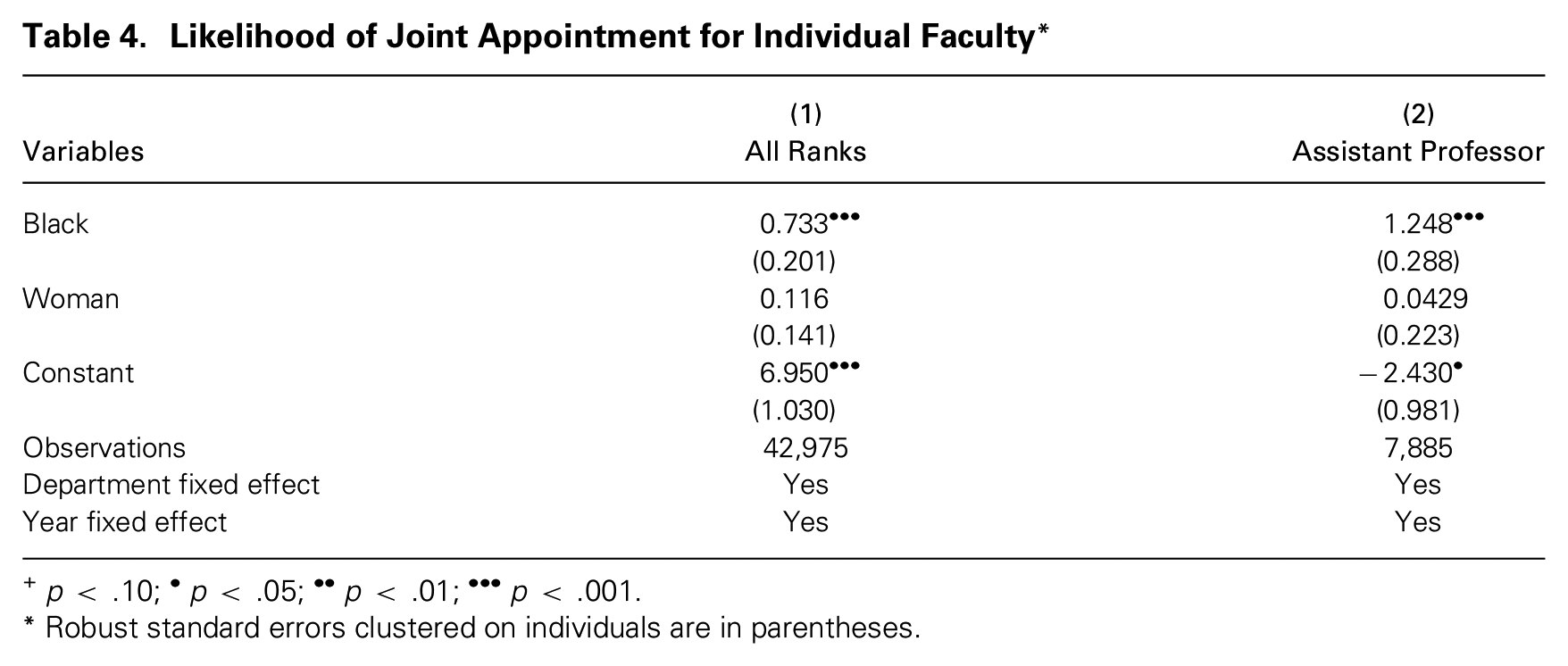
p < .10; • p < .05; •• p < .01; ••• p < .001.
Robust standard errors clustered on individuals are in parentheses.
Next, we examined Hypothesis 2, regarding the retention of employees who experience differential allocation to joint appointment. In our main analyses, we used the linear probability estimator to examine whether joint appointments affect assistant professors’ likelihood of retention with promotion to the rank of associate professor. In our context of higher education, the majority of assistant professors are evaluated for promotion after a similar duration, and we accounted for right censoring by restricting the sample to the observations of individuals who were hired as assistant professors prior to the year 2010. The models we used to test Hypothesis 2 with a linear probability estimator are specified as follows:

where
The models in Table 5 present estimates from the linear probability regression and offer strong support for Hypothesis 2. To start, Model 3 indicates that Black assistant professors face a significantly lower likelihood of retention, on average, compared to White assistant professors (
Likelihood of Retention*

p < .10; • p < .05; •• p < .01; ••• p < .001.
This table presents linear probability estimates of the likelihood of retention among individuals first hired as assistant professors. Robust standard errors clustered on individuals are in parentheses.
Additionally, analyses using the machine-coded sample present confirmatory results for the negative association between joint appointment and retention (
Mechanism Tests
Research productivity
We implemented an additional set of analyses examining the mechanisms that underpin the lower likelihood of retention associated with joint appointment. To assess the main mechanism regarding research productivity, we attempted to gather rich information on the pre- and post-hire publication records of all pertinent assistant professors in our dataset. Despite our extensive efforts to match the university administrative records with the publications data from the MAG database, the sample size for this analysis is notably smaller due to missing observations. The issue of missing observations can also be attributed in part to distinct norms in several departments in which few people produce the types of publications recognized in MAG. Our final analysis sample consists of the publication records of 908 assistant professors.
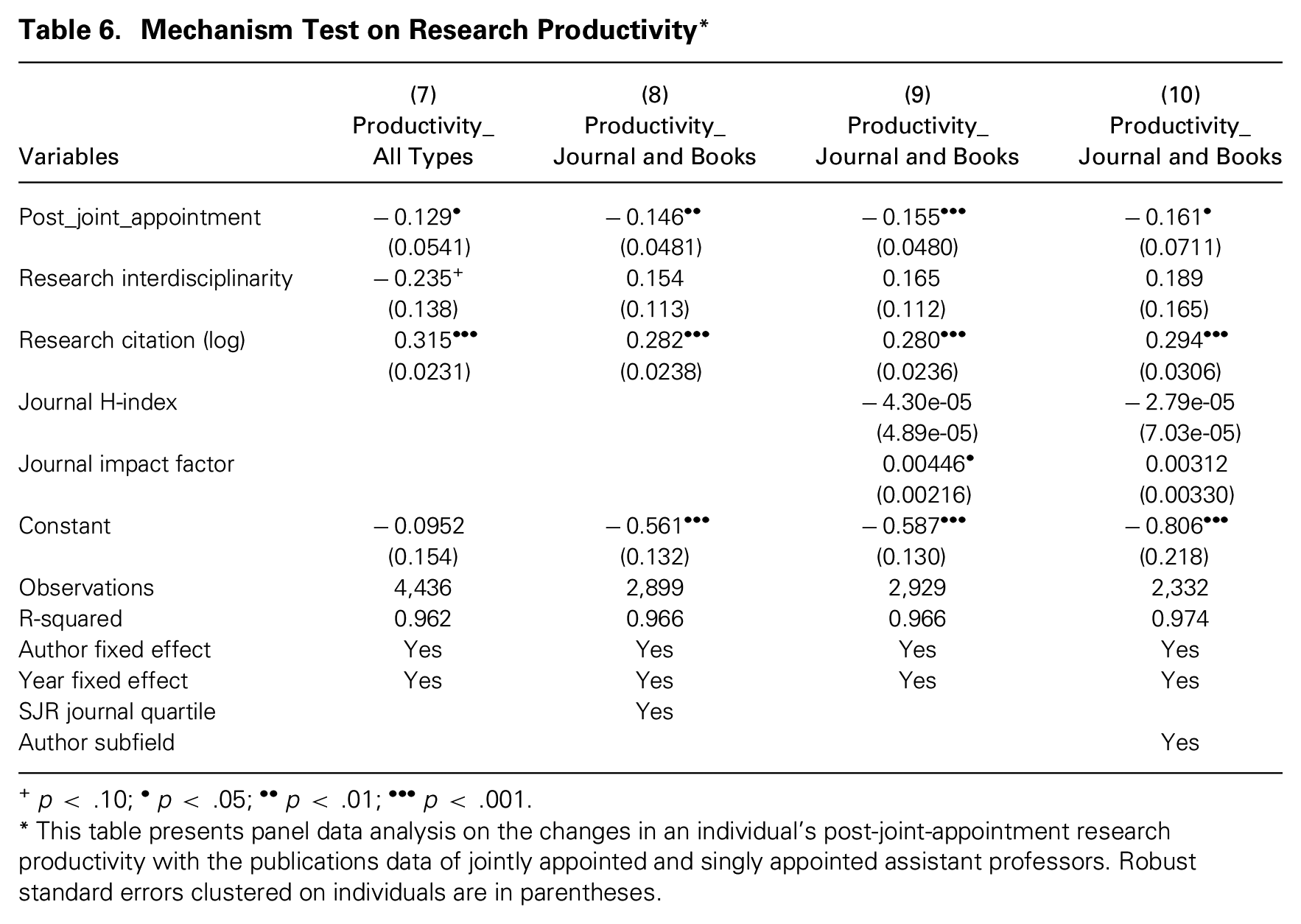
To investigate the relationship between joint appointment and research productivity, we sought to estimate the changes in an individual’s research productivity before and after joint appointment through panel data on both jointly and singly appointed assistant professors. Following convention, we conducted panel data analysis in which we controlled for author fixed effect and year fixed effect, and we included a binary variable Post_joint_appointment to indicate the effect of joint appointment (Wooldridge, 2013: 486). Specifically, the indicator variable Post_joint_appointment is conceptually equivalent to the product of the binary variable Joint appointment and a binary variable indicating the start of the joint appointment status. Therefore, for all author–year observations, Post_ joint_appointment is equal to one if the author–year observation is subject to joint appointment and zero otherwise. We measured two dependent variables of productivity: (1) the total number of all research outputs, including journal articles, books, book chapters, and conference proceedings; and (2) the total number of journal articles and books that individuals produce every year. As discussed, to account for the quality and the interdisciplinary nature of the works, we further controlled for the total number of citations and the level of interdisciplinarity (Leahey, Beckman, and Stanko, 2017); journal prestige measures including journal H-index, journal impact factor, and SJR journal quartile; and author subfield fixed effect.
Model 7 in Table 6 presents the result of the analysis on the total number of all research outputs. When we control for author fixed effect, year fixed effect, the citation impact, and the interdisciplinarity of the individual’s work, the post-joint appointment rate of publication is notably lower among jointly appointed assistant professors (
Mechanism Test on Research Productivity*
p < .10; •p < .05; ••p < .01; •••p < .001.
This table presents panel data analysis on the changes in an individual’s post-joint-appointment research productivity with the publications data of jointly appointed and singly appointed assistant professors. Robust standard errors clustered on individuals are in parentheses.
Estimation using the machine-coded sample presents confirmatory evidence of reduced productivity among jointly appointed assistant professors in terms of all research outputs (
Additional mechanism tests
We had further proposed that jointly appointed faculty may experience greater fragmentation in their job structure, which may exacerbate evaluative hurdles and further increase the rate of voluntary and involuntary turnover among jointly appointed assistant professors. We conducted two additional tests to explore this possibility. First, we examined whether jointly appointed assistant professors experience lower likelihood of retention irrespective of observable indicators of research performance. Table 7 investigates whether the likelihood of retention differs by joint or standard appointment status when individuals’ research productivity and performance are accounted for. Model 11 presents the results using linear probability estimation. In support of our prediction, conditional on an individual’s research productivity, impact, work interdisciplinarity, gender, race, and department and year fixed effects, the retention likelihood for joint appointments remains significantly lower than for standard appointments (
Additional Mechanism Test*

p < .10; •p < .05; ••p < .01; •••p < .001.
This table presents the linear probability estimates of the likelihood of retention with respect to the additional mechanism test. Robust standard errors clustered on individuals are in parentheses.
In Model 12, we used an alternative measure of retention that is more likely to indicate involuntary turnover. We coded the years in which faculty members left their universities, as well as the positions and schools to which those individuals moved directly after leaving. We then eliminated cases in which a faculty member left the university (1) more than two years prior to their estimated tenure review and/or (2) for a higher-status institution. While we acknowledge that this coding is imperfect and that many unobserved factors that affect one’s decision remain, we assume that an assistant professor’s exit is more likely to be voluntary when their subsequent job is at an institution more prestigious (according to U.S. News & World Report rankings) than the focal institution. With this more restrictive definition of retention that is more likely to indicate promotion decisions, the result in Model 12 demonstrates that jointly appointed assistant professors remain significantly less likely to be retained (
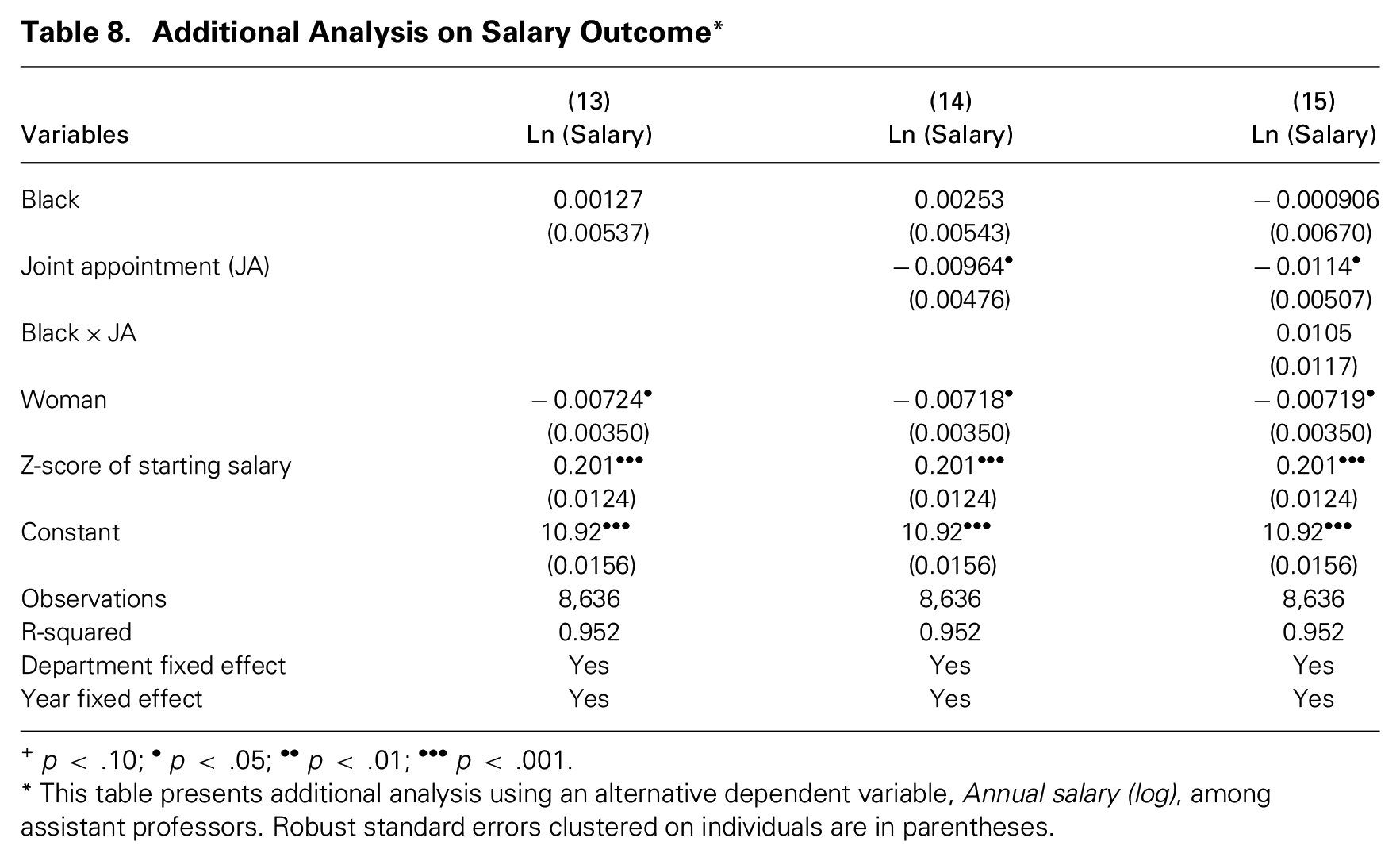
To further investigate the evaluative difficulties associated with joint appointment, we conducted an additional test on annual salary. While annual salary increases can depend on several factors, including basic cost-of-living increases or department-level differences, we assume that the size of an individual’s raise relative to that of other individuals in comparable positions reflects at least in part an evaluation of that individual’s performance. Accordingly, we treat annual salary as an informative (albeit imperfect) measure that suggests how an individual was evaluated for their performance over the prior year. We used standard OLS regression with Ln_salary as the dependent variable. We included the z-score of an individual’s starting salary as a covariate to control for unobserved, pre-existing differences among candidates that may be reflected in the initial conditions at the time of hiring (cf. Rider et al., 2023). Specifically, the coefficient on Black in Model 13 of Table 8 is insignificant, indicating that the annual salaries received by Black faculty members are on average no different in magnitude from those received by their White colleagues. Model 14 adds the indicator variable Joint appointment and confirms that jointly appointed assistant professors receive significantly less annual salary on average compared to singly appointed colleagues, which provides suggestive evidence for the evaluative hurdles pertinent to joint appointment. In addition, Table A5 in the Online Appendix presents consistent estimates on Ln_salary derived from the machine-coded sample.
Additional Analysis on Salary Outcome*
p < .10; •p < .05; ••p < .01; •••p < .001.
This table presents additional analysis using an alternative dependent variable, Annual salary (log), among assistant professors. Robust standard errors clustered on individuals are in parentheses.
Robustness Tests
The analyses presented thus far are not without limitations. In this section, we highlight several of these limitations and describe various attempts to adjust for them. First, it is possible that our effects may be due to unobserved initial differences between jointly appointed and singly appointed individuals. For example, if jointly appointed faculty were to have systematically lower initial (pre-hire) quality compared to singly appointed faculty, then underlying quality differences and not differences in appointment status per se may account for differing employment outcomes. Likewise, if departments are more likely to accept a jointly appointed candidate whom they are not enthusiastic about (because the alternative is to hire no one), then jointly appointed faculty may be vulnerable to negative evaluations. Finally, if jointly versus singly appointed faculty do indeed differ in quality, it is possible that jointly appointed faculty may have lower capacity to negotiate salary increases and promotion outcomes.
We took several steps to mitigate these concerns. First, we used U.S. News & World Report ranking data to compare jointly and singly appointed faculty with respect to their Ph.D. (or highest degree) granting institutions. The results of this analysis, which are shown visually in Figure 1 panels (A) and (B), reveal no significant differences between jointly and singly appointed faculty. This analysis is imperfect for several reasons, not least of which is the fact that university-wide rankings do not perfectly correlate with quality at the department level. Next, we compared the pre-hire research performance of jointly appointed faculty with that of singly appointed faculty, controlling for each individual’s race, gender, and department and year fixed effects. Figure 2 panels (A) and (B) present the coefficients and the 95 percent confidence intervals of the joint appointment status in terms of predicting productivity measured by the number of journal articles and books and citation impact. The results show no significant difference between jointly appointed and singly appointed faculty with respect to their pre-hire research productivity (
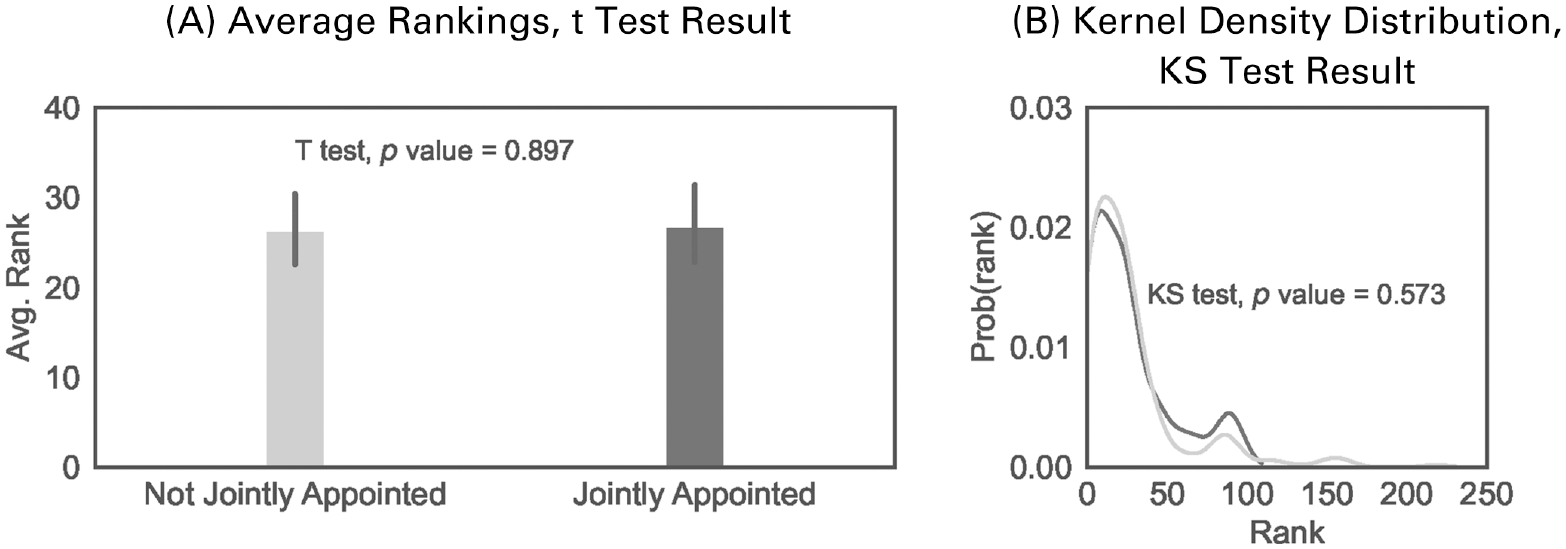
Ph.D. Institution Rankings

Pre-Hire Research Performance
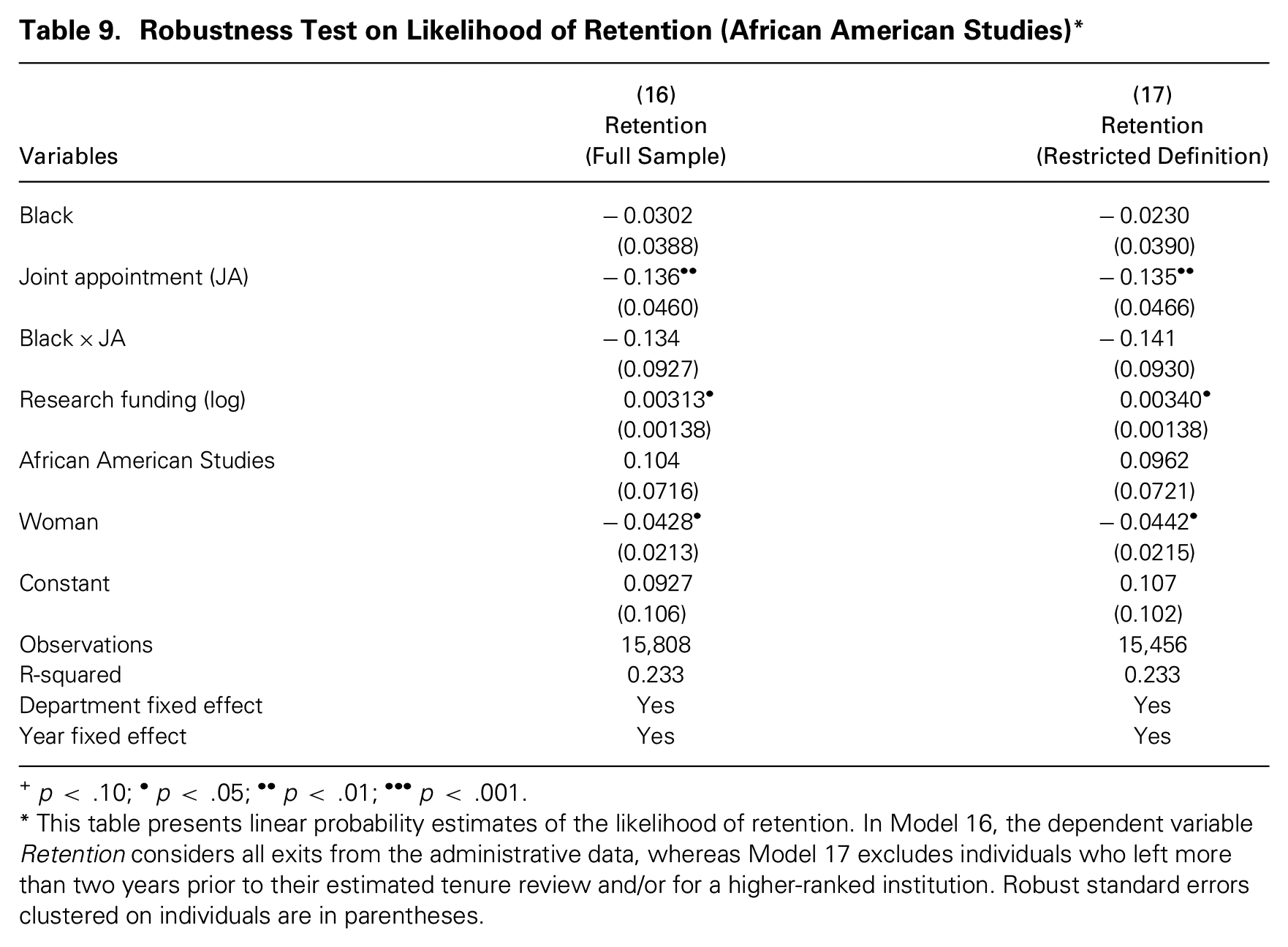
Last, because a fraction of Black assistant professors who were jointly appointed were affiliated with the African American Studies department and one other department, we further addressed the possible concern that the negative effect of joint appointment on an individual’s retention may simply reflect higher likelihood of turnover in the African American Studies department. Models 16 and 17 in Table 9 indicate that this is not the case. On average, the African American Studies department does not differ from other departments in propensity to retain assistant professors. Online Appendix Table A6 presents confirmatory results using the machine-coded sample.
Robustness Test on Likelihood of Retention (African American Studies)*
p < .10; •p < .05; ••p < .01; •••p < .001.
This table presents linear probability estimates of the likelihood of retention. In Model 16, the dependent variable Retention considers all exits from the administrative data, whereas Model 17 excludes individuals who left more than two years prior to their estimated tenure review and/or for a higher-ranked institution. Robust standard errors clustered on individuals are in parentheses.
Discussion
The persistence of racial disparities in labor market and organizational contexts not only calls into question the efficacy of organizational efforts to recruit underrepresented racial groups but also raises important questions about turnover dynamics in the racial stratification process (Sørensen, 2004; Rider, Sterling, and Tan, 2016; Ferguson and Koning, 2018; Shaw et al., 2021). Sustainable achievement in diversity requires addressing both differential recruitment and differential turnover (Sørensen, 2004), and our theory highlights an important paradox: organizational efforts that increase the inclusion of underrepresented groups in the short term may conceal an emergent mechanism that inadvertently results in exclusion over time. We argue that as they attempt to increase diversity, organizations must overcome significant operational strains, which may spark the opportunistic use of unexpected means to reach existing goals (March and Olsen, 1976; Miner, 1987). One implication is that organizations striving for greater diversity are more likely to rely on non-standard positions that can give them more flexibility and opportunities to increase diversity. While non-standard positions may manifest in various forms across different contexts, such positions tend to involve expectations that differ from those for standard positions. Because the differences in expectations tend to be overlooked in purportedly standard performance evaluations, efforts to increase diversity may paradoxically place underrepresented groups in positions in which it is harder for them to be retained.
We examined one instantiation of this paradox, using a revelatory case in the context of higher education. Integrating administrative personnel data from a large (R1) U.S. public university with rich data on individual demographics and research performance, we found that Black faculty are significantly overrepresented in non-standard appointments, i.e., formal joint appointments with shared compensation by more than one academic department. We further demonstrated that joint appointments, compared to standard appointments, overexpose early-stage faculty to a set of unique risks that are associated with significant decline in their research productivity and ultimately an increase in their likelihood of voluntary and involuntary attrition.
Our study contributes to the growing research on emergent and unintended mechanisms that undermine organizational efforts to achieve diversity (e.g., Kalev, Dobbin, and Kelly, 2006; Castilla, 2008; Dobbin, 2009; Castilla and Benard, 2010; McDonald and Westphal, 2013; Dobbin, Schrage, and Kalev, 2015; Chan and Anteby, 2016; Ray, 2019). We argue that the emergent mechanism in our study stems from a misalignment between allocation in the matching process and valuation in the evaluation process (Petersen and Saporta, 2004). On one hand, efforts to achieve diversity in the matching process may inadvertently give rise to a subtle mechanism of allocative inequality whereby underrepresented groups are disproportionately allocated to non-standard positions with distinct scopes of expectations. On the other hand, neutral and merit-based organizational practices in performance evaluation mask a novel instantiation of valuative inequality insofar as organizations fail to adjust the scope of evaluation for the distinct scope of expected behaviors. The striking misalignment between the scope of expected behaviors in allocation and the scope of contributions valued in performance evaluation may result in hurdles that undermine the organizational goal of retaining underrepresented groups.
The misalignment between the allocative and valuative mechanisms also speaks to the important distinction between equality and equity, which is crucial for diversity interventions. While equivalent treatment is key to achieving equality, it does not necessarily lead to equitable outcomes (Rider and Reagans, 2022). As our study demonstrates, although neutral evaluation standards are meant to provide equivalent treatment in the evaluation process, they may have disparate impacts on individual career outcomes when combined with differential treatment in the hiring process. This important nuance sheds light on the intricacy involved in designing effective diversity interventions. In our context, because the disparate outcome stems from a misalignment between the allocative and valuative processes of employment, organizations often face a choice between adjusting their allocation efforts in the hiring process or their valuation efforts in the evaluation process.
One important consideration pertinent to this choice is whether differential allocation in the matching process has a positive spillover effect on other underrepresented individuals in earlier phases of their career cycle (Bertrand et al., 2019). Prior research has argued that demographic composition can be self-reinforcing (e.g., Kanter, 1977; Cohen, Broschak, and Haveman, 1998; Stainback and Tomaskovic-Devey, 2012), as early entrants into a field or position may function as internal advocates for future inclusion of other members of those underrepresented groups (Dobbin, Kim, and Kalev, 2011; Dobbin and Kalev, 2019). However, Bertrand and colleagues (2019) found scarce support for a spillover effect in the context of mandated gender quotas. In their study, an increase in women’s board membership in Norway did not have a marked influence on younger women. In our context, do joint appointments among faculty members from underrepresented groups help address the pipeline problem by increasing enrollments of students from those groups? If future research were to find strong evidence that the disproportionate use of joint appointments among faculty from underrepresented groups has a direct, causal effect on increasing student enrollments from underrepresented groups, universities would be wise to implement practices to adjust the evaluation process to alleviate the disparate consequences that we have presented here.
We also need to consider the conditions that can enable our findings to generalize to various contexts beyond academia. In terms of differential allocation, one primary condition is a growing organizational demand for diversity achievement despite prevailing operational strains. As external pressures in an organization’s legal and normative environments are major sources of motivation for diversity efforts (e.g., Kalev, 2009; Dobbin, Kim, and Kalev, 2011), we point to the prevalence of such enabling conditions in numerous organizational contexts. Many organizations face regulatory mandates to pursue diversity. For example, companies in Norway are subject to regulations such as gender quotas on corporate boards that make diversity goals mandatory for organizations (Ahern and Dittmar, 2012; Bertrand et al., 2019). Regulatory pressures in many other contexts have been found to motivate diversity efforts among various organizations that have heightened legal awareness (Kalev, 2009), including organizations in the public sector (Steinberg, Haignere, and Chertos, 1990; Wilson, Roscigno, and Huffman, 2013), private companies under legal oversight, such as government contractors (Kalev, Dobbin, and Kelly, 2006), and companies that have experiences with discrimination charges or affirmative action reviews in the past (Kalev and Dobbin, 2006; Skaggs, 2008, 2009; Bielby, 2012). Organizations also increasingly face massive normative pressures to achieve diversity. In particular, such normative pressures tend to be pronounced in industries with pro-diversity cultures (Dobbin, Kim, and Kalev, 2011) and in visible roles and positions (Gardberg and Fombrun, 2006; King, 2008; Chu and Davis, 2016; Chang et al., 2019; Knight, Dobbin, and Kalev, 2022).
Another important enabling condition for the generalization of our study pertains to organizational contexts in which initial conditions play a significant role in an individual’s future career attainments (e.g., Rosenbaum, 1979; DiPrete and Soule, 1988; Steinberg, Haignere, and Chertos, 1990; Sørensen, 2004; Beckman and Burton, 2008). Our findings may readily generalize to careers organized with hierarchical ladders whereby an individual’s initial conditions have profound impacts on long-term career trajectories and advancement through promotion milestones. This is relevant to many professions (Briscoe and Kellogg, 2011), white collar jobs, and large organizations with internal labor markets (Steinberg, Haignere, and Chertos, 1990). Briscoe and Kellogg’s (2011) study on professional labor, for example, analyzed a unique longitudinal dataset on professional careers in a large law firm and revealed a strong initial assignment effect on lawyers’ career trajectories. And while our theory and findings are not conditioned by salient competition or relative performance, the mechanisms underlying our findings may be further magnified in organizational contexts in which career ladders involve a sequence of competitions in the form of tournament mobility (e.g., Rosenbaum, 1979; Ehrenberg and Bognanno, 1990).
Our findings also offer a meaningful example of how the unintended consequences of organizational efforts can sometimes work counter to the outcomes they are meant to achieve. Robert K. Merton (1936: 894) long ago called for “a systematic treatment” of unanticipated consequences of purposive actions, and researchers in sociology and organizational theory have taken up this challenge (e.g., Castilla and Benard, 2010; Tilcsik, 2010; Turco, 2012; McDonnell, King, and Soule, 2015; Chan, 2016; Berrey, Nelson, and Nielsen, 2017; Kalev, 2019). For example, Berrey, Nelson, and Nielsen (2017) demonstrated that the prevailing approach to workplace discrimination law may unintentionally end up perpetuating the hierarchies it was created to tackle. Although our empirical context differs significantly from such prior work, our findings are consistent with the overarching theme of unintended consequences.
Recent research on labor market inequality has emphasized the importance of studying the consolidation of multiple mechanisms conducive to inequality (Ray and Seamster, 2016; Ray, 2019; Wilmers and Aeppli, 2021). As Ray (2019) contended, central to the perpetuation of racial inequality in supposedly race-neutral organizations are the numerous ways that various mechanisms may interact as organizations respond to emergent problems. Our theory and findings demonstrate one case in point, as the misalignment of allocative and valuative mechanisms underlies the paradox of diversity achievement whereby organizational efforts to increase diversity may inadvertently sustain racial inequality over time. Although the specific mechanisms and their consolidation processes differ notably across studies and contexts, these recent studies point to the importance for organizational research and practices to address the consolidation of multiple mechanisms. In light of this insight, future research may uncover novel combinations of mechanisms underlying inequality and their implications for diversity intervention.
Supplemental Material
sj-pdf-1-asq-10.1177_00018392241247744 – Supplemental material for Stretched Thin: How a Misalignment Between Allocation and Valuation Underlies the Paradox of Diversity Achievement in Higher Education
Supplemental material, sj-pdf-1-asq-10.1177_00018392241247744 for Stretched Thin: How a Misalignment Between Allocation and Valuation Underlies the Paradox of Diversity Achievement in Higher Education by Tanya Y. Tian and Edward B. Smith in Administrative Science Quarterly
Footnotes
Acknowledgements
We are grateful to the editor Christine Beckman and three anonymous reviewers for their guidance and helpful comments. We thank Jillian Chown, Jeannette Colyvas, Joan Friedman, Brayden King, Erin Smith, and Jim Westphal for their advice and support during the revision process. We are grateful for the opportunity to dedicate this paper to Finn, Beckett, Eliza, and Cecily Smith.

Supplementary Material
1
If there is an oversupply of Ph.D. holders relative to positions requiring a Ph.D., the relative scarcity of minority Ph.D. recipients is not sufficient to demonstrate a pipeline problem. This nuance is beyond the scope of this article.
2
This list of reasons for joint appointments is not meant to be exhaustive. For our purposes here, the many pathways to joint appointment suggest that the individuals selected for jointly appointed positions may be different than those selected for singly appointed positions. This complicates our analysis in various ways. We address these issues in detail in our empirical section.
3
For a robustness test, we also used Scopus data to create a productivity measure for a subsample of individuals, which yielded results that are qualitatively consistent with the full sample analyses based on MAG data.
4
They referred to the racial classification adopted by the U.S. Census Bureau’s Population Estimates Program (PEP) and added the category “unknown,” which was used if raters were unable to find the individuals or to code with confidence.
5
The calculation excludes cases for which raters did not specify a racial category and indicated “unknown.” Interrater reliability remains good (agreement = 89%; Cohen’s κ = 0.715) when such cases are included.
6
We identified 117 Black faculty and 1,349 White faculty at the associate professor level and 112 Black faculty and 1,892 White faculty at the full professor level.
7
Compared to all other underrepresented racial groups, Asian and Asian American faculty are overrepresented relative to their percentage in the U.S. population. Our results are not conditional on restricting the analyses to Black and White faculty. Specifically, there are 673 individuals who are not included in the primary analyses. Either they were coded as other underrepresented racial groups or there was insufficient information to code.
8
Specifically, we used the diversity detector based on visual information provided by Kairos to derive the machine-selected measures of the demographic variables.
11
To estimate the impact of nullifying joint appointment (JA), we consider neutralizing both the over-representation of Black assistant professors in the JA position and the negative association between JA and retention. Assuming that JA entails the same racial composition and the same rate of retention as standard appointment, denoted by γ, we derive the following calculation percent increase in the retention of Black assistant professors =
Authors’ Biographies
References
Supplementary Material
Please find the following supplemental material available below.
For Open Access articles published under a Creative Commons License, all supplemental material carries the same license as the article it is associated with.
For non-Open Access articles published, all supplemental material carries a non-exclusive license, and permission requests for re-use of supplemental material or any part of supplemental material shall be sent directly to the copyright owner as specified in the copyright notice associated with the article.
