



Abstract
This article explores how policies that reduce barriers to entrepreneurship impact underrepresented groups differently depending on local norms and cultural beliefs. While prior studies suggest that underrepresented groups should benefit more than other groups do from policies lowering entry barriers, the empirical evidence is mixed. We argue that the absence of normative and cognitive support can undermine the effectiveness of these policies for underrepresented groups. To explore this, we leveraged the staggered rollout of a policy that reduced entry barriers to entrepreneurship in Mexico. The results show that while the policy increased the number of businesses founded by men, it had a small and statistically insignificant impact for women, thus exacerbating the gender gap in entrepreneurship. Further analyses suggest that while women were not more likely to become involved in entrepreneurship as founders, they did become engaged in alternative roles within new ventures, often leaving other forms of employment to enter unpaid work in businesses founded by men in their household. The effects of the policy on the gender gap in entrepreneurship and unpaid work were more pronounced in areas with a strong patriarchy logic and among married individuals. This research highlights the need to consider context in the design of policies intended to encourage entrepreneurship.
Prior research suggests that policies that reduce barriers to entry facilitate entrepreneurship among underrepresented groups (Chatterji and Seamans, 2012). 1 The argument hinges on the premise that underrepresented groups often face additional barriers to entrepreneurship and thus benefit more than other groups do from lower entry barriers (Castellaneta, Conti, and Kacperczyk, 2020). Highlighting this trend, a 2020 World Bank report noted that between 2018 and 2019, 115 governments worldwide implemented 294 policies aimed at reducing such barriers (World Bank, 2020). Despite the popularity of similar policies, our understanding of why their effects vary significantly across institutional contexts remains limited (Eberhart, 2023).
For instance, while some studies have found that policies that lower entry barriers increase entrepreneurship among underrepresented groups, others have noted that similar initiatives have minimal impact (Field, Jayachandran, and Pande, 2010; Bruhn and Love, 2011; Berge, Bjorvatn, and Tungodden, 2015). Unfortunately, scholarship has yet to develop boundary conditions that can explain these discrepancies. We believe the inconsistent outcomes in research on this subject may be due in part to the interplay of policy and informal institutional elements (Kalev, Dobbin, and Kelly 2006; Eesley et al., 2018). While previous research has concentrated primarily on the ways in which policy changes may reduce entry barriers to entrepreneurship, an institutional perspective focuses on the normative and cognitive institutional elements that determine the perceived appropriateness and taken-for-granted assumptions related to policy efforts (Zhang, 2020; Armanios and Eesley, 2021).
In this study, we address the limitations of existing research by demonstrating how the interplay between policies and institutional logics may explain instances in which reducing barriers to entry does not increase entrepreneurship among underrepresented groups (Thornton et al., 2012; York, Hargrave, and Pacheco, 2016; York, Vedula, and Lenox, 2018). 2 Specifically, we theorize that when local institutional logics do not support entrepreneurship among certain underrepresented groups, then these logics may hinder the impact of lower barriers through two mechanisms: cognitive mechanisms, which affect how these groups recognize the relevance of entrepreneurial policies or increase the bias that potential entrepreneurs face from resource providers; and normative mechanisms, which dictate the social norms and expectations within a community and discourage entrepreneurial exploitation among these groups due to social sanctions and stigma for deviating from community norms. Overall, we anticipate that in contexts in which local institutional logics do not support entrepreneurship among certain underrepresented groups, efforts to lower entry barriers may paradoxically exacerbate the entrepreneurial gap between these groups and the broader population.
To test our theoretical prediction, we focus on changes in the entrepreneurial gap between men and women following a policy change in Mexico that lowered the barriers to entry by reducing the time, number of office visits, and procedures required to register a firm (Bruhn, 2011). This is an ideal context for two reasons. First, the rollout of the policy, called System of Rapid Business Opening (SARE, for its initials in Spanish), was a plausibly exogenous change to entrepreneurial entry barriers, offering an opportunity for causal identification. Second, Mexico is a country with a pronounced patriarchy logic that discourages woman-led entrepreneurship (Zhao and Wry, 2016), which made it feasible to explore the role of institutional logics in policy outcomes within an underrepresented group.
In accordance with our hypothesis, we found that the reduction in entry barriers increased the gender gap by boosting the rate of men’s entry into entrepreneurship and having no significant impact on women’s entry into entrepreneurship. Further analyses reveal that while the policy change did not lead to an increase in women founding their own businesses, it did result in women taking on alternative roles within new ventures. Notably, the policy change led to a significant increase in women leaving paid employment to engage in unpaid work in businesses founded by men in their household. This trend was more pronounced in areas with a strong patriarchy logic and among married women. The results provided evidence consistent with our theory that cognitive and normative mechanisms associated with the patriarchy logic shaped how women recognized and exploited opportunities associated with the policy change. Finally, we found evidence consistent with our main findings in an exploratory experimental vignette study with 400 Mexican women.
Theory and Hypotheses
Entry Barriers and the Gender Gap in Entrepreneurship
Research has long indicated that underrepresented groups wishing to engage in entrepreneurship encounter interrelated obstacles that range from limited access to resources (Renzulli, Aldrich, and Moody, 2000; Tonoyan, Strohmeyer, and Jennings, 2020) and biases (Botelho and Abraham, 2017; Kanze et al., 2018) to homophily (Greenberg and Mollick, 2017; Abraham, 2020; Rocha and van Praag, 2020; Kacperczyk, Younkin, and Rocha, 2022; Snellman and Solal, 2023). These interrelated barriers can work together to hinder underrepresented groups’ entry into entrepreneurship (Jennings and Brush, 2013; Guzman and Kacperczyk, 2019). One solution to these challenges lies in lowering entry barriers by eliminating obstacles such as financial constraints and bureaucratic complexities (Grandy and Hiatt, 2020).
Policy changes that lower entry barriers have been found to be particularly effective at increasing entrepreneurship among underrepresented groups, which often have limited access to resources with which to initiate new ventures and confront additional hurdles. For example, in their study of a policy change meant to decrease entry costs for new entrepreneurs in Portugal, Castellaneta, Conti, and Kacperczyk (2020) found that the measure increased the ratio of women to men entering entrepreneurship and thus narrowed the gender gap. According to the authors, because women face more barriers to entrepreneurship than men do, they stand to gain more from lower entry barriers. In another example, Chatterji and Seamans (2012) showed that credit card deregulation, which offers liquidity-constrained individuals easier access to capital, increased the rate of new firm foundings, especially among financially disadvantaged socioeconomic groups such as Black Americans. The effects of the policy were amplified in states with a history of racial discrimination, where the policy served to mitigate discrimination-based barriers to entry. Cueto, Mayor, and Suárez (2017) similarly found that a self-employment support program in Spain reduced capital constraints and thus increased venture foundings, especially among young, unemployed individuals.
Although institutional changes that lower entry barriers may spur entrepreneurship in underrepresented groups by lowering their startup costs, several studies have found that similar initiatives do not always produce the intended effects (Bates and Williams, 1996; de Mel, McKenzie, and Woodruf, 2009; Fiala, 2018; Bernhardt et al., 2019; Berge and Pires, 2020). For instance, in a study of entrepreneurs in Mexico, Bruhn and Love (2011) found that increasing the availability of credit led to higher rates of entrepreneurship among men but had no significant impact on women’s entrepreneurship. Similarly, Berge, Bjorvatn, and Tungodden (2015), who examined the impact of funding and training on the business outcomes of entrepreneurs in Tanzania, found that the intervention had a positive impact on business outcomes for men but not for women entrepreneurs. Field, Jayachandran, and Pande (2010), who investigated the impact of financial literacy and business skills training on women entrepreneurs across various religious groups in India, found that despite expectations that such resources and skills would benefit Muslim women who faced significant barriers to entrepreneurship, this group did not experience the anticipated benefits. These results underscore the need for further exploration of the factors, institutional and otherwise, affecting policy outcomes among underrepresented groups.
Institutional Theories of Entrepreneurial Response to Policy
When addressing these discrepant findings, we find it important to consider the broader institutional environment and the ways in which formal policies interact with informal institutions (Conzon, 2023). Past research has suggested that the interaction between policy and informal institutional elements may affect entrepreneurship (Meek, Pacheco, and York, 2010; Eberhart and Eesley, 2018; Eesley et al., 2018; Armanios and Eesley, 2021). Thus, simply enacting policies that lower entry barriers to entrepreneurship may not suffice if informal institutions transform the way in which individuals interpret the opportunities generated by these policy changes.
To better unpack the mechanisms through which informal institutional elements may interact with new formal policies, we center our discussion on local institutional logics, that is, socially constructed “rules of action, interaction, and interpretation” that guide individuals and organizations within a specific organizational field (Thornton, Ocasio, and Lounsbury, 2012: 804; Haveman and Gualtieri, 2017; Lounsbury and Wang, 2020). Logics encompass both formal institutions, such as policy and regulation, and informal institutions, such as normative and cognitive elements. We focus on the informal aspects of logics because they are pivotal in shaping the nuanced ways in which individuals and organizations interpret and adapt to formal policies (York, Vedula, and Lenox, 2018). While the normative elements embody values and rules of moral behavior, the cognitive elements encapsulate the shared beliefs and collective understanding that underpin these logics (Sine, Cordero, and Coles, 2022).
Scholarship is increasingly recognizing the ways in which informal cognitive and normative institutional elements associated with an institutional logic moderate how policy affects entrepreneurial outcomes (Lee and Lounsbury, 2015). The cognitive element influences how potential entrepreneurs assess the feasibility and attractiveness of opportunities arising from policy changes (Eberhart and Eesley, 2018). York, Vedula, and Lenox (2018), for example, found that in areas where the shared cognitive understanding of rationality, self-interest, and profitability was strong, policy incentives were more likely to increase the number of wind energy startups. The normative element, too, can shape the impact of policy on entrepreneurship. Armanios and Eesley (2021), for example, found that normative institutions supporting entrepreneurship in China’s science parks have amplified the effect of regulatory changes on entrepreneurship within these parks.
Although these studies offer evidence of informal elements’ power to impact the success of formal policies meant to spur entrepreneurship, they have yet to identify the specific mechanisms underlying the effects of these interactions or how these mechanisms may shape entrepreneurship differently among underrepresented groups. In the following section, we theorize the specific cognitive and normative mechanisms that shape how individuals from underrepresented groups perceive and respond to entrepreneurial opportunities created by policy changes.
The Patriarchy Logic and Entrepreneurship Among Women
We examine our arguments within the context of women’s entrepreneurship and patriarchy, an institutional logic that can be found worldwide. The patriarchy logic defines the norms, values, beliefs, and practices that prescribe gender-appropriate roles and behaviors for men and women in society (Bendroth, 1999). The patriarchy logic is one specific institutional logic that operates alongside and interacts with other logics (Zhao and Wry, 2016). This logic exerts influence by shaping activities, goals, and identities and, thus, determines what is deemed desirable and appropriate behavior for women and men (Thornton, Ocasio, and Lounsbury, 2012). From a normative standpoint, this logic views women primarily as caregivers and men as breadwinners and organizational and family leaders. In cognitive terms, a recurrent theme in the patriarchy logic is the commonly held belief that men align more naturally with the public and economic sphere, while women gravitate toward the private and domestic one (Tost et al., 2022). As one might expect, the patriarchy logic portrays woman-led entrepreneurship as an anomaly and secondary and man-led entrepreneurship as the default. We describe some of the assumptions of the patriarchy logic and its impact on entrepreneurship in the Online Appendix in Table A1.
We deconstruct the patriarchy logic into the cognitive and normative mechanisms through which it may affect entrepreneurship among women. We propose that both these mechanisms express themselves in two salient dimensions: internal and external constraints. Internal constraints affect women’s conceptions of themselves and their fit in entrepreneurial contexts (Thébaud, 2010). By contrast and often more important, external constraints limit the entrepreneurial opportunities available to women. These dual constraints are not mutually exclusive but, rather, interconnected through the cognitive and normative institutions that reinforce the patriarchy logic. Below we discuss each dimension and how it may impact women’s entry into entrepreneurship.
Cognitive mechanisms
Cognitive institutions encompass the shared perceptions of the boundaries and viability of social activity (Luo, Chen, and Chen, 2021). The patriarchy logic tends to undervalue the abilities and competencies of women entrepreneurs compared to those of their men counterparts. This skewed perception affects both how women view their own entrepreneurial potential and how they are perceived and evaluated by others. The cognitive mechanism of the patriarchy logic operates internally, shaping women’s perceptions of their own fit in entrepreneurship. It can reduce women’s self-efficacy and self-esteem regarding their capacity to succeed in entrepreneurial roles (Thébaud, 2010; Dempsey and Jennings, 2014). Thus, the internal cognitive mechanisms associated with the patriarchy logic can lead women to internalize social stereotypes about their own abilities and suitability for entrepreneurship.
Cognitive mechanisms influence women’s entrepreneurship externally through gender biases and stereotypes that affect evaluations by stakeholders (Eddleston et al., 2016; Kanze et al., 2018). Such biases can obstruct women’s access to important entrepreneurial milestones such as financing their products or services (Brooks et al., 2014) and hiring employees (Kacperczyk, Younkin, and Rocha, 2022). External cognitive mechanisms mold perceptions of women’s entrepreneurial capabilities, which are crucial for gaining legitimacy and support in their business ventures. As a result, women are often less likely than men to engage in entrepreneurship (Thébaud, 2010).
Normative mechanisms
Normative institutions encompass the values and norms that dictate appropriate behavior and roles (Hiatt, Sine, and Tolbert, 2009; Thébaud, 2015). Normative mechanisms associated with patriarchy often deem woman-led entrepreneurship to be inappropriate (Zhao and Wry, 2016). These mechanisms function internally by shaping social expectations about women’s roles in entrepreneurship. The patriarchy logic ingrains specific social norms and moral standards regarding appropriate employment for women and discourages deviation from these norms (Dimitriadis et al., 2017). Consequently, driven by an ingrained disapproval of any break in gender norms, women may avoid entrepreneurship. In this way, the internal normative mechanism associated with the patriarchy logic discourages women from assuming nontraditional roles such as those demanded by entrepreneurship.
Regarding the external dimension, the normative mechanisms associated with the patriarchy logic impact entrepreneurship among women by reinforcing social norms that discourage women from entering. These mechanisms manifest in the social disapproval of or sanctions on women who defy gender roles by engaging in entrepreneurial activities. Such women, for example, may face negative reactions from their community, family, or peer groups (Heilman et al., 2004). The possibility of social sanctions on women who deviate from the norm may reduce their aspiration to become entrepreneurs and create barriers between them and family members or resource providers who oppose entrepreneurship for women. In their study of microfinance organizations in 115 countries, Zhao and Wry (2016: 1998) quoted a microfinance manager in a country where the patriarchy logic stands strong: “Women [here] almost always need permission [from a man] to get a loan or start a business . . . I see lots of times where husbands feel threatened and push back or start to resist it if their wives start to be financially successful.” In short, external normative mechanisms associated with the patriarchy logic can lead to social disapproval of women who attempt entrepreneurship rather than heed social norms; thus, these mechanisms can discourage them from entering the field or create additional hurdles for those who decide to enter.
Overall, normative institutions shaped by the patriarchy logic reinforce deeply ingrained beliefs about the appropriate qualities of an entrepreneur. These institutions lead to internal mechanisms that instill social expectations in women and deter them from playing nontraditional roles, such as those seen in entrepreneurship; these institutions also lead to external mechanisms that inspire social disapproval of women who challenge these norms, and they collectively create barriers that hinder women from pursuing entrepreneurship. The cognitive and normative mechanisms associated with the patriarchy logic thus exert significant influence on the entrepreneurial landscape.
How Patriarchy and Policy Interact to Shape Entrepreneurship Among Women
Given the patriarchy logic’s influence on rates of entrepreneurship among women, it is crucial to understand how it may facilitate or impede the impact of policies that lower entry barriers. If this logic impedes entrepreneurship primarily by setting more obstacles for women who are trying to access resources for new ventures, then a reduction in entry barriers may have a significant positive effect on entrepreneurial women in deeply patriarchal regions and ultimately narrow the gender gap.
But if the patriarchy logic impedes women’s entrepreneurship through cognitive and normative mechanisms that go beyond access to resources, then policy changes that lower entry barriers may not suffice. It is possible that cognitive mechanisms, such as the perception of women’s entrepreneurial competence, and normative mechanisms, such as gender roles that regard woman-led entrepreneurship as inappropriate, could interact with policies lowering entry barriers in a way that increases the gender gap in the field. Specifically, these mechanisms could shape how people recognize and exploit opportunities and could encourage women to assume roles consistent with the patriarchy logic, e.g., as unpaid employees in newly founded businesses run by family members who are men.
Opportunity recognition
Cognitive and normative mechanisms can shape whether individuals interpret policy changes as entrepreneurial opportunities (York, Vedula, and Lenox, 2018). In areas with a strong patriarchy logic, these mechanisms may lead to a difference in the ways in which men and women perceive entrepreneurial opportunities arising from a policy change. Cognitive elements influenced by the patriarchy logic may negatively impact women’s beliefs about their entrepreneurial abilities. Despite lowered entry barriers for them, women who have internalized such stereotypes may see these opportunities associated with a policy change as better suited for men. Normative mechanisms associated with the patriarchy logic can also determine whether women interpret new policies as opportunities. Social disapproval of those who defy gender roles may cause women to avoid entrepreneurship or choose roles that are considered more appropriate for women. This disapproval may impact whether they recognize the new opportunities generated by policy changes. Even if they do, internalized norms may convince them that the entrepreneurial opportunities brought about by these policy changes are meant for men, not women, and thus the norms may encourage them to share ideas with or contribute resources to ventures led by men.
Opportunity exploitation
Both cognitive and normative mechanisms can shape an individual’s decision about whether to take advantage of opportunities that arise from changes in entrepreneurial policies. As Shane and Venkataraman (2000: 233) pointed out, “the decision to exploit an opportunity involves weighing the value of the opportunity against the costs.” We argue that in contexts dominated by the patriarchy logic, cognitive and normative mechanisms increase the costs of exploitation for women by promoting stereotypes about gender and entrepreneurship, and thus these mechanisms significantly shape social perceptions of who is a capable entrepreneur. Such stereotypes work to convince investors, customers, and peers that entrepreneurship is primarily men’s domain. This external perception creates an additional hurdle for women, forcing them to anticipate or experience bias and discrimination, both of which can significantly deter them from starting a business even when facing lower entry barriers. Seeing greater potential for ventures led by men, who do not have to deal with these biases, women may end up sharing their own ideas with or contributing resources to ventures led by men.
The normative mechanisms associated with the patriarchy logic may also discourage women from exploiting entrepreneurial opportunities due to the high social cost of society’s disapproval. It is well-known that women in nontraditional fields often face backlash for deviating from gender norms (Parks-Stamm, Heilman, and Hearns, 2008; Wright, 2016; Dresden et al., 2018). Even if women recognize and try to exploit business opportunities, the social disapproval that they may face will increase the cost of potential backlash and reduce the likelihood that they successfully exploit the opportunity. Family members or other resource providers, for instance, may refuse to provide them with the capital to develop their ventures.
Consequently, because the patriarchy logic shapes how men and women recognize and exploit opportunities, policies aimed at reducing entry barriers are likely to exacerbate gender disparities in entrepreneurial entry wherever this logic’s influence is strong. First, it affects how men and women recognize the relevance of entrepreneurial policies; if women doubt their entrepreneurial abilities and internalize beliefs about gender roles, they are likelier to view these opportunities as inapplicable to themselves. Second, the patriarchy logic increases the costs of exploitation for women, compared to men, by kindling resource providers’ bias and increasing the risk of social sanctions for deviation from the norm. Thus, we argue as follows:
Methods
Empirical Context: Policy that Lowered Entry Barriers in Mexico
We test our theory by leveraging a policy change in Mexico that reduced entry barriers to entrepreneurship. The Mexican federal government, through its Federal Commission of Regulatory Improvement, launched a program known as the System of Rapid Business Opening (SARE). SARE cut the average business registration time from 30.1 to 1.4 days, reduced office visits from 4.2 to 1, and lowered the number of required procedures from 7.9 to 2.7. However, the program could not be implemented simultaneously across the country because of the commission’s limited resources (Bruhn, 2011). Thus, SARE began its staggered rollout in May 2002. Importantly, SARE’s scope of operation was limited to new firms in what were considered low-risk industries, such as retail stores and restaurants that require no special permits and pose minimal public health risks (Kaplan, Piedra, and Seira, 2011). Online Appendix Table A2 lists examples of the industry categories affected and not affected by the policy. These industries constituted 55 percent of all sectors and 80 percent of active companies (Bruhn, 2011). 3
Two aspects of this context made it ideal for our study. First, the policy change provided a setting in which the lowering of entry barriers was exogenous to the gender gap in entrepreneurship. This is important as characteristics inherent to individual municipalities could have led to misleading correlations between local entry barriers and entrepreneurship among women. To mitigate this problem, we had to use a research design that leveraged a change in entry barriers that was exogenous to the outcomes of interest (Assenova, 2021). We discuss this assumption in greater detail below.
Second, in the early 2000s, the patriarchy logic was still quite pronounced in Mexico, as is clear from many common indicators. Eighty-nine percent of the population identified as Catholic, a religious denomination that tends to uphold gender roles (Maoz and Henderson, 2013). Labor force participation rates indicated stark gender disparities: for example, the labor participation ratio of women to men was 54.1 percent, meaning that for every 100 men in the labor force, there were approximately 54 women (Frias, 2008). 4 Furthermore, on average, women had 2.7 children (World Bank, 2005). This patriarchy logic also had far-reaching consequences. For instance, 67 percent of women over the age of 15 reported having experienced some form of gender-based violence (ENDIREH, 2006). Collectively, these factors restricted women’s access to formal employment and economic independence, curtailing their active participation in both the public and economic arenas. Table A3 in the Online Appendix contains various quotes about Mexico’s institutional environment that show the extent to which entrepreneurship is regarded as a masculine endeavor and how the environment shapes gender roles about unpaid work and marital support.
However, we note that the intensity of the patriarchy logic is not evenly distributed across Mexico. Past research has demonstrated that there are large differences in gender equality among geographic areas in Mexico (Frias, 2008). To put this into context, in the state of Sonora the labor force participation ratio of women to men is 61.4 percent, meaning that for every 100 men in the labor force, there are approximately 61 women. In contrast, the ratio drops dramatically to 36.6 percent in the state of Chiapas. Similar state and municipality differences exist across Mexico (Frias, 2008). For these reasons, the early 2000s in Mexico offers a compelling setting for our investigation due to the patriarchy logic that varied in intensity across the country.
Data
The primary data source for this study is the Encuesta Nacional de Empleo (ENE), known in English as the Mexican National Employment Survey. The Mexican government conducts the ENE on a quarterly basis to calculate trends in employment, unemployment, earnings, and other aspects of the general labor force. An important aspect of our data source is its ability to measure informal aspects of the labor market, such as unpaid work, which is not possible with many administrative data sources (Aguilar-Gomez, Arceo-Gomez, and Toledo, 2022). Introduced in the second quarter of the year 2000, the ENE covers a random sample of approximately 150,000 representative households, each of which remains in the survey for up to five consecutive quarters. The survey includes detailed information on the economic involvement of each member of the household, including their occupation and entrepreneurial status, and distinguishes between formal and informal businesses. It thus allowed us to explore firm ownership and employment among each individual in the households. Each observation represents an individual during a given quarter. The data are limited, however, in that they include information on individuals for five consecutive quarters at most and do not follow individuals who migrate across Mexico or to another country.
We restricted our main sample to working individuals between the ages of 20 and 65 who resided in municipalities that had adopted the policy by December 2004, the end of our sampling frame, resulting in 1,636,250 quarter-by-individual observations. Table 1 displays summary statistics, showing mean values and standard deviations at the individual level for our main sample of individuals who lived in municipalities that were eventually treated. We also obtained municipality-level data from the Mexican government’s National Institute of Statistics and Geography and the Mexican census. In 2005, the ENE was discontinued and replaced by the National Survey of Occupation and Employment (ENOE). This transition involved modifications to several survey questions, including those crucial to defining the variables used in this study. This change made it more difficult to compare data directly across the two surveys; thus, we restricted our analysis to data from the second quarter of 2000 (the first quarter of the survey) to the fourth quarter of 2004 (for a total of 19 quarters).
Summary Statistics

Dependent Variable
We operationalized Entrepreneurship according to whether an individual was a registered business owner in one of the industries affected by the SARE policy’s reduction in entry barriers (see Table A2 in the Online Appendix). Multiple individuals, including household members, can indicate ownership of the same business. We determined industry eligibility by following earlier studies of SARE’s impact on entrepreneurship (Bruhn, 2011). Our understanding of an entrepreneur as an individual registered as the owner of a business is consistent with research in sociology and organizational theory, which define an entrepreneur as the “owner of a business” (Thébaud, 2015: 681; Thébaud and Sharkey, 2016). Although early hires and unpaid workers are also becoming involved in entrepreneurship, we focus on ownership as our primary outcome to be consistent with past literature and the significant legal, social, and economic benefits that ownership provides. In a placebo check on the exogeneity of SARE, we also created a measure for Entrepreneurship in the industries not associated with the policy as the policy change should not have had any impact on the entry into these industries.
Independent Variable
SARE, the variable of interest, is a dummy variable indicating whether the policy was implemented in the respondent’s municipality in a given quarter. This variable is 0 for all quarters before municipalities’ implementation and remains 1 for the duration of the time frame after their implementation. Woman is a dummy variable indicating whether an individual stated that they were a woman. To measure the patriarchy logic, we adapted measures from Zhao and Wry (2016), who evaluated its intensity across Mexican municipalities, and we focused on the religious and family dimensions as these are most closely related to the normative and cognitive institutions central to our theory. Table A4 in the Online Appendix displays both the measures used by Zhao and Wry (2016) and those that we used. Our measures map quite closely to theirs, but we adapted them to our setting, that is, the municipality or state level rather than the country level of their analysis. Our measures include indicators for legal restrictions on remarriage and abortion among women, legislation on marital rape, family violence interventions, divorce laws, protections against sexual harassment, and socioeconomic indicators such as men-to-women’s labor participation, households headed by women, and average number of children per woman.
We coded each measure so that higher values indicated greater levels of patriarchy, and we standardized each variable, so the mean value is 0. To confirm the correlation between our multiple measures, we used factor analysis and calculated the first principal component of the six measures for all municipalities in Mexico. We report the factor loadings in Online Appendix Table A5. All loadings for the first principal component were positive, which is consistent with our expectations and Zhao and Wry’s (2016) analysis. Figure A1 in the Online Appendix shows a histogram of the distribution of our patriarchy measure. Across the treated municipalities in our sample, the average value of our patriarchy index is 0.257, which suggests a level of patriarchy close to the average across all municipalities in Mexico. The standard deviation of the patriarchy index in our sample of treated municipalities is 0.82, suggesting that there are treated municipalities on both ends of the distribution. Higher values indicate more-intense levels of patriarchy, and lower values indicate less-intense patriarchy. For example, a value above 1 indicates a very high level of patriarchy, in the top 25th percentile, while a value below −1 would indicate a lower level of patriarchy, in the bottom 25th percentile. To ensure the robustness of our findings, we conducted additional analyses using alternative specifications of our patriarchy measure. The results were consistent across all measures, as detailed below.
Additional Variables
In addition to including our primary measures, we incorporated control variables at both the individual and municipality levels to enhance the robustness of our analysis. At the individual level, we controlled for age, marital status, and education. The latter consists of four dummy variables corresponding to the highest level of education achieved: primary, secondary, high school, and university. At the municipality level, we included two controls related to local politics: PAN Party (Municipality), which denotes whether the governing municipal party was affiliated with the president’s Partido Acción Nacional (PAN) political party, and PAN Party (Municipality and State), which indicates whether both the municipal and state governing parties are PAN-affiliated. We included these indicators because prior research suggests that local political affiliation may be one predictor of the timing of a municipality’s adoption of SARE because the PAN party advocated the program (Bruhn, 2011). We also included the quarterly median income, unemployment rate, and municipal population from the 2000 Mexican Census, which we interacted with a linear time trend. The municipality-level controls are time-varying. We conducted additional analyses with additional control variables to demonstrate model robustness, as we detail below.
Difference-in-Differences Analyses
Our identification strategy relies on the assumption that the timing of SARE’s enactment did not correlate with our outcomes of interest. This implies that had the SARE policy not been implemented, rates of entrepreneurship and the gender gap in entrepreneurship would have evolved in the same way in both the treated and not-yet-treated areas during the pre- and post-treatment periods. A few aspects of our setting support the assumption of parallel trends. First, the Federal Commission of Regulatory Improvement’s goal was to introduce the policy to municipalities with the greatest volume of economic activity. However, within this set, there was no specific pattern of implementation. Furthermore, the commission was unable to implement the policy in all municipalities simultaneously because it lacked sufficient personnel. For this reason, prior research argues that the municipalities that adopted SARE at this early stage were largely comparable and represented appropriate counterfactuals (Bruhn, 2011). We followed this earlier research by restricting our sample to the 34 municipalities that adopted SARE by the fourth quarter of 2004, so that we could exploit the variation in the time of adoption while keeping the decision to adopt fixed. 5 To assess the plausibility of parallel trends, we conducted several additional exercises, which we discuss below.
Exogeneity of the shock
Although previous research suggests that the timing of SARE's adoption is unrelated to key municipal characteristics (e.g., Bruhn, 2011), we still investigate this potential relationship by estimating a linear probability model to predict the timing of the adoption of SARE. The dependent variable equaled 1 in the quarter of the policy’s enactment in a given municipality and 0 otherwise. For every municipality–quarter observation, we computed the municipality rates for our outcomes variables and other important social and economic characteristics listed in Table A6 in the Online Appendix for quarter t–1. As shown in Model 1 in the table, these variables have no significant relationship with the timing of the SARE policy’s enactment in a municipality. Most important, the gender gap in entrepreneurship, the rate of entrepreneurship in general, and the institutional logic of patriarchy are not significantly associated with the timing of SARE’s enactment, thereby reinforcing the validity of our identification strategy.
Time-specific effects
In a second test, we examined whether the rates of entrepreneurship and of the gender gap in municipalities where SARE had been implemented ran parallel to those rates in municipalities that did not adopt the policy in the pre-treatment period. We estimated the pre-trend differences by using an event study model in which the quarter right before treatment was the reference group. We used the Callaway and Sant’Anna (2021) estimator to adjust for heterogeneous treatment effects that could bias our results. We observed flat pre-trends for both men and women in our analysis. The coefficients of all the quarters to treatment dummies are small in magnitude and indistinguishable from 0, indicating no discernible pre-trend differences in rates of entrepreneurship between treated and not-yet-treated municipalities (see Figure 1). (A) shows estimates for the subsample of men, and (B) shows estimates for the subsample of women. Importantly, pre-trends remained indistinguishable from 0 when we included different configurations of controls and different numbers of pre-treatment periods (see Tables A7 and A8 in the Online Appendix). These estimates reinforce our belief that in the absence of the policy, the municipalities in our sample would have continued to follow similar trends in entrepreneurship.
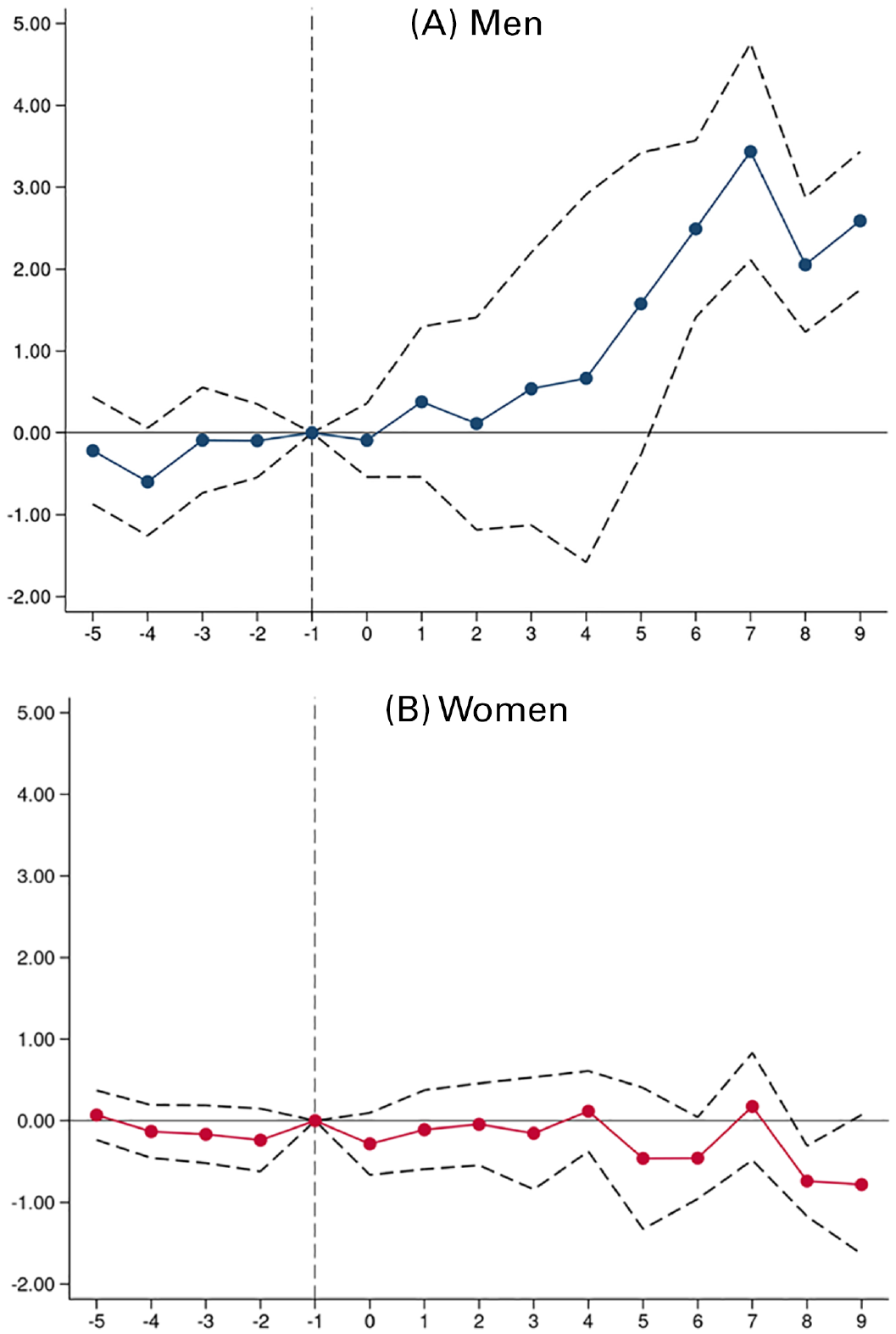
Dynamic Effect of SARE on the Rate of Entrepreneurship*
Main analysis
For our main analysis, we compared men’s and women’s propensity for entrepreneurship in municipalities where the policy reduced entry barriers to their propensity in areas where entry barriers had not yet been reduced. To confirm the overall impact of SARE on entrepreneurship, we began with a generalized difference-in-differences (DD) model. We then added the gender factor by conducting a split-sample analysis and using a difference-in-difference-in-differences estimator (DDD), which allowed us to isolate the differing impact of gender on entrepreneurial activity after a reduction in entry barriers. The two models thus assumed the following forms:


where y is our dependent variable, Entrepreneurship, SARE is a dummy variable equal to 1 if the individual resides in a municipality that has enacted the SARE program in each quarter, and CV is a vector of control variables, including individual-level controls, municipality-level controls, and municipality and quarter fixed effects. For the DDD model (2), we also included an interaction between the Woman and SARE dummy variables, and Municipality×Woman and Quarter×Woman fixed effects to control for unobservable factors that could be constant for women in different municipalities or that could change over time throughout Mexico.
In the DD model (Model 1), which measures the impact of SARE on entrepreneurship, the coefficient of interest is π. The results are presented in Models 1–3 of Table 2. First, we present the general impact of SARE on entrepreneurship in Panel A. Overall, and consistent with past research, we found that SARE increased entrepreneurship by approximately 0.4 percentage points, an increase of 5.3 percent from the pre-policy level of 7.6 percent, suggesting that the policy led to a substantial increase in entrepreneurship. There was no statistically significant change in entrepreneurship in the industries that were not associated with the policy (Model 4 in Table 2). Panels B and C represent the samples of men and women, respectively. We find that although SARE led to a significant increase in entrepreneurship for the subset of men, the SARE coefficient remained indistinguishable from 0 in the women subset. Figure 1 supports these results.
Difference-in-Differences Estimates of SARE’s Effect on Entrepreneurship for Men and Women*

p < .05; ••p < .01; •••p < .001
For legibility, outcome measures are scaled by 100. Standard errors in parentheses are clustered at the municipality level.
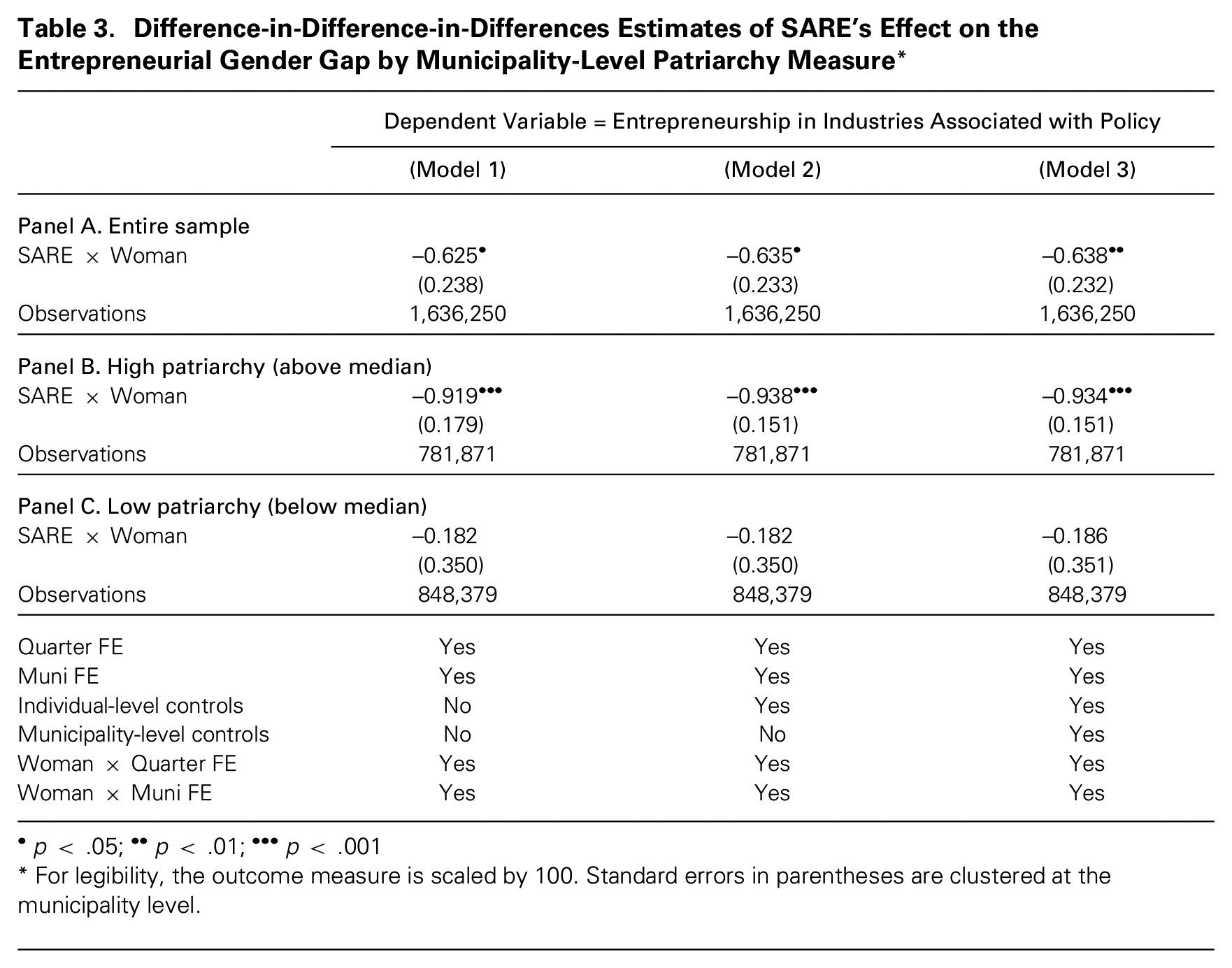
We also replicated these findings with the DDD model, in which γ in Model 2 is the coefficient of interest that measures the differential effect of the SARE policy on women versus men. The results of this analysis appear in Table 3. In Panel A, which is based on the entire sample, our findings indicate that the SARE policy can be associated with a discernible decrease in the likelihood of women—compared to men—engaging in entrepreneurship. This differential effect is highlighted by the negative interaction term (β = −0.638, p < .05). More concretely, this interaction term suggests that the SARE policy led to a relative decrease in the probability of women engaging in entrepreneurship as owners or founders, compared to men.
Difference-in-Difference-in-Differences Estimates of SARE’s Effect on the Entrepreneurial Gender Gap by Municipality-Level Patriarchy Measure*
p < .05; ••p < .01; •••p < .001
For legibility, the outcome measure is scaled by 100. Standard errors in parentheses are clustered at the municipality level.
Next, to explore the possibility that the patriarchy logic contributed to the widening of this gender gap following the policy’s implementation, we ran our DDD model separately for different groups of municipalities and then compared the resulting γ coefficients. We expected that based on the median of our patriarchy factor analysis, the interaction between SARE and Woman would be greater in communities where the patriarchy logic was stronger and less pronounced in communities where it was weaker. This method follows past research on the ways in which social context impacts the relationship between institutional change and entrepreneurship (Chatterji and Seamans, 2012). Panels B and C in Table 3 display our results. In each model, the magnitude of the coefficient of the interaction between SARE and Woman is much larger and more significant in municipalities with higher levels of patriarchy logic. This outcome, aligning with our hypothesis, suggests that in patriarchal societies, lower entry barriers may lead to more entrepreneurship for men than women and may thus widen the gender gap in entrepreneurship. We also replicated this analysis with different configurations of our measure of patriarchy, and these results are in Table A9 of the Online Appendix, with additional control variables included in Tables A10 and A11. The results are consistent with our main results in terms of statistical significance and magnitude. 6 Here we have concentrated on the gender gap in entrepreneurship, specifically looking at the owners of firms. However, we recognize that women may still be participating in entrepreneurship in alternative roles, such as through unpaid work. We explore this in more detail in the section Examining the Proposed Mechanism, to further substantiate our argument.
Robustness Checks
We conducted numerous robustness checks to provide additional evidence for our findings; Table 4 provides a summary. We began by replicating our analysis with an additional set of control municipalities: those that did not adopt the policy during our sampling time frame. To create this sample, we used propensity score-matching to match municipalities that adopted SARE during our time frame with municipalities that did not based on municipality-level characteristics and pre-policy outcome measures. Details on our matching process can be found in Table A13 in the Online Appendix, and the results are presented in Tables A14 and A15. The results are consistent with our main results in terms of statistical significance and magnitude.
Summary of Robustness Checks
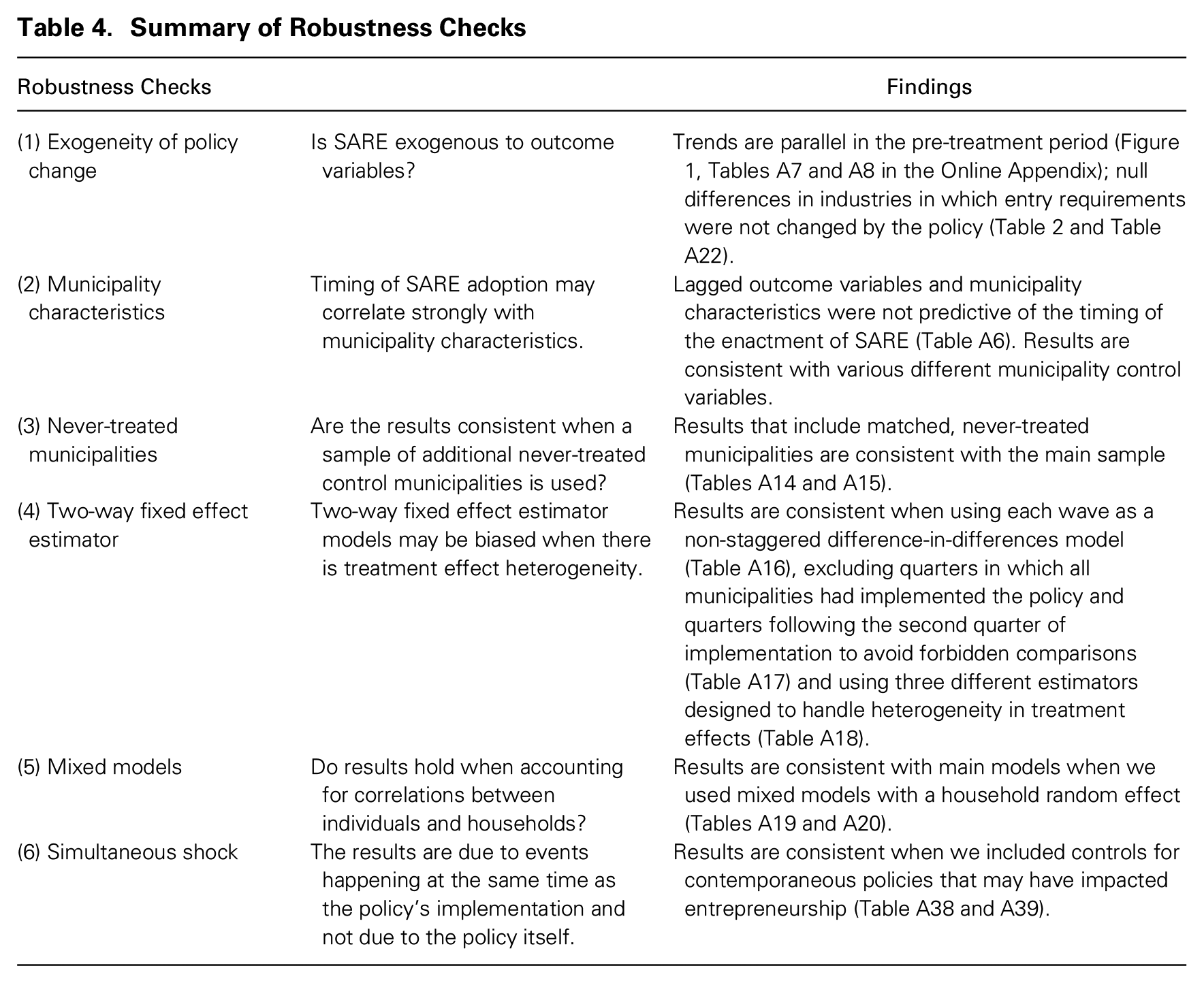
Recent studies have indicated a potential issue in the difference-in-differences framework when it uses both unit and time fixed effects, or two-way fixed effects. If the treatment is applied in several different time periods with varying effects, it can lead to biased estimates due to heterogeneous treatment effects (e.g., Callaway and Sant’Anna, 2021; Goodman-Bacon, 2021; Sun and Abraham, 2021; Roth et al., 2023). Since the adoption of the SARE policy occurred in different municipalities at different points in time, we explored how this may impact our results by following guidelines outlined in the recent literature. First, we estimated the impact of SARE on the gender gap in entrepreneurship separately for each wave of the policy, while ignoring its staggered rollout (Table A16 in the Online Appendix). Second, we excluded all observations of a municipality after the second quarter of the program’s implementation to ensure that municipalities treated earlier did not serve as controls for municipalities treated later. Third, we excluded all quarters once all the municipalities had implemented the policy (Table A17). Finally, we re-ran our models, using recently developed estimators by Callaway and Sant’Anna (2021), Sun and Abraham (2021), and Borusyak, Jaravel, and Spiess (2024). Table A18 in the Online Appendix shows these results, which are consistent with our main estimates.
Next, because individuals are nested within families, we employed multi-level mixed effects models (Woodcock, 2015; Rocha and Van Praag, 2020). To do this, we incorporated a household-specific random effect, which can adjust for unobserved heterogeneity within households. These models account for correlations between individuals belonging to the same household, which could potentially introduce bias into our estimates due to unobserved household-level dynamics. We replicated our analysis with this method and found that the results were consistent with our main analysis. The results appear in Tables A19 and A20 in the Online Appendix.
Examining the Proposed Mechanism
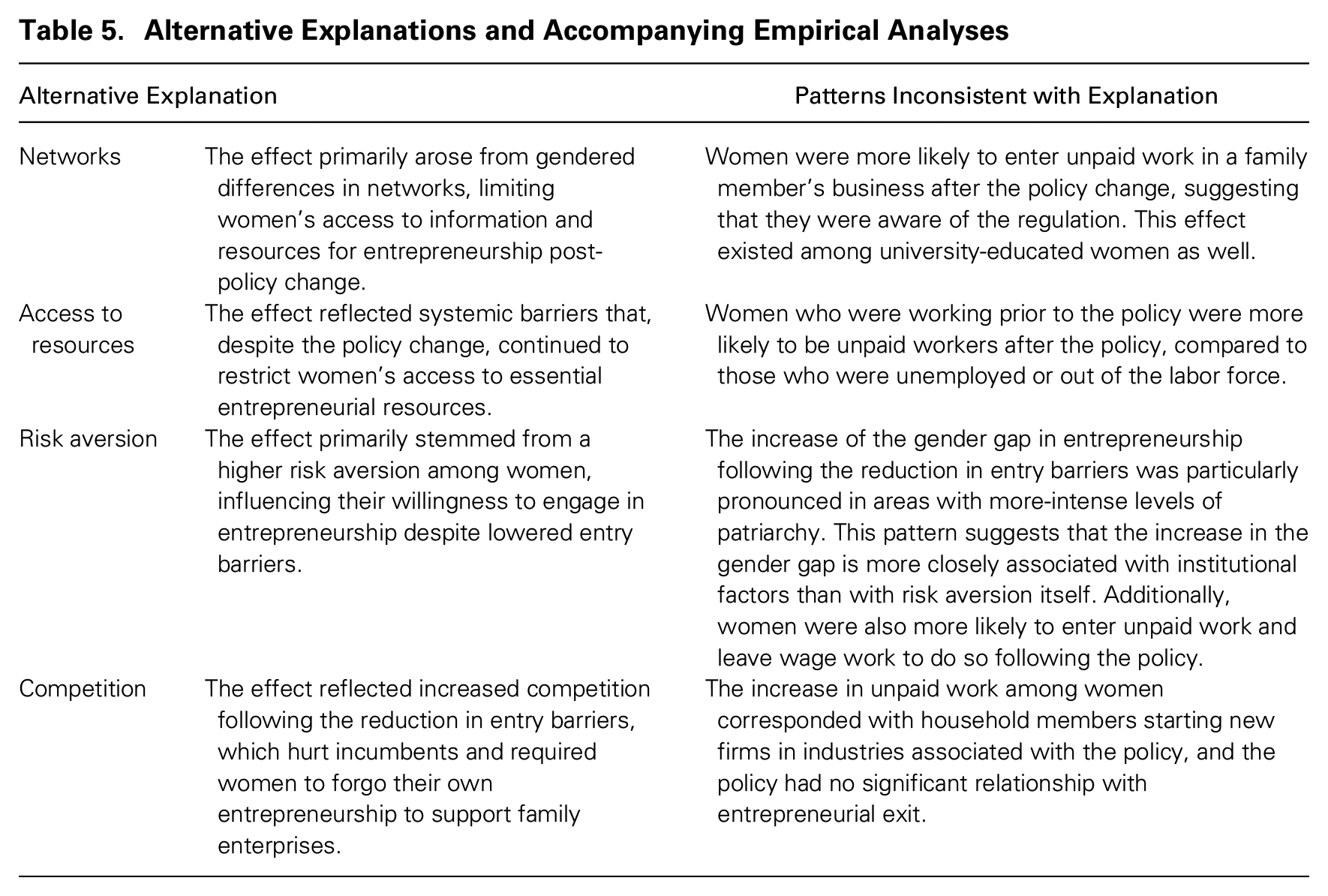
We proposed that the increase in the gender gap in entrepreneurship following the reduction of entry barriers in communities with a strong patriarchy logic is due to this logic’s normative and cognitive dimensions, which interact with lower entry barriers to discourage woman-led entrepreneurship. Beyond the qualitative anecdotes presented in Table A3, which suggest the role of these mechanisms in entrepreneurship among women in Mexico, we cannot directly state whether this logic was, in fact, the mechanism that led to the increased gender gap in entrepreneurship after the lowering of entry barriers. It is unlikely, moreover, that our theorized mechanisms were the only reason behind this effect. In this section, we examine a range of empirical patterns that are consistent with our proposed mechanism but less consistent with alternative proposed mechanisms, such as greater competition due to the policy, networks, access to capital, and risk aversion, among others. Table 5 summarizes these alternative explanations and empirical patterns that are more consistent with our theorized mechanism than with these other explanations.
Alternative Explanations and Accompanying Empirical Analyses
Examining the Impact of SARE on Unpaid Work
We theorized that the normative and cognitive dimensions of the patriarchy logic would shape the way in which individuals recognized opportunities associated with the policy change. We argued that these dimensions may make individuals less likely to recognize an entrepreneurial policy as relevant for women because such recognition would be inconsistent with gender roles and stereotypes regarding who is a capable entrepreneur. These dimensions of the patriarchy logic may lead individuals to recognize policy as relevant to men, as this belief is more consistent with the patriarchy logic. We therefore anticipated that if the increased gender gap in entrepreneurship following the reduction in entry barriers was due to normative and cognitive dimensions of the patriarchy logic rather than to the result of differences in networks, lack of access to resources, or risk aversion, then reduced entry barriers would lead to an increase in unpaid work among women. We anticipated this effect because the patriarchy logic may cause individuals to see the policy change as an opportunity for man- rather than woman-led ventures and thus women may be encouraged to support new ventures led by relatives who are men, instead of leading their own ventures or helping women with new ventures.
This assumption is also consistent with a long line of research in sociology (Aldrich and Cliff, 2003; Hook, 2010; Daminger, 2020). In contexts in which the patriarchy logic is strong, women are expected to offer their labor, without receiving personal financial reward, to family businesses (Tilly and Scott, 1989). In the mid-nineteenth century, for example, the prevalence of the patriarchy logic in the United States led most working women to engage in unpaid work in a family member’s business (Hartog, 2002; Ruggles, 2015). Ruef (2020: 22) noted that “women and girls had come to replace slaves, apprentices, and young male indentured servants as the most important source of household labor among the city’s small business owners.” Although the U.S. economy has become less reliant on unpaid family work, the legacy of this phenomenon remains a crucial factor of new venture growth in low- and middle-income economies, such as that of Mexico (Antonopoulos and Hirway, 2010).
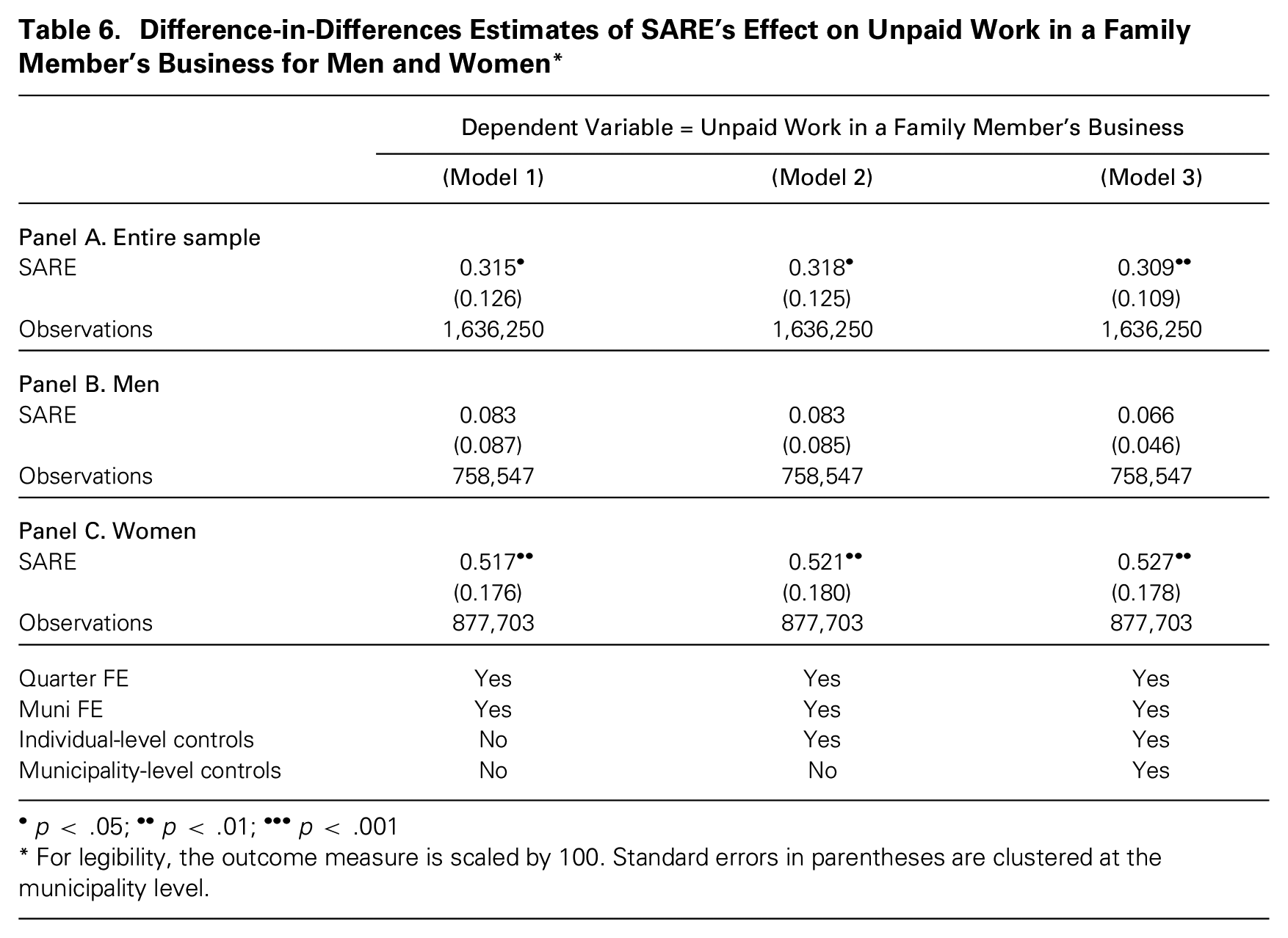
To test this, we used the same models for our main estimates of entrepreneurship but with the outcome variable Unpaid work in a family member’s business, which indicates that an individual was working for a family member’s business without pay in a given quarter. This specifically measures unpaid work in a family member’s business and does not include other forms of family labor such as housework or childcare. 7 Although unpaid workers also engage in entrepreneurship, we measured unpaid work separately because of the legal, social, and economic benefits of ownership versus working in a new venture. The difference-in-differences estimates, presented in Table 6, show a significant increase in women’s unpaid work in a family member’s business but no significant increase among men. Specifically, after the reduction of entry barriers, women’s propensity to engage in unpaid work in a family member’s business increased by approximately 15.97 percent, an increase of 0.53 percentage points from the pre-policy level of 3.3 percent.
Difference-in-Differences Estimates of SARE’s Effect on Unpaid Work in a Family Member’s Business for Men and Women*
p < .05; ••p < .01; •••p < .001
For legibility, the outcome measure is scaled by 100. Standard errors in parentheses are clustered at the municipality level.
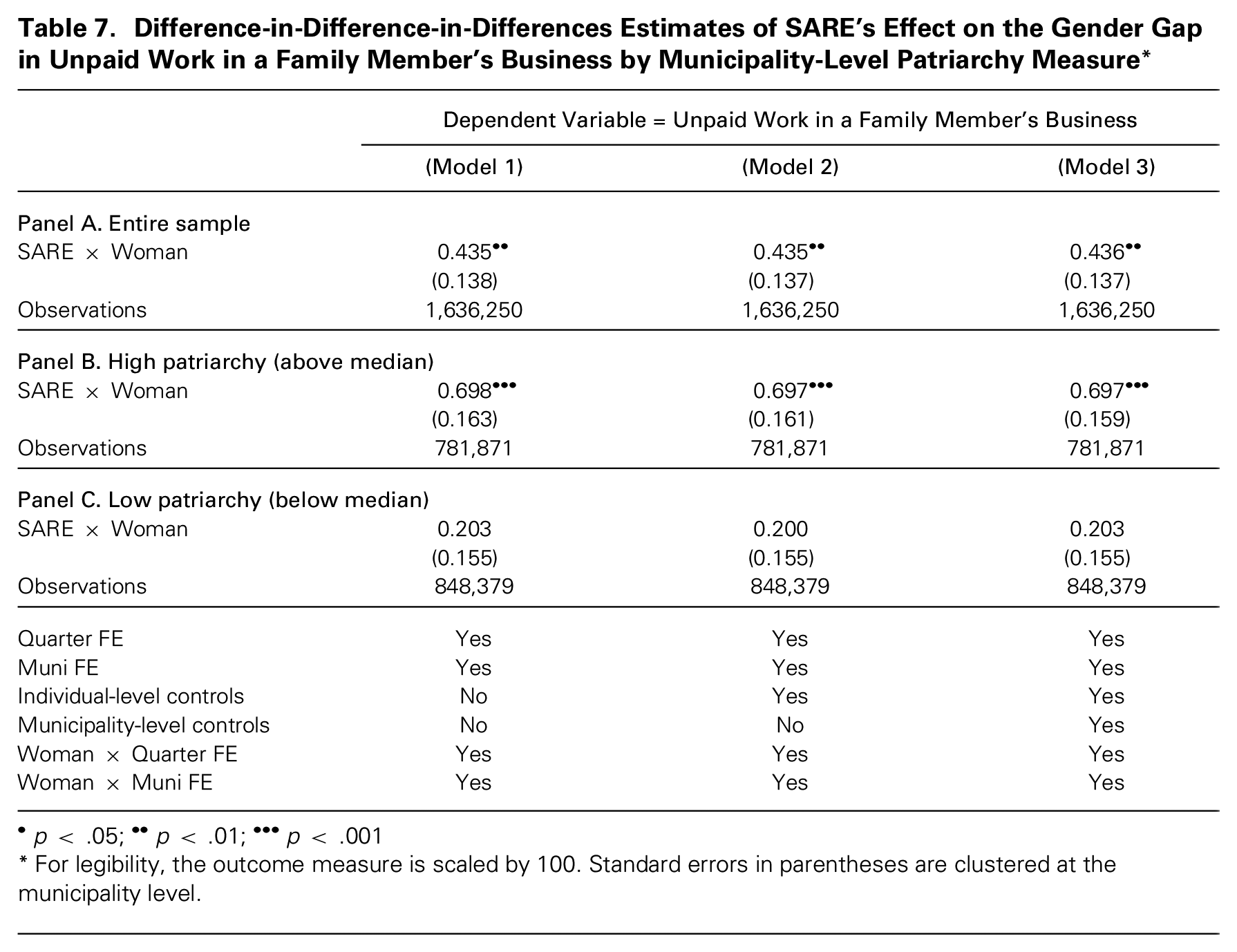
We also replicated these findings with the DDD model. Table 7 presents the results of this analysis, which show a significant increase in the gender gap in unpaid work in a family member’s business, especially in areas where the patriarchy logic is strong. In Panel A, which is based on the entire sample, our findings indicate that the SARE policy can be associated with a discernible increase in the likelihood of women, compared to men, engaging in unpaid work for a family member’s business. This differential effect is highlighted by the positive and significant interaction term (β = 0.436, p < .01), which suggests that the SARE policy led to a relative increase in the probability of women, compared to men, engaging in unpaid work in a family member’s business. Importantly, this relationship was much greater in magnitude and significance in areas where the influence of the patriarchy logic was stronger, as Panels B and C in Table 7 show.
Difference-in-Difference-in-Differences Estimates of SARE’s Effect on the Gender Gap in Unpaid Work in a Family Member’s Business by Municipality-Level Patriarchy Measure*
p < .05; ••p < .01; •••p < .001
For legibility, the outcome measure is scaled by 100. Standard errors in parentheses are clustered at the municipality level.
To check for robustness we conducted a few additional analyses. First, we estimated an event study model with the outcome of unpaid work in a family member’s business, which is displayed in Figure 2. Each point in the figure represents event study estimates using the Callaway and Sant’Anna estimator (2021). The estimates are relative to the quarter preceding a municipality’s implementation of SARE (–1). (A) shows estimates for the subsample of men, and (B) shows estimates for the subsample of women. The results show that the timing of SARE adoption is not correlated with pre-trends in unpaid work in a family member’s business. Second, we replicated the main analysis with a sample that includes matched never-treated municipalities (Tables A14 and A15 in the Online Appendix), using a mixed model with a household random effect (Tables A19 and A20) and correction methods for the two-way fixed effects estimators (Tables A18). Our results for each of these robustness checks are consistent with the results from our main model and are presented in the Online Appendix. The effect also seems to persist to the end of our time period (Table A21). Finally, we ran another placebo check to demonstrate additional evidence that the increase in unpaid work in a family member’s business was, in fact, due to the policy and not to some contemporaneous change, by drawing distinctions between the industries associated with the policy and those that were not. Our results suggest that entry into unpaid work in a family member’s business was driven by entry into industries associated with the SARE policy rather than by entry into unpaid work in industries not associated with the policy (Table A22).
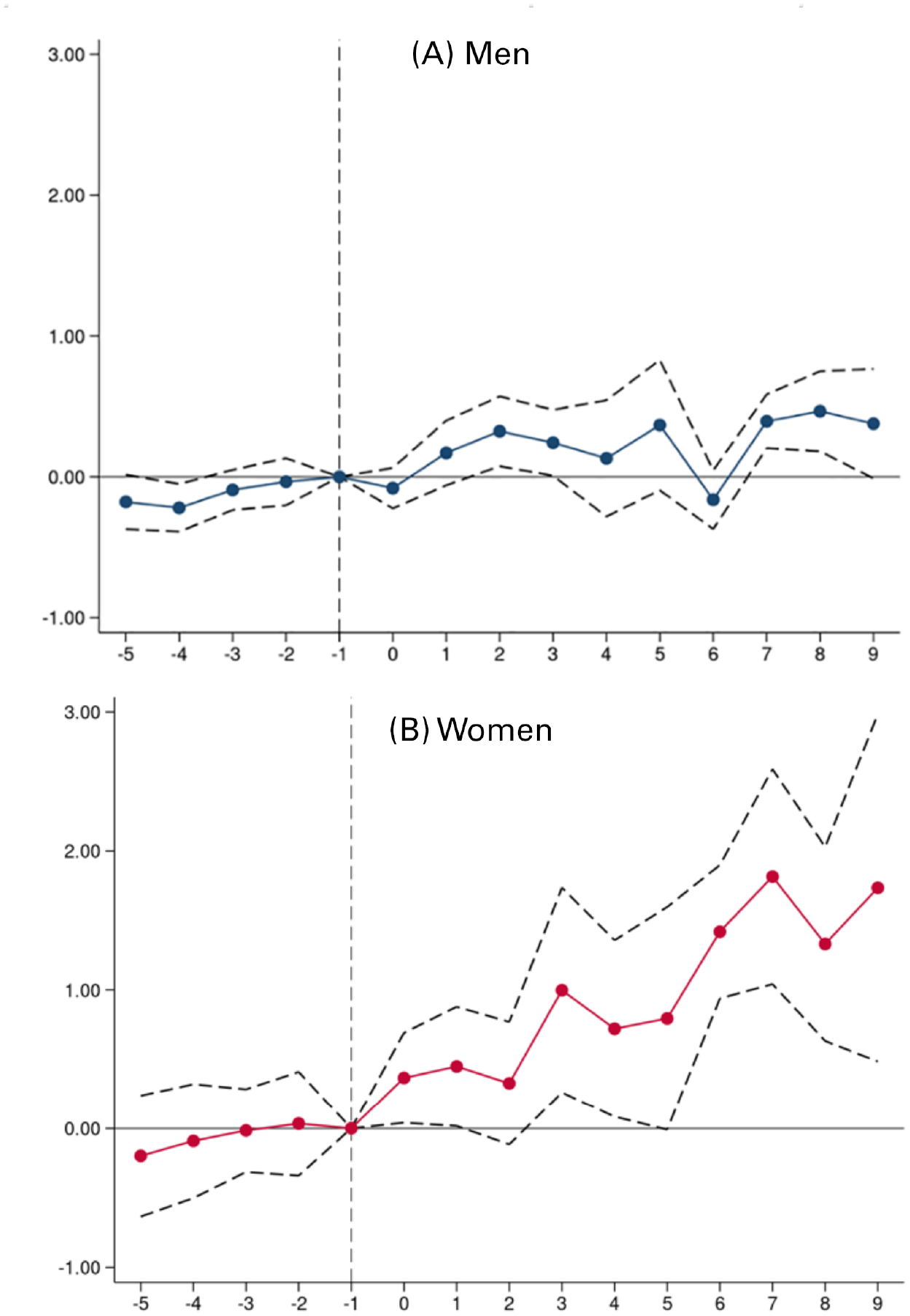
Dynamic Effect of SARE on the Rate of Unpaid Work in a Family Member’s Business*
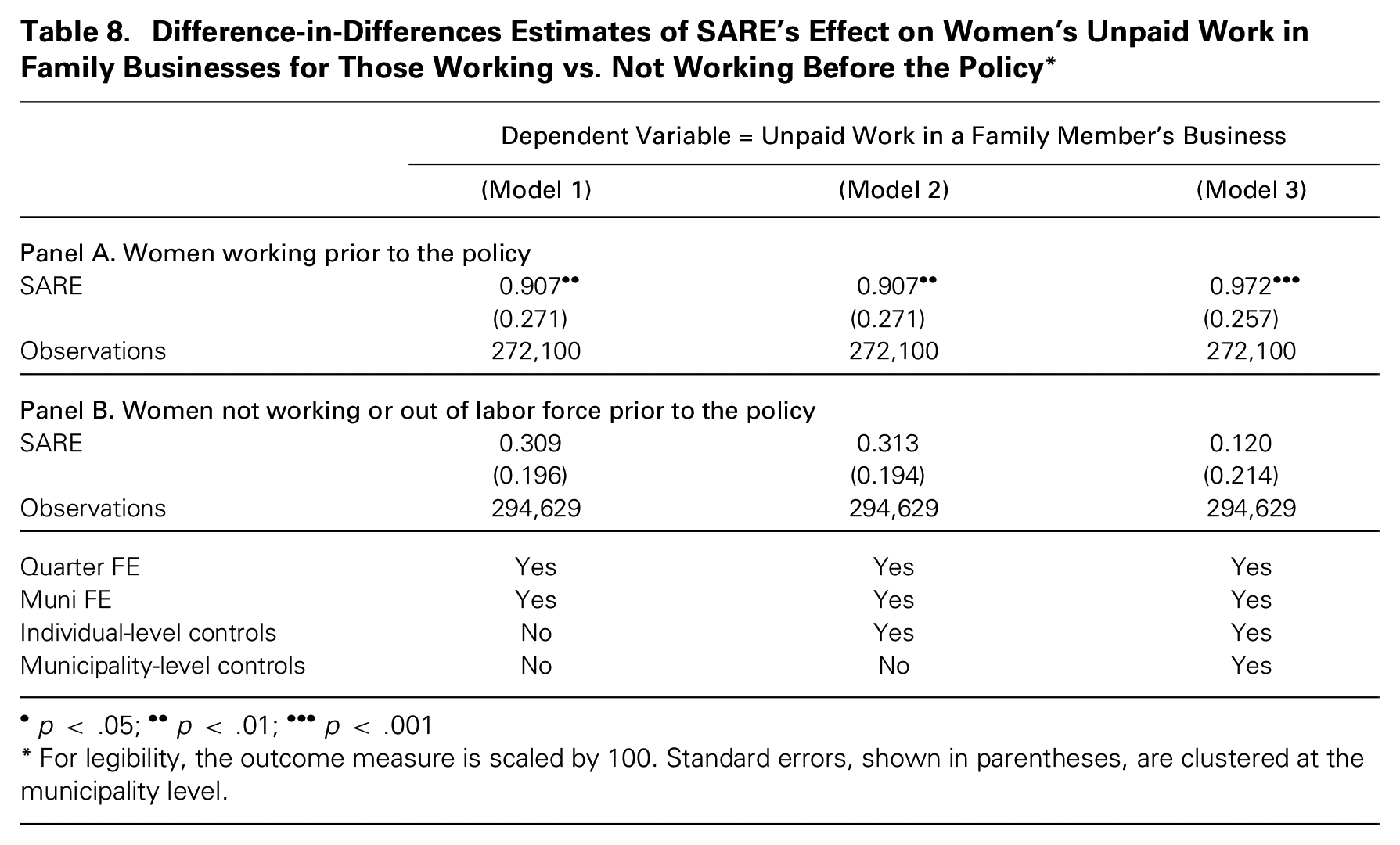
We further investigated the factors driving the increase in unpaid work among women, specifically examining whether this trend was primarily driven by women who were already employed before the policy was implemented or by those who were previously unemployed or outside the labor force before the policy was introduced. We determined employment status prior to the policy by individuals’ employment status when they were first observed in the survey. We dropped the first period of observation for each person in the analysis because their employment status in the previous period was unknown. The results, presented in Table 8, show a significant impact of SARE on women’s unpaid work in family businesses for women working before the policy. However, we find no significant effect of the policy on the likelihood of entry into unpaid work for women who were unemployed or not in the labor force prior to the policy. 8 This indicates that access to resources may not be the primary explanation for the effect. Instead, SARE seems to have redirected women already engaged in the labor market to enter unpaid work in a family member’s business. To further understand this phenomenon, we explored the career implications of unpaid work in a family member’s business. While it is likely that unpaid workers often undertake significant managerial roles within family businesses, the impact of these roles on future employment outcomes remains uncertain. Using an event study model with individual fixed effects, our results suggest that women’s individual income decreases in the quarters following entry into unpaid work in a family member’s business (see Figure A2 in the Online Appendix). 9 This finding suggests that entering unpaid work in a family member’s business leads to lower future individual earnings. We are limited, however, in estimating the longer-term impact because our data only follow an individual for at most five quarters and may not capture other forms of compensation.
Difference-in-Differences Estimates of SARE’s Effect on Women’s Unpaid Work in Family Businesses for Those Working vs. Not Working Before the Policy*
p < .05; ••p < .01; •••p < .001
For legibility, the outcome measure is scaled by 100. Standard errors, shown in parentheses, are clustered at the municipality level.
We also explored the potential impact of SARE and unpaid work in a family member’s business on household income and find no discernible impact of SARE on household income (Table A24). We find that households with unpaid workers in a family business had less income for the first two quarters following SARE. After the third quarter post-SARE, however, the estimates were not significantly different from 0, as shown in Table A25. This suggests the possibility that unpaid work in a family member’s business may have led to an immediate loss in family income in the short run, as a household member forgoes individual income to help a new business, but that this penalty decreases in the long run, potentially due to greater income from the family business. These results suggest that improving household income may be one motivation for women to enter unpaid work in a family business. These results do not, however, directly consider the non-pecuniary benefits of performing unpaid family labor, such as schedule flexibility or less need for help with childcare, which could provide value for women and families in our context.
These analyses reveal that while the policy failed to boost entrepreneurship led by women, it did lead to a significant increase in women's participation in entrepreneurial activities. However, the patriarchy logic shaped the types of roles women assumed in new ventures, such as by encouraging unpaid positions that aligned with normative expectations and discouraging women from starting their own businesses.
Examining the Effects of Marriage
For an additional test of our mechanisms, we examined whether the effect was greater for married individuals. Research indicates that marriage tends to amplify gender roles and expectations (Lorber, 1994; Ridgeway, 2011). In social contexts with a strong patriarchy logic, the husband is the primary breadwinner, while the wife is expected to focus on domestic responsibilities (Hartog, 2002). The patriarchy logic thus places additional pressure on married women to prioritize their husband’s career and domestic duties over their own entrepreneurial endeavors, which could impact entrepreneurship rates and performance among women (Delecourt and Fitzpatrick, 2021). For example, Yang and Aldrich (2014) found that women have reduced chances to oversee the daily operations of a new business if they co-found new businesses with their husbands, compared to when they co-found with someone who is not their spouse.
Married men, in contrast, may benefit more than single men from gender roles in patriarchal societies. A division of labor can grant married men more time and resources to devote to entrepreneurship, along with direct and indirect support from their spouses (Ruggles, 2015). Thus, if our results were, in fact, driven by normative and cognitive mechanisms related to the patriarchy logic, we would expect that the increase in the gender gap in entrepreneurship would be especially strong for married women. We tested whether the impact of lower entry barriers on the gender gap in entrepreneurship was greater for married individuals, by re-estimating the DDD model but using a split-sample analysis for married and unmarried individuals. The results, which are presented in Table A26 in the Online Appendix, show that married individuals primarily drove SARE’s effect on the gender gap in entrepreneurship and unpaid work in a family member’s business. 10 We also replicated these same analyses but split the sample by childbearing age and whether a woman had children, and we find comparable results (Tables A29, A30, and A31).
Individual-Level Experimental Analysis
Although our analyses lend support to our arguments, our observational data lack details of the micro-level motivations that enable the patriarchy logic to discourage women from entering entrepreneurship. To examine this further, we conducted an exploratory experimental vignette study of 400 native-Spanish-speaking Mexican women on Prolific.com, detailed in Online Appendix B with descriptions and results in Tables A32, A33, and A34. The results offer suggestive evidence that both the normative and cognitive mechanisms of the patriarchy logic impact how women in Mexico recognize and exploit entrepreneurial opportunities associated with policy changes that lower entry barriers. However, in Online Appendix B we also discuss the limitations of our approach, which include social desirability bias and the challenges associated with measuring normative and cognitive institutions. The experiment does, however, offer an independent sample consistent with the trends we document in our main analysis.
Other Alternative Explanations
Competition
Another alternative explanation for our findings could be that the SARE policy increased competition from new entrants, which could cause women to forgo their own entrepreneurship and instead help men family members’ businesses through unpaid work. We explored this alternative explanation in two ways. First, we created a variable to measure entrepreneurial exit and examined the impact of the SARE policy on this outcome; we find no significant relationship, which suggests that competition might not be the key factor influencing women’s choice between entrepreneurship and unpaid work in a family member’s business (Table A35). Second, we found evidence of significant rates of co-occurrence between a given woman’s entry into unpaid work in a family member’s business and a man in the household having recently entered into entrepreneurship (Table A36). This finding suggests that women’s entry into unpaid work in family members’ businesses was driven by new family businesses, not by women supporting struggling incumbents.
Municipality development
Another potential explanation for the increase in the gender gap following the policy is the role of municipality development or public services. To explore this, we created an index to measure local devolvement of infrastructure, using data from Mexico’s National Council for the Evaluation of Social Development Policy to conduct a principal component analysis of the local piped water, drainage system, and electricity infrastructure in each municipality. We then replicated our analysis from Table 3 to see whether there was any difference between areas with strong (above the median) and weak (below median) public services in terms of the increased gender gap in entrepreneurship following the policy change. We find that there were no significant differences between these two groups (Table A37). This result suggests that municipality public services are likely not the most important mechanism that explains the gender gap following the policy change. However, the index used here is limited in that it focuses primarily on infrastructure-related variables. It does not include other important factors that women may rely on, such as childcare facilities, health care access, or public transportation.
Simultaneous Shocks
We also explored the possibility that changes in the gender gap in entrepreneurship were due to events happening at the same time as the policy’s implementation and not due to the policy itself. However, the empirical support for the mechanisms consistent with our theory mitigates this worry. If our findings were influenced by other policy changes or shocks occurring concurrently, then it would be surprising to find such consistency with our proposed mechanisms. Similarly, the staggered introduction of the policy reduces the probability of it coinciding with unobserved events that might occur simultaneously. Still, to increase confidence in our findings, we conducted a search of potential simultaneous policy changes or macroeconomic shocks in Mexico that occurred within the time frame of our analysis in our treated municipalities. We identified two other contemporaneous events that might potentially impact our results. In 2003, a policy began to expand access to subsidized health insurance (Conti and Ginja, 2023). Hence, one might think that increased access to health care affected entrepreneurship, leading to spurious correlations in our estimates. Second, a new bank, Banco Azteca, opened nearly 800 branches in October 2002, which led to increased amounts of credit available to business owners (Bruhn and Love, 2011, 2014). We collected data on the timing of the staggered adoption of the health care policy and included an indicator in our analyses for when the policy was implemented in specific states. We also included a dummy indicating whether a municipality had a Banco Azteca branch, which takes the value of 1 after the third quarter of 2002 when the branches were open. We report the results in Tables A38 and A39 in the Online Appendix. Adding these controls does not substantively change the significance or magnitude of our estimates for entry into entrepreneurship or unpaid work in a family member’s business. 11
Discussion
Prior research suggests that policy efforts that reduce barriers to entry can facilitate entrepreneurial activity among underrepresented groups (Chatterji and Seamans, 2012; Castellaneta, Conti, and Kacperczyk, 2020). This argument hinges on the premise that underrepresented groups often face multiple barriers that prevent them from entering entrepreneurship and thus stand to benefit more from lowered entry barriers, compared to other groups. Empirical results, however, suggest that similar policies can have profoundly different effects across different institutional contexts. While some studies have found that policy changes that lower entry barriers increase entrepreneurship among underrepresented groups, others have shown that similar initiatives have minimal impact (Field, Jayachandran, and Pande, 2010; Bruhn and Love, 2011; Berge, Bjorvatn, and Tungodden, 2015).
Our study used institutional theory to explain variation in how a policy may interact with local institutional logics that hinder entrepreneurship among underrepresented groups. We argued that cognitive and normative mechanisms may account for why local institutional logics decrease the ability of lower entry barriers to facilitate entrepreneurial entry for these groups. We argued that internal cognitive and normative mechanisms may influence the ways in which underrepresented groups perceived the relevance of policies intended to facilitate entrepreneurship. And external cognitive and normative mechanisms may deter these groups from exploiting entrepreneurial opportunities by reinforcing stereotypes about their entrepreneurial abilities or raising concerns about potential social sanctions for deviating from the norm.
We examined our theory in the context of Mexico’s SARE program, which lowered entry barriers for new businesses. Central to our analysis is the strong influence of patriarchy logic in Mexico, which discourages woman-led entrepreneurship. Our findings indicate that the policy change widened the gender gap in entrepreneurship by boosting man-led entrepreneurship while having minimal to no impact on woman-led entrepreneurship. Further analyses provide suggestive evidence of the cognitive and normative mechanisms we proposed. First, the policy resulted in more women, primarily those already employed before the policy, becoming unpaid workers in family businesses. Although the policy did not lead to an increase in woman-led entrepreneurship, it did result in more women participating in new businesses. However, the prevailing patriarchal norms influenced the roles women took on in these ventures, often leading them to unpaid supportive positions for men entrepreneurs rather than encouraging them to launch their own businesses. Second, we discovered that the effect was more pronounced among women who were married and those who lived in areas where the patriarchy logic was more pronounced. These women potentially face increased backlash for deviating from local norms and may be encouraged to support men relatives’ ventures instead. This observation supports our argument that normative mechanisms shape the exploitation of opportunities following a policy change. Finally, in an experimental vignette study of 400 Mexican women, we find evidence consistent with our main findings. Overall, our analyses suggest that in environments in which local institutional logics do not support entrepreneurship among underrepresented groups, initiatives to reduce barriers to entry may, in fact, widen the entrepreneurial gap in foundings between these groups and the population at large.
This article advances nascent literature on how policies designed to lower entry barriers into entrepreneurship affect underrepresented groups. As noted, previous literature suggests that people facing significant obstacles in entrepreneurship benefit from policies that lower entry barriers, but the empirical findings are mixed. Drawing on institutional theory, we contribute to this research by arguing that policy will fail to spur entrepreneurship among underrepresented groups if local societal norms (normative institutions) and taken-for-granted expectations (cognitive institutions) discourage entrepreneurship among such groups. We also show that the patriarchy logic redirects the impact of policy on woman-led entrepreneurship through cognitive and normative mechanisms, thereby increasing the gender gap in entrepreneurship and women’s entry into unpaid work in a family member’s business.
This research contributes to institutional theory by unpacking the specific mechanisms through which institutional logics can moderate the impact of policy changes on entrepreneurship (Eberhart and Eesley, 2018; Eesley et al., 2018; York, Vedula, and Lenox, 2018; Armanios and Eesley, 2021). Previous studies have indicated that the informal aspects of an institutional environment, such as logics, values, and beliefs, can interact with formal policies and thus either enhance or diminish entrepreneurial activities (Marquis and Qiao, 2020). However, the specific processes underlying these interactions have remained largely unexplored. Our research delves into how the cognitive aspects of institutional logics affect the ways in which individuals recognize entrepreneurial opportunities arising from policy changes, for themselves and for others. Concurrently, due to societal expectations, the normative aspects of these logics push individuals toward exploiting new entrepreneurial opportunities or other forms of labor participation. We also respond to the scholarly inquiry posed by Lounsbury et al. (2021) by empirically exploring logic incoherence. Our study reveals that a policy designed to lower entry barriers, ostensibly to promote entrepreneurship, lacked coherence with both the normative and cognitive dimensions of patriarchy logic. This incoherence resulted in an unintentional outcome of the policy change: a widening gender gap in entrepreneurship and increased instances of unpaid work among women in family members’ businesses.
This study also advances the literature on gender dynamics in the labor market by examining how family ties affect women’s professional experiences (Doering and Thébaud, 2017; Ranganathan and Pedulla, 2021; Yang, Kacperczyk, and Naldi, 2023). Previous research has explored how motherhood influences employment outcomes and entrepreneurship, but the link between marriage and either women’s employment or choice to be an entrepreneur has been less understood (Light, 2004; Correll, Benard, and Paik, 2007; Killewald and Gough, 2013; Marshall and Flaig, 2014). Our findings shed light on the link between marriage and women’s professional choices by showing that, following a reduction in entry barriers, married women are less likely to engage in entrepreneurship and more likely to engage in unpaid work for businesses owned by relatives who are men. The result suggests that marriage can reinforce patriarchal structures in the labor market and affect women’s employment outcomes.
Additionally, by theorizing and empirically demonstrating the mechanisms explaining how logics interact with new policy to affect the propensity of underrepresented individuals to start new ventures or enter other forms of labor, our study addresses scholarly calls to examine “the social conditions that make entrepreneurial activity more easily accessible” for specific social groups (Tolbert, David, and Sine, 2011: 1340). The implications are significant for public policy, particularly regarding government intervention to foster entrepreneurship among women (Doering and Liu, 2019; Marx, 2022). Our findings suggest that policies aimed at promoting entrepreneurship must consider not only the unique challenges faced by women, such as greater difficulties in accessing resources, but also the norms and expectations that discourage women from entering entrepreneurship.
Limitations
Some limitations of this study provide opportunities for future research. We conducted numerous empirical analyses that provide evidence consistent with our proposed mechanisms. However, we were unable to determine which of our proposed mechanisms—normative or cognitive, operating internally or externally—plays a more significant role. Future research could also examine the conditions under which other mechanisms shape who enters entrepreneurship following a policy change, such as network differences (Dimitriadis and Koning, 2022), local politics (Inoue, 2020; Raj, 2021), or labor market discrimination (Hwang and Phillips, 2024; Pongeluppe, 2024). Additionally, while our study focuses on patriarchy, it is challenging to differentiate the effects of patriarchy from those of related family dynamics and responsibilities. Future research should pay closer attention to the role of families in entrepreneurship (Aldrich et al., 2021).
Our study is limited by its geographical focus. We analyzed the impact of patriarchy within a single country following one specific policy change. Future research should explore how policies affect entrepreneurship among underrepresented groups in various contexts. Although Mexico provides a context that is relatively generalizable, with a strong patriarchy logic alongside more-progressive policies common to many other national contexts, this scenario is not uniform across all countries. Exploring other contexts such as West Asia, the Middle East, and Northern Africa, where patriarchy is more formally connected with the law, would enhance our understanding of how varying degrees of patriarchal intensity influence how policy changes impact entrepreneurship among women.
Similarly, future research could examine how the type and form of institutional changes affect the impact of policies designed to increase entrepreneurship. While our study focuses on a policy that decreased the time and administrative hurdles for starting a business, further investigation is needed into how policies incorporating training, mentorship, grants, or other initiatives might yield different outcomes (Lyons and Zhang, 2017; Assenova, 2020). Additionally, this study explores the impact of a policy that reduced entry barriers for all entrepreneurs. Future research should assess the applicability of our theory to targeted policies aimed at specific groups (Chatterji, Chay, and Farlie, 2014). Researchers should also investigate the significant role of institutional changes unrelated directly to entrepreneurship but that create favorable conditions for business creation. For example, the availability of quality education institutions, accessible childcare services, health care, or public transportation can greatly impact women’s capacity to launch businesses following policy changes (Bao, 2022, 2024). Exploring these types of institutions might improve our understanding of the non-pecuniary benefits of unpaid family labor for women and their families, such as increased flexibility and childcare support, which we were not able to directly measure with our data.
Another limitation of our study is its focus solely on entrepreneurial entry. Future research should continue to examine many other significant processes within entrepreneurship that warrant further investigation (Ding, Ohyama, and Agarwal, 2021; Delecourt and Ng, 2023). Recent studies indicate that women entrepreneurs are less likely than men to differentiate their businesses and tend to profit less than men when they do differentiate (Carlson, 2023). Further research could investigate how patriarchy and other informal institutions shape differentiation and innovation in woman-led ventures. Additionally, the data from this study track individuals for only five quarters, which constrained our ability to evaluate long-term impacts and variations within individuals. Future research should use different data sources to explore a wider array of long-term career outcomes (Dobrev, Claes, and Godart, 2023).
Supplemental Material
sj-pdf-1-asq-10.1177_00018392241283008 – Supplemental material for Cultural Norms and the Gendered Impact of Entrepreneurship Policy in Mexico
Supplemental material, sj-pdf-1-asq-10.1177_00018392241283008 for Cultural Norms and the Gendered Impact of Entrepreneurship Policy in Mexico by Grady W. Raines, Peter S. Polhill, Shon R. Hiatt and Ryan S. Coles in Administrative Science Quarterly
Footnotes
Acknowledgements
We express appreciation to associate editor Olenka Kacperczyk and three anonymous reviewers for helping us to refine this study. We would also like to thank Howard Aldrich, Brittany Bond, Solène Delecourt, Sean Fath, Andrew Foley, Joan Friedman, Heather Haveman, Nate Hill, Kenneth Huang, Ashleigh Imus, Hans Christian Kongsted, Wesley Sine, Pamela Tolbert, Milo Wang, Qian Wang, Zhibin Ye, Cristobal Young, as well as seminar participants at the Academy of Management Conference, Cornell University, EGOS, Entrepreneurship, Innovation and Policy Seminar, Global Entrepreneurship and Innovation Research Conference, INSEAD Doriot Entrepreneurship Conference, University of Connecticut, and University of Southern California for their constructive feedback. Finally, appreciation goes to Miriam Bruhn for sharing data.

1
Following prior studies, we define entrepreneurs as individuals identified as owners of a business (Thébaud, 2015; Castellaneta, Conti, and Kacperczyk, 2020). While early hires and unpaid workers also engage in entrepreneurial activities, we focus on owners to align with past literature and acknowledge the distinct legal, social, and economic benefits of ownership versus working in a new venture.
2
Our study follows York, Vedula, and Lenox (2018) by focusing on the informal components of logics, emphasizing the role of underlying values, beliefs, and norms in shaping the impact of a policy change.
4
This reflects the percentage of women 12 years and older who are in the labor force, regardless of whether they are employed or not.
5
We also replicated our analyses with a sample that includes never-treated municipalities, which we discuss below.
6
7
8
10
11
The results suggest that the adoption of the health care policy is correlated with an increase in entrepreneurship and unpaid work in a family member’s business. In contrast, the bank expansion showed no significant correlation with our outcomes within our sample of municipalities.
Authors’ Biographies
References
Supplementary Material
Please find the following supplemental material available below.
For Open Access articles published under a Creative Commons License, all supplemental material carries the same license as the article it is associated with.
For non-Open Access articles published, all supplemental material carries a non-exclusive license, and permission requests for re-use of supplemental material or any part of supplemental material shall be sent directly to the copyright owner as specified in the copyright notice associated with the article.
