




Abstract
Many organizations want to increase diversity among their workforce, but employees from marginalized groups consistently face uncertainty about how to navigate their identities at work, which can lead to high turnover among these employees. To highlight the unexpected ways in which such risks can arise for employees and organizations, we investigate the intrapersonal consequences of a curation approach to navigating social identities in the workplace. Curation involves frequent identity expression (integrating an identity into the workplace, such as discussing identity-based traditions) and frequent identity suppression (concealing aspects of an identity at work, such as hiding concerns about discrimination). Given that expression and suppression both have benefits and risks, combining these behaviors into a curation approach could be seen as a socially adept and professionally beneficial solution. However, focusing on the intrapersonal experiences of employees of color, we argue that, compared to primarily expressing or primarily suppressing a minority identity, curation is more psychologically detrimental to these employees. Combining expression and suppression fosters ambivalence—conflicting thoughts about whether one’s identity is a resource or a liability—which is psychologically aversive. In two surveys and an internal meta-analysis (of the two studies in the manuscript and a supplemental study reported in supplementary online materials), curation was associated with greater ambivalence and psychological strain, which, in turn, were associated with greater turnover intentions. While our core findings emerge with employees of color, we also provide exploratory evidence that the costs of curation extend to women. Our findings regarding curation reveal a previously unrecognized well-being risk for employees from marginalized groups and a retention risk for organizations. We offer recommendations for future research and practice to address the conditions that lead employees to engage in curation.
The loss of diverse talent is a major challenge facing organizations today. Employees of color are significantly more likely to leave their organizations, compared to majority-group colleagues (Hofhuis et al., 2014; McKay et al., 2007), in part due to the former group’s subtle yet pervasive experiences with discrimination (Hebl et al., 2020). This outcome is costly, not only for the individuals, who must start over in their jobs, but also for organizations, which invest considerable resources in hiring, training, and integrating new talent (Dess & Shaw, 2001; Laser, 1980). Thus, researchers have examined why racial and ethnic minority employees leave and have tried to identify strategies to remedy this issue.
One well-established reason that employees of color exit their organizations is to seek relief from the psychological burden of concealing who they are in order to fit in and get ahead. Many employees hide or downplay marginalized identities to avoid drawing attention to negative stereotypes that can undermine their desired professional image (Roberts, 2005). While this behavior, termed identity suppression, can arguably serve as a useful and essential tool for career advancement, it comes with a trade-off: Hiding important aspects of the self leaves employees feeling depleted and questioning whether their organization is the best place for their well-being (Hewlin, 2009; Quinn et al., 2017; Roberts et al., 2014). As a result, scholars have increasingly shed light on how being more authentic and embracing one’s identity in the workplace, referred to as identity expression, can boost well-being and commitment (Madera et al., 2012; Roberts et al., 2008; Roberts & Nkomo, 2025). However, research has also identified the potential for unexpected interpersonal and professional costs of expressing one’s identity despite the potential psychological benefits (Cha et al., 2019; Cha & Roberts, 2019; Clair et al., 2005; Phillips et al., 2009). Taken together, these findings reveal a long-standing challenge that employees of color face, wherein either identity management strategy can result in trade-offs between external and internal goals, such as credibility versus authenticity (Roberts, 2005), forcing employees to engage in a “cost-benefit analysis in deciding whether to pass or reveal” (Clair et al., 2005, p. 89).
One potential solution to the myriad challenges associated with engaging in either expression or suppression lies in adopting an expansive portfolio of identity management behaviors that encompasses both expression and suppression—an approach we term curation. Curation is an approach to identity management characterized by a tendency to both frequently express and suppress an identity at work. For instance, a person may open up about challenging experiences with immigration or discrimination during lunch with teammates but shift the conversation away from these topics during work meetings with a supervisor. Alternatively, a person may educate their colleagues about less-understood traditions they celebrate but hide aspects of their identity that are negatively stereotyped, such as foods they enjoy. Past work has been suggestive of this approach (Chrobot-Mason et al., 2001; Roberts et al., 2008; Smith et al., 2019), noting that some employees may resolve the dilemma of whether to express or suppress by having a large “repertoire of passing and revealing behaviors” (Clair et al., 2005, p. 87).
We do not currently know whether curation is a solution. Indeed, this identity management approach remains theoretically underdeveloped and empirically unexamined, particularly regarding the intrapersonal consequences, such as well-being and turnover intentions. This gap remains for several reasons. First, some research on intrapersonal consequences investigates the effects of one strategy only (e.g., suppression; Hewlin, 2009; King & Botsford, 2009) but not both, or theorizes the separate effects of expression and suppression but not the impact of using both in combination (e.g., Lyons et al., 2014; Mohr et al., 2019). Second, other lines of research consider expression and suppression to be diametrically opposed, such that engaging in more of one assumes engaging in less of the other (e.g., Day & Schoenrade, 1997; Griffith & Hebl, 2002), thereby precluding the possibility that these behaviors can be combined. Third, to the extent that past research has considered expression and suppression in combination, it has focused on their interpersonal effects. Specifically, scholars theorize that engaging in both expression and suppression is an adept form of impression management that can enable employees of color “to reach their career goals and to maintain positive relationships” (Roberts et al., 2008, p. 298). While this theorizing suggests the potential relational and professional benefits of curation, it is also important to develop theories about intrapersonal effects that may drive decisions to leave an organization.
We shine a light on the intrapersonal ramifications of curation to paint a more holistic picture of what employees of color stand to gain or lose when they rely on both expressing and suppressing a minority identity. If curation can uplift employees of color psychologically, then it could potentially resolve the long-standing dilemma of how to best navigate a minority racial/ethnic identity, by offering a holistically beneficial option. That is, given the previously theorized interpersonal and professional advantages of both expressing and suppressing (Roberts et al., 2008), if using this approach also enhances well-being then it may be a much-needed solution for those urgently seeking an ideal way to navigate their marginalized identities at work. Curation could potentially augment well-being if, for instance, its ability to enable stronger relationships and career success satisfies fundamental needs for belonging and achievement (Maslow, 1943). However, we propose that a curation approach is deleterious for well-being and retention. Evaluating curation through an ambivalence theoretical lens (Ashforth et al., 2014; Emmons & King, 1988; Rothman et al., 2017) reveals that this approach preserves inconsistent and contradictory views that a minority identity can be both a resource and a liability. This ambivalence leaves employees feeling uncertain and distressed about the consequences of their actions in the wake of either expressing or suppressing their identities (van Harreveld et al., 2009a). As a result, expression, when combined with suppression, actually amplifies—rather than attenuates—psychological strain, leading to worse well-being than any other identity management approach. We propose that employees of color cope with this psychological strain by planning to exit their organizations. We examine these possibilities in two survey studies, a supplemental study reported in the supplementary online materials, and an internal meta-analysis. While our findings center the experiences of employees of color, we also explore whether our predictions extend to women.
Our research contributes to scholarship on identity management and diversity at work. We not only bring to the forefront curation as an identity management approach but also unveil its detrimental psychological consequences, thereby broadening scholarly discourse regarding the holistic experience of this approach. In doing so, we both highlight a potential downside associated with curation and speak to just how elusive it can be to identify an identity management approach that is optimal (i.e., beneficial both professionally and psychologically) for people of color and potentially other marginalized groups. More broadly, our research moves beyond solely examining expression and suppression as isolated constructs and calls attention to the importance of investigating them jointly. Such joint investigations can provide insight into a person’s overall portfolio of identity management behaviors and thereby lead to unique insights, such as the potential for expression and suppression to interfere with each other, trigger ambivalence, and lead to adverse intrapersonal outcomes.
Theoretical Background: Social Identity Management
In the workplace, members of marginalized groups grapple with how to present their social identities. Social identities refer to collective groups that individuals belong to and are defined as “the significance and qualitative meaning that individuals accord their group membership within their self-concept” (Roberts et al., 2008, p. 272). Social identities include various cognitions, such as self-categorization into the group, importance of the group to the self, personal regard for the group, and perceptions of others’ regard for the group (Ashmore et al., 2004). When we refer to “identity” in this article, we specifically mean social identities. Racial and ethnic minority identities are social identities that are historically marginalized, such that people who possess these identities are often devalued and excluded from opportunities (Bell, 1990). Moreover, race and ethnicity are considered visible identities because they typically include observable, rather than concealable, characteristics (Clair et al., 2005; Roberts, 2005). The challenges that employees of color face in navigating their identities in the workplace have led scholars to produce a robust literature on identity management (Cha & Roberts, 2019; Roberts et al., 2008; Thomas, 1993), which focuses centrally on how employees—particularly those from marginalized groups—decide between identity expression and suppression (Cha et al., 2019; Phillips et al., 2009; Roberts & Nkomo, 2025).
Identity Expression and Suppression
Identity expression is defined as intentionally integrating one’s identity into the workplace by openly embracing, revealing, displaying, or bringing attention to it (Cha et al., 2019; Madera et al., 2012; Roberts & Nkomo, 2025). Identity management research has illuminated a range of expression behaviors that an employee can engage in at work. These can include positive distinctiveness behaviors that both portray one’s identity positively and inform others, such as intentionally challenging stereotypes (Cha & Roberts, 2019), incorporating desirable identity-based attributes into the conversation (Bell & Nkomo, 2001; Roberts, 2005), and educating others about one’s group (Creed & Scully, 2000). Expression can also include disclosures about one’s identity, such as sharing activities one engages in or experiences with discrimination (Arnett, 2023; Phillips et al., 2009). Finally, through their attire, music, or food, individuals can intentionally shape which features related to their identity others observe (Madera et al., 2012).
Identity suppression is defined as intentionally downplaying, concealing, or minimizing one’s identity at work (Roberts & Nkomo, 2025). More than simply a lack of expression, suppression involves going out of one’s way to hide aspects of an identity. Suppression can emerge through various behaviors, such as altering one’s name to resemble the majority culture (Kang et al., 2016), code-switching to mirror workplace norms by changing one’s accent, speech, or hair (McCluney et al., 2021), avoiding conversations about threatening identity-relevant topics (McCluney et al., 2017), dodging identity-based questions (Button, 2001), and pretending to adhere to values that are inconsistent with one’s identity (Hewlin, 2003). Given that race and ethnicity are typically visible identities, suppression in the form of fully passing as a member of the dominant group is less common (Clair et al., 2005; Ragins, 2008; cf. Leary, 1999). However, employees of color can nonetheless engage in social recategorization, wherein they not only downplay their membership in a devalued minority group but also emphasize their affiliation with a more highly regarded group, such as a professional identity (Roberts, 2005).
Consequences of Expression and Suppression
When it comes to understanding the consequences of expression and suppression, research typically focuses on one of two interrelated directions. The first direction focuses on external outcomes, often examining how specific behaviors and tactics influence one’s image, relationships, and career success. This research has historically positioned marginalized identities as liabilities at work because drawing attention to such identities bears the risk of highlighting stereotypes and eliciting negative evaluations from others, making suppression a prudent choice (Kang et al., 2016; McCluney et al., 2021). Recently, however, scholars have shown increased interest in the ways in which marginalized identities such as race and ethnicity are not only liabilities but also resources, meaning sources of value (Cha & Roberts, 2019; Creary et al., 2015). Scholars taking this more optimistic view have highlighted ways in which expression can be professionally beneficial. For example, drawing on meaningful details about a marginalized identity can facilitate deeper connections with coworkers, disrupt negative assumptions about one’s group, or enable more insightful work deliverables (Arnett, 2023; Cha & Roberts, 2019; Roberts, 2005; Thomas, 1993). Yet, these same scholars acknowledge that risks remain, such as when an attempt to draw on one’s identity in meaningful ways inadvertently triggers anxiety in others, alienates valued colleagues, or narrows career opportunities. Thus, marginalized identities can be both resources and liabilities, and expressing these identities can improve or undermine one’s image, relationships, and success (Cha & Roberts, 2019).
The second research direction focuses on internal outcomes, such as psychological experiences. This research typically moves beyond specific behaviors to instead consider the cumulative frequency with which a person expresses or suppresses in their workplace (i.e., whether they do so rarely or a great deal), which can be shaped both by dispositional (e.g., self-monitoring) and contextual factors relevant to one’s workplace (e.g., diversity climate, industry norms; Clair et al., 2005; Roberts, 2005). This body of work examines the frequency with which a person engages in either expression or suppression and how this relates to person-level psychological outcomes such as employees’ overall well-being and organizational commitment. The consensus in this line of work is that expression is beneficial for well-being, which, in turn, fuels organizational commitment and retention, whereas suppression undermines these outcomes (Day & Schoenrade, 1997; Griffith & Hebl, 2002; Jones & King, 2014; Madera et al., 2012; Martinez et al., 2017; Ragins, 2008; Ragins et al., 2007; Roberts et al., 2008). For example, the more open that LGBTQ employees were about their sexual orientation (a continuum ranging from full suppression to open expression), the lower their experience of conflict and the higher their job satisfaction and commitment were (Day & Schoenrade, 1997). Among Black doctors, engaging in frequent positive distinctiveness (a form of expression) reduced depression and increased career commitment due to the behavior’s potential for “enhancing one’s sense of authentic self-expression and providing a sense of psychological empowerment” (Roberts et al., 2008, p. 285). The opposite was predicted for social recategorization (a form of suppression), as the authors theorized that “the need to suppress one’s social identity in the professional context may engender feelings of identity conflict and poor fit into the profession” (Roberts et al., 2008, p. 285).
Taken together, these two directions of literature highlight the double-edged nature of both expression and suppression: Suppression can be professionally prudent but is psychologically taxing, whereas expression is psychologically uplifting but professionally risky. In light of these trade-offs, scholars have astutely pointed out that some employees may opt to engage in both expression and suppression at work. Although this possibility has received only limited attention in the literature, to the extent that scholars have discussed the consequences of combining expression and suppression, they have focused on the potential external consequences (Clair et al., 2005; Roberts et al., 2008; Smith et al., 2019). For instance, although Roberts and colleagues’ (2008) theorizing primarily focused on internal consequences of identity management, they included a valuable point about how some individuals may both express and suppress, and highlighted how this combination may be advantageous professionally and interpersonally.
Building on this idea, we note that a person concerned about the potential interpersonal risks of expression may choose to occasionally suppress, perhaps in the hope that they can achieve better career prospects while still attaining the psychological benefits of expression. In a similar vein, a person who is psychologically taxed from suppression may decide to occasionally express, hoping that doing so can relieve their distress without jeopardizing their career. Thus, people who both express and suppress may be seeking an optimal solution wherein they can achieve both professional success and psychological well-being. In light of these possibilities, it is important to gain a holistic understanding of the implications of engaging in both expression and suppression. Building on the foundation laid by researchers highlighting the potential interpersonal and professional benefits of this combination, we seek to address an open question regarding its intrapersonal ramifications.
A Curation Approach to Identity Management
To move the literature forward, we argue that it is critical to expand scholarly understanding of identity management at the individual level by considering how frequently employees engage in both expression and suppression. We refer to this as an individual's identity management approach, reflecting the extent to which an individual uses expression behaviors as well as how frequently that individual uses suppression behaviors in the aggregate (i.e., ranging from not at all to very often). Some people may primarily express (frequently expressing but rarely suppressing), others may primarily suppress (frequently suppressing but rarely expressing), and still others may do neither (rarely expressing but also rarely going out of their way to suppress if their identity becomes relevant for reasons outside of their control). As we describe below, however, some people can also engage in both expression and suppression.
Building on this latter possibility, a curation approach is characterized by frequently expressing and frequently suppressing an identity at work. We refer to this approach as curation because it involves the act of carefully selecting the best or most appropriate of something for presentation (Merriam-Webster, n.d.-a, n.d.-b). Thus, the term curation implies that there are things intentionally chosen for presentation but also things that are intentionally not chosen, which are, instead, hidden or suppressed. In institutions that present cultural information to the world (e.g., libraries, galleries, museums), curators determine what cultural knowledge and artifacts to present and, correspondingly, what not to present (Curator, 2025). We build on these ideas to suggest that individuals who curate are selecting which aspects of their identity to express and to suppress within their organization. We consider curation an umbrella construct that encompasses the range of ways in which an individual may both express and suppress their identity at work.
How can someone both express and suppress their identity? Past research has provided some initial insight into this question. Roberts and colleagues (2008) found a positive relationship between the extent to which women and people of color engage in positive distinctiveness (a form of expression) and the extent to which they engage in social recategorization (a form of suppression). The researchers concluded that these employees may frequently engage in both behaviors, in part because both positive distinctiveness and social recategorization can help to counteract devaluation (the former by pushing back against stereotypes and the latter by avoiding them). Consistent with this possibility, qualitative research documents how many Black women executives strike a balance between being authentic and strategically making themselves invisible (Smith et al., 2019). Indeed, scholars have recognized that individuals may vary in the identity management behaviors they draw upon (Jones & King, 2014), with some potentially expressing or suppressing depending on the audience (Chrobot-Mason et al., 2001; Reid, 2015). People who closely monitor social situations may be especially likely to enact both behaviors (Clair et al., 2005).
Consider Daniel, a Black American physician. According to Roberts and colleagues (2008, p. 298), a Black physician like Daniel may “advocate on behalf of Black patients” (i.e., express) but also suppress by modifying his speech and demeanor to ensure he is “behaving in a nonstereotypical manner.” Extending this example, we note that Daniel may also educate coworkers about how stereotypes serve as barriers to Black medical students seeking jobs or discuss elements of Black culture that are often misconstrued by the media. However, he may go out of his way to conceal anything that could bring attention to stereotypes, such as his love for basketball and collection of Air Jordans, opting to focus on activities and attire that his colleagues can relate to, such as playing tennis and wearing dress shoes even for informal occasions. Collectively, this combination of expression and suppression behaviors enables him to depict some aspects of his race in a positive light and to hide elements of his racial background that may be devalued by others.
The Intrapersonal Consequences of Curation
Drawing on the ambivalence literature (Ashforth et al., 2014), we propose that, compared to employees who primarily express or who primarily suppress, employees of color who enact a curation approach will experience more ambivalence, which triggers psychological strain. In turn, heightened psychological strain amplifies turnover intentions. Our predictions are summarized in Figure 1.

Theoretical Model
The Curation Approach Heightens Ambivalence
Ambivalence is “simultaneously positive and negative orientations toward an object” (Ashforth et al., 2014, p. 1454). More than just the mere existence of opposing orientations (often referred to as “objective ambivalence”), ambivalence is most potent when it involves an experience of being pulled between opposing sides (also referred to as “subjective ambivalence”; Priester & Petty, 1996, p. 432), such as being torn between the advantages and disadvantages of a new policy (van Harreveld et al., 2009a) or being conflicted between the desire to appear smart vs. to be authentic (Emmons & King, 1988). Multifaceted objects that have both positive and negative features are a common source of ambivalence (Ashforth et al., 2014; Smith & Berg, 1987), and minority identities are ripe for such tensions given that their multifaceted nature can make them a resource or a liability (Cha & Roberts, 2019). We therefore focus on ambivalence that captures the extent to which employees are subjectively torn between positive thoughts regarding their identity (as a resource) and negative thoughts regarding their identity (as a liability). Although ambivalence can include both cognitive components (e.g., torn between conflicting thoughts) and emotional components (e.g., torn between conflicting emotions) (Rothman et al., 2017), we focus on the cognitive aspect of ambivalence given our focus on conflicting views of one’s identity as a resource versus liability. Notably, one need not personally endorse the liability side to experience ambivalence; to experience ambivalence, it is sufficient to perceive the identity as a resource yet also perceive that others hold the identity in low regard or associate it with stereotypes (Pratt, 2000; Priester & Petty, 2001).
The ambivalence literature reveals that when grappling with a multifaceted object like a minority identity, individuals recognize the potential for ambivalence and thus engage in different strategies to manage and potentially attenuate subsequent experiences of ambivalence (Ashforth et al., 2014). These strategies focus, to differing degrees, on the opposing orientations underlying the multifaceted object, in this case on perceptions of the identity as either a resource or a liability; consequently, the strategies vary in how effectively they reduce ambivalence (Ashforth et al., 2014). Drawing on this foundation, we consider how different identity management approaches map onto specific strategies from the ambivalence literature and the potential consequences for downstream experiences of ambivalence.
We contend that a curation approach is associated with the most potent experience of ambivalence. Individuals invoking a curation approach of high levels of expression and suppression use what scholars refer to as a compromise response for managing ambivalence, which occurs when a person enacts behaviors consistent with both sides of opposing orientations (Ashforth et al., 2014). Engaging in both expression and suppression keeps the opposing orientations of one’s identity top of mind, thereby making these orientations chronically accessible. When opposing sides of multifaceted objects, like minority identities, remain salient, a person is most likely to experience ambivalence in the form of conflict between contradictory facets of the object (Newby-Clark et al., 2002). For instance, employees of color who express to leverage their identity as a resource may experience tension because of increased awareness of how they have made themselves vulnerable to liabilities (Cha & Roberts, 2019). We argue that curators are especially likely to perceive expression through this ambivalent lens because liabilities are already salient to them due to curators’ frequent suppression. Similarly, individuals who suppress to protect themselves from liabilities can experience conflict over concealing a valued aspect of the self (Roberts, 2005; Roberts et al., 2008). We propose that curators are especially likely to experience suppression as an acute source of ambivalence because the positive side of their identity—the valued part of themselves they feel they must hide—is top of mind for these individuals given that they often express.
In contrast, people who either primarily express or primarily suppress minimize ambivalence by invoking a domination response that prioritizes one orientation and discounts the other (Ashforth et al., 2014). Indeed, a fundamental tenet of navigating conflicting cognitions is that focusing on one orientation reduces experiences of tension (Festinger, 1957; Nordgren et al., 2006). Employees who primarily express (pairing high expression with low suppression) use a domination strategy by focusing on their identity as a valued resource and downplaying its liabilities (Crocker & Major, 1989; Tajfel & Turner, 1986). These individuals may still perceive risks or liabilities, including in the wake of expression; however, they overshadow or discredit liabilities in a way that counteracts ambivalence (Ashforth et al., 2014). For instance, Mei, a Chinese American woman, could challenge a negative stereotype about Asian people, encounter a negative response from a coworker, and still keep ambivalence in check by discrediting the coworker and reminding herself of the value she gets from staying true to herself and speaking up on behalf of her group (Ellemers et al., 2002; Roberts et al., 2008). Thus, individuals who primarily express are able to mitigate ambivalence, allowing perceived resources to eclipse liabilities. Similarly, employees who primarily suppress (combining high suppression with low expression) also invoke a domination response focused on a single orientation, liabilities rather than resources, which protects them from bearing the full brunt of ambivalence (Ashforth et al., 2014). Individuals following this approach avoid liabilities at all costs and downplay their identity’s relevance as a resource. Although suppression can be seen as sacrificing a valued aspect of their identity (Roberts et al., 2008), individuals following this identity management approach ease ambivalence by rationalizing that it is sensible to blend in to protect their career or that they are deferring bringing attention to their identity until they make it to the top (Meyerson & Scully, 1995; Thomas, 1993).
Finally, people who pair low suppression with low expression invoke what the ambivalence literature refers to as an avoidance response of minimizing both the positive and negative sides of a multifaceted object (Ashforth et al., 2014). They ignore concerns that their identity could be a liability (and thus they may engage in low suppression by answering honestly if asked a question about their identity), and they do not engage deeply with thoughts about their identity as a resource (hence why they do not express). The tendency to chronically disengage from both positive and negative thoughts associated with one’s identity facilitates relatively lower ambivalence (Ashforth et al., 2014). The culmination of these patterns is that we expect ambivalence to be strongest when expression is combined with suppression, consistent with a curation approach. We therefore predict an interaction effect:
Ambivalence Leads to Psychological Strain
Researchers prioritize understanding the consequences of identity management for well-being (Clair et al., 2005; Day & Schoenrade, 1997; Griffith & Hebl, 2002; Hewlin, 2009; Mohr et al., 2019), such as anxiety (subjective feelings of apprehension and nervousness, often caused by uncertainty; Raghunathan & Pham, 1999; Spielberger, 1985), stress (a perceived inability to cope with environmental stressors; Hobfoll, 1989), and exhaustion (a depletion of emotional energy; Moore, 2000). Although distinct, these outcomes are components of a broader construct of psychological strain: adverse emotional and emotion-related responses to stressors (Beehr et al., 2000; Chang et al., 2007; Côté, 2005; Karasek, 1979).
Ambivalence is important to evaluate in the context of psychological strain because it is aversive; that is, the experience of having opposing orientations toward an object is discomforting (Ashforth et al., 2014). Having ambivalent attitudes about an object, such as genetically modified food, can trigger negative feelings, including anxiety (Nordgren et al., 2006), as can experiencing conflict about the advantages and disadvantages of personal goals, such as trying “to be all things to all people” (Emmons & King, 1988, p. 1042). This occurs because ambivalence violates expectations of self-consistency (Festinger, 1957). While awareness of inconsistency and conflicting thoughts can sometimes be reconciled (e.g., having to both care for animals and euthanize animals is reconciled by viewing euthanasia as a form of care) in ways that can mitigate the negative ramifications of ambivalence (Ashforth et al., 2024), in many situations no clear resolution exists. Under these conditions, ambivalence is most likely to trigger psychological strain (Ashforth et al., 2014; Emmons & King, 1998). For a curation approach, conflicting thoughts related to one’s race or ethnicity violate a general desire to see oneself as consistent, and such thoughts are especially likely to disrupt well-being because they stem from something core to the self: one’s identity. Moreover, opposing perceptions of one’s identity as a resource and liability do not lend themselves to easy reconciliation. People can struggle to see liabilities as helpful or as synergistic with a view of their identity as a resource, which causes these contradictory thoughts to intensify psychological strain.
The connection between ambivalence and psychological strain is particularly pronounced when one takes action, because doing so increases uncertainty about the ramifications of one’s choice (Rothman et al., 2017). For example, having ambivalent attitudes toward a policy and then writing an endorsement or rejection of it led to anxiety and regret, specifically due to individuals’ concerns over the outcomes of their actions (van Harreveld et al., 2009a). Because the potential for losses looms larger than the potential for gains, ambivalence may make individuals especially likely to fixate on the undesirable outcomes of their choices, engage in counterfactual thinking, and thus experience negative emotions (van Harreveld et al., 2009b). Ambivalence can also lead to distress about whether actions fall short of one’s goals. For instance, seeking support from an ambivalent friend can cause the seeker to “question the intent, sincerity, or possible subsequent consequences of support,” which in turn triggers both anxiety and physiological signs of stress about the inability to attain support (Holt-Lunstad et al., 2007, p. 279). For those using a curation approach, expressing or suppressing involves frequently taking action in a way that not only highlights the conflict between the resources and liabilities of their identity but also leads to distress about the consequences of their decisions and whether they are getting the support needed for career advancement. As ambivalence makes identity-related trade-offs readily accessible, Daniel, the aforementioned Black physician, may feel uncertain and anxious about whether broaching the topic of race with a colleague helps or hurts his image as an expert as well as his relationships (Cha & Roberts, 2019; Dumas et al., 2008). He may also feel stressed about whether suppressing beloved activities relating to his race unnecessarily estranges him from a valued identity (Bell, 1990). The culmination of experiences like this may contribute to an exacerbated sense of psychological strain. We therefore predict the following:
Psychological Strain Increases Turnover Intentions
Scholars have long recognized that employees who are unhappy at work cope with their dissatisfaction by looking for better circumstances (Maslach & Jackson, 1981). Psychological strain has the ability to trigger psychosomatic issues, drain psychological resources, and undermine one’s sense of accomplishment and self-esteem at work (Cheng & McCarthy, 2018; Lee & Ashforth, 1993; Melamed et al., 1999). Because of these negative ripple effects, psychological strain is considered a fundamental influence on behavior and the extent to which people determine the need for change (Chang et al., 2007). Indeed, psychological strain serves as a cue that a new organizational environment may be needed, and therefore leads to withdrawal and turnover intentions in one’s current organizational environment (Cheng & McCarthy, 2018; Lee & Ashforth, 1993). Identity management approaches can be guided by individual preferences but are heavily influenced by context (Goffman, 1963; Roberts, 2005). Employees who experience psychological strain may conclude that a new organizational environment can afford them the opportunity to enact a new, less psychologically taxing identity management approach. We thus expect that for people who draw on a curation approach involving high levels of both expression and suppression, psychological strain will translate into greater turnover intentions.
We test our theoretical framework across two studies and a supplemental study focused on employees of color. Study 1 is a preregistered organizational study testing the effects of expression and suppression on psychological strain (H2) and turnover intentions (H3) in a small sample of employees of color. Study 1 also includes exploratory tests of our hypotheses with a broader sample that includes women. Study 2 is a preregistered longitudinal survey in which we test our full model (H1–H3), including mediation via ambivalence. The supplemental study tests H2–H3 and is reported in Appendix E of the supplementary online materials (SOM) because it was not preregistered and was a single-time-point study with online participants. We conclude with an internal meta-analysis (across Study 1, Study 2, and the supplemental study) and p-curve analysis to summarize our key findings. Our preregistrations, supplementary online materials (SOM), and data/analysis files are available on ResearchBox (https://researchbox.org/6050). 1 Following Willroth and Atherton (2024), we provide a full table of deviations from pre-registration in SOM Appendix A.
Study 1: Organizational Study
In Study 1, we developed measures of expression and suppression and conducted preregistered tests of their consequences for psychological strain and turnover intentions with employees of color in an organization. Our deviations from the preregistration are described in SOM Appendix A; these deviations do not change our conclusions regarding the tests of our hypotheses. Deviations include rewording hypotheses and moving results replicating past work to supplementary online materials. Another deviation includes moving analyses of employees with a range of marginalized social identities (including invisible identities such as sexual orientation, religion) to supplementary online materials; however, we report below an exploratory analysis with women and employees of color.
Sample and Procedure
We collected data for Study 1 in April 2022. Participants were employees in a public-sector organization. Two C-suite officers sent an email inviting all employees to complete a survey about workplace climate. We did not have a predetermined sample size and aimed to recruit as many employees as possible. The participants were asked to focus on one of their non-work identities and to report their selection in a text box prior to responding to the key measures. Of the 558 employees who completed the survey, we included racial or ethnic minority participants, who completed the expression and suppression scales about a minority racial or ethnic identity or a closely related identity (e.g., nationality, social class, religion, each of which is a component of cultural identity; Ely & Thomas, 2001). This yielded a sample of 41 participants (51.2 percent men, 46.3 percent women, 2.4 percent non-binary; modal age: 40–49; 75.6 percent Hispanic/Latinx, 14.6 percent Black, 12.2 percent Asian American, 7.3 percent Native American, 2.4 percent Middle Eastern, 29.3 percent White given some participants identified as multiracial or as White Hispanic/Latinx). On average, the participants had worked at the organization for 8.88 years (SD = 7.46). The participants completed the study measures below and measures unrelated to the present research.
Measures
Expression and suppression
Although there are existing scales that measure or relate to expression and suppression (Madera et al., 2012; Roberts et al., 2008, 2014; Wessel et al., 2020), we sought to create new scales, for two key reasons. First, some existing measures focus on specific instantiations of these constructs (e.g., Roberts et al., 2008 measured positive distinctiveness and social recategorization), rather than measuring expression and suppression broadly. Second, even broader scales (e.g., Madera et al., 2012) do not address employees discussing or avoiding certain risky, identity-related topics likely to be relevant to marginalized groups broadly speaking (including people of color), such as societal issues (e.g., mega-threats and social movements; DeCelles et al., 2020; Leigh & Melwani, 2019) or identity-related experiences at work (e.g., micro-aggressions; King et al., 2023; Sue et al., 2007). We therefore developed new measures to capture a broader range of identity management behaviors. SOM Appendix B describes in detail the stages of our scale development process, following recommendations from Hinkin (1995, 1998). This process included deductive and inductive item development; content validation; confirmatory factor analyses (CFA), which showed that a two-factor model fit better than a one-factor model; and validation, which demonstrated that our scale was related to but distinct from existing measures. See Table 1 for the final items.
Expression and Suppression Scale Items and Confirmatory Factor Analysis Factor Loadings*
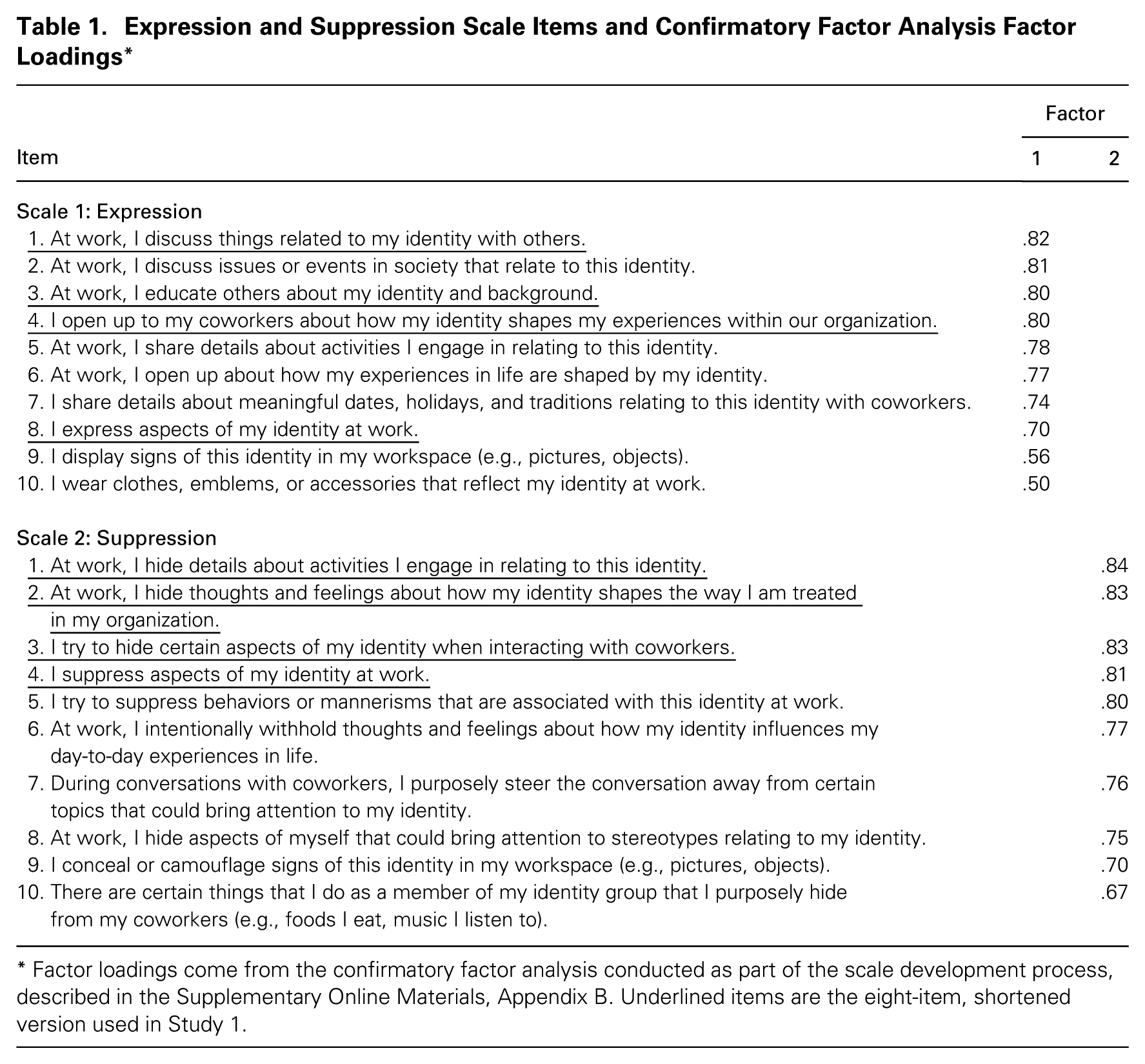
Factor loadings come from the confirmatory factor analysis conducted as part of the scale development process, described in the Supplementary Online Materials, Appendix B. Underlined items are the eight-item, shortened version used in Study 1.
Given organizational constraints, participants completed a shortened, four-item version of expression and suppression (see the underlined items in Table 1) on a scale of 1 to 5 (“not at all” to “very much”). For each measure, we selected one broad item (“I express/suppress aspects of my identity at work”) and then the three highest-loading items in our CFA, with one exception: We chose item 4 over item 2 for expression due to its greater organizational relevance. Participants chose the identity for which they would complete the actions described in each item and indicated this choice in a free-response question. Specifically, they were told that they would answer questions about navigating a non-work identity at work, were given example identities (e.g., race, ethnicity, nationality, religion, social class, gender, etc.), and were asked to “please write one non-work identity that you would like to focus on for the questions on the following page.” The next page showed the expression and suppression items, and the identity participants had written earlier was inserted as piped text in the instructions (i.e., “Below are statements about the identity you listed on the prior page: [piped text]. For the purposes of the statements below, the word ‘identity’ refers to this identity ([piped text]).”
Psychological strain (emotional exhaustion)
Given that exhaustion is central to psychological strain (Chang et al., 2007; Karasek, 1979), we measured psychological strain by using three items from Maslach and Jackson’s (1981) emotional exhaustion scale (e.g., “I feel emotionally drained from my work”; α = .76), rated from 1 (“strongly disagree”) to 7 (“strongly agree”).
Turnover intentions
We assessed turnover intentions with three items from Colarelli (1984), e.g., “I frequently think of quitting my job” (α = .83), using a scale of 1 to 7 (“strongly disagree” to “strongly agree”).
Preregistered Tests of Hypotheses
Table 2 shows descriptives and correlations of our key measures for this sample. For our analyses, expression and suppression were mean-centered. To conduct simple moderation analyses, we used Hayes’s (2022) Process macro (Model 1), with percentile bootstrapping (10,000 samples, 95 percent confidence intervals). Following Yzerbyt and colleagues (2018), we examined moderated mediation by first applying causal steps (MacKinnon et al., 2000); then we tested the index of moderated mediation by using Hayes’s (2022) Process macro (Model 8) with percentile bootstrapping (10,000 samples, 95 percent confidence intervals). In the analyses, we used the 16th, 50th, and 84th percentiles as the low, average, and high levels of the moderator, respectively.
Means, Standard Deviations, and Correlations in Study 1 (Organizational Study)*
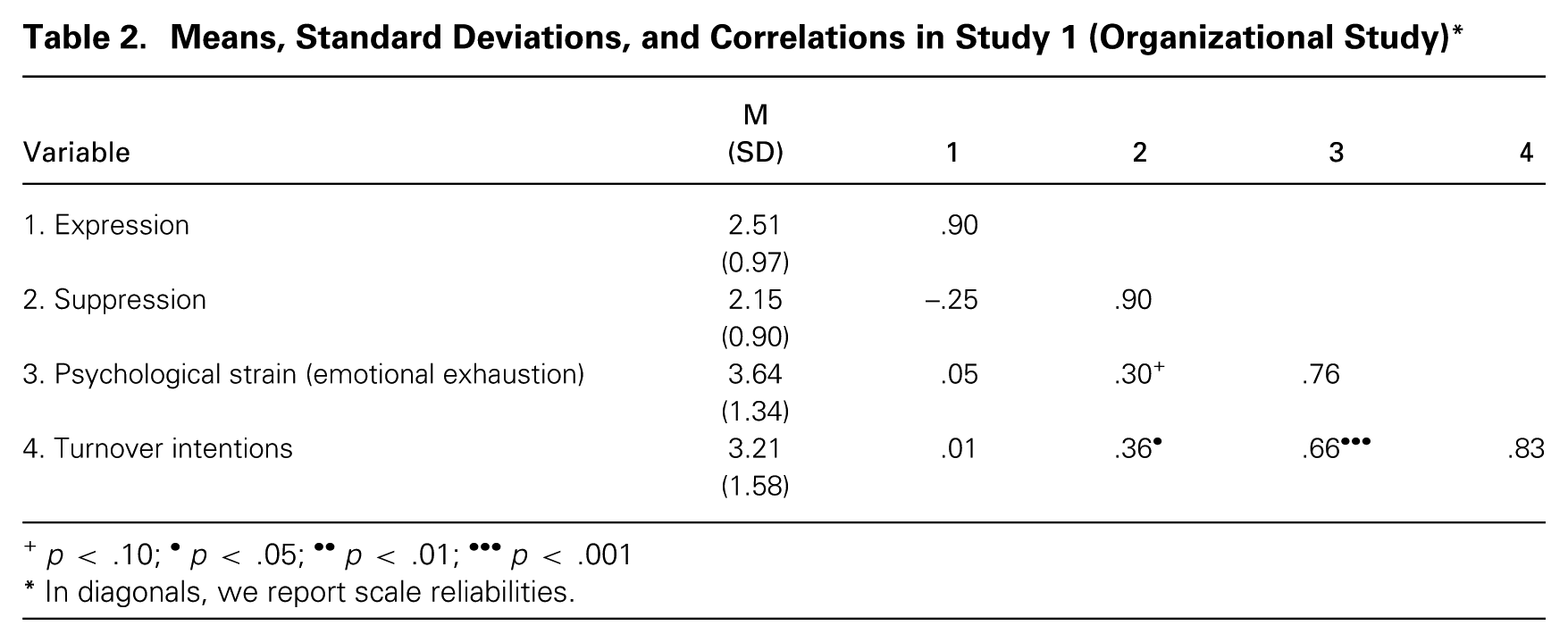
p < .10; •p < .05; ••p < .01; •••p < .001
In diagonals, we report scale reliabilities.
Psychological strain (emotional exhaustion)
We found a positive relationship between suppression and emotional exhaustion (b = 0.51, SE = 0.22, p = .03, 95 percent CI [0.07, 0.96]). Although the relationship between expression and emotional exhaustion was nonsignificant (b = 0.39, SE = 0.22, p = .08, 95 percent CI [–0.06, 0.84]), it was qualified by a significant interaction (b = 0.64, SE = 0.26, p = .02, 95 percent CI [0.12, 1.16]), supporting Hypothesis 2a. Specifically, expression was positively related to emotional exhaustion when suppression was high (b = 1.09, SE = 0.42, p = .01, 95 percent CI [0.24, 1.95]) but not when suppression was low (b = −0.34, SE = 0.29, p = .26, 95 percent CI [–0.93, 0.26]). To further probe the interaction, we also examined the relationship between suppression and emotional exhaustion at low and high levels of expression. Suppression had a positive relationship with emotional exhaustion when expression was high (b = 1.19, SE = 0.36, p < .01, 95 percent CI [0.47, 1.91]) but had no relationship when expression was low (b = −0.13, SE = 0.34, p = .70, 95 percent CI [–0.81, 0.55]). These patterns indicate that individuals enacting high levels of both expression and suppression—a curation approach—experienced the most emotional exhaustion, supporting Hypothesis 2a. Figure 2 shows this result.
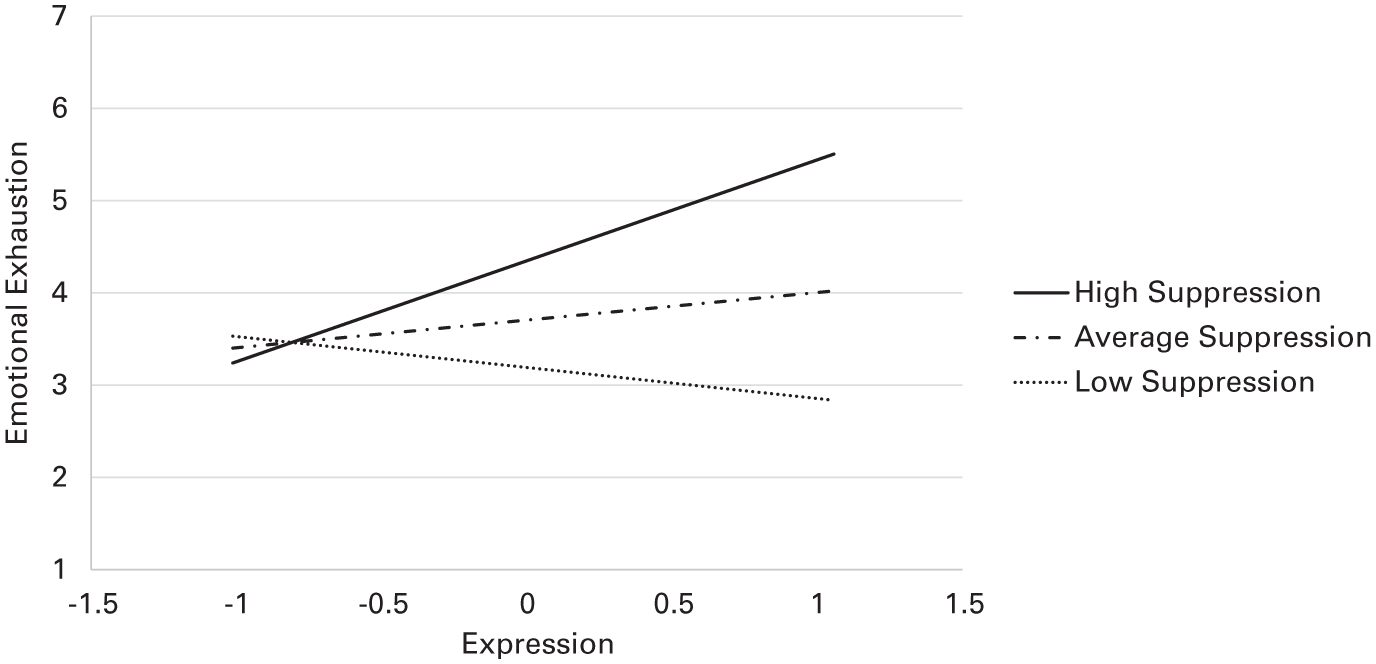
Study 1: Interactive Relationship of Expression and Suppression with Psychological Strain (Emotional Exhaustion)
Turnover intentions via psychological strain (emotional exhaustion)
Suppression had a positive relationship with turnover intentions (b = 0.69, SE = 0.27, p = .01, 95 percent CI [0.14, 1.23]), and there was no relationship between expression and turnover intentions (b = 0.33, SE = 0.27, p = .23, 95 percent CI [–0.22, 0.87]). The interaction was directionally (but not significantly) consistent with Hypothesis 3a (b = 0.48, SE = 0.31, p = .13, 95 percent CI [–0.15, 1.12]). Specifically, expression showed a directionally but not significantly positive relationship with turnover intentions when suppression was high (b = 0.86, SE = 0.51, p = .10, 95 percent CI [–0.18, 1.90]) but not when suppression was low (b = −0.23, SE = 0.36, p = .53, 95 percent CI [–0.95, 0.49]). We then examined suppression’s relationship with turnover intentions at low and high levels of expression. We found that suppression had a significantly positive relationship with turnover intentions when expression was high (b = 1.20, SE = 0.43, p = .01, 95 percent CI [0.32, 2.08]) but had no relationship when expression was low (b = 0.20, SE = 0.41, p = .63, 95 percent CI [–0.63, 1.02]). The overall pattern of results was consistent with Hypothesis 3a, such that a curation approach was highest in turnover intentions. Figure 3 shows this result.

Study 1: Interactive Relationship of Expression and Suppression with Turnover Intentions
We next examined expression’s indirect relationship with turnover intentions via emotional exhaustion, moderated by suppression. Supporting Hypothesis 3b, the results showed a significant interaction between expression and suppression on emotional exhaustion (p = .02; see above), a significant positive association between emotional exhaustion and turnover intentions (b = 0.71, SE = 0.17, p < .001, 95 percent CI [0.37, 1.04]), and a significant index of moderated mediation (b = 0.45, SE = 0.23, 95 percent CI [0.02, 0.95]). Specifically, expression had a positive indirect relationship with turnover intentions via emotional exhaustion when suppression was high (b = 0.77, SE = 0.34, 95 percent CI [0.19, 1.52]) but not when suppression was low (b = −0.24, SE = 0.28, 95 percent CI [–0.79, 0.35]). We then also examined suppression’s indirect relationship to turnover intentions via emotional exhaustion, moderated by expression. Suppression had a positive indirect relationship with turnover intentions via emotional exhaustion when expression was high (b = 0.84, SE = 0.33, 95 percent CI [0.23, 1.51]) but had no indirect relationship when expression was low (b = −0.09, SE = 0.31, 95 percent CI [–0.74, 0.51]).
Additional Analyses Examining Curation Among Other Marginalized Groups
As described in our summary of deviations from preregistration (SOM Appendix A, #6), we moved our preregistered analyses with employees who have any marginalized identity (e.g., based on gender, sexual orientation, disability, etc.) to the supplementary online materials. Our hypotheses were not supported in this broader sample. However, in additional exploratory analyses, we focused on the two most common visible marginalized identities in our dataset: employees of color who answered our expression and suppression questions about identities related to race or ethnicity (n = 41 from our sample above) and women employees who answered about a gender, family, or caregiver identity (n = 130). When conducting analyses with these two groups combined, we found a significant interaction between expression and suppression on both emotional exhaustion and turnover intentions, ps < .05. Furthermore, we found significant moderated mediation. These results suggest that our findings regarding the detrimental effects of curation for employees of color likely extend to women employees. See SOM Appendix C for detailed results.
Discussion
Study 1 provides some initial evidence for our thesis that racial and ethnic minority employees using a curation approach (high expression and high suppression) experience the greatest psychological strain and, therefore, higher levels of turnover intentions in organizational settings. Moreover, Study 1 provides suggestive evidence that our hypotheses regarding curation apply not only to employees of color but also to women. However, Study 1 did not include a measure of ambivalence and is limited in its ability to address common method bias (Podsakoff et al., 2003). In addition, the small sample size rendered the study underpowered (post-hoc power = 31 percent for emotional exhaustion and 19 percent for turnover intentions) and prevented robustness checks using controls, due to a low variable-to-observation ratio (Tanaka, 1987). Study 2 addresses these limitations. Additionally, while the results of Study 1 support our predictions, there is also a somewhat surprising result: When expression is low, suppression did not relate to psychological strain or turnover intentions, despite long-standing research suggesting that suppression should be positively related to these outcomes (Hewlin, 2009; Madera et al., 2012; Ragins et al., 2007; Roberts et al., 2014). Study 2 examines whether this result persists with a larger sample size.
Study 2: Longitudinal Study
Study 2 was a preregistered longitudinal study on Prolific that tested our full model. It included a fuller set of measures: all items from our expression and suppression scale, ambivalence, a broader measure of psychological strain (a composite of anxiety, stress, and exhaustion), and turnover intentions. Preregistration deviations include rewording and restructuring hypotheses, operationalizing psychological strain more comprehensively, moving results replicating past work to supplementary online materials, and relocating non-focal research questions to the supplementary online materials (see SOM Appendix A for details). These deviations do not change the conclusions reported below regarding the tests of significance of our main analyses. Additional analyses, including analyses focused on components of psychological strain (anxiety, stress, exhaustion) and results with controls, are provided in SOM Appendix D.
Participants and Procedure
Given that we were interested in recruiting a narrow segment of the population (racial/ethnic minority employees in white collar jobs) to complete an overtime study that required a high sample size and was subject to attrition across time points, our goal was to first attract as many eligible participants from the Prolific pool as possible, with a goal of achieving a minimum final sample of 200 racial/ethnic minority participants who met all of our eligibility criteria and passed all of our pre-registered exclusion criteria. 2 Of the 2,855 participants who completed a pre-screening survey (January 2023), 1,276 met our eligibility criteria (racial/ethnic minority, employed in a U.S. white-collar job) and passed preregistered attention checks. We invited them to a four-week study (throughout April 2023) involving a weekly survey. The participants (N = 503) who completed Time 1 were invited to complete the remaining waves. To encourage participation, compensation increased at each wave ($3.00, $3.25, $3.50, and $3.75), plus a $2 bonus for completing all four. Of the 396 who completed all four waves, 22 failed at least one preregistered attention check, yielding a final sample of 374 (57 percent men, 42 percent women, 1 percent non-binary; 80.5 percent heterosexual, 19.5 percent other sexuality; 40.6 percent Asian, 31.8 percent Black, 25.9 percent Hispanic/Latinx, 17.1 percent White, 2.4 percent Indigenous, 1.1 percent Arab, and 1.1 percent Prefer to self-describe; Mage = 36.21 years; Morganizational tenure = 6.37 years).
Measures
The four time points were spaced apart by one week. We collected key measures at each time point, except for control variables, which we assessed only at Time 1. In addition to the measures described below, the participants completed exploratory outcomes, contextual moderators, individual difference moderators, and free response questions. See SOM Appendix D for details.
Expression and suppression
We used the full ten-item version of our expression scale (α = .95) and the full ten-item version of our suppression scale (α = .96). Participants were instructed to complete the measures about their racial/ethnic identity. See Table 1.
Ambivalence
Ambivalence at work over the past week was measured on a 1–7 scale (“strongly disagree” to “strongly agree”) using three items from Rothman (2011), “I felt ambivalent,”“I felt torn,”“I felt conflicted,” and one item from Fong (2006), “I felt a mix of positive and negative emotions” (α of four items = .87). The results yielded the same conclusions when we omitted the fourth item to align more closely with cognitive ambivalence.
Psychological strain
We used a comprehensive measure of psychological strain by operationalizing it as a composite of emotional exhaustion, anxiety, and stress. Although these three components are conceptually distinct, we treated them as formative indicators (i.e., dimensions that collectively define psychological strain; Podsakoff et al., 2006), consistent with past research showing that each contributes uniquely to strain (Beehr et al., 2000; Chang et al., 2007; Côté, 2005; Karasek, 1979). Emotional exhaustion was measured by asking the extent to which participants agreed (7-point scale—“strongly disagree” to “strongly agree”) with nine items pertaining to the past week (e.g., “I feel emotionally drained from my work,”“I feel burned out from my work,”“I feel used up at the end of the workday,” adapted from Maslach and Jackson, 1981; α = .96). Anxiety was measured on a 5-point scale (“never” to “always”) using ten items assessing feelings over the past week at work (tense, upset, nervous, strained, frightened, jittery, indecisive, worried, confused, anxious; Spielberger et al., 1970; α = .93). Stress was measured with six items on a 5-point scale from “never” to “often” (e.g., “In the last week, how often have you felt work-related difficulties were piling up so high that you could not overcome them?”, “In the last week, how often have you been upset because of something that happened unexpectedly at work?” adapted from Cohen and Williamson, 1988; α = .93). Although high correlations are not required for formative indicators (MacKenzie et al., 2005), the three measures were moderately to highly correlated (rExhaustionAnxiety = .60, rExhaustionStress = .76, rAnxietyStress = .73), and the 25 items showed strong reliability (α = .87). The full set of measures and results using separate operationalizations (exhaustion, anxiety, stress) are provided in SOM Appendix D.
Turnover intentions
We assessed turnover intentions using the same three items from Study 1, except that one reverse-coded item was reworded as forward-coded (“If I have my own way, I will NOT be working for my company one year from now”; α = .94).
Control variables
We included demographic controls for gender, sexual orientation, and age. These social identities have been studied extensively in their own right, given that marginalization on any of these dimensions prompts identity management decisions that relate to well-being and turnover intentions (Berger, 2009; Ragins et al., 2007; Roberts, 2005; Roberts et al., 2008; Shih et al., 2013). Furthermore, gender, sexual orientation, and age intersect with race in ways that shape experiences with stereotypes and discrimination (Hall et al., 2019), and thus have implications for how employees of color manage their racial identities and their overall well-being (e.g., Atewologun et al., 2016; Smith et al., 2019).
Also following Madera and colleagues (2012), we controlled for job tenure, given that more time within an organization provides individuals with opportunities to demonstrate their skills and individual qualities, potentially lowering concerns with stereotyping and identity-related disclosure (Phillips et al., 2009). Moreover, tenure is associated with greater job commitment (Brimeyer et al., 2010; Day & Schoenrade, 1997). One participant indicated that they worked for 207 years; this participant’s score was edited to match their pre-screen survey response of 15 years. Finally, we measured self-monitoring (a person’s general tendency to adapt their expressive behavior, perform, and display what others expect; Snyder & Gangstad, 1986), which is associated with both expression and suppression tendencies, as well as outcomes such as depression and turnover intentions (Clair et al., 2005; Roberts et al., 2008). This control ensured that our findings were not due to differences in self-monitoring but, rather, variation in expression and suppression. The participants responded to eight items on a 5-point scale (“strongly disagree” to “strongly agree”; e.g., “I guess I put on a show to impress or entertain others”; α = .82; Snyder & Gangestad, 1986).
Additional pre-registered analyses
We preregistered a measure of quality of DEI solutions as a potential positive outcome of curation but found no evidence for this hypothesis. We deviated from preregistration by moving its rationale and analysis to SOM Appendix D. We also omitted preregistered measures of antecedents to expression and suppression so as to focus more directly on curation and its consequences. See Appendix A (#4 and #5).
Preregistered Tests of Hypotheses
Means, standard deviations, and correlations of key measures are included in Table 3. While each of our key measures was collected at each time point, our preregistered plan specified analyzing each at a single time point (e.g., expression and suppression at T2). We adopted this between-subjects design given that we conceptualized identity management as an individual-level approach. 3 Although we used a between-subjects design, the longitudinal structure, spanning different time points for different model stages, helped to reduce concerns about common method bias (Podsakoff et al., 2003).
Means, Standard Deviations, and Correlations in Study 2 (Longitudinal Study)*

p < .10; •p < .05; ••p < .01; •••p < .001
In diagonals, we report scale reliabilities.
To test our preregistered hypotheses, we examined the interactive relationship between T2 expression and T2 suppression with T3 ambivalence, T3 psychological strain, and T4 turnover intentions. When included in the model, controls were from T1. Expression and suppression were mean-centered in all analyses. We used the Process macro (Hayes, 2022) for simple moderation (model 1), moderated mediation (model 8), and sequential moderated mediation (model 86), with 10,000 bootstrapped samples to estimate 95 percent confidence intervals. As in Study 1, we examined mediation by using causal steps and an index-based test of moderated mediation (Yzerbyt et al., 2018). We again used the 16th, 50th, and 84th percentiles to represent low, average, and high levels of the moderator, respectively. We reported results without controls; however, results with preregistered controls (gender, sexual orientation, age, job tenure, and self-monitoring) were consistent. See SOM Appendix D for the full results with controls.
Ambivalence
To test Hypothesis 1, we conducted a simple moderation analysis. Suppression had a positive relationship with ambivalence (b = 0.40, SE = 0.06, p < .001, 95 percent CI [0.29, 0.51]), while expression had no relationship (b = −0.05, SE = 0.06, p = .38, 95 percent CI [–0.16, 0.06]). Supporting Hypothesis 1, their interaction was significant (b = 0.21, SE = 0.06, p < .001, 95 percent CI [0.10, 0.33]). The relationship between expression and ambivalence was positive when suppression was high (b = 0.19, SE = 0.09, p = .03, 95 percent CI [0.01, 0.37]) but negative when suppression was low (b = −0.24, SE = 0.07, p = .001, 95 percent CI [–0.38, –0.09]). We then assessed the relationship between suppression and ambivalence moderated by expression: Suppression was positively associated with ambivalence when expression was low (b = 0.20, SE = 0.07, p < .01, 95 percent CI [0.07, 0.33]) and even more so when expression was high (b = 0.63, SE = 0.09, p < .001, 95 percent CI [0.44, 0.81]). The highest ambivalence was therefore observed under high expression and suppression (i.e., the curation approach); see Figure 4. These findings support Hypothesis 1.
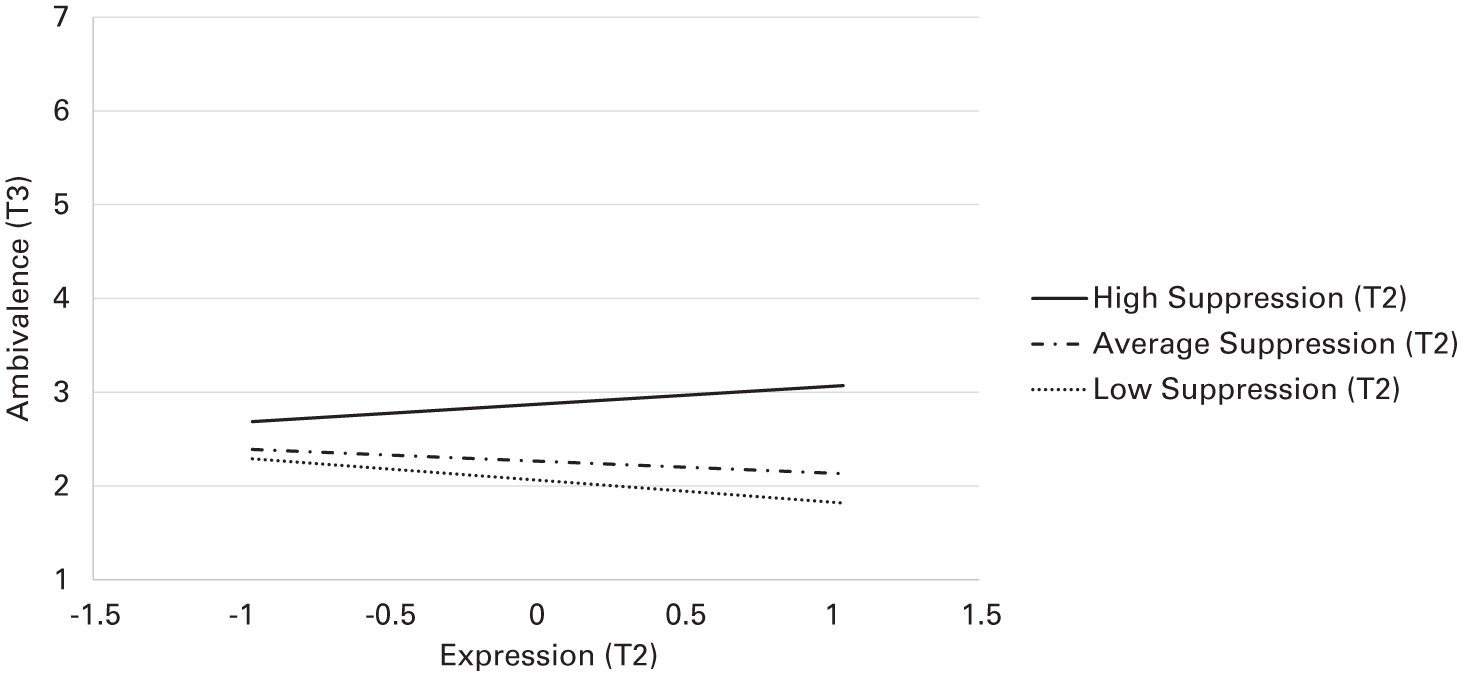
Study 2: Interactive Relationship of Expression and Suppression with Ambivalence
Psychological strain via ambivalence
To test Hypothesis 2a, we first examined the interaction of expression and suppression on psychological strain. Suppression had a positive relationship with psychological strain (b = 0.46, SE = 0.04, p < .001, 95 percent CI [0.38, 0.55]), while expression had no relationship (b = −0.04, SE = 0.04, p = .33, 95 percent CI [–0.13, 0.04]). As predicted by H2a, their interaction was significant (b = 0.14, SE = 0.04, p = .001, 95 percent CI [0.06, 0.23]). Consistent with our expectations, when suppression was high, expression had a directionally although not significantly positive relationship with psychological strain (b = 0.12, SE = 0.07, p = .08, 95 percent CI [–0.02, 0.26]); when suppression was low, the relationship was significantly negative (b = −0.17, SE = 0.06, p < .01, 95 percent CI [–0.28, –0.06]). We then assessed the relationship between suppression and psychological strain moderated by expression. Suppression was positively related to psychological strain when expression was low (b = 0.32, SE = 0.05, p < .001, 95 percent CI [0.22, 0.43]) and even more so when expression was high (b = 0.61, SE = 0.07, p < .001, 95 percent CI [0.47, 0.75]). Accordingly, the curation approach (high expression and suppression) was associated with the greatest psychological strain, consistent with Hypothesis 2a; see Figure 5.
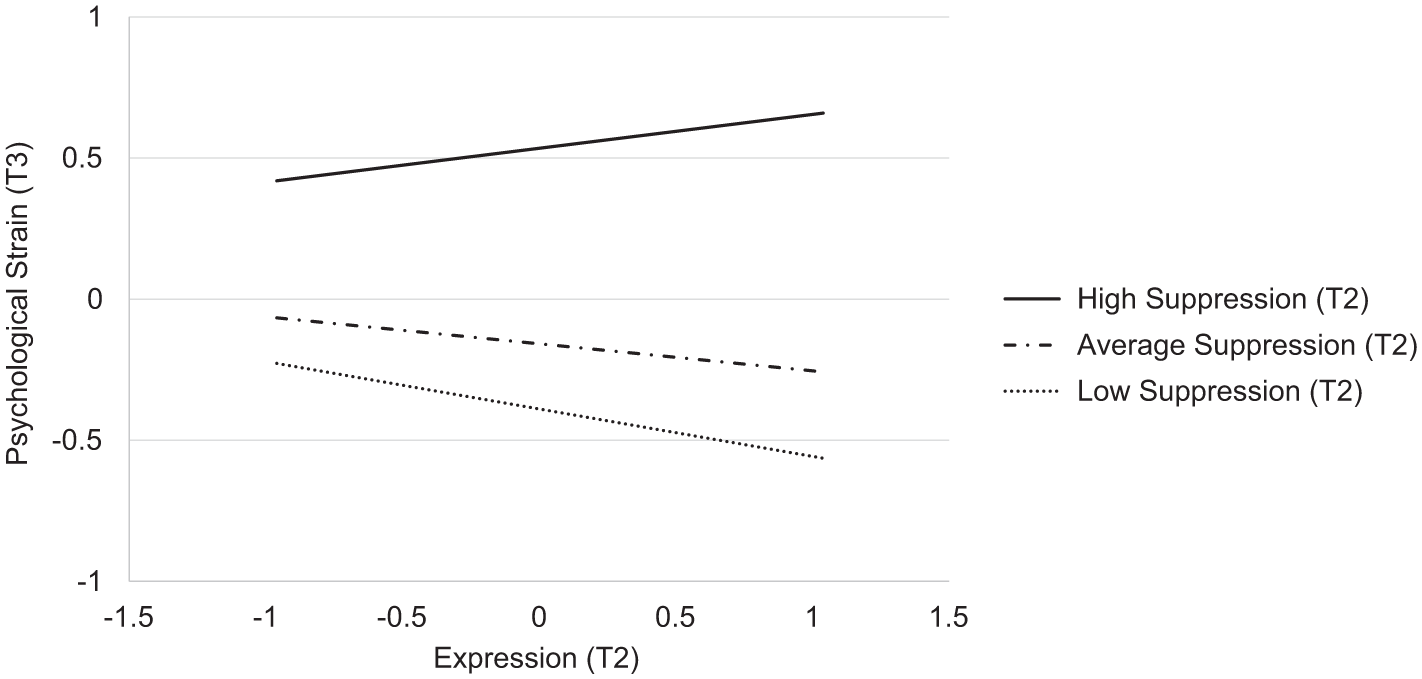
Study 2: Interactive Relationship of Expression and Suppression with Psychological Strain
We next assessed the indirect relationship between expression and strain via ambivalence moderated by suppression (H2b). In the first causal step, as reported above, we found a significant interaction between expression and suppression on ambivalence (p < .001). In the next causal step, we found that ambivalence was significantly related to psychological strain (b = 0.49, SE = 0.03, p < .001, 95 percent CI [0.43, 0.55]). Finally, the index of moderated mediation was significant (b = 0.10, SE = 0.03, 95 percent CI [0.05, 0.16]), supporting Hypothesis 2b. When suppression was high, expression had a positive indirect relationship with psychological strain via ambivalence (b = 0.09, SE = 0.05, 95 percent CI [0.01, 0.18]): Greater expression was associated with greater ambivalence, which, in turn, was associated with greater strain. The opposite pattern emerged when suppression was low: There was a negative indirect relationship (b = −0.12, SE = 0.03, 95 percent CI [–0.18, –0.05]), such that expression was associated with less ambivalence and, in turn, less psychological strain. We also assessed the indirect relationship between suppression and strain via ambivalence moderated by expression. Suppression had a consistently positive indirect relationship with psychological strain via ambivalence, but this indirect relationship was stronger when expression was high (b = 0.31, SE = 0.04, 95 percent CI [0.23, 0.39]) compared to low (b = 0.10, SE = 0.04, 95 percent CI [0.02, 0.18]).
Turnover intentions via ambivalence and psychological strain
To test Hypothesis 3a, we first examined the interaction of expression and suppression on turnover intentions. We found, consistent with past research, a positive relationship between suppression and turnover intentions (b = 0.58, SE = 0.10, p < .001, 95 percent CI [0.37, 0.78]). Expression was negatively related to turnover intentions (b = −0.56, SE = 0.10, p < .001, 95 percent CI [–0.77, –0.36]). Contrary to Hypothesis 3a, there was no interaction between expression and suppression (b = 0.007, SE = 0.11, p = .94, 95 percent CI [–0.20, 0.22]). Thus, expression was associated with lower, and suppression was associated with higher, turnover intentions regardless of the other one’s levels; see Figure 6.
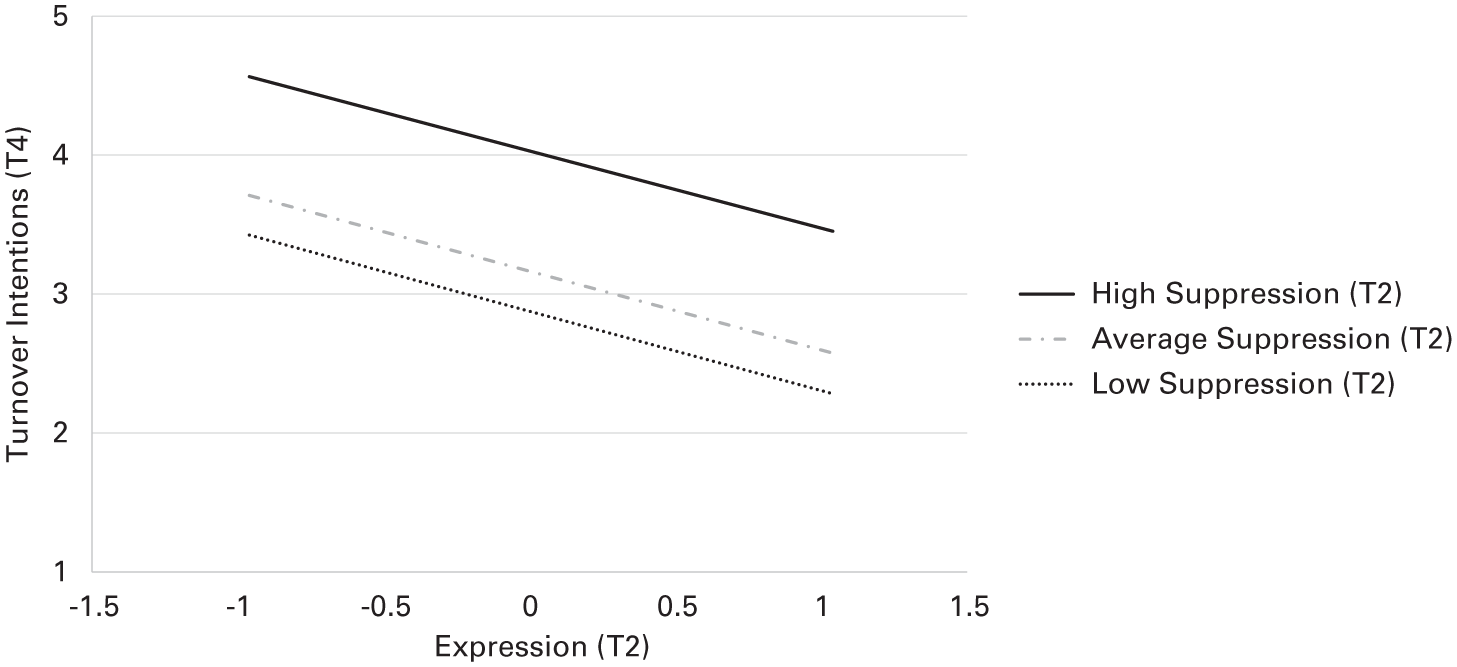
Study 2: Interactive Relationship of Expression and Suppression with Turnover Intentions
Despite the lack of an interaction, conditional indirect effects are still possible (Hayes, 2022), whereby high suppression may amplify expression’s indirect relationship with turnover intentions via ambivalence and strain (H3b). We therefore tested sequential moderated mediation via ambivalence followed by strain. As reported above, there was a significant interaction of expression and suppression on ambivalence (p < .001). In the next two causal steps, we found that ambivalence had a significant positive relationship with psychological strain (b = 0.57, SE = 0.03, p < .001, 95 percent CI [0.51, 0.63]), and psychological strain had a significant positive relationship with turnover intentions (b = 1.01, SE = 0.14, p < .001, 95 percent CI [0.73, 1.28]). Finally, the index of moderated mediation was significant (b = 0.12, SE = 0.04, 95 percent CI [0.05, 0.20]). When suppression was high, expression had a significant positive indirect relationship with turnover intentions (b = 0.11, SE = 0.06, 95 percent CI [0.01, 0.23]), such that higher levels of expression were associated with greater ambivalence, which, in turn, was associated with greater psychological strain; this strain, in turn, was associated with higher turnover intentions. When suppression was low, the opposite pattern emerged: Expression had a significant negative indirect relationship with turnover intentions (b = −0.13, SE = 0.05, 95 percent CI [–0.23, –0.05]), such that higher levels of expression were associated with lower ambivalence, which, in turn, was associated with lower psychological strain; this lower strain, in turn, was associated with lower turnover intentions. We also assessed the indirect relationship between suppression and turnover intentions via ambivalence and strain moderated by expression. Suppression had a positive indirect relationship with turnover intentions, though this relationship was more potent at high expression (b = 0.31, SE = 0.07, 95 percent CI [0.19, 0.45]) than at low expression (b = 0.10, SE = 0.04, 95 percent CI [0.02, 0.19]). SOM Appendix D (Table D1) shows a table summarizing all mediation results.
Additional Analyses: Robustness Checks
We conducted additional analyses (reported in SOM Appendix D) suggesting that the proposed model fits the data better than alternative causal models do. First, we examined a reverse causality model (e.g., perhaps psychological strain causes people to engage in certain identity management approaches). Specifically, we examined a model in which turnover intentions (T2) led to psychological strain (T3), which, in turn, led to ambivalence (T3), and this ambivalence, in turn, led to both expression (T4) and suppression (T4). Second, we also tested a simultaneous model in which ambivalence and psychological strain are parallel mediators, contrasting it with our hypothesized sequential model. In both cases, our predicted model exhibited better fit.
Discussion
Study 2 provides evidence that a curation approach (high in both expression and suppression) is linked to significant psychological strain among employees of color. This pattern emerges because although expression is associated with diminished psychological strain when suppression is low (consistent with past theorizing), this relationship is reversed when suppression is high. Moreover, consistent with existing theory, suppression was positively associated with psychological strain at all levels of expression; however, we reveal that this relationship is strongest among people of color who engage in high levels of expression. The resulting greater psychological strain experienced by curators is associated with greater turnover intentions. Importantly, Study 2 reveals that ambivalence—feeling torn between opposing thoughts—is a driving factor underlying these negative intrapersonal outcomes.
Although we found that the psychological strain associated with the curation approach heightens turnover intentions, Study 2 did not find that employees of color who use a curation approach are the most inclined to leave their organizations overall. The reason for this is unclear, as we found no evidence in our exploratory analyses that curation has advantages, such as generating better insights into complex organizational dilemmas, fueling optimism about one’s leadership potential, or enabling greater job satisfaction (see SOM Appendix D). Of note, in a supplemental study, we found further evidence for our prediction that the curation approach leads to higher turnover intentions (see SOM Appendix E), indicating the possibility that moderators may strengthen or weaken this relationship.
Internal Meta-Analysis and P-Curve Analysis
Having evaluated our findings, we turn to an internal meta-analysis that allows us to synthesize across our studies the relationships between curation and its consequences. Ambivalence was excluded from the meta-analysis because it was measured only in Study 2. Psychological strain and turnover intentions were assessed across all three studies; Study 1 and the supplemental study (see SOM Appendix E) measured psychological strain as emotional exhaustion, and Study 2 measured psychological strain as a composite of emotional exhaustion, anxiety, and stress. We conducted a random-effects meta-analysis (McShane & Böckenholt, 2017) of the interaction and simple slopes of expression and suppression on psychological strain and turnover intentions across these three studies. Here, we report the results without controls (see SOM Appendix F for results with common controls of age, gender, and tenure).
As we expected, for psychological strain (H2a), the interaction of expression and suppression was significant (b = 0.17, 95 percent CI [0.10, 0.25], z = 4.59, p < .001). Expression had a positive relationship with psychological strain when suppression was high (b = 0.30, 95 percent CI [0.06, 0.53], z = 2.48, p = .01) and a negative relationship when suppression was low (b = −0.12, 95 percent CI [–0.20, –0.05], z = −3.14, p < .01). We then assessed the relationships of these measures with suppression moderated by expression: Suppression had a positive relationship with psychological strain; however, this relationship was stronger when expression was high (b = 0.73, 95 percent CI [0.54, 0.92], z = 7.47, p < .001) compared to when expression was low (b = 0.33, 95 percent CI [0.15, 0.51], z = 3.55, p < .001). These patterns show that individuals with a curation approach had the strongest psychological strain, supporting Hypothesis 2a.
For turnover intentions (H3a), the interaction was non-significant but was directionally positive (b = 0.09, 95 percent CI [-0.03, 0.20], z = 1.52, p = .13). At high suppression, expression had no relationship to turnover intentions (b = 0.12, 95 percent CI [–0.32, 0.56], z = 0.53, p = .60); at low suppression, it was directionally but not significantly negative (b = −0.15, 95 percent CI [–0.34, 0.03], z = −1.60, p = .11). We then assessed the relationship between suppression and turnover intentions at high and low levels of expression: Suppression had a positive relationship with turnover intentions, but this relationship was directionally stronger when expression was high (b = 0.56, 95 percent CI [0.19, 0.92], z = 2.99, p < .01) compared to when expression was low (b = 0.34, 95 percent CI [0.16, 0.53], z = 3.62, p < .001).
Although the interaction between expression and suppression was not significant, we found evidence for a significant conditional indirect relationship between expression and turnover intentions via psychological strain, moderated by suppression (index of moderated mediation: b = 0.10, 95 percent CI [0.06, 0.14], z = 4.84, p < .001), supporting Hypothesis 3b. Expression had a positive indirect relationship with turnover intentions via psychological strain at high suppression (b = 0.17, 95 percent CI [0.02, 0.33], z = 2.20, p < .05) and a negative indirect relationship at low suppression (b = −0.07, 95 percent CI [–0.11, –0.03], z = −3.23, p = .001). When assessing suppression’s indirect relationship with turnover intentions via psychological strain moderated by expression, we found a consistently positive indirect relationship; however, this indirect relationship was more potent when expression was high (b = 0.43, 95 percent CI [0.31, 0.55], z = 6.99, p < .001) compared to when expression was low (b = 0.21, 95 percent CI [0.09, 0.32], z = 3.52, p < .001). Overall, these results support our main thesis that psychological strain is most acute at high levels of expression and suppression, consistent with a curation approach, and that this elevated psychological strain is, in turn, associated with heightened turnover intentions.
Finally, to illustrate the evidential value of our hypotheses across our studies (Study 1, Study 2, and Supplemental Study), we conducted p-curve analyses on the interactions and simple slopes for psychological strain and turnover intentions, using the p-curve app (v4.10) (Simonsohn et al., 2014). The results indicated evidential value for each of our hypothesized predictions. The output for each of these relationships is available in SOM Appendix G.
General Discussion
In recent years, increased awareness of racial injustice has prompted a host of DEI initiatives that explicitly encourage racial and ethnic minority employees to bring their whole selves to work (Lublin, 2022; Silva, 2022). However, the sociopolitical climate has recently shifted, and DEI efforts are now facing resistance and retrenchment across many industries and sectors (Rae, 2025; Yoshino et al., 2025). Whether in environments that support expressing one’s identity or not, racial minority employees persistently experience vulnerability and uncertainty about how best to navigate their identities at work. This shift in the sociopolitical landscape underscores the importance of understanding the psychological experiences associated with identity management approaches among this segment of employees.
In this research, we attend to employees of color who curate by both frequently expressing and frequently suppressing their identities at work. While initial theorizing suggests that curation may enable employees of color to craft a polished image that serves them well professionally (Roberts et al., 2008), we reveal the personal costs of curation. Curation is associated with greater ambivalence: the experience of being torn or conflicted between opposing thoughts regarding whether one’s identity is a resource or a liability. Thus, racial and ethnic minority employees who use a curation approach experience greater psychological strain, compared to those who primarily express (high expression, low suppression) or primarily suppress (high suppression, low expression). Employees of color seek relief from this distress by planning to leave their organizations. Exploratory analyses suggest that similar dynamics unfold for women who rely on a curation approach when navigating their gender identity. These results reveal that curation, though laudable in some respects, takes a previously unseen toll on employees of color and potentially other marginalized groups as well.
The Perils of Identity Management: Curation, Expression, and Suppression
Our research contributes to a long-standing conversation in the identity management literature regarding the costs and benefits of identity expression and suppression in the workplace. Both expression and suppression are associated with trade-offs: Expression is often positioned as beneficial for well-being but professionally risky, and suppression is viewed as psychologically taxing but potentially necessary for success (Cha et al., 2019; Clair et al., 2005; Hewlin, 2003; Phillips et al., 2009). In an effort to resolve the dilemma of how to best navigate a minority identity, the literature is replete with examples of scholars looking for ways that employees of color can engage in identity expressions that are less professionally risky, such as sharing positive or meaningful aspects of one’s identity at work (Arnett, 2023; Phillips et al., 2009; Roberts, 2005; Thomas, 1993). Yet, these solutions often have hidden risks of their own, such as the potential to inadvertently cause anxiety, elicit stereotypes, or violate others’ perceptions of propriety. Perhaps because of these persistent trade-offs, scholars have proposed that it could benefit employees of color to both express and suppress (Roberts et al., 2008), for example by engaging in meaningful conversations that bring attention to positive aspects of one’s group (Arnett, 2023) but purposely disengaging from topics that could cause anxiety or friction such as systemic discrimination (McCluney et al., 2017). While we see the potential professional value of this approach, our research demonstrates that curation may not simply surmount professional risks but, rather, shift those risks internally, such that a person of color who wishes to embrace curation may shoulder a greater psychological burden. Moreover, while the intent of enacting curation could be to enable professional advancement, the psychological strain associated with this approach may prompt employees of color to exit their organizations before achieving their objective of getting ahead. This dilemma suggests a previously undiscussed double bind for those who express: They can either be an open book about their minority identity and risk being pushed out of their organizations due to negative perceptions of their identity, or they can curate, contorting themselves to the point where they feel compelled to leave. To the extent that our findings extend to women, they highlight yet another double bind they must navigate with regard to their gender identity in the workplace (Rudman & Phelan, 2008). Overall, our research illuminates not only the hidden psychological costs of curation but also the elusiveness of viable solutions that satisfy a dual desire for career prosperity and internal vitality.
Our findings reveal a critical boundary condition to the long-standing finding that expression, as well as authenticity more broadly, is beneficial for the well-being and commitment of employees of color (Cha et al., 2019; Madera et al., 2012; Ragins et al., 2007; Roberts et al., 2008). Indeed, these notions about the intrapersonal benefits of authenticity are so deeply ingrained in the literature that scholars developing new authenticity scales use relationships with well-being (higher vitality, lower negative affect and stress) and commitment (higher dedication) as evidence of construct validity (van den Bosch & Taris, 2014). Notably, our findings show that expression’s ability to improve psychological and retention outcomes is not simply eliminated among people who suppress but is actually reversed: Expression psychologically harms employees of color who engage in suppression and makes them actively consider alternative employment options. As such, our findings suggest that the well-established well-being benefits of expression, and authenticity in general, may be limited to individuals who refrain from suppression at work.
While our research uncovers a critical boundary condition to expression, we do not intend our interactive findings to cast aspersion upon expression but, rather, to reveal the pernicious nature of suppression. We advance the literature by revealing that suppression is problematic not only due to its negative main effect on well-being (as suggested by prior works; Bell, 1990; Clair et al., 2005; Hewlin, 2003) but also because it undermines or even reverses the benefits of expression. In this way, suppression essentially harms employees of color twice over: It not only robs them of the ability to be authentic when they conceal, but it also takes away their ability to benefit from authenticity when they engage in expression.
Broadening the Lens of Identity Management
Perhaps an even broader revelation that stems from our work is that, to gain a holistic understanding of the consequences of expression or suppression, researchers must move beyond understanding them in isolation and, instead, consider them jointly. Existing research on intrapersonal consequences has laid valuable groundwork for understanding how expression and suppression separately influence individual-level outcomes. Building on this foundation, we contend that to truly understand the complexities of the whole person, researchers should account for the broader portfolio of identity management, including the extent to which an individual expresses and suppresses. Using this portfolio perspective, we propose that past and future research focused on the consequences of expression and suppression would benefit from considering how the predictions for one variable are shaped by the other. For instance, past research focused on the psychological benefits of high expression may be implicitly theorizing about high expression combined with low suppression (e.g., Madera et al., 2012; Roberts et al., 2008), whereas research considering ambivalence associated with expression may be implicitly theorizing about high expression combined with high suppression (e.g., Cha & Roberts, 2019). Additionally, considering the psychological costs of suppression may benefit from considering the broad portfolio of identity management—including how much a person intentionally draws attention to their identity—when they attempt to understand the full landscape of challenges that employees of color grapple with at work (e.g., Hewlin, 2009; McCluney et al., 2019).
Through this research, we make explicit something that has been implicit in the literature: the notion that expression and suppression are two distinct dimensions. Past research has acknowledged that the same person can enact both expression and suppression (Roberts et al., 2008). However, the literature still reflects the idea that expression and suppression could be two ends of the same continuum and, thus, need not or perhaps even cannot be considered in conjunction. This assumption emerges when, for example, hypotheses about their effects are considered as opposites (e.g., if suppression is expected to decrease well-being and retention, then expression is predicted to increase these outcomes). Our explicit theorizing about the two-dimensional nature of expression and suppression pushes the literature toward considering outcomes that may have been overlooked, such as interactive effects as investigated in this research, and other possibilities, such as distinct effects on different outcomes.
Through this research, we contribute to a broader conversation within the diversity and identity management domains by illustrating high levels of nuance as requisite for addressing the complexities inherent in identity-related challenges. For instance, intersectionality research has shown that studies of the separate effects of race and gender are not sufficient for understanding the compounding impact of intersectional identities like being a Black woman (Dupree, 2024; Hall et al., 2019; Smith et al., 2019). In a similar vein, our research shows the importance of investigating complex identity management approaches whose outcomes cannot be clearly derived from existing knowledge about the distinct effects of expression and suppression.
The Importance of Integrating the Ambivalence Literature into Identity Management
Our research adds more theoretical and empirical depth to an ongoing conversation about the complex relationship between identity management and ambivalence. Cha and Roberts (2019) primarily focused on ambivalence as an antecedent to identity management, but they also recognized that expression can be a trigger for ambivalence, particularly due to the tension from viewing one’s identity as both a resource and a liability. Taking an intrapersonal outcomes perspective, our research builds on the foundation set by existing research to demonstrate that expression is not necessarily associated with greater ambivalence. Indeed, when expression was combined with low suppression, ambivalence was actually lower. However, among individuals who combine expression with the seemingly oppositional behavior of high suppression (consistent with a curation approach), ambivalence was amplified. While shifting between oppositional behaviors can be associated with ambivalence, scholars also acknowledge the need for deeper insight into the psychological ramifications of such an approach (Pratt & Doucet, 2000). We therefore engage in deeper integration of the ambivalence literature to understand why curation is detrimental. We theorize that curation involves a compromise strategy for managing ambivalence, which is especially likely to keep opposing thoughts (i.e., one’s identity as a resource and liability) salient in a way that can lead to negative psychological experiences, particularly when the two sides cannot be easily reconciled (Ashforth et al., 2014).
Yet, an even deeper dive into the ambivalence literature provides greater insight into our research and reveals the value of better integrating ambivalence theory into the identity management literature. Ambivalence theory asserts that the mere presence of ambivalence need not be detrimental; rather, various factors, including how a person navigates their ambivalence, can influence outcomes (Ashforth et al., 2014; Rothman et al., 2017). Thus, although our theory and findings suggest that curation invokes a compromise strategy that keeps opposing thoughts alive, the ambivalence literature reveals that acute awareness of opposing sides need not always be as psychologically detrimental as our research indicates. When the two opposing sides are synergistic or reconcilable, employees can move beyond a compromise strategy to a more adaptive way of managing ambivalence, referred to as holism (Ashforth et al., 2024). A holistic response is susceptible to similar challenges with regard to keeping both orientations alive but may have redeeming qualities in that it involves finding ways to channel the opposing orientations toward some productive end or overall positive perspective (Ashforth et al., 2014; Pratt & Pradies, 2011). To illustrate, consider research on tempered radicals, employees who are radical about social change but also feel pressure to temper this passion to succeed at work (Meyerson, 2001). Tempered radicals experience ambivalence because they are balancing two antithetical viewpoints: the view of oneself as an insider to an organization, who is seeking to get ahead and often conforms to norms to do so, and the view of oneself as an outsider, often based on demographic differences or different belief systems, who is seeking to shift the status quo by enacting social change within the organization (Meyerson & Scully, 1995). Yet, these opposing thoughts can be understood in a synergistic way, such that being an outsider enables a person to see the need for social change, and being an insider enables them to enact it (Meyerson & Scully, 1995). In this way, oppositional thoughts, although challenging, are appraised as adding value to the broader cause of social change, leading ambivalence scholars to characterize tempered radicalism as an example of holism rather than compromise (Ashforth et al., 2014).
This counterfactual regarding holism raises the question of why curation is not similarly a form of holism and, instead, seems to be a compromise that accentuates ambivalence and yields negative intrapersonal outcomes. In theory, it seems as though curation, like tempered radicalism, could have synergies. Indeed, Roberts (2005) characterized certain forms of expression (particularly positive distinctiveness, which focuses on shaping a positive narrative related to one’s identity) and certain forms of suppression (specifically social recategorization, which combines downplaying one’s marginalized identity with affiliating with positively regarded identities) as both enabling career success. To the extent that expression and suppression are perceived as enabling the same goal (i.e., career success), they can be viewed as synergistic. Yet, empirical research did not find evidence of this possibility, instead finding that suppression is associated with lower, not greater, perceived career success (Roberts et al., 2014). These findings are consistent with our premise that suppression largely evokes negative thoughts that are incompatible with viewing one’s identity as a resource, rather than positive thoughts that could be viewed as synergistic with a resource view. This supports our theorizing that curation involves constantly grappling with irreconcilably incompatible thoughts, and this is the basis through which negative downstream intrapersonal consequences emerge.
Overall, it is clear that both ambivalence and identity management theory are highly nuanced; yet, the identity management literature to date has only scratched the surface of integrating ambivalence theory. We hope our research will spark future identity management studies and theoretical frameworks that engage more deeply in ambivalence theory, as the answers that scholars are seeking regarding how employees from marginalized groups can effectively harness resources and mitigate liabilities may lie within the ambivalence literature.
Practical Implications
Organizations may be inadvertently losing diverse talent because employees of color are straining themselves to curate the perfect workplace image. One of the most likely causes of this predicament is when organizations send mixed messages, encouraging employees to be themselves without accounting for the risks that may compel employees to suppress. Organizational leaders often feel ambivalent about diversity (Creary, 2025), and employees frequently detect leaders’ ambivalence through mixed messages (Ashforth et al., 2014). These mixed messages can come out in various ways. For instance, organizations can say they value diversity yet also pigeonhole employees of color (Ely & Thomas, 2001) or reject notions that discrimination exists within their walls (Kaiser et al., 2013). Following the cue that diversity is valued, employees may seek opportunities to express. Yet, an undercurrent of risk—that their race or experiences related to it could be a liability—may cause them to suppress.
Employees who perceive fewer mixed messages may be less likely to curate. Take, for example, the concern that trying to leverage one’s identity as a resource by speaking up about negative assumptions about one’s group may lead to being seen as too disruptive (Ashford et al., 1998; Cha & Roberts, 2019; Rattan et al., 2022), which can, in turn, cause marginalized employees to suppress (Shelton & Stewart, 2004). A tech organization can make it clear that although speaking up about concerns, including concerns with discrimination, is viewed as an unwanted disruption in some places, the organization values and actively seeks disruption as a way to fulfill its values of innovation and continuous improvement. In this way, the organization is taking something traditionally viewed as a liability associated with a minority identity and reframing it as valued in a way that can enhance self-esteem and self-efficacy (Tajfel & Turner, 1986). By reframing a potential liability, such as a concern about being viewed as disruptive, as part of the reason that a minority identity is an asset, organizations can send a consistent message that employees’ identities are valued. Such messages may make employees less inclined to curate.
Limitations and Future Directions
Theoretical and empirical work extending beyond the scope of this research will be useful for understanding how, when, and why people curate, as well as the associated outcomes. First, building on the above practical implications, we see promising opportunities to build on our research by examining the antecedents of curation. Doing so may be an important step toward creating inclusive and equitable environments for employees of color. Future research can also examine whether employees of color who invoke a curation approach are doomed to worse well-being or whether there are avenues for overcoming the psychological strain uncovered in our study. Curation is an alluring solution, but it also functions as a potential trap for employees who may unwittingly strain themselves by trying to craft the perfect image at work. Our findings suggest that this trap occurs because racial and ethnic minority employees view expression and suppression as separate, non-synergistic identity management approaches, fostering a compromise response to ambivalence. We encourage future research to build on the ambivalence theoretical framework by investigating whether it is possible to promote a holistic response to ambivalence whereby expression and suppression are viewed as synergistic. Such research could help to bridge our findings with studies suggesting that curation could yield positive career-related outcomes (e.g., Roberts et al., 2008).
Future studies can also further investigate when and why curation leads to greater turnover intentions. In Study 2, we found that while curation is associated with the highest levels of psychological strain, employees drawing on this approach did not exhibit the highest turnover intentions, despite our finding that psychological strain as a mechanism is associated with greater turnover intentions. These Study 2 results suggest there is a mechanism that, at least in some circumstances, counteracts the negative relationship between psychological strain and turnover intentions. However, we found no evidence in our exploratory analyses that curation has other advantages (see SOM Appendix D). One possible explanation that we did not explore in the present research is that, although curation is psychologically straining, it nonetheless successfully shields employees from discrimination and, thus, enhances their commitment to the organization. Indeed, employees sometimes resolve their ambivalence by accepting the bad parts of their organization along with the good in a way that strengthens their bond to the organization (Brickman, 1987; Rothman et al., 2017). We see fruitful opportunities to explore this possibility in future studies.
Future research can further examine the relationships and causal chain underlying the effects shown in our studies. We used longitudinal data to lower the chances of common method bias, which could inflate relationships among our variables. However, we acknowledge that our primary evidence is based on self-reported, between-person analyses that are correlational in nature. Our study is therefore limited in its ability to definitively establish causality. Although this limits our ability to infer causality, we encourage future studies to use methodologies that build on the foundation we developed in this research.
Our framework establishes new footing for research on other marginalized identity groups in the workplace. Our initial foray into whether the negative consequences of curation extend to other marginalized groups suggests that the challenges of curation most likely apply to people with visible, historically marginalized social identities, such as gender, as well as race and ethnicity. That said, although we examined a range of potentially invisible social identities (e.g., sexual orientation, disability), each one was extremely underrepresented within our Study 1 dataset, which means we do not know whether our findings also apply to specific invisible social identities. We encourage future research examining how expression and suppression may interactively influence intrapersonal outcomes for both visible and invisible identities and whether the visibility of a marginalized identity may serve as a boundary condition to our findings. We hope that our work sparks continued inquiry into the complex and nuanced dynamics of identity management, particularly among employees with traditionally marginalized social identities.
Footnotes
Acknowledgements
We greatly appreciate the editorial guidance of Stéphane Côté and the insightful comments from three anonymous reviewers. We thank Keana Richards for her work on early stages of this manuscript, Lakshmi Ramarajan, Andrew Carton, Nancy Rothbard, Tracy Dumas, Sandra Cha, Naomi Rothman, Michael Pratt, Laura Rees, Kristie Rogers, Amy Wrzesniewski, and the audiences at the Identity Research Gathering and Academy of Management for their feedback, as well as Brian Xing, Jane Mai, and several others for their research assistance. We are thankful for the financial support provided by the Wharton Behavioral Lab, the Wharton Dean's Research Fund, the Wharton Leadership Center, and the Wharton School’s Claude Marion Endowed Faculty Scholar Award.
Data Availability Statement
Code and survey instrument files for all studies, as well as the data files for Study 2 and the supplemental study, are available in the SOM on Research Box (available at  ). We do not provide the data for Study 1 to protect the confidentiality of the field site, but we have shared this data directly with the handling editor. Additionally, we provide a truncated version of our field study survey, omitting questions that could violate confidentiality (e.g., organization-specific questions such as department name) as well as questions pertaining to other research papers.
1
The one exception is that, to protect the confidentiality of the field site in Study 1, we shared the dataset for this study with the handling editor rather than posting it on ResearchBox.
2
Target sample size was based on a preliminary study (provided as a supplemental study in Appendix E) testing our hypotheses for both psychological strain and turnover, resulting in interaction effect sizes of f2 = 0.102 and f2 = 0.042, respectively (see post-hoc power analysis in the last section of Appendix E). Considering these results, we powered Study 2 for a small-medium effect size of f2 = .085, power = .80, α = .05, predictors = 8 (independent variable, moderator, interaction, 5 controls). This required a sample size of 185, which we rounded to 200.
3
Exploratory analyses revealed that, indeed, variance explained by between-person effects (R2 ranging from .26 to .51) was at least ten times higher than variance explained by within-person effects (R2 ranging from .002 to .04).