



Abstract
The inclusion of perceptions of control over behavioral performance has importantly advanced the ability of reasoned action theory to explain behavioral intentions and predict behavior. In consequence, the theory has usefulness as a tool for developing behavior change interventions. Despite the theoretical and practical importance of a perceived behavioral control construct, there remains ambiguity regarding the precise meaning and measurement of items. A central issue is that items used to measure perceived behavioral control often load on two factors, one composed of confidence-framed items and the other of control-framed items. According to reasoned action theory, these two factors represent capacity and autonomy aspects of perceived behavioral control. In this article I review the usefulness of the current dual-aspect conceptualization of perceived behavioral control, present illustrative perceived capacity and autonomy data, and discuss new areas of inquiry that can further advance the conceptualization of perceived behavioral control.
The inclusion of perceived control over behavioral performance as an additional determinant of intention and behavior marks one of the most significant developments in reasoned action theory. In essence, perceived behavioral control is a person’s answer to the question “Can I do it?” when he or she considers performing a particular behavior. People with high perceived behavioral control are expected to be motivated to perform the behavior under consideration and to be perseverant in their attempts to do so. In contrast, people with low perceived behavioral control should be less motivated to perform the behavior, and their attempts to do so are short-lived. The perceived behavioral control construct has advanced our understanding of the foundation of behavior formation and change. It has important implications for interventions that seek to improve socially relevant behaviors. However, there is not full consensus on the precise meaning and standard measurement of perceived behavioral control. In this article, I discuss the current conceptualization and measurements of perceived behavioral control, review the debate on perceived behavioral control with an emphasis on interpretive problems regarding the dimensionality of control measures, and end with a discussion of promising new areas of inquiry.
The Construct of Perceived Behavioral Control
The conceptualization of perceived behavioral control has been systematically refined since Ajzen (1985, 1991) introduced perceived behavioral control as a key component of the theory of planned behavior. In the current formulation of reasoned action theory, perceived behavioral control denotes “people’s perception of the degree to which they are capable of, or have control over, performing a given behavior” (Fishbein and Ajzen 2010, 64). Perceived behavioral control is conceptually the same as self-efficacy (Bandura 1977, 1986, 1997), which is “a judgment of one’s ability to organize and execute given types of performances” (Bandura 1997, 21). Believing that they can perform a behavior motivates people to try to perform the behavior and increases the likelihood that they will expend effort and persevere in their attempts (Ajzen 2002; Bandura 1997; Bandura and Locke 2003). These effects may have a physiological basis; it has been found that weak perceived control over behavioral performance attenuates brain activity associated with motor preparation that immediately precedes and is necessary for motor execution of behavior (Rigoni et al. 2011).
People will believe that they can carry out a behavior when they believe that they have resources and opportunities to perform the behavior and when they believe that they can freely make the decision to use those resources and opportunities. Consistent with this, perceived behavioral control is conceptualized as a latent construct that has two aspects: perceived capacity and perceived autonomy (Fishbein and Ajzen 2010; see also Ajzen 2002). Perceived capacity is the degree to which one believes that one is able to perform a behavior; perceived autonomy is the degree to which one believes that one has control over behavioral performance.
In many cases, perceived capacity and autonomy go together. In a study of physical exercise among members of a gym, for example, Armitage (2005) found that the degree of confidence in engaging in physical activity and the degree of control over physical activity were strongly correlated. It is possible, however, that for some behaviors or people, perceived capacity and autonomy are not congruent (Ajzen 2002). For example, modest associations between confidence in ability for and control over behavioral performance have been found for sunscreen use (Pertl et al. 2010), breast self-examinations (Norman and Hoyle 2004), and blood donation (Giles et al. 2004).
The role within reasoned action theory
In reasoned action theory, intention is a function of attitude, perceived norm, and perceived behavioral control, such that the more one feels favorable toward performing a particular behavior, expects normative support, and believes that one can perform the behavior, the stronger one’s intention is to engage in the behavior. The hypothesized association between perceived behavioral control and intention has been tested in hundreds of studies. It has received considerable empirical support from meta-analyses of studies across different behavioral domains (Armitage and Conner 2001) as well as specific domains such as health screening (Cooke and French 2008) and condom use (Albarracín et al. 2001).
Whereas perceived behavioral control has received the most attention as a determinant of intention, it can affect behavior in other ways. Consider that individuals cannot perform a behavior when they do not have the required skills or when situational factors obstruct behavioral performance, in short—when they do not have actual control over the behavior. To the extent that perceptions of control reflect actual levels of control, perceived behavioral control therefore should relate to behavior. In early writings, this relation was proposed to be direct, such that perceived behavioral control directly informs behavior (Ajzen 1985, 1991). Consistent with this, extant research has primarily focused on whether perceived behavioral control predicts behavior once intention effects on behavior have been accounted for (e.g., Albarracín et al. 2001; Armitage and Conner 2001; Cooke and French 2008). Empirical support for direct perceived behavioral control effects on behavior is not very strong, however. This is not surprising if one considers that there is no good reason to expect that perceived behavioral control directly affects behavior. Indeed, having control over performing a behavior should not necessarily mean that behavioral performance will occur (Eagly and Chaiken 1993). For example, people generally have the capacity and autonomy to destroy their own property yet refrain from it nonetheless.
Instead of directly affecting behavior, perceived behavioral control might moderate the effect of intention on behavior (Ajzen this volume; Fishbein 2000; Fishbein and Ajzen 2010). When people intend to perform a behavior, they should be more likely to act on their intention when perceived control over performing the behavior is high than when it is low. For example, Fishbein and Stasson (1990) found that intention correlated more strongly with training session attendance when control was high (r = .45) than when it was low (r = .21). It even is conceivable that when people do not intend to perform a behavior, correlations between perceived behavioral control and behavior are not attenuated but are negative (Fishbein and Ajzen 2010). The logic of this proposition becomes clear when we consider that many measures of perceived behavioral control ask people about their beliefs in whether or not they can perform a particular behavior. Thus, when people indicate that they feel complete control, their judgments can mean complete control over performing the behavior and complete control over not performing the behavior. If most people do not intend to perform a behavior (i.e., have low scores on intention), the more control they feel over whether or not they perform the behavior (i.e., have high scores on perceived behavioral control), the more likely it is that they can act consistent with their intention, which in this case means not performing the behavior. This results in a negative correlation between perceived behavioral control and behavior. Bleakley, Hennessy, and Fishbein (2011), for example, found that among adolescents who did not intend to seek sexual content in media (M = −1.70 on a –3 [very unlikely] to +3 [very likely] scale), the relation between perceived behavioral control (M = 1.42 on a –3 [certain I could not] to +3 [certain I could] scale) and behavior was negative (β = –.07).
The Sources of Perceived Behavioral Control in Individuals
Perceived behavioral control is a function of beliefs about resources, opportunities, and other factors that facilitate or obstruct behavioral performance. Specifically, beliefs about the probability that these factors will be present or absent (control beliefs) are weighed by the perceived influence of each factor in facilitating or obstructing behavioral performance (perceived power). For example, the belief that syringes will be available increases perceived behavioral control over self-administering insulin when one thinks that availability of syringes facilitates self-injection. Similarly, the belief that one will be fatigued reduces perceived behavioral control when one thinks that being fatigued will hamper one’s ability to self-inject. The sum of the control belief × perceived power product terms indicates one’s overall sense of perceived behavioral control.
Beliefs about resources and opportunities and other control factors originate from a variety of different sources. Bandura (1977, 1997) suggests four: vicarious experience, persuasion, physiological states, and personal experience. Vicarious experience refers to observational learning from modeled events, which includes references in the mass media. In Bandura’s work, persuasion primarily has to do with social influence, for example when friends or family tell someone that they believe that “You can do it.” Physiological feedback also can affect one’s sense of capability. For example, people can interpret a racing heart, sweaty palms, and other arousal manifestations that they experience before public speaking as signs of poor ability. Personal experience is the most powerful source of control beliefs, because failure or success of past behavioral attempts signals individuals whether they can carry out a behavior. Affecting perceived behavioral control through an intervention will be very difficult if perceived control is based on personal experience, and it may require actual behavioral rehearsal as an intervention component (Yzer et al. 2003).
There are two reasons why the belief basis of perceived behavioral control deserves more research attention. First, although there is empirical evidence in support of a weighted belief basis of perceived behavioral control (e.g., Armitage and Conner 2001), research that measures control beliefs and perceived power as the basis of perceived behavior control is scarce. This prevents scientific inferences about the robustness or generalizability of the relation between control beliefs and perceived behavioral control. Second, whereas the conceptualization of perceived behavioral control as a latent variable with perceived capacity and autonomy aspects is a clear refinement of the original construct, the conceptualization and operationalization of control beliefs have not substantively changed since they were first introduced. For example, control beliefs are elicited by asking people to list all factors that they believe would enable or hamper their performing the particular behavior. It is possible but not empirically corroborated that this procedure results in both capacity and autonomy beliefs. In a similar vein, it is not clear, but of theoretical interest, whether perceived capacity and autonomy have unique or correlated underlying beliefs. Thus, there are fruitful opportunities for further theoretical work on the belief basis of perceived behavioral control.
The Measurement of Perceived Behavioral Control
Perceived behavioral control reflects people’s judgments about their capacity to perform a behavior and judgments about their autonomy over the decision to perform the behavior. Measures therefore should include both perceived capacity and autonomy items to capture the full range of perceptions of behavioral control. Because perceived capacity is the degree to which people believe that they have the ability to perform a behavior, capacity items need to include a reference to confidence in one’s ability to perform a behavior (e.g., How confident are you that you will be able to inject insulin twice a day? and I am certain that I have the ability to inject insulin twice a day). Perceived autonomy is the degree to which people feel that behavioral performance is of their own volition. Autonomy items thus need to include a reference to control over behavioral performance (e.g., Whether or not I inject insulin twice a day is up to me and How much control do you feel you have over injecting insulin twice a day?).
Illustrative analysis of perceived capacity and autonomy
Because capacity and autonomy perceptions are aspects of the same construct, it should be possible to empirically separate capacity and autonomy items yet also to find that measures comprising capacity items and measures comprising autonomy items are correlated. From a generalizability perspective, it is also worth testing whether capacity and autonomy measures relate differently to each other and to intention as a function of the behavior under examination. We have collected data to address these questions (Yzer, Hennessy, and Fishbein 2011).
Participants in our study (N = 200, 53 percent female, Mage = 20 years, SDage = 4.33) answered questions about perceived capacity, perceived autonomy, and intention regarding five behaviors and seven goals. The five behaviors were (1) taking something from a store without paying, (2) telling my sex partner(s) that I think I have a sexually transmitted disease (STD), (3) complaining to my neighbors if they are noisy, (4) always using condoms when I have sex with a new partner (for men only), and (5) using marijuana nearly every month for the next 12 months. The seven goals were (1) winning money from a slot machine, (2) getting a good night’s sleep in the next few days, (3) getting the job I want right after I graduate, (4) getting a PhD, (5) avoiding getting the flu this season, (6) always using condoms when I have sex with a new partner (for women only), and (7) getting an A on my next exam. The perceived capacity and autonomy items are presented in Table 1.
Perceived Capacity, Perceived Autonomy, and Intention Measures
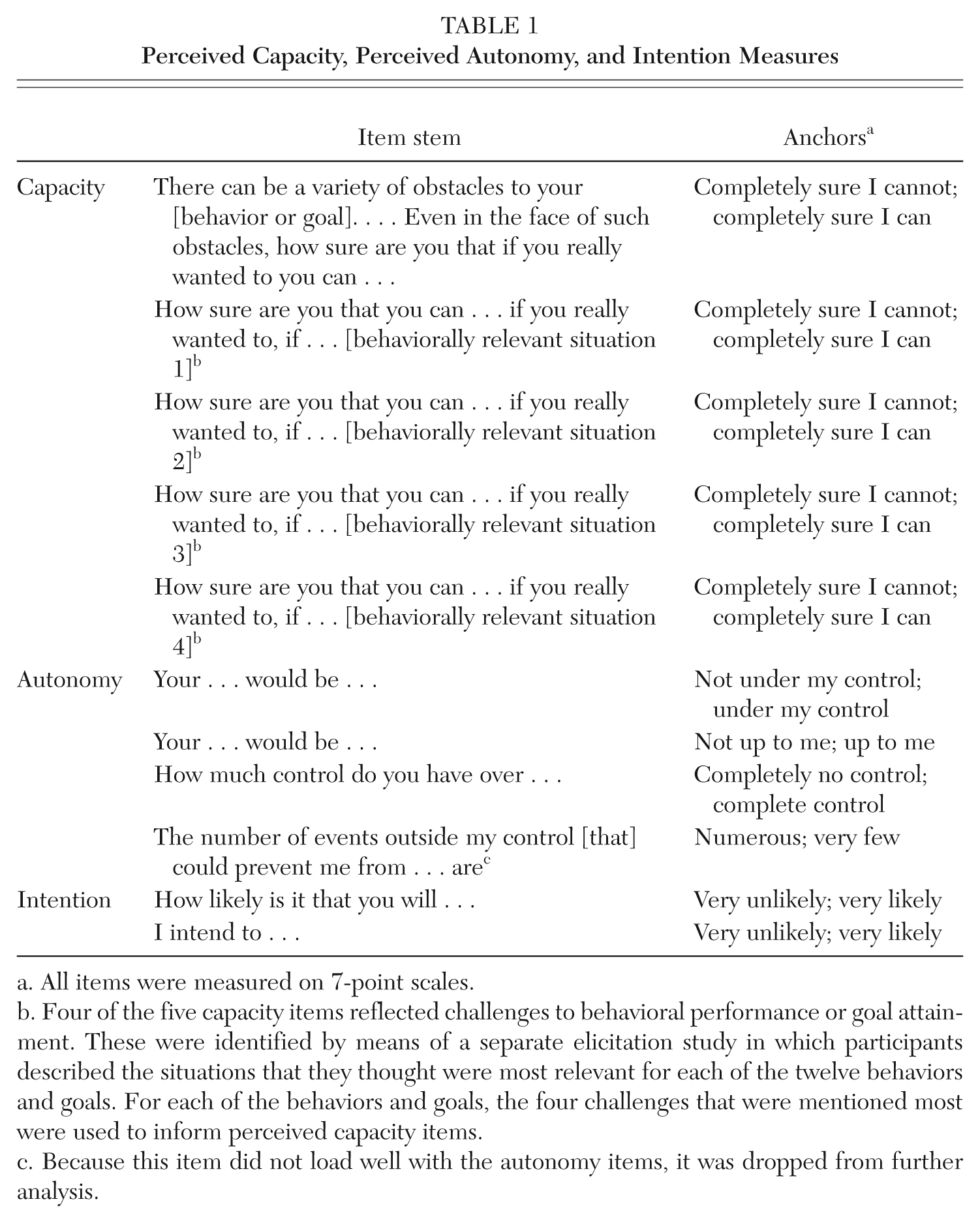
All items were measured on 7-point scales.
Four of the five capacity items reflected challenges to behavioral performance or goal attainment. These were identified by means of a separate elicitation study in which participants described the situations that they thought were most relevant for each of the twelve behaviors and goals. For each of the behaviors and goals, the four challenges that were mentioned most were used to inform perceived capacity items.
Because this item did not load well with the autonomy items, it was dropped from further analysis.
Factor analysis of the perceived behavioral control items, using maximum likelihood extraction and oblique rotation, confirmed a two-factor solution for each of the behaviors and goals. Across the twelve behaviors and goals, the two factors explained between 58 and 68 percent of the variance in the items. The items that a priori were thought to capture perceived capacity loaded on one factor, and all but one of the items thought to be autonomy items loaded on another factor. In contrast to expectations, the item asking about “the number of events outside my control” did not clearly load on the autonomy factor. In fact, for six of the behaviors and goals, the “number of events” item loaded to a similar degree with both capacity and autonomy items, although its factor loadings were as low as .14 and did not exceed .49. The possibility that the “number of events” item (and perhaps other items) captures both capacity and autonomy perceptions merits future attention. Because the present analysis serves to illustrate the relation between perceived capacity and autonomy factors, the “number of events outside my control” item will not be further used here.
Perceived capacity measures had high internal consistency. Although internal consistency of measures comprising autonomy items was somewhat lower for some behaviors and goals, all but the “shoplifting” autonomy factor had acceptable to high internal consistency (see Table 2). These results should not be interpreted as evidence that the two factors necessarily should always be kept separate. Indeed, measures comprising both capacity and autonomy items had very high internal consistency, which is consistent with the view that perceived capacity and autonomy are aspects of the same overarching construct. (But note that Cronbach’s alpha, which was used here to assess internal consistency, increases not only as a function of interitem correlations but also as a function of the number of items analyzed.) In addition, correlations between perceived capacity and autonomy ranged from r = .06 to r = .63, suggesting that support for separating perceived capacity and autonomy items is stronger for some behaviors (e.g., marijuana use) than for others (e.g., condom use).
Associations between Perceived Capacity and Autonomy Items
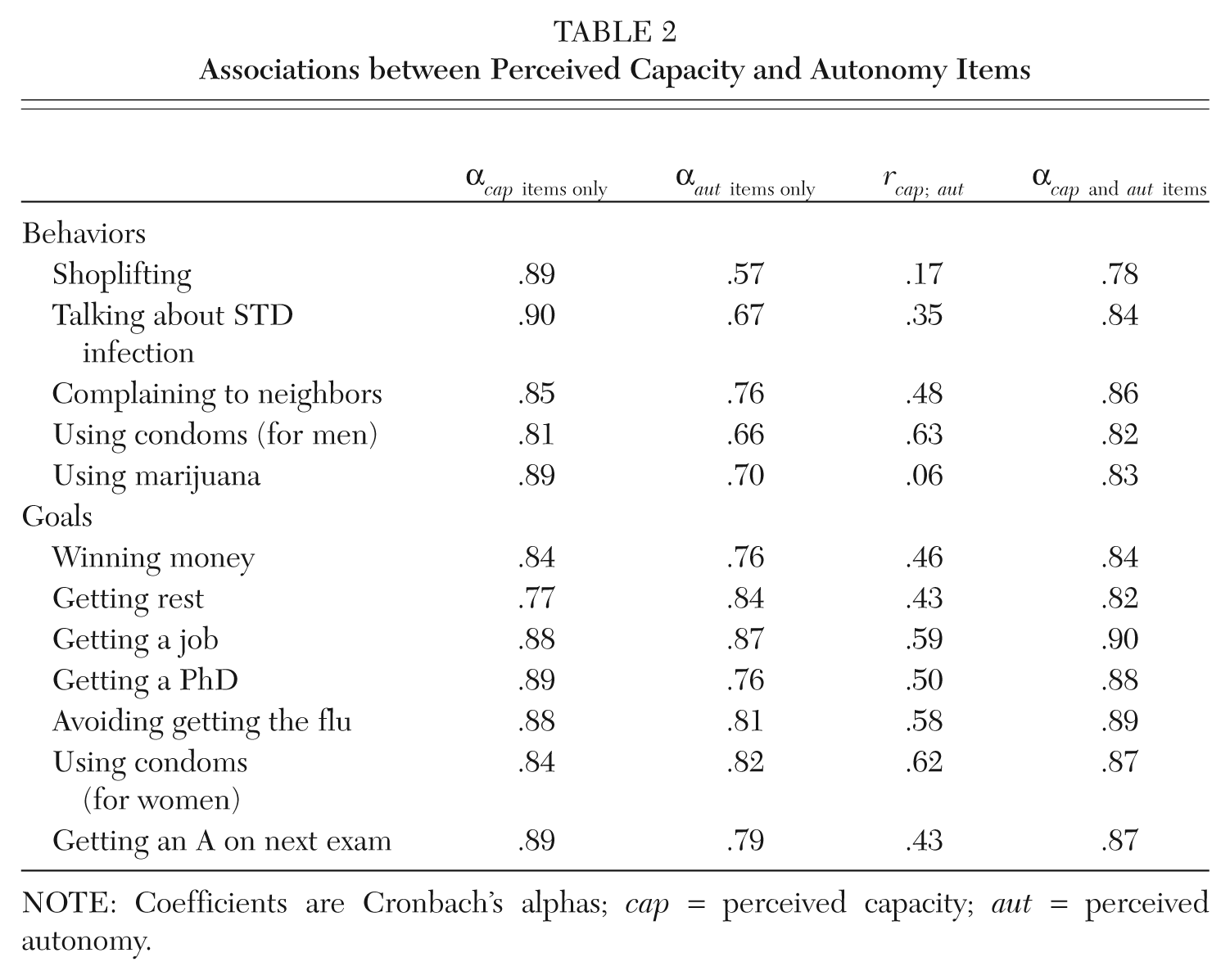
NOTE: Coefficients are Cronbach’s alphas; cap = perceived capacity; aut = perceived autonomy.
Mean scores indicated that perceived autonomy was higher for behaviors than for goals (see Table 3). This may reflect that goal attainment generally is contingent on more factors than the decision to perform a behavior. For example, inserting a quarter in a slot machine is an autonomous decision, but winning money from a (fair) slot machine is controlled solely by the laws of probability. In addition, mean perceived autonomy scores tended to be higher than mean perceived capacity scores, which suggests that when people feel that the decision to engage in a particular behavior is theirs to make, they may still not feel able to actually carry out the behavior.
Means and Variance of Perceived Capacity and Perceived Autonomy Factors
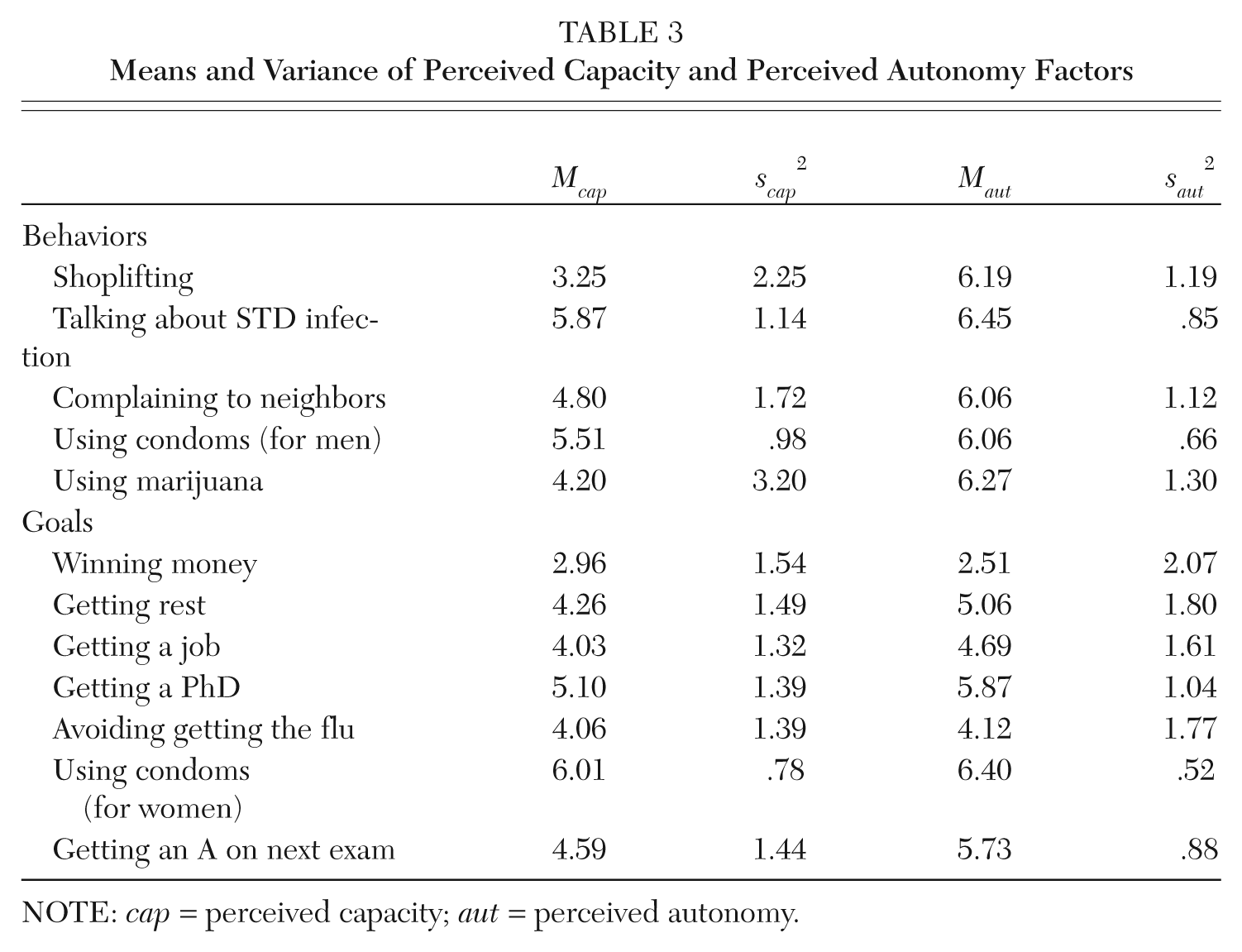
NOTE: cap = perceived capacity; aut = perceived autonomy.
As theorized, the relative importance of perceived capacity and autonomy for explaining intention varied as a function of the behavior or goal. At the same time, regression weights were generally larger for perceived capacity than for perceived autonomy (see Table 4). It seems unlikely that this is due to multicollinearity or distribution issues; tolerance was high, and variance in perceived capacity and autonomy did not systematically covary with the size of regression coefficients. Empirical evidence additionally suggests that these findings are robust. For example, in a review of planned behavior research, Armitage and Conner (2001) found that confidence items correlated more strongly with intention (r = .44; 28 tests) than did autonomy items (r = .23; 7 tests). It is unclear whether these findings reflect that people’s own abilities are more readily accessible when they consider whether they can carry out a behavior, are a result of overestimating the degree of free will that people possess, or are caused by a different factor.
Regression of Intention on Perceived Capacity and Perceived Autonomy
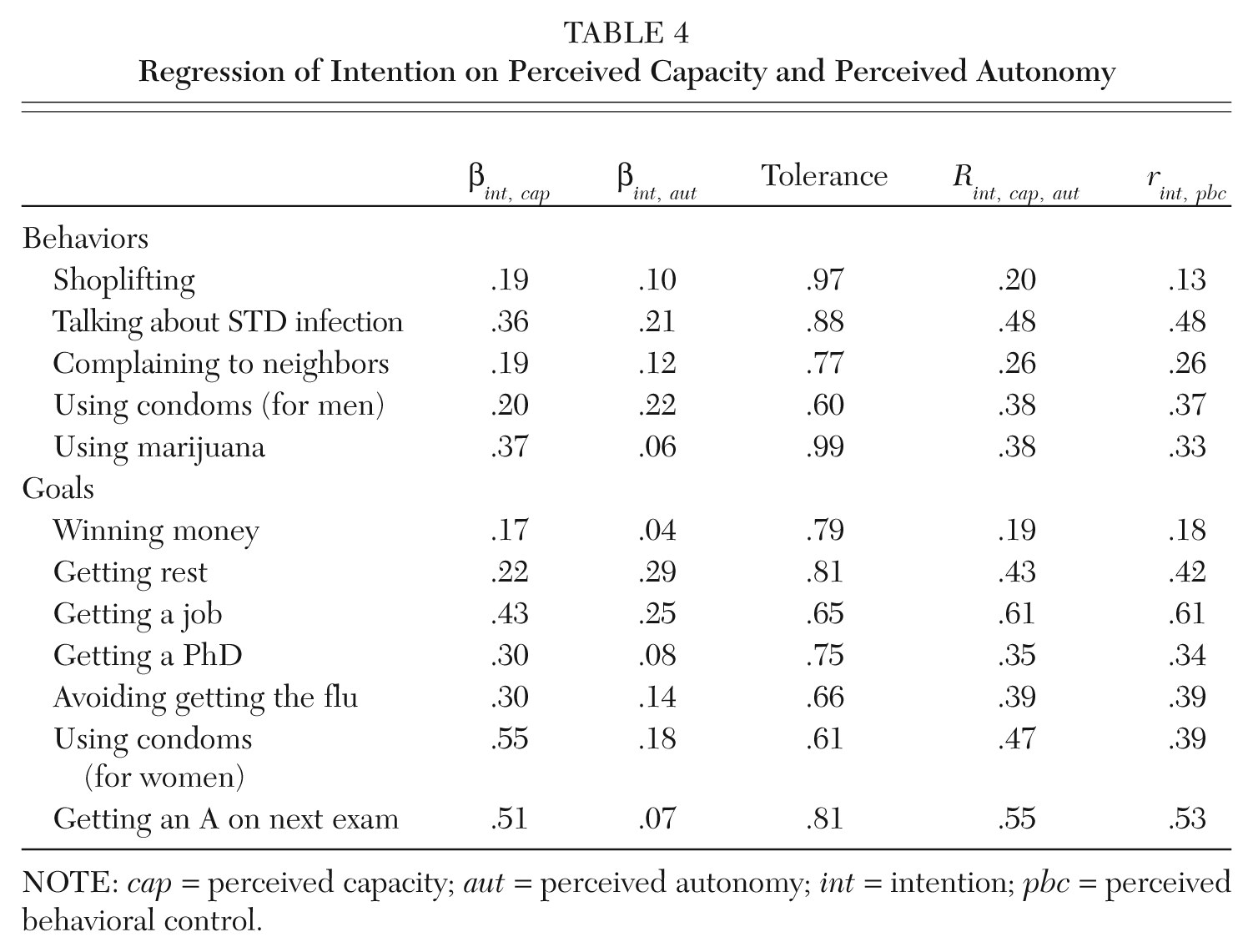
NOTE: cap = perceived capacity; aut = perceived autonomy; int = intention; pbc = perceived behavioral control.
Consistent with reasoned action propositions, the degree to which perceived capacity and autonomy explained intention varied as a function of the behavior or goal. The range in multiple correlations was .19 to .61, which indicates that control perceptions mattered more for some behaviors (e.g., talking about an STD infection with one’s partner) than for others (e.g., shoplifting). The multiple correlations of intention with perceived capacity and autonomy were generally similar to the bivariate correlations of intention with a measure comprising both perceived capacity and autonomy items. This may be obvious, but it serves to point out that it is not necessary to separate perceived capacity and autonomy when the objective is to test the degree to which behavioral intention is guided by control perceptions. It is useful to separate the two factors only if the objective is to determine the relative importance of perceived capacity and autonomy and if perceived capacity and autonomy do not share large portions of their variance.
Dimensionality of Control Items: Interpretive Issues
The evolution of perceived behavioral control theory and research is marked by a debate about the meaning of the construct. Originally, perceived behavioral control was defined as the “subjective degree of control over performance of the behavior itself” (Ajzen 2002, 668), proposed to be the same as “the person’s belief as to how easy or difficult performance of the behavior is likely to be” (Ajzen and Madden 1986, 457) and “compatible with . . . perceived self-efficacy” (Ajzen 1991, 184). This tripartite definition left room for interpretation. For example, Fishbein and Stasson (1990, 196) wondered, “Does perceived control have to do with (a) perceptions that performance of a behavior . . . is influenced by other people or events, (b) . . . self-efficacy (i.e., I can do it if I want to), or . . . (c) [the] concept of facilitating factors (i.e., performing this behavior is difficult, complex, time consuming)? Clearly, this is an issue that must be resolved before perceived control can become a viable construct in [a] theory.”
To address this issue, many investigators turned to an empirical examination of items commonly used to measure perceived behavioral control. Consistent with the original tripartite definition, such items asked people how much control they believe they have over performing a behavior, how easy or difficult they believe performing the behavior will be, or how confident they are that they can perform the behavior. To determine whether control, difficulty, or confidence items can all be regarded as perceived control measures, investigators have tested whether these items cluster on one or multiple factors (e.g., Norman and Hoyle 2004; Manstead and van Eekelen 1998; Sparks, Guthrie, and Shepherd 1997).
A common finding from that research, and ostensibly consistent with a dual-aspect conceptualization of perceived behavioral control, is that confidence-framed items and control-framed items load on separate factors (e.g., Armitage and Conner 1999; Giles et al. 2004; Pertl et al. 2010). Difficulty items have been found to load well with confidence items (e.g., Manstead and van Eekelen 1998), but there is evidence also that for some behaviors, perceived difficulty is more closely related to attitude (Kraft et al. 2005; Leach, Hennessy, and Fishbein 2001; Yzer, Hennessy, and Fishbein 2004) or intention (Rhodes and Courneya 2003) than to perceived ability to carry out a behavior. It is not well understood when or for whom perceived difficulty reflects control, attitude, or intention, but it is clear that the conceptual meaning of perceived difficulty is ambiguous, and perceived behavioral control should therefore not be defined in terms of perceived difficulty (see also Bandura 1997, 127; Forsyth and Carey 1998).
In contrast to reasoned action theory’s emphasis on the conceptual similarity between perceived behavioral control and self-efficacy, investigators have commonly interpreted the two factors that have emerged from factor analysis of control items as evidence that perceived behavioral control and self-efficacy are distinct constructs (e.g., Armitage and Conner 2001; Pertl et al. 2010). To further support this interpretation, investigators have examined which of the two factors contributes most to the explanation of intention and behavior (Giles et al. 2004; Rodgers, Conner, and Murray 2008). For example, upon a review of research that found that confidence, difficulty, and control items differed in their contribution to the explanation of intention and behavior, Armitage and Conner (2001, 476) wrote, “These studies therefore provide support for a distinction between self-efficacy and PBC [perceived behavioral control].” The logic of this interpretation rests on the assumption that control-framed items are perceived control and confidence-framed items are self-efficacy or, put differently, that the conceptual meaning of perceived behavioral control and self-efficacy can be derived from particular measures. Rhodes and Courneya (2003, 80) warned that this is backward theorizing: “Items should be created to indicate theoretical concepts; theoretical concepts should not be created to indicate items!”
A study by Dzewaltowski, Noble, and Shaw (1990) illustrates how conclusions about conceptual differences are suspect if derived from operational definitions. These investigators correlated perceived control, self-efficacy, and intention. Self-efficacy was measured by asking study participants to “indicate their confidence that they would participate in physical activity at least three days a week over the next 2, 4, 8, and 16 weeks” (p. 394) and to indicate their confidence if self-reported barriers were present. These items ask about confidence in whether one will perform a behavior, not about confidence in one’s ability to perform the behavior. They thus are not self-efficacy/perceived behavioral control items but are more closely aligned with intention items. Consistent with this, confidence and intention scales correlated strongly (r = .81), whereas control correlated less strongly with intention (r = .40) and with confidence (r = .37). Dzewaltowski and colleagues’ conclusion that “it is clear, then, that self-efficacy and perceived behavioral control, as operationally defined in this study, are not similar constructs” (p. 398) succinctly points out that inferences about conceptual distinction sometimes are derived from operational definitions. Such inferences can be accepted only if good construct validity can be assumed, and that is an assumption that cannot always be made.
To be clear on this issue, asking whether control items can be empirically separated is a sound research question. For example, empirical separation of control items can help us to understand what kinds of control perceptions underlie a particular behavior, which in turn can inform the focus of an intervention (Rodgers, Conner, and Murray 2008). The findings that confidence and control items load on separate factors and differ in their relative contribution to the explanation of intention and behavior therefore are important. In addition, when investigators argue that confidence and control-framed items can usefully be analyzed either as a composite measure or as separate dimensions, they are in agreement with reasoned action propositions. Problematic discrepancies arise, however, when one of these factors is labeled as perceived behavioral control and the other as self-efficacy (Norman and Hoyle 2004; Terry and O’Leary 1995). This is problematic because it incorrectly suggests a meaningful conceptual distinction between perceived behavioral control and self-efficacy. Moreover, it can lead to a decision to choose one set of items over the other, which ironically reduces rather than improves the conceptual breadth of the perceived behavioral control construct.
I should note that whereas the current dual-aspect definition of perceived behavioral control is quite clear about the meaning of the construct, it does not remove all ambiguity. In its most recent formulation, reasoned action theory proposes that perceived behavioral control is a construct that has two aspects and that one of those aspects but not the other can be measured with items referring to control. Maintaining “control” as the name of the overarching construct, while at the same time proposing “control” as a necessary component of perceived autonomy but not of perceived capacity, may very well leave some with the notion that perceived autonomy is perceived control and that perceived capacity is self-efficacy. This is a problem if we take seriously the idea that in their most basic conceptualization, reasoned action theory’s perceived behavioral control and social cognitive theory’s self-efficacy both refer to the degree to which one believes that one can carry out a behavior. From this perspective, it would be of value to name the construct in closer semantic correspondence with its intended meaning, but we should also consider that introducing an altogether new name may only add to the confusion. Consistent use of the terms “perceived capacity” and “perceived autonomy” to indicate types of measures used may already greatly reduce the ambiguity of research on perceived behavioral control.
New Areas of Theoretical Inquiry
Further development of our understanding of the meaning and effects of perceived behavioral control can benefit from work that addresses two important questions. One asks whether perceived behavioral control can affect behavior in other ways than currently proposed, and the other asks whether testable hypotheses can be developed regarding when perceived behavioral control can be expected to matter.
Perceived behavioral control as a moderator
According to reasoned action theory, attitude, perceived norm, and perceived behavioral control affect behavioral intention in a direct, additive fashion. It is conceivable, however, that even when attitude and perceived norm toward a particular behavior are positive, people will not consider engaging in the behavior if they believe that they are not able to do so (Eagly and Chaiken 1993). It is thus theoretically possible that perceived behavioral control moderates attitudinal and normative effects on intention, such that the relationship of attitude and perceived norm with intention is stronger when perceived behavioral control is high than when it is low (Ajzen 2002; Yzer 2007).
Although reasoned action theory does not formally model interaction effects of perceived behavioral control with attitude and perceived norm, the assumptions of the original theory of reasoned action implicitly support the idea of a possible moderator role for perceived behavioral control. The theory of reasoned action focused on behaviors that are under volitional control and proposed that attitude and perceived norm are sufficient to explain intention to perform volitional behaviors. Volitional behaviors are likely to be perceived as under one’s control, which implies that the theory of reasoned action modeled attitudinal and normative effects on intention under the condition of high perceived control. It follows that if this condition is not met—that is, when behaviors are perceived to be not under one’s control—attitude and norms should perform less well in explaining intention. This is the crux of the perceived behavioral control as a moderator hypothesis.
Plausible as this idea may seem, there is not much empirical evidence that perceived behavioral control moderates attitudinal and normative effects on intention. This does not necessarily mean that the hypothesis is conceptually flawed. Instead, the lack of empirical support for the moderator hypothesis is likely due to insufficient statistical power to detect interactions in most reasoned action research (Yzer 2007).
Two factors account for the power problem. The first has to do with the hypothesized size of the moderator effect. Attitude and perceived norm are expected to have a strong positive effect on intention if perceived behavioral control is high and an attenuated but not negative effect if perceived behavioral control is low. In statistical terms, we should expect an interaction where within the range of possible values, the simple slopes have the same sign, not opposite signs. Same-sign interactions are smaller in size than opposite-sign interactions, which means that more statistical power is required to demonstrate them. Second, reasoned action research typically relies on survey data. A common feature of those data is that perceived behavioral control data are skewed. This is a problem, because statistical power for interaction tests is weakened when observations do not primarily lie at the extreme points of the predictor and moderator scales (i.e., low-low, low-high, high-low, or high-high [McClelland and Judd 1993]). Survey data typically suggest moderate to strong positive correlations of perceived behavioral control with attitude and perceived norm, which imply that only few observations reside in off-diagonal cells (i.e., low-high and high-low) and, thus, that statistical power for interaction tests in most reasoned action research is weak.
Tests of interaction effects that suffer from methodological issues are not sufficient to reject the perceived behavioral control as moderator hypothesis. In fact, there is some evidence that if statistical power for interaction tests is increased, perceived behavioral control interactions can be demonstrated. Yzer and van den Putte (2007), for example, used a sample of 3,456 smokers, which was sufficiently large to demonstrate that attitude predicted intention more strongly when control was relatively high (b = .56) than when it was relatively low (b = .22). Similarly, perceived norm predicted intention more strongly when control was relatively high (b = .33) than when it was relatively low (b = .09). Attitude and perceived norm did not interact with each other, which suggests that effects on intention were conditional on perceived behavioral control, and not on attitude or perceived norm. Dillard (2011) demonstrated that similar results can be found in much smaller samples if the distribution of attitude, perceived norm, and perceived behavioral control scores is not overly skewed. Examining intention to get vaccinated against HPV in a sample of 174 young women, Dillard found that attitude and injunctive norm predicted HPV vaccination intention more so when perceived behavioral control was high (b = .67 and b = .24) than when it was low (b = .36 and b = .08). Once again, attitude and injunctive norm did not interact.
Colberg (2007) handled the statistical power challenge in a different fashion. She randomly selected twenty-five studies to plot attitude-intention and perceived norm–intention correlations at different mean levels of perceived behavioral control. She found that under high control, the correlation of attitude (r = .52) and norms (r = .41) with intention was stronger than under moderate control (r = .38 and r = .29). The perceived behavioral control as a moderator hypothesis thus can be demonstrated if appropriately tested. One next step for reasoned action researchers is to systematically examine the theoretical and practical implications of the moderating role of perceived behavioral control.
Predicting prediction
Reasoned action theory proposes that because each behavior is substantively unique, the degree to which a behavior is guided by perceived behavioral control is an empirical question. Both theory and intervention practice would benefit tremendously, however, if the importance of perceived behavioral control were predictable. The success with which such predictions can be developed depends on the use of other theory in a complementary fashion (Fishbein and Ajzen 2010; Weinstein and Rothman 2005).
One example comes from Lutchyn and Yzer (2011). These investigators used construal-level theory (Trope and Liberman 2003) to develop the hypothesis that the relative importance of behavioral and control beliefs is a function of how far away in time a behavior is to be performed. According to construal-level theory, people construe distant-future behaviors in abstract terms, emphasizing the value or desirability of a behavioral outcome to describe why one would perform the behavior. In reasoned action terminology, such construals emphasize behavioral beliefs. In contrast, people construe near-future behaviors in concrete terms, emphasizing feasibility of the behavior to describe how one could perform the behavior. In reasoned action terms, near-future behaviors are construed in terms of control beliefs. Lutchyn and Yzer manipulated the time component in behavioral definitions and found that when a behavioral time frame moved from the near to the distant future, the salience of behavioral beliefs increased and the salience of control beliefs decreased. These findings imply that perceived behavioral control is more likely to matter for behaviors that are relevant for the near than for the distant future. At a more general level, they illustrate that it is possible to develop testable predictions about the degree to which perceived behavioral control is a basis of behavior.
Conclusion
Current reasoned action theory posits that perceived behavioral control is a latent variable that has two aspects: perceived capacity and perceived autonomy. Perceived capacity and autonomy can be, but are not necessarily, congruent. They are different aspects of the same overarching question that people ask when considering performing a particular behavior: can I carry out the behavior? The analyses presented in this article illustrate that depending on the purpose of the investigation, perceived capacity and autonomy can be combined or analyzed separately but also that even when separable, perceived capacity and autonomy items reflect the same overarching construct. The dual-aspect interpretation of perceived behavioral control clarifies its conceptual meaning and refocuses attention to the possibility of additive contributions of perceived capacity and autonomy to behavioral prediction rather than superiority of one theoretical construct over another. From a practical perspective, the dual-aspect definition suggests that to enhance perceived behavioral control over a behavior, an intervention can focus on skill-building, emphasize autonomous decision-making, or do both. It also is a new idea and should be a priority in future reasoned action research.