




Abstract
U.S. children today have increasingly diverse living arrangements. In 2012, 10 percent of children lived with at least one grandparent; 8 percent lived in three-generational households, consisting of a parent and a grandparent; while 2 percent lived with a grandparent and no parent in the household. This article reviews the literature on grandparent coresidence and presents new research on children coresiding with grandparents in modern families. Findings suggest that grandparent coresidence is quite common and that its prevalence increased during the Great Recession. Additionally, these living arrangements are diverse themselves, varying by the marital status of the parent, the home in which the family lives, and the economic well-being of the family. Suggestions for future research are also proposed.
Keywords
One important aspect of family diversity in the United States is the extent to which children live with their grandparents. Grandparent coresidence takes one of two forms—children living with parents and grandparents, referred to as “three-generational families”; and children being raised by grandparents with no parent in the household, known as “custodial grandparent families.” As this article shows, the population of children living with grandparents is diverse in terms of family structure and economic well-being—of interest to policy-makers and not yet well understood by researchers.
Grandparent coresidence is a more important issue now than in recent decades (Generations United 2011). One reason is heightened economic need. Economic forces, such as the Great Recession, have the potential to increase and change the nature of grandparent coresidence, as households may double up to protect against economic shocks, such as job loss or eviction. Another factor is increased availability of grandparents; life expectancy has risen from less than 50 years in 1900 to almost 80 years in 2009 (National Center for Health Statistics 2010). This trend, combined with improved financial resources for older adults and more time spent in retirement, increase opportunities for coresidence (Szinovacz 1998). Family sizes have decreased as well, meaning that grandparents have fewer grandchildren, increasing their availability to live with any one grandchild (U.S. Census Bureau 2009). The aging of the baby boom generation may also precipitate grandparent coresidence, if families have to provide care for elderly parents (Generations United 2011). Finally, changing family demographics may play a role in grandparent coresidence. A growing number of children living with a single parent (U.S. Census Bureau 2011), and increases in maternal employment (U.S. Bureau of Labor Statistics 2011) may mean a greater need for grandparents’ presence in the household to help care for children.
This article reviews the literature and presents new research on children coresiding with grandparents in contemporary U.S. families. We focus specifically on three-generational households and custodial grandparent households, present trends in these types of living arrangements, examine how families enter into such arrangements, and discuss implications of such living arrangements for individuals in these families. We conclude with a discussion of future research needs and policy implications.
Trends in Grandparent Coresidence
Figure 1 documents the proportion of U.S. children living in various types of three-generational and custodial grandparent households between 2001 and 2012. In 2012 10 percent of U.S. children lived with their grandparents, representing slightly more than 7 million children.
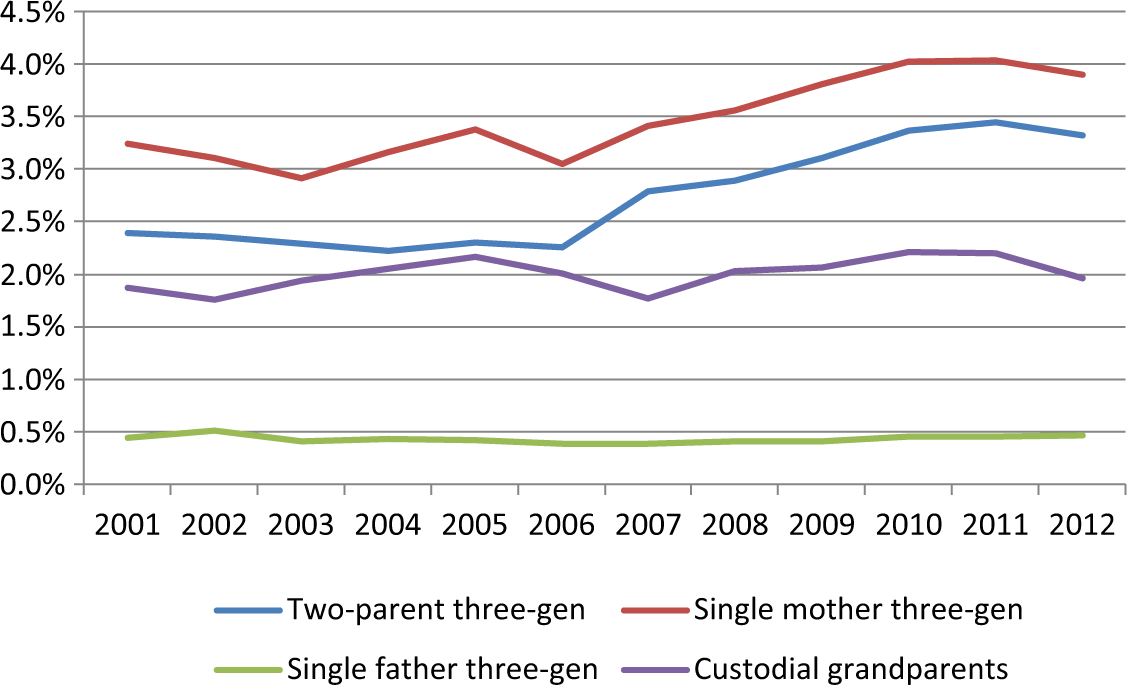
Trends in Three-Generational and Custodial Grandparent Households: Percentage of Children under Age 18
Three-generational families
Prevalence and characteristics
We begin by discussing three-generational families, which consist of a child, that child’s parent(s), and one or more grandparent. In 2012, 8 percent of U.S. children were living in a three-generational household. As shown in Figure 1, there has been a 30 percent increase in the proportion of children living in three-generational households since 2001; much of this increase occurred during the Great Recession. In 2012, the majority (54 percent) of children in three-generational households lived with only a grandmother, 36 percent lived with both grandparents, and very few lived with a grandfather only (10 % authors’ calculations).
Certain groups of children are more likely to live in three-generational households than others. Such arrangements are more common among those from nonwhite racial and ethnic groups; in 2012, 5 percent of white children lived in such families, compared to 10 percent of black children, 11 percent of Hispanic children, and 13 percent of Asian children. 1 Three-generational households are also more prevalent among children living with a single parent. In 2012, 5 percent of children living with both parents 2 also lived with a grandparent, compared to 16 percent of those living with a mother only and 12 percent of those living with a father only. Of the children in three-generational households in 2012, 43 percent lived with both parents, 51 percent lived with a single mother, and 6 percent lived with a single father (authors’ calculations).
Three-generational living arrangements can be quite unstable. For example, a sample of urban mothers who had at some point lived in three-generational households was surveyed five times over nine years; the modal pattern was that they lived in a three-generational household just once in the five waves of data collection. Patterns differed by mothers’ marriage and partnership status at the time of the child’s birth, with single mothers spending longer durations in three-generational arrangements than those who were married or cohabiting when the child was born (Pilkauskas 2012).
The first three columns of Table 1 present descriptive characteristics for U.S. children in different types of three-generational households—those living with two parents, those living with a single mother, and those living with a single father. The stark differences across these family types highlight the fact that three-generational living arrangements look very different depending on the parent’s marital or partnership status 3 and gender. For example, children in two-parent three-generational living arrangements are much more advantaged than those in single-mother three-generational households. Two-parent three-generational households are much less likely to be poor than single-mother three-generational households, have lower rates of food assistance, are more likely to own their home, and are more likely have an employed parent. Single-father three-generational households, while rare, also differ from those in which a child lives with a single mother. Such households have low rates of poverty, are most likely to consist of school-aged children, and have the highest rates of home ownership; but they have the lowest rates of child health insurance coverage.
Descriptive Statistics by Family Type in 2012 (in percentages; numbers in thousands)

SOURCE: U.S. Census Bureau, Current Population Survey, 2012 Annual Social and Economic Supplement.
A key area of difference between two-parent and single-parent three-generational households has to do with who owns or rents the home in which the family lives. The majority (66 percent) of children in two-parent three-generational households live in a home owned or rented by the parent, implying that the grandparent moved into the parental home. In contrast, the majority of children in single-mother (71 percent) and single-father (74 percent) three-generational households live in homes that are owned or rented by the grandparent, suggesting that the parent moved into the grandparents’ home (authors’ calculations). Differential patterns in home ownership may shed light on “who is helping whom” in three-generational households. Differences across types of three-generational families also highlight the need to examine such families separately, which we do throughout the rest of this article.
Selection into three-generational arrangements
A variety of factors may precipitate the formation of three-generational living arrangements. Some of these factors represent the needs of the parent, and include teen parenthood, a need for financial support or child care, or a general need for parenting or other assistance on the part of the mother. Cultural factors may also play a key role in the formation of three-generational families, as some cultures with a familial orientation may enter into such arrangements due to cultural preferences, not out of need.
The reasons for entering into a three-generational arrangement also likely differ by the relationship status of the parent. Single mothers are more likely to live in three-generational arrangements, a pattern that may reflect that such mothers have greater needs. In a study of disadvantaged African American young mothers, three-generational arrangements were more common when the children were younger, suggesting a situation in which the grandparent is helping the parent (Chase-Lansdale et al. 1999). For single parents, it is more likely that the parent has moved into the grandparents’ home, and evidence suggests that, in these situations, the grandparent is providing assistance to the parent, for example by providing child care or financial support. For married-parent families, on the other hand, three-generational living arrangements represent a situation in which the grandparent is moving into the parental household, suggesting that the parent is providing assistance to the grandparent. We know of no research that has examined the factors leading single-fathers to select into three-generational households.
External forces, such as the Great Recession, may lead families to enter three-generational living arrangements. As shown in Figure 1, between 2006 and 2012, there was a large increase in the prevalence of two-parent and single-mother three-generational households. Data from a September 2011 survey suggest that, during the Great Recession, economic factors were the most common driving force behind decisions to form a multigenerational household (Generations United 2011).
The well-being of family members in three-generational arrangements
The implications of three-generational living arrangements may differ, depending on which family member is being considered (the parent, grandparent, or grandchild). It is also important to think carefully about to whom those in three-generational households should be compared. For single-mother three-generational families, the relevant comparison group may be unmarried mother families not living with the child’s grandparent, while for two-parent three-generational households, the relevant comparison may be two-generational households with married or cohabiting parents. Unfortunately, research has not always been clear or consistent about the most relevant group to which three-generational households should be compared, hindering our understanding of the implications of such living arrangements for individuals and families.
Figure 2 documents trends in poverty status 4 for the three different types of three-generational living arrangements, showing consistently higher poverty rates for single-mother three-generational families, compared to the other types. During and after the Great Recession, poverty rates increased for all family types, but especially for two-parent three-generational households, with an increase of 80 percent between 2007 and 2012.

Percent of Children in Poverty by Family Type
Research linking three-generational living arrangements to child well-being is mixed, with some studies showing that children living in three-generational households have reduced well-being, including higher behavior problems and less positive behavior, compared to all children not living with a grandparent (Pittman and Boswell 2008) and lower educational attainment, compared to children living with a single mother and no grandparent (McLanahan and Sandefur 1994). In contrast, DeLeire and Kalil (2002) show that children in single-mother three-generational households fare just as well or better than those in two-generational married-parent households in terms of education and risky behaviors, and better than those living with a single mother alone.
Others have found that associations between three-generational status and child well-being differ by race, with one study finding benefits of three-generational arrangements for young children’s cognitive test scores only among African Americans (Mollborn, Fomby, and Dennis 2011). In contrast, studies using more robust techniques to address selection into coresidential situations (Augustine and Raley 2013; Dunifon and Kowaleski-Jones 2007) find evidence that African American children do not derive benefits from three-generational living arrangements.
Other research examines the well-being and behaviors of parents in three-generational arrangements. Research finds that grandmother coresidence benefits teen mothers’ education (Unger and Cooley 1992) and employment (Gordon, Chase-Lansdale, and Brooks-Gunn 2004; Hao and Brinton 1997), but is associated with less positive parenting behaviors (Luster and Dubow 1990; Wakschlag, Chase-Lansdale, and Brooks-Gunn 1996; Chase-Lansdale et al. 1999). However, this may be attributable to the selection into coresiding situations of mothers who have lower parenting skills (Gordon, Chase-Lansdale, and Brooks-Gunn 2004). There is some evidence that three-generational arrangements are linked to improved parenting behaviors of older mothers (Pittman and Boswell 2008) and reduced parenting stress among Latina mothers (Greenfield 2011).
Research examining the linkages between three-generational living arrangements and the well-being of grandparents is quite limited. Studies find that grandparent coresidence is associated with reduced well-being among grandparents, including higher stress and depression (Musil and Ahmad 2002), and reduced positive affect and increased negative affect (Deaton and Stone 2013). However, much of the linkage between grandparent coresidence and grandparent well-being is due to the fact that grandparents who live in three-generational arrangements have worse health to start with than those who do not (Deaton and Stone 2013; Hughes et al. 2007). Additionally, the well-being of coresident grandparents may vary by race and ethnicity; one study shows that Latino grandmothers fare best in three-generational arrangements, compared to other groups (Goodman and Silverstein 2002).
Future research in this area should address the nonrandom selection of families into three-generational arrangements. It is likely that some of the factors that lead families to enter three-generational arrangements are also linked to individual or family well-being. If this is the case, estimates of the associations between three-generational arrangements and individual or family well-being will be biased. Very few studies have addressed this issue; exceptions include Dunifon and Kowaleski-Jones’s (2007) use of a child fixed-effects design, and Augustine and Raley’s (2013) propensity score analysis. Future work in this area should strive to employ rigorous research designs to address the selection of families into living arrangements. Additionally, studies are inconsistent in how three-generational households are measured and to whom they are compared. Given the differences in the characteristics and selection into three-generational households by family structure, separating them by the mothers’ marital status is an important direction for future research.
When looking at the influence of three-generational households on child well-being, one key area of interest is the nature of grandparents’ interactions with children: what types of interactions and behaviors are exhibited by grandparents in three-generational arrangements? Unfortunately, data in this area are extremely limited, with the vast majority of surveys only measuring parenting behaviors among parents, not among coresiding grandparents. An exception is Chase-Lansdale et al. (1999), who observed both mother-child and grandparent-grandchild interactions in a sample of children born to young African American mothers; they found that grandmothers living with their daughters and grandchildren in three-generational arrangements had less positive interactions with their grandchildren than those living outside of the home (but still highly involved).
Custodial grandparent families
Prevalence and characteristics
We now turn to grandparents raising their grandchildren with no parent in the household, referred to as custodial grandparent families. Figure 1 shows that 2 percent of U.S. children live in such an arrangement, a number that has held relatively steady for the last 10 years. In 2012 1.6 percent of white children lived in such families, compared to 3.9 percent of black children, 1.5 percent of Hispanic children, and 0.4 percent of Asian children. 5 Research shows that there are a variety of potentially overlapping reasons why children leave their parental home to live with their grandparents, including substance use, abuse and neglect, parental incarceration, mental health issues, parental death, and parental young age (Gleeson et al. 2009; Jendrick 1994).
As shown in the last column of Table 1, almost half (49 percent) of children living in custodial grandparent families lived with both a grandmother and grandfather; 46 percent resided with just a grandmother, and the remaining 5 percent lived with just a grandfather. Custodial grandparent families are economically disadvantaged. Two-thirds of children in these families live in households with income less than 200 percent of the poverty line (half of these are below 100 percent of the poverty line). Figure 2 shows trends in poverty status for children in custodial grandparent households.
These numbers confirm other research that indicates that custodial grandparent households are disadvantaged compared to other family types. Compared to those in other family structures, custodial grandmothers are more likely to be on public assistance, are less likely to be employed, care for more children, are less likely to be married or cohabiting, use less child care assistance, and have more physical limitations and chronic disabilities (Bachman and Chase-Lansdale 2005). Households headed by an unmarried custodial grandparent appear to be at a particularly high risk for financial disadvantage (Brandon 2005; Park 2006).
Most children in custodial grandparent households are raised by their grandparent in an informal arrangement and are therefore outside the reach of many social service agencies. A study drawing on a 1999 national sample of U.S. children found that 85 percent of children in custodial grandparent families entered into such an arrangement due to a private arrangement within a family, rather than the involvement of a child welfare agency (although it is possible that child welfare involvement is avoided when children come to live with their grandparents). Further, only 29 percent of families were receiving cash assistance, despite the fact that all were eligible for such payments (Scaracella, Macomber, and Geen 2003).
To shed further light on the characteristics of custodial grandparent families, we present results of analyses using two separate datasets. First, data are drawn from the Fragile Families and Child Wellbeing Study (FFCWS), which follows a cohort of 4,898 children born in twenty large U.S. cities between 1998 and 2000 (Reichman et al. 2001). Mothers and fathers were interviewed in the hospital after the birth of the child, and again when the child was one, three, five, and nine years. Our analysis uses data from a special survey given at age nine for cases in which the child’s primary caregiver was someone other than the mother or the father. We select children whose primary caregiver is a grandparent (n = 87). We also draw data, gathered in 2009, from a unique multimethod study of custodial grandparent families in New York. Data for this study were collected by the first and third authors from dyads of custodial grandparents and the teenage grandchildren they were raising. The sample was drawn from across New York State and recruitment took place through local community agencies providing programming for custodial grandparent families. Interviews consisted of three components: surveys for both the teenager and the grandparent; videotaped interactions between grandparents and grandchildren; and open-ended interviews with the grandparents. Neither the FFCWS nor the New York sample is a representative sample of children in custodial grandparent families. Because data were gathered from children at relatively older ages, these samples likely overrepresent the length of time children have lived in custodial grandparent households. Additionally, the New York sample in particular comprises families who received services from community agencies, thereby potentially differing from national samples in a variety of ways (for example, the New York sample may include families that are more in need of services, or it may over-represent families that are more advantaged and therefore able to access services).
Table 2 presents information from the FFCWS and New York samples of children being raised by custodial grandparents. This table shows that, for both samples, the most common reason grandparents gave for raising their grandchild had to do with the parent voluntarily giving up the child to the grandparent. Analysis of the New York data revealed that this often occurred when parents’ new partners did not want to live with a child from a previous relationship, or were even abusive toward that child. The quote below illustrates these types of situations: His birth mother really signed off on him when he was four . . . after she and my son divorced. . . . He went with my son for eight years and that was just horrible. My son didn’t take care of him . . . [he and his wife] had two more children. . . . And Max just got shoved by the wayside. . . . And then when he was 13, they just called us one Saturday night and said Max’s not going to live here anymore, come and get him, he’s out.
Characteristics of Custodial Grandparent Families in the FFCWS and New York Study

In the FFCWS this variable represents contact in the last 30 days and is calculated only for those children whose parent is not deceased. In the New York study this represents contact in the past year, among those whose parent is not deceased.
In the FFCWS this represents whether the child was reported to have had any health problem in the past 12 months including hay fever or respiratory allergy, food or digestive allergy, eczema or skin allergy, frequent diarrhea or colitis, anemia, frequent headaches or migraines, three or more ear infections, seizures, stuttering or stammering, and diabetes. In the New York study this represents children who have a health condition that: limits participation in school, schoolwork, or activities; or requires a doctor, medication, or special equipment.
Because longitudinal data on custodial grandparent families are rare, it is difficult to determine the average duration of such arrangements. However, Table 2 shows that, in both studies, children had been living with their grandparent for the majority of their lives. In the New York study, the average teen was 15 years old and had been living with the grandparent(s) for 10 years. In the FFCWS, the average child was 10 years old and had been living with their grandparent(s) for 7 years. Finally, this table shows high rates of disability among the grandparents, and health problems among the youth, with about 50 percent of the youth in each sample having a health problem.
Complexity in custodial grandparent arrangements
Despite not living in the household, parents have the potential to play important roles in the lives of custodial grandparent families. In the New York and FFCWS samples, and echoed in other studies (Dolbin-MacNab and Keiley 2009; Goodman and Silverstein 2001), the majority of children were in regular contact with their mothers, despite having lived with their grandparents for many years. The nature of parent-child contact in custodial grandparent families likely depends on a host of factors, including the reasons why the child left the parental home; the parent’s characteristics, the grandparents’ relationship with the parent; and the involvement of partners, spouses, or other children of the parent. Indeed, qualitative work suggests that the parent can be a source of stress for the grandparent and child alike in custodial grandparent households (Musil et al. 2009; Dolbin-MacNab and Keiley 2009). One grandparent in the New York study discusses how her grandson’s anger at his parents plays out in the way he interacts with her: I had books thrown at me, chairs . . . but through it all he always cried and said, “Nana, I didn’t want to hurt you, I was so angry . . . I don’t think I’ll ever forgive mommy and daddy”
The well-being of family members in custodial grandparent arrangements
Any discussion of the well-being of those in custodial grandparent arrangements must take into account two factors: first, to whom are custodial grandparent family members being compared? Second, whose well-being is being considered? It is likely that implications of such an arrangement differ for children, for parents, and for grandparents.
Several studies have shown high rates of behavior problems among children being raised by grandparents (Pittman 2007; Sun 2003) while others show that such children look similar to children in single-mother families (Solomon and Marx 1995). Many differences in well-being between children being raised by grandparents and those living with their parents appear to relate to high rates of poverty in grandparent-headed households, rather than the living arrangement per se. However, one study finds that children being raised by relatives have higher rates of suspension and expulsion and lower engagement in school, compared to children being raised by parents with similar economic backgrounds (Billing, Macomber, and Kortenkamp 2002). A key factor distinguishing children in custodial grandparent families from other family types is that such children have experienced some type of event or circumstance that has led them to leave their parental home. These events, combined with the challenges related to living apart from one’s parent, likely play a role in the well-being of children in custodial grandparent families, above and beyond the influence of the living arrangement itself on children’s development.
Because of this, the most relevant comparison group when examining the well-being of children in custodial grandparent families may be children in foster care. However, studies comparing the well-being of children in custodial grandparent families to those in foster care are extremely rare. An exception is Rubin et al. (2008), who found that children placed with kin had fewer behavior problems three years after their placement, compared to children in traditional foster care.
Other literature examines the well-being of grandparents in custodial grandparent households. Burton (1992) highlights the stress and strain felt by such grandparents, despite the love and commitment they feel for their grandchildren. As illustrated in both the New York and the FFCWS data, many custodial grandparents will raise their grandchildren for very long periods of time. Combined with the investment these grandparents have already made in raising their own children, this represents a very large portion of adult life spent in child-rearing. Such a commitment can be particularly stressful when combined with the health concerns of custodial grandparents. Indeed, there is evidence that custodial grandmothers have worse health and higher stress than other grandmothers (Musil and Ahmad 2002). Hayslip and Kaminski (2005) lay out other implications for well-being among custodial grandparents, including physical and mental health problems resulting from what can be a stressful situation, and financial concerns that arise in the face of increased expenses related to caring for the child while living on a fixed income. However, custodial grandparents also have several sources of strength, including an opportunity to form a close relationship with the custodial grandchild and an increased sense of purpose (DiSciullo and Dunifon 2012).
Other studies have examined the parenting behaviors of custodial grandparents and have highlighted some challenges, including higher levels of parental aggravation than other family types (Jooste, Hayslip, and Smith 2008); less monitoring, less school involvement, and lower expectations, compared to two biological parents, single mothers, or stepfather families (Sun 2003). However, other studies (Ehrle and Geen 2002; Harden et al. 2004) found few differences in parenting behaviors and attitudes between kinship (many of whom were grandparents) and traditional foster parents.
Although parents have a key role to play in custodial grandparent households, no existing studies examine the well-being of parents whose children are being raised by grandparents. There are severe challenges to collecting such data, due to the fragile relationship among parents, grandparents, and children in such arrangements. However, the collection of such data would greatly enhance our understanding of custodial grandparent families.
Conclusion, Policy Implications, and Future Research Agenda
This article sheds light on the role of coresident grandparents in U.S. family life, looking specifically at three-generational and custodial grandparent families. The research and findings presented here highlight several key points. First, grandparent coresidence is quite common. In 2012, a total of 10 percent of U.S. children lived with a grandparent, representing approximately 7.1 million children. The prevalence of grandparent coresidence increased during the Great Recession, suggesting that such living arrangements act as a key buffer for extended family when times are hard. However, research on grandparent coresidence has not kept up with these demographic trends, limiting our knowledge of the implications of grandparent coresidence for families and individuals.
To address this lack of knowledge, several avenues of new research are needed. First, there is a need for high-quality descriptive work on grandparent coresidence, drawing on the latest census and other datasets to document prevalence and trends over time in such arrangements, for the U.S. as a whole and for various policy-relevant subgroups to generate a baseline level of information that can inform future work. Second, a need exists for longitudinal studies of grandparent coresidence. Very few studies have followed grandparent coresident families over time (key exceptions being Pilkauskas [2012] and Szinovacz, DeViney, and Atkinson [1999]). Data collection efforts and research are needed to better understand the factors that lead families to transition into and out of the different types of coresidential arrangements, how these factors differ for various subgroups of the population, and what the implications are for individual and family well-being.
Research in this area also should evolve to reflect the fact that living arrangements involving grandparents are highly varied. Evidence suggests that two-parent three-generational arrangements differ from those of single-parent three-generational arrangements in terms of selection into such an arrangement, the behaviors of parents and grandparents in such arrangements, and implications for family members. As such, future research should take care to examine these two different types of three-generational families separately. Research also shows that the precursors and implications of grandparent coresidence may vary by race and ethnicity, another key area for future research. In all such analyses, careful attention should be paid to identifying an appropriate comparison group to whom grandparent coresident families can be compared.
Finally, scholarship in this area would greatly benefit from a mixed-methods approach. Qualitative work is useful to understand the dynamics occurring within three-generational and custodial grandparent households. In terms of quantitative analyses, more robust approaches are needed, particularly those that can address the nonrandom selection of families into grandparent coresident arrangements, such as fixed-effects, propensity score, or instrumental variables methods. In addition, time use data can shed light on patterns of behavior in these complex families.
Several policy implications evolve from this work as well. Policy-makers increasingly discuss modifying the social safety net for the elderly to address concerns about the level of expenditures on the elderly and whether these are sustainable as the number of elderly increase (Gould and Cooper 2013). What is missing from this debate, however, is the fact that social policies supporting the elderly also support millions of children. As a result, any weakening of this safety net is likely to have implications for not only the elderly, but also the grandchildren with whom they live. Furthermore, those elderly who are most economically vulnerable, and therefore most likely to feel the consequences of reductions in social support, are those very same elderly who are most likely to live with their grandchildren (Gould and Cooper 2013). This highlights a need for a policy discussion focused not only on how proposed policy changes may impact the elderly, but also the grandchildren with whom many of their lives are embedded.
There is also a particular need for resources for custodial grandparent families. As noted above, the vast majority of such families are not part of the foster care system, and therefore not eligible for the higher rates of financial assistance that foster families receive. All custodial grandparent families not part of the foster care system are eligible to receive cash assistance; however, only a very small number of families do (Scaracella, Macomber, and Geen 2003). Given the high rates of need among custodial grandparent families, both in terms of material resources and physical and emotional issues, specific supports for grandparents raising grandchildren are necessary. These supports could include outreach to ensure families receive services to which they are entitled, as well as the creation of new programs designed to address such families’ unique needs.
Grandparents play a key role in the increasing complexity of U.S. family life. Grandparent coresidence is prevalent, increasing, and has important implications for individuals and families alike. As this article points out, research and policy advances are needed to keep up with these trends.
Footnotes
NOTE:
We are grateful for support from the William T. Grant Foundation, the Cornell Institute for the Social Sciences, a Cornell donor, and from USDA Hatch and Smith-Lever funds.
Notes
Rachel E. Dunifon is a professor in the Department of Policy Analysis and Management at Cornell University and associate director of the Bronfenbrenner Center for Translational Research.
Kathleen M. Ziol-Guest is a research associate professor in the Department of Humanities and Social Sciences at New York University. At the time of this study, she was a postdoctoral associate in the Department of Policy Analysis and Management at Cornell University.
Kimberly A. Kopko is a senior extension associate in the Department of Policy Analysis and Management at Cornell University, and an affiliate of the Bronfenbrenner Center for Translational Research.