



Abstract
The American creed stresses political equality and political involvement, but substantial political inequality still persists from one generation to the next. Despite the importance of political inequality, not enough is known about the mechanisms that reproduce it. Political socialization research has focused on the transmission of political attitudes and culture across generations, but it has paid scant attention to how family transfers of economic resources, human capital, and social capital reproduce and perpetuate unequal patterns of political involvement and political authority. This article argues that more attention should be paid to measuring the persistence of political identity, political participation, civic engagement, and political influence networks over time and across generations. Special attention should be devoted to learning more about how the passage of family resources (economic resources, human capital, social capital, and cultural capital) from parents to children reproduces political inequality and reduces the opportunity for political mobility. Current data sources fall far short of what is needed to answer these questions, but linking the proposed American Opportunity Study with public voting records and with the American National Election Studies would provide a rich and powerful dataset for studying them.
The American creed stresses political equality and political involvement, but political participation and political authority in America are highly stratified by income and education. People with higher income and education are more active participants in American politics (Verba, Schlozman, and Brady 1995). They are more likely to have their interests represented by lobbyists (Schlozman, Verba, and Brady 2012), and they are more likely to have their opinions count for policy outcomes (Bartels 2008; Gilens 2012). As a result of the unequal stratification of political participation, authority, and outcomes, those with the most political power can influence the government’s tax and expenditure policies to shape economic and social stratification to their taste. This insight is not new. More than 100 years ago, Max Weber recognized that the stratification of political authority could affect the stratification of class and social status. Today, those social scientists interested in stratification, inequality, and mobility should study the distribution of political authority as an important part of their research program.
Class, Status, and Party
In “Class, Status, and Party,” Weber (1946) described three important ways modern societies are graded and stratified. He identified economic classes, social status groups, and political authority groups such as political parties and interest groups. 1 Weber argued that income, status, and political authority provide individuals with economic, social, or political power that they can use to satisfy their needs and achieve their goals. Sociologists and (increasingly) economists have followed up on Weber’s insights by studying the class or status locations of people in graded stratification systems. Class has been conceptualized as occupation, income, or wealth. Status has been defined by social prestige, occupational prestige, education, or, more recently, as location in social networks. 2 Researchers have studied the distribution of people in these stratification systems, their degree of economic and social inequality, and the opportunities they have to move from one location to another throughout their life cycle and from generation to generation. Economic and social mobility have been important topics in sociology, and to a lesser degree in economics, because mobility is an important index of how much opportunity a society provides to its members and how well it rewards innovation and hard work. Sociologists and economists, however, have not paid as much attention to the stratification of political authority and to the issues of political inequality, political opportunity, and political mobility. 3
Perhaps one reason for this neglect is the academic division of labor that assigns the study of political authority to political scientists who have applied themselves to the study of political power, political parties, political participation, and political identity. Political scientists have typically approached these topics from a different direction than have sociologists or economists. Sociologists and economists have written extensively on inequality, opportunity, and mobility, but political scientists have seldom referred to “political inequality,” “political opportunity,” or “political mobility.” These three phrases are about one-tenth as likely to be found in the major repository of social science journal articles (JSTOR) as the corresponding six phrases compounded of one of the words “economic” and “social” taken together with one of the words “inequality,” “opportunity,” and “mobility.” 4 Moreover, the small number of articles on “political mobility” almost all refer to the mobility of elites from one position of authority to another—as in the career paths of Soviet or Chinese cadres—and most of the articles that discuss “political opportunity” refer to political opportunities for social movements to succeed, not for individuals to get more political authority.
Instead of focusing on political inequality, opportunity, and mobility, political scientists have focused on how political systems maintain stability from one generation to the next. This subfield of study, called “political socialization,” is rooted in a concern with how societies develop a “civic culture” 5 that supports democratic processes, legitimates political authority, and ensures the ongoing viability of the state. Although a few economists and sociologists have studied parallel questions regarding “economic, class, occupational, or educational socialization,” about one-tenth as many articles appear on these topics as on “political socialization.” Economists and even sociologists appear much less concerned with socialization than political scientists.
Unlike political scientists, sociologists have focused on how economic and social inequality are replicated over time. They use the term “social reproduction” to mean something akin to “political socialization,” but their notion of the process is much broader. 6 Social reproduction does not just refer to the transmission of cultural capital from one generation to the next. It also encompasses the transmission of economic resources, human capital, and social capital in the form of social networks (Jonsson et al. 2009, 985–91). These factors go far beyond those considered in most political socialization research, which usually focuses on the development of a civic culture through psychological processes within the family, school, and peer group. These psychological processes include the development of ideas about political authority and institutions; norms of patriotism and civic duty; approval for political leaders and trust in the regime; interest in politics and feelings of political efficacy; knowledge about politics and political institutions; political ideology; and political identity, values, and attitudes (Niemi and Sobieszek 1977; Renshon 1977; Sapiro 2004; Jennings 2009; Sears and Brown 2013; Huddy, Sears, and Levy 2013). The emphasis is on how individuals come to accept the political regime. Little attention is paid to how individuals within each generation differ significantly in their political participation and authority and to how this inequality is reproduced from one generation to the next.
Political socialization research is a much narrower field of study than social reproduction research. Its limits become clear if we consider what would have happened had sociologists who study social reproduction followed the same path as those who study political socialization. If this had been the case, sociologists might have gotten stuck in the “culture of poverty debates” that absorbed a lot of energy in the 1960s. They might have explained the intergenerational transmission of poverty by arguing that there was a “culture of poverty” learned in households. Studies would have focused almost entirely on how cultural capital reproduces the pattern of social stratification, and debates would have centered on how learning and psychological processes within the family (especially those families on welfare) socialized children into attaining the same educational level and taking up the same lifestyles and occupations as their parents. The problem with this approach is not that culture is irrelevant to intergenerational mobility; rather, it is that the culture of poverty perspective ignores other very important determinants of social behavior from one generation to the next. Modern researchers are sensibly concerned with the ways that limited resources (economic, social, and human capital) in poor families disadvantage children and reproduce the stratification system. 7
To develop a model of intergenerational political opportunity and mobility that goes beyond explanations based on culture and socialization, we contend, in this article, that it is time to consider political mobility and political socialization. The roles of economic, social, and human capital should be considered as well as the role of cultural capital. 8 To advance that agenda, this article defines what we mean by political mobility, and it suggests ways that we might study it as part of a broader study of societal mobility.
Is Political Authority Different?
One reason that political scientists might deal with political authority in a different way than class or status is that political authority might just be fundamentally different from them. Weber suggests this possibility in his discussion of “party”: [Party] action is oriented toward the acquisition of social “power,” that is to say, toward influencing a communal action no matter what its content may be. In principle, parties may exist in a social “club” as well as in a “state.” As over against the actions of classes and status groups, for which this is not necessarily the case, the communal actions of “parties” always mean a societalization. For party actions are always directed toward a goal which is striven for in a planned manner. This goal may be a “cause” (the party may aim at realizing a program for ideal or material purposes), or the goal may be “personal” (sinecures, power, and from these, honor for the leader and the followers of the party). Usually the party action aims at all these simultaneously. Parties are, therefore, only possible within communities that are societalized, that is, which have some rational order and a staff of persons available who are ready to enforce it. For parties aim precisely at influencing this staff, and if possible, to recruit it from party followers. . . . The sociological structure of parties has to differ in a basic way according to the kind of communal action which they struggle to influence. Parties also differ according to whether or not the community is stratified by status or by classes. Above all else, they vary according to the structure of domination within the community. For their leaders normally deal with the conquest of the community. . . . By virtue of these structural differences of domination it is impossible to say anything about the structure of parties without discussing the structural forms of social domination per-se. Parties, which are always struggling for domination, are very frequently organized in a very strict “authoritarian” fashion. (Weber 1946, 194–95)
As indicated in the last paragraph in the quotation above, for Weber a party is any group with a common interest that engages in negotiation or conflict to attain political power. Parties are more than just political parties. Consequently, in this article, we also use the terms “interests” and “political groups” instead of parties.
Weber’s discussion suggests that political authority may be different from class and status in four ways. Most importantly, “Parties are . . . only possible within communities that are societalized, that is, which have some rational order and a staff of persons available who are ready to enforce it. . . . Parties . . . are always struggling for domination.” Second, Weber notes that political authority exists in places beyond the state such as social clubs. Third, the stratification of political authority differs from class and status in that the exercise of authority represents multifarious interests determined through classes and status. Finally, Weber goes on to say that there may be multiple forms of attaining political authority “ranging from naked violence of any sort to canvassing for votes with coarse or subtle means” (Weber 1946, 194). In these four ways, and in two other ways he does not mention explicitly, political goods as public goods and the seeming irrelevance of parties and politics for many citizens, political authority is different from class and status.
Political authority in societalized communities
It is not entirely clear what Weber meant by saying that interest groups (parties) are “only possible within communities that are societalized” (these last four words are a translation of the German word Gesellschaft, which refers to a rational order and an apparatus ready to enforce the rational order). Later in his essay he says that all three stratification systems “need a comprehensive development of the rationalized Gesellschaft as a prerequisite” (Weber 2010, 149; Waters and Waters 2010), but one reasonable interpretation is this. While all three forms of stratification need a rational legal and social framework in which economic, social, or political exchanges can occur, only political authority requires a locus and structure of authority that begets an array of interest groups contending to control it. Only politics is about the provision of public goods requiring common action by a political authority. As a result, we now know that organized interests contending for the provision of these public goods must contend with free rider problems and inattention from citizens who see little personal gain from their involvement in politics. But these characteristics do not make political stratification so different that it cannot be studied along with economic and social stratification.
Political authority in venues other than the state
Weber rightly notes that political authority arises in many different institutions including social clubs and the state. Today we would add that it also occurs in the family, voluntary organizations, the workplace, religious groups, labor unions, and subnational governments. For very good intellectual reasons, the division of family authority (and its intergenerational transmission) has become an important area of research in gender studies, and this has alerted social scientists to the fact that political authority exists wherever there are decision processes with respect to a defined group of people. In this article, we focus on political authority in the nation-state and in civil society, but intergenerational transmission of political authority in the family (and other locations) is a very interesting topic that might also be addressed with a relatively small number of questions on a survey. 9
Political groups are about interests and differences of opinion rooted in class and status groups
Perhaps the primary distinguishing characteristic of political authority is not just who exercises it but the fact that it invariably involves deciding between alternative interests that emanate, as described by Weber, from class and status groups. Political scientists often think of these political divisions in terms of “Left and Right” or “liberal and conservative,” although multidimensional conceptualizations of political issues are also common, and modern social scientists know that interests also stem from ethnic, racial, gender, religious, and age differences. 10 Some of these might be subsumed under “class and status” differences, but not all of them.
The fact that choices must be made between contending groups is what makes political authority important. Unlike income or prestige, which are intrinsically valuable for the pleasure and utility they can provide, political authority would mean little if it did not also entail the power to make some choices between contending public policies that often can be put in the form of Left and Right. 11 Having more authority means little unless it is accompanied by some perspective (even if it is only implicit or focused on obtaining political spoils) about some political program. 12 Political authority is not typically prized for itself, but for what it can be used to do. 13
Related to this is the possibility that in a democratic society, inequalities in authority are most likely to lead to biases in societal outcomes when those with authority have different preferences for public policy than those without authority. If those with authority perfectly reflect the general will and the public interest, 14 they will be representatives for the public, and there is little reason to worry about political inequality. Consequently, any assessment of unequal political authority must take into account whether those with authority have different preferences from those without authority. This is a major distinguishing characteristic of political authority—it must be understood in terms of people’s interests.
People and political interests use multiple methods to gain authority
Because political authority is so hard to measure directly, we typically must consider a proxy for political authority. One proxy is the way that people try to shape authority through their political participation. 15 Because there are many forms of political participation, political participation requires considering many different kinds of activities such as voting, contacting public officials, giving time to campaigns, giving money to campaigns, engaging in political protest, and supporting lobbying groups (Brady 1999). The use of lobbying groups to exert power has often been studied separately from political participation, but Schlozman, Verba, and Brady (2012) deal with both political participation (Part II) and organized interests (Part III) in the same volume. We focus on political participation here because political lobbying can typically be traced back only to institutions and organizations and not as far back as individuals in a sample survey. This requirement for multiple measures makes the study of political stratification somewhat more difficult than the study of economic or social stratification, but it is important to remember that the use of only income (or wealth or occupation) or only education (or occupational prestige or reputation) poses similar difficulties in those more settled areas of inquiry.
Public goods and the seeming irrelevance of political groups and political authority to many citizens
Weber noted that economic and social stratification systems offer many different locations (e.g., occupations or status groups) where people can personally and directly enjoy varying amounts of private benefits such as income or prestige. He only hinted at the idea that the exercise of political authority provides public goods, which, by their very nature, typically offer only diffuse benefits. As noted earlier, this leads to the free rider problem in which people do not participate in politics because they do not garner enough personal benefit in helping to provide a public good. Even the expropriation of individual wealth through taxation, which does impose concentrated costs, typically does not lead to political involvement because the likelihood of an individual’s actions changing the tax system is very small. These facts lead to apathy or withdrawal from the public sphere because it is too costly relative to the potential benefits to even think or learn about public problems, much less to participate in public debates and activities.
The low salience of politics and political action for many people has been the leitmotif of modern behavioral political science, and the paradox of why people engage in politics when the payoffs seem so meager has been a major concern of the discipline. Because rational explanations seem to fail, political scientists have looked for explanations of political participation in psychology, political socialization, and civic culture. Even noted rational choice theorists have added psychological benefits (in the form of “duty”) to the calculus of participation (Riker and Ordeshook 1968) to explain why people vote. In an attempt to provide a rational basis for participation, we have argued in previous work that participation is not a paradox given the many noninstrumental benefits of political action (Schlozman, Verba, and Brady 1995), but our argument requires an examination of the reasons people give for participation so that it too ends up in the realm of psychology and culture. More recent research has suggested the importance of altruism, social identification (Fowler and Kam 2007), and social preferences (Dawes, Loewen, and Fowler 2011). Explaining political behavior seems to require an understanding of political psychology, which is precisely where the political socialization research has focused.
Political participation compared to class or status
Although political participation is somewhat different from class or status, explanations for different levels of participation do not have to rest entirely on theories from political psychology. In a series of papers and two books, 16 we have shown that human capital (education and civic skills), social capital (social networks), and economic resources (income and time) matter as much or more for political participation than psychological factors such as political interest and political efficacy. In addition, we show that parental characteristics, respondents’ activities in high school, and respondents’ peer groups have an impact on their political participation. In sum, there are good reasons to go beyond political psychology and political socialization to develop a genuine study of political mobility and political reproduction. The remainder of this article discusses how to do this and why it makes sense to do so.
How Should We Measure Political Authority and Civic Engagement?
It is very difficult to measure someone’s level of political authority directly. It is much easier to measure involvement with political groups and attempts by people to affect and influence political power through political voice. Four measures seem especially appropriate:
—Involvement with political parties: Membership or identification with political parties;
—Exercise of political voice: Involvement in political activity such as voting, contacting governmental officials, working for campaigns, giving money to politics, going to political meetings, and protesting;
—Engagement in civil society: Involvement in voluntary and civic organizations and activities; and
—Location in political social networks: Actual social networks linking people to politicians and powerful actors.
This list shies away from attitudes such as efficacy, interest, trust, willingness to participate, or political issue positions. The reason for doing so is to stay as close as possible to data on actual activities by people and to activities that are “social facts” because others can observe them. Researchers in the realms of economic and social stratification have primarily used information on occupations, income, and educational attainment, which are social facts. They have shied away from attitudes such as “What do you consider your social class?” and even from prestige measures based on attitudes toward occupations. We do the same (but see Walsh, Jennings, and Stoker 2004, which shows that subjective class identification may have an independent political impact beyond objective class identification). Party identification might be considered an attitude, but party identification is an especially strong and long-lasting form of attitude that involves deep-seated sensibilities about one’s own identity. Moreover, in many contexts, party identification can be measured by behaviors such as becoming a member in a party or registering to vote in the party’s primaries. Although party identification is not really a form of political participation, it is a strong indicator of a tendency to participate in politics. It also provides a measure of political interests.
This list also omits questions that ask about “reading a newspaper or watching television,” “discussing politics with others,” “knowledge about politics,” “talking with your neighbors,” and even “providing favors to neighbors.” These are important precursors of political activity that deserve study, but it is more important to focus on activities where people have done more than think about an action or merely tried it out in a relatively informal fashion.
We focus here on activities, which, for almost everyone, involve a small proportion of their time (unlike work or education) and are episodic. (The only exception is party identification, which is longer lasting and more durable.) This presents some measurement issues since we cannot realistically ask people about the political contact, volunteer effort, or attempt to influence political power that they made in the last week; whereas it makes more sense to ask people about the job or educational degree that they hold today. Hence, we must use at least one-year, and maybe longer, periods when we ask about these activities.
A focus on political participation only goes part way toward measuring political authority. Different forms of participation have vastly different impacts at different times. Mass protests or letter-writing campaigns about food or personal safety, for example, can fall on deaf ears and have little impact compared to aggressive lobbying by a small group until some event, often the death of a protestor or a citizen, spotlights the protestors’ concerns. Much more work must be done to map the relationship between political voice and political authority.
How Should We Measure Political Interests?
Class and status can be used directly to procure private goods. Political participation can also be used to procure some private benefits (such as political office, government contracts, a light at a school crossing, an abatement of a real estate assessment, or social welfare payments), but political participation is also used to advocate for public or communal interests such as roads, military defense, new social welfare programs, or tax subsidies that will affect everyone (or at least a large number of people) in a society. Paradoxically, it is possible (although unlikely) that political participation and political authority could be highly concentrated and yet produce outcomes favorable to those who did not participate in politics if those who participated acted on behalf of the less active and less powerful. Hence, it becomes important to know the political preferences and interests represented by those who participate in politics.
One way to do this is to know people’s party identification, which provides some idea of their political preferences. Another way is to ask people about their political preferences through a battery of questions about public policies. Then, we can compare the political interests of those who participate in politics to those who do not (Verba, Schlozman, and Brady 1995, 463–508, Appendix C, 571–601; Leighley and Nagler 2013) to see if inequality of political participation might lead to distortions and biases in who gets what from the political system. One requirement of any study of political mobility is the measurement of both involvement and interests.
How Should We Think about Political Participation and Interests over the Life Cycle?
Although levels of political participation vary with age, these differences are not “on their face” worrisome in the same ways as are differences in participation by gender, race, or ethnicity. Age is not a permanent characteristic, and (nearly) everyone passes through the same phases of age-related advantage and disadvantage. Consider economic and social inequality. If during their lifetime, every person went through the same series of occupations, income levels, and status groups, intergenerational, and even life cycle (intragenerational), economic and social inequality would take on a different cast. If, for example, each person started out as a young person in low-income and low-status occupations but eventually got to high-income and high-status occupations, intergenerational immobility might be of little concern because everyone would start in the same modest circumstances and end in much better ones. Young people might make less than older people and enjoy less status, but this might be considered reasonable given differences in accumulated skills and experiences. And even some differences in lifetime earnings trajectories across people might be justified on the grounds that a stratification system must encourage economic efficiency by providing greater rewards to those who work harder (but see Breen 1997). Substantial life cycle mobility would vitiate many concerns about inequality. But there is not that much life cycle economic and social mobility, so intergenerational mobility must be a major concern. Is this true for political mobility?
Political inequality (and by implication political mobility) is a more complex topic than economic or social inequality because we must consider both inequality in the amount of political authority (which we shall index by political participation) and differences in the political interests and views of people. If political participation is unequal and those who participate have different views from those who do not, political outcomes will be tilted in the favor of those who participate. We show in the following pages that intergenerational political mobility should be a concern because both political views and unequal levels of political participation are relatively persistent over people’s lifetimes, and the views of those exercising political voice differ from the rest of the population.
Changes in these conditions could conceivably mitigate concerns about intergenerational political mobility. 17 If everyone’s views were fixed and persistent over their lifetimes but everyone had a chance to participate in politics at a high level sometime in their lives, there would be political equality over the life cycle and intergenerational concerns would vanish. Even if this were not the case and some “power elite” with fixed and persistent views always ruled, but this elite’s views were a random sample of the population, there would also be much less to worry about in terms of intergenerational political mobility. Still another, more fanciful possibility is that there could be a fixed power elite composed of individuals whose individual views changed over time, and these changes occurred in such a way that the elite always remained representative of the population. But none of these scenarios reflect the situation in America.
This discussion indicates that it is important to study life cycle changes in participation and political views—before asking about intergenerational mobility. It is important to establish the degree of stability in measures of political involvement and political views over the life cycle. We shall find that the stability of political participation and political views over people’s life cycle means that political inequality is only slightly mitigated by life cycle effects. Consequently, intergenerational political mobility is a real concern.
Life cycle persistence of party identification
Party identification provides us with an opportunity to study both the persistence of political involvement (measured as attachment to any political party) and the persistence of political views (measured as attachment to a particular political party). Table 1 adapts data from Jennings and Niemi (1968) for a cohort of parents of a U.S. high school class of 1965. The responses come from the question for party identification asked in 1965 and 1973 (eight years apart), which is, “Generally speaking, do you usually think of yourself as a Republican, a Democrat, an independent, or what?” The percentages are totals so that they add to 100 percent.
Changes in Adult Party Identification over an Eight-Year Period (1965–1973)
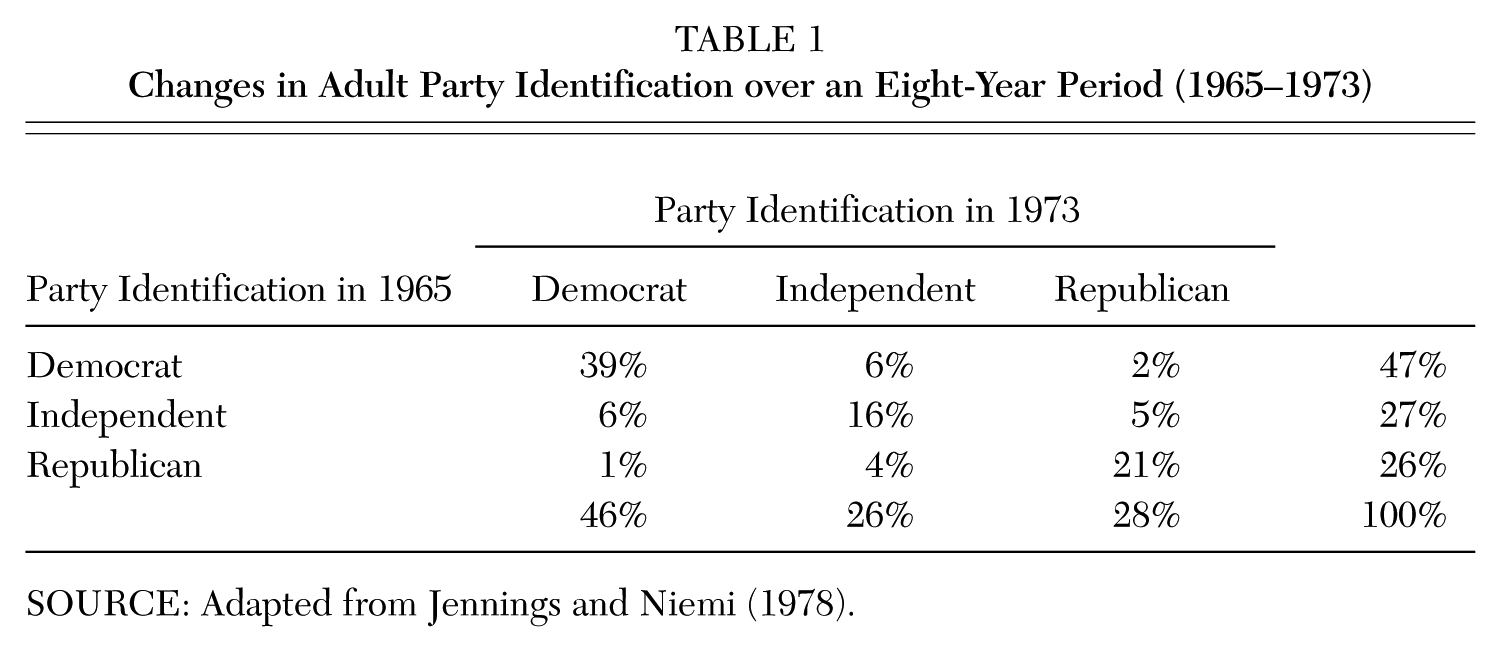
SOURCE: Adapted from Jennings and Niemi (1978).
Note that the total percentage along the diagonal is 76 percent, which suggests a substantial amount of stability—Democrats remain Democrats, independents stay independent, and Republicans remain Republicans. In addition, very few people go from being a Democrat to a Republican or vice versa (only 3 percent); most changes are smaller steps from identifying with a party to being an independent or vice versa (21 percent). Finally, it can be shown that about 60 percent of the independents remained independent and about 85 percent of the party identifiers remained party identifiers (the percentage is about 80 percent if we require that Democrats remain Democrats and Republicans remain Republicans). We conclude that both political involvement measured as attachment to a political party and political perspective measured as staying with the same political party or remaining independent remain stable over an eight-year period.
Several comprehensive studies have corroborated this result (Jennings and Markus 1984; Green and Palmquist 1994; Sears and Funk 1999). For example, Green and Palmquist (1994) propose stability coefficients in the range of .95 for two-year changes in party identification (see p. 447, Table 2). They propose a stability of .84 for panels spaced eight or more years apart (p. 441). They conclude that stabilities over one year are in the range of .975. In a comprehensive review of the party identification literature, Johnston (2006) concludes that although party identification can change over a lifetime, it is much more appropriate to call it an “unmoved mover” which “moves other features of the political landscape” (p. 329).
Persistence of Political Activity and Inactivity across Three Waves of a Panel Study: 2000, 2002, and 2004

SOURCE: Adapted from Schlozman, Verba, and Brady (2012), with permission from Princeton University Press.
NOTE: Active: Active in political participation: 3 or more political acts on 9-act scale. Inactive: Zero or one political act on a 9-act scale. Study: American Election Studies Panel—2000-2002-2004.
Life cycle persistence of political participation
Our recent book (Schlozman, Verba, and Brady 2012) explores the persistence of political activity. Table 2 is taken from that book, and it shows the persistence of individual political activity over a three-wave panel. The data are consistent with a political stability level of at least .75 from one two-year period to the next, assuming no measurement error. If measurement error were factored in, it is likely that the stability would be much higher.
Other studies have found similar levels of persistence in political participation across the life cycle. Voting turnout appears to be quite stable (Jennings and Niemi 1978; Jennings and Markus 1984), and there is even evidence that voting is habit forming (Plutzer 2002; Gerber, Green, and Shachar 2003; Green and Shachar 2000; Schlozman, Verba, and Brady 2012, 172–73). Other forms of political participation are also persistent across the life cycle (Schlozman, Verba, and Brady 2012; Jennings and Stoker 2004, 359–63), although there is no evidence for habituation (Schlozman, Verba, and Brady 2012).
Although they did not study intragenerational persistence of political participation directly, McFarland and Thomas (2006) demonstrate interesting results about how youth voluntary associations influence adult political participation. Using two longitudinal studies, they study political participation over 12- and eight-year intervals. Their measure of political participation includes five items on registering to vote, voting, volunteering in a civic or community organization, involvement in a political campaign, and membership in a political organization. They find that “involvement in politically salient youth voluntary associations has significant, positive returns on adult political participation seven to twelve years later” (p. 412). They also find significant impacts of social background, parents’ education, and student-peer practices.
Life cycle persistence of volunteering
There is very little work on life cycle persistence of volunteering, but Wilson and Musick (1999) found that 72 percent of those people who volunteered in 1986 were still doing so three years later in 1989. As noted above, McFarland and Thomas (2006) show that high school volunteering has impacts on later political participation.
Conclusion about life cycle persistence
There appears to be substantial persistence across the life cycle in party identification, political participation, and civic engagement. Studies have traced this to socioeconomic factors (Schlozman, Verba, and Brady 2012, 147–76, 199–231; Sears and Funk 1999: Green and Palmquist 1994), to peer group and neighborhood effects (Campbell 2006; Pacheco 2008), to high school activities (McFarland and Thomas 2006; Jennings and Stoker 2004, 361–63), and more recently to genetic factors (Fowler, Baker, and Dawes 2008; Settle, Dawes, and Fowler 2009). Interestingly, Hatemi et al. (2009) conclude that “genes exert little, if any, influence on party identification, directly or indirectly through covariates. However, genes appear to play a pivotal role in shaping the strength of an individual’s party identification” (p. 584, emphasis added). More generally, political views (apart from party identification and perhaps ideological self-identification) appear to be less persistent than political participation, but they have such a strong correlation with political participation and with socioeconomic status (see Verba, Schlozman, and Brady 1995) that there are substantial political implications for participatory inequality.
Intergenerational Reproduction of Participatory Inequality
There is significant, although limited, evidence for intergenerational transmission of party identification and participatory inclinations.
Intergenerational transmission of party identification
Table 3 is adapted from Jennings and Niemi (1968), and it is exactly the same format as Table 1 except that it refers to intergenerational transmission from parent (along the left side) to child (along the top).
Relationship of Parent and Child Party Identification in 1965

SOURCE: Adapted from Jennings and Niemi (1968).
The sum of the diagonal elements is 60 percent (compared to 76 percent in Table 1), and there is more spillover into the off-diagonals than in Table 1. Part of this is due to the fact that the children in this study are less likely to be partisans and more likely to be independents (24 percent of the parents compared to 36 percent of the children). There are also slightly higher values for transitions from Democrat to Republican and vice versa, but the major force is clearly the move to independence. Based on this table, Jennings and Niemi (1968) concluded that partisanship was only partly transmitted from one generation to the next, but a reanalysis of the data by Dalton (1980) with corrections for the unreliability of the measure suggested a much higher stability between parents and children.
Other work (Tedin 1974, 1979, 1980; Jennings 1984; Glass, Bengtson, and Dunham 1986; Mattei and Niemi 1991; Niemi and Jennings 1991; Jennings, Stoker, and Bowers 2009) has confirmed the strength of the parent-child tie, although evidence has been found for some malleability (Stoker and Jennings 2008), for children’s views affecting those of their parents (Glass, Bengtson, and Dunham 1986), and for some contribution of peer groups (Tedin 1980). Finally, Beck and Jennings (1991) show that the correlation between the 1965 party identification (7-point scale) of parents and the party identification of their children declines from .61 (Pearson correlation) in 1965 to .42 in 1973, and to .39 in 1982. They conclude that “it seems reasonable to suppose that the decay of parent-child partisan similarities has been more pronounced for this youth generation than for any previous generation since the realignment of the 1930s” (p. 749).
Intergenerational transmission of political participation
There are only a few papers that look at the intergenerational transmission of political participation. Beck and Jennings (1991) use an index that includes measures of media usage, voting, activity in politics beyond voting, political interaction among family members, and other items. Using this somewhat mongrel index, they find that the correlation between the parents’ score in 1965 and the child’s scores in each successive wave go from .16 in 1965, to .26 in 1973, and then to .17 in 1982 (p. 747, Table 1). These are rather modest relationships.
Two other papers look at how family characteristics affect participation from one generation to the next. Verba, Burns, and Schlozman (2003) and Schlozman, Verba, and Brady (2012, 177–98) find that parents’ socioeconomic status and political stimuli in the parents’ home affect children’s political activity (see also Verba, Schlozman, and Burns 2005). Table 4 (adapted from Verba, Burns, and Schlozman 2003, 50) summarizes the impact of parent’s education on the average level of an individual’s political activity through three different routes. The three ways that parental education affects a child’s adult political participation are through politics at home (as measured by the political activity of the parents and by having political discussions at home); socioeconomic processes that provide education, income, civic skills, and recruitment opportunities to the child; and a residual impact through other routes. The striking feature of this table is that on an eight-act scale where the average respondent performs 2.11 political acts, about 25 percent of the average level of activity is accounted for by parental education (0.53 acts). Another striking fact is the degree to which the level of political participation from one generation to the next is determined by the processes by which socioeconomic stratification is reproduced from one generation to the next. 18
Predicting How Much Participation Comes from Parents’ Education

Using the four-wave panel (1965-1973-1982-1997) of 1965 high school graduates and their parents, Jennings (2002) shows that the political activities of children can have substantial implications for the intergenerational transmission of political views. He finds a sharp rift between those children who were protestors and those who were not, and he finds that “although influenced by their parents, the two student groups—most particularly the protestors—carved out their own political identities” (p. 322). This result is also echoed by Verba, Schlozman, and Burns (2005, 107–9), who find that events such as the civil rights movement can temporarily break the cycle of political inequality, although the impact may not be permanent.
Intergenerational transmission of volunteering
There is very little work on the relationship between parental volunteering and children’s volunteering, but at least one paper uses a panel study “in which the volunteer work of a sample of American women and their daughters was tracked over an extended period of time (Mustillo, Wilson, and Lynch 2004, 530). The paper concludes that volunteering runs in families. “Specifically, mother’s volunteering and daughter’s education affect baseline volunteering but not the trajectory of volunteering. Family socioeconomic status predicts growth in volunteering but has no effect on baseline volunteering. . . . Later growth in volunteering, however, is completely driven by family socioeconomic status” (p. 538).
Conclusions about intergenerational transmission of political activity
There is substantial evidence for some intergenerational transmission of political identification, political activity, and civic engagement, but the exact size of the effects and the degree to which this transmission is mediated by socioeconomic status needs much more research.
The Problem of Relying on Recall Questions to Study Political Mobility
Political inequality, in the form of participatory inequality, appears to persist within a generation and across generations, but we know very little about its exact shape or form. One of the problems with the literature is that it has had to rely on recall questions—either of the respondent’s past experiences (e.g., “Did you discuss politics in your home?” “Did you belong to a club in high school?”) or of the respondent’s best estimates of their parents activities and characteristics (“Were your parents active in politics?” “What was your father’s occupation?”). These retrospective queries are fraught with chances for reporting biases. One problem is that there is substantial evidence for the proposition that a child’s perceptions of his or her parents play a mediating role in the transmission of parental political perspectives and activity (Tedin 1974, 1979; Acock and Bengtson 1980; Westholm 1999). Hence, it seems quite possible that recall questions might cause respondents to project backward their current perspectives and activity levels.
Using the 1972 to 1976 American Election Studies Panel, Niemi, Katz, and Newman (1980) concluded that individuals themselves were not good reporters of their past party identification. When asked in 1976 to give their 1972 partisanship (for which the researchers had a record), 18 percent of the respondents got it wrong—even when making very generous allowances for correct responses. They conclude that “it seems likely that the true level of error is on the order of 25–30 percent” (p. 640). In addition, it seems likely that retrospective reports err on the side of projecting one’s current party identification into the past, hence leading to a false sense of stability in party identification.
In a 1976 article, Tedin found a relatively high correlation between a parent’s actual party identification and a child’s report of it (.77), but he found much lower correlations between reports and actual attitudes on three political issues (average of .46 across three issues) and evaluations of eight political figures (average correlation of .47 with a high of .64—for Nixon—and a low of .28—for John Lindsay). He concluded that children’s reports of parents’ political attitudes “should be limited to variables like party identification, partisan direction of the vote, and the choice between candidates in a presidential election” (Tedin 1976, 123).
Finally, Niemi and Krehbiel (1984) use data on a two-wave (1965 and 1973) matched sample of parents and adolescents to study the reliability of parent’s reports of their parents’ partisanship by comparing 1965 and 1973 reports and the accuracy of youth’s reports about parents in 1965 and 1973. They find that the reliability of parent’s reports of their parent’s partisanship is relatively low—for only 64 percent of the sample are the 1965 reports the same as the 1973 reports and the tau-b is only .73. As for accuracy, 71 percent of the youths got their father’s (three-category) partisanship right in 1965 and in 1973, and 71 percent got their mother’s partisanship right in 1965 and 72 percent in 1973. For turnout, 92 percent got their father’s turnout correct in 1965 and 1973, and 92 percent got their mother’s turnout correct in 1965 and 90 percent in 1973. These figures for turnout are somewhat encouraging, but the figures for partisanship are less so. Moreover, youths clearly overestimated the intergenerational similarity.
Although retrospective reports are not useless, they must be used very carefully and with the realization that they probably overestimate stability and agreement. One clear result is that the biases are probably less for highly salient characteristics such as voting and party identification. If we have to compromise and use such reports, it is important to choose measures of political identity, political participation, civic engagement, and political social networks that are likely to minimize biases. The four types of items discussed above (party identification, political activity, engagement in civil society, and social networks) are probably reasonable choices, and retrospective questions about parents could be designed for each of these areas.
Long-Run Panels as a Better Strategy
A much better strategy would be to have long-term panels that include parents and their children. In this way, it is possible to get firsthand reports—both in time and in terms of respondent—on childhood and adult experiences and on parent and child characteristics. At the moment, the only long-run panel of a general population sample is the Long-Term Socialization Panel, produced by Jennings, Niemi, Markus, and Stoker. This panel includes four waves and three generations: 1965 (a sample of high school seniors and their parents), 1973 (reinterview of the high school seniors and their parents), 1982 (reinterview of the high school seniors and their parents), 1997 (reinterview of the high school seniors and their children). More panels like this are needed to get a true sense of the long-run dynamics of political mobility over time.
These panels should include both contemporaneous and recall questions (to get a better fix on their utility) on political involvement and political interests. They should also include detailed information on economic and social characteristics so that economic and social mobility can be compared with and used to explain political mobility. These panels should run for many years to capture as much of the respondents’ life cycle as possible, and ideally they should have a large number of respondents. Unfortunately, such panels are very expensive, they take a long time to develop, and they suffer from respondent attrition.
The American Opportunity Study as a Better Solution
The American Opportunity Study (AOS) proposed and described by Grusky, Smeeding, and Snipp (this volume) will link the 1960–2010 decennial censuses, all years of the American Community Surveys, tax records, earnings reports, and other administrative program data. The AOS will link children with parents so that income, education, occupation, and other variables can be obtained over time and across generations. It will provide detailed data on economic and social stratification over time and across generations, but it will have absolutely no information on political attitudes or behavior.
This limitation could be resolved by linking the AOS with administrative data on voting or with political surveys. Two basic approaches are possible:
Linking with voter registration data
Voter registration data is public information, and it typically indicates (1) that the person is registered; (2) whether the person voted in recent elections; and (3) in twenty-eight states plus the District of Columbia the person’s party preference (thus, twenty-two states, mostly in the Midwest and the South, do not have this information). For matching purposes, the data typically have name, address, and age. Recently these data have become available in computerized form for every state. By linking these data to the AOS, detailed studies could be done of intergenerational relationships in party registration and voting participation. If matching is successful, these data could provide a definitive picture of the stratification of voting participation and its intergenerational transmission, and the biases in terms of party preference. They could also provide a vivid picture of how income and education are related to the transmission of political inequality. The weaknesses of this approach is that it focuses on only one participatory act, it has a weak and incomplete measure of political preference in party registration, and there might be confounding of failed matches with those who did not register in a locality.
Linking with survey data
The American National Election Studies (ANES) have completed in-person interviews on political topics every four years since 1948 (and every two years between 1956 and 2004) and they have between 1,100 and 2,500 respondents. The surveys contain a plethora of information on party identification, voting, political participation, political attitudes, and many other topics; and although new items have been inserted over the years, there is a core of continuous questions. The ANES also has substantial experience matching its survey data (through names, addresses, age, and other information) to registration records (Berent, Krosnick, and Lupia 2011). This experience could be helpful in matching the ANES to the AOS. The strength of this approach is the extraordinary amount of political information available for scholars, including information on those people who did not register to vote. The weakness would be the small number of respondents for each election. Because of the smaller number of respondents but much greater number of variables compared to the voting registration data linkage, this approach is highly complementary to the first approach.
Summary
Political inequality and political mobility have been woefully understudied. Although there are some differences between economic and social stratification on the one hand and political stratification on the other, these differences do not rule out the study of political stratification. Rather, they add some interesting features such as the importance of studying interests as well as involvement, and the necessity of dealing with more fleeting phenomena such as episodes of political participation and longer-term characteristics such as political identity. We know enough from the existing literature to assert that political mobility is an interesting and important topic, and it should be studied with as much diligence as are economic and social stratification. Perhaps the most important reason to do this is that the political system will ultimately be responsible for using governmental tax and expenditure policies to ensure a fair and effective amount of economic and social stratification and mobility. Timothy Smeeding has shown (2005) that through public policies, countries can make disposable income inequality much less than market income inequality, but whether countries will be willing to do this undoubtedly depends on the stratification of political authority.
Footnotes
NOTE:
Henry E. Brady is the lead author on this article, but it draws heavily on joint work with Kay Schlozman and Sidney Verba. Our thanks to David Grusky and Amy Lerman, who provided very useful comments.
Notes
Henry E. Brady is dean of the Goldman School of Public Policy and Class of 1941 Monroe Deutsch Professor of Political Science and Public Policy at the University of California, Berkeley. He is coauthor, with Sidney Verba and Kay Schlozman, of “Beyond SES: A Resource Model of Political Participation,” which appeared in the American Political Science Review.
Kay Lehman Schlozman is the J. Joseph Moakley Endowed Professor of Political Science at Boston College. She is coauthor, with Sidney Verba and Henry Brady, of The Unheavenly Chorus: Unequal Political Voice and the Broken Promise of American Democracy (Princeton University Press 2012).
Sidney Verba is the Carl H. Pforzheimer University Professor Emeritus and Research Professor of Government at Harvard University. He is coauthor, with Kay Schlozman and Henry Brady, of Voice and Equality: Civic Voluntarism in American Politics (Harvard University Press 1995), which won the Converse Award for making a lasting contribution to public opinion research and the American Association for Public Opinion Research award for influential books stimulating scientific research in public opinion.