



Abstract
In this commentary, we embed the volume’s contributions on public beliefs about science in a broader theoretical discussion of motivated political reasoning. The studies presented in the preceding section of the volume consistently find evidence for hyperskepticism toward scientific evidence among ideologues, no matter the domain or context—and this skepticism seems to be stronger among conservatives than liberals. Here, we show that these patterns can be understood as part of a general tendency among individuals to defend their prior attitudes and actively challenge attitudinally incongruent arguments, a tendency that appears to be evident among liberals and conservatives alike. We integrate the empirical results reported in this volume into a broader theoretical discussion of the John Q. Public model of information processing and motivated reasoning, which posits that both affective and cognitive reactions to events are triggered unconsciously. We find that the work in this volume is largely consistent with our theories of affect-driven motivated reasoning and biased attitude formation.
Normatively, the conjuring up of facts and reasons in a policy dispute should be independent of one’s hopes for which way the evidence will point. In particular, scientific debates should be independent of partisan considerations. The results of many empirical studies find significant deviations from this ideal, however. Partisans in these studies systematically denigrate, depreciate, and counterargue evidence that is contrary to their political views but accept uncritically the supportive evidence. As a consequence we often find that both elites (e.g., Vertzberger 1990) and ordinary citizens (Lord, Ross, and Lepper, 1979; Taber and Lodge 2006) are reluctant to “trust the evidence” when it contradicts their prior beliefs.
The articles presented in the preceding section of this volume of The ANNALS provide different perspectives on partisan influences on attitudes toward scientific evidence. Across different domains and contexts, these studies consistently find evidence for hyperskepticism toward scientific evidence among ideologues, perhaps especially among conservatives. While some recent research points at systematic psychological and cognitive differences between liberals and conservatives in terms of the way (negative) information is processed (e.g., Amodio et al. 2007; Carraro, Castelli, and Macchiella 2011; Eidelman et al. 2012; Onraet et al. 2011; Talhelm et al. 2012), we show that the empirical patterns presented across these studies can be understood as part of a general tendency among individuals to defend their prior attitudes and actively challenge attitudinally incongruent arguments. In theory, all human beings are predisposed to be motivated reasoners: the stronger their belief or attitude, the greater the likelihood to disparage or deny the incongruent evidence; although there is mounting evidence that the most politically sophisticated and knowledgeable among us are the most prone to the strongest bias (Lodge and Taber 2013). These biases, however, appear to be evident among both liberals and conservatives (cf. for example Taber and Lodge 2006; Bolsen, Druckman, and Cook 2014b). The goal of this commentary is to integrate the empirical results reported in this volume into a broader theoretical discussion of motivated reasoning (see for example Kunda 1990; Lodge and Taber 2013).
Political Beliefs and Scientific Skepticism
Scientific inquiries in areas such as stem cell or vaccine research often have broad implications for individual values, norms, or religious beliefs (see, for example, Clifford and Jerit 2013), which are also related to corresponding political beliefs, partisanship, and ideologies (Graham, Haidt, and Nosek 2009; Schwartz, Caprara, and Vecchione 2010; Gerber et al. 2010; De Neve 2014). So it should not surprise us that debates about scientific research in such sensitive areas align with partisanship and ideology, but many questions remain about the nature of the relationships between attitudes toward scientific inquiries in specific areas and broader political beliefs.
Blank and Shaw (this volume) investigate individual willingness to accept scientific recommendations across a wide range of policy areas (e.g., AIDS prevention, global warming, and teaching of evolution). Deference to scientific evidence, they find, depends on the availability of such alternative points of view as religious faith and political ideology. When scientific results conflict with a readily available alternative view, individuals are less likely to defer to the research. Blank and Shaw do not expect partisanship to have any independent effect on deference to science once religiosity and ideology have been accounted for, but that is not what they find. Party identification does have independent influence, suggesting that there are other motivational factors besides religiosity and ideology to explain differences in individual willingness to rely on scientific recommendations for policy decisions.
Stoutenborough, Vedlitz, and Liu (this volume) examine the effects of risk perceptions in the context of public support for energy policies. Interestingly, the authors show that for some domains, such as attitudes toward nuclear energy, specific risk perceptions appear to have differential effects: while risk perceptions toward nuclear waste storage are inconsequential for public policy support, the risk of a nuclear meltdown indeed affects support in the expected direction. Moreover, in contrast to Blank and Shaw, Stoutenborough, Vedlitz, and Liu find no evidence for partisan-motivated reasoning after controlling for specific risk perceptions as well as other covariates. However, it could still be argued that individual predispositions toward certain policies (which themselves might be affected by ideology and partisanship) influence how specific risks are perceived, thereby leading to endogeneity issues.
The other articles that we review demonstrate the importance of framing effects in science denial (see also Bolsen, Druckman, and Cook 2014a). Looking specifically at the issue of climate change, Schuldt, Roh, and Schwarz (this volume) show that the partisan divide is contingent on questionnaire design, including wording and order effects. Using the phrase “global warming” as opposed to “climate change” reduced reported belief in climate science among Republicans, and question order moderated Republican support for limiting greenhouse emissions, with no clear effects for Democrats. Schuldt, Roh, and Schwarz demonstrate that the observed partisan divide on climate change (see McCright and Dunlap 2011) can be partly attributed to the context and framing of survey questions. It remains less clear, however, which psychological mechanisms could explain these differential framing effects among Democrats and Republicans.
Shen and Gromet (this volume) present results from a framing experiment in a less salient context—neuroscience-based legal reforms—where citizens have weak or nonexistent prior beliefs. Shen and Gromet varied the framing of neurolaw reforms in terms of whether they were supportive of the defense or the prosecution, finding that Republicans were less likely to support legal reforms incorporating neuroscientific evidence if they were framed to potentially reduce a defendants’ sentences. Similar to what Schuldt, Roh, and Schwarz found, however, Democrats were not influenced by the frames to the same degree as Republicans.
How can these results be integrated into a common theoretical framework? Blank and Shaw suggested that partisan differences in skepticism toward science are mainly driven by alternative beliefs and motivations individuals hold that potentially stand in contrast to scientific explanation. Schuldt, Roh, and Schwarz and Shen and Gromet, on the other hand, describe variability in individual response patterns as contingent on contextual informational frames. More generally, there has been a powerful movement in public opinion research that suggests that individuals do not have fixed and stable preferences and attitudes about political issues (Converse 1964; Zaller 1992; Zaller and Feldman 1992). Framing theory suggests that this variability in (reported) preferences can be explained by looking at the way individuals form their attitudes in the context of informational frames (see Chong and Druckman 2007). Following Ajzen and Fishbein (1980), an attitude toward an object is conceptualized as a combination of related (evaluative) beliefs, where each consideration is weighted by its respective importance or accessibility. In this context, describing an issue in terms of a specific frame does not directly affect the evaluation of the object itself but, rather, influences what considerations are seen as relevant and important for the issue. Attitude changes due to framing occur if the frame increases the salience or importance of a different set of evaluative considerations (see also Nelson, Oxley, and Clawson 1997).
Schuldt, Roh, and Schwarz showed that framing the climate issue as “global warming” or more neutrally as “climate change” influenced beliefs among Republicans. And in Shen and Gromet’s study, attitudes of Republicans toward neurolaw reform were especially susceptible to information framing that linked the reforms to advantages for defendants. However, if these differences are solely due to the fact that the frames trigger specific considerations, it remains unclear why we did not observe equivalent effects among Democrats. Frames in these studies were effective when the facts and arguments matched the individual’s partisanship. This suggests that the effects of framing are best understood if one takes into account the motivational processes engaged as people evaluate policy proposals (Bolsen, Druckman, and Cook 2014b; Druckman and Bolsen 2011; Taber and Lodge 2012). Accordingly, it could be the case that certain issues (such as neurolaw reforms) implicate stronger directional motivations among conservatives than among liberals (and vice versa): being “tough on crime” might be more essential for someone who identifies as a conservative than supporting defendants is for liberals. In other words, differences between partisans could potentially be explained by the nature of the specific topics under consideration. On the other hand, one could also argue that the observed discrepancies in deference to science between liberals and conservatives can be attributed to differences in fundamental psychological and cognitive mechanisms. To give but some examples, growing literature suggests that liberals and conservatives differ in their openness to experience and new information (McRae 1996; Onraet et al. 2011; De Neve 2014), their attention to negative stimuli (Carraro, Castelli, and Macchiella 2011), and their reliance on low-effort thought (Eidelman et al. 2012; see also Talhelm et al. 2012).
Nisbet, Cooper, and Garret (this volume) report the results of a classic framing experiment to address these competing explanations. Respondents were assigned to either a conservative-dissonant message (on climate change or human evolution), a liberal-dissonant message (on hydraulic fracking or nuclear power), or a neutral message (astronomy or geology). The authors explain differences between liberals and conservatives in distrust of science as the result of a contextual interaction between individual psychological factors and elite communication that strongly links conservative topics to the conservative ideological label (see also Zaller 1992). They are not persuaded by “intrinsic” explanations, which tend to point to the particular psychology of conservatives. Nisbet, Cooper, and Garret advance a moderation-mediation model to test for motivated reasoning, finding support for the hypothesis that exposure to dissonant information will trigger a negative affective response, leading to distrust of the scientific community, counterarguing, and attitude polarization for both conservatives and liberals. These effects are moderated by the strength of ideology and belief (in)accuracy related to the object.
Conservatives in the Nisbet, Cooper, and Garret experiment, though, show greater bias than do liberals—as in the research of Jost et al. (2003)—suggesting deep between-group psychological differences (Talhelm et al. 2012; Kruglanski 2004; Kruglanski and Boyatzi 2012; Young 2009). While it is well out of the scope of this commentary to resolve this dispute between contextual and intrinsic sources of scientific skepticism, we think that it is crucial to further theorize about the underlying (cognitive) processes that describe how individuals arrive at certain evaluations when facing new and potentially incongruent information. As such, we now turn to the presentation of a process model of motivated reasoning, adapted from Lodge and Taber’s The Rationalizing Voter (2013), to show how prior beliefs and context spontaneously interact to promote the effects found in these studies.
Putting Affect First: Motivated Reasoning and the John Q. Public Model
Individuals do not accept and internalize informational and contextual frames irrespective of their predispositions. Framing elicits different considerations related to an object, but individuals also engage in motivated reasoning consistent with their prior attitudes. Our John Q. Public (JQP) model (Lodge and Taber 2013) claims that these biases, and information processing in general, are driven by initial affect (see also Zajonc 1980). We distinguish between unconscious (implicit) and conscious (explicit) processing (Wilson, Lindsey, and Schooler 2000). The fundamental assumption driving our model is that both affective and cognitive reactions to external and internal events are triggered unconsciously, followed spontaneously by the activation of associative pathways that link thoughts to feelings to intentions to behavior, so that very early events, even those that occur below conscious awareness, set the direction for all subsequent processing (Custers and Aarts 2010; Libet 1985).
Most of the key concepts and processes in our theory are represented in Figure 1, starting with the left to right causal directionality of processing through time. A stimulus event triggers the stream of processing, proceeding first through affective and then cognitive mediators, and then perhaps leading to the construction of evaluations of political objects and conscious deliberation. As a function of time, attention, and other factors, the likelihood of subjective awareness also increases over time, left to right. Each arrow in the figure represents a hypothesized theoretical process. It is worth noting before we introduce these hypotheses that the conventional model of political reasoning involves only the c-g-i sequence in Figure 1, where an event triggers the retrieval of cognitive considerations from memory, from which conscious deliberations are constructed, yielding reasoned evaluations.
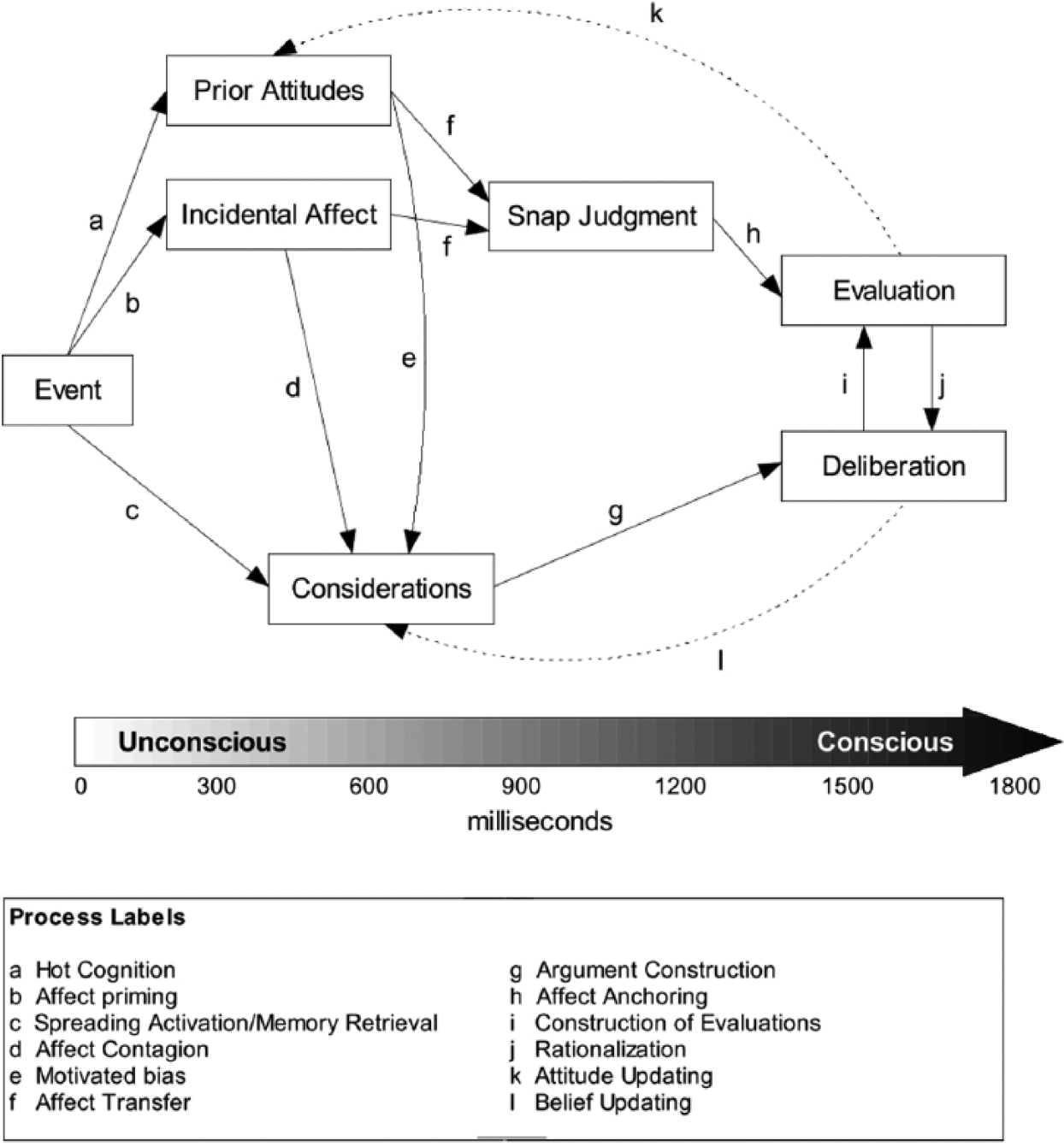
The John Q. Public Model of Political Information Processing
Our dual-process model claims that all thinking is suffused with feeling, and these feelings arise automatically within a few milliseconds (ms) (in our data as little as 200 ms) of exposure to a familiar sociopolitical object or event. This is the hot cognition hypothesis that stands at the center of our theory of motivated political reasoning: all concepts that have been evaluated in the past are affectively charged (i.e., they arouse positive or negative valence), and this affect response springs spontaneously to mind on mere exposure to the name or image of a person, group, or idea to influence all subsequent processing. Affect is primary in our theory because it arises first in the stream of processing, is unintentional, and is difficult to control. Almost immediately, the decision stream becomes affectively charged, viscerally “hot,” and thereupon embodies our thoughts, providing proprioceptive feedback to mental processing (Damasio 1994; Niedenthal, Halberstadt, and Innes-Ker 1999; Thagard and Kunda 1998). Some of these feelings are prior attitudes that are intrinsic to the stimulus object (arrow a), say a picture of the president; while others are incidental affect, triggered by such unrelated events as sad music, an attractive spokesman, a sunny day (arrow b). All subsequent considerations and deliberations are necessarily influenced by this spontaneously activated affect. The pro or con evaluation, say a proposal to allow tuition assistance to the children of illegal immigrants, is determined by the joint effects of prior attitude and incidental affect on the considerations that spontaneously enter the decision stream. Conventional political reasoning (path c-g-i) can occur only in the context of hot cognition.
Shortly after the arousal of positive and/or negative feelings, activation from both prior attitude and incidental affect will spread along such well-traveled “hot” associative pathways as, say, global warming to limits in greenhouse gas emissions to Al Gore to Democrat, thereby enriching our understanding of the original stimulus. This is the spreading activation hypothesis (arrow c), well-established in cognitive psychology as the primary mechanism of memory retrieval. Many considerations may receive and send activation within the associative network and thereby influence the stream of processing, but only a small number of highly activated considerations will reach conscious awareness, limited perhaps to the 7 ± 2 chunks suggested in early psychological research (Miller 1956).
In the context of just-aroused feelings, the retrieval of considerations will be biased in the direction of the valence of initial affect evoked by prior attitudes and incidental affect. This is the affective contagion hypothesis (arrow d) and the motivated bias hypothesis (arrow e). A flag, a foul smell, an attractive candidate all influence the content and character of thought by favoring the retrieval of affectively congruent considerations while suppressing incongruent ones. Though it is possible to reverse the direction of initial affect (as when initial positive affect triggered by a picture of Governor Chris Christie becomes strongly negative upon recognition and retrieval of memories of his bullying behavior), it is more likely that initial feelings will “snowball” through the retrieval of affectively congruent considerations through both direct (arrows f) and indirect causal pathways (arrows d and e) that bias the thoughts and feelings that come to mind to rationalize the evaluation.
Spontaneous feelings can also cause evaluations directly through affect transfer (arrows f) from prior attitudes or incidental affect to a snap judgment, which in turn (arrow h) directly anchors the evaluation before any conscious cognitive considerations. The twin influences of prior attitude and incidental affect on affect contagion and affect transfer are, we believe, among the most powerful and underappreciated sources of unexplained variation in studies of political evaluation.
With sufficient time and motivation, the retrieval of a set of considerations can trigger the construction of conscious reasons for believing, given the motivation, opportunity, and cognitive wherewithal to query the immediate affective response (Devine 1989; Gawronski and Bodenhausen 2007; Olson and Fazio 2009). This process, labeled argument construction (arrow g) in Figure 1, builds on the earlier processes of hot cognition, spreading activation, and affect contagion. Conventional models of political thought view the conscious construction of arguments and reasons as the foundations of public opinion and the guideposts to rational political behavior, but the central processes of motivated reasoning, including disconfirmation biases and the active counterarguing of counterattitudinal evidence, invoke these affective biases that spontaneously impact what considerations are retrieved from memory and enter the evaluation (Taber and Lodge 2006; Taber, Cann, and Kucsova 2009).
Out of the grist of deliberation, citizens might construct evaluations (arrow i). That is, they might consciously build their evaluations of political figures, groups, or ideas from well-reasoned foundations, as in the conventional c-g-i model. In the context of hot cognition, affect contagion, and affect transfer, however, such cold evaluations, if not impossible, are quite rare. As depicted in Figure 1, two types of affective reasoning are at work: the considerations that feed into deliberation are biased by affect, and the deliberation process dredges up post hoc congruent considerations. The central place accorded to intentional rational evaluation in political science, a vestige of Enlightenment mythology in our view, continues to mislead our discipline, despite the valiant efforts of a few critics (e.g., Antonio Damasio, William James, David Sears, and George Marcus). Far more common, we believe, will be the reverse causal pathway from evaluation to deliberation. This rationalization hypothesis (arrow j) posits that the causal pathways in Figure 1 that travel through unconscious affect, and in particular the affect-driven evaluation processes, guide deliberation about politics. It is not our claim that citizens are incapable of rational thought in the traditional sense defined by links c-g-i, but evidence is accumulating that attitudes and behavior arise from automatic, uncontrolled processes and are often set before we begin seriously “thinking” about them. If this is the case, deliberation serves to rationalize rather than cause our thinking, reasoning, and intentions.
The two dashed arrows in Figure 1 represent updating processes through which affect and considerations are stored back to long-term memory for future use. Most of this processing—the establishing of affect, meaning, and intentions—is subterranean, each process following upon the other in about a second of time. An inkling of conscious awareness begins 200–300 ms after stimulus exposure with a sense of positive and/or negative feeling, followed by a rudimentary semantic understanding of the concept, both of which are based entirely on prior unconscious processes. While people are fairly quick in reporting simple like-dislike judgments (500–800 ms), it takes systematically more time to provide graded responses or make semantic or conceptual categorizations. Were we to ask a committed Republican to evaluate Secretary of State Kerry using a simple like-dislike button response, it would take about 700 ms to press the dislike button. It would take significantly longer to report any cognitive associations, for example that Kerry is a man, a Democrat, or a former senator. Affect precedes and contextualizes cognition.
Finally, given sufficient time and motivation, people may think self-consciously and reflectively about the object of evaluation and their own reactions. A point about conscious deliberation bears repeating: though we feel we direct our thoughts and behaviors through conscious reasoning, deliberation is a product of unconsciously determined, affectively driven processes. Conscious deliberation and rumination is usually the rationalization of multiple unconscious processes that recruit reasons to justify and explain. It is possible, though difficult, to override implicit responses, as when we make an effort to censor our socially unacceptable group stereotypes (Devine 1989; Greenwald and Banaji 1995), and it remains unclear how fully we can control the “cognitive monster” of unconscious processing (Bargh 1999).
JQP as a Theoretical Framework for Motivated Scientific Beliefs
How can the model described above account for the empirical findings on science denial? The starting point is the hot cognition hypothesis: JQP posits that all social objects and concepts for which prior attitudes exist are affectively charged. Initial affective responses to a stimulus enter the decision stream before any and all conscious deliberations and thereby influence all down-streaming processes, such as the activation of certain considerations in memory, or related judgments and evaluations.
For example, in the survey manipulation described in Schuldt, Roh, and Schwarz, respondents were exposed to questions related to “global warming” versus “climate change.” According to the JQP model, these stimuli evoke different prior attitudes and incidental affect. For example, the term “global warming” is more often used by proponents calling for a significant reduction of greenhouse gas emissions (Schuldt, Roh, and Schwarz, this volume). Accordingly, Republicans and conservatives could be expected to have a more negative prior attitude and affective response toward the concept “global warming” as compared to the more neutral term “climate change.” In the context of these negative feelings, activation from prior attitudes and incidental affect spreads to semantically and affectively related concepts stored in memory (spreading activation hypothesis). Accordingly, it is not only the frame itself, which influences the set of considerations that come to mind and are deemed important for evaluating the object, but also memory retrieval that is influenced by incidental affect (affect contagion hypothesis) and prior attitudes (motivated bias). These mechanisms operating in tandem explain why Schuldt, Roh, and Schwarz found differences in the reactions to both framing conditions between Republicans and Democrats. For Republicans, the term “global warming” led to stronger negative affective reactions than “climate change,” ostensibly because different affectively charged considerations were evoked by the differences in wording. Activation of different sets of considerations as well as prior attitudes and incidental affect subsequently influence judgments, evaluations, and deliberation about the object, which ultimately manifest themselves in differences in existence beliefs and skepticism toward scientific evidence on climate change.
But why did Democrats not show similar patterns? The key is that the phrases “global warming” and “climate change” are far more affectively different for Republicans than for Democrats. Whether Democrats are exposed to either frame alone has little effect on subsequent information processing and attitude formation. For Republicans, however, “global warming” arouses much stronger negative affect and drives greater motivated reasoning.
A similar underlying mechanism could be proposed to explain the findings reported by Shen and Gromet. If neurolaw reforms are presented in the absence of additional cues, neither Democrats nor Republicans appear to have strong prior attitudes. Republicans and Democrats report similar neutral preferences regarding this rather obscure policy area. However, if neurolaw reforms are described as having favorable consequences for the defendant rather than the prosecution, Republicans reported stronger opposition. Their prior attitudes on criminal justice are now engaged, and motivated reasoning ensues.
The theoretical mechanisms that the JQP model describes provide a strong framework to integrate the different findings related to political biases on public beliefs about science. However, while the hypotheses underlying JQP have been explicitly tested elsewhere (see Lodge and Taber 2013), they have not been tested directly for scientific beliefs (but see Kahan 2013). Our empirical conjectures are consistent with the findings reported in this section, but we have no direct and conclusive tests of the causal pathways suggested by our theory in this context. Nevertheless, the results presented by Blank and Shaw; Nisbet, Cooper, and Garret; Schuldt, Roh, and Schwarz; and Shen and Gromet are largely consistent with our perspective of affect-driven motivated reasoning and biased attitude formation. To provide further insights about the underlying mechanisms, future studies could focus more explicitly on the influence of initial affect on the subsequent activation of related considerations. Furthermore, it would be interesting to investigate whether fast and effortless snap judgments differ from more deliberate evaluations, for example with regard to their susceptibility to frames and affective primes.
If citizens’ beliefs and deliberations about science can be fundamentally biased by prior attitudes and initial affective responses as we argue and these studies suggest, one might wonder whether public discourse on scientific evidence could be evaluated in a more rational and evenhanded manner. If science denial stems from motivated reasoning processes that are fundamental to our basic cognitive architecture, we may simply not have the capacity to separate the evaluation of the facts and reasons in a policy dispute from our hopes for which way the evidence will point.
However, the model presented in this commentary does not claim that individuals never revise their initial attitudes or are unable to overcome their initial affects, but JQP does suggest that persuasion is difficult and certainly more effortful than following the powerful affective currents down the stream of processing. Other studies have shown that implicit responses to stimuli can be overridden (Devine 1989; Greenwald and Banaji 1995) and that motivated reasoners do indeed update their prior beliefs given sufficient counterattitudinal evidence (Redlawsk, Civettini, and Emmerson 2010). A necessary condition to overcome individual biases and motivated reasoning appears to be that individuals be sufficiently motivated by accuracy goals rather than partisan goals (Kunda 1990; Lundgren and Prislin 1998). Policy-makers and journalists can and should emphasize the importance and relevance of objectivity in the context of scientific inquiries (see also Bolsen, Druckman, and Cook 2014a), but it will be especially difficult to overcome ideological biases in scientific beliefs among the public as long as political elites align the debates along partisan lines rather than emphasizing the necessity of a common understanding of the underlying issues.
Footnotes
Patrick W. Kraft is a PhD student in the Department of Political Science at Stony Brook University. His research interests include political information processing, attitude formation, and voting behavior.
Milton Lodge is a distinguished university professor of political science at Stony Brook University. He has authored five books and numerous articles, and his research has been recognized by election to the American Academy of Arts and Sciences.
Charles S. Taber is a professor of political science, dean of the Graduate School, and codirector of the Laboratory for Experimental Research in Political Behavior at Stony Brook University. His research interests include political psychology and public opinion, international relations and foreign policy decision-making, and computational models of political cognition. Most recently, Taber has worked on affect and political information processing, the formation and updating of preferences, and automatic and controlled processing. A recent book coauthored with Milton Lodge, The Rationalizing Voter (Cambridge University Press 2013), presents a theory that integrates this research program.