



Abstract
We use an experiment with a nationally representative sample of the U.S. population to examine how political partisans consume and process media reports about nanotechnology—a scientific issue that is unfamiliar to most Americans. We manipulate the extent to which participants receive ideological cues contextualizing a news article, and follow their subsequent information seeking about nanotechnology. Our results provide insights into patterns of media use and how media use differs among people with varying political ideologies. When cues clarifying the political stakes of nanotechnology are made available, individuals are willing to read information from countervailing sources. When such cues are lacking, however, individuals avoid incongruent information and opt for headlines from attitude-consistent sources. We explore variations in the circumstances under which ideological selectivity occurs and demonstrate that both confirmation bias and defensive avoidance are heightened under such conditions.
Balanced information acquisition is a normative necessity for a well-functioning democracy. Ideally, citizens would be exposed to a diverse marketplace of ideas, but there is concern that such exposure is becoming limited. Although the empirical evidence is contested (Abramowitz and Saunders 1998, 2008; Fiorina, Abrams, and Pope 2008; Prior 2013), there is some agreement that the American electorate is becoming more balkanized (Baldassarri and Gelman 2008; Evans 2003; Gastil, Kahan, and Braman 2006; Levendusky 2013). Scholars primarily point to balkanization’s negative effects on democracy (Layman, Carsey, and Horowitz 2006; Sobieraj and Berry 2011). The polarization debate has expanded to include the electorate’s media consumption habits, and there have been some attempts to discover whether political polarization is caused by partisan media use or if the opposite is true (e.g., Stroud 2008). Scholars are concerned that the splintered media landscape, due to the proliferation of online tools, could enhance polarization by offering a multitude of choices for news consumers, allowing for selective exposure (Bennett and Iyengar 2008; Chaffee and Metzger 2001; Mutz 2002; Mutz and Martin 2001; Scheufele and Nisbet 2012; Sunstein 2001, 2007). While we know that individuals tend to filter information according to their ideological preferences (e.g., Bennett and Iyengar 2008; Iyengar and Hahn 2009), the contexts under which selective exposure occurs are relatively unknown. We know little about whether elements in media presentations of information induce selectivity.
Most of the work on the dynamics of information seeking and selectivity has explored relatively accessible issues (e.g., Barlett et al. 1974; Brannon, Tagler, and Eagly 2007; Garrett 2009a; Gil de Zúñiga, Correa, and Valenzuela 2012; Iyengar and Hahn 2009; Messing and Westwood 2012). For example, Gil de Zúñiga and colleagues (2012) use the issue of Mexican immigration to the United States to examine selective exposure to cable news. Contemporary politics, however, involves complex and potentially unfamiliar topics for which readily accessible partisan or ideological cues are not often available. Moreover, issues of science and technology are increasingly present in the public discourse. For example, in his 2014 State of the Union address, President Obama stated, “Climate change is a fact” (Obama 2014). This prompted a flurry of discussion among lay audiences. As evidenced by the collection of work presented in this volume, there is increasing recognition that science is embedded in the political fabric of society. Contemporary scientific issues not only are more politicized, but also are complex, are laden with uncertainty, and require policy decisions that involve numerous stakeholders (Scheufele 2013).
This study seeks to explore whether ideological-based media habits influence how individuals seek scientific information by examining variations in the circumstances under which ideological-based media use may be more or less likely. We conduct an experiment with a nationally representative sample of the United States to examine media consumption processes in the context of a relatively unfamiliar scientific issue, nanotechnology. As science evolves and captures the public interest, citizens are faced with unfamiliar issues that lack clear cues, which facilitate interpretation of novel information. As consumers move away from traditional media, their diets have become more varied and science news and information are increasingly consumed online (Anderson, Brossard, and Scheufele 2010; Brossard and Scheufele 2013). In this fragmented environment, the resulting patterns of selection have implications for the future of these technologies (Nisbet and Scheufele 2009). Information gathering is likely influenced by how individuals process information to form opinions (Smith et al. 2007), and these opinions have the potential to influence how public money is allocated to science and technology. This study both contributes to our knowledge about information selectivity and responds to the call for a closer examination of how science is dealt with in a society where public opinion, expert knowledge, and policy decisions often overlap (Brossard and Scheufele 2013; Scheufele 2013).
In our experiment, we find that when individuals are exposed to information that lacks clear ideological cues, they are significantly more likely to avoid news that comes from sources inconsistent with their attitudes and predisposition. Instead, they revert to partisan sources of information. For example, conservatives exposed to information with ambiguous ideological cues were more likely to seek subsequent information from Fox News compared with conservatives who were exposed to clear ideological cues. In an attempt to explain this behavior, we build on the framework of selectivity proposed by Sears and Freedman (1967) and suggest that perceived information utility may trump ideological selectivity in certain situations.
Literature Review
De facto selectivity, selective exposure, and partisan media habits
The theoretical foundation of selective exposure lies in the theory of cognitive dissonance (Festinger 1957). Individuals prefer consonant cognitions. When cognitions are incompatible, individuals are motivated to resolve this cognitive dissonance. Selective exposure is an important mechanism for the alleviation of cognitive dissonance. In this context, the use of the term selective exposure refers specifically to a cognitive mechanism, i.e., confirmation bias. However, contemporary research has obfuscated the terms selective exposure and de facto selectivity.
De facto selectivity refers to correlations between the attitudes of audiences and the content of communication to which they were exposed (Sears and Freedman 1967). De facto selectivity describes a phenomenon that occurs because of selective exposure. In other words, selective exposure is the psychological mechanism that accounts for de facto selectivity. A classic example of de facto selectivity can be found in the book The People’s Choice (Lazarsfeld, Berelson, and Gaudet 1948). The authors note that “a positive relationship exists between people’s opinions and what they choose to listen to or to read” (p. 164). Sears and Freedman contend that such claims are descriptive and “noncommittal with respect to the cause of this bias” (emphasis theirs, p. 196). The term de facto selectivity has fallen out of use in modern scholarship and has been replaced by selective exposure, which has been used in a less precise fashion.
Selective exposure has been used to describe both empirical findings and the psychological mechanism of dissonance reduction. For the sake of clarity, we use selective exposure to refer to the description of the phenomenon without any indication of its cause, which Sears and Freedman (1967) refer to as de facto selectivity. To describe the mechanisms resulting in empirical observations of selective exposure, we use confirmation bias and defensive avoidance. Confirmation bias refers to seeking information that is congruent with one’s own attitudes, whereas defensive avoidance refers to selectively evading incongruent information.
In the era of broadcast television, viewers were limited to relatively few media choices. Selective exposure, to the extent it existed, was determined more by viewing time than by media channel. With today’s fragmented media ecosystem, our choices are limitless. There are opportunities to attend to news sources that align with one’s own views on most issues. Indeed, exposure to news can be avoided altogether. Some point to entertainment media as the culprit of both polarization and political apathy among the American electorate (Prior 2007, 2013). Scholars have taken note of the effects of media fragmentation, and selective exposure has been among their chief concerns (Bennett and Iyengar 2008).
Most of the research on selective exposure has been conducted using political issues and has shown evidence of confirmation bias. Iyengar and Hahn (2009) showed that Republicans preferred Fox News to CNN and NPR, whereas Democrats preferred CNN and NPR, selecting these sources at relatively equivalent rates. Similarly, numerous other studies have found that group views and predispositions align with their media use patterns (e.g., Byrne et al. 2013; Iyengar et al. 2008; Stroud 2008). While some scholarship shows that Republicans and conservatives are more likely to exhibit a confirmation bias (Iyengar et al. 2008), other studies demonstrate the opposite (Knobloch-Westerwick and Kleinman 2012). Since scholarship has demonstrated confirmation bias on both sides of the partisan aisle, we have few expectations about the degree of selectivity exhibited by either liberals or conservatives.
Additionally, although much of the scholarship on selective exposure has been conducted on partisan selectivity, in the current study we explore ideological selectivity for a variety of reasons. For obvious reasons, partisan selectivity is highly appropriate in the context of political and civic issues. However, partisanship is arguably less relevant compared with ideology when it comes to scientific issues. Few media articles about science include information that specifically identifies a political party. It is more common for news about science and technology to include views from think tanks or other organizations that are not explicitly associated with a political party. Instead, they are often described based on their ideological leanings. To reflect this, our experimental stimulus manipulates ideological instead of partisan cues, and our subsequent analyses explore ideological selective exposure.
Although it is not a main focus of the work here, we are interested in whether selectivity occurs when a scientific issue is used instead of a political one. There is evidence to suggest that people select news about issues other than politics based on political preferences. Specifically, Iyengar and Hahn (2009) found that partisan selectivity occurred for soft news topics, including travel, sports, and crime. Therefore, we expect a similar outcome with respect to scientific issues. Formally, we pose the following hypothesis:
H1a: Compared with liberals, conservatives are more likely to select information from Fox News regardless of the contextual cues presented to them in a news article about nanotechnology.
H1b: Compared with conservatives, liberals are more likely to select information from MSNBC regardless of the contextual cues presented to them in a news article about nanotechnology.
Confirmation bias and defensive avoidance
There are many studies on selective exposure that demonstrate confirmation bias. The seminal study by Iyengar and Hahn (2009) has come to characterize this literature. Other studies have found similar results. For example, Stroud (2008) found that conservatives were more likely to “listen to conservative talk radio, watch FOX, and access conservative websites” (p. 352) relative to liberals who were more likely to attend to liberal media. However, evidence of confirmation bias does not necessarily imply that defensive avoidance is occurring. Indeed, empirical evidence has shown that information that is inconsistent with consumers’ attitudes is not always avoided (Canon 1964; Festinger 1964).
More recently, Garrett (2009b) and Garrett, Carnahan, and Lynch (2013) have argued that confirmation bias and defensive avoidance should be distinguished in the literature because “the dissonance-mitigating consequences of these two forms of selective exposure are not equivalent” (Garrett, Carnahan, and Lynch 2013, 115). Yet with the exception of this work, relatively few studies have specifically sought to probe defensive avoidance. Using survey data, Garrett, Carnahan, and Lynch show that Americans who use attitude-consistent information also tend to use more attitude-discrepant information. They called for future work to “examine the motivations for exposure to other perspectives” (p. 132). The current study responds to this call by examining the mechanisms behind exposure to both consistent and inconsistent views.
Scholars have also found that social cues have a significant effect on partisan confirmation bias. In fact, the presence of social endorsements significantly reduces the likelihood of individuals opting for attitude-congruent channels (Messing and Westwood 2012). Using a nationally representative sample, Messing and Westwood (2012) showed that recommendations by other readers significantly reduced the likelihood of Republicans and Democrats selecting Fox News and MSNBC, respectively. While this work extends our knowledge of the interaction between social cues and partisan selectivity habits, we know little about how contextual cues embedded in media presentations of information affect selective exposure.
In addition to social cues, scholars have identified the perceived utility of information as another factor in selectivity (Sears and Freedman 1967). Information utility is the extent to which any piece of knowledge serves a practical purpose. The greater the perceived utility of information, the more likely an individual is to attend to it, regardless of its alignment with preexisting attitudes (Freedman 1965). More recently, Knobloch-Westerwick and Kleinman (2012) found that information about the political party about to take office (Democrats) was perceived to be more useful than attitude-congruent information. In particular, Republicans did not exhibit confirmation bias toward attitude-congruent messages, and the authors propose that learning about the Democratic Party’s policy stances was more useful in light of its victory in the 2008 elections.
The need for information arises from uncertainty and can elicit various responses with respect to information seeking (Atkin 1973). Among these functions are surveillance and guidance information seeking. Surveillance information is information that an individual seeks to “keep abreast of relevant events in the world around him, and to interpret his internal feelings in response to environmental stimuli” (Atkin 1973, 211). Guidance information seeking, on the other hand, becomes salient when people are exposed to novel objects or situations; they then use such guidance information to help make sense of new issues. It seems reasonable to posit that in familiar contexts, individuals are more likely to seek information for purposes of surveillance instead of guidance. Perhaps once individuals are familiar with an issue, surveillance information may be all that is required to keep informed. On the other hand, in unfamiliar environments, information that provides guidance is necessary to arrive at conclusions or judgments about the issue. As technologies and scientific developments continue to emerge, individuals will increasingly be faced with unfamiliar information. These contexts may elicit guidance instead of surveillance information seeking.
Nanotechnology is a good exemplar of such scientific developments, and we use this issue to examine information-seeking habits of American voters. Issues such as nanotechnology have been called “post-normal science” (Funtowicz and Ravetz 1993), in which uncertainty and policy implications are high. Scientific uncertainty often translates to ambiguous public attitudes toward science, which in turn can influence regulatory policies. In the case of nanotechnology in particular, uncertainty surrounding the environmental, health, and safety risks of nanomaterials are causes for concern among the public. Such issues pose significant challenges to lay audiences, who often lack the tools necessary to evaluate such nuanced scientific information. And nanotechnology—which is part of the larger nano-bio-info-cogno (NBIC) revolution characterized by rapid development, high complexity and uncertainty, and the intersection of scientific disciplines—is just the tip of the iceberg. Faced with other NBIC technologies, nonexpert publics will continue to be faced with decisions imbued with ethical, legal, and social implications (Scheufele 2013).
Using the issue of nanotechnology—a novel and unfamiliar issue—we hypothesize that individuals will be motivated to seek information to guide their thinking if clear ideological cues are absent in media reporting. We test whether individuals return to partisan sources to help them make sense of the science. On the other hand, when clear ideological cues about novel science are present in reporting, it should allow individuals to categorize the unfamiliar information, encouraging broader subsequent media surveillance to keep abreast of current information. Formally, we pose the following hypothesis:
H2: The absence of ideological cues in the stimulus will accentuate the effect of selective exposure.
Method
Participants
Data were obtained as part of a broader, online experiment that used the issue of nanotechnology to explore patterns of information selectivity. The survey was fielded in October 2012 and was conducted using a probability-based web panel, KnowledgePanel run by GfK Knowledge Networks, which is representative of the United States population. KnowledgePanel’s initial sample is obtained through probability sampling techniques and is a reliable source of data (see American Association for Public Opinion Research 2011 for more information on online panels). GfK initially selects households for their panel using random-digit dialing or address-based sampling. To offset attrition, multiple recruitment samples are fielded at even intervals throughout the calendar year. Households that do not already have Internet access are provided a laptop computer and Internet access. Those that have existing personal computers and Internet access are incentivized with points for completing surveys.
Our sample was drawn at random from active panel members. Descriptive statistics and results reported in this article are those using a poststratification weight provided by GfK. Those contacted who did not consent to participate were terminated from the survey. Efforts were made to enhance survey completion, including sending email reminders to nonresponders during the field period. Some 3,326 panelists were randomly drawn from the GfK KnowledgePanel; 1,902 responded to the invitation, yielding a final stage completion rate of 57.2 percent.
Experimental design
To examine ideological selectivity, we modified the Solomon four-group design (Babbie 2013; Solomon 1949), which expands on the typical controlled experimental design by including two additional groups. This design allows researchers to account for effects of the pretest instrument, among others (for a comprehensive review of the Solomon four-group design, see Solomon 1949). Respondents were randomly assigned to one of four news articles in which ideological cues about nanotechnology had been manipulated. Ideological cues were used instead of partisan cues as they are more realistic—few articles about science and technology associate the organizations involved with political parties. The news excerpts were taken from a Canadian newspaper, the Ottawa Citizen, to represent a relatively neutral and unfamiliar news source. The article was about regulation of nanosilver and food safety, and was presented to participants in one of two experimental conditions, either with consistent ideological cues or no cues. In the cued condition, a fictional conservative think tank, American Heartland Foundation, opposed new U.S. Food and Drug Administration guidelines to regulate the use of nanotechnology in consumer products, while a fictional liberal think tank, The Progress Institute, favored the guidelines (see appendix for examples). The excerpt included quotes from representatives of each think tank and the order of the quotes was randomized.
Following exposure to the stimulus, participants were asked to choose one of nine headlines for more information. The headlines were randomized in a 3 (media source) × 3 (topic area) design. 1 The media sources were MSNBC, Fox News, and the Canadian Broadcasting Corporation (CBC), and the headlines were from three broad topics—the ability of nanotechnology to stimulate the economy, the risks of nanotechnology in consumer products, and federal regulations on nanomaterials (see the appendix for examples of headlines). Participants were presented with a logo of the media outlet next to the headline. The media source CBC was included in the options as a relatively less ideologically charged option for respondents.
Dependent variables
A nominal dependent variable with three categories, selection of media channel, was created by coding respondents who selected a headline from Fox News as “0,” whereas those who selected a headline from MSNBC were coded as “2,” and respondents who selected CBC coded as “1.”
Independent variables
Demographics
Age, gender (52.4 percent female), income, education, and race were included in the models to control for demographic influences on the dependent variables. Age was measured as a continuous variable (M = 46.5 years old, SD = 17.2 years. Education (median: some college, no degree) and income (median: $50,000 to $59,999) were measured categorically. Self-reports of race (“white, non-Hispanic,” “black, non-Hispanic,” “other, non-Hispanic,” “Hispanic,” “2+ races, non-Hispanic,”) were dichotomized as “white” or “nonwhite” (67.4 percent white).
Political characteristics
Self-reports of fiscal and social ideology were used to create a mean index of political ideology (M = 4.15, SD = 1.38, Pearson’s r = .70), ranging from “very liberal” (1) to “very conservative” (7). Political interest was measured by asking respondents to indicate their interest in politics and public affairs on an 11-point Likert scale (0 = “not at all interested,” 10 = “very interested”.
Media attention
Attention to media items were measured on 5-point scales (1 = “none,” 5 = “a lot”). Attention to news on television was measured by asking respondents how much attention they pay to news stories on television, including online television, about (1) international and national affairs, (2) local government and politics, (3) science and technology, and (4) scientific studies in new areas of research. Items were averaged to create an index (M = 2.99, SD = .98, Cronbach’s alpha = .89). Attention to newspapers (M = 2.80, SD = 1.04, Cronbach’s alpha = .90), attention to online news (M = 2.30, SD = 1.11, Cronbach’s alpha = .93), and attention to news on social media (M = 1.77, SD = .99, Cronbach’s alpha = .95) were created in similar manners.
Exposure to partisan cues
A dichotomous variable was created to capture whether respondents were exposed to the cued news article or the noncued stimulus. The variable called exposure to partisan cues coded respondents who read the cued news article as “1” while all other respondents were coded as “0.”
Data analysis
Two multinomial logistic regression models were used to analyze these data. Independent variables included in the models were demographics (age, gender, education, income, race), political characteristics (ideology, political interest), media use (attention to newspapers; news on television, online, and on social media), and exposure to partisan cues. Additionally, two-way interactions between ideology and exposure to partisan cues were included. Interaction terms were created by multiplying the standardized main effect variables to avoid collinearity between the interaction term and its components (Cohen et al. 2003).
Results
The results of the models predicting the likelihood of seeking information from one of the three media channels are presented in Table 1. 2 In response to our first hypothesis, we found a significant, positive relationship between ideology and the selection rate of Fox News relative to CBC (B = .58, SE = .12, p ≤ .001) and a significant, negative relationship when predicting the selection rate of MSNBC relative to Fox News (B = –.45, SE = .10, p ≤ .001).
Multinomial Logistic Regression Predicting Channel Selection
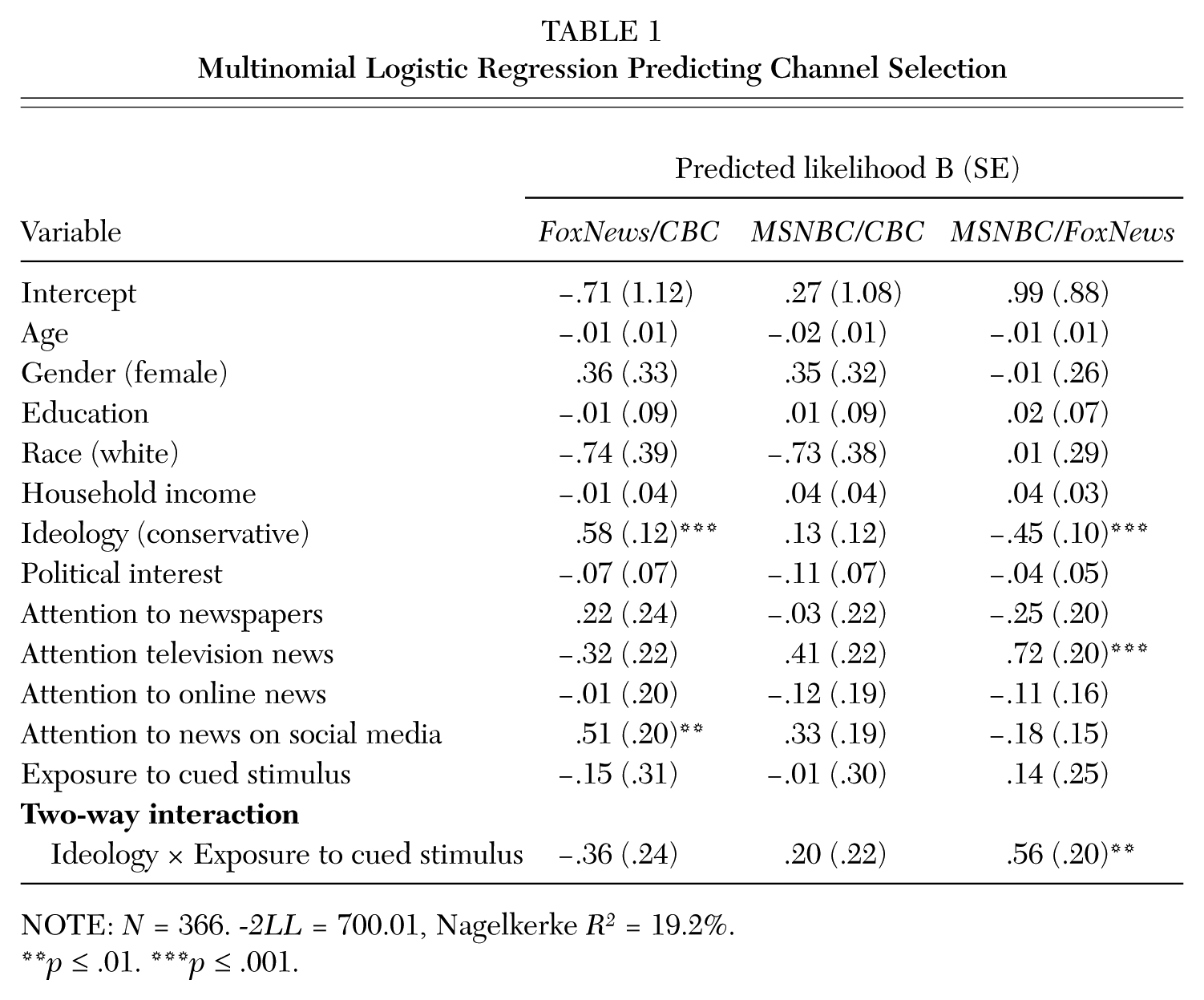
NOTE: N = 366. -2LL = 700.01, Nagelkerke R2 = 19.2%.
p ≤ .01. ***p ≤ .001.
For ease of interpretation, the logit coefficients were converted to probabilities, also known as selection rates, which were calculated by holding all other variables aside from the independent variable of interest at their respective means. The selection rate of Fox News relative to CBC was highest among those who reported being “very conservative” (90.8 percent) and lowest among “very liberal” respondents (23.2 percent). The trend in the selection rate of Fox News relative to MSNBC was similar, with “very conservative” respondents being most likely to select Fox News (78.3 percent) and “very liberal” respondents being the least likely to select the same source (19.5 percent).
Two media variables were significant predictors in our model. First, we found that attention to social media significantly predicted the selection rate of Fox News relative to CBC. Among respondents who reported paying no attention to news on social media, the selection rate of Fox News was 56.5 percent, whereas those who reported paying a lot of attention had a selection rate of 90.9 percent. Second, attention to news on television significantly predicted opting for MSNBC compared with Fox News. The selection rate of MSNBC among those who reported paying a lot of attention was 80.5 percent relative to 18.8 percent among those who claimed to pay no attention to television news. Control variables were not significant in the models.
To address our second hypothesis, interactions between political ideology and exposure to ideological cues were included in both models. The interaction had a positive, significant effect only when comparing selection rates of MSNBC and Fox News (see Figure 1). Among those who received obvious and consistent ideological cues, there is relatively little difference in the selection rate of MSNBC by liberals and conservatives. However, among those who received no cues, liberals were more likely to select MSNBC and CBC relative to Fox News, while conservatives were more likely to select Fox News over the other two channels. As we move along the ideology spectrum from liberal to conservative, the selection rate of Fox News increases while that of MSNBC declines.
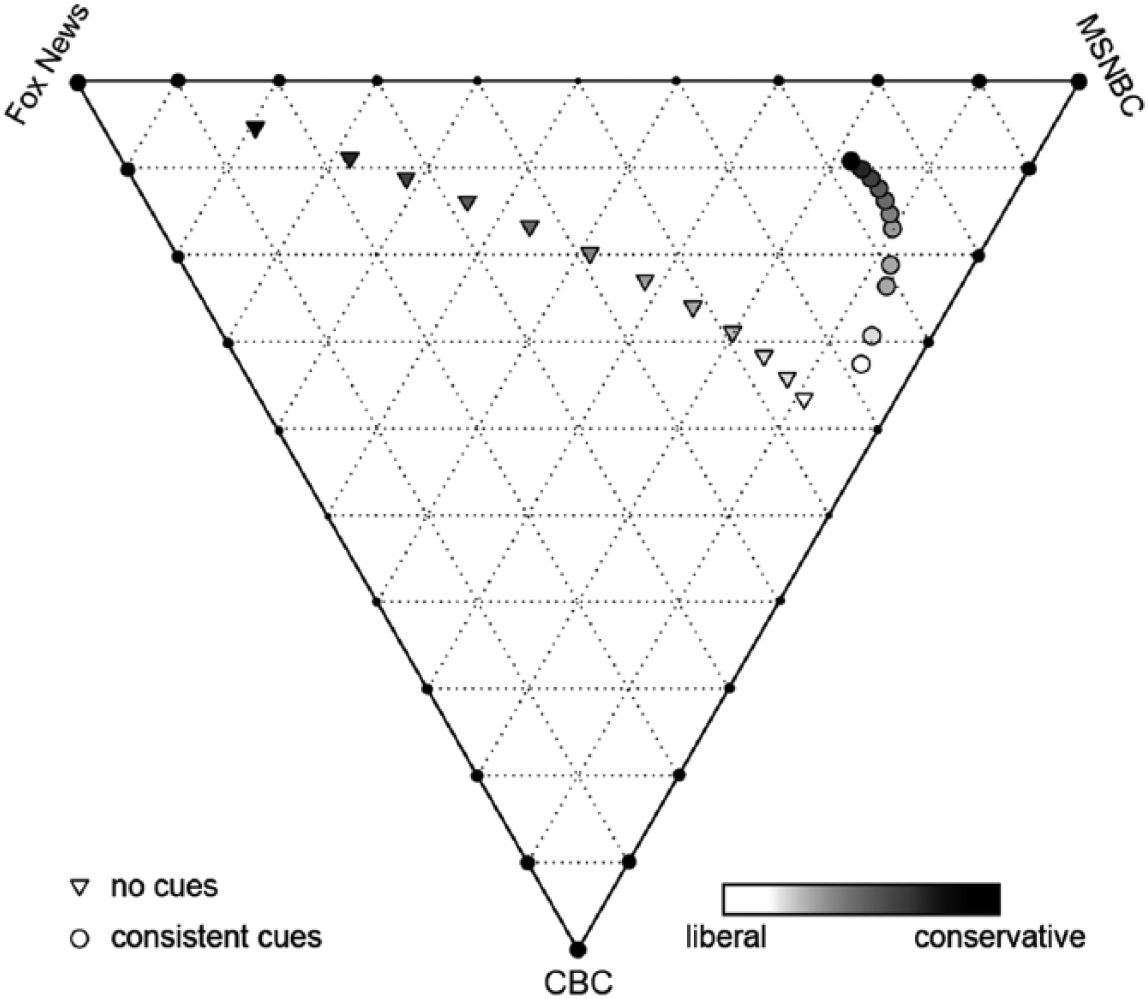
Ternary Plot Showing Interactive Effect of Ideological Cueing and Political Ideology on the Selection Rate of MSNBC, Fox News, or CBC
When clear cues are present, both liberals and conservatives were more likely to opt for countervailing channels, compared to when cues are ambiguous. This may indicate that people use ideological cues to guide their judgments of issues they know little about. When they know where their side stands on a particular issue, they seek a broader range of information.
Discussion
The exposure of citizens to a diverse marketplace of ideas is beneficial to society (Mutz and Martin 2001). As consumers migrate from more traditional media to the Internet for information about science and technology (Anderson, Brossard, and Scheufele 2010), this fragmented online environment makes it difficult for citizens to experience cross-cutting information. Instead, it allows citizens to select information and cocoon themselves in “echo chambers” (Sunstein 2001). The consequences of these echo chambers are concerning; scholars point to polarization as the primary detrimental outcome. Yet we know relatively little about the conditions under which information selectivity is likely to occur. While some work has explored how media sources and socialization affect selective exposure (Messing and Westwood 2012), there has been relatively little scholarship on the contextual conditions that induce partisan selectivity.
The paucity of scholarship can be partly attributed to the fact that much of this work has been conducted using political issues for which many have strong partisan opinions. Here, we use the issue of nanotechnology as representative of emerging NBIC technologies. The advantage of using this issue is twofold. First, unlike many political issues, the American public is largely unaware of nanotechnology, making it a relatively ideologically neutral issue. In addition, they often lack frameworks necessary to incorporate new information about such complex issues (Scheufele 2013). In general, lay audiences are more aware of political issues relative to scientific ones and have partisan or ideological frameworks in place to help them organize new information. Second, as future generations continue to face new technological and scientific developments, examining how public audiences seek information about postnormal science allows us to better understand patterns of information seeking that may arise for future technologies.
Before a comprehensive discussion of the findings, it is necessary to highlight some limitations. First, a common argument against experiments is the artificiality of the settings to which respondents are subjected. We do not contend that this is the case for the current study. Indeed, it is unlikely that individuals expose themselves to a relatively neutral information source on a routine basis. In fact, it could be argued that a Canadian periodical represents a relatively liberal source instead of a neutral one. However, it is challenging to find an objectively neutral source of news. Second, although it would be rare for news articles to contain no heuristics, which help people to interpret new information, this often happens for news articles about scientific and technological developments. Moreover, the experimental manipulation was justified for the purpose of this study, which was to identify specific conditions under which selective exposure occurs.
Despite these limitations, these results provide interesting insights into ideological selectivity. The main effect of ideology was significant; a finding similar to that of previous studies (Iyengar and Hahn 2009). Although partisanship and ideology are conceptually distinct, this study provides evidence that political biases affect how we select information about science and technology. First, we found evidence of defensive avoidance. When presented with three media channels, most respondents tended to avoid information from a source perceived as countervailing to their own attitudes and disposition. Yet instead of opting for a comparatively less partisan source, i.e., the CBC, individuals exhibited confirmation bias by opting for attitude-congruent channels. In general, conservatives were more likely to select Fox News, whereas liberals were more likely to select MSNBC. At first glance, this may not seem surprising as confirmation bias has been demonstrated in many studies (e.g., Iyengar and Hahn 2009; Stroud 2008, 2010) and is a relatively robust finding. However, while previous studies involved political issues, our experiment involved a scientific one that most Americans are unaware of. Despite this, selectivity occurred, emphasizing the notion that science is becoming increasingly politicized and that respondents use political frameworks to anchor new information about such issues.
Our finding of defensive avoidance represents a departure from previous work that has found a positive correlation between exposure to congruent and incongruent sources (Garrett, Carnahan, and Lynch 2013). One possible explanation may lie in how the data were used in the respective studies. In the current work, we distinguished between political groups, i.e., conservatives and liberals. However, Garrett and colleagues explored congruent attitudes and media use at the aggregate level without distinguishing between ideological groups when they conducted their analyses. Future scholarship should attempt to better understand the details of the relationship between these mechanisms of selective exposure at both an aggregate level and among different groups. It should also be noted that in our analysis here we used ideology instead of partisanship. When political party identification was substituted for ideology in our models, the interaction between the presence of clear cues and partisanship was not significant. In addition to understanding the details of confirmation bias and defensive avoidance, future research should attempt to elucidate the relationship between selectivity, political partisanship, and political ideology.
The goal of this study was to explore the contexts in which ideological selectivity occurs. To do so, respondents were assigned to different experimental conditions, one of which included clear ideological cues in a news article while the other contained no cues. The results showed that selective exposure was heightened by a lack of unequivocal ideological cues. And this selectivity effect was heightened through mechanisms that involve not only confirmation bias but also defensive avoidance (see Figure 1). In particular, both conservatives and liberals in our sample exhibited evidence of both confirmation bias and defensive avoidance (see Figure 1). When cues were absent from the news article, the selection rate of attitude consistent channels increased significantly compared with when cues were present. Similarly, respondents actively avoided incongruent channels when there were no clear ideological cues.
The findings of confirmation bias and defensive avoidance presented in this study occurred among both liberals and conservatives. Although studies have found evidence of conservative Republicans engaging more in confirmation bias relative to liberal Democrats (e.g., Iyengar et al. 2008), others have found the opposite (e.g., Knobloch-Westerwick and Kleinman 2012). Future studies should explore the extent to which either side of the partisan aisle is susceptible to confirmation bias and defensive avoidance to understand why partisans are so affected.
In existing scholarship, there is evidence that perceived information utility can trump partisan selectivity (Atkin 1973). Few studies have examined the conditions under which information utility trumps political loyalties. One situation in which this occurs is when the political regime is about to change after a national election (Knobloch-Westerwick and Kleinman 2012). We have identified another potential condition under which perceived information utility may trump confirmation bias. When people are faced with unfamiliar issues, political cues may be important heuristics that help them to interpret and understand new information. When such unequivocal cues are present, it is possible information utility trumps any tendency toward confirmation bias. In this case, surveillance information seeking may drive respondents to information, perhaps related to risks of nanotechnology, to keep abreast with the issue at hand. On the other hand, in the condition with no cues, it may be that they were too unfamiliar with the issue to interpret it and were therefore unable to assign any value to it in terms of utility. In this case, readers may have engaged in guidance information seeking to help make sense of the issue and retreated to a trusted partisan source.
Selective exposure appears unavoidable in the current fragmented media environment. Although the results of this study paint a relatively bleak picture for the likelihood of citizens’ exposure to cross-cutting information, a growing body of evidence indicates that perceived information utility plays an important role in information selection. Specifically, perceived information utility may trump partisan selectivity in certain situations, exposing individuals to a diversity of ideas. Individual selectivity is one aspect of the media use–polarization puzzle. Another important consideration is information processing. But before we can understand how individual biases affect information processing, it is necessary to understand how citizens are selecting information. Therefore, understanding the processes and mechanisms of selective exposure is an integral part of deepening our understanding of the formation of public opinion and attitudes toward science and technology.
Footnotes
Appendix
Percentage of Liberals and Conservatives Who Selected a Headline from MSNBC, CBC, and Fox News, by Experimental Condition
| Liberals |
Conservatives |
|||
|---|---|---|---|---|
| Media | No cues | Consistent cues | No cues | Consistent cues |
| MSNBC | 52.3 | 42.3 | 26.0 | 42.4 |
| CBC | 22.4 | 21.5 | 12.3 | 16.7 |
| Fox | 25.2 | 36.2 | 61.6 | 40.9 |

NOTE: Conditions = no ideological cues or consistent ideological cues.
NOTE:
This material is based on work supported by grants from the National Science Foundation to the University of Wisconsin–Madison Nanoscale Science and Engineering Center in Templated Synthesis and Assembly at the Nanoscale (Grant No. SES-DMR-0832760). Any opinions, findings, conclusions, or recommendations expressed in this material are those of the authors and do not necessarily reflect the views of the National Science Foundation.
Notes
Sara K. Yeo is an assistant professor in the Department of Communication at the University of Utah.
Michael A. Xenos is an associate professor in and chair of the Department of Communication Arts. He is the director of the Center for Communication Research at the University of Wisconsin–Madison.
Dominique Brossard is a professor in and chair of the Department of Life Sciences Communication at the University of Wisconsin–Madison.
Dietram A. Scheufele holds the John E. Ross Chair in Science Communication at the University of Wisconsin–Madison, and is co-principal investigator at the Center for Nanotechnology in Society at Arizona State University.