




Abstract
The governance of crime and security has undergone major transformations in recent decades. Several important shifts in the rationale and logic of crime control have led to a growth in regulatory practices and an expansion of regulatory provisions. As a result, the scope of actors who regulate behaviors have widened as have the types of tools to facilitate the governance of crime and security also expanded. We argue that the expansion of the boundaries of crime control is facilitated through a wide variety of criminal justice and non-criminal-justice regulatory tools to tackle both social problems and crime. We suggest that the time has come for criminologists to look beyond criminology’s traditional narrow focus on criminal law and the criminal justice apparatus utilized for crime control and engage in the broader discourse of regulation and governance of crime and security.
We live in a highly regulated world. When we brush our teeth in the morning, the toothpaste comes out of a tube whose packing and manufacturing processes are regulated to be tamperproof. We walk out the door and deactivate the alarm system of our homes and our cars—systems that were installed as a prerequisite for discounted home and car insurance premiums. When we drive through the ATM at the bank, we are watched by the camera that was installed as part of the ATM manufacturing requirements. We walk through our lives every day navigating mundane tasks that are encircled by crime-control techniques, most of which are regulatory mechanisms imposed by the state through its nonstate agents or by independent third parties.
Regulation is everywhere, an indispensable part of the contemporary governance of crime and security. While other disciplines have addressed the problem of regulation in various sectors of economic and social life in great detail, criminology’s engagement with regulation still remains a part of the very limited discourse on nodal governance (multiple state and private providers engaged in regulating social and economic relationships), plural policing, and restorative justice (see Mazzerolle and Ransley 2006; Weber 2013; Terpstra 2017). Despite Braithwaite’s (2000) aspiration to bring the regulation debate to the forefront of criminological analysis, the discipline rarely engages in dialogue on this topic. The so-called golden age of regulation (Levi-Faur 2011) is certainly not the golden age of analyses aimed at trying to understand what works in controlling crime.
The “new criminology of crime control” (Freilich and Newman 2016) seeks to address the problem of how crime can be regulated through mechanisms that are not necessarily related to traditional criminal justice procedures. This article explores this idea, discussing the expansion of a variety of regulatory tools aimed at controlling crime. We deal primarily with state and nonstate types of regulatory provisions, addressing private regulatory mechanisms in less detail, as they are covered by Tilley (this volume) and by Berg and Shearing (this volume).
We view regulation as a tool, an instrument of social control, and, more narrowly, crime control. After a brief comparative discussion of the meanings and notions of regulation, in socio-legal studies and criminology, we explore temporal, spatial, and sectoral shifts in the rationale and logic of contemporary crime control that led to an expansion in regulatory practices. We identify four types of regulatory provisions aimed at dealing with social problems including crime and suggest that these provisions are often unrelated to traditional criminal justice solutions. Finally, we provide commonly used metrics to assess the expansion of these types of regulatory mechanisms.
Defining Regulation
The idea of regulation in the social sciences is controversial (for a discussion, see Black 2002). Definitions have evolved from “sustained and focused control exercised by a public agency over activities that are valued by the community” (Selznick 1985, 363) to “ex-ante bureaucratic legalization of prescriptive rules and the monitoring and enforcement of these rules by social, business, and political actors on other social, business, and political actors” (Levi-Faur 2011, 6) to “the sustained and focused attempt to alter the behavior of others according to defined standards or purposes with the intention of producing a broadly identified outcome or outcomes, which may involve mechanisms of standard-setting, information-gathering and behavior-modification” (Black 2002, 20). These definitions reflect an evolution in regulatory practices as well. One of the most significant transformations is the multiplication of the regulatory actors, both state and nonstate. Regulatory mechanisms can be characterized as “smart” (Gunningham, Grabosky, and Sinclair 1998) or “polycentric” (Black 2008) and can involve indirect types of behavior modification, such as choice architecture, or “nudging” (Thaler and Sunstein 2008). Thus, in sociolegal studies, a broad and multifaceted understanding of regulation has gained considerable support (see Drahos 2017).
While in the social sciences the idea of regulation is a source of considerable debate, the criminological discussion of the meaning of the word regulation remains rather limited. In the Sage Dictionary of Criminology, the article on regulation refers the reader to other notions, such as self-governance, governmentality, managerialism, and social control, although some discussion is presented under the heading “regulatory agencies” (McLaughlin and Muncie 2012).
To introduce the term regulation into criminological discourse, one must be aware that the current debate is focused on three completely different interpretations of the meaning of regulation. First, there is a tendency to treat regulation in a very narrow sense of the word: as an activity of the state regulatory agencies aimed at private enterprise for ensuring the just and fair provision of services by these private entities. In that sense, a considerable debate takes place in criminology about the provision of the service of security by private policing agencies. This debate is primarily focused on expansion of the idea of policing from the activities of the regular police force to a broader set of the state agencies that include white-collar police (Nalla and Newman 1994) and eventually to a nodal network of the government and private agents that undertake policing functions (Shearing and Wood 2003). Some scholarship has argued that private provision has led to the “clubbing” of the good of security (Hope 2000), the emergence of “bubbles” of security (Rigakos and Greener 2000), or just generally to the poor quality of services and accountability issues (Zedner 2006). State regulation of the provision of the public good of security by the private security industry is one solution to this problem of “liquid” security (Zedner 2006) that needs “civilizing” (Loader and Sparks 2010). Such an understanding of regulation limits its definition to the state activity aimed at private security providers that is carried out through creating legal standards of operation and service provision.
Second, there is an opposite tendency to view regulation broadly, using it interchangeably with such a conception as policing. Regulation is described as activities similar to those of the continental police in the eighteenth century (a tool of the police economy [Braithwaite 2008; Levi-Faur 2005a]) that created order in the areas of trade and commerce but was not limited to it. The earliest known use of the terms police and policing in Europe was in the context of three services: “cleanliness of the nation, security of nation, and abundance and cheapness of goods at market” (Harcourt 2011, 20), covering a range of activities aimed at governing population from health, labor standards, fires, and forests to migration and immigrant communities (Pasquino 1991). Regulation is described in the literature as a way of “steering the flow of events” (Braithwaite 2008, 1), and in this sense, it becomes indistinguishable from that early conception of policing and from the notion of governance in general.
Third, more recently, another understanding of regulation entered the criminological debate. It juxtaposes the direct, coercive, state-related forms of social control (criminalization, law enforcement, punishment) and the softer, often nonstate methods of control that are referred to as regulation. This approach can be linked to the changes in the vision of what constitutes the object of social control and governance. This object had shifted from the offender to the offense or, rather, the situation where opportunities for crime are created or inhibited. The offender is regarded as the object of coercive intervention, while the situation can be addressed by the state and the responsible private actors (or communities) with a variety of noncoercive, often self-regulatory measures. These include situational crime prevention (R. V. Clarke 1995), crime prevention through environmental design (Brantingham and Brantingham 1981), and community policing. All traditional criminal justice activities are excluded from the scope of this definition of regulation.
The term regulation can refer both to the repressive and reactive criminal justice measures as well as to primarily preventive mechanisms. Criminal law should be regarded as one of the many regulatory means available to achieve an end of behavior modification (Smith, Seddon, and Quirk 2010) to provide regulators with a larger scope of possible interventions to alter the regulatees’ behavior. Grabosky (2010) recognizes criminal justice and regulation as overlapping spaces and likens it to a “mansion with many rooms.” The exploration of these overlapping systems allows us to spot a significant expansion of the use of the regulatory mechanisms—both related and unrelated to criminal justice—for social control purposes.
The diversity in the definition of regulation may also vary according to the purposes of a particular academic project. For the purposes of this article we are using the notion of regulation in a rather limited, instrumental way. We suggest that regulation is a particular tool, an instrument of governance and social control that can be used along with other tools. Regulation represents the purposeful activity of rule-setting and the subsequent monitoring of compliance as well as enforcement. These rules can be formal and informal, accompanied by a formal or an informal sanction. They can be enacted, created, or negotiated by multiple entities, both state and nonstate. They can have different targets and be aimed at different subsets of the population: law-abiding as well as deviant, and even would-be offenders. The rules define what specific measures can or must be undertaken, in what place, at what time. They prohibit certain types of behavior while encouraging others with a distinct aim of reducing crime (or minimizing the risks of its occurrence). Overall, regulation is a process of establishing, monitoring, and enforcing rules about the who, when, where, and how of crime prevention.
Mapping the Rise of Regulation
The notions of the “regulatory state” (Majone 1994) or the “new regulatory state” (Braithwaite 2000) have long ago become formulas used to describe the expansion of the various types of regulatory practices. When Ronald Reagan came to power in 1980, what followed was not deregulation but the “regulatory revolution” (Levi-Faur 2005a, 27). Government’s role as the property owner or employer declined, but its role as a regulator advanced (Hood, Rothstein, and Baldwin 2001, 4), resulting in the widening net of regulation (Levi-Faur 2011). Despite the expansion of the nonstate forms of regulation, the neoliberal promise of the “hollowing out” of the state (Rhodes 1994) has never occurred. Braithwaite (2008) argues that the neoliberal agenda of downsizing the government has always remained a rhetoric-only move and, along with Levi-Faur (2005b), suggests that regulatory capitalism is the primary method of the functioning of contemporary society.
These profound transformations in governance have produced a strong impact in the field of crime control. They were coupled with the expansion of security concerns and preoccupation with risk minimization (for the discussion of these profound transformations in the area of crime control, see Garland 2001; O’Malley 1992; Zedner 2009). This expansion manifests itself in the growth in the number of preventive coercive measures (Ashworth and Zedner 2014) targeted at antisocial behaviors, terrorism, and extremism. The proliferation of security is also evident from the growing number of provisions in the laws that aim to preempt behaviors at the earliest stages of criminal activity. As a result, the general regulatory upsurge and precautionary obsession of the “security society” (Zedner 2009) have reinforced each other, creating overlapping spatial, temporal, and sectoral expansions of regulatory provisions of all kinds—of the command-and-control as well as decentered, nonstate types. It should be noted that the nonstate security provision was never a substitute but an adjunct to the state provision and in that sense represented a rolling out and not a rolling back of the state (J. Clarke [1996, 15] as cited in Hudson [2001, 156]) and its regulatory instruments.
Spatial expansion
With the rise in the recognition of the utility of situational crime prevention techniques, more spaces are regulated to reduce the occurrence of crimes in these locations. These spaces include shops, objects of mass private property, and certain public spaces that require increased security (airports, governmental buildings, and public institutions such as schools and hospitals). What complicates the spatial problem further is that sometimes to regulate the environment we must regulate a party that is not present in that space—that is, the producer of the tamperproof packaging. In this sense, regulatory space and crime space do not always match. In addition, with the emergence of cyberspace, regulatory provisions gradually have been extended to control this initially unregulated domain. The emergent “surveillant assemblages” (Haggerty and Ericson 2000; Lippert 2009) are the subproducts of complex processes of regulation, including enforced and voluntary self-regulation. Their existence suggests the extension of regulation from real human beings to their digital copies that exist in the virtual space of social networks, surveillance databases, and other public and private data archives.
Temporal expansion
The primary goal of crime control in the risk society (Beck 1992) is preempting all possible risks and hazards. Prevention, as a boundless, self-referential, and self-reinforcing concept, allows for the continuous expansion of state action (Peeters 2013). To address all possible risks, the list of which is constantly expanding, the state and nonstate actors develop a broad range of regulatory measures ranging from the most coercive to the softest possible. These measures make intervention possible at the earliest occurrence of the problem or even before the problem occurs. They also allow oversight even after the problem ceased to exist, to prevent its reoccurrence. Preventive efforts are focused on the behaviors that are considered to have the potential to turn into offence and people who might represent threat in the future (including and not including actual offenders). Some examples of such regulatory mechanisms in the U.S. context include the use of preventive detention, prohibiting conduct that precedes terrorism through the mechanisms of criminal law, the expansion of surveillance (Cole 2015) and other measures that can be described under the umbrella of “pre-crime” (Zedner 2006; McCulloch and Wilson 2015), “preventive justice” (Ashworth and Zedner 2014), and “postpunishment” (Hallsworth and Lea 2011). The expansion of crime control efforts in time requires new regulatory provisions that identify how far back in the past or forward in the future crime control efforts should reach.
Sectoral expansion
A noticeable shift has occurred in the past several decades from state monopoly on policing to multilateralization of policing activities (Bayley and Shearing 2001) or patchwork policing (Crawford and Lister 2004). There is not only the strong presence of nonstate actors in regulation but, as a matter of fact, expansion has occurred in non-criminal-justice regulatory agencies (Nalla and Newman 1991, 1994). The literature on nodal governance portrays and analyzes how multiple nodes of governance emerge consisting of several state and nonstate actors and employ very diverse mentalities and technologies to provide security (Shearing and Johnston 2013; Shearing and Wood 2003), though we know little about the coherence, synchronization, and harmonization of the regulatory apparatus. In addition to the plural policing and nodal governance framework, a concept of responsibilization (Garland 2001) is used to explain the shift to nonstate provision of security. The sectoral shift requires new regulatory provisions that set the rules for the nonstate actors involved in maintaining security. It also contributes to the expansion of regulation due to the fact that the responsibilized actors engage in self-regulatory activities.
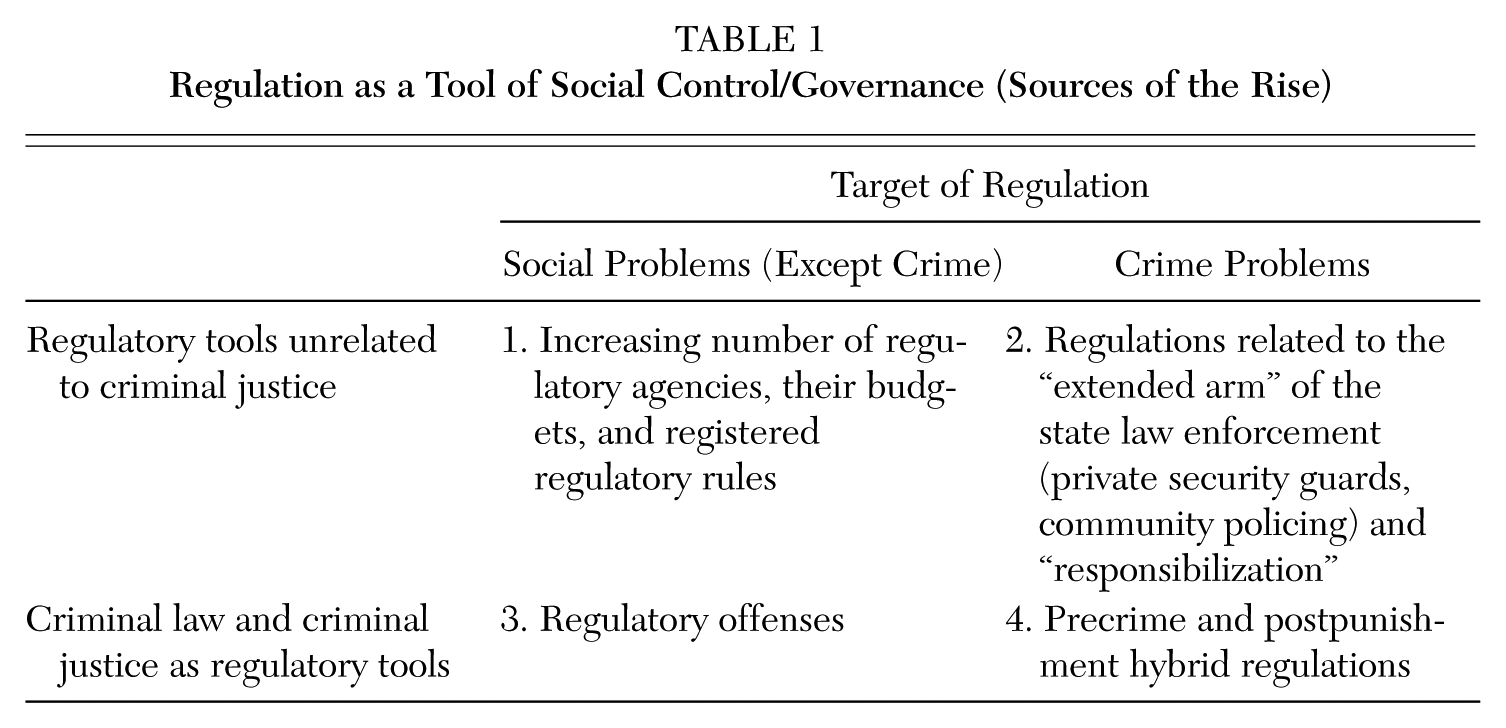
Table 1 displays four domains of regulation: time, space, across state and nonstate actors. As regulation is aimed at behavior modification in the areas where order is socially desirable, we identify two areas: the general area of social problems and the area of crime problems. These two types of problems are addressed with two types of regulatory tools: related and unrelated to the use of criminal law and criminal justice regulations. Each cell of the table provides examples of the sources of the regulatory expansions as they pertain to a specific type of problem and regulatory tool. Next, we discuss the existing data that point to the rise in the number of regulatory provisions in each of these cells or, when numerical data are not available, we outline examples in which the expansion is evident.
Regulation as a Tool of Social Control/Governance (Sources of the Rise)
Rising Regulation: Empirical Support
Tackling social problems through non-criminal-justice regulatory tools
As noted above, in addition to the state criminal justice agencies, many non-criminal-justice agencies explicitly deal with societal risks and social problems. For instance, Wall Street Reforms, Controlled Exports, and Navigation Areas and Safety and Security Zones are all examples of agencies and legislative efforts that regulate societal risks. Employing occupational force as a metric, prior research on trend lines of government regulation employment data (1960–1985) in public and private sectors over the last several decades established a rise in state regulation of traditional and other forms of regulatory policing through an array of state agencies (Nalla and Newman 1991; Jordana and Levi-Faur 2004; Jordana, Levi-Faur, and Marín 2011) whose primary goals are the collection of taxes, overseeing migration, and public health.
Analogous to this example are federal budgetary allocations and agency spending. Dudley and Warren’s (2016) analysis of the U.S. Budget for Fiscal Years 1960 to 2017 provides two areas as proxy indicators for the increase in allocations for regulatory agencies to develop, administer, and enforce federal rules and regulations. They identify two broad classes of regulators: social regulation (e.g., Departments of Consumer Safety and Health, Homeland Security, Transportation, Workplace, and Environment and Energy) and economic regulation (e.g., Departments of Finance and Banking, Industry-Specific Regulation, and General Business) and provide budgetary data. Total federal allocations for social regulation in 1960 were $354 million and $57,349 million in 2016 in real 2009 dollars, an increase of 16,100 percent without controlling for inflation. Similarly, there was a sharp increase in federal budgets for economic regulation from $179 million in 1960 to $12,606 million in 2017, representing an increase of 6,900 percent.
Figure 1 shows the percentage change in the allocation for each of the specific federal agencies in social and economic regulations from 1960 to 2017 in constant real 2009 dollars per million population. Total spending for each category of regulation spending has steadily increased each decade from 1960 to 2017. The percentage change for regulatory spending since 1960 reveals staggering growth, commonly more than 1,000 percent. For example, during this time frame, under social regulation, Homeland Security grew by 3,335 percent, Environment and Energy by 4,598 percent, and Transportation by 1,170 percent. During the same period, both General Business (1,830 percent) and Finance and Banking (1,781 percent) showed strong growth, suggesting a general trend relating to federal budgetary allocations for the regulatory apparatus. These allocations represent the growth of agencies’ capacities in rule-making and white-collar policing activities (Nalla and Newman 1994).
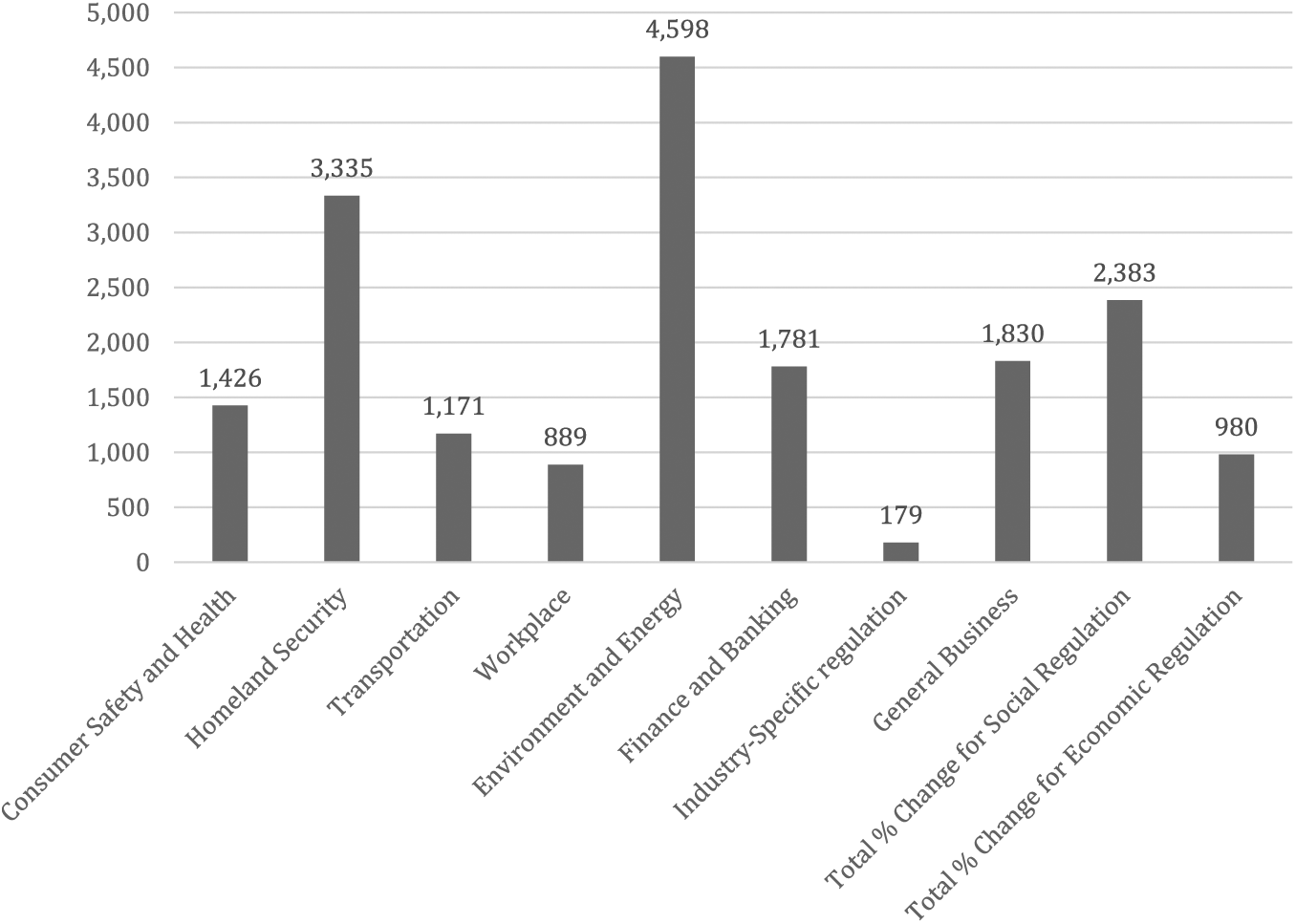
Percentage Change in Federal Regulatory Agency Spending in Constant Real 2009 Dollars per Million Population since 1960
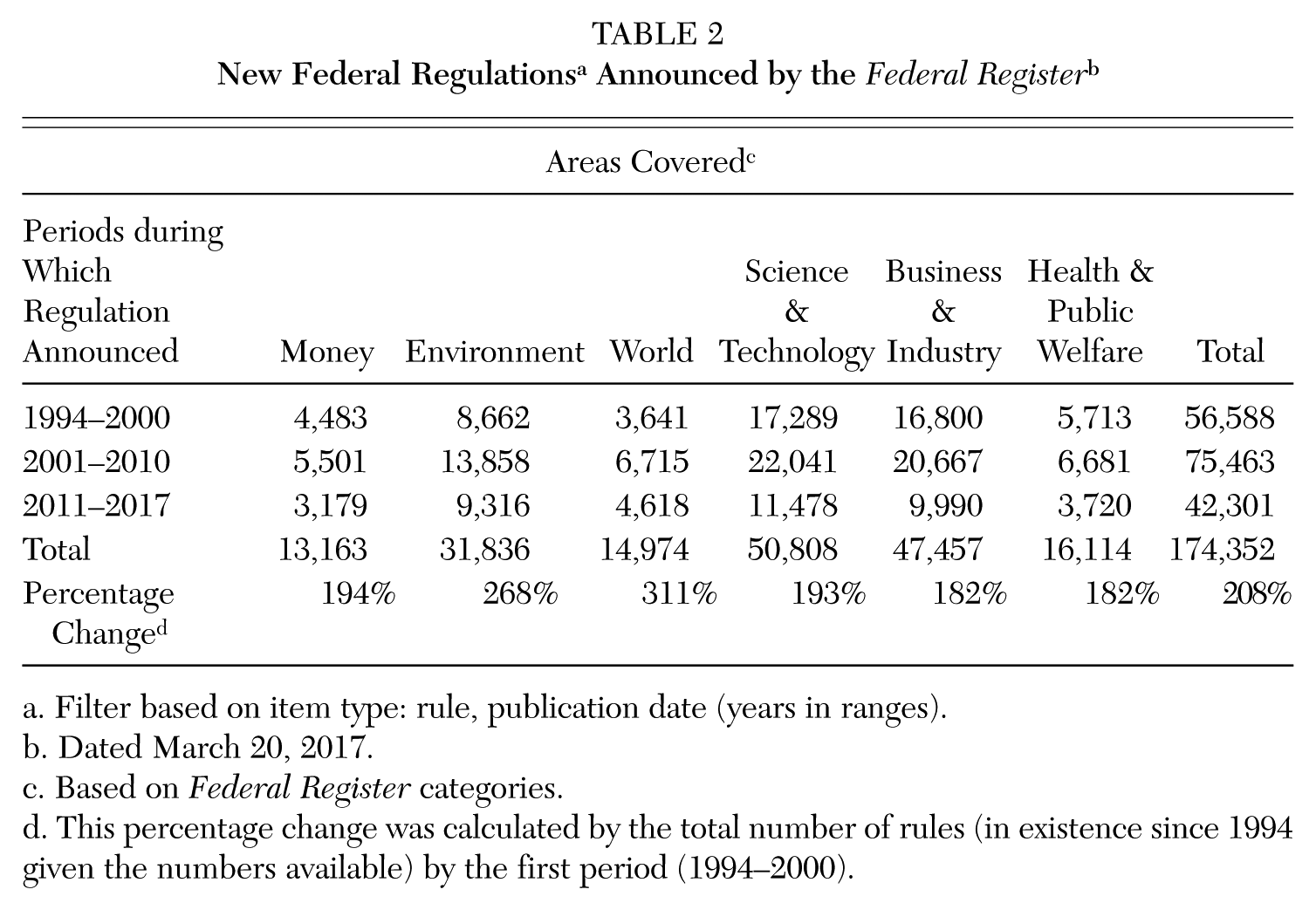
The volume of legislation that speaks to growth in public regulation is rather significant. Table 2 presents the extent to which the government has expanded its regulatory framework from the mid-1990s to 2016 in the areas of money, environment, world, science and technology, business and industry, and health and public welfare. Each of these areas subsumes a number of agencies, each having a set of documents issued. For instance, “money” includes a number of divisions such as the Dodd-Frank Wall Street reform, stock and commodity trading, government contracts, and so forth. The category “world” includes divisions such as immigration and border control, controlled exports, North American Free Trade Agreement (NAFTA), navigation areas, and safety and security zones.
Filter based on item type: rule, publication date (years in ranges).
Dated March 20, 2017.
Based on Federal Register categories.
This percentage change was calculated by the total number of rules (in existence since 1994 given the numbers available) by the first period (1994–2000).
Yet another measure partially employed is the volume of regulations listed in the Federal Register during the golden age of regulation (Levi-Faur 2011) of the 1990s through 2017. Overall, (as seen in Table 3) the Federal Register shows an increase in new federal regulations in the above-mentioned categories between 1994 and 2017 by 208 percent, indicating expanded regulation. Among the specific categories, world regulations grew by 311 percent during the period between 1994 and 2017, followed by environment, which increased by 268 percent. The other remaining categories include money (194 percent), science and technology (193 percent), health and public welfare (182 percent), and business and industry (182 percent).
Specific Acts Denoting Regulatory Control over Private Society

Some examples of state regulations aimed at managing environmental risks and financial fraud that might occur in the course of the business activities are the Toxic Release Inventory (TRI) and the U.S. Securities and Exchange Commission’s (SEC’s) reporting requirements. TRI was established by Section 313 of the Emergency Planning and Community Right-to-Know Act (EPCRA). It mandates companies to report annually the amount of the released or otherwise managed toxic chemicals that potentially pose a threat to human health and the environment. SEC requirements are created to increase the transparency of the business transactions of public companies for the investors. The filings provide insights into a company’s financial standing and risks that one might face when dealing with the company.
It is important to note that not only the state regulations expand to tackle noncriminal social problems. The expansion is evident in the nonstate sector as well. Vandenbergh (2007) discusses how new, global private governance often substitutes for or bypasses government regulation by setting standards that either promote or restrict behaviors of the companies that might lead to environmental harm (e.g., such as tropical deforestation and the release of toxins). He found that half of the firms in various sectors impose environmental requirements on the suppliers.
Non-criminal-justice regulations for crime problems
The spatial shift in crime control as well as sectoral transformations discussed earlier have resulted in the expansion of regulatory provisions of different kinds aimed at reducing situational opportunities for crime control, on one hand, and controlling the service provision of the privatized or “responsibilized” actors, on the other. Educational institutions (e.g., rules to regulate truancy), zoning (e.g., permits for bars), banks (e.g., report suspicious transactions to the IRS), pharmaceutical companies (e.g., ensure chemicals needed in making prohibited substances appropriately move in the supply chain), and fusion centers (e.g., establish public-private partnerships for precrime and counterterrorism) are all examples of nonstate actors’ roles in crime control. They are the “third parties” (Mazerolle and Ransley 2006) and “force multipliers” (Ayling 2007) that the state successfully engages in crime control through various regulatory mechanisms (Grabosky 2010), thus lengthening the arm of the law (Ayling, Grabosky, and Shearing 2009). They are also capable of producing decentered regulatory rules and standards aimed at controlling the behavior of other third parties or potential offenders. Therefore, through various responsibilization techniques (regulation being one of them), the state has successfully widened the “net” (Cohen 1979) of social control.
What complicates the picture further is that the divide between state and nonstate regulation in the area of crime control is not straightforward. The efforts of private actors aimed at crime prevention, although begun as self-regulatory, have filtered into market regulatory apparatuses (market forces, insurance, etc.) and flowed back into state-initiated crime-reduction programs such as community policing and problem-oriented policing. Further, the efforts of social engineering of crime-proofing products (e.g., redesigning products, labeling, and packaging) and manipulation of environments (e.g., design and layout of premises; closed-circuit television [CCTV]) by the corporate sector flow back to the state to reappear as “grand” crime prevention policy (R. V. Clarke and Newman 2005b; Freilich and Newman 2016). These centrifugal and centripetal processes of transferring the responsibility for taking care of crime problems often depend on regulatory provisions (Freilich and Newman 2016) and therefore expand regulation.
Police partnership with citizens in community policing programs is another such example that brings nonstate actors into regulation. These programs have expanded considerably since the 1980s and are well documented in the literature. For instance, the federal government has invested in community policing schemes more than $15 billion since 1994 (U.S. Department of Justice 2016). These programs were meant for establishing partnerships with local community members and groups, including other government agencies, nonprofit and community groups, businesses, and the media, to promote greater public safety and reduce crime. They were also aimed at lowering citizen dependence on the police, who in turn educated citizens with crime prevention techniques. There are numerous examples of citizens becoming an extension of the local police in community policing programs (for a review, see Maguire and Wells 2009) where community sharing becomes an important dimension in crime prevention. Neighborhood watch groups and citizens’ patrols, campaigns like Mothers against Drunk Driving (MADD), and slogans such as “Drug Free Zone – You Are Being Watched” (Grabosky 1995) are some common examples. All of these initiatives cannot operate without regulations by the state or its agents, or self-regulation of the parties involved in crime prevention activities.
Expansion of the criminal justice apparatus to noncriminal social problems
Criminal law, policing, and other traditional criminal justice mechanisms are frequently used not in a reactive fashion but as the instruments of prevention and deterrence, as tools for regulating behaviors and increasing compliance (Fitzgibbon 2007). Criminal law has come to be applied widely for governing regulatory offenses. Husak (2008, 10) suggests that one of the reasons why we are witnessing the “explosive growth in the scope of the criminal law” is that new regulations that are introduced routinely complement rules that provide criminal penalty for noncompliance. They are placed toward the apex of Ayers and Braithwaite’s (1992) regulatory pyramid and are meant to increase compliance with regulatory provisions. They allow noncompliance to be treated like street crime (Larkin 2013). The exact number of these offenses enforced even on the federal level is unknown. According to some estimates, by the 1990s there were approximately three hundred thousand regulations at the federal level that could be enforced through civil and criminal sanctions (Coffee 1991). The estimates of the American Bar Association (Strazzella 1998) are more modest: they suggest that there are about ten thousand regulatory provisions that are accompanied with criminal sanctions. According to some other estimates, by 2007 there were about four thousand federal statutes that defined behavior as criminal (Baker 2008). However, it is not clear whether those include regulatory offenses.
A sample of federal regulations suggests stringent criminal penalties for noncompliance (see Table 3). For instance, nondisclosure of information in relation to the Child Nutrition Act to provide increased access to food can draw both monetary fines and imprisonment. Similar criminal penalties are provided in laws that protect privacy of children, control pollutants entering into water sources, and minimize interference with the ability to engage in commerce. While many of these agencies have enforcement wings (as in the case of law enforcement officers), others are empowered to seek the help of local and/or federal law enforcement agencies to enforce regulatory provisions.
Expansion of criminal justice regulations for crime control
The state, while distancing itself from the direct provision of services under the neoliberal agenda, does not seem to get too far from using the most ancient reactive type of crime control, the coercive criminal justice system and the institutes of criminal law and punishment (Crawford 2010). The penal sphere is one of the main spaces where the state has the legitimacy to act and provide security (Harcourt 2011). The state’s reluctance to undermine its own sovereignty results in the expansion of direct state involvement into regulation of human behavior through criminalization of a broader scope of conduct, its preventive ambitions, and a reactionary fervor that had manifested itself in the phenomenon of mass incarceration (Garland 2001). One of the most prominent developments in criminal law regulation is its temporal shift to precrime and postpunishment (Hallsworth and Lea 2011) and the emergence of the preventive justice system (Ashworth and Zedner 2014). Through hybrid tools of precrime regulation, legal restrictions are applied to those who are not yet convicted of any crime. Precrime is a distinct trend of the U.S. crime control policy (McCulloch and Wilson 2015).
Banishment practices such as trespassing programs, exclusion, “no contact” and off-limits orders, gang injunctions, and juvenile curfews are used by the police, judges, correctional officers, and housing authorities to exclude certain categories of people (e.g., homeless people, reformed criminals, drug sellers, and gang members) from entering public houses or buildings and even whole sections of the cities temporarily or permanently (Beckett and Herbert 2009). These measures, some of which are touted as zero-tolerance policing and are well documented in New York City (Harcourt and Ludwig 2007), often combine civil and criminal mechanisms and are aimed at tackling antisocial behavior that allegedly leads to crime. The state authorities have banishment powers, and owners of private shops and other businesses are encouraged by state laws to ban unwanted customers from their premises.
Precrime is distinct from other risk-based measures (including risk-based sentencing practices, police profiling, and target hardening) in that it is not always fueled by the history of past offending but rather by a fear (often unsubstantiated) of possible future harm (McCulloch and Wilson 2015, 3). Policy measures are driven by the urge to harness the uncertainty of the imagined future rather than by objective knowledge (Zedner 2009). What is important is that uncertainty justifies intervention even when the nature and extent of the potential threat are not known and that it prompts action “just in case” (Crawford 2009).
Legal provisions that introduce mandatory sentencing rules as well as “three strikes” laws can also be interpreted as regulatory provisions that pursue a preventive goal. But it is not just the rules of sentencing but also the postpunishment (Hallsworth and Lea 2011) regime that is introduced after the punishment has been served that is used to ensure incapacitation of the ex-offenders and speaks to the expansion of regulation. Community notification acts (for a review, see Tewksbury 2005) such as Megan’s Law of 1996 (Title XVII of the Violent Crime Control and Law Enforcement Act of 1994, 42 U.S.C.A. §14071) and PROTECT ACT of 2003 (Prosecutorial Remedies and Other Tools to End the Exploitation of Children Today [Pub. L. 108-21, §604]) are enacted to ensure that the information about those who were convicted for sex offenses is available to the general public. Also, many states now require that sex offenders admit their crimes on social media such as Facebook (Brown 2012). These postpunishment measures thus expand the scope of public and private surveillance of offenders as a part of the crime prevention strategies such as target hardening and increase guardianship by reducing anonymity.
One other form of traditional criminal justice regulation involves community partnerships with federal government consisting of programs related to policing school districts where wardens of the school become key enforcers of federal rules. All fifty states and Washington, D.C., have statutes whereby the federal government authorizes and commissions school officers, who are not law enforcement personnel, to enforce laws relating to truancy, delinquency, and crimes committed on school premises through memoranda of understanding among school districts, local police, juvenile justice entities, and community stakeholders. For example, a Missouri statute (Mo. Rev. Stat. §162.215 [2016]) notes that school boards may “authorize and commission school officers to enforce laws relating to crimes committed on school premises, at school activities, and on school buses,” expanding the notion of responsibilization to a higher degree as well as shifting state responsibilities to nonstate actors (U.S. Department of Education, n.d.). Also among the new partnerships that involve the private sector is the Customs-Trade Partnership against Terrorism (a layer of the U.S. Customs and Border Protection) that has more than eleven thousand business partners that partake in terrorism prevention activities.
Discussion and Conclusion
In this article, we have addressed the ongoing process of the expansion of the regulatory mechanisms aimed at tackling risks, reducing crime, and providing safety. We view regulation as a tool of governance (or social control) that represents a purposeful and deliberate activity of the state and nonstate actors that is directed at establishing, monitoring, and enforcing rules aimed at preventing crime or reacting to it. Here, we argue that regulation is a means of social control—a purposeful and deliberate activity in which the government or private actors deploy rules to prevent crime and to mitigate adverse reactions to crime. In using this broad definition of regulation, we reveal various patterns in the expansion of regulatory practices.
We draw attention to how neoliberal transformations in the governance practices in general and the “preventive turn” (Hughes 1998; Peeters 2013) in crime control policy have contributed to the rise in regulation. One of the examples in criminology that most clearly represents this process of regulatory expansion is situational crime prevention (SCP). Over recent decades, SCP has gone beyond a basic theory designed to address specific situational factors that precede the actual crime, to a piecemeal social engineering project of “grand” crime prevention policy (Freilich and Newman 2016). It often requires responses that are removed from the particular situation of crime through the redefinition of the problem and the subsequent transfer of its ownership. Regulation of the crime problem becomes shifted to a stage when the crime can only be envisaged. The responsibility for regulation gets transferred from the traditional state criminal justice agencies to nonstate actors. The solution lies not only in the transformation of the situation at the particular crime-prone location but presupposes a much wider array of measures aimed at changing the opportunity structure.
Our analysis is not limited to the discussion of the SCP and the expansion of the regulatory practices that are developed for its implementation. SCP, according to our view, mostly designs non-criminal-justice measures aimed at controlling specific crimes. Along with this category, we identify three other distinct areas where regulatory expansion has occurred. One of them is the rise in the non-criminal-justice measures targeted at governance of various types of risk (environmental, financial) and maintenance of general order. Another area represents the rise of traditional criminal justice regulatory tools aimed at solving noncriminal social problems through such mechanisms as regulatory crimes (sanctions for the noncompliance to the general regulatory provisions). Finally, we talk about the expansion in traditional criminal justice regulations that target crime: preventive justice, precrime, and postpunishment measures. All four areas that we have looked at clearly demonstrate that in the era of “regulatory capitalism” (Levi-Faur 2005a; Braithwaite 2008), crime is being controlled through the ongoing temporal, spatial, and sectoral expansion of regulatory provisions.
Having provided metrics that suggest the rise of regulation, we also acknowledge that a possible source of this growth is the expansion of the definition of regulation. As discussed, the notion of regulation has developed from a very limited understanding of it as the state effort to control for market inefficiency through imposing certain specific rules on businesses. A much broader social-legal definition includes a wide range of activities (from rule-setting and enforcement to information gathering), a variety of possible agents of regulation, and even social and economic forces acting as regulators. If the notion of regulation is used even more broadly—as “policing,” “governance,” or “social control”—then virtually any purposeful human activity can be classified as regulation. Any law enforcement activity, any act of criminalizing conduct, any manipulation of the environment (e.g., installing a security camera or remodeling a cashier’s area) to reduce crime (R. V. Clarke 1980, 1995), and any efforts of designing crime-proof products (R. V. Clarke and Newman 2005a, 2005b) can possibly be interpreted as a regulatory activity (Grabosky 2010). Therefore, the literature might suggest that regulation is expanding. But this expansion can also be illusory—a product of the scholarly debates regarding its meaning and scope. If, in contrast, we employ the narrowest definition of regulation as state activity we might see some rise—however, not that dramatic.
We refrain from the debate about whether the rise in regulation enhances security and contributes to the maintenance of social order. We also leave out the question about normative dimensions of the regulatory expansion (for the case of preventive justice, see Tulich et al. 2017). Perhaps a more important imperative of these developments is the role and place of criminology as a discipline and its engagement in the discourse of regulation and crime. These developments question the current crime control approaches that mainstream criminology advocates and advances. More specifically, they question its relationship to the more orthodox perspectives of the treatment of crime and crime prevention meted out in the mainstream criminology scholarship and its teachings. With the majority of criminology textbooks devoted to positivist explanations of crime, the dispersal of crime control approaches in the regulatory age will have a bearing on the efficacy and legitimacy of traditional understandings of offenders and crime causation.
Footnotes
NOTE:
We are grateful for anonymous reviewers’ comments, which helped to improve the quality of this article. Our sincere thanks to Nolan Gillespie, who assisted us in research and data gathering.
Anna Gurinskaya holds a joint appointment as an associate professor at the Faculty of Liberal Arts and Sciences, St. Petersburg State University, and at the Faculty of Law, Russian State Pedagogical University of Herzen in St. Petersburg, Russia. Her current research projects include social regulation and crime prevention; migration and criminal policy; private policing; and legal philosophy, ideology, and crime.
Mahesh K. Nalla is a professor of criminal justice at Michigan State University in East Lansing. His current research projects are focused in two areas in emerging and transitional democracies: governance, legitimacy, and social regulation (public & private policing); and gendered spaces, victimization, and public health. He coordinated and led a global project on firearm related violence prevention programs for the United Nations that covered over 180 countries. His research has appeared in leading journals, such as the Journal of Research in Crime and Delinquency, Justice Quarterly, and European Journal of Criminology.