



Abstract
Public policies sometimes generate “policy feedback effects,” reshaping public opinion and political participation among beneficiaries or the public generally, often with the effects of generating supportive constituencies that help to sustain the program. Yet such effects do not always occur; in fact, despite that Americans use more social policies than ever, antipathy to government runs high—evidence of a seeming “government-citizen disconnect.” Policy design and delivery matters for policy feedback, as policies that make government’s role more visible may make more of an impression on beneficiaries; yet political polarization and distrust in government can interfere with such effects. In addition, those who are most aware of the government’s role in social provision often participate least in politics, and vice versa. This article considers strategies that public officials and other civic and political leaders can use to facilitate policy feedback effects.
Keywords
What a difference a few years can make. In March 2010, President Barack Obama signed into law the Affordable Care Act (ACA), achieving a goal that his party had pursued for decades: health coverage for working-age Americans. Yet when the midterm elections arrived that fall, not only did voters fail to reward the Democrats, but instead they gave the president’s party what he himself termed a “shellacking,” as Republicans picked up several seats in the Senate and regained control of the House. GOP officials continued, right up through the 2016 election, to rally their voters through calls to repeal the ACA. After President Trump took office, however, public opinion over the ACA shifted from mostly “unfavorable” to mostly “favorable,” as Democrats and independents grew more supportive (Kaiser Health Tracking Polls 2019). Congress proved unable to muster the votes to “repeal and replace” health reform in the Senate, where three Republicans voted against the measure. As Trump and members of his administration threatened to weaken components of the ACA, moreover, the public grew more protective of it. By the time the 2018 midterms arrived, safeguarding the ACA became a winning issue for Democratic candidates, including several in “red” states. Also, voters in some conservative states threw their approval to ballot initiatives that called on state lawmakers to adopt the ACA’s expanded Medicaid provisions. In short, the ACA did finally generate “policy feedback effects,” but these did not occur immediately or automatically when the law was enacted.
When lawmakers engage in herculean efforts to enact major legislation with far-reaching social, economic, or other effects, it seems reasonable to assume that Americans will take notice, appreciate the new law, and reward its proponents in elections. But it is not that simple. It is not that policies do not matter to citizens: indeed, they do, as people appreciate the specific social policies they use, and rate them highly. But that reaction does not necessarily translate into broader support for those policies, lawmakers, or the party who championed them, or government generally; and it does not guarantee that they will vote or participate in politics in other ways. Still, it can: policy feedback sometimes happens, as policies created at an earlier time influence subsequent political attitudes and behavior. It all depends.
The contemporary polity features what I call a “government-citizen disconnect” (Mettler 2018). 1 On one hand, Americans deeply disapprove of government. Survey data show that Americans’ trust in the federal government and their sense that it is responsive to people like them—which ran high during the mid-twentieth century—have plummeted for decades and hover at low levels today. At the same time, Americans in all states and all counties of the nation rely on the federal government more than ever for social benefits that help them to afford health care, housing, higher education, and retirement, and to sustain them in times of economic insecurity. According to data from the U.S. Bureau of Economic Analysis, the portion of the average American’s income that comes from federal social transfers has increased from 7 percent in 1969 to 17 percent in 2014 (author’s calculations from U.S. Bureau of Economic Analysis 2016). Accounting for both federal social transfers and tax expenditures for the same purposes, I find that use of social benefits is common and widespread, with similar rates of use regardless of income, partisanship, generation, and other divides (Mettler 2018, 54–80). Simply put, we are all beneficiaries of government.
These two trends make for a paradoxical combination. Samuel Lubell, a political scientist writing in the mid-twentieth century, predicted that as public policies gained a larger role in Americans’ lives, citizens would become more affirming of government, and politicians who protected social benefits would enjoy an easier path to office (Lubell 1952). But while some evidence of such outcomes exists, so does considerable evidence to the contrary. Over the past 40 years, conservatives have shifted the Republican Party to the Right, and made the dismantling and shrinkage of social policies a top priority. Democrats, meanwhile, have fought to protect such benefits, and despite often-intense opposition, they have largely succeeded; in fact, they have even managed to expand eligibility for several policies and to enact the ACA. Yet even many parts of the country that most rely on social benefits have been sending more conservative politicians to Washington, D.C., including officials who explicitly aim to eviscerate the very policies on which many of their own constituents rely. Take the state of Kentucky, for example. The state elected moderate Democrats to Congress in the 1970s and 1980s, but by the mid-1990s to the present, it chose increasingly conservative Republicans to those positions. Yet over the same time period, the share of the average Kentuckian’s income from federal social transfers grew from 10 percent in 1969 to 23 percent in 2015 (Mettler 2018, 14). These developments seem to fly in the face of the expectations of policy feedback theory.
Policy feedback research examines how policies, in addition to producing first-order or intended effects, may also influence politics itself by altering citizens’ political behavior. For example, policies may affect citizens’ political attitudes, including their support for policies, and they may also shape citizens’ rates of political participation, including their likelihood of taking action to advocate for the policies they utilize (Pierson 1993; Skocpol 1992; Schneider and Ingram 1993). Policies can generate supportive constituencies, including groups that mobilize to advocate for and protect them. Some policies, conversely, may undermine citizens’ sense of government responsiveness and depress their involvement in politics (Soss, Fording, and Schram 2011). Such developments can affect policy sustainability, and they can also, more broadly, shape citizens’ orientations toward government and their civic involvement (Skocpol 1991; Patashnik 2008). The first generation of empirical policy feedback research revealed instances of such occurrences and identified some of the particular forms of participation that ensued. For example, Social Security beneficiaries and recipients of GI Bill education and training benefits subsequently took part in political activities and civic organizations at higher rates, while welfare recipients experienced reduced political efficacy and voted at lower rates (Campbell 2003; Mettler 2005; Soss 1999). More recently, a second generation of scholars has generated new insights by acknowledging that feedback effects do not always occur and specifying the conditions under which they are more or less likely, the motivations that drive them, and the impact of not only policy benefits but also policy burdens (Patashnik and Zelizer 2013; Morgan and Campbell 2011; Mettler 2011). Welfare reform, for example, has not induced the broader public to grow more supportive of aid to the poor, as proponents had predicted it might (Soss and Schram 2007).
Not all policies lead to the creation of supportive constituencies, and feedback effects are unlikely to occur automatically or mechanistically. Policy design and arrangements for delivery matter, as policies that make government’s role more obvious are more likely to stimulate supportive responses. Some features of contemporary politics, however, present obstacles to such dynamics. Political polarization and distrust in government spur “motivated reasoning” that can interfere with feedback processes (Taber and Lodge 2006). Conservative antipathy to some policies with visible designs, such as public assistance and food stamps, limits the available policy tools and hinders policy-makers’ efforts to showcase government’s role. If policy effects are to be spotlighted, therefore, organizations, political parties, and elected officials must take on that task.
In this article, I begin with a brief overview of how the design of social policies matters for policy feedback, focusing particularly on visibility, with some attention to policies that affect both means-tested and non-means-tested social programs. Next, I discuss the factors that can impede policy feedback effects, both with respect to political attitudes and political participation. Finally, I consider strategies and solutions that public officials and other civic and political leaders can use to facilitate policy feedback effects.
Policy Design Matters
Scholars have long argued that policy design influences a policy’s capacity to generate effects on citizens’ views and behavior. In particular, the visibility of benefits and of government as their sources matters for the effects they will generate (Pierson 1993). For beneficiaries to grow supportive of a policy that benefits them, as well as to take political action in relation to it, first they need to be aware of its existence and its source. Yet many American social benefits obscure government’s role as a provider, and some leave people seeing only their own effort in earning resources. When Americans borrow funds to purchase a home and claim the home mortgage interest deduction, for example, they may be unaware that they are reaping a financial advantage that is denied to renters, and few will think of themselves as beneficiaries of a government policy (Mettler 2011, 38, 60–63). Some other policies, such as the GI Bill, Medicaid, and unemployment insurance, more clearly emanate from government largesse.
Tax expenditures is a term that refers to social policies and others that are ensconced within the tax code, so that instead of distributing money or in-kind benefits directly to beneficiaries, government instead collects less in taxes from them. Such policies constitute the lion’s share of what I have termed the “submerged state,” meaning policies with designs that camouflage government’s role as a provider. The cost of U.S. tax expenditures today—meaning the additional dollars that would be collected through the tax system if they did not exist—amounts to $1.5 trillion annually. If such benefits are included with other social spending, the size of the American welfare state as a portion of GDP is on par with those of the most generous among the affluent nations. Most of these policies bestow their benefits disproportionately on more affluent Americans. In the case of the tax-exempt status of employer-provided health and retirement benefits, the upward redistributive bent owes to the fact that more well-off individuals are more likely to be employed in jobs offering such benefits, and this form of inequality has increased over time. Several other tax expenditures subsidize activities that more affluent people are better poised to take advantage of, and low- and moderate-income taxpayers are unlikely to be able to claim enough to reach the threshold for itemizing deductions. While the largest tax expenditures have been around since the early or mid-twentieth century, policy-makers have created many additional ones in recent decades because they have found that their policy design stands a better chance than direct visible benefits of gaining enough bipartisan support to ensure enactment (Michener 2018; Rose 2018; Lerman and Weaver 2014; Lerman, Sadin, and Trachtman 2017; Lerman and McCabe 2017).
Americans typically appreciate these policies, but it is less clear whether they perceive the resources they gain from them to be government benefits. Neither does use of such policies appear to improve their assessments of government, whether the policies are means-tested or not.
The Earned Income Tax Credit (EITC) offers an important test case of these dynamics, because unlike most tax expenditures, it is targeted to the working poor, and it is widely credited with lifting more Americans out of poverty than any other policy today. It has been praised for its impact on social inclusion: a study by Sarah Halpern-Meekin and her collaborators finds that beneficiaries feel that they are treated with dignity and respect when they claim it, typically from a “neat as a pin” office of H&R Block or a similar company, and they appreciate the benefits. Whereas Temporary Assistance for Needy Families (TANF) seems to bestow stigma, the EITC offers claimants a “veritable certificate of deservedness,” as they have “no welfare bureaucrats controlling their lives,” and “their status as beneficiaries of a cash assistance program is invisible,” making it clear only that “they filed their taxes just like every other hardworking American” (Halpern-Meekin et al. 2015, 114, 120). This raises the question of whether the EITC would similarly generate political inclusion.
I find that those who have used EITC, compared to nonbeneficiaries with the same income, education, and other characteristics, are no more likely to think that government has helped them in times of need or has provided them with opportunities to improve their standard of living. By contrast, those who have used TANF or Aid to Families with Dependent Children (AFDC) are 23 percent more likely than others with similar characteristics to think that government has helped them in times of need. The EITC beneficiaries have significantly lower political efficacy than nonbeneficiaries, being more likely to agree that public officials do not care about people like them and that they have no say in what government does. The relationships between policy receipt and income in the case of these attitudes is shown in Figure 1. It is not surprising that political efficacy is related to income, given Martin Gilens’s finding about how little responsiveness low-income people receive from policy-makers (Gilens 2012). Yet it is surprising that among low-income people, EITC beneficiaries would be most likely to express such attitudes, given that nearly one out of five tax claimants in recent years utilized the EITC, benefits averaged $2,469 per household, and recipients routinely appreciated the form of policy delivery. TANF, by contrast, now reaches less than 1 percent of the population annually, and its benefits are restrictive and stigmatizing. Evidently, the working poor who are aided by the EITC feel that government has not been very responsive to them; the policy itself, despite its popularity, appears to do nothing to mitigate these views. Its design, which shrouds government’s role as a provider of benefits, appears to account for this disconnect (Mettler 2018, 106–12).
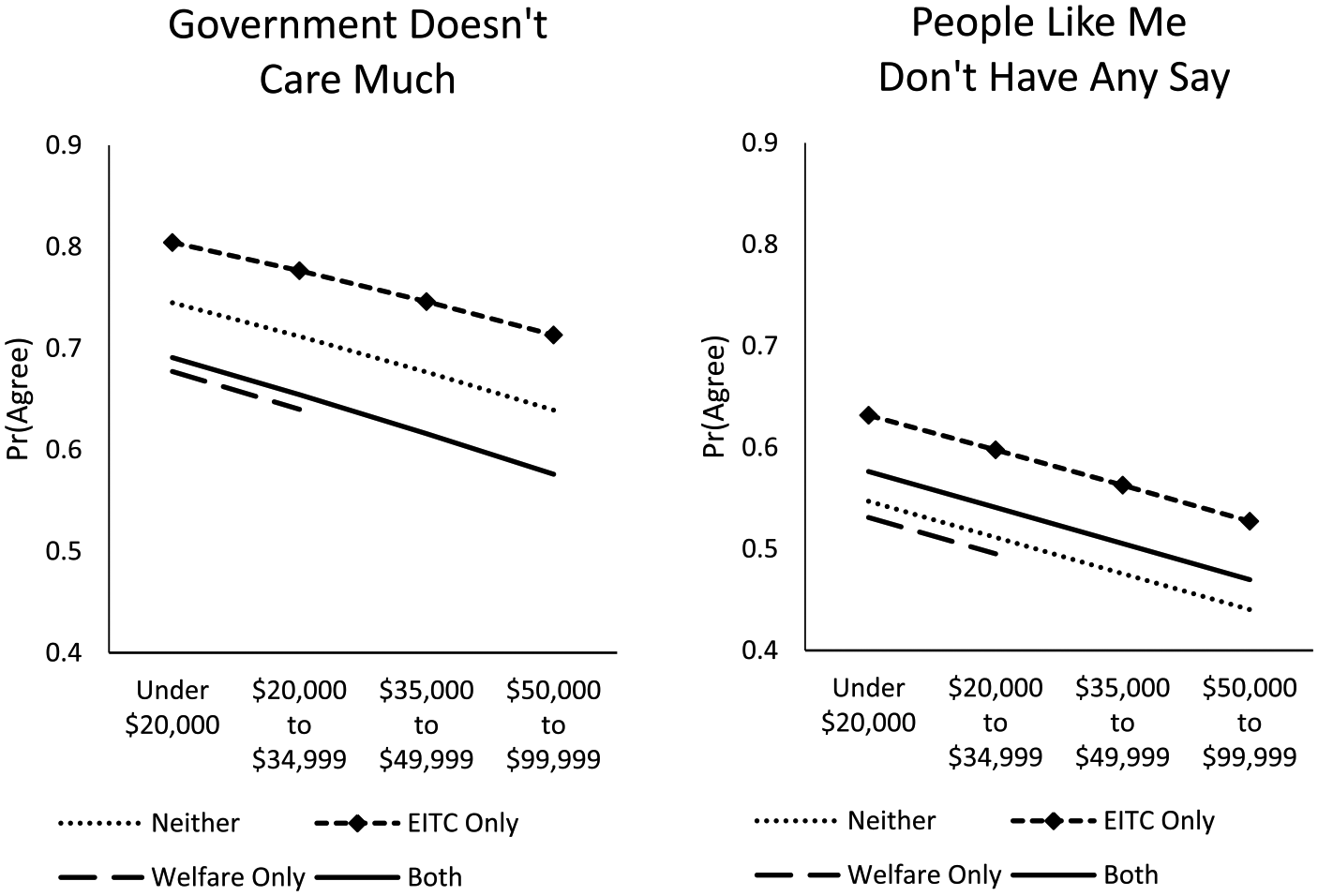
Predicted Probability of Agreement by EITC and AFDC/TANF Users That “Public Officials Don’t Care Much” and “People Like Me Don’t Have Any Say,” by Income Group
Beneficiaries’ responses to higher education policies also indicate that the visibility of social policies may make more of a difference for beneficiaries’ political attitudes than whether they are means-tested. Controlling for several other factors, those who have benefitted from the GI Bill were 23 percent more likely than nonbeneficiaries to agree that government provided them with opportunities to improve their standard of living, and Pell Grant recipients were about 10 percent more likely; both policies make government’s role fairly visible. By contrast, neither the use of student loans, means-tested Hope and Lifetime Learning tax credits (a precursor to the American Opportunity Tax Credit), nor 529 plans, all policies that obscure government’s role, was associated with a significant difference in such views, as seen in Figure 2.

Impact of Higher Education Policy Usage on View That Government Provided Opportunities to Improve Standard of Living
In sum, policies vary in terms of the awareness of government’s role they cultivate among beneficiaries, and the degree of visibility in policy design appears to make a difference. Policies that have most easily gained political support in recent decades have often been designed in ways that stymie the capacity for feedback effects. While they may go far to support economic, social, environmental, and other goals, they do little to generate a supportive constituency or support among the public for government generally.
Deterrents to Feedback Effects on Political Attitudes
While social policies with visible designs are more likely than others to be noticed by beneficiaries and understood by them to emanate from government, there is no guarantee that even these policies will generate positive attitudes about government or support for the policy. Other factors may intervene and overwhelm the impact of policy design.
I considered how individuals’ cumulative lifetime usage of different types of policies influenced their views about government, gauged by several different indicators. I divided policies between four types: (1) submerged-means-tested, (2) visible-means-tested, (3) submerged-non-means-tested, and (4) visible-non-means-tested. (By “submerged policies,” I mean those that are located in the tax code or channeled through nongovernmental organizations, making government’s role in providing them less than obvious.) I controlled for age, race, ethnicity, gender, education, income, partisanship, and views toward welfare. On only one attitude about government was the number of policies people had used associated with more positive views, and that was the view that government had helped in times of need: those who had used more visible-means-tested policies held more positive attitudes. On two measures of perceived government responsiveness, individuals who had used more submerge-means-tested policies actually registered significantly more negative views. It is unlikely that these views were actually caused by policy usage, but rather it seems that the working poor who qualify for such policies likely hold distinctly negative views about government and that the policies themselves are insufficient to mitigate those views (Mettler 2018, 96–106).
If accumulated experiences of social policies do not have much bearing on people’s views about government generally, what does? I found, repeatedly, one factor that was highly significant, and that was individuals’ attitudes about welfare. Those with unfavorable views of welfare, regardless of how many policies they themselves had used, were significantly more likely to hold unfavorable views of government generally, on all seven different measures I examined. I interpret this to mean that “welfare”—whatever that term may mean to people—functions for some as a microcosm of government, from which they derive broader lessons about how government functions. Exploring the determinants of such views of welfare, I found that both income and racial bias played a role, as groups throughout the entire middle-income spectrum, in households from $35,000 to $100,000, held significantly more unfavorable views, as did whites. The racial bias associated with welfare attitudes has long been observed by scholars (e.g., Gilens 1999). These results also indicate that middle-income people generally resent it, even controlling for race. Many people noted in interviews that they felt they were effectively penalized once they succeeded in earning higher incomes, because it meant that they no longer qualified for means-tested benefits; they regarded that as unfair and deduced from it that government was unresponsive to their struggles.
In short, positive messages about government that these individuals might have derived from social policy usage were in some instances blocked by other messages that have been dominant in political discourse and that they share with people with whom they identify. Recent research has shown that as a society we have become increasingly sorted by income, race, religiosity, and place; and people form their political affiliations particularly through the social bonds and psychological attachments they hold, rather than through a rational, abstract assessment of issue positions (Mason 2015; Achen and Bartels 2016; Cramer 2016). Views about welfare may also be formed through such processes, and then in turn shape broader views about government among some individuals—regardless of their personal experiences of social provision.
In a study of public opinion on the ACA, Larry Jacobs and I detected similar dynamics. We have been conducting a panel study of the ACA since 2010, using an identical questionnaire, with new waves during election season every two years. This permits us to track individuals’ views as implementation unfolds. We find that between 2010 and 2014, individuals adopted more positive views that the ACA provided access to health insurance for themselves and their families, controlling for partisanship, trust in government, and several socioeconomic factors. The shift in views was driven by public policy experiences, including usage (by oneself or one’s family) of subsidies to pay for health insurance or prescription drug coverage for seniors, shifting from being uninsured in 2010 to insured in 2014, and using government coverage as opposed to private coverage. One group acquired more negative evaluations over time: those who remained uninsured throughout the period. This suggests that people do notice and appreciate policies that benefit them, and they may also notice policies that fail to include them (Jacobs and Mettler 2018).
Yet when we considered how those evaluations, in turn, shaped overall assessments of the ACA, we found that the impact of policy experiences grew muted. Rather, partisanship and distrust in government yielded the greatest impact on changed attitudes between 2010 and 2014. The impact of individuals’ own personal experiences of policies became diffused by these factors. In short, social and political identities can be more consequential in shaping attitudes in the contemporary political environment than policies themselves, even though respondents clearly appreciate them.
In sum, although many assume that self-interest is a primary driver in politics and that people will be most attentive to policies that benefit them individually or their families in particular, these results suggest that that is not always the case. Citizens may appreciate specific policies and the difference they make in their own lives, but other factors—such as partisanship or views about welfare, for example—may play a more dominant role in shaping their political behavior, impeding the possibilities for a supportive constituency to take shape.
Despite assumptions that self-interest is a chief determinant of political behavior, many scholars have found that behavior can also be motivated by regard for others, or sociotropism. For example, as people’s evaluations of the economy pertain more to their perception of how the country as a whole is faring rather than how they themselves are getting by. Similarly, Jacobs and I find that Americans who over time became more convinced that the ACA was helping the country as a whole also became more supportive of the law, and less concerned about new taxes it would impose. Sociotropism is an underappreciated dimension of policy feedback, one that deserves greater attention (Jacobs and Mettler 2018).
A Participatory Tilt
Some policy feedback research has found that beneficiaries of specific policies participate more in politics, whether to help protect the policies that they themselves benefit from, as in the case of Social Security and Medicare, or because by receiving generous benefits, such as the GI Bill, they have experienced inclusion in the polity and therefore respond as more active citizens. Such analysis identifies differences in the participation rates of individuals who are similar in many characteristics that are associated with political involvement, but who differ in terms of policy usage. In the discussion that follows, I offer more general observations, not ones based on controlling for multiple characteristics, but rather based on associations between general patterns of political participation and types of policy usage.
Scholars of political participation have long established that, generally speaking, individuals with higher socioeconomic status tend to participate more in politics than others. Education serves as a particularly influential determinant, and several other factors can matter as well, including income, race and ethnicity, and gender (e.g., Verba, Schlozman, and Brady 1995). In the contemporary polity, mobilization by organizations or candidates tend to reinforce these patterns, as resources are used efficiently to target those most likely to participate (Schlozman, Verba, and Brady 2012).
These participatory patterns combine with the distribution of differently designed policies to generate a discernable tilt in political involvement: those who take part most frequently are less likely to be aware of how government has benefitted them, whereas those who participate less often are typically more aware of how it has done so. Although government bestows benefits on nearly all Americans, those who are more privileged are most likely to have used primarily non-means-tested policies with submerged designs, which leave them without much of a sense that they have benefitted. These individuals are more likely than others to vote in presidential elections, as seen in Figure 3, and they are highly likely to participate in most other political activities, as seen in Figure 4. By contrast, those who are most aware of how government has aided them are people who have typically used multiple, visible-means-tested benefits, but they are least likely to participate in any political activities with the exception of protest. As a result, public officials are chosen by an electorate tilted toward those less cognizant of government’s role as a provider, and once in office they hear more from such individuals than from citizens who are more aware and appreciative of that role. It is worth noting, however, that beneficiaries of some non-means-tested visible policies, such as Social Security and veterans’ benefits, do vote at high rates, and as a group they take part in other political activities at rates comparable to those who have used non-means-tested submerged policies (Mettler 2018, 122–30).

Percentage of Beneficiaries Who Are Registered to Vote and Report Voting Regularly
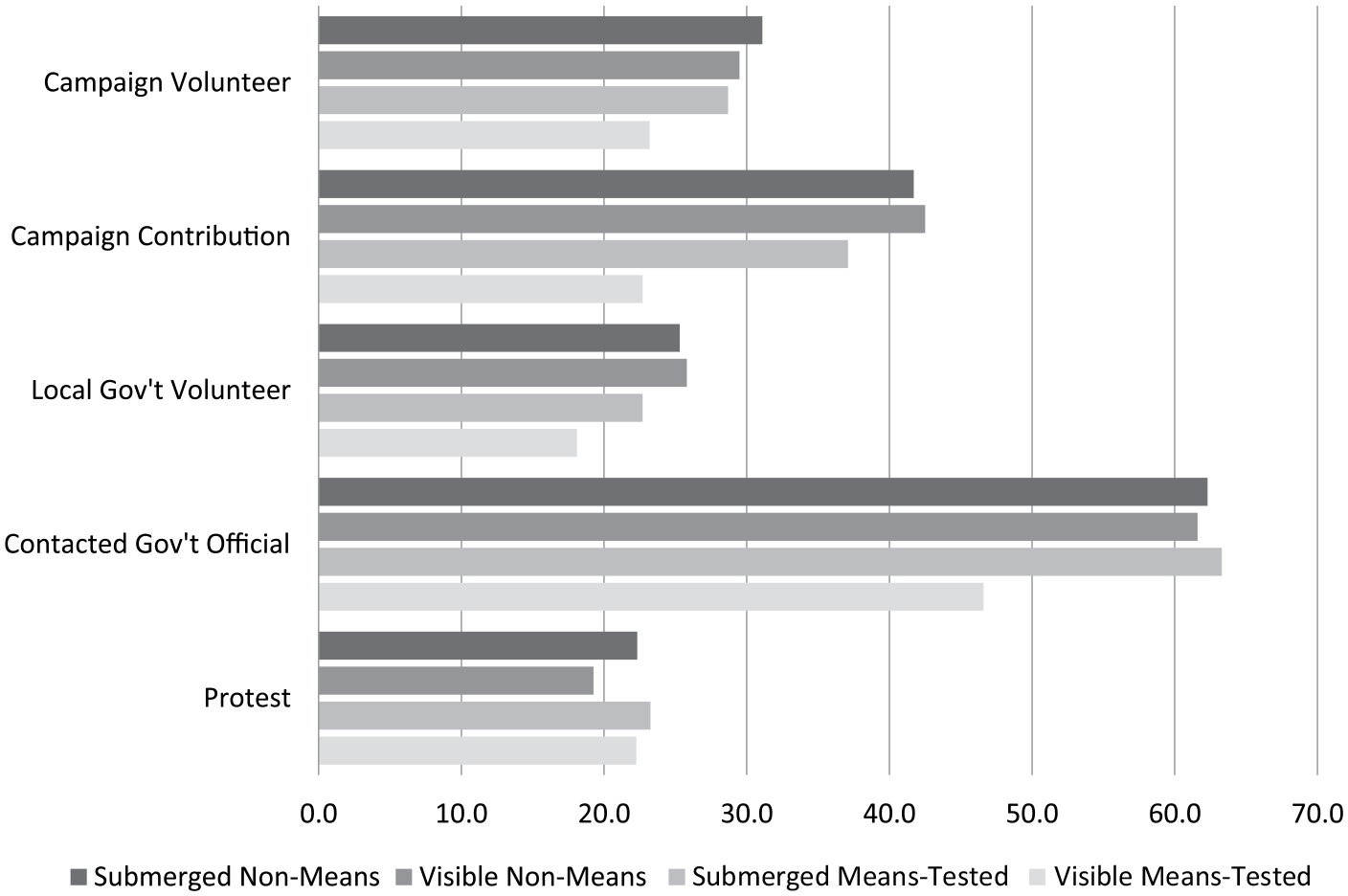
Average Rate of Political Participation among Beneficiaries of Social Policies, by Type of Policy
The participatory tilt is most striking when we consider it in light of beneficiaries’ support for more general social provision. I have explored how lifetime usage of different types of policies relates to support for social provision, controlling for several other factors. In one analysis, I considered determinants of the view that “too little” (as opposed to “too much” or “the right amount”) is spent on social policies, measured as an index of eight items including “housing for the poor,” “Social Security,” “welfare,” “aid for poor people,” “aid for college students,” “health care,” “assistance for child care,” and “aid for the unemployed.” Those who have used more visible means-tested policies are 20 percent more likely to support higher social spending, and those who have used more non-means-tested policies are 30 percent more likely to offer such support; use of submerged policies of either type, by contrast, are not associated with such attitudinal effects. Similarly, I analyzed the determinants of support for the U.S. government guaranteeing health insurance for all citizens, even if it means paying higher taxes. In this case, those who had used more visible means-tested policies were 34 percent more likely to favor such coverage. Considering these results in light of the participatory patterns, this suggests that many of the individuals who are most supportive of more generous social provision—those who themselves have used more visible means-tested policies—are the least likely to take part in elections or to be responded to by policy-makers, because they are less likely to participate (Mettler 2018, 119–22).
Returning to the analysis of the EITC, I considered how its use relates to political involvement. Those who have used the EITC, controlling for several other factors, are significantly more likely to be registered to vote and to vote in nonpresidential elections than others with comparable circumstances. Considering this in light of the earlier findings, this means that such individuals take part in elections while possessing little awareness that government has aided them or been responsive to them. EITC claimants, therefore, like other beneficiaries of tax expenditures, are likely to exercise their political voices but are unlikely to offer policy-makers a message of support for generous social provision (Mettler 2018, 131–33).
In sum, those whose voices are heard most loudly by policy-makers use plenty of social policies themselves, but they are typically policies that obscure government’s role, whereas those who use more visible policies, particularly means-tested ones, are more aware of government’s role, but they are less likely to be active in politics. This participatory tilt means that policy-makers receive less support for strengthening and expanding social provisions than they would if citizens spoke in politics with equal voices.
These circumstances are not inevitable, however. The ACA, though it has endured scores of death threats by Congress, the courts, and the Trump administration, has managed not only to survive but moreover it appears to be gaining a supportive constituency. In the latest wave of our panel study, conducted in fall 2018, Jacobs, Ling Zhu, and I find that support for the law has grown to its highest point, up 6 percentage points since 2016. Among those who still oppose it, support for repeal has declined by 9 percentage points since 2016; most now favor giving the law time to work and making changes to improve it. The law’s supporters, moreover, were more politically engaged in the midterms, exhibiting higher interest in the election (86 percent of supporters voiced “a great deal” or “fair amount” of interest compared to 79 percent of opponents). The supporters were also much more likely to take health care into account in their votes, with 60 percent indicating that it would affect their choice of candidates, compared to only 40 percent among opponents. The ACA, still under serious threat, does appear to be generating feedback effects. Going forward, policy-makers may find that efforts to repeal or decimate it may be increasingly risky for their reelection efforts (Jacobs, Mettler, and Zhu, forthcoming).
Strategies and Solutions
Although social policies do seem to generate policy feedback effects in some instances, perhaps what is more striking in contemporary politics is how infrequently such dynamics are evident. Americans rely on social policies as of this writing more than ever, and policy usage transcends social, economic, and political divisions; and yet the impact of such experiences is often barely perceptible in politics. Rather, the voices of opponents to social provision have been more pronounced.
This suggests that while policy design does have the potential to influence policy feedback effects, such outcomes do not occur automatically or mechanistically. Put differently, lawmakers cannot simply create a new policy and then assume it will generate a greater sense of satisfaction with government among citizens, more supportive constituencies, and more active and engaged citizens generally. Rather, additional steps may be necessary to draw out the potential of policies to foster greater civic involvement. I offer several suggestions here, moving from those that are less likely to be feasible in the near term to those that could be adopted more easily.
A. Enhance policy visibility through design, delivery, and information
New policies might benefit, also, from receiving a
In the interim, policy-makers might consider how government’s role in providing benefits in existing policies could be spotlighted more effectively through
Policy beneficiaries could be provided with
The relative invisibility of many upwardly redistributive policies in the tax code means that policy-makers need to decide with each
B. Reconnecting citizens and government
While the approaches outlined above might make government’s role in some policies more visible, many Americans are already aware that they use government benefits and they appreciate them, but nonetheless they refrain from participating in politics. And others may be unimpressed by efforts to highlight information. It may be at least equally important to find ways to “connect the dots” between citizens’ use of social benefits, government’s role, and the need to be involved in politics, at least to vote.
Over the past 40 years, even as Americans have relied more on social policies, conservatives have learned effective ways of engaging citizens for purposes that aim to undermine those same policies. Their success in that respect, paired with the results of the research I have summarized here, can be understood through the lens of a classic study about American public opinion conducted a half century ago. In that study, Lloyd A. Free and Hadley Cantril discovered that most Americans espoused conservative values, supporting a “curbing of [f]ederal power,” in some respects, but at the same time on practical matters they demonstrated growing liberalism. When Americans were asked abstract questions about government interference, lower taxes, and the sources of poverty, they answered in an ideologically conservative manner, yet when the same individuals were asked about their level of support for specific social policies of the federal government, they responded as operational liberals (Free and Cantril 1967).
The existence of the “government-citizen disconnect” suggests that conservatives have effectively drawn citizens’ attention to concerns about abstract issues such as the size of government, the threat of taxes, and the deservingness of recipients of “welfare.” Progressives, by contrast, have not managed to direct Americans attention—in a sustained manner—to the value of government benefits and the difference they make in individuals’ lives.
These findings suggest that proponents of social policies need to find ways to direct attention to how such policies help Americans in their everyday lives. Certainly, this has implications for the messages that party leaders and candidates offer. The impact of such messages should not be exaggerated, however, given our highly partisan environment, the likelihood of some citizens to discount messages associated with the opposing party, and the inclination of others to ignore politics altogether.
Conclusion
Over the past 40 years, a conservative public philosophy has promoted the idea that the market solves problems and government creates them. Yet, over the same period, the market has offered less than impressive results for many low- and middle-income Americans, who have seen their earnings grow little or stagnate, while job insecurity has increased and employment benefits have become less common. Meanwhile, policy-makers have managed to protect most government social policies and even to expand coverage in some of them. Americans have relied on these policies to help them to weather stagnating incomes and job insecurity, and although policy benefits are often meager, particularly in programs left to individual states to manage, beneficiaries report to pollsters that they find them to be very helpful (Mettler 2018, 84–86). It is an irony, therefore, that many people who benefit from generous policies do not think about them as government benefits, and many others do value their benefits but refrain from taking part in politics. Unlike businesses, however, government does not market or promote its services or remind those who have used them of the value they have derived from them. Neither are most Americans mobilized in ways that would provide them with such reminders. While such circumstances persist, the government-citizen disconnect may only intensify.
Footnotes
Notes
Suzanne Mettler is John L. Senior Professor of American Institutions in the Government Department at Cornell University. She is the author of five books, including, most recently, The Government-Citizen Disconnect (Russell Sage Foundation 2018).