



Abstract
Total birth rates have fallen dramatically in many European countries during the last 40 years. Job and income instability caused by labor market polarization are significant drivers of declining birth rates because employment certainty and stability are crucial to childbirth planning among young adults. This article investigates the impact of job instability on the fertility intentions of young adults in Europe, focusing on employment protection legislation (EPL) in European countries. I use data from twenty-seven countries that participated in the European Social Survey in 2004 and 2010 to show that job instability measured as temporary employment, informal work, and unemployment decreases fertility intentions among European youth regardless of the EPL in the country. Unemployed young adults tend to plan less for having their first child in the countries with high EPL. Contrary to the hypotheses, multilevel modeling showed that young people in temporary or informal employment in countries with low EPL show decreases in their fertility intentions.
Keywords
Only a few European countries have experienced fertility growth in the last 20 years, while others have been facing considerable decline in birth rates, with fertility falling far below the replacement level (Feyrer, Sacerdote, and Stern 2008; Balbo, Billari, and Mills 2013; Rindfuss and Choe 2015). Between 1970 and the 1990s, fertility decline was attributed to increased female participation in higher education and the labor force (Becker 1981; Bloom and Trussell 1984; Kiernan 1989; Jacobson and Heaton 1991). In the 2000s, however, we learned that the higher the female employment rate in a country, the higher the fertility rate (Ahn and Mira 2002; Adsera 2005). Further investigations have shown that women’s employment status (if they are permanently or temporary employed, unemployed, self-employed, or nonactive) plays an even greater role in fertility decisions than the employment rate in general (Adsera 2005; Adsera and Menendez 2011; Del Bono, Weber, and Winter-Ebmer 2011).
This study investigates the impact of job instability on fertility intentions for young adults across European countries. Fertility intentions or desired number of children or plans to have a child are widely taken as indicators measuring fertility behavior of a population (Modena and Sabatini 2012; Dommermuth, Klobas, and Lappegård 2015; Karabchuk 2017). Job instability includes temporary employment, informal employment, and unemployment. Recent studies have revealed that most nonpermanent types of work are insecure; have no social benefits; and are associated with lack of career opportunities, long-term unemployment, entrapment in temporary jobs, and wage losses (Sverke and Hellgren 2002; Kalleberg 2011; Yu 2012). Due to unstable income and uncertainty in the future, job instability leads young adults to postpone marriage and childbearing (Adsera 2005; Kreyenfeld 2010; Kalleberg 2011).
A few single-country case studies have highlighted the negative impact of job instability on fertility and plans for childbearing (Adsera and Menendez 2011; Del Bono, Weber, and Winter-Ebmer 2011; Modena and Sabatini 2012; Auer and Danzer 2016), but there is a lack of research on job instability and fertility that takes a cross-national perspective. Further, there is a paucity of research that focuses on labor market regulations as a main predictor of job instability. Therefore, the goal of this article is to explore the effects of job instability on fertility intentions among European young adults and the extent to which cross-national differences in employment protection legislation (EPL) 1 explain these effects. I use data from the 2004 and 2010 European Social Survey (ESS) in the analyses.
The article is organized as follows: in the next section, I discuss demographics and the literature on job instability and EPL. I then move on to theoretical frameworks and hypotheses and a description of data and research methodology. Finally, I provide the analysis and discuss the empirical results and conclusions.
Fertility Decline and Job Instability
Against the background of declining world birth rates, several patterns of fertility dynamics in Europe took shape in the 2000s (see Table A1 in the appendix). Some countries had been experiencing constant growth in fertility rates; and by 2010, fertility in France, Iceland, Ireland, Sweden, and the UK reached about two children per female. Most European countries witnessed moderate increases, but the rates were still below replacement level in Russia, Slovenia, the Netherlands, and Estonia, among other countries. A third group of countries had negative or frozen dynamics, with very low fertility rates—Germany, Slovakia, Latvia, and Italy, to name a few (Table A1).
In the 1970s and 1980s, the greater opportunities for women in the workforce and in higher education and the better prospects for a good career led to lower fertility and lower probability of parenthood (Bloom and Trussell 1984; Kiernan 1989; Jacobson and Heaton 1991; DiCioccio and Wunnava 2008). The rewards from the labor market became higher than rewards of childbearing, and this made many females change the ideal family pattern from having two to three kids to having one or even none (Hochschild 1996; Kiecolt 2003; Hakim 2003; Liefbroer 2005).
Starting from the 1990s, the correlation between female labor market activity and fertility on the macro level proved to be positive (Ahn and Mira 2002; Adsera 2005), especially for Northern European countries, which were implementing various fertility programs to assist working mothers (e.g., daycare, paid maternity leave, and so on) (Del Boca 2002; Del Boca and Sauer 2009; Duvander, Lappegård, and Andersson 2010). Job instability captured by such indicators as unemployment, job displacement, job loss, fixed-term contracts, temporary contracts, casual work, informal employment, and part-time work proved to have a negative effect on fertility behavior (Adsera 2005, 2011; Adsera and Menendez 2011; Del Bono, Weber, and Winter-Ebmer 2011, 2012; DiCioccio and Wunnava, 2008).
Among Austrian women, unemployment after job displacement in white-collar jobs decreased fertility for the following three years by 17.4 percent (Del Bono, Weber, and Winter-Ebmer 2011). Moreover, women who became unemployed after their first childbirth were discouraged to have a second and third baby after reentering the labor market (Hoem and Hoem 1989; Kravdal 2002; Meron and Widmer 2002). German longitudinal data demonstrated that women tend to postpone first birth due to fixed-term employment at labor market entry and reduce the number of children in the first 10 years after graduation (Auer and Danzer 2016). Job loss for highly educated women leads to four less children born in Finland (Huttunen and Kellokumpu 2012); and on the opposite end, stable and well-paid jobs lead women to have one more child in Russia (Sinyavskaya and Billingsley 2013; Karabchuk 2017).
Taking into consideration this negative effect of job instability on fertility, it is important to emphasize that the share of permanent secure jobs is constantly declining across the world (Farber 1999; Valletta 1999; Kalleberg 2000, 2011; Boyce et al. 2007; Giesecke 2009; Barbieri and Cutuli 2016). In general, the level of temporary employment in 2010 varied from 5 percent in the UK to about 20 percent in Portugal, 21 percent in Spain, and 27 percent in Poland. These unstable jobs are mostly prevalent among the younger generations (up to 35 years) (OECD 2013, 2016). In some European countries, up to 60 to 70 percent of youth aged 15 to 24 are working on temporary contracts (appendix Table A1).
Labor Legislation and Its Effect on Job Stability
What defines the spread of job instability across a country? According to the segmentation theory, the labor market is divided into two parts—the core and the periphery (Doeringer and Piore 1971; Sorensen 1983). The core employees are well protected by employment legislation, and they usually have better positions, better bargaining power, and better pay. Those on the periphery usually suffer from uncertainty and instability. They have no social benefits, have no social guarantees or career opportunities, are paid less and less trained, and often experience poor working conditions.
In some European countries, the gap between the core and the periphery is huge and mobility is restricted. Usually such countries have very strict EPL or a closed labor market, which facilitates this division in the labor market. EPL is a set of norms and procedures that regulate hiring and firing processes in the labor market. Usually labor market rigidity is measured separately for permanent and temporary workers; that is why the OECD publishes EPL on dismissals and EPL on temporary contracts (OECD 2013). The EPL index on dismissals measures the strictness of the labor laws on firing permanent employees in a country. The EPL index on temporary contracts assesses the opportunities for employers to hire workers on a temporary basis. It does not reflect the protection of the temporary workers; it speaks more about the rigidity of the legislation on how free an employer is to use temporary contracts. Countries such as Portugal, Poland, Spain, Greece, Czech Republic, France, and Germany could be named as countries with strict (high) EPL. Countries such as the UK, Ireland, Switzerland, and Belgium could be considered countries with liberal (low) EPL.
Strict EPL leads to the expansion of temporary employment (Kahn 2007; Cazes and Tonin 2010; Wulfgramm and Fervers 2015; Hipp, Bernhardt, and Allmendinger 2015). That hampers family planning in the long run (Wulfgramm and Fervers 2015; Birch Petersen et al. 2015; Alesina et al. 2015), as temporary workers are less likely to create families and produce children (Piotrowski, Kalleberg, and Rindfuss 2015; Chan and Tweedie 2015; Auer and Danzer 2016).
In countries with liberal labor legislation or a more open labor market, the difference between the stable permanent jobs and precarious temporary jobs is not as distinct, as all employees could easily be fired by their employers. In such countries, there is less of a need for temporary contracts or informal employment, because of this flexibility in recruitment and dismissals (Wulfgramm and Fervers 2015). Therefore, weak EPL is usually associated with no barriers to entering the labor market and low rates of unemployment (Hipp, Bernhardt, and Allmendinger 2015). The share of temporary or informal jobs is lower, and this contributes positively to childbearing and family planning.
Based on this theoretical discussion, we can assume a significant difference for those in a rigid or a liberal labor market who are in temporary labor positions. That most young adults under 35 have temporary, insecure jobs and are at higher risk of unemployment (O’Reilly et al. 2015) supports the notion of a correlation between job instability and fertility intentions.
The first hypothesis I test states, In European countries, young men and women who are unemployed or in temporary or informal jobs will be less likely to plan to have children within the next three years than those in permanent positions (H1), especially if we speak about the first child (H1a) and young men, who are still the main breadwinners in the families (H1b). Young adults who are employed on a temporary basis or unemployed are less likely to create families due to perceived income uncertainty in the future. They will keep searching for better career opportunities and good permanent jobs and, thus, postpone child planning.
The second hypothesis relates to the variation in EPL indices across countries and fertility intentions. In rigid labor markets, the probability of planning childbirth in the next three years is smaller than in liberal labor markets (H2). I assume that at the country level the EPL will have a negative impact on childbirth intentions for adults younger than 35 years old, as the growing job instability generated by the rigid EPL will decrease fertility rates.
Finally, I test the cross-country differences in fertility intentions depending on employment status and rigid versus liberal EPL. Labor market legislation is seen as the explanatory mediating variable between job instability and childbirth planning in cross-country perspective. In countries with rigid employment legislation (where EPL reaches maximum scores), temporary and informal employment will be associated with lower fertility intentions (H3a). In countries with liberal labor legislation (where EPL indices are close to the minimum), temporary and informal employment will not influence young adults’ fertility intentions (H3b). In this case, the correlation between employment status and fertility intentions should not be significant.
Data and Methodology
This study uses data from the ESS, 2 2004 and 2010 waves. 3 The two waves were merged to have more countries on the second level of the analysis and have bigger samples on the individual levels 4 for some countries. The ESS is the only available cross-country nationally representative dataset containing information on the contract type (work) and fertility intentions. The question about planning to have children and questions on the importance of job security and the possibility of combining work and family are asked only in these two waves. 5 This dataset allows me to identify those in permanent employment (unlimited duration contracts); temporary workers (fixed-term contracts); and informal employees (no written contracts); as well as those in self-employment, unemployment, and nonactivity. The sample was restricted to individuals aged 18 to 34 years old and comprised 20,950 people.
The dependent variable (dummy for fertility intentions) reflects a person’s plans for having a child in the next three years. The main tested independent variable on the individual level has six possible outcomes: (1) permanently employed, (2) temporary workers, (3) informally employed, (4) self-employed, (5) unemployed, and (6) nonactive. Each respondent can belong to only one category at a time, and these categories do not overlap. We follow the International Labour Organization’s definitions to identify each outcome of the employment status in the dataset. 6
The following individual-level characteristics were used as control predictors of fertility intentions: gender (for total youth population), education, having a spouse, subjective health, self-reported degree of religiosity, type of settlement, importance of job security, and importance of combining job and family. Previous research has demonstrated that the degree of religiosity, marital status, and a person’s good health are key predictors of planning to have children. Such job values as importance of job security and possibility of combining work and family are important determinants for expanding families, too. Due to the large number of missing answers to the question on income and the strong correlation between income and type of work contract, income is not included as a control variable in the final model. 7
To test the assumptions stated above regarding the country differences, I added the EPL indices, produced by the OECD for 2004 and 2010, as country-level predictors for each year. This step reduced the number of countries to twenty-seven, as the EPL scores are not available for Bulgaria, Cyprus, Croatia, Lithuania, and Ukraine for 2004 and 2010. The countries are ranked by EPL scale, from 0 (totally open labor markets with liberal legislation) to 6 (totally closed labor markets with rigid legislation) (OECD 2013). The higher the rank, the stricter the EPL is in the country.
More specifically I inserted two EPL subindices: EPL on dismissals (EPL_dismissals) and EPL on temporary contracts (EPL_temps) (see country rates in appendix Table A2). The first one, EPL_dismissals, concerns the regulations for individual dismissals and reflects how easily a person can be fired in a country (OECD 2013). It incorporates eight data items. 8 The second, EPL_temps, measures the strictness of regulation on the use of fixed-term and temporary work agency contracts. It incorporates six data items. 9 Both indicators are used simultaneously as they reflect two different aspects of protection and strictness in an EPL.
Additionally, at the country level, Human Development Index (HDI) and number of weeks of paid maternity leave were added to the model to control for the country-level developments and family policies that can explain cross-country variation in fertility rates. The changes in time were controlled by EPL, HDI, and number of weeks of paid maternity leave.
Multilevel modeling with random effects for twenty-seven countries is applied as the main instrument. The number of countries is sufficient for multilevel modeling as there are only four second-level predictors in our models.10 The descriptive statistics for the variables are provided in Table A2.
It is important to underline that I estimate the fertility intention models separately for those who have no children (13,570 respondents) and for those who already have at least one child (6,035 respondents). According to the demographic and sociological literature, the patterns of behavior for having the first or the second child vary considerably (Vignoli, Drefahl, and De Santis 2012; Sinyavskaya and Billingsley 2013; Karabchuk 2017; Selezneva and Karabchuk 2017). The factors for having the first child might not be significant for having the second or third child.
On one hand, having a first child is the norm for creating a family; thus, a majority of women give birth to a first child irrespective of job characteristics and working conditions (Meron and Widmer 2002; Sinyavskaya and Billingsley 2013; Karabchuk 2017; Selezneva and Karabchuk 2017). On the other hand, the chances that a woman will have more than one child significantly increase with the availability of working from home and flexible working hours (Adsera 2005; Sinyavskaya and Billingsley 2013). The likelihood of bearing a second child also increases with stable employment (Adsera 2011; Vignoli, Drefahl, and De Santis 2012; Sinyavskaya and Billingsley 2013) as well as the availability of maternity leave since it guarantees the stability of the work position for a woman after the childbearing period (Sinyavskaya and Billingsley 2013).
First, I select those who have no children and run the basic models for the three subsamples: (1) for total population of young adults of age 18 to 34, (2) for men, and (3) for women (specifications 1.1, 2.1, 3.1 in appendix Table A3). Then, I introduce interaction terms between employment dummies and EPL_dismissals and EPL_temps into the models (specifications 1.2, 2.2, 3.2 in Table A3). Permanent employment status is a reference category for comparisons in all models.
Finally, to interpret the significance of the main effects of temporary employment, informal work, and unemployment on planning to have a first child, I calculate the conditional effects for the interactions. One can interpret the main effects from the interacted variable only when the other interacted variable equals zero (Jaccard 2001). Thus, to test the effects from job instability in countries with strict EPL (maximum scores) and in countries with low EPL (minimum scores), we need to set them to zero turn by turn. 11 The minimum EPL_dismissals and EPL_temps can be observed in the UK with values of 1.198 and 0.375 for 2004 and 2010, respectively. The observed maximum for EPL_dismissals both in 2004 and in 2010 was in Portugal (4.417 and 4.13,1 respectively). The maximum EPL_temps was in Turkey (4.875) in 2004 and in France (3.625) in 2010. The same sequence of operations is repeated for the sample of young adults who already have at least one child to test if employment status under different EPL country scores affects their decisions to have a next child.
Results and Discussion
The analysis showed that in 2010, from 21.5 percent (Ireland) to 58.5 percent (Israel) of young adults declared that they were planning to have a child within the next three years. This share of youth was higher than 40 percent in only seven out of the twenty-seven countries (Table 1). The increase was noticeable only in Slovakia, Germany, the UK, the Czech Republic, Belgium, Slovenia, Hungary, and the Netherlands.
Share of Temporary, Informal Workers, Unemployed and Share of Those Planning to Have a Child in the Next Three Years among Young Adults, ESS Data, 2004 and 2010

SOURCE: Author calculations based on ESS data from 2004 and 2010.
NOTE: Spaces with dashes means the country was not covered in the ESS wave, or there were no data collected on this question.
In the other countries, there was a decrease in the percentage of youth expressing the intention to have a child in the next three years. The decrease could be explained by the rise of job instability, as temporary, informal employment, and unemployment rates have increased among youth. Table 1 shows that in nineteen out of twenty-seven countries, more than 15 percent of the young adult population was in temporary or informal employment or unemployment. In some countries, the share of young adults experiencing job instability reached more than 50 percent (when summing temporary, informal employment, and unemployment).
The multilevel modeling results speak to the negative effects of temporary employment, informal work, and unemployment on fertility intentions both for young men and women living in Europe (Table 2). All the coefficients are significant and strong. The status of nonactivity has the same or even a stronger negative impact on planning to have children. At the same time, there is no negative influence of job instability for those young Europeans who already have at least one child and plan to have one more. This outcome is in line with the studies on the probability of having a second or third child in Norway and Russia (Kravdal 1992; Karabchuk 2017).
Regression Coefficients from Multilevel Modeling without EPL Interaction on Planning to Have Children within the Next Three Years for Young Adults Aged 18 to 34

SOURCE: Own calculations using merged 2004 and 2010 ESS data
NOTE: See complete tables with all control variables in Appendix Tables A3 and A4.
p < 0.05. **p < 0.01. ***p < 0.001.
The results allow us to confirm H1 about the negative impact of job instability on fertility intentions for young adults in Europe. The conclusion is in line with previous country studies in Germany, Austria, Italy, Spain, and Russia (De la Rica and Iza 2005; Adsera and Menendez 2011; Del Bono, Weber, and Winter-Ebmer 2011; Modena and Sabatini 2012; Auer and Danzer 2016; Selezneva and Karabchuk 2017).
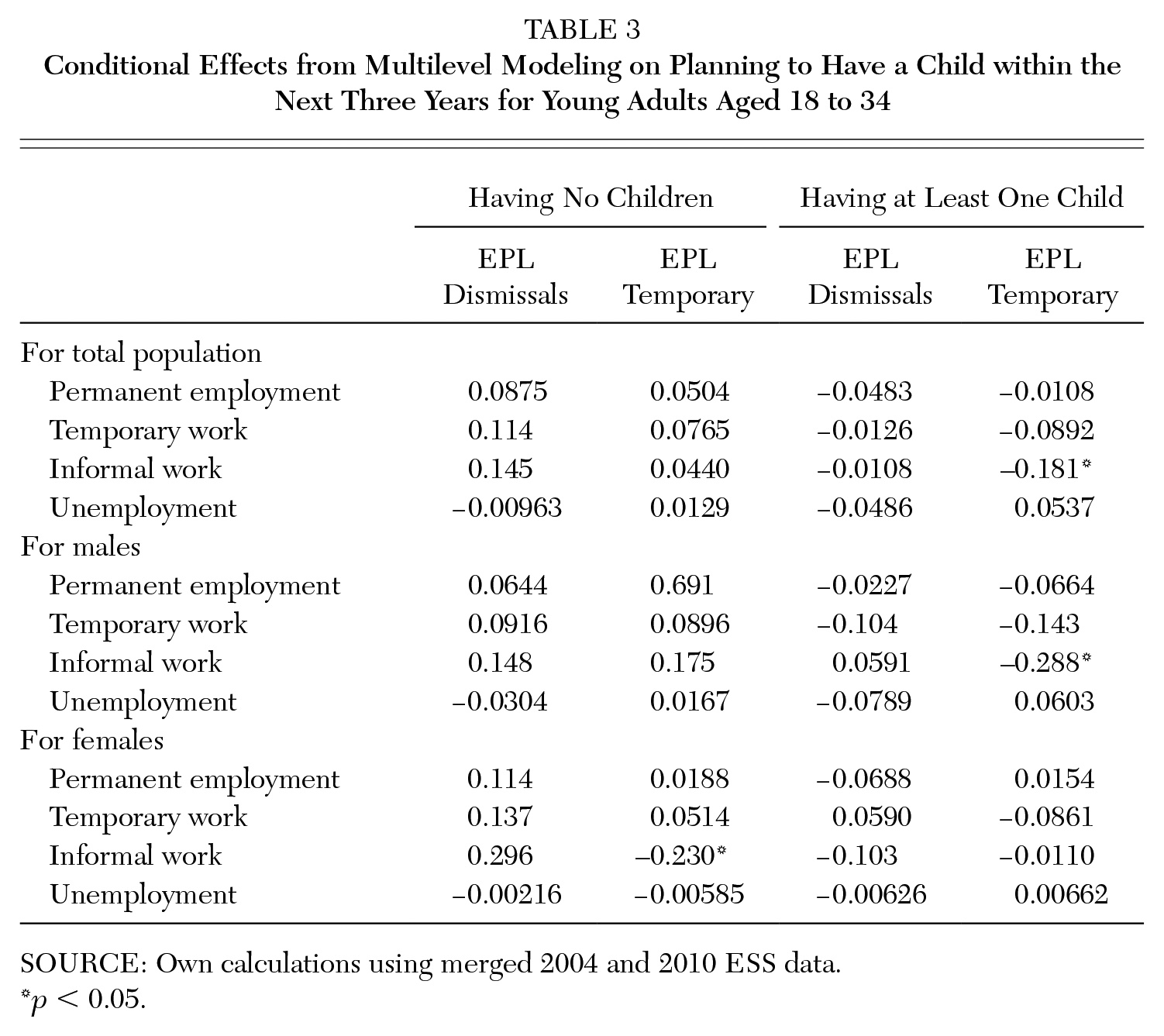
There is almost no significant correlation between EPL and plans to have children (Table 3). EPL has a slightly negative impact on informally employed women’s plans for the first child and on informally employed men for the next child. Other than that, there is no significant relationship between EPL on the country level and individual childbirth planning among young Europeans. This outcome allows us to reject H2 regarding EPL’s macro-level impact on individual youth’s fertility intentions in European countries. It would be fair to say that the estimated models fail to show any significant effect of the proxy for family policies as well, which was measured by the number of weeks for paid maternity leave on the country level. The only country-level characteristic that demonstrates a significant correlation with plans to have children is the HDI.
Conditional Effects from Multilevel Modeling on Planning to Have a Child within the Next Three Years for Young Adults Aged 18 to 34
SOURCE: Own calculations using merged 2004 and 2010 ESS data.
p < 0.05.
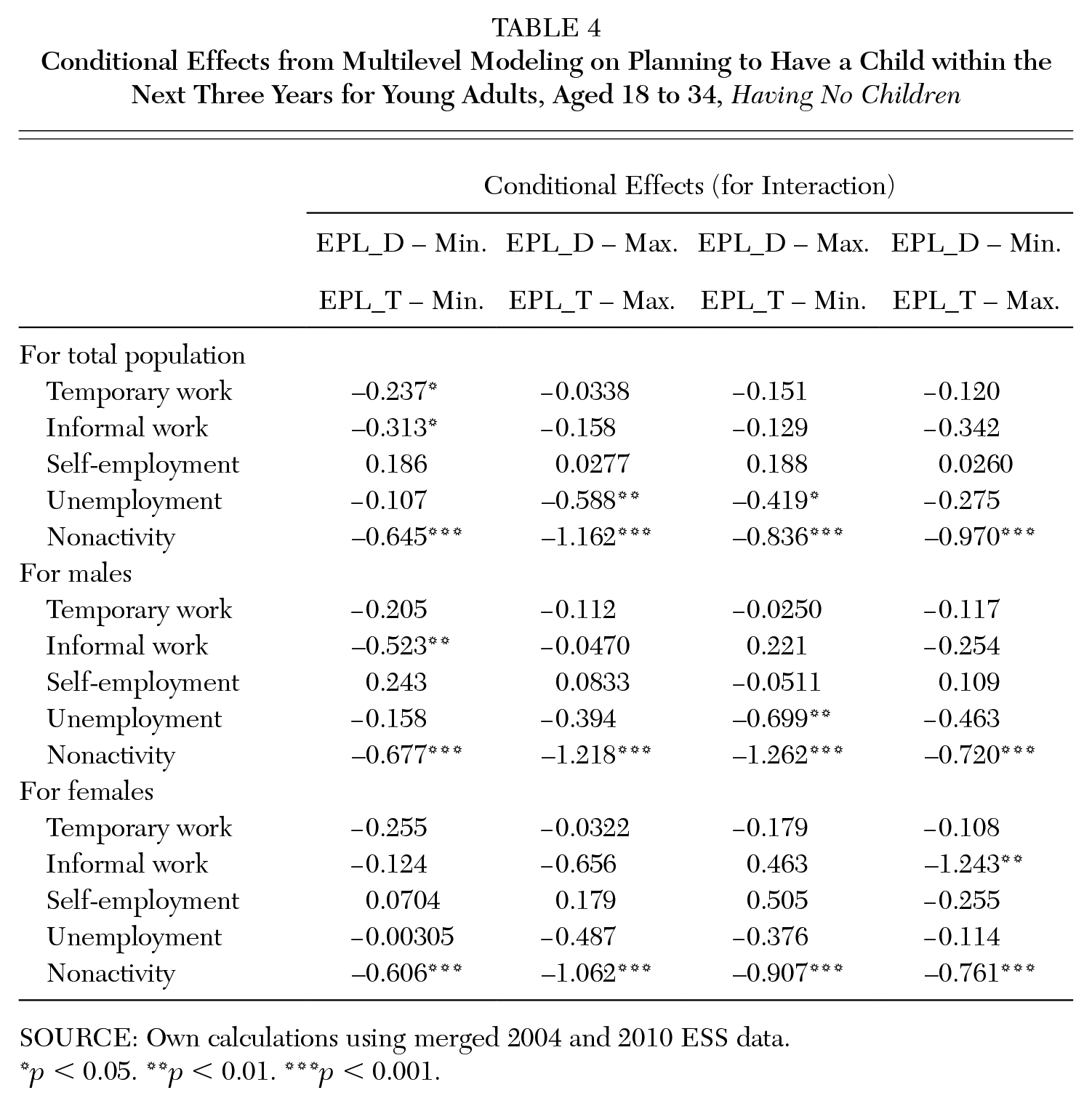
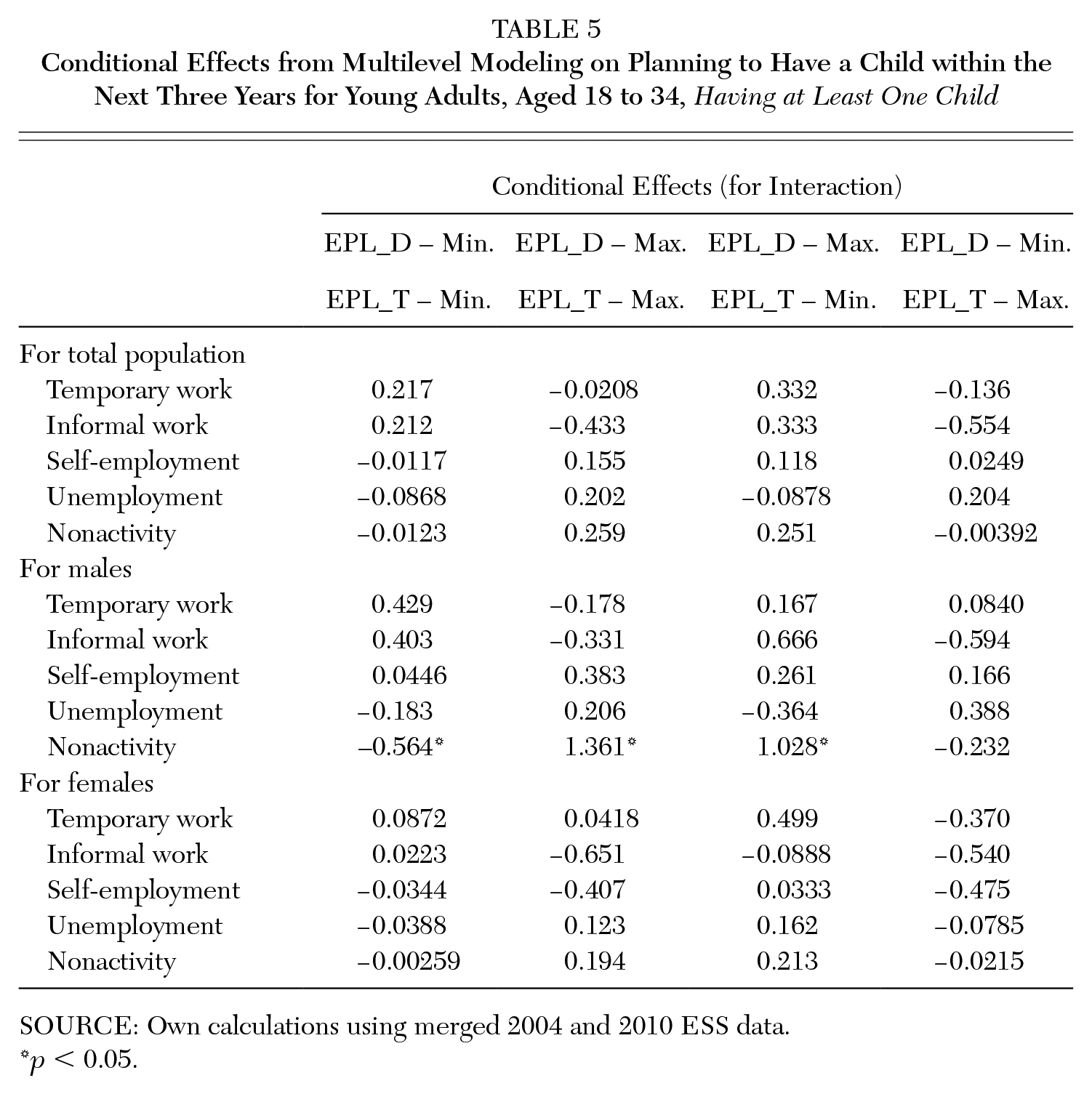
Tables 4 and 5 relate to H3a and H3b on the mediation effect of EPL between employment status and fertility intentions among young adults in European countries. The results are unexpected and contradict our theoretical assumptions.
Conditional Effects from Multilevel Modeling on Planning to Have a Child within the Next Three Years for Young Adults, Aged 18 to 34, Having No Children
SOURCE: Own calculations using merged 2004 and 2010 ESS data.
p < 0.05. **p < 0.01. ***p < 0.001.
Conditional Effects from Multilevel Modeling on Planning to Have a Child within the Next Three Years for Young Adults, Aged 18 to 34, Having at Least One Child
SOURCE: Own calculations using merged 2004 and 2010 ESS data.
p < 0.05.
First, the estimated conditional effects on planning to have the first child do not demonstrate significant negative effects of temporary and informal employment in the countries with rigid EPL (Table 4). The results are the same for both males and females. However, the signs for the coefficients are negative; they all are insignificant.
Unemployment in the countries with strict EPL has a significant strong negative impact on child planning. This means that young adults without jobs in countries with strict EPLs related to dismissals will be less likely to plan their first children in the next three years. These results coincide with the previous findings on the moderating role of EPL in the negative effects of unemployment and insecure jobs on well-being and health for European countries (Voßemer et al. 2017). Indeed, strong restrictions on firing core workers might make it difficult for young adults to obtain jobs. These barriers might prevent the younger generation from fertility planning. At the same time, the effects of unemployment are unseen for women if we estimate them separately for females.
The most interesting finding relates to the countries with minimum EPL restrictions on using temporary work and with minimum EPL on dismissals (most liberal EPL). Contrary to my assumptions, the results demonstrate that young people employed on temporary contracts or with no contract at all are less likely to plan for the first child. This is especially true for informally employed men. For women, informal employment has a negative impact on first child planning only in countries where usage of temporary contracts is highly restricted but EPL on dismissals is low. These results oppose H3a and H3b. The analysis did not confirm that under strict EPL, young people with insecure jobs have significantly fewer chances to plan their first child than in countries with flexible labor market legislation. On the contrary, in countries with minimum EPL, job instability has a strong negative impact on first childbirth planning.
Second, the estimation of the conditional effects for the interactions between EPL indices and employment type in the multilevel modeling of fertility intentions show no significant effects of job instability for those who already have at least one child (Table 5). This means that job instability does not have any impact on planning a next child among young adults in respect to the country’s EPL. Likely, factors other than employment status affect decisions to have a second child.
At first sight, it might seem that the results are not in line with previous studies that show negative unemployment effects among white-collar female employees in Austria for further childbirth (Del Bono, Weber, and Winter-Ebmer 2011), or fixed-term contract effects on native German women who tend to postpone first childbirth and reduce the number of children they birth (Auer and Danzer 2016), or marriage delays and childbirth postponement for men employed in nonregular jobs in Japan (Piotrowski, Kalleberg, and Rindfuss 2015), or the role of precarious work in reproductive insecurity in Australia (Chan and Tweedie 2015). But it would be incorrect to directly compare the results of the moderating effects of EPL on job instability and fertility intentions from this study with the previous country-case studies of nonregular jobs with marriages and childbirth. Moreover, in general, the negative impact of job instability (temporary and informal employment and unemployment) on planning to have a first child on the individual level was confirmed for Europe (H1a). At the same time, the article does not provide evidence for significant differences across European countries on the relationship between job instability and fertility intentions that would be explained by the EPL.
Conclusion
Apart from the confirmed significant negative impact of job instability on childbirth planning for young adults in Europe, my results are unexpected and may be controversial. First, multilevel modeling estimations do not show any significant direct effects of EPL on youths’ fertility intentions. Only higher scores of EPL on usage of temporary work have a negative influence on child planning for informal workers. This result supports the deregulation of labor markets in favor of temporary contracts that has been addressed over the last 10 years in many European countries (see more on EPL gap in Barbieri and Cutuli 2016).
Second, the test of EPL country-level moderation effects between job instability and fertility intentions among young adults does not confirm the initial hypotheses. In countries with strict EPL (both on dismissals and on temporary work usage), temporary employment and informal work do not have any significant impact on planning to have first or the next child. Unemployment, however, does have a significant negative effect on fertility intentions. At the same time, in countries with liberal EPL, unemployment has no significant effect on child planning. Overregulated labor markets can cause unemployment traps for young adults that lead to postponement of marriage and childbirth. Despite my prediction, the fertility intentions are lower among young temporary workers and informal employees in countries with minimum EPL restrictions.
Finally, I see no definite and convincing evidence that extremely strict labor market regulations would cause a decrease in the probability of having a child within the next three years. On the contrary, this article gives rise to even more questions and, therefore, calls for more research. It is crucial to compare the effects of job instability on fertility intentions between young adults and older generations. It makes sense to estimate these effects at the national level. Having the effects for each country and the EPL indexes would allow researchers to better interpret the outcomes.
A lack of supportive family policies leads to postponement of childbirth and childlessness (Mills et al. 2011). Previous studies indicate that, in general, women overestimate their own reproductive capacity and underestimate the risk of future childlessness with the continuous postponement of pregnancies (Birch Petersen et al. 2015).
Should governments create more formal and stable jobs for youth or concentrate more on support policies for young families? This is a crucial question for policy-makers. To create more jobs and reduce unemployment among youth, employment protection for “the core” should be deregulated. The ongoing liberalization of EPL concerns mainly temporary work, which does little to fight unemployment or reduce fixed-term contracts’ dead-ends (Barbieri and Cutuli 2016; Voßemer et al. 2017).
Recent research has shown the positive role that policies have in reducing the tensions that exist between motherhood and careers (Engelhardt and Prskawetz 2004; Sinyavskaya and Billingsley 2013; Billingsley and Ferranini 2014). Such policies can increase employment flexibility and reduce the opportunity costs of having children by providing part-time work, child benefits, parental leave, and subsidized childcare (Neyer 2003; Del Boca, Pasqua, and Pronzato 2005). More opportunities for mothers to combine families and work need to be provided.
Footnotes
Appendix
Regression Coefficients from Multilevel Modeling on Planning to Have Children within the Next Three Years for Young Adults Aged 18–34: Total Sample, Men and Women, Having at Least One Child (using merged 2004 and 2010 ESS data)

| Young adults who have at least one child | ||||||
|---|---|---|---|---|---|---|
| Total | Men | Women | ||||
| T.1 | T.2 | M1 | M2 | F1 | F2 | |
| Being male | 0.0887* | 0.0910* | ||||
| Having university diploma | 0.326*** | 0.323*** | 0.318*** | 0.309*** | 0.350*** | 0.350*** |
| Having a partner/being married | 0.632*** | 0.630*** | 0.876*** | 0.870*** | 0.624*** | 0.623*** |
| Having good health | 0.144** | 0.144** | 0.0831 | 0.0875 | 0.172** | 0.172** |
| Being religious | 0.0219*** | 0.0213*** | 0.0429*** | 0.0410*** | 0.00875 | 0.00866 |
| Living in a city | 0.102** | 0.103** | 0.0675 | 0.0839 | 0.127** | 0.129** |
| Importance of job security when choosing a job | −0.0238 | −0.0225 | −0.0511 | −0.0445 | −0.00677 | −0.00659 |
| Importance of combining work and family when choosing a job | 0.0309 | 0.0302 | 0.0578 | 0.0545 | 0.00534 | 0.00462 |
| HDI | 1.914* | 1.821* | 1.122 | 0.986 | 2.132* | 2.178* |
| N_weeks_mat_leave | −0.00347 | −0.00364 | −0.00774 | −0.00781 | −0.00185 | −0.00175 |
|
|
|
|
|
|
|
|
|
|
|
|
|
|
|
|
|
|
0.0528 | −0.0630 | 0.172* | −0.0461 | −0.159 | −0.0229 |
|
|
|
|
|
|
|
|
|
|
|
|
|
|
|
|
|
|
−0.0170 | −0.0483 | 0.0128 | −0.0227 | −0.0318 | −0.0688 |
|
|
−0.0156 | −0.0108 | −0.0654 | −0.0664 | −0.00168 | 0.0154 |
|
|
0.0357 | −0.0813 | 0.128 | |||
|
|
−0.0785 | −0.0767 | −0.102 | |||
|
|
0.0375 | 0.0818 | −0.0345 | |||
|
|
−0.170 | −0.222 | −0.125 | |||
| Self.empl*EPL_dism | 0.0403 | 0.0672 | 0.0210 | |||
| Self.empl*EPL_temps | 0.00814 | 0.0271 | −0.0979 | |||
| Unempl*EPL_dismis | −0.000322 | −0.0563 | 0.0625 | |||
| Unempl*EPL_temps | 0.0645 | 0.127 | −0.00880 | |||
| Nonactivity*EPL_dismis | 0.0818 | 0.495* | 0.0671 | |||
| Nonactivity*EPL_temps | 0.00185 | 0.0740 | −0.00420 | |||
| cons | −2.794** | −2.645** | −2.180 | −1.989 | −2.922** | −2.903** |
| var(_cons[cntry])_cons | 0.0234* | 0.0225* | 0.0318 | 0.0297 | 0.0178 | 0.0180 |
| N | 6035 | 6035 | 2034 | 2034 | 4001 | 4001 |
| aic | 7713.5 | 7723.1 | 2707.3 | 2709.9 | 5024.3 | 5039.2 |
| bic | 7840.9 | 7917.5 | 2808.5 | 2867.2 | 5137.6 | 5215.5 |
p < .05. **p < .01. ***p < .001.
Notes
Tatiana Karabchuk has published more than twenty peer-reviewed articles, completed twelve research grants, and has been working at the UAE University in Al Ain since 2016. Before that, she worked with the National Research University - Higher School of Economics in Moscow for 14 years as an associate professor and the deputy director of LCSR.