



Abstract
This study investigates the mechanisms that courts apply to expose private social service suppliers to constitutional duties. In doing so, we suggest two variants of welfare regimes: the regulatory constitutional welfare state and the regulatory constitutional neoliberal welfare state. We outline how constitutional rights, including social rights, are applied to private entities, and the tests that courts use in doing so. We then analyze the transformation of traditional jurisprudence in Israel since the 1990s, and we discuss developments in British jurisprudence, which embraces a neoliberal approach. We end with an analysis of the differences between British and Israeli jurisprudence to highlight our theoretical framework’s contribution to comparative research.
Keywords
The relationship between the welfare state and the regulatory state has recently been reconsidered by scholars in light of changes in how public services are delivered. The regulatory state is a model in which rule-making regarding markets is used as a means of advancing public policy, whereas the welfare state is a model aimed at advancing social justice and fulfilling social rights. The significance of recent development lies in the understanding that the regulatory state itself—which has always been captured as reflecting a neoliberal ideology— can be a mechanism for enhancing social policy and the model of the welfare state.
One of the recent and promising attempts to grasp the changes taking place in the way governments provide social services in recent years involves exploration of the ways in which regulatory regimes interact with welfare regimes. Majone (1994; 1999, 3) viewed the rise of the regulatory state as intertwined with the spread of privatization and contracting services out and as an alternative form of state organization that competes with the welfare state. And yet Levi-Faur (2014, 600) claims that Majone’s view of the regulatory state fails to recognize that these state regimes can coexist. Investigating this interaction and the factors shaping it in the welfare services arena is the purpose of the current article.
While focusing on the preservation of welfare norms and social rights within the framework of the regulatory state, we start with the wave of privatization, viewed as the core process shaping the regulatory state’s evolution, which began in the 1980s and rapidly diffused throughout the world in the context of neo-liberalism’s emergence (Levi-Faur 2005; Kus 2006; Mabbett 2010). Looking into the preservation of welfare norms, we follow Benish and Levi-Faur’s (2012) claim that through publicization, which extends public law norms to private entities (Freeman 2003; Metzger 2009; Benish and Maron 2016), public law norms and administrative law requirements can serve as a central accountability mechanism and diagnostic instrument for the state.
Within this conceptual framework, Levi-Faur (2013, 2014) distinguishes between the goals and tools of welfare and regulatory states as regulatory states may pursue various goals and welfare states may use a variety of policy tools. Benish, Haber, and Eliahou (2017) point out that this split between the goals and tools of welfare and regulatory states opens up a space in which both types of state can coexist. We follow this line of reasoning and focus on one tool that both regulatory and welfare states may use: publicization. In most cases, publicization takes the form of declaring nongovernmental organizations (NGOs) as well as those private corporations that supply welfare services to be hybrid bodies having both public and private characteristics. This enables the application of public law norms, originally binding only public authorities, to private entities providing public services (Freeman 2003; Metzger 2009). We suggest publicization to be one type of interaction conducted between goals and tools that may shape a space for coexistence of the regulatory and the welfare state. Braithwaite (2008 in Stewart 2014) suggests that regulatory capitalism represents hybridization between privatization of the public and publicization of the private. While privatization has been widely studied, publicization has been much less documented (Stewart 2014). In this study we attempt to address this gap by investigating the publicization that courts apply to private entities supplying social services. They apply this publicization by declaring these bodies to be hybrid, which allows them to be subject to dual systems of law—private and public (Kosar 2011).
Benish, Haber, and Eliahou (2017) refer to systems where regulation is a key policy tool in safeguarding social welfare values and outcomes as “regulatory welfare states.” Combining the polymorphic argument and that of the role of publicization in the preservation of public law norms and constitutional rights, we suggest distinguishing between two variants of regulatory regimes: the regulatory constitutional welfare state and the regulatory constitutional neoliberal welfare state. Within the regulatory constitutional welfare state, the application of constitutional rights on services delivered by private entities is an attempt to preserve the welfare norms in privatized welfare services. Publicization is the major way to protect constitutional social rights in this type of regulatory state. Conversely, the regulatory constitutional neoliberal welfare state preserves the distinction between the public and the private sphere and thus refrains from applying constitutional rights to private entities. These two variants—the regulatory constitutional welfare state and regulatory constitutional neoliberal welfare state—are both subcategories of the regulatory welfare state, given that the regulatory welfare state can take different forms and be of different types (Levi-Faur 2014).
We further suggest that one major factor shaping the differences between the variants is the approach that the jurisprudence embraces regarding the application of constitutional rights through publicization. In attributing this role to courts, we follow previous research that has pointed to the role of judicial decisions in regulatory policymaking. For instance, Miles and Sunstein (2006), when discussing whether judges make regulatory policy, claim that determining new rules regarding the market activity of private bodies is equivalent to formulating regulatory-like decisions. This results from statutory ambiguities often requiring policy-like judgements but also from the courts’ duty to monitor the activity of public regulatory agencies and governmental actors regarding their interpretation of vague laws.
Publicness, Publicization, Hybridity, and Regulatory Welfare Regimes
Benish and Mattei (forthcoming) suggest that hybridity takes on different dynamic arrangements, a reflection of the large range of organizations providing social services. Some are clearly located in either the public or the private domain, namely: they are either public or private entities at their core. Others have both public and private features and are not easily characterized as one or the other. Publicness theory (Bozeman 1984) can be useful for the classification of hybrid bodies. Publicization theory claims that classification of organizations as private or public requires a multidimensional approach that positions organizations along the public-private continuum (Anderson 2012). The concept of publicness is operationalized by a series of interval measures, placed in direct competition with traditional definitions of the public nature of an organization, that is, public as opposed to private ownership (Bozeman and Brestschneider 1994). Following (Bozeman and Brestschneider (1994), we suggest such dimensions can include type of resources and public funding, diversity of aim, and whether the organization is an NGO or a for-profit entity incorporated as a corporation enhancing either public interest goals or profit-oriented goals. Other indicators of publicness would be the degree of control exercised by public authorities versus the freedom of operation typical of private bodies. In this respect, at one end of the pole are private entities that are either partially owned or partially managed by public authorities and characterized by significant public authority and consequently a high level of publicness. At the other end are private bodies acting in the market realm, supplying welfare services while regulated by the government. Private or privatized bodies, and those engaged in contracting out with public authorities, lie between the two poles of publicness as the authorities preserve different degrees of control over policy-setting and decision-making.
We argue that courts play an important role in creating a unique mechanism belonging to the hybrid-accountability arrangements characterizing regulatory constitutional welfare governance. Thus, publicization by courts is an additional layer in the accountability arrangements that differentiate between the two variants of the welfare state and carry implications for the ability of those variants to preserve welfare norms. Embracing the welfare variant, courts tend, we suggest, to declare hybridity even upon bodies with low publicness and high privateness; while in the neoliberal variant we suggest that the courts’ tendency to exhibit this is diminished.
While our conceptualization builds on the earlier concepts that we have presented, it adds two dimensions: first, it allows for the identification of two diverse variants of the possible relations formed among regulation, social rights, and publicization in the context of a regulatory state. Second, it points to actors and factors infrequently dealt with before: jurisdictions and courts as institutions where the attributes of regulatory regimes are shaped.
To examine the fruitfulness of the suggested distinction between the two regulatory regimes, this article examines two jurisprudences in the welfare services domain, that of Israel and that of the UK. These two countries were selected based on the common law characteristics they share and the large wave of privatization of social services that both underwent (Scott-Samuel et al. 2014). At the same time, the two countries differ, with Britain traditionally liberal and maintaining a minimal welfare state regime, and Israel considered a social democratic state up to the 1970s. Since then, Israel has transformed into a market-oriented system (Benish, Haber, and Eliahou 2017).
Our analysis of both systems shows that differences in the rulings of each jurisprudence have shaped important aspects of two emerging variations of the regulatory state: the regulatory welfare constitutional state and the regulatory constitutional neoliberal state. By doing so, the article contributes to development of a theory on the polymorphic nature of regulatory regimes. On the empirical side, we examine rulings regarding health services, nursing homes, pension payments, and programs for the unemployed, and we offer criteria for distinguishing each variant; we thus contribute to the development of a comparative approach to judicial rulings as part of the study of policy regimes.
The rest of the article is structured as follows: the first part discusses the application of constitutional rights, including social rights, to private entities and the distinction among the two variants of the regulatory state, the regulatory welfare constitutional state and the regulatory neoliberal constitutional state. The first section also presents the tests each judiciary typically uses when deciding whether to apply public law to private entities. The second part analyzes the transformation of the traditional jurisprudence regarding the application of public law norms in Israel since the 1990s. The third part discusses developments in British jurisprudence and its embrace of a neoliberal approach. In the fourth and concluding section, we offer an analysis of the differences between British and Israeli jurisprudence to highlight the theoretical framework’s contribution to comparative research.
Preserving Social Rights in the Regulatory State
The concept of social rights is largely a twentieth-century phenomenon (King and Waldron 1988). In 1967, social rights were entered into the UN’s International Covenant of Social and Economic Rights (United Nations 1967).
One result of the privatization of public services that has raised special concern is that the private bodies fulfilling public duties are not, for the most part, subjected to the same constitutional obligations and public law norms to which public authorities are subject, thus giving rise to a lack of constitutional accountability (S. Palmer 2008; Metzger 2009; Frankel 2009). Extension of public law norms to private entities allows for introduction of an accountability mechanism effective in these circumstances.
The distinction between a regulatory constitutional welfare regime and a regulatory constitutional neoliberal regime lies in the transformation of constitutional rights and publicization into policy tools for the fulfillment of welfare norms, which creates diverse accountability mechanisms. Following Levi-Faur (2014) we suggest that such differences in the application of constitutional rights and publicization shape distinctive modes of the regulatory constitutional state and form morphs of the regulatory states.
Two applications of constitutional rights within the regulatory state
The two different regulatory constitutional regimes proposed differ in several major respects regarding their adherence to constitutional welfare norms and publicization as a tool to preserve those norms. Regulatory constitutional welfare regimes perceive social rights as human rights with constitutional status, meaning that they should also be applied in the privatized service arena. The neoliberal variant lags behind in recognizing social rights as constitutional rights and applying them to private entities (Kus 2006).
The approaches also differ in their adherence to the public/private distinction as it relates to the imposition of constitutional obligations. These differences rely on two tests; first, whether a close connection to public authorities is a prerequisite for the application of constitutional rights and public law norms, and second, whether a voluntary contractual relationship between the private body and the service recipient denies the possibility of the application of public law norms. Organic tests require a close connection with public authorities and the absence of contractual relationships as preconditions to the application of public duties to private entities, while functional tests look at whether the task the entity performs is a public one (Morris 2000). Close connections to public authorities can be reflected in the involvement of those authorities in the challenged private act or in activities closely meshed with the activities of the public authority.
The regulatory constitutional neoliberal regime typically stresses application of organic tests that limit the implementation of public law primarily to bodies closely connected to the state or acting under state control, meaning bodies characterized with high publicness. Alternatively, the regulatory constitutional welfare approach emphasizes functional tests for the application of public law norms, even to entities characterized by a low degree of publicness, based on the public function of the respective private entities, regardless of any connection to public authorities.
We, therefore, suggest that the more courts are willing to use functional tests on bodies with low-to-medium degrees of publicness, the more they enhance the regulatory welfare accountability regime. In contrast, the more courts use organic tests on bodies with low-to-medium degrees of publicness, the more they enhance the neoliberal regulatory accountability regime.
Methodology
Accessing relevant court rulings in Israel and the UK
To empirically substantiate our claims, we performed a search of all rulings by judicial bodies that dealt with the publicization of services in each site. The court decisions and the areas where these are applied are different in the UK and Israel. In the UK, they refer to housing and to health care in nursing homes, while the Israeli cases refer to medical insurance, treatment of the unemployed, and pension funds. The different areas, between Britain and Israel, reflect differences in the legal systems and differences in the areas that have been privatized in each country. For instance, in Israel as opposed to Britain, public housing has always been supplied by public corporations owned by either the government or the local municipality, such as the governmental corporation “Amidar,” with no involvement of the private sector. Since these entities are purely public and have never been privatized, the issue of capturing them as hybrid bodies naturally has never been raised in courts. 1
The Israeli dataset we analyzed consists of Israeli court rulings from 1990 through 2019, whereas the British dataset consists of decisions handed down from 2000 through 2019. Data reflect the constitutional development and legal context of the two countries. In Israel, two basic laws regarding human rights were passed in the early 1990s: Basic Law: Freedom of Occupation and Basic Law: Dignity and Liberty, both being considered as having a constitutional status. This means that the application of social rights was looked at in cases dated 1990s onward. In Britain, the Human Rights Act 1998 (here after HRA), when introduced, declared the application of the constitutional rights mentioned in the European Convention of Human Rights within British law. Hence, the search of cases was from the year 2000 onward.
We obtained the Israeli cases by a search for the keyword “hybrid,” together with several other terms: “supplementary health services,” “from welfare to work program,” “the right to a minimum standard of living,” and “pension fund.” Searching for “supplementary health insurance” in the legal database Nevo yielded twenty-seven cases.
Regarding British jurisprudence, the keywords guiding our search in the Westlaw database were “hybrid” and “section 6(3)(b) of the HRA.” The search yielded seven court decisions regarding hybrid bodies that relate to health and welfare.
Operationalizing degrees of publicness
We used three degrees of publicness. A high degree of publicness reflects an organization whose nature is very close to a core public body. A low degree of publicness indicates an organization whose nature is close to that of a core private body. A medium degree of publicness refers to an organization located in the middle of the private-public continuum.
We operationalized the degrees of publicness by means of several parameters:
(1) Type of funding: private funding reflects a low degree of publicness, whereas public funding or partial public funding reflects a high degree of publicness.
(2) Aims of the private body: a for-profit corporation or an NGO. NGOs aimed at furthering the public interest reflect a high degree of publicness, whereas for-profit entities exhibit a low degree of publicness; an NGO with no public interest goal is marked by a medium degree of publicness.
(3) Type of arrangement and form under which public functions are carried out: with respect to this indicator, a firm partially owned by the state or in which the state has the ability to nominate some of the directors reflects a high degree of publicness; a body engaged in contracting-out arrangements with public authorities reflects a medium degree of publicness since the private authorities can still determine public policy regarding the service. Regulated private bodies reflect only a low degree of publicness since they are subject only to regulation. Privatized bodies reflect a low-to-medium degree of publicness since the services they provide were once governmental and supplied by the state itself.
The Rise of a Regulatory Constitutional Welfare State in Israel
The transformation of jurisprudence after the 1980s
Since its establishment in 1948 and until the mid-1980s, Israel could be characterized as a variant of “social democratic corporatism” stressing welfare interventionism (Mundlak 2007). Since the mid-1980s, Israel has been undergoing a deep shift toward a “neoliberal regime” that, beginning in the 1990s, included liberalization of financial markets, deregulation of labor markets, decreasing welfare allowances, and massive privatization (Ben-Bassat 2001; (Maman and Rozenhak 2012).
Within this context, the jurisdiction of Israeli courts up until the end of the 1980s was restricted to the application of public law norms to state authorities as the main actors in the welfare services arena (Barak Erez 2017). In the early 1990s, application of public law norms and constitutional rights to hybrid bodies began. The term “hybrid” was defined in the Mikrodaf case as the Israeli Supreme Court held that in addition to state authorities, private entities having major public characteristics, and thus considered hybrid bodies, could also be subject to public law norms (HCJ 731/86.1987). Public characteristics included, for instance, monopolistic status and the supply of essential services or public utilities.
In the early 1990s, following passage of the two basic laws on human rights—Basic Law: Freedom of Occupation and Basic Law: Dignity and Liberty—Israel’s Supreme Court ruled that the two basic laws enjoyed constitutional status (Bank Hamizrahi v. Migdal 1993). The human rights now covered by the basic laws were therefore recognized as constitutional.
Analysis of the application of constitutional rights and public law norms to Israel’s privatized welfare services since the 1990s
The cases retrieved by our search in the Israeli legal database concern three social service sectors: health care services, pension funds, and a government-initiated program intended to channel the unemployed back into the labor market. Provision of these areas of service has been increasingly outsourced to private entities while pension funds have been transferred from public control by the unions to the private market. A short description of each of these areas follows.
In 1995, Israel enacted its National Health Insurance Law, granting all residents medical services financed by a compulsory health tax and delivered by government-regulated health care organizations. Concomitantly, a plethora of private and supplementary medical insurance programs became available to the public. These programs, which go beyond the statutory required minimum health services and do not enjoy public funding, may be voluntarily purchased by the public (Mizrahi and Cohen 2012).
The cases reviewed in Table 1 deal with those same private medical insurers, occupational pensions provided by private corporations, and a third set of cases concerning the “from welfare to work” program initiated in 2004 and operated by private providers based on competitive tendering.
Israeli Court Decisions regarding Publicization of Privatized Services
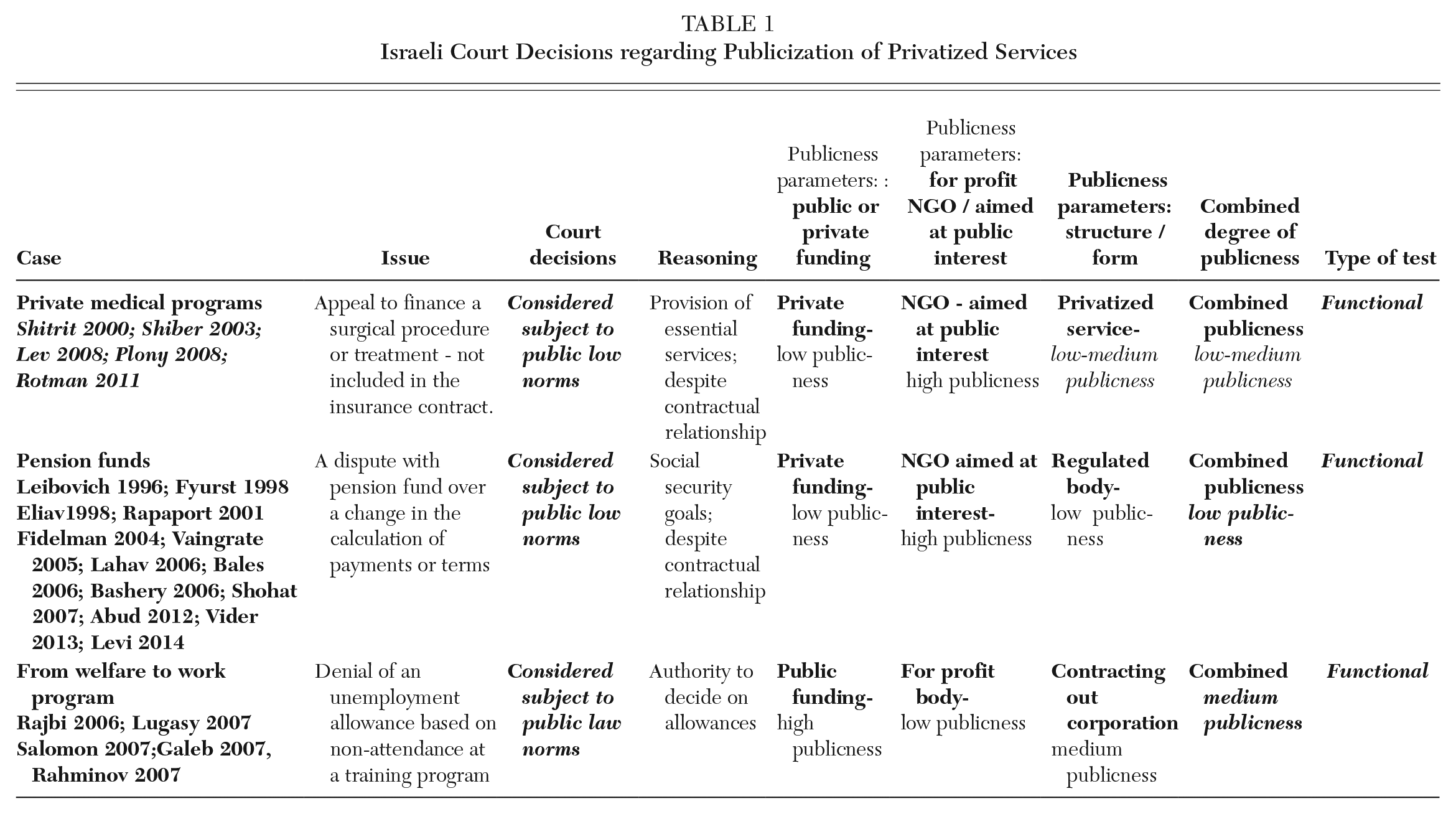
Regarding coverage of medical procedures as shown in Table 1, even though the basis of the relationship is contractual and no public funding is provided, and regardless of either the government’s noninvolvement in the entity’s management or any close connection to the relevant activity, the Court used functional tests to declare these associations hybrid bodies and therefore subject to public law norms.
For example, in the Lev case, the Court ordered a medical insurance corporation (Bituach Mashlim) to finance a surgical procedure in a private hospital based on the positive character of the constitutional social right for health even though the procedure was not included in the contract concluded with Bituach Mashlim (Regional Labor Court case 9914/05 2008). Even though the basis of a relationship is contractual and regardless of the lack of either governmental involvement in the form’s management or the provision of public funding, the Court held that Bituach Mashlim was a hybrid body subject to public law norms. Thus, this case, like others, demonstrates that even though the degree of publicness is only low-to-medium, the Court applied functional tests, thus indicating the emergence of a regulatory constitutional welfare regime.
In the area of pension funds, even though the relationship between the private fund and the insured persons was contractual, and despite no public funding nor any tight connection to public authorities, using functional tests led the Court to hold that the funds were subject to public law norms.
With respect to private corporations involved in the “from welfare to work” program, it was held that despite their for-profit orientation, the fact of having the discretion to decide entitlement to unemployment allowances demands that they be considered hybrid bodies.
British Jurisprudence, 2000–2019
Analysis of the application of constitutional rights in Britain’s privatized welfare services
Britain’s social and economic policies have become subject to a neoliberal regime shift that Prime Minister Thatcher instituted in 1979, one that held even after Labor came to power, as Jessop (2015, 22) notes: “New Labor committed itself to further liberalization and . . . to the privatization or, at least, corporatization of most of what remained of the state-owned sector as well as to the extension of market forces into what remains of the public and social services at the national, regional, and local level.”
Within the wave of privatization, a central privatization of welfare relates to public housing. Mostly, housing associations, which are registered social landlords (RSL) under the Housing Act 1996, provide social housing (S. Palmer 2008). Social housing trusts provide affordable housing below market value to those who cannot secure their housing needs in the market. RSLs are regulated in various ways by the Housing Corporation—an executive public body responsible to the Secretary of State. Other privatized welfare services are residential care homes and nursing homes, which are mostly operated by charity associations and financed by public funds. Charity associations provide accommodation to individuals to whom the local authority owed a duty under the National Assistance Act 1948 as amended by the Local Government Act 1972.
Britain’s HRA has incorporated the European Convention for the Protection of Human Rights and Fundamental Freedoms CETS No. 5 Rome 1950 into UK law. The human rights included in the convention are considered constitutional rights in Britain, with the HRA declaring that public authorities are subject to compliance with those constitutional rights. With the spread of privatization, the courts were confronted with the dilemma of whether such service providers should be considered hybrid bodies and thus subordinate to the human rights regime in place. Section 6(3)(b) of the HRA demanded application of the human rights listed in the European Convention to any person or entity who provides services of a public nature. The legal definition for “hybrid bodies” was not mentioned explicitly in Britain’s HRA, although the term was framed within the British jurisprudence, even as late as 2009. As we show in Table 2 for the British cases reviewed, the Aston Cantlow case stated that a hybrid body is any legal body whose functions are considered by the courts to be fulfilled by a public authority according to the HRA (Leslie 2009).
British Court Decisions regarding Publicization of Privatized Services: Court Decisions, Reasoning, and Type of Test Applied by the Court
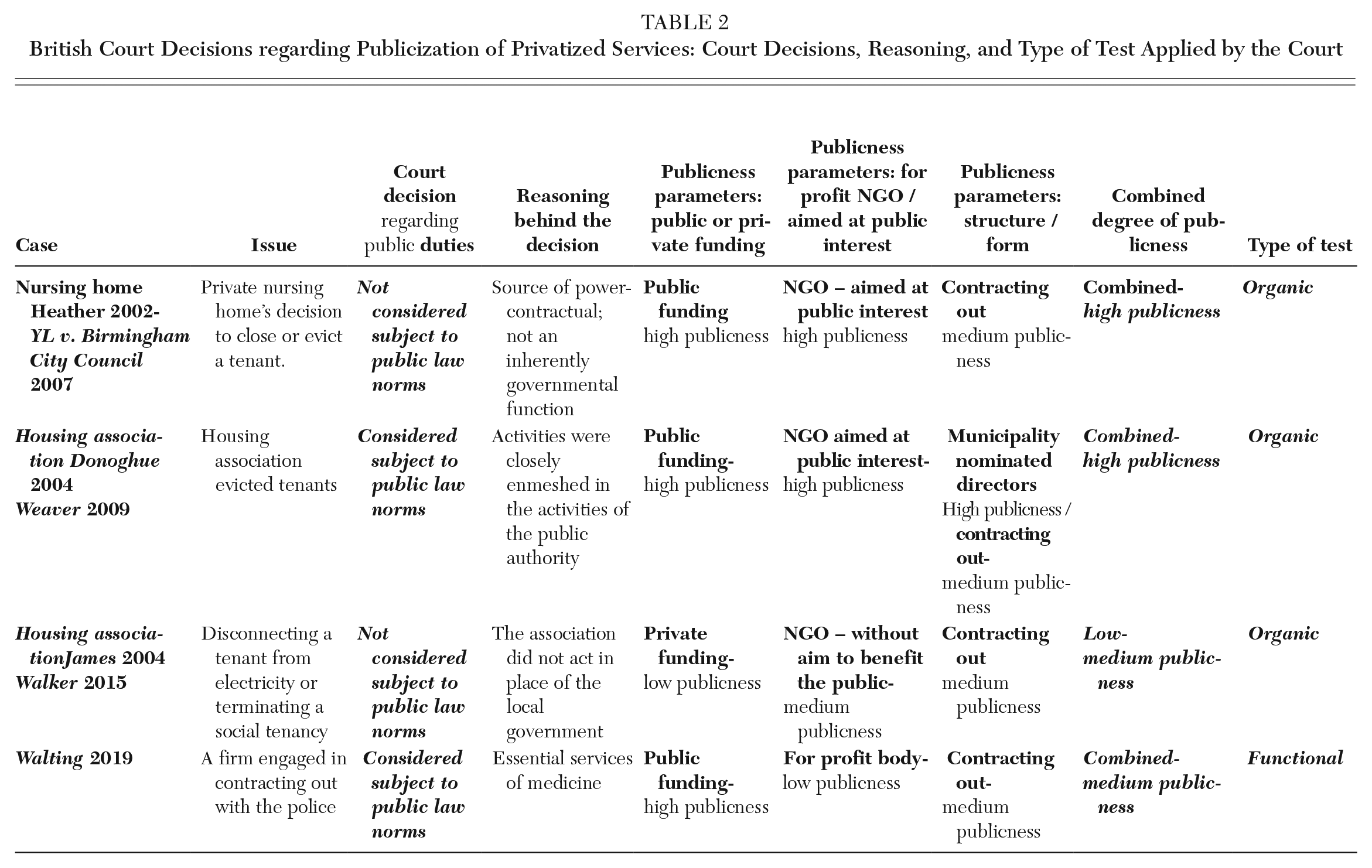
As demonstrated in the rulings presented in Table 2, British jurisprudence, when considering the attribution of public duties to private bodies, has tended to base amenability to compliance with human rights law on either a very close connection to the authorities or the authorities’ involvement in the private body’s activities.
British courts declared a close connection in cases where the private body either operated in very close harmony with a public authority, its activities were tightly enmeshed with those of that authority, the private body’s charitable objectives were specifically determined by the public authority, or the public body’s statutory authority was explicitly delegated to the private body.
British jurisprudence thus emphasizes organic tests that base amenability to human rights on a public authority’s involvement in the private body’s specific actions while stressing the source of the private organization’s power. When the source of that power is contractual, it usually prevents the application of constitutional rights and leads to classification of the respective body as a purely private entity.
This approach is reflected in the case of YL v. Birmingham City Council (2007, 27), where it was held that a care home contracted out to a local authority was not subject to constitutional rights. The Court distinguished between a local authority having a statutory duty to arrange care and accommodations, and a private company providing services contracted out by the local authority as a means to fulfill its (the local authority’s) statutory duty. The Court consequently denied application of the functional test in this case. The court in the case of YL based its decision on the Donoghue case (included in our analyzed cases, see Table 2) and observed that the court in Donoghue did not apply a functional test. Thus, despite public funding of the patient’s stay at the nursing home, contracting out services, and operating an NGO aimed at public interest—all reflecting high publicness—the Court denied the application of constitutional rights. Hence, the use of organic tests, regarding bodies characterized by high publicness, reflects the regulatory constitutional neoliberal variant of the welfare state.
Discussion and Conclusion
The shift toward privatization and contracting out of social services as major policy tools in the second half of the twentieth century has given rise to concerns regarding the preservation of welfare norms. While more traditional views of the regulatory state have considered the regulatory state and the welfare state as tradeoffs, a more recent approach suggests that the two potentially coexist, based on a polymorphic conceptualization of the regulatory state (Levi-Faur 2013, 2014) and the rise of the regulatory welfare state (Benish Haber, and Eliahou 2017). Our analysis builds on these theoretical contributions and on the distinction between publicness and privateness as developed by Bozeman (1987).
The analysis offered in this article lends support to the fruitfulness of the polymorphic conceptualization of regulatory regimes on one hand and contributes to the development of a typology of these regimes’ variants on the other. We introduce the concepts of the regulatory constitutional welfare state and the regulatory constitutional neoliberal welfare state as two such variants. These terms denote differences in adherence to social rights as constitutional rights and application of public law to those private entities performing public functions. In this article we also draw attention to the courts as co-creators of a regulatory constitutional regime, facilitated by their interpretation of the legal framework in a way that enables delegation of public duties to the respective private entities.
To demonstrate how social rights are viewed in a given regulatory regime as well as to provide a basis for further development of the typology we offer, we looked at the specific criteria used when applying public law to private entities and implementing publicization. We suggest that the criteria regarding decisions on publicization be construed as important features that distinguish a welfare constitutional from a neoliberal constitutional regulatory state.
Our analysis of Israeli trends revealed the Court’s application of constitutional rights and public law norms, based on functional tests and imposed on a wide range of private bodies regardless of the type of nexus holding between the private body and the public authority, that is, the association of public law to private bodies with even relatively low publicness. This practice also enables application of public law norms in cases where the contractual relationship between the private body and the public authority is apparent. The use of publicization as a policy tool enhances the entrenchment of accountability within the privatized welfare arena.
The constitutional neoliberal regulatory state, as our analysis of the British cases shows, tends to refrain from applying public law norms and constitutional rights to private bodies. The British courts tend to apply organic tests and require a tight nexus between the private body and the public authority as a precondition for applying constitutional rights. As a result, the types of bodies subject to constitutional rights and public law norms are limited; they include only those with high publicness. These tendencies to apply public duties and subject private entities to constitutional rights capture different modes of protecting the citizen’s social rights that lie at the heart of the two regulatory regimes.
The two variants developed here, and the tests used, can be applied to other countries as well. We therefore argue that using this conceptualization of organic and functional tests allows interaction and interplay between the regulatory state and the welfare state and shapes important aspects of their coexistence. Further research is required to address several issues.
One question to be addressed is how the differences between the two jurisdictions affect their tendency to apply public norms to nonpublic entities. While they share common law characteristics, the two systems differ in how the courts operate. As we mentioned, British courts operate in a context that has traditionally represented a liberal social policy regime, with a minimal welfare state regime that moved toward the neoliberal pole in the Thatcher era. Israel, however, was considered a social democratic state up to the 1980s (Doron 1985; Litor 2019b), until a deep and far-reaching process of liberalization emerged in the mid-1980s, led by the executive branch (Maman and Rozenhek 2012; Litor 2019a). Israeli courts have thus operated in a context marked by a government-led retreat of the welfare state. Therefore, a related question is whether, in jurisdictions operating in the context of transforming social regimes, courts lean toward the regulatory constitutional welfare pole in an attempt to preserve constitutional social rights.
While the current study pointed to two variants of the regulatory state, further research should investigate and delineate additional variants. Research should also attempt to identify the other factors shaping each variant. In the Israeli case, it appears that the courts played an important role in preserving welfare norms, but further research should look into the role of bureaucracy, elected officials, and epistemic communities.
Footnotes
Notes
Lilach Litor is a lecturer at The Open University of Israel. Her research focuses on the intersection of public law, labor relations, and public policy. She is the author of the book Strike: Law, History and Politics (2019) and co-author of Judicial Activism and Passivism (2008).
Gila Menahem is a retired professor, Department of Public Policy, Tel Aviv University. She studies policy formulation, policy paradigms, and policy networks. Her recent research deals with collaborative governance in local municipalities. She has coedited two books, Public Policy in Israel (Frank Cass 2002) and Policy Analysis in Israel (Policy Press 2016).
Hadara Bar-Mor is an associate professor in the School of Law at Netanya Academic College, Israel. Her fields of research include labor and employment law, corporate law, and nonprofit law. Her recent articles deal with the nature of strike as a basic right and with lifting the veil in employment tribunals.