



Abstract
Previous research has expanded our understanding of Latinx students’ schooling and outcomes in many ways, but current knowledge fails to appreciate nuances associated with the constantly evolving Latinx population. In many cases, schools are ill prepared to serve these students. I offer recommendations for developing a robust knowledge base on the education of Latinx students and the roles that schools play in perpetuating or ameliorating inequities. Specifically, I discuss strength-based perspectives and the expansive diversity of the population as concepts that are essential to framing research and interventions that aim to improve education for the Latinx student population. I review the empirical evidence on achievement outputs and key features of the school opportunity gap—segregation, discrimination, family-school partnerships, classroom teaching and learning, and instruction language use. Finally, I propose implications for developing equity-oriented reforms to support the continuous improvement of Latinx students’ education.
Scholars from multiple disciplinary perspectives have examined Latinx students’ schooling experiences and educational outcomes over time and in different places. 1 Research has demonstrated that, on average, Latinx students’ education outcomes (e.g., test scores, grade point average [GPA], years of education) were below those of their peers. We also learned that Latinx students’ identity markers, such as country of origin and generational status, were related to variability in outcomes (Portes and Rumbaut 2001).
In addition, researchers have highlighted family and neighborhood attributes associated with Latinx students’ education disparities. Lower academic test scores were linked to family demographic characteristics (e.g., parents’ educational attainment, economic status, and English proficiency), and to “limited” access to educational resources and neighborhood socioeconomic composition. Other scholars have identified opportunity gaps by showing that Latinx students attend schools with varying levels of quality located in high-poverty neighborhoods (Gándara and Contreras 2009). Without doubt, the previous waves of research have expanded our understanding of Latinx education in many ways.
For many Latinx students, schools are the first U.S. institution that they encounter, and schools offer the potential to improve their educational opportunities and economic well-being (Suárez-Orozco, Suárez-Orozco, and Todorova 2008). However, our current knowledge on Latinx students’ schooling experiences and outcomes is incomplete and (in some regard) distorted. Policy-makers, practitioners and researchers, though, fail to fully appreciate that the Latinx student population is constantly evolving and changing, and schools in many cases are ill prepared to respond to their multiple needs. I argue that the field needs to move away from monolithic understandings of the Latinx population and take stock of the multiple strengths of Latinx students and families. Starting with the Coleman Report in 1966, analyzing students’ outputs became common practice to evaluate academic performance; however, students’ outputs are highly influenced by individual attributes and diverse contexts (e.g., families and neighborhoods). I propose to center the analysis of Latinx education on the transformative potential of schools, considering both schools’ inputs and students’ outputs to understand the roles that schools play in perpetuating or ameliorating inequities. The resulting knowledge can help education stakeholders and schools to embrace equity-oriented policies and practices that address Latinx students’ diverse needs, strengthen their instruction, and alleviate educational disparities.
Not all Latinx subgroups face educational struggles, but many do. As I discuss here, particular subgroups (e.g., first-generation Latinx students living in poverty) show significant educational disadvantages, whereas other subgroups (e.g., English-speaking students, middle-class Latinx) have similar educational outcomes as white students. Besides the multiple benefits for society of improving the educational outcomes of one of the fastest growing segments of the youth population, students’ outcomes and experiences have cumulative consequences for their future learning and upward mobility. Multiple studies have documented the importance of early learning for later achievement and high school completion. For example, Chetty et al. (2011) demonstrated that the features of kindergarten classrooms (e.g., class size, teacher experience) were associated with college enrollment and earnings. Other studies have demonstrated the significance of schooling experiences for high school graduation and labor market outcomes, including earnings. T. Brown et al. (2019), for instance, found that students’ perceptions of the high school context (e.g., caring relations with personnel and instructional quality) improved their odds of graduating.
Because improving Latinx students’ schooling experiences and academic outcomes is critical to their future well-being, I offer several recommendations, from a strength-based perspective, for developing a robust and responsive knowledge base to inform those improvement efforts.
Conceptual Considerations
As the field of Latinx education expands, we must reconsider the way that researchers position Latinx students (and their families) as active members of schools. The field needs a strength-based perspective and to recognize their increasing diversity to gain a nuanced understanding of the schooling experiences of these students.
Strength-based perspectives on Latinx students
Many researchers, policy-makers, and practitioners position Latinx students from deficit perspectives, highlighting their limitations and struggles. This positioning perpetuates stereotypes and limits their educational opportunities. Embracing strength-based perspectives involves both considering Latinx students’ specific talents and areas for improvement and acknowledging the role of schools and diverse stakeholders in maintaining educational inequities. Strength-based perspectives align with approaches to learning and practices that are culturally specific and adapt to the needs of students in particular contexts, but at the same time recognize that culture is not static, as it evolves in response to classrooms and schools.
Plenty of empirical evidence identifies the strengths of Latinx students and their families that could be incorporated into education to improve learning opportunities. Latinx students are committed to learning English and obtaining educational credentials, and they exhibit attributes associated with school success and strong academic outcomes. Moreover, Latinx students in the early grades have strong social-emotional skills (e.g., positive regulation of emotions and actions, attentiveness, eagerness to learn, independence; Galindo and Fuller 2010). In the later grades, many Latinx students have a high commitment to expand their education as a means for social and economic mobility (Hill and Torres 2010). The strengths of Latinx students are related to their positive home environment and parents’ socialization practices (Cabrera et al. 2019; Jung, Fuller, and Galindo 2012).
Latinx families, in general, reinforce values such as familism (familismo), or a commitment to and value of family; and proper comportment (bien educado) and respectful and polite interactions (respeto). Latinx parents share their children’s commitment to education, have high educational expectations, and provide a positive home environment and supportive socialization practices (Cabrera 2012). Barrueco, López, and Miles (2007) demonstrated that Latinx and white parents of nine-month-old children showed similar parenting practices, such as daily signing, responsiveness to child distress, and encouragement of cognitive and social-emotional development. Galindo, Sonnenschein, and Montoya-Ávila (2019) found that Latina mothers used diverse practices to support their children’s math learning at home regardless of the mother’s education. These values and learning opportunities at home could be leveraged in the classroom to enhance education equity and reduce achievement gaps.
Increasing diversity and intersecting identities of Latinx students
Early research on Latinx students acknowledged their diversity in terms of country of origin, generational status, 2 and home language (e.g., Portes and Rumbaut 2001). In recent years, the diversity of Latinx students in the United States has expanded in various ways. Socioeconomic diversity, for instance, is increasing as the middle-class Latinx population grows. In 2017, about one-fifth of the Latinx population was classified as middle class (Reeves and Busette 2018). Also, 33 percent of Latinx people aged 25 or older had at least a bachelor’s degree, one indicator associated with middle-class status; this was mostly due to the increasing education levels of recent immigrants (Noe-Bustamante 2020). While middle-class growth is encouraging, poverty among the school-age Latinx population remains persistent and limits educational outcomes and upward mobility.
The number of school-age recent Latinx immigrants from Central America (Guatemala, Honduras, and El Salvador) is also increasing. Many of these students come from rural areas, and their families speak indigenous languages that are commonly oral only (without a written language) and have less familiarity with Spanish (National Academies of Sciences, Engineering, and Medicine 2017). Central American immigrants may be refugees, asylum seekers, or unaccompanied minors who have experienced traumatic events more than once (e.g., civil unrest in their countries, family separation). The number of undocumented Latinx students has also increased, and schools struggle to serve these students effectively. The stresses and limitations that these students experience due to restrictive immigration policies negatively influence their school engagement because their hopes and dreams of getting ahead in life are interrupted (Enriquez 2017).
Another important dimension of diversity of the Latinx population in the United States is associated with colorism, or discrimination of individuals within a given social group by their skin tone, phenotype, and hair texture. The Latinx population spans the full range of skin tones, which affects how individuals are ranked within a social hierarchy. Colorism is also associated with factors that affect educational outcomes; evidence exists that Latinx students with darker complexions have lower socioeconomic status than those with lighter complexions (Bonilla-Silva 2004).
The increasing diversity of the Latinx population is not a problem; on the contrary, important benefits exist that are linked to having a diverse student body. Student diversity, for example, facilitates advanced learning by providing space to consider cultural assumptions and perspectives and foster critical thinking and creative approaches to social problems (Banks 2013; see also Wells, Fox, and Cordova-Cobo 2016). It is also associated with other positive outcomes, including college attendance, expanding business networking, and overall positive social development (e.g., Graham 2018). However, school diversity needs to be embraced to implement equity-oriented strategies that are responsive to students’ specific characteristics and needs. It is important to use an intersectional framework to consider how students’ attributes are jointly linked to their experiences. Diverse identity dimensions (e.g., race, socioeconomic status, and nativity) interact in complex ways to influence the ways that individuals experience institutions and contexts of oppression. For example, although first- and second-generation Latinx students are more likely than third-generation students to be poor and to come from homes where Spanish is the primary language, their learning outcomes may vary when researchers jointly consider generational status, socioeconomic status, and home language. These and other identity markers are not independent of each other; they need to be considered simultaneously.
Unfortunately, most of the research on Latinx students’ experiences and outcomes has focused on the influence of specific identity markers (most commonly, generational status, country of origin, and home language) and conceptualizing them as having separate influences. We know less about emerging dimensions of the Latinx school-age population’s diversity and how these identity markers interact to influence experiences and outcomes.
Latinx Students’ Outputs: Achievement Gaps
Achievement gaps—disparities in academic performance between different groups of students—have emerged as a metric of educational inequity and school performance since the No Child Left Behind Act of 2001. 3 Although scholars use different metrics to examine achievement gaps (e.g., standardized test scores, GPA, high school graduation, educational attainment), I center the discussion of achievement on standardized test scores and GPA. In examining these two measures, I acknowledge the multiple limitations of standardized scores in terms of their emphasis on basic skills and their cultural biases. Although K–12 standardized test scores, such as the National Assessment of Educational Progress (NAEP), are considered strong predictors of later academic achievement as well as other educational outputs (e.g., high school graduation, college enrollment) and labor market outcomes (e.g., wage disparities), they are considered by many scholars as imperfect (to say the least) measures of minoritized student learning.
The literature on the Latinx student achievement gaps demonstrates four critical findings. First, the gaps have narrowed over time, but many Latinx students’ learning outcomes still lag behind those of their white (and Asian) peers. The U.S. Department of Education (2009) found that the national average GPA for Latinx students was 2.84, while for their white counterparts it was 3.1. 4 Based on the NAEP assessments, the reading and math achievement gaps between Latinx and white students, despite having decreased by about half since 1970, still remained strong in 2013 (0.50 and 0.60 of a standard deviation, respectively; Reardon, Robinson-Cimpian, and Weathers 2015). Between 2013 and 2017, further decreases occurred in some achievement gaps in fourth and eighth grades, but these smaller changes were not enough to eliminate the gaps (see Figures 1 and 2).

Trends in National Assessment of Educational Progress Math Scale Scores for White and Latinx Students
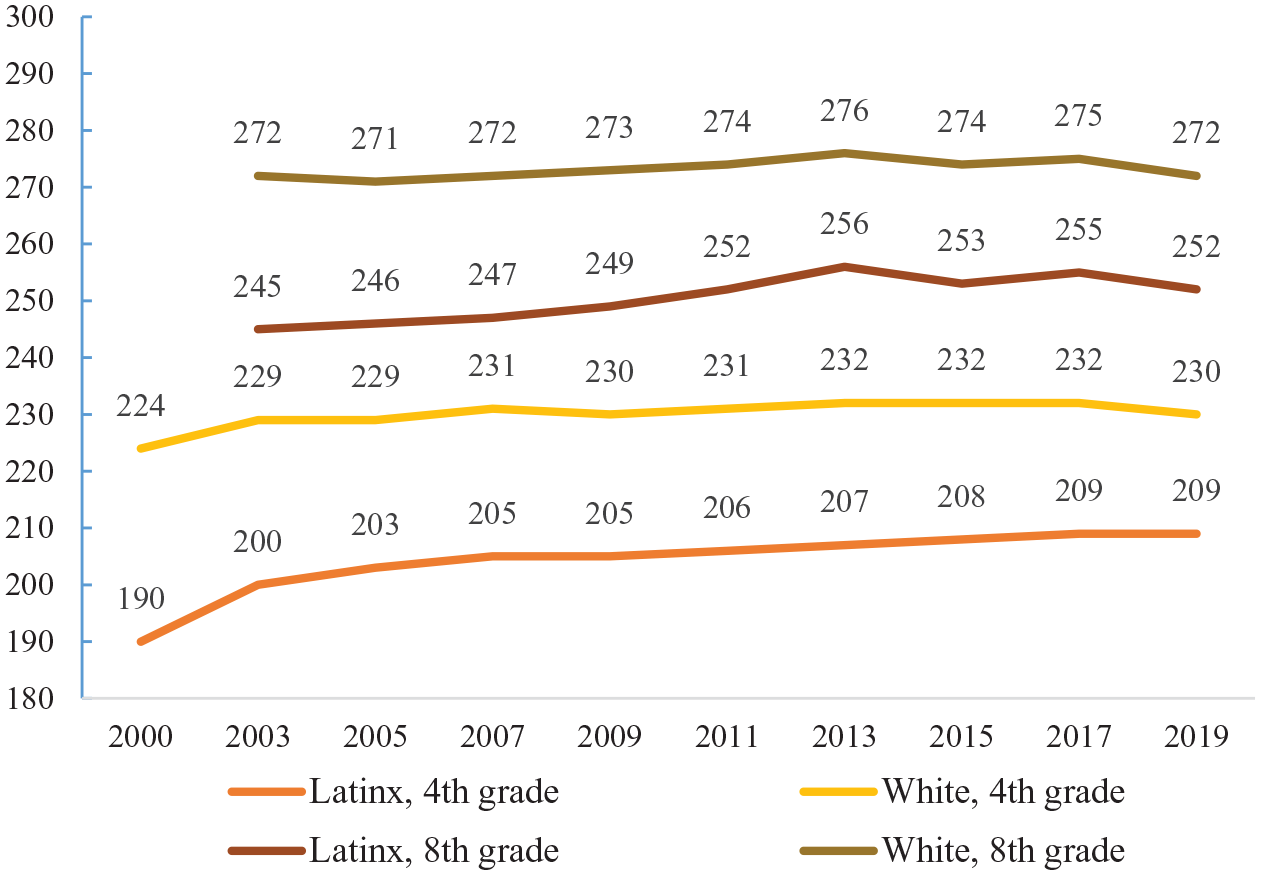
Trends in National Assessment of Educational Progress Reading Scale Scores for White and Latinx Students
Studies using nationally representative samples of students have also reported narrowing achievement gaps. Reardon and Galindo (2009) found that the differences in achievement between Latinx and white students at kindergarten entry in 1998–1999 were 0.75 of a standard deviation in math and 0.50 of a standard deviation in reading. These gaps decreased between kindergarten and fifth grade, but their magnitude remained large by the end of elementary school. Reardon and Portilla (2016), using two different cohorts of kindergarten students (1998–1999 and 2010–2011), found a 14 percent decrease in the Latinx-white math achievement gap. Similarly, Berends and Penaloza (2010) found a similar decreasing gap, but persisting disparities, after examining tenth and twelfth graders’ math achievement between 1972 and 2004.
Second, achievement gaps vary significantly because of the Latinx population’s diversity. Reardon and Galindo (2009) found that Latinx kindergartners in the three lowest socioeconomic status groups, but not in the two highest, had lower math and reading test scores than white students. Kalogrides (2009) found variability in math and reading scores across generational status of tenth-grade students, with first-generation Latinx students showing larger gaps than students in the second and third-plus generations (see also Reardon and Galindo [2009] for analysis in elementary grades). Research also demonstrates that academic disadvantage begins as early as in kindergarten, where Latinx emergent bilingual students (meaning students who speak a different language, mostly Spanish, and are learning English) show lower math and reading test scores than native English-speaking children, and that this disadvantage continues in middle and high school (e.g., Genesee and Lindholm-Leary 2011).
Using GPA as a measure of achievement, Patel et al. (2016) showed that Latinx high school students who arrived in the United States about three years before ninth grade had lower scores than their counterparts from Asia and the Caribbean (Haiti, Barbados). Similarly, Suárez-Orozco and colleagues (2010) found that about two-thirds of adolescent immigrants who arrived in the country about two years before participating in the study (85 percent of whom were Latinx) witnessed a GPA decrease during the five-year longitudinal study.
Third, educational outcomes are location related. Latinx-white achievement gaps vary significantly across school districts and metropolitan areas, with larger disparities in economically advantaged geographical regions, in areas with a large prevalence of Latinx students, and in areas with the largest socioeconomic differences across racial/ethnic groups (Reardon, Kalogrides, and Shores 2019). 5 Also, Latinx immigrant tenth graders in new destination states, or states experiencing recent growth in their Latinx population, obtain higher math and reading scores on average than students attending schools in states where Latinx populations have historically been more prevalent (e.g., California, Texas, Illinois, New York, and Florida; Potochnick 2014). Emergent bilingual students, most often Latinx, show significantly higher eighth-grade NAEP scores in reading and math in new destination states (Spees, Perreira, and Fuligni 2017).
Last, Latinx and Black students share a minoritized status in U.S. schools, and both tend to have lower overall achievement outcomes than white students. Still, their academic achievements diverge, at least in the early grades. At the start of kindergarten, Latinx-white achievement gaps were slightly larger than Black-white achievement gaps (Reardon and Portilla 2016). Black-white gaps in kindergarten were explained by a few covariates, including family socioeconomic status, but this was not the case for Latinx-white gaps (Fryer and Levitt 2004). The evolution of the gaps in elementary grades showed a narrowing pattern for Latinx students and a widening pattern for Black students (Reardon and Galindo 2009). Although the Latinx-white and Black-white math achievement gaps narrowed for both groups in high school, the difference in math achievement was larger for Black than for Latinx students (Berends and Penaloza 2010). These divergent patterns indicate that these two minoritized groups’ schooling experiences are different—at least on some dimensions, or that schools’ ability to respond effectively to their students’ unique needs vary. Further research should investigate these issues.
Studies of achievement gaps provide useful information to better understand one dimension of the educational disparities of Latinx students. Nevertheless, focusing only on achievement gaps provides an incomplete picture of Latinx students’ academic outcomes. Therefore, we must also examine school dimensions of the opportunity gap.
Schools’ Inputs: Dimensions of the Opportunity Gap
Many Latinx students attend schools that have limited resources and are less well equipped to support their specific academic, pedagogical, and social-emotional needs (Gándara and Contreras 2009). Much of the research on schools’ inputs has focused on class size, per-pupil expenditure, teacher education, and teacher experience. 6 I argue that researchers need to expand the examination of inequities in school opportunities. In addition to school segregation, research should consider school discrimination, family-school partnerships, classroom teaching and learning, and instruction language use. These important factors have been associated with achievement outcomes and other indicators of educational success, including school engagement, educational attainment, psychological well-being, and social-emotional skills (e.g., Brown and Rodriguez 2009; Covarrubias 2011; Durand and Perez 2013).
School racial and economic segregation
The segregation of Latinx students—separation of students in particular schools or school districts from white or middle-class students—remains a stubborn reality in the United States. Although the Supreme Court’s ruling in Brown v. Board of Education (1954) spurred desegregation efforts in the South, this decision did not apply to Latinx students. At that time, Mexican-Americans experienced de facto segregation; they were classified as white for legal purposes but were separated from white students, a practice justified on the basis of their language needs (Orfield et al. 2014). In 1970, with Cisneros v. Corpus Christi Independent School District, the protections initially afforded to Black students were expanded to Mexican-Americans (Donato and Hanson 2019). However, meaningful desegregation practices were stopped in 1974, when the Court ruled in Milliken v. Bradley against between-district desegregation.
Latinx school segregation is rising nationally across all grade levels. Orfield and others (2014) found that exposure—a measure that reflects contact or interaction among student groups—to white students decreased nationally between 1968 and 2011, especially in the West and Midwest (see also Fuller et al. 2019). Economic segregation—which is often concurrent with racial segregation—is also increasing. 7 Orfield, Kuscera, and Siegel-Hawley (2012) demonstrated that the average Latinx student attended schools with a prevalence of low-income students double that of the average white student. Within schools, the educational opportunities of Latinx students can also be limited by tracking or “ability groups,” which segregate students in classrooms. Within-school segregation is reinforced by the approaches that schools take to teach Latinx emergent bilingual students.
Furthermore, district segregation is more pronounced than school segregation in general. For Latinx students, segregation at the district level keeps increasing over time, and it is more pronounced for students with foreign-born parents or those living in Spanish-speaking homes (Fuller et al., forthcoming). The same study found that the potential for racial integration for Latinx students in the early grades is minimal because only 13 percent of all school districts had a student population of at least 15 percent Latinx and 15 percent white in 2015.
Because segregation is associated with lower academic outcomes for minoritized students, Latinx segregation remains a major topic of concern. Besides the legal setbacks that have stalled school desegregation, segregation is highly influenced by demographic shifts in overall school enrollments (Latinx students are now the largest minoritized group) and the dispersion of Latinx populations into suburban and rural areas (Tienda and Fuentes 2014). These factors have generated important challenges for desegregation that will require multifaceted and creative solutions.
Little research has examined school segregation experiences across Latinx student subgroups. Research focusing on residential segregation demonstrated that Black Latinx people experienced higher residential segregation levels than white Latinx people (Iceland and Nelson 2008). The same study showed a similar pattern when comparing native- and foreign-born Latinx people, whereby native-born Latinx were less segregated from whites than were foreign-born Latinx. This trend has been observed in traditional and new destination states. Because many students go to neighborhood schools, correspondence between residential segregation and school segregation is likely.
My analysis of elementary school data with a representative sample of students starting kindergarten in 2010 showed that Latinx students with foreign-born parents attended more segregated schools than those with native-born parents. The average Latinx student with foreign-born parents attended schools that were 21 percent white, 25 percent middle class, and 60 percent Latinx. For Latinx students with native-born parents, these percentages changed to 35, 35, and 45, respectively. Ryabov and Van Hook (2007) also found differences in Latinx students’ school composition by generational status. First-generation Latinx students in grades seven through twelve attended schools that were 50 percent white. These percentages increased, respectively, to 53, 58, and 64 percent for Latinx students in the second, 2.5, and third-plus generations.
Segregation limits the educational opportunities of Latinx students in different ways. At the district level, segregation is associated with unequal distribution of resources, including lower expenditures. At the school level, segregation has been associated with less effective teachers and scarce instructional resources and support services, including access to advanced placement and college-preparatory courses. Other scholars argue that segregated schools host a less positive school climate or less “pro-academic culture,” including less-demanding norms for task engagement and other behaviors conducive to learning. Students in these schools have limited educational opportunities. Of note, other scholars (e.g., Carter 2016) question whether desegregation and exposure to white students will increase learning opportunities for Latinx students as these schools may not be equipped to respond to their specific needs, embrace their cultural frames, and protect them from stereotypes and biases.
School discrimination
Discrimination—unequal treatment of minoritized students by peers or educators because of their ethnicity or language use—can significantly influence the students’ development and overall well-being. In general, about 40 percent of Latinx adults reported having been discriminated against directly or having seen a friend or family member experience discrimination (Lopez, Gonzalez-Barrera, and Krogstad 2018).
Precise information on the prevalence of school discrimination is lacking, but research suggests that Latinx students experience more discrimination than white students. These experiences start as early as elementary school and increase as students move to middle and high school. For example, a study of fourth and fifth graders of mostly Mexican origin, reported that around three-fourths and one-half of the sample experienced peer and teacher discrimination, respectively (C. Brown and Tam 2019). Another study, with middle and high school students, found that 60 percent of Latinx students experienced discrimination in school (Huynh and Fuligni 2010).
Discrimination against Latinx students in schools reflects the broader social and political contexts in the United States. Narratives that emerged from the Trump administration that portrayed Latinx immigrants as criminals, rapists, gang members, and uneducated people, along with anti-immigrant sentiments and language restriction policies (e.g., limited support for Spanish use for instruction), are expanding across the country (Bennett et al. 2020; Lopez, Gonzalez-Barrera, and Krogstad 2018). These actions trigger the normalization of discrimination practices in society and schools.
Discrimination in schools is manifested at different levels. At the institutional level, discrimination is reflected in unequal access to resources or academic support programs and disparities in disciplinary policies and practices. Research has identified unfair disciplinary procedures as a source of institutional discrimination. For example, Peguero and Shekarkhar (2011) found that tenth-grade Latinx students, both female and male, were punished at a higher rate than their white counterparts. However, both groups reported similar levels of disciplinary problems. Research has observed similar overrepresentation of Latinx students in out-of-school suspensions and expulsions in middle schools but not in elementary schools (Skiba et al. 2011).
At the individual level, teachers and peers may have explicit negative attitudes and behaviors or even microaggressions (subtle yet disparaging everyday messages) toward Latinx students. Teachers’ and peers’ negative dispositions and actions emerge from stereotypes and biases that have been attached to Latinx students’ and families’ cultural knowledge and practices. In some cases, teachers develop deficit perceptions of students and their abilities or blamed Latinx students for their school’s “failure.” In other cases, teachers’ biases toward students were associated with their non-English-speaking status (Mellom et al. 2018). Racial insults and exclusion from group activities are the most common manifestations among those who reported experiencing peer discrimination. Latinx students reported discrimination from white but also from other Latinx peers (Stein et al. 2019). These findings indicate the importance of considering complex intragroup dynamics when examining discrimination among peers.
Some evidence shows that discrimination in schools varies across Latinx subgroups. Multiple stereotypes and biases are associated with skin color, language proficiency and accent, or foreign-born status. Because these attributes are markers of privilege and proximity to whiteness and vary across Latinx groups, not surprisingly, experiences of discrimination similarly vary. For example, teachers sometimes stereotype emergent bilingual students as underachievers or miscategorize them as having learning difficulties. Latinx foreign-born students reported being discriminated against because of their limited acculturation (e.g., clothing style, accent; Córdova and Cervantes 2010). In terms of unfair disciplinary practices, a different study found that high school suspensions were more common among Latinx students who were U.S. born and English speakers than among those who were foreign born and Spanish speakers, respectively (Jang 2019).
Without a doubt, discrimination is harmful to Latinx students beyond its negative impact on academic outcomes. In the early grades, discrimination experiences can negatively influence students’ development of self and cultural identities. Being exposed to negative stereotypes at school could influence the ways that students position their sense of self and their own cultural groups. In later grades, perceptions of school discrimination are associated with mental health issues, including stress, substance use, and involvement in sexually risky behaviors (Benner et al. 2018). Teachers’ and peers’ unfair actions and perceptions can diminish Latinx students’ motivation, and Latinx can foster a more negative perception of school climate and sense of belonging. Of note, not all Latinx students exposed to discrimination experience adverse educational outcomes. Positive ethnic-racial socialization (the process through which students learn about the values, beliefs, attitudes, expectations, and behaviors of their racial/ethnic groups) and cultural orientation (positive dispositions toward one’s own culture) have been identified as protective factors (e.g., Neblett, Rivas-Drake, and Umaña-Taylor 2012).
Family-school partnerships
Family-school partnerships refer to collaborations between schools and families that support students’ learning experiences. When overlap occurs among the different systems of influence (e.g., schools, families, and communities), students’ learning and development are enhanced. Equity-oriented, authentic partnerships that are built from the strengths of families and establish two-way communication channels have shown several benefits for Latinx students. These partnerships decrease family and school mismatches and facilitate the utilization of families’ cultural knowledge for learning in the classroom. They can enhance teachers’ cultural understanding of their students, which is essential for building trustworthy relationships within the classroom (Galindo, Sonnenschein, and Montoya-Ávila 2019).
However, building partnerships with Latinx families requires a genuine commitment from the school principal, an organizational structure for partnership efforts, and buy-in from all school personnel. Unfortunately, some schools are not successful at building partnerships with Latinx families. Latinx families, for example, have reported feeling unwelcome and being ignored or treated disrespectfully. Other Latinx immigrant families reported not trusting schools, which they perceive as mainstream institutions that perpetuate oppression and discrimination. When schools do not recognize and respond to Latinx families’ needs (e.g., offer language accommodations or flexible hours for meetings), Latinx families find it difficult to consider themselves valued by the school. Thus, to build equity-oriented partnerships, schools need to acknowledge and be responsive to these perceptions to nurture trust and authentic engagement.
Also, building authentic partnerships with Latinx families may be challenging because some educators embrace narrow conceptions of family engagement that are more aligned to white middle-class approaches and therefore create barriers for Latinx families (Barajas-López and Ishimaru 2020). By doing this, educators perpetuate misconceptions about Latinx families (e.g., not caring about the education of their children) and do not recognize Latinx homes as valued sources of knowledge. When researchers used culturally relevant ways of collecting data on school engagement, results have shown a different picture.
When building partnerships with Latinx families, schools need to consider that these families vary in their knowledge, practices, and expertise. For instance, research has shown that foreign-born parents, because of their unfamiliarity with the U.S. educational system and perceived barriers from teachers, tend to participate less in school activities and contact their children’s teachers less frequently than white native-born parents (e.g., Suárez-Orozco, Suárez-Orozco, and Todorova 2008). Another study demonstrated the importance of documentation status for Latinx parents visiting their children’s schools (Cross et al. 2019).
The lack of authentic family-school partnerships limits the educational opportunities of Latinx students in different ways. In general, practices associated with meaningful family-school partnerships, like school outreach to families or parents’ involvement at school, are associated with students’ learning and other educational outcomes. Crosnoe (2009) also found that students took advanced math courses at the start of high school when family-school connections were strong. These connections also decreased the course selection disparities between English learners and other students. Other research conducted with Latinx parents demonstrated that family-school partnerships clarify expectations about schools’ and families’ roles and responsibilities around student learning and provide useful information for families (e.g., extracurricular activities, effective learning strategies to use at home; Durand 2011).
Classroom teaching and learning
In the classroom, students are actively involved in the creation of knowledge through exchanges with others—including teachers and peers. Thus, students learn content knowledge, higher-order skills, and critical thinking by being exposed to a challenging curriculum and teachers’ high expectations while being supported with appropriate scaffolding.
Equally important, the pedagogical approaches utilized in the classroom should embrace equity and social justice by moving away from deficit perspectives, centering the language and cultural experiences of minoritized students, and respecting their communities’ ways of being, as proposed in the concept of culturally sustaining pedagogy (Paris 2012). 8 In the classroom, teachers reframe curricula to incorporate children’s cultural understanding (e.g., discourse conventions and social norms) to make academic content more accessible, validate students’ differences, and facilitate diverse cultural competence. This pedagogical approach also embraces critical understanding as it empowers students to take charge of their learning and positions them as active learners who explore, discuss, and experience content and become creators rather than mere consumers of knowledge.
An equity-oriented pedagogy includes a commitment to building trusting student-teacher relationships. While holding high expectations, teachers respect and trust students, show concern for their well-being, and treat all students equally. In particular, Latinx students in the early grades felt supported when teachers used—or tried to use—Spanish in the classroom (Reese, Jensen, and Ramírez 2014). Latinx high school students felt cared for when teachers supported their academic development by assisting with homework or talking about college and, at the same time, demonstrating and understanding of their unique cultural and linguistic experiences. Thus, teachers’ caring—both personally and academically—influences students’ commitment to their education even when students feel academically disengaged.
In addition, teachers embracing an equity-oriented pedagogy value families’ diverse home knowledge and connect it to school learning. An important piece of families’ knowledge is their native language, which reflects their culture and traditions and facilitates connections among group members. Teachers bring families’ daily routines and cultural narratives (or their “funds of knowledge”) to the classroom to enrich content instruction in math, reading, and other subjects (Moll et al. 1992). Also, as discussed in the next section, using students’ home language for instruction facilitates positive cultural and linguistic identities and creates a cultural continuity between home and school. In these ways, teachers leverage students’ home knowledge to enhance learning.
While there are multiple benefits of an equity-oriented pedagogy (or similar pedagogical approaches), many teachers struggle to provide Latinx students with learning experiences that combine content knowledge and culturally sustaining approaches. In some cases, teachers have low expectations for Latinx students, which affect the way that teachers interact with these students and the rigor of the academic instruction they provide. The difficulty of providing high-quality instruction is multifaceted; teachers may struggle to provide these experiences for several reasons. For instance, teachers may lack adequate training on issues of race, structural inequalities, cultural diversity, and how diverse students learn; and they may have little knowledge about Latinx cultures. Teachers may fail to recognize the cultural strengths that Latinx students bring to school or fail to make connections between classroom content and students’ everyday experiences. Teachers may also struggle to confront their own biases and deficit attitudes and beliefs or to consider how their own experiences intersect with students’ cultural, ethnic, and socioeconomic backgrounds.
Instruction language use
Discussions around language and instruction for Latinx emergent bilingual students typically center on two interrelated key topics: What is the role of home language for content instruction? How can teachers best foster English skills?
Although many states and school districts encourage the use of English only for instruction of emergent bilingual students, scholars and practitioners acknowledge the benefits of incorporating students’ home language for content instruction. A meta-analysis found that emergent bilingual students in English-only classroom obtained lower test scores than peers in programs that used home language in the classroom (Genesee and Lindholm-Leary 2011). When instructional programs have a curriculum that fosters high-level bilingual skills and an accountability system for language and content learning, students’ learning outcomes are significantly better. Using students’ home language for content learning facilitates meaning-making by allowing students to focus on one task—learning the new content—and enhancing their confidence levels and sense of belonging.
Reaching English proficiency is an important milestone that Latinx emergent bilingual students need to achieve to improve their overall academic and social success in schools. Although different approaches exist to support English learning (e.g., bilingual education, dual language immersion programs), a “sink or swim” approach, in which students are exposed only to English without scaffolding or support, is not a best practice. Instead, language scholars recommend helping students gain skills and knowledge in their home language that will translate into literacy in English. Also, having teachers who are fluent in Spanish or opportunities in the classroom for interactions with native English speakers can facilitate the learning of academic English.
Of note, language is more than a means for learning; it also signifies appreciation of cultural differences, facilitates feelings of integration in the classroom, and provides emotional support for those students (Reese, Jensen, and Ramirez 2014). More recently, language scholars are embracing translanguaging, a language ideology that values diverse languages and promotes more fluid interactions between home and school languages. This approach to language acknowledges the different contexts in which emergent bilingual students interact and encourages an asset-based approach.
While attention to language use for instruction is an important dimension of Latinx students’ school experiences, some schools and classrooms may lack the capacity to address the language needs of emergent bilingual students. These classrooms may not have the required resources and infrastructure (e.g., bilingual teachers or programs for learning English) or the relevant curricula and materials that would be needed for scaffolding rich language instruction in both English and Spanish and simultaneously building academic skills. Even instructors recently certified to teach emergent bilingual students report feeling unprepared to meet these students’ language and instructional needs (López, Scanlan, and Gundrum 2013).
Discussion
The increasing presence of Latinx students in U.S. schools provides an opportunity for schools to enrich the learning experiences of all students. Students in diverse classrooms tend to have better cognitive skills (e.g., critical thinking) and more success working with individuals from different cultural backgrounds. Although not all Latinx students are struggling, improving schooling experiences and educational outcomes for those who are is important. Doing so will benefit U.S. society as a whole in addition to improving students’ opportunities for upward mobility and overall economic well-being.
Reconceptualizing research on Latinx education
This article is a call to rethink the way that researchers conceptualize and carry out research on Latinx students’ schooling experiences and educational outcomes. Although the previous waves of research on Latinx education have expanded our understanding of some dimensions of education inequities, it is time “to study the complexities of educational equity and transcend the limits of previous research” (Artiles 2011, 431). I argue that research on Latinx education needs to embrace intersectional lenses and center on the assets of Latinx students and their families. This orientation enables researchers to better appreciate how different identity markers interact to influence their experiences. Students’ individual characteristics may influence each other and partially overlap, but their combined effects on educational disparities could be uniquely complex. Also, research on Latinx education must consider the multiple strengths that Latinx students and their families bring to schools. Instead of perpetuating deficit perspectives by spreading stereotypes and misconceptions, research should illuminate malleable opportunities for improvement that embrace and build upon students’ (and their families’) knowledges, practices, and shared understandings.
Addressing the historical, economic, sociopolitical, and moral inequities that Latinx people experience in U.S. society warrants focused attention. Part of this imperative is to recognize the central role that race and racism play in educational equity and how race and power are highly interrelated. However, policy-makers cannot wait to resolve macro social injustices to push forward an equity-oriented educational agenda that centers on addressing the educational disparities of struggling Latinx students. Schools should play an important role in ameliorating the inequities these students face.
An equity-oriented approach to Latinx education should examine students’ outputs (standardized test scores and GPA) as well as school dimensions of the opportunity gap. This framing allows researchers to consider Latinx students’ school context and acknowledge the roles that unequal schooling plays in influencing their experiences and outcomes. It is important to expand our examination of inequities in school opportunities by going beyond commonly studied inputs (e.g., class size, per-pupil expenditure, teacher education, and teacher experience) and incorporate other interrelated dimensions of the opportunity gap: school segregation, school discrimination, family-school partnerships, learning and teaching in the classroom, and instruction language use. These dimensions reflect the macro sociopolitical and economic contexts of the United States and the social position of Latinx students. They also reveal the multiple constraints that schools as organizations face as they work to address the needs of students and families with diverse cultural understanding, values, and practices.
While moving away from essentializing notions of culture and acknowledging its dynamic and evolving nature, schools and teachers must appreciate how students’ diverse cultural contexts and cultural meanings are tightly associated with content learning. It is important to leverage this understanding so students can make more meaningful connections with content learning, families can feel appreciated and valued by schools and teachers, and partnerships can be based on mutual respect and two-way relationships.
Reconceptualizing research on Latinx students’ educational experiences and outcomes in the ways that I have outlined is not a panacea, yet it holds promise for developing a more fine-grained understanding of Latinx students’ school experiences and the full set of factors that interact to shape their educational opportunities. With that stronger knowledge base, key stakeholders will be poised to support efforts to develop and sustain more efficacious policies and practices in schools that serve Latinx students as well as a commitment to equitable educational opportunities and outcomes for this large, diverse population of students.
Implications for policy and practice
Although equity-oriented reform to support continuing improvement of Latinx students’ education should be responsive to diverse Latinx subgroups’ characteristics and specific needs, I offer some considerations for stakeholders and policy-makers to build upon when developing these strategies.
Renewing a commitment to desegregating schools
Given the complexity of desegregating schools, a multimethod approach is essential to accomplishing this goal. To start, research must examine within-district opportunities for desegregation, as we know that the demographic distribution of Latinx and other racial/ethnic groups complicates the potential for racial desegregation. Where within-district desegregation is not feasible, federal support and incentives (e.g., financial and technical assistance) should be increased for school districts’ voluntary cooperation on integration plans. Incentives for desegregating schools, although minimal, already existed before Betsy DeVos called for their elimination during her term as U.S. secretary of education. Finally, in places where neither of the two first options is plausible, we should implement equity-oriented policy and practices that center on the unique learning needs of Latinx students.
Providing extended learning opportunities
School districts and schools are utilizing after-school programs, both and in other extended learning spaces, to improve students’ learning and other dimensions of well-being. These programs could provide content learning opportunities and language resources and relevant curricula for scaffolding the learning of English skills while valuing students’ native languages (Gándara and Contreras 2009). Also, these programs provide emotional support, help Latinx students adapt to their new environments and cultures, facilitate their integration, and foster a sense of belonging. Extended learning may be especially important for recent immigrant youth, who are often unfamiliar with the U.S. school system and must deal with life stressors (including ethnic discrimination) associated with their recent arrival.
Scaffolding from a culturally situated understanding
While avoiding essentializing notions of culture and embracing its dynamic nature, it is important to leverage cultural understanding, values, and practices as a starting point to foster student learning, family engagement, and family-school partnerships (Galindo, Sonnenschein, and Montoya-Ávila 2019). By doing this, students could make more meaningful connections with content learning, families could feel appreciated and valued by schools and teachers, and partnerships could be based on mutual and reciprocal respect. Also, schools and teachers would share their commitment to diverse cultural contexts and their recognition that cultural meaning is tightly associated with content learning. This approach to working with Latinx students and families will also help Latinx students to maintain cultural connections with their families and communities to avoid experiencing alienation.
Conclusion
Although previous research has expanded our understanding, current knowledge on Latinx students’ K–12 schooling experiences and educational outcomes is incomplete. To gain a more robust understanding of Latinx students’ education and the roles that schools play in perpetuating or ameliorating inequities, research needs to move away from monolithic understandings of this population and embrace intersectional lenses, centered on the assets of Latinx students and their families, and consider both students’ outputs and schools’ inputs. Equally importantly, researchers should expand their conception of the opportunity gap beyond commonly studied school inputs (e.g., class size, per-pupil expenditure, teacher quality) and incorporate other interrelated dimensions, such as school segregation, school discrimination, family-school partnerships, teaching and learning in the classroom, and instruction language use. Together, these proposed approaches will help policy-makers to develop equity-oriented policies and practices specifically targeted to address Latinx students’ diverse educational needs.
Footnotes
Note:
This article was partially funded by the Spencer Foundation and a research and scholarship award from the Graduate School, University of Maryland. Special thanks to graduate researchers who assisted with the literature review for the article: Antoinette Waller, Nicole Mejia, and Marissa Sariol-Clough. I appreciate the feedback provided by the editors, an anonymous reviewer, and Betty Malen on earlier drafts of this article. The opinions included are those of the author.
Notes
Claudia L. Galindo is an associate professor of education policy at the University of Maryland. Her research examines minoritized and poor students’ learning and schooling experiences, paying particular attention to Latinx populations. She also investigates mechanisms in families, schools, and communities that may perpetuate or ameliorate inequities. She teaches courses on sociology of education and research methodologies.