



Abstract
We define scientific misinformation as publicly available information that is misleading or deceptive relative to the best available scientific evidence and that runs contrary to statements by actors or institutions who adhere to scientific principles. Scientific misinformation violates the supposition that claims should be based on scientific evidence and relevant expertise. As such, misinformation is observable and measurable, but research on scientific misinformation to date has often missed opportunities to clearly articulate units of analysis, to consult with experts, and to look beyond convenient sources of misinformation such as social media content. We outline the ways in which scientific misinformation can be thought of as a disorder of public science, identify its specific types and the ways in which it can be measured, and argue that researchers and public actors should do more to connect measurements of misinformation with measurements of effect.
Misinformation has attracted considerable attention as a topic for academic inquiry, especially in recent years (e.g., Wardle and Derakhshan 2017; or Southwell, Thorson, and Sheble 2018). Despite the scores of papers published with the word “misinformation” in the title, however, social science literature has lacked consensus to date on the conceptualization, definition, and measurement of misinformation.
In this volume assessing threats to science, misinformation appears to be a viable candidate to consider. Misinformation involving topics investigated by scientists is especially relevant in light of recent history. Amid a global pandemic and a vaccine rollout challenged by a torrent of false information available online and in public forums (and following decades of intentionally false claims by various actors concerning climate change, Ebola, genetically modified organisms [GMOs], and tobacco, among other topics), scholars and commentators have pointed to scientific misinformation as a threat to scientific institutions and to society more broadly (e.g., Dahlstrom 2021; or West and Bergstrom 2021).
Defining Scientific Misinformation
In a recent article, some of us have described misinformation as a stimulus or message that represents some false proposition as though it were true (Paquin et al. 2022), but we did not attempt a broader argument concerning what makes a proposition true or false. Any claim of distinction between false and true information will invite consideration of whether absolute truth is knowable to humans, as Stahl (2006) has noted. Much communication research has proceeded from an assumption of information as measurable and existent in an objective reality, and yet we must also acknowledge the limitations that we face as human beings in claiming to know reality (Krippendorff 1993). But even if we stop short of a focus on absolute truth, it is still reasonable to focus on accuracy relative to shared understanding. That approach resonates with Vraga and Bode’s (2020, 138) definition of misinformation as “information considered incorrect based on the best available evidence from relevant experts at the time.”
To differentiate scientific misinformation from other potential forms of misinformation, such as political misinformation, we can consider what we know about science as a process of inquiry. In attempting to explain what distinguishes scientific efforts from others, Oreskes (2019) emphasizes the social aspect of science, framing scientific facts as the collective accomplishment of research communities engaged in practice, as emphasized by Fleck (1986). Collective adjudication and contestation of claims, in this view, is an integral part of the scientific process. Multiple parties use agreed-upon methods to vet ideas, claims that were once accepted as fact can be disproved through independent observation and testing, and no individual scientist should enjoy unchecked status as an unquestionable authority.
These collective practices are in principle guided by epistemic goals: science aims to provide approximately true, or at least empirically adequate, descriptions of the world and to avoid those that are false (e.g., Goldman 1999). Other norms and values commonly associated with scientific practice, like favoring simplicity, accuracy, and replicability, are an extension of this overarching aim. Kuhn (1996) emphasized that such shared norms and values guide the process of scientific inquiry; and while the weight placed on certain values may vary among individual scientists or groups of scientists at different moments in history, he argued that they nonetheless provide a basis for scientific judgment.
According to Gerken (2015), someone who asserts a scientific claim should be capable of articulating epistemic reasons for believing the claim that are adequate relative to the communication context. Scientific claims carry the mark of this epistemic position, reflecting a collaborative process governed by norms and values. At its core, scientific misinformation violates the presupposition of a process of generating claims based on the best available scientific evidence and relevant expertise. Extending this, we suggest defining scientific misinformation as publicly available information that is misleading or deceptive relative to the best available scientific evidence or expertise at the time and that counters statements by actors or institutions who adhere to scientific principles without adding accurate evidence for consideration. By best available evidence, we generally mean the preponderance of scientifically observed evidence, whether in terms of quantity or quality.
At least two aspects of this emphasis are notable. First, we acknowledge that fraud and deception can occur privately between people (including between scientists), but for our discussion we focus on publicly available information, meaning information that is discoverable by an audience beyond a single peer-to-peer exchange. In other words, we focus on information that a person can encounter at some point after it has been expressed; misinformation could take the form of a social media post, a billboard, or even a fraudulent research paper. Second, we acknowledge that decisions about which actors count as acting scientifically or which evidence counts as the best available can invite debate, but, for our purposes, we define scientific misinformation as publicly available information that originates outside the process of scientific inquiry that we described earlier.
Focusing on scientific misinformation as public and as countering scientific inquiry offers two insights: (1) scientific misinformation represents claims that fail relevant tests of validity based on the best available evidence or expert judgment at the time, and (2) scientific misinformation as a phenomenon is a disorder arising from science existing in a public context. Scientific misinformation directly or indirectly threatens the objects, subjects, practices, and institutions of science because it threatens to disrupt the iterative evaluation of evidence required for scientific inquiry and because it can crowd out scientific information on the public stage without the justification of scientific backing. As Lewandowsky, Ecker, and Cook (2017) have noted, misinformation can be problematic because of its potential negative consequences for collective decision-making, and yet we also should acknowledge that false information is not all equally problematic (see also Southwell et al. 2019).
Scientific misinformation is a disorder of public science
Unlike a presentation of scientific research by one scientist to another, public science is usually meant for a public, nonexpert audience and potentially can “persuade the public or influential sectors thereof that science both supports and nurtures broadly accepted social, political, and religious goals and values, and that it is, therefore, worthy of receiving public attention, encouragement, and financing” (Turner 1980, 590). Although all scientific activity by people is social, in a sense, or conceivably knowable to publics at least eventually (Shapin and Schaffer 2011), public science and research science tend to exist as distinct discourses, marked by different rhetoric, speakers, and institutions. Public science actors aim to make scientific research and findings more broadly meaningful in ways that extend beyond research science (Brennen 2018).
In recognizing scientific misinformation as public (and a symptom of public science), we can view the phenomenon as both observable and relational, a product of mediated communication. Although misinformation can hold cognitive or emotional consequences for individuals, misinformation is not necessarily the same as a single human’s misperception. Vraga and Bode (2020) have noted a divergence in social science literature between personal misperceptions—meaning beliefs people hold that are demonstrably inaccurate—and misinformation as an observable phenomenon that exists outside of any individual mind.
Scientific misinformation is disconnected from best available evidence and expertise
Following Vraga and Bode (2020), we locate the falsity of misinformation in the foundations of scientific expertise and evidence, while also acknowledging that the determination of falseness must be located in a particular moment or time. They note some of the limitations in indexing the validity of a piece of scientific information to empirical evidence or scientific expertise. For example, it can be unclear just who does and should count as an expert. They also note that for many issues, “expert consensus is not available” (Vraga and Bode 2020, 4).
At least two additional issues arise in relying on expertise and evidence to assess validity. First, neither evidence nor expertise is completely external to misinformation. This approach ultimately suggests that a claim is true when it corresponds, not to an external reality, but to a clear and momentarily stable set of evidence and consensus. Nonetheless, some misinformation directly challenges the evidence and expertise that declare it false; misinformation producers sometimes offer their own evidence and alleged expertise and raise questions about what constitutes valid evidence. Famously, the tobacco industry ran and funded its own studies and employed its own experts to muddy the waters about what the evidence, and what consensus, showed—a technique also embraced in climate change denial (Oreskes and Conway 2011). The point is not that all evidence is the same but, rather, that evidence and expertise can be contested, just as claims themselves can be.
Importantly, the emergence of misinformation itself sometimes can compel scientific expert communities to attempt to assert or establish consensus. Institutional processes that respond to individual worries or concerns about the appearance of false content, in turn, can exert social power in generating and announcing consensus. Assembling a panel to weigh evidence and discuss consensus about the effects of a new cellphone technology on the spread of infectious disease in response to the prevalence of false claims on the topic would be an example of misinformation prompting official consensus determination and pronouncement. At least in some instances, in other words, we should view misinformation and institutional efforts to generate consensus as linked in a reciprocal relationship, or in a temporal sequence, that scholars sometimes overlook; misinformation can precede a formal report on consensus if false claims run counter to a preponderance of evidence that has not been gathered in one report yet.
Second, if scientific misinformation is a function of public science, misinformation should not necessarily be assessed in the same manner as research science. We accept that a piece of science journalism should not have to pass the same bar in terms of specificity and detail as an academic journal article, as long as it preserves key relationships in describing data.
Scientific Misinformation as a Threat to Science
As a disorder of public science, scientific misinformation directly or indirectly threatens scientific actors and institutions in various ways. Whereas some misinformation presents falsified claims contradicting science consensus on specific subjects and complicates societal discussion of policies related to those subjects, actors also sometimes use scientific misinformation to attack the integrity of scientific communities. The threat posed by the latter can be detrimental and long lasting because it undermines trust in science, as well as delegitimizes the epistemic authority of scientists and scientific institutions. For instance, by claiming that vaccine development is a money-making scheme by “big pharma,” or that scientists are bought by agribusiness to suppress evidence that GMOs cause cancer, misinformation can imply that science is corrupted and does a disservice to the public. Mede and Schäfer (2020) conceptualized ideas suggesting antagonism between the general public and scientific elites as science-related populism. Scientific misinformation and science-related populism can feed into each other and interact to delegitimize science as an institution. Populistic thinking can seek to render misinformation unfalsifiable and irrefutable, in a sense, in that the sources of scientific consensus on which debunking efforts are based—evidence or expertise—can be dismissed as “misinformation” manufactured by corrupted elites.
Importantly, limitations exist to integrating threat as an element in the conceptualization of scientific misinformation. First, misinformation’s impact is perhaps the hardest thing to assess—after years of study, we still lack clear understanding of whether and how pieces of (scientific) misinformation influence people’s understanding and behavior. Second, we do not mean to suggest that a piece of false content must have a measurable effect on the actual practice of science for it to be misinformation: if someone writes a tweet spreading vaccine misinformation that is not read by anyone, it still should be considered scientific misinformation. Threats do not have to be actualized; nor do they have to have clear demonstrable impact.
Aspects and Types of Scientific Misinformation
As a disorder of public communication, scientific misinformation may be more than a series of expressly false factual claims. Importantly, misinformation can exist without clear attribution of intentional authorship; the key is the falsehood depicted or implied and not the mental state of the author. Scientific misinformation is a complex communication problem. We can ask how exactly scientific misinformation is false by considering common forms of scientific misinformation content already recognized in the literature. This literature recognizes that a piece of scientific misinformation—which can be anything from a tweet to a book—can operate to mislead in at least two distinct ways: some claims can be demonstrably false when considering available empirical evidence, while others are unsubstantiated and unsupported by available evidence and sometimes stem from logical fallacies.
Donald Trump’s suggestion that disinfectants could be used to treat COVID-19 is an example of a demonstrably false claim. This type of misinformation simply includes claims or representations that no longer represent the best available evidence or expertise (at the time). Alongside groundless false claims, other factually wrong scientific misinformation may come with supposed evidence that is forged or falsified. For instance, Brennen, Simon, and Nielsen’s (2021) recent research shows how counterfeit images were used to propagate false claims about COVID-19.
In an example of misinformation depicted in Figure 1, we see misinformation that is misleading both because it shows an altered image and because it suggests an unsubstantiated argument. The doctored image of a railcar accompanied a claim that that train depicts intentional transport of the virus. We are unlikely to witness any scientific research assessing whether that train carried the virus, and yet the larger implication of the claim is a contextual argument or deep story that COVID-19 is manufactured and part of an international conspiracy to spread the virus, which can be judged as unsubstantiated misinformation.
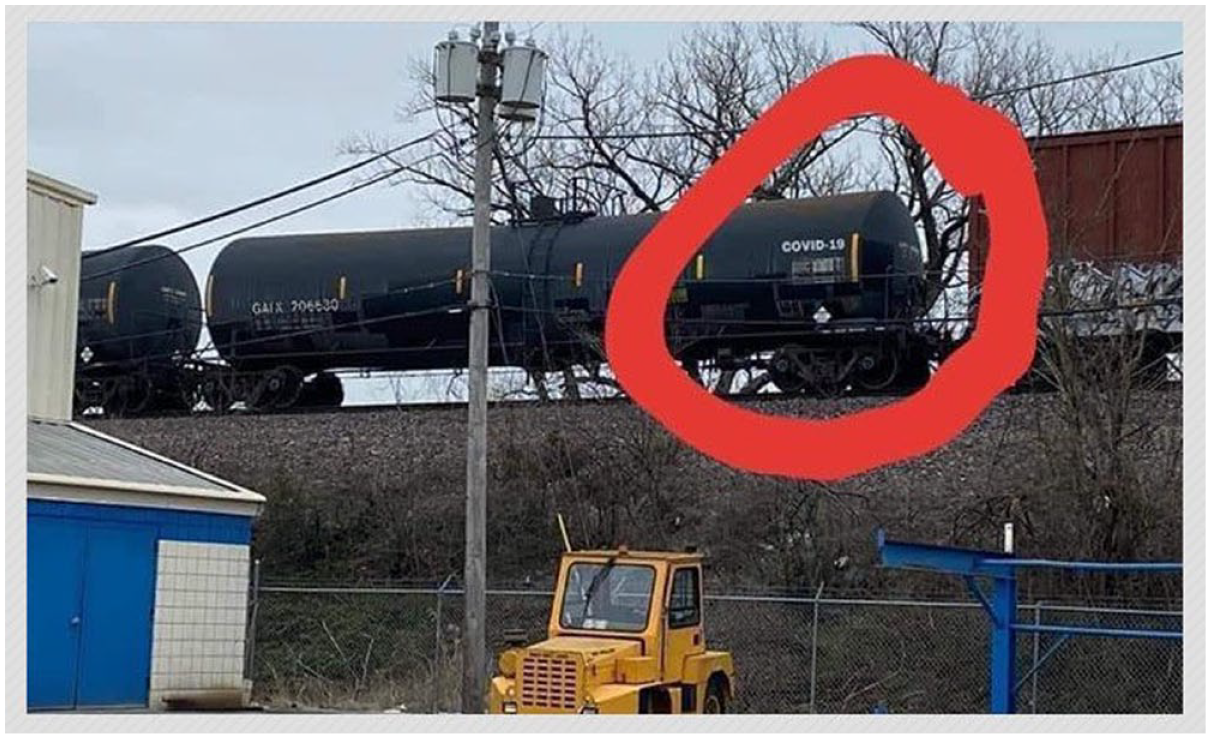
Altered Image of Tanker Appearing on Facebook and Fact Checked by AFP
In another example, a video that appeared online in May 2021 falsely suggested that the Moderna vaccine contains a carcinogen (AFP 2021). 1 In this case, the contextual argument is that the vaccine has not been thoroughly tested and is unsafe because it contains an ingredient—a lipid—that has been associated with health warnings for the carcinogen chloroform. This second level of misinformation involves not solely an explicitly false factual claim but a broader misleading implication embedded within. The misinformation does not necessarily include expressly factual errors, but often centers on logically fallacious arguments that are the product of flawed reasoning. In the chloroform example, the misleading video showed a real Occupational Safety and Health Administration Data Sheet for a lipid with the same name as the vaccine ingredient in question without also noting that two chemicals can have the same name but also can have differing safety designations if they are manufactured with different processes. The manufacturing protocol drives the safety warning, in part, and two chemical products can have the same name but differing manufacturing protocols. No evidence exists that the Moderna vaccine manufacturing process used chloroform at the time of the video (even if other manufacturing processes for the lipid in question do). This form of scientific misinformation appears in some discussion of conspiracy theories and attempted denial of scientific consensus. For instance, using the example of scientific evidence on smoking, Diethelm and McKee (2009) illustrated how logical fallacies (e.g., red herrings, straw men, excluded middle fallacies) were used by pro-tobacco campaigners to refute scientific consensus.
Misleading visuals
Both language and visuals can convey misinformation. Therefore, it is also important to consider how visual information—both graphical (e.g., data visualizations, charts) and illustrative (e.g., photos, videos, illustrations, content features)—holds distinct potential to convey misinformation. Indeed, current media environments offer numerous opportunities for visual deception through social media posts on a multitude of platforms. Data visualization scholars have long warned about the possibilities for visual deception (Tufte 1983, 2006). Although visual graphics can aid understanding in some areas (e.g., Houts et al. 2006), the potential for spreading misinformation in other areas exists. The possibility of deception through visual propositions is relevant for scientific information, as charts or graphs can be easily used and manipulated to convey data points. Alternatively, photos or videos can be strategically used to increase the virality of a post, by provoking an emotional response through a powerful visual component and conveying a powerful narrative. For example, in examining Pinterest posts about vaccines, Guidry et al. (2020) found that not only were fear-invoking visuals (presence of needles, scared facial expressions) frequently used, but they were more common in negative pins about the flu vaccine and garnered more engagement. When images are taken out of context, fabricated, intentionally altered, or simply poorly designed, they can either inadvertently or intentionally spread misinformation. Brennen, Simon, and Nielsen (2021) identified and discussed three broad functions that visuals play within pieces of misinformation: illustrating and selectively emphasizing elements of misinformation, purporting to present evidence for claims, and impersonating authoritative institutions.
Regulation of, and research on, visual deception is challenging, both from a theoretical and practical standpoint. Messaris (1997) notes that judging consequential deception stemming from the visual dimension of advertising is difficult because, unlike written language, visual communication lacks explicit propositional syntax to guide interpretation of elements. Researchers have attempted to demonstrate deception through so-called visual lies; one example is a study by Pandey et al. (2015) of the effect of distorted graphic elements in charts and figures that exaggerate quantity differences, relative to the actual numbers being reported. We also know that visual elements of communication can affect processing of erroneous claims and corrective information about those claims (e.g., Aikin et al. 2017). We, nonetheless, have relatively little evidence on the prevalence and the effects of visual misinformation compared to textual misinformation, suggesting a priority for future research. For a discussion on potential dimensions of visual misinformation, see Hemsley and Snyder (2018) or King and Lazard (2020).
Measuring Scientific Misinformation
A crucial task for our consideration is deciding how to observe and measure misinformation related to various sciences for the purposes of social science inquiry. Peer-reviewed literature might appear to offer a useful source of dictionaries to determine what counts as misinformation relative to available evidence, but just turning to conveniently available literature as a misinformation determination approach alone does not guarantee the best available measurement. Misinformation definition efforts also might benefit from systematic review techniques, for example, Cochrane methods (Higgins et al. 2019), to ensure comparison with a literature, rather than comparison with a single article. Moreover, measuring scientific misinformation should involve expert consultation, careful definition of units of analysis, and thoughtful consideration of where to look.
The utility of collaborating with experts
One challenge of classifying or labelling scientific misinformation is that it often requires domain expertise. Whereas the factuality of some political misinformation may be assessed by nonexpert coders, the accuracy of science-related claims often requires assessment by experts (e.g., Sharma et al. 2017). Given this particularity, the technical threshold (or skill threshold) required for conducting in-depth content analysis of scientific misinformation is high.
Consequently, when it comes to empirically measuring scientific misinformation, researchers regularly rely on secondary sources from third-party fact checkers to identify misinformation (e.g., Brennen et al. 2020; Zeng and Chan 2021) or limit the research to “safe” topics with a noncontroversial consensus and where the dichotomy between factuality and falsehood is relatively obvious.
Multidisciplinary and interdisciplinary collaborations with domain experts can be beneficial to advance the study of scientific misinformation. The advantage of working with domain experts extends beyond improving the reliability of dichotomous coding and can encourage important nuance in analysis. To be able to empirically investigate and differentiate such nuance is important, because it helps to uncover the root of scientific misinformation and develop contextualized remedies. For instance, climate communication scholars have attempted to develop a typology of fallacies associated with climate denial arguments by working with topical experts (Cook, Ellerton, and Kinkead 2018; Kemp, Milne, and Reay 2010; Washington and Cook 2013). Such research provides insights into how educators and researchers can engage with, and respond to, climate change deniers in a productive way.
The challenge of defining units of analysis
Beyond questions of dichotomous coding of whether a claim or content element is misinformation, we also should consider the unit of analysis. For social science measurement to be useful in producing results that can be judged by audiences, measurement should reflect the theoretical definition of a specified unit of analysis. Where does a phenomenon physically reside, for example, in a tweet, in a conversation, or in a brain? How might we know when we have two or more instances of a phenomenon? These questions require that we specify the level of spatial organization at which we should look for indicators of the phenomenon, as well as what constitutes a single unit.
For example, scientific misinformation sometimes has been operationalized so as to include even misleading claims that are balanced against an accurate claim within the same news article (for discussion, see Dixon et al. 2015). Characterizing an entire article as an instance of scientific misinformation affords the opportunity to compare such content against other content not containing such a claim, but it does not necessarily distinguish such content from an instance in which the inaccurate claim is not balanced by accurate (and conflicting) information. Whether research focuses on an aggregated unit of content or on a specifically articulated claim is another consideration. A unit of problematic content will include at least one erroneous claim to warrant classification as misinformation and yet perhaps also includes multiple claims that are erroneous. Some researchers will focus on each of the individual claims as a unit; others will assess an entire article or a post or an advertisement as a unit. In either case, useful measurement will require explicit definition of a unit of analysis.
Examples of common measurement protocols and their limitations
Many studies that measure instances of misinformation assume that prevalence is an indicator of effect. Other studies examine the effect of misinformation on behavior or perceptions, focusing, for example, on indicators of deception or purchase decisions (for a review, see Boudewyns et al. 2018). In many of these studies, researchers have randomly assigned people to be exposed to claims known to be false or to claims that imply inaccurate information and then assessed the effects on claim acceptance, product perceptions, or intentions (e.g., Boudewyns et al. 2021). In many cases, claim acceptance measures are a key focus. For this article, nonetheless, we are highlighting the measurement of misinformation itself as a consideration, rather than the measurement of misinformation rejection or acceptance. (For a review on ways to operationalize misinformation rejection, see Paquin et al. 2022.)
Studies on misinformation in social media offer useful examples and tend to fall in one of a couple camps. Some analyze social media data (either manually or through machine learning algorithms or data-driven approaches) to characterize the content of the misinformation or how, by whom, and to what extent the misinformation is shared. Some studies of social media content measure misinformation by counting the number of posts/tweets that include at least one unit of a given falsehood or by characterizing who is sharing misinformation. While these studies paint a picture of the prevalence of misinformation, the speed at which it spreads, or the actors who spread it, many fail to capture the context of how the misinformation appeared. In the case of studies that ignore what the misinformation is about and only focus on the spread of a broad class of misinformation (e.g., grouping all false tweets about vaccines together) or about a specific falsehood (e.g., examining the spread of a single false news story), we lose an appreciation for how different types of misinformation affect sharing behavior, or how different executions of a piece of misinformation (e.g., use of graphics or narratives) shape behavior, or whether other contradictory (factual) information was circulating at the same time and what role that might have played.
Other studies take the form of content analyses that code for instances of misinformation. When deciding whether something should be coded as an instance of scientific misinformation, some researchers defer to decisions made by fact-checking organizations (e.g., Zeng and Chan 2021), others code the information themselves (e.g., Kata 2010) or through other computational tools (e.g., Tingley and Wagner 2017), and others do a combination of the two to validate analysis (e.g., Vosoughi, Roy, and Aral 2018). These studies are useful to understand the types of content to which people are exposed and whether some types are more prevalent than others, although what they fail to uncover is how the various types of misinformation affect communication behavior, such as misinformation sharing.
Where to look for scientific misinformation
Communication between people can involve a wide array of information in the form of verbal utterances, nonverbal exchanges, broadcast messages, online posts, and many other formats. The task of measuring misinformation in communication, then, requires consideration of where one expects misinformation to be found. We might look at a static collection of bits of information, such as a television news story or a social media post, as an entity that we can characterize as containing misinformation or not. We might also consider coherent ideas as entities capable of diffusion across platforms and format, as Cappella (2002) suggested in his articulation of information as memetic; misinformation theoretically can transcend any one platform, as a false claim can travel from social media post to conversation with a reporter to inadvertent inclusion in a news story. To classify units, we nonetheless need to make choices about what constitutes a unit of misinformation, and we should be transparent about those choices.
As a potential threat to scientific institutions and scientists, misinformation that resides in electronic content poses a source of concern because of the potential for widespread exposure. Thus, that much social science investigation is focused on units of high-profile content is not surprising. We can see an example of this in the regulatory science arena, as agencies such as the U.S. Food and Drug Administration monitor and assess individual product advertisements as instances of misinformation (O’Donoghue et al. 2015). At the same time, any social network exchange can include intentional or inadvertent false claims, and some of those exchanges are viewable to people beyond the initial dyad. We should focus our attention on misinformation in publicly available electronic media content, as well as in widely available print content and social network exchanges.
Recent scholarship on scientific misinformation predominantly focuses on online content, which could be partially explained by the accessibility of related data. For instance, the prevalence of Twitter studies reflects the availability of application programming interfaces (APIs) and structured data from the platform (Suarez-Lledo and Alvarez-Galvez 2021). Despite the relevance of digital platforms, the phenomenon of scientific misinformation embodies epistemic and social activities that cannot be captured solely by traceable online data. Future research should move beyond single-platform studies of ready-to-use data (Walker, Mercea, and Bastos 2019). We also should note offline behavior, both in terms of information production and consumption, to generate a comprehensive understanding of how scientific misinformation propagates and affects information ecosystems. People continue to interact in person in many circumstances.
In sum, researchers should strive to connect misinformation measurement with measurement of potential misinformation effect, rather than assuming either alone is sufficient for theoretical advancement. Moreover, researchers should clearly outline their operationalization of misinformation, assess internal reliability, and ensure coding is replicable and transparent. Improving misinformation measurement will require resources; building the necessary infrastructure for this work in the future is an important step for researchers to take now.
Conclusion
As an umbrella concept, the notion of misinformation is useful, as it groups together a wide range of problematic stimuli without necessarily requiring that we know the authorship of that stimuli. However, this range of possibilities nonetheless poses challenges for research, given the lack of specifically prescribed or consistent measurement practices to date. Our focus on scientific misinformation as a phenomenon emphasizes that it is a threat to science that arises as a disorder of public science communication. We conceptualize scientific misinformation as publicly available information that is misleading or deceptive relative to the best available scientific evidence or expertise at the time and that counters statements by actors or institutions who adhere to scientific principles.
In conceptualizing scientific misinformation and suggesting measurement possibilities, approaches that focus on discernible content (as separate from the effects said content might have) and approaches that reflect the timing and context of claims can be useful. Research should connect measurements of misinformation with measurements of effect. Researchers should describe their operationalization of misinformation clearly, outline steps taken to reach internal reliability, and ensure that coding is replicable and transparent. In doing that, we will better discern the threat that scientific misinformation does or does not pose to scientific actors, institutions, and public understanding of science.
Footnotes
Notes
Brian G. Southwell directs the Science in the Public Sphere program at RTI International and is a faculty member at Duke University and the University of North Carolina at Chapel Hill.
J. Scott Babwah Brennen leads online expression policy at the Center on Science and Technology Policy at the University of North Carolina at Chapel Hill.
Ryan Paquin is a senior research scientist in the Patient, Provider, & Community Engagement program at RTI International.
Vanessa Boudewyns is a senior research scientist in the Science in the Public Sphere program at RTI International.
Jing (Meg) Zeng is a senior research and teaching associate at the University of Zurich.