



Abstract
The opioid epidemic has increased adult mortality, disrupted families, and changed labor supply—all factors that are independently associated with poverty and food insecurity. We explore the relationship between the opioid crisis and food insecurity at the state level, first by examining the relationship of drug-related mortalities to food insecurity, and then by exploiting cross-state variations in OxyContin misuse prior to reformulation of the drug to investigate whether food insecurity increased as individuals with opioid use disorder transitioned from prescription to street drugs such as heroin. Results provide further evidence of the presence and size of the social consequences of the opioid crises and the negative consequences associated with drug reformulation for food security.
As the opioid crises in America continue to unfold, the connection between opioid use disorder and another public health crisis—food insecurity—is often left out of the headlines. This is despite strong evidence that connects substance use to food insecurity (Whittle et al. 2019; Werb et al. 2010; Weiser et al. 2009; Nelson, Brown, and Lurie 1998; Normen et al. 2005; McLaughlin et al. 2012; Wang et al. 2013; Baer et al. 2015; Palar et al. 2016), which is defined by the U.S. Department of Agriculture (2021a) as “a lack of consistent access to enough food for an active, healthy life.” Food insecurity is a social problem that touched 13.8 million households at some point during 2020, and approximately 5.1 million U.S. households experienced very low food security in 2020, meaning that there was a disruption in these household’s eating patterns in which reported food intake was below adequate levels.
Food insecurity is associated with a host of negative outcomes across the life course. Individuals who experience food insecurity are more prone to poor physical health and mental health (including substance use disorders) and evince reduced healthcare utilization, sometimes termed the “treat or eat” trade-off (Herman et al. 2015; Berkowitz, Seligman, and Choudhry 2014; Gundersen and Ziliak 2015). Oftentimes, individuals who experience food insecurity simultaneously experience other forms of material hardship, such as housing hardships, utility hardships, or transportation hardships, and face the problem of having “more month than money” (Edin et al. 2013; Heflin 2017). Food insecurity is associated with reduced work productivity, school achievement, and cognitive functioning when mental bandwidth becomes preoccupied with identifying a food procurement strategy, leading to a decrease in executive functioning (Mani et al. 2013). Food insecurity–related declines in executive functioning during adolescence, in particular, may lead to an increase in risky or negative behaviors, which translate into increased teen births, school suspensions, and high school drop-out (Heflin, Kukla-Acevedo, and Darolia 2019; Heflin, Darolia, and Kukla-Acevedo 2020). Finally, food insecurity also impacts personal relationships and family formation: it is associated with a reduction in the probability that unmarried parents will marry after the birth of a child and an increase in family dissolution among married or cohabiting partners with a young child (Lerman 2002).
Food insecurity is also a social challenge that can be significantly mitigated through public policy and public investment. We know, for example, that families participating in the U.S. Department of Agriculture’s Supplemental Nutritional Assistance Program (SNAP, formerly known as food stamps) have a reduced risk of food insecurity (Nord and Prell 2011). SNAP is the nation’s largest food assistance program, reaching 35.7 million individuals in fiscal year 2019, with average monthly benefits of $129.83 per person and a national cost of $60.4 billion (U.S. Department of Agriculture 2021b) and is supportive of a wide range of positive physical and mental health outcomes (Gundersen and Ziliak 2015; Heflin et al. 2019; Berkowitz et al. 2017).
In light of the size and growth of the population with opioid use disorders, it is important to better understand the relationship between opioid use and food insecurity. This article will describe the existing evidence for the direct connection between food insecurity and the opioid crises. Then, we posit a conceptual model that describes the indirect mechanisms that connect the opioid crisis and food insecurity, and we test this model using state-level data. Finally, we use state-level data over time to investigate the possibility that a 2010 drug reformulation—the introduction of an abuse-deterrent form of OxyContin by the Food and Drug Administration (FDA)—increased levels of food insecurity at the state level. The new version of OxyContin was designed to be more difficult to crush or dissolve, with the goal of reducing opioid abuse by injecting and inhalation (Cicero, Ellis, and Surratt 2012). As a consequence, many opioid abusers transited from prescription opioids to street drugs such, as heroin, resulting in unintended consequences such as an increase in heroin-related deaths (Maclean et al., this volume; Alpert, Powell, and Pacula 2018). Our results provide further evidence of the presence and size of the social consequences of the opioid crisis and the unintended consequences associated with drug reformulation.
The Connection between Food Insecurity and the Opioid Crisis
Several lines of research have linked food insecurity and opioid use in the United States. One line directly explores the association between opioid use and food insecurity at the individual level, with the causal direction going in both directions. Another line explores the aggregate-level association between food insecurity and opioid-related mortality. We propose a third possible connection: food insecurity may be indirectly associated with opioid misuse through the opioid-related disruptions to family systems and economic well-being at the household, community, and state level.
The individual-level association between opioid use and food insecurity
Studies of people who use illegal substances, injected drugs, crack, methamphetamines, and prescription opioids have consistently shown high rates of food insecurity and malnutrition (Whittle et al. 2019; Rose-Jacobs et al. 2019; Weiser et al. 2009; Himmelgreen et al. 1998; Werb et al. 2010; Davey-Rothwell et al. 2014; Anema et al. 2010; Shannon et al. 2011). The nature of the relationship has largely been assumed to flow from the substance use disorder to food insecurity, either by the addiction directly reducing economic resources for material needs such as food (Anema et al. 2010; Strike et al. 2012) or by creating a chaotic lifestyle among users (Weiser et al. 2009; Strike et al. 2012; Anema et al. 2011). Furthermore, there is also evidence that particular treatment models (such as methadone treatment) reduce the risk of severe food insecurity among some populations of injected drug users (McLaughlin et al. 2012).
However, more recent work has found that food insecurity is associated with an increased risk of injuries, chronic pain, and use of prescription opioids, suggesting that the causal pathway may also flow in the opposite direction (Men et al. 2021; Men, Urquia, and Tarasuk 2021). Thus, it is likely that the causal direction flows in both directions between food insecurity and opioid use. That is, food insecurity may be both a cause and a consequence of opioid use. This potential simultaneity creates significant difficulties when trying to model the relationship but is similar to the literature exploring the relationship between poverty and poor health.
The population at risk for food insecurity and opioid use disorder had markedly different demographic risk profiles prior to the 2010 drug mandatory reformulation. However, the profiles have been converging over time since reformulation reduced prescription opioid use and those with opioid use disorder switched to other forms of opioids, such as heroin and fentanyl (Greene 2020). While opioid use and deaths are more common among non-Hispanic Whites, food insecurity is more concentrated among Black, Hispanic, and Native American households (Lippold et al. 2019; Coleman-Jensen et al. 2021). Opioid use is most common among adults in their 20s to 30s, although the risk is growing among adults in their 40s and 50s, while food insecurity levels are highest during childhood and then steadily drop as age increases (Hudgins et al. 2019; Coleman-Jensen et al. 2021). Opioid use at the beginning of the crisis was mainly limited to those with health insurance who had access to prescribed, legal opioids, a group somewhat well off economically; while the risk of food insecurity is highly correlated with household income, with one-third of poor households reporting food insecurity (Lin et al. 2018; Coleman-Jensen et al. 2021). Geographically, opioid use disorder and mortality were concentrated in rural areas prior to 2010, while the risk of food insecurity is highest in inner cities (Rossen, Khan, and Warner 2013; Hedegaard, Miniño, and Warner 2019; Hedegaard and Spencer 2021; Coleman-Jensen et al. 2021). After drug reformulation, however, the population of opioid users has grown less White, older, less economically well off, and has shifted to more populous areas as the supply of opioids shifted from legal to illegal sources and opioids became mixed with a wide variety of illegal drugs. In other words, the demographic profile of opioid users is slowing shifting towards the risk profile for food insecurity over time in every aspect except for age (Schuler, Schell, and Wong 2021).
The aggregate-level association between food insecurity and opioid mortality
Another more limited line of research has focused on the components of the social, economic, and health environment that are associated with the risk of opioid-related mortality (Monnat 2018; Flores et al. 2020; Wunsch et al. 2009; Ruhm 2017; Keyes et al. 2014; West et al. 2015; Lippold et al. 2019; Lippold and Ali 2020; McClellan 2019). These studies disagree on the direction of the association of food insecurity and opioid-related deaths. One study (Langabeer et al. 2020) explored the correlation of seventeen county-level characteristics with population-weighted opioid-related mortality averaged over 2016 and 2017 and found that levels of county food insecurity were negatively correlated with opioid-related mortality. Another study (Flores et al. 2020) used block group and county-level data from Massachusetts and 2011 to 2014 pooled mortality related deaths to estimate multilevel models. They found that the county food insecurity rate was positively associated with opioid-related mortality. In addition, county SNAP participation levels were uncorrelated with opioid-related mortality.
These studies, while an important contribution to the field, have several limitations. Most significantly, they rely solely on cross-sectional data from the postreformulation period, a time when opioid-related drug use was shifting rapidly and unevenly across the country. Only Langabeer and colleagues (2020) examined this question at the national level, while Flores and colleagues (2020) rely upon data from a single state: Massachusetts. Finally, given the previous research in the addiction field examining food insecurity both as a consequences and cause of opioid use, it is quite likely that county levels of food insecurity are endogenously related to opioid-related deaths.
The indirect pathways linking food insecurity and opioid use
Unlike the demographic risk profile for individuals with opioid use disorder, the known risk factors for food insecurity have remained stable over time. In this section, we explain how opioid use is likely to disrupt family systems and lead to economic instability and hardship, both of which are likely to have consequences not just for the opioid user but also for the family, household, and community of the opioid user.
First, opioid use disorder often results in a drop in household income due to a change in labor supply (Cheung, Marchand, and Mark, this volume). It is well known that the risk of food insecurity is highly correlated with poverty and unemployment. For example, one in three households with income below the federal poverty standard for their household size were food insecure in 2020 (Coleman-Jensen et al. 2021). Similarly, macroeconomic conditions, such as the unemployment rate, are highly correlated with the state level of food insecurity (Bartfeld and Dunifon 2006; Gundersen, Engelhard, and Waxman 2014). Based on this previous research, we hypothesize that opioid use and mortality may increase the level of food insecurity, not only directly for the opioid user themselves, but also indirectly for the opioid user’s family and community by increasing the state poverty rate and unemployment rate.
Second, there is growing literature indicating the extent to which opioid use disorder is associated with disruptions in household composition and family structure (Mackenzie-Liu 2021; Caudillo, Villarreal, and Cohen, this volume; Chapman, this volume; Bullinger, Wang, and Feder, this volume). Opioid use disorder may directly result in the dissolution of families of all types (single-parent households as well as married-couple households) from opioid-related deaths and desertion, or indirectly through incarceration. There is also a clear relationship between family structure and the risk for food insecurity: married-couple households have the lowest levels of food insecurity, while single-parent households and multigenerational households have the highest risk of food insecurity. Thus, opioid use disorder is likely to increase food insecurity by reducing family stability and causing the formation of households with greater need for social welfare support, such as single-parent households and multigenerational households.
Our Research
The opioid crisis in the U.S. has disrupted families (Caudillo, Villarreal, and Cohen, this volume; Chapman, this volume; Bullinger, Wang, and Feder, this volume) and decreased labor force participation (Harris et al. 2020; Aliprantis, Fee, and Schweitzer 2019; Cheung, Marchand, and Mark, this volume), both factors that are independently associated with food insecurity (Coleman-Jensen et al. 2021). This analysis focuses less on the opioid users themselves and the negative consequences of opioid use for user’s family relations, economic stability, and health. Instead, this analysis focuses on how opioid use and opioid-related mortality specifically might have ripple effects beyond the user that extend to the structure of families of the opioid user and beyond into the community. For example, if an opioid user abandons their spouse and children, or becomes incarcerated, the family structure and the economic well-being of their family will be affected. And if the abandoned spouse and children move in with their parents or sibling, the disruption in both the family structure and economic well-being will be shared by another household. As more households in a community face economic and family instability, the ripple effects may extend beyond the specific households involved and move into the community at large. Thus, we posit that disruptions in family structure and economic well-being have consequences not only for the opioid user themselves but also for the family and community of the opioid user.
However, the national time trends of the two public health problems would not immediately suggest that a strong relationship between opioid misuse and food insecurity exists (see Figure 1). Food insecurity in the U.S. increased during the Great Recession of 2008, peaked in 2011, and then fell steadily from 2014 to the beginning of the 2020 COVID pandemic. Trends in food insecurity are consistent with economic cycles, such as the sharp rise during the Great Recession in 2008 and the ongoing recessions in 2009, 2010, and 2011. Overall, drivers of trends in food insecurity reflect demographic, economic, and other contextual factors (Bartfeld and Dunifon 2006; Hayes 2021). On the other hand, opioid-related mortality increased slowly from 2001 to the years just after the 2010 drug reformulation before rising steadily from 2013 to 2017. Given the national time trends that clearly go in opposite directions (the national level of food insecurity is falling just as opioid-related mortality increases sharply), we know little about how the opioid epidemic has affected measures of material hardship, such as food insecurity, except for a handful of studies showing illegal drug use generally and opioid use specifically is correlated with food insecurity (Whittle et al. 2019; Rose-Jacobs et al. 2019; Men et al. 2021; Men, Urquia, and Tarasuk 2021).

Time Trend in Food Insecurity and Opioid-Related Deaths at the U.S. National Level, 2001–2019
The first part of our analyses aims to explore these indirect relationships by answering the following question: to what extent is the state-level correlation between opioid-related mortality and food insecurity explained by changes in family structure and economic well-being?
As Figure 2 shows, the first part of our analysis aims to model the relationship between the opioid epidemic and food insecurity through two channels. First, we will explore the direct effects of the opioid-related mortality on state levels of food insecurity over time. Note that the direct effect is already building in the idea that opioid-related mortality has consequences for others besides the user. While opioid misuse might result in higher levels of food insecurity for the user, our measure of opioid-related mortality prevents this interpretation of the direct effect since the user themselves is deceased. 1 Second, we will explore the indirect effects that are related to the family and economic disruption caused by the epidemic. A better understanding of the mechanisms through which the opioid epidemic has increased hardship will help to guide and target programs and policies.

Conceptual Model
Then, we use state-year data and exploit cross-state variation in the level of OxyContin misuse prior to drug reformulation to investigate if food insecurity increased as individuals with opioid use disorder transitioned from prescription opioids to street drugs, such as heroin, after drug reformulation. This analysis will yield causal estimates that provide insight into the consequences of one approach to dealing with the opioid crisis.
Data
We rely upon state-year level data from a variety of sources for the time period from 2001 to 2019. Please see Appendix Table A1 for full details. Opioid-related mortality data come from the Centers for Disease Control and Prevention (CDC) WONDER file (Wide-Ranging Online Data for Epidemiologic Research). According to mortality codes used by CDC to identify overdoses, we code opioid-related deaths using the International Classification of Disease, Tenth Revision (ICD-10). Deaths with underlying cause-of-death coded as X40–44 (unintentional), X60–64 (suicide), X85 (homicide), or Y10–Y14 (undetermined intent), combined with multiple cause-of-death related to opioid coded as T40.0-T40.4 or T40.6 are classified as opioid-involved overdose deaths (Rudd et al. 2016; Gomes et al. 2018).
Our main outcome, state-year level food insecurity, indicates the fraction of individuals who meet the definition of food insecure (defined as three or more of affirmative responses to the Core Food Security Model on the Current Population Survey) as reported by the University of Kentucky Center for Poverty Research (UKCPR) National Welfare Data (2021). 2 In addition, we draw on information on the state population, poverty rate, and unemployment rate from the UKCPR National Welfare Data (2021).
We use state-level data from National Survey on Drug Use and Health to create a measure of cross-state variation in exposure to OxyContin reformulation measured by the percentage of the population reporting misuse of OxyContin prior to the reformulation. State policy variables such as prescription drug monitoring program (PDMP), pill mill legislation, medical marijuana law (MML), and active and legal medical marijuana dispensaries are drawn from Prescription Drug Monitoring Program Training and Technical Assistance Center (2019); Buchmueller and Carey (2018); Powell, Pacula, and Jacobson (2018); Alpert, Powell, and Pacula (2018); Rutkow, Vernick, and Alexander (2017); and additional webpage searches for state regulations and status (Prescription Drug Abuse Policy System 2017; Insurance Institute for Highway Safety n.d.).
We draw other demographic variables including race (share of the state population non-Hispanic Black and share of the state population Hispanic), educational attainment (share of the state population with a high school degree and share of the state population with less than a high school degree with the share of the population with more than a high school degree as the omitted reference group), family structure (share of the state population in multigenerational households, married households, single-person households, female-headed households, and male-headed households with the share of the population in nonfamily households as the omitted reference group) and age structure (share of the state population 0–19, 20–39, 65 and over, with 40–64 as the omitted reference group) from the American Community Survey, the U.S. Census, and the Integrated Public Use Microdata Series (Ruggles et al. 2021). See Appendix Table A1 for full information.
Analytic Approach
We begin by descriptively examining the correlation between opioid-related mortality and food insecurity from 2001 to 2019 at the state level by estimating a series of reduced-form ordinary least squares (OLS) models. We cluster standard errors at the state level and include state fixed effects to control for within state time-invariant sources of variation, as well as year fixed effects to incorporate within-year change in policy and economic conditions. Then, we estimate the total effect of opioid-related deaths on state food insecurity levels and assess the extent to which the associations between opioid-related mortality and food insecurity were attributable to the disruptions in family structure and economic well-being. This simple analysis is a straightforward way to see if opioid-related deaths, in addition to having a direct effect on food insecurity, also have an indirect effect and are mediated by changes in family structure and economic well-being. This type of model does not address the potential presence of reverse causation (that food insecurity causes opioid use disorder) or operates through some lagged time structure (perhaps as the opioid epidemic effects ripple throughout families and communities) or a host of more technical issues. As such, the analysis should be considered suggestive only.
Then, in order to better identify the causal impact of the direct effect of opioid crises on levels of food insecurity at the state level, we exploit cross-state variation in the level of OxyContin misuse prior to reformulation to investigate if food insecurity increased as individuals with opioid use disorder transitioned from prescription opioids to heroin. We use a difference-in-difference design after testing the parallel trends assumption through an event study analysis, which is specified as

where
We begin by using an event study to test the parallel trends assumption following Alpert, Powell, and Pacula (2018) and find that the parallel trends test (shown in Appendix Figure A1) indicate that the trends for the states with low and high rates of OxyContin misuse prior to reformulation (states with low rates are considered control states and are compared to states with high rates who are viewed as treatment states) are statistically insignificant in every year before the drug reformulation. 3 Thus, the parallel trend assumption is supported, and we can interpret the difference-in-difference model as yielding a causal interpretation of the effect of drug reformulation under the assumptions that selection bias relates to the fixed characteristics of states and there were no systematic differential policy or contextual changes concurrent with the reformulation for low and high Oxy states.
For estimating the average effect of drug reformulation, we first estimate a naïve model in which we use a dichotomous treatment based on the median of OxyContin misuse at the state level prior to the reformulation on the state-year level of food insecurity:

where OxyCs is a dichotomous measure on whether state s has an initial OxyContin misuse rate at or above median prior to the reformulation. Postt is an indicator that equals to 1 if year is 2011 and later.
We then estimate a trend-break specification following Alpert and colleagues (2018) on the state-year level of food insecurity once again:

where Postt is an indicator that equals to 1 if year is 2011 and later.
In this model, we test the sensitivity of our estimates to the effect of drug reformulation on food insecurity to the inclusion of a postindicator interacted with initial OxyContin misuse, a linear time trend interacted with initial OxyContin misuse, and a post-2011 linear trend interacted with initial OxyContin misuse. Another sensitivity check by excluding the linear time trend interaction was conducted to avoid some potential overcontrol issues in our settings. We include sociodemographic controls at the state level including the share non-Hispanic Black, share Hispanic, share with high school degree, share with less than high school degree, population density, share of the population in age groups (0–19, 20–39, 65 plus), poverty rate, and unemployment rate. 4 We also account for state policy variables including indicators for prescription drug monitoring program, pill mill legislation, medical marijuana law, and active and legal medical marijuana dispensaries to control for concurrent state policies during OxyContin reformulation that might have effects on our outcomes.
Results
The indirect effects of the opioid crises on food insecurity
Table 1 presents the results of OLS models that estimate food insecurity levels as a function of opioid-related deaths. In model 1, we find that the state opioid-related death rate is positively related to the state level of food insecurity in models that include controls for state racial composition (share of population that is non-Hispanic Black and Hispanic), education level (share of population with a high school education and with less than high school education), the population per square mile, and age structure (share of population age 0–19, 20–39 and 65 plus) as well as state and year fixed effects. Since this model focuses on the correlation between opioid-related mortality and food insecurity and the deceased individuals cannot be the direct cause of the positive association with food insecurity, we explore the possibility that family structure and economic factors are mediating this relationship. In model 2, we introduce a set of indicators for family structure (share of households that are comprised of married, living alone, male-headed, female-headed, and multigenerational households) to determine if these act as mediators for the relationship between opioid-related deaths and food insecurity. In addition to finding a significant correlation between the share of male-headed households and food insecurity, we find that adding this group of indicators of family structure reduced the direct effect of opioid-related deaths by 10.2 percent. This result indicates that family structure indirectly mediates a portion of the relationship between opioid-related deaths and food insecurity. In model 3, we examine the extent to which the direct effect is mediated by economic mediators (poverty rate and unemployment rate). In this case, we find that the association of opioid-related deaths and food insecurity is unchanged. However, both the state poverty rate and unemployment rate are directly associated with increases in food insecurity, a result that is consistent with past literature (Bartfeld and Dunifon 2006). 5
Relationship between State Opioid-Related Death Rate and Food Insecurity Rate (2001–2019)

NOTE: Figures in parentheses are the respective robust standard errors. Robust standard errors are clustered at the state level. N reports state-year observations. State and time-varying covariates include share non-Hispanic Black, share Hispanic, share with high school degree, share with less than high school degree, population density, and share of the population in age groups (0–19, 20–39, 65 plus). Family formation mediators include share of the population with married-couple households, share of the population with single-person households, share of the population with female-headed households, share of the population with male-headed households, share of the population with multigenerational households. Economic mediators include poverty rate and unemployment rate.
p < .05.
The effect of drug reformulation on food insecurity
Next, we explore the effects of drug reformulation on food insecurity to probe for evidence of unintended consequences, with results shown in Table 2 and Table 3. We begin by showing the effect of drug reformulation averaged over the entire postreformulation period on food insecurity in Table 2. We find that drug reformulation significantly increased the state food insecurity rate by 0.657 percentage points on average over the entire postreformulation period in models that include controls for state demographic characteristics as well as policy variables that changed over time (PDMP, pill mill legislation, MML, and active and legal medical marijuana dispensaries).
Effect of OxyContin Reformulation on State Food Insecurity Rate, Dichotomous Treatment Model
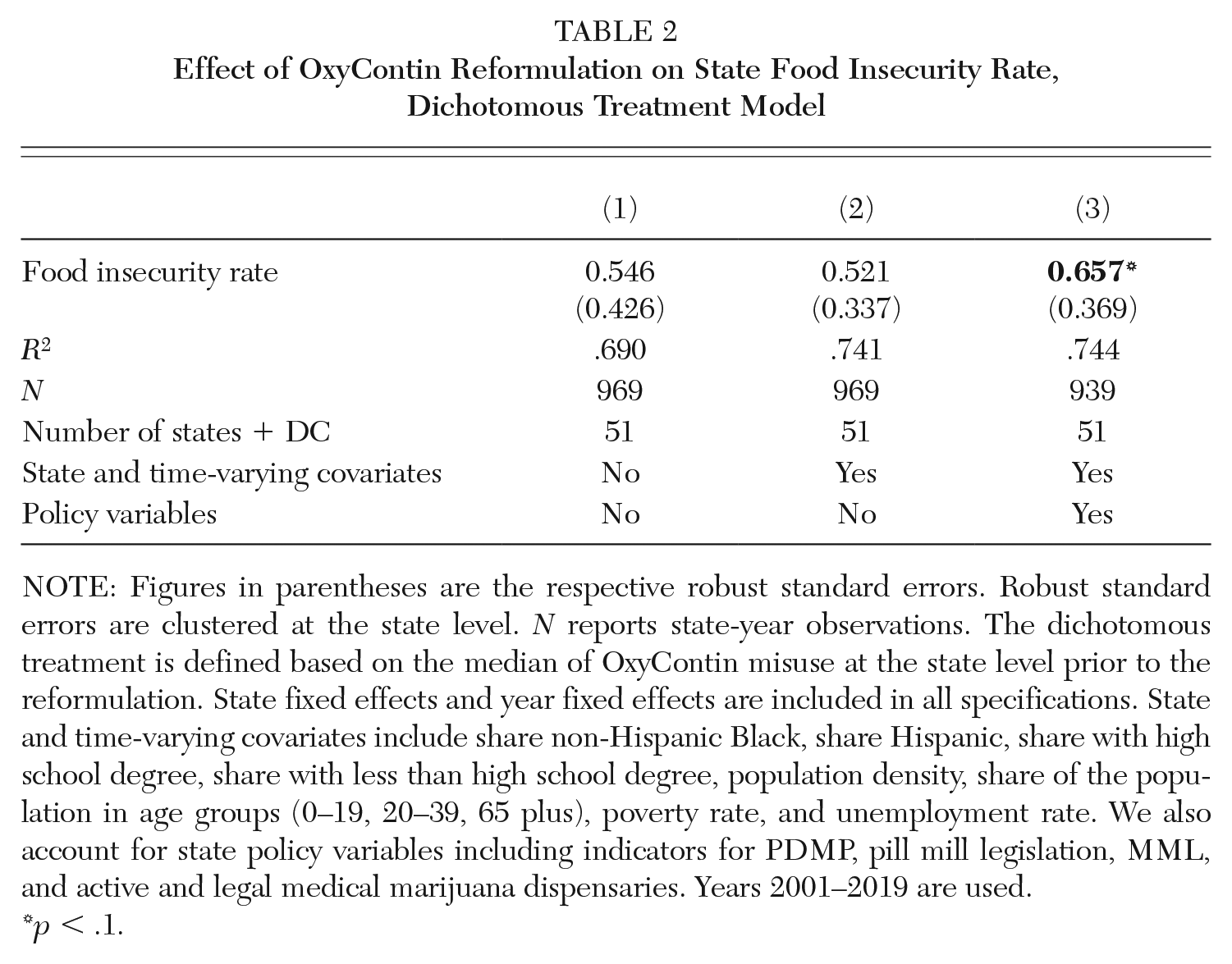
NOTE: Figures in parentheses are the respective robust standard errors. Robust standard errors are clustered at the state level. N reports state-year observations. The dichotomous treatment is defined based on the median of OxyContin misuse at the state level prior to the reformulation. State fixed effects and year fixed effects are included in all specifications. State and time-varying covariates include share non-Hispanic Black, share Hispanic, share with high school degree, share with less than high school degree, population density, share of the population in age groups (0–19, 20–39, 65 plus), poverty rate, and unemployment rate. We also account for state policy variables including indicators for PDMP, pill mill legislation, MML, and active and legal medical marijuana dispensaries. Years 2001–2019 are used.
p < .1.
Effect of OxyContin Reformulation on State Food Insecurity Rate, Trend-Break Model
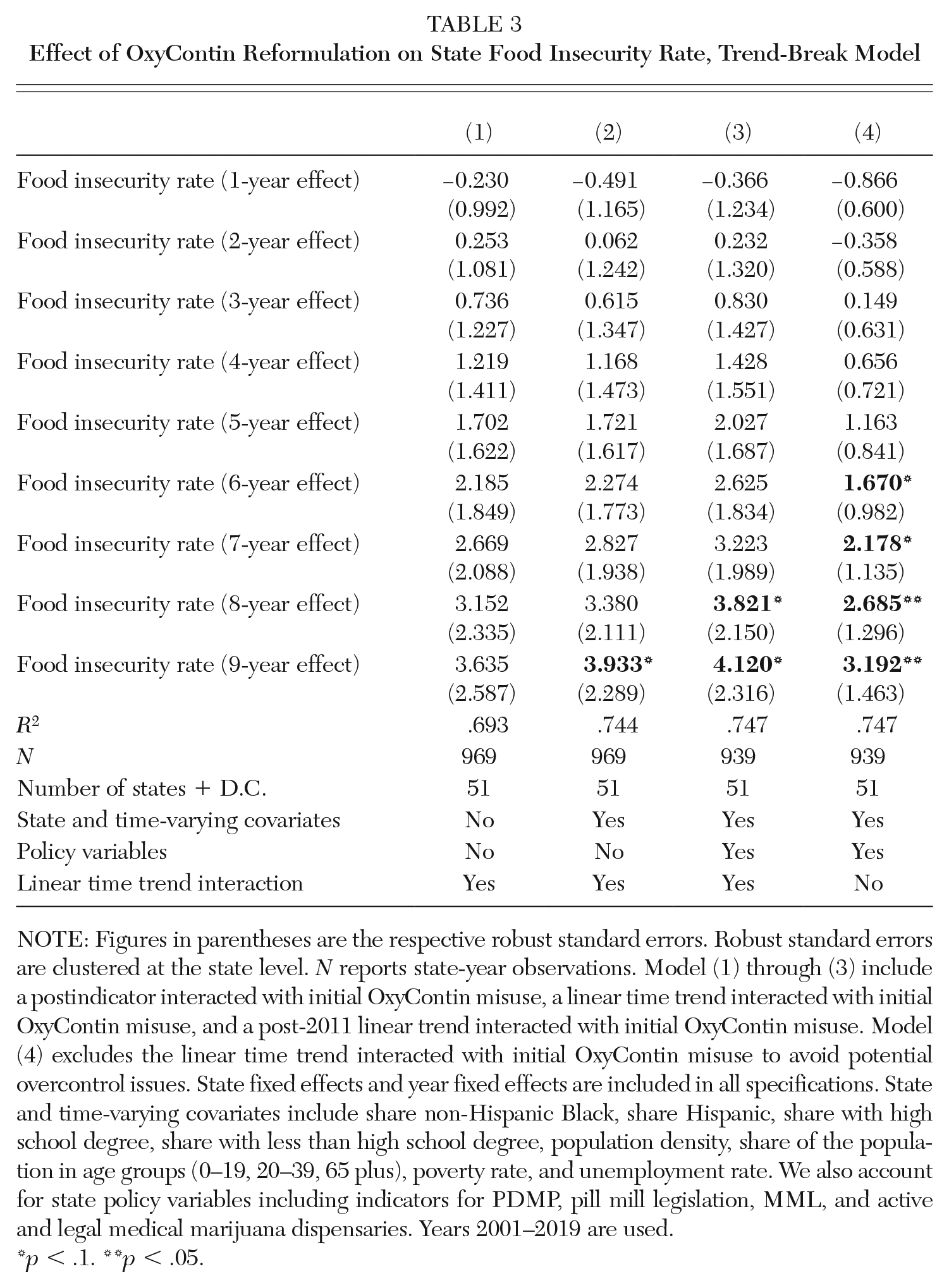
NOTE: Figures in parentheses are the respective robust standard errors. Robust standard errors are clustered at the state level. N reports state-year observations. Model (1) through (3) include a postindicator interacted with initial OxyContin misuse, a linear time trend interacted with initial OxyContin misuse, and a post-2011 linear trend interacted with initial OxyContin misuse. Model (4) excludes the linear time trend interacted with initial OxyContin misuse to avoid potential overcontrol issues. State fixed effects and year fixed effects are included in all specifications. State and time-varying covariates include share non-Hispanic Black, share Hispanic, share with high school degree, share with less than high school degree, population density, share of the population in age groups (0–19, 20–39, 65 plus), poverty rate, and unemployment rate. We also account for state policy variables including indicators for PDMP, pill mill legislation, MML, and active and legal medical marijuana dispensaries. Years 2001–2019 are used.
p < .1. **p < .05.
Furthermore, in models that control for the trend-break (Table 3), which allows the postformulation effect to vary over time, we find that reformulation has a positive effect on food insecurity by year 3 and that this effect is statistically significant by years 6, 7, 8, and 9, providing further evidence that drug reformulation increased food insecurity. In column 3 of Table 3, the estimate of 3.821 for the 8-year effect indicates that a 1 percentage point higher rate of initial OxyContin misuse rate increased the state food insecurity rate in 2018 by 3.821 percentage points (10 percent significance level); by 2019, the effect grew to an increase of 4.12 percentage points (10 percent significance level). The results for our sensitivity check without the linear time trend interaction shown in column 4 suggest more significant estimates in 2018 and 2019 and an earlier existence of the significant effects on food insecurity in 2016 and 2017. Specifically, a 1 percentage point higher rate of initial OxyContin misuse rate increased the state food insecurity rate by 1.670 percentage points (10 percent significance level) in 2016, 2.178 percentage points (10 percent significance level) in 2017, 2.685 percentage points (5 percent significance level) in 2018, and 3.192 percentage points (5 percent significance level) in 2019.
Discussion
We examined the connection between opioid use and food insecurity, finding support for the hypothesis that changes in family structure mediate the relationship between opioid-related death and food insecurity at the state level. However, we do not find empirical support that economic factors—state poverty rate and unemployment rate—mediate the relationship between opioid-related deaths and food insecurity, despite the fact that these economic factors are directly related to food insecurity. In sum, we find that the direct effect of opioid crises on food insecurity is mediated more by associated changes in family structure than economic factors. Yet, based on the model-adjusted R-squares shown in Table 1, our reduced-form models are only able to explain about half of the variation in state-level food insecurity even after including state and time fixed effects, which suggests that other factors are important as well. Certainly, more research is needed in this area.
Our analysis of the direct effect of drug reformulation on state food insecurity rates, which relies on prereformulation levels of prescription opioid use for identification, finds that state food insecurity levels in states with prescription opioid use above the national median prior to reformulation are, on average, 0.657 percentage points higher postreformulation. A 1 percentage point higher rate of initial OxyContin misuse rate increased the state food insecurity rate by approximately 2 percentage points by 6 to 7 years after reformulation and by 3 to 4 percentage points by 8 to 9 years after reformulation. In other words, after the 2010 reformulation of OxyContin that made the drug more difficult to abuse, we find that food insecurity increased in states with relatively higher rates of prior opioid abuse in the long run. This is a helpful addition to the empirical evidence finding unintended negative effects of drug reformulation on a long list of outcomes including child welfare caseloads, heroin deaths, and blood-borne diseases (Mackenzie-Liu 2021; Alpert, Powell, and Pacula 2018; Beheshti 2019; Evans, Lieber, and Power 2019).
In general, treatment effects occur quickly after a policy is implemented. The lagged treatment effects of drug reformulation on state food insecurity rates is likely explained by the slow shift of the demographic profile of opioid users towards the risk profile for food insecurity over time as the supply of opioids shifts from prescription drugs to street drugs, such as heroin (Schuler, Schell, and Wong 2021). The change in the demographic risk profile occurs slowly year by year, which may explain why the sign of our estimated effect of drug reformulation becomes negative after year 2, while the precision needed to reach statistical significance does not emerge until many years later.
A few limitations of this study should be noted. First, there are inherent limitations of the difference-in-difference model, and our analysis may not reveal the true causal effect of drug reformulation. During the drug reformulation implementation period, concurrent state policies or economic conditions might also have an effect on food insecurity. Even though we control for a variety of economic conditions and state policies, it is difficult to rule out the possibility that excluded factors from the model may bias our results. Second, this study uses data at the state level. It is likely that within-state heterogeneity is suppressed and that analysis at a different geographic level might yield different results. We focus on the state level given our high level of confidence in the indicators of both food insecurity and the location of opioid-related deaths. Third, the opioid crisis has unfolded over time and is now considered to have at least three distinct periods, and it is possible that the relationship with food insecurity has evolved as well. Although we ran a sensitivity analysis controlling for the first wave of opioid crisis from year 2001 to 2010, the shorter time periods for the second and third waves create sample size issues that prevent more robust consideration of the changing relationship between opioid deaths and food insecurity. We encourage future work to look more closely at these later waves of the opioid epidemic.
Finally, this analysis focuses on opioid-related deaths as an indicator of the severity and the family and community-level disruption caused by the opioid epidemic. While the measure is consistently available and measured throughout our time period, it is a more extreme measure of the opioid epidemic and is not without its disadvantages. Other studies focus on the opioid-abuse rate, access to opioid use treatment (or particular type of treatment), or side effects of the opioid epidemic (such as the number of births with neonatal abstinence syndrome), and it is likely that analysis on these different measures would capture a different slice of the relationship between food insecurity and the opioid epidemic that what is presented here.
Food insecurity is recognized by Healthy People 2020 as a key consequence of economic stability and a social determinant of health by the U.S. Department of Health and Human Services (2020). As such, food insecurity deserves special attention among the set of basic needs that are required to survive. Although we did not test it in our study, the idea that food insecurity leads to opioid use has been supported by many recent studies (Men et al. 2021; Men, Urquia, and Tarasuk 2021). However, it is likely that opioid-related deaths have a negative effect on other forms of material hardship. While Sullivan and Park (this volume) examine the connection between state prescription drug monitoring programs and homelessness, other studies should probe the relationship between opioid-use disorder and utility disconnections, transportation problems, and having an unmet health need. While material hardship domains are related, Heflin, Sandberg, and Rafail (2009) argue that each domain has unique cause and consequences. Furthermore, while the demographic risk profile of opioid users early in the epidemic, when a prescription was more often required for drug access, may have worked to limit the extent of food insecurity at the population level, drug reformulation has shifted the demographic profile of opioid users towards the group already more likely to be food insecure (Heflin 2017).
The evidence presented here that drug reformulation increased state food insecurity rates suggests that the opioid crisis might be increasing participation in food and nutrition programs designed to address food insecurity. We tested this hypothesis explicitly (in models not shown but available from the authors). When we ran parallel models to those shown here (replacing state food insecurity rates with population-weighted state SNAP caseloads as the outcome), we did not find any evidence of a direct or indirect effect of opioid-related mortality on SNAP caseloads in our first set of analysis. In addition, we found no relationship between drug reformulation and SNAP participation rates. However, given the strong secular downward trajectory in SNAP participation due to strong macroeconomic conditions in the entire postreformulation period, this result is not entirely surprising. SNAP is designed as a countercyclical program, and while opioid-related deaths have been increasing, it is likely that they are not high enough (yet) to overcome the effect of strong macroeconomic conditions running up to the 2020 COVID pandemic. However, our analysis was limited to SNAP alone and did not examine the relationship between opioid-related deaths or drug reformulation and WIC (Special Supplemental Nutrition Program for Women, Infants, and Children) participation or school meal participation. Given our findings regarding food insecurity, future work should explore the relationship between opioid use and mortality with the broader set of food and nutrition programs.
Given the evidence that food insecurity might also be a cause of opioid-related drug use, it is important to understand the extent to which opioid use, misuse, and mortality are related to state-level policies that make SNAP participation less burdensome and more accessible for individuals. Given the age distribution of opioid use, it may be helpful to focus attention on policies that target access to public supports for able-bodied adults without dependents (termed ABAWDs in the literature). For example, some states aggressively limit access to SNAP for ABAWDs, while others provide more generous access for less severe economic conditions. In addition, half of states (n = 25) still offer cash benefits through what is called General Assistance Programs, although the size of the benefit is quite small: most states with programs offer benefits below half the poverty line (Schott 2020). Future research should explore if states that provide a more robust safety net have a lower rate of opioid-related mortality and higher rates of success in drug abuse treatment programs.
Finally, this study suggests that the effects of the opioid crises are far reaching and will often overlap with existing points of vulnerability in U.S. society. Given our finding that drug reformulation, a policy designed to limit the opioid crisis, increased food insecurity, public policy must get much more creative and consider not only the direct addiction-related health needs of the opioid user but look at the user as a whole person and consider their food, housing, transportation, and other ancillary needs. Finally, public policy must also recognize that opioid users are embedded within families and communities and that their drug use causes disruptions that extend far beyond the users themselves. Failure to address these needs are likely to cause the cycle of substance use and food insecurity to repeat itself.
Footnotes
Appendix
Variable Descriptions and Data Sources

| Variable | Description | Data Source |
|---|---|---|
| Opioid-related mortality | Opioid-related death rate per 100,000 | CDC WONDER file |
| Food insecurity | State-year level food insecurity, the fraction of individuals who meet the definition of food insecure | UKCPR |
| Poverty rate | State-year poverty rate | UKCPR |
| Unemployment rate | State-year unemployment rate | UKCPR |
| Population | Annual estimates of the resident population | UKCPR |
| Area | Area by state (square miles) | U.S. Census Bureau |
| Population density | Population per square mile | UKCPR & U.S. Census Bureau |
| Share non-Hispanic Black | Share of population for non-Hispanic Black | U.S. Census Bureau |
| Share Hispanic | Share of the population for Hispanic | U.S. Census Bureau |
| Share of the population in age groups (0–19, 20–39, 65 plus) | Share of the population for age ≤19, age 20–39, age ≥65 | U.S. Census Bureau |
| Share with high school degree | Share of the population with only a high school degree/GED | IPUMS |
| Share with less than high school degree | Share of the population with less than high school degree/GED | IPUMS |
| Share of the population with married-couple households | Share of the population with married-couple family households | IPUMS |
| Share of the population with single-person households | Share of the population with living-alone households | IPUMS |
| Share of the population with female-headed households | Share of the population with female householder | IPUMS |
| Share of the population with male-headed households | Share of the population with male householder | IPUMS |
| Share of the population with multigenerational households | Share of the population with multigenerational households (≥3 generations) | IPUMS |
| Initial OxyContin misuse rate | Share of the population reporting misuse of OxyContin prior to the reformulation | NSDUH; Alpert, Powell, and Pacula (2018) |
| Prescription drug monitoring program (PDMP) | Indicator for PDMP adoption | Prescription Drug Monitoring Program Training and Technical Assistance Center; Prescription Drug Abuse Policy System; Buchmueller and Carey (2018); Alpert, Powell, and Pacula (2018) |
| Pill mill legislation | Indicator for whether the state has pill mill legislation | Buchmueller and Carey (2018); Alpert, Powell, and Pacula (2018); Rutkow, Vernick, and Alexander (2017) |
| Medical marijuana law (MML) | Indicator for whether the state has a medical marijuana law (MML) | Powell, Pacula, and Jacobson (2018); Alpert, Powell, and Pacula (2018); IIHS |
| Active and legal medical marijuana dispensaries | Indicator for the presence of active and legal medical marihuana dispensaries | Powell, Pacula, and Jacobson (2018); Alpert, Powell, and Pacula (2018); webpage searches |
NOTE: CDC = Centers for Disease Control and Prevention; WONDER = Wide-Ranging Online Data for Epidemiologic Research; UKCPR = University of Kentucky Center for Poverty Research National Welfare Data; IPUMS = Integrated Public Use Microdata Series; GED = general educational development; NSDUH = National Survey on Drug Use and Health; IIHS = Insurance Institute for Highway Safety.
Notes
Colleen Heflin is an associate dean and professor in the Maxwell School of Citizenship and Public Affairs at Syracuse University. Her research focuses on food insecurity, nutrition and welfare policy, and the well-being of vulnerable populations. She has published over 70 peer-reviewed academic articles and engages with policy-makers at the federal, state, and local level to redesign programs and improve accessibility.
Xiaohan Sun is a postdoctoral scholar working with Colleen Heflin in the Maxwell School of Citizenship and Public Affairs at Syracuse University. Her research focuses on child well-being and health, policy analysis, economics of education, and applied microeconomics. Xiaohan received her PhD in agricultural and resource economics from the University of Connecticut.