



Abstract
Civic education is associated with the development of democratic capacity. However, this concept is measured using a limited battery of metrics (e.g., trust in government) that do not adequately capture the political sentiments of racially marginalized youth. Drawing from conversations with Chicago high school students and their teachers, I argue that democratic capacity should comprise a broader set of attitudes and behaviors, including political empowerment and acts of public voice. In the process, I identify one pedagogical technique associated with the development of empowerment: historically grounded conversations about politics that validate students’ distrust of government. Nationally representative survey data suggests that civic learning experiences of this kind are associated with feelings of political empowerment and that empowerment is associated with multiple forms of political participation, particularly among Black and Latinx youth. Overall, this study provides a path forward for those interested in reimagining civic education in the U.S.
Civic education courses are believed to contribute to democratic capacity—the knowledge, attitudes, skills, and behaviors that allow young people to participate in politics (Levinson 2012)—but their effectiveness has traditionally been measured using a limited battery of systems-justifying metrics such as trust in government and external efficacy (Jost and van der Toorn 2012). But should young people, and particularly young people of color, be taught to trust and believe in the responsiveness of government? I argue that such an approach to civic education risks invalidating the lived experiences of many racially marginalized youth, who may have good reasons for distrusting government (Cohen 2012; hooks 1994; Junn 2004; Weaver and Geller 2019). To address this concern, this article presents an expanded conception of democratic capacity, one that takes into account a broader set of attitudes and behaviors. This form of democratic capacity, I argue, can foster a sense of empowerment among young people to take political action in ways that address their distrust and cynicism toward government.
The article proceeds in three parts. First, drawing on data from focus groups with high schoolers in Chicago, I highlight the shortcomings of existing conceptions of democratic capacity and argue that it should comprise a much broader set of attitudes and behaviors, including feelings of empowerment and acts of public voice. An approach to civic education that seeks to foster this broader democratic capacity is particularly meaningful for racially marginalized youth who have legitimate reasons for distrusting political institutions and who seek to reimagine democracy.
Second, I draw on in-depth interviews with high school social studies teachers in Chicago to highlight one pedagogical technique associated with the development of this expanded conception of democratic capacity: historically grounded conversations about politics that validate and contextualize students’ distrust of government. Enacting this pedagogical approach answers calls to more rigorously assess how various social contexts shape how discourse manifests in the classroom (Barber, Clark, and Torney-Purta 2021), especially for marginalized youth (Rubin, El-Haj, and Bellino 2021).
Third, I assess this theory of democratic capacity using a national-representative survey of young adults. I find that historically grounded conversations about politics are associated with feelings of political empowerment and that empowerment is associated with multiple forms of political participation, particularly among Black and Latinx youth.
Taken together, the evidence presented in this article offers one potential path forward for those interested in reforming civic education courses in the U.S. By building lessons around the political concerns of racially marginalized youth and highlighting the innovative teaching practices already adopted by social studies teachers, we can forge civic learning spaces that validate multiple forms of democratic capacity, including political empowerment.
Rethinking Democratic Capacity
Social studies courses are traditionally evaluated by examining how they impact democratic capacity—the knowledge, skills, attitudes, and behaviors that allow individuals to effectively participate in public life (Levinson 2012). This work draws heavily from the civic voluntarism model, which suggests that access to important resources, including education, is a critical factor in whether individuals participate in politics (Verba, Schlozman, and Brady 1995). The core idea is that schools can help develop the knowledge, attitudes, skills, and behaviors that will allow young people to make informed decisions at the ballot box once they reach voting age and the literacy and public-speaking skills that will allow them to make their positions known in messages to elected officials and statements to their local city council (Addonizio 2011; Gill et al. 2018; Weinschenk and Dawes 2022). For this reason, social scientists, educational organizations, and school districts oftentimes gauge the success of social studies courses by employing key measures used by the civic voluntarism model, including trust in government, external efficacy, and intent to vote (Campbell 2008; Dassonneville et al. 2012; Holbein and Hillygus 2020; Martens and Gainous 2013; Torney-Purta 2002). While there are certainly democratic benefits associated with each of these outcomes, I argue that they represent a single dimension of democratic capacity, one that captures a limited set of systems-justifying dispositions. System-justification theory suggests that individuals are oftentimes motivated to defend existing social, economic, and political arrangements that do not serve marginalized communities (Jost and van der Toorn 2012). Trust in political institutions and external efficacy—one’s belief in the responsiveness of government—are systems-justifying metrics. Similarly, while voting certainly represents one way for people to try to influence policy and challenge the status quo (Verba, Schlozman, and Brady 1995, 358–61), it also represents an institutionalized form of participation managed by the government. Thus, the choice to cast a ballot is motivated, at least in part, by a belief that the existing institutional arrangements are legitimate. I argue that voting represents one tool that can be leveraged alongside other forms of political participation to deliver structural change. However, current conceptions of democratic capacity overlook the multifaceted ways in which young people may seek to influence the political system.
That we measure this single dimension of democratic capacity within the realm of civic education is troubling for at least three reasons. First, by taking these outcomes as normatively desirable, we assume that young people should trust and believe in the responsiveness of government—when they may have legitimate reasons not to do so (Cohen 2012; Junn 2004). Second, structuring civic education courses around the importance of voting overlooks the fact that not all students will be U.S. citizens when they turn 18 and that access to the ballot box is constrained in many communities throughout the country (Barreto, Sanchez, and Walker 2022; Brady and McNulty 2011; Burch 2013; Sobel and Smith 2009). Finally, educators and curriculum developers are frequently trained to “backwards plan,” determining the desired outcomes of instruction before developing daily lessons (Wiggins and McTighe 2005). If systems-justifying metrics such as trust, external efficacy, and voting serve as the foundation upon which we develop civic education curricula, we potentially miss out on important civic learning opportunities where students are encouraged to channel feelings of distrust and cynicism into multiple forms of political participation, including acts of public voice: “the ways citizens give expression to their views on public issues,” including activities such as protests and boycotts (Cohen 2012; Zukin et al. 2006, 54). Learning experiences such as these not only allow students to learn about established, institutionalized processes such as voting but invite them to reimagine the potential of democratic institutions.
Centering the insights of students
During the winter of 2020, I conducted a series of focus groups with 24 high school students at four schools in Chicago. The primary goal of these focus groups was to understand how young people respond to different accounts of American history presented within social studies textbooks (Nelsen 2023).
1
At the end of each focus group, I asked students to share their thoughts about how civics, government, and American history courses could be improved. A common theme that emerged from these conversations was a sense of frustration with idealized accounts of American government that highlight the responsiveness of political institutions and the effectiveness of a limited set of political processes. Jasmine,
2
a 17-year-old Black student, shared a particularly prominent point of frustration regarding presidential elections: how can someone receive the most votes in an election and not become president? They need to explain elections and the Electoral College better. My eighth grade [civics] teacher at [another school] didn’t do that. Hillary Clinton had the most votes but didn’t become president because of the Electoral College? Like, how confusing is that? It really didn’t make sense to me. I was like why vote? My voice individually is not being heard and no one answered my questions [in my civics class] so I just, I don’t know. It made me not want to be political.
At first glance, one might conclude that Jasmine’s civic education class would benefit from a more in-depth discussion of the Electoral College. While this may be true, her response includes an important reflection: why vote or “be political” if individuals feel they are not being heard in the process? Jasmine was not alone in sharing this sense of cynicism regarding the power of voting. Julia, a 17-year-old white student attending an affluent school in downtown Chicago, provided a similar response: Let me first say before everyone freaks out, I’m going to show up to vote on Election Day. I know that’s super important, but I don’t think I’m going to change the world by doing that . . . by choosing between two candidates that probably won’t do anything for me. . . . So, I like this idea of people working together to demand something. Like, the only time things really change is when a group of people stands up and demands something. I think I feel more powerful when I am speaking up about something I believe in.
Jasmine and Julia’s responses are reflective of an ongoing trend in American politics: young people are simultaneously participating in politics at record rates while distrust toward government is at an all-time high (CIRCLE 2021; Dalton 2015; Pew Research Center 2021). How might we approach civic learning in a way that makes room for this joint distrust and political engagement? My conversations with students again shed light on this question.
The students I spoke with frequently expressed a sense of political empowerment, that is, a desire or calling to participate in politics, while harboring strong feelings of distrust toward political institutions. For example, Julia acknowledges that voting represents one important political tool but feels that real change happens when a group of people works together to demand something by using acts of public voice such as protests or boycotts (see Zukin et al. 2006). These feelings frequently emerged alongside comments about how history can inform our understanding of contemporary challenges. 3 Misael, a 17-year-old Mexican American student, and Jasmine both make strong cases for a historically grounded approach to civic education.
I believe civics makes a huge impact on politics. It helps people first realize what is the issue and then look back. How did this come about? What are some things that have already been done to try to address the issues? Then we can look into those solutions people came up with and say, “Okay, yes this was good. Did that actually address the problems they needed to? Can it work now? If not, let’s adapt.” People actually have to have a firm understanding of that. Then they can go into politics and determine a better solution.
I think civics shapes our involvement in politics. Learning about all the wrong that has been done in the world . . . I think that makes me want to get more involved in making a change and finding a way for things to be equal and just try to fix it. I know it’s impossible to fix all the wrong in the world, but I want to try to make up for it in any way that I can and I feel like social studies, us being able to learn about that and understand all of that, it really leads to a better pathway of me being able to go out in the world and eventually make a change.
These reflections demonstrate that there is an important (and largely untapped) dimension of democratic capacity that can be developed in civic education courses. Across racial and ethnic groups, students recognize that institutionalized forms of political participation such as voting are an important, albeit imperfect, avenues for pursuing political change. For many students, the perceived effectiveness of voting is diluted by legitimate feelings of distrust toward government. Yet their responses suggest that historical examples of collective action can help us make sense of contemporary political challenges. In turn, this increased understanding contributes to feelings of empowerment—a desire to participate even in the face of daunting political challenges (see also Freire 2018).
I contend this attitude is distinct from other commonly assessed political attitudes and dispositions, such as efficacy or grit. Political empowerment does not require that students believe in the responsiveness of institutions (external efficacy). Moreover, people who are politically empowered do more than employ grit while navigating hurdles at polling stations (see Holbein and Hillygus 2020; García Bedolla 2005); they also seek to challenge or fundamentally reform those institutions. 4 In the next section, I build on students’ insights about the value of historically grounded conversations as a means of cultivating political empowerment, drawing further from hundreds of hours of classroom observations and 26 in-depth interviews with Chicago-area social studies teachers.
Broadening Our Conception of Open Classroom Environments
Open classroom environments consistently rank as one of the most effective ways to foster democratic capacity in classrooms (Campbell 2008; Gainous and Martens 2012; Hess 2009; Hess and McAvoy 2014; Kawashima-Ginsberg and Levine 2014; Martens and Gainous 2013). For example, one analysis of 4,000 Chicago high school students found that discussions about how to best address community challenges were associated with stronger commitments toward civic participation among students (Kahne and Sporte 2008, 754). Discussions of this kind are certainly akin to the solutions-oriented civic learning experiences students discussed in the focus groups. However, at present, the study of open classroom environments largely overlooks the importance of historical context during in-class discussions about current events (e.g., Campbell 2008; Dassonneville et al. 2012; Torney-Purta 2002). When Jasmine, the 17-year-old student previously quoted, expressed a desire to avoid politics due to her frustration with the Electoral College, civics teachers have a unique opportunity to facilitate a conversation that leverages history to validate Jasmine’s frustration and use it as an opportunity for students to consider whether existing political processes and institutions are working. While observing classrooms and interviewing educators throughout Chicago, I witnessed phenomenal social studies teachers navigating and facilitating historically grounded conversations of this kind. 5
Historically grounded conversations and political empowerment
In my classroom observations and interviews with teachers, I found that historically grounded conversations often emerge organically, when teachers table their prepared lessons and lean into topics of conversation that they perceive to be meaningful (see also hooks 1994). For example, Ms. Weiss, 6 a ninth-grade social studies teacher in suburban Chicago, discussed her decision to use class time to discuss the murder conviction of Jason Van Dyke, the white Chicago police officer who shot Laquan McDonald—a 17-year-old Black boy—sixteen times. The murder and subsequent cover-up by the Chicago Police Department were widely covered in the Chicago area. In her reflection, Ms. Weiss mentions not only the importance of discussing the headline with her students but also the need to draw historic connections to the legacy of racism within the American criminal justice system.
Sometimes there are just things that as a teacher you can’t ignore, you can’t pretend like it’s not happening. For instance, when the verdict was going to come down on Jason Van Dyke. Laquan McDonald is from the West Side. His cousin goes to our school. A lot of people knew him or knew people that knew him . . . it wasn’t just some kid on the news for my students. So, we definitely talked about that, and it didn’t necessarily connect with whatever curriculum I was teaching at that point. . . . Sometimes there are just things that you can’t ignore, right? So, instead I let my students talk about what was on their mind and would try to bring them back to some of the things we had already discussed. We had recently watched the 13th documentary, which really dives into racism within the criminal justice system in the United States. So, my students were able to say, “Hey, all of this anger and pain I’m feeling is part of a much bigger story.” It’s obviously a painful history, but I think that was a useful topic to bring up while discussing what was happening that day.
Other educators were even more explicit about connecting these conversations to political action. Mr. Miller, a 24-year teaching veteran within Chicago Public Schools, explains how he managed to use the 1848 Seneca Falls Convention, the sexual assault allegations that emerged during Brett Kavanaugh’s Supreme Court confirmation hearing, and gender inequities at school to facilitate an in-class conversation about political power.
We had just talked about the Seneca Falls Declaration, and there’s all this stuff about gender discrimination in the news. There’s the MeToo Movement. There’s Kavanaugh. You have a lot of stuff you are supposed to cover in one day, but you see these terrible headlines and see how they tie into the Seneca Falls Declaration. And as a teacher you say, “Okay. You know what? We’re going to talk more about this in a big group for 40 minutes now.” And I try to take this news and this history and connect it to what I think is one of the bigger problems on our campus: there not being enough bathrooms for female students, even though [we are now] now a majority female school. And I use these current events, and history, and inequalities at [school] to say, “Let’s do something about it. Protest. Bring your concerns to the principal. Bring your concerns to the administration. If they respond, great. If they don’t, protest.” I would say to the kids, “[Our school] is ranked [as a top] high school in the State of Illinois. You have power. You’re making a lot of administrators look good. You’re making a lot of [Chicago Public Schools] officials look good because of the wonderful job you’re doing here. The least they could do for you is give you an opportunity to go to the bathroom, and not have to wait in line for 20 or 30 minutes or be late for class.” So, I feel a need to have these conversations where students understand that they have power, and that they need to be courageous enough to use that power.
These educators’ reflections enrich our understandings of open classroom environments. They are not only committed to providing space for their students to share their ideas about current events but also make an additional effort to connect these conversations to a broader historical context. Conversations of this kind may have the potential to help students better understand why certain headlines elicit such a strong emotional response. These conversations are not demoralizing. Rather, they allow students to connect contemporary political challenges to a broader historical legacy and foster empowerment in the process.
During my interviews, teachers frequently discussed the lasting impact of their own high school social studies teachers on their socialization (Sapiro 2004). On several occasions, I was even able to validate their descriptions because I had serendipitously observed the classrooms they were describing. The key takeaway for the purposes of this study is that historically grounded conversations frequently emerged as source of political empowerment. For example, Ms. Ocampo, a student teacher and immigrant rights activist in Chicago, discussed the impact of her high school history teacher on her ability to navigate the college application processes as an undocumented student and her desire to become more politically engaged. Without knowing I had observed her former teacher’s classroom on multiple occasions, she linked her politicization to conversations about current events in her AP U.S. History class. Specifically, she describes developing an understanding of the dynamic nature of history through in-class discussions about the 2014 Black Lives Matter protests in Ferguson, Missouri, following the police killing of Michael Brown, a Black teenager.
When I was in my junior year of high school, I was in Mr. Williams’ AP U.S. [History] class. The summer prior, before coming to school, was when everything happened in Ferguson. A lot of things were happening politically, including the murder of Michael Brown, but I guess I really didn’t care; I wasn’t really exposed to a lot of that. I didn’t know how to think about these things critically, but when I got into Mr. Williams’ classroom, . . . he showed me how history is interactive and part of everything we are doing today, how it connects to us as people, why doing identity work in AP U.S. History is important, and why we need to talk about current events and social justice. I just never knew teachers could do this. I never knew that education could do this, and that was super eye-opening for me. . . . I couldn’t tell you how I did on the AP U.S. History exam, but I remember those experiences and I think that was the moment when I first became politicized. I knew at that moment that I wanted to pursue social justice work.
Examining the findings from the student focus groups, teacher interviews, and classroom observations, I saw three major themes emerge. First, many young people want to participate in democratic processes while simultaneously harboring strong feelings of distrust toward political institutions. Second, these feelings of empowerment are frequently overlooked within common understandings of democratic capacity and represent an untapped dimension of civic learning. Third, political empowerment may be fostered through historically grounded conversations about politics where teachers help students make connections between historical acts of collective action and contemporary political frustrations. The insights gleaned from these conversations can help foster a desire to pursue multiple participatory avenues in order to reimagine American democracy. To assess whether such a trend is observable within a broader subset of the population, I conduct a final set of analyses that assess these relationships using a nationally representative survey of young adults.
Looking beyond Chicago
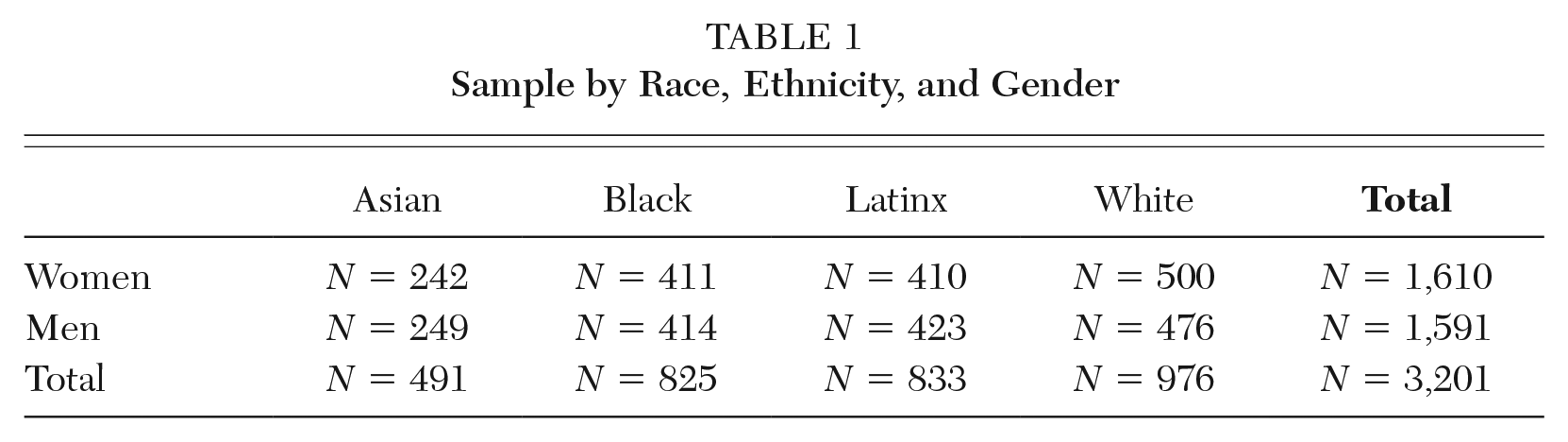
The analyses highlighted below use data from the GenForward Survey fielded in August 2021 by NORC (National Opinion Research Center) at the University of Chicago. The survey asked young adult respondents (aged 18–36) about a variety of topics, including details about their high school social studies courses (GenForward Suvey 2021). While these social studies education questions were retrospective in nature—asking some respondents to think about educational experiences that occurred several years prior—they substantiate the qualitative data discussed above. Moreover, the GenForward data are particularly helpful for the purposes of this study in that it contains oversamples of Black, Latinx, and Asian youth, thus allowing me to disaggregate results by ethnoracial groups (Masuoka and Junn 2013). A breakdown of this sample is summarized in Table 1.
Sample by Race, Ethnicity, and Gender
Independent variables
The GenForward Survey collected data for two independent variables that aimed to understand a young person’s recollection of their teachers’ pedagogical practices. The first question asked whether respondents had high school social studies teachers who facilitated historically grounded conversations about politics where they were provided the space to make sense of modern political challenges through a historical lens. Participants were asked the following: “How much do you disagree or agree with the following statement? My social studies teacher(s) pushed me to use history as a way to better understand political challenges impacting my life (1 = strongly disagree | 5 = strongly agree).”
The second question aimed to assess whether participants had social studies teachers who used critical content in their classroom—narratives that center the grassroots collective action of marginalized groups. Participants responded to the following question: “How much do you disagree or agree with the following statement? My social studies teacher(s) taught about individuals and groups who used protests, boycotts, and other forms of political activism to fight for what they believed in (1 = strongly disagree | 5 = strongly agree).” Since recent work has shown a strong link between content of this kind and political participation (Nelsen 2021a), it is important to account for this as confounding factor.
Dependent variables
In the forthcoming analyses, I examine the extent to which these pedagogical variables—historically grounded conversations about politics and critical content—are associated with three categories of dependent variables. The first is a novel measure of political empowerment. Survey participants were asked to respond to the following question: “How much do you disagree or agree with the following statement? Even if government doesn’t respond to my concerns, it’s important to keep fighting for the things I believe in (1 = strongly disagree | 5 = strongly agree).” 7
The second set of dependent variables includes four self-reported acts of public voice. Public voice refers to the ways in which individuals express their political views (Zukin et al. 2006). Respondents were asked whether they had shared news on social media, expressed an opinion on social media, signed a petition, or contacted a public official over the course of the past 12 months (0 = No | 1 = Yes).
Finally, individual respondents were matched to voter registration and turnout data. While I did not generate formal hypotheses for acts of political engagement, I include these items, first, to examine the relationship between empowerment and more traditional forms of participation and, second, to preemptively address concerns about the limited utility of self-reported participation data. There are two validated variables I use in this final set of analyses: validated voter registration and voting in the 2018 midterm election. Including these more traditional participatory measures alongside acts of public voice allowed me to explore the multifaceted ways in which individuals try to influence politics.
I conduct three sets of regression analyses in order to highlight the socialization process described above (Pedagogy → Empowerment → Participation). 8 The first category examines whether historically grounded conversations about politics are associated with political empowerment after accounting for a number of demographic factors, other commonly assessed political attitudes, and state fixed effects to account for state-by-state variations in civic education curricula and voting laws. The second category tests the relationship between political empowerment and various acts of public voice: sharing news or expressing an opinion online, signing a petition, and contacting a public official. The variables included in each model were standardized using a 0 to 1 scale to allow for easier comparisons between coefficient sizes. Since existing research documents the heterogenous effects of civic education across racial and ethnic groups, each model is conducted separately for Asian, Black, Latinx, and white respondents (Campbell and Niemi 2016; Nelsen 2021a, 2021b; Niemi and Junn 2005).
Is pedagogy associated with political empowerment?
First, I assess whether historically grounded conversations about politics are associated with political empowerment across racial and ethnic groups. As demonstrated by the ordinary least squars (OLS) models in Table 2, this teaching technique is strongly and significantly associated with feelings of political empowerment across racial and ethnic groups (p < .01). The comparatively large coefficient values for this pedagogical technique highlight the important role of a quality high school social studies education in cultivating feelings of political empowerment. In fact, historically grounded conversations about politics are more strongly associated with political empowerment than are several important demographic characteristics (including age, sex, income, educational attainment, and citizenship status) or commonly assessed political attitudes such as linked fate and political efficacy (Dawson 1995; Verba, Schlozman, and Brady 1995; White and Laird 2020).
OLS Models by Race and Ethnicity

NOTE: Coefficients included in Table 2 have been standardized using a 0 to 1 scale to allow for ease of comparison.
p < .1. **p < .05. ***p < .01.
These analyses also reveal a number of interesting relationships between demographic factors and political attitudes that future work on civic education and political empowerment should explore. Namely, the belief that it is important to keep fighting for the things you believe in even if government fails to respond to your needs is most pronounced among Black women (p < .01) and Latinas (p < .05). This finding is not particularly surprising given the long history of political activism among women of color in the United States (Berry and Gross 2020; Davis 1983). Moreover, it is possible that young women of color are particularly responsive to relational pedagogical techniques within the classroom, including historically grounded conversations. After all, many of the educators who utilized these techniques in the classroom were women and people of color who rooted the practice in their own political activism. Other demographic factors and political attitudes are strongly associated with political empowerment as well. While there appear to be multiple sources of political empowerment, comparing the coefficient sizes of each variable suggests that the dynamics of one’s high school social studies courses—and historically grounded conversations in particular—are important factors within processes of political socialization.
Is political empowerment associated with acts of public voice?
Next, I examine whether political empowerment is associated with four acts of public voice: petition signing, sharing news on social media, expressing a political opinion online, and contacting a public official. As demonstrated by the probit models summarized in Figure 1, political empowerment is strongly associated with participating in acts of public voice across racial and ethnic groups even after accounting for a number of demographic factors and political attitudes. The results demonstrate that political empowerment is significantly associated with expressing an opinion (p < .01) or sharing news (p < .01) on social media, signing a petition (p < .01), and contacting a public official (p < .01) among white youth. Among Latinx youth, political empowerment is associated with expressing an opinion (p < .05) or sharing news (p < .01) on social media and signing a petition (p < .01). Political empowerment is associated with petition signing (p < .01) and sharing news on social media (p < .01) among both Asian and Black young adults. However, the models summarized in Figure 1 mask some nuance that is worth discussing.
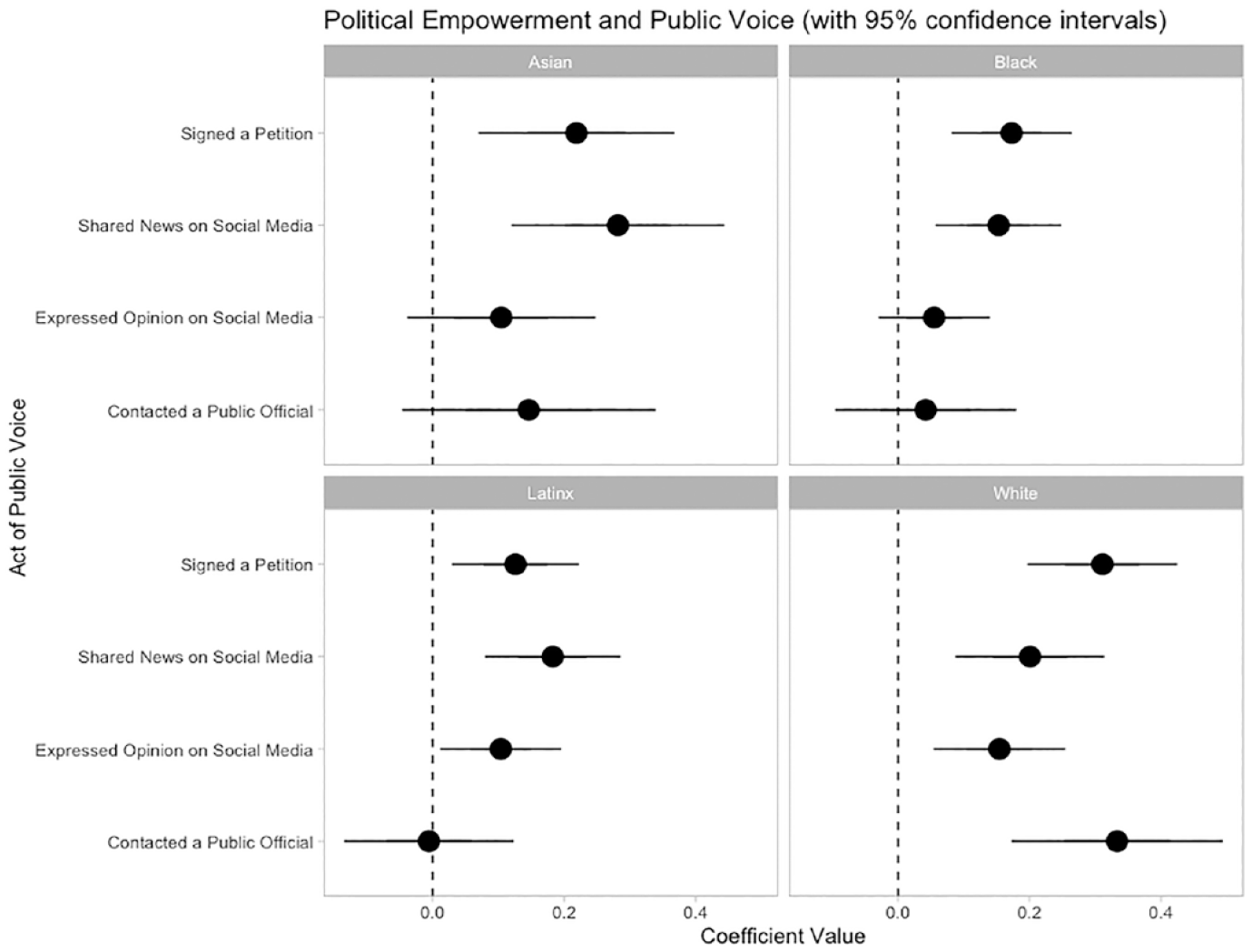
Political Empowerment and Acts of Public Voice
While empowerment is strongly associated with petition signing and sharing news online, there is one variable that serves as a more powerful predictor of these outcomes: identifying as female. 9 Future work should more thoroughly assess the intersection of both race and gender when exploring how to foster empowerment within civic learning spaces (see Bos et al. 2022). Similarly, political efficacy is more strongly related to two of the public voice outcomes: expressing an opinion online and contacting a public official. This finding reinforces the central thesis of this article: it is important to adopt a multidimensional conception of democratic capacity—one that accounts for both efficacy and empowerment—to comprehensively prepare students for full engagement in public life. Detailed regression analyses summarized in Figure 1 are included in Tables 2 to 5 in the online appendix.
What about political engagement?
Finally, I leverage validated voter registration and turnout data to examine whether historically grounded conversations are associated with more traditional measures of democratic capacity. 10 Again, significant relationships emerge for Black and Latinx youth specifically. The probit models in Figure 2 demonstrate that historically grounded conversations are significantly associated with both validated voter registration (p < .05) among Black youth and 2018 voter turnout among Latinx youth (p < .05). Among Black youth, historically grounded conversations emerge as the only significant factor associated with validated voter registration (see column 1 of online appendix Table 7). Meanwhile, educational attainment jumps out as the primary factor associated with validated voter 2018 turnout among Black youth (see column 2 of online appendix Table 7). Contrastingly, historically grounded conversations emerge as a factor strongly associated with Latinx voter turnout in 2018, albeit not to the same degree as educational attainment (see column 4 of online appendix Table 7).
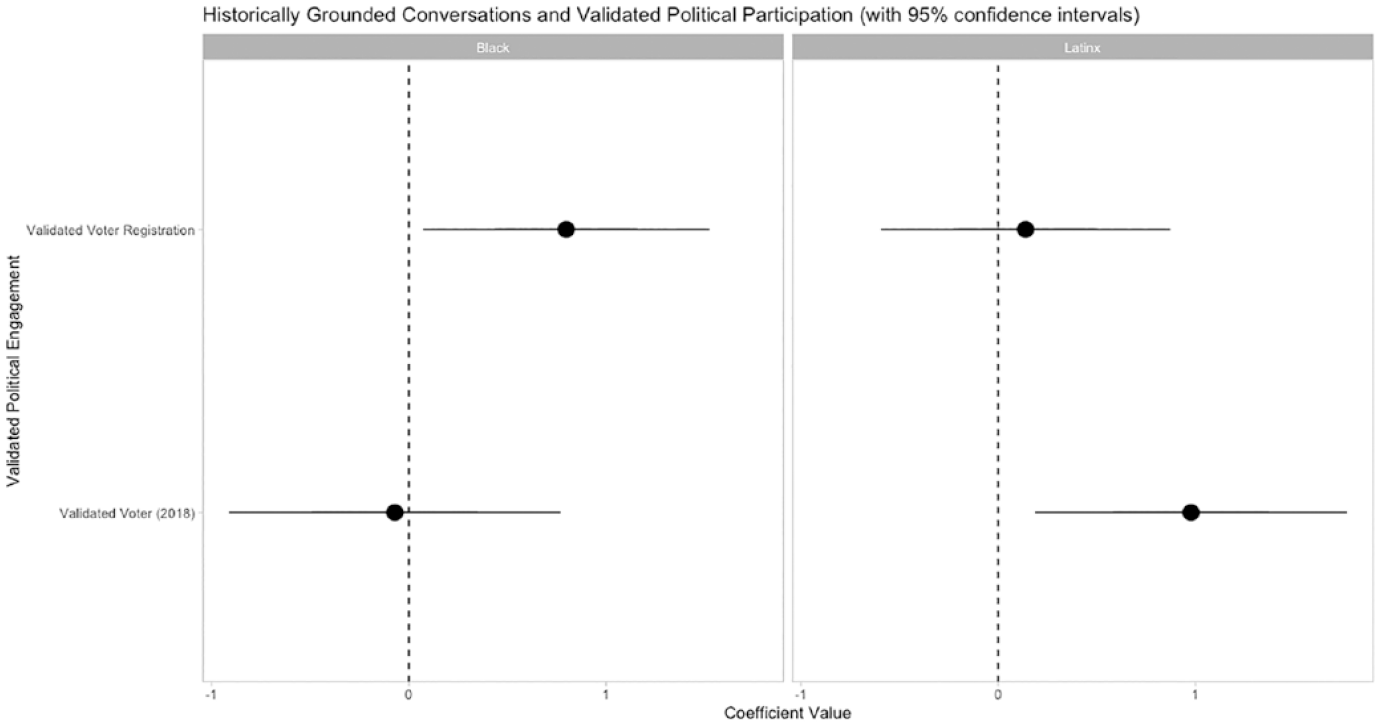
Historically Grounded Conversations and Validated Political Participation
Though I theorized that historically grounded conversations’ emphasis on grassroots political action and collective action narratives is particularly adept at pushing young people to engage in acts of public voice, the results presented here suggest that content of this kind also influences political engagement (see also Nelsen 2021a). This is not particularly surprising in light of work addressing the interconnectedness of public voice and electoral politics among Black Americans specifically (e.g., Brown and Reed 2020; Morris 1986). This additional set of analyses also adds a degree of confidence to the self-reported behavioral findings presented earlier in this article; historically grounded conversations appear to be significantly associated with electoral participation, at least among Black and Latinx youth.
Conclusion
Civic education advocates have emphasized the need to reform social studies curricula and teaching practices for decades (Holbein and Hillygus 2020; Levinson 2012; Niemi and Junn 2005; Rebell 2018). Research has consistently found that civic education courses frequently fail to fulfill their most basic promise: fostering democratic capacity (Holbein and Hillygus 2020; Weinschenk and Dawes 2022). These findings are particularly troubling for racially marginalized youth who too often lack access to high-quality civic education courses (Kahne and Middaugh 2008; Levinson 2012) or are asked to consume content that invalidates their lived experiences (Epstein 2008). This article suggests that (1) building content around young people’s political concerns and (2) highlighting innovative teaching practices that are already present within many classrooms offer promising paths forward for those interested in meaningful civic education reform.
My conversations with young Chicagoans reveal that existing conceptions of democratic capacity are incomplete. Many young people, and racially marginalized youth in particular, are both distrustful of government and aspire to reimagine the possibility of more equitable democratic institutions by using acts of public voice if necessary. Recognizing this sense of political empowerment as a legitimate democratic outcome of civic learning allows us to better understand the classroom environments that help channel these sentiments into effective political action. My observations of classrooms and my conversations with high school social studies teachers demonstrate that historically grounded conversations about politics allow students to make sense of their distrust by connecting it to a broader historical context. In these moments, political frustration is no longer something to be explained away, but a valid emotion with deep historical roots. As my interviews suggest, these conversations frequently serve as the foundation for future political activism.
Analyses of GenForward survey data further substantiate this claim. While political empowerment is related to several factors, the analyses included in this article suggest that an individual’s educational experiences—including historically grounded conversations about politics—are most strongly associated with political empowerment. Moreover, this sense of political empowerment is associated with a number of participatory outcomes ranging from acts of public voice to validated voting participation among Black youth.
While social studies courses only represent one component of a well-rounded education, investing in these courses means reinvesting in our democracy. Schools have long been viewed as a central component of American identity that provide young people with the knowledge, skills, and behaviors that will prepare them for a lifetime of engagement in public life. This article shows that the promise of civic education is worth advocating for, but that significant reforms are necessary in how we measure its success. By taking the lived experiences of marginalized communities seriously and highlighting the innovative teaching practices of social studies teachers, civics courses can become empowering spaces where young people are afforded the opportunity to express their political concerns and begin to explore their own agency.
Supplemental Material
sj-docx-1-ann-10.1177_00027162231188576 – Supplemental material for Lessons in Empowerment: The Civic Potential of Historically Grounded Conversations among Racially Marginalized Youth
Supplemental material, sj-docx-1-ann-10.1177_00027162231188576 for Lessons in Empowerment: The Civic Potential of Historically Grounded Conversations among Racially Marginalized Youth by Matthew D. Nelsen in The ANNALS of the American Academy of Political and Social Science
Footnotes
Supplemental Material
Supplemental material for this article is available online.
Notes
Matthew D. Nelsen is an assistant professor of political science at the University of Miami. His research examining civic education was awarded the American Political Science Association’s E.E. Schattschneider Award for best doctoral dissertation in the field of American government in 2022.
References
Supplementary Material
Please find the following supplemental material available below.
For Open Access articles published under a Creative Commons License, all supplemental material carries the same license as the article it is associated with.
For non-Open Access articles published, all supplemental material carries a non-exclusive license, and permission requests for re-use of supplemental material or any part of supplemental material shall be sent directly to the copyright owner as specified in the copyright notice associated with the article.
