




Abstract
Healthy democratic polities feature competing visions of a good society. They also require tolerance, trust, and cooperation to avoid toxic polarization that puts democracy itself at risk. In the U.S., liberal-leftists and conservative-rightists differ in many attitudes, values, and personality traits, as well as tendencies to justify the unequal status quo and embrace authoritarian aggression and group-based dominance. Some of these differences imply that conflict between liberal-leftists and conservative-rightists is tantamount to a struggle for and against democratic ideals. However, these political and psychological differences between the left and the right do not necessarily mean that Americans are forever doomed to intergroup hatred and intractable political conflict. Some modest basis for optimism emerges from recent experimental interventions, including one that encourages people to identify with and justify the system of liberal democracy in the U.S.
Keywords
“If you want money for people with minds that hate, All I can tell you is brother you have to wait.”
Social science finds that there is not one type of political polarization, but at least three (see Jost, Baldassarri, and Druckman 2022). One pertains to the ideological distance between individuals and groups, either at the level of general values and belief systems or at the level of specific policy positions (Lelkes 2016; McCarty, Poole, and Rosenthal 2016). A second, more group-based type of polarization has to do with partisan alignment, such as the extent to which Democrats and Republicans find themselves on opposite sides of most issues (Kozlowski and Murphy 2021). The third is the one that worries social scientists the most these days: affective polarization, which occurs when members of different social groups (such as liberals and conservatives or Democrats and Republicans) not only differ and disagree with one another but also come to deeply dislike and derogate one another (Iyengar et al. 2019).
Importantly, these three types of political polarization reinforce and exacerbate one another (Jost, Baldassarri, and Druckman 2022). For instance, ideological distance and partisan alignment amplify affective polarization over time (Bougher 2017; Enders and Lupton 2021; Rogowski and Sutherland 2016; Webster and Abramowitz 2017). Conversely, affective polarization amplifies ideological distance and partisan alignment (Bullock 2011; Druckman et al. 2021; Enders and Lupton 2021; Lelkes 2018). The upshot is that these three types of polarization, in combination, lead citizens to experience politics in terms of competitive intergroup dynamics. And the field of social psychology teaches us that once categorical boundaries between “us and them” are drawn, a series of destructive processes may be triggered, including stereotyping, prejudice, in-group favoritism, out-group hostility, and dehumanization. These destructive dynamics, in turn, may threaten liberal-democratic norms of tolerance, civility, cooperation, and compromise (Finkel et al. 2020; Lees and Cikara 2020; Moore-Berg, Hameiri, and Bruneau 2020).
Before turning to the question of what can be done to curb destructive, even toxic, forms of polarization, it is necessary to understand the social psychological bases of the ideological divide—the myriad ways in which leftists and rightists differ from one another. The point in examining these differences is not to exaggerate or exacerbate the ideological divide but to understand it more deeply from a psychological perspective and appreciate that some degree of political polarization may be overdetermined, and perhaps even necessary (see also Kreiss and McGregor 2024).
The Political Psychology of Left and Right
More than 20 years of research in political psychology finds that liberal-leftists and conservative-rightists differ in many ways when it comes to attitudes, values, personality traits, epistemic motives, existential motives, system-justification tendencies, authoritarian proclivities, and social dominance orientation (Jost 2021). 1 Some of these differences are small in terms of statistical effect sizes, but others are medium or large and, in combination, almost surely make it harder for people on the liberal-left and conservative-right to understand and appreciate each other and work together on serious problems facing the U.S. and the world at large.
Attitudes and values
Since at least the 1950s, the public opinion literature in the U.S. has shown that people who identify themselves as liberals versus conservatives differ very consistently in terms of two general attitudes, from which many more specific policy positions are derived. Regardless of the platform used to measure public opinion, in surveys and interviews, we see strong correlations between political orientation and attitudes toward tradition and equality. As people become more and more conservative, they value tradition more and equality less. Or conversely, as people become more and more liberal, they value tradition less and equality more (Clifford, Jewell, and Waggoner 2015).
These differences show up even when you measure attitudes implicitly or indirectly using the Implicit Association Test (IAT), a computer-based reaction-time measure that gauges automatic evaluations in milliseconds. Conservatives are faster than liberals to respond favorably to words associated with “order” and “conformity,” compared to words associated with “chaos” and “rebellion.” Whereas liberals respond more favorably to words associated with “flexibility,” “progress,” and “feminism,” conservatives respond more favorably to their semantic opposites, namely, “stability,” “tradition,” and “traditional values” (Jost, Nosek, and Gosling 2008). So, even on an implicit or automatic level, we see left-right ideological differences in responses to equality, tradition, and related concepts.
Clear and consistent ideological differences also emerge at the level of personal values, which are often conceptualized in terms of a circumplex model, such that certain values are represented as closer to some and further away from other values (psychologically speaking). Studies carried out all over the world indicate that liberal-leftists value harmony, benevolence, and universalism more than conservative-rightists, whereas conservative-rightists value power, conformity, security, tradition, and self-interest more than liberal-leftists (Caprara and Vecchione 2017; Goren, Smith, and Motta 2022; Jost et al. 2016).
To see how these value differences played out in public discourse, Sterling, Jost, and Hardin (2019) used quantitative text-analytic methods and structural topic modeling to identify areas of left-right ideological convergence and divergence about what constitutes a good (versus bad) society. The sample consisted of more than 3.8 million tweets sent by over 1 million distinct Twitter users in the U.S. in 2015 and 2016. When writing about a “good society,” liberals were more likely to mention themes of social justice, global inequality, women’s rights, racism, criminal justice, health care, poverty, progress, social change, personal growth, and environmental sustainability. Conservatives, on the other hand, were more likely to mention religion, social order, business, capitalism, national symbols, immigration, and terrorism, as well as individual authorities and news organizations. There were also several areas of convergence: liberals, moderates, and conservatives were equally likely to prioritize economic prosperity, family, community, and the pursuit of health, happiness, and freedom. One problem with polarization may be that differences take on much more significance than similarities do (Finkel et al. 2020), but some similarities at the level of values (and conceptions of the good society) do exist—or at least they did in 2016 when this study was conducted.
Personality traits
There are similarities and differences between leftists and rightists at the level of broad personality traits as well (Caprara and Vecchione 2017). The most popular scientific taxonomy is the “Big Five” framework. Leftists and rightists do not differ consistently on two traits, namely, extroversion and emotional stability. But there are other differences. The biggest one has to do with openness to new experiences. Hundreds of studies conducted all over the world, when meta-analyzed, confirm that liberal-leftists score significantly higher on openness and various facets of openness, such as curiosity, creativity, fantasy, sensation-seeking, and the tendency to value novelty and diversity for its own sake (Carney et al. 2008; Osborne, Satherley, and Sibley 2021; Sibley, Osborne, and Duckitt 2012). The connection between openness and liberalism appears to be mediated by cultural exposure. People higher in openness read more books, articles, and newspapers; have more hobbies and interests; shop a wider range of products and brands; and watch more and more varied movies, TV shows, concerts, and plays. Over time, exposure to cultural diversity predicts increased liberalism (Xu, Mar, and Peterson 2013; Xu and Peterson 2017; see also Rogers and Jost 2022).
Conservatives score consistently higher on the personality trait of conscientiousness. This effect is robust in meta-analyses and has been observed in many different countries, although the effect size is not as large as that for openness (Carney et al. 2008; Osborne, Satherley, and Sibley 2021; Sibley, Osborne, and Duckitt 2012). This ideological gap is especially pronounced on certain facets of conscientiousness, such as needs for order, discipline, achievement, and rule-following. Finally, there is a split decision when it comes to agreeableness; liberals score higher on compassion and empathy, whereas conservatives score higher on politeness and courtesy (Hirsh et al. 2010).
It remains a matter of scientific controversy how personality traits, which are partially heritable in a genetic sense, and specific attitudes and values, which are acquired in a social context, all come together (Dawes and Weinschenk 2020; Hufer et al. 2020). We do not know precisely “what causes what” during individual human development, although childhood temperament obviously precedes the acquisition of political knowledge (Patterson et al. 2019; Reifen-Tagar and Cimpian 2022). We only know that over time there are certain “elective affinities”—to use Max Weber’s metaphor, borrowed from Goethe—that bring people and ideas together. Left-right ideological orientations, in this view, reflect a mutual attraction or magnetic bond between psychological needs, motives, and characteristics on the one hand, and political beliefs, opinions, and values on the other (see Jost 2021). This does not mean the bonds last forever. Circumstances can change psychological needs and ideological preferences and how they fit together in the life of an individual (Cornelis et al. 2009; Peterson, Smith, and Hibbing 2020), much as introducing a new chemical compound can dissolve existing chemical bonds and create new ones.
Epistemic and existential motives
Epistemic motives and abilities—processes of belief formation and updating—are drawn into the psychology-ideology equation, and differences in thinking styles may help to explain why it is increasingly difficult for leftists and rightists to arrive at a shared sense of reality. On both self-reported measures and more objective behavioral measures, conservatives exhibit more intolerance of ambiguity and uncertainty than liberals do (Jost et al. 2003; Van Hiel, Onraet, and De Pauw 2010; Van Hiel et al. 2016; Zmigrod, Eisenberg, et al. 2021). Dozens of studies show that conservatives score higher than liberals on personal needs for order, structure, and cognitive closure and also on content-free (that is, apolitical) measures of dogmatism, consistent with the patterns for intolerance of ambiguity (Jost 2021).
Liberals score higher on subjective measures of need for cognition (or enjoyment of thinking) and on both subjective and objective measures of cognitive complexity and cognitive reflection. They also score higher on objective measures of cognitive abilities, such as fluid intelligence and verbal reasoning (Jost 2021; Van Hiel, Onraet, and De Pauw 2010). Differences in cognitive styles and epistemic motives and abilities may help to explain why rightists are less likely to detect and more likely to share misinformation and “fake news,” in comparison with leftists (e.g., Arin, Mazrekaj, and Thum 2023; DeVerna et al. 2024; Garrett and Bond 2021; Grinberg et al. 2019; Guess et al. 2021; Zhang, Chen, and Lukito 2023).
There are also left-right ideological differences on what psychologists refer to as existential motives. Dozens of studies have found that, compared to liberal-leftists, conservative-rightists are more sensitive to and vigilant about potential threats to safety and security. Conservatives are more likely to see the world as a dangerous place and to be highly worried about crime, violence, and terrorism (Jost 2021). Left-right differences have been observed on measures of “internal,” or psychological, threat; but the differences are especially pronounced when it comes to “external” threat sensitivity, that is, threats to social or economic stability posed by out-groups, such as immigrants or foreign actors (Onraet et al. 2013). At the same time, exposure to system-level threats tends to increase the individual’s affinity for conservative labels and opinions and cause liberals to resemble conservatives more closely, thereby reducing polarization (see Jost 2021; van der Toorn et al. 2014).
Many of the left-right differences mentioned thus far are readily observable in the spontaneous use of language. To begin with, there are differences in the style of language, such as parts of speech. Conservative citizens and politicians use a higher proportion of nouns and noun phrases, presumably because these parts of speech convey more stability and permanence than adjectives and adverbs (Cichocka et al. 2016). There are also significant differences in the thematic contents of language. Sterling, Jost, and Bonneau (2020) used Natural Language Processing to investigate 27 hypotheses derived from the literature on political psychology and tested them in a linguistic corpus harvested from roughly 25,000 U.S. Twitter users. Whereas liberals used more language conveying benevolence, conservatives used more language pertaining to threat, tradition, resistance to change, power, certainty, security, anger, anxiety, and negative emotion in general.
Some of these differences were also observed in the language of Democrats and Republicans in Congress. Jost and Sterling (2020) found that liberal legislators used more language pertaining to affiliation, benevolence, emotion, and prosocial concerns. When they gave speeches on the floor of Congress, liberals used more language pertaining to universalism, stimulation, and hedonism—aspects of openness. Conservative legislators used more language pertaining to religion, power, threat, inhibition, and risk and—on the floor of Congress—tradition and resistance to change. Part of Donald Trump’s electoral success in 2016, it seems, was attributable to his ability to connect with voters who were highly averse to social change (Grossmann and Thaler 2018).
System-justification tendencies
The leftist British philosopher Cohen (2012) noted that there is something intrinsically appealing about the “conservative” impulse to preserve certain legacies and traditions simply because they exist—a “natural” bias in favor of existing value. However, Cohen added that he could never be a conservative about matters of social justice, because “conservatives like me want to conserve that which has intrinsic value, and injustice lacks intrinsic value—and has, indeed, intrinsic disvalue” (2012, 144). The challenge, for all of us, regardless of ideological orientation, is to distinguish clearly between elements of the status quo that possess intrinsic value and those that do not—and to preserve the former, not the latter.
One way to think about the understandable psychological impulse to preserve the status quo is in terms of the concept of system justification, defined as the motivated tendency to defend, bolster, and justify aspects of the status quo (whether consciously or nonconsciously). System justification is the disposition to regard the way things are as the way they should be, to see procedures and outcomes in society as fundamentally fair, legitimate, and desirable (Jost 2020). Social scientists measure system-justification tendencies in specific domains—such as gender or race, the economy, or the political system—with items such as these: “The American political system is the best system there is,” or “The American political system is unfair and cannot be trusted” (reverse-scored).
Individuals who endorse system-justification items tend to be happier than people who do not, and they report more positive affect and less negative affect (Napier, Bettinsoli, and Suppes 2020). This is because injustice—including unjustified inequality—is psychologically difficult: it is distressing to see and experience it. It is “better” for the individual, hedonically (but not epistemically), to see existing social systems on which they depend as basically good and fair and just. The problem, however, is that system justification also contributes to the denial or downplaying of systemic social problems such as racism, sexism, class exploitation, and so on (Jost 2020). People who endorse system-justifying beliefs are generally more conservative or right-leaning (and conservative-rightists also report being happier than liberal-leftists [Butz, Kieslich, and Bless 2017; Oishi and Westgate 2022]). In most countries studied so far, including Argentina, Brazil, Finland, Germany, Hungary, Japan, Lebanon, New Zealand, Poland, Sweden, the U.K., and the U.S. (but not China or France), conservative-rightists score higher than liberal-leftists on measures of system justification (Jost 2020; Nakagoshi and Inamasu 2023).
In the U.S., high system-justifiers tend to be older, wealthier, male, highly educated, religious, and to vote Republican and score higher on measures of national identification, social, economic, and political conservatism (measured in terms of issues as well as identities). Individuals who justify the status quo in one domain often do so in other domains; general system justification is, for example, positively correlated with economic and gender-specific system justification. Overall, liberal-leftists are less sanguine about the legitimacy and desirability of the status quo, especially when it comes to existing inequalities, than are conservative-rightists. System justification, as it turns out, is also correlated with right-wing authoritarianism and social dominance orientation in the U.S. (Jost 2020).
Authoritarian aggression and group-based dominance
In psychology, the study of the authoritarian personality began with a thousand-page book by Adorno et al. (1950). If the work lost relevance at any point over the past 70 years, there can be little doubt that Donald Trump’s presidency made it great again (Dean and Altemeyer 2021). Trump vividly exemplified the characteristics of the authoritarian syndrome, including aggression against those who deviate from “the established norm,” such as immigrants, environmentalists, and protestors; a preoccupation with toughness and power; exaggerated sexual concerns; a tendency to project undesirable traits onto others; and destructiveness and cynicism about human nature (Jost 2021; Pettigrew 2017).
Trump’s authoritarianism has much to do with why he remains an intensely divisive figure in American politics. Public opinion surveys confirmed the obvious, namely, that Trump’s supporters—even in 2016—differed from other voters in their penchant for authoritarianism (MacWilliams 2016). Womick et al. (2019) sought to determine which specific facets of authoritarianism—and a related construct, “social dominance orientation” (SDO), defined as a preference for group-based hierarchy—were associated with support for Trump. Results revealed that voters who supported Trump in the 2016 primary election scored higher on authoritarianism compared to other voters, including supporters of other Republican candidates, on one facet, namely, authoritarian aggression. Trump supporters were more likely than other Republicans to endorse statements such as “What our country needs instead of more ‘civil rights’ is a good stiff dose of law and order” and “What our country really needs is a strong, determined president who will crush the evil and set us in our right way again.”
Likewise, Womick et al. (2019) observed in four samples that Trump supporters scored higher than other Republicans on one of the two facets of the SDO scale, namely, group-based dominance. Trump supporters were especially likely to agree that “Some groups of people are simply inferior to other groups” and “Some groups of people must be kept in their place.” The dominant political cliché of our era is that “tribalism” (or perhaps “sectarianism”) has infected our politics. However, this way of putting things ignores history, including long-standing social, economic, and political inequalities. As Kreiss and McGregor put it, purely symmetrical, ahistorical accounts of political polarization create false equivalences between “struggles to defend an existing racial and unequal social order with struggles to democratize this order” (2024, 569). From their perspective, ideological polarization concerning the values of equality and tradition—which are in conflict whenever a civil rights movement gains traction and faces backlash (see Liaquat, Jost, and Balcetis 2023)—is not only inevitable, but desirable from the standpoint of defending and advancing the normative ideals of liberal democracy.
A hopeless situation?
We have seen that conservative-rightists hold more favorable implicit and explicit attitudes toward tradition, order, and social stability, whereas liberal-leftists hold more favorable attitudes toward equality, progress, and social justice. Rightists value conformity, security, and power, whereas leftists value harmony, benevolence, and universalism. Rightists are conscientious and often polite, whereas leftists are open and compassionate. Rightists want certainty and closure, whereas leftists are driven by curiosity and deliberation. Rightists are vigilant about potential threats to our society, especially from the outside, whereas leftists prefer to open the doors (Jost 2021). Rightists in the U.S., it seems, are also quicker to resort to antidemocratic means of wielding power, as we saw on January 6, 2021, whereas leftists struggle to meet their own standards of democratic tolerance, as frustration and moral outrage accumulates. If liberals on the left and conservatives on the right differ in so many ways, one might surmise that toxic, even violent, forms of polarization are here to stay. So, what do we do?
An Experimental Intervention to Promote Democratic System Justification
In 2021, the Stanford University Center on Philanthropy and Civil Society announced the “Strengthening Democracy Challenge,” which incentivized teams of social scientists to compete in a tournament to see who could devise the most empirically successful intervention to reduce affective polarization and strengthen ordinary citizens’ commitment to democratic principles of tolerance, pluralism, and adherence to the rule of law. They started with more than 250 submissions and tested 25 interventions, some of which turned out to be reasonably successful (Voelkel, Stagnaro, et al. 2023).
All interventions were evaluated using the same pair of outcome variables:
(1) partisan animosity, measured with four items that required participants to indicate whether they agreed or disagreed that members of their own political party should (a) “reduce the number of polling stations in areas that support” the opposing party, (b) “ignore unfavorable court rulings” by out-party judges, (c) “prosecute journalists who accuse” in-party politicians of misconduct without revealing sources, and (d) refuse to “accept the results of elections if they lose”; and
(2) support for partisan violence, measured with four items that required participants to indicate whether it was justifiable for members of their own political party to (a) “send threatening and intimidating messages” to out-party leaders, (b) harass out-party members on the Internet “in a way that makes [them] feel frightened,” (c) “use violence in advancing their political goals these days,” and (d) “use violence” if the other party “wins more races in the next election.”
All responses were provided on a scale from 0 (strongly disagree/not at all justifiable) to 100 (strongly agree/extremely justifiable).
The three authors of the present article competed in this research tournament. We started by conducting two studies using paid convenience samples recruited by Cloud Research Panel. Figure 1 shows what was observed in the control condition (without any intervention), to establish a baseline. Although support for ignoring the rule of law or committing violence against out-partisans was not very high in absolute terms, it was not zero.
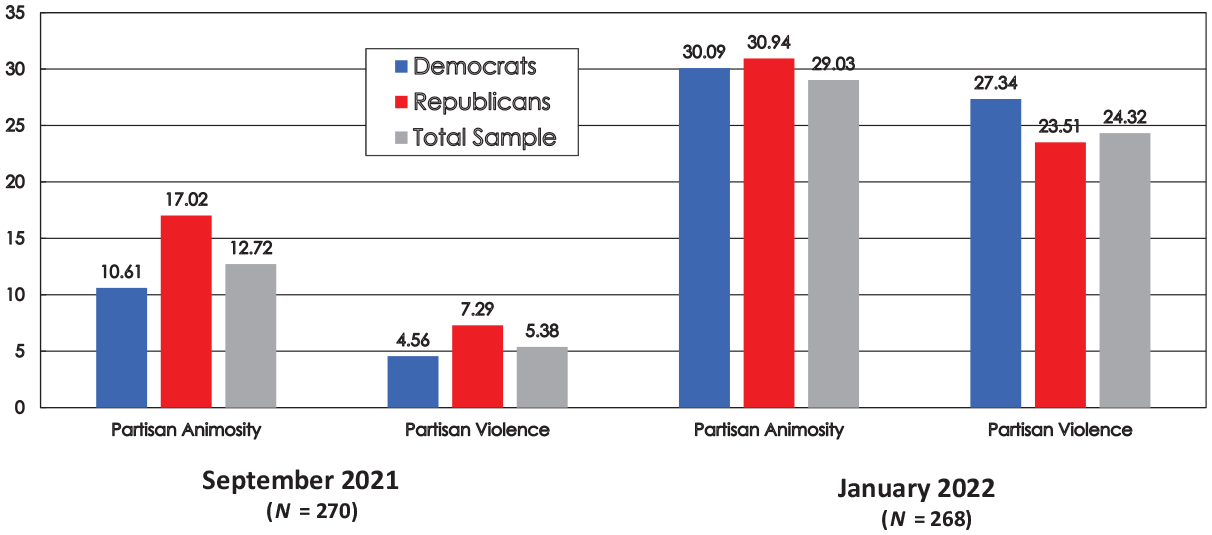
Baseline Levels of Partisan Animosity and Support for Violence
At Time 1 (September 2021), Republican participants expressed more animosity and more support for violence than did Democratic participants, consistent with other evidence that antidemocratic extremism in the U.S. is asymmetrical (e.g., see Olzak 2023). However, this was not the case at Time 2 (January 2022). There was a substantial increase in partisan animosity from Time 1 to Time 2 among both Democrats and Republicans, possibly because the latter time period was close to the highly publicized one-year anniversary of the insurrection, which may have riled up “both sides” for different reasons (Kreiss and McGregor 2024). At Time 2, both Democrats and Republicans were between 23 and 31 on a scale from 0 to 100 concerning partisan animosity and support for partisan violence.
Our collective effort to attenuate partisan animosity and support for antidemocratic violence focused on encouraging people to defend and justify the U.S. system of democracy, consistent with system justification theory (Jost 2020). Specifically, we exposed experimental participants to a simple passage that was designed to make Americans feel civic pride on behalf of the political system and desire to maintain it, without evoking defensiveness or reactance. The idea was to activate patriotism as a system-justifying motivation (van der Toorn et al. 2014) and to link that motivation to the preservation of the liberal democratic system in the U.S. rather than, say, the status quo of social, economic, or political inequality. The passage, which was entitled “The Resilience of the American System,” read as follows:
There are many things that make the United States of America unique and special. But one of the biggest factors is that it and its people never abandon the principles that made it great. In many countries, many times through history, when a crisis happens—be it an economic recession or a pandemic or natural disaster—people turn on each other and lose faith in the system. Americans have proven robust to this. Through thick and thin, the core of what makes America thrive seems to persist. People might cast doubt or engage in lively debates here and there, but generally, across time, stay faithful to the principles of democracy and civility and respect. This can be challenging at times, especially with the media and social echo chambers, but time and time again, Americans have proven they stick to what makes them special: faith in the system and trust in each other.
In these first two studies, we observed that this democratic system-justification message did indeed successfully reduce partisan animosity and support for antidemocratic violence. Figure 2 illustrates the results from the first experiment (September 2021), broken down separately for Democratic and Republican respondents and for the sample as a whole (which also includes Independents). For the total sample (n = 544), reading the democratic system-justification message significantly reduced partisan animosity (b = −3.29, SE = 1.45, t = −2.27, p < .05) and support for violence (b = −2.79, SE = 1.12, t = −2.50, p < .05).
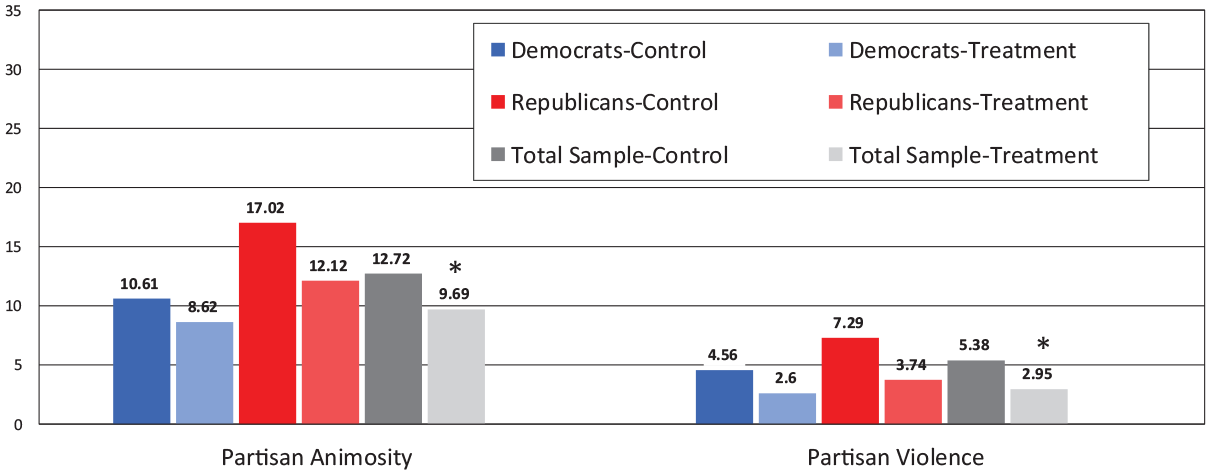
Effects of Democratic System-Justification Message—Study 1
The effects were much stronger in the second experiment (January 2022), with a larger sample (n = 651) and higher baseline levels of animosity and violence (see Figure 3). Here the democratic system-justification message successfully lowered partisan animosity and support for partisan violence among Democrats, among Republicans, and for the total sample (b = −16.62, SE = 1.97, t = −8.44; and b = −18.51, SE = 1.85, t = −10.00, respectively, both ps < .001). Furthermore, the reductions were sizeable. Partisan animosity dropped from approximately 30 to 10 for Democrats and from 31 to 16 for Republicans. Support for violence dropped from the 20s to around 5.
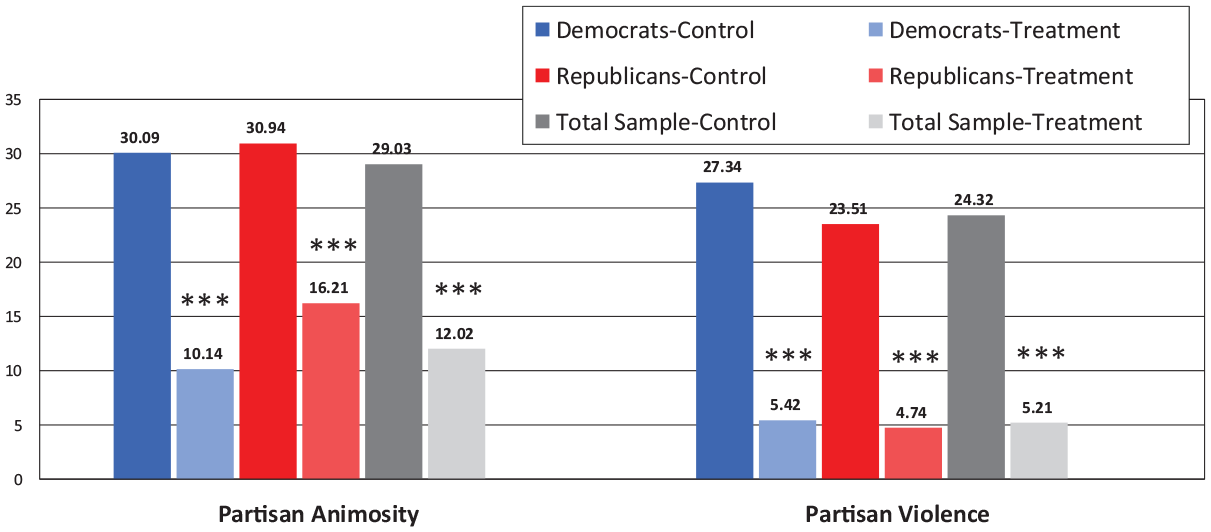
Effects of Democratic System-Justification Message—Study 2
Based on these results, our intervention was selected for inclusion in the tournament, where it was administered to a nationally representative sample in the “Strengthening Democracy Challenge,” fielded in April and May 2022. This opportunity enabled us to compare the responses of Democrats and Republicans who read the passage above (n = 1,101) to a very large control group that did not (n = 5,552). Overall, levels of partisan animosity were much higher (in the mid- to high 60s) than in the previous two studies, which were based on convenience samples. In this experiment, exposure to our democratic system-justification passage lowered partisan animosity among Republicans from 69.3 in the control condition to 66.0 in the experimental condition (b = −3.16, SE = 0.91, t = −3.48, p < .001), and it also lowered partisan animosity for the sample as a whole (b = −2.29, SE = 0.65, t = −3.53, p < .001). Unfortunately, however, the manipulation exerted only a marginally significant effect (in the hypothesized direction) for Democratic participants (b = −1.42, SE = 0.92, t = −1.53, p = .063). Moreover, it failed to reduce support for antidemocratic violence, which was, very surprisingly, unrelated to partisan animosity (see Voelkel, Chu, et al. 2023).
Fortunately, two other interventions in the contest successfully reduced support for antidemocratic violence as well as partisan animosity. One of these strategies was to correct stereotypical misperceptions of the out-party, such as disproving assumptions about the extent to which they would be willing to violate democratic norms. The other was to expose participants to political elites from both parties endorsing their shared commitment to democracy and to nonviolent forms of political participation (Voelkel, Stagnaro, et al. 2023). Thus, experimental research in social science may yet point the way to more constructive forms of public discourse. Among other things, defenders of liberal democracy must find ways of encouraging Americans to maintain faith in their democratic system, as flawed as it is, and to inspire pride in it and dedication to its continuation and improvement. Only then will it be possible to reduce levels of toxic polarization and allow people of divergent ideological inclinations to work together—dare we say patriotically—on urgent problems facing the nation and the world at large. Accomplishing this will require genuine political leadership on the left, right, and center, and a renewal of the nation’s shared commitment to democratic norms and principles. It will also require political elites—especially on the right—to unambiguously denounce antidemocratic activity in their ranks (e.g., Kreiss and McGregor 2024).
Concluding Remarks
For decades, many prominent political scientists have expressly doubted that political ideology is a meaningful force in ordinary citizens’ lives (e.g., Achen and Bartels 2016; Converse 1964; Kinder and Kalmoe 2017). However, a growing accumulation of evidence from political psychology is at odds with such a skeptical position. Left-right orientations permeate people’s public and private lives, in good times and bad. They are connected to the ways we live, eat, drink, travel, educate ourselves, participate in cultural activities, spend our free time, and cope with personal challenges and collective crises (Jost 2021)—including terrorist attacks (Godefroidt 2023), demographic shifts (Craig and Richeson 2014), and even pandemic diseases (Fischer, Chaudhuri, and Atkinson 2023; Schaller, Hofer, and Beall 2017; Zmigrod, Ebert, et al. 2021).
We are by no means claiming that “top-down” political leadership or elite signaling is irrelevant to the attitudes and behaviors of ordinary citizens. It seems obvious, for instance, that President Trump deserves much of the responsibility for the ways in which his followers have behaved (e.g., Barber and Pope 2019; see also Young et al. 2022). At the same time, a “bottom-up” psychological approach is needed to complement “top-down” analyses of political leadership and elite behavior. It is important to remember that not everyone—not even every Republican—loves Trump’s antics; roughly half the U.S. population is repelled. Every outcome in mass politics, we submit, is the result of an interaction between top-down processes of political messaging (including media exposure and elite communication) and bottom-up processes of psychological need fulfillment on the part of message recipients (Jost 2021). Some citizens, quite clearly, are susceptible to Trump’s demagoguery, while many others are not. Or, to take a macroeconomic metaphor, it is impossible to understand the “market for belief systems” by focusing exclusively on the supply side and ignoring the demand side of the equation (Gries, Müller, and Jost 2022).
A psychological approach such as the one we have advocated for here builds on—and extends—the work of political scientists who have long stressed logical coherence, temporal stability, and cognitive sophistication as defining characteristics of ideology (Converse 1964). But ideology is not merely a “benign organizing device” (Knight 2006). It is also a way in which individuals and groups situate themselves and seek shared justifications for their thoughts, feelings, and behaviors. Conservative-rightists want tradition and social order and trust certain authorities and hierarchical systems to deliver it, whereas liberal-leftists want equality and social justice and are at least sometimes willing to challenge the status quo to get it (Jost 2020, 2021; see also Grossmann and Thaler 2018). This itself will produce periods of intense political polarization, for better or worse (Kreiss and McGregor 2024).
What societies need from their democratic institutions and political leaders is a way of appreciating and resolving important psychological as well as philosophical differences in a spirit of good-faith deliberation and debate, with free and procedurally fair and binding elections used to break the inevitable stalemates. This is a tremendous challenge, for there is no shortage of bad-faith actors in the ideological arena, whether in politics, mass media, or other segments of society, to say nothing of international meddling. It should always be kept in mind that a robust commitment to liberal democracy does not require tolerance of antidemocratic norms or behaviors (Godfrey-Smith and Kerr 2019; Walzer 1997). At this moment in U.S. history, we need to process the past, some of which is deeply painful and divisive—including the events of January 6, 2021—and find ways of maintaining and, indeed, improving upon democratic traditions and practicing them openly, fairly, rigorously, and conscientiously.
Footnotes
Note:
This article is based in part on the 2022 Aaron Wildavsky Lecture, “Left & Right: Its Psychology and Implications for Political Polarization,” delivered by John T. Jost in the Goldman School of Public Policy at the University of California, Berkeley. We are grateful for feedback from Dean David C. Wilson, Elissa Epel, Jack Glaser, Dacher Keltner, Michal Kosinski, Wendy Berry Mendes, and several other audience members on that occasion. We also thank Geoffrey Layman, Frances Lee, and Christina Wolbrecht for helpful comments on an earlier draft of this article.
Notes
John T. Jost is a professor of psychology, politics, and (by affiliation) sociology and data science at New York University. His work addresses stereotyping, prejudice, social justice, political ideology, and system justification theory. His most recent books are A Theory of System Justification (Harvard, 2020) and Left & Right: The Psychological Significance of a Political Distinction (Oxford, 2021).
Daniela Goya-Tocchetto is an assistant professor of organization and human resources at the University at Buffalo School of Management.
Aaron C. Kay is J. Rex Fuqua Distinguished Chair at the Management and Organizations area of the Fuqua School of Business at Duke University, with a joint appointment in the department of psychology and neuroscience.