



Abstract
In this article, the authors discuss the three most important strategic framing choices by political actors (“substantive emphasis choice,” “oppositional emphasis choice,” and “contest emphasis choice”) of direct-democratic campaigns. The authors investigate these strategic framing choices in the media input and look at how the political actors change their choices in another communication channel (political advertisement) and over time. The results provide the following insights: First, political actors tend to emphasize one to two main frames in their media input. They generally also use their main frames in the political advertisements and stay on their main frames over time. Second, although political actors tend to emphasize their own frames, they do not exclusively revert to this behavior. The authors find that the political actors pay more attention to their opponents’ frames in the media input than in the ads. With regard to variation over time, the authors can state that campaign dialogue does not disappear over the course of the campaign. Third, framing is primarily accomplished in substantive terms. In the advertisements and toward the end of the campaign, the authors do not find more contest frames.
To win a political campaign, political actors try to achieve an emphasis effect (Druckman, 2001, 2004), that is, to lead the media or individuals to focus on certain aspects of an issue instead of others when constructing their opinions (Druckman, 2001, p. 230). They frame the issue at stake strategically and “campaign on behalf of competing ways of understanding what is at issue” (Sniderman & Theriault, 2004, p. 158). In this article, we look at two sets of processes that are part of frame building—frame construction and frame promotion—and the strategic choices involved in these processes. In the construction process of frame building, we argue that political actors face at least three strategic emphasis choices (Hänggli & Kriesi, 2010) while they choose the communication channels and decide about variation of the choices over time in the promotion process of frame building (Hänggli, 2010).
The article is structured according to the choices. We start by discussing the construction and promotion processes for each framing choice. In the second part, we present the empirical analysis structured according to the choices. We distinguish between mediated channels (media input, e.g., press releases) and unmediated channels (political advertisements). In mediated channels, campaigners must cater to the needs and values of journalists. Unmediated channels offer campaigners control over the content and form of the message. Both mediated and unmediated channels target the general public. The comparison between the two channels is worth studying for at least two reasons. First of all, since campaigners must satisfy journalists, news values may determine their framing strategies in the media input, but not in the advertisements. By comparing the actors’ media input with their political advertisements, we can assess their true framing intentions. Second, a successful strategic communication depends on coordinating messages across all publications (Norris, Curtice, Sanders, Scammell, & Semetko, 1999, p. 67). Therefore, in spite of some variation across channels, there should also be some framing similarity between them. To our knowledge, the way in which political actors rely on the same message across different channels in direct-democratic campaigns has never been investigated.
Substantive Emphasis Choice
First, to win a campaign, the strategic actors are expected to search for a frame that they believe has the capacity to become a strong substantive frame. We call this choice the “substantive emphasis choice.” They might also provide a second or third main frame, to which they can switch if their most important frame (core frame) is not resonating well. At the same time, actors do not want to overload the processing capacity of the media (Shoemaker & Reese, 1996, p. 104) and might not promote too many frames. The number of frames with which they will ultimately campaign is an empirical question.
A strong frame is a frame that provokes a defensive reaction by the opponents and/or that resonates in the media (Hänggli & Kriesi, 2010). This conceptualization of strength is based on Koopmans’s idea that resonant messages (i.e., messages that provoke reactions) travel further (Koopmans, 2004, p. 374). It means that a frame discussed by the opponent is a strong frame. In Chong and Druckman’s (2007a) experiments, the relative strength of a frame turned out to be the most important dimension of influence, under both one-sided and competitive conditions. However, the study was concerned with the effects of frames on voters and not on the media.
We expect political actors focus on their core frame in their advertisements for three reasons: First of all, if advertising provides candidates with much greater control over their message than does news coverage, it is a less credible source than the news media (Iyengar & McGrady, 2007). Thus, in ads, political actors have an incentive to use their most credible message, that is, their core frame. Second, advertising allows campaigners to tailor their message to the specific target of those voters who are pivotal to the outcome of a vote. In other words, in ads, campaigners use the frame they think will most effectively mobilize swing voters. Third, an advertisement focusing on a given frame can be used to seize the attention of the news media (Iyengar & McGrady, 2007).
Do the political actors vary their substantive emphasis choice over time? Campaigners should not waffle or flip-flop between the frames (Iyengar & McGrady, 2007). Rather, campaigners should stay on message (Norris et al., 1999; Perron, 2007) or on their core frame, which they chose according to the substantive emphasis choice. Staying on message means the capacity to repeat the central campaign message, even when challenged by journalists, the opponents, or simply the campaign environment. This promotion practice goes hand in hand with the well-known advice put forward by issue-ownership theory (Petrocik, 1996), which states that political actors should focus on the issue or issue attribute for which they enjoy an advantage. Of course, if a message is failing, it might be better to jettison plans and adapt to the circumstances. Nevertheless, strategic communication is based on the principle of planning for all eventualities and developing a popular message well in advance of the crucial phase of the campaign. Thus, we expect the campaigners to stay on their core frames in both channels.
Oppositional Emphasis Choice
Second, the political actors have to decide how much importance they attach to the frames of the opponents compared to their own frames. This choice is labeled the “oppositional emphasis choice.” According to well-known advice, political actors should focus on the issue or issue attributes where they enjoy an advantage. Riker’s (1996) “dominance principle” formulates this type of strategy: “When one side has an advantage on an issue, the other side ignores it.” Issue-ownership theory (Petrocik, 1996) suggests that political parties tend to follow this recipe, which means that they essentially talk past each other in political campaigns. As a consequence, yes and no campaigners fighting against each other are expected to essentially rely on different frames. However, actors may have an incentive to address the opponents’ frames as well. We expect political actors to prefer their own substantive frames and to refer to their opponents’ frames only to the extent that their opponents’ framing is successful or that they anticipate it to be successful. Campaign dialogue (Kaplan, Park, & Ridout, 2006) investigates how far the two camps converge on the main frames of a campaign.
With regard to the variation of the oppositional emphasis choice in the communication channels, campaigners are expected to use fewer opponents’ frames in their political advertisements than they use in media input. Thus, it is expected that campaigners will engage in less campaign dialogue with regard to ads than they will with regard to the media input. In their political advertisements, campaigners follow issue ownership theory and emphasize issues on which they enjoy an advantage over their opponent (Iyengar & McGrady, 2007). This also appears to be plausible for frames. Normally, ads in newspapers or flyers are small (half a newspaper page), decreasing the chance of a dialogue. They often include no more than a short, catchy message, and thus do not lend themselves to extensive debate. Consequently, campaigners are expected to not be interested in their opponents’ frames.
How do the campaigners vary the level of campaign dialogue (oppositional emphasis choice) over time? In real-world debates, framing strategies such as alternate frames (promotion of one’s own frames) and direct rebuttals (counterframes; Jerit, 2009) are common. Gilland and Marquis (2006) document that in contrast to Riker’s so-called “dominance principle,” there is no concentration on a smaller number of frames over the course of a direct-democratic campaign. Koopmans (2004, p. 389) supports this notion, stating that he does not expect a “long-term tendency towards an increasingly uniform public discourse. . . . [P]ublic discourse is kept alive by the small minority of ‘distortions’ or ‘mutations.’” Based on Gilland and Marquis’s findings, we also expect there to be no concentration on a smaller number of frames toward the end of the campaign in the media input, or in the media coverage. In the political advertisements, we expect to find less campaign dialogue in general, but we do not have a specific hypothesis about variation over time here.
Contest Emphasis Choice
Concerning the third choice, the political actors have to decide how much importance they attach to the campaign contest compared to the substantive content of the campaign. This is the “contest emphasis choice.” In this respect, we distinguish between two types of frames—contest frames and substantive frames. 1 The unique feature of the contest frames is that they do not address the issue(s) at stake, but focus on the actors involved or on the contest per se—on politics—whereas substantive frames focus on the substantive contents of the debate—on policy. In general, we expect that the political actors would like to get their substantive message across and place a high priority on their chosen substantive frame(s). Direct-democratic votes are issue specific, which implies a certain substantive focus.
Extreme actors are likely to use more contest frames because they are likely to pursue other goals goal than simply influencing the outcome of the vote on the issue at stake or of the next elections. Extreme actors often do not have sufficient power to win a direct-democratic campaign or an election and must have other reasons for their participation. Most importantly, they are likely to aim at mobilizing their grassroots. Harmel and Janda (1994, p. 275) called this goal the “intraparty democracy” goal. We prefer to call it the “grassroots participation” goal. Organizations that pursue this grassroots participation goal seek to keep up the activities after a direct-democratic campaign. This constitutes an aim in itself. A direct-democratic campaign can help to reach this goal by strengthening the group identity. One way to strengthen this identity is to distinguish between in-group and out-group and to denounce the others or point out the conflicts. Thus, the extreme actors are expected to use more contest frames. In addition, members of extreme organizations are found to use a different style of political engagement (McClosky & Chong, 1985). They are more likely to attribute personal failings to those who are far from their own political ideals. In other words, they are again expected to use more contest frames.
With regard to political ads, we expect that newspaper editors, who depend on advertising revenue, will refuse to print advertisements that are too aggressive to avoid alienating potential advertisers. Nevertheless, contest frames, that is, personal attacks and criticism, are still possible. It is well known that in the United States campaigners rely heavily on negative or attack advertisements (Iyengar & McGrady, 2007, pp. 147-149). Typically, consultants differentiate between critiques on performance, which focus on opponents’ records, and character assassinations, in which opponents are portrayed as immoral people. As a result of several factors, however, both tactics appear to be insignificant in Swiss direct-democratic campaigns. First, the opponent’s character is not at stake. Second, the Swiss consensus democracy is based on power sharing, which handicaps clear responsibilities and performance critiques. Third, Swiss political culture has traditionally been less confrontational. As such, we expect political actors to use arguments in their advertisements instead of contest frames, such as attacks.
How do the campaigners vary the contest emphasis choice over time? Campaigners of ad hoc committees believe that they have more influence on the frame-building process before the “crucial phase” starts. Based on their experience with the media, the campaigners presume that scarcity in terms of media attention increases during the “crucial phase” when more actors are involved. To compensate this increasingly scarce media attention, the political actors may increase the news value of their events (Schulz, 1997) by becoming more aggressive or increasing the conflict in their media input toward the end of a campaign. This means that they vary their contest emphasis choice by increasing their contest frames in the media input toward the end. The news media might then follow suit. By contrast, we do not expect a variation in the use of contest frames for the political advertisements.
To sum up our hypotheses, first, the strategic actors are expected to search for a frame that they believe has the capacity to become a strong substantive frame (substantive emphasis choice). We expect political actors to increase the use of their core frame in their advertisements and to stay on frames over the course of the campaign. Second, pro and contra campaigners fighting against each other are expected to essentially rely on different frames. If the political actors refer to the frames of their opponents, they are expected to do so defensively insofar as their opponents’ framing is successful or they anticipate their opponents’ framing to be successful (oppositional emphasis choice). Campaigners are expected to use fewer opponents’ frames in their political advertisements than in their media input. We also expect there to be no concentration on a small number of frames toward the end of the campaign. Third, we expect that the political actors put a high priority on their chosen substantive frame(s) (contest emphasis choice). The extreme political actors might use more contest frames. We expect political actors to focus on substantive arguments in their advertisements. With regard to variation over time, political actors possibly increase their contest frames in the media input toward the end but do not vary the use of contest frames for the political advertisements.
Context of the Study
This article studies frame construction and promotion in the context of a political campaign dealing with the issue of immigration in Switzerland: The initiative “for democratic naturalizations” was launched by the conservative Swiss people’s party (SVP) and submitted to the voters on June 1, 2008. It was voted down by 63.6% of the voters. The clarity of this verdict came as a big surprise and constituted a conspicuous defeat for the SVP, for which this vote had been the most important test of its new opposition politics. The party had won the federal elections in fall 2007, but it had lost the fight for the composition of the governmental coalition in December 2007: Its coalition partners had respected its claim for two out of the total of seven governmental seats, but they had not complied with the party’s demand to reelect both of its incumbent ministers. Instead of the party’s charismatic leader Christoph Blocher—the incumbent minister of justice, Parliament had chosen another member of the party—Eveline Widmer-Schlumpf—to replace him. It was essentially a coalition of Social Democrats and Christian Democrats that had unseated the SVP leader. As a reaction to the ousting of its leader, the SVP proceeded to exclude its two newly elected ministers from the party and decided to adopt a systematic oppositional stance. The exclusion procedure preoccupied the SVP and the Swiss public right up to the vote on the naturalization initiative, which explains why the campaign for the initiative began rather late, just 5 weeks before the vote. This vote provided the first important test for the party’s new overall strategy.
The initiative proposed that the voters in a given municipality should be able to decide which kind of procedure they wanted for naturalizations—in particular whether they wanted to vote at the ballot box on individual naturalizations. Moreover, the initiative stipulated that it should not be possible to appeal against local rejections of naturalization requests. The initiative, in fact, demanded that the act of naturalization become an exclusively political act of the citizens as sovereign.
The government rejected the initiative, arguing above all that it violated international law, in particular the European Convention on Human Rights, the UN Pact II, and the UN Convention Against Racism. The debate in Parliament on the initiative was rather controversial, since several members of the moderate right felt a good deal of sympathy for the proposal. Eventually, Parliament decided by a clear majority to reject the initiative. The parliamentary and the direct-democratic debate slightly varied. In Parliament, they were mainly concerned about the procedure they wanted for naturalization. As revealed by an extensive analysis of parliamentary documents, the pro camp asked for fair procedures that complied with basic rights (rule of law), whereas the pro side conceived naturalizations as political acts and not as administrative ones and claimed that people should have the final say (people final say). In the direct-democratic phase, the pro camp also argued that “mass naturalizations” had to be stopped. These were the three main frames suggested by political actors (for these frames, see Gerth & Siegert, 2012; Hänggli, 2012; Matthes, 2012; Schemer, Wirth, & Matthes, 2012; Wettstein, 2012).
Method
Coding of Campaign Material
We rely on a content analysis of all the campaign material produced by the political actors for communication with the media—input for earned media coverage (“media input”: press releases, speeches from media conferences or public statements)—as well as on the content analysis of the political advertisements (“political ads”). This material was coded with the same codebook on a daily basis for the 3 months prior to the vote. Frames constitute our unit of analysis. We operationalize substantive frames with the arguments that the two camps have produced to support their own position or to undermine the position of their adversaries. Frames and arguments are not entirely the same. Framing is the process by which political actors define the issue for their audience (e.g., Matthes, 2009; Nelson et al., 1997a, 1997b). A frame highlights some aspects of a perceived reality and enhances a certain interpretation or evaluation of reality (Entman, 1993). In this respect, a frame is more than an argument because it also provides a specific understanding of the world. We use the term frame when referring to this broader sense of the term. By contrast, we rely on the term argument when we are concerned with the specific justifications provided in the course of the campaign. In each document we coded all the arguments provided by or reported for each one of the relevant actors (organizations or their individual representatives) in great detail and then summarized them in a limited number of abstract categories (frames), which we created on the basis of our reading of the controversy. 2 For each side, the main frames are defined on the basis of the relative frequency in the media input. The camp that uses a given frame most frequently is said to own the frame.
Let us illustrate the coding of the substantive frames with an example: the “mass naturalization frame.” We coded the following pro arguments (in favor of the proposition): “mass naturalization has to be stopped,” “there are too many foreigners in Switzerland,” and “we should avoid naturalization of criminals or welfare recipients.” The contra arguments against the proposition included “the share of immigrants among the Swiss population is not excessively large” and “the number of naturalizations is not excessive.” We summarized these (and other) related arguments in a single frame, the mass naturalization frame. Since the pro camp used the mass naturalization frame more often in the media input than the contra camp, it is said to have owned this frame. The pro arguments of the mass naturalization frame are the offensive arguments, whereas the contra arguments of this frame correspond to the defensive arguments.
Overall, almost 8,000 arguments were coded by eight different coders. Cohen’s κ for intercoder reliability at the single argument level was .61, which is not high, but acceptable. We consider it acceptable because one of us carefully checked all the arguments after the coding and corrected for coding errors and because, for the analysis, we summarized the detailed codes for arguments to broader categories (frames), which are less error prone (Cohen’s κ = .87).
Campaign Dialogue
We rely on the formula developed by Sigelman and Buell (2004) to calculate the level of campaign dialogue:
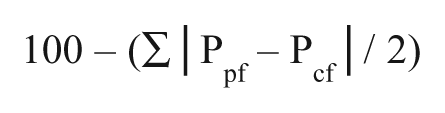
Ppf and Pcf are the percentages of total emphasis that the pro and contra camp put on a certain frame, f, respectively. This measure is derived from the total of the absolute differences between the two camps in the share of attention each camp devotes to a certain frame. For example, assume that there were three frames for the two camps to address and that the sides distributed their attention as follows:

In this example, the pro camp concentrated exclusively on one frame, the contra camp focused exclusively on a different frame, and both sides ignored the third frame. Obviously, no campaign dialogue occurred during this campaign. Summing up the absolute differences between the camps would produce a difference of 200—that is, |100 – 0| + |0 – 100| + |0 – 0| = 200. The result corresponds to 200 rather than to 100 because of double counts. We need to divide the sum by 2 to calibrate the measure to the range between 0 and 100. In addition, subtracting from 100 converts the measure to one of similarity rather than dissimilarity. Thus, the closer the resulting measure is to 100, the more campaign dialogue we have. A score of, say, 40 for a campaign would indicate a 40% overlap in the two sides’ attention profiles.
Political Actor Types
In direct-democratic campaigns, different actor types are involved. We distinguish among political parties, economic interest groups and unions, citizens’ interest groups, church organizations and social movement organizations (SMOs), the authorities consisting of the minister in charge of the campaign issue and the public administration, and finally ad hoc campaign committees.
Extremity
Based on a block-model analysis by Bernhard (2010), we define extreme and moderate actors. Block-model analysis allows for distinguishing between structurally equivalent groups of actors on the basis of an analysis of the cooperative relationships. A block model consists of two elements (Wasserman & Faust, 1999, p. 395): (a) a partition of actors in the network into discrete subsets called positions and (b) for each pair of positions, a statement of the presence or absence of a tie within or between the positions. The CONCOR algorithm was used, which applies successive splits to the network. In the naturalization initiative, there was only one block in the center. The more extreme blocks (the left and the populist right) are labeled extreme left- and right-wing blocks. These extreme blocks are extreme in relative, but not necessarily in absolute terms: They are just more extreme than the moderate block in the center.
We use a rare event logistic regression (relogit) to investigate the factors influencing the contest frames. Relogit is used in the case of binary dependent variables, with dozens to thousands fewer ones (events, such as contest frames) than zeros (“nonevents,” such as substantive frames; King & Zeng, 2001).
Results
Substantive Emphasis Choice
We begin this section by identifying and describing the main frames of the campaign under scrutiny. The main frames of each camp are in bold. We arrive at one main frame for the contra camp and two main frames for the pro camp. As becomes clear from Table 1, the campaigners predominantly address their own frame. In the media input, the most important (core) frame of the contra camp makes up 49% of the arguments, whereas the pro camp focused on its most important frame in 39% of cases.
The Main Substantive Frames of the Two Camps, by Communication Channel: Percentages
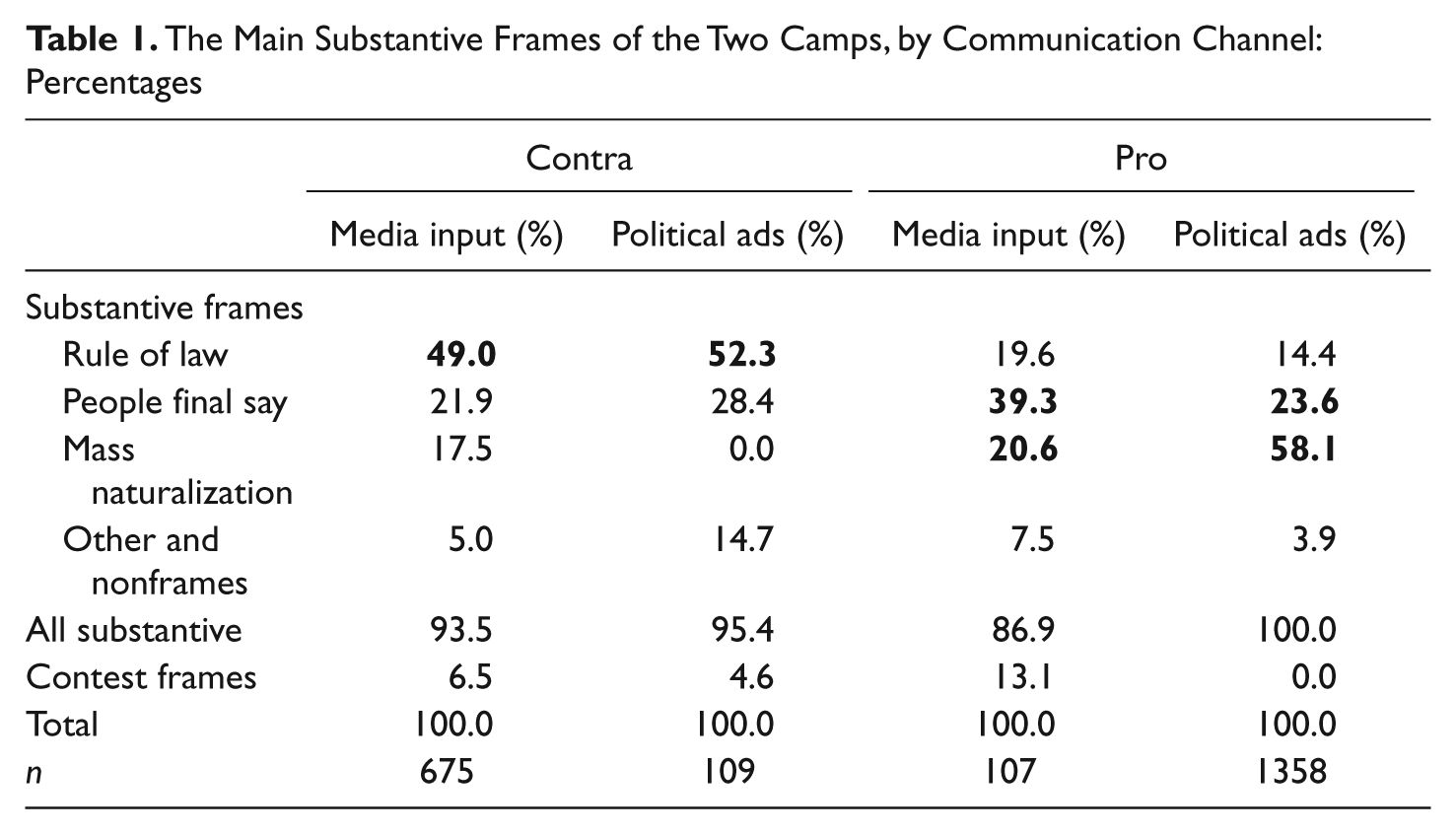
To avoid arbitrary decisions, the rule of law frame asks for fair procedures that comply with basic human rights. By contrast, the pro side conceived naturalizations as political and not as administrative acts. Therefore, it is not surprising that its core frame is concerned with the claim that people should have the final say (people final say). Aside from procedural aspects, the proponents adopted a rather xenophobic discourse. They stated that “mass naturalizations” had to be stopped and also alluded to crimes that occurred during the campaign, especially to those committed by recently naturalized persons. Both sides used additional frames, which are summarized under “other” frames in Table 1.
Table 1 also allows for a comparison of the media input with the political advertisements. First, a look at the total number of arguments (n total) in the two channels provides us with a general idea of the importance of the different channels. The figures indicate that the contra camp was much more active in producing arguments for media input. It produced more than twice as many arguments for the news media than for the advertisements. By contrast, the pro camp produced twice as many arguments in political ads than in media input. This suggests that the two camps followed different strategies: Although the contra camp relied much more on media news reporting, the pro camp heavily relied on paid advertisements. The populist right-wing party (SVP) had the lead in the pro camp campaign and used the political advertisements channel more often than the media input. This is a result of the organizational structure of the two camps—heterogeneous and decentralized (contra) versus access to resources and homogenous and centralized structure (pro). The contra camp has access to more personnel, the pro camp to more money (Bernhard, 2010).
As expected, in the political advertisements, the political actors use their core frame more frequently. The corresponding share rises above 50%. This result shows that the political actors, indeed, focus more on their core frame in their advertisements. Nevertheless, they use other frames as well in their ads—their own second main frame or their rival’s frame. Figure 1 provides typical examples of advertisements that the two sides used during the campaign. These illustrations show that the camps generally focus on one message in advertisements.

Political advertisements of the two camps
For the contra camp, the core frame of the media input also remains the core frame of the political advertisement. By contrast, the core frame of the pro camp in the media input, the people final say frame, is used in only 23.6% of all frames in ads. Instead, the mass naturalization frame makes up 58% of all frames in ads. This result points to a change in the strategy of the pro camp. The campaigner responsible for this strategic change explained in an interview: Toward the end of the campaign, the pro camp changed its strategy because the campaigners received feedback from their activists indicating that the people final say frame was not convincing. In addition, the pro camp had more funds available than was originally planned. This allowed it to publish a significant number of political advertisements in the last 3 weeks of the campaign. The pro camp tested different arguments and decided to promote primarily the mass naturalization frame. As a result, we see the mass naturalization frame emphasized in their advertisements. The pro camp reused its well-known advertisement from the 2004 naturalization of second and third generation immigrants campaign (Figure 1a). Because the end of the campaign was nearing, the pro camp was unable to change its core frame in the other channels, too.
Usually (see Hänggli, 2010), campaigners do not change their substantive emphasis choice during a campaign. The strategic actors rather stay on frame. The main frames are promoted from the very beginning, and no new frame appears in the course of the campaign. In addition, the most important frame of a camp remains the most important over time in both channels. The behavior of the pro camp in the naturalization campaign represents an exception to this general behavior.
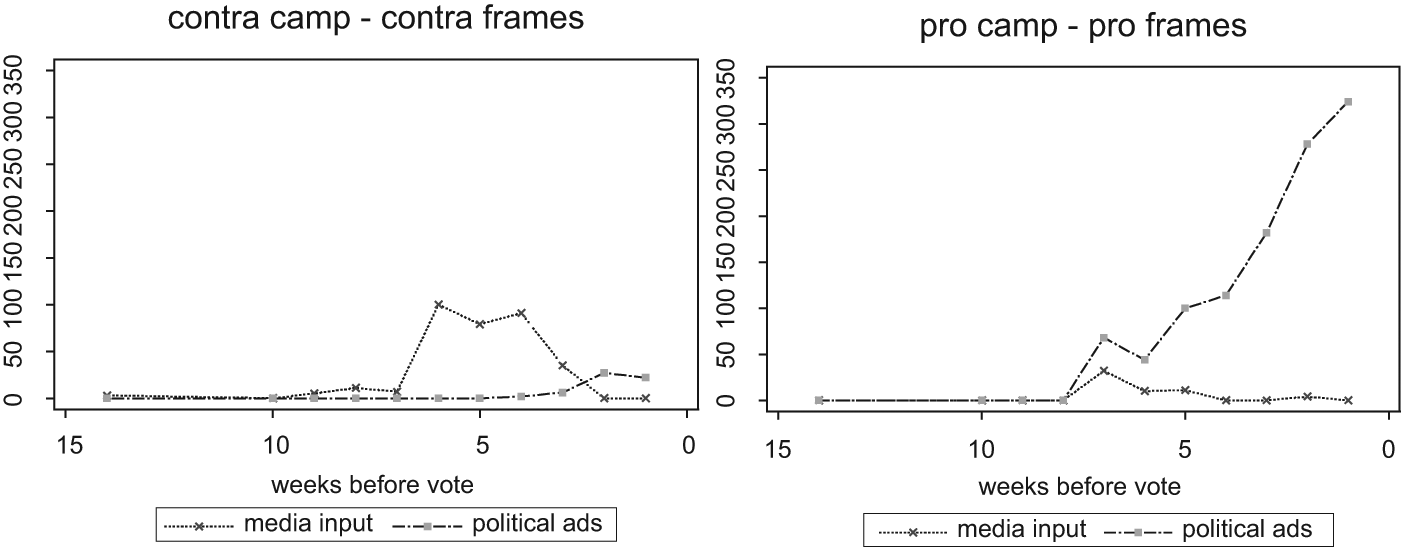
Figure 2 presents the development of the total number of frames in the course of the campaign. It presents the weekly development of the frames in the media input and the political advertisements of the two camps. The panels show that the contra camp launched its media input at well-chosen moments (two peaks), whereas the pro camp’s media input was not time related. Instead, the pro camp ran a low but steady stream of ads that contained its core frame, which it increased heavily toward the end of the campaign. The peaks are characteristic of the media input, and their high amplitude indicates media conferences. The fact that political actors pause between media conferences explains the steepness. This campaign started comparatively (see Hänggli, 2010) late because the minister was new in office. In addition, the highest peak in the media input occurs 7 or 6 weeks before the vote takes place. This is the beginning of the “critical period” of media coverage.
Weekly development of the frames in the media input, and the political advertisements of the two camps
In the panels of the pro camp, we see an increase in the use of arguments in the political advertisements in the final stages of the campaign. With this additional effort, the campaigners tried to get out the vote. We call this the “mobilizing strategy.” The contra camps lacked advertising money, but also slightly increased their paid media efforts in the final stages of the campaign because of the “mobilizing strategy.”
Oppositional Emphasis Choice
We turn to use of the opponents’ frames. Looking at the nonbold figures in the first three rows of Table 1, we see that in the media input, both sides address the main frames of the opposing camp. They primarily refer to the core frame of the opposing camp and—in the case of the contra camp—secondarily to the other camp’s next most important frame. In the political advertisements, the political actors address their opponents’ frames less often.
Table 2 shows campaign dialogue in the two communication channels. We also report the level of dialogue in the news media because we think it is interesting to compare the channels with the news media. We find slightly more campaign dialogue in the news media than in the media input. More reliably, however, we can state that the dialogue level of the ads is lower in comparison to the media input and the news media.
Campaign Dialogue in the Different Communication Channels

Figure 3 shows the level of campaign dialogue in media input, political ads, and the news media over time. In the media input, the political actors continue to use their opponents’ frames during the whole campaign and slightly increase their use toward the end. In the news media, the level of campaign dialogue slightly decreases. It remains at a high level during the whole “crucial phase,” which starts around 6 weeks before the vote. It shows that public discourse is kept alive. In the political advertisements, the campaign level varies strongly, but drops to a rather low level in the last 3 weeks, when political actors are most active in advertising.
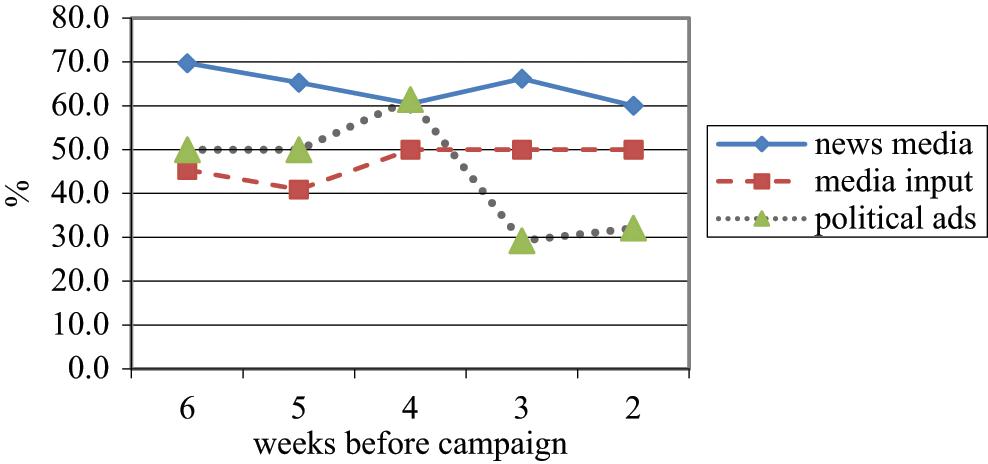
Campaign dialogue in the two communication channels and over time. In Weeks 15–7, it does not make sense to calculate the campaign dialogue because there were too few observations. In Week 1, political actors were inactive with media input.
Contest Emphasis Choice
Next, we look at whether political actors primarily used substantive or contest frames in the media input. As is shown in Table 1, the contra camp used contest frames in 7% of the arguments in the media input, the pro camp in 13%. The result meets our expectation; contest frames such as personal attacks and conflicts are only rarely used by Swiss political actors. In comparison to other campaigns (not shown here; see Hänggli, 2010), the proportion of the contest frames is somewhat higher in this campaign, especially in the pro camp. This might be the result of the fact that a former member of the Federal Council from the populist right-wing party (SVP), Christoph Blocher, was not reelected and was instead replaced by another person from the same party, Eveline Widmer-Schlumpf, on December 12, 2007. After Ms. Widmer-Schlumpf had accepted the election, she was thrown out of the SVP, and a small minority of supporters of Widmer-Schlumpf split off from the party. The issue was highly contentious and emotional, and the naturalization initiative was the first vote for which Widmer-Schlumpf was the responsible federal councilor. Moreover, as the federal councilor responsible for defending the government’s position, she was forced to take a stand against her former party. Table 3 provides more details for this particular aspect and shows the use the contest frames by the different actor types. It can be seen that the authorities and the political parties of the pro camp mainly campaigned with significantly more conflict frames. In fact, it appears that the dispute between Christoph Blocher, the SVP, and Eveline Widmer-Schlumpf caused the quarrelling actors to rely more on conflict frames. Blocher and the SVP belonged to the political parties of the pro camp, and Widmer-Schlumpf to the authorities.
Since the campaign took place soon after the non-reelection of Blocher, it is likely that the actors involved used more contest frame than would otherwise have been the case. However, even in this particular case, framing is still primarily accomplished in substantive terms. In Table 4, it becomes evident that the political actors of the more extreme blocks use more contest frames than the political actors of the moderate block. This effect is significant at the p = .001 level. As control variables, we also examine whether the right-wing political actors or the governmental camp use more contest frames. This is not the case in this campaign. Before discussing the influence of time on contest frames, we discuss variation in different communication channels.
Contest Frames: Percentage Shares by Camp and Actor Type
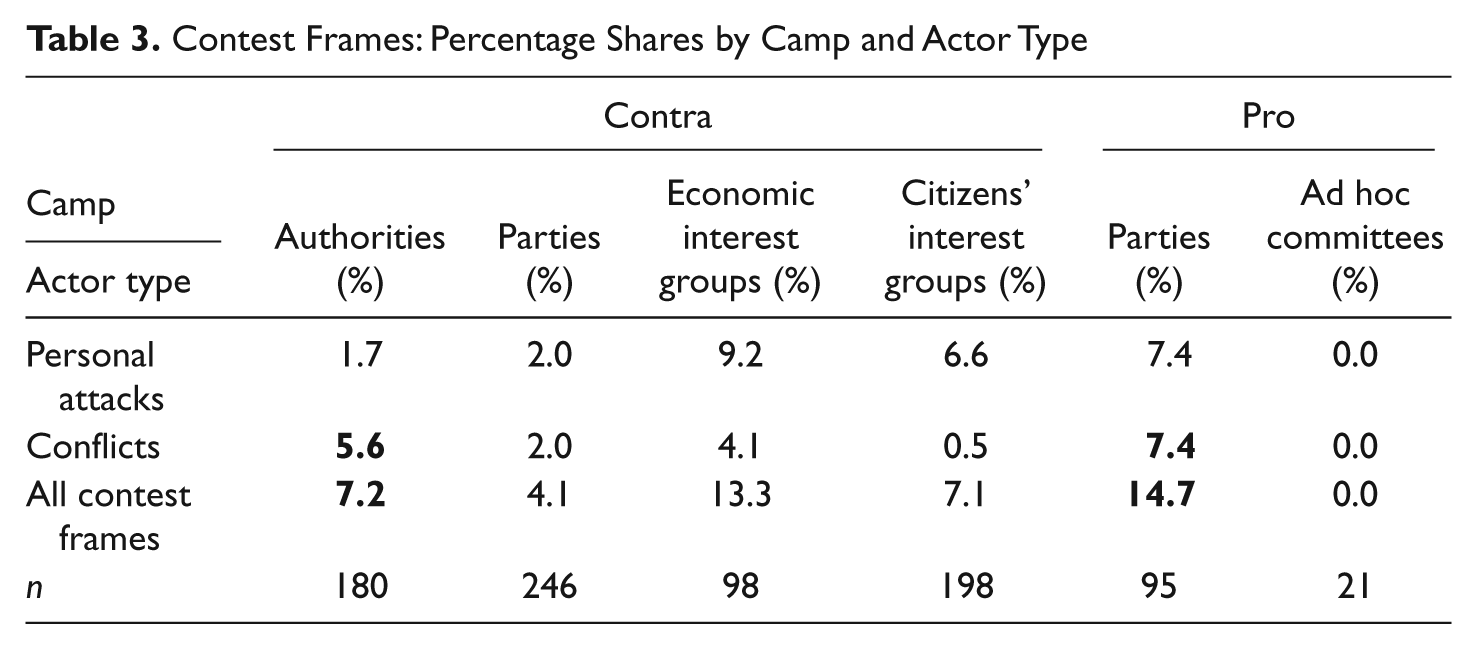
Returning again at Table 1, we see that, in the ads, the political actors also generally refrain from using contest frames. Compared to the media input, they are used less often in the political advertisements. However, we can state that in direct-democratic campaigns, framing is done primarily in substantive terms in both channels.
Table 4 also shows the influence of time on the share of contest frames in the media input. Time is measured in terms of campaign weeks. This variable turns out to be insignificant, which means that, in the media input, the campaigners do not change their contest emphasis choice over time by increasing the use of contest frames. This might be different in other campaigns (Hänggli 2010). With regard to the use of contest frames over time in the political ads, we can state that there is no variation over time.
Rare Event Logistic Regression of Time and Other Influencing Factors on Contest Frames in Media Input
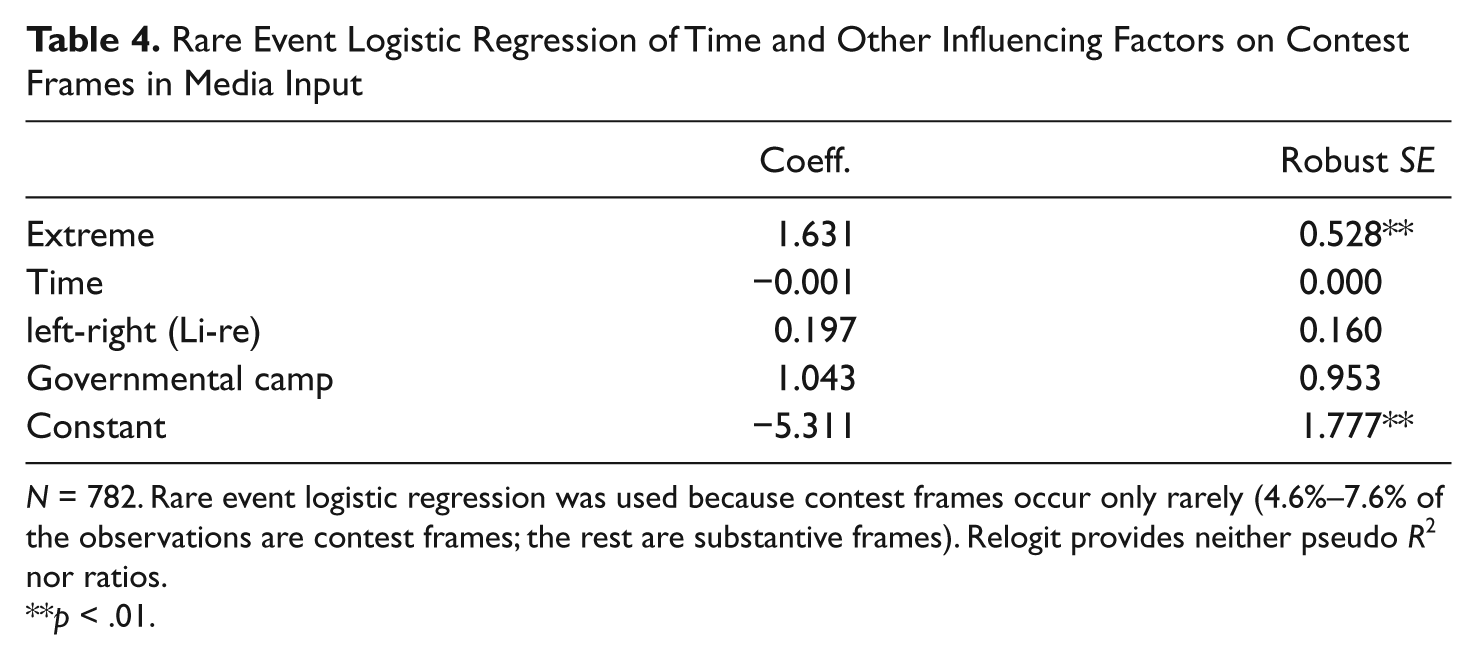
N = 782. Rare event logistic regression was used because contest frames occur only rarely (4.6%–7.6% of the observations are contest frames; the rest are substantive frames). Relogit provides neither pseudo R2 nor ratios.
p < .01.
Conclusion
We can summarize the results according to the three strategic choices of framing that we have outlined in this article. With regard to the substantive emphasis and the oppositional emphasis choices, we find that political actors tend to emphasize their own frames, but they do not exclusively do so. In addition, they also address the frames owned by their opponents (also see Gerth & Siegert, 2012).
With regard to variation of the substantive emphasis choice in the communication channels, we find that political actors generally focus on their core frame in the political advertisements. In the media input, the core frame of the contra camp makes up 49% of the arguments, whereas the pro camp focuses on its most important frame in 39% of the cases. In the political advertisements, the core frame amounts to around half of the frames used. Exceptionally, the pro camp emphasized its second main frame (“mass naturalization”) more than its core frame (“people final say”) in the advertisements. Although the political actors of the contra camp stayed on their core frame, the pro camp switched from the people final say frame to the mass naturalization frame in their ads toward the end of the campaign. The people final say frame was not convincing. In general, however, the core frame in the media input remains the core frame in the advertisements, which shows that the frames used in the media input are not used simply to placate journalists but are representative of the intentions of the actors.
In the oppositional emphasis choice, the political actors determine how much attention to devote to their opponents’ substantive frame(s) as compared to their own frames. With regard to the different communication channels, we find that the political actors pay more attention to their opponents’ frames in the media input than in the ads because the mediation motivates the political actors to enter into campaign dialogue with each other. In political advertisements, we find less campaign dialogue, that is, the quality of the debate is lower in the advertisements than in the other communication channels. Political advertisements have primary functions other than to provide dialogue. They should mobilize citizens to vote or increase public debate.
With regard to variation over time, we can state that campaign dialogue does not disappear over the course of the campaign. In the media input, even though campaigners slightly decrease the use of the opponents’ frames toward the end, campaign dialogue remains quite high until campaigners stop promoting their message. In the news media, campaign dialogue increases and remains high over several weeks.
With regard to the third choice, the contest emphasis choice, we have shown that the political actors mainly focus on substance in direct-democratic campaigns in their media input, that is, they mainly rely on substantive framing. We found that actors with more extreme positions use more contest frames and that the dispute among Christoph Blocher, the SVP, and Eveline Widmer-Schlumpf caused the quarrelling political actors to rely significantly more on contest frames in the naturalization campaign. Concerning the contest emphasis choice in the different communication channels, we show that in direct-democratic campaigns, the political actors often refrain from using contest frames in their ads and in media input. Toward the end of the campaign, we do not find more contest frames in both channels.
What do these results mean for the quality of the debate in direct-democratic campaigns? There are two reasons to be optimistic. First, political actors address their opponents’ frames. Campaign dialogue in the direct-democratic campaign (69.3) is much higher than the average (44.1) found in the study by Kaplan et al. (2006) of American candidate television advertising aired in U.S. Senate campaigns from 1998 to 2002. In contrast, it is lower than the mean (75.3) of dialogue in U.S. presidential campaigns from 1960 to 2000. However, the campaign reaches a level that is almost as high as that seen in U.S. presidential campaigns. Thus, we conclude that there is a quite high level of campaign dialogue in the press releases in Swiss direct-democratic campaigns. Second, in media input and in advertisements, framing is primarily done in substantive terms.
Footnotes
The author(s) declared no potential conflicts of interest with respect to the authorship and/or publication of this article.
This work is based on research done in NCCR Democracy and funded by the Swiss National Science Foundation.