



Abstract
The rapid aging of Japan’s population and workforce has prompted proposals by key political and economic actors to advocate for immigration, though public sentiment has generally been opposed to immigration. Japan has therefore undertaken social policies to mobilize seniors and women as workers and establish gender equality in employment. These measures have sought to reduce the rising costs faced by Japan’s pension system and mitigate the long-term decline of the country’s fertility rate. The author examines the efficacy of these social policies in the context of Japan’s deregulation of labor markets and the expansion of flexible and low-wage employment arrangements. Although the proportion of nonregular employment has grown since the late 1980s, it has not created gains in productivity, though it has increased economic disparities. These outcomes suggest that the importation of unskilled immigrants as a (similarly) cheap source of labor would not be an adequate solution.
Population Aging
Japan is rapidly aging. According to the definition of the United Nations (1956), a society whose aging ratio (the ratio of those aged 65 and older to the whole population) reaches 7% is an “aging society,” and a society whose aging ratio is greater than 14% is an “aged society.” Japan could be considered an “aging society” in 1970 and an “aged society” in 1994. Japan took only 24 years to transition from the first phase to the second, whereas France took 117 years and Germany took 44 years (Bonoli & Shinkawa, 2005). Japan’s transitional period was strikingly short, but this would prove to be only the beginning of Japan’s experience as an aged society.
By the end of the 20th century, Japan had surpassed all advanced nations in terms of population aging. Japan’s aging ratio hit a record of 23.1% in 2010 (National Institute of Social Security and Population Research [NISSPR], 2006). The medium-variant projection made by the NISSPR in December 2006 indicates that the aging ratio of Japan will increase from 20.2% in 2005 to 40.5% in 2055. Accordingly, the ratio of the productive-age population (those aged 15–64) to the whole population would decrease from 66.1% to 51.1%. Roughly speaking, 38.5 million productive-age people will disappear from the labor market between 2005 and 2055 (NISSPR, 2006). Simply put, Japan would need to import 770,000 foreign workers every year during that 50-year span to make up the balance.
The annual acceptance of 770,000 immigrant workers is unimaginable in Japan, where the homogeneity of society is taken for granted and immigration is regarded as unusual and exceptional. Immigration policy in Japan is accordingly restrictive, and its basic principle is to close the door to immigrants. Though a series of revisions toward opening the door since the 1990s have modified exclusiveness in immigration policy, changes are too minimal and too gradual to counterbalance the decrease in the productive-age population. The Ministry of Health, Labor, and Welfare (MHLW) estimated that the total number of foreign workers, including those illegally staying with expired visas, was 925,000 in 2006 (MHLW, 2009).
Population aging affects national attitudes and immigration policy. The Japanese have become more liberal minded and positive toward immigration. According to a survey conducted in 2000, 45% of respondents affirmatively answered a question on the acceptance of foreign workers to alleviate a scarcity of workforce. Immigration was, however, regarded as a means of last resort after all other measures—such as the activation of women and senior citizens—have been utilized (Government Information Office, 2004). A critical question is, how many immigrants are acceptable? A noteworthy report released on June 12, 2008, by a group of Liberal Democratic Party (LDP) Diet members attempted to address this question. They proposed what some considered to be exceptionally enlightened liberal ideas of building a multicultural society and accepting 10 million immigrants in the following 50 years (LDP, 2008). The proposed number is not large enough to maintain the current working-age population, but it is likely still too large for most people in Japan to accept. In July 2008, shortly after the release of the report, Livedoor News conducted an Internet survey asking whether or not 10 million immigrants in the following 50 years would be too many to take. The overwhelming majority (76% of the respondents) replied “too many to take” (“Poll of the Week,” 2008). The reaction was anticipated. A few years back, the Association of Japanese Economic Organizations, the most authoritative and influential business organization in Japan, challenged the conventional immigration policy. Its president, Hiroshi Okuda, asserted that immigrants of all kinds are necessary for Japan. Okuda’s proposal provoked nationalistic sentiments, and 9 out of 10 respondents to an Internet survey conducted shortly thereafter opposed Okuda’s radical view.
Assuming that people’s negative attitudes toward immigration remain unchanged and that the government will move very slowly toward opening the door to immigrants, what else could be done to mitigate the impacts of the decreasing productive-age population on the Japanese economy? The most prominent approach seen in Japan is the mobilization of economically inactive citizens, including women and elderly citizens (Harada & Suzuki, 2004; Matsutani, 2005). This mobilization strategy is placed in the context of labor market deregulation, which aimed to increase flexibility in employment and restrain labor costs. This article focuses on the mobilization strategy and discusses how effectively the Japanese government has mobilized inactive citizens and rearranged industrial relations for flexible employment and lower wages.
The first section discusses the activation of older workers. Compulsory retirement ages are fixed in most Japanese firms, but the practice of compulsory retirement is more flexible now through various measures, such as keeping and rehiring workers beyond the compulsory retirement age. The government provides both employers and employees various incentives for the extension of retirement ages.
The second section addresses the mobilization of women into the labor market, which seems more effective and promising than the first alternative because of the much greater number of women (than the elderly) in the Japanese population. The government passed legislation in 1986 on the equal treatment of men and women in employment and later revised it in 1999 to impose sanctions on discrimination against women in recruitment, employment, and promotion. The equal treatment of men and women in employment parallels increased flexibility in employment. Labor dispatching was legalized in a limited number of businesses in 1986 and universalized by the 1999 revision (except for manufacturing). 1 A combined effect of gender-equal employment and labor market deregulation was the expansion of the marginal workforce, whose largest component is female labor.
The article concludes by considering problems caused by the activation policy. The expansion of the marginal labor force has been pursued based on the belief that lower wages and flexible employment contribute to the improvement of labor productivity. The service sector, which absorbed the largest portion of nonregular employees, however, shows no significant change in labor productivity. The Japanese-style activation strategy has reinforced dualism in the labor market and enlarged disparities in wages, working conditions, and social protections, thereby becoming detrimental to the increase of domestic demand. This has resulted in an enlarged inequality, undermining the social cohesion and solidarity key to the revival of the Japanese economy over the long run.
Unfortunately, immigrant labor cannot be a promising alternative to activation. Given that the Japanese are reluctant to accept a great number of foreign workers, the government is unlikely to open the door to unskilled foreign workers, as suggested above. If the door were open to immigrants with no barriers, the aforementioned problem would become more serious, considering the fact that foreign workers currently working in Japan suffer lower wages, poor working conditions, and few social protections (Ono, 2008). My point is not to deny the increased importance of immigration but to cast doubt on the economic and social validity of mobilizing immigrant workers as a cheap labor force. A liberal immigration policy is necessary and could contribute to the national economy over the long run by building a multicultural society, one that accepts different ethnicities and cultures and creates new dynamism in Japan’s “homogeneous” society.
Activation of Elderly Citizens
The easiest and simplest way of coping with the decreasing productive population is to delay retirement by extending the employment period or rehiring senior citizens. In Japan, compulsory retirement at a certain age is a widespread practice. In the 1950s, most firms, including smaller and medium-sized ones, set compulsory retirement at the age of 55 for male workers. 2 Compulsory retirement is still a common practice in Japan, but the age of compulsory retirement has been extended since the early 1970s. The government started a review of the retirement system in 1971 by enacting the Special Measurement Law to Promote Middle- and Senior-Aged Employment. Subsequently, in 1973, the government set a policy aiming to extend employment up to the age of 60.
The Special Measurement Law was renewed with the Stabilization of Senior Citizens’ Employment Law (SSCEL) in 1986, a policy designed to create and secure the employment and reemployment of senior citizens aged 55 and older. SSCEL prohibited discrimination against those older than 40 in hiring and recruitment. Unambiguous administrative guidance and generous subsidies to promote senior employment encouraged the extension of retirement. By the end of the 1980s, retirement at the age of 60 became a common practice. SSCEL was revised in 1994 to ban compulsory retirement before the age of 60. The revision came into effect in April 1998.
Most firms had extended employment to the age 60 by 1994. In that year, since the entitlement age of employees’ basic pension was also shifted from 60 to 65 years old, 3 the retirement age needed another review to align retirement with pension entitlement. The government set the new goal for retirement at the age of 65. To discourage those aged 60 to 64 from retiring, their privilege of receiving both unemployment and pension benefits was cancelled. Pretending to look for jobs and receiving both benefits could be seen as a rational way to maximize income under the old system. The new system closed the door to such a temptation, reducing financial costs and providing stronger work incentives while the age of pension entitlement was gradually raised to 65.
Three approaches have been identified for the extension of employment between 60 and 65. Option A is the “60+α” approach. Leaving retirement at the age of 60 unchanged, α years are added for employment extension. Option B is the “65–β” approach. Raise the retirement age to 65 altogether, β years are then deducted at will by employees. Option C is the age-free approach, which means no compulsory retirement ages. The most popular among the Japanese firms is Option A. More than 70% of firms have adopted continued employment or reemployment. Approximately 30% of them do not require specific procedures and accept all applicants for employment continuation or reemployment. Of them, 7% set the retirement age at 65 (Labor Policy Research and Training Organization, 2003). Since they are able to use experienced and skilled workers with lower wages and receive governmental subsidies, employers are generally positive toward the extension of employment. SSCEL was revised again in 2006 to secure employment at least until the age of 65. Firms are obliged to introduce one of the following three options by 2013, as the basic pension entitlement age reaches 65: (a) make the retirement age 65, (b) introduce a program of employment extension until 65, or (c) abolish the retirement age altogether. The government subsidizes small and medium-sized firms extending employment until or past age 70.
Older Japanese citizens are actually quite active in the labor market. More than 70% of men between ages 60 and 64 are engaged in work. No other major economies enjoy such high levels of employment among elderly men. Among women aged 60 to 64, only 42.9% of them are in the workforce. They have more potential to mobilize. If the labor force participation of those aged 60 to 64 comes closer to that of men aged 25 to 54 (91.3%), Japan would easily have another million workers. In addition, one out of three men works in his late 60s in Japan (Organisation for Economic Co-operation and Development, 2010), a high rate of labor force participation for their age that is seen in few major economies.
In spite of the relatively high level of work engagement of elderly citizens, the Japanese government continues to pursue employment extension. It publicized the goal of extending employment until age 70 in 2007. To restrain basic pension and service costs and modify financial tightness, employment extension has been deemed the best approach, if possible. The Japan Institute for Labour Policy and Training (JILPT) conducted a survey in August 2008 concerning the employment of those older than 65. Among 3,867 firms, 23% have introduced schemes to employ those older than 65. A third of the respondents are positive toward further employment extension (JILPT, 2008).
A major reason in favor of employment extension is that senior workers are considered more capable of performing specific jobs. Farsighted firms also perceive the necessity of utilizing the potential of elderly people over the long run, considering the decreasing population. The majority of respondents feel negatively toward further employment extension because they consider it simply unnecessary (JILPT, 2008). The negative attitude is reasonable under the currently stagnant Japanese economy, but it lacks a medium or long-term perspective concerning coping mechanisms for population aging. According to the 2006 medium-variant population projection, those in Japan older than 65 will increase by more than 10 million in less than 50 years—from 25.76 million in 2005 to 36.46 million in 2050 (National Institute of Population and Social Security Research [NIPSSR], 2006).
The strategy of activating senior citizens, however, has its own limits. Physical and mental conditions vary widely among elderly citizens, especially in their late 60s. It is not realistic to assume that they can be as active as younger workers. Therefore, while creating job opportunities, the government should also provide conditions for elderly citizens to retire anytime at will. What the Japanese government is doing is the opposite of the ideal. It has reduced the levels of pension benefits and increased the financial burdens of elderly citizens for medical and nursing care (Genba, 2010; Shinkawa, 2005, 2008). Finally, the forceful mobilization of the elderly into the labor market by welfare retrenchment will have an increasingly limited effect as the elderly aged 75 and older increase in number.
Labor Force Participation of Women
Though Japan is no longer a country where men are the typical breadwinners, the gender-biased division of labor is not as deeply eroded in Japan as in Western countries. Family care is still broadly regarded as a woman’s responsibility. Accordingly, women’s labor force participation remains relatively low. The labor force participation of women older than 15 has remained unchanged for the past three decades (48.7% in 1985 and 48.4% in 2005), but the rate of those aged 15 to 64 is steadily rising, reaching 60% in 2004, though it is still lower than in most Western countries (except for Southern European countries; Ministry of Internal Affairs and Communications [MIAC], 2006).
Japan shows a strong attachment to the male breadwinner family, as do Southern European countries. A bias against working women in Japan is reflected in the M-shaped curve of women’s labor force participation, which has disappeared in most advanced economies. Female labor force participation comes to a peak between ages 24 and 29 (75.7% in 2006), before sharply falling in the 30s (staggering around at 63%) and recovering in the 40s (MIAC, 2006).
The relatively low labor force participation of women indicates their potential for mobilization. If women’s labor force participation had been as high as men’s participation in 2006, an additional 1.4 million workers would have been available. The M-shaped curve implies a huge waste of human resources. A substantial number of women do not work during the period of child rearing. They return to the labor market in their 40s, mostly as part-time assistant workers. Their potential is not fully utilized, particularly given that Japanese women are as educated as men (one out of two high school graduates enters university). As far as the newly employed are concerned, women are more educated than men—51.7% of newly employed women are university graduates, compared to just 35.7% of men (MHLW, 2006; Ministry of Education, 2006).
Half of working women quit their jobs after childbirth. Of women, 73.5% work a year before childbirth, but only 32.2% of them hold their jobs 6 months after childbirth (MHLW, 2001). 4 According to a survey by the Japan Labor Research Institute, 52% of job quitters abandoned their jobs at will to pour all their energy and attention into family responsibilities. On the other hand, 24.2% of job quitters confessed that they resigned against their own will because of difficulties in balancing work and child care (Japan Labor Research Institute, 2003). It is reasonable to assume that a substantial number of women quit “voluntarily” without pursuing the possibility of work and life balance, which is extremely difficult to attain under the current standards.
A survey conducted by the Twenty-First Century Employment Foundation (2005) suggests the difficulties Japanese women face after childbirth. They are provided poor support programs and encounter unfriendly environments in the workplace. Flexible working hours are not available for women with family responsibilities. They feel pressured to work as hard as before and are disadvantaged because of marriage and childbirth. They call for fair, gender-equal personnel evaluation and promotion (Twenty-First Century Employment Foundation, 2005).
Women-friendly or gender-equal environments, where women are treated with fairness and respect, are necessary for the expansion of women’s labor force participation. Gender equality is required not only as a short- or medium-term response to the decreasing labor force but also for the recovery of fertility over the long run. The real problem with population aging is not longer life expectancy but declining fertility. 5 Therefore, the policy of promoting female labor force participation must go hand in hand with the creation of work and life balance.
Social Policy Development Toward a Gender Equal Society
The government enacted the Equal Employment Opportunity Law (EEOL) in 1986 to meet the requirements of the Convention on the Elimination of All Forms of Discrimination Against Women. The EEOL requested that employers treat women fairly in employment. The law includes both compulsory clauses and noncompulsory clauses that require sincere efforts. Discriminatory treatment in education and training, welfare provisions, retirement age, and dismissal is prohibited. Employers are obligated to make a sincere effort to treat men and women equally in recruitment, hiring, employment, and promotion.
Employers responded to the introduction of the EEOL by providing two options: “general office work” and “managerial track work.” Of firms with the two-way hiring system, 67% introduced it between 1986 and 1998. General office workers can choose to work in their local areas with few chances to get promoted to managerial positions. Most women are conventionally engaged in general office work. When women choose the managerial track, they are expected to compete equally with men under the same conditions. Of course, the two tracks are open equally to both men and women, but few men choose general office work and few women choose managerial track work. As of October 2000, women occupied only 2.2% of managerial track positions (Otobe, 2010, p. 118). Women make the choice individually, but they are seemingly constrained by the traditional way of thinking about family values.
The EEOL alone cannot change people’s familial orientation, but it has a great impact on the subsequent development of social policy. The government introduced the EEOL in spite of staunch opposition by employers. Furthermore, the EEOL has been strengthened through a series of revisions. The 1999 revision changed the noncompulsory clauses to compulsory ones. Employers were also requested to deal effectively with sexual harassment. The 1999 revision also authorized the use of affirmative action in employment to achieve gender equality, if necessary. The 2007 revision extended the concept of sexual harassment to include cases against men and prohibited the dismissal of women who are pregnant or have delivered babies within the past year, unless employers can prove that the dismissal is not because of pregnancy, child delivery, or the taking of leave before or after childbirth.
The so-called “1.57 shock” provided a decisive impetus for the creation of female-friendly work environments. In 1989, the total fertility rate (TFR) declined to 1.57 in Japan, which shocked the nation because the figure was lower than the previous record low, 1.58 in 1966 (MHLW, 2010). 6 Looking back, 1989 was only the beginning of the nation’s fertility decline, but the “1.57 shock” helped people perceive the reality of population decline and pushed the government to develop new social policies. 7 A special committee dealing with low fertility (the Committee for Creating Supportive Environments for Childbirth and Rearing) was instituted in the Cabinet Office Council on Internal Affairs.
The government enacted the Childcare (Parental) Leave Law in 1991 to provide regularly employed workers with 1 year of child care leave with a guaranteed return to the same position in the same workplace. The law was revised in 1995 and implemented in 1999 to expand its functions. First, employees in establishments with fewer than 30 employees are covered under the revised law. Second, leave takers are entitled to receive an allowance equivalent to 25% of their wages financed out of employment insurance and to be exempted from contributions to employees’ pension and health insurance during the period of leave. Third, midnight work shifts cannot be imposed on employees with preschool-aged children.
Entering the 21st century, the program has been further improved. The allowance during the period of leave was raised to 40% of the wage in 2001. The 2004 revision entitled nonregular workers to take leave on the condition that they have been employed for at least 1 year and would stay employed when their babies turn 1 year old. The maximum of the leave period was also extended. In principle it is 1 year, but it can now be extended to 18 months in special cases where no child care facilities are available nearby. Nursing holidays (5 days per year) are given to workers who have preschool-aged children. The 2009 revision (enforced in 2010) entitles workers with children younger than 3 to take short-time work (a maximum of 6 hours per day) and reject overtime work. Male workers whose spouses stay home are also entitled to take nursing leave.
Since the implementation of these policies, the number of leave takers has steadily increased. In 1996, 49.1% of qualified women took leave. The rate went up to 89% in 2008. It should be noted, however, that half of working women quit their jobs after their first childbirth. Of nonregular female workers, 75% left the labor market. Working women still have difficulties in fulfilling the conditions of taking child care leave. Even among regularly employed women, 36.4% left the labor market (Otobe, 2010, p. 24). Another serious problem is the low percentage of male leave takers. Between 1996 and 2008, the percentage of male leave takers increased within a minimal range from 0.12% to 1.56% (MHLW, 2008). The low rate of male leave takers indicates the unchanged male breadwinner mentality. Unless men take on more responsibilities in family care, a gender-equal society will be difficult to attain.
Since the 1990s, the government has also developed various social service programs in support of family care, in addition to family care leave. The so-called Angel Plan began in 1994 to provide infrastructure for child care by increasing the number of public nurseries and extending the range and time of nursery service. For elementary school children, after-school care service is provided, and kindergartens are allowed to extend their service hours. To provide daily consultation and support, family-support centers have opened in many neighborhoods. The Angel Plan was upgraded to the New Angel Plan in 1999 (See Table 1). In the first years of the 21st century, the government has transitioned toward a policy of involving men in family care. The Program to Cope with Low Fertility “Plus One,” formulated in 2002, calls for men’s commitment to child care. To increase the number of men taking child care leave, employers are requested to provide special treatment for men. 8 The Program to Support Childbirth and Rearing, introduced in 2004, reconfirmed the importance and necessity of men’s involvement in the family (Ato & Akachi, 2003).
Major Actions Taken by the Government for Gender Equality
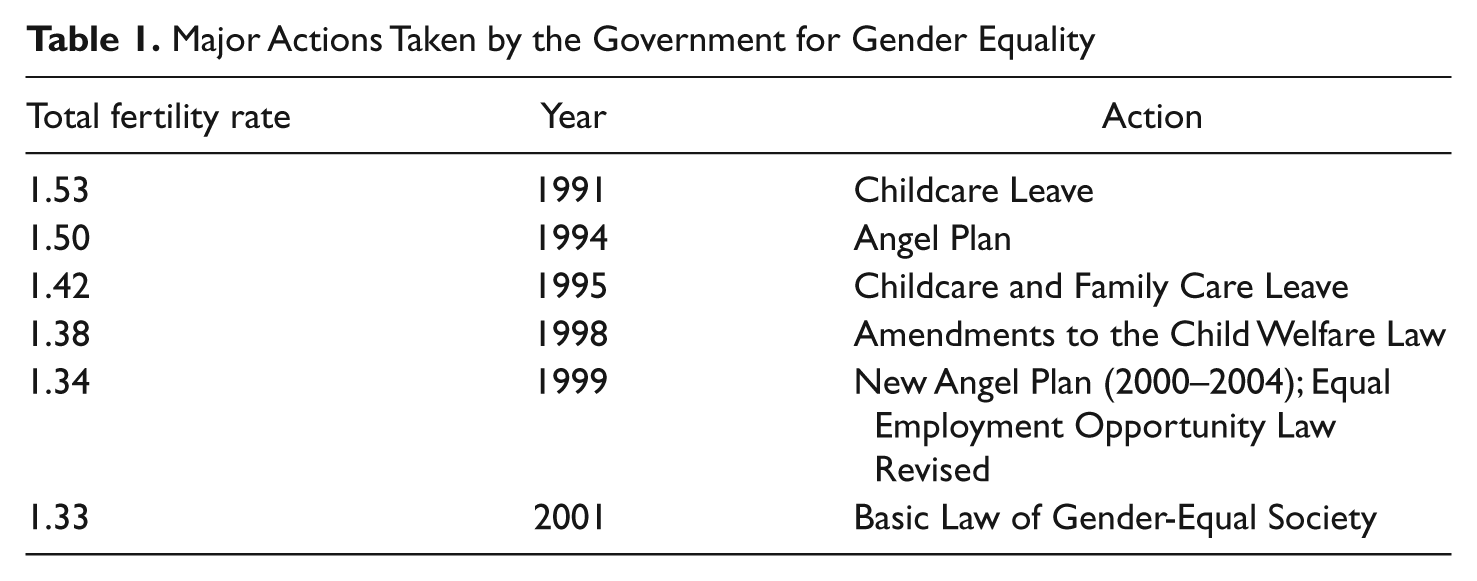
Given that public support alone can never achieve work and family balance, a call for men’s commitment to child care and rearing is appropriate and valid. Men’s commitment, however, remains low. Where the male breadwinner norm is predominant in workplaces, it is difficult for men to take leave for their families. A family-first man may encounter the negative image that he does not fully devote himself to his work. 9 Women are also restrained by the male breadwinner norm. NIPSSR has, since 1993, regularly conducted a national survey on family trends. Those survey results indicate that an absolute majority of women support the idea that mothers should devote themselves exclusively to child rearing until their children turn 3 years old: 89.1% of respondents supported the idea in 1993, and 85.9% did in 2008 (NIPSSR, 2008; Otobe, 2010, p. 26).
To change both men’s and women’s images of the family, the concept of gender equality is frequently invoked. 10 The Basic Law of Gender-Equal Society, enacted in 2002, asserts that, to cope with rapidly changing economic and societal conditions caused by population aging, fertility decline, and economic maturity, Japan has to transform itself to a gender-equal society, where men and women respect each other, share family responsibilities, and develop their individual potentials and talents.
The goal of a gender-equal society, however, has failed to build a national consensus. Given that men do not want to interrupt their careers for family care and women want to concentrate on child rearing (at least for a while), mechanically designed schemes for gender equality are not likely to be accepted by the majority of the nation, where traditional families are no longer sustainable, but their values remain alive. If the majority of Japanese people are negative on gender equality, can Japan find a way to maintain the traditional family? The answer is negative. In some countries, such as Taiwan, Singapore, and Southern European countries, immigrant workers are employed for the maintenance and reproduction of the traditional family. This alternative is, however, not seriously discussed in Japan because of the nation’s anti-immigrant feelings.
Japan seems to face a stalemate. It seemingly has no choice but to make progress toward gender equality as population aging accelerates. It is not an ideological preference but should be taken simply as a matter of fact. Japan cannot afford to waste women’s potential. Gender equality, which evolves with debates over decreasing fertility, may not necessarily promise the recovery of TFR. The relationship between gender equality and fertility is neither simple nor straightforward, to say the least. If a gender-equal society cannot recover fertility, gender equality has its own value and is relevant to societal development (Akagawa, 2004). In any case, continuously low fertility rates make gender equality more important and urgent for Japanese society.
The relevance of gender equality is evident without the commitment to a feminist view. With the catchword “building a sex-neutral tax system,” the Tax Research Committee of the Government started reviewing spouses’ tax credits in June 2002. Spouses’ special tax credits were partially cancelled, and spouses’ general tax credits are also discussed to be eliminated. The correction of the gender-biased tax system is expected to remove a barrier to women’s participation in the labor market. Gender equality can be legitimized by neoliberal economic and fiscal concerns.
Women and Labor Market Deregulation
Women’s labor force participation can be promoted in various ways; three different routes have been utilized in major advanced economies. The first is the social democratic route, where the government takes the initiative in promoting women’s labor force participation, mainly through the expansion of social services. The expanded social service sector creates employment for women. Public-sector employment facilitates gender equality by improving women’s wages and working conditions based on the principle of equal pay for the same job. The second is the liberal, or market-centered, route, where cheap child care is available in the labor market and helps talented women pursue their careers. (The affordable child care is provided by women whose education and skills are low.) Accordingly, the liberal route creates a dualistic structure in the women’s labor market.
The third route is called “flexicurity,” combining flexibility and security in employment. Most Continental European countries, and the European Union as a whole, have shown an explicit inclination toward flexicurity. Women’s labor force participation in Continental European countries used to be low because of strong traditional familial values. Today, the situation has changed and more women work outside, but most of them are expected to be part-time or temporary workers. They are mobilized as marginal workers who provide flexibility in the labor market, as is the case in Japan.
The recent growth of women’s labor force participation does not change the marginality of women’s employment. Gaps in wages and working conditions are certainly narrowed through work sharing. While nonregular workers’ wages and working conditions have improved, regular workers’ wages are often curtailed according to reduced working hours. Regular and nonregular workers are equally covered by social protection schemes. Familial gender biases remain influential in flexicurity-oriented countries, but women are institutionally protected to a considerable extent.
Japan does not fit any of these models. State initiatives implemented in Japan are common in social democratic countries, but Japan is far from the social democratic model. The government encourages women to enter the labor market but does not provide decent job opportunities by expanding the social service sector. Unlike social democratic countries, Japan mobilizes women as a cheap labor force so that the gender wage disparity remains higher than in most major economies. 11 The considerably large gender wage disparity places Japan closer to the United States, but Japan’s female labor force participation is substantially lower than that in the United States. In 2003 the labor force participation of productive-age women (15–64 years old) in Japan was 60.2%, 69.7% in the United States (MHLW, 2004).
The marginality of the female labor force positions Japan closer to the flexicurity model, but working women in Japan are not as generously treated and protected as those in flexicurity-based countries. No substantial work sharing takes place in Japan, so gaps between nonregular and regular employment remain huge. In addition, nonregular workers are not covered by regular employee pension schemes. Even regularly employed women are often treated like casual workers, who are not expected to stay long in the workplace. Quite a few women quit their jobs after childbirth. When they are back in the labor market, they are employed mostly as part-time workers. Gender-equal treatment in employment and labor market deregulation combine to increase the availability and flexibility of the female labor force.
The mobilization of women as a marginal labor force is not a new phenomenon in Japan. In the process of economic recovery in the late 1970s, employers restrained the number of new regular employees and, instead, hired nonregular workers; among others, middle-aged married women were employed as part-time workers. Consequently, dualism in the labor market reappeared explicitly in the 1980s. While keeping lifelong employment and seniority-based wages for regular employees, nonregular employment rapidly expanded. The government has supported the explosion of nonregular employment since the introduction of the Labor Dispatching Law in 1985.
Labor market deregulation promotes the expansion of nonregular employment. The ratio of nonregular employment to total employment rose from 15.2% in 1985 to 31% in 2005. The actual number of regular employees has declined since 1997, whereas the number of nonregular employees continues to increase. Middle-aged women accounted for 35% of the total female labor force in 2005, reaching 5.23 million in number. Moving into the 21st century, young people, including both men and women, have been increasingly prominent in the casual labor market. In 2005, 4.65 million nonregular workers were younger than 35 years of age (Ohara Shakai Mondai Kenkyujo, 2007).
The acceleration of labor market deregulation since the late 1990s, however, was not a simple development of the flexicurity strategy. It was brought about by a new employment strategy. The Japan Employers’ Association released a report, “Japanese-Style Management in the New Era,” in 1995. The report proposed the idea of replacing lifelong employment with contracted employment. The New Era report figuratively declared the end of lifelong employment and seniority-based wages (Nihon Keieisha Dantai Renmei, 1995). Labor market deregulation since the late 1990s has been developed by the government in response to employers’ demand as well as the revision of the Enterprise Pension Law. A major goal of the revised law was to reduce employers’ financial burdens and facilitate flexibility in employment. Most noteworthy in this vein was the introduction of a defined-contribution scheme modeled after 401(k) plans in the United States, which improved the portability of the enterprise pension and made it easier for workers to switch their careers. The 401(k) model also passed risks and responsibilities in pension management over to employees. Employers now pay fixed contribution amounts and, by so doing, can be free from financial uncertainties in pension management (Shinkawa, 2005).
Concluding Remarks
Given the anti-immigrant feelings of the Japanese people, the activation of women and older people in the labor force is one of the few options available to Japan to maintain a viable economy in an era of population decline. The prolonged recession in the 1990s accelerated their mobilization into the labor market as a cheap, nonregular workforce. A cheap and flexible labor force is expected to reduce labor costs and improve labor productivity. Japan’s labor productivity, however, is staggeringly low. Among the top 30 countries with high labor productivity, Japan ranks 20th overall and at the bottom among the seven major economies. Admittedly, there is a positive sign. Although labor productivity in Japan remained at only 0.7% between 1996 and 2000, it reached 1.8% between 2001 and 2005; 1.8% is the second highest among the seven major economies (Shakai Keizai Seisansei Honbu, 2007).
The expansion of the marginal labor force may have contributed to the improvement of labor productivity, but the service sector, which has absorbed the largest portion of the nonregular female workforce, shows no substantial growth of labor productivity. A prominent improvement has been seen in manufacturing, where the marginal labor force has also been mobilized. The growth of labor productivity in manufacturing, however, cannot be explained solely by flexible employment. It is more appropriate to consider that increased productivity in manufacturing has taken place because of the combined effects of automation, the international division of labor, and flexible employment. In short, no simple, straightforward causality has been confirmed between labor productivity and the increase in the cheap and flexible labor force. It should also be noted that the enlargement of marginal labor negatively affects the economy by reducing domestic demand, especially when social protection is thin. Enlarging wage disparity and inequality eventually erode social cohesion and solidarity, damaging the infrastructures of economic prosperity.
The limits inherent in labor-cost restraints suggest that inviting unskilled immigrant workers cannot be a great help to cope with the population decreasing society. The care business would expand as the aged population increases. Care work is low-productive and low-paid hard work, so immigrants are most likely to be mobilized into it. Japan now has bilateral agreements with the Philippines and Indonesia on care and nursing but accepts a very limited number (only thousands, including nurses and care workers) and imposes strict conditions on the extension of their residence in Japan. In short, Japan shows no serious interest in attracting foreign care workers and nurses.
In the case of manufacturing, the relevance of immigrant workers is more dubious. Japan can no longer maintain international competitiveness in the labor-intensive industry by domestic production. Production is no longer vertically integrated within its borders; successful manufacturers have horizontal networks across its borders (Kubo, 2010). The transformation of the production system has made it outdated and inefficient to maintain a large number of cheap and flexible workers within its borders. Japan has no choice but to promote value-added production, whose success depends on a highly skilled labor force instead of unskilled cheap labor.
Needless to say, the choice of keeping the door closed to immigrants is inappropriate and critically damaging in the era of globalization. So is the idea of inviting immigrants as a cheap labor force. Today, no economy can maintain itself as a national unit. Globalization, and the international division of labor in particular, promotes the rearrangement of economic order beyond borders. This tendency naturally encourages a liberal immigration policy or an open-door policy in principle. Japan needs to establish the principle of immigration policy with a vision of a multicultural or multiethnic society, before discussing how many immigrants are acceptable.
Footnotes
Declaration of Conflicting Interests
The author(s) declared no potential conflicts of interest with respect to the research, authorship, and/or publication of this article.
Funding
The author(s) received no financial support for the research, authorship, and/or publication of this article.