



Abstract
Immigration scholars have made great strides in documenting the role of labor agents in connecting immigrant workers with jobs, though less attention has centered on whether such brokerage exacerbates existing workplace inequalities. Based on participant observation and in-depth interviews over 15 months in seven workplaces, I examine power dynamics and relations between brokers and immigrant workers. My analyses show that temporary agencies and embedded brokers play a complementary role in incorporating undocumented immigrants into jobs. Yet important power imbalances develop within these relationships, with implications for the inequalities that the most vulnerable workers experience.
Immigration scholars have made important strides in denoting the role of brokers and labor agents in recruiting immigrant workers to jobs (Elrik & Lewandowska, 2008; Gabaccia, 2000; Hagan, 1998; Hernández-León, 2005, 2008; Krissman, 2000; Kyle, 2000; Kyle & Liang, 2001). More attention is warranted, however, particularly when it comes to how labor brokers mediate the relationship between undocumented workers and employers after the initial matching has taken place. In this article, and building on my in-depth analyses of seven workplaces, I argue that brokers actively mediate immigrant workers’ need for training, supervision, and assistance to integrate into formal organizations even after initial matching has occurred. As my analyses show, such relations hold important implications for both power and inequality experienced by immigrant workers, especially the most vulnerable and undocumented.
In most cases, any supervisor or hiring agent can perform posthiring functions. However, a legal and cultural boundary characterizes the relationship between employers and undocumented workers. This boundary creates entrepreneurial opportunities for migration industry agencies (Hernández-León, 2005, 2008) and cultural brokers to mediate the relationship. By virtue of their ability to bridge otherwise disconnected groups, brokers control valuable resources (Burt, 1992)—jobs, cultural knowledge—and can move between categories (e.g., employer/worker, in-group/out-group member). In fact, it is within this gatekeeping role that brokers can shape the fate of the most vulnerable workers and even exacerbate existing inequalities.
During the course of 15 months, 12 months in 2005-2006 and 3 months in 2009, I worked in seven low-wage, light industrial jobs in South Carolina, investigating the power dynamics between labor brokers and immigrant workers. Below, and following a background discussion of relevant network, immigration, and inequality literature, I report key findings derived from my own observations. For analytic purposes, I distinguish between “external” labor brokers (temporary employment agencies) and “embedded” brokers (bilingual supervisors who mediate the day-to-day relationship between immigrant worker and employer). External brokers, such as temporary agencies, connect workers with jobs and insulate employers from the legal risks of hiring the undocumented, while the latter socialize, assist, and often exercise power and control over immigrant workers.
Structural Holes and Relational Theories of Inequality
In certain respects, organizational network theories explain the importance of brokers in bridging the gap between the unlikely pair of undocumented workers and large industrial organizations. Burt (1992) defines discontinuities in the social structure as “structural holes.” Structural holes are “entrepreneurial opportunities for information access, timing, referrals and control” (p. 2). Brokers benefit from taking advantage of these opportunities and from functioning “between people who vary in their behavior and opinions” (Burt, 2005, p. 354). In the case of undocumented immigrant employment, brokers bridge structural holes by connecting employers and undocumented workers. They function at the boundary between corporate authority and unskilled workers, “between speaking English and speaking Spanish” (Pattillo, 2007, p. 114), between relational and rational perceptions of workplace norms, and between legal and less-than-legal realms.
The effect of bridging these symbolic and social boundaries (Lamont & Molnar, 2002), however, implies a duality (Pattillo, 2007; Stovel & Shaw, 2012). On one hand, brokers facilitate hiring between firms and the undocumented, enable communication between employers and workers, and promote workers’ integration into firms. On the other hand, and no less important, brokers also seek personal gain, create dependencies (Molm & Cook, 1995), exploit workers, and amass power. Through their active role in these processes, embedded brokers generate persistent inequalities (Stovel & Shaw, 2012).
Gould and Fernandez (1989) have created a useful categorization that views brokers as either a “gatekeeper” or “representative.” A “representative role is created when one or more members of a subgroup delegate one of their own to communicate information to, or negotiate exchanges with, outsiders.” The gatekeeper role occurs “when an actor selectively grants outsiders access to members of his or her own group” (Gould & Fernandez, 1989, p. 92). This distinction between gatekeeper and representative highlights the importance of the within-/between-group boundaries. For instance, brokers of immigrant labor tend to be former immigrant workers themselves and are connected to immigrant workers by norms of reciprocity and bounded solidarity (Portes & Sensenbrenner, 1993). As a member of the immigrant group, the broker may also act as “representative” when communicating requests and/or complaints from immigrant workers to the managers or supervisors. Because brokers control access and resources, they also act as gatekeepers. Employers understand that hiring a network insider (the immigrant broker) can facilitate access to immigrant workers.
Although the brokerage roles of representatives and gatekeepers emerge where structural holes exist in the social structure (Burt, 1992; Fernandez & Fernandez-Mateo, 2006), individuals in these positions are susceptible to the social relations between different actors and to the power asymmetries emerging in those relationships (Roscigno, 2011; Tilly, 1998; Tomaskovic-Devey, Avent-Holt, Zimmer, & Harding, 2009; Vallas & Cummins, 2011). Thus, understanding the consequences of brokerage requires attention to the micro-level processes unfolding in the course of every day interaction (Stovel & Shaw, 2012). Taking these theories further, and along with Vallas and Cummins’s (2011) call for enhancing relational models of inequality, this article examines how brokerage influences the integration of undocumented immigrants beyond the initial connection between employers and workers. It also examines the consequences of brokerage on workplace inequality. In the context of the shop floor, brokers manage cultural and material boundaries (Lamont & Molnar, 2002), and these actions generate exclusionary processes that affect vulnerable populations.
Latino Immigrants and Brokered Employment in South Carolina
During the 1990s and early 2000s, many immigrants to the United States bypassed the traditional gateways of New York and Los Angeles and moved directly to new locations (Massey, 2008)—new locations scholars label as “new immigrant gateways” (Singer, Hardwick, & Brettell, 2008). I undertook my research in South Carolina, one of these gateways and a state wherein the Latino population quadrupled between 1990 and 2005 (U.S. Census Bureau, 1990-2005). Many Latinos, if not most, work in low-wage jobs. Many also lack the permits to work legally in the United States (Cobb & Stueck, 2005; Odem & Lacy, 2009). Two-thirds of unauthorized workers concentrate in service jobs, construction, and manufacturing, while only 31% of native-born workers work in these occupations (Passel & Cohn, 2009).
Unauthorized status, of course, creates vulnerability for these workers. Employers can threaten deportation if workers complain about working conditions, and there have certainly been high-visibility cases wherein employers have exploited this power imbalance. On the other hand, employers can be sanctioned legally and through public oversight—something that has helped foster the niche for brokers. Hiring an undocumented worker is against the law and carries substantial risks for employers, both civil and criminal, with penalties up to $10,000 per undocumented immigrant hired and 6 months in prison. Instead of assuming such risk or even having to verify eligibility, many employers turn to temporary agencies and brokers tied to the immigrant community. By doing so, they shift the burden of verifying worker eligibility on the agency. The agency assumes the risk, increases their relevance in the local labor market, and collects fees from employers. The arrangement does not completely shield the employers, however. Anyone who knowingly uses a subcontractor to provide undocumented workers is technically as responsible as if he or she had hired the workers directly. Maintaining plausible deniability is, therefore, a priority for employers when hiring brokers and explains in large part why employers give brokers disproportionate levels of autonomy.
Data and Method
I used a mode of participant observation that involves working alongside community members to study a specific issue (McDermott, 2006)–such as labor market dynamics. I revealed the general purpose of my research to people with whom I had close relationships and to all subjects I interviewed. With gatekeepers such as employers and supervisors, however, I limited my disclosure. I told them I was a doctoral student studying the growth and transformation of midsized communities in the South. The sensitive nature of studying undocumented immigration and race and ethnic relations precluded me from revealing the precise subject of my research. Not fully disclosing my identity as an observer with casual acquaintances allowed me to document the subtleties of attitudes toward immigrants. Crosby, Bromley, and Saxe (1980) note that if people do not know they are being observed or measured, they are more likely to behave in accordance with their attitudes.
I draw on semistructured interviews with key informants—interviews that provide detailed accounts on questions about getting a job and relationships with supervisors and employers. Some of my respondents were either former or current labor brokers. To protect the privacy of research participants, I use pseudonyms when referring to people and organizations.
My analyses, presented below, are largely inductive. Using qualitative software for data analysis, I assigned codes to each line of text from interviews and field notes to sort and organize information into categories and render it meaningful for analysis. I then integrated these codes into analytical clusters to form themes (Lofland, Snow, Anderson, & Lofland, 2006). These codes and themes provide the analytic and conceptual foundation of the foci reported below.
Brokered Jobs and Employment Contexts
The seven jobs I held each lasted at least 2 weeks but not more than 7 months. In some cases I simultaneously worked in multiple jobs. I sought jobs without having any prior contacts in South Carolina. This strategy allowed me to document network processes as a newly arrived Mexican immigrant. With the exception of one of the jobs, where I was hired to supervise a crew of Latino workers and build a “Mexican enclave,” all of these jobs were advertised as “light industrial” or assembly jobs. In most I primarily spoke Spanish and had a Latino supervisor mediating my communication and training. As a supervisor, I trained workers and mediated the communication between managers and immigrant workers and between immigrant workers and native-born workers and supervisors.
The workplaces in this research vary in many ways. As illustrated in Table 1, the jobs in four of the seven organizations involved working on an assembly line. One entailed packaging materials and in the remaining two, I worked alongside crews on service assignments. All of these jobs were temporary and paid from below minimum wage to just above the median wage at the time for manufacturing in the state of South Carolina. Two of the seven workplaces were staffed primarily by Latino immigrants, and the other five were staffed mostly with native-born workers. Important to my theoretical emphases above, five of the firms had embedded brokerage situations. Only one firm had a “distributed brokerage situation”—a situation in which the actions of embedded and external brokers were combined. And, finally, one establishment had no brokers.
Employment Site Characteristics (N = 7).
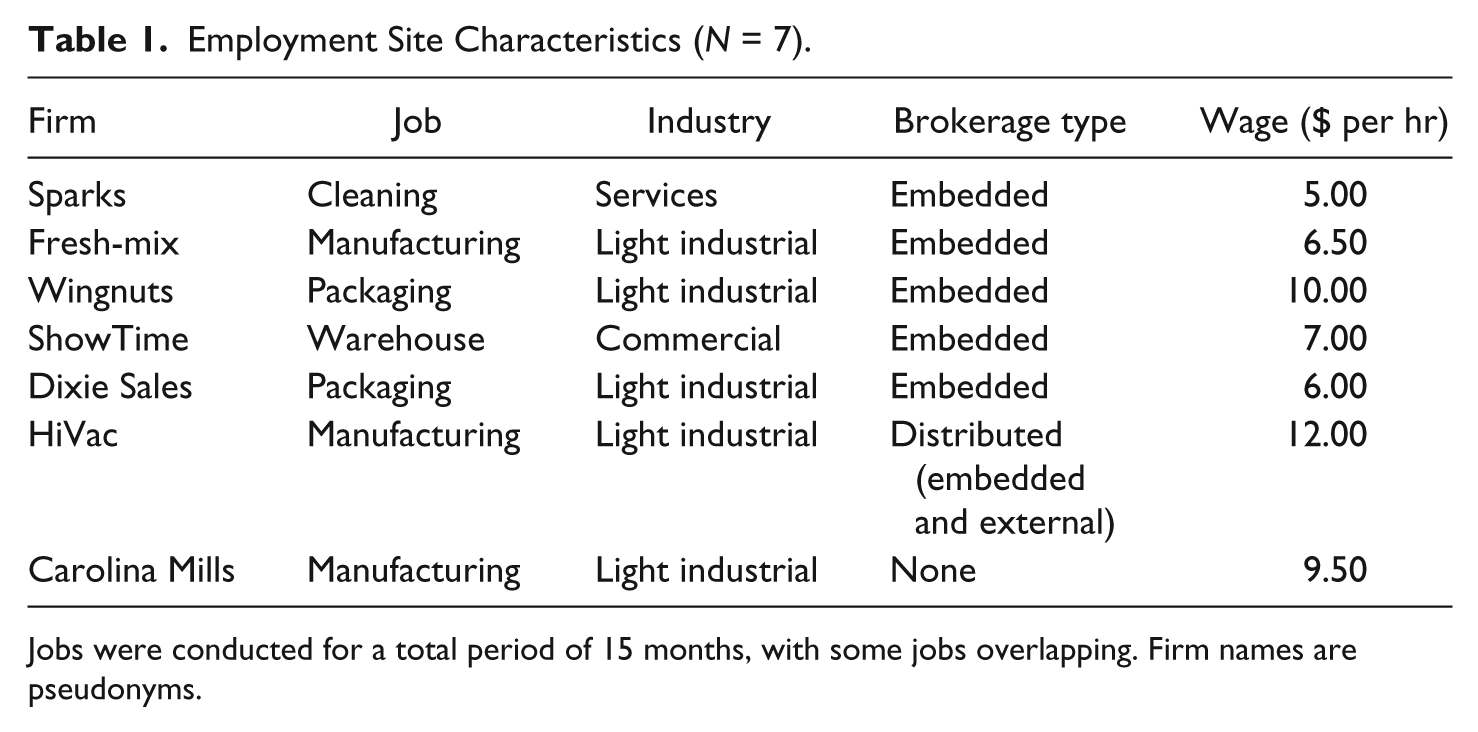
Jobs were conducted for a total period of 15 months, with some jobs overlapping. Firm names are pseudonyms.
Types of Brokerage Situations
The jobs available to immigrants in the study fall into three types of brokerage: (a) embedded brokerage, (b) external brokerage, and (c) distributed brokerage.
In embedded brokerage situations, a firm hired bilingual supervisors to interview, supervise, and train immigrant workers directly inside the firm. Embedded brokers enabled communication between Spanish-speaking workers and English-speaking individuals in the workplace. Operating between managers’ and immigrants’ networks, embedded brokers benefited from access to privileged knowledge and from exclusive control over immigrant workers.
Some embedded brokers are subcontractors hired by large firms. Subcontractor embedded brokers may manage an immigrant crew hired for a short period of time or on an ongoing basis. Two characteristics distinguish subcontractors from “pure” embedded brokers. First, subcontractors recruit, hire, and compensate immigrant workers directly. Second, subcontractor supervision tends to isolate workers from the owner of the contracting firm—physically and legally. Subcontractors absorb the risk of hiring unauthorized immigrant workers, creating a situation of dependency for both workers and employers. In three of the seven jobs in this study subcontractors mediated the employment relationship. Formalized authority confers substantial power on embedded brokers—both subcontractors and “pure.” Except when I describe a situation where the subcontractor relationship became important, I refer to both of these subtypes as “embedded brokers” for simplicity.
The counterpart to embedded brokerage is external brokerage. This entails situations in which a formal entity such as an employment agency mediates the relationship between employer and immigrant worker. Such agencies may be immigrant agencies and nonimmigrant agencies. Immigrant agencies serve to isolate both employers and workers from the legal risk of hiring unauthorized workers. I refer to temporary employment agencies engaged in the hiring of immigrant workers as “immigration industry agencies.”
The third brokerage situation I identify is best described as “distributed brokerage,” or a situation in which both embedded brokers and temporary employment agencies mediate the relationship between employers and immigrant workers. My analyses, by examining how embedded brokers and agencies function to incorporate immigrant workers, shed light on the importance of these actors and what their relations mean for the relative power and inequality of immigrant workers themselves.
The Two Faces of Brokers
In some instances, I observed brokers having a positive influence in workplaces and for workers. However, I also found situations within which brokers’ dual roles as both mediators and supervisors created dependencies for immigrant workers that bolstered power imbalances and inequalities. I denote both scenarios below.
Benefits for Workers in Brokered Situations
Embedded brokers main functions are (a) socializing immigrant workers to employers’ expectations and (b) providing assistance with work and personal matters.
Socialization, I observed, involved transmitting and upholding the belief among managers that Latino immigrants are “reliable” and “hard-working.” In one company, workers often talked about brokers telling them that the company wanted to hire Hispanic workers because “we work hard” and “we come to work every day.” At another firm a Latino supervisor frequently praised the Latino workers: “The managers like that we don’t complain. We focus on work.”
Brokers strategically deployed such codes at the first sign that behaviors could challenge the image of “hard-working” immigrant crews. For example, on one occasion, a worker had missed the van that transported us to job sites because her car broke down. The broker called a meeting to remind the crew that the “only reason managers want the Latino crew” is because “everyone is always at work and on time.” And that he “didn’t want one worker to affect the rest.” Brokers understood that their position was contingent on their ability to maintain a distinction between the performance of the immigrant crews and the crews of native-born workers. Consequently, this type of warning was commonly deployed when brokers feared their crew’s image as hard-working and reliable was in jeopardy.
Another way of socializing workers involved communicating the norms of the workplace. At a packaging company, the embedded broker instructed me on my first day, “Come to work ‘presentable.’ . . . Don’t come wearing jewelry like earrings or rings . . . not even little earrings, nothing. I know ‘we’ like wearing jewelry but not here, not at the plant. No open shoes. Cellular phones should be off at all times.” At another company, a native-born worker complained to a floor manager that her “asthma got worse” from working next to a female immigrant worker who wore a “very strong perfume.” At the floor manager’s request the broker counseled the worker about wearing perfume at work. These types of incidents not only socialized workers to fit into the factory environment, but often provided necessary information to help new workers stay safe.
Some embedded brokers also trained workers to train one another in an effort to counteract the unwillingness of native-born workers to provide such support. This involved, in my observations, teaching workers to understand tools or processes and to rotate jobs to prevent injury. Brokers also helped with carpooling and often enabled the formation of raitero networks, a form of commuter groups (Hernández-León, 2005). One broker, for instance, gave two workers without transportation the name of a Spanish-speaking worker in a different department who did own a car. Within a couple of days these two workers had found transportation (for a fee) to get to work every day. Embedded brokers also themselves provided rides to immigrant workers.
In addition to providing assistance with work related matters, embedded brokers often supported workers in meaningful personal matters. When Adriana, an undocumented worker from Mexico, had a difficult pregnancy, the broker, Daniel, stepped in, as she explains: My section leader saved me from losing my baby and my job when I was very sick with a high-risk pregnancy. The office told me that I had to be at work . . . because of the rules of employment, but I was feeling very sick. [Daniel] sent me home every day during the first two weeks. Because, you know, at the plant, when they had too many people on the floor they would ask workers in the morning if they wanted to go home. It was your own decision but because he [section leader] knew I was sick, before he would ask anyone else if they wanted to go home he would come and ask me first. I didn’t like missing work. I didn’t like arriving late to work. I had a very, very good record but at that time I was very sick with the pregnancy and thanks to the supervisor that sent me home every day, my son was viable. . . . Otherwise, God knows what would have happened.
For Daniel, helping Adriana guaranteed her subsequent loyalty when she was coordinating workers and managing the routines on the assembly line. Coordinating in this manner was a privileged position she could fulfill because she spoke enough English to assist in communication with nonimmigrant workers, yet not enough to become a threat by communicating with the managers.
The ability to operate between English-speaking and Spanish-speaking work groups gave embedded brokers the power to mediate racial tensions between native-born and immigrant workers. Brokers dealt regularly with the animosity that arose when employers introduced Latinos into factories that had been traditionally organized along Black and White racial lines. Beyond the use of slurs and swearing toward immigrant workers and refusals to train them, many immigrant workers reported that native-born supervisors “always ignored them” and even refused to provide them safety equipment. Brokers often contained conflict and mitigated negative attitudes by isolating immigrants from nonimmigrant workers. This, however, and as noted below, also had certain negative, long-term consequences.
By socializing workers in the norms and routines of the labor market, embedded brokers provided workers with what Swidler (1986) calls a “cultural tool kit of habits, skills and styles from which people construct ‘strategies of action’” (p. 273). Indeed, embedded brokers taught immigrants to work at a faster pace than the native-born, to limit complaints and restrain from reacting to abuse, conflict, and provocation.
Recruiting and Hiring
In contrast to embedded brokers, agencies influenced workers’ employment situation when they mediated recruiting and hiring. Agencies used Spanish newspapers and radio to target advertisements about job openings to the immigrant population (Johnson-Webb, 2003). Agencies, for example, advertised for crew leaders or assembly jobs in the local (free) Spanish-language newspaper and radio stations. Targeted recruitment in ethnic media allowed agencies to achieve wide diffusion of job information at low cost to immigrants.
Agencies had the added advantage of being able to directly access their networks of contacts with the immigrant community—something consonant with Granovetter’s (1973) conception of “weak ties.” These brokers typically maintained updated lists of key contacts in Latino neighborhoods. Arnulfo, a worker at a janitorial company, served as an informal labor intermediary for an agency and gave three cellular phones to people in different neighborhoods to contact him when new and available workers arrived to that neighborhood. He also visited friends weekly in four different Latino neighborhoods. Arnulfo revealed, “To clean this office building, I got a call in the morning and that night I already had five to six people ready to work.” His strategy allowed him to rapidly respond to opportunities and paid off by elevating him to a supervisory role, even though he had no more experience than the other workers.
Agencies served other recruitment functions as well. In addition to relaying information about jobs, they related to prospective workers which companies did not ask tough questions about worker documentation. Agencies also employed cultural accommodation strategies. For example, workers liked that many employment agencies had bilingual interviewers and that they could request to work on all-Latino crews or for reassignment if supervisors were abusive or exploitative.
Gaining employment through an agency enabled some workers to transfer between firms and increased the stability in their employment situation. In an organization where I worked as a supervisor, the company had employed undocumented workers through an agency long enough to consider them for conversion to permanent employee status. However, this conversion process required scrutiny of the employee’s legal status and often removed the plausible deniability that allowed the employer to ignore the workers’ undocumented status. Although some workers were terminated as a result of the process, they did not lose all of the benefits of having been incorporated into the workforce at large. Their relationship with the employment agency still benefited them, in fact, and the employment agencies had the capacity to reassign workers to new firms. In this way, the agency made workers less vulnerable even than they would have been if hired directly without any kind of broker.
The Price of Brokers: Asymmetry, Power Imbalance, and Vulnerability
Intentionally or unintentionally, brokered relationships can translate into dependency on the broker. Dependency on the broker to communicate, work, and negotiate with others can lead, as my observations revealed, to power imbalances, systematic exploitation, and occasional abusive treatment. The type of brokerage situation, however, often shaped the specific consequences.
In embedded brokerage situations, a power asymmetry emerged because of spatial and linguistic barriers. Isolation gave workers a sense of group cohesion and brokers a sense of control over communication flows. In an illustrative case, the job I held involved crews of workers traveling together for 2 to 3 hours in a van to get to different job sites. The Latino immigrant crew traveled in one van while the non-Latinos traveled in another van. During our daily meeting to go over rules and expectations, the broker communicated with Latinos exclusively in Spanish and the native-born supervisors communicated with all other workers in English. Although this eased communication, it exacerbated disparities. I learned from talking to workers in the English-speaking crew that the embedded broker was applying different standards. Immigrants were asked to package more units per hour than the native-born and were being paid less than the temporary workers in the native-born crew. The broker took advantage of the linguistic differences of the crews to communicate different expectations for immigrants, and Latino workers had little recourse to report the supervisor.
In situations in which the embedded broker isolated the immigrant crew, workers perceived brokers as having the ability to influence their employment experience in other ways. Some crews included workers from different nationalities, which created disputes about which group should be assigned to the worst jobs. It was common for Mexican and Central American workers to express frustration with their Colombian supervisors. Arturo, a Mexican worker, noted that Colombian supervisors “keep [Mexicans] totally controlled but they let the Colombians do what they want . . . they get away with anything.” Although the workers might have imagined national alliances, I observed brokers most frequently exploiting Mexican and Central American workers’ vulnerability. In conversations with brokers I learned that they perceived Mexican and Central American workers as less willing to speak out against abuses or exploitation, due to their more tenuous legal status and lack of resources.
Inequalities in the relationship between embedded brokers and workers also involved negative consequences for immigrants when brokers managed racial boundaries. For example, one job involved crews of Black, White, and Latino immigrant workers hired to perform a variety of assignments in different workplaces—assignments that included working for several hours in a refrigerated area. Not a single worker wanted to work in the refrigerated area because the cold caused pain in almost every bone of our bodies to the point that was difficult to keep working. Black and White workers refused to do the job and complained to a manager. The manager spared the native-born workers but asked the embedded broker to send the Hispanic crew to work in refrigeration. When the immigrant crew complained, the embedded broker said he was “going to talk to the manager” but did nothing. When a worker in the Hispanic crew asked again, the broker responded, “If you don’t like the job, you can leave. This is your job.” Unlike the native-born, immigrant workers refused to go over the authority of the supervisor for fear of losing their job.
Workers commonly encountered abuses related to gaining employment and manifesting aspirations for advancement. The immigration literature offers examples of brokerage situations in which brokers charge workers a commission to gain access to jobs (Elrik & Lewandowska, 2008; Kyle & Liang, 2001). Although other researchers have observed abuses by agencies, I discovered embedded brokers committed fewer abuses when an employment agency was also involved. For example, Esteban, an immigrant worker, noted in an interview, I was looking for a job and a friend of mine asked that I gave him $100 to get me in . . . to place me on the job. And once I was on the job, he made my life miserable because he had more years there than I had. And he spoke English well and since I had just arrived, well . . . he saw that I didn’t know. He was like a supervisor, the foreman . . . well, in fact, he fired me from the job. He got me the job and he fired me from it even though I knew how to do the job well. I think it was because I learned fast and I tried learning English also . . . well, the basics, at least. . . . So, when they sent me to go and get something like tools, well, I already knew. But since he saw that I was learning fast, he decided to kick me out of the job just three weeks after I started.
With no one else to report abuses to, workers are vulnerable to brokers’ absolute power. In this and other examples, a broker would turn against a worker if he perceived the worker to represent a threat to his position. On one occasion, a worker asked the broker, “What do I need to do to get your job?” This question prompted the broker to evaluate the worker under more strict standards and eventually fired the worker for reasons that were tolerated in other workers (e.g., playing at work, using tinted safety glasses, walking over the conveyor belt). Cases such as this illustrate that brokers suspend their support when a threat is perceived. Without this support workers are more exposed to the vulnerability of their situation.
Other cases illustrate the risk of demanding benefits. With time on a job, many workers felt more comfortable being self-advocates. Patricia, a worker in a packing plant, reported on a common type of claim: There was a woman . . . a friend of mine that fell twice in the same year on the floor and injured her back or her hip, I am not sure. She slipped and fell . . . the floor was always slippery. First, the supervisor suspended her for 3 days. Without work my friend couldn’t pay for her medical bill and asked to see if the company could pay her medical bill. Then [the supervisor] fired the woman. [The supervisor] told her that she had violated the company’s safety rules [chuckles] . . . it was the worker’s fault to fall twice in the same year! That wasn’t because she violated the company’s safety rules. That was because she asked if the company could pay for her medical bill!
The quote, and many others like it, suggests that in pure embedded brokerage situations, where the only source of authority is embedded brokers, the likelihood of power abuses increases, thereby making immigrant employment more precarious. In situations such as these, the broker ceases to be a representative of the immigrant group and becomes a representative of his or her own interests.
Balancing Power Asymmetry: Embedded and External Brokers
In companies with a distributed brokerage situation, where an embedded and an external broker worked in tandem, workers had more recourse when they experienced abuses. To illustrate, in a situation in which an embedded subcontractor managed payroll, immigrant workers often received paychecks that reflected a lower number of hours than what they had worked. On one occasion, a worker asked the broker to adjust her wages, showing him a piece of paper where she tracked her worked hours. The broker told her that she needed to “go back to school and learn to add” and that she had “made up the form that day.” The incident generated a conversation with workers about what to do with the problem of not getting paid for the number of hours worked. Some workers expressed frustration with not “knowing who the supervisor’s boss was” to “report him.” Others felt that they “didn’t want to make trouble” and contest their wages. Still others thought that it was better to “look for another job.”
In contrast to the case above, workers in a distributed brokerage situation had more recourse. At a manufacturing firm with distributed brokerage, workers were more likely to express grievances regarding wage discrepancies. On one instance, a worker’s pay check was not reflecting several hours of overtime. The worker approached the embedded broker, but the adjustment was not reflected in the next paycheck. Needing the funds to pay for her rent, the worker bypassed the broker and called the agency. Within a couple of days the agency had adjusted her wages. Although it is hard to argue malice in this situation, the broker told me that he “forgot to ask the agency.” Thus, in distributed brokerage, it is more difficult for embedded brokers to maintain dominance and more likely for agencies to gain trust.
Other form of abuse where distributed brokerage balanced the power of embedded brokers involved embedded brokers using their position of power to extract sexual favors from their workers. At the workplace where I worked as a supervisor, Carmina, a Mexican worker, requested a transfer to avoid problems with a group of Black female workers in her section. Rodrigo, an embedded broker at the plant, offered to give her a job in his section that had no Black workers. Within a few days, Rodrigo started dating Carmina and often took her home with him after work.
A few weeks after they had been dating, one of the managers called me into his office. When I arrived, the manager asked me to translate this meeting “word by word.” His request surprised me given that Rodrigo, another bilingual supervisor, was in the room. The manager said the agency called him because Carmina had complained about Rodrigo. Rodrigo interrupted him to argue that “Carmina had been absent three times and she had arrived late to work three times as well.” Carmina responded that “it’s something personal.” She explained that Rodrigo had approved her absences and late arrivals and that now “Rodrigo wanted to terminate her.” She said, “Rodrigo has something against me because I don’t want to go out with him anymore.” Rodrigo responded, “It has nothing to do with that, I was just following the manager’s orders . . . making sure people are at work.” Carmina’s having access to an agency to report an abuse of power allowed her to resolve a problem with a third party and ultimately keep her job. Because of the distributed brokerage situation, she was less dependent on Rodrigo and he had less power over her.
Other workers revealed similar stories of harassment by embedded brokers. In cases of embedded brokerage, workers can address issues they have with their supervisor only to the supervisor. In situations of distributed brokerage, however, workers can go to the external agency and address their grievances with a more or less impartial party.
Discussion and Conclusions
My observations and analyses illustrate that brokers play a role in whether and how workers succeed in a precarious labor market. The examples, derived from my qualitative immersion into seven workplaces, suggest that brokers can certainly play a positive role in workers’ lives. Because this mediating role confers power to brokers over immigrant workers, however, the consequences for immigrant labor market incorporation can be both positive and negative. It seems to depend largely on whether power is deployed in employment contexts characterized by embedded, external, or distributed brokerage.
Brokers, as my analyses reveal, use distinct tools to manage relationships with workers. Embedded brokers use socializing and assistance to transfer knowledge about the norms and rules of the workplace. In doing so, they gain loyalty and trust from their subordinates and accolades from their superiors. Broker assistance is closed off, however, when workers refuse to comply with brokers’ demands or are perceived as a threat to the broker’s position. When this occurs, workers must either realign with the broker’s expectations or move to other jobs. The most vulnerable workers, those who believe they have limited options, are more apt to comply with brokers’ demands and keep ambitions for advancement at bay. Workers’ linguistic and legal barriers also enable embedded brokers to draw distinctions between groups of workers and exercise control.
In line with relational theories of inequality including those pertaining to employment specifically (Roscigno, 2011; Tilly, 1998; Tomaskovic-Devey et al., 2009; Vallas & Cummins, 2011), this study also shows that the basis for exploitation is both cultural and categorical. Immigrant workers experience exploitation and opportunism in workplaces due to the brokers’ ability to manage the linguistic, racial, and legal boundaries that separate employers and workers. Brokers buffer employers from the legal risk of hiring categorically and also control the experience of workers on the shop floor. The type of brokerage situation, however, seems to influence such power dynamics and the leverage brokers have over workers.
It is possible that isolation weakens when workers participate in social networks outside the workplace or have access to resources that enable them to trespass legal, ethnic, and linguistic boundaries. My observations, however, rendered little evidence of these sorts of resources. Most workers’ community relationships often overlapped with those of their workplace. Consistent with “weak ties” (Granovetter, 1973) arguments, people with closed networks ended up locked in bad jobs and working under brokers. My observations and conclusions in this regard are suggestive at this point and reveal a need for more research exploring how outside networks might reduce the inequalities in the relationship between brokers and workers.
The potential for abuse and exploitation always lingers in the brokered relationship. A core condition influencing inequality is the level of power that embedded brokers have over workers. Immigrant workers are most likely to experience recurrent exploitation and opportunism in employment contexts where embedded brokers mediate the relationship between workers and employers and control access to key elements of the employer–employee relationship such as hiring and socializing. This is particularly the case with subcontractor-type embedded brokers because they derive additional power by insulating employers from the legal risk of hiring unauthorized workers. This has clear implications for the precariousness of immigrant employment. In employment contexts in which distributed brokerage characterizes the hiring and socializing of workers on the shop floor, immigrants are far more likely to achieve stability in their formal employment situation and indeed derive some countervailing leverage by having several sources of authority to approach when seeking resources or when situations of abuse emerge.
Of importance, the balance of power in the embedded broker/worker relationship need not be achieved exclusively by an employment agency. Any impartial party having access to authority figures in an organization can check the power that embedded brokers have over workers. As shown in the example of the supervisor requesting sexual favors from a female immigrant, the presence of another embedded broker helped address the abusive behavior. Similarly, as workers develop their cultural tool kit they learn how to take a stand and speak out. For them to resolve situations of abuse and/or exploitation, however, the brokerage situation needs to be open rather than isolated. Without access to representatives from the hiring firm, abuses and exploitation from embedded brokers often go unchecked.
In this article, I have drawn from existing research focused on the gains of brokers (Burt, 2005; Granovetter, 1973). However, I also show that brokers often achieve their gains at the expense of the most vulnerable workers. Focusing solely on brokerage resulting in social mobility to the lucky few may obscure brokerage’s broader relationship to inequality. In this vein, there are at least three forces that might foster the persistence of inequality in brokered relationships. First, employers have little incentive to eliminate embedded brokerage from their relationship with workers. In fact, the legal buffering brokers provide creates incentives for them to maintain the gap in the relationship. Second, embedded brokers maintain the gap because it gives them a level of power substantially above their pay grade. Third, even though individual brokers may move up or out of the organization, the structural hole persists and another broker will fill it.
Although my study focuses on undocumented immigrants, the relational dynamics uncovered in this research enrich broader theories of relational inequality. Insights emerge relative to embedded brokerage as a mechanism in inequality production—a mechanism that can have fundamental implications for the employment experiences of other vulnerable populations. If, as illustrated in this article, the vulnerabilities of a population expose them to hiring and socialization and, more important, isolation in the workplace, then the embedded brokers they rely on to counteract isolation will wield inordinate power. And, in the absence of external brokers to check the asymmetry in the relationship, the most vulnerable can perpetually be locked into the worst jobs.
Footnotes
Declaration of Conflicting Interests
The author(s) declared no potential conflicts of interest with respect to the research, authorship, and/or publication of this article.
Funding
The author(s) declared receipt of the following financial support for the research, authorship, and/or publication of this article: This research was supported by a National Science Foundation Dissertation Improvement Grant, a Center for Comparative Studies in Race and Ethnicity Graduate Dissertation Fellowship from Stanford University, a School of Humanities and Sciences Graduate Research Opportunity Grant and a Vice Provost for Graduate Education Dissertation Research Grant at Stanford University. Additional support for publication was received from the Robert Wood Johnson Foundation Postdoctoral Fellowship Program in Health Policy Research.