




Abstract
When badly hit by the same global financial and economic crisis in the early 2000s, the Irish and the Greek societies reacted in quite different ways. Whereas Ireland remained largely acquiescent and displayed a high degree of civil compliance, Greeks took massively to the streets using violence and attacking specifically the state and the state personnel, a phenomenon we refer to as “political Luddism.” It is shown that the two countries are quite similar in terms of their economic condition, cultural background, social composition, ideological profiling, and party system dynamics, among other factors. What, then, explains the two countries’ dissimilar reactions to crisis? Through a detailed analysis of the cases, the article offers evidence that the most compelling explanation relates to the varying ability of the Greek and Irish states to continue providing basic public goods and other state-related services to their respective societies.
Introduction: The Puzzle
When the world financial and economic crisis hit them in the late 2000s, Greece and Ireland competed to outdo one another in the same “league of misery.” Both countries suffered similar economic declines and both were bailed out by the so-called Troika (consisting of the European Union [EU], European Central Bank [ECB], and International Monetary Fund [IMF]) in exchange for tough austerity measures. Yet, the respective societies in the two countries reacted very differently. Through the economic crisis, Greece witnessed massive, and often violent, social unrest, which is without parallel in other crisis-ridden European societies. As the crisis deepened in that country, ideological polarization became intensified, effectively dividing Greek society into two camps, one standing against austerity and the other pro-austerity. It eventually led to the collapse of the old party system, the growth of neo-populist forces, and the rise of neo-fascism. Nothing similar happened in Ireland, although it was also at the epicenter of the crisis. Instead, in 2009, then-Irish Minister of Finance Brian Lenihan toured important European capitals, projecting an image of Ireland as taking its medicine in dealing with the economic crisis. There were very few protests in Ireland and no cases of violence. In short, as mass and violent social unrest made Greece the pin-up for political protest movements, Ireland’s comparative peace made it a poster child for austerity.
This raises a compelling puzzle for theorists of social movements and protest politics, as well as political economists in general: Why, given a similar economic crisis, did the Greek and Irish societies react in such dissimilar ways? This becomes even more puzzling when we consider that, in contrast to Greece, the root cause of the crisis in Ireland was not just public overspending, but the cost of rescuing reckless private banks and repaying mainly non-Irish bondholders in these banks. It should be expected, therefore, that the Irish would be more prone than the Greeks to react to such an apparently “unfair” situation. The economist Joseph Stiglitz was but one among many who marveled at the almost religious fervor he saw in the Irish ability to “suck up austerity pain” compared to that of Greece, which he noted at least had “sinned” (O’Hora, 2013).
The analysis proceeds as follows: First, we review the chief reasons that have been proposed to explain political protest and, in particular, focus on economic, cultural, social, ideological, and state-related theories. We then outline an alternate explanation, which rests on the varying capacity of states to provide welfare for their citizens. Third, we present key data for social unrest during crisis in both Greece and Ireland and examine whether, and how well, they apply to the foregoing theories. Fourth, we analyze in some detail our two cases and, by bringing the state back in, propose an original interpretation of varying social unrest during the crisis. Finally, we present our findings and conclusions.
Theorizing Social Unrest
Mass social unrest is “an expression of collective dissatisfaction with the political system [that] manifests itself in unconventional forms of protest behavior” (Jovanović, Renn, & Schröter, 2012, p. 42, italics added). In this understanding, emphasis shifts from conventional nonviolent protest that aims at the satisfaction of particularistic demands (e.g., demonstrations, sit-ins, temporary traffic blockades) to larger, often violent, activities that target specifically the state (e.g., general strikes, riots, and social insurrections). In general, we consider that there is a relationship between the degree of social dissatisfaction and the intensity, and violence, of protest activity. Accordingly, society’s insurrection against the state represents the highest form of social dissatisfaction and points to the existence in the state of a severe legitimation crisis.
What causes social unrest? Although “apparently, everything” seems in many cases and times like the obvious answer, we may still distinguish among four groups of possible causes: economic, cultural, socio-ideological, and finally, state related, which we favor and herein advance. In addition, however, we are also going to discuss in passing some less prominent explanations of social unrest and try to put them in our specific comparative context.
The first set of causes includes economic downturns, deprivation, and austerity. It is hypothesized that the likelihood that a country will suffer from social unrest rises when economic growth is slow and declines when growth is fast (for good empirical cases, see Bohlken & Sergenti, 2010; Brandt & Ulfelder, 2011). Social unrest is expected to increase in countries where their governments cut spending in response to market concerns about their mounting debt burdens. According to a recent cross-country study of social instability in Europe from 1919 to 2009 (Ponticelli & Voth, 2011), the risk of unrest increases with every percentage point of gross domestic product (GDP) in spending cuts, and when such cuts reach 5% of GDP, episodes of chaotic unrest occur twice as often as when expenditure is on the rise. At any rate, people hit hard by either a general downturn of the economy or more specific austerity measures suffer from feelings of relative deprivation (Gurr, 1970), which, in turn, causes frustrations that can trigger mass social mobilization and political instability. Roberts (2013) argues from the U.S. and U.K. cases that “the end of protest” is achieved there in part because the losses are moderated by the ability of central banks in these countries to create large amounts of money through “quantitative easing.”
The second set of causes involves issues of culture and identity, which leads to the hypothesis that certain countries present a significantly higher-than-average degree of tolerance, if not outright sympathy, to social protest activity. As Neil Smelser (1962) once observed, protests “cluster in time; they cluster in certain cultural areas; they occur with greater frequency amongst certain social groupings” (p. 1). As different clusterings in time and space demand explanation, feelings of social injustice may credibly provide one. Thus, starting from the premise that “before collective action can get underway, people must collectively define their situations as unjust” (McAdam, 1982, p. 51), many authors have considered strong injustice components as the necessary prerequisite before the emergence of mass social unrest. Such feelings of injustice may in fact be prevalent in certain political cultures and constantly reproduced through various frames by the media, the school system, intermediate elites, and political activists (Gamson, 1992). For instance, it has been shown (Pappas, 2008) that mass radical social movements in countries as diverse as Greece, Serbia, and Venezuela, but commonly characterized by strong underdog cultures, are linked to power-seeking political entrepreneurs who are capable of mobilizing large social sectors on the basis of compelling injustice frames.
The third set of causes for social protest involves primarily social and ideological factors, which, in turn, are closely related to political parties, interest groups, and, eventually, the dynamics of party system and political competition. It is widely accepted that social unrest is more likely in societies with deep cleavage divisions, large socioeconomic inequalities, and/or a high degree of social heterogeneity (Davies, 1969). In such environments, politics tends to become polarized, most usually along a sharp bipolarity between left and right, and in extreme cases, this may also give rise to party systems resembling Sartori’s (1976) “extreme and polarized pluralism.” A related factor for generating protest is the strength and density of labor unions, both in terms of membership and as influential agents within the political process (Roberts, 2013).
It will be argued that, notwithstanding their strengths, each of the foregoing sets of explanations has its own shortcomings. Instead, we advance an alternate explanation based on the state and state breakdown theory. This suggests that protest and violence against the state has a deep structural form, which is tipped by an exogenous shock, such as a fiscal crisis, leading to violence against the state and ultimately possible revolution (Goldstone, 1991; Skocpol, 1979). We begin from the simple proposition that empirically states have been remarkably stable because they provide their citizens with basic goods and services such as security, justice, and welfare. When states deliver these goods, citizens will not need to question their legitimacy or threaten their integrity. States, however, are distinguished by varying degrees of “infrastructural power” that is, “the capacity of the state to actually penetrate civil society and implement its actions across its territories” (Mann, 2008, p. 355). This involves all key modern state functions such as the maintenance of law and order, the provision of effective administration, tax collection, fighting corruption—in short, the state’s ability to exercise authority in society. The ability of the state to provide a normalized environment is central to our explaining both the reasons and degree of social unrest in a country in times of crisis. Where the state can no longer provide such normality, that is, when the utility it represents for its citizens gets diminished, its legitimacy becomes questioned. As Kirkpatrick (2008) has noted of the United States, “uncivil disobedients complain bitterly about the inefficiency, inadequacy, and corruption in political and legal institutions” (p. 4). The crux of our argument is that social unrest (relative to its breadth, intensity, and duration) is inversely related to state capacity and willingness to provide public goods and other vital services.
We explain the Greek social unrest as an instance of what we term “political Luddism,” whereby groups of people turn massively, and at times violently, against a state that is considered to have stopped providing public goods. Drawing a clear parallel with economic Luddism during the early stages of the Industrial Revolution, political Luddism denotes the destructive power of those who are no longer served by the state when economic or political power is rebalanced, and whose behavior is directed at what they see as the main reason for the social and economic malaise. Although well-being was seriously affected in both countries, in Greece the state had been central for the majority of the population in maintaining privileged positions (Pappas, 2013). When the economic rents could no longer be paid, those who had previously benefited had little reason to maintain loyalty to the state. It was different in Ireland, where the state was able to manage declining incomes by continuing to provide services, thus helping keep the Irish, to a large degree, acquiescent.
An interesting parallel with modern-day social unrest in Greece is provided by the machine breakers in the early phase of the British Industrial Revolution. As Hobsbawm (1952) has noted, Luddism was neither a “pointless and blind activity” nor an act of despair by people faced with harsh economic difficulties; rather, it was a rational reaction of workers feeling threatened by the passage of their societies from a traditional into the industrial world. According to Mokyr (1992), the Luddites’ resistance to the introduction of new technologies and the opening of markets is distinguished by two phases. In an earlier phase, the protesters attempted to prevent change through lobbying and ordinary protest activity, such as strikes and demonstrations; it was only after the innovations in production had become inevitable that the workers entered into a second phase of protest activity that included the wrecking of machines. Like it happened with the machine-breaking Luddites, and as already has been shown above, state reformism in Greece was resisted for several decades by the majority in Greek society, wary of losing privileges (e.g., jobs, lax working schedules, useful social contacts) specific to an unproductive state but unfitting for open and competitive markets. As long as the traditional state-controlling parties of center-left and center-right were in power, the groups depending on the state used both their votes and their protest capacity for obstructing state reforms and market liberalization. But when the crisis made it evident that the state had failed and was no longer able to provide the same amount of services and benefits as in the past, Greek society turned against it with a vengeance. Andreas Kalyvas (2010) described the situation nicely: “With their direct actions and words, the demonstrators violated the law, turned against its guardians, attacked public goods, disrupted order, looted government property, resisted arrest, and, when arrested, charged under anti-terrorist law” (p. 354). This is an exemplar of modern Luddism.
Explaining Unrest: Method, Data, and Excluding Other Explanations
We select the two cases, Greece and Ireland, which, despite both being stable democracies and members of the European Union, present as the most extreme cases on the dependent variable, social unrest. By comparing these two countries, we use the most similar case selection, commonly known as “method of difference” after John Stuart Mill (1843/1872; Gerring, 2007, pp. 131-139; see also Skocpol & Somers, 1980, pp. 183-184). It focuses on relatively similar situations, which nonetheless produce a dissimilar outcome—in this case, quite different types of social disorder. The two countries display extreme values on the dependent variable—social protest. Because the two countries are similar on a range of likely explanatory variables, we should be able to identify those causal factors that could plausibly account for the variation. For reasons of comparison, we also employ data from Portugal, another reasonably small European country that was affected dramatically by the crisis and underwent a bailout process but which has a more moderate value for social protest. At times, we also include data for Spain as another crisis-hit country.
On plausible explanatory variables related to political economy and culture, the two cases, Greece and Ireland, are reasonably similar, and therefore it is difficult to sustain an argument that these variables explain variation of protests at least in these cases. This, therefore, leads us to question the universality of these theories.
Measuring Social Protest
With regard to our dependent variable, social unrest, Greece emerges as a clear case of civil disobedience (i.e., it displays widespread social protest) and Ireland as a case of civil compliance (i.e., it displays almost no protest). Most other European countries facing similar challenges stand somewhere in the middle, presenting—as in Portugal—limited protest activity. Coverage of protests between 2008 and 2011 has yielded 1,840 articles on Greece, 354 on Ireland, and 390 on Portugal in the New York Times; in the Financial Times, the respective figures were 172, 82, and 59. Yet, we do not wish to overplay what have by now become stereotypes. Certainly, Greece has not descended into chaos or become ungovernable. There is not daily violence and the state has continued to function. Also, Ireland has not been entirely protest-free. There have been some demonstrations, and if one were to measure protest by the success or failure of a new tax—the Local Property Tax—one might even say that the protest has been both intense and extensive. Here is a brief overview of social protest in the two countries.
Social unrest in Greece has been remarkable in terms of its duration, size and social composition, and intensity. Notably, it was under way prior to the economic crisis. This is probably related to the fact that Greece is characterized by a distinct, primarily leftist, “protest culture” that developed in the aftermath of the 1974 transition to democracy. Especially promoted by PASOK while in opposition during the mid- and late 1970s, and tolerated by all other parties ever since, social protest became “a winning political formula for all sorts of interest groups formulating claims against the state” (Andronikidou & Kovras, 2012). However, the protest activity that emerged in December 2008, and carried Greece through the subsequent debt crisis up to the twin elections of 2012, was quite unconventional in terms of its mass character, with leftist as well as rightist perpetrators, antistate action, and use of violence. In successive cycles of protest during the 2008-2012 period, hundreds of thousands of Greeks were reported to participate throughout the country. Repeated survey analyses have shown that demographic characteristics such as age, gender, employment, and education did not play a role in protest participation. As Rüdig and Karyotis (2013) found, it was not “primarily students, political extremists or dropouts who were involved in the actions; . . . it was the average Greek who took part, those in full-time employment, married, not particularly young or old, or highly educated” (p. 23). Nor were ideological differences among protesters of any significance as the presence of both the radical left and the radical right became similarly evident. Social unrest in Greece was particularly intense, often descending to open street violence and rioting. 1 Clashes between the police and protesters became a frequent occurrence in Athens and most other large cities in Greece, hundreds were arrested, and many were injured on both sides. In one incident of mass protest, three bank employees died during an arson attack.
By contrast, most protests in Ireland saw hundreds of people rather than hundreds of thousands of people take part. Protest marches were regularly called by some of the political parties or civil society groups, but they failed to gain traction. There were also small local protests in areas. However, media coverage of these far outweighed their significance. By far, the largest protest took place at the end of November 2010, in the wake of Ireland’s EU/IMF program being agreed upon. Police estimated that 50,000 people took part in a protest against the terms of the program. This was still much smaller than the 100,000 who protested in Dublin in 2003 against the Iraq war (O’Malley & Marsh, 2004). There were no disturbances at the main protest, although some violence was reported later as some protesters tried to march on Leinster House (the seat of the houses of parliament). One person was arrested (Wall, 2010). At that time, one union, Mandate, suggested that it would plan a campaign of civil disobedience and national strikes. However, none ever materialized. In fact, if general strikes measure the level of protest, Table 1 shows the contrast between Greece and Ireland (as well as bailed-out Portugal as an intermediate case of protest intensity). This variation in protest activity calls for explanation.
General Strikes in Selected European Countries, 2002-2012.
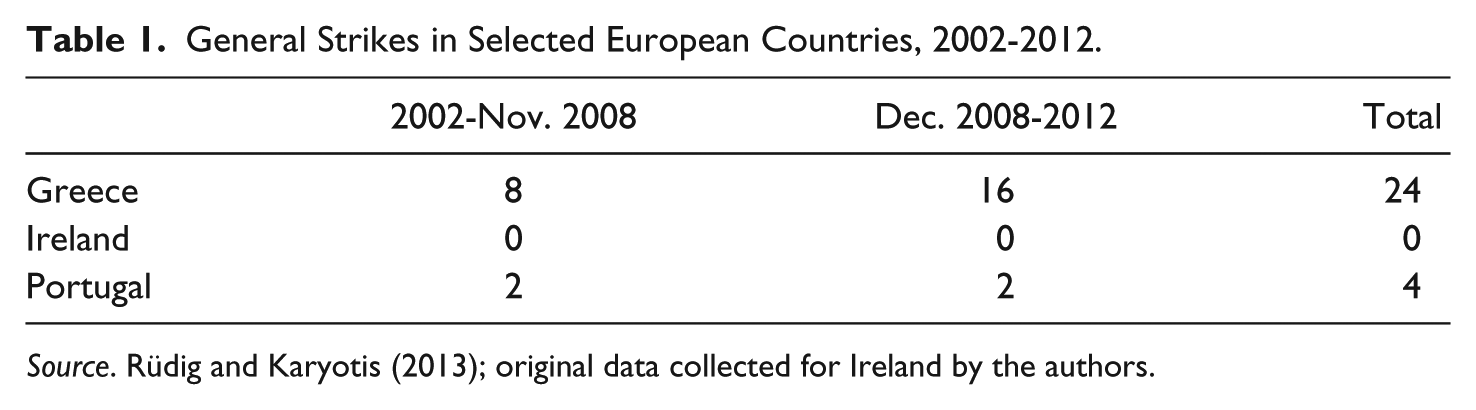
Source. Rüdig and Karyotis (2013); original data collected for Ireland by the authors.
Alternate Explanations
Table 2 shows some of the plausible explanations and sets out the expectations for these. It becomes evident below that none of those explanations can sufficiently account for the variance in social unrest between Greece and Ireland. We do not list these explanations in order to test them all but merely to indicate that our case studies are not subject to omitted variable bias.
Explanations That Cannot Adequately Account for Variance in Social Unrest.
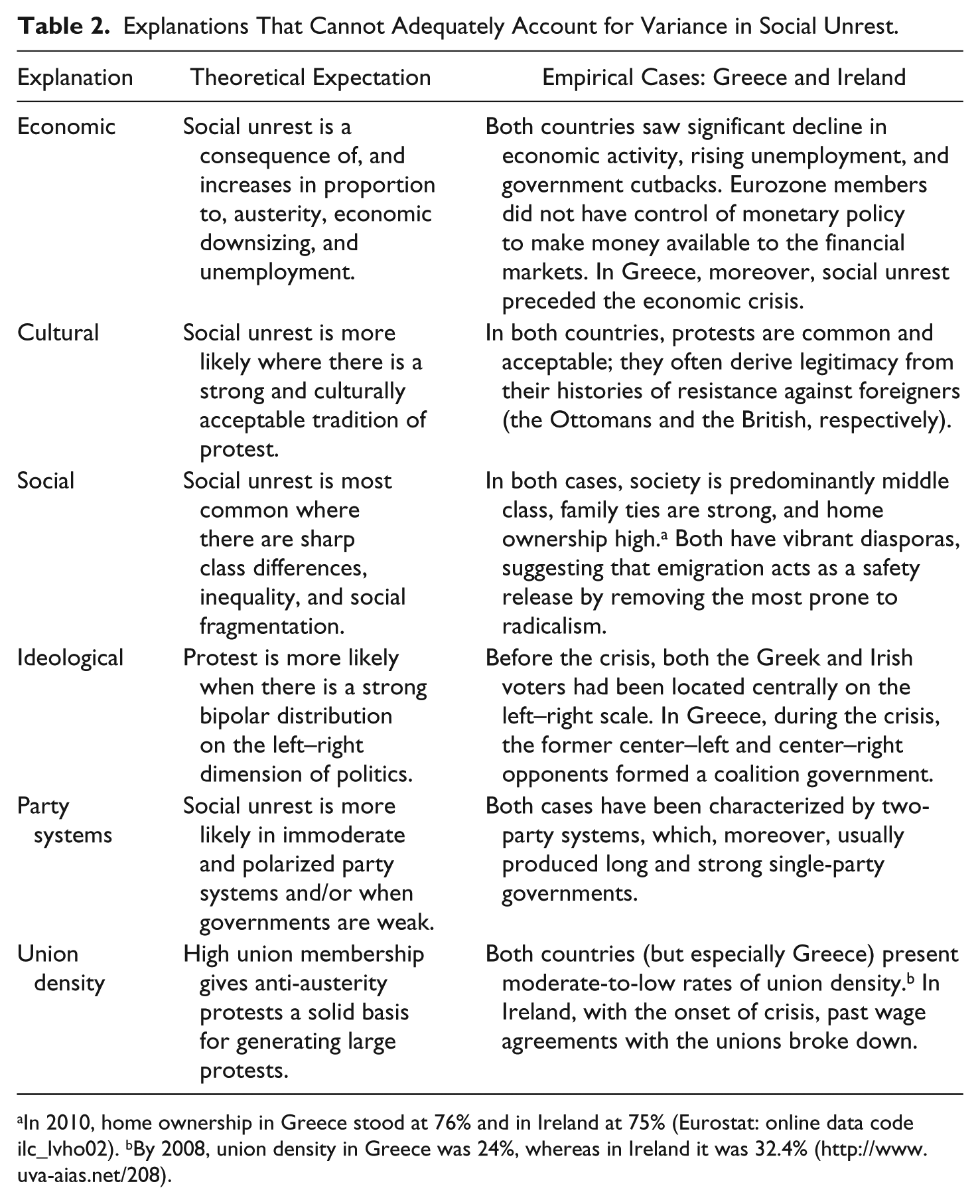
In 2010, home ownership in Greece stood at 76% and in Ireland at 75% (Eurostat: online data code ilc_lvho02). bBy 2008, union density in Greece was 24%, whereas in Ireland it was 32.4% (http://www.uva-aias.net/208).
The first, and most obvious, group of explanations for the differing reaction in the two countries focuses on the causal relationship between deteriorating economic factors and, via mechanisms of relative deprivation, mass social unrest. Table 3 presents data for Greece, Ireland, and Portugal on what are often used to create “misery indices.” It presents several basic economic indicators, including GDP growth, government overall debt and budget deficits, unemployment, and savings. What is immediately visible from the data is that all three countries have suffered from the economic crisis to a quite comparable degree.
The Misery Indicators: Basic Economic Indicators in Crisis-Hit Greece, Ireland, and Portugal (2007-2011).

Sources. International Monetary Fund, World Economic Outlook Database, April 2013; for unemployment rate, Beate Czech, Population and Social Conditions, EUROSTAT, no. 29, 2009.
Note. GDP = gross domestic product.
Greece and Ireland, in particular, have suffered severe recessions, registering negative growth. Ireland seemed to recover somewhat by 2011, but using gross national income (GNI) growth, which is usually regarded as a better indicator of the real economy in Ireland (see O’Malley, 2011), the economy continued to contract (–2.5%). During the crisis, Ireland saw its government debt rise more than 8-fold from 11% of GDP in 2007 to 94% in 2011. This compares to Greece, featuring an increase of debt from an already high 107% in 2007 to 168% by 2011, some of which was then written off.
By no means are Greece and Ireland at either ends of a scale of economic misery. In fact, given Ireland’s better initial position, one could make the argument that material deterioration has been more dramatic there. Ireland might also be regarded as especially likely to see massive protests in that the bailout of Ireland’s banks by the state was by far the largest in the current crisis and, according to some, the largest in financial history. This was despite the people being promised that it would be “the cheapest bank bailout in the world” (Carswell, 2008). The net cost is estimated at €62 billion or about 45% of GNI. 2 In all other indicators in Table 3, Ireland fares slightly better than Greece but hardly enough to validate the hypothesis of a direct causal link between material conditions and differing protest patterns. Although the Irish banks retained more deposits, in both countries the drop in savings was similarly impressive. On the other hand, however, thanks to the housing bubble in Ireland, the growth of housing prices in Greece between 1996 and 2008 was kept at a relatively modest 80% as compared with 170% in Ireland (Mazower, 2013). The collapse in house prices then was felt more keenly by Irish mortgage holders than those in Greece.
The economic explanations, though plausible, are questionable given the comparable economic misery suffered in both countries and that Greece saw significant protest activity even when it was enjoying an economic boom in the early and mid-2000s. The later protests were bigger in scale and intensity, but it appeared that Greece had a tradition of protests, which would lend support to cultural explanations.
Cultural Explanations
Cultural explanations of social unrest are particularly popular, especially in the Greek and Irish cases (e.g., Andronikidou & Kovras, 2012; Donovan & Murphy, 2013). Greece is often thought of as distinguishing itself from other European countries by a particular protest culture, which developed in the early postauthoritarian period and is related to the predominance of the leftist views in Greek society. Social unrest episodes are therefore seen as rites of passage, motivated by a culture of sympathy toward anti-state resistance. This view is particularly resonant in the international press, as it clearly appears in the following excerpt: “Greeks have a deep well of tolerance for those who rebel against authority, and generally accept the low-level violence that can break out during demonstrations, such as smashing store windows or torching the occasional car” (Becatoros, 2008).
Besides begging the question—why are the Greeks more likely to protest than the Irish?—the problem with this explanation of protest is that it does not withstand empirical validation. According to Nam’s calculations of protest activity between 1990 and 1995 based on the European Protest and Coercion Dataset, Ireland with 267.17 protest events is well above Greece with 224.17 events, let alone Portugal with only 68.67 such events during the same period. Adjusting for different population sizes, Ireland again easily tops the league with 75.1 protest events per million inhabitants, whereas Greece is well behind with 21.3 events and Portugal at the bottom with just 6.9 events (Rüdig & Karyotis, 2013). 3 This makes Ireland’s quiescence in the face of the crisis even more puzzling. Cultural arguments that claim Ireland has no tradition of protest also ignore that Ireland was historically an innovator in protest politics. It was the first place in the world to use mass political movements—the first place to have unified, whipped parliamentary parties and the place where the boycott was developed and where advances were made in urban guerrilla warfare, all in the struggle against British rule (Coakley, 2010). As recent as the 1980s, political violence in Northern Ireland spilled over the border during the “hunger strikes,” accompanied by riots. 4
In a more specific cultural argument, Smith (2012) places emphasis on feelings of national pride and humiliation. According to Smith, EU membership was an act of emancipation for both countries, which was, however, superseded by the humiliation of recent bailouts allegedly subjecting them to the interests of the core and relegating them permanently to a secondary role. Similar to people, who have different ways to deal with humiliation, countries, so the argument goes, also use various strategies to deal with similar situations including escape, acceptance, rejection, and reform. Smith argued that the Irish quiescence is related to the absence of national pride in this country compared to the strong existence of such pride in Greece. It is a rather odd argument, and not one that stands up to a basic empirical test. According to data presented in the World Values Studies in 2004, Ireland scores higher than Greece on a subjective measure of national pride: on a scale of 1 to 4, where 1 is very proud, Ireland scores 1.28 compared to Greece’s 1.59.
Another explanation related to both political culture and ideology is the supposed strength of the left (and left-leaning culture) in Greece. Accordingly, whereas Greek politics is assumed to be highly ideological with strong polarization, Irish politics tends to be nonideological and with little polarization to divide people on. Notwithstanding that this too begs the question, there are several theoretical and empirical objections to this argument. First, it has been shown (Pappas, 2013) that left–right polarization in Greece has been strategic (i.e., one used by state-controlling parties for crowding out the opposition) rather than ideological. Second, as data from the European Social Survey show, Greece and Ireland are remarkably similar in their left–right distribution and much less widely dispersed than other countries in Europe, including Portugal and Spain, where the left is notably stronger (Figure 1).
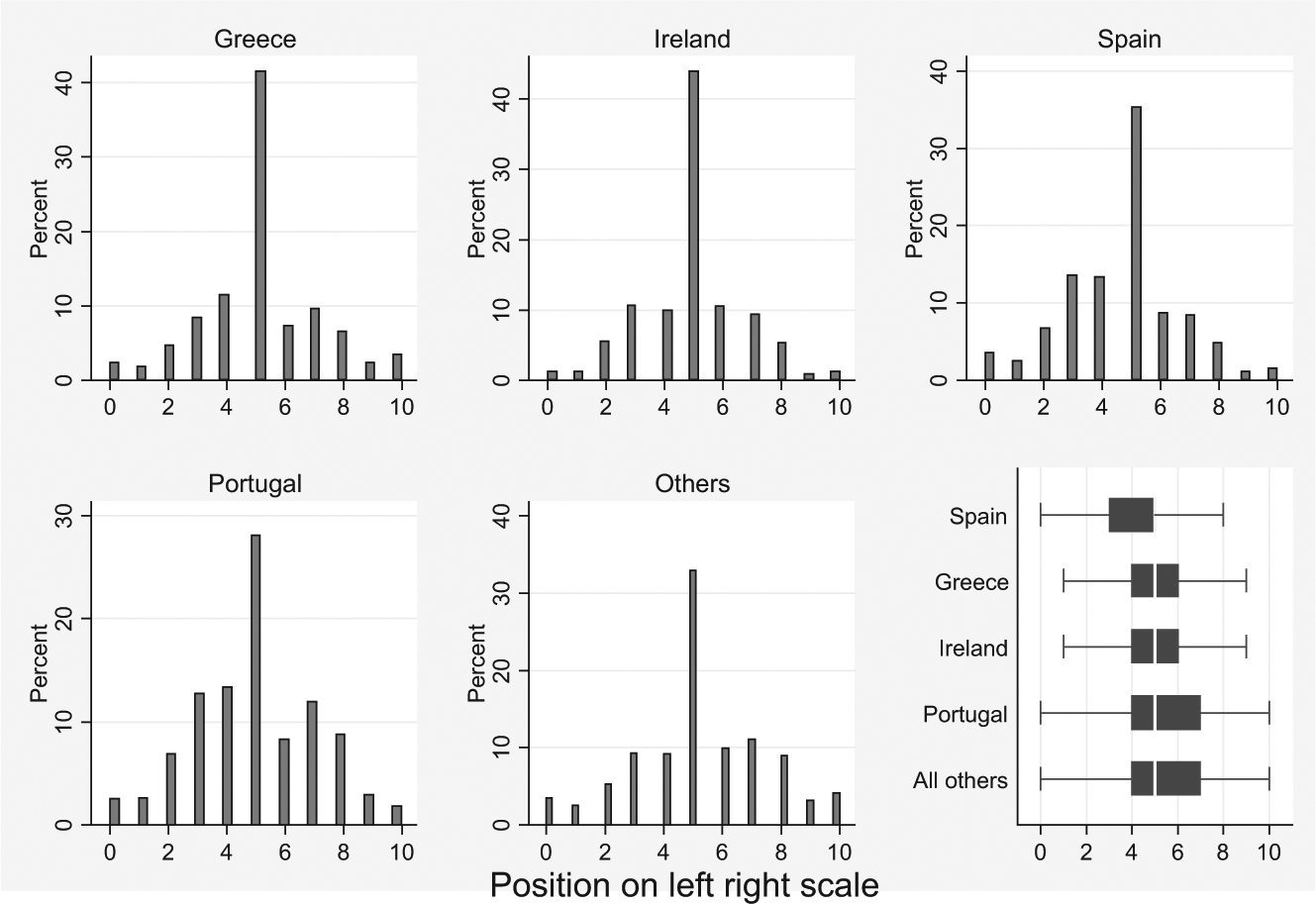
Left–right self-placement.
As has already been indicated in Table 2, Greece and Ireland bear remarkable historical and cultural similarities. Both have experienced long-lasting colonization by a neighboring power, undergone bloody civil wars, and seen the formation of large diasporas. Both have strong revolutionary traditions since their respective states were built on the use of brute force against illegitimate foreign powers. Finally, in what concerns their contemporary socioeconomic conditions, both countries feature robust middle classes with high levels of home ownership and strong conservative constituencies within them influenced by the church—Orthodox in Greece, Roman Catholic in Ireland. Until recently, both countries were socially and ethnically homogeneous but experienced high levels of immigration in the boom years following the accession of Eastern European countries to the EU.
An Alternate Theory: The State’s Varying Strength
We have found most explanations available in the literature of public protest to be short of accounting adequately for the great variance of social unrest in Greece and Ireland. In this section, we argue that those varying patterns relate to the differing ability of the respective states to attenuate the effect of the crisis on their citizens’ individual lives.
Ireland’s Civil Compliance
Until 2008, Ireland had enjoyed the epithet “Celtic Tiger” as its economy had grown at a remarkable rate from 1997 to 2007. Unemployment had fallen to close to 4%; employment had doubled. Ireland, traditionally a country of emigration, saw its population rise through a combination of high immigration and high fertility rates. Whereas growth in the early part of the so-called Tiger period was caused by a significant inward-investment boom and a strengthening of the domestic economy, after 2002 the high rates of property-price growth fed consumer-led growth that was ultimately unsustainable. Irish banks in particular fed the property bubble through lax lending funded by cheap credit available on international money markets. The very weak regulation of those banks became apparent in late 2007 during the “credit crunch.” The weakening position of the Irish banks came to a head in September 2008 (i.e., concurrently with the collapse of Lehman Brothers) when they could not access money on the financial markets to service their debts, and their loan books were increasingly troubled as more and more loans were defaulting. On being told that a bank was within a day or two of collapsing, the Irish government guaranteed the debt of Irish banks. It believed that the banks were solvent but suffering from a short-term liquidity problem. In fact, the banks were insolvent and a €62 billion bank rescue was the result of this decision.
Ireland’s crisis was caused to a great extent by the failure of the state to regulate, but this would have been largely a banking crisis had not the state nationalized large private banks’ debts in 2008. Until 2007, Ireland’s state was running a budgetary surplus and regarded as reasonably efficient, although high public spending and public sector salaries would have inevitably been unsustainable in the economic downturn. The state’s main failure was to regulate a property bubble. Although it could claim that one important tool—the control of interest rates—was no longer open to it, it retained powers to regulate bank lending but failed to do so. It provided tax incentives to property developers during the biggest property boom in the country’s history. Maintenance of the coalition was built on economic growth in the private sector, which provided tax revenues for the state to redistribute to key electoral groups.
The economic crisis reduced government revenue and increased demand for the state’s services. This created a massive deficit, which the government attempted to close through a series of emergency budgets. These budgets took more money out of the economy, arguably exacerbating the recession in the Irish economy. Each successive budget over this period continued to cut spending and simultaneously increase or introduce new taxes. These efforts were in vain, to an extent, as by late 2011, Ireland could no longer depend on private markets to borrow money and was forced into a lending program with the Troika.
An election followed soon after in which the ruling Fianna Fáil party saw its support halve and its representation in parliament fall from 78 to 21 seats. Fianna Fáil had been the dominant party in the Irish party system since it first came to office in 1932. The party had been in power since 1997 and had sustained this through a mix of increased public sector pay, lower taxes, and state spending on large infrastructural projects as well as other benefits. One could easily argue that Irish political parties are characterized by attempts at patronage, but there is little direct patronage targeted at individual voters; rather, it is more particularistic spending aimed at geographical areas (Suiter & O’Malley, 2014).
Although the state in Ireland was under severe financial pressure as a result of the crisis, it was crucial that it continue to function. The Irish state used voluntary redundancies to achieve the reductions in its staffing numbers. Although there were significant pay cuts, pay and pensions in the public sector were protected up to 2013 after a 14% pay cut was imposed in 2009. In 2013, more cuts were imposed on public sector workers earning more than €65,000 per annum.
Mass layoffs in the construction sector particularly increased the demand for state services. Although there were cuts to many services, for instance, increased school class sizes and longer hospital waiting times, the state continued to provide very generous unemployment benefits, leaving the rates untouched. There were also generous rent allowances, and for those who became unemployed, the state would assist with paying mortgages for a period. It also effectively guaranteed that people would not be evicted from their homes except in exceptional circumstances. Unlike in Greece, there was little evidence of destitution. There were reports of increased reliance on charity shops, and a large Catholic charity, St. Vincent de Paul, said that it saw a qualitative change in the type of people availing of its services, as it said many were now middle class professionals (Meagher, 2013). But with the exception of those forced to emigrate, many changes were to peoples’ lifestyles than to their lives.
Greece’s Political Luddism
In the 2000s, Greece, not unlike Ireland, had experienced fast growth rates that seemed to give credence to claims by successive prime ministers during this period that a “strong Greece” (Costas Simitis) was protected by an “ironclad economy” (Costas Karamanlis) in which “the money did exist” (George Papandreou). Unlike Ireland, however, in Greece the state had grown during the same period excessively large, patronage-tainted, corrupt, inefficient, and unproductive.
Greece’s two-party system had for several decades enabled an almost perfect alternation in office of two strong parties (center-left PASOK and center-right ND) keen to distribute political rents. Voters learned that the state was up for grabs and that it was better to associate with the state through party contacts rather than venture into the market through competition. And politicians learned that reforms do not pay off as, if attempted, society would only penalize them for it at the ballot box. As attested by the occasional attempts during the 1990s and 2000s by reform-minded politicians from both parties to reshape key areas of public policy, such as social insurance, public health, and higher education, Greek society was resistant to change and reacted by protest. Indeed, according to all available comparative evidence, Greece presented even in good economic times the highest rate of contentious protest activity in Europe. In the 1990s, there were numerous strikes and demonstrations against welfare reforms and public spending cuts. European Values Survey data show that 48% of Greek respondents claimed in 1999 to have taken part in a demonstration at some point in their lives (cited in Rüdig & Karyotis, 2013). During the 2000s, in particular, general strikes became a quite common occurrence, setting Greece apart from any other European country.
Then, in December 2008, an insurrection against the state occurred in Greece. It became directed against both the political system in general and, more particularly, the government’s attempts to rationalize higher education and restructure it according to market rules. This led to rioting that soon spread throughout Greece’s major cities, turning their streets into urban battlegrounds. What had really happened was that the insurgent youth reacted violently when they realized that the low-hanging fruits of the Greek state had already been depleted and that painful reforms to the state were now imminent. It was their challenge that revealed the deep legitimation crisis of the Greek state, including the latter’s inability to exercise a monopoly of power.
For Greece, 2009 was an uneasy year. As the global financial and economic crisis had begun developing, the Greek economy was already in recession and the budget deficit was expected to exceed 7% of GDP (it later turned out to be 15.6%). The (already weak and highly mistrusted) government led by Costas Karamanlis promptly pledged to introduce austerity measures together with the implementation of bold structural reforms that were deemed necessary for recovery. The plan was to reduce government expenditure by freezing public sector wages and pensions, halt recruitment in the broader state sector, and significantly reduce the other costs related to state operation. In addition, the government was intent on promoting a policy of privatizations, which actually began with the selling of Olympic Airways in March 2009. In September, Karamanlis called snap elections, asking for a new mandate to deal with the looming crisis. PASOK’s leader, George Papandreou, opposed ND’s austerity plan and promised a new stimulus package for the economy to reinforce middle and lower incomes. In November, he won by a landslide at the same time as the global economic downturn hit Greece.
Already by May 2010, PASOK’s new government had been forced to impose harsh austerity in exchange for a massive bailout program by the Troika, thus sparking a tidal wave of social unrest that was to continue unabated until the next general elections in 2012. During that period, as the economy collapsed and the old political and party systems crumbled, society was found in a shambles.
At the same time, as public expenditure in Greece had diminished dramatically, public services in health, education, and transport were cut to a bare minimum. In reality, the state, society’s former mainstay, increased the demands it made on its citizens. As it was required by Greece’s foreign creditors to become leaner and more efficient, it not only stopped hiring new employees, froze contracts with temporary staff, and even threatened to lay off permanent workers; it also sought to extract resources by augmenting its tax base, which it tried to do by increasing taxation on both incomes and, more important, individual property, which was broadly perceived by the general Greek public as a major threat to families’ lives and their properties. To that public, the state had simply outlived its former utility function, hence the massive and violent social reaction that became Greece’s most distinguishing characteristic during the crisis.
What therefore brought together on the same street over such a prolonged period Greeks with diverse socioeconomic backgrounds and opposing ideological views, we submit, was their hostility to a state that they thought had let them down. For decades, all those protestors had thrived on short-term handouts from the state and believed in long-term promises while resisting all kinds of liberal reforms. And now that the state had failed them, they turned massively against it, challenging its legitimation as well as its monopoly on (legitimate) violence. “The ‘authoritarian Greek state’ and the ‘corrupt order’ of the Metapolitefsi became enemy number one,” as Papadimitriou (2009, p. 49) succinctly put it. Society turned against state representatives (including elected members of parliament and other top state officials), state institutions (most prominently the police, the legislature, and the public education system), and state property (administration buildings, schools and universities, and other public spaces). In addition, banks and other big businesses, especially those associated with foreign interests, were also seen as legitimate targets by the mobilized society.
Greece’s and Ireland’s States Compared
The humanitarian crisis that befell Greece during the crisis was manifested in most aspects of the nation’s social life. According to the UN Human Development Index, for instance, Greece dropped from ranking 18th in the world in 2008 to 29th by 2013 (in comparison, Ireland dropped during the same period from 5th to 7th position). By 2011, 31% of Greece’s population was recorded by Eurostat as being at risk of poverty (no comparable data were available for Ireland; Eurostat news release 171/2012, December 3, 2012, http://epp.eurostat.ec.europa.eu/cache/ITY_PUBLIC/3-03122012-AP/EN/3-03122012-AP-EN.PDF). So, although deprivation did vary in the two countries, this was due to the ability of each state to moderate the effect of the crisis and not to the underlying economic downturn, which was similar in nature and extent.
Ireland’s state is comparatively small, as a percentage of GDP: On average, between 2004 and 2007, it was 34.1% of GDP (as compared to Greece’s 45.6% of GDP; cf. IMF, 2013). Although there is a sense within Ireland that the Irish public sector and the state are inefficient, comparatively they are regarded as reasonably professional, independent, and exceptions apart (see below), generally free from corruption. The Irish public administrative system was modeled on the British one inherited at independence. As such, there is a strong norm against party political involvement in appointments and career progression. Appointment had, since the foundation of the state, been on the basis of a competitive examination. Career progression was generally on the basis of seniority but, since the late 1980s, has gradually become more competitive and meritocratic.
The public sector in Ireland employs about 300,000 people out of a labor force of 2 million people, or 16.7% of the labor force (Organisation for Economic Co-operation and Development [OECD], 2011). About two thirds of these work in either health or education. Within this 300,000 is a core civil service of about 35,000. Although jobs in the public sector were once highly valued for their permanency and high pensions, they were less in demand during Ireland’s economic boom, when private sector salaries outstripped those in the public sector.
In 2009, the total number of public sector employees in Greece approximated 1 million, or 21.8% of Greece’s active workforce (Pappas & Assimakopoulou, 2012), which then stood at 4.5 million (INE, 2009). This was, moreover, a state that has been shown to display by far the highest rates of party patronage politics in Europe (Kopecky, Mair, & Spirova, 2012), thus serving as “a model of patronage democracy in the European context” (Pappas & Assimakopoulou, 2012). Second, corruption had by the same time become so pervasive that prime minister George Papandreou bluntly presented it to his EU peers as Greece’s “basic problem” (Barber, 2009). The late 2000s, in particular, had seen an unusually wide range of high-level Greek officials felled by scandals related to corruption. In one of such instances, a deputy finance minister was forced to resign as a result of having told a group of customs inspectors not that they should eliminate their requests for bribes but rather moderate them. State inefficiency was easily noticeable, too. In the summer of 2007, for instance, while wildfires destroyed the larger part of the country’s forests, leaving more than 70 people dead, the state response was inadequate.
In Ireland, citizens can expect public services to be distributed fairly. Perceptions of the corruption of the state in Ireland are much lower than in Portugal or Spain (ISSP data set, 2006, http://www.issp.org/page.php?pageId=4; no figures are available for Greece). Thirty percent of Irish believe quite a lot or almost all politicians to be corrupt (about the average for western democracies), compared to 57% and 58% in Portugal and Spain, respectively. Just 17.6% of Irish believe that quite a lot or almost all public officials are corrupt, compared to 37% and 40% in Portugal and Spain, respectively. Transparency International figures show that Ireland and Portugal rank 25th and 33rd, respectively, out of 176 countries, whereas Greece is perceived to be much more corrupt in 94th place.
The Bertelsmann Sustainable Governance Indicators give an assessment of the quality of government in 31 OECD countries. Ireland’s 2011 score of 7.37 (out of 10) puts it in 14th place—a drop from the 2006 score, which had Ireland in the top 10. Still, Ireland is firmly in a group of Anglo-American democracies in terms of governmental performance. Ireland compares favorably to the southern European countries (see Table 4). The World Bank also compiles indicators of government effectiveness and regulatory quality. These are standardized with a mean of 0 and standard deviation of 1. Although Ireland’s rating has fallen sharply since 2006, again we see that Ireland differs from the southern European countries. Greece scores particularly poorly.
Worldwide Governance Indicators, 2011.
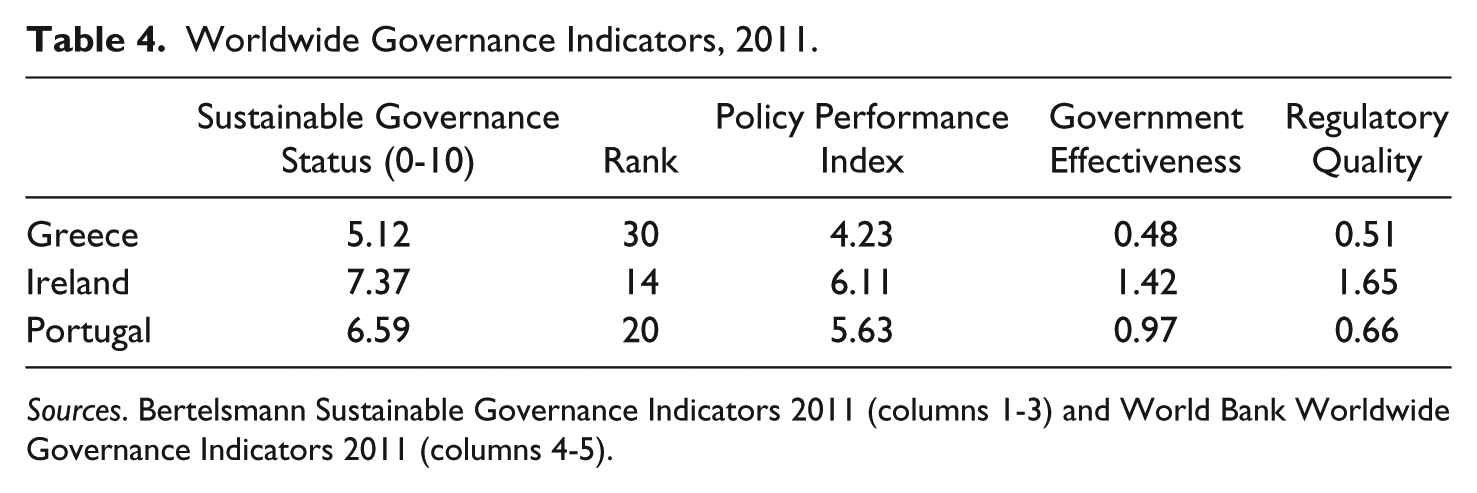
Sources. Bertelsmann Sustainable Governance Indicators 2011 (columns 1-3) and World Bank Worldwide Governance Indicators 2011 (columns 4-5).
The differing ability of the state to provide basic services efficiently is reflected in people’s attitude to the state across Europe. Table 5 shows the attitudes to nonpolitical state institutions, the police, and the legal system. The Greek people’s trust in police and the legal system is much lower than for Ireland. Although the Greeks, Irish, and Portuguese show broadly similar negativity in their attitudes to the economy, Greek dissatisfaction with democracy is very high (as it is in Portugal).
Attitudes to the State, Democracy, and Institutions.
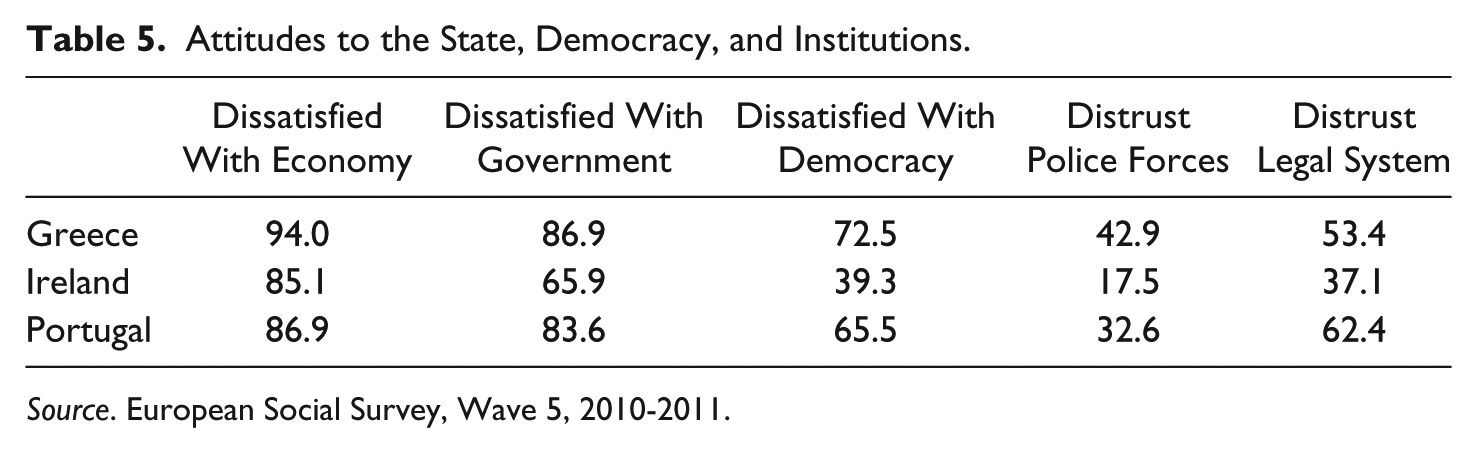
Source. European Social Survey, Wave 5, 2010-2011.
These data indicate that the significant difference between Greece and Ireland is not necessarily the attitude to the economy or the pessimism of its people, which is high in both these countries, especially compared to nonperiphery European countries, but the attitude to the state and its ability to provide utility to the people.
Conclusion
When hit in the late 2000s by the same global financial and economic crisis, the Irish and the Greek societies reacted in quite different ways. Whereas the former society remained largely acquiescent and displayed a high degree of civil compliance, Greeks took massively to the streets using violence and attacking specifically the state and the state personnel, a phenomenon herein dubbed “political Luddism.” It has been shown that the most well-known theories of social protest cannot account satisfactorily for such a variance in public unrest during the current economic and financial crisis. Both countries experienced sharp declines in GDP growth, and their respective governments drastically cut spending and imposed harsh austerity measures. Both countries, too, display similarities in their historical development, cultural patterning, and political and party systems, thus rendering such variables superfluous. In most other social, ideological, and political indices, Greece and Ireland have been shown to display remarkable similarities.
Instead, we have proposed an explanation that focuses on the role of the state (and, consequently, the relation between state and market) in the two countries. In Ireland, social unrest was limited because the state, despite the imposition of austerity and public spending cuts, was still able to provide utility to the people. In more technical terms, the Irish state maintained its infrastructural power with relation to the provision of vital services such as welfare, health, and education, thus retaining broad legitimacy vis-à-vis society. In Greece, by contrast, the state had been seriously undermined, and its legitimacy questioned, before the crisis broke out. As the insurrection of December 2008 had already made clear, the state had ceased being viewed by society as a beneficial provider of services and other social utilities, beside the fact, of course, that it had also lost its ability to exercise a monopoly of legitimate violence. The ensuing crisis only exacerbated the low capacity of the Greek state not only to deliver services but also to implement painful reforms that, for decades, had been successfully resisted by society.
Because of the different capacities of the Irish and the Greek states, but also the correlative fact that the legitimacy of the Greek state had been seriously undermined prior to the crisis, each country was faced during crisis with a different predicament—indeed, with a different set of troubles. Ireland, first, was faced with a purely economic crisis, namely, a largely “artificial” sovereign debt problem that was created by the government’s decision to rescue private banks. Greece, on the other hand, was confronted with an economic-cum-political crisis. In fact, the economic crisis in this country took such enormous dimensions precisely because of the existence, and past practices, of a bloated and spendthrift state that was, and remained, unable to introduce and implement necessary reforms. And where the Irish people complied, patiently waiting for the crisis to subside, the Greeks revolted against their state for it no longer being able to provide benefits and resources as in the past.
It is not surprising that different social reactions to differently textured crises in Ireland and Greece are bound to also have different outcomes. Although this falls outside the scope of this article, a note is at least warranted in anticipation of future research. With no significant social unrest to burden its political system, crisis-ridden Ireland managed to maintain social cohesion and progressively return its economy to modest growth and is now poised to leave the bailout and return to the international bond markets. The party system looks broadly similar as no new party has emerged, although Sinn Féin, a party once associated with political violence in Northern Ireland, has increased its support and Fianna Fáil is now no longer dominant. Greece presents an altogether different picture, as successive feeble and broadly mistrusted governments still find it difficult to implement reforms that are necessary for economic growth. At the same time, after the collapse of its old two-party system in the elections of 2012, Greek politics is also faced with the emergence of new actors including neo-populist parties on both the left (i.e., Syriza) and the right (i.e., Independent Greeks) of the political spectrum as well as, more menacingly, Golden Dawn, a pugnacious neo-Nazi party that, if anything, is already precipitating a deep political crisis.
A final note is warranted by way of caution but also for inviting further research on the topic. Although this article is based on case studies that are not representative of crisis-ridden countries, we argue that their holding extreme values on the dependent variable—social unrest—makes their comparison particularly useful. We therefore believe that our hypothesis would benefit from testing on a larger number of countries, both in Europe and elsewhere. One such example is Brazil, a large, economically booming, newly industrialized country, which in 2013 experienced extensive social unrest (the so-called World Cup protests) without having a culture of protest politics (Campante, 2013). Social unrest was in effect a result of demands for services from the growing middle-classes that could not be satisfied by corrupt and inefficient governance and state structures (Campos, 2013). Thus, we suggest that governance should be a prior variable in the model in which economic deprivation has an intervening role.
Footnotes
Acknowledgements
The authors thank the two editors of this special issue as well as Catherine Lynch, Iosif Kovras, and Hanspeter Kriesi for useful comments in earlier versions of this article.
Declaration of Conflicting Interests
The author(s) declared no conflicts of interest with respect to the authorship and/or publication of this article.
Funding
The author(s) received no financial support for the research and/or authorship of this article.