




Abstract

Hybridity is an umbrella term that can be applied to a multitude of organizational phenomena. They have in common that formerly separate, distinct elements are being combined: social and economic (social entrepreneurship) in terms of objectives, public and private organizations (quangos) in regard to legal status, or formal and informal organizational cultures (cooperatives emerging from social movements). For the most part, the emergent research on hybridity focuses on its alleged positive aspects: It is said to increase competitiveness and to provide broader community engagement and support at the same time (Smith, 2010) and to play an enabling role by filling institutional voids (Mair & Marti, 2009). What is more, hybrid organizations and the individuals steering them, driven by an unfamiliar combination of motivations, are ascribed a power of transformation, with an often very distinct emphasis (Bornstein, 2007; Koppell, 2001). Finally, it is suggested that hybrids’ combination of a strong ideological foundation with the provision of services acts as a catalyst for social change (Hasenfeld & Gidron, 2005).
However, critical voices in view of hybridity are on the rise and challenge the positively charged discourse surrounding the phenomenon (Dey, 2006). They describe hybridity as self-reflexive, as a field that floats toward a predetermined state, which is directed by the individual agendas of involved actors rather than based on facts (Nicholls, 2010). Certain buzzwords are being used to keep the hybridity agenda “dangerous” (Steyaert & Dey, 2010). In view of the increasing empirical research, hybrid organizations’ significance is put into question, specifically in terms of the number of organizations and the size of the organizational field, which is overestimated in policy talk if compared to actual figures (Teasdale, Lyon, & Baldock, 2013). Irrespective of these debates, no systematic assessments are available that go beyond a particular case, field, or country, and any analysis across cases remains all too rare with very few exceptions (Kerlin, 2009, 2010). What is more, the existing exceptions mostly focus on conditions for the emergence of hybridity rather than its effects. This limits our understanding of hybridity generally.
This special issue of American Behavioral Scientist seeks to further the comparative perspective on hybridity across the selected set of articles included here. Most of the articles apply a welfare regime lens on the phenomenon and thereby explicitly take into account its context specificity. The contributions seek to enhance the study of hybridity in various respects by providing insights on many open questions. For instance, which concepts of governance are particularly useful in investigating hybridity (see Schiersmann’s contribution for inputs on network and multilevel governance)? Which broader organizational processes and concepts are strongly linked to the phenomenon (see Pestoff’s contribution for the enabling effects of coproduction and Balarin’s contribution for downsides in terms of commodification)? How does hybridity relate to welfare ideologies (see Garrow and Hasenfeld’s contribution on neo-liberalism)? How does hybridity relate to existing research on fields and organizations that have been more intensely studied (see Smith’s contribution on the nexus between hybridity and nonprofit theories)? Last, is hybridity an emergent and stable concept or one that is actually in decline (see Grohs’ contribution)?
The aim of this introductory article is to merge theoretical reasoning with insights from the contributions against the most prominent welfare system classifications. These include the worlds of welfare capitalism, the social origins theory, and the varieties of capitalism approaches. Against this background, the special issue provides readers from the United States, Europe, and beyond with valuable insights on hybridity from a comparative welfare perspective.
The Comparative Perspective: How Welfare Reforms Affect Hybridity
Typically, social welfare provision and education involve some third sector engagement, and even if not, these fields are usually marked by some sort of civic involvement, voluntary engagement, or both. At the same time, these fields and the welfare state as a whole are subjected to increasing influence from market principles. Both trends combined lead to hybridity in organizational design but also in organizational practices. Not all of these effects are favorable. The new public management (NPM) agenda (Hood, 1995), for instance, has played a major role in incorporating market rationales in public procurement and performance-oriented management practices in welfare providers—be they public or private. These performance criteria comprise cost savings, operational efficiency, and intervention effectiveness—following the rationale of cost versus benefit. Thus, the NPM agenda has fostered what may be referred to as “economization.” The term can be used to “denote the processes through which behaviours, organizations, institutions and, more generally, objects are constituted as being ‘economic’” (Çalışkan & Callon, 2010, p. 2). Market principles referred to by Çalışkan and Callon as being part of economization or the closely connected urge for privatization of services as such are not negative in themselves. However, economization may give overriding weight to economic rationales and institutional logics. It is thereby likely to destroy the welfare hybridity it has initially created by invading public administration and social services. This is because hybridity is characterized by the persistent engagement of various stakeholders with Hirschman-type (1970) agencies that pursue multiple objectives with varying intensity. Only two conditions—multiple stakeholders and multiple objectives—can guarantee that a hybrid organizational nature is preserved over time.
Dominant economic forces may instead lead to the commodification of social services or education and undermine the norms and values that are inherent to them (which is highlighted as a reason for the primary engagement of nonprofits in these fields; e.g., Anheier, 2014). A potential consequential effect of economization is political clientelism, which refers to a particularistic political preference for the demands of dominant stakeholder groups. Dominance is defined not by mere size but rather by the stakeholder’s status, financial capacity, or political power. This dominance of particular stakeholders leads to the neglect of minority interests and thereby undermines the very essence of social services and violates their potential hybrid nature. Clientelism is often “built around asymmetric but mutually beneficial and open-ended transactions and predicated on the differential control by social actors over the access and control of resources in stratified societies” (Roniger, 1994, p. 3). These circumstances are most likely to be found in developing countries but can also occur in welfare systems of industrialized nations. Both commodification and clientelism can lead hybrid organizations to dissolution by provoking mission drift to a single purpose, eliminating stakeholder influence or effectuating organizational decline altogether (independent of their “sector affiliation,” i.e., social economy, public or commercial).
The tendencies resulting from the NPM agenda are subject to a layering of further policy streams (Wegrich, 2011). According to Wegrich, post-NPM policy reforms have stressed “smart” regulation, which is characterized by the deliberate transfer of responsibilities from the state to a diverse set of actors. Since this includes not only private commercial providers but also nonprofits and civil society more generally—calling upon the self-regulating capacity of societies 1 —this cooperative logic is somewhat at odds with pure market principles. Although the term post-NPM evokes the impression of a chronological order and clear-cut lines of separation, the current policy landscape across all welfare states tends to be characterized by a mixture of partly divergent trends. Against the background of ongoing processes that follow the logic of NPM, the formation of network coalitions between stakeholders plays a major role. Phenomena that might be associated with these new constellations in social welfare provision and education are multilevel governance as well as network governance. The first form of governance refers to the vertical architecture of institutional bodies or institution-organization constellations and the importance of multiple layers of decision making (Benz, 2007). The second form, network governance, refers to horizontal multistakeholder relations (Powell, 1990). Both forms of governance may increase the general legitimacy of decisions and actions due to the increased multitude of actors involved in rule-setting or service provision; however, the legitimacy formation process is likely to be accordingly more complex. This may reduce organizational effectiveness and bureaucratic efficiency.
Coproduction is another concept that fits the post-NPM agenda well, as it refers to the involvement of citizens, patients, users, or customers in any equivalent sense in the provision of public services (Parks et al., 1981). Although coproduction is usually treated as a positive concept due to the empowerment of citizens or the enhancement of user centrality (Carr, 2012), it may also put organizations under increasing coordinative pressure, in particular when organizations shift positions with regard to sector intersections in the wake of hybridity.
It is obvious that we will not expect to find the organizational phenomena just described or the (divergent) trends producing them in a state of harmony. To develop our understanding of hybridity in empirical research further, the core organizational features and practices have to be connected to the larger welfare context. To put it otherwise, hybridity depends on the nexus between the traits of organizational entities or organizational fields and the welfare system surrounding them.
Alternative Welfare Classifications
At present, there is a tendency to discuss local welfare systems (Andreotti, Mingione, & Polizzi, 2012) rather than national regimes because the differences between regions and localities within countries are becoming more and more extreme to the extent that we cannot easily compare, for example, rural and urban settings. The particularities of the latter have recently received major attention. 2 The direction of current welfare trends is, however, uncertain at best, depending on both the service field in question and the diversity of standpoints taken into account. This leads Ranci and Pavolini (2013) to assert the formation of two very different long-term care systems across all of Europe, despite having previously observed general convergence in the same field—considering only a smaller set of Western European countries (Pavolini & Ranci, 2008). Taking this into account, there is no reason to assume that we cannot learn from drawing on classic welfare state conceptions to study the context specificity of hybridity as an emergent global phenomenon.
The study of social welfare systems and economies has undergone major shifts. In his seminal contribution, Esping-Andersen (1990) proposed three major types of welfare regimes across the world. These have been complemented by the inclusion of, for example, a specific southern welfare state concept at later points (as discussed in Arts & Gelissen, 2002). Most of these types can, however, be related to Esping-Andersen’s use of two parameters to explain the shape of the welfare state: (1) decommodification, which refers to the extent to which public services are not treated as a commodity and traded on markets; and (2) stratification, which refers to the power distance between members and groups of society. To link this more explicitly to the country-specific examples of hybridity in this special issue, we use existing country classifications or complement these by including further insights from current research on national welfare regimes. This results in the allocation illustrated in Table 1.
Decommodification and Stratification in National Contexts.

Note. Based on Arts & Gelissen (2002); Esping-Andersen (1990); Wood & Gough (2006).
It is quite evident that the NPM and post-NPM reform schemes have played out differently, depending on the initial welfare state conception in the cases at hand, producing policy contradictions and layering. It will be particularly interesting to see how these affect hybridity as an organizational and field phenomenon. Discourses on social enterprise, in which the very terminology explicitly points to hybridity, are currently undoubtedly most pronounced in the United Kingdom and the United States, with other countries only gradually engaging with the concept. This squares with the classification above, since we would assume that people more readily accept enterprising entities in social service provision in states that are characterized by a comparatively high degree of stratification and commodification. However, if we add further economic push factors, such as the NPM agenda, we would expect to find not only more social enterprises in these liberal states but also more such organizations that are subject to mission drift and eventually dissolve to nonhybridity by eliminating the multiplicity of objectives, often simultaneously inviting single stakeholder dominance.
Peru then becomes a related but distinct case. Wood and Gough (2006) described the state of Latin American welfare in general as “liberal-informal,” while highlighting that the states in the southern cone are more like the formal welfare states found in Europe. Especially in the northern states of Latin America, including Peru, a large part of social welfare depends on less formal, community-based processes. Wood and Gough thus advocate shifting the social policy focus from decommodification to de-clientelization, which has to be overcome to move to a more formal state. We referred earlier to how commodification and clientelism are related; formalization only adds one more variable to the complex set of forces that hybridity is subject to through welfare reforms. In contexts where stratification and commodification are low, we would assume fewer hybrids but potentially more stable and established ones, such as in Sweden.
These considerations regarding stability and stakeholder engagement evoke questions about how hybridity might relate to the standard organizational and institutional structure governing social service provision and education. To explore such questions, we draw on a more recent welfare classification, the social origins theory (Salamon & Anheier, 1998), which focuses on the relation between the state and civil society, approximated by its organizational embodiment in the nonprofit sector. The two central dimensions of the nonprofit regime typology are (1) national social welfare spending and (2) the size of the nonprofit sector (see Table 2). The classification is conceptually related to Esping-Andersen’s conception but explicitly stresses the nexus between available financial resources and the operational entities of welfare provision (be it in terms of products, services, or less formalized actions like advocacy). It thereby relates to economic theories (Weisbrod, 1988) that seek to explain government–nonprofit connections (Anheier, 2010), which are interpreted as principal-agent, competitive, or complementary relations.
Government Spending and Nonprofit Sector in National Contexts.
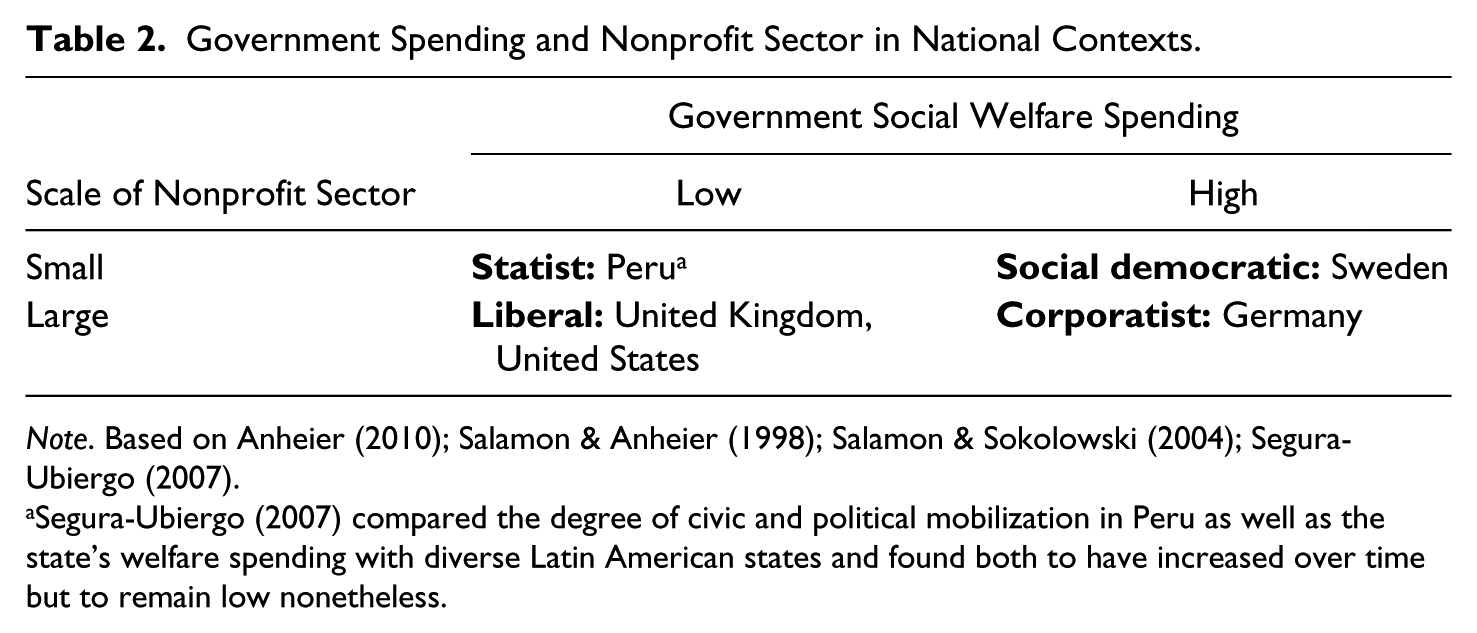
Note. Based on Anheier (2010); Salamon & Anheier (1998); Salamon & Sokolowski (2004); Segura-Ubiergo (2007).
Segura-Ubiergo (2007) compared the degree of civic and political mobilization in Peru as well as the state’s welfare spending with diverse Latin American states and found both to have increased over time but to remain low nonetheless.
First of all, this classification supports a point that has initially been taken as a given: the preference of liberal institutional contexts for hybridity. The argument is as follows: Where the nonprofit sector—that is, the dominant and established welfare providers as well as social welfare spending, that is, the resources that these can tap into—is large, hybridity in service fields will be low. The reason is the prevalence of established players that can rely on stable funding streams from state sources. This would quite accurately, though simplistically, describe the situation in Germany. However, where state resources are scarce but the sector is similarly large, as is the case in the United Kingdom, we can expect to find a more dynamic provider landscape (with a respectively higher rate of organizational births and deaths).
These organizational constellations have significant implications for governance. In a dense institutional social welfare landscape, in terms of both providers and (financial) regulation, hybridity would add a profound degree of complexity. It would do so in two respects: It would challenge established welfare structures, and it would make regulatory control more difficult as hybridity often cuts across the borders of organizational legal forms, social insurance pillars, and social service fields (Bode & Evers, 2005). Governance of hybridity in such contexts would thus benefit from multilevel governance approaches, whereas this is less likely the case in more fluid and less regulated welfare state conceptions. The (in)formality question raised in the Peruvian case comes in here too. Where hybridity is supported by neither a strong organizational nor a strong institutional infrastructure, it will be less prone to commodification but more so to clientelism, with unfavorable conditions for minority groups. This effect is probably even more pronounced where the political influence of state power (less so its market influence; see below) not only is great but has been authoritarian as in Peru.
This finally leads us to speculate how state influence might affect hybridity. Based on the rationales of coordination (in the tradition of Weber’s [1921] understanding of bureaucracy) or competition (in the tradition of Coase’s [1937] understanding of the firm), the varieties of capitalism approach (Hall & Soskice, 2001) postulates that two main types of capitalism exist: liberal market economies (LMEs) and coordinated market economies (CMEs). The main defining variable is the private sector’s ability to act (in)dependent of government influence. This approach has been empirically investigated and refined by Schneider and Paunescu (2012), who have added the categories of purely state-dominated, intermediate, 3 and LME-like economies (see Table 3).
State Versus Market Dominance in National Contexts.

Note. CME = coordinated market economy; LME = liberal market economy. Based on Hall & Soskice (2001); Schneider & Paunescu (2012, p. 741); Wood & Gough (2006, p. 1705).
As mentioned in the text, Sweden has shifted from a CME position in the 1990s to an LME-like one in 2005. bThe varieties of capitalism approach has been applied only to OECD countries. Since the ways that Wood and Gough (2006) use to describe the group of Latin American countries to which Peru belongs are similar to the institutional characteristics of LMEs described by both Hall and Soskice (2001) and Schneider and Paunescu (2012)—only not quite so strong—we have decided to allocate it generically to the “LME-like” category. Commonalities include disintegration of corporatist politics, labor market deregulation, and private financing of education.
It is interesting that Schneider and Paunescu have found a stable allocation to the respective categories over the time period from 1990 to 2005 for some countries (e.g., Germany, United Kingdom, and United States) but a position shift from CME to LME-like for Sweden, for instance. Although the (re-)allocation of countries points to institutional change, as Schneider and Paunescu assert and other authors have observed in more qualitative terms, the justification of this assertion by Schneider and Paunescu is mainly based on national comparative advantage in high-tech industries. Although this definition criterion is unrelated to our investigation, we have decided to take both positions into account for Sweden (its original and its new position).
Although this classification refers to industrial and service provision in commercial firms rather than social welfare provision, the implied state-economy link can provide general insights on the occurrence of welfare reform themes and their effects on hybridity. Strong state influence would lead us to expect that trends toward privatization and marketization are being blocked. Thus, whereas commodification might be slowed, the very emergence of hybrid organizations might be as well (as in Germany). However, commodification is supposedly low only where structures are formal and strong and less so where these are weak (as is more likely the case for Eastern European or for developing countries like Peru).
By contrast, competitive environments are more likely to be populated by a variety of different organizational forms. In combination with comparatively lower social welfare spending (see Table 2), the liberal market economies of the United States and the United Kingdom are more likely to produce network-like hybrid forms to compensate for missing institutional structures. Network governance approaches thus promise to be fruitful in understanding hybrid organizational fields in these contexts, but less so in Germany, for example. In Germany, we would expect to find a more dispersed landscape of hybrid organizational entities. Also, these entities are supposed to affect the welfare regime—guided by the principle of subsidiarity—vertically (adding an additional layer of welfare providers) rather than horizontally (adding new players to the same layer) and would thus be analyzed more effectively by multilevel governance approaches rather than network governance approaches.
In Sweden, finally, hybrid entities are likely to be as scarce as are private/civic service providers in general. However, due to ongoing transformations, which the above classification suggests with regard to Sweden, hybridity is hard to assess against this specific national context. Based on its shifting position and the contradictions that result, Sweden is indeed an interesting case not only in terms of the organizational landscape of hybridity but also with regard to the application of hybrid processes such as coproduction. Although the traditional social-democratic welfare state conception would suggest that we would find a high degree of stakeholder involvement through coproduction within organizations (whereas coproduction is generally less likely in particular where stratification is high), the more recent view of Sweden as LME-like would predict a more market-oriented, competitive situation.
We will touch on these theoretical considerations in the presentation of the contributions to this special issue and revisit them later to derive a concrete set of research propositions on hybridity from a comparative welfare perspective.
Contributions to This Special Issue
In his contribution, “Hybridity, Coproduction, and Third Sector Social Services in Europe,” Victor Pestoff explores the link between coproduction and hybridity. He asserts that coproduction and network governance are being fostered by what he calls the new public governance, which is equivalent to what we have labeled the post-NPM reform regime. Pestoff argues that third sector organizations are subject to tensions arising between their social value-oriented logic and the market-oriented NPM agenda (for instance, demanding professionalization or introducing competitive bidding processes). In complex and dynamic environments, organizations have to employ different institutional logics at different time points, with some organizations typically closer to one, some to the other. Pestoff argues that a “moving out of the comfort zone,” that is, engaging with unfamiliar institutional logics, creates hybridity and poses significant challenges to leadership and governance. Where organizational profile and reform agenda are more similar to each other, tensions will be resolved more easily. He then relates this idea to coproduction, which he extends to comanagement and cogovernance. His example of how the idea of involving patients in health care has resulted in a “patient-consumer” model in the United Kingdom (and similarly in Sweden) instead of “mass collaboration and participatory health care” highlights the tensions between organizational practices, reform themes, and welfare contexts with differing logics.
The contribution, “Hybrid Organizations in Social Service Delivery in Quasimarkets: The Case of Germany,” by Stephan Grohs looks at the NPM-driven introduction of quasimarket principles in the conservative and corporatist welfare system and coordinated market economy of Germany. Grohs points out that the uniform reform wave has played out differently in different service fields, specifically youth welfare and care for the elderly. Based on distinct governance regimes, the two fields have differed in terms of openness to new entrants, organizational change of incumbents (third sector organizations), and modes of policy steering. An important variable has been the degree of decentralization (which applies to youth welfare, whereas care for the elderly remains a rather hierarchical field). Grohs interprets a disintegration of organizations into several entities as “dehybridization” and argues that this is more likely in hierarchical rather than decentralized field structures. This is somewhat at odds with our theoretical reasoning on welfare regimes but could be consistent when interpreted through the lenses of multilevel governance versus network governance (see research propositions below). The general observation remains that reform themes reverberate with context conditions, and both shape hybridity in very distinct ways.
In her contribution, “The Changing Governance of Education: A Comparative Political Economy Perspective on Hybridity,” Maria Balarin focuses on the field of education in England and Peru. Despite the extremely different historical background and socioeconomic status of the two countries, she finds that the NPM-like reform wave dominant in both—a move from what she refers to as a “Keynesian national welfare state regime” to a “Schumpeterian postnational workfare regime”—has led to very similar outcomes. Among these outcomes is the fragmentation and depolitization of education. As a consequence, education has become a commodity rather than a human ideal and a private rather than a public good, thus adding to the segregation of these societies. Although the outcomes as such are very similar, Balarin points out that their underlying mechanisms are different.
Christiane Schiersmann’s article, “Hybridity and Governance Changes in Continuing Education,” also relates to the field of education but focuses on continuing education—a naturally more commodified field—within the welfare state conception of Germany. Continuing education is particularly affected by legal ambiguity with unclear or overlapping regulations for funding, educational programs, staff, and the quality of services. The political and regulatory responsibility for the field is distributed across multiple layers of authority. Schiersmann shows how competitive funding from the European Union has substituted for continuous funding at the German (federal) state level and thereby adds to hybridity. One of the consequences is that actors are embracing economic practices affecting individuals (e.g., higher fees, as well as monetary incentives for individuals to participate) and the organizations themselves (e.g., competitive bidding for funds, requests for professional assistance in change management). Another consequence is the reorganization of the field by programs initiated by the German government, the federal states, and the European Union, which aim at forming regional networks to foster interorganization synergies.
In their article, “Social Enterprises as an Embodiment of a Neoliberal Welfare Logic,” Eve Garrow and Yeheskel Hasenfeld touch on yet another distinct field, work integration—treating the social enterprises operating in it as examples of hybrid organizations. Here, they explicitly address the link between welfare regime and mission drift: commodification through the dominance of neoliberal welfare ideology. The particularity of work integration lies in the fact that clients are both beneficiaries and production workers. Drawing on neo-institutional theory, Garrow and Hasenfeld argue that the very emergence of work integration social enterprises (WISEs) is being proliferated by neoliberal ideology, which has in some way taken precedence over alternative value systems such as the social-democratic logic. They assert that the underlying agenda undermines the rights of individuals and comes as “social in disguise” more often than not.
Finally, Steven Smith in his contribution, “Hybridity and Nonprofit Organizations: The Research Agenda,” advocates drawing on existing theory to enhance our understanding of hybridity. Smith roots hybridity in the combination of at least two different institutional logics, for example, competition versus community within a nonprofit organization. He asserts that the study of hybridity is complicated by the fact that some scholars see every organization as (partly) hybrid; that the delineation of sector intersections is practically difficult if not impossible; and that hybridity research has been alienated from nonprofit theory, although it is mostly supposed to take place in organizational fields typically populated by such kinds of organizations. Smith subsequently proposes areas of priority for research on hybridity, for example, legal and organizational form transitions through hybridity; programmatic innovation that fosters social innovation; or the relation between hybridity and market failure. Smith furthermore argues that insights on hybridity would be leveraged by drawing on institutional theory and on welfare state conceptions more broadly. In particular, the latter ambition and that of developing testable research propositions are the subjects of the next section.
Research Propositions
Merging theoretical considerations from the preceding sections with empirical evidence from the articles allows us to formulate several explicit research propositions. Relating to Pestoff, when organizations are becoming hybrid by shifting positions—encountering new institutional logics or adhering to a welfare reform stream—tensions arise. These tensions can be productive or destructive with regard to the stability of hybridity as an organizational and field phenomenon. Among the most pronounced destructive effects are mission drift or single stakeholder dominance, invited through commodification, clientelism, or both. One of the most productive effects is coproduction, the common engagement of a multitude of stakeholders. However, not only will the prevalence of hybridity and the factors influencing its stability be affected by the surrounding welfare regime and economy, but also the modes of governance applied. We expect to find differences in whether hybridity predominantly takes place across organizations (best analyzed as network governance) or along the multiple layers of the welfare provision system (best analyzed as multilevel governance).
Garrow and Hasenfeld generally assert that market logic is currently stronger than social logic, which has consequences for assessing the occurrence of hybridity. We can expect hybrids to be particularly numerous in contexts that are more open to accepting economic influence both in social welfare and in policy. Where field logics and welfare regimes are more at odds with economized reform themes, hybrids will be less numerous.
Proposition 1: Hybridity is more likely to occur in liberal market-oriented economies/welfare regimes than other regime types.
However, following our previous thinking further, these contexts will also pose the biggest challenges for the stability of hybridity. Where the institutional logics of economized organizational change reverberate with those of fields or welfare systems in place, there is an increased risk of mission drift back to a single-purpose entity or single stakeholder dominance. Balarin demonstrates this for the field of education in two countries that are very different at face value. If we go back to our welfare state discussion, though, we see that they have a lot in common: a liberal(-informal) welfare regime and an LME(-like) economy. Where this constellation comes into contact with ideologically close reform ideas, the rise of hybridity bringing new practices into education finally dissolves into a one-sided agenda—which is effectively a move from education as a predominantly collective good to a hybrid good to a competitive good—with potentially adverse effects. One of these effects is the exacerbation of educational inequalities where social stratification was already high. Whereas the main underlying mechanism in England (with a high degree of institutional density and a democratic tradition) is commodification, the connection works via increased clientelism in a more informal (i.e., unstructured) and formerly authoritarian welfare system and economy like Peru. This circumstance ultimately pushed aside the “good governance” agenda that had been promoted by international organizations and the decentralization policies of the postauthoritarian government in Peru after 2001.
Garrow and Hasenfeld take this one step further. They show how neoliberalism in the United States and Europe affects and partly perverts the very logic of remedying social ills through the mechanisms that have caused these ills in the first place. Some ideologies have such overriding force that they crowd out alternative welfare concepts such as social-democratic logic, the authors argue. This comes with shifts of responsibility from the collective to the individual linked to marketization and privatization. Work integration social enterprises, they imply further, are a hybrid vehicle for transporting ideas that are becoming increasingly dominant and do not contribute to a sustainable construct of social and economic elements but rather subvert the sphere of welfare into that of the market. In some contexts, especially with regard to the Third Way that has been most strongly embraced in the United Kingdom (Giddens, 1998), this has been more effective than in other contexts. Thereby, success according to market logic (i.e., profitability) increases isomorphic pressures to effectively operate like a business rather than a welfare provider. Garrow and Hasenfeld’s application of embeddedness as a critical trigger for either maintaining balance in hybridity or giving way to mission drift reconciles with our discussion of different welfare state classifications, where the descriptive variables indicate dominant streams of influence.
The evidence referred to above leads us to posit the following two research propositions:
Proposition 2: Hybrids in liberal market-oriented regimes are most likely to suffer from mission drift to a single objective due to market pressures.
Proposition 3: Hybrids in statist/informal market-oriented economies/welfare regimes are most likely to suffer from single stakeholder dominance due to political pressures.
Following from this, hybrid practices like coproduction are more likely to be applied in organizations that equally resonate with its underlying values, taking into account that coproduction will strive where power distance between individuals is low and solidarity is a pronounced ideal. The same can be assumed in relation to welfare contexts. If applied in systems governed by existing institutional logics that are potentially in conflict with participatory reform agendas, hybrid practices will look different. We do not suggest that, for example, coproduction will not occur in more economized welfare states and economies at all, however, the latter are likely to produce an altered and potentially corrupted version of intended effects (see Pestoff’s example of coproduction in the United Kingdom turning into a patient-consumer model).
Proposition 4: Coproducing hybrids are more likely in social-democratic welfare regimes, but only if market pressures remain weak to moderate.
In addition to differences in the occurrence and stability of hybridity, there are different approaches to the governance of hybridity in relation to welfare contexts. Schiersmann shows how competitive elements put organizations in adult education in Germany under pressure. Instead of giving way to mission drift and despite complaints about tensions between economic practices and educational vocation, these organizations seek professional assistance in managing necessary change. Another strategy to cope with the challenges of hybridity is the formation of network structures. Mostly, however, they do not seem to grow organically but are initiated by regional, federal, or EU government. Actor networks thereby become another layer in the multilevel governance of hybridity in conservative corporatist welfare systems and coordinated market economies. Thus,
Proposition 5: Hybridity is most likely to form institutional multilevel governance structures in conservative, state-oriented economies/welfare regimes.
This proposition—like the others—is of course subject to field-specific tendencies that can alter or reinforce the dominant characteristics of the welfare regime in question. As the contribution of Grohs suggests, the effect of fields is probably more immediate but, we would argue, weaker than that of the welfare regime. What is more, although according to Grohs, hierarchical organizational or policy fields are more likely to be affected by tensions leading to the disintegration of hybrid organizations, this could be interpreted as contributing to multilevel governance structures of hybridity rather than dehybridization, if regarded from the viewpoint of an organizational corporate structure rather than that of independent organizational divisions. By contrast, decentralized fields are more likely to preserve the “amalgamation of logics,” as Grohs puts it. Since we keep focusing on the field characteristics, we could argue that this happens through networks between organizations rather than within single organizations. Both ideas are implied but are insufficiently spelled out by Grohs’ comment that disintegration could be “an attempt to perpetuate the hybridity of the umbrella organizations by reducing the degree of hybridity of its parts.” Smith similarly describes the formation of subsidies as “structural innovation” and interprets it as an effect of hybridity. What is more, in contrast to Grohs, Garrow and Hasenfeld assert that system devolution adds to mission drift rather than to preservation of hybridity. It is becoming evident that there is a difference between the general prevalence of the phenomenon, how hybridity plays out within organizational corporate structures or single entities, and how it affects constellations in organizational fields.
It seems fruitful to consider two variables in addition to the ones initially proposed: centralization and decentralization of systems and especially of organizational fields. Their actual effect is harder to judge than that of the other variables, since we find inconclusive evidence in the contributions to this special issue. Against the background of our previous reasoning, we nonetheless deduce that naturally grown network structures are not very likely in state-dominated contexts. They are more likely in liberal welfare traditions, less as an expression of adherence with the post-NPM ideal of collective governance but rather as a means to enhance market positions or to coopt users (compare to Pestoff’s argument in relation to Martin, 2011, for the latter). In parallel with the proposition on coproduction, networks seem most likely to be genuinely fostered in social-democratic regimes.
Proposition 6: Hybridity is most likely to form organizational network governance structures in liberal and social-democratic market-oriented economies/welfare regimes.
Smith points to several unresolved issues in hybridity research that are directly relevant to the developed propositions. For instance, the likely mission drift toward markets in some contexts and the general shift inherent in hybridity more generally evoke questions about the source and stability of legitimacy of hybridity. What replaces the nondistribution constraint that is being partially removed, and how is political legitimacy formed by hybrid nonprofits when market mechanisms are being embraced and when market failure is one of the very reasons for their existence? Although we have mainly focused on a static analysis of the connection between context and hybridity, Smith is right in pointing out that life-cycle theory, of both organizations and fields, could enhance the intertemporal (i.e., dynamic) perspective on hybridity.
Conclusion
The purpose of this article and the entire special issue is to posit propositions that can be useful—though tentative—points of departure for future research. We believe that the propositions introduced are valuable for investigating hybridity at the level of the welfare state but can be transferred to the field level too. Whether welfare and field level logics actually resonate with or oppose one another remains to be explored in further empirical research. The same applies to organizational, field, and welfare state dynamism.
We encourage more targeted investigations on the connections between hybridity and context conditions at different levels of analysis. Moreover, the future direction and the explanatory potential of research will depend on how hybridity is being analyzed.
One can look at hybrids according to the mere existence of multiple actors and stakeholders in fields or organizations or the prevalence of multiple objectives within fields or organizations. Alternatively, hybrids can be defined by the direct involvement of multiple stakeholders with agency and their pursuit of multiple objectives with varying intensity and dominance over time. Although the former understanding is regularly applied, we advocate the latter definition since it specifies a necessary and a sufficient condition for hybridity and thereby brings more conceptual and methodological rigor to the investigation of the phenomenon.
Footnotes
Acknowledgements
We would like to thank all peer-reviewers who have invested their time and effort in commenting on the contributions to this special issue.
Declaration of Conflicting Interests
The author(s) declared no potential conflicts of interest with respect to the research, authorship, and/or publication of this article.
Funding
The author(s) declared receipt of the following financial support for the research, authorship, and/or publication of this article: This special issue resulted from a symposium on “governance and leadership in hybrid organizations” held at the Centre for Social Investment of the University of Heidelberg in December 2011. The symposium was funded by StiftungVolkswagen under grant agreement number 85317.