



Abstract
We study a multidisciplinary, geographically dispersed, and multi-institutional research network that shows the complex relationships in collaborative research. Although collaborative work ties declined, the number of friendship and advice ties stayed stable and acquaintanceship ties grew. Most researchers seem satisfied with the network and relish the opportunities for cross-disciplinary exchanges. The benefits of the network do not lie in the traditional academic output of publications and artifacts, but in intellectual exchanges, knowledge transfer, fostering long-term ties within and across disciplines and universities, and the development of a collaborative culture.
Keywords
Introduction
Although most studies of research networks look only at one time period, networks are rarely stable. When researchers hook up, people, projects, and involvement are in flux. What happens when the initial excitement becomes routinized, and the gold of grants and the lure of new playmates turns into the everyday life of research? It is time to go beyond one-shot analyses to see how such networks change. Do researchers stay or leave? Do they intensify, change, or weaken their involvement?
Only a few studies have examined changes in collaborative networks over time. The ground-breaking research of Guimera, Uzzi, Spiro, and Amaral (2005) showed that team size in a field evolves over time, reaching an optimal size, while the field itself becomes more integrated. However, teams may become less integrated in the short run: Cummings and Kiesler’s (2005) research suggested that communication in multi-institutional projects drops and researchers start working more independently. Yet these few studies do not provide conclusive findings.
We are fortunate to have survey, interview, and participant-observation information about the evolution of ties in a large and diverse research network. We address four sets of questions:
To what extent do researchers’ professional and social ties change?
What personal and tie characteristics are associated with dropping, adding, or keeping a tie?
What are the implications of disciplinary, institutional, and geographical diversity in which ties are formed and maintained?
What practices of the researchers help explain these changes?
We study a multidisciplinary, geographically dispersed, and multi-institutional research network that shows the complex relationships in collaborative research. Contrary to our initial expectations, we find that collaborative work ties declined, but that friendship and advice ties endured and acquaintanceship ties grew substantially. Most researchers seem satisfied with the network and relish the opportunities for cross-disciplinary exchanges. We find that the benefits of the network lie in intellectual exchanges, knowledge transfer, fostering long-term ties within and between disciplines and universities, and the development of collaborative culture.
Network Assessment and Validation for Effective Leadership (NAVEL): The Research Design
Our analysis draws on the study of the Graphics, Animation and New Media (GRAND) Network of Centres of Excellence, a country-wide, multidisciplinary, and multi-institutional network of Canadian researchers. GRAND consistently promotes diversity and synergies among its members. For instance, the organizers require each project to be multidisciplinary and multi-institutional (for detailed descriptions, see Hayat & Mo, 2015; Mo, 2014; Mo & Hayat, 2015).
Our primary sources are the two online surveys we conducted with Canadian faculty researchers: in 2010, at the initial stage of the network, and in 2012, in its midpoint. In these surveys, we collected social network information about the kinds of relationships GRAND researchers had: the Know network of acquaintanceship within the past 12 months, self-identified Friendships, self-identified giving or obtaining Advice, coWorking in paper writing and conference presentations.
We created three related data sets for each of these four relationships:
The 2010 NAVEL survey data set (n = 144), with a response rate of 70% (101 respondents out of 144 GRAND researchers listed in GRAND administrative records). The resulting networks are defined on 143 (n − 1) GRAND faculty researchers, forming a network database of 83 × 143 = 11,869 ties.
The 2012 NAVEL survey data set (n = 207), with a response rate of 60% (124 respondents out of 207 GRAND researchers listed in GRAND administrative records). The networks are defined on 206 (n − 1) GRAND faculty researchers, forming a network database of 83 × 206 = 17,098 ties.
Repeat respondents (n = 83), consisting of researchers who completed both the 2010 and 2012 surveys. This is the data set of respondents we principally use: 57% of the original GRAND researchers and 82% of those who responded to the initial 2010 survey. It does not take into account the small number of researchers who left GRAND between 2010 and 2012 and the somewhat larger number who joined between 2010 and 2012.
In all cases, these are self-identified networks. They might not be symmetrical, as when one researcher says she is a friend of another, but the second researcher does not mention her as a friend (see also Dimitrova et al., 2013; Hayat, 2014; Hayat & Mo, 2015; Mo & Wellman, 2012; Wellman, Dimitrova, Hayat, Mo, & Smale, 2014).
We also draw on semistructured interviews with 47 GRAND researchers, as well as participant observation by our NAVEL team in four projects and at all GRAND annual meetings. The interviews asked about reasons for joining GRAND; networking, communication, and coordination practices; and the benefits and challenges researchers faced in GRAND. All the interviews were transcribed and entered into an NVivo textbase.
We first present cross-sectional analyses of GRAND in two synopses based on the 2010 and 2012 surveys. We then analyze changes in researchers’ ties by estimating four multilevel multinomial logistic regression models, for each of the Know, Friend, Advice, and Work networks. Finally, we present qualitative analyses of researchers’ practices. In what follows:
“Disciplines” refer to the eight broad disciplinary categories defined by the major Canadian funding agencies; subdisciplines are narrower definitions based on the researchers’ disciplinary affiliation within the eight categories.
“Senior” versus “junior” researchers refers to tenured versus nontenured professors; these are the professorial or academic ranks we examine.
“PNIs” and “CNIs” stand for Principal and Collaborative Network Investigators, terms introduced by GRAND. PNIs receive more funding from the network, participate in more projects, and typically lead at least one project. CNIs, by comparison, receive less funding, participate in one or only a few projects, and do not lead projects. The division does not follow academic seniority: While some CNIs are nontenured academics invited by former supervisors to the network, many are tenured and some have high positions in university hierarchies.
The GRAND Network
Overall, our results show the following:
GRAND membership grew between 2010 and 2012. Membership grew 1.44 times from 144 to 207 researchers. Much of this growth came from an increase of more peripheral CNIs (Tables 1 and 2).
GRAND became more multidisciplinary. Forty-four of the 63 new researchers (70%) were from 7 different disciplines outside of Computer Science while only 19 new researchers were from Computer Science. Specifically, 37 of the 77 subdisciplines listed in 2012 were not represented in 2010 (Mok, Dimitrova, & Wellman, 2015). Despite this increasing multidisciplinarity, computer scientists remained the largest subdiscipline of GRAND, with 66 researchers in 2010 (46%) and 81 in 2012 (39%). Researchers in Arts and Technology, although much fewer in number than computer scientists, represented the second largest subdiscipline, comprising 9 researchers in both 2010 (6%) and 2012 (4%). Researchers in Information Technology comprised the third largest group, with 8 and 9 researchers in 2010 and 2012, respectively.
Summary Count of Graphics, New Media, and Design (GRAND) Faculty Membership by Seniority, by Year.
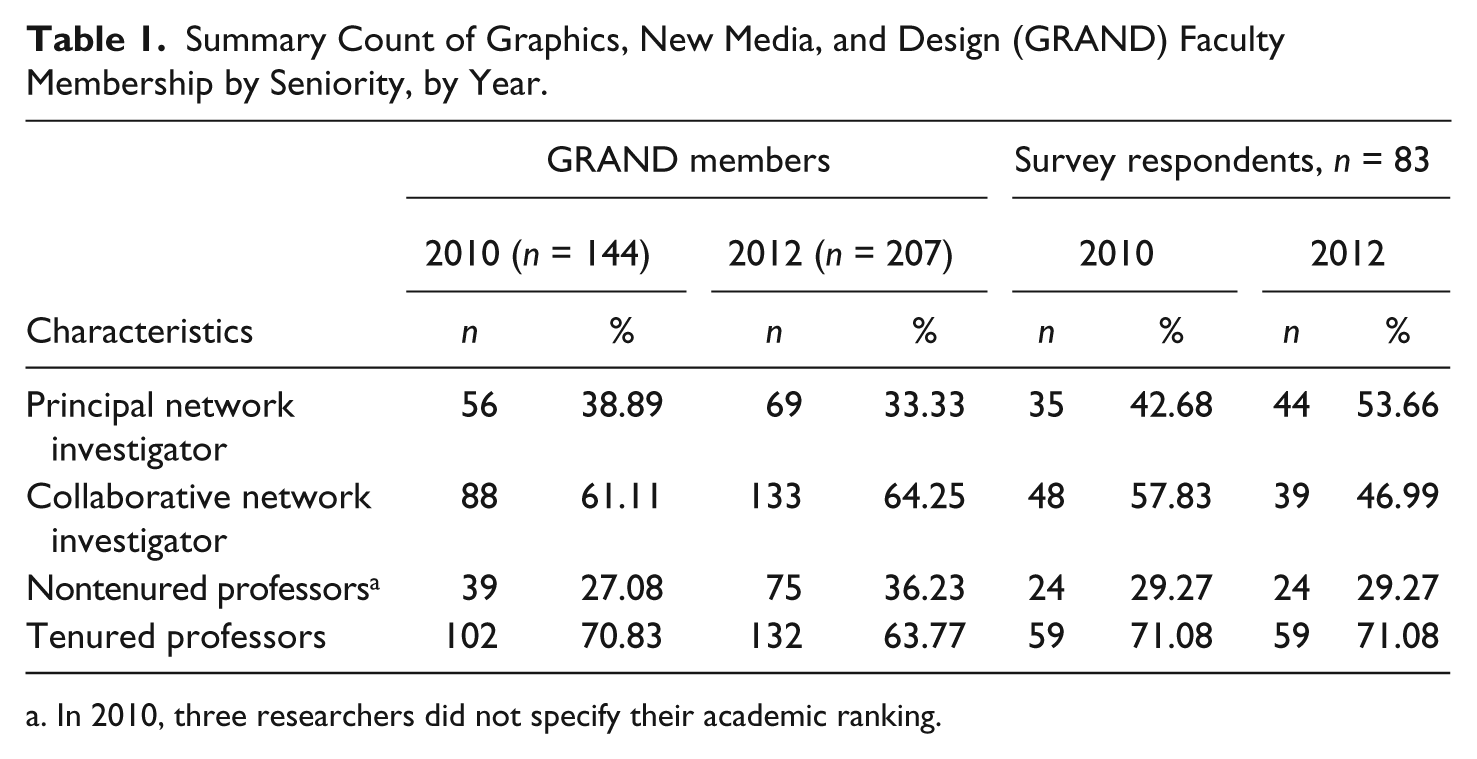
In 2010, three researchers did not specify their academic ranking.
Overall Graphics, New Media, and Design (GRAND) Network Ties: Know, Friend, Advice, and Work.

Although overall GRAND membership grew, most researchers’ own Know, Friend, Advice, and Work networks within GRAND did not grow. There was both stability and churn, with most researchers changing 4 to 8 of their ties in their four types of 2012 networks out of a mean of 9 to 23 researchers in their 2010 networks.
The Know networks grew from a mean of 23 in 2010 to 29 in 2012 with the researchers coming to know six more GRAND members. Moreover, the Know network became more interdisciplinary. Among the 23 GRAND faculty members the researchers knew in 2010, 11 were from disciplines different from their own, whereas in 2012, 15 of the 28 GRAND members were from disciplines different from their own (Mok et al., 2015). The Know networks also involved more researchers from different cities (a mean of 18 GRAND researchers in 2010 and 24 in 2012), different institutions (17 in 2010 and 22 in 2012), and different academic ranks (15 in 2010 and 19 in 2012).
The Friend and Advice networks stayed similar in 2010 and 2012, without significant changes. The researchers had an average of 12 friends in 2010 and 10 in 2012. The average size of the Advice network was 9 and 11 in 2010 and 2012, respectively. These differences are not statistically significant.
By contrast to the growing Know networks and the stable Friend and Advice networks, the Work networks shrank from a mean of 11 to 7 faculty researchers, while becoming proportionately more cross-disciplinary although less geographically dispersed. In particular, the number of cross-disciplinary Work ties remained almost the same, with an average of 5 in 2010 and 4 in 2012. A smaller number of Work ties spanned different cities (7 in 2010 and 5 in 2012), different institutions (7 in 2010 and 5 in 2012), and different academic ranks (7 in 2010 and 5 in 2012).
Several characteristics of researchers were not associated with changes in the size of their networks. The number of Friends, Advice, and Work ties of different genders did not change between 2010 and 2012. Moreover, the composition of different academic ranks in the researchers’ networks did not change significantly. One exception: the networks of GRAND members who were promoted to tenure had a higher percentage of other tenured researchers.
To summarize, GRAND researchers started with networks that were cross-disciplinary, geographically dispersed, and cross-institutional. To a great extent, their networks remained stable: The composition of Friend and Advice networks did not change in size or heterogeneity, although at times one researcher replaced another with similar characteristics. By comparison, their Know networks grew and became more diverse, whereas their Work networks shrank in size and decreased in geographic diversity (although not in disciplinary diversity). The upshot was that after 2½ years of GRAND, the researchers knew more people from different disciplines, institutions, and cities, but collaborated with fewer and more local colleagues.
The Change Model
Although most ties were stable between 2010 and 2012, we wonder what was associated with the changes in relationships that did occur. Which characteristics of the relationships and which attributes of the researchers exerted an impact on their keeping, dropping, or adding relationships—or having no relationship with a researcher in either 2010 or 2012 (the null choice)?
To do this, we estimated a multilevel multinomial logistic regression model, using network data from the 83 researchers who were respondents in both the 2010 and 2012 surveys (Skrondal & Rabe-Hesketh, 2003). We focused on their existing or potential ties with the 143 researchers who were members of GRAND in both 2010 and 2012. In our model, we recognized both the network structure of the data set and the multicategorical responses of the strategy categories (details in Mok et al., 2015).
The coefficient estimates are available on request; they are interpreted as the impact of changing the covariates on the log-odds of choosing a particular choice category, relative to the reference choice of keeping the existing tie. The fact that these impacts are logs of relative probabilities makes them hard to interpret as their signs might not be the same as the covariates’ actual marginal impacts on the probabilities of the choices. Hence, we summarize the marginal impacts of the covariates in Table 3, which shows the conditional marginal impact, evaluated at sample means. They are conditional on three choices only (keeping, dropping, or adding ties), as including the null category of no ties in both 2010 and 2012 would overwhelm and distort our results because of the sheer size of “no ties.” Note that the conditional marginal probabilities sum to zero across the three choices—that is, an increase in the probability of choosing one category occurs at the expense of other categories. For example, if being a CNI increases a GRAND researcher’s probability of adding ties by 0.2, then the GRAND researcher would be less likely (by the same probability of −0.2) to drop or simply keep existing ties.
Model Results a .

Estimated marginal effect of covariates on changing Know, Friend, Advice, Work ties, conditional on three choices: dropping, adding, keeping a tie.
Note. The conditional marginal probabilities are evaluated at sample means. The conditional choices are adding, dropping, or keeping a tie. The null category of no ties in both 2010 and 2012 is excluded. The conditional marginal probabilities sum to zero across the three choices.
Although the model estimates are small in magnitude, most are statistically significant and, more important, are contextually meaningful. For example, a 1 percentage point increase (a coefficient estimate of the order of 0.01) describes the probability of adding one GRAND coworker to a researcher’s network. Although 1 percentage point may seem small, the contextual meaning of one collaborator is meaningful, considering the fact that the mean number of Work ties is 11 in 2010 and only 7 in 2012.
Changes in Ties
We summarize our model-based findings about changes in ties in five points:
Network changes are driven by disciplinary, geographic, and institutional diversity. Such diversity decreases the chance of ties being kept and increases the chance of ties being dropped in the Know and Friend networks. As GRAND developed, the researchers came to know more people from different provinces and befriend more researchers from different institutions, but such ties were short-lived at times.
Each diversity dimension has a somewhat different impact for the Advice and Work networks. Multidisciplinarity increases the likelihood of ties being added (and kept in the case of Work networks), but geographic and institutional diversity increase the probability of ties being dropped.
CNIs are more likely than the more central PNIs to drop their Know, Friend, Advice, and Work ties.
Nontenured professors are more likely than tenured professors to keep or add ties to their Know, Friend, Advice, and Work networks.
Ties between researchers with different genders or academic ranks have little impact on changes in their networks.
The details are given below.
Knowing Other GRAND Members
Knowing other GRAND faculty researchers is the easiest tie to maintain. Often these are acquaintances met lightly at conferences, although they have the potential to develop into stronger friendship, advice, and coworking ties. Thus, it is not surprising that Know networks have the highest probability of two GRAND researchers having a tie: 35 percentage points. In more detail, Table 3, column a, summarizes the marginal impacts of the covariates on the probabilities of the three choices: dropping, adding, and keeping ties. These three choices sum to an unconditional probability of 35 percentage points, implying a 65% chance that the researcher has formed no ties with other GRAND researchers.
Ties across disciplines tend to be less stable. Cross-disciplinarity increases the probability of ties being added by 2 percentage points while simultaneously increasing the probability of ties being dropped by 5 percentage points.
Ties across institutions, cities, or provinces are similarly less stable. For such ties, the covariates’ marginal impact on dropping a tie far exceeds that on adding new ties. For cross-institutional relationships, the chance of adding new ties is higher by 2 percentage points compared with same-institutional ties, but the likelihood of dropping ties is higher by 8 percentage points: 4 times as large as the impact on adding new ties. Similarly, having ties across cities means a 1 percentage point higher chance of adding a new tie, but a 6 percentage point higher chance of dropping a tie. Relationships across professorial ranks are slightly more likely to be dropped, by less than 1 percentage point only.
The researchers’ own academic characteristics are differentially associated with changes in their ties. CNIs are more likely to drop ties than PNIs, by 5 percentage points; nontenured researchers are more likely to keep ties or form new ones than those who are further along in their career, by 0.6 and 0.5 percentage points, respectively.
In sum, GRAND researchers know more people in 2012 than in 2010, and many of these ties come from different disciplines, institutions, and cities. Yet these ties are also more volatile and more easily dropped. Peripheral researchers are more likely to drop their ties; nontenured researchers are more likely to keep and grow their ties. Gender, on the other hand, is not associated with the researchers keeping existing ties or forming new ones.
Friendship
Friendships require more interpersonal investment than the lighter-weight tie of knowing an acquaintance. Table 3, column b, shows the conditional marginal impact of the covariates on keeping, adding, or dropping a friendship tie. These three choices sum to an unconditional probability of 7%, implying that the average GRAND researcher has no friendship ties with 93% of other GRAND researchers.
Cross-disciplinarity increases the probability of ties being added or dropped by 0.5 and 11 percentage points, respectively, with its impact on dropping ties being 21 times greater than adding ties. Researchers working in different institutions are more likely to form new friendships by 7 percentage points, but there is also a 3% chance of these cross-institutional friendships being dropped. Friends in different cities or provinces are more likely to drop their friendship ties, by 24 and 13 percentage points than those working in the same city or province.
Position in GRAND matters. Peripheral CNIs are more likely to drop their friendship ties than PNIs do (by 12 percentage points). Nontenured researchers are more likely to keep (12 percentage points) or form new (3 percentage points) friendship ties than are tenured researchers.
Gender and professorial rank have minimal impact. Researchers with different genders are more likely to keep or form new friendships, by 2 and 0.7 percentage points, respectively. Researchers with different professorial ranks are likely to form new friendships by 1 percentage point.
In sum, cross-disciplinary and geographically dispersed friendships tend to be more volatile. New ties might be formed, but they are also more likely to be dropped. On the other hand, friendships tend to be stable when they are between researchers of different genders or where both researchers are nontenured.
Advice
Advice, like friendship, requires some investment, although it is a more professional tie than sociable friendships. GRAND researchers have about as many Advice ties as friendship ties. The conditional marginal impacts of the covariates on three specific choices sum to an unconditional probability of 7 percentage points (Table 3, column c), implying a 93% chance that the researcher has no advice ties with other GRAND researchers.
By 3 percentage points, researchers are more likely to form cross-disciplinary advice ties than ties within their own disciplines. If they work in different institutions, their advice ties tend to be less stable: the ties are about three times as likely to be dropped (11 percentage points) than added (4 percentage points). Ties that are between cities or provinces are likely to be dropped by 8 and 12 percentage points, respectively. Ties across different professorial ranks are slightly more likely to be kept (3 percentage points) than added (2 percentage points).
CNIs are 15 percentage points more likely to drop advice ties, compared with PNIs, whereas nontenured researchers are more likely to add advice ties by 5 percentage points.
Gender has little impact. Advice ties between men and women are likely to be dropped by only 1 percentage point.
In short, advice ties that are cross-disciplinary, cross-institutional, or geographically dispersed tend to be more volatile than those that are local or within-discipline. New advice ties tend to occur between researchers who are different in professorial ranks or who are both nontenured researchers.
Work
Collaborative work, even more than advice, entails a strong tie. Yet like friendship and advice, dropping, adding, or keeping ties sum to an unconditional probability of 7 percentage points, implying a 93% chance that the researcher forms no ties with other network members (Table 3, column d).
Coworking ties that are cross-disciplinary are more likely by 3 percentage points to be added, when compared with ties within disciplines. However, several structural stresses increase the likelihood of researchers dropping work ties between 2010 and 2012: working in different cities or provinces, being of different genders, and occupying different professorial ranks. By contrast, those who work in different institutions are slightly more likely to form new ties (by 2 percentage points) or drop existing ties (by 5 percentage points), but the association of being cross-institutional on dropping ties is 2 times greater than that of adding ties. The marginal impacts range from 0.2 percentage points (different gender) to 10 percentage points (cross-city).
CNIs are 8 percentage points more likely to drop work relationships, compared with PNIs. Nontenured researchers are more likely to keep (8 percentage points) or add (6 percentage points) work ties.
In sum, researchers build more work ties that are cross-disciplinary and cross-institutional. However, these diverse work ties also are less stable, compared with those that are local and those that involve researchers who are at similar stages of their career. Nontenured researchers—ambitious enough to join GRAND in the first place—are more likely to branch out and build new work ties than those who are further along in their career.
Although our statistical analysis has focused on changes, the overall picture confirms the relative stability of personal networks in GRAND. Yet a more dynamic picture emerges behind the stable surface. By increasing the odds of ties being added and dropped, cross-disciplinarity, geographic dispersal, and institutional diversity foster the creation of more volatile and easily dissolved ties. While networks do not substantially change, ties are frequently added and dropped—especially ties across disciplines, institutions, and locations.
The impact of these three types of diversity is associated with the type of ties. Cross-disciplinarity is the key driver for professional ties, with a somewhat different impact on advice and work ties. Cross-disciplinary advice exchanges are more apt to be both added and dropped: When looking for advice or sharing their expertise, researchers do not necessarily return to colleagues they have previously consulted. By contrast, cross-disciplinary collaborative work ties are longer lasting, possibly buttressed by shared interests and formal project affiliation: Such work ties are more likely to be added and kept.
The situation is different for institutional diversity and geographical diversity, whether across cities or provinces. Although distance is little hindrance for making acquaintances with distant researchers, such distant ties—both social (Know and Friend) and professional (Advice and Work)—can be more easily dropped.
Nontenured GRAND researchers tend to add ties more actively. Yet CNIs—whether tenured or nontenured—may be less committed to their relationships and hence more apt to drop them.
Practices of GRAND researchers
Why are boundary-spanning ties across disciplines, distance, and institutions more volatile? Why do the number of often-weaker Know ties grow, but Friendship and Advice ties do not? Why do the number of collaborative Work ties decline? Why do some peripheral researchers not increase their connections? How satisfied are GRAND researchers with their networks? Our interviews and participant observation with GRAND researchers help us understand the stability and changes in the networks between 2010 and 2012.
Networking
Many GRAND researchers spent time and effort looking for potential collaborators and strengthening their ties with team members. There was a mad scramble for projects and collaborators as GRAND began. Since then, the key networking opportunities have been in-person interactions at the annual meetings of the network, sponsored workshops, and other events. These activities are especially valuable because they bring together researchers from different disciplines, locations, and institutions who rarely encounter each other at traditional professional events. To uncover common interests, they actively use both serendipitous encounters—at receptions or poster sessions—and deliberately organized meetings.
This events-oriented networking explains why distance is not a complete hindrance for meeting colleagues. At the same time, events are short-lived, and if there are no follow-ups or ongoing interactions, ties are easily dropped. The lack of homophily in cross-disciplinary, cross-institutional, and geographically distant ties further increases the transiency of some newly created ties.
Projects emerge as foci for networking with past and new colleagues. GRAND researchers are partly self-selected and partly recruited from past collaborators. Researchers who have successfully worked together and whose research fits into the network’s mandate, take advantage of GRAND to continue their collaboration. For them, GRAND is a vehicle to maintain preexisting ties and make new connections.
But not all project members know each other nor do they routinely communicate. Typically, projects include a core of well-connected collaborators coexisting with a periphery of CNI researchers invited by PNIs. That is why membership has grown mostly by adding CNIs. Although many CNIs initially had limited ties within their projects, some went on to network with other project members to enhance common interests.
Project procedures, such as preparing reports and renewal applications, helps keep researchers updated on fellow project members. Even more important are project meetings at the annual GRAND conferences that combine task orientation and conviviality. Project leaders use these meetings to make sure that “everybody knows everybody,” as one PNI said. Project members who already know each other take the opportunity to strengthen their ties; less connected researchers have a chance to meet other GRAND researchers. These practices are consistent with our findings that ties predominantly remain within projects and that CNIs—who are less connected and rely on infrequent events to network—have more volatile ties.
Collaboration
If projects link GRAND members with common interests and foster networking among researchers, why did the number of work ties decline between 2010 and 2012? Some were added, but slightly more disappeared. The project workflow, the content of new ties, and the meaning researchers attribute to collaboration all contribute to the answer.
Multi-institutional and dispersed projects often have parallel workflows and fewer coordination mechanisms (see also Cummings & Kiesler, 2007; Haythornthwaite, Lunsford, Bowker, & Bruce, 2006). Many GRAND projects, especially large ones, comprise several distinct subprojects and are only loosely integrated. Not all researchers have interdependent tasks, nor are they equally active in all project phases. On a day-to-day basis, many researchers work with students in their labs or with a few colleagues. Several researchers remarked on the independent “noncollaborational” nature of the work.
If ties within projects are not supported by workflow, they may easily lapse. Moreover, common interests are only a starting point for collaboration. GRAND researchers often grumble about the challenges of starting new collaborations. Creating new ties does not necessarily translate into collaborative work ties. In addition to common interests and complementary expertise, researchers also need compatible personalities, a “personality click” in the words of one researcher. Sometimes, both common interests and personality clicks exist, but researchers may not have a specific fundable idea to start a project: A senior computer scientist reports that coming up with a workable project idea may take 2 years.
In GRAND, multidisciplinarity, distance, and institutional diversity compounds such routine collaborative challenges (see also Mo, 2014). For instance, interdisciplinary work often requires significant understanding of different research cultures’ perspectives. Researchers need time to learn how to work with each other, negotiate the key research questions, and find their way around. Echoing many colleagues, a senior computer scientist has told us that half of what he does in GRAND are “conversations” that help him understand how other researchers think and work.
Distance and institutional diversity further exacerbate the difficulties of starting collaborations. Developing new ideas or making progress requires face-to-face interactions—they are “what keep things happening.” Yet such interactive opportunities are event-based and rare. The coalescence of new ideas and the development of trust are thus more difficult, echoing our finding that distance increases the probability of dropping ties.
Thus, the multidisciplinary, distant, and cross-institutional research in the GRAND network has a steep learning curve. Similar to Rhoten (2002), we find that new multidisciplinary ties are more apt to support information sharing instead of knowledge production: researchers meet at events, get to know each other, and later exchange information. Conversations and consultations, rather than collaborations, are the predominant activity. Despite the interest in collaboration and the active networking of GRAND members, collaborative ties are slow to develop and hard to maintain.
This helps us understand why the number of existing work ties declines. To reduce coordination costs, some researchers decrease communication and start working more independently (see also Cummings & Kiesler, 2005).
There is also a second process at work. Researchers define collaboration through outcomes. Collaboration is expected to result in publications or artifacts. Yet when researchers use colleagues’ tools, seek advice, or exchange data, their use has no measurable output—and the researchers do not consider this collaboration. As one mused: We haven’t published together right so I can’t provide you with evidence that we have a cohesive collaboration. I look at it more as they [my project members] give me advice. . . . So, some of it is just discussion and some of it is actual use of resources—but no collaboration.
Nevertheless, this same researcher was already planning to publish with colleagues in his project. This suggests the conditional, outcome-based definition of a Work tie. Some ties do not qualify as collaboration until they lead to the specific predefined outcomes of papers, presentations, and artifacts. This definition may have led to the decrease in the reported number of Work ties from 2010 to 2012. Only when researchers actually publish or create apps collaboratively does their tie get redefined and upgraded into being collaborative work.
Benefits
Even though new collaborations outside of the initial projects are rare and measurable output such as publications are slow in coming, researchers are satisfied with GRAND. Yet satisfaction varies by discipline. In the core discipline of computer science, young scientists value association with leaders in their field (see also Hayat & Mo, 2015; Network Assessment and Validation for Effective Leadership Team, 2014). For example, a nontenured researcher feels that GRAND projects are not really collaborative. Nonetheless, he is very satisfied with the network because of the connections he develops: “If you want to be a well-known researcher in Canada, you need to be part of whatever collaborative ground is happening at the time.”
By contrast, tenured GRAND researchers are more apt to state they value learning about research across the country. They believe cross-disciplinary collaborations improve the quality of outcomes, help them solve big problems, and provide fresh ideas. Their ties with researchers elsewhere bring in new ideas that they disseminate to others. Thus, connections across projects amplify collaboration within projects: links between individuals are also links between projects and institutions (Breiger, 1974).
Social sciences and humanities are a special case. They are as satisfied with GRAND as computer scientists and other researchers. However, with less access to funding, they rely on GRAND for a significant portion of their research money and readily acknowledge its importance. At the same time, they are unusual for their disciplines because of their involvement in multidisciplinary research with computer scientists—precisely what has drawn them to GRAND. That is why the intangible benefits of networking, doing interesting projects, and fostering collaborative culture in their own disciplines—which are traditionally more individualistic than natural sciences—are important to them.
Yet social scientists and humanists report the greatest challenge of fitting in. Unlike other GRAND members, social scientists and humanists collaborate in areas functionally distant from their own disciplines. They struggle to find the right contribution to make because they do not “build things” and commercialization is rarely relevant for them. They feel that they do not participate in projects on an equal footing with other researchers and consider themselves “at the periphery” of the GRAND network even when they are PNIs. As a social scientist PNI said, I am delighted with the substance, vitality, and funding of GRAND. Yet, while they have good will—in principle—to social scientists, their procedures and evaluations are all based on computer science practices which is frustrating, time-consuming, and puts us at a competitive disadvantage. Often, I don’t think they are sensitive to the differences.
Discussion
First, GRAND researchers from all disciplines point to networking benefits and associate these with disciplinary diversity. The strong appeal of cross-disciplinary exchanges—considered “fun” and “cool”—suggest that the formal requirement for multidisciplinarity in GRAND is buttressed by a genuine belief in its value and a culture of collaboration.
Second, collaborative culture matters, not only for disciplinary but also for multidisciplinary research networks (see also Birnholtz, 2007). After 2 years, self-selection, recruitment policy, and networking opportunities have facilitated the emergence of a research network with a collaborative culture and a preference for multidisciplinary exchanges. The growth of Know ties shows increasing integration, and most GRAND researchers relish the intellectual stimulation of cross-disciplinary discussions (see also Rhoten, 2002). GRAND is especially important for tenured researchers with secure funding (attracted by its diversity) and for social scientists and humanists who are a distinct group with strong commitment to cross-disciplinary work. GRAND provides such researchers with a network of like-minded colleagues.
Third, although we have focused on change in this article, the overall picture is of network stability. Yet this picture masks the frequent adding and infrequent dropping of ties. Even when researchers drop coworking ties, they continue to be acquaintances and may continue to be friends and to exchange advice.
GRAND researchers’ practices, combined with loosely integrated projects featuring parallel workflows, contribute to tie volatility. The researchers actively create new ties, but do not always sustain them. Weak social ties, such as knowing another GRAND member, are especially unstable, with an “easy come, easy go” pattern. Researchers readily meet at GRAND events, but they lack the ongoing interactions and workflow interdependence to strengthen acquaintanceships into friendships or professional collaborative ties. CNIs, whose workflows weakly connects them to projects and who have limited contacts, are especially susceptible to dropping ties. Yet when weaker ties continue to exist, they expand technical and intellectual knowledge as well as foster links between universities and disciplines.
Fourth, disciplinary, geographic, and institutional diversity affects tie dynamics. For social ties (Know and Friend), all dimensions of diversity increase tie volatility, especially the likelihood of dropping ties. Homophily benefits the longevity of such ties. By comparison, multidisciplinarity increases the likelihood of adding professional ties (Advice and Work), while geographic and institutional diversity increase the likelihood of dropping ties. This more complex pattern is rooted in GRAND’s multidisciplinary and multi-institutional project design. GRAND researchers strive to create the cross-disciplinary ties that are required by GRAND administrators and spark fresh ideas. Yet geographically distant ties are hard to maintain. By emphasizing geographic and institutional diversity in addition to cross-disciplinarity, the network’s founders may have over-ambitiously introduced too much uncertainty and thus, increased volatility (see also Lungeanu & Contractor, 2015). Despite the best efforts of GRAND’s organizers, scholars of a feather tend to flock together, be it spatial, disciplinary, or institutional proximity (see also Mo, 2014; Olson & Olson, 2003; Olson et al., 2008).
Fifth, the most surprising result in the analysis is the decline of work ties. Despite the interest in collaboration among researchers and the support of formal procedures, turning networking opportunities into collaboration is a challenge. The excitement of working in a network drew many researchers into multiple projects, but as the initial glow wore off, some researchers could not work on as many projects as they had originally signed on for. They needed to focus on only a few. Some heavy collaborators we interviewed said they were even too busy to complete the second 2012 survey.
Conclusions
Our research brings into the foreground how researchers benefit from a network such as GRAND even if collaborative ties do not grow and traditional outputs are slower to come. The ties researchers develop in GRAND are valuable because they provide access to expertise, build reputations, and create connections for future work. Dialogue and advice seem to be the prevalent exchanges in GRAND, suggesting that GRAND functions as a network of practice (Rhoten, 2002; Dimitrova & Koku, 2010). Members remain satisfied with the network: this unusual collaboration-oriented network values interaction and intellectual challenges.
GRAND researchers recognize that traditional research outputs such as collaborative publications, presentations, and artifacts develop more slowly, especially in newer projects. They see the real work of GRAND—and its success—in networking: I think [GRAND] is effective for what a network is supposed to be. . . . But you can’t measure that really. . . . It’s much easier to write a paper or to give a [presentation or] submit a publication. It’s cleaner and you get a measureable thing out of it. But this thing where you develop relationships and you try to make people talk to each other. . . . This is very long and you can’t capture it the same way. But it is supposed to be . . . the real work of the network.
Our research suggests that networks such as GRAND are even harder and slower to start than traditional collaborations due to their disciplinary, geographic, and institutional diversity. Our interviews also show that considering only traditional academic outputs as “work ties” may be a by-product of how narrowly collaboration is defined by administrators and most researchers. As multidisciplinary, multi-institutional, and dispersed projects are slower to produce such outputs, some work ties may have become redefined as noncollaborative ties (see also Cummings & Kiesler, 2007; Lee & Bozeman, 2005; Rhoten, 2002). However, without a control group, we cannot tell whether GRAND helped scholars to be more—or less—productive in the traditional sense.
Thus, our findings have policy implications for the development of research networks. Such networks cannot only be evaluated by traditional measures such as publications or conference presentations. Fostering new ties and information exchanges is the real output of a research network. Hence, the evaluation of research collaboration needs to attend to knowledge transfer processes and longer time horizons.
Footnotes
Acknowledgements
Our warmest thanks to the GRAND Network of Centres of Excellence for supporting our research at arm’s length and to the GRAND members who gave generously of their time. We especially appreciate the research collaboration of Christian Beermann, Anatoliy Gruzd, Tsahi Hayat, Guang Ying Mo, Eleni Stroulia, and Lilly Wang. Kelly Booth, Kelly Lyons, and Beverly Wellman were insightful commentators, and the iSchool at the University of Toronto was a supportive and hospitable home.
Declaration of Conflicting Interests
The author(s) declared no potential conflicts of interest with respect to the research, authorship, and/or publication of this article.
Funding
The author(s) disclosed receipt of the following financial support for the research, authorship, and/or publication of this article: This article is based on the Network Assessment and Validation for Effective Leadership (NAVEL). The NAVEL research was funded by the Graphics, Animation and New Media (GRAND) Network of Centres of Excellence, part of the Network of Centres of Excellence program of the federal government of Canada.